EP4036792A1 - Procédé et dispositif de classification de pixels d'une image - Google Patents
Procédé et dispositif de classification de pixels d'une image Download PDFInfo
- Publication number
- EP4036792A1 EP4036792A1 EP21154378.0A EP21154378A EP4036792A1 EP 4036792 A1 EP4036792 A1 EP 4036792A1 EP 21154378 A EP21154378 A EP 21154378A EP 4036792 A1 EP4036792 A1 EP 4036792A1
- Authority
- EP
- European Patent Office
- Prior art keywords
- edge detection
- detection algorithm
- pixel
- ground truth
- image
- Prior art date
- Legal status (The legal status is an assumption and is not a legal conclusion. Google has not performed a legal analysis and makes no representation as to the accuracy of the status listed.)
- Granted
Links
Images

Classifications
-
- G—PHYSICS
- G06—COMPUTING OR CALCULATING; COUNTING
- G06V—IMAGE OR VIDEO RECOGNITION OR UNDERSTANDING
- G06V20/00—Scenes; Scene-specific elements
- G06V20/50—Context or environment of the image
- G06V20/56—Context or environment of the image exterior to a vehicle by using sensors mounted on the vehicle
-
- G—PHYSICS
- G06—COMPUTING OR CALCULATING; COUNTING
- G06T—IMAGE DATA PROCESSING OR GENERATION, IN GENERAL
- G06T7/00—Image analysis
- G06T7/10—Segmentation; Edge detection
- G06T7/11—Region-based segmentation
-
- G—PHYSICS
- G06—COMPUTING OR CALCULATING; COUNTING
- G06V—IMAGE OR VIDEO RECOGNITION OR UNDERSTANDING
- G06V20/00—Scenes; Scene-specific elements
- G06V20/70—Labelling scene content, e.g. deriving syntactic or semantic representations
-
- G—PHYSICS
- G06—COMPUTING OR CALCULATING; COUNTING
- G06F—ELECTRIC DIGITAL DATA PROCESSING
- G06F18/00—Pattern recognition
- G06F18/20—Analysing
- G06F18/24—Classification techniques
- G06F18/241—Classification techniques relating to the classification model, e.g. parametric or non-parametric approaches
-
- G—PHYSICS
- G06—COMPUTING OR CALCULATING; COUNTING
- G06F—ELECTRIC DIGITAL DATA PROCESSING
- G06F18/00—Pattern recognition
- G06F18/20—Analysing
- G06F18/24—Classification techniques
- G06F18/241—Classification techniques relating to the classification model, e.g. parametric or non-parametric approaches
- G06F18/2413—Classification techniques relating to the classification model, e.g. parametric or non-parametric approaches based on distances to training or reference patterns
-
- G—PHYSICS
- G06—COMPUTING OR CALCULATING; COUNTING
- G06T—IMAGE DATA PROCESSING OR GENERATION, IN GENERAL
- G06T7/00—Image analysis
- G06T7/10—Segmentation; Edge detection
- G06T7/12—Edge-based segmentation
-
- G—PHYSICS
- G06—COMPUTING OR CALCULATING; COUNTING
- G06T—IMAGE DATA PROCESSING OR GENERATION, IN GENERAL
- G06T7/00—Image analysis
- G06T7/10—Segmentation; Edge detection
- G06T7/13—Edge detection
-
- G—PHYSICS
- G06—COMPUTING OR CALCULATING; COUNTING
- G06T—IMAGE DATA PROCESSING OR GENERATION, IN GENERAL
- G06T7/00—Image analysis
- G06T7/60—Analysis of geometric attributes
- G06T7/62—Analysis of geometric attributes of area, perimeter, diameter or volume
-
- G—PHYSICS
- G06—COMPUTING OR CALCULATING; COUNTING
- G06V—IMAGE OR VIDEO RECOGNITION OR UNDERSTANDING
- G06V10/00—Arrangements for image or video recognition or understanding
- G06V10/20—Image preprocessing
- G06V10/26—Segmentation of patterns in the image field; Cutting or merging of image elements to establish the pattern region, e.g. clustering-based techniques; Detection of occlusion
-
- G—PHYSICS
- G06—COMPUTING OR CALCULATING; COUNTING
- G06V—IMAGE OR VIDEO RECOGNITION OR UNDERSTANDING
- G06V10/00—Arrangements for image or video recognition or understanding
- G06V10/40—Extraction of image or video features
- G06V10/44—Local feature extraction by analysis of parts of the pattern, e.g. by detecting edges, contours, loops, corners, strokes or intersections; Connectivity analysis, e.g. of connected components
- G06V10/443—Local feature extraction by analysis of parts of the pattern, e.g. by detecting edges, contours, loops, corners, strokes or intersections; Connectivity analysis, e.g. of connected components by matching or filtering
-
- G—PHYSICS
- G06—COMPUTING OR CALCULATING; COUNTING
- G06V—IMAGE OR VIDEO RECOGNITION OR UNDERSTANDING
- G06V10/00—Arrangements for image or video recognition or understanding
- G06V10/40—Extraction of image or video features
- G06V10/44—Local feature extraction by analysis of parts of the pattern, e.g. by detecting edges, contours, loops, corners, strokes or intersections; Connectivity analysis, e.g. of connected components
- G06V10/443—Local feature extraction by analysis of parts of the pattern, e.g. by detecting edges, contours, loops, corners, strokes or intersections; Connectivity analysis, e.g. of connected components by matching or filtering
- G06V10/449—Biologically inspired filters, e.g. difference of Gaussians [DoG] or Gabor filters
- G06V10/451—Biologically inspired filters, e.g. difference of Gaussians [DoG] or Gabor filters with interaction between the filter responses, e.g. cortical complex cells
- G06V10/454—Integrating the filters into a hierarchical structure, e.g. convolutional neural networks [CNN]
-
- G—PHYSICS
- G06—COMPUTING OR CALCULATING; COUNTING
- G06V—IMAGE OR VIDEO RECOGNITION OR UNDERSTANDING
- G06V10/00—Arrangements for image or video recognition or understanding
- G06V10/70—Arrangements for image or video recognition or understanding using pattern recognition or machine learning
- G06V10/764—Arrangements for image or video recognition or understanding using pattern recognition or machine learning using classification, e.g. of video objects
-
- G—PHYSICS
- G06—COMPUTING OR CALCULATING; COUNTING
- G06V—IMAGE OR VIDEO RECOGNITION OR UNDERSTANDING
- G06V10/00—Arrangements for image or video recognition or understanding
- G06V10/70—Arrangements for image or video recognition or understanding using pattern recognition or machine learning
- G06V10/77—Processing image or video features in feature spaces; using data integration or data reduction, e.g. principal component analysis [PCA] or independent component analysis [ICA] or self-organising maps [SOM]; Blind source separation
- G06V10/774—Generating sets of training patterns; Bootstrap methods, e.g. bagging or boosting
- G06V10/7747—Organisation of the process, e.g. bagging or boosting
-
- G—PHYSICS
- G06—COMPUTING OR CALCULATING; COUNTING
- G06V—IMAGE OR VIDEO RECOGNITION OR UNDERSTANDING
- G06V10/00—Arrangements for image or video recognition or understanding
- G06V10/70—Arrangements for image or video recognition or understanding using pattern recognition or machine learning
- G06V10/82—Arrangements for image or video recognition or understanding using pattern recognition or machine learning using neural networks
-
- G—PHYSICS
- G06—COMPUTING OR CALCULATING; COUNTING
- G06T—IMAGE DATA PROCESSING OR GENERATION, IN GENERAL
- G06T2207/00—Indexing scheme for image analysis or image enhancement
- G06T2207/10—Image acquisition modality
- G06T2207/10004—Still image; Photographic image
-
- G—PHYSICS
- G06—COMPUTING OR CALCULATING; COUNTING
- G06T—IMAGE DATA PROCESSING OR GENERATION, IN GENERAL
- G06T2207/00—Indexing scheme for image analysis or image enhancement
- G06T2207/20—Special algorithmic details
- G06T2207/20021—Dividing image into blocks, subimages or windows
-
- G—PHYSICS
- G06—COMPUTING OR CALCULATING; COUNTING
- G06T—IMAGE DATA PROCESSING OR GENERATION, IN GENERAL
- G06T2207/00—Indexing scheme for image analysis or image enhancement
- G06T2207/20—Special algorithmic details
- G06T2207/20081—Training; Learning
-
- G—PHYSICS
- G06—COMPUTING OR CALCULATING; COUNTING
- G06T—IMAGE DATA PROCESSING OR GENERATION, IN GENERAL
- G06T2207/00—Indexing scheme for image analysis or image enhancement
- G06T2207/20—Special algorithmic details
- G06T2207/20084—Artificial neural networks [ANN]
-
- G—PHYSICS
- G06—COMPUTING OR CALCULATING; COUNTING
- G06T—IMAGE DATA PROCESSING OR GENERATION, IN GENERAL
- G06T2207/00—Indexing scheme for image analysis or image enhancement
- G06T2207/30—Subject of image; Context of image processing
- G06T2207/30248—Vehicle exterior or interior
- G06T2207/30252—Vehicle exterior; Vicinity of vehicle
- G06T2207/30261—Obstacle
-
- G—PHYSICS
- G06—COMPUTING OR CALCULATING; COUNTING
- G06V—IMAGE OR VIDEO RECOGNITION OR UNDERSTANDING
- G06V20/00—Scenes; Scene-specific elements
- G06V20/50—Context or environment of the image
- G06V20/56—Context or environment of the image exterior to a vehicle by using sensors mounted on the vehicle
- G06V20/58—Recognition of moving objects or obstacles, e.g. vehicles or pedestrians; Recognition of traffic objects, e.g. traffic signs, traffic lights or roads
Definitions
- the present disclosure relates to methods and devices performing a semantic segmentation by classifying a plurality of pixels of an image.
- semantic segmentation i.e. classifying objects in the environment and determining areas e.g. in an image of the environment which are occupied by a certain object type or object class.
- the predetermined classes may include a respective class for other vehicles, for pedestrians, for the road, for buildings, etc.
- the semantic segmentation may further be performed for pixels of an image of the environment. That is, each pixel of the image is assigned to one of the predetermined classes.
- CNNs convolutional neural networks
- a CNN includes an arbitrary number of consecutive layers which are trained together to fulfill a given task, i.e. in the present case the classification of objects represented by the pixels of the image which are each assigned to one of the predetermined classes.
- the loss function includes a certain comparison between the output or prediction of the neural network and the desired output which is also referred to as ground truth labels.
- a regression is performed by assigning large loss values to undesired output data and by minimizing the total loss.
- the present disclosure provides a computer implemented method, a computer system and a non-transitory computer readable medium according to the independent claims. Embodiments are given in the subclaims, the description and the drawings.
- the present disclosure is directed at a computer implemented method for classifying pixels of an image.
- an image captured by a sensor device is received, wherein the image comprises a plurality of pixels.
- a neural network implemented on a processing device is used for estimating probability values for each pixel, wherein each probability value indicates the probability for the respective pixel being associated with one of a plurality of predetermined classes.
- One class of the plurality of predetermined classes is assigned to each pixel of the image based on the respective probability values for each pixel in order to create a predicted segmentation map for the image.
- a loss function is generated by relating the predicted segmentation map to ground truth labels.
- an edge detection algorithm is applied to at least one of the predicted segmentation map and the ground truth labels, wherein the edge detection algorithm predicts boundaries between objects in the predicted segmentation map and in the ground truth labels. Generating the loss function is based on a result of the edge detection algorithm.
- the sensor device may include a camera and/or a Lidar system. Therefore, the term “image” generally refers to the output of the sensor device and may comprise a two-dimensional or a three-dimensional matrix including a respective plurality of pixels.
- the plurality of predetermined classes refers to the types of objects which are expected to be seen in the image.
- Each class may be represented by an indicator which may be assigned to the respective pixels of the image.
- the classes may comprise "other vehicle”, “pedestrian”, “road”, “building”, etc.
- the ground truth labels refer to images for which the type of the respective object is known for each pixel. That is, the ground truth labels represent the desired output of the neural network and of the entire method. Therefore, the predictions of the neural network and the ground truth labels are compared during the training of the neural network, and the deviation between the prediction and the ground truth labels is quantified via the loss function which is therefore to be minimized.
- the edge detection algorithm may be based e.g. on a Sobel operator for extracting boundaries between objects belonging to different classes. Since the result of the edge detection algorithm is incorporated into the definition or generation of the loss function, the contribution of object boundaries to the loss function is strongly enhanced. Therefore, the contribution of small objects is enhanced as well since their fraction of pixels belonging to the boundaries related to their total number of pixels is greater in comparison to large objects.
- the neural network is trained with an emphasis on small objects and object boundaries within the image since the result of the edge detection algorithm is considered when generating the loss function. Due to this, the entire semantic segmentation or classification of the pixels within the image is improved by the method according to the disclosure. For automotive applications of the method, it helps to prevent that small objects and object boundaries are overlooked or assessed in an erroneous manner. Hence, the method may improve safety if semantic segmentation is used within the framework of autonomous driving or driver assistance systems.
- the method may comprise one or more of the following features:
- the edge detection algorithm may be applied to the predicted segmentation map only.
- the edge detection algorithm may be applied to the ground truth labels only, or the edge detection algorithm may be applied to both of the predicted segmentation map and the ground truth labels.
- a result of applying the edge detection algorithm to the predicted segmentation map and a result of applying the edge detection algorithm to the ground truth labels may be merged by selecting the maximum value of the respective results for each pixel.
- the result of the edge detection algorithm may be applied to the result of relating the predicted segmentation map to the ground truth labels for generating the loss function.
- the result of the edge detection algorithm may be a mask which covers the pixels of the predicted boundaries.
- the mask may include a respective element for each pixel, a loss matrix including an element for each pixel may be calculated by relating the predicted segmentation map to the ground truth labels, and each element of the mask may be multiplied by the corresponding element of the loss matrix for each pixel when generating the loss function.
- the elements of the mask whose pixels are outside the predicted boundaries may be assigned a value close to zero.
- the edge detection algorithm may include a Sobel operator comprising two predefined convolutional kernels and two additional kernels which are generated by rotating the two predefined convolutional kernels.
- the edge detection algorithm may include an consequential convolutional kernel for increasing the width of the predicted boundaries between objects.
- the additional convolutional kernel may be a bivariate Gaussian kernel.
- the edge detection algorithm may be applied to the predicted segmentation map only.
- the edge detection algorithm may be applied to the ground truth labels only.
- the computational effort is reduced which is required for generating the loss function based on the result of the edge detection algorithm.
- the predicted segmentation map is taken into account, wrongly classified, "hallucinated" objects may be suppressed in the training of the neural network since their weights within the loss function may be increased and there may be no corresponding objects within the ground truth labels.
- minimizing the total loss during training of the neural network may lead to the suppression of the hallucinated objects.
- the ground truth labels are considered by the edge detection algorithm only, it is ensured that most important objects are respected in the loss function, i.e. irrespective of their predicted classification via the neural network.
- the edge detection algorithm may be applied to both of the predicted segmentation map and the ground truth labels.
- the advantages of the both embodiments described before are valid, i.e. suppression of "hallucinated" objects and proper consideration of the most important objects.
- the same edge detection algorithm may be applied to the prediction segmentation map and to the ground truth labels in order to generate the final result of the edge detection algorithm. By considering the ground truth labels in addition to the predicted segmentation map when performing the edge detection, even objects which are missed by the model underlying the neural network and which are therefore missing in the predicted segmentation map may be emphasized.
- a result of applying the edge detection algorithm to the predicted segmentation map and a result of applying the edge detection algorithm to the ground truth labels may be merged by selecting the maximum value of the respective results for each pixel. That is, the final result of the edge detection may be generated by applying a pixel-wise maximum operator to the separate results of applying the edge detection algorithm to the prediction and to the ground truth. In comparison to an arithmetical merging, the final result of the edge detection may be improved.
- the result of the edge detection algorithm may be applied to the result of relating the predicted segmentation map to the ground truth labels for generating the loss function.
- a "preliminary loss” may be estimated by the relation of the predicted segmentation map and the ground truth labels, e.g. by applying a cross-entropy loss function.
- the result of the edge detection algorithm may be applied to the preliminary loss for estimating the final loss function in order to increase the contribution of small objects and object boundaries. In other words, the contribution of the boundaries between the objects may be enhanced since all pixels which do not belong to the boundaries are suppressed.
- the result of the edge detection algorithm may be a mask which covers the pixels of the predicted boundaries.
- the mask may include a respective element for each pixel, a loss matrix including an element for each pixel may be calculated by relating the predicted segmentation map to the ground truth labels, and each element of the mask may be multiplied by the corresponding element of the loss matrix for each pixel when generating the loss function.
- the elements of the mask whose pixels are outside the detected boundaries may be assigned a value close to zero.
- the mask may comprise values between zero and one.
- the element of the mask for this pixel may be assigned a value of one or close to one, whereas the pixels which do not belong to the boundaries between objects may be assigned a small value of e.g. 0.1.
- a small value close to zero may ensure that all pixels are accounted for when generating the loss function.
- the contribution of the pixels not belonging to the boundaries between objects may be strongly suppressed.
- the edge detection algorithm may include a Sobel operator comprising two predefined convolutional kernels and two additional kernels which are generated by rotating the two predefined convolutional kernels.
- the Sobel operator is per se a well-known means for edge detection and usually has two predefined and constant convolutional kernels.
- two additional convolutional kernels may be included in the edge detection algorithm which are rotated versions of the original Sobel kernels.
- the original Sobel kernels may be rotated by +/- 45°.
- the edge detection algorithm may include a consequential convolutional kernel for increasing the width of the predicted boundaries between objects.
- the additional convolutional kernel may be a bivariate Gaussian kernel.
- the additional kernel may also be called a padding kernel since it may add e.g. a padding of three pixels before and of three pixels after an original line representing a boundary between objects.
- the bivariate Gaussian kernel may be a convenient representation of such a padding kernel.
- the bivariate Gaussian kernel used by the method may be normalized such that the mean value over all its elements may be one.
- the present disclosure is directed at a system for classifying pixels of an image.
- the system comprises a sensor device configured to capture an image including a plurality of pixels, and a processing device.
- the processing device is configured to receive the image from the sensor device, to implement a neural network to be used for estimating probability values for each pixel, wherein each probability value indicates the probability for the respective pixel being associated with one of a plurality of predetermined classes.
- the processing device is further configured to assign one of the plurality of predetermined classes to each pixel of the image based on the respective probability values for each pixel in order to create a predicted segmentation map for the image, to generate a loss function for training the neural network by relating the predicted segmentation map to ground truth labels, and to apply an edge detection algorithm at least one of the predicted segmentation map and the ground truth labels, wherein the edge detection algorithm predicts boundaries between objects in the predicted segmentation map and in the ground truth labels. Generating the loss function is based on a result of the edge detection algorithm.
- processing device may refer to, be part of, or include an Application Specific Integrated Circuit (ASIC); an electronic circuit; a combinational logic circuit; a field programmable gate array (FPGA); a processor (shared, dedicated, or group) that executes code; other suitable components that provide the described functionality; or a combination of some or all of the above, such as in a system-on-chip.
- ASIC Application Specific Integrated Circuit
- FPGA field programmable gate array
- processor shared, dedicated, or group
- module may include memory (shared, dedicated, or group) that stores code executed by the processor.
- the system according to the disclosure includes a sensor device, e.g. a camera and/or a Lidar system, and a processing device which are configured to perform the steps as described above for the corresponding method. Therefore, the benefits, the advantages and the disclosure as described above for the method are also valid for the system according to the disclosure.
- a sensor device e.g. a camera and/or a Lidar system
- a processing device which are configured to perform the steps as described above for the corresponding method. Therefore, the benefits, the advantages and the disclosure as described above for the method are also valid for the system according to the disclosure.
- the present disclosure is directed at a computer system, said computer system being configured to carry out several or all steps of the computer implemented method described herein.
- the computer system may comprise a processing unit, at least one memory unit and at least one non-transitory data storage.
- the non-transitory data storage and/or the memory unit may comprise a computer program for instructing the computer to perform several or all steps or aspects of the computer implemented method described herein.
- the present disclosure is directed at a non-transitory computer readable medium comprising instructions for carrying out several or all steps or aspects of the computer implemented method described herein.
- the computer readable medium may be configured as: an optical medium, such as a compact disc (CD) or a digital versatile disk (DVD); a magnetic medium, such as a hard disk drive (HDD); a solid state drive (SSD); a read only memory (ROM); a flash memory; or the like.
- the computer readable medium may be configured as a data storage that is accessible via a data connection, such as an internet connection.
- the computer readable medium may, for example, be an online data repository or a cloud storage.
- the present disclosure is also directed at a computer program for instructing a computer to perform several or all steps or aspects of the computer implemented method described herein.
- Fig. 1 schematically depicts a high-level diagram of a system 10 for classifying pixels of an image, i.e. for performing a semantic segmentation of the picture.
- the system includes a camera 11 as a sensor device and processing device 15.
- the camera 11 is mounted to a vehicle and is able to capture an image 13 of the environment of the vehicle, e.g. in front of the vehicle.
- a Lidar system may be used for capturing the image 13 which may be in this case a three-dimensional matrix of pixels.
- the image 13 captured by the camera 11 is used as an input for the processing device 15 which is configured to generate a convolutional neural network 33 (see Fig. 3 ) for performing the semantic segmentation of the image 13.
- the processing device 15 uses a method 31 which will be described in context of Fig. 3 below.
- the output of the processing device 15, i.e. a semantic segmentation 17 of the picture 13, is provided as an input for further devices of the vehicle which are part e.g. of a driver assistance system.
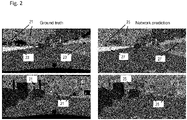
- Fig. 2 depicts results of a semantic segmentation according to the background art. That is, areas within pictures 13 captured by the camera 11 are assigned to predefined types of objects or object class, e.g. to one of the object classes "other passenger car”, “truck”, “road”, “sidewalk”, “pedestrian”, etc. The area occupied by a certain object type is represented by a unique color in Fig. 2 .
- ground truth labels are shown for two different scenes. For these scenes, it is known which area belongs to which object type.
- the ground truth labels depicted on the left side of Fig. 2 are used for training a convolutional neural network which provides a network prediction shown on the right side, respectively, of Fig. 2 for the semantic segmentation of the images 13.
- the semantic segmentation or classification of objects is performed on the basis of pixels of the respective image 13.
- the convolutional neural network provides a prediction regarding the object class, i.e. it assigns an indicator for a certain object class to each pixel. Therefore, each area as shown on the left side of Fig. 2 and having a certain color includes a plurality of pixels which are classified as a certain type of object by the convolutional neural network.
- the respective ground truth labels for the pictures 13 include many small objects 21 and boundaries 23 between object.
- the respective network prediction according to the background art fails to classify the small objects 21 and the boundaries 23 properly.
- the sharp boundaries 23 between the objects as shown on the left side of Fig. 2 are also not properly recognizable in the network prediction, as is indicated by 27.
- the sharp boundary 23 between the objects appears to be corrupted in the output of the convolutional neural network.
- a reason for the erroneous or not satisfying classification by the network prediction according to the background art is related to a loss function which is usually used for training the convolutional neural network.
- a robust loss function is generally essential for a learning or training process of any neural network.
- the loss function generally includes a certain comparison of a predicted output of the neural network and a desired output, i.e. the ground truth labels.
- a regression is performed by assigning large loss values to undesired values within the network prediction, and the total loss is minimized thereafter during training of the neural network.
- the total loss is then defined as the mean over all pixels within the image 13. Since for an image having 2048 rows and 1024 columns and therefore almost 2.1 million of pixels, the contribution of a single pixel to the loss function or total loss is approximately weighted by 1/(2.1*10 6 ).
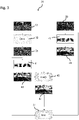
- Fig. 3 depicts a flow diagram for a method 31 according to the disclosure.
- the method 31 is provided for classifying pixels of the image 13 which is captured by the camera 11 (see Fig. 1 ). That is, the image 13 including a plurality of pixels is provided as input for the method, i.e. for a convolutional neural network 33 which is generated by the processing device 15 (see Fig. 1 ).
- the convolutional neural network 33 includes a plurality of layers which are based on an underlying model.
- the neural network 33 estimates probability values for each pixel. Each probability value indicates a probability for the respective pixel for being associated with one of a plurality of predetermined classes. Based on the respective probability values for each pixel, each pixel of the image 13 is assigned to one class of the plurality of classes, i.e. by selecting the class having the highest probability value.
- the predetermined classes include predetermined types of objects visible for the camera 11, i.e. other vehicles, the road, the sidewalk, pedestrians, etc.
- the convolutional neural network 33 creates a predicted segmentation map 35 which includes a predicted class for each pixel. In the predicted segmentation map 35 as shown in Fig. 3 and in similar predicted segmentation maps as shown in Figs. 5 and 6 , different types of objects are represented by different colors.
- the predicted segmentation map 35 is related to ground truth labels 39, i.e. the desired output of the convolutional neural network 33.
- ground truth labels 39 the correct assignment to the respective class or object type is known for each pixel of the image 13.
- the predicted segmentation map 35 is related to ground truth labels 39 via a loss function 37 which is based on the cross-entropy function as described above in context of Fig. 2 .
- a total loss provided by the loss function 37 is to be minimized.
- the commonly used loss function which is based on the cross-entropy function as the disadvantage that the contribution of all pixels is the same which leads to an underestimation of small objects and object boundaries when estimating the loss function and therefore to an erroneous or missing classification of the small objects and the object boundaries.
- the method includes providing a modified version 37 of the loss function in which the small objects and object boundaries are provided with a greater weight in order to increase their contribution to the total loss.
- an edge detection algorithm 41 is applied to the predicted segmentation map 35 and to the ground truth labels 39.
- the output of the edge detection algorithm 41 is a prediction mask 43 when applied to the predicted segmentation map 35, and a ground truth map 44 when applied to the ground truth labels 39.
- a prediction mask 43 when applied to the predicted segmentation map 35
- a ground truth map 44 when applied to the ground truth labels 39.
- the edge detection algorithm 41 is based on a so-called Sobel operator which is able to extract boundaries between the predicted classes.
- color gradients in the image 13 can be detected.
- the pixels not belonging to the detected edges are suppressed by setting their value close to zero in the mask. Therefore, almost no loss values are assigned to a major portion in the predicted segmentation map 35 in order to create the masks 43, 44.
- all pixels in the respective mask 43 or 44 have at least a small value of e.g. 0.1 in order to account for loss values of all pixels.
- a consequential convolutional kernel is applied which is a bivariate Gaussian kernel having a predefined size.
- the additional kernel adds a padding of three pixels before and of three pixels after the original line or boundary between respective objects. Therefore, the widths of the boundaries as represented in the masks 43, 44 are increased. In practice, additional padding kernels of roughly 30x30 pixels are used. In contrast to the classical Gaussian kernel which is normalized such that the sum over all its elements is equal to one, the method according to the disclosure normalizes the bivariate Gaussian kernel such that the mean value over its elements is one.
- the two masks 43,44 are merged by using a pixel-wise maximum operator at 45. That is, for each pixel the greater value of the respective masks 43, 44 is selected in order to generate a final or merged mask 47.
- the final mask 47 is included in the generation of the loss function 37. That is, for each pixel the contribution to the loss is calculated according to the cross-entropy function as defined in (1) such that a "preliminary loss" or loss matrix is generated for which each element includes the contribution of the respective pixel.
- the final mask 47 is applied to the preliminary loss or loss matrix. In detail, for each pixel the preliminary loss is multiplied by the corresponding element of the final mask 47. Due to this, object boundaries and small objects have a greater contribution to the loss function 37 than areas which do not belong to the detected boundaries between objects.
- the method includes generating the prediction mask 43 for which the edge detection algorithm 41 is applied to the prediction segmentation map 35, generating the ground truth mask 44 for which the edge detection algorithm 41 is applied to ground truth labels 39, and generating the final mask 47 for which both masks 43, 44 are merged and which is applied when generating the loss function 37.
- the prediction mask 43 is applied to the ground truth labels 39 only. That is, the final mask 47 is identical with the prediction mask 43 for this embodiment since no merging of the two masks 43, 44 is performed.
- the ground truth mask 44 is used only in order to generate the final mask 47, i.e. the prediction mask 43 is omitted and no merging of the two masks 43, 44 is performed. In other words, the ground truth mask 44 is applied directly to the loss function 37, i.e. to the preliminary loss, for this alternative embodiment.
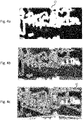
- Fig. 4a depicts an enlarged example for the prediction mask 43.
- Fig. 4b depicts the result for applying the prediction mask 43 from Fig. 4a to the ground truth labels 39.
- the prediction mask 43 By using the prediction mask 43, wrongly classified or "hallucinated" objects may be suppressed. Such a hallucinated object can be recognized in the bottom left corner of Fig. 4b . Since the weight or contribution of this hallucinated object is increased due to the prediction mask 43 when calculating the total loss, such objects will be suppressed by the trained neural network after the minimization of the loss function during the training.
- Fig. 4b also represents the masked ground truth labels for the embodiment of the method for which the prediction mask 43 is considered for generating the loss function 37 only.
- Fig. 4c depicts the masked ground truth labels for which the merged final mask 47 has been applied to the original ground truth labels 39. That is, Fig. 4c represents the masked ground truth labels for the embodiment as shown in Fig. 3 for which the final mask 47 is generated by merging both masks 43, 44.
- the ground truth mask 44 By taking the ground truth mask 44 additionally into account, it is ensured that the most important parts of the image are properly respected.
- the contribution of the boundaries which belong to a pink element 50 is strongly enhanced since the ground truth mask 44 is additionally considered. Weights for the pink element 50 are almost missing in the prediction mask 43 as can be recognized in the upper right corner of Fig. 4a .
- the prediction mask 43 as shown in Fig. 4a and the merged final mask 47 are applied to or multiplied by the ground truth labels 39 for illustration purposes only, i.e. for demonstrating the effect of the masks 43, 47 on individual objects within the image 13.
- the masks are applied to (or multiplied by) the "preliminary loss", i.e. the loss matrix which is calculated based on the cross-entropy function, but not to the ground truth labels 39 directly.
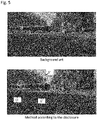
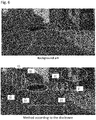
- Figs. 5 and 6 depict a comparison of the semantic segmentation for a respective image performed by a method according to the background art (upper part of Figs. 5 and 6 ) and performed by a method according to the disclosure (lower part of Figs. 5 and 6 ).
- the boundaries between the objects are much clearer in the segmentation result for the method according to the disclosure.
- some small objects are almost completely classified in a wrong manner by the method according to the background art.
- the pole on the right side in the image of Fig. 6 cannot be recognized in the segmentation result according to the background art, whereas is clearly comes out when the segmentation is performed by the method according to the disclosure.
- the recognition of pedestrians 57 is improved by the method according to the disclosure, as can be seen on the right side of Fig. 6 .
- the improved segmentation results as shown on the respective lower part of Figs. 5 and 6 are due to the fact that the edge detection algorithm 41 (see Fig. 3 ) is incorporated into the method 31 when generating the loss function 37. Since the result of the edge detection algorithm 41 is applied to the ground truth labels 39 before relating the predicted segmentation map 35 to the ground truth labels 39 via the loss function 37, the contribution of object boundaries and small objects to the loss function 37 is enhanced during the training procedure of the neural network 33. Since small objects and object boundaries are better recognizable in the semantic segmentation results as shown in Figs. 5 and 6 (respective lower part), the safety for a vehicle may be improved if the method according to the disclosure is applied e.g. in connection with driver assistance systems and autonomous driving.
- border IoU border intersection over union
- the border IoU is defined and applied e.g. in Milioto, A. et al.: "RangeNet++: Fast and accurate LiDAR semantic segmentation", 2019 IEEE/RSJ International Conference on Intelligent Robots and Systems (IROS), pp. 4213-4220. IEEE, 2019 .
- the intersection over union (IoU) is commonly used for describing a similarity of sets, vectors and objects.
- the IoU is generally used as a metric to assess the labeling performance which relates the true positives of a network prediction to the sum over true positive, false positive and false negative predictions of the neural network.
- this assessment key is applied to boundaries between objects only.
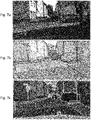
- Fig. 7a depicts an original picture 13 captured by the camera 11 (see Fig. 1 ) being installed in a vehicle.
- Fig. 7b depicts the border IoU wherein the evaluated pixels of the image 13 are masked with their respective color which is assigned to the respective object class.
- Fig. 7c a so-called interior IoU is depicted which is evaluated as the complement of the border IoU shown in Fig. 7b .
- all metrics i.e. the "normal" IoU, the interior IoU and especially the border IoU, provided better values for the semantic segmentation based on the method according to the disclosure in comparison to the semantic segmentation based on the method according to the background art.
Landscapes
- Engineering & Computer Science (AREA)
- Theoretical Computer Science (AREA)
- Physics & Mathematics (AREA)
- General Physics & Mathematics (AREA)
- Computer Vision & Pattern Recognition (AREA)
- Multimedia (AREA)
- Evolutionary Computation (AREA)
- Artificial Intelligence (AREA)
- General Health & Medical Sciences (AREA)
- Health & Medical Sciences (AREA)
- Computing Systems (AREA)
- Software Systems (AREA)
- Medical Informatics (AREA)
- Data Mining & Analysis (AREA)
- Databases & Information Systems (AREA)
- Life Sciences & Earth Sciences (AREA)
- General Engineering & Computer Science (AREA)
- Bioinformatics & Computational Biology (AREA)
- Evolutionary Biology (AREA)
- Bioinformatics & Cheminformatics (AREA)
- Computational Linguistics (AREA)
- Geometry (AREA)
- Biodiversity & Conservation Biology (AREA)
- Biomedical Technology (AREA)
- Molecular Biology (AREA)
- Image Analysis (AREA)
Priority Applications (3)
| Application Number | Priority Date | Filing Date | Title |
|---|---|---|---|
| EP21154378.0A EP4036792B1 (fr) | 2021-01-29 | 2021-01-29 | Procédé et dispositif de classification de pixels d'une image |
| US17/579,536 US12211297B2 (en) | 2021-01-29 | 2022-01-19 | Method and device for classifying pixels of an image |
| CN202210101395.9A CN114820644B (zh) | 2021-01-29 | 2022-01-27 | 对图像的像素进行分类的方法和设备 |
Applications Claiming Priority (1)
| Application Number | Priority Date | Filing Date | Title |
|---|---|---|---|
| EP21154378.0A EP4036792B1 (fr) | 2021-01-29 | 2021-01-29 | Procédé et dispositif de classification de pixels d'une image |
Publications (2)
| Publication Number | Publication Date |
|---|---|
| EP4036792A1 true EP4036792A1 (fr) | 2022-08-03 |
| EP4036792B1 EP4036792B1 (fr) | 2025-10-22 |
Family
ID=74418332
Family Applications (1)
| Application Number | Title | Priority Date | Filing Date |
|---|---|---|---|
| EP21154378.0A Active EP4036792B1 (fr) | 2021-01-29 | 2021-01-29 | Procédé et dispositif de classification de pixels d'une image |
Country Status (3)
| Country | Link |
|---|---|
| US (1) | US12211297B2 (fr) |
| EP (1) | EP4036792B1 (fr) |
| CN (1) | CN114820644B (fr) |
Families Citing this family (9)
| Publication number | Priority date | Publication date | Assignee | Title |
|---|---|---|---|---|
| US12002217B1 (en) * | 2021-10-25 | 2024-06-04 | Zoox, Inc. | Detection box determination based on pixel clustering |
| IL297653B2 (en) * | 2022-10-25 | 2024-03-01 | Geox Gis Innovations Ltd | System and method for segment-aware semantic segmentation |
| CN116052061B (zh) * | 2023-02-21 | 2024-02-27 | 嘉洋智慧安全科技(北京)股份有限公司 | 事件监测方法、装置、电子设备及存储介质 |
| US12456305B2 (en) | 2023-03-31 | 2025-10-28 | Geotab Inc. | Systems and methods for identifying tailgating |
| US12586230B2 (en) | 2023-03-31 | 2026-03-24 | Geotab Inc. | Systems and methods for training a model for determining vehicle following distance |
| US11989949B1 (en) | 2023-03-31 | 2024-05-21 | Geotab Inc. | Systems for detecting vehicle following distance |
| US12423864B2 (en) | 2023-03-31 | 2025-09-23 | Geotab Inc. | Systems for detecting vehicle following distance |
| EP4492253A1 (fr) | 2023-07-11 | 2025-01-15 | GEOTAB Inc. | Systèmes et procédés de récupération de données télématiques |
| US12322162B1 (en) | 2024-05-09 | 2025-06-03 | Geotab Inc. | Systems and methods for training vehicle collision and near-miss detection models |
Citations (1)
| Publication number | Priority date | Publication date | Assignee | Title |
|---|---|---|---|---|
| CN112070779A (zh) * | 2020-08-04 | 2020-12-11 | 武汉大学 | 一种基于卷积神经网络弱监督学习的遥感影像道路分割方法 |
Family Cites Families (12)
| Publication number | Priority date | Publication date | Assignee | Title |
|---|---|---|---|---|
| US20160217335A1 (en) | 2009-02-27 | 2016-07-28 | GM Global Technology Operations LLC | Stixel estimation and road scene segmentation using deep learning |
| CN104346620B (zh) * | 2013-07-25 | 2017-12-29 | 佳能株式会社 | 对输入图像中的像素分类的方法和装置及图像处理系统 |
| US9934577B2 (en) | 2014-01-17 | 2018-04-03 | Microsoft Technology Licensing, Llc | Digital image edge detection |
| CN106874921B (zh) | 2015-12-11 | 2020-12-04 | 清华大学 | 图像分类方法和装置 |
| KR102592076B1 (ko) | 2015-12-14 | 2023-10-19 | 삼성전자주식회사 | 딥러닝 기반 영상 처리 장치 및 방법, 학습 장치 |
| US9972092B2 (en) | 2016-03-31 | 2018-05-15 | Adobe Systems Incorporated | Utilizing deep learning for boundary-aware image segmentation |
| US10635927B2 (en) * | 2017-03-06 | 2020-04-28 | Honda Motor Co., Ltd. | Systems for performing semantic segmentation and methods thereof |
| EP3474189A1 (fr) | 2017-10-18 | 2019-04-24 | Aptiv Technologies Limited | Dispositif et procédé d'attribution d'étiquettes d'une pluralité de classes prédéterminées à des pixels d'une image |
| US11234666B2 (en) * | 2018-05-31 | 2022-02-01 | Canon Medical Systems Corporation | Apparatus and method for medical image reconstruction using deep learning to improve image quality in position emission tomography (PET) |
| US10410352B1 (en) * | 2019-01-25 | 2019-09-10 | StradVision, Inc. | Learning method and learning device for improving segmentation performance to be used for detecting events including pedestrian event, vehicle event, falling event and fallen event using edge loss and test method and test device using the same |
| CN110287777B (zh) * | 2019-05-16 | 2021-06-08 | 西北大学 | 一种自然场景下的金丝猴躯体分割算法 |
| CN111882560B (zh) * | 2020-06-16 | 2024-05-31 | 北京工业大学 | 一种基于加权全卷积神经网络的肺实质ct图像分割方法 |
-
2021
- 2021-01-29 EP EP21154378.0A patent/EP4036792B1/fr active Active
-
2022
- 2022-01-19 US US17/579,536 patent/US12211297B2/en active Active
- 2022-01-27 CN CN202210101395.9A patent/CN114820644B/zh active Active
Patent Citations (1)
| Publication number | Priority date | Publication date | Assignee | Title |
|---|---|---|---|---|
| CN112070779A (zh) * | 2020-08-04 | 2020-12-11 | 武汉大学 | 一种基于卷积神经网络弱监督学习的遥感影像道路分割方法 |
Non-Patent Citations (4)
| Title |
|---|
| LI YUQI ET AL: "Edge-guided Hierarchically Nested Network for Real-time Semantic Segmentation", 2019 IEEE INTERNATIONAL CONFERENCE ON SIGNAL AND IMAGE PROCESSING APPLICATIONS (ICSIPA), IEEE, 17 September 2019 (2019-09-17), pages 296 - 301, XP033702040, DOI: 10.1109/ICSIPA45851.2019.8977788 * |
| MILIOTO, A. ET AL.: "2019 IEEE/RSJ International Conference on Intelligent Robots and Systems (IROS", 2019, IEEE, article "RangeNet++: Fast and accurate LiDAR semantic segmentation", pages: 4213 - 4220 |
| ROLAND S ZIMMERMANN ET AL: "Faster Training of Mask R-CNN by Focusing on Instance Boundaries", ARXIV.ORG, CORNELL UNIVERSITY LIBRARY, 201 OLIN LIBRARY CORNELL UNIVERSITY ITHACA, NY 14853, 19 September 2018 (2018-09-19), XP081459221, DOI: 10.1016/J.CVIU.2019.102795 * |
| SHUO LIU ET AL: "ERN: Edge Loss Reinforced Semantic Segmentation Network for Remote Sensing Images", REMOTE SENSING, vol. 10, no. 9, 22 August 2018 (2018-08-22), CH, pages 1339, XP055685172, ISSN: 2072-4292, DOI: 10.3390/rs10091339 * |
Also Published As
| Publication number | Publication date |
|---|---|
| US20220245955A1 (en) | 2022-08-04 |
| CN114820644A (zh) | 2022-07-29 |
| EP4036792B1 (fr) | 2025-10-22 |
| US12211297B2 (en) | 2025-01-28 |
| CN114820644B (zh) | 2025-08-05 |
Similar Documents
| Publication | Publication Date | Title |
|---|---|---|
| US12211297B2 (en) | Method and device for classifying pixels of an image | |
| JP7272533B2 (ja) | 知覚システムを評価するシステム及び方法 | |
| JP5815910B2 (ja) | マルチキュー・オブジェクトの検出および分析のための方法、システム、製品、およびコンピュータ・プログラム(マルチキュー・オブジェクトの検出および分析) | |
| US20210213961A1 (en) | Driving scene understanding | |
| US10803357B2 (en) | Computer-readable recording medium, training method, and object detection device | |
| US9911055B2 (en) | Method and system for detection and classification of license plates | |
| US20190019042A1 (en) | Computer implemented detecting method, computer implemented learning method, detecting apparatus, learning apparatus, detecting system, and recording medium | |
| US20190042888A1 (en) | Training method, training apparatus, region classifier, and non-transitory computer readable medium | |
| US20180307911A1 (en) | Method for the semantic segmentation of an image | |
| CN112200131B (zh) | 一种基于视觉的车辆碰撞检测方法、智能终端及存储介质 | |
| CN111507468B (zh) | 使用人工智能来警告驾驶员危险的方法和装置 | |
| US11487295B2 (en) | Method and device for abstracting a data record | |
| EP3767534B1 (fr) | Dispositif et procédé d'évaluation d'un déterminateur de carte de relief | |
| JP7233572B2 (ja) | エクスプレイナブルセルフフォーカスされたアテンションを利用して行動予測を遂行する方法及び装置 | |
| CN113743179A (zh) | 路上障碍物检知装置、方法及记录介质 | |
| JP7845083B2 (ja) | 画像分類方法及び装置、並びに画像分類器の訓練を向上させる方法及び装置 | |
| Ma et al. | Controlloc: Physical-world hijacking attack on visual perception in autonomous driving | |
| Choodowicz et al. | Hybrid algorithm for the detection and recognition of railway signs | |
| CN112784817A (zh) | 车辆所在车道检测方法、装置、设备及存储介质 | |
| CN115063761B (zh) | 车道线检测方法、装置、设备及存储介质 | |
| US12340594B2 (en) | Systems and methods for determining road object importance based on forward facing and driver facing video data | |
| KR20230056250A (ko) | 인공지능 기반 차선 손상 상태 평가 방법 및 장치 | |
| CN114461671A (zh) | 数据处理方法、车辆、计算机可读存储介质 | |
| US20260105220A1 (en) | Method of generating driving scenarios and apparatus thereof | |
| Nawaz | Hog-svm car detection on an embedded gpu |
Legal Events
| Date | Code | Title | Description |
|---|---|---|---|
| PUAI | Public reference made under article 153(3) epc to a published international application that has entered the european phase |
Free format text: ORIGINAL CODE: 0009012 |
|
| STAA | Information on the status of an ep patent application or granted ep patent |
Free format text: STATUS: THE APPLICATION HAS BEEN PUBLISHED |
|
| AK | Designated contracting states |
Kind code of ref document: A1 Designated state(s): AL AT BE BG CH CY CZ DE DK EE ES FI FR GB GR HR HU IE IS IT LI LT LU LV MC MK MT NL NO PL PT RO RS SE SI SK SM TR |
|
| STAA | Information on the status of an ep patent application or granted ep patent |
Free format text: STATUS: REQUEST FOR EXAMINATION WAS MADE |
|
| 17P | Request for examination filed |
Effective date: 20230131 |
|
| RBV | Designated contracting states (corrected) |
Designated state(s): AL AT BE BG CH CY CZ DE DK EE ES FI FR GB GR HR HU IE IS IT LI LT LU LV MC MK MT NL NO PL PT RO RS SE SI SK SM TR |
|
| RAP3 | Party data changed (applicant data changed or rights of an application transferred) |
Owner name: APTIV TECHNOLOGIES LIMITED |
|
| STAA | Information on the status of an ep patent application or granted ep patent |
Free format text: STATUS: EXAMINATION IS IN PROGRESS |
|
| 17Q | First examination report despatched |
Effective date: 20231222 |
|
| RAP1 | Party data changed (applicant data changed or rights of an application transferred) |
Owner name: APTIV TECHNOLOGIES AG |
|
| RAP3 | Party data changed (applicant data changed or rights of an application transferred) |
Owner name: APTIV TECHNOLOGIES AG |
|
| REG | Reference to a national code |
Ref country code: DE Ref legal event code: R079 Free format text: PREVIOUS MAIN CLASS: G06K0009000000 Ipc: G06F0018241300 Ref country code: DE Ref legal event code: R079 Ref document number: 602021040693 Country of ref document: DE Free format text: PREVIOUS MAIN CLASS: G06K0009000000 Ipc: G06F0018241300 |
|
| GRAP | Despatch of communication of intention to grant a patent |
Free format text: ORIGINAL CODE: EPIDOSNIGR1 |
|
| STAA | Information on the status of an ep patent application or granted ep patent |
Free format text: STATUS: GRANT OF PATENT IS INTENDED |
|
| RIC1 | Information provided on ipc code assigned before grant |
Ipc: G06F 18/2413 20230101AFI20250704BHEP Ipc: G06V 10/44 20220101ALI20250704BHEP Ipc: G06V 20/56 20220101ALI20250704BHEP |
|
| INTG | Intention to grant announced |
Effective date: 20250725 |
|
| GRAS | Grant fee paid |
Free format text: ORIGINAL CODE: EPIDOSNIGR3 |
|
| P01 | Opt-out of the competence of the unified patent court (upc) registered |
Free format text: CASE NUMBER: UPC_APP_3241_4036792/2025 Effective date: 20250813 |
|
| GRAA | (expected) grant |
Free format text: ORIGINAL CODE: 0009210 |
|
| STAA | Information on the status of an ep patent application or granted ep patent |
Free format text: STATUS: THE PATENT HAS BEEN GRANTED |
|
| AK | Designated contracting states |
Kind code of ref document: B1 Designated state(s): AL AT BE BG CH CY CZ DE DK EE ES FI FR GB GR HR HU IE IS IT LI LT LU LV MC MK MT NL NO PL PT RO RS SE SI SK SM TR |
|
| REG | Reference to a national code |
Ref country code: CH Ref legal event code: F10 Free format text: ST27 STATUS EVENT CODE: U-0-0-F10-F00 (AS PROVIDED BY THE NATIONAL OFFICE) Effective date: 20251022 Ref country code: GB Ref legal event code: FG4D |
|
| REG | Reference to a national code |
Ref country code: DE Ref legal event code: R096 Ref document number: 602021040693 Country of ref document: DE |
|
| REG | Reference to a national code |
Ref country code: IE Ref legal event code: FG4D |
|
| REG | Reference to a national code |
Ref country code: NL Ref legal event code: MP Effective date: 20251022 |
|
| PG25 | Lapsed in a contracting state [announced via postgrant information from national office to epo] |
Ref country code: NL Free format text: LAPSE BECAUSE OF FAILURE TO SUBMIT A TRANSLATION OF THE DESCRIPTION OR TO PAY THE FEE WITHIN THE PRESCRIBED TIME-LIMIT Effective date: 20251022 |
|
| PGFP | Annual fee paid to national office [announced via postgrant information from national office to epo] |
Ref country code: GB Payment date: 20260112 Year of fee payment: 6 |
|
| PG25 | Lapsed in a contracting state [announced via postgrant information from national office to epo] |
Ref country code: ES Free format text: LAPSE BECAUSE OF FAILURE TO SUBMIT A TRANSLATION OF THE DESCRIPTION OR TO PAY THE FEE WITHIN THE PRESCRIBED TIME-LIMIT Effective date: 20251022 |
|
| REG | Reference to a national code |
Ref country code: LT Ref legal event code: MG9D |
|
| PG25 | Lapsed in a contracting state [announced via postgrant information from national office to epo] |
Ref country code: NO Free format text: LAPSE BECAUSE OF FAILURE TO SUBMIT A TRANSLATION OF THE DESCRIPTION OR TO PAY THE FEE WITHIN THE PRESCRIBED TIME-LIMIT Effective date: 20260122 |
|
| PGFP | Annual fee paid to national office [announced via postgrant information from national office to epo] |
Ref country code: DE Payment date: 20251217 Year of fee payment: 6 |
|
| PG25 | Lapsed in a contracting state [announced via postgrant information from national office to epo] |
Ref country code: AT Free format text: LAPSE BECAUSE OF FAILURE TO SUBMIT A TRANSLATION OF THE DESCRIPTION OR TO PAY THE FEE WITHIN THE PRESCRIBED TIME-LIMIT Effective date: 20251022 Ref country code: HR Free format text: LAPSE BECAUSE OF FAILURE TO SUBMIT A TRANSLATION OF THE DESCRIPTION OR TO PAY THE FEE WITHIN THE PRESCRIBED TIME-LIMIT Effective date: 20251022 Ref country code: FI Free format text: LAPSE BECAUSE OF FAILURE TO SUBMIT A TRANSLATION OF THE DESCRIPTION OR TO PAY THE FEE WITHIN THE PRESCRIBED TIME-LIMIT Effective date: 20251022 |
|
| REG | Reference to a national code |
Ref country code: AT Ref legal event code: MK05 Ref document number: 1849765 Country of ref document: AT Kind code of ref document: T Effective date: 20251022 |
|
| PG25 | Lapsed in a contracting state [announced via postgrant information from national office to epo] |
Ref country code: RS Free format text: LAPSE BECAUSE OF FAILURE TO SUBMIT A TRANSLATION OF THE DESCRIPTION OR TO PAY THE FEE WITHIN THE PRESCRIBED TIME-LIMIT Effective date: 20260122 |
|
| PG25 | Lapsed in a contracting state [announced via postgrant information from national office to epo] |
Ref country code: IS Free format text: LAPSE BECAUSE OF FAILURE TO SUBMIT A TRANSLATION OF THE DESCRIPTION OR TO PAY THE FEE WITHIN THE PRESCRIBED TIME-LIMIT Effective date: 20260222 |
|
| PGFP | Annual fee paid to national office [announced via postgrant information from national office to epo] |
Ref country code: FR Payment date: 20260107 Year of fee payment: 6 |
|
| PG25 | Lapsed in a contracting state [announced via postgrant information from national office to epo] |
Ref country code: PT Free format text: LAPSE BECAUSE OF FAILURE TO SUBMIT A TRANSLATION OF THE DESCRIPTION OR TO PAY THE FEE WITHIN THE PRESCRIBED TIME-LIMIT Effective date: 20260223 |
|
| PG25 | Lapsed in a contracting state [announced via postgrant information from national office to epo] |
Ref country code: PL Free format text: LAPSE BECAUSE OF FAILURE TO SUBMIT A TRANSLATION OF THE DESCRIPTION OR TO PAY THE FEE WITHIN THE PRESCRIBED TIME-LIMIT Effective date: 20251022 |
|
| PG25 | Lapsed in a contracting state [announced via postgrant information from national office to epo] |
Ref country code: LV Free format text: LAPSE BECAUSE OF FAILURE TO SUBMIT A TRANSLATION OF THE DESCRIPTION OR TO PAY THE FEE WITHIN THE PRESCRIBED TIME-LIMIT Effective date: 20251022 |