EP4040792B1 - Codage d'image ou de vidéo basé sur la signalisation d'informations liées au saut de transformée et au codage de palette - Google Patents
Codage d'image ou de vidéo basé sur la signalisation d'informations liées au saut de transformée et au codage de palette Download PDFInfo
- Publication number
- EP4040792B1 EP4040792B1 EP20872437.7A EP20872437A EP4040792B1 EP 4040792 B1 EP4040792 B1 EP 4040792B1 EP 20872437 A EP20872437 A EP 20872437A EP 4040792 B1 EP4040792 B1 EP 4040792B1
- Authority
- EP
- European Patent Office
- Prior art keywords
- enabled
- information
- transform
- flag
- skip
- Prior art date
- Legal status (The legal status is an assumption and is not a legal conclusion. Google has not performed a legal analysis and makes no representation as to the accuracy of the status listed.)
- Active
Links
Images






Classifications
-
- H—ELECTRICITY
- H04—ELECTRIC COMMUNICATION TECHNIQUE
- H04N—PICTORIAL COMMUNICATION, e.g. TELEVISION
- H04N19/00—Methods or arrangements for coding, decoding, compressing or decompressing digital video signals
- H04N19/10—Methods or arrangements for coding, decoding, compressing or decompressing digital video signals using adaptive coding
- H04N19/102—Methods or arrangements for coding, decoding, compressing or decompressing digital video signals using adaptive coding characterised by the element, parameter or selection affected or controlled by the adaptive coding
- H04N19/12—Selection from among a plurality of transforms or standards, e.g. selection between discrete cosine transform [DCT] and sub-band transform or selection between H.263 and H.264
-
- H—ELECTRICITY
- H04—ELECTRIC COMMUNICATION TECHNIQUE
- H04N—PICTORIAL COMMUNICATION, e.g. TELEVISION
- H04N19/00—Methods or arrangements for coding, decoding, compressing or decompressing digital video signals
- H04N19/10—Methods or arrangements for coding, decoding, compressing or decompressing digital video signals using adaptive coding
- H04N19/102—Methods or arrangements for coding, decoding, compressing or decompressing digital video signals using adaptive coding characterised by the element, parameter or selection affected or controlled by the adaptive coding
- H04N19/12—Selection from among a plurality of transforms or standards, e.g. selection between discrete cosine transform [DCT] and sub-band transform or selection between H.263 and H.264
- H04N19/122—Selection of transform size, e.g. 8x8 or 2x4x8 DCT; Selection of sub-band transforms of varying structure or type
-
- H—ELECTRICITY
- H04—ELECTRIC COMMUNICATION TECHNIQUE
- H04N—PICTORIAL COMMUNICATION, e.g. TELEVISION
- H04N19/00—Methods or arrangements for coding, decoding, compressing or decompressing digital video signals
- H04N19/10—Methods or arrangements for coding, decoding, compressing or decompressing digital video signals using adaptive coding
- H04N19/102—Methods or arrangements for coding, decoding, compressing or decompressing digital video signals using adaptive coding characterised by the element, parameter or selection affected or controlled by the adaptive coding
- H04N19/124—Quantisation
-
- H—ELECTRICITY
- H04—ELECTRIC COMMUNICATION TECHNIQUE
- H04N—PICTORIAL COMMUNICATION, e.g. TELEVISION
- H04N19/00—Methods or arrangements for coding, decoding, compressing or decompressing digital video signals
- H04N19/10—Methods or arrangements for coding, decoding, compressing or decompressing digital video signals using adaptive coding
- H04N19/102—Methods or arrangements for coding, decoding, compressing or decompressing digital video signals using adaptive coding characterised by the element, parameter or selection affected or controlled by the adaptive coding
- H04N19/13—Adaptive entropy coding, e.g. adaptive variable length coding [AVLC] or context adaptive binary arithmetic coding [CABAC]
-
- H—ELECTRICITY
- H04—ELECTRIC COMMUNICATION TECHNIQUE
- H04N—PICTORIAL COMMUNICATION, e.g. TELEVISION
- H04N19/00—Methods or arrangements for coding, decoding, compressing or decompressing digital video signals
- H04N19/10—Methods or arrangements for coding, decoding, compressing or decompressing digital video signals using adaptive coding
- H04N19/102—Methods or arrangements for coding, decoding, compressing or decompressing digital video signals using adaptive coding characterised by the element, parameter or selection affected or controlled by the adaptive coding
- H04N19/132—Sampling, masking or truncation of coding units, e.g. adaptive resampling, frame skipping, frame interpolation or high-frequency transform coefficient masking
-
- H—ELECTRICITY
- H04—ELECTRIC COMMUNICATION TECHNIQUE
- H04N—PICTORIAL COMMUNICATION, e.g. TELEVISION
- H04N19/00—Methods or arrangements for coding, decoding, compressing or decompressing digital video signals
- H04N19/10—Methods or arrangements for coding, decoding, compressing or decompressing digital video signals using adaptive coding
- H04N19/134—Methods or arrangements for coding, decoding, compressing or decompressing digital video signals using adaptive coding characterised by the element, parameter or criterion affecting or controlling the adaptive coding
- H04N19/136—Incoming video signal characteristics or properties
- H04N19/137—Motion inside a coding unit, e.g. average field, frame or block difference
-
- H—ELECTRICITY
- H04—ELECTRIC COMMUNICATION TECHNIQUE
- H04N—PICTORIAL COMMUNICATION, e.g. TELEVISION
- H04N19/00—Methods or arrangements for coding, decoding, compressing or decompressing digital video signals
- H04N19/10—Methods or arrangements for coding, decoding, compressing or decompressing digital video signals using adaptive coding
- H04N19/134—Methods or arrangements for coding, decoding, compressing or decompressing digital video signals using adaptive coding characterised by the element, parameter or criterion affecting or controlling the adaptive coding
- H04N19/157—Assigned coding mode, i.e. the coding mode being predefined or preselected to be further used for selection of another element or parameter
-
- H—ELECTRICITY
- H04—ELECTRIC COMMUNICATION TECHNIQUE
- H04N—PICTORIAL COMMUNICATION, e.g. TELEVISION
- H04N19/00—Methods or arrangements for coding, decoding, compressing or decompressing digital video signals
- H04N19/10—Methods or arrangements for coding, decoding, compressing or decompressing digital video signals using adaptive coding
- H04N19/169—Methods or arrangements for coding, decoding, compressing or decompressing digital video signals using adaptive coding characterised by the coding unit, i.e. the structural portion or semantic portion of the video signal being the object or the subject of the adaptive coding
- H04N19/17—Methods or arrangements for coding, decoding, compressing or decompressing digital video signals using adaptive coding characterised by the coding unit, i.e. the structural portion or semantic portion of the video signal being the object or the subject of the adaptive coding the unit being an image region, e.g. an object
- H04N19/176—Methods or arrangements for coding, decoding, compressing or decompressing digital video signals using adaptive coding characterised by the coding unit, i.e. the structural portion or semantic portion of the video signal being the object or the subject of the adaptive coding the unit being an image region, e.g. an object the region being a block, e.g. a macroblock
-
- H—ELECTRICITY
- H04—ELECTRIC COMMUNICATION TECHNIQUE
- H04N—PICTORIAL COMMUNICATION, e.g. TELEVISION
- H04N19/00—Methods or arrangements for coding, decoding, compressing or decompressing digital video signals
- H04N19/10—Methods or arrangements for coding, decoding, compressing or decompressing digital video signals using adaptive coding
- H04N19/169—Methods or arrangements for coding, decoding, compressing or decompressing digital video signals using adaptive coding characterised by the coding unit, i.e. the structural portion or semantic portion of the video signal being the object or the subject of the adaptive coding
- H04N19/186—Methods or arrangements for coding, decoding, compressing or decompressing digital video signals using adaptive coding characterised by the coding unit, i.e. the structural portion or semantic portion of the video signal being the object or the subject of the adaptive coding the unit being a colour or a chrominance component
-
- H—ELECTRICITY
- H04—ELECTRIC COMMUNICATION TECHNIQUE
- H04N—PICTORIAL COMMUNICATION, e.g. TELEVISION
- H04N19/00—Methods or arrangements for coding, decoding, compressing or decompressing digital video signals
- H04N19/60—Methods or arrangements for coding, decoding, compressing or decompressing digital video signals using transform coding
-
- H—ELECTRICITY
- H04—ELECTRIC COMMUNICATION TECHNIQUE
- H04N—PICTORIAL COMMUNICATION, e.g. TELEVISION
- H04N19/00—Methods or arrangements for coding, decoding, compressing or decompressing digital video signals
- H04N19/60—Methods or arrangements for coding, decoding, compressing or decompressing digital video signals using transform coding
- H04N19/61—Methods or arrangements for coding, decoding, compressing or decompressing digital video signals using transform coding in combination with predictive coding
-
- H—ELECTRICITY
- H04—ELECTRIC COMMUNICATION TECHNIQUE
- H04N—PICTORIAL COMMUNICATION, e.g. TELEVISION
- H04N19/00—Methods or arrangements for coding, decoding, compressing or decompressing digital video signals
- H04N19/70—Methods or arrangements for coding, decoding, compressing or decompressing digital video signals characterised by syntax aspects related to video coding, e.g. related to compression standards
Definitions
- VR virtual reality
- AR artificial reality
- hologram immersive media
- broadcasting of images/videos exhibiting image/video characteristics different from those of an actual image/video, such as game images/videos are also growing.
- BROSS B ET AL "Versatile Video Coding (Draft 6)", 15. JVET MEETING; 20190703 - 20190712; GOTHENBURG; (THE JOINT VIDEO EXPLORATION TEAM OF ISO/IEC JTC1/SC29/WG11 AND ITU-T SG.16 ), no.
- Yet still another technical subject of the present document is to provide a method and an apparatus for defining a dependent condition for effectively parsing a syntax element having dependency with respect to a transform skip and/or palette coding related high-level syntax element, and determining whether to perform parsing based on the dependent condition.
- transform skip enabled information and pallet enabled information may be signaled through a sequence parameter set (SPS), and whether to parse/signal minimum quantization parameter information related to the minimum allowed quantization parameter for a transform skip mode may be determined based on at least one of the transform skip enabled information and the palette enabled information.
- SPS sequence parameter set
- the minimum quantization parameter information may be parsed/signaled through the SPS based on a condition that a value of the transform skip enabled information is 1 or a value of the palette coding enabled information is 1.
- a decoding apparatus performing video/image decoding.
- the decoding apparatus may perform a method disclosed in embodiments of the present document.
- an encoding apparatus performing video/image encoding.
- the encoding apparatus may perform a method disclosed in embodiments of the present document.
- a computer-readable digital storage medium storing encoded video/image information generated according to a video/image encoding method disclosed in at least one of embodiments of the present document is provided.
- a computer-readable digital storage medium storing encoded information or encoded video/image information causing a decoding apparatus to perform a video/image decoding method disclosed in at least one of embodiments of the present document is provided.
- the present document may have various effects. For example, according to an embodiment of the present document, the overall image/video compression efficiency can be enhanced. Further, according to an embodiment of the present document, the transform skip and/or palette coding related information can be efficiently parsed/signaled. Further, according to an embodiment of the present document, whether to perform coding can be effectively determined in accordance with the dependency and/or non-dependency of the information being used during the transform skip and/or palette coding. Further, according to an embodiment of the present document, efficient coding is possible by defining the dependent condition for effectively parsing the syntax element having dependency with respect to the transform skip and/or palette coding related high-level syntax element, and determining whether to perform parsing in accordance with the dependent condition.
- the term “A or B” may mean “only A”, “only B”, or “both A and B”.
- the term “A or B” may be interpreted to indicate “A and/or B”.
- the term “A, B or C” may mean “only A”, “only B”, “only C”, or "any combination of A, B and C”.
- the parentheses used in the present document may mean "for example”. Specifically, in the case that "prediction (intra prediction)" is expressed, it may be indicated that “intra prediction” is proposed as an example of "prediction”. In other words, the term “prediction” in the present document is not limited to “intra prediction”, and it may be indicated that “intra prediction” is proposed as an example of "prediction”. Further, even in the case that "prediction (i.e., intra prediction)" is expressed, it may be indicated that "intra prediction” is proposed as an example of "prediction”.
- the present document relates to video/image coding.
- the methods/embodiments disclosed in the present document are applied to a method disclosed in the versatile video coding (VVC) standard.
- the methods/embodiments disclosed in the present document may be applied to a method disclosed in the essential video coding (EVC) standard, the AOMedia Video 1 (AV1) standard, the 2nd generation of audio video coding standard (AVS2), or the next generation video/image coding standard (ex. H.267 or H.268, etc.).
- VVC versatile video coding
- EVC essential video coding
- AV1 AOMedia Video 1
- AVS2 2nd generation of audio video coding standard
- next generation video/image coding standard ex. H.267 or H.268, etc.
- the present document presents various embodiments of video/image coding, and the embodiments may be performed in combination with each other unless otherwise mentioned.
- a video may mean a set of a series of images according to the passage of time.
- a picture generally means a unit representing one image in a specific time period
- a slice/tile is a unit constituting a part of the picture in coding.
- the slice/tile may include one or more coding tree units (CTUs).
- One picture may consist of one or more slices/tiles.
- a tile is a rectangular region of CTUs within a particular tile column and a particular tile row in a picture.
- the tile column is a rectangular region of CTUs having a height equal to the height of the picture and a width specified by syntax elements in the picture parameter set.
- the tile row is a rectangular region of CTUs having a width specified by syntax elements in the picture parameter set and a height equal to the height of the picture.
- a tile scan is a specific sequential ordering of CTUs partitioning a picture in which the CTUs are ordered consecutively in CTU raster scan in a tile whereas tiles in a picture are ordered consecutively in a raster scan of the tiles of the picture.
- a slice includes an integer number of complete tiles or an integer number of consecutive complete CTU rows within a tile of a picture that may be exclusively contained in a single NAL unit.
- one picture may be divided into two or more subpictures.
- the subpicture may be a rectangular region of one or more slices within the picture.
- At least one of quantization/dequantization and/or transform/inverse transform may be omitted.
- the quantized transform coefficient may be referred to as a transform coefficient.
- transform coefficients may be called coefficients or residual coefficients, or may still be called transform coefficients for the sake of uniformity of expression.
- a quantized transform coefficient and a transform coefficient may be referred to as a transform coefficient and a scaled transform coefficient, respectively.
- the residual information may include information about the transform coefficient(s), and the information about the transform coefficient(s) may be signaled through a residual coding syntax.
- Transform coefficients may be derived based on residual information (or information about transform coefficient(s)), and scaled transform coefficients may be derived through inverse transform (scaling) on the transform coefficients. Residual samples may be derived based on an inverse transform (transform) for the scaled transform coefficients. This may be applied/expressed in other parts of the present document as well.
- the video source may acquire video/image through a process of capturing, synthesizing, or generating the video/image.
- the video source may include a video/image capture device and/or a video/image generating device.
- the video/image capture device may include, for example, one or more cameras, video/image archives including previously captured video/images, and the like.
- the video/image generating device may include, for example, computers, tablets and smartphones, and may (electronically) generate video/images.
- a virtual video/image may be generated through a computer or the like. In this case, the video/image capturing process may be replaced by a process of generating related data.
- the decoding apparatus may decode the video/image by performing a series of procedures such as dequantization, inverse transform, and prediction corresponding to the operation of the encoding apparatus.
- the predictor may determine whether intra prediction is applied or inter prediction is applied in units of the current block or the CU.
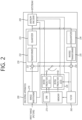
- the predictor may generate various information about prediction, such as prediction mode information, to transfer the generated information to the entropy encoder 240 as described later in the description of each prediction mode.
- the information about prediction may be encoded by the entropy encoder 240 to be output in a form of the bitstream.
- the IBC may use at least one of inter prediction techniques described in the present document.
- the palette mode may be regarded as an example of intra coding or intra prediction. When the palette mode is applied, a sample value in a picture may be signaled based on information on a palette index and a palette table.
- the quantizer 233 may quantize the transform coefficients to transmit the quantized transform coefficients to the entropy encoder 240, and the entropy encoder 240 may encode the quantized signal (information about the quantized transform coefficients) to the encoded quantized signal to the bitstream.
- the information about the quantized transform coefficients may be called residual information.
- the quantizer 233 may rearrange the quantized transform coefficients having a block form in a one-dimensional vector form based on a coefficient scan order, and also generate the information about the quantized transform coefficients based on the quantized transform coefficients of the one dimensional vector form.
- LMCS luma mapping with chroma scaling
- the filter 260 may apply filtering to the reconstructed signal, thereby improving subjective/objective image qualities.
- the filter 260 may apply various filtering methods to the reconstructed picture to generate a modified reconstructed picture, and store the modified reconstructed picture in the memory 270, specifically, the DPB of the memory 270.
- Various filtering methods may include, for example, a deblocking filtering, a sample adaptive offset, an adaptive loop filter, a bilateral filter, and the like.
- the filter 260 may generate various filtering-related information to transfer the generated information to the entropy encoder 240, as described later in the description of each filtering method.
- the filtering-related information may be encoded by the entropy encoder 240 to be output in a form of the bitstream.
- the modified reconstructed picture transmitted to the memory 270 may be used as the reference picture in the inter predictor 221. If the inter prediction is applied by the inter predictor, the encoding apparatus may avoid the prediction mismatch between the encoding apparatus 200 and the decoding apparatus, and also improve coding efficiency.
- FIG. 3 is a diagram for schematically explaining a configuration of a video/image decoding apparatus to which the present document is applicable.
- the decoding apparatus may include an image decoding apparatus and/or a video decoding apparatus.
- the decoding apparatus 300 may reconstruct the image in response to a process in which the video/image information is processed in the encoding apparatus illustrated in FIG. 2 .
- the decoding apparatus 300 may derive the units/blocks based on block split-related information acquired from the bitstream.
- the decoding apparatus 300 may perform decoding using the processing unit applied to the encoding apparatus. Therefore, the processing unit for the decoding may be, for example, a coding unit, and the coding unit may be split according to the quad-tree structure, the binary-tree structure, and/or the ternary-tree structure from the coding tree unit or the maximum coding unit.
- One or more transform units may be derived from the coding unit.
- the reconstructed image signal decoded and output through the decoding apparatus 300 may be reproduced through a reproducing apparatus.
- a receiver for receiving the signal output from the encoding apparatus may be further configured as the internal/external element of the decoding apparatus 300, or the receiver may also be a component of the entropy decoder 310.
- the decoding apparatus according to this document may be called a video/image/picture decoding apparatus, and the decoding apparatus may also be classified into an information decoder (video/image/picture information decoder) and a sample decoder (video/image/picture sample decoder).
- the intra predictor 331 may predict the current block with reference to the samples within the current picture.
- the referenced samples may be located neighboring to the current block according to the prediction mode, or may also be located away from the current block.
- the prediction modes in the intra prediction may include a plurality of non-directional modes and a plurality of directional modes.
- the intra predictor 331 may also determine the prediction mode applied to the current block using the prediction mode applied to the neighboring block.
- the (modified) reconstructed picture stored in the DPB of the memory 360 may be used as the reference picture in the inter predictor 332.
- the memory 360 may store motion information of the block in which the motion information within the current picture is derived (decoded) and/or motion information of the blocks within the previously reconstructed picture.
- the stored motion information may be transferred to the inter predictor 260 to be utilized as motion information of the spatial neighboring block or motion information of the temporal neighboring block.
- the memory 360 may store the reconstructed samples of the reconstructed blocks within the current picture, and transfer the stored reconstructed samples to the intra predictor 331.
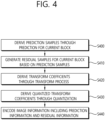
- the encoding apparatus may derive transform coefficients through a transform process for residual samples (S420), and may derive quantized transform coefficients by quantizing the derived transform coefficients (S430).
- the output bitstream may be transferred to a decoding apparatus through a storage medium or a network.
- FIG. 5 illustrates an example of a schematic video/image decoding procedure to which embodiments of the present document are applicable.
- the method disclosed in FIG. 5 may be performed by the decoding apparatus 300 of FIG. 3 as described above.
- S500 may be performed by the inter predictor 332 or the intra predictor 331 of the decoding apparatus 300.
- a process of deriving values of related syntax elements by decoding prediction information included in the bitstream may be performed by the entropy decoder 310 of the decoding apparatus 300.
- S510, S520, S530, and S540 may be performed by the entropy decoder 310, the dequantizer 321, the inverse transformer 322, and the adder 340 of the decoding apparatus 300, respectively.
- the encoding apparatus may perform entropy encoding based on various encoding methods, for example, such as exponential Golomb, context-adaptive variable length coding (CAVLC), and context-adaptive binary arithmetic coding (CABAC). Further, the decoding apparatus may perform entropy decoding based on the coding method, such as the exponential Golomb coding, CAVLC, or CABAC.
- entropy encoding/decoding process will be described.
- the encoding apparatus may perform binarization for a target syntax element (S600).
- the binarization may be based on various binarization methods, such as truncated rice binarization process and fixed-length binarization process, and the binarization method for the target syntax element may be predefined.
- the binarization process may be performed by the binarizer 242 in the entropy encoder 240.
- the decoding apparatus may decode encoded image/video information.
- the image/video information may include partitioning-related information, prediction-related information (e.g., inter/intra prediction classification information, intra prediction mode information, inter prediction mode information, and the like), residual information, and in-loop filtering related information, and may also include various syntax elements thereof.
- the entropy coding may be performed in the unit of a syntax element.
- S800 to S810 may be performed by the entropy decoder 310 of the decoding apparatus 300 of FIG. 3 as described above.
- the residual coding syntax may include syntax elements representing whether the transform has been applied to the corresponding block, where is the position of the last effective transform coefficient in the block, whether an effective transform coefficient is present in a subblock, and what is the size/sign of the effective transform coefficient.
- the (quantized) transform coefficients may be encoded and/or decoded based on the syntax elements, such as last_sig_coeff_x_prefix, last_sig_coeff_y_prefix, last sig_coeff_x_suffix, last_sig_coeff_y_suffix, coded_sub_block_flag, sig_coeff_flag, par_level_flag, abs_level_gtx_flag, abs_remainder, coeff_sign _flag, dec_abs_level included in the residual information.
- This may be called residual (data) coding or (transform) coefficient coding.
- lastScanPos numSbCoeff - 1
- residual samples may be derived for the CB, and the (quantized) transform coefficients may be derived through the transform and quantization with respect to the residual samples as described above, and information (or syntax elements) efficiently representing (the position, size, and sign of) the (quantized) transform coefficients may be generated and signaled through the residual coding process.
- the quantized transform coefficients may be simply called transform coefficients.
- the size of the CB may be equal to the size of the TB, and in this case, the target block that is transformed (and quantized) and residual-coded may be called the CB or TB.
- the transform coefficient may be called a coefficient or residual coefficient, or for unity of expression, may still be called the transform coefficient.
- Whether to omit the transform/inverse transform may be signaled based on the transform _skip_flag. For example, if the value of the transform_skip_flag is 1, it may represent that the transform/inverse transform is omitted, and this may be referred to as a transform skip mode.
- the sample may be indicated as an escape symbol, and a quantized sample value may be directly signaled.
- the pixel or the pixel value may be referred to as the sample or the sample value.
- the palette index may be coded using two kinds of palette sample modes, and for example, "INDEX” mode and "COPY_ABOVE" mode may be used.
- palette modes may be signaled using a flag representing whether the palette mode is the "INDEX” mode or the "COPY_ABOVE” mode.
- the escape symbol may be signaled in the "INDEX” mode, and an index having the same size as the current palette size may be allocated. For example, if it is assumed that the size of the current palette is 10, No. 0 to No. 9 indexes may mean entry indexes in the palette, and No. 10 index may mean an index for the escape symbol.
- the flag may be signaled excluding the top row, and in case that the vertical scan is used, or the previous mode is the "COPY_ABOVE" mode, the flag may be signaled excluding the first column.
- the palette index of the sample of the row on the top may be copied.
- the palette index may be explicitly signaled.
- the run value representing the number of next samples being coded using the same mode may be signaled.
- escape component values may be signaled with respect to each escape symbol.
- the quantized residual domain BDPCM may be proposed as an alternative of the BDPCM, and the prediction direction or signaling may be equal to the BDPCM applied to the spatial domain. That is, the residual may be reconstructed through the dequantization after the quantization coefficients themselves are built up like delta pulse code modulation (DPCM) through the quantized residual domain BDPCM. Accordingly, the quantized residual domain BDPCM may be used as the meaning that a residual coding end applies the DPCM.
- the quantized residual domain used hereinafter is obtained by quantizing the residual derived based on the prediction without being transformed, and means a domain for the quantized residual sample.
- the BDPCM may be applied to the quantized residual domain
- the quantized residual domain may include the quantized residual (or quantized residual coefficient), and in this case, the transform skip may be applied with respect to the residual. That is, in case that the BDPCM is applied, the transform may be skipped and the quantization may be applied with respect to the residual sample. Further, the quantized residual domain may include the quantized transform coefficient.
- a flag representing whether the BDPCM is applicable may be signaled at a sequence level (SPS), and such a flag may be signaled only in case of being signaled that the transform skip mode is possible at the SPS. The flag may be called a BDPCM enabled flag or SPS BDPCM enabled flag.
- intra prediction may be performed with respect to entire blocks by sample copy according to a prediction direction (e.g., vertical prediction or horizontal prediction) similar to the intra prediction direction.
- the residual that is the difference value between the original and the prediction blocks may be quantized through skipping of the transform, and a delta value, that is, the difference value between the quantized residual and the predictor in the horizontal or vertical direction (i.e., quantized residual in the horizontal or vertical direction), may be coded.
- transform skip (enabled) flag e.g., sps_transform_skip_enabled_flag
- minimum quantization parameter information for transform skip e.g., min_qp_prime_ts_minus4
- information on whether to apply the BDPCM e.g., sps_bdpcm_enabled_flag
- the value of the transform skip (enabled) flag is defined as 1, the related flag or information syntax elements should be necessarily transmitted, whereas if the value of the transform skip (enabled) flag is defined as 0, the syntax elements excluding the transform skip (enabled) flag syntax element may not be transmitted.
- syntax elements related to the transform skip based coding may be defined in the high-level syntax set, and may be defined in a sequence parameter set (SPS) as in an embodiment in Table 6 below.
- SPS sequence parameter set
- the min_qp_prime_ts_minus4 syntax element may represent the minimum allowed quantization parameter allowed for the transform skip mode. For example, based on the min_qp_prime_ts_minus4 syntax element, the minimum quantization parameter value (e.g., QpPrimeTsMin) in the transform skip mode may be derived. Based on the minimum quantization parameter in the transform skip mode, the quantization parameter being used in a scaling process (dequantization process) may be derived. Further, a scaled transform coefficient (dequantized transform coefficient) may be derived by performing the scaling process (dequantization process) for the current block based on the quantization parameter, and based on this, a residual sample of the current block may be derived.
- the minimum quantization parameter value e.g., QpPrimeTsMin
- the quantization parameter being used in a scaling process may be derived.
- a scaled transform coefficient (dequantized transform coefficient) may be derived by performing the scaling process (dequantization process) for the current block
- syntax elements having dependency may be defined with respect to the transform skip enabled flag syntax element (e.g., sps transform_skip_enabled_flag) among the syntax elements related to the transform skip.
- the transform skip enabled flag e.g., sps transform_skip_enabled_flag
- the min_qp_prime ts minus4 syntax element representing the minimum quantization parameter information for the transform skip block in the transform skip mode and the sps_bdpcm_enabled_flag syntax element representing whether the BDPCM is enabled may have dependency.
- the transform kip enabled flag e.g., sps_transform_skip_enabled_flag
- the min_qp_prime_ts_minus4 syntax element and the sps_bdpcm_enabled_flag syntax element may be parsed/signaled.
- the value of the transform skip enabled flag e.g., sps transform_skip_enabled_flag
- the min_qp_prime_ts_minus4 syntax element and the sps_bdpcm_enabled_flag syntax element may not be parsed/signaled.
- the transform skip (enabled) flag As an example, if the value of the transform skip (enabled) flag is defined as 1, the related flag or information syntax elements should be necessarily transmitted, whereas if the value of the transform skip (enabled) flag is defined as 0, the syntax elements excluding the transform skip (enabled) flag syntax element may not be transmitted.
- sps_bdpcm_enabled_flag 0 specifies that intra_bdpcm_flag is not present in the coding unit syntax for intra coding units. When not present, the value of sps_bdpcm_enabled_flag is inferred to be equal to 0.
- the present document proposes a method for saving bits being transmitted by enabling the syntax element having dependency to determine whether to perform parsing/signaling according to the dependent condition with respect to the transform skip related high-level syntax element and the palette coding related high-level syntax element.
- proposed is a method for parsing the high-level syntax element having dependency by the transform skip (enabled) flag and/or the palette coding (enabled) flag.
- transform skip (enabled) flag e.g., sps_transform_skip_enabled_flag
- information on the transform skip application size e.g., log2_transform_skip_max_size_minus2
- minimum quantization parameter information for the transform skip e.g., min_qp_prime_ts_minus4
- information on whether the BDPCM is applied e.g., sps_bdpcm_enabled_flag.
- the minimum quantization parameter information for the transform skip may be used in performing the quantization.
- the syntax elements related to the transform skip based coding and/or the palette mode based coding may be defined in the high-level syntax set, and may be defined in the sequence parameter set (SPS) as in an embodiment of Table 10 below.
- SPS sequence parameter set
- sps_transform_skip_enabled_flag equa to 1 specifies that transform_skip_flag may be present in the transform unit syntax.
- sps_transform_skip_enabled_flag 0 specifies that transform_skip_flag is not present in the transform unit syntax.
- sps_bdpcm_enabled_flag 1 specifies that intra_bdpcm_flag may be present in the coding unit syntax for intra coding units.
- sps_palette_enabled_flag 0 specifies that pred_mode_plt_flag is not present in the coding unit syntax. When sps_palette_enabled_flag is not present, it is inferred to be equal to 0.
- log2_transform_skip_max_size_minus2 When not present, the value of log2_transform_skip_max_size_minus2 is inferred to be equal to 0.
- the variable MaxTsSize is set equal to 1 ⁇ ( log2_transform_skip max_size_minus2 + 2 ).
- sps_palette_enabled_flag 1 specifies that pred_mode_plt_flag may be present in the coding unit syntax.
- sps_palette_enabled_flag 0 specifies that pred_mode_plt_flag is not present in the coding unit syntax.
- sps_palette_enabled_flag When sps_palette_enabled_flag is not present, it is inferred to be equal to 0.
- syntax elements having dependency may be defined with respect to the transform skip enabled flag syntax element (e.g., sps_transform_skip_enabled_flag) and/or the palette coding enabled flag syntax element (e.g., sps_ palette enabled flag) among the syntax elements related to the transform skip and/or the palette coding.
- the transform skip enabled flag syntax element e.g., sps_transform_skip_enabled_flag
- palette coding enabled flag syntax element e.g., sps_ palette enabled flag
- the syntax elements related to the transform skip based coding and/or the palette mode based coding may be defined in the high-level syntax set, and may be defined in the sequence parameter set (SPS) as in an embodiment of Table 15 below.
- SPS sequence parameter set
- sps_transform_skip_enabled_flag equa to 1 specifies that transform_skip_flag may be present in the transform unit syntax.
- sps_transform_skip_enabled_flag 0 specifies that transform_skip_flag is not present in the transform unit syntax.
- sps_bdpcm_enabled_flag 1 specifies that intra_bdpcm_flag may be present in the coding unit syntax for intra coding units.
- sps_bdpcm_enabled_flag 0 specifies that intra_bdpcm_flag is not present in the coding unit syntax for intra coding units. When not present, the value of sps_bdpcm_enabled_flag is inferred to be equal to 0.
- sps_palette_enabled_flag 0 specifies that pred_mode_plt_flag is not present in the coding unit syntax. When sps_palette_enabled_flag is not present, it is inferred to be equal to 0.
- syntax elements having dependency may be defined with respect to the palette coding enabled flag syntax element (e.g., sps_palette_enabled_flag) among the syntax elements related to the transform skip and/or the palette coding.
- the min_qp_prime_ts_chroma_minus4 syntax element representing the minimum quantization parameter information in the transform skip mode for the chroma component based on the value of the palette coding enabled flag (e.g., sps_palette_enabled_flag) may have the dependency in the SPS.
- syntax elements having dependency may be defined with respect to the transform skip enabled flag syntax element (e.g., sps_transform_skip_enabled_flag) and/or the palette coding enabled flag syntax element (e.g., sps_ palette enabled flag) among the syntax elements related to the transform skip and/or the palette coding.
- the transform skip enabled flag syntax element e.g., sps_transform_skip_enabled_flag
- palette coding enabled flag syntax element e.g., sps_ palette enabled flag
- the min_qp_prime_ts_luma_minus4 syntax element representing the minimum quantization parameter information in the transform skip mode for the luma component based on the value of the transform skip enabled flag (e.g., sps _transform_skip_enabled_flag) and/or the palette coding enabled flag syntax element (e.g., sps_palette_enabled_flag) may have the dependency in the SPS.
- the present document proposes a method for saving bits being transmitted by enabling the syntax element having dependency to determine whether to perform parsing/signaling in accordance with the dependent condition with respect to the transform skip related high-level syntax element and the palette coding related high-level syntax element.
- a method for parsing the high-level syntax element having dependency by the transform skip (enabled) flag and the palette coding (enabled) flag is proposed.
- the semantic of the syntax element for the above-described embodiment among the syntax elements of the SPS syntax may be represented as in Table 18 below.
- Table 18 sps_transform_skip_enabled_flag equa to 1 specifies that transform_skip_flag may be present in the transform unit syntax.
- sps_transform_skip_enabled_flag 0 specifies that transform_skip_flag is not present in the transform unit syntax.
- sps_bdpcm_enabled_flag 1 specifies that intra_bdpcm_flag may be present in the coding unit syntax for intra coding units.
- the transform skip enabled flag e.g., sps_transform_skip_enabled_flag
- the syntax elements of the sps_bdpcm_enabled_flag and the log2_transform_skip_max_size_minus2 may be parsed/signaled.
- the value of the transform skip enabled flag e.g., sps_transform_skip_enabled_flag
- the syntax elements of the sps_bdpcm_enabled_flag and the log2_transform_skip_max_size_minus2 may not be parsed/signaled.
- the transform skip enabled information is information on whether the transform skip is enabled, and as disclosed in Table 6 to Table 18, it may be represented as the sps_transform_skip_enabled_flag syntax element. For example, if the value of the sps_transform_skip_enabled_flag is 1, it represents that the transform skip is enabled, and in this case, the transform_skip_flag is parsed/signaled through the transform unit syntax.
- the transform_skip_flag syntax element represents whether the transform can be applied to the associated transform block.
- image information may include various kinds of information according to the above-described embodiment(s) in the present document, and may include information disclosed in at least one of Tables 1 to 18 as described above.
- the SPS may be configured to parse/signal BDPCM enabled flag information (e.g., sps_bdpcm_enabled_flag) on whether to enable the BDPCM based on the value of the transform skip enabled information (e.g., sps_transform_skip_enabled_flag).
- BDPCM enabled flag information e.g., sps_bdpcm_enabled_flag
- the transform skip enabled flag information e.g., sps_transform_skip_enabled_flag
- the BDPCM enabled flag information e.g., sps_bdpcm_enabled_flag
- the information e.g., sps_bdpcm_enabled_flag
- the BDPCM flag information (e.g., intra_bdpcm_flag) on whether to apply the BDPCM to the current block) may be parsed/signaled through the coding unit syntax.
- the palette prediction mode flag information (e.g., pred_mode_pit_flag) may be included in the coding unit syntax, and the information (e.g., pred_mode_pit_flag) may be parsed/signaled from the coding unit syntax. Further, if the value of the palette coding enabled information (e.g., sps_palette_enabled_flag) is 0, the palette prediction mode flag information (e.g., pred_mode_plt_flag) may not be parsed/signaled from the coding unit syntax.
- the quantization parameter for an escape value of the current block is derived based on the minimum quantization parameter information (e.g., min_qp_prime_ts_minus4).
- the quantized escape value e.g., palette_escape_val
- the process in which the palette coding mode is applied may be performed as disclosed in Table 4 and Table 5 above.
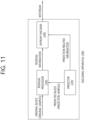
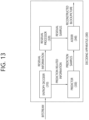
- a process of receiving prediction information for the current block may be performed by the entropy decoder 310 of the decoding apparatus 300, and a process of deriving a prediction sample of the current block may be performed by the predictor 330 of the decoding apparatus 300.
- the method disclosed in FIG. 12 may include the above-described embodiments of the present document to be performed. Accordingly, referring to FIG. 12 , the detailed explanation of the duplicate contents of the above-described embodiments will be omitted or simplified.
- the decoding apparatus receives image information (or video information) from a bitstream (S 1200).
- the decoding apparatus derives information (e.g., video/image information) necessary for image reconstruction (or picture reconstruction) by parsing the bitstream.
- the image information includes residual information, and the residual information may include value information of quantized transform coefficients, location information, transform technique, transform kernel, and quantization parameter information.
- the image information may include prediction-related information (e.g., prediction mode information).
- the image information includes information related to the transform skip, for example, transform skip enabled information and transform skip flag information. That is, the image information may include various kinds of information necessary in the decoding process, and may be decoded based on a coding method, such as exponential Golomb coding, CAVLC, or CABAC.
- image information may include various kinds of information according to the above-described embodiments of the present document, and may include information disclosed in at least one of Tables 1 to 18 as described above.
- the image information may include a sequence parameter set (SPS).
- SPS may include transform skip related information and palette coding related information.
- the transform skip related information may include transform skip enabled information (e.g., sps_transform_skip_enabled_flag), BDPCM enabled information (e.g., sps_bdpcm_enabled_flag), information on the maximum block size used in the transform skip mode (e.g., log2_transform_skip_max_size_minus2), and the minimum quantization parameter information related to the minimum allowed quantization parameter for the transform skip mode (e.g., min_qp_ prime ts minus4).
- transform skip enabled information e.g., sps_transform_skip_enabled_flag
- BDPCM enabled information e.g., sps_bdpcm_enabled_flag
- information on the maximum block size used in the transform skip mode e.g., log2_transform
- the palette coding related information may include palette coding enabled information (e.g., sps_palette_enabled_flag) and the minimum quantization parameter information related to the minimum allowed quantization parameter for the transform skip mode (e.g., min_qp_prime_ts_minus4).
- palette coding enabled information e.g., sps_palette_enabled_flag
- minimum quantization parameter information related to the minimum allowed quantization parameter for the transform skip mode e.g., min_qp_prime_ts_minus4
- information having dependency may be defined with respect to the transform skip enabled information (e.g., sps_transform_skip_enabled_flag).
- the transform skip enabled flag information e.g., sps_transform_skip_enabled_flag
- the BDPCM enabled flag information e.g., sps_bdpcm_enabled_flag
- the information e.g., sps_bdpcm_enabled_flag
- the BDPCM enabled flag information e.g., sps_bdpcm_enabled_flag
- the SPS the transform skip enabled flag information
- the BDPCM flag information (e.g., intra_bdpcm_flag) on whether to apply the BDPCM to the current block) may be parsed/signaled through the coding unit syntax.
- the BDPCM flag information (e.g., intra_bdpcm_enabled_flag) may be included in the coding unit syntax, and the information (e.g., intra_bdpcm_flag) may be parsed/signaled from the coding unit syntax. Further, if the value of the BDPCM enabled flag information (e.g., sps_bdpcm_enabled_flag) is 0, the BDPCM flag information (e.g., intra_bdpcm_flag) may not be parsed/signaled from the coding unit syntax.
- the transform skip enabled flag information e.g., sps_transform_skip_enabled_flag
- the information on the maximum block size e.g., log2_transform_skip_max_size_minus2 used in the transform skip mode may be included in the SPS, and the information (e.g., log2_transform_skip_max_size_minus2) may be parsed/signaled from the SPS.
- transform skip flag information (e.g., transform_skip_flag) on whether to apply the transform skip to the current block may be parsed/signaled through the transform unit syntax.
- the transform skip flag information (e.g., transform_skip_flag) may be included in the transform unit syntax, and the information (e.g., transform_skip_flag) may be parsed/signaled from the transform unit syntax.
- information having dependency may be defined with respect to the palette coding enabled information on whether the palette coding is enabled (e.g., sps_palette_enabled_flag).
- palette coding enabled information e.g., sps_palette_enabled_flag
- palette prediction mode flag information e.g., pred_mode_plt_flag
- the palette prediction mode flag information (e.g., pred_mode_pit_flag) may be included in the coding unit syntax, and the information (e.g., pred_mode_pit_flag) may be parsed/signaled from the coding unit syntax. Further, if the value of the palette coding enabled information (e.g., sps_palette_enabled_flag) is 0, the palette prediction mode flag information (e.g., pred_mode_plt_flag) may not be parsed/signaled from the coding unit syntax.
- information having dependency may be defined with respect to the transform skip enabled information (e.g., sps_transform_skip_enabled_flag) and/or the palette coding enabled information (e.g., sps_palette_enabled_flag).
- transform skip enabled information e.g., sps_transform_skip_enabled_flag
- palette coding enabled information e.g., sps_palette_enabled_flag
- the minimum quantization parameter information (e.g., min_qp_prime_ts_minus4) related to the minimum allowed quantization parameter for the transform skip mode may be parsed/signaled.
- the decoding apparatus determines whether to apply the transform to the current block based on the transform skip enabled information (S1210).
- the transform skip enabled information is information on whether the transform skip is enabled, and may be represented as the sps_transform_skip_enabled_flag syntax element as disclosed in Table 6 to Table 18. For example, if the value of the sps transform skip_enabled_flag is 1, it may represent that the transform skip is enabled, and in this case, the transform_skip_flag may be parsed/signaled through the transform unit syntax.
- the transform_skip_flag syntax element may represent whether the transform can be applied to the associated transform block.
- transform skip flag e.g., transform_skip_flag
- transform skip mode a mode in which the transform is not applied
- the transform skip flag e.g., transform_skip_flag
- the decoding apparatus derives the residual sample based on whether to apply the transform and the residual information (S 1220).
- the decoding apparatus and the encoding apparatus to which the present document is applied may be included in a multimedia broadcasting transceiver, a mobile communication terminal, a home cinema video device, a digital cinema video device, a surveillance camera, a video chat device, and a real time communication device such as video communication, a mobile streaming device, a storage medium, a camcorder, a video on demand (VoD) service provider, an Over The Top (OTT) video device, an internet streaming service provider, a 3D video device, a Virtual Reality (VR) device, an Augment Reality (AR) device, an image telephone video device, a vehicle terminal (for example, a vehicle (including an autonomous vehicle) terminal, an airplane terminal, or a ship terminal), and a medical video device; and may be used to process an image signal or data.
- the OTT video device may include a game console, a Blu-ray player, an Internet-connected TV, a home theater system, a smartphone, a tablet PC, and a Digital Video Recorder (DVR
- the processing method to which the present document is applied may be produced in the form of a program executed by a computer and may be stored in a computer-readable recording medium.
- Multimedia data having a data structure according to the present document may also be stored in the computer-readable recording medium.
- the computer readable recording medium includes all kinds of storage devices and distributed storage devices in which computer readable data is stored.
- the computer-readable recording medium may include, for example, a Blu-ray disc (BD), a universal serial bus (USB), a ROM, a PROM, an EPROM, an EEPROM, a RAM, a CD-ROM, a magnetic tape, a floppy disk, and an optical data storage device.
- the computer-readable recording medium also includes media embodied in the form of a carrier wave (for example, transmission over the Internet).
- a bitstream generated by the encoding method may be stored in the computer-readable recording medium or transmitted through a wired or wireless communication network.
- FIG. 14 represents an example of a contents streaming system to which the embodiment of the present document may be applied.
- the content streaming system to which the embodiments of the present document is applied may generally include an encoding server, a streaming server, a web server, a media storage, a user device, and a multimedia input device.
- the streaming server may receive contents from the media storage and/or the encoding server. For example, in a case the contents are received from the encoding server, the contents may be received in real time. In this case, the streaming server may store the bitstream for a predetermined period of time to provide the streaming service smoothly.
- Each of servers in the contents streaming system may be operated as a distributed server, and in this case, data received by each server may be processed in distributed manner.
Landscapes
- Engineering & Computer Science (AREA)
- Multimedia (AREA)
- Signal Processing (AREA)
- Physics & Mathematics (AREA)
- Discrete Mathematics (AREA)
- General Physics & Mathematics (AREA)
- Compression Or Coding Systems Of Tv Signals (AREA)
Claims (4)
- Procédé de décodage d'image pour le codage vidéo polyvalent, VVC, exécuté par un appareil de décodage, le procédé comprenant:l'obtention d'informations d'image comprenant des informations résiduelles et des informations de saut de transformation activé à partir d'un flux binaire;l'obtention d'informations d'indicateur de saut de transformation en fonction de la valeur des informations de saut de transformation activé, les informations de saut de transformation activé indiquant si le saut de transformation est activé, et i) la valeur des informations de saut de transformation activé égale à 1 indique que le saut de transformation est activé et que les informations d'indication de saut de transformation sont présentes dans la syntaxe de l'unité de transformation, et ii) la valeur des informations de saut de transformation activé égale à 0 indique que le saut de transformation n'est pas activé et que les informations d'indication de saut de transformation ne sont pas présentes dans la syntaxe de l'unité de transformation;la détermination si une transformation est appliquée à un bloc actuel sur la base des informations d'indicateur de saut de transformation;la déduction d'un échantillon résiduel en fonction de l'application ou non de la transformation et des informations résiduelles; etla génération d'un échantillon reconstruit sur la base de l'échantillon résiduel,dans lequel les informations d'image comprennent des informations de codage de palette activé pour indiquer si un mode palette est activé, et dans lequel i) une valeur des informations de codage de palette activé égale à 1 indique que le mode palette est activé, et ii) la valeur des informations de codage de palette activé égale à 0 indique que le mode palette n'est pas activé,dans lequel, à condition que la valeur des informations de saut de transformation activé soit égale à 1 et que la valeur des informations de codage de palette activé soit égale à 1, les informations d'image comprennent en outre des informations de paramètre de quantification minimum concernant un paramètre de quantification minimum autorisé pour un mode de saut de transformation, et dans lequel, à condition que la valeur des informations de saut de transformation activé et la valeur des informations de codage de palette soient toutes deux égales à 0, les informations de paramètre de quantification minimum ne sont pas incluses dans les informations d'image,dans lequel, dans le cas où le saut de transformation serait appliqué au bloc actuel, un paramètre de quantification pour le bloc actuel est dérivé sur la base des informations de paramètre de quantification minimum, et dans lequel, dans le cas où le mode palette serait appliqué au bloc actuel, le paramètre de quantification pour le bloc actuel est dérivé sur la base des informations de paramètre de quantification minimum,dans lequel, dans le cas où le saut de transformation serait appliqué au bloc actuel, l'échantillon résiduel est dérivé sur la base du paramètre de quantification, et dans le cas où le mode palette serait appliqué au bloc actuel, une valeur d'échappement est dérivée sur la base du paramètre de quantification.
- Procédé de codage d'image pour le codage vidéo polyvalent, VVC, exécuté par un appareil de codage, le procédé comprenant:la détermination s'il faut appliquer une transformation à un bloc actuel sur la base des informations de saut de transformation activé;la génération d'informations d'indicateur de saut de transformation en fonction de l'application ou non du saut de transformation;la génération d'informations résiduelles sur le bloc actuel en fonction de l'application ou non de la transformation; etle codage d'informations d'image comprenant les informations de saut de transformation activé et des informations résiduelles,dans lequel les informations de saut de transformation activé indiquant si le saut de transformation est activé, et i) une valeur des informations de saut de transformation activé égale à 1 indique que le saut de transformation est activé et que les informations d'indication de saut de transformation sont présentes dans la syntaxe de l'unité de transformation, et ii) la valeur des informations de saut de transformation activé égale à 0 indique que le saut de transformation n'est pas activé et que les informations d'indication de saut de transformation ne sont pas présentes dans la syntaxe de l'unité de transformation,dans lequel les informations d'image comprennent des informations de codage de palette activé pour indiquer si un mode palette est activé, et dans lequel i) une valeur des informations de codage de palette activé égale à 1 indique que le mode palette est activé, et ii) la valeur des informations de codage de palette activé égale à 0 indique que le mode palette n'est pas activé,dans lequel, à condition que la valeur des informations de saut de transformation activé soit égale à 1 et que la valeur des informations de codage de palette activé soit égale à 1, les informations d'image comprennent en outre des informations de paramètre de quantification minimum concernant un paramètre de quantification minimum autorisé pour un mode de saut de transformation, et dans lequel, à condition que la valeur des informations de saut de transformation activé et la valeur des informations de codage de palette soient toutes deux égales à 0, les informations de paramètre de quantification minimum ne sont pas incluses dans les informations d'image,dans lequel, dans le cas où le saut de transformation serait appliqué au bloc actuel, un paramètre de quantification pour le bloc actuel est déterminé sur la base des informations de paramètre de quantification minimum, et dans lequel, dans le cas où le mode palette serait appliqué au bloc actuel, le paramètre de quantification pour le bloc actuel est déterminé sur la base des informations de paramètre de quantification minimum.
- Support d'enregistrement non transitoire lisible par ordinateur stockant un flux binaire pour le codage vidéo polyvalent, VVC, généré selon un procédé, le procédé comprenant: la détermination de l'application d'une transformation à un bloc actuel sur la base d'informations de saut de transformation activé, la génération d'informations d'indication de saut de transformation sur la base de l'application de la transformation, la génération d'informations résiduelles sur le bloc actuel sur la base de l'application du saut de transformation, et la génération du flux binaire par le codage d'informations d'image comprenant les informations de saut de transformation activé et les informations résiduelles,dans lequel les informations de saut de transformation activé indiquant si le saut de transformation est activé, et i) une valeur des informations de saut de transformation activé égale à 1 indique que le saut de transformation est activé et que les informations d'indication de saut de transformation sont présentes dans la syntaxe de l'unité de transformation, et ii) la valeur des informations de saut de transformation activé égale à 0 indique que le saut de transformation n'est pas activé et que les informations d'indication de saut de transformation ne sont pas présentes dans la syntaxe de l'unité de transformation,dans lequel les informations d'image comprennent des informations de codage de palette activé pour indiquer si un mode palette est activé, et dans lequel i) une valeur des informations de codage de palette activé égale à 1 indique que le mode palette est activé, et ii) la valeur des informations de codage de palette activé égale à 0 indique que le mode palette n'est pas activé,dans lequel, à condition que la valeur des informations de saut de transformation activé soit égale à 1 et que la valeur des informations de codage de palette activé soit égale à 1, les informations d'image comprennent en outre des informations de paramètre de quantification minimum concernant un paramètre de quantification minimum autorisé pour un mode de saut de transformation, et dans lequel, à condition que la valeur des informations de saut de transformation activé et la valeur des informations de codage de palette soient toutes deux égales à 0, les informations de paramètre de quantification minimum ne sont pas incluses dans les informations d'image,dans lequel, dans le cas où le saut de transformation serait appliqué au bloc actuel, un paramètre de quantification pour le bloc actuel est déterminé sur la base des informations de paramètre de quantification minimum, et dans lequel, dans le cas où le mode palette serait appliqué au bloc actuel, le paramètre de quantification pour le bloc actuel est déterminé sur la base des informations de paramètre de quantification minimum.
- Procédé de transmission de données d'image, pour le codage vidéo versatile, VVC, le procédé de transmission comprenant:la génération d'un flux binaire en exécutant le procédé de codage d'image selon la revendication 2; etla transmission des données comprenant le flux binaire.
Priority Applications (3)
| Application Number | Priority Date | Filing Date | Title |
|---|---|---|---|
| RS20250420A RS66766B1 (sr) | 2019-10-05 | 2020-10-05 | Kodiranje slike ili videozapisa na osnovu signalizacije informacija u vezi preskakanja transformacije i kodiranja paletom |
| EP25170053.0A EP4561074B1 (fr) | 2019-10-05 | 2020-10-05 | Codage d'image ou de vidéo basé sur la signalisation d'informations relatives au saut de transformée et au codage de palette |
| HRP20250565TT HRP20250565T1 (hr) | 2019-10-05 | 2020-10-05 | Kodiranje slika ili videa na temelju signaliziranja informacija povezanih s preskakanjem transformacije i kodiranjem paleta |
Applications Claiming Priority (2)
| Application Number | Priority Date | Filing Date | Title |
|---|---|---|---|
| US201962911221P | 2019-10-05 | 2019-10-05 | |
| PCT/KR2020/013495 WO2021066618A1 (fr) | 2019-10-05 | 2020-10-05 | Codage d'image ou de vidéo basé sur la signalisation d'informations liées au saut de transformée et au codage de palette |
Related Child Applications (2)
| Application Number | Title | Priority Date | Filing Date |
|---|---|---|---|
| EP25170053.0A Division EP4561074B1 (fr) | 2019-10-05 | 2020-10-05 | Codage d'image ou de vidéo basé sur la signalisation d'informations relatives au saut de transformée et au codage de palette |
| EP25170053.0A Division-Into EP4561074B1 (fr) | 2019-10-05 | 2020-10-05 | Codage d'image ou de vidéo basé sur la signalisation d'informations relatives au saut de transformée et au codage de palette |
Publications (5)
| Publication Number | Publication Date |
|---|---|
| EP4040792A1 EP4040792A1 (fr) | 2022-08-10 |
| EP4040792A4 EP4040792A4 (fr) | 2023-11-15 |
| EP4040792B1 true EP4040792B1 (fr) | 2025-04-16 |
| EP4040792C0 EP4040792C0 (fr) | 2025-04-16 |
| EP4040792B9 EP4040792B9 (fr) | 2025-07-16 |
Family
ID=75338443
Family Applications (2)
| Application Number | Title | Priority Date | Filing Date |
|---|---|---|---|
| EP25170053.0A Active EP4561074B1 (fr) | 2019-10-05 | 2020-10-05 | Codage d'image ou de vidéo basé sur la signalisation d'informations relatives au saut de transformée et au codage de palette |
| EP20872437.7A Active EP4040792B9 (fr) | 2019-10-05 | 2020-10-05 | Codage d'image ou de vidéo basé sur la signalisation d'informations liées au saut de transformée et au codage de palette |
Family Applications Before (1)
| Application Number | Title | Priority Date | Filing Date |
|---|---|---|---|
| EP25170053.0A Active EP4561074B1 (fr) | 2019-10-05 | 2020-10-05 | Codage d'image ou de vidéo basé sur la signalisation d'informations relatives au saut de transformée et au codage de palette |
Country Status (12)
| Country | Link |
|---|---|
| US (2) | US12166985B2 (fr) |
| EP (2) | EP4561074B1 (fr) |
| JP (4) | JP7351003B2 (fr) |
| KR (2) | KR102715088B1 (fr) |
| CN (5) | CN117939166A (fr) |
| ES (1) | ES3025935T3 (fr) |
| HR (1) | HRP20250565T1 (fr) |
| HU (1) | HUE071222T2 (fr) |
| MX (5) | MX2022004015A (fr) |
| PL (1) | PL4040792T3 (fr) |
| RS (1) | RS66766B1 (fr) |
| WO (1) | WO2021066618A1 (fr) |
Families Citing this family (7)
| Publication number | Priority date | Publication date | Assignee | Title |
|---|---|---|---|---|
| MX2022002304A (es) * | 2019-08-26 | 2022-03-25 | Lg Electronics Inc | Codificacion de imagen o video basada en codificacion de escape de paleta. |
| CN117412066A (zh) * | 2019-10-05 | 2024-01-16 | Lg电子株式会社 | 解码设备、编码设备和发送设备 |
| KR102715088B1 (ko) * | 2019-10-05 | 2024-10-11 | 엘지전자 주식회사 | 변환 스킵 및 팔레트 코딩 관련 정보의 시그널링 기반 영상 또는 비디오 코딩 |
| WO2021170091A1 (fr) * | 2020-02-29 | 2021-09-02 | Beijing Bytedance Network Technology Co., Ltd. | Contraintes pour éléments de syntaxe de haut niveau |
| WO2021208896A1 (fr) | 2020-04-13 | 2021-10-21 | Beijing Bytedance Network Technology Co., Ltd. | Signalisation de drapeaux indicateurs dans un ensemble de paramètres d'image |
| WO2021233449A1 (fr) | 2020-05-22 | 2021-11-25 | Beijing Bytedance Network Technology Co., Ltd. | Bits réservés dans des informations de contrainte générale d'une vidéo |
| CN121037578A (zh) * | 2025-10-30 | 2025-11-28 | 南京美乐威电子科技股份有限公司 | 一种图像编码方法和错误码流替补方法 |
Family Cites Families (16)
| Publication number | Priority date | Publication date | Assignee | Title |
|---|---|---|---|---|
| CN108712652A (zh) * | 2012-06-29 | 2018-10-26 | 韩国电子通信研究院 | 视频编码方法和计算机可读介质 |
| JP5798539B2 (ja) | 2012-09-24 | 2015-10-21 | 株式会社Nttドコモ | 動画像予測符号化装置、動画像予測符号化方法、動画像予測復号装置及び動画像予測復号方法 |
| US11259020B2 (en) * | 2013-04-05 | 2022-02-22 | Qualcomm Incorporated | Determining palettes in palette-based video coding |
| US9558567B2 (en) * | 2013-07-12 | 2017-01-31 | Qualcomm Incorporated | Palette prediction in palette-based video coding |
| US10645399B2 (en) * | 2013-07-23 | 2020-05-05 | Intellectual Discovery Co., Ltd. | Method and apparatus for encoding/decoding image |
| CN104754361B (zh) * | 2013-12-28 | 2018-01-23 | 同济大学 | 图像编码、解码方法及装置 |
| CN104320657B (zh) * | 2014-10-31 | 2017-11-03 | 中国科学技术大学 | Hevc无损视频编码的预测模式选择方法及相应的编码方法 |
| CN114630131B (zh) * | 2014-11-12 | 2023-11-07 | 寰发股份有限公司 | 索引映射编解码中的跳出像素编解码方法 |
| KR20220030999A (ko) * | 2019-06-14 | 2022-03-11 | 프라운호퍼 게젤샤프트 쭈르 푀르데룽 데어 안겐반텐 포르슝 에. 베. | 스케일링에 기초하는 개선된 변환을 갖는 인코더, 디코더, 방법 및 컴퓨터 프로그램 |
| MX2022000007A (es) * | 2019-07-05 | 2022-03-17 | Fraunhofer Ges Forschung | Codificador, decodificador, metodos y programas informaticos para una compresion mejorada sin perdidas. |
| WO2021033749A1 (fr) * | 2019-08-22 | 2021-02-25 | Sharp Kabushiki Kaisha | Systèmes et procédés de signalisation d'informations d'images en codage vidéo |
| KR102957825B1 (ko) * | 2019-08-26 | 2026-04-24 | 엘지전자 주식회사 | 팔레트 모드 기반 영상 또는 비디오 코딩 |
| CN114827605A (zh) * | 2019-09-23 | 2022-07-29 | 北京达佳互联信息技术有限公司 | 用于视频解码的方法和计算设备 |
| KR102715088B1 (ko) * | 2019-10-05 | 2024-10-11 | 엘지전자 주식회사 | 변환 스킵 및 팔레트 코딩 관련 정보의 시그널링 기반 영상 또는 비디오 코딩 |
| WO2021066609A1 (fr) * | 2019-10-05 | 2021-04-08 | 엘지전자 주식회사 | Codage d'image ou de vidéo basé sur un élément de syntaxe avancée lié au codage de saut de transformée et de palette |
| CN117412066A (zh) * | 2019-10-05 | 2024-01-16 | Lg电子株式会社 | 解码设备、编码设备和发送设备 |
-
2020
- 2020-10-05 KR KR1020227009534A patent/KR102715088B1/ko active Active
- 2020-10-05 ES ES20872437T patent/ES3025935T3/es active Active
- 2020-10-05 PL PL20872437.7T patent/PL4040792T3/pl unknown
- 2020-10-05 CN CN202410267270.2A patent/CN117939166A/zh active Pending
- 2020-10-05 CN CN202080082959.8A patent/CN114762336B/zh active Active
- 2020-10-05 JP JP2022520214A patent/JP7351003B2/ja active Active
- 2020-10-05 HU HUE20872437A patent/HUE071222T2/hu unknown
- 2020-10-05 KR KR1020247032721A patent/KR20240151253A/ko active Pending
- 2020-10-05 CN CN202410267236.5A patent/CN117939164A/zh active Pending
- 2020-10-05 WO PCT/KR2020/013495 patent/WO2021066618A1/fr not_active Ceased
- 2020-10-05 CN CN202410267238.4A patent/CN117939165A/zh active Pending
- 2020-10-05 CN CN202410267234.6A patent/CN117956186A/zh active Pending
- 2020-10-05 RS RS20250420A patent/RS66766B1/sr unknown
- 2020-10-05 EP EP25170053.0A patent/EP4561074B1/fr active Active
- 2020-10-05 EP EP20872437.7A patent/EP4040792B9/fr active Active
- 2020-10-05 MX MX2022004015A patent/MX2022004015A/es unknown
- 2020-10-05 HR HRP20250565TT patent/HRP20250565T1/hr unknown
- 2020-10-05 US US17/765,948 patent/US12166985B2/en active Active
-
2022
- 2022-04-01 MX MX2025009498A patent/MX2025009498A/es unknown
- 2022-04-01 MX MX2025009502A patent/MX2025009502A/es unknown
- 2022-04-01 MX MX2025009497A patent/MX2025009497A/es unknown
- 2022-04-01 MX MX2025009503A patent/MX2025009503A/es unknown
-
2023
- 2023-09-11 JP JP2023146837A patent/JP7631455B2/ja active Active
-
2024
- 2024-11-01 US US18/935,072 patent/US20250071276A1/en active Pending
-
2025
- 2025-02-05 JP JP2025017419A patent/JP7769158B2/ja active Active
- 2025-10-30 JP JP2025183364A patent/JP2026012342A/ja active Pending
Non-Patent Citations (1)
| Title |
|---|
| ZHAO (LGE) J ET AL: "Non-CE8: Minimum QP for Palette Escape Coding", no. JVET-P0460 ; m50428, 25 September 2019 (2019-09-25), XP030217369, Retrieved from the Internet <URL:http://phenix.int-evry.fr/jvet/doc_end_user/documents/16_Geneva/wg11/JVET-P0460-v1.zip JVET-P0460.docx> [retrieved on 20190925] * |
Also Published As
Similar Documents
| Publication | Publication Date | Title |
|---|---|---|
| EP4040792B9 (fr) | Codage d'image ou de vidéo basé sur la signalisation d'informations liées au saut de transformée et au codage de palette | |
| US12519966B2 (en) | Image or video coding based on palette mode | |
| US12382013B2 (en) | Image or video coding based on palette coding | |
| US20260082050A1 (en) | Image or video coding based on transform skip- and palette coding-related advanced syntax element | |
| US20250071285A1 (en) | Image or video coding on basis of transform skip - and palette coding-related data | |
| US20220286700A1 (en) | Image or video coding based on palette escape coding | |
| US20260075191A1 (en) | Image or video coding based on quantization parameter information for palette coding or transform unit | |
| US20250150607A1 (en) | Image or video coding based on chroma quantization parameter offset information | |
| US12177485B2 (en) | Image or video coding based on escape binarization in palette mode | |
| US12323631B2 (en) | Image or video coding based on quantization-related information | |
| US12262012B2 (en) | Image or video coding based on signaling of quantization parameter offset-related information |
Legal Events
| Date | Code | Title | Description |
|---|---|---|---|
| REG | Reference to a national code |
Ref country code: HR Ref legal event code: TUEP Ref document number: P20250565T Country of ref document: HR |
|
| STAA | Information on the status of an ep patent application or granted ep patent |
Free format text: STATUS: THE INTERNATIONAL PUBLICATION HAS BEEN MADE |
|
| PUAI | Public reference made under article 153(3) epc to a published international application that has entered the european phase |
Free format text: ORIGINAL CODE: 0009012 |
|
| STAA | Information on the status of an ep patent application or granted ep patent |
Free format text: STATUS: REQUEST FOR EXAMINATION WAS MADE |
|
| 17P | Request for examination filed |
Effective date: 20220330 |
|
| AK | Designated contracting states |
Kind code of ref document: A1 Designated state(s): AL AT BE BG CH CY CZ DE DK EE ES FI FR GB GR HR HU IE IS IT LI LT LU LV MC MK MT NL NO PL PT RO RS SE SI SK SM TR |
|
| DAV | Request for validation of the european patent (deleted) | ||
| DAX | Request for extension of the european patent (deleted) | ||
| REG | Reference to a national code |
Ref country code: DE Ref legal event code: R079 Free format text: PREVIOUS MAIN CLASS: H04N0019600000 Ipc: H04N0019124000 Ref country code: DE Ref legal event code: R079 Ref document number: 602020049705 Country of ref document: DE Free format text: PREVIOUS MAIN CLASS: H04N0019600000 Ipc: H04N0019124000 |
|
| A4 | Supplementary search report drawn up and despatched |
Effective date: 20231013 |
|
| RIC1 | Information provided on ipc code assigned before grant |
Ipc: H04N 19/70 20140101ALI20231009BHEP Ipc: H04N 19/61 20140101ALI20231009BHEP Ipc: H04N 19/176 20140101ALI20231009BHEP Ipc: H04N 19/157 20140101ALI20231009BHEP Ipc: H04N 19/124 20140101AFI20231009BHEP |
|
| STAA | Information on the status of an ep patent application or granted ep patent |
Free format text: STATUS: EXAMINATION IS IN PROGRESS |
|
| 17Q | First examination report despatched |
Effective date: 20240521 |
|
| GRAP | Despatch of communication of intention to grant a patent |
Free format text: ORIGINAL CODE: EPIDOSNIGR1 |
|
| STAA | Information on the status of an ep patent application or granted ep patent |
Free format text: STATUS: GRANT OF PATENT IS INTENDED |
|
| INTG | Intention to grant announced |
Effective date: 20241119 |
|
| GRAS | Grant fee paid |
Free format text: ORIGINAL CODE: EPIDOSNIGR3 |
|
| GRAA | (expected) grant |
Free format text: ORIGINAL CODE: 0009210 |
|
| STAA | Information on the status of an ep patent application or granted ep patent |
Free format text: STATUS: THE PATENT HAS BEEN GRANTED |
|
| AK | Designated contracting states |
Kind code of ref document: B1 Designated state(s): AL AT BE BG CH CY CZ DE DK EE ES FI FR GB GR HR HU IE IS IT LI LT LU LV MC MK MT NL NO PL PT RO RS SE SI SK SM TR |
|
| REG | Reference to a national code |
Ref country code: GB Ref legal event code: FG4D |
|
| REG | Reference to a national code |
Ref country code: CH Ref legal event code: EP Ref country code: DE Ref legal event code: R096 Ref document number: 602020049705 Country of ref document: DE |
|
| REG | Reference to a national code |
Ref country code: IE Ref legal event code: FG4D |
|
| U01 | Request for unitary effect filed |
Effective date: 20250429 |
|
| U07 | Unitary effect registered |
Designated state(s): AT BE BG DE DK EE FI FR IT LT LU LV MT NL PT RO SE SI Effective date: 20250507 |
|
| REG | Reference to a national code |
Ref country code: ES Ref legal event code: FG2A Ref document number: 3025935 Country of ref document: ES Kind code of ref document: T3 Effective date: 20250610 |
|
| REG | Reference to a national code |
Ref country code: SK Ref legal event code: T3 Ref document number: E 46329 Country of ref document: SK |
|
| REG | Reference to a national code |
Ref country code: CH Ref legal event code: PK Free format text: BERICHTIGUNG B9 |
|
| REG | Reference to a national code |
Ref country code: HR Ref legal event code: T1PR Ref document number: P20250565 Country of ref document: HR |
|
| REG | Reference to a national code |
Ref country code: CH Ref legal event code: PK Free format text: BERICHTIGUNG B9 |
|
| REG | Reference to a national code |
Ref country code: GR Ref legal event code: EP Ref document number: 20250401005 Country of ref document: GR Effective date: 20250613 |
|
| REG | Reference to a national code |
Ref country code: HU Ref legal event code: AG4A Ref document number: E071222 Country of ref document: HU |
|
| REG | Reference to a national code |
Ref country code: HR Ref legal event code: ODRP Ref document number: P20250565 Country of ref document: HR Payment date: 20250904 Year of fee payment: 6 |
|
| PGFP | Annual fee paid to national office [announced via postgrant information from national office to epo] |
Ref country code: NO Payment date: 20250911 Year of fee payment: 6 Ref country code: MC Payment date: 20250909 Year of fee payment: 6 Ref country code: GR Payment date: 20250908 Year of fee payment: 6 |
|
| PGFP | Annual fee paid to national office [announced via postgrant information from national office to epo] |
Ref country code: TR Payment date: 20250908 Year of fee payment: 6 Ref country code: PL Payment date: 20250910 Year of fee payment: 6 |
|
| PGFP | Annual fee paid to national office [announced via postgrant information from national office to epo] |
Ref country code: GB Payment date: 20250909 Year of fee payment: 6 |
|
| PGFP | Annual fee paid to national office [announced via postgrant information from national office to epo] |
Ref country code: HR Payment date: 20250904 Year of fee payment: 6 |
|
| PGFP | Annual fee paid to national office [announced via postgrant information from national office to epo] |
Ref country code: IE Payment date: 20250908 Year of fee payment: 6 Ref country code: CZ Payment date: 20250915 Year of fee payment: 6 Ref country code: RS Payment date: 20250904 Year of fee payment: 6 |
|
| PGFP | Annual fee paid to national office [announced via postgrant information from national office to epo] |
Ref country code: SK Payment date: 20250912 Year of fee payment: 6 |
|
| PG25 | Lapsed in a contracting state [announced via postgrant information from national office to epo] |
Ref country code: IS Free format text: LAPSE BECAUSE OF FAILURE TO SUBMIT A TRANSLATION OF THE DESCRIPTION OR TO PAY THE FEE WITHIN THE PRESCRIBED TIME-LIMIT Effective date: 20250816 |
|
| REG | Reference to a national code |
Ref country code: CH Ref legal event code: U11 Free format text: ST27 STATUS EVENT CODE: U-0-0-U10-U11 (AS PROVIDED BY THE NATIONAL OFFICE) Effective date: 20251101 |
|
| PGFP | Annual fee paid to national office [announced via postgrant information from national office to epo] |
Ref country code: HU Payment date: 20251029 Year of fee payment: 6 |
|
| U20 | Renewal fee for the european patent with unitary effect paid |
Year of fee payment: 6 Effective date: 20251022 |
|
| PG25 | Lapsed in a contracting state [announced via postgrant information from national office to epo] |
Ref country code: SM Free format text: LAPSE BECAUSE OF FAILURE TO SUBMIT A TRANSLATION OF THE DESCRIPTION OR TO PAY THE FEE WITHIN THE PRESCRIBED TIME-LIMIT Effective date: 20250416 |
|
| PGFP | Annual fee paid to national office [announced via postgrant information from national office to epo] |
Ref country code: CH Payment date: 20251101 Year of fee payment: 6 |
|
| PGFP | Annual fee paid to national office [announced via postgrant information from national office to epo] |
Ref country code: ES Payment date: 20251117 Year of fee payment: 6 |
|
| PLBE | No opposition filed within time limit |
Free format text: ORIGINAL CODE: 0009261 |
|
| STAA | Information on the status of an ep patent application or granted ep patent |
Free format text: STATUS: NO OPPOSITION FILED WITHIN TIME LIMIT |
|
| REG | Reference to a national code |
Ref country code: CH Ref legal event code: L10 Free format text: ST27 STATUS EVENT CODE: U-0-0-L10-L00 (AS PROVIDED BY THE NATIONAL OFFICE) Effective date: 20260225 |
|
| 26N | No opposition filed |
Effective date: 20260119 |