EP4041013B1 - Conservation des propriétés d'évaporation de l'humidité et de régulation de la température corporelle relatives à des vêtements après impression - Google Patents
Conservation des propriétés d'évaporation de l'humidité et de régulation de la température corporelle relatives à des vêtements après impression Download PDFInfo
- Publication number
- EP4041013B1 EP4041013B1 EP20874664.4A EP20874664A EP4041013B1 EP 4041013 B1 EP4041013 B1 EP 4041013B1 EP 20874664 A EP20874664 A EP 20874664A EP 4041013 B1 EP4041013 B1 EP 4041013B1
- Authority
- EP
- European Patent Office
- Prior art keywords
- garment
- printing
- active
- ink
- region
- Prior art date
- Legal status (The legal status is an assumption and is not a legal conclusion. Google has not performed a legal analysis and makes no representation as to the accuracy of the status listed.)
- Active
Links
Images


Classifications
-
- D—TEXTILES; PAPER
- D06—TREATMENT OF TEXTILES OR THE LIKE; LAUNDERING; FLEXIBLE MATERIALS NOT OTHERWISE PROVIDED FOR
- D06P—DYEING OR PRINTING TEXTILES; DYEING LEATHER, FURS OR SOLID MACROMOLECULAR SUBSTANCES IN ANY FORM
- D06P5/00—Other features in dyeing or printing textiles, or dyeing leather, furs, or solid macromolecular substances in any form
- D06P5/30—Ink jet printing
-
- A—HUMAN NECESSITIES
- A41—WEARING APPAREL
- A41D—OUTERWEAR; PROTECTIVE GARMENTS; ACCESSORIES
- A41D31/00—Materials specially adapted for outerwear
- A41D31/04—Materials specially adapted for outerwear characterised by special function or use
- A41D31/12—Hygroscopic; Water retaining
- A41D31/125—Moisture handling or wicking function through layered materials
-
- B—PERFORMING OPERATIONS; TRANSPORTING
- B41—PRINTING; LINING MACHINES; TYPEWRITERS; STAMPS
- B41M—PRINTING, DUPLICATING, MARKING, OR COPYING PROCESSES; COLOUR PRINTING
- B41M5/00—Duplicating or marking methods; Sheet materials for use therein
- B41M5/0041—Digital printing on surfaces other than ordinary paper
-
- D—TEXTILES; PAPER
- D06—TREATMENT OF TEXTILES OR THE LIKE; LAUNDERING; FLEXIBLE MATERIALS NOT OTHERWISE PROVIDED FOR
- D06M—TREATMENT, NOT PROVIDED FOR ELSEWHERE IN CLASS D06, OF FIBRES, THREADS, YARNS, FABRICS, FEATHERS OR FIBROUS GOODS MADE FROM SUCH MATERIALS
- D06M16/00—Biochemical treatment of fibres, threads, yarns, fabrics, or fibrous goods made from such materials, e.g. enzymatic
-
- D—TEXTILES; PAPER
- D06—TREATMENT OF TEXTILES OR THE LIKE; LAUNDERING; FLEXIBLE MATERIALS NOT OTHERWISE PROVIDED FOR
- D06Q—DECORATING TEXTILES
- D06Q1/00—Decorating textiles
Definitions
- the present invention in some embodiments thereof, relates to a method for preserving body moisture evaporation and temperature regulation properties on garments post printing, and, more particularly, but not exclusively, to printing on fabrics in a way that does not interfere with the fabric's ability to help with moisture evaporation and temperature regulation.
- Body temperature regulation and management of body moisture or sweat is desirable in sports garments particularly tight garments, but also in loose garments.
- fabrics such as moisture-wicking fabrics are used.
- Such fabrics have two tasks: one is quickly moving or wicking sweat to the fabric's outer surface and the other is to dry rapidly so that the sweat does not saturate the fabric. The result is a wearer who is more comfortable because the body can regulate its temperature efficiently and the fabric touching the skin has a dry and non-sticky feel.
- the printed layer tends to block openings in the mesh and /or destroys the microstructure that allows for the wicking process.
- the result is a negative affect on the breathing capability of the printed garment.
- the ink used in image printing on garments may further include extra ink layers intended to prevent dye migration in the printing (curing) process, and these extra layers go even further in interfering with wicking, breathing, moisture regulation etc.
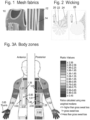
- Fig. 2 shows a fiber 20 with microstructure 22 that takes up sweat particles 24.
- Fiber 26 has been printed on and the ink has blocked the microstructure, so that the sweat particles are no longer taken up.
- the capillary action through the microstructure which enables sweat and /or other liquid such as water to have movement through the fabric resulting in regulated body temperature, is terminated. More particularly, the capillaries enable evaporation and heat regulation is a result thereof. Specifically, as a result of ink blocking the microstructure, the Moisture management and cooling quality of the fabric ceases. Wicking is often applied on tight garments.
- Garments are disclosed in prior art documents CN106820301A , CN206603274U , CN204146408U and US2018/279696A1 .
- the present embodiments involve mapping out regions of the garment that correspond to high temperature or high sweat areas of the body and diluting the amount of ink printed onto such regions.
- special ink that is designed to prevent bad smells and/or microbial effects and/or bacterial effects may be printed in the identified regions.
- Such inks may be relatively expensive and thus it is desirable to limit their use to where they can be most effective.
- a method of printing a garment to retain moisture and liquid wicking or heat management properties of an underlying fabric comprising:
- the garment may have at least one active body region and at least one other region, the image having a first ink density in said active body region and a second ink density in said other region.
- the garment may have an anti-smell or anti-microbial or anti-bacterial ink printed onto said active region.
- Implementation of the method and/or system of mapping out printing to dilute ink in the high temperature and high sweat regions of the body may involve performing or completing selected tasks manually, automatically, or a combination thereof.
- selected tasks could be implemented by hardware, by software or by firmware or by a combination thereof using an operating system.
- a data processor such as a computing platform for executing a plurality of instructions.
- the data processor includes a volatile memory for storing instructions and/or data and/or a non-volatile storage, for example, a magnetic hard-disk and/or removable media, for storing instructions and/or data.
- a network connection is provided as well.
- a display and/or a user input device such as a keyboard or mouse are optionally provided as well.
- the present invention in some embodiments thereof, relates to a method for preserving body moisture and temperature regulation properties on garments post printing, and, more particularly, but not exclusively, to printing on fabrics in a way that does not interfere with the fabric's ability to help with moisture and temperature regulation. Additionally or alternatively, embodiments may use the same mapping in order to print anti-microbial or anti-bacterial or anti-smell inks in the identified areas. It is further noted that the present method is not restricted to printing on the final garment but may also be applied to textile printing in the roll to roll process where the garment fabric is printed and then cut into a ready garment. The latter may be carried out as long as there is coordination between the printing and the cutting so that the areas identified as heat or sweat areas for printing in fact turn out to be so after cutting.
- the present embodiments may, as will be explained below, provide a method for preserving original fabric qualities following printing of an image on the garment.
- the qualities to be preserved include: a dry feel of the fabric, temperature regulation and non-stick feel, and when adding anti-microbial or anti-bacterial inks preventing bad smell and microbial grows in these areas.
- the present embodiments thus provide a method of printing a garment, particularly for use in sport and outdoor activities, to retain moisture wicking or heat management properties of an underlying fabric.
- the method comprises mapping active body regions onto a print file for the garment.
- the print file defines standard print areas and modified print areas where the modified printing areas correspond to the active body regions, or print in these areas the anti-microbial or anti-bacterial inks.
- Printing onto the garment over the standard print areas uses a standard ink density, but printing onto the garment at the active areas uses a second lower ink density which preserves, or at least does less harm to, wicking and venting properties of the underlying fabric.
- the embodiments further relate to a garment printed with different ink densities for active and passive regions where the active regions correspond to hot and sweat producing regions on the body as the garment is worn in the normal way.
- garment is used for anything that is normally worn.
- Reference to corresponding body areas relates to the way in which the garment is normally worn and is intended to be worn.
- Particular emphasis is laid on garments worn for sports and outdoor activities, including underwear and outerwear, and including running vests, shorts, trousers, shirts, swim suits, jackets, coats, and more generally anything that is intended for wearing and is printed on.
- mapping relates to transferring data having a geometric dimension from one domain to another.
- data relating to body regions is held on one map of the body, and an image to be printed is held in an image file that relates the data to locations on a garment.
- Mapping refers to the process of transferring body regions onto the image to be printed so that a new file is created having image data that is distinguished according to body regions.
- a feature of fabrics used for sports garments and garments intended for outdoor activities in general is moisture-wicking.
- Such fabrics may use microfibers for wicking sweat using capillary action to draw away sweat from the body and allow the sweat to spread out and evaporate easily.
- These or other fabrics may include mesh or pores which allow the skin to breath and give the user a feeling of ventilation.
- heat regulation may be a result of windchill, that is the lowering of body temperature due to the flow of lower-temperature air.
- a surface loses heat through conduction, evaporation, convection, and radiation. The rate of convection depends on both the difference in temperature between the surface and the fluid surrounding it and the velocity of that fluid with respect to the surface.
- the zones indicated in Figs. 3A -3C are those that are more heat and sweat sensitive, and the use of reduced ink density may reduce the capillarity action degradation and avoid blocking pores and thus preserve the original qualities of the fabric.
- the sports garment may continue to meet its original specification of remaining dry, assisting the sports person with temperature regulation and having a cool and non-stick feel.
- the present embodiment may be used for fabrics, and garments using those fabrics, which have native qualities including heat regulation/ preservation and giving a feel of cooling and warming, by allowing for moisture wicking etc., particularly in those parts of the garment that face active areas of the body, meaning areas that are hotter or produce more sweat.
- mapping it is possible to use the mapping to print special anti-smell or anti-microbial or anti-bacterial inks to prevent microbial or bacterial grows and bad smell.
- the active area may already be designed into the garment and may have low fabric density, or a higher density of capillary-micro-fiber for enhanced moisture wicking etc.
- the present embodiments may define the active areas based on previous knowledge, for example using the heat & sweat zones map shown in Figs. 3A - 3C , or using vendors data etc. when the garment is explicitly designed with active areas in mind, or actually carrying out trials with detection apparatus etc.
- garments may be printed with antimicrobial inks, or anti-bacterial inks or anti-staining inks etc.
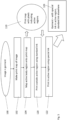
- a simplified flow chart illustrating printing on a garment, such as a garment specifically for sport or outdoor activities, in such a way as to retain moisture wicking or heat management properties of the underlying fabric.
- the garment and the image it is intended to print are obtained 100.
- the image is typically in the form of a digital image file, or may be scanned to form a digital image file.
- the image file is transformed into a print file, which is the same as the image file except that image parameters are modified for the printer.
- the image file may use the RGB color mapping scheme whereas the print map may use the CMYK color coordinate system.
- the image file may use pixel sizes and resolutions intended for screen formats whereas the print file may use pixel sizes that correspond to the print nozzles of the printer and the resolution that the printer is able to achieve.
- an active body region that is a region that produces excess heat or excess sweat, is mapped onto the print file and pixels that correspond to the active regions are marked.
- the mapping may alternatively be made at the stage of the image file, as long as the pixel information is retained during the conversion to a print file.
- Mapping active body regions onto a print file may be involve carrying out a pixel by pixel concatenation of the print file for a garment with a map of the active body regions.
- the print file now contains two types of pixels, those identified as belonging to an active region and those identified as not belonging to an active region.
- the print file thus defines standard print areas on the garment and modified print areas that correspond to the active body regions.
- the active body regions are then printed at a lower ink density than the standard regions.
- printing onto the garment over the standard print areas uses a first ink density which is typically the standard density produced by the print file for the given color and brightness etc., and the active areas are printed with a second ink density which is lower than the first ink density.
- the lower ink density may be achieved by printing fewer pixels in the region, or by printing less ink per pixel, or by not printing under-layers, or even by diluting of ink.
- the active body region is a region of the body producing an above-average amount of heat, as shown in Fig. 3B , together with a region of the body producing an above-average amount of sweat as shown in Fig. 3C .
- a print map, 110 which contains pixels marked as belonging to active regions may thus be used for printing a garment, in that the print map is used to print using a lower printing density for printing at the pixels in the active region and using a second print density for printing at unmarked pixels.
- the active region may accord with a body map of heat or sweat producing regions.
- a garment 112 may thus be printed with an image so that parts belonging to the active body region have a lower ink density and the remainder of the garment has a higher ink density.
- the present invention it is possible to make a garment designed for heat retention.
- the heat map of the body is used to define regions which can be printed more heavily in order to retain heat in the body.
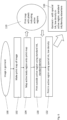
- Fig. 5 is a flow chart illustrating the use of special inks. Boxes 100, 102 and 104 are as discussed above, and the print map 110 may be the same. In box 120, printing is carried out outside the active region using standard ink, and in box 122, specialized ink is added to the color ink inside the active region. Garment 124 is the end result.
Landscapes
- Engineering & Computer Science (AREA)
- Textile Engineering (AREA)
- Life Sciences & Earth Sciences (AREA)
- Chemical & Material Sciences (AREA)
- Biochemistry (AREA)
- Chemical Kinetics & Catalysis (AREA)
- General Chemical & Material Sciences (AREA)
- Microbiology (AREA)
- Treatment Of Fiber Materials (AREA)
- Ink Jet (AREA)
Claims (3)
- - Procédé d'impression d'un vêtement pour conserver les propriétés d'évacuation d'humidité et de liquide ou de gestion de chaleur d'un tissu sous-jacent, le procédé comprenant :cartographier des régions corporelles actives sur un fichier d'impression pour le vêtement, pour fournir un fichier d'impression définissant des zones d'impression standard sur ledit vêtement et des zones d'impression modifiée, les zones d'impression modifiée correspondant auxdites régions corporelles actives, ladite cartographie de régions corporelles actives sur un fichier d'impression comprenant la réalisation d'une concaténation pixel par pixel dudit fichier d'impression pour un vêtement avec une carte de régions corporelles actives, ladite région corporelle active étant une région du corps produisant une quantité de chaleur supérieure à la moyenne, ou étant une région du corps produisant une quantité de sueur supérieure à la moyenne ;imprimer sur ledit vêtement sur lesdites zones d'impression standard à l'aide d'une première densité d'encre ; etimprimer sur ledit vêtement aux zones actives avec une seconde densité d'encre, ladite seconde densité d'encre étant inférieure à ladite première densité d'encre, ladite densité d'encre inférieure auxdites zones actives étant obtenue en imprimant moins de pixels, ou en imprimant moins d'encre par pixel, ou en n'imprimant pas de sous-couches, ou en diluant l'encre.
- - Vêtement imprimé avec une image selon le procédé de la revendication 1, le vêtement ayant au moins une région corporelle active et au moins une autre région, l'image ayant une première densité d'encre dans ladite région corporelle active et une seconde densité d'encre dans ladite autre région.
- - Vêtement selon la revendication 1 ou la revendication 2, comprenant en outre une encre anti-odeur ou anti-microbienne ou anti-bactérienne imprimée sur ladite région active.
Applications Claiming Priority (2)
| Application Number | Priority Date | Filing Date | Title |
|---|---|---|---|
| US201962911411P | 2019-10-07 | 2019-10-07 | |
| PCT/IL2020/051080 WO2021070179A1 (fr) | 2019-10-07 | 2020-10-06 | Conservation des propriétés d'évaporation de l'humidité et de régulation de la température corporelle relatives à des vêtements après impression |
Publications (4)
| Publication Number | Publication Date |
|---|---|
| EP4041013A1 EP4041013A1 (fr) | 2022-08-17 |
| EP4041013A4 EP4041013A4 (fr) | 2023-12-06 |
| EP4041013B1 true EP4041013B1 (fr) | 2025-06-25 |
| EP4041013C0 EP4041013C0 (fr) | 2025-06-25 |
Family
ID=75437061
Family Applications (1)
| Application Number | Title | Priority Date | Filing Date |
|---|---|---|---|
| EP20874664.4A Active EP4041013B1 (fr) | 2019-10-07 | 2020-10-06 | Conservation des propriétés d'évaporation de l'humidité et de régulation de la température corporelle relatives à des vêtements après impression |
Country Status (4)
| Country | Link |
|---|---|
| US (1) | US12577729B2 (fr) |
| EP (1) | EP4041013B1 (fr) |
| CN (1) | CN114760877A (fr) |
| WO (1) | WO2021070179A1 (fr) |
Families Citing this family (1)
| Publication number | Priority date | Publication date | Assignee | Title |
|---|---|---|---|---|
| WO2021070179A1 (fr) | 2019-10-07 | 2021-04-15 | Kornit Digital Ltd. | Conservation des propriétés d'évaporation de l'humidité et de régulation de la température corporelle relatives à des vêtements après impression |
Family Cites Families (20)
| Publication number | Priority date | Publication date | Assignee | Title |
|---|---|---|---|---|
| US6931665B2 (en) | 2001-07-30 | 2005-08-23 | 3M Innovative Properties Company | Vapor permeable retroreflective garment |
| US20120260422A1 (en) | 2005-06-23 | 2012-10-18 | Mmi-Ipco, Llc | Thermal blankets |
| US9332792B2 (en) * | 2005-02-17 | 2016-05-10 | Nike, Inc. | Articles of apparel utilizing targeted venting or heat retention zones that may be defined based on thermal profiles |
| KR20060120834A (ko) | 2005-05-23 | 2006-11-28 | 염명선 | 인쇄용 항균 잉크 조성물 및 이를 이용한 항균 노트 |
| US7531471B2 (en) | 2007-01-30 | 2009-05-12 | Kimberly-Clark Worldwide, Inc. | Substrate containing a deodorizing ink |
| DE102009045931B4 (de) | 2009-10-22 | 2015-06-03 | Adidas Ag | Bekleidung |
| US9107459B2 (en) | 2011-01-10 | 2015-08-18 | Nike, Inc. | Aerographics and denier differential zoned garments |
| CN203692637U (zh) | 2013-09-30 | 2014-07-09 | 安踏(中国)有限公司 | 一种吸湿发热面料及一种服装 |
| EP3119225A1 (fr) * | 2014-03-21 | 2017-01-25 | The Regents of The University of California | Réseau d'écoulement fluidique intégré pour gestion de fluide |
| CN204146408U (zh) | 2014-10-11 | 2015-02-11 | 安踏(中国)有限公司 | 一种服装面料及用所述服装面料制成的服装 |
| US10696089B2 (en) * | 2015-09-28 | 2020-06-30 | Nike, Inc. | Decals with dimensional offsets |
| WO2017055960A1 (fr) * | 2015-09-28 | 2017-04-06 | Delta Galil Industries Ltd. | Étoffe pour articles d'habillement, et procédé et système de production de celle-ci |
| US10674774B2 (en) | 2017-02-14 | 2020-06-09 | Salvador Navarro | Garment for water weight-loss |
| CN106820301A (zh) | 2017-04-08 | 2017-06-13 | 海宁酷彩数码科技有限公司 | 数码印花透气t恤 |
| CN206603274U (zh) | 2017-04-08 | 2017-11-03 | 海宁酷彩数码科技有限公司 | 数码印花透气t恤 |
| CA3078784A1 (fr) | 2017-11-01 | 2019-05-09 | Dryco, Inc. | Tissus a regulation amelioree de l'humidite |
| DE102018205136A1 (de) * | 2018-04-05 | 2019-10-10 | Adidas Ag | Bekleidungsartikel |
| US20190366675A1 (en) * | 2018-05-31 | 2019-12-05 | Nike, Inc. | Multilayer textile having printed layer |
| US11376343B2 (en) * | 2018-10-26 | 2022-07-05 | The Procter & Gamble Company | Absorbent article with graphics printed in preservative-free ink, and methods of manufacture thereof |
| WO2021070179A1 (fr) | 2019-10-07 | 2021-04-15 | Kornit Digital Ltd. | Conservation des propriétés d'évaporation de l'humidité et de régulation de la température corporelle relatives à des vêtements après impression |
-
2020
- 2020-10-06 WO PCT/IL2020/051080 patent/WO2021070179A1/fr not_active Ceased
- 2020-10-06 US US17/766,244 patent/US12577729B2/en active Active
- 2020-10-06 EP EP20874664.4A patent/EP4041013B1/fr active Active
- 2020-10-06 CN CN202080082659.XA patent/CN114760877A/zh active Pending
Also Published As
| Publication number | Publication date |
|---|---|
| WO2021070179A1 (fr) | 2021-04-15 |
| EP4041013A1 (fr) | 2022-08-17 |
| EP4041013A4 (fr) | 2023-12-06 |
| EP4041013C0 (fr) | 2025-06-25 |
| US20240052564A1 (en) | 2024-02-15 |
| US12577729B2 (en) | 2026-03-17 |
| CN114760877A (zh) | 2022-07-15 |
Similar Documents
| Publication | Publication Date | Title |
|---|---|---|
| US20250129546A1 (en) | Apparel fabric with heat retention | |
| US9332792B2 (en) | Articles of apparel utilizing targeted venting or heat retention zones that may be defined based on thermal profiles | |
| US20240245157A1 (en) | Visualizing Garments in Shadow Neutral 3-D | |
| US8910313B2 (en) | Apparel | |
| US11840782B2 (en) | Synthetic radiator fabric | |
| US20040132367A1 (en) | Multi-layer garment system | |
| EP4041013B1 (fr) | Conservation des propriétés d'évaporation de l'humidité et de régulation de la température corporelle relatives à des vêtements après impression | |
| EP1746909A2 (fr) | Article d'un appareil utilisant une aeration repartie en zones et/ou d'autres caracteristiques ou procedes de refroidissement de corps | |
| US10264833B2 (en) | Garment with rewritable areas | |
| US20160165990A1 (en) | Sublimation printed clothing articles | |
| JP2017002441A (ja) | 生地体、この生地体を用いた衣類、その製造方法及びこの生地体を用いた構造体 | |
| CN105088826A (zh) | 水响应印花织物及其制备方法 | |
| Stančić et al. | The influence of inkjet print parameters on warm/cool feeling and air permeability of printed textile substrates | |
| TW201540500A (zh) | 溫度調節布料 | |
| Stančić et al. | Mathematical models for water vapour resistance prediction of printed garments | |
| CN205250381U (zh) | 一种防液汗服装 | |
| Ho et al. | Development and trial of athletic T-shirt using spacer blocks to enhance ventilation | |
| Mukhopadhyay | Ergonomics in Fashion and Accessory Products: Comfort and Functionality | |
| JP2008038324A (ja) | 袖のある衣類において,左右の胴体側面から脇の下を通り上腕部にかけスリットを入れ、スリットの縁にボタンを縫いつけた衣類。 | |
| Baharudin et al. | Thermophysiological Evaluation Properties of Sport Hijab Knitted Fabrics for Thermoregulatory Comfort | |
| Butler | Cover Art Concept | |
| JP2021134474A (ja) | 布帛および衣料 | |
| CN105019102A (zh) | 温度调节布料 | |
| BR202013016726U2 (pt) | método para confecção de apliques emborrachados termocolantes estampados para serem aplicados sobre produtos variados | |
| CN108600635A (zh) | 图像的拍摄方法、装置及电子设备 |
Legal Events
| Date | Code | Title | Description |
|---|---|---|---|
| STAA | Information on the status of an ep patent application or granted ep patent |
Free format text: STATUS: THE INTERNATIONAL PUBLICATION HAS BEEN MADE |
|
| PUAI | Public reference made under article 153(3) epc to a published international application that has entered the european phase |
Free format text: ORIGINAL CODE: 0009012 |
|
| STAA | Information on the status of an ep patent application or granted ep patent |
Free format text: STATUS: REQUEST FOR EXAMINATION WAS MADE |
|
| 17P | Request for examination filed |
Effective date: 20220425 |
|
| AK | Designated contracting states |
Kind code of ref document: A1 Designated state(s): AL AT BE BG CH CY CZ DE DK EE ES FI FR GB GR HR HU IE IS IT LI LT LU LV MC MK MT NL NO PL PT RO RS SE SI SK SM TR |
|
| DAV | Request for validation of the european patent (deleted) | ||
| DAX | Request for extension of the european patent (deleted) | ||
| P01 | Opt-out of the competence of the unified patent court (upc) registered |
Effective date: 20230515 |
|
| RIC1 | Information provided on ipc code assigned before grant |
Ipc: B41M 5/00 20060101ALI20230721BHEP Ipc: D06Q 1/00 20060101ALI20230721BHEP Ipc: D06M 16/00 20060101ALI20230721BHEP Ipc: B32B 7/027 20190101ALI20230721BHEP Ipc: B32B 3/10 20060101ALI20230721BHEP Ipc: D06P 5/30 20060101ALI20230721BHEP Ipc: A41D 31/30 20190101ALI20230721BHEP Ipc: A41D 31/14 20190101ALI20230721BHEP Ipc: A41D 27/28 20060101ALI20230721BHEP Ipc: A41D 13/00 20060101ALI20230721BHEP Ipc: A41D 13/005 20060101ALI20230721BHEP Ipc: A41D 31/12 20190101AFI20230721BHEP |
|
| A4 | Supplementary search report drawn up and despatched |
Effective date: 20231106 |
|
| RIC1 | Information provided on ipc code assigned before grant |
Ipc: B41M 5/00 20060101ALI20231030BHEP Ipc: D06Q 1/00 20060101ALI20231030BHEP Ipc: D06M 16/00 20060101ALI20231030BHEP Ipc: B32B 7/027 20190101ALI20231030BHEP Ipc: B32B 3/10 20060101ALI20231030BHEP Ipc: D06P 5/30 20060101ALI20231030BHEP Ipc: A41D 31/30 20190101ALI20231030BHEP Ipc: A41D 31/14 20190101ALI20231030BHEP Ipc: A41D 27/28 20060101ALI20231030BHEP Ipc: A41D 13/00 20060101ALI20231030BHEP Ipc: A41D 13/005 20060101ALI20231030BHEP Ipc: A41D 31/12 20190101AFI20231030BHEP |
|
| STAA | Information on the status of an ep patent application or granted ep patent |
Free format text: STATUS: EXAMINATION IS IN PROGRESS |
|
| 17Q | First examination report despatched |
Effective date: 20240725 |
|
| GRAP | Despatch of communication of intention to grant a patent |
Free format text: ORIGINAL CODE: EPIDOSNIGR1 |
|
| STAA | Information on the status of an ep patent application or granted ep patent |
Free format text: STATUS: GRANT OF PATENT IS INTENDED |
|
| INTG | Intention to grant announced |
Effective date: 20250212 |
|
| GRAS | Grant fee paid |
Free format text: ORIGINAL CODE: EPIDOSNIGR3 |
|
| GRAA | (expected) grant |
Free format text: ORIGINAL CODE: 0009210 |
|
| STAA | Information on the status of an ep patent application or granted ep patent |
Free format text: STATUS: THE PATENT HAS BEEN GRANTED |
|
| AK | Designated contracting states |
Kind code of ref document: B1 Designated state(s): AL AT BE BG CH CY CZ DE DK EE ES FI FR GB GR HR HU IE IS IT LI LT LU LV MC MK MT NL NO PL PT RO RS SE SI SK SM TR |
|
| REG | Reference to a national code |
Ref country code: GB Ref legal event code: FG4D |
|
| REG | Reference to a national code |
Ref country code: CH Ref legal event code: EP |
|
| REG | Reference to a national code |
Ref country code: DE Ref legal event code: R096 Ref document number: 602020053512 Country of ref document: DE |
|
| REG | Reference to a national code |
Ref country code: CH Ref legal event code: EP |
|
| REG | Reference to a national code |
Ref country code: IE Ref legal event code: FG4D |
|
| U01 | Request for unitary effect filed |
Effective date: 20250711 |
|
| U07 | Unitary effect registered |
Designated state(s): AT BE BG DE DK EE FI FR IT LT LU LV MT NL PT RO SE SI Effective date: 20250718 |
|
| PG25 | Lapsed in a contracting state [announced via postgrant information from national office to epo] |
Ref country code: GR Free format text: LAPSE BECAUSE OF FAILURE TO SUBMIT A TRANSLATION OF THE DESCRIPTION OR TO PAY THE FEE WITHIN THE PRESCRIBED TIME-LIMIT Effective date: 20250926 Ref country code: NO Free format text: LAPSE BECAUSE OF FAILURE TO SUBMIT A TRANSLATION OF THE DESCRIPTION OR TO PAY THE FEE WITHIN THE PRESCRIBED TIME-LIMIT Effective date: 20250925 |
|
| PG25 | Lapsed in a contracting state [announced via postgrant information from national office to epo] |
Ref country code: HR Free format text: LAPSE BECAUSE OF FAILURE TO SUBMIT A TRANSLATION OF THE DESCRIPTION OR TO PAY THE FEE WITHIN THE PRESCRIBED TIME-LIMIT Effective date: 20250625 |
|
| PG25 | Lapsed in a contracting state [announced via postgrant information from national office to epo] |
Ref country code: RS Free format text: LAPSE BECAUSE OF FAILURE TO SUBMIT A TRANSLATION OF THE DESCRIPTION OR TO PAY THE FEE WITHIN THE PRESCRIBED TIME-LIMIT Effective date: 20250925 |
|
| U20 | Renewal fee for the european patent with unitary effect paid |
Year of fee payment: 6 Effective date: 20251028 |
|
| PG25 | Lapsed in a contracting state [announced via postgrant information from national office to epo] |
Ref country code: IS Free format text: LAPSE BECAUSE OF FAILURE TO SUBMIT A TRANSLATION OF THE DESCRIPTION OR TO PAY THE FEE WITHIN THE PRESCRIBED TIME-LIMIT Effective date: 20251025 |
|
| PG25 | Lapsed in a contracting state [announced via postgrant information from national office to epo] |
Ref country code: SM Free format text: LAPSE BECAUSE OF FAILURE TO SUBMIT A TRANSLATION OF THE DESCRIPTION OR TO PAY THE FEE WITHIN THE PRESCRIBED TIME-LIMIT Effective date: 20250625 |
|
| PG25 | Lapsed in a contracting state [announced via postgrant information from national office to epo] |
Ref country code: CZ Free format text: LAPSE BECAUSE OF FAILURE TO SUBMIT A TRANSLATION OF THE DESCRIPTION OR TO PAY THE FEE WITHIN THE PRESCRIBED TIME-LIMIT Effective date: 20250625 |
|
| PG25 | Lapsed in a contracting state [announced via postgrant information from national office to epo] |
Ref country code: PL Free format text: LAPSE BECAUSE OF FAILURE TO SUBMIT A TRANSLATION OF THE DESCRIPTION OR TO PAY THE FEE WITHIN THE PRESCRIBED TIME-LIMIT Effective date: 20250625 |
|
| PG25 | Lapsed in a contracting state [announced via postgrant information from national office to epo] |
Ref country code: SK Free format text: LAPSE BECAUSE OF FAILURE TO SUBMIT A TRANSLATION OF THE DESCRIPTION OR TO PAY THE FEE WITHIN THE PRESCRIBED TIME-LIMIT Effective date: 20250625 |
|
| PG25 | Lapsed in a contracting state [announced via postgrant information from national office to epo] |
Ref country code: ES Free format text: LAPSE BECAUSE OF FAILURE TO SUBMIT A TRANSLATION OF THE DESCRIPTION OR TO PAY THE FEE WITHIN THE PRESCRIBED TIME-LIMIT Effective date: 20250625 |