EP4043199A1 - Mehrschichtiges band mit mehreren breiten zum aufwickeln mit stufenloser änderung des ablagewinkels - Google Patents
Mehrschichtiges band mit mehreren breiten zum aufwickeln mit stufenloser änderung des ablagewinkels Download PDFInfo
- Publication number
- EP4043199A1 EP4043199A1 EP22154793.8A EP22154793A EP4043199A1 EP 4043199 A1 EP4043199 A1 EP 4043199A1 EP 22154793 A EP22154793 A EP 22154793A EP 4043199 A1 EP4043199 A1 EP 4043199A1
- Authority
- EP
- European Patent Office
- Prior art keywords
- layer
- edge
- strip
- angle
- multilayer
- Prior art date
- Legal status (The legal status is an assumption and is not a legal conclusion. Google has not performed a legal analysis and makes no representation as to the accuracy of the status listed.)
- Granted
Links
Images


Classifications
-
- B—PERFORMING OPERATIONS; TRANSPORTING
- B32—LAYERED PRODUCTS
- B32B—LAYERED PRODUCTS, i.e. PRODUCTS BUILT-UP OF STRATA OF FLAT OR NON-FLAT, e.g. CELLULAR OR HONEYCOMB, FORM
- B32B1/00—Layered products having a non-planar shape
- B32B1/08—Tubular products
-
- B—PERFORMING OPERATIONS; TRANSPORTING
- B32—LAYERED PRODUCTS
- B32B—LAYERED PRODUCTS, i.e. PRODUCTS BUILT-UP OF STRATA OF FLAT OR NON-FLAT, e.g. CELLULAR OR HONEYCOMB, FORM
- B32B19/00—Layered products comprising a layer of natural mineral fibres or particles, e.g. asbestos, mica
- B32B19/02—Layered products comprising a layer of natural mineral fibres or particles, e.g. asbestos, mica the layer of fibres or particles being impregnated or embedded in a plastic substance
-
- B—PERFORMING OPERATIONS; TRANSPORTING
- B32—LAYERED PRODUCTS
- B32B—LAYERED PRODUCTS, i.e. PRODUCTS BUILT-UP OF STRATA OF FLAT OR NON-FLAT, e.g. CELLULAR OR HONEYCOMB, FORM
- B32B3/00—Layered products comprising a layer with external or internal discontinuities or unevennesses, or a layer of non-planar shape; Layered products comprising a layer having particular features of form
- B32B3/02—Layered products comprising a layer with external or internal discontinuities or unevennesses, or a layer of non-planar shape; Layered products comprising a layer having particular features of form characterised by features of form at particular places, e.g. in edge regions
-
- B—PERFORMING OPERATIONS; TRANSPORTING
- B32—LAYERED PRODUCTS
- B32B—LAYERED PRODUCTS, i.e. PRODUCTS BUILT-UP OF STRATA OF FLAT OR NON-FLAT, e.g. CELLULAR OR HONEYCOMB, FORM
- B32B3/00—Layered products comprising a layer with external or internal discontinuities or unevennesses, or a layer of non-planar shape; Layered products comprising a layer having particular features of form
- B32B3/02—Layered products comprising a layer with external or internal discontinuities or unevennesses, or a layer of non-planar shape; Layered products comprising a layer having particular features of form characterised by features of form at particular places, e.g. in edge regions
- B32B3/04—Layered products comprising a layer with external or internal discontinuities or unevennesses, or a layer of non-planar shape; Layered products comprising a layer having particular features of form characterised by features of form at particular places, e.g. in edge regions characterised by at least one layer folded at the edge, e.g. over another layer ; characterised by at least one layer enveloping or enclosing a material
-
- B—PERFORMING OPERATIONS; TRANSPORTING
- B32—LAYERED PRODUCTS
- B32B—LAYERED PRODUCTS, i.e. PRODUCTS BUILT-UP OF STRATA OF FLAT OR NON-FLAT, e.g. CELLULAR OR HONEYCOMB, FORM
- B32B3/00—Layered products comprising a layer with external or internal discontinuities or unevennesses, or a layer of non-planar shape; Layered products comprising a layer having particular features of form
- B32B3/10—Layered products comprising a layer with external or internal discontinuities or unevennesses, or a layer of non-planar shape; Layered products comprising a layer having particular features of form characterised by a discontinuous layer, i.e. formed of separate pieces of material
-
- B—PERFORMING OPERATIONS; TRANSPORTING
- B32—LAYERED PRODUCTS
- B32B—LAYERED PRODUCTS, i.e. PRODUCTS BUILT-UP OF STRATA OF FLAT OR NON-FLAT, e.g. CELLULAR OR HONEYCOMB, FORM
- B32B3/00—Layered products comprising a layer with external or internal discontinuities or unevennesses, or a layer of non-planar shape; Layered products comprising a layer having particular features of form
- B32B3/10—Layered products comprising a layer with external or internal discontinuities or unevennesses, or a layer of non-planar shape; Layered products comprising a layer having particular features of form characterised by a discontinuous layer, i.e. formed of separate pieces of material
- B32B3/14—Layered products comprising a layer with external or internal discontinuities or unevennesses, or a layer of non-planar shape; Layered products comprising a layer having particular features of form characterised by a discontinuous layer, i.e. formed of separate pieces of material characterised by a face layer formed of separate pieces of material which are juxtaposed side-by-side
-
- B—PERFORMING OPERATIONS; TRANSPORTING
- B32—LAYERED PRODUCTS
- B32B—LAYERED PRODUCTS, i.e. PRODUCTS BUILT-UP OF STRATA OF FLAT OR NON-FLAT, e.g. CELLULAR OR HONEYCOMB, FORM
- B32B3/00—Layered products comprising a layer with external or internal discontinuities or unevennesses, or a layer of non-planar shape; Layered products comprising a layer having particular features of form
- B32B3/10—Layered products comprising a layer with external or internal discontinuities or unevennesses, or a layer of non-planar shape; Layered products comprising a layer having particular features of form characterised by a discontinuous layer, i.e. formed of separate pieces of material
- B32B3/14—Layered products comprising a layer with external or internal discontinuities or unevennesses, or a layer of non-planar shape; Layered products comprising a layer having particular features of form characterised by a discontinuous layer, i.e. formed of separate pieces of material characterised by a face layer formed of separate pieces of material which are juxtaposed side-by-side
- B32B3/16—Layered products comprising a layer with external or internal discontinuities or unevennesses, or a layer of non-planar shape; Layered products comprising a layer having particular features of form characterised by a discontinuous layer, i.e. formed of separate pieces of material characterised by a face layer formed of separate pieces of material which are juxtaposed side-by-side secured to a flexible backing
-
- B—PERFORMING OPERATIONS; TRANSPORTING
- B32—LAYERED PRODUCTS
- B32B—LAYERED PRODUCTS, i.e. PRODUCTS BUILT-UP OF STRATA OF FLAT OR NON-FLAT, e.g. CELLULAR OR HONEYCOMB, FORM
- B32B37/00—Methods or apparatus for laminating, e.g. by curing or by ultrasonic bonding
- B32B37/06—Methods or apparatus for laminating, e.g. by curing or by ultrasonic bonding characterised by the heating method
- B32B37/065—Methods or apparatus for laminating, e.g. by curing or by ultrasonic bonding characterised by the heating method resulting in the laminate being partially bonded
-
- B—PERFORMING OPERATIONS; TRANSPORTING
- B32—LAYERED PRODUCTS
- B32B—LAYERED PRODUCTS, i.e. PRODUCTS BUILT-UP OF STRATA OF FLAT OR NON-FLAT, e.g. CELLULAR OR HONEYCOMB, FORM
- B32B5/00—Layered products characterised by the non- homogeneity or physical structure, i.e. comprising a fibrous, filamentary, particulate or foam layer; Layered products characterised by having a layer differing constitutionally or physically in different parts
- B32B5/02—Layered products characterised by the non- homogeneity or physical structure, i.e. comprising a fibrous, filamentary, particulate or foam layer; Layered products characterised by having a layer differing constitutionally or physically in different parts characterised by structural features of a fibrous or filamentary layer
- B32B5/08—Layered products characterised by the non- homogeneity or physical structure, i.e. comprising a fibrous, filamentary, particulate or foam layer; Layered products characterised by having a layer differing constitutionally or physically in different parts characterised by structural features of a fibrous or filamentary layer the fibres or filaments of a layer being of different substances, e.g. conjugate fibres, mixture of different fibres
-
- B—PERFORMING OPERATIONS; TRANSPORTING
- B32—LAYERED PRODUCTS
- B32B—LAYERED PRODUCTS, i.e. PRODUCTS BUILT-UP OF STRATA OF FLAT OR NON-FLAT, e.g. CELLULAR OR HONEYCOMB, FORM
- B32B5/00—Layered products characterised by the non- homogeneity or physical structure, i.e. comprising a fibrous, filamentary, particulate or foam layer; Layered products characterised by having a layer differing constitutionally or physically in different parts
- B32B5/02—Layered products characterised by the non- homogeneity or physical structure, i.e. comprising a fibrous, filamentary, particulate or foam layer; Layered products characterised by having a layer differing constitutionally or physically in different parts characterised by structural features of a fibrous or filamentary layer
- B32B5/12—Layered products characterised by the non- homogeneity or physical structure, i.e. comprising a fibrous, filamentary, particulate or foam layer; Layered products characterised by having a layer differing constitutionally or physically in different parts characterised by structural features of a fibrous or filamentary layer characterised by the relative arrangement of fibres or filaments of different layers, e.g. the fibres or filaments being parallel or perpendicular to each other
-
- B—PERFORMING OPERATIONS; TRANSPORTING
- B32—LAYERED PRODUCTS
- B32B—LAYERED PRODUCTS, i.e. PRODUCTS BUILT-UP OF STRATA OF FLAT OR NON-FLAT, e.g. CELLULAR OR HONEYCOMB, FORM
- B32B5/00—Layered products characterised by the non- homogeneity or physical structure, i.e. comprising a fibrous, filamentary, particulate or foam layer; Layered products characterised by having a layer differing constitutionally or physically in different parts
- B32B5/22—Layered products characterised by the non- homogeneity or physical structure, i.e. comprising a fibrous, filamentary, particulate or foam layer; Layered products characterised by having a layer differing constitutionally or physically in different parts characterised by the presence of two or more layers which are next to each other and are fibrous, filamentary, formed of particles or foamed
- B32B5/24—Layered products characterised by the non- homogeneity or physical structure, i.e. comprising a fibrous, filamentary, particulate or foam layer; Layered products characterised by having a layer differing constitutionally or physically in different parts characterised by the presence of two or more layers which are next to each other and are fibrous, filamentary, formed of particles or foamed one layer being a fibrous or filamentary layer
- B32B5/26—Layered products characterised by the non- homogeneity or physical structure, i.e. comprising a fibrous, filamentary, particulate or foam layer; Layered products characterised by having a layer differing constitutionally or physically in different parts characterised by the presence of two or more layers which are next to each other and are fibrous, filamentary, formed of particles or foamed one layer being a fibrous or filamentary layer another layer next to it also being fibrous or filamentary
-
- B—PERFORMING OPERATIONS; TRANSPORTING
- B32—LAYERED PRODUCTS
- B32B—LAYERED PRODUCTS, i.e. PRODUCTS BUILT-UP OF STRATA OF FLAT OR NON-FLAT, e.g. CELLULAR OR HONEYCOMB, FORM
- B32B7/00—Layered products characterised by the relation between layers; Layered products characterised by the relative orientation of features between layers, or by the relative values of a measurable parameter between layers, i.e. products comprising layers having different physical, chemical or physicochemical properties; Layered products characterised by the interconnection of layers
- B32B7/04—Interconnection of layers
- B32B7/05—Interconnection of layers the layers not being connected over the whole surface, e.g. discontinuous connection or patterned connection
-
- B—PERFORMING OPERATIONS; TRANSPORTING
- B32—LAYERED PRODUCTS
- B32B—LAYERED PRODUCTS, i.e. PRODUCTS BUILT-UP OF STRATA OF FLAT OR NON-FLAT, e.g. CELLULAR OR HONEYCOMB, FORM
- B32B7/00—Layered products characterised by the relation between layers; Layered products characterised by the relative orientation of features between layers, or by the relative values of a measurable parameter between layers, i.e. products comprising layers having different physical, chemical or physicochemical properties; Layered products characterised by the interconnection of layers
- B32B7/04—Interconnection of layers
- B32B7/12—Interconnection of layers using interposed adhesives or interposed materials with bonding properties
-
- B—PERFORMING OPERATIONS; TRANSPORTING
- B29—WORKING OF PLASTICS; WORKING OF SUBSTANCES IN A PLASTIC STATE IN GENERAL
- B29B—PREPARATION OR PRETREATMENT OF THE MATERIAL TO BE SHAPED; MAKING GRANULES OR PREFORMS; RECOVERY OF PLASTICS OR OTHER CONSTITUENTS OF WASTE MATERIAL CONTAINING PLASTICS
- B29B11/00—Making preforms
- B29B11/14—Making preforms characterised by structure or composition
- B29B11/16—Making preforms characterised by structure or composition comprising fillers or reinforcement
-
- B—PERFORMING OPERATIONS; TRANSPORTING
- B29—WORKING OF PLASTICS; WORKING OF SUBSTANCES IN A PLASTIC STATE IN GENERAL
- B29L—INDEXING SCHEME ASSOCIATED WITH SUBCLASS B29C, RELATING TO PARTICULAR ARTICLES
- B29L2031/00—Other particular articles
- B29L2031/30—Vehicles, e.g. ships or aircraft, or body parts thereof
- B29L2031/3076—Aircrafts
-
- B—PERFORMING OPERATIONS; TRANSPORTING
- B32—LAYERED PRODUCTS
- B32B—LAYERED PRODUCTS, i.e. PRODUCTS BUILT-UP OF STRATA OF FLAT OR NON-FLAT, e.g. CELLULAR OR HONEYCOMB, FORM
- B32B2250/00—Layers arrangement
- B32B2250/02—2 layers
-
- B—PERFORMING OPERATIONS; TRANSPORTING
- B32—LAYERED PRODUCTS
- B32B—LAYERED PRODUCTS, i.e. PRODUCTS BUILT-UP OF STRATA OF FLAT OR NON-FLAT, e.g. CELLULAR OR HONEYCOMB, FORM
- B32B2250/00—Layers arrangement
- B32B2250/03—3 layers
-
- B—PERFORMING OPERATIONS; TRANSPORTING
- B32—LAYERED PRODUCTS
- B32B—LAYERED PRODUCTS, i.e. PRODUCTS BUILT-UP OF STRATA OF FLAT OR NON-FLAT, e.g. CELLULAR OR HONEYCOMB, FORM
- B32B2250/00—Layers arrangement
- B32B2250/20—All layers being fibrous or filamentary
-
- B—PERFORMING OPERATIONS; TRANSPORTING
- B32—LAYERED PRODUCTS
- B32B—LAYERED PRODUCTS, i.e. PRODUCTS BUILT-UP OF STRATA OF FLAT OR NON-FLAT, e.g. CELLULAR OR HONEYCOMB, FORM
- B32B2260/00—Layered product comprising an impregnated, embedded, or bonded layer wherein the layer comprises an impregnation, embedding, or binder material
- B32B2260/02—Composition of the impregnated, bonded or embedded layer
- B32B2260/021—Fibrous or filamentary layer
- B32B2260/023—Two or more layers
-
- B—PERFORMING OPERATIONS; TRANSPORTING
- B32—LAYERED PRODUCTS
- B32B—LAYERED PRODUCTS, i.e. PRODUCTS BUILT-UP OF STRATA OF FLAT OR NON-FLAT, e.g. CELLULAR OR HONEYCOMB, FORM
- B32B2260/00—Layered product comprising an impregnated, embedded, or bonded layer wherein the layer comprises an impregnation, embedding, or binder material
- B32B2260/04—Impregnation, embedding, or binder material
- B32B2260/046—Synthetic resin
-
- B—PERFORMING OPERATIONS; TRANSPORTING
- B32—LAYERED PRODUCTS
- B32B—LAYERED PRODUCTS, i.e. PRODUCTS BUILT-UP OF STRATA OF FLAT OR NON-FLAT, e.g. CELLULAR OR HONEYCOMB, FORM
- B32B2262/00—Composition or structural features of fibres which form a fibrous or filamentary layer or are present as additives
- B32B2262/02—Synthetic macromolecular fibres
- B32B2262/0261—Polyamide fibres
- B32B2262/0269—Aromatic polyamide fibres
-
- B—PERFORMING OPERATIONS; TRANSPORTING
- B32—LAYERED PRODUCTS
- B32B—LAYERED PRODUCTS, i.e. PRODUCTS BUILT-UP OF STRATA OF FLAT OR NON-FLAT, e.g. CELLULAR OR HONEYCOMB, FORM
- B32B2262/00—Composition or structural features of fibres which form a fibrous or filamentary layer or are present as additives
- B32B2262/10—Inorganic fibres
-
- B—PERFORMING OPERATIONS; TRANSPORTING
- B32—LAYERED PRODUCTS
- B32B—LAYERED PRODUCTS, i.e. PRODUCTS BUILT-UP OF STRATA OF FLAT OR NON-FLAT, e.g. CELLULAR OR HONEYCOMB, FORM
- B32B2262/00—Composition or structural features of fibres which form a fibrous or filamentary layer or are present as additives
- B32B2262/10—Inorganic fibres
- B32B2262/101—Glass fibres
-
- B—PERFORMING OPERATIONS; TRANSPORTING
- B32—LAYERED PRODUCTS
- B32B—LAYERED PRODUCTS, i.e. PRODUCTS BUILT-UP OF STRATA OF FLAT OR NON-FLAT, e.g. CELLULAR OR HONEYCOMB, FORM
- B32B2262/00—Composition or structural features of fibres which form a fibrous or filamentary layer or are present as additives
- B32B2262/10—Inorganic fibres
- B32B2262/105—Ceramic fibres
-
- B—PERFORMING OPERATIONS; TRANSPORTING
- B32—LAYERED PRODUCTS
- B32B—LAYERED PRODUCTS, i.e. PRODUCTS BUILT-UP OF STRATA OF FLAT OR NON-FLAT, e.g. CELLULAR OR HONEYCOMB, FORM
- B32B2262/00—Composition or structural features of fibres which form a fibrous or filamentary layer or are present as additives
- B32B2262/10—Inorganic fibres
- B32B2262/106—Carbon fibres, e.g. graphite fibres
-
- B—PERFORMING OPERATIONS; TRANSPORTING
- B32—LAYERED PRODUCTS
- B32B—LAYERED PRODUCTS, i.e. PRODUCTS BUILT-UP OF STRATA OF FLAT OR NON-FLAT, e.g. CELLULAR OR HONEYCOMB, FORM
- B32B2307/00—Properties of the layers or laminate
- B32B2307/20—Properties of the layers or laminate having particular electrical or magnetic properties, e.g. piezoelectric
- B32B2307/204—Di-electric
-
- B—PERFORMING OPERATIONS; TRANSPORTING
- B32—LAYERED PRODUCTS
- B32B—LAYERED PRODUCTS, i.e. PRODUCTS BUILT-UP OF STRATA OF FLAT OR NON-FLAT, e.g. CELLULAR OR HONEYCOMB, FORM
- B32B2307/00—Properties of the layers or laminate
- B32B2307/30—Properties of the layers or laminate having particular thermal properties
- B32B2307/304—Insulating
-
- B—PERFORMING OPERATIONS; TRANSPORTING
- B32—LAYERED PRODUCTS
- B32B—LAYERED PRODUCTS, i.e. PRODUCTS BUILT-UP OF STRATA OF FLAT OR NON-FLAT, e.g. CELLULAR OR HONEYCOMB, FORM
- B32B2307/00—Properties of the layers or laminate
- B32B2307/70—Other properties
- B32B2307/738—Thermoformability
-
- B—PERFORMING OPERATIONS; TRANSPORTING
- B32—LAYERED PRODUCTS
- B32B—LAYERED PRODUCTS, i.e. PRODUCTS BUILT-UP OF STRATA OF FLAT OR NON-FLAT, e.g. CELLULAR OR HONEYCOMB, FORM
- B32B2605/00—Vehicles
- B32B2605/18—Aircraft
Definitions
- the present invention relates to the general field of processes for the manufacture of parts in composite material implementing in particular the winding of strips of pre-impregnated fabrics with a change in angle of deposition.
- Ablative type thermal protection parts are conventionally used to thermally protect the structures or vehicles in which they are incorporated.
- Ablative-type thermal protection parts are generally made by winding pre-impregnated fabrics to form a laminated structure, which will then be hardened and consolidated.
- the deposited layers are conventionally applied by winding one or more strips of fabric around a last, for example a mandrel, with a fixed deposition angle relative to the axis of revolution of the last.
- deposition angle is meant here the angle formed between the axis of revolution of the form and the layer applied.
- Lamination angle here denotes the angle formed between the surface of the form and the layer applied. It is therefore necessary to control the value of this angle.
- Changing the lamination angle may be necessary in different cases, for example when the shape to be wound presents angle changes with respect to its axis of revolution, or when parts of the coiled part must withstand stresses in different main directions.
- the lamination angle and the laying angle are constant, or even coincident in the case of a cylindrical shape.
- a winding with a fixed deposition angle makes it easy to obtain a laminated structure with a satisfactory lamination angle over the entire length of the shape with respect to a given stress.
- a first method consists in manufacturing the various portions of the final structure separately, each portion corresponding to a simple conical or cylindrical shape. Each portion is thus wound with a fixed deposition angle, but which corresponds to a satisfactory lamination angle for this portion. The different portions are then hardened and their ends are machined so as to allow assembly of the final structure. This method is long and expensive to implement. Furthermore, this method is not always applicable, especially when the final shape to be wound cannot be cut into portions.
- the method therefore comprises a first step of conventional winding, according to a first fixed laying angle, on a part of the form associated with a first satisfactory lamination angle. Then winding one or more strips of fabric having a smaller width based on the previous winding, or always according to the first laying angle.
- the structure formed by these narrower strips of fabric is similar to a ramp structure with an angle ⁇ , in other words in the form of stairs with a slope ⁇ .
- a new winding is then carried out, using strips of fabric of conventional width, based on the ramp structure previously created.
- this new winding will be according to a new fixed laying angle, corresponding to the value of the first laying angle subtracted from the value of the angle ⁇ of the ramp introduced.
- the object of the present invention is to remedy the aforementioned drawbacks and to propose a solution which makes it possible to achieve a gradual variation in the angle of deposition, for parts made of composite material produced by winding.
- a multilayer tape intended to be wound on a form, comprising pre-impregnated fibrous layers superimposed along a stacking direction, each layer extending in width along a direction transverse perpendicular to the direction of stacking between a first and a second edge, characterized in that on at least a part of the said multilayer strip the first edges of the pre-impregnated fibrous layers are aligned with each other in the direction of the stack, and each second edge is recessed relative to the second edge of the underlying layer in the transverse direction.
- each fibrous layer comprises a plurality of segments, aligned with each other in a longitudinal direction perpendicular to the transverse direction, the opposite transverse edges being covered by a segment of an adjacent layer.
- the upper edges of the second edges of the superposed fibrous layers are included in the same plane.
- the multilayer tape comprises at least one layer comprising a first portion in which the second edge of the diaper is recessed a first distance from the second edge of the underlying layer, and a second portion in which the second edge of the diaper is recessed a second distance from the second edge of the underlying layer, the first setback distance being greater than the second setback distance.
- the multilayer strip comprises at least one layer comprising at least one segment whose second edge has a setback distance different from that of the second edge of another segment of said layer with respect to the second edge of the underlying layer.
- the same multilayer strip can comprise at least two ramps of different angles, which allows a very gradual variation in the angle of deposition, and thus a structure with better thermomechanical properties.
- the invention also relates to a method for manufacturing a fibrous preform of a composite material part, comprising at least the winding of the multilayer strip.
- the invention also relates to a process for the manufacture of a composite material part comprising at least the manufacture of the fiber preform, and the heat treatment of at least one resin present in the preform so as to obtain the part made of composite material.
- the part is a rocket engine part, for example a nozzle or a space vehicle structure.
- the figures 1-3 show a multilayer tape comprising three layers superimposed along a stacking direction E, according to one embodiment of the invention. As will be detailed below, this strip can be used to manufacture a part made of composite material.
- the multilayer strip la extends in a longitudinal direction L and the direction T materializes the direction along the width of the strip 1a.
- the band la comprises a first layer 10, extending in width between a first edge 11 and a second edge 12, the second edge 12 having an upper edge 12a.
- the band also comprises a second layer 20, extending in width between a first edge 21 and a second edge 22, the width of which is smaller than the width of the layer 10, the second edge 22 having an upper edge 22a.
- the distance between edges 21 and 22 is less than the distance between edges 11 and 12.
- the second layer 20 is superimposed on the first layer 10 so that the edges 11 and 21 are aligned in the stacking direction. .
- the band la comprises a third layer 30, extending in width between a first edge 31 and a second edge 32, the width of which is smaller than the width of the layer 20, the second edge 32 having an upper edge 32a. Thus, the distance between edges 31 and 32 is less than the distance between edges 21 and 22.
- the third layer 30 is superimposed on the second layer 20 so that the edges 21 and 31 are aligned in the stacking direction. .
- the longitudinal edges 11, 12, 21, 22, 31 and 32 may not be straight, but may for example form a broken line or a curve.
- the value of the setback distance of the second edge of a layer with respect to the second edge of the underlying layer can vary in the longitudinal direction (not shown on the figures 1 and 2 ).
- the transverse edges, that is to say along the direction T may not be rectilinear, but may for example form a broken line or a curve.
- layers 10, 20 and 30 are two-dimensional fabrics pre-impregnated with resin.
- the layers may also have been produced by three-dimensional weaving, provided that the final thickness of the multilayer strip allows it to be wound.
- the fibrous structures may also have been made from layers or unidirectional layers of fibers (UD).
- the fibers of the layers 10, 20 and 30 can be made of carbon C, Kevlar or ceramics, for example silica, glass, silicon carbide SiC.
- Layers 10, 20 and 30 can be impregnated with a crosslinkable resin, for example an epoxy resin, or a carbon or ceramic precursor resin, for example silicon carbide (SiC).
- Layers 10, 20 and 30 can also be pre-impregnated with a phenolic resin. Each layer can be impregnated with a different resin.
- the multilayer strip 1a is in one piece. In particular, there is continuity and cohesion of material between layers 10, 20 and 30, and in particular continuity of the matrix precursor resin or resins between them.
- the figure 2 illustrates in particular the continuity of material of the strip la along the longitudinal direction L.
- Each layer is broken down into segments which are repeated along the longitudinal direction L.
- the segments of the first layer 10 extend in the longitudinal direction between a first transverse edge 10a and a second transverse edge 10b.
- the segments of the second layer 20 extend in the longitudinal direction between a first transverse edge 20a and a second transverse edge 20b
- the segments of the third layer 30 extend in the longitudinal direction between a first transverse edge 30a and a second transverse edge 30b.
- a segment of the third layer 30 overlaps at least two consecutive segments of the second layer 20, overlapping at least the transverse edge 20a of one segment of the layer 20 and the transverse edge 20b of another segment of the layer 20.
- a segment of the second layer 20 covers at least two consecutive segments of the first layer 10, covering at least the transverse edge 10a of one segment of the layer 10 and the transverse edge 10b of another segment of the layer 10.
- transverse edges 10a and 10b, 20a and 20b, 30a and 30b, of the consecutive segments are close enough to ensure the cohesion of the strip 1a, without necessarily touching. Care will be taken, however, that the transverse edges 10b and 10a, 20b and 20a, 30b and 30a of consecutive segments do not overlap.
- longitudinal edges 11, 12, 21, 22, 31 and 32 and the transverse edges 10a, 10b, 20a, 20b, 30a and 30b may not be straight, but may for example form a broken line or a curve.
- the picture 3 presents a section of the multilayer strip 1a, and makes it possible to represent the ramp shape of the multilayer strip 1a, which has an angle ⁇ .
- the upper edges 12a, 22a and 32a of each of the layers 10, 20 and 30 of the strip are included in the same plane P.
- the multilayer strip 1a previously described may be part of a longer strip.
- the figure 4 presents a portion of a multilayer strip 1b, comprising over a first part of its length a multilayer strip 1, which is a multilayer strip comprising three layers 10 of identical dimension in the transverse direction T, i.e. of identical nominal width, and on a second part of its length a multilayer tape as described above with three layers of variable widths 10, 20 and 30.
- the strip Over the first part of the length of the multilayer strip 1b, the strip consists of the multilayer strip 1, which comprises three layers 10 which extend in width between a first edge 11 and a second edge 12. The first edges 11 are aligned in the stacking direction, and the first edges 12 are aligned in the stacking direction. Each layer breaks up into segments which are repeated along the longitudinal direction L. A segment of the second or third layer spans at least two consecutive segments of the underlying layer.
- the first segment of the first layer 10 of the multilayer strip la is placed consecutively in the longitudinal direction L to the last segment of the first layer 10 of the multilayer strip 1.
- the first segment of the second layer 20 of the multilayer strip 1a is placed consecutively in the longitudinal direction L to the last segment of the second layer 10 of the multilayer strip 1, so as to cover the last segment of the first layer 10 with strip 1 and the first segment of the first layer 10 of strip 1a.
- the first segment of the third layer 30 of the multilayer strip la is placed consecutively in the longitudinal direction L to the last segment of the third layer 10 of the multilayer strip 1, so as to cover the last segment of the second layer 10 of the strip 1 and the first segment of the second layer 20 of the band 1a.
- the “first segment” designates the leftmost segment
- “last segment” refers to the rightmost segment. It can be ensured that each last segment of the strip 1 is sufficiently close to the first consecutive segment of the strip 1a to ensure the cohesion of the strip 1b, without necessarily touching it. Care should be taken, however, that consecutive segments do not overlap.
- consecutive segments of a layer touch each other, at least two consecutive segments may have been made in one piece, that is to say that they are integral even without being covered by the segments of adjacent layers, including if they are of different widths.
- the multilayer strip 1b comes in one piece. In particular, there is continuity and cohesion of material between the multilayer strip 1 and the multilayer strip 1a, and between the layers 10, 20 and 30, and in particular continuity of the matrix precursor resin or resins between them.
- the figures 5-8 present a multilayer tape according to another embodiment of the invention, which allows a more gradual variation of the angle of the ramp formed by the multilayer tape during winding.
- a ramp with an angle ⁇ 2 it is possible to pass through an intermediate ramp with an angle ⁇ 1 less than ⁇ 2 .
- the multilayer strip 1c extends along a longitudinal direction L and the direction T materializes the direction along the width of the strip 1c.
- the multilayer strip 1c comprises at least three superimposed layers, each extending in width between a first edge and a second edge, the first edges of all the layers being aligned in the direction of the stack.
- the multilayer strip 1c comprises at least a first, a second and a third consecutive portions in the length of the strip 1c.
- each of the portions comprises three stacked layers.
- Each portion comprises a first layer consisting of one or more segments 110, the second edges 112 of which have an upper edge 112a.
- the first portion of the strip 1c comprises a second layer consisting of one or more segments 120A, of width less than that of the segments 110 of the first layer, and whose second edges 122A have an upper edge 122a.
- the first portion of the strip 1c also comprises a third layer consisting of one or more segments 130A, of width less than that of the segments 110 of the first layer and of the segments 120A of the second layer, and whose second edges 132A comprise a upper edge 132a.
- the width of the segments 120A and 130A is chosen so that the edges 112a, 122a and 132a are included in the same first plane P 1 which forms an angle ⁇ 1 with the direction of the stack. This angle ⁇ 1 is the angle of the ramp formed by the first portion of the multilayer strip 1c during winding.
- the second portion of the strip 1c comprises a second layer consisting of one or more segments 120A, identical to those present in the second layer of the first portion of the strip 1c, and whose second edges 122A comprise an upper edge 122a.
- the first portion of the strip 1c also comprises a third layer consisting of one or more segments 130B, of width less than that of the segments 130A of the third layer of the first portion of the strip 1c, and whose second edges 132B comprise a upper edge 132b.
- the width of the segment or segments 130B is chosen so that the edges 122a and 132b are included in the same second plane P 2 , which forms an angle ⁇ 2 with the direction of the stack. This angle ⁇ 2 is the final angle desired for the ramp formed by the multilayer strip 1c during winding. Edges 112a and 122a are always included in the first plane P 1 , which forms an angle ⁇ 1 with the direction of the stack.
- the third portion of the strip 1c comprises a second layer consisting of one or more segments 120C, of width less than that of the segments 120A of the second layer of the second portion of the strip 1c, and whose second edges 122C comprise an edge upper 122c.
- the first portion of the strip 1c also comprises a third layer consisting of one or more segments 130C, of width less than that of the segments 130B of the third layer of the second portion of the strip 1c, and whose second edges 132C comprise a upper edge 132c.
- the width of the segments 120C and 130C is chosen so that the edges 112a, 122c and 132c are included in a plane P 2 bis parallel to the second plane P 2 , which forms an angle ⁇ 2 with the direction of the stack. This angle ⁇ 2 is the angle of the ramp formed by the third portion of the multilayer strip 1c during winding.
- consecutive segments of a layer touch each other, at least two consecutive segments may have been made in one piece, that is to say that they are integral even without being covered by the segments of adjacent layers, including if they are of different widths.
- each additional superimposed layer must have a width less than the underlying layer.
- a first step 100 consists in obtaining a plurality of fibrous structures pre-impregnated with at least one resin.
- the fibrous structures are two-dimensional tissues.
- the fibrous structures have a different structure, as explained in the previous embodiments.
- the possible materials for making these fibrous structures are also described in the previous embodiments.
- a second step 200 consists of making layers from the fibrous structures created previously and stacking them by superposition as described in the previous embodiments.
- the stack comprises at least two of the three layers described on the figures 1-3 .
- a third step 300 the stack produced in step 200 is heated to a temperature at least equal to the softening temperature of at least one resin contained in the stack. Then, in a step 400, the stack thus heated will be compacted to make the stacked layers adhere to each other.
- the softened resin can thus cause the layers to adhere to each other.
- the softening temperature is a temperature at which the resin liquefies slightly without polymerizing or crosslinking.
- the heating 300 and compacting 400 steps can be carried out simultaneously, in a heating press for example.
- One possibility for carrying out steps 200, 300 and 400 is to use a device as described in the document EP3418046 , comprising a conveyor, two loading devices and a heating press, or comprising a step for placing the robotic layers.
- step 500 the stack thus heated and compacted is cooled so as to obtain a multilayer strip intended to be wound.
- the figure 10 schematizes a fibrous preform obtained after winding a multilayer strip onto a form having a change in angle within the framework of an example of a process according to the invention.
- the multilayer strip 1a, 1b or 1c is implemented by winding around a winding tool 50, of axis of revolution A which is also the winding axis.
- This winding tool breaks down into a first sub-form 51, for which a first lamination angle ⁇ 1 would be satisfactory, and a second sub-form 52, for which a second lamination angle ⁇ 2 would be satisfactory.
- a strip with a nominal width is wound on the surface 51a, according to the first lamination angle ⁇ 1 .
- This tape can be a tape composed of a single layer, or a multi-layer tape like the one described in the document EP3418046B1 .
- this strip retains a fixed nominal width.
- the strip is then wound with a nominal width around the axis of revolution A according to a first fixed laying angle ⁇ 1 by moving towards the opposite surface, that is to say towards the left in the drawing, until to partly cover the surface 51a of the tool.
- the process described in the document US2019160760A1 can be implemented.
- a second winding 2000 is then carried out, by winding the multilayer strip of the invention, the upper layer or layers of the multilayer strip having a width less than the nominal width of the previous strip, and forming an angle ramp structure ⁇ . More precisely, the second winding 2000 rests on the first winding 1000, ie always according to the first laying angle ⁇ 1 .
- a third winding 3000 is then carried out by taking up a strip with a nominal width, relying on the previously wound multilayer strip.
- the third winding will thus take place according to the second stratification angle ⁇ 2 .
- a preform is thus obtained in several winding steps. It is not beyond the scope of the invention if the winding 2000 of the multilayer strip is made during the same winding as the first or second winding of the strip of nominal width, for example by using a multilayer strip 1b, described above. It is also possible to carry out the three winding steps 1000, 2000 and 3000 during the same winding, using a multilayer tape adapted on the model of the multilayer tape 1b.
- the strips used for the windings 1000 and 3000 have different nominal widths, for example to optimize the thickness of the part.
- the part can then be obtained by heat treatment of the preform obtained, for example in order to polymerize or crosslink the resin(s) present.
- the figure 11 schematizes a fibrous preform obtained after winding a multilayer strip in the context of an example of a method according to the invention.
- the part obtained by heat treatment of the fiber preform is intended to undergo a first stress in a first part of the length of the part, and a second different stress in a second part of the length of the part.
- a multilayer tape according to the invention is implemented by winding around a winding tool 60, of axis of revolution A which is also the winding axis.
- the first stress S1 will apply to a first part 61 of the length of the preform located on the right in the drawing, opposite which the angle ⁇ 3 is a satisfactory lamination angle.
- a second stress S2, directed at a different angle and of greater importance, will apply to a second part 62 of the length of the preform located on the left in the drawing, and facing which the angle ⁇ 2 is an angle of satisfactory stratification.
- a strip 1 with a first nominal width is wound on the surface 51a, according to the first stratification angle ⁇ 3 .
- This tape can be a tape composed of a single layer, or a multi-layer tape like the one described in the document EP3418046B1 .
- this strip retains a fixed nominal width.
- the strip is then wound with the first nominal width around the axis of revolution A according to a first fixed laying angle ⁇ 3 by moving towards the opposite surface, that is to say towards the left on the drawing until to cover the surface 61a of the tool.
- a second winding 2100 is then carried out, by winding the multilayer strip of the invention, the upper layer or layers of the multilayer strip having a width less than the nominal width of the previous strip, and forming an angle ramp structure ⁇ 3 . More precisely, the second winding 2000 is based on the first winding 1100, that is always according to the first angle of deposits ⁇ 3 .
- the multilayer strip 2a according to the invention comprises four superimposed layers.
- a third winding 3100 is then carried out by implementing a strip 2 with a second nominal width, relying on the multilayer strip 2a previously wound.
- the stress S2 being greater than the stress S1, a greater thickness is necessary.
- the second nominal width of the strip 2 is greater than the first nominal width of the strip 1.
- the third winding will thus take place according to the second stratification angle ⁇ 4 .
- the part can then be obtained by heat treatment of the preform obtained, for example in order to polymerize or crosslink the resin(s) present.
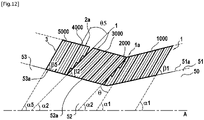
- the figure 12 schematizes a fibrous preform obtained after winding a multilayer strip around a form comprising a change of angle within the framework of an example of a process according to the invention.
- the deposition angle is varied twice during the winding of the preform.
- a multilayer tape according to the invention is implemented by winding around a winding tool 50, of axis of revolution A which is also the winding axis.
- a fourth winding 4000 is thus carried out, by winding the multilayer strip of the invention, the upper layer or layers of the multilayer strip having a width less than the nominal width of the previous strip, and forming an angle ramp structure ⁇ 5 . More precisely, the fourth winding 4000 rests on the third winding 3000, ie according to the laying angle ⁇ 2 .
- the multilayer strip 2a according to the invention comprises four superimposed layers.
- a fifth winding 5000 is then carried out by implementing a strip 3, relying on the multilayer strip 2a previously wound.
- the fifth winding will thus take place according to a stratification angle ⁇ 5 .
- the part can then be obtained by heat treatment of the preform obtained, for example in order to polymerize or crosslink the resin(s) present.
Landscapes
- Engineering & Computer Science (AREA)
- Mechanical Engineering (AREA)
- Moulding By Coating Moulds (AREA)
- Laminated Bodies (AREA)
Applications Claiming Priority (1)
| Application Number | Priority Date | Filing Date | Title |
|---|---|---|---|
| FR2101310A FR3119565B1 (fr) | 2021-02-11 | 2021-02-11 | Bande multicouche multi largeurs pour bobinage avec changement progressif de l’angle de dépose |
Publications (2)
| Publication Number | Publication Date |
|---|---|
| EP4043199A1 true EP4043199A1 (de) | 2022-08-17 |
| EP4043199B1 EP4043199B1 (de) | 2025-06-25 |
Family
ID=76730603
Family Applications (1)
| Application Number | Title | Priority Date | Filing Date |
|---|---|---|---|
| EP22154793.8A Active EP4043199B1 (de) | 2021-02-11 | 2022-02-02 | Mehrschichtiges band mit mehreren breiten zum aufwickeln mit stufenloser änderung des ablagewinkels |
Country Status (3)
| Country | Link |
|---|---|
| US (1) | US12226992B2 (de) |
| EP (1) | EP4043199B1 (de) |
| FR (1) | FR3119565B1 (de) |
Citations (6)
| Publication number | Priority date | Publication date | Assignee | Title |
|---|---|---|---|---|
| US6195984B1 (en) | 1998-12-10 | 2001-03-06 | The United States Of America As Represented By The Administrator Of The National Aeronautics And Space Administration | Rocket engine thrust chamber assembly |
| US20040081783A1 (en) | 2002-10-23 | 2004-04-29 | Prince Andrew S. | Laminar structures having variable angle tape wrap and method of forming same |
| WO2012010805A1 (fr) * | 2010-07-22 | 2012-01-26 | Hexcel Reinforcements | Nouveau materiau intermediaire de renfort constitue d'un ensemble de fils voiles espaces |
| EP3418046A1 (de) | 2017-06-20 | 2018-12-26 | ArianeGroup SAS | Mehrschichtband für die herstellung von teilen aus verbundmaterial, und sein herstellungsverfahren |
| US20190160760A1 (en) | 2017-11-29 | 2019-05-30 | Arianegroup Sas | Method and an installation for winding a pre-impregnated fabric strip onto a sloping surface |
| US20190276616A1 (en) * | 2018-03-09 | 2019-09-12 | GM Global Technology Operations LLC | Lightweight fiber-reinforced polymer sandwich structures |
Family Cites Families (1)
| Publication number | Priority date | Publication date | Assignee | Title |
|---|---|---|---|---|
| US11027521B2 (en) * | 2018-06-09 | 2021-06-08 | Textron Innovations Inc. | Splice joint in laminate composite structure |
-
2021
- 2021-02-11 FR FR2101310A patent/FR3119565B1/fr active Active
-
2022
- 2022-02-02 EP EP22154793.8A patent/EP4043199B1/de active Active
- 2022-02-10 US US17/668,995 patent/US12226992B2/en active Active
Patent Citations (7)
| Publication number | Priority date | Publication date | Assignee | Title |
|---|---|---|---|---|
| US6195984B1 (en) | 1998-12-10 | 2001-03-06 | The United States Of America As Represented By The Administrator Of The National Aeronautics And Space Administration | Rocket engine thrust chamber assembly |
| US20040081783A1 (en) | 2002-10-23 | 2004-04-29 | Prince Andrew S. | Laminar structures having variable angle tape wrap and method of forming same |
| WO2012010805A1 (fr) * | 2010-07-22 | 2012-01-26 | Hexcel Reinforcements | Nouveau materiau intermediaire de renfort constitue d'un ensemble de fils voiles espaces |
| EP3418046A1 (de) | 2017-06-20 | 2018-12-26 | ArianeGroup SAS | Mehrschichtband für die herstellung von teilen aus verbundmaterial, und sein herstellungsverfahren |
| EP3418046B1 (de) | 2017-06-20 | 2019-06-12 | ArianeGroup SAS | Mehrschichtband für die herstellung von teilen aus verbundmaterial, und sein herstellungsverfahren |
| US20190160760A1 (en) | 2017-11-29 | 2019-05-30 | Arianegroup Sas | Method and an installation for winding a pre-impregnated fabric strip onto a sloping surface |
| US20190276616A1 (en) * | 2018-03-09 | 2019-09-12 | GM Global Technology Operations LLC | Lightweight fiber-reinforced polymer sandwich structures |
Also Published As
| Publication number | Publication date |
|---|---|
| US12226992B2 (en) | 2025-02-18 |
| US20220250348A1 (en) | 2022-08-11 |
| FR3119565B1 (fr) | 2023-02-10 |
| FR3119565A1 (fr) | 2022-08-12 |
| EP4043199B1 (de) | 2025-06-25 |
Similar Documents
| Publication | Publication Date | Title |
|---|---|---|
| EP0557158B1 (de) | Vorrichtung und Verfahren zur Herstellung eines Formteils mit einer komplexen Struktur durch Kontaktauflegen eines Fadens oder Bandes | |
| WO2011061430A1 (fr) | Panneau acoustique pour nacelle d'aeronef | |
| FR2953885A1 (fr) | Aube de turbomachine en materiau composite et procede pour sa fabrication | |
| EP2225099B1 (de) | Verfahren zur herstellung einer platte mit mindestens einem zellkörper und einer ersten haut aus einem verbundwerkstoff | |
| FR3053623A1 (fr) | Procede de fabrication d’une preforme pour materiaux composites | |
| EP3446863A1 (de) | Verfahren zum abdichten eines kraftstofftanks | |
| EP4463314B1 (de) | Drapieren einer haut aus thermoplastischem material auf einem mehrzelligen körper | |
| EP4297960A1 (de) | Verfahren zur herstellung eines verbundteils und vorform zur herstellung davon | |
| EP3017937B1 (de) | Herstellungsverfahren eines verbundmaterial-paneels, in das ein blitzschutz integriert ist, und mit diesem verfahren hergestelltes verbundmaterial-paneel | |
| EP4043199B1 (de) | Mehrschichtiges band mit mehreren breiten zum aufwickeln mit stufenloser änderung des ablagewinkels | |
| WO2017174945A1 (fr) | Préforme pour matériaux composites comportant des angles resserrés après conformation | |
| FR3072604A1 (fr) | Procede de collage structural de pieces de structure et insert de collage pour la mise en oeuvre dudit procede | |
| EP0364360B1 (de) | Verfahren zum Herstellen von Verbundwerkstoffteilen, bestehend aus einem Flies und einer Verstärkung | |
| EP3625038A1 (de) | Verfahren zur herstellung eines gebogenen teils aus verbundwerkstoff und entsprechendes gebogenen teil | |
| EP3418046B1 (de) | Mehrschichtband für die herstellung von teilen aus verbundmaterial, und sein herstellungsverfahren | |
| EP4043198B1 (de) | Mehrschichtiges band aus mehreren materialien zum aufwickeln | |
| FR2953973A1 (fr) | Procede de fabrication de panneau acoustique pour nacelle d'aeronef | |
| EP0447317B1 (de) | Verfahren zur Ausbildung einer Falt- oder Trennlinie während der Herstellung eines Verbundwerkstoffteils | |
| WO2025074059A1 (fr) | Procede de drapage geodesique | |
| WO2026083020A1 (fr) | Procede de fabrication d'une structure alveolaire pour une piece en particulier d'une turbomachine d'aeronef | |
| FR3140572A1 (fr) | Procédé de fabrication d’une pièce par assemblage de pièces intermédiaires obtenues par fabrication additive par dépôt de filament | |
| FR2970670A1 (fr) | Piece en materiau composite et procede de realisation d'une telle piece | |
| FR2745746A1 (fr) | Materiau composite pour le chemisage de canalisations | |
| WO2024224016A1 (fr) | Procede de fabrication d'un assemblage de deux pieces en materiau composite a matrice organique co-densifiees | |
| FR3153016A1 (fr) | Procédé de fabrication d’un réservoir en matériau composite compartimenté |
Legal Events
| Date | Code | Title | Description |
|---|---|---|---|
| PUAI | Public reference made under article 153(3) epc to a published international application that has entered the european phase |
Free format text: ORIGINAL CODE: 0009012 |
|
| STAA | Information on the status of an ep patent application or granted ep patent |
Free format text: STATUS: REQUEST FOR EXAMINATION WAS MADE |
|
| 17P | Request for examination filed |
Effective date: 20220202 |
|
| AK | Designated contracting states |
Kind code of ref document: A1 Designated state(s): AL AT BE BG CH CY CZ DE DK EE ES FI FR GB GR HR HU IE IS IT LI LT LU LV MC MK MT NL NO PL PT RO RS SE SI SK SM TR |
|
| STAA | Information on the status of an ep patent application or granted ep patent |
Free format text: STATUS: EXAMINATION IS IN PROGRESS |
|
| 17Q | First examination report despatched |
Effective date: 20221216 |
|
| P01 | Opt-out of the competence of the unified patent court (upc) registered |
Effective date: 20230612 |
|
| GRAP | Despatch of communication of intention to grant a patent |
Free format text: ORIGINAL CODE: EPIDOSNIGR1 |
|
| STAA | Information on the status of an ep patent application or granted ep patent |
Free format text: STATUS: GRANT OF PATENT IS INTENDED |
|
| INTG | Intention to grant announced |
Effective date: 20250121 |
|
| GRAS | Grant fee paid |
Free format text: ORIGINAL CODE: EPIDOSNIGR3 |
|
| GRAA | (expected) grant |
Free format text: ORIGINAL CODE: 0009210 |
|
| STAA | Information on the status of an ep patent application or granted ep patent |
Free format text: STATUS: THE PATENT HAS BEEN GRANTED |
|
| AK | Designated contracting states |
Kind code of ref document: B1 Designated state(s): AL AT BE BG CH CY CZ DE DK EE ES FI FR GB GR HR HU IE IS IT LI LT LU LV MC MK MT NL NO PL PT RO RS SE SI SK SM TR |
|
| REG | Reference to a national code |
Ref country code: GB Ref legal event code: FG4D Free format text: NOT ENGLISH |
|
| REG | Reference to a national code |
Ref country code: CH Ref legal event code: EP |
|
| REG | Reference to a national code |
Ref country code: CH Ref legal event code: EP |
|
| REG | Reference to a national code |
Ref country code: IE Ref legal event code: FG4D Free format text: LANGUAGE OF EP DOCUMENT: FRENCH |
|
| REG | Reference to a national code |
Ref country code: DE Ref legal event code: R096 Ref document number: 602022016265 Country of ref document: DE |
|
| PG25 | Lapsed in a contracting state [announced via postgrant information from national office to epo] |
Ref country code: FI Free format text: LAPSE BECAUSE OF FAILURE TO SUBMIT A TRANSLATION OF THE DESCRIPTION OR TO PAY THE FEE WITHIN THE PRESCRIBED TIME-LIMIT Effective date: 20250625 |
|
| REG | Reference to a national code |
Ref country code: LT Ref legal event code: MG9D |
|
| PG25 | Lapsed in a contracting state [announced via postgrant information from national office to epo] |
Ref country code: NO Free format text: LAPSE BECAUSE OF FAILURE TO SUBMIT A TRANSLATION OF THE DESCRIPTION OR TO PAY THE FEE WITHIN THE PRESCRIBED TIME-LIMIT Effective date: 20250925 Ref country code: GR Free format text: LAPSE BECAUSE OF FAILURE TO SUBMIT A TRANSLATION OF THE DESCRIPTION OR TO PAY THE FEE WITHIN THE PRESCRIBED TIME-LIMIT Effective date: 20250926 |
|
| PG25 | Lapsed in a contracting state [announced via postgrant information from national office to epo] |
Ref country code: BG Free format text: LAPSE BECAUSE OF FAILURE TO SUBMIT A TRANSLATION OF THE DESCRIPTION OR TO PAY THE FEE WITHIN THE PRESCRIBED TIME-LIMIT Effective date: 20250625 |
|
| PG25 | Lapsed in a contracting state [announced via postgrant information from national office to epo] |
Ref country code: HR Free format text: LAPSE BECAUSE OF FAILURE TO SUBMIT A TRANSLATION OF THE DESCRIPTION OR TO PAY THE FEE WITHIN THE PRESCRIBED TIME-LIMIT Effective date: 20250625 |
|
| PG25 | Lapsed in a contracting state [announced via postgrant information from national office to epo] |
Ref country code: RS Free format text: LAPSE BECAUSE OF FAILURE TO SUBMIT A TRANSLATION OF THE DESCRIPTION OR TO PAY THE FEE WITHIN THE PRESCRIBED TIME-LIMIT Effective date: 20250925 |
|
| PG25 | Lapsed in a contracting state [announced via postgrant information from national office to epo] |
Ref country code: LV Free format text: LAPSE BECAUSE OF FAILURE TO SUBMIT A TRANSLATION OF THE DESCRIPTION OR TO PAY THE FEE WITHIN THE PRESCRIBED TIME-LIMIT Effective date: 20250625 |
|
| REG | Reference to a national code |
Ref country code: NL Ref legal event code: MP Effective date: 20250625 |
|
| PG25 | Lapsed in a contracting state [announced via postgrant information from national office to epo] |
Ref country code: NL Free format text: LAPSE BECAUSE OF FAILURE TO SUBMIT A TRANSLATION OF THE DESCRIPTION OR TO PAY THE FEE WITHIN THE PRESCRIBED TIME-LIMIT Effective date: 20250625 |
|
| PG25 | Lapsed in a contracting state [announced via postgrant information from national office to epo] |
Ref country code: PT Free format text: LAPSE BECAUSE OF FAILURE TO SUBMIT A TRANSLATION OF THE DESCRIPTION OR TO PAY THE FEE WITHIN THE PRESCRIBED TIME-LIMIT Effective date: 20251027 |
|
| REG | Reference to a national code |
Ref country code: AT Ref legal event code: MK05 Ref document number: 1806069 Country of ref document: AT Kind code of ref document: T Effective date: 20250625 |
|
| PG25 | Lapsed in a contracting state [announced via postgrant information from national office to epo] |
Ref country code: IS Free format text: LAPSE BECAUSE OF FAILURE TO SUBMIT A TRANSLATION OF THE DESCRIPTION OR TO PAY THE FEE WITHIN THE PRESCRIBED TIME-LIMIT Effective date: 20251025 |
|
| PG25 | Lapsed in a contracting state [announced via postgrant information from national office to epo] |
Ref country code: AT Free format text: LAPSE BECAUSE OF FAILURE TO SUBMIT A TRANSLATION OF THE DESCRIPTION OR TO PAY THE FEE WITHIN THE PRESCRIBED TIME-LIMIT Effective date: 20250625 Ref country code: SM Free format text: LAPSE BECAUSE OF FAILURE TO SUBMIT A TRANSLATION OF THE DESCRIPTION OR TO PAY THE FEE WITHIN THE PRESCRIBED TIME-LIMIT Effective date: 20250625 |
|
| PG25 | Lapsed in a contracting state [announced via postgrant information from national office to epo] |
Ref country code: CZ Free format text: LAPSE BECAUSE OF FAILURE TO SUBMIT A TRANSLATION OF THE DESCRIPTION OR TO PAY THE FEE WITHIN THE PRESCRIBED TIME-LIMIT Effective date: 20250625 |
|
| PG25 | Lapsed in a contracting state [announced via postgrant information from national office to epo] |
Ref country code: PL Free format text: LAPSE BECAUSE OF FAILURE TO SUBMIT A TRANSLATION OF THE DESCRIPTION OR TO PAY THE FEE WITHIN THE PRESCRIBED TIME-LIMIT Effective date: 20250625 |
|
| PG25 | Lapsed in a contracting state [announced via postgrant information from national office to epo] |
Ref country code: EE Free format text: LAPSE BECAUSE OF FAILURE TO SUBMIT A TRANSLATION OF THE DESCRIPTION OR TO PAY THE FEE WITHIN THE PRESCRIBED TIME-LIMIT Effective date: 20250625 |
|
| PG25 | Lapsed in a contracting state [announced via postgrant information from national office to epo] |
Ref country code: SK Free format text: LAPSE BECAUSE OF FAILURE TO SUBMIT A TRANSLATION OF THE DESCRIPTION OR TO PAY THE FEE WITHIN THE PRESCRIBED TIME-LIMIT Effective date: 20250625 |
|
| PG25 | Lapsed in a contracting state [announced via postgrant information from national office to epo] |
Ref country code: ES Free format text: LAPSE BECAUSE OF FAILURE TO SUBMIT A TRANSLATION OF THE DESCRIPTION OR TO PAY THE FEE WITHIN THE PRESCRIBED TIME-LIMIT Effective date: 20250625 |
|
| PGFP | Annual fee paid to national office [announced via postgrant information from national office to epo] |
Ref country code: GB Payment date: 20260220 Year of fee payment: 5 |
|
| PG25 | Lapsed in a contracting state [announced via postgrant information from national office to epo] |
Ref country code: DK Free format text: LAPSE BECAUSE OF FAILURE TO SUBMIT A TRANSLATION OF THE DESCRIPTION OR TO PAY THE FEE WITHIN THE PRESCRIBED TIME-LIMIT Effective date: 20250625 |
|
| PGFP | Annual fee paid to national office [announced via postgrant information from national office to epo] |
Ref country code: DE Payment date: 20260218 Year of fee payment: 5 |
|
| PGFP | Annual fee paid to national office [announced via postgrant information from national office to epo] |
Ref country code: IT Payment date: 20260224 Year of fee payment: 5 |
|
| PGFP | Annual fee paid to national office [announced via postgrant information from national office to epo] |
Ref country code: FR Payment date: 20260219 Year of fee payment: 5 |
|
| PLBE | No opposition filed within time limit |
Free format text: ORIGINAL CODE: 0009261 |
|
| STAA | Information on the status of an ep patent application or granted ep patent |
Free format text: STATUS: NO OPPOSITION FILED WITHIN TIME LIMIT |