EP4043230A1 - Document à hologramme volumique permettant de mémoriser un élément de sécurité - Google Patents
Document à hologramme volumique permettant de mémoriser un élément de sécurité Download PDFInfo
- Publication number
- EP4043230A1 EP4043230A1 EP22156196.2A EP22156196A EP4043230A1 EP 4043230 A1 EP4043230 A1 EP 4043230A1 EP 22156196 A EP22156196 A EP 22156196A EP 4043230 A1 EP4043230 A1 EP 4043230A1
- Authority
- EP
- European Patent Office
- Prior art keywords
- document
- layer
- volume hologram
- substrate layer
- security feature
- Prior art date
- Legal status (The legal status is an assumption and is not a legal conclusion. Google has not performed a legal analysis and makes no representation as to the accuracy of the status listed.)
- Pending
Links
- 239000010410 layer Substances 0.000 claims abstract description 279
- 239000000758 substrate Substances 0.000 claims abstract description 171
- 239000012790 adhesive layer Substances 0.000 claims abstract description 99
- 238000000034 method Methods 0.000 claims abstract description 53
- 230000001070 adhesive effect Effects 0.000 claims description 31
- 239000000853 adhesive Substances 0.000 claims description 30
- 239000002131 composite material Substances 0.000 claims description 29
- 230000000007 visual effect Effects 0.000 claims description 23
- 239000000835 fiber Substances 0.000 claims description 21
- 230000005855 radiation Effects 0.000 claims description 13
- 229920002678 cellulose Polymers 0.000 claims description 10
- 239000001913 cellulose Substances 0.000 claims description 10
- 229920000742 Cotton Polymers 0.000 claims description 9
- 229920000642 polymer Polymers 0.000 claims description 9
- 239000000126 substance Substances 0.000 claims description 9
- 230000003287 optical effect Effects 0.000 claims description 8
- 230000006378 damage Effects 0.000 claims description 7
- 239000011888 foil Substances 0.000 claims description 7
- 230000004913 activation Effects 0.000 claims description 4
- 239000010408 film Substances 0.000 description 28
- 230000008901 benefit Effects 0.000 description 26
- 239000000463 material Substances 0.000 description 24
- 238000004519 manufacturing process Methods 0.000 description 20
- 238000010586 diagram Methods 0.000 description 12
- 239000007788 liquid Substances 0.000 description 8
- 230000008569 process Effects 0.000 description 8
- 238000005520 cutting process Methods 0.000 description 7
- 230000008859 change Effects 0.000 description 6
- 239000012071 phase Substances 0.000 description 5
- 239000000049 pigment Substances 0.000 description 5
- 230000000295 complement effect Effects 0.000 description 4
- 239000012209 synthetic fiber Substances 0.000 description 4
- 229920002994 synthetic fiber Polymers 0.000 description 4
- 239000004831 Hot glue Substances 0.000 description 3
- 238000004590 computer program Methods 0.000 description 3
- 239000013078 crystal Substances 0.000 description 3
- 238000009826 distribution Methods 0.000 description 3
- 238000001093 holography Methods 0.000 description 3
- 230000002427 irreversible effect Effects 0.000 description 3
- 239000007787 solid Substances 0.000 description 3
- NIXOWILDQLNWCW-UHFFFAOYSA-M Acrylate Chemical compound [O-]C(=O)C=C NIXOWILDQLNWCW-UHFFFAOYSA-M 0.000 description 2
- IJGRMHOSHXDMSA-UHFFFAOYSA-N Atomic nitrogen Chemical compound N#N IJGRMHOSHXDMSA-UHFFFAOYSA-N 0.000 description 2
- 238000010521 absorption reaction Methods 0.000 description 2
- 239000002313 adhesive film Substances 0.000 description 2
- 239000012876 carrier material Substances 0.000 description 2
- 238000013500 data storage Methods 0.000 description 2
- 230000000694 effects Effects 0.000 description 2
- 230000003993 interaction Effects 0.000 description 2
- 238000003475 lamination Methods 0.000 description 2
- 238000000608 laser ablation Methods 0.000 description 2
- 239000000203 mixture Substances 0.000 description 2
- 230000035699 permeability Effects 0.000 description 2
- 238000007781 pre-processing Methods 0.000 description 2
- 238000000926 separation method Methods 0.000 description 2
- 238000007493 shaping process Methods 0.000 description 2
- 241001523162 Helle Species 0.000 description 1
- 239000004820 Pressure-sensitive adhesive Substances 0.000 description 1
- 239000004823 Reactive adhesive Substances 0.000 description 1
- XUIMIQQOPSSXEZ-UHFFFAOYSA-N Silicon Chemical compound [Si] XUIMIQQOPSSXEZ-UHFFFAOYSA-N 0.000 description 1
- 230000003213 activating effect Effects 0.000 description 1
- 239000003153 chemical reaction reagent Substances 0.000 description 1
- 230000001427 coherent effect Effects 0.000 description 1
- 239000013039 cover film Substances 0.000 description 1
- 230000007547 defect Effects 0.000 description 1
- 230000001419 dependent effect Effects 0.000 description 1
- 238000009792 diffusion process Methods 0.000 description 1
- 230000005684 electric field Effects 0.000 description 1
- 239000002657 fibrous material Substances 0.000 description 1
- -1 fleece Substances 0.000 description 1
- 238000005286 illumination Methods 0.000 description 1
- 239000012535 impurity Substances 0.000 description 1
- 229910052757 nitrogen Inorganic materials 0.000 description 1
- 229920001296 polysiloxane Polymers 0.000 description 1
- 238000003825 pressing Methods 0.000 description 1
- 238000004080 punching Methods 0.000 description 1
- 230000035945 sensitivity Effects 0.000 description 1
- 229910052710 silicon Inorganic materials 0.000 description 1
- 239000010703 silicon Substances 0.000 description 1
- 239000007790 solid phase Substances 0.000 description 1
- 230000003068 static effect Effects 0.000 description 1
- 238000003860 storage Methods 0.000 description 1
- 239000011232 storage material Substances 0.000 description 1
- 239000013589 supplement Substances 0.000 description 1
- 230000008542 thermal sensitivity Effects 0.000 description 1
- 230000007704 transition Effects 0.000 description 1
- 230000032258 transport Effects 0.000 description 1
- 230000008016 vaporization Effects 0.000 description 1
Images


Classifications
-
- B—PERFORMING OPERATIONS; TRANSPORTING
- B42—BOOKBINDING; ALBUMS; FILES; SPECIAL PRINTED MATTER
- B42D—BOOKS; BOOK COVERS; LOOSE LEAVES; PRINTED MATTER CHARACTERISED BY IDENTIFICATION OR SECURITY FEATURES; PRINTED MATTER OF SPECIAL FORMAT OR STYLE NOT OTHERWISE PROVIDED FOR; DEVICES FOR USE THEREWITH AND NOT OTHERWISE PROVIDED FOR; MOVABLE-STRIP WRITING OR READING APPARATUS
- B42D25/00—Information-bearing cards or sheet-like structures characterised by identification or security features; Manufacture thereof
- B42D25/30—Identification or security features, e.g. for preventing forgery
- B42D25/328—Diffraction gratings; Holograms
-
- B—PERFORMING OPERATIONS; TRANSPORTING
- B42—BOOKBINDING; ALBUMS; FILES; SPECIAL PRINTED MATTER
- B42D—BOOKS; BOOK COVERS; LOOSE LEAVES; PRINTED MATTER CHARACTERISED BY IDENTIFICATION OR SECURITY FEATURES; PRINTED MATTER OF SPECIAL FORMAT OR STYLE NOT OTHERWISE PROVIDED FOR; DEVICES FOR USE THEREWITH AND NOT OTHERWISE PROVIDED FOR; MOVABLE-STRIP WRITING OR READING APPARATUS
- B42D25/00—Information-bearing cards or sheet-like structures characterised by identification or security features; Manufacture thereof
- B42D25/40—Manufacture
- B42D25/45—Associating two or more layers
- B42D25/465—Associating two or more layers using chemicals or adhesives
- B42D25/47—Associating two or more layers using chemicals or adhesives using adhesives
Definitions
- the present invention relates to a document, in particular a security document, with a volume hologram for storing a security feature and a method for its production.
- the invention relates to paper-based security documents secured with volume holograms and methods for their production.
- paper-based security documents with a high demand for protection of personal data in particular are provided with embossed holograms over the entire surface or part of the surface (e.g. in the form of patches) to identify the owner.
- This form of protection can be applied as a transparent film to the personalized area or as an additional feature, e.g. as a fully or partially metalized patch next to other elements (e.g. print, personalization area, etc.).
- the kinematic structures used in embossed holograms are uniform for the respective application, i.e. not individually personalized.
- the invention is based on the idea of protecting security-critical documents with a volume hologram.
- a high-quality imitation of volume holograms is difficult due to the complex manufacturing process available materials and the less widespread distribution unknown.
- an individual personalization that is linked to the document (e.g. name of the owner, document ID number).
- Security documents that are equipped with a volume hologram therefore have a much higher level of protection against counterfeit attacks.
- paper-based security documents as described in this disclosure, can be protected against forgery much more securely and can be identified easily and without tools.
- volume holograms can achieve much higher storage densities.
- the smallest changes in the illumination angle, the wavelength or in the phase distribution of the wave prevent the reconstruction.
- the enormous potential of data storage is based on this condition, known as Bragg selectivity: Any change in one of these three parameters, which determine the properties of the volume hologram, enables one to be written and stored new picture.
- there is also an enormous potential for security In the case of complex objects that can be stored in such a volume hologram on the one hand and complex production processes for storing these objects or security features on the other hand, attempts at manipulation are extremely difficult or impossible.
- Photorefractive materials which react to bright light in a similar way to photographic layers or hologram plates, are used to store such a quantity of data in a volume material. They are characterized by the fact that they contain a few foreign atoms, which are either implanted into the material in a defined manner during the growth process or are caused by impurities. When there is light, e.g. B. by an interference pattern, as is the case when data and reference waves are superimposed in holography, these defects or imperfections can very easily release charges. The light then transports these charges from the bright, illuminated areas to dark areas by diffusion or drift.
- This refractive index grating represents a miniature hologram in the crystal volume, or is referred to as a volume hologram for short.
- volume hologram can, for example, be easily identified as a Level 1 feature even for inexperienced users in the visual area without additional aids, but can also be read out by machine (eg using the laser described above).
- the volume hologram which is also referred to as an "identigram", can be easily recognized by simply visual reflection of the applied surfaces. Attacks on the areas to be protected quickly lead to the destruction of the hologram or substrate and thus to the entire document becoming unusable. All in all, this leads to a high degree of protection against forgery, which is further strengthened by using a personalized connection to the document (e.g. personal data or document ID number in the form of plain text or 1D/2D code).
- the invention relates to a document with a security feature, the document comprising: a substrate layer; an adhesive layer; and a carrier layer with a volume hologram, wherein the volume hologram is designed to store the security feature, and wherein the carrier layer is bonded to the substrate layer by means of the adhesive layer.
- volume hologram offers a higher level of security, i.e. they are much better protected against forgery than documents that are secured using the prior art.
- Level 1 feature the volume hologram can also be easily identified visually without any additional tools, but can also be read out by machine. Attacks on the areas to be protected quickly lead to the destruction of the hologram or substrate and thus to the entire document becoming unusable. All in all, this leads to a high degree of protection against counterfeiting, which is further strengthened by using a personalized connection to the document (e.g. personal data or document ID number in the form of plain text or 1D/2D code).
- the substrate layer consists of paper or a paper substitute, in particular comprising one or a combination of the following substances: cotton, polymers, fibers, fiber composites, cellulose, fleece, felt.
- the carrier layer with the volume hologram is applied to the substrate layer at least over part of the area.
- a part-area hologram is also referred to as a patch.
- volume holograms can now be applied not only over the entire surface but also over part of the surface of the document in order to protect various areas of the document against counterfeit attacks.
- different sub-areas can be secured with specially provided volume holograms, which prevent an attack on data on this sub-area.
- the entire surface of the document can also be provided with a volume hologram.
- the front of the document can be partially protected with one or more volume holograms, while the back of the document is protected over its entire area with a volume hologram.
- several volume holograms can cover part of the area or the entire area be placed on top of each other.
- these can be applied one on top of the other by means of several adhesive layers or, alternatively, can already be produced during the production process as multi-layer volume holograms, which are then applied to the substrate with an adhesive layer and bonded to it with a material bond.
- the volume hologram can be applied over the entire surface or as a patch, i.e. a partial volume hologram.
- the volume hologram can be cut in a pre-processing step.
- a cutting process can be carried out so precisely that there are no fringes at the cutting points.
- a pre-structuring can be carried out with a laser, so that the section of the volume hologram can be cut without fraying.
- the integral connection of the carrier layer to the substrate layer is based on thermal, pneumatic or radiation-based, in particular UV-ray-based, activation of the adhesive layer.
- the adhesive layer can, for example, comprise a latently reactive hot-melt adhesive, which can be activated as described above.
- the adhesive layer is at least 5 microns thick, preferably 15 to 60 microns thick, before processing. With such a thick adhesive layer, a cohesive connection between the carrier layer and the substrate layer can be produced particularly efficiently.
- the adhesive layer is viscous to liquid at room temperature or at the processing temperature, ie it can be easily shaped so that it can be easily attached or attached to both the substrate layer and the carrier layer.
- the adhesive layer can be applied in various ways, e.g change their shape, in particular solidify, under the exertion of pressure, temperature or the application of radiation, for example UV radiation, and thus produce a material bond between the carrier layer and the substrate layer.
- the security feature stored in the volume hologram can only be manipulated with uncontrollable destruction of the carrier layer with the volume hologram and/or the substrate layer.
- the document has greater security against counterfeit attacks. If the security feature in the volume hologram is manipulated, the document is rendered unusable, namely by destroying the carrier layer with the volume hologram and/or the substrate layer, which is clearly visible to everyone.
- a visible structure is applied, in particular printed, on the substrate layer, which has a predetermined relationship to the security feature stored in the volume hologram.
- the security feature in the volume hologram itself, on the other hand through the relationship in which this security feature stands to the visible structure applied to the substrate layer, which can e.g. include a code or personal data or biometric information.
- the relationship can represent an identity.
- the relationship can, for example, represent a complementary property, for example the visible feature of the substrate layer is supplemented in an unambiguous manner by the security feature of the volume hologram.
- the relationship can represent a simple key or password, such as personal data of the owner known only to the owner, such as mother's maiden name, child's first name, favorite color, etc.
- the visible feature of the substrate layer can pose a question , which is answered in an unambiguous manner by the security feature of the volume hologram.
- the relationship may represent a code, e.g., a concatenation of a first code generated by the visible feature of the substrate layer with a key to a concatenated code indicated by the security feature of the volume hologram.
- a code e.g., a concatenation of a first code generated by the visible feature of the substrate layer with a key to a concatenated code indicated by the security feature of the volume hologram.
- All types of known cryptographic methods can be used for this, e.g. symmetric codes, asymmetric codes, public keys, private keys, etc.
- the visible structure on the substrate layer includes information in plain text or as a 1D or 2D code, which is identical to the security feature stored in the volume hologram.
- the user of the document can easily check whether the document is genuine, i.e. has not been manipulated. If the visible structure on the substrate layer contains information in plain text, the user only needs to compare this with the security feature stored in the volume hologram, e.g. by means of a purely visual check, in order to be able to easily determine the authenticity of the document. If the visible structure on the substrate layer is in the form of a 1D or 2D code, a visual check may also be possible. Alternatively, a machine, e.g. a reader, can carry out this check for the user, which makes their work easier and protects their eyes.
- Identical can mean, for example, that the information can be assigned to the security feature stored in the volume hologram.
- the information can therefore be assigned to the security feature.
- the surname, in particular first name and/or surname, of the document holder can be complete information on the substrate layer, ie for example it can be completely printed.
- the security feature can, for example, include an abbreviation, for example the initials of the name, in particular the first name and/or the surname.
- Example: Document holder name is "Christos Christopoulos".
- the security feature stored in the volume hologram includes, for example, the abbreviation "CC”.
- the information, here the name “Christos Christopoulos” as an example, can thus be assigned to the initials, here "CC” as an example.
- the document is a banknote.
- the value of the banknote is included as an integer as information from the visible structure.
- the security feature stored in the volume hologram comprises, for example, a specific mathematical notation, for example an exponential notation, a power notation, for example a power of ten notation and/or a square root notation.
- the value is 100 EUR.
- the visible structure includes, for example, "100 EUR" as information.
- "10 ⁇ 2" and/or 10E2 is stored as a security feature.
- identical can mean semantic equality.
- the information and the security feature mean the same thing, for example, but are represented by different characters, for example.
- Identical can mean, for example, syntactic identity or sameness.
- the information and the security feature are thus represented by the same characters, for example.
- the visible structure on the substrate layer includes additional information in plain text or as a 1D or 2D code, which reproduces specified information only together with the security feature stored in the volume hologram.
- This specified information can be information that is only known to a specific user, so that even if one of the two security features is tampered with, ie the visible structure on the substrate layer and the security feature stored in the volume hologram (which in itself is almost impossible to do), the composite information from both security features would have to correspond to the specified information, which is only known to the specific user.
- the visible structure is applied at least to a partial area of the substrate layer, the partial area of the substrate layer being connected to the carrier layer by means of the adhesive layer.
- the visible structure of the substrate layer can be attached below the volume hologram and is only visible due to the transparency of the adhesive layer and the carrier layer with the volume hologram.
- the visible structure of the substrate layer can interact with the security feature in the volume hologram, e.g. interfere with it, and thus generate specific patterns which have a specific meaning, e.g. only known to the owner of the document, and/or to verify authenticity of the document is relevant.
- This increases the security against forgery due to the two security features of the substrate layer and in the volume hologram.
- this type of production is also very complex and therefore particularly forgery-proof.
- the substrate layer comprises a personalization area on which the visible structure is applied, the visible structure comprising personal data, in particular a name of a document owner, a document identification and/or biometric data.
- the document is suitable for personal documents such as passports, vehicle registration documents, vehicle registration documents, visas, all types of passports, firearms licenses and all types of paper-based or paper-based documents, whether as separate documents or as pages in carried out in a book, to secure as efficiently as possible and thus to prevent counterfeit attacks or to prevent them or even make them impossible.
- the adhesive layer is transparent in the optical wavelength range and visual features on the substrate layer as well as visual structures of the volume hologram are visible through the adhesive layer.
- the visual features on the substrate layer e.g. personal data printed there, such as name, identification or biometric features, e.g. photo, fingerprints or image of the eye, etc. are visible through the adhesive layer and thus under the Volume hologram can be applied. Furthermore, these visual features can complement the visual features of the volume hologram and, for example, produce certain optical effects through their interaction, which further increase the security of the document.
- the invention relates to a method for producing a document comprising a substrate layer, an adhesive layer and a carrier layer with a volume hologram, a security feature being stored in the volume hologram, the method comprising the following steps: applying the carrier layer comprising the volume hologram by means the adhesive layer to the substrate layer; and materially connecting the carrier layer to the substrate layer.
- volume hologram Security documents or documents in general, which are produced with a volume hologram, are significantly better protected against counterfeiting than documents that are secured according to the prior art.
- the volume hologram can also be easily identified visually without any additional tools, but can also be read out by machine. Attacks on the areas to be protected quickly lead to the destruction of the hologram or substrate and thus to the entire document becoming unusable. All in all, this leads to a high degree of protection against counterfeiting, which is further strengthened by using a personalized connection to the document (e.g. personal data or document ID number in the form of plain text or 1D/2D code).
- the method includes applying, in particular printing, a visible structure to the substrate layer, with the visible structure being in a predetermined relationship to the security feature stored in the volume hologram.
- the advantages listed above also result for the corresponding method step, i.e. there is double security, on the one hand through the security feature in the volume hologram itself, on the other hand through the relationship in which this security feature to that on the substrate layer applied visible structure, which e.g. can include a code or personal data or biometric information.
- the relationship can represent an identity.
- the relationship can, for example, represent a complementary property, for example the visible feature of the substrate layer is supplemented in an unambiguous manner by the security feature of the volume hologram.
- the relationship can represent a simple key or password, such as personal data of the owner that is known only to the owner, such as maiden name of the mother, first name of the child, favorite color, etc.
- the visible feature of the substrate layer can ask a question , which is answered in an unambiguous manner by the security feature of the volume hologram.
- the relationship may represent a code, e.g., a concatenation of a first code generated by the visible feature of the substrate layer with a key to a concatenated code indicated by the security feature of the volume hologram.
- a code e.g., a concatenation of a first code generated by the visible feature of the substrate layer with a key to a concatenated code indicated by the security feature of the volume hologram.
- All types of known cryptographic methods can be used for this, e.g. symmetric codes, asymmetric codes, public keys, private keys, etc.
- the method comprises providing a composite of the carrier layer and the adhesive layer before the carrier layer is applied to the substrate layer, in particular by providing the carrier layer with a foil carrier made of adhesive.
- the carrier layer can be placed on the substrate layer in a simple and precise manner, so that manufacturing tolerances can be reduced.
- a corresponding machine can, for example, hold the substrate layer in a specific position and use a gripper to grip the composite of carrier layer and adhesive layer, position it over the substrate layer and finally place it on the substrate layer and press it down to create the connection.
- the machine can also produce the material connection using UV rays and/or application of pressure and/or temperature.
- the method includes providing the composite of the backing layer and the adhesive layer on a liner; and shaping of the composite of the carrier layer and the adhesive layer before application to the substrate layer by means of stamping, lasers or pressure stamps.
- the composite can be produced using standard manufacturing processes.
- the process can be automated to produce a large number of documents in a time-efficient manner.
- the substrate layer consists of paper or a paper substitute, in particular comprising one or a combination of the following substances: cotton, polymers, fibers, fiber composites, cellulose, fleece, felt.
- the method comprises at least part-area application of the carrier layer with the volume hologram to the substrate layer.
- the method comprises a thermal, pneumatic or radiation-based, in particular UV-ray-based, activation of the adhesive layer in order to produce the material connection.
- the security feature stored in the volume hologram can only be manipulated with uncontrollable destruction of the carrier layer with the volume hologram and/or the substrate layer.
- the method includes applying, in particular printing, a visible structure or at least a machine-readable structure to the substrate layer, the structure being in a predetermined relationship to the security feature stored in the volume hologram.
- the visible or machine-readable structure on the substrate layer includes information in plain text or as a 1D or 2D code, which is identical to the security feature stored in the volume hologram.
- Identical can mean, for example, that the information can be assigned to the security feature stored in the volume hologram.
- the information can therefore be assigned to the security feature.
- the surname, in particular first name and/or surname, of the document holder can be complete as information on the substrate layer, that is to say it can be printed completely, for example.
- the security feature can, for example, include an abbreviation, for example the initials of the name, in particular the first name and/or the surname.
- Example: Document holder name is "Christos Christopoulos".
- the security feature stored in the volume hologram includes, for example, the abbreviation "CC”.
- the information, here the name “Christos Christopoulos” as an example, can thus be assigned to the initials, here "CC” as an example.
- the document is a bank note.
- the value of the banknote is included as an integer as information from the visible structure.
- the security feature stored in the volume hologram comprises, for example, a specific mathematical notation, for example an exponential notation, a power notation, for example a power of ten notation and/or a square root notation.
- the value is 100 EUR.
- the visible structure includes, for example, "100 EUR" as information.
- "10 ⁇ 2" and/or 10E2 is stored as a security feature.
- identical can mean semantic equality.
- the information and the security feature mean the same thing, for example, but are represented by different characters, for example.
- Identical can mean, for example, syntactic identity or sameness.
- the information and the security feature are thus represented by the same characters, for example.
- the visible or machine-readable structure on the substrate layer includes additional information in plain text or as a 1D or 2D code, which reproduces specified information only together with the security feature stored in the volume hologram.
- the method comprises applying the visible or machine-readable structure to at least a partial area of the substrate layer, which is connected to the carrier layer by means of the adhesive layer.
- the method includes applying the visible or machine-readable structure to a personalization area of the substrate layer, wherein the visible structure comprises personal data, in particular a name of a document holder, a document identification and/or biometric data.
- the adhesive layer is transparent in the optical wavelength range and visual features on the substrate layer as well as visual structures of the volume hologram are visible through the adhesive layer.
- the adhesive layer is at least 5 microns thick, preferably 15 to 60 microns thick, before processing. With such a thick adhesive layer, a cohesive connection between the carrier layer and the substrate layer can be produced particularly efficiently.
- the invention relates to a machine for producing a document comprising a substrate layer, an adhesive layer and a carrier layer with a volume hologram, wherein a security feature is stored in the volume hologram, the machine comprising the following machine components: a first machine component that is formed to apply the carrier layer comprising the volume hologram to the substrate layer by means of the adhesive layer; and a second machine component, which is designed to bond the carrier layer to the substrate layer.
- the invention relates to a computer program with a program code for controlling the machine according to the third aspect, wherein the program code comprises a first section for controlling the first machine component, applying the carrier layer comprising the volume hologram to the substrate layer by means of the adhesive layer, and wherein the Program code comprises a second section for controlling the second machine component to cohesively connect the carrier layer to the substrate layer.
- the machine can be programmed to execute the program code or parts of the program code.
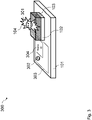
- FIG. 1 1 shows a schematic diagram of a document 100 with a volume hologram 104 for storing a security feature according to a first embodiment, in which the carrier layer 103 with the volume hologram 104 is applied to the entire surface of the substrate layer 101.
- the security feature document 100 comprises a substrate layer 101; an adhesive layer 102; and a carrier layer 103 with a volume hologram 104, the volume hologram 104 being designed to store the security feature, and the carrier layer 103 being bonded to the substrate layer 101 by means of the adhesive layer 102.
- the substrate layer 101 can consist of paper or a paper substitute, in particular comprising one or a combination of the following substances: cotton, polymers, fibers, fiber composites, cellulose, fleece, felt.
- Documents made of paper which were previously only provided with embossed holograms due to their material and kinematic structure, i.e. easy foldability, wrinkleability, low weight, etc., can thus be given greater security against counterfeit attacks.
- the documents can also consist of paper-like or paper-like or paper-replacing materials, e.g. documents based on cotton, polymers, fibers, fiber composites, cellulose, fleece, felt, etc., which have the above-mentioned properties, i.e. easy foldability, creaseability, light weight, etc.
- the carrier layer 103 is connected to the substrate layer 101 over the entire surface.
- the carrier layer can also be applied to a part of the surface on the substrate layer, as for example in figure 2 shown.
- the volume hologram can be applied to the substrate layer on both sides or on one side.
- volume holograms can be applied not only over the entire surface but also over part of the surface of the document in order to protect different areas of the document to protect against counterfeit attacks. For example, different sub-areas can be secured with specially provided volume holograms, which prevent an attack on data on this sub-area. Additionally or alternatively, the entire area of the document (as in figure 1 shown) are provided with the volume hologram. For example, the front of the document can be partially protected with one or more volume holograms, while the back of the document is protected over its entire area with the same or a different volume hologram. Furthermore, several volume holograms can also be applied over part of the area or over the entire area.
- these can be applied one on top of the other by means of several adhesive layers or, alternatively, can already be produced during the production process as multi-layer volume holograms, which are then applied to the substrate with an adhesive layer and bonded to it with a material bond.
- the integral connection of the carrier layer 103 to the substrate layer 101 can be based, for example, on a thermal, pneumatic or radiation-based, in particular UV-based, activation 501 (see figure 5 ) of the adhesive layer 102 are based.
- the adhesive layer can be viscous to liquid at room temperature or at the processing temperature, so that it is easily moldable in order to be easily adhered or attached to both the substrate layer 101 and the backing layer 103 .
- the adhesive layer 102 suitably wets both layers to a sufficient thickness, the adhesive layer 102 can change its shape in various ways, e.g. by applying pressure, temperature or the application of radiation, e.g. UV radiation, in particular becoming solid, and thus creating a material connection Connect the carrier layer to the substrate layer.
- the security feature stored in the volume hologram 104 can be designed in such a way that it can only be manipulated by uncontrollably destroying the carrier layer 103 with the volume hologram 104 and/or the substrate layer 101 .
- the document thus has greater security against counterfeiting attacks, because if the security feature in the volume hologram is tampered with, the document is rendered unusable, for example by destroying the carrier layer with the volume hologram and/or the substrate layer, which is clearly visible to everyone.
- the figure 1 represents a new use of volume holograms to secure paper-based security documents and a new way of application.
- the volume holograms can be personalized or non-personalised and they can cover the entire surface (as in 1 shown), e.g. to protect the data page of an ID document against manipulation or partially (as in figure 2 shown), for example in the form of a patch to attest to the authenticity of a document (e.g. EU visa).
- the volume holograms can also be processed very precisely and in a very short time in a partial form (as in 2 shown) are applied to the document.
- the decisive factor here is that the volume hologram 104 is equipped with a foil carrier made of adhesive (represented by the adhesive layer 102) or that an adhesive film is provided.
- the adhesive has very good adhesion properties and preferably has latently reactive properties that can be activated, for example, thermally, by pressure or by UV radiation and thus ensure irreversible bonding of the composite partners.
- the volume hologram 104 or its composite partner is at least partially destroyed in the event of a separation attempt. An attempted forgery is thus immediately recognized as such and the document becomes unusable.
- the adhesive has a high optical quality, so it does not affect the visual features on the document or the holographic properties.
- the adhesive can already be tacky at room temperature or only ensure adhesion of the bond partners under the appropriate processing conditions.
- the composite of holofilm (i.e. carrier layer 103 with volume hologram 104) and adhesive (or adhesive layer 102) can also be provided on a liner, e.g. made of silicone paper and, e.g. in the case of patches, be present as a stamped part or be lasered in the desired shape.
- the tearing off of the carrier material can be carried out just as well, e.g. by means of a corresponding pressure stamp, as in the case of a hot foil application.
- volume hologram can, for example, be easily identified as a level 1 feature even for inexperienced users in the visual area without additional aids, but can also be read out by machine. Attacks on the areas to be protected quickly lead to the destruction of the hologram or substrate and thus to the entire document becoming unusable. All in all, this leads to a high degree of protection against forgery, which is further strengthened by using a personalized connection to the document (e.g. personal data or document ID number in the form of plain text or 1D/2D code).
- a personalized connection to the document e.g. personal data or document ID number in the form of plain text or 1D/2D code.
- the documents 100 described above with a volume hologram 104 for storing a security feature can be used in a number of configurations. Some exemplary embodiments of such documents are described below.
- a first exemplary embodiment represents the protection of an inkjet data page (or generally printed data page) of a passport with a full-surface volume hologram application, which can be linked to the document by individual personalization.
- a second exemplary embodiment represents the protection of a visa sticker with a partial volume hologram application (patch), for example according to FIG figure 2 , in which the part-surface design is described in more detail.
- a third exemplary embodiment represents the protection of banknotes (made of paper and/or cotton and/or polymer) with one or more partial or full-area volume hologram applications.
- a fourth exemplary embodiment represents the protection of visa stickers, for example, with identical information in plain text or as a 1D/2D code on the sticker and on a volume hologram.
- a fifth exemplary embodiment represents the protection of e.g.
- the substrate layer 101 can consist of paper or a paper substitute.
- the substrate layer 101 can be designed, for example, as a layer with a basis weight of 50-300 g/m2, preferably 90-180 g/m2.
- the substrate layer 101 can, for example, have a porosity of 50-800 ml (according to Bendtsen) for papers based on cellulose and coated synthetic fiber substrates.
- uncoated long-fiber synthetic fiber substrates with an air permeability of up to 200 l/m2s can be provided. The air permeability can be determined according to Wester ashameder in accordance with DIN 53 887.
- a fiber mixture of at least 20% fibers of 10 mm or longer can be used, and in the case of synthetic fiber-based substrates, at least 40% fibers of 10 mm or longer.
- more than 80% of the synthetic fibers have a length of 15-50 mm.
- the adhesive of the adhesive layer 102 can be a liquid or paste-like adhesive, e.g. a one- or two-component adhesive, preferably a UV-crosslinkable acrylate or an adhesive that reacts to pressure and/or temperature changes and becomes a solid adhesive networked.
- a liquid or paste-like adhesive e.g. a one- or two-component adhesive, preferably a UV-crosslinkable acrylate or an adhesive that reacts to pressure and/or temperature changes and becomes a solid adhesive networked.
- Adhesive layer 102 may be at least 5 microns thick prior to processing, preferably 15 to 60 microns thick. With such a thick adhesive layer, a cohesive connection between the carrier layer 103 and the substrate layer 101 can be produced particularly efficiently.
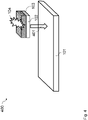
- FIG. 2 shows a schematic diagram of a document 200 with volume hologram 104 for storing a security feature according to a second embodiment, in which the carrier layer 103 with the volume hologram 104 is partially applied to the substrate layer 101 .
- the security feature document 100 comprises a substrate layer 101; an adhesive layer 102; and a carrier layer 103 with a volume hologram 104, as already mentioned above figure 1 described.
- the volume hologram 104 is designed to store the security feature.
- the carrier layer 103 is materially bonded to the substrate layer 101 by means of the adhesive layer 102 .
- the carrier layer 103 with the volume hologram is applied to the substrate layer 101 only over part of the area.
- the volume hologram can be applied to the substrate layer on both sides or on one side.
- volume holograms With the partial surface application of one or more volume holograms on the substrate layer 101, different areas of the document can be protected against forgery attacks. For example, different sub-areas can be secured with specially provided volume holograms, which prevent an attack on data on this sub-area. Additionally or alternatively, the entire surface of the document, on the front and/or back (as in figure 1 shown) are provided with the volume hologram. For example, part of the back of the document can be protected with one or more volume holograms, while the front of the document is protected over its entire area with the same or a different volume hologram. Furthermore, several volume holograms can also be applied over part of the area or over the entire area.
- these can be applied one on top of the other by means of several adhesive layers 102 or, alternatively, can already be produced as multilayer volume holograms during the production process, which are then applied to the substrate 101 with an adhesive layer 102 and connected to it in a materially bonded manner.
- the substrate layer 101 can consist of paper or a paper substitute, in particular comprising one or a combination of the following substances: cotton, polymers, fibers, fiber composites, cellulose, fleece, felt.
- the volume hologram 104 can be applied over the entire surface, as above figure 1 shown, or as a patch, ie partial volume hologram 104, as in figure 2 shown.
- the volume hologram 104 can be cut in a pre-processing step. Such a cutting process can be carried out so precisely that there are no fringes at the cutting points.
- a pre-structuring can be carried out with a laser, so that the section of the volume hologram can be cut without fraying.
- a web of latent-reactive hotmelt adhesive film (hotmelt adhesive film) with a thickness of about 10-15 ⁇ m is first laminated onto a web consisting of a carrier film 1 and a volume holographic film.
- a gap is created in the adhesive layer around the holographic motifs and a cut is made through the holographic layer by vaporizing these layers.
- the width of the laser cut through the adhesive and holographic layer is advantageously about 0.3-1 mm.
- power and feed speed are selected in such a way that the carrier film 1 is not cut.
- the adhesive layer for lamination is preferably provided on a carrier film 2 .
- the carrier film 2 is preferably pulled off the laminated adhesive layer after lamination onto the web and before laser ablation.
- the finished holographic adhesive patches are created by peeling off the holographic foil with the adhesive layer that is outside the patches.
- a carrier film 1 with adhesive-laminated holographic patches remains on for a precise application a value or security document, by means of pressure and heat. After application, the carrier film 1 is peeled off.
- carrier film 1 and 2 are peeled off from one another in the opposite direction so that the patches with a cover layer made of elements of carrier film 1 remain on carrier film 2, while the remaining strip consists of carrier film 1, holographic film and adhesive layer from the components that are no longer used.
- the carrier film 2 with the patches consisting of an adhesive layer, holographic film and cover film, is provided for application to a security document.
- the patches are peeled off the carrier film 2 and applied to a security document with a precise fit. The required application of pressure and heat can take place when it is placed on the security document or in a subsequent step.
- Typical cutting width would be 0.1-0.5 mm here.
- Example 3 but kiss cut using a cutting roller which is cooled to -25 to -15°C and is flushed with dried air or nitrogen in a chamber.
- FIG. 3 shows a schematic diagram of a document 200 with a volume hologram 104 for storing a security feature according to a third embodiment, in which the carrier layer 103 and the volume hologram 104 have personalization information 301, 302, 304.
- the security feature document 100 comprises a substrate layer 101; an adhesive layer 102; and a carrier layer 103 with a volume hologram 104, the volume hologram 104 being designed to store the security feature, and the carrier layer 103 being bonded to the substrate layer 101 by means of the adhesive layer 102, as already mentioned above figures 1 and 2 described.
- a personalized area 303 is identified, e.g. printed, on the substrate layer 101 and represents a visible structure 303 .
- This personalized area 303 can e.g. include various security features, such as biometric data 302, such as a photo, fingerprints or an eye picture of an owner of the document and additionally his name and his identification 304, e.g. in fair copy or as a 1-dimensional or also 2- dimensional code, e.g. QR code.
- the substrate layer 101 can consist of paper or a paper substitute, in particular comprising one or a combination of the following substances: cotton, polymers, fibers, fiber composites, cellulose, fleece, felt.
- the carrier layer 103 is partially connected to the substrate layer 101 .
- the carrier layer can also be applied to the entire surface of the substrate layer, such as in figure 1 shown.
- the volume hologram can be applied to the substrate layer on both sides or on one side.
- a visible structure 303 is applied, e.g. printed, to the substrate layer 101, which has a predetermined relationship to the security feature 301 stored in the volume hologram 104.
- a double security can be achieved with such a predetermined relationship, namely on the one hand by the security feature in the volume hologram 104 itself, and on the other hand by the relationship in which this security feature stands to the visible structure 303 applied to the substrate layer 101, which can comprise a code or personal data or biometric information such as a photo of the owner of the document or generally a photo of a person .
- the relationship can represent an identity.
- the relationship can represent a complementary property, for example, for example the visible feature 303 of the substrate layer 101 is supplemented by the security feature of the volume hologram 104 in an unambiguous manner.
- the relationship can represent a simple key or password, such as the owner's personal data that is known only to the owner, such as the mother's maiden name, the child's first name, favorite color, etc.
- the visible feature 303 of the substrate layer 101 can be a Ask a question that is answered by the security feature of the volume hologram 104 in a unique way.
- the relationship may represent a code, e.g., a concatenation of a first code generated by the visible feature 303 of the substrate layer 101 with a key to a concatenated code indicated by the volume hologram 104 security feature.
- a code e.g., a concatenation of a first code generated by the visible feature 303 of the substrate layer 101 with a key to a concatenated code indicated by the volume hologram 104 security feature.
- a code e.g., a concatenation of a first code generated by the visible feature 303 of the substrate layer 101 with a key to a concatenated code indicated by the volume hologram 104 security feature.
- the substrate layer 101 has the visible feature 303 which ensures additional security to the security feature 301 of the volume hologram 104 .
- a watermark for example, a watermark, chemical reagents, mottled fibers, personalization ink, one or more substances from materials from the group consisting of color pigments, effect pigments, optically variable pigments and/or luminescent substances or pigments or fluorescent substances or pigments can be provided.
- the visible structure 303 on the substrate layer 101 includes information in plain text or as a 1D or 2D code, which is identical to the security feature 301 stored in the volume hologram 104.
- the visible structure 303 on the substrate layer 101 contains information in plain text, the user only needs to compare it with the security feature 301 stored in the volume hologram 104, e.g. by means of a purely visual check, in order to be able to easily determine the authenticity of the document 300 . If the visible structure 303 on the substrate layer 101 is present as a 1D or 2D code, a visual check may also be possible. Alternatively, a machine, e.g. a reader, can carry out this check for the user, which makes their work easier and protects their eyes.
- the visible structure 303 on the substrate layer 101 includes additional information in plain text or as a 1D or 2D code, which only reproduces specified information together with the security feature 301 stored in the volume hologram 104 .
- This specified information can be information that is only known to a specific user, so that even if one of the two security features is tampered with, i.e. the visible structure 303 on the substrate layer 101 and the security feature 301 stored in the volume hologram 104 (which in itself is almost impossible is), the composite information from both security features would have to correspond to the specified information, which is only known to the specific user.
- the visible structure 303 is applied at least to a partial area of the substrate layer 101, the partial area of the substrate layer being connected to the carrier layer 103 by means of the adhesive layer 102.
- This embodiment is not in figure 3 shown because here the visible structure 303 is attached next to the carrier layer 103 with the volume hologram 104 .
- the visible structure 303 of the substrate layer 101 can be attached below the volume hologram 104 and only because of the Transparency of the adhesive layer 102 and the carrier layer 103 with the volume hologram 104 is visible, a particularly high security against forgery is achieved.
- the visible structure 303 of the substrate layer 101 can interact with the security feature 301 in the volume hologram 104, e.g. interfere with it, and thus generate specific patterns which have a specific meaning, which, for example, is only known to the owner of the document and/or or is relevant to verifying the authenticity of the document.
- the protection against forgery is thus increased due to the two security features of the substrate layer 101 and in the volume hologram 104 .
- this type of production is also very complex and therefore particularly forgery-proof.
- the substrate layer 101 comprises a personalization area on which the visible structure 303 is applied.
- the visible structure 303 can include personal data, in particular a name 304 of a document owner, a document identification and/or biometric data 302.
- the adhesive layer 102 is transparent in the optical wavelength range and visual features on the substrate layer 101 as well as visual structures of the volume hologram 104 are through the adhesive layer 102 .
- the visual features on the substrate layer for example personal data printed there such as name, identification or biometric features such as photo, fingerprints or image of the eye, etc. are visible through the adhesive layer and can therefore also be applied under the volume hologram 104 . Furthermore, these visual features can interfere with the visual features of the Supplement volume hologram 104 and, for example, generate certain optical effects through their interaction, which further increase the security of the document.
- FIG. 4 1 shows a schematic diagram of a method for producing a document with a volume hologram for storing a security feature according to an embodiment, wherein a first method step 400 is shown.
- the method is used to produce a document, such as a document 100, 200, 300, such as the Figures 1 to 3 described, which comprises a substrate layer 101, an adhesive layer 102 and a carrier layer 103 with a volume hologram 104, wherein a security feature is stored in the volume hologram 104.
- the method 600 includes an application 401 of the carrier layer 103 comprising the volume hologram 104 by means of the adhesive layer 102 on the substrate layer 101, as here figure 4 shown as a first method step and a material connection 500 of the carrier layer 103 to the substrate layer 101 as a second method step, as in figure 5 shown.
- the application 401 of the carrier layer 103 to the substrate layer 101 can take place by machine or manually.
- the carrier layer 103 with the adhesive layer 102 attached to it is brought into a suitable position relative to the substrate layer 101 and moved towards it until there is contact between the substrate layer 101 and carrier layer 103 by means of the adhesive layer 102 and the connection via the adhesive layer 102 is established.
- the adhesive layer 102 and the carrier layer 103 with the volume hologram 104 form a composite.
- the carrier layer 103 can be placed simply and precisely on the substrate layer 101, so that manufacturing tolerances can be reduced.
- a corresponding machine can, for example, hold the substrate layer 101 in a specific position and use a gripper to grip the composite of carrier layer 103 and adhesive layer 102, position it over the substrate layer 101 and finally place it on the substrate layer 101 and press it on to create the connection.
- the Machine can also, in a second step, as to figure 5 described in more detail, using UV rays and/or the application of pressure and/or temperature to produce the material connection.
- Such a machine can, for example, comprise the following machine components: a first machine component which is designed to apply the carrier layer 103 comprising the volume hologram 104 to the substrate layer 101 by means of the adhesive layer 102; and a second machine component, which is designed to bond the carrier layer 103 to the substrate layer 101, such as, for example, to figure 5 described in more detail.
- the machine can have a controller, for example a programmable logic controller (PLC), which can be controlled via a computer program.
- a computer program comprises a program code for controlling the machine, wherein the program code comprises a first section for controlling the first machine component, the carrier layer 103 comprising the volume hologram 104 to be applied to the substrate layer 101 by means of the adhesive layer 102, and the program code comprises a second section for Controlling the second machine component to bond the carrier layer 103 to the substrate layer 101 as below figure 5 described in more detail.
- the machine can be programmed to execute the program code or parts of the program code.
- the volume holograms 104 can be applied to the document very precisely and in a very short time for further processing in part-area form by means of a decisive change in the application process. It is crucial that the volume hologram 104 is equipped with a foil carrier made of adhesive 102 or that an adhesive film 102 is provided.
- the adhesive 102 has very good adhesive properties and preferably has latently reactive properties that can be activated, for example, thermally, by pressure or by UV radiation and thus ensure irreversible bonding of the composite partners, as explained below figure 5 shown.
- the volume hologram 104 or its composite partner is at least partially destroyed in the event of a separation attempt. This is an attempt at counterfeiting immediately recognized as such and the document becomes unusable.
- the adhesive 102 has a high optical quality, so that neither the visual features on the document nor the holographic properties are affected.
- the adhesive 102 can already be tacky at room temperature or only ensure adhesion of the bond partners under the appropriate processing conditions.
- the composite of holofilm 103, 104 and adhesive 102, as in figure 4 shown, can also be provided on a liner, for example made of silicon paper and, for example in the case of patches, can be present as a punched part or lasered in the desired shape.
- the carrier material can be torn off just as easily, for example by means of a corresponding pressure stamp, as in the case of a hot foil application.
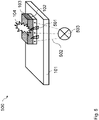
- FIG. 12 shows a schematic diagram of a method for producing a document with a volume hologram for storing a security feature according to an embodiment, wherein a second method step 500 is shown.
- the second method step 500 follows the first method step 400, as above figure 4 described, and ensures an integral or irreversible connection between carrier layer 103 with volume hologram 104 and substrate layer 101. This is carried out by activating the adhesive layer by means of irradiation 502 via a UV radiation source 503.
- the material properties of the adhesive 102 change as a result of the irradiation 502 and it changes from a liquid or sticky phase to a solid phase.
- the phase transition 501 is accompanied by a material connection between the two layers 103 and 101.
- the adhesive of the adhesive layer 102 can be a liquid or paste-like adhesive, e.g. a one- or two-component adhesive, preferably a UV-crosslinkable acrylate or an adhesive that reacts to pressure and/or temperature changes and becomes a solid adhesive networked.
- a liquid or paste-like adhesive e.g. a one- or two-component adhesive, preferably a UV-crosslinkable acrylate or an adhesive that reacts to pressure and/or temperature changes and becomes a solid adhesive networked.
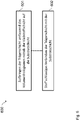
- FIG. 6 shows a schematic diagram of a method 600 for producing a volume hologram document according to an embodiment.
- the method 600 is used to produce a document, such as a document 100, 200, 300, such as the Figures 1 to 3 described, which comprises a substrate layer 101, an adhesive layer 102 and a carrier layer 103 with a volume hologram 104, wherein a security feature is stored in the volume hologram 104.
- the method 600 comprises the following steps: application 601, 400 of the carrier layer 103 comprising the volume hologram 104 by means of the adhesive layer 102 on the substrate layer 101; and cohesively connecting 602, 500 the carrier layer 103 to the substrate layer 101.
- the application 601 can take place, for example, as shown in FIG figure 4 described application 400 of the carrier layer.
- the cohesive connection 602 of the carrier layer 103 to the substrate layer 101 can take place, for example, as shown in FIG figure 5 described material connection 500.
- the method 600 can include a further step, namely applying, in particular printing, a visible structure, for example a visible structure 303 as shown in FIG figure 3 described, on the substrate layer 101, the visible structure 303 being in a predetermined relationship to the security feature stored in the volume hologram 104, for example according to the description figure 3 .
- a visible structure for example a visible structure 303 as shown in FIG figure 3 described
- the method 600 can include a further step, namely providing a composite of the carrier layer 103 and the adhesive layer 102 before applying the carrier layer 103 to the substrate layer 101, in particular by equipping the carrier layer 103 with a film carrier made of adhesive, e.g. as above for figure 1 described.
- the method 600 can include a further step, namely providing the composite of the carrier layer 103 and the adhesive layer 102 on a liner; and shaping of the composite of the carrier layer 103 and the adhesive layer 102 before application to the substrate layer 101 by means of stamping, lasers or pressure stamps.
Landscapes
- Health & Medical Sciences (AREA)
- Chemical & Material Sciences (AREA)
- Chemical Kinetics & Catalysis (AREA)
- General Chemical & Material Sciences (AREA)
- General Health & Medical Sciences (AREA)
- Toxicology (AREA)
- Engineering & Computer Science (AREA)
- Manufacturing & Machinery (AREA)
- Credit Cards Or The Like (AREA)
- Holo Graphy (AREA)
Applications Claiming Priority (1)
| Application Number | Priority Date | Filing Date | Title |
|---|---|---|---|
| DE102021103404.3A DE102021103404A1 (de) | 2021-02-12 | 2021-02-12 | Dokument mit Volumenhologramm zum Speichern eines Sicherheitsmerkmals |
Publications (1)
| Publication Number | Publication Date |
|---|---|
| EP4043230A1 true EP4043230A1 (fr) | 2022-08-17 |
Family
ID=80446849
Family Applications (1)
| Application Number | Title | Priority Date | Filing Date |
|---|---|---|---|
| EP22156196.2A Pending EP4043230A1 (fr) | 2021-02-12 | 2022-02-10 | Document à hologramme volumique permettant de mémoriser un élément de sécurité |
Country Status (2)
| Country | Link |
|---|---|
| EP (1) | EP4043230A1 (fr) |
| DE (1) | DE102021103404A1 (fr) |
Families Citing this family (1)
| Publication number | Priority date | Publication date | Assignee | Title |
|---|---|---|---|---|
| DE102023117335A1 (de) | 2023-06-30 | 2025-01-02 | Heliatek Gmbh | Verfahren zur Erzeugung von optischen Strukturen in einer flächig ausgebildeten Klebeschicht |
Citations (11)
| Publication number | Priority date | Publication date | Assignee | Title |
|---|---|---|---|---|
| EP1168111A2 (fr) * | 2000-06-27 | 2002-01-02 | Dai Nippon Printing Co., Ltd. | Stratifié avec hologramme multicouche et étiquette pour la fabrication d'un stratifié avec hologramme multicouche |
| EP1110717B1 (fr) * | 1999-12-22 | 2005-06-01 | Bundesdruckerei GmbH | Procédé et dispositif pour la fabrication d'un laminé comprenant au moins un film polymère portant des informations et une couche support, utilisé pour produire des documents infalsifiables |
| DE202005009985U1 (de) * | 2005-06-25 | 2005-09-01 | Emil Wild Kg | Ausweisvorlage |
| DE102007050277A1 (de) * | 2007-10-18 | 2009-04-23 | Bundesdruckerei Gmbh | Sicherheits- und/oder Wertdokument mit in verschiedenen Schichten eingerichteten Hologrammen |
| DE102008036402B3 (de) * | 2008-08-01 | 2009-09-17 | Bundesdruckerei Gmbh | Goniolumineszentes Sicherheitselement und Verfahren zu dessen Herstellung |
| DE102010034793A1 (de) * | 2010-08-18 | 2012-02-23 | Hologram Industries Research Gmbh | Dokument mit Hologramm und Verfahren zu dessen Herstellung |
| US20120286504A1 (en) * | 2010-01-19 | 2012-11-15 | Dai Nippon Printing Co., Ltd. | Volume hologram sheet to be embedded, forgery prevention paper, and card |
| EP1866168B1 (fr) * | 2005-03-03 | 2013-04-24 | Bundesdruckerei GmbH | Document en forme de livre, notamment document d'identification |
| WO2017202578A1 (fr) * | 2016-05-25 | 2017-11-30 | Leonhard Kurz Stiftung & Co. Kg | Procédé de fabrication d'un film d'hologramme volumique ayant des éléments de sécurité formés en tant que segments de transmission |
| DE102016123007A1 (de) * | 2016-11-29 | 2018-05-30 | Osram Oled Gmbh | Organisches optoelektronisches Bauteil |
| EP2704128B1 (fr) * | 2012-08-27 | 2018-10-17 | Trautwein GmbH & Co. | Sceau |
Family Cites Families (4)
| Publication number | Priority date | Publication date | Assignee | Title |
|---|---|---|---|---|
| DE3650027T2 (de) | 1985-05-07 | 1995-01-26 | Dainippon Printing Co Ltd | Artikel mit transparentem Hologramm. |
| GB2452066B (en) | 2007-08-23 | 2012-05-30 | Ver Tec Security Systems Ltd | Security holograms |
| JP2012113077A (ja) | 2010-11-24 | 2012-06-14 | Sony Corp | ホログラム積層体およびホログラム積層体の製造方法 |
| DE102014116940A1 (de) | 2014-11-19 | 2016-05-19 | Leonhard Kurz Stiftung & Co. Kg | Mehrschichtkörper und Verfahren zu dessen Herstellung |
-
2021
- 2021-02-12 DE DE102021103404.3A patent/DE102021103404A1/de active Pending
-
2022
- 2022-02-10 EP EP22156196.2A patent/EP4043230A1/fr active Pending
Patent Citations (11)
| Publication number | Priority date | Publication date | Assignee | Title |
|---|---|---|---|---|
| EP1110717B1 (fr) * | 1999-12-22 | 2005-06-01 | Bundesdruckerei GmbH | Procédé et dispositif pour la fabrication d'un laminé comprenant au moins un film polymère portant des informations et une couche support, utilisé pour produire des documents infalsifiables |
| EP1168111A2 (fr) * | 2000-06-27 | 2002-01-02 | Dai Nippon Printing Co., Ltd. | Stratifié avec hologramme multicouche et étiquette pour la fabrication d'un stratifié avec hologramme multicouche |
| EP1866168B1 (fr) * | 2005-03-03 | 2013-04-24 | Bundesdruckerei GmbH | Document en forme de livre, notamment document d'identification |
| DE202005009985U1 (de) * | 2005-06-25 | 2005-09-01 | Emil Wild Kg | Ausweisvorlage |
| DE102007050277A1 (de) * | 2007-10-18 | 2009-04-23 | Bundesdruckerei Gmbh | Sicherheits- und/oder Wertdokument mit in verschiedenen Schichten eingerichteten Hologrammen |
| DE102008036402B3 (de) * | 2008-08-01 | 2009-09-17 | Bundesdruckerei Gmbh | Goniolumineszentes Sicherheitselement und Verfahren zu dessen Herstellung |
| US20120286504A1 (en) * | 2010-01-19 | 2012-11-15 | Dai Nippon Printing Co., Ltd. | Volume hologram sheet to be embedded, forgery prevention paper, and card |
| DE102010034793A1 (de) * | 2010-08-18 | 2012-02-23 | Hologram Industries Research Gmbh | Dokument mit Hologramm und Verfahren zu dessen Herstellung |
| EP2704128B1 (fr) * | 2012-08-27 | 2018-10-17 | Trautwein GmbH & Co. | Sceau |
| WO2017202578A1 (fr) * | 2016-05-25 | 2017-11-30 | Leonhard Kurz Stiftung & Co. Kg | Procédé de fabrication d'un film d'hologramme volumique ayant des éléments de sécurité formés en tant que segments de transmission |
| DE102016123007A1 (de) * | 2016-11-29 | 2018-05-30 | Osram Oled Gmbh | Organisches optoelektronisches Bauteil |
Also Published As
| Publication number | Publication date |
|---|---|
| DE102021103404A1 (de) | 2022-08-18 |
Similar Documents
| Publication | Publication Date | Title |
|---|---|---|
| EP1744904B2 (fr) | Materiau en feuille et son procede de fabrication | |
| EP2665607B1 (fr) | Procédé de fabrication d'un support de données multicouche et support de données fabriqué selon ledit procédé | |
| EP2027562B1 (fr) | Procédé de production de documents à hologramme, et document à hologramme correspondant | |
| EP0718121B1 (fr) | Support de données et sa méthode de fabrication | |
| EP3188915B1 (fr) | Support de données et objet en forme de cahier ou de livre contenant le support de données ainsi que procédé de fabrication du support de données | |
| DE102008016795A1 (de) | Verfahren zum Erzeugen einer mikrooptischen Moiré-Vergrößerungsanordnung | |
| DE19940790A1 (de) | Übertragungsfolie zur Aufbringung einer Dekorschichtanordnung auf ein Substrat | |
| EP3291996B1 (fr) | Support de données destiné à être inséré dans un objet en forme de cahier ou de livre et procédé de fabrication dudit support | |
| DE102008036402B3 (de) | Goniolumineszentes Sicherheitselement und Verfahren zu dessen Herstellung | |
| EP1691988B1 (fr) | Carte d'identification et son procede de production | |
| WO2008006459A1 (fr) | Procédé d'application d'un signe de sécurité sur un document de sécurité et document de sécurité pourvu d'un signe de sécurité | |
| EP1567364B1 (fr) | Element de securite et procede de production de cet element | |
| DE102021103404A1 (de) | Dokument mit Volumenhologramm zum Speichern eines Sicherheitsmerkmals | |
| DE102018132321A1 (de) | Verfahren zur Herstellung eines Folienzwischenprodukts, Folienzwischenprodukt sowie Verfahren zur Herstellung eines Produkts | |
| EP2943351A1 (fr) | Support de stockage de données sous forme de carte à relief | |
| DE102007003955A1 (de) | Rohling, Verfahren zur Herstellung und Verwendung desselben sowie Verfahren zur Herstellung eines Wert- und Sicherheitsdokumentes | |
| WO2005011998A2 (fr) | Papier de surete servant a produire des documents de valeur | |
| EP3611027B1 (fr) | Composite multicouche et son procédé de fabrication ainsi que composite multicouche pour un document de valeur et / ou de sécurité | |
| EP3877194A1 (fr) | Élément de sécurité doté d'éléments de structure associés spatialement les uns aux autres en couches différentes | |
| DE112004002006B4 (de) | Sicherheitselement und Verfahren zu seiner Herstellung | |
| DE602005006300T2 (de) | Verfahren zum schutz von auf papier- oder kunststoffträgern enthaltenen daten durch transfer einer durchsichtigen schutzschicht | |
| DE20015840U1 (de) | Sicherungselement und Folie mit dielektrischer Schicht | |
| DE102022129499A1 (de) | Sicherheitselement, Sicherheitsdokument und Verfahren zur Herstellung eines Sicherheitsdokuments | |
| EP1102267A2 (fr) | Element de securité et feuille comprenant une couche dielectrique | |
| EP3725537A1 (fr) | Produit d'impression pourvu d'au moins une marque d'impression luminescente, son procédé de fabrication et feuille de transfert |
Legal Events
| Date | Code | Title | Description |
|---|---|---|---|
| PUAI | Public reference made under article 153(3) epc to a published international application that has entered the european phase |
Free format text: ORIGINAL CODE: 0009012 |
|
| STAA | Information on the status of an ep patent application or granted ep patent |
Free format text: STATUS: THE APPLICATION HAS BEEN PUBLISHED |
|
| AK | Designated contracting states |
Kind code of ref document: A1 Designated state(s): AL AT BE BG CH CY CZ DE DK EE ES FI FR GB GR HR HU IE IS IT LI LT LU LV MC MK MT NL NO PL PT RO RS SE SI SK SM TR |
|
| STAA | Information on the status of an ep patent application or granted ep patent |
Free format text: STATUS: REQUEST FOR EXAMINATION WAS MADE |
|
| 17P | Request for examination filed |
Effective date: 20230209 |
|
| RBV | Designated contracting states (corrected) |
Designated state(s): AL AT BE BG CH CY CZ DE DK EE ES FI FR GB GR HR HU IE IS IT LI LT LU LV MC MK MT NL NO PL PT RO RS SE SI SK SM TR |
|
| P01 | Opt-out of the competence of the unified patent court (upc) registered |
Effective date: 20230526 |
|
| STAA | Information on the status of an ep patent application or granted ep patent |
Free format text: STATUS: EXAMINATION IS IN PROGRESS |
|
| 17Q | First examination report despatched |
Effective date: 20240502 |