EP4043645B1 - System zur überwachung des zustands von strassenoberflächen, arbeitsfahrzeug, verfahren zur überwachung des zustands von strassenoberflächen und programm - Google Patents
System zur überwachung des zustands von strassenoberflächen, arbeitsfahrzeug, verfahren zur überwachung des zustands von strassenoberflächen und programm Download PDFInfo
- Publication number
- EP4043645B1 EP4043645B1 EP20890154.6A EP20890154A EP4043645B1 EP 4043645 B1 EP4043645 B1 EP 4043645B1 EP 20890154 A EP20890154 A EP 20890154A EP 4043645 B1 EP4043645 B1 EP 4043645B1
- Authority
- EP
- European Patent Office
- Prior art keywords
- tire
- road surface
- rock
- monitoring object
- surface condition
- Prior art date
- Legal status (The legal status is an assumption and is not a legal conclusion. Google has not performed a legal analysis and makes no representation as to the accuracy of the status listed.)
- Active
Links
Images




Classifications
-
- E—FIXED CONSTRUCTIONS
- E02—HYDRAULIC ENGINEERING; FOUNDATIONS; SOIL SHIFTING
- E02F—DREDGING; SOIL-SHIFTING
- E02F9/00—Component parts of dredgers or soil-shifting machines, not restricted to one of the kinds covered by groups E02F3/00 - E02F7/00
- E02F9/26—Indicating devices
- E02F9/261—Surveying the work-site to be treated
-
- H—ELECTRICITY
- H04—ELECTRIC COMMUNICATION TECHNIQUE
- H04N—PICTORIAL COMMUNICATION, e.g. TELEVISION
- H04N7/00—Television systems
- H04N7/18—Closed-circuit television [CCTV] systems, i.e. systems in which the video signal is not broadcast
- H04N7/183—Closed-circuit television [CCTV] systems, i.e. systems in which the video signal is not broadcast for receiving images from a single remote source
Definitions
- the present invention relates to a road surface condition monitoring system, a work vehicle, a road surface condition monitoring method, and a program.
- a wheel loader operating in a mine and a quarry perform excavation work of a blasting rock and the like.
- a tire may come into contact with a sharp rock and cause tire damage.
- a tire damage is, for example, scratching or puncturing a tire.
- an operator allows the wheel loader to travel while checking whether there is any rock on a road surface which may cause the tire damage, it is difficult to visually recognize a condition of the road surface from an operator's seat in some cases. Therefore, in a work vehicle disclosed in Patent Document 1, a road surface condition in front of a front tire is imaged by a camera installed in front of a front accelerator, and the operator can check the road surface condition by a monitor provided in a cab.
- Patent Document 2 describes a vehicle operation management device for a vehicle, in particular, a mine transport vehicle.
- the system has the capability of detecting a contact between a tire of the vehicle and an object on the road such as a stone.
- a contact waveform including collision peak data In particular, in case of a collision between the vehicle and the object, it is determined whether or not the object may damage a tire. The determination is based on a contact waveform including collision peak data.
- Patent Document 3 describes an operation system for a transport vehicle such as mine vehicle (dump truck).
- the system is capable of determining a contact between a tire of the vehicle and an obstacle on the road, which may potentially cause damage and thus reduce the life-cycle of tires, and record respective information.
- the system is equipped with front cameras such as a stereo camera system.
- Patent Documents 2 and 3 thus describe systems for detecting a contact between a tire of a vehicle and an obstacle and determining whether this may cause damage, after the contact.
- Patent Document 4 describes a tire pattern determination device and a vehicle type determination device, in particular, for toll collection facilities.
- a toll booth system includes inter alia a tire pattern determination device capable of determining a tire pattern from passing by vehicles.
- the operator can visually recognize whether a rock causing the tire damage exists in a traveling direction by viewing the monitor.
- the operator's line of sight is forward, and there is a problem that it is difficult for the operator to keep viewing the monitor always.
- the frequency of looking the monitor is increased, the operation of the work vehicle becomes slow and the productivity is lowered.
- the present invention has been made in view of the above circumstances, and an object of the present invention is to provide a road surface condition monitoring system, a work vehicle, a road surface condition monitoring method, and a program which enable an operator to easily monitor a road surface condition.
- the operator can easily monitor the road surface condition.
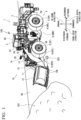
- Fig. 1 is a perspective view showing a wheel loader 1 as an example of a work vehicle according to the present embodiment.
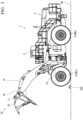
- Fig. 2 is a side view of the wheel loader 1 shown in Fig. 1 .
- Fig. 3 is a side view of the wheel loader 1 (when a bucket 12 is moved upward) shown in Fig. 1 .
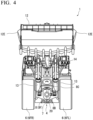
- Fig. 4 is a front view of the wheel loader 1 shown in Fig. 3 .
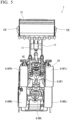
- Fig. 5 is a view of the wheel loader 1 shown in Fig. 3 as viewed from diagonally below.
- Fig. 6 is a perspective view of a tire 6 shown in Fig. 1 .
- Fig. 7 is a schematic diagram showing an imaging region of a camera according to the present embodiment.
- the wheel loader 1 includes a vehicle body 2 and work equipment 10 supported by the vehicle body 2.
- Fig. 1 schematically shows a rock pile 201, which is a work object of the wheel loader 1, and a rock 202, which is located away from the rock pile 201 and has a possibility of damaging the tire 6.
- the vehicle body 2 has a cab 3, a traveling mechanism 4, and an engine (not shown) that generates power for driving the traveling mechanism 4.
- the cab 3 is provided with a driver's seat (not shown).
- the wheel loader 1 is operated by an operator who is seated in the driver's seat in the cab 3.
- a driving operation device operated by the operator is disposed around the driver's seat.
- the driving operation device includes, for example, a shift lever, an accelerator pedal, a brake pedal, and a work equipment lever for operating the work equipment 10. The operator operates the driving operation device, to control the traveling speed of the wheel loader 1, switch between forward and reverse, and operate the work equipment 10.
- the traveling mechanism 4 has wheels 5 that can rotate around a rotating shaft DX.
- the tire 6 is mounted on each of the wheels 5.
- the wheels 5 include two front wheels 5F and two rear wheels 5R.
- the tires 6 include a right front tire 6FR and a left front tire 6FL mounted on the front wheels 5F, and a right rear tire 6RR and a left rear tire 6RL mounted on the rear wheels 5R.
- the right front tire 6FR and the left front tire 6FL may be collectively referred to as a front tire 6F
- the right rear tire 6RR and the left rear tire 6RL may be collectively referred to as a rear tire 6R.
- the traveling mechanism 4 can travel on a road surface RS.
- a direction parallel to the rotating shaft DX when the wheel loader 1 travels in a straight advancing state is appropriately referred to as a vehicle width direction of the vehicle body 2
- a direction parallel to the vertical axis orthogonal to the road surface RS is appropriately referred to as an up-down direction of the vehicle body 2
- a direction orthogonal to both the rotating shaft DX and the vertical axis is appropriately referred to as a front-rear direction of the vehicle body 2.
- the tire 6 has, for example, a block pattern (also referred to as a tread pattern) 6P as shown in Fig. 6 .
- the block pattern 6P is a pattern formed of a groove 6G or the like carved in a tread 6S which is a portion where the tire 6 is in contact with the road surface RS.
- the block pattern 6P is a pattern (lug type pattern) in which a plurality of the grooves 6G are alternately carved on the left and right at substantially right angles to a circumferential direction of the tire 6.
- the direction in which the work equipment 10 is present is the front, and the opposite direction to the front is the rear, with respect to the operator who is seated in the driver's seat of the cab 3.
- One in the vehicle width direction is the right, and the opposite direction to the right is the left.
- the front wheels 5F are disposed in front of the rear wheels 5R.
- the front wheels 5F are disposed on both sides of the vehicle body 2 in the vehicle width direction.
- the rear wheels 5R are disposed on both sides of the vehicle body 2 in the vehicle width direction.
- the work equipment 10 has an arm 11 movably connected to the vehicle body 2, a bucket 12 which is an excavation member movably connected to the arm 11 via a link 16, and a bell crank 15.
- the arm 11 is operated by power generated by a lift cylinder 13 ( Fig. 3 ).
- the lift cylinder 13 is a hydraulic cylinder that generates power for moving the arm 11.
- One end portion of the lift cylinder 13 is connected to the vehicle body 2, and the other end portion of the lift cylinder 13 is connected to the arm 11.
- Two lift cylinders 13 are provided.
- One lift cylinder 13 is provided on the right side of the center in the vehicle width direction, and the other lift cylinder 13 is provided on the left side of the center in the vehicle width direction.
- the lift cylinder 13 expands and contracts. As a result, the arm 11 moves in the up-down direction.
- the bucket 12 is an excavation member having teeth 12B.
- the excavation member may be a blade having a blade edge.
- the bucket 12 is connected to a tip portion of the arm 11 and is connected to the vehicle body 2 via the arm 11.
- the bucket 12 is operated by power generated by a bucket cylinder 14.
- the bucket cylinder 14 is a hydraulic cylinder that generates power for moving the bucket 12.
- a central portion of the bell crank 15 is rotatably connected to the arm 11.
- One end portion of the bucket cylinder 14 is connected to the vehicle body 2, and the other end portion of the bucket cylinder 14 is connected to one end portion of the bell crank 15.
- the other end portion of the bell crank 15 is connected to the bucket 12 via the link 16 ( Fig. 3 ).
- One bucket cylinder 14 is provided.
- the bucket cylinder 14 is disposed at the center in the vehicle width direction. When the operator operates the work equipment lever, the bucket cylinder 14 expands and contracts. As a result, the bucket 12 swings.
- the bucket 12 swings in front of the vehicle
- end portions 12E on both sides of the bucket 12 in the vehicle width direction are disposed outside the tire 6 in the vehicle width direction. That is, a distance in the vehicle width direction between the right end portion 12E and the left end portion 12E of the bucket 12 is larger than a distance in the vehicle width direction between an outer surface of the right tire 6 and an outer surface of the left tire 6.
- Fig. 4 is a front view showing the wheel loader 1 according to the present embodiment, and shows a state in which the bucket 12 is moved upward.
- the traveling mechanism 4 has a power transmission mechanism 7 that transmits the power generated by the engine to the front wheels 5F, and a housing 8 (also referred to as an axle case) that houses at least part of the power transmission mechanism 7.
- the engine is disposed in a rear part of the vehicle body 2.
- the power generated by the engine is transmitted to the left and right front wheels 5F via a differential gear of the power transmission mechanism 7.
- the differential gear is housed in a spherical portion 8B of the housing 8.
- the spherical portion 8B of the housing 8 that houses the differential gear is appropriately referred to as an axle ball 8B.
- the axle ball 8B is disposed at the center in the vehicle width direction. In addition, the axle ball 8B is disposed below the bucket cylinder 14.
- An axle housing 8C which is a cover of the axle ball 8B (housing 8), is provided above the axle ball 8B.
- the housing 8 includes a housing 8F for the front wheels 5F and a housing 8R for the rear wheels 5R ( Fig. 5 ).
- a road surface condition monitoring system 100 includes a camera 20, a computer 30, a buzzer 40, and a monitor 50.
- the camera 20 is installed in the axle housing 8C, for example, as shown in Figs. 4 and 5 .
- the computer 30, the buzzer 40, and the monitor 50 are installed in the cab 3.
- the camera can be attached to the back side of the bucket 12 (the upper surface of the bucket facing the cab 3) (camera 20a), attached to the top (camera 20b) or back (camera 20e) of a front fender 18, attached to the top, bottom, or side of lighting 19 (camera 20c), attached to the top 3a of the ceiling of the cab 3 (camera 20d), or attached to the cover of the housing 8R (camera 20f).
- the cameras 20 and 20a to 20f can be mounted on the wheel loader 1 via, for example, a bracket, and the bracket may be provided with an adjustment mechanism capable of adjusting the imaging direction.
- the cameras 20 and 20a to 20f shown in Fig. 7 are represented by two rectangles, and the imaging direction of each camera is from a large rectangle to a small rectangle.
- the imaging region is not limited to the region 401, and for example, part or the entirety of a region 402, a region 403, and a region 404 may be used as the imaging region.
- the region 402 is a certain region behind the front tire 6F.
- the region 403 is a certain region in front of the rear tire 6R.
- the region 404 is a certain region behind the rear tire 6R.
- Each of the regions 401 to 404 can be a region including part of the tire 6 and part of the road surface RS.
- an imaging region of the camera may be provided for each of the left and right tires 6.
- the road surface condition monitoring system 100 includes the camera 20, the computer 30, the buzzer 40, and the monitor 50 whose installation positions are described with reference to Fig. 1 and the like.
- the input/output device 33 inputs an image signal captured by the camera 20 and stores the input image signal in a predetermined storage device or outputs the input image signal to the image processing unit 311, superimposes, for example, an image signal indicating a predetermined determination result of the image recognition unit 312 on the input image signal and outputs the superimposed image signal to the monitor 50, or outputs a signal indicating a predetermined determination result of the image recognition unit 312 to the buzzer 40.
- the input/output device 33 is a device that executes a transmission control of the image signal, a control of display contents displayed on the monitor 50 based on the image signal, and a control of sound contents output to the buzzer 40 based on the image signal.
- the image processing unit 311 receives the image signal captured by the camera 20.
- the image signal is input to the image processing unit 311 via the input/output device 33, performs predetermined image processing (for example, resolution conversion and image quality adjustment), and stores the image-processed image signal in a predetermined storage device.
- the image recognition unit 312 receives the image-processed image signal by the image processing unit 311, determines whether or not the image captured by the camera 20 contains rocks or the like to be paid attention which may damage the tire 6, and decides information to be output from the buzzer 40 or the monitor 50 based on the determined result.
- the monitor 50 is a display device such as a liquid crystal display or an organic electroluminescence display, and displays, for example, an image (moving image or still image) that can be visually recognized by the operator in the cab 3 according to the image signal output from the input/output device 33.
- the monitor 50 may use a display device such as a head-up display capable of displaying an image or information on a windshield of the cab 3.
- the monitor 50 may be a single display device or may be composed of a plurality of display devices.
- the display device and the sound output device may be integrated. For example, a liquid crystal display and a speaker may be integrated.
- the monitor 50 is disposed in the cab 3 of the vehicle body 2.
- the monitor 50 displays, for example, the moving image data acquired by the camera 20 in real time, or displays information according to the determination result of the image recognition unit 312.
- the operator of the cab 3 can visually recognize the bucket 12, the arm 11, the bucket cylinder 14, and the like via the windshield 53, it is difficult to visually recognize the condition of the road surface RS.
- the condition of the road surface RS on a lower surface of the bucket 12 and the condition of the road surface RS in front of the bucket 12 are also difficult to be visually recognized by the operator of the cab 3.
- the condition of the road surface in front of the front tire 6 becomes less visible as it comes closer to the front tire 6.
- the monitor 50 displays the moving image data acquired by the camera 20 in real time
- the operator of the cab 3 views the monitor 50 provided in the cab 3 and can visually recognize, for example, the condition of the road surface RS (region 401) between the bucket 12 and the front tire 6F.
- Step S11 the input/output device 33 acquires the image signal output by the camera 20 for one or a plurality of frames and stores the image signal in a predetermined storage device (Step S11).
- the input/output device 33 may perform, for example, a process of outputting the image signal input from the camera 20 to the monitor 50 as it is in response to an instruction from the image recognition unit 312.
- an image captured by the camera 20 can be displayed in real time on the monitor 50 in response to the instruction from the image recognition unit 312.
- the image processing unit 311 inputs the image signal stored in the predetermined storage device in Step S11, performs predetermined image processing thereon, and then stores the image signal in the predetermined storage device again (Step S12).
- the image recognition unit 312 executes image recognition processing on the image signal of one or a plurality of frames stored in the predetermined storage device, and determines whether or not the region 401 includes the rock 202 to be paid attention which may damage the tire 6 (Step S13).
- the image recognition unit 312 determines in Step S13 that the rock 202 to be paid attention is included ("YES" in Step S13)
- the image recognition unit 312 outputs an instruction to the input/output device 33 to issue information (alarm sound) indicating the determination result from the buzzer 40 or to display information (alarm image) indicating the determination result on the monitor 50 (Step S14), to alert the operator, and the process shown in Fig. 9 ends.
- the image recognition unit 312 does not determine in Step S13 that the rock 202 to be paid attention is included ("NO” in Step S13)
- the process shown in Fig. 9 ends.
- the determination processing by the image recognition unit 312 can be processing of determining whether the image signal to be determined is classified into an image containing a rock to be paid attention or an image not containing a rock to be paid attention, by using the trained model 321 stored in the storage device 32.
- the trained model 321 is a trained model using a neural network such as a convolution neural network (CNN) as an element, and weighting coefficients between neurons in each layer of the neural network are optimized by machine learning so that a solution obtained for a large number of input data is output.
- the trained model 321 is composed of, for example, a combination of a program that performs an operation from input to output and a weighting coefficient (parameter) used for the operation.
- the trained model 321 can be generated as follows, for example. That is, for example, as shown in Fig. 10 , a plurality of pieces of image data 301 including the rock pile 201 and the rock 202 to be paid attention, a plurality of pieces of image data 302 including the rock pile 201 without the rock 202 to be paid attention, and a plurality of pieces of image data 303 including neither the rock pile 201 nor the rock 202 to be paid attention are prepared. Then, the plurality of pieces of image data 301 are defined as data including the rock 202 to be paid attention and the rock pile 201. In addition, the plurality of pieces of image data 302 are defined as data including the rock pile 201 without the rock 202 to be paid attention.
- the plurality of pieces of image data 303 are defined as data including neither the rock pile 201 nor the rock 202 to be paid attention.
- the defined plurality of pieces of image data 301, 302, and 303 are prepared as a data set 310 for learning.
- classification labeling
- the trained model 321 is generated by machine learning by supervised learning using the data set 310 for learning.
- the pieces of image data 301 to 303 are all images including part of the tire 6 (block pattern 6P).
- the size and orientation of the rock 202 can be easily grasped with reference to the tire 6 (block pattern 6P) as compared with a case where part of the tire 6 (block pattern 6P) is not included, and the learning accuracy can be improved.
- the initial classification (labeling) of the image data included in the data set 310 for learning can be performed, for example, manually or by image recognition processing such as pattern matching based on the conditions described below.
- the rock 202 to be paid attention can be defined as, for example, a rock having a certain size or larger or a rock having a sharp edge angle, and defined as being in a case where it is assumed that the tire 6 is highly likely to be damaged when traveling toward the rock, based on the relative position and the relative orientation with respect to the tire 6.
- the rock 202 to be paid attention can be defined as a rock having a certain size or larger or a rock having a sharp edge angle and defined as being in a case where the position of the rock 202 does not exist on a slope of the rock pile 201 (or exists on a flat surface).
- a rock smaller than a certain size has a high possibility of avoiding the damage by flexibility of the tire 6 and is not the rock to be paid attention, but the rock having a certain size or larger has a high possibility of causing the damage due to the weight of the wheel loader 1 when the wheel loader 1 goes over the rock.
- the rock having a round shape has a low possibility of piercing the tire 6 or cutting the tire 6 and is not a rock to be paid attention.
- the rock pile 201 is an object in which a plurality of rocks, earth, and the like are accumulated, and is an area to be worked by the work equipment 10, so that the tire 6 does not normally enter the rock pile 201. Therefore, the rock located on the slope of the rock pile 201 can be excluded from the rock 202 to be paid attention since it does not lie on the road surface RS.
- the "rock pile” is merely one aspect of "an area where the tires of the work vehicle do not enter”. For example, "rock loaded in a dump truck” may be defined as “an area where the tires of the work vehicle do not enter” in the same manner as the "rock pile".
- the fact that the rock does not exist on the slope of the rock pile 201 is used as a condition for determining the rock 202 to be paid attention. In this way, for example, when rocks are scattered all over a mine, it is possible to avoid determining that the rocks are the rock 202 to be paid attention, and as a result, it is possible to prevent unnecessary alarm from being issued.
- the condition relating to the size of the rock (monitoring object) or the shape of the rock (shape with a sharp edge angle) is included in the information for defining whether or not the image data includes the rock 202 to be paid attention, so that the image recognition unit 312 (damage determination unit) can use information on the shape or size of the rock (monitoring object) included in the image captured by the camera 20 as an element for the determination.
- the condition relating to the monitoring object information (relative position and relative orientation, or whether or not the position is on the slope of the rock pile 201) of the rock (monitoring object) with respect to the tire 6 is included in the information defining whether or not the image data includes the rock 202 to be paid attention, so that the image recognition unit 312 (damage determination unit) can use, as an element for the determination, information on the relative position and the relative orientation of the rock (monitoring object) and whether or not the rock is on the slope, with respect to the tire 6 included in the image captured by the camera 20.
- part of the tire 6 (block pattern 6P) is included, so that the image recognition unit 312 (damage determination unit) can use tire information on the shape of the block pattern 6P or the size of the block pattern 6P of the tire 6 as an element for the determination.
- the data set 310 for learning it is desirable to prepare the data set 310 for learning at night so that the determination processing can be performed even though an image in which a rock is illuminated by a light source mounted on the work vehicle is acquired during night work. In this case, this system functions effectively even during night work.
- the data set 310 for learning at night may be created based on an image that reproduces the appearance at night by performing image processing such as color tone correction based on an image acquired during daytime.
- a first trained model 321 based on the data set for learning 310 in rainy weather and a second trained model 321 based on the data set for learning 310 other than in rainy weather may be prepared, and the second trained model 321 may be switched to the first trained model 321 in rainy weather (for example, a raindrop sensor).
- a detection signal may be output to the computer 30, and switching from the second trained model to the first trained model may be performed by the input/output device 33 in response to the input of the detection signal.
- the image of the data set for learning 310 may be artificially created by using software for creating computer graphics.
- the tire need not be reflected in the image of the data set for learning 310.
- any image recognition technique such as pattern matching can be used in addition to the trained model such as CNN.
- an image generated by using the image generation technique such as auxiliary classifier generative adversarial Network (ACGAN) can be used.
- ACGAN auxiliary classifier generative adversarial Network
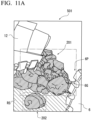
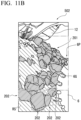
- FIGs. 11A and 11B are schematic diagrams showing an example of a captured image by the camera 20 according to the present embodiment.
- An image 501 shown in Fig. 11A includes the rock pile 201 surrounded by a chain line frame and one rock 202 surrounded by a broken line frame.
- the rock 202 shown in the example of this captured image is a rock to be paid attention for the damage to the tire 6 and exists on a flat surface (road surface RS).
- the image 501 (image-processed) is input to the trained model 321, so that the image recognition unit 312 can obtain the determination result that the image includes the rock 202 to be paid attention by using the trained model 321.
- 11B includes the rock pile 201 surrounded by a chain line frame and four rocks 202 surrounded by a broken line frame.
- the rock 202 shown in the example of this captured image is a rock to be paid attention for the damage to the tire 6 and exists on a flat surface (road surface RS).
- the image 502 (image-processed) is input to the trained model 321, so that the image recognition unit 312 can obtain the determination result that the image includes the rock 202 to be paid attention by using the trained model 321.
- the road surface condition monitoring system 100 can identify whether or not the monitoring object is a rock to be paid attention by the image recognition technique by using the image captured by the in-vehicle camera 20 as an input to the computer 30.
- the rock to be paid attention in the present embodiment can be a rock having a certain size or larger, a rock with a sharp edge angle, a rock existing on a flat surface not on a rock pile, and the like.
- the buzzer 40 issues a warning and the monitor 50 displays a warning, and the operator can be alerted.
- the operator can take measures to prevent the front tire 6F from being damaged by viewing the moving image data displayed on the monitor 50.
- the operator can take measures to prevent the front tire 6F from being damaged by, for example, confirming that the rock 202 lies in front of the front tire 6F by viewing the moving image data displayed on the monitor 50 in accordance with the received alert, operating a brake to stop the wheel loader 1 or operating a steering to change the traveling direction of the wheel loader 1 so that the front tire 6F does not ride on the rock 202 to be paid attention.
- the operator without looking the monitor 50 always or frequently, the operator need only view the monitor 50 when the rock 202 to be paid attention exists in the vicinity of the tire 6 and can perform an operation to surely avoid the damage to the tire 6. That is, according to the present embodiment, the operator can normally execute excavation work and the like without concentrating on the image of the camera 20 and can carefully execute the traveling operation and take necessary measures to avoid the tire damage only when the rock 202 to be paid attention comes closer to the tire 6. According to the present embodiment, it is possible to monitor the road surface condition even though the operator does not always or frequently view the monitor 50, and to improve workability and productivity.
- FIG. 12 is a block diagram showing the basic configuration example of the embodiment including the above-described embodiment.
- the same reference numerals are appropriately used for the same or corresponding configurations as those shown in Figs. 1 to Figs. 11A and 11B .
- a basic configuration example of the embodiment including a modification example of the above-described embodiment will be described.
- a road surface condition monitoring system 600 shown in Fig. 12 includes a road surface condition acquisition unit 601, a storage unit 602, a damage determination unit 603, and an output unit 604 as functional components composed of, for example, hardware such as a computer and its peripheral devices and software such as a program.
- the storage unit 602 stores reference information 605.
- the road surface condition acquisition unit 601 acquires the monitoring object information on at least the shape or size of the monitoring object 200 existing in the area including the road surface RS in the direction in which the work vehicle 1 travels by driving of the traveling mechanism 4, which mounts a tire, of the work vehicle 1.
- the work vehicle 1 can be a tire-based work vehicle such as a wheel loader, a motor grader, or a dump truck.
- the monitoring object information may further include information on the relative position and the relative orientation of the monitoring object with respect to the tire 6.
- the monitoring object information may further include information on the existence position of the monitoring object with respect to the tire 6.
- the road surface condition acquisition unit 601 can be a camera (monocular, stereo, infrared ray), a radar scanner, or the like.
- the monitoring object is, for example, a rock. Note that holes in the road surface that cause the tire damage can also be monitored.
- the object to be monitored may be a sharp metal object. Of course, even such a metal object may cause the tire damage.
- the road surface is not limited to the soil road surface, but may be a road surface paved with asphalt or concrete.
- the storage unit 602 stores the reference information 605 for determining whether or not the tire 6 is likely to be damaged.
- the reference information 605 is a trained model if the determination is made by artificial intelligence (AI), pattern data if the determination is made by image processing (pattern matching), waveform data if the determination is made by a radar scanner, and the like.
- the damage determination unit 603 determines, based on the monitoring object information acquired by the road surface condition acquisition unit 601 and the reference information stored in the storage unit 602, whether the tire 6 is to be damaged when the tire 6 comes into contact with the monitoring object 200 by the driving of the traveling mechanism 4.
- the damage determination unit 603 may determine whether the tire is to be damaged by using the tire information on the shape of the block pattern or the size of the block pattern of the tire.
- the damage determination unit 603 makes the determination based on any of the determination by artificial intelligence (AI), the determination by pattern matching by image processing, the determination by analysis of a reception signal of a radar scanner, and the like.
- AI artificial intelligence
- the output unit 604 outputs the result determined by the damage determination unit 603.
- the output unit 604 may output information indicating which tire 6 is to be damaged as a result of the determination by the damage determination unit 603.
- the road surface condition acquisition unit 601 may have a number corresponding to the number of the tires 6.
- the output unit 604 can perform a sound output from a speaker in the cab, an image output to a monitor, an output to a head-up display, an output by vibration of an operation lever, and the like.
- the result determined by the damage determination unit 603 may be output to a place away from the work vehicle 1.
- the result output by the output unit 604 may be a result indicating that there is no risk of the tire damage due to an object. That is, the output unit 604 may output not only that there is an object on the road surface RS but also that there is no object on the road surface RS (having no sharp rock or hole or metal object that may damage the tire), and the output unit 604 outputs the result of the "road surface condition monitoring".
- the road surface condition monitoring system 600 shown in Fig. 12 the road surface condition can be monitored even though the operator does not view the monitor always or frequently.
- the output unit 604 may output a signal for controlling the brake of the work vehicle
- the output unit 604 may output a signal for controlling the steering of the work vehicle 1.
- the damage determination unit 603 determines that the monitoring object may damage the tire 6, the actuator controls the steering based on a signal transmitted from the output unit 604 to the actuator.
- the work vehicle 1 can automatically turn in a direction to avoid damage to the tire 6 by controlling the steering of the work vehicle 1.
- the output unit 604 may output a signal for controlling the engine speed of the work vehicle 1.
- the damage determination unit 603 determines that the monitoring object may damage the tire 6, the output unit 604 outputs a signal for instructing reduction of the engine speed.
- the signal is transmitted to a controller that executes engine control, and the controller can reduce an output of the engine and reduce the speed of the work vehicle 1.
- the output unit 604 may output a signal for controlling a posture of the bucket of the work vehicle 1.
- a hydraulic valve that controls the operation of the work equipment 10 can automatically lower the bucket of the work vehicle 1 based on a signal transmitted from the output unit 604 to the hydraulic valve, to avoid the contact between the monitoring object and the tire 6.
- the road surface condition monitoring system 600 may have all the configurations in the work vehicle 1, but for example, when the work vehicle 1 is provided with a device capable of being remotely operated and the work vehicle 1 is remotely operated, a configuration of part (for example, a display device or a sound output device connected to the output unit 604) of the output unit 604 or the like other than the road surface condition acquisition unit 601 may be provided at a remote location among the components of the road surface condition monitoring system 600.
- the output unit 604 includes a display device (not shown) at a remote location.
- Information output from the output unit 604 is transmitted to a display device (not shown) at a remote location via wireless communication or the like, and the display device displays or outputs information (alarm) on the alert about the monitoring object to be paid attention.
- a display device not shown
- the display device displays or outputs information (alarm) on the alert about the monitoring object to be paid attention.
- a vehicle speed sensor may be provided, and the output unit 604 receiving a signal indicating the vehicle speed of the work vehicle from the vehicle speed sensor may switch information for the alert according to the vehicle speed. For example, when the work vehicle travels at a high speed faster than a predetermined speed, the output unit 604 may output a warning with a high alarm level, and when the work vehicle 1 travels at a low speed lower than a predetermined speed, the output unit 604 may output a warning with a low alarm level.
- the correspondence between the configuration of the embodiment described with reference to Figs. 1 and 8 and the configuration shown in Fig. 12 is as follows.
- the road surface condition monitoring system 100 shown in Figs. 1 and 8 corresponds to the road surface condition monitoring system 600 shown in Fig. 12 .
- Part of the combination of the camera 20 and the input/output device 33 shown in Fig. 8 corresponds to the road surface condition acquisition unit 601 shown in Fig. 12 .
- the image recognition unit 312 shown in Fig. 8 corresponds to the damage determination unit 603 shown in Fig. 12 .
- the storage device 32 shown in Fig. 8 corresponds to the storage unit 602 shown in Fig. 12 .
- the trained model 321 shown in Fig. 8 corresponds to the reference information 605 shown in Fig. 12 .
- the combination of part of the input/output device 33, the buzzer 40, and the monitor 50 shown in Fig. 8 corresponds to the output unit 604 shown in Fig. 12 .
- the rock 202 to be paid attention shown in Fig. 1 corresponds to the monitoring object 200 shown in Fig. 12 .
- the operator can easily monitor the road surface condition.
Landscapes
- Engineering & Computer Science (AREA)
- Mining & Mineral Resources (AREA)
- Civil Engineering (AREA)
- General Engineering & Computer Science (AREA)
- Structural Engineering (AREA)
- Multimedia (AREA)
- Signal Processing (AREA)
- Component Parts Of Construction Machinery (AREA)
- Traffic Control Systems (AREA)
- Closed-Circuit Television Systems (AREA)
Claims (7)
- Straßenoberflächen-Zustandsüberwachungssystem, umfassend:eine Straßenoberflächenzustands-Erfassungseinheit (601), die so konfiguriert ist, dass sie Überwachungsobjekt-Informationen über mindestens eine Form oder Größe eines Überwachungsobjekts (200, 202) erfasst, das in einem Bereich vorhanden ist, der eine Straßenoberfläche (RS) in einer Richtung enthält, in der ein Arbeitsfahrzeug (1) fährt, indem ein Fahrmechanismus (4) des Arbeitsfahrzeugs (1) angetrieben wird, wobei der Fahrmechanismus (4) einen Reifen (6) montiert hat;eine Speichereinheit (602), die so konfiguriert ist, dass sie Referenzinformationen (605) speichert, um zu bestimmen, ob der Reifen (6) beschädigt wird; undeine Ausgabeeinheit (33, 604);gekennzeichnet durcheine Schadensbestimmungseinheit (603), die so konfiguriert ist, dass sie, bevor der Reifen (6) mit dem Überwachungsobjekt (200, 202) in Kontakt kommt, auf der Grundlage der Überwachungsobjektinformationen und der Referenzinformationen (605) bestimmt, ob der Reifen (6) beschädigt wird, wenn der Reifen (6) durch den Antrieb des Fahrmechanismus (4) mit dem Überwachungsobjekt (200, 202) in Kontakt kommt; und dadurch, dassdie Ausgabeeinheit (33, 604) so konfiguriert ist, dass sie ein von der Schadensbestimmungseinheit (603) bestimmtes Ergebnis ausgibt.
- Straßenoberflächen-Zustandsüberwachungssystem nach Anspruch 1, wobei die Überwachungsobjektinformationen ferner Informationen über eine relative Position und eine relative Ausrichtung des Überwachungsobjekts (200, 202) in Bezug auf den Reifen (6) umfassen.
- Straßenoberflächen-Zustandsüberwachungssystem nach Anspruch 1 oder 2, wobei die Schadensbestimmungseinheit (603) konfiguriert ist, um unter Verwendung von Reifeninformationen über eine Form eines Blockmusters (6P) des Reifens (6) oder eine Größe des Blockmusters (6P) zu bestimmen, ob der Reifen (6) beschädigt wird.
- Straßenoberflächen-Zustandsüberwachungssystem nach einem der Ansprüche 1 bis 3, wobei eine Vielzahl von Reifen (6) vorgesehen ist, und
das von der Ausgabeeinheit (33. 604) ausgegebene Ergebnis Informationen enthält, die angeben, welcher der Reifen (6) beschädigt wird. - Arbeitsfahrzeug, umfassend:einen Fahrmechanismus (4);einen an dem Fahrmechanismus (4) montierten Reifen (6); undein Straßenoberflächen-Zustandsüberwachungssystem (100, 600) nach einem der Ansprüche 1 bis 4.
- Straßenoberflächenzustandsüberwachungsverfahren zum Überwachen eines Zustands einer Straßenoberfläche (RS) in Kontakt mit einem Reifen (6), der auf einem Fahrmechanismus (4) eines Arbeitsfahrzeugs (1) montiert ist, wobei das Verfahren umfasst:einen Schritt (S11, S12) des Erfassens von Überwachungsobjektinformationen über mindestens eine Form oder Größe eines Überwachungsobjekts (200, 202), das in einem Bereich vorhanden ist, der die Straßenoberfläche (RS) in einer Richtung einschließt, in der sich das Arbeitsfahrzeug (1) durch den Antrieb des Fahrmechanismus (4) bewegt;einen Schritt (S13) des Bestimmens, bevor der Reifen (6) mit dem Überwachungsobjekt (200, 202) in Kontakt kommt, basierend auf der Überwachungsobjektinformation und der Referenzinformation (605) zum Bestimmen ob der Reifen (6) beschädigt wird, ob der Reifen (6) beschädigt wird wenn der Reifen (6) mit dem Überwachungsobjekt (200, 202) durch den Antrieb des Fahrmechanismus (4) in Kontakt kommt; undeinen Schritt (S14) des Ausgebens des bestimmten Ergebnisses.
- Programm, das einen Computer (30) zum Überwachen eines Zustands einer Straßenoberfläche (RS) in Kontakt mit einem Reifen (6), der auf einem Fahrmechanismus (4) eines Arbeitsfahrzeugs (1) montiert ist, veranlasst,auszuführen: einen Schritt (S11, S12) des Erfassens von Überwachungsobjektinformationen über mindestens eine Form oder Größe eines Überwachungsobjekts (200, 202), das in einem Bereich vorhanden ist, der die Straßenoberfläche (RS) in einer Richtung umfasst, in der sich das Arbeitsfahrzeug (1) durch den Antrieb des Fahrmechanismus (4) bewegt,einen Schritt (S13) des Bestimmens, bevor der Reifen (6) in Kontakt mit dem Überwachungsobjekt (200, 202) kommt, basierend auf der Überwachungsobjektinformation und der Referenzinformation (605) zum Bestimmen ob der Reifen (6) beschädigt wird, ob der Reifen (6) beschädigt wird wenn der Reifen (6) in Kontakt mit dem Überwachungsobjekt (200, 202) durch den Antrieb des Fahrmechanismus (4) kommt, undeinen Schritt (S14) des Ausgebens des bestimmten Ergebnisses.
Applications Claiming Priority (2)
| Application Number | Priority Date | Filing Date | Title |
|---|---|---|---|
| JP2019210857A JP7295785B2 (ja) | 2019-11-21 | 2019-11-21 | 路面状況監視システム、作業車両、路面状況監視方法およびプログラム |
| PCT/JP2020/041308 WO2021100469A1 (ja) | 2019-11-21 | 2020-11-05 | 路面状況監視システム、作業車両、路面状況監視方法およびプログラム |
Publications (3)
| Publication Number | Publication Date |
|---|---|
| EP4043645A1 EP4043645A1 (de) | 2022-08-17 |
| EP4043645A4 EP4043645A4 (de) | 2023-11-01 |
| EP4043645B1 true EP4043645B1 (de) | 2025-02-26 |
Family
ID=75966202
Family Applications (1)
| Application Number | Title | Priority Date | Filing Date |
|---|---|---|---|
| EP20890154.6A Active EP4043645B1 (de) | 2019-11-21 | 2020-11-05 | System zur überwachung des zustands von strassenoberflächen, arbeitsfahrzeug, verfahren zur überwachung des zustands von strassenoberflächen und programm |
Country Status (5)
| Country | Link |
|---|---|
| US (1) | US20220372733A1 (de) |
| EP (1) | EP4043645B1 (de) |
| JP (1) | JP7295785B2 (de) |
| CN (1) | CN114729524A (de) |
| WO (1) | WO2021100469A1 (de) |
Families Citing this family (9)
| Publication number | Priority date | Publication date | Assignee | Title |
|---|---|---|---|---|
| JP2023114372A (ja) * | 2022-02-04 | 2023-08-17 | 株式会社小松製作所 | 作業機械の監視システム及び作業機械の監視方法 |
| JP2023114371A (ja) | 2022-02-04 | 2023-08-17 | 株式会社小松製作所 | 作業機械の監視システム及び作業機械の監視方法 |
| JP2023114314A (ja) * | 2022-02-04 | 2023-08-17 | 株式会社小松製作所 | 作業機械の監視システム及び作業機械の監視方法 |
| JP2024011049A (ja) * | 2022-07-13 | 2024-01-25 | 株式会社小松製作所 | 作業機械の監視システム及び作業機械の監視方法 |
| JP2024011050A (ja) | 2022-07-13 | 2024-01-25 | 株式会社小松製作所 | 作業機械の監視システム及び作業機械の監視方法 |
| CN115431878A (zh) * | 2022-09-28 | 2022-12-06 | 上海宏英智能科技股份有限公司 | 一种装载机远程监视系统 |
| CN115798081A (zh) * | 2023-02-07 | 2023-03-14 | 中国第一汽车股份有限公司 | 车辆的信息处理方法、装置、存储介质、处理器和车辆 |
| JP2025007150A (ja) * | 2023-06-30 | 2025-01-17 | 株式会社小松製作所 | 作業機械の監視システム及び作業機械の監視方法 |
| JP2025007151A (ja) * | 2023-06-30 | 2025-01-17 | 株式会社小松製作所 | 作業機械の監視システム及び作業機械の監視方法 |
Family Cites Families (7)
| Publication number | Priority date | Publication date | Assignee | Title |
|---|---|---|---|---|
| JP2002197588A (ja) | 2000-12-26 | 2002-07-12 | Fujitsu Ltd | 走行車両のタイヤ種別判別方法,車種判別方法及び車種判別装置 |
| JP5805692B2 (ja) * | 2013-03-21 | 2015-11-04 | 日立建機株式会社 | ホイール式作業機械 |
| JP6447820B2 (ja) * | 2015-03-12 | 2019-01-09 | 三菱重工機械システム株式会社 | タイヤパターン判定装置、車種判別装置、タイヤパターン判定方法及びプログラム |
| JP2016203836A (ja) | 2015-04-24 | 2016-12-08 | 日立建機株式会社 | 車両及び鉱山用運搬車両の運用システム |
| EP3246474B1 (de) * | 2016-03-29 | 2021-11-10 | Komatsu Ltd. | Nutzfahrzeug |
| JP2019192157A (ja) | 2018-04-27 | 2019-10-31 | 株式会社ブリヂストン | 車両の運行管理装置 |
| JP7014678B2 (ja) | 2018-06-04 | 2022-02-01 | 株式会社オティックス | ロッカアーム及びその製造方法 |
-
2019
- 2019-11-21 JP JP2019210857A patent/JP7295785B2/ja active Active
-
2020
- 2020-11-05 US US17/772,243 patent/US20220372733A1/en not_active Abandoned
- 2020-11-05 CN CN202080080774.3A patent/CN114729524A/zh active Pending
- 2020-11-05 WO PCT/JP2020/041308 patent/WO2021100469A1/ja not_active Ceased
- 2020-11-05 EP EP20890154.6A patent/EP4043645B1/de active Active
Also Published As
| Publication number | Publication date |
|---|---|
| JP7295785B2 (ja) | 2023-06-21 |
| EP4043645A1 (de) | 2022-08-17 |
| CN114729524A (zh) | 2022-07-08 |
| EP4043645A4 (de) | 2023-11-01 |
| US20220372733A1 (en) | 2022-11-24 |
| JP2021080790A (ja) | 2021-05-27 |
| WO2021100469A1 (ja) | 2021-05-27 |
Similar Documents
| Publication | Publication Date | Title |
|---|---|---|
| EP4043645A1 (de) | System zur überwachung des zustands von strassenoberflächen, arbeitsfahrzeug, verfahren zur überwachung des zustands von strassenoberflächen und programm | |
| JP7450083B2 (ja) | 周辺監視システム及び周辺監視方法 | |
| JP6251453B1 (ja) | 作業車両の周辺監視システム、作業車両、及び作業車両の周辺監視方法 | |
| EP3412837B1 (de) | Radlader und radladersteuerungsverfahren | |
| EP3385458B1 (de) | Arbeitsfahrzeug und anzeigevorrichtung | |
| CN114556253A (zh) | 自驾驶车辆中的传感器视场 | |
| CN105474635A (zh) | 作业机械的周围监视装置 | |
| US20190279512A1 (en) | Vehicle cameras for monitoring off-road terrain | |
| CN114074682A (zh) | 处理自返回的方法和车辆 | |
| CN111886555A (zh) | 作业车辆的自动行驶装置 | |
| JP6259116B2 (ja) | 作業車両 | |
| KR102682768B1 (ko) | 건설장비의 후방안전시스템 | |
| JP2024541420A (ja) | 衝突回避システム | |
| US20250381977A1 (en) | Camera monitor system with trailer curb strike alert and trailer striking area | |
| US20260054650A1 (en) | Kinematics model for camera monitor system | |
| US20260054649A1 (en) | Camera monitor system with curve cut alert | |
| US20250162595A1 (en) | Work vehicle | |
| US20250290284A1 (en) | Work machine and method for object detection including identifying and ignoring a moveable work implement | |
| JP2025037446A (ja) | 検出システム、作業機械、検出方法、及び作業機械の遠隔操作システム | |
| JP2023056118A (ja) | 作業車両の状態判断システム | |
| WO2024182033A1 (en) | Camera monitor system with trailer curb strike alert and trailer striking area | |
| DE112024001627T5 (de) | 12überwachungssystem für eine arbeitsmaschine und überwachungsverfahren für eine arbeitsmaschine |
Legal Events
| Date | Code | Title | Description |
|---|---|---|---|
| STAA | Information on the status of an ep patent application or granted ep patent |
Free format text: STATUS: THE INTERNATIONAL PUBLICATION HAS BEEN MADE |
|
| PUAI | Public reference made under article 153(3) epc to a published international application that has entered the european phase |
Free format text: ORIGINAL CODE: 0009012 |
|
| STAA | Information on the status of an ep patent application or granted ep patent |
Free format text: STATUS: REQUEST FOR EXAMINATION WAS MADE |
|
| 17P | Request for examination filed |
Effective date: 20220513 |
|
| AK | Designated contracting states |
Kind code of ref document: A1 Designated state(s): AL AT BE BG CH CY CZ DE DK EE ES FI FR GB GR HR HU IE IS IT LI LT LU LV MC MK MT NL NO PL PT RO RS SE SI SK SM TR |
|
| DAV | Request for validation of the european patent (deleted) | ||
| DAX | Request for extension of the european patent (deleted) | ||
| A4 | Supplementary search report drawn up and despatched |
Effective date: 20231004 |
|
| RIC1 | Information provided on ipc code assigned before grant |
Ipc: H04N 7/18 20060101ALI20230927BHEP Ipc: E02F 9/26 20060101ALI20230927BHEP Ipc: E02F 9/24 20060101AFI20230927BHEP |
|
| GRAP | Despatch of communication of intention to grant a patent |
Free format text: ORIGINAL CODE: EPIDOSNIGR1 |
|
| STAA | Information on the status of an ep patent application or granted ep patent |
Free format text: STATUS: GRANT OF PATENT IS INTENDED |
|
| INTG | Intention to grant announced |
Effective date: 20241016 |
|
| GRAS | Grant fee paid |
Free format text: ORIGINAL CODE: EPIDOSNIGR3 |
|
| GRAA | (expected) grant |
Free format text: ORIGINAL CODE: 0009210 |
|
| STAA | Information on the status of an ep patent application or granted ep patent |
Free format text: STATUS: THE PATENT HAS BEEN GRANTED |
|
| AK | Designated contracting states |
Kind code of ref document: B1 Designated state(s): AL AT BE BG CH CY CZ DE DK EE ES FI FR GB GR HR HU IE IS IT LI LT LU LV MC MK MT NL NO PL PT RO RS SE SI SK SM TR |
|
| REG | Reference to a national code |
Ref country code: GB Ref legal event code: FG4D |
|
| REG | Reference to a national code |
Ref country code: CH Ref legal event code: EP |
|
| REG | Reference to a national code |
Ref country code: SE Ref legal event code: TRGR |
|
| REG | Reference to a national code |
Ref country code: DE Ref legal event code: R096 Ref document number: 602020046990 Country of ref document: DE |
|
| REG | Reference to a national code |
Ref country code: IE Ref legal event code: FG4D |
|
| REG | Reference to a national code |
Ref country code: NL Ref legal event code: MP Effective date: 20250226 |
|
| PG25 | Lapsed in a contracting state [announced via postgrant information from national office to epo] |
Ref country code: RS Free format text: LAPSE BECAUSE OF FAILURE TO SUBMIT A TRANSLATION OF THE DESCRIPTION OR TO PAY THE FEE WITHIN THE PRESCRIBED TIME-LIMIT Effective date: 20250526 |
|
| PG25 | Lapsed in a contracting state [announced via postgrant information from national office to epo] |
Ref country code: FI Free format text: LAPSE BECAUSE OF FAILURE TO SUBMIT A TRANSLATION OF THE DESCRIPTION OR TO PAY THE FEE WITHIN THE PRESCRIBED TIME-LIMIT Effective date: 20250226 |
|
| PG25 | Lapsed in a contracting state [announced via postgrant information from national office to epo] |
Ref country code: PL Free format text: LAPSE BECAUSE OF FAILURE TO SUBMIT A TRANSLATION OF THE DESCRIPTION OR TO PAY THE FEE WITHIN THE PRESCRIBED TIME-LIMIT Effective date: 20250226 |
|
| PG25 | Lapsed in a contracting state [announced via postgrant information from national office to epo] |
Ref country code: ES Free format text: LAPSE BECAUSE OF FAILURE TO SUBMIT A TRANSLATION OF THE DESCRIPTION OR TO PAY THE FEE WITHIN THE PRESCRIBED TIME-LIMIT Effective date: 20250226 |
|
| REG | Reference to a national code |
Ref country code: LT Ref legal event code: MG9D |
|
| PG25 | Lapsed in a contracting state [announced via postgrant information from national office to epo] |
Ref country code: IS Free format text: LAPSE BECAUSE OF FAILURE TO SUBMIT A TRANSLATION OF THE DESCRIPTION OR TO PAY THE FEE WITHIN THE PRESCRIBED TIME-LIMIT Effective date: 20250626 Ref country code: NO Free format text: LAPSE BECAUSE OF FAILURE TO SUBMIT A TRANSLATION OF THE DESCRIPTION OR TO PAY THE FEE WITHIN THE PRESCRIBED TIME-LIMIT Effective date: 20250526 |
|
| PG25 | Lapsed in a contracting state [announced via postgrant information from national office to epo] |
Ref country code: NL Free format text: LAPSE BECAUSE OF FAILURE TO SUBMIT A TRANSLATION OF THE DESCRIPTION OR TO PAY THE FEE WITHIN THE PRESCRIBED TIME-LIMIT Effective date: 20250226 |
|
| PG25 | Lapsed in a contracting state [announced via postgrant information from national office to epo] |
Ref country code: HR Free format text: LAPSE BECAUSE OF FAILURE TO SUBMIT A TRANSLATION OF THE DESCRIPTION OR TO PAY THE FEE WITHIN THE PRESCRIBED TIME-LIMIT Effective date: 20250226 |
|
| PG25 | Lapsed in a contracting state [announced via postgrant information from national office to epo] |
Ref country code: PT Free format text: LAPSE BECAUSE OF FAILURE TO SUBMIT A TRANSLATION OF THE DESCRIPTION OR TO PAY THE FEE WITHIN THE PRESCRIBED TIME-LIMIT Effective date: 20250626 Ref country code: LV Free format text: LAPSE BECAUSE OF FAILURE TO SUBMIT A TRANSLATION OF THE DESCRIPTION OR TO PAY THE FEE WITHIN THE PRESCRIBED TIME-LIMIT Effective date: 20250226 |
|
| PG25 | Lapsed in a contracting state [announced via postgrant information from national office to epo] |
Ref country code: BG Free format text: LAPSE BECAUSE OF FAILURE TO SUBMIT A TRANSLATION OF THE DESCRIPTION OR TO PAY THE FEE WITHIN THE PRESCRIBED TIME-LIMIT Effective date: 20250226 Ref country code: GR Free format text: LAPSE BECAUSE OF FAILURE TO SUBMIT A TRANSLATION OF THE DESCRIPTION OR TO PAY THE FEE WITHIN THE PRESCRIBED TIME-LIMIT Effective date: 20250527 |
|
| REG | Reference to a national code |
Ref country code: AT Ref legal event code: MK05 Ref document number: 1770723 Country of ref document: AT Kind code of ref document: T Effective date: 20250226 |
|
| PG25 | Lapsed in a contracting state [announced via postgrant information from national office to epo] |
Ref country code: SM Free format text: LAPSE BECAUSE OF FAILURE TO SUBMIT A TRANSLATION OF THE DESCRIPTION OR TO PAY THE FEE WITHIN THE PRESCRIBED TIME-LIMIT Effective date: 20250226 |
|
| PG25 | Lapsed in a contracting state [announced via postgrant information from national office to epo] |
Ref country code: DK Free format text: LAPSE BECAUSE OF FAILURE TO SUBMIT A TRANSLATION OF THE DESCRIPTION OR TO PAY THE FEE WITHIN THE PRESCRIBED TIME-LIMIT Effective date: 20250226 |
|
| PG25 | Lapsed in a contracting state [announced via postgrant information from national office to epo] |
Ref country code: IT Free format text: LAPSE BECAUSE OF FAILURE TO SUBMIT A TRANSLATION OF THE DESCRIPTION OR TO PAY THE FEE WITHIN THE PRESCRIBED TIME-LIMIT Effective date: 20250226 |
|
| PG25 | Lapsed in a contracting state [announced via postgrant information from national office to epo] |
Ref country code: AT Free format text: LAPSE BECAUSE OF FAILURE TO SUBMIT A TRANSLATION OF THE DESCRIPTION OR TO PAY THE FEE WITHIN THE PRESCRIBED TIME-LIMIT Effective date: 20250226 |
|
| PG25 | Lapsed in a contracting state [announced via postgrant information from national office to epo] |
Ref country code: EE Free format text: LAPSE BECAUSE OF FAILURE TO SUBMIT A TRANSLATION OF THE DESCRIPTION OR TO PAY THE FEE WITHIN THE PRESCRIBED TIME-LIMIT Effective date: 20250226 Ref country code: CZ Free format text: LAPSE BECAUSE OF FAILURE TO SUBMIT A TRANSLATION OF THE DESCRIPTION OR TO PAY THE FEE WITHIN THE PRESCRIBED TIME-LIMIT Effective date: 20250226 |
|
| PG25 | Lapsed in a contracting state [announced via postgrant information from national office to epo] |
Ref country code: RO Free format text: LAPSE BECAUSE OF FAILURE TO SUBMIT A TRANSLATION OF THE DESCRIPTION OR TO PAY THE FEE WITHIN THE PRESCRIBED TIME-LIMIT Effective date: 20250226 |
|
| PG25 | Lapsed in a contracting state [announced via postgrant information from national office to epo] |
Ref country code: SK Free format text: LAPSE BECAUSE OF FAILURE TO SUBMIT A TRANSLATION OF THE DESCRIPTION OR TO PAY THE FEE WITHIN THE PRESCRIBED TIME-LIMIT Effective date: 20250226 |
|
| REG | Reference to a national code |
Ref country code: DE Ref legal event code: R097 Ref document number: 602020046990 Country of ref document: DE |
|
| PLBE | No opposition filed within time limit |
Free format text: ORIGINAL CODE: 0009261 |
|
| STAA | Information on the status of an ep patent application or granted ep patent |
Free format text: STATUS: NO OPPOSITION FILED WITHIN TIME LIMIT |
|
| PGFP | Annual fee paid to national office [announced via postgrant information from national office to epo] |
Ref country code: DE Payment date: 20250930 Year of fee payment: 6 |
|
| 26N | No opposition filed |
Effective date: 20251127 |