EP4043741A1 - Structure de rotule sphérique - Google Patents
Structure de rotule sphérique Download PDFInfo
- Publication number
- EP4043741A1 EP4043741A1 EP22154139.4A EP22154139A EP4043741A1 EP 4043741 A1 EP4043741 A1 EP 4043741A1 EP 22154139 A EP22154139 A EP 22154139A EP 4043741 A1 EP4043741 A1 EP 4043741A1
- Authority
- EP
- European Patent Office
- Prior art keywords
- ball
- socket
- concave spherical
- spherical surface
- coating layer
- Prior art date
- Legal status (The legal status is an assumption and is not a legal conclusion. Google has not performed a legal analysis and makes no representation as to the accuracy of the status listed.)
- Granted
Links
Images




Classifications
-
- F—MECHANICAL ENGINEERING; LIGHTING; HEATING; WEAPONS; BLASTING
- F16—ENGINEERING ELEMENTS AND UNITS; GENERAL MEASURES FOR PRODUCING AND MAINTAINING EFFECTIVE FUNCTIONING OF MACHINES OR INSTALLATIONS; THERMAL INSULATION IN GENERAL
- F16C—SHAFTS; FLEXIBLE SHAFTS; ELEMENTS OR CRANKSHAFT MECHANISMS; ROTARY BODIES OTHER THAN GEARING ELEMENTS; BEARINGS
- F16C17/00—Sliding-contact bearings for exclusively rotary movement
- F16C17/02—Sliding-contact bearings for exclusively rotary movement for radial load only
- F16C17/03—Sliding-contact bearings for exclusively rotary movement for radial load only with tiltably-supported segments, e.g. Michell bearings
-
- F—MECHANICAL ENGINEERING; LIGHTING; HEATING; WEAPONS; BLASTING
- F16—ENGINEERING ELEMENTS AND UNITS; GENERAL MEASURES FOR PRODUCING AND MAINTAINING EFFECTIVE FUNCTIONING OF MACHINES OR INSTALLATIONS; THERMAL INSULATION IN GENERAL
- F16C—SHAFTS; FLEXIBLE SHAFTS; ELEMENTS OR CRANKSHAFT MECHANISMS; ROTARY BODIES OTHER THAN GEARING ELEMENTS; BEARINGS
- F16C11/00—Pivots; Pivotal connections
- F16C11/04—Pivotal connections
- F16C11/06—Ball-joints; Other joints having more than one degree of angular freedom, i.e. universal joints
- F16C11/0619—Ball-joints; Other joints having more than one degree of angular freedom, i.e. universal joints the female part comprising a blind socket receiving the male part
- F16C11/0623—Construction or details of the socket member
- F16C11/0628—Construction or details of the socket member with linings
-
- F—MECHANICAL ENGINEERING; LIGHTING; HEATING; WEAPONS; BLASTING
- F16—ENGINEERING ELEMENTS AND UNITS; GENERAL MEASURES FOR PRODUCING AND MAINTAINING EFFECTIVE FUNCTIONING OF MACHINES OR INSTALLATIONS; THERMAL INSULATION IN GENERAL
- F16C—SHAFTS; FLEXIBLE SHAFTS; ELEMENTS OR CRANKSHAFT MECHANISMS; ROTARY BODIES OTHER THAN GEARING ELEMENTS; BEARINGS
- F16C11/00—Pivots; Pivotal connections
- F16C11/04—Pivotal connections
- F16C11/06—Ball-joints; Other joints having more than one degree of angular freedom, i.e. universal joints
-
- F—MECHANICAL ENGINEERING; LIGHTING; HEATING; WEAPONS; BLASTING
- F16—ENGINEERING ELEMENTS AND UNITS; GENERAL MEASURES FOR PRODUCING AND MAINTAINING EFFECTIVE FUNCTIONING OF MACHINES OR INSTALLATIONS; THERMAL INSULATION IN GENERAL
- F16C—SHAFTS; FLEXIBLE SHAFTS; ELEMENTS OR CRANKSHAFT MECHANISMS; ROTARY BODIES OTHER THAN GEARING ELEMENTS; BEARINGS
- F16C11/00—Pivots; Pivotal connections
- F16C11/04—Pivotal connections
- F16C11/06—Ball-joints; Other joints having more than one degree of angular freedom, i.e. universal joints
- F16C11/0619—Ball-joints; Other joints having more than one degree of angular freedom, i.e. universal joints the female part comprising a blind socket receiving the male part
- F16C11/0623—Construction or details of the socket member
- F16C11/0647—Special features relating to adjustment for wear or play; Wear indicators
-
- F—MECHANICAL ENGINEERING; LIGHTING; HEATING; WEAPONS; BLASTING
- F16—ENGINEERING ELEMENTS AND UNITS; GENERAL MEASURES FOR PRODUCING AND MAINTAINING EFFECTIVE FUNCTIONING OF MACHINES OR INSTALLATIONS; THERMAL INSULATION IN GENERAL
- F16C—SHAFTS; FLEXIBLE SHAFTS; ELEMENTS OR CRANKSHAFT MECHANISMS; ROTARY BODIES OTHER THAN GEARING ELEMENTS; BEARINGS
- F16C11/00—Pivots; Pivotal connections
- F16C11/04—Pivotal connections
- F16C11/06—Ball-joints; Other joints having more than one degree of angular freedom, i.e. universal joints
- F16C11/0685—Manufacture of ball-joints and parts thereof, e.g. assembly of ball-joints
-
- F—MECHANICAL ENGINEERING; LIGHTING; HEATING; WEAPONS; BLASTING
- F16—ENGINEERING ELEMENTS AND UNITS; GENERAL MEASURES FOR PRODUCING AND MAINTAINING EFFECTIVE FUNCTIONING OF MACHINES OR INSTALLATIONS; THERMAL INSULATION IN GENERAL
- F16C—SHAFTS; FLEXIBLE SHAFTS; ELEMENTS OR CRANKSHAFT MECHANISMS; ROTARY BODIES OTHER THAN GEARING ELEMENTS; BEARINGS
- F16C27/00—Elastic or yielding bearings or bearing supports, for exclusively rotary movement
- F16C27/02—Sliding-contact bearings
-
- F—MECHANICAL ENGINEERING; LIGHTING; HEATING; WEAPONS; BLASTING
- F16—ENGINEERING ELEMENTS AND UNITS; GENERAL MEASURES FOR PRODUCING AND MAINTAINING EFFECTIVE FUNCTIONING OF MACHINES OR INSTALLATIONS; THERMAL INSULATION IN GENERAL
- F16C—SHAFTS; FLEXIBLE SHAFTS; ELEMENTS OR CRANKSHAFT MECHANISMS; ROTARY BODIES OTHER THAN GEARING ELEMENTS; BEARINGS
- F16C33/00—Parts of bearings; Special methods for making bearings or parts thereof
- F16C33/02—Parts of sliding-contact bearings
- F16C33/04—Brasses; Bushes; Linings
- F16C33/043—Sliding surface consisting mainly of ceramics, cermets or hard carbon, e.g. diamond like carbon [DLC]
-
- F—MECHANICAL ENGINEERING; LIGHTING; HEATING; WEAPONS; BLASTING
- F16—ENGINEERING ELEMENTS AND UNITS; GENERAL MEASURES FOR PRODUCING AND MAINTAINING EFFECTIVE FUNCTIONING OF MACHINES OR INSTALLATIONS; THERMAL INSULATION IN GENERAL
- F16C—SHAFTS; FLEXIBLE SHAFTS; ELEMENTS OR CRANKSHAFT MECHANISMS; ROTARY BODIES OTHER THAN GEARING ELEMENTS; BEARINGS
- F16C2206/00—Materials with ceramics, cermets, hard carbon or similar non-metallic hard materials as main constituents
- F16C2206/02—Carbon based material
- F16C2206/04—Diamond like carbon [DLC]
-
- F—MECHANICAL ENGINEERING; LIGHTING; HEATING; WEAPONS; BLASTING
- F16—ENGINEERING ELEMENTS AND UNITS; GENERAL MEASURES FOR PRODUCING AND MAINTAINING EFFECTIVE FUNCTIONING OF MACHINES OR INSTALLATIONS; THERMAL INSULATION IN GENERAL
- F16C—SHAFTS; FLEXIBLE SHAFTS; ELEMENTS OR CRANKSHAFT MECHANISMS; ROTARY BODIES OTHER THAN GEARING ELEMENTS; BEARINGS
- F16C2223/00—Surface treatments; Hardening; Coating
-
- F—MECHANICAL ENGINEERING; LIGHTING; HEATING; WEAPONS; BLASTING
- F16—ENGINEERING ELEMENTS AND UNITS; GENERAL MEASURES FOR PRODUCING AND MAINTAINING EFFECTIVE FUNCTIONING OF MACHINES OR INSTALLATIONS; THERMAL INSULATION IN GENERAL
- F16C—SHAFTS; FLEXIBLE SHAFTS; ELEMENTS OR CRANKSHAFT MECHANISMS; ROTARY BODIES OTHER THAN GEARING ELEMENTS; BEARINGS
- F16C2223/00—Surface treatments; Hardening; Coating
- F16C2223/30—Coating surfaces
- F16C2223/60—Coating surfaces by vapour deposition, e.g. PVD, CVD
-
- F—MECHANICAL ENGINEERING; LIGHTING; HEATING; WEAPONS; BLASTING
- F16—ENGINEERING ELEMENTS AND UNITS; GENERAL MEASURES FOR PRODUCING AND MAINTAINING EFFECTIVE FUNCTIONING OF MACHINES OR INSTALLATIONS; THERMAL INSULATION IN GENERAL
- F16C—SHAFTS; FLEXIBLE SHAFTS; ELEMENTS OR CRANKSHAFT MECHANISMS; ROTARY BODIES OTHER THAN GEARING ELEMENTS; BEARINGS
- F16C2240/00—Specified values or numerical ranges of parameters; Relations between them
- F16C2240/40—Linear dimensions, e.g. length, radius, thickness, gap
- F16C2240/70—Diameters; Radii
-
- F—MECHANICAL ENGINEERING; LIGHTING; HEATING; WEAPONS; BLASTING
- F16—ENGINEERING ELEMENTS AND UNITS; GENERAL MEASURES FOR PRODUCING AND MAINTAINING EFFECTIVE FUNCTIONING OF MACHINES OR INSTALLATIONS; THERMAL INSULATION IN GENERAL
- F16C—SHAFTS; FLEXIBLE SHAFTS; ELEMENTS OR CRANKSHAFT MECHANISMS; ROTARY BODIES OTHER THAN GEARING ELEMENTS; BEARINGS
- F16C2300/00—Application independent of particular apparatuses
- F16C2300/20—Application independent of particular apparatuses related to type of movement
- F16C2300/22—High-speed rotation
-
- F—MECHANICAL ENGINEERING; LIGHTING; HEATING; WEAPONS; BLASTING
- F16—ENGINEERING ELEMENTS AND UNITS; GENERAL MEASURES FOR PRODUCING AND MAINTAINING EFFECTIVE FUNCTIONING OF MACHINES OR INSTALLATIONS; THERMAL INSULATION IN GENERAL
- F16C—SHAFTS; FLEXIBLE SHAFTS; ELEMENTS OR CRANKSHAFT MECHANISMS; ROTARY BODIES OTHER THAN GEARING ELEMENTS; BEARINGS
- F16C33/00—Parts of bearings; Special methods for making bearings or parts thereof
- F16C33/30—Parts of ball or roller bearings
- F16C33/38—Ball cages
- F16C33/44—Selection of substances
Definitions
- the present invention relates to enhancement of a ball socket structure.
- a ball socket structure may be used in a tilting pad bearing, which is used in a journal bearing.
- a socket portion of the ball socket structure is fixed to a housing of the journal bearing, and pads are disposed on a ball portion that slides along the socket portion. These pads are tiltable.
- the sliding surface of the ball portion and the sliding surface of the socket portion are both made of a bearing metal.
- both the sliding surface of the ball portion and the sliding surface of the socket portion are made of metal, the space between these sliding surfaces needs to be supplied with lubricating oil.
- a (point-shaped, groove-shaped) recessed portion for collecting lubricating oil is formed in at least one of the sliding surfaces (see Patent Document 1). Providing such a recessed portion achieves the following effects. As both the sliding surfaces slide against one another, the lubricating oil collected in the recessed portion is drawn up into the space between both the sliding surfaces, allowing sliding performance between the two sliding surfaces to be maintained. In this manner, the pads disposed on the ball portion can be given a favorable tilting function.
- Patent Documents 2 and 3 For other technologies relating to the present invention, see Patent Documents 2 and 3.
- the following problem arose in a case where a recessed portion for collecting lubricating oil is formed in the sliding surface of the ball portion or the sliding surface of the socket portion.
- the region where the recessed portion is formed does not contribute to sliding between the sliding surfaces of the ball portion and the socket portion.
- providing the recessed portion results in a smaller effective area of both sliding surfaces than in a structure without a recessed portion, which leads to an increase in the coefficient of friction.
- the tilt angle required for the pads disposed in the circumferential direction of the axis of the journal bearing is very small (for example, approximately 0.1 degree), and, as a result, the amount that the sliding surface of the ball portion slides against the sliding surface of the socket portion is also very small. If the amount of sliding is very small as described, the amount of lubricating oil drawn up into the space between both the sliding surfaces from the recessed portion for collecting lubricating oil may be insufficient, and this may cause the coefficient of friction to increase.
- the invention solves the above-described problem, and a first aspect is defined as follows.
- a ball socket structure includes a ball portion and a socket portion, the ball portion and the socket portion being configured to slide against one another, wherein the socket portion includes a sliding surface including a PVD coating layer, the sliding surface of the socket portion is a concave spherical surface, and a value (Ds/Rs) of a ratio between a depth Ds of the sliding surface and a radius of curvature Rs of the sliding surface is from 0.05 to 0.70.
- the value (Ds/Rs) of the ratio between the depth Ds of a sliding surface 43a and the radius of curvature Rs of the sliding surface 43a in a socket portion 43 is set to from 0.05 to 0.70.
- the sliding surface 43a is a relatively shallow concave spherical surface. Accordingly, when particles generated from an evaporation source or plasma collide with the metal socket portion 43 serving as a negative electrode, the particles are more likely to collide with the entire region of the sliding surface 43a.
- the sliding surface 43a of the socket portion 43 is too deep, and the particles may not collide at deep positions of the sliding surface 43a with sufficient energy.
- the value (Ds/Rs) of the ratio is less than 0.05, the sliding surface 43a is too shallow, which is not preferable. In other words, when the sliding surface 43a is shallow, to enable a ball portion 41 to rotate and pads 20 (see FIG. 4 ) supported by the ball portion 41 to tilt effectively, the sliding surface 43a needs to have a large area. This increases the size of the ball socket structure.
- the value (Ds/Rs) of the ratio is more preferably from 0.3 to 0.6.
- the most preferred value of the ratio is from 0.4 to 0.6.
- PVD physical vapor deposition
- the particles of the material of the PVD coating layer 433 layered by the PVD process also collide with the concave spherical surface uniformly and form a layer thereon, giving the PVD coating layer 433 a uniform film thickness and density.
- the material of the PVD coating layer 433 is a material for forming a solid sliding layer of a bearing sliding surface and has properties such as high lubricity and wear resistance.
- examples of such materials include, but are not limited to, DLC and CrN as used in the Examples, as well as CrC, SiC, SiN, TiN, and TiC.
- the coefficient of friction between the sliding surface 43a and a sliding surface 41a of the ball portion 41 can be reduced without providing any recessed portions for collecting lubricating oil.
- the PVD coating layer 433 is preferably formed on the entire surface of the sliding surface 43a of the socket portion 43, but it is sufficient that the PVD coating layer 433 be formed on only the portion of the sliding surface 43a of the socket portion 43 that comes into contact with the ball portion 41.
- the PVD coating layer 433 has uniform film thickness and density, which makes it possible to achieve a thin film with high durability.
- a second aspect of the invention is defined as follows.
- the ball socket structure as defined in the first aspect has a configuration in which the sliding surface of the socket portion includes a chamfered outer periphery.
- the outer periphery of the sliding surface 43a of the socket portion 43 is chamfered, meaning that the edge is removed from the socket portion 43 serving as the negative electrode with which the particles collide.
- the outer periphery of the sliding surface 43a refers to the portion of the concave spherical surface having the maximum diameter.
- a value (Rc/Rs) of a ratio between a chamfer radius of curvature Rc of the chamfered portion and the radius of curvature Rs of the sliding surface 43a or a value (Dc/Rs) of a ratio between the radius of curvature Rs and a depth Dc of a chamfered surface is preferably 0.02 or greater (third aspect).
- the chamfer radius of curvature Rc refers to the radius of curvature of the cross-section when the chamfered surface of the chamfered portion is formed with a hemispherical cross-section bulging outward.
- the shape of the chamfer is not limited to a curved surface as described above, and the shape is only required to suppress disturbance in the electric field.
- an angle Ac of the planar chamfered surface may be 60 degrees or less.
- a fourth aspect of the invention is defined as follows. That is, the ball socket structure as defined in any one of the first to third aspects has a configuration in which the socket portion includes a through hole formed in a central portion of the socket portion.
- the central portion of the socket portion refers to the deepest portion in the sliding surface.
- a through hole 48 is formed at the deepest position in the sliding surface 43a of the socket portion 43, causing a strong electric field to be generated around an opening portion 48c of the through hole 48. This can compensate for the intensity of the electric field at the deepest position of the sliding surface 43a where the intensity of the electric field tends to be weak.
- the through hole 48 preferably includes the opening portion 48c with a chamfered peripheral edge to stabilize the electric field at the peripheral edge of the opening portion 48c (fifth aspect).
- the degree of chamfering can be the same as that of the outer periphery of the sliding surface 43a.
- a sixth aspect of the invention is defined as follows: the ball socket structure as defined in any one of the first to fifth aspects has a configuration in which the PVD coating layer includes diamond-like carbon (herein, also abbreviated to DLC).
- DLC diamond-like carbon
- the PVD coating layer 433 is made of DLC, giving the PVD coating layer 433 the high durability property of the DLC.
- a seventh aspect of the invention is defined as follows.
- the ball socket structure as defined in any one of the first to sixth aspects has a configuration in which the PVD coating layer has a thickness of from 0.001 to 0.300% of a wall thickness Ts of the central portion of the socket portion.
- the central portion of the socket portion 43 refers to the deepest portion in the sliding surface 43a as described above.
- the central portion is the portion of the socket portion 43 with the thinnest wall thickness.
- the ratio of the thickness of the PVD coating layer 433 in the central portion of the socket portion 43 is less than 0.001%, the PVD coating layer 433 is too thin and its film thickness service life is reduced.
- the ratio of the thickness of the PVD coating layer 433 is greater than 0.300%, the PVD coating layer 433 is unnecessarily thick and the proportion of the base in the central portion of the socket portion 43 is reduced, reducing rigidity. As a result, the mechanical strength is reduced.
- the ratio of the thickness of the PVD coating layer 433 in the central portion of the socket portion 43 is more preferably from 0.010 to 0.100%.
- the most preferred ratio is from 0.020 to 0.050%. This makes adjusting the wall thickness of the PVD coating layer 433 easier.
- the ball socket structure defined in any of the first to seventh aspects has a configuration in which the ball portion includes a sliding surface including a PVD coating layer, and the PVD coating layer has a thickness of from 0.001 to 0.300% of a wall thickness Tb of a central portion of the ball portion.
- a PVD coating layer 413 is also layered on the sliding surface 41a of the ball portion 41. This, together with the PVD coating layer 433 of the sliding surface 43a of the socket portion 43, helps reduce the coefficient of friction of the ball socket structure.
- the thickness of the PVD coating layer 413 By setting the thickness of the PVD coating layer 413 to be from 0.001 to 0.300% of the wall thickness Tb of the central portion of the ball portion 41, the mechanical strength required for the ball portion 41 can be ensured and the film thickness required for the PVD coating layer 413 can also be ensured.
- the central portion of the ball portion 41 refers to a portion of the ball portion 41 that faces the central portion of the socket portion 43 when in an unloaded state.
- the ratio of the thickness of the PVD coating layer 413 in the central portion of the ball portion 41 is less than 0.001%, the PVD coating layer 413 may be too thin and have insufficient durability.
- the ratio of the thickness of the PVD coating layer 413 is greater than 0.300%, the PVD coating layer 413 is unnecessarily thick and the central portion of the ball portion 41 is too thin, meaning that the mechanical strength may be insufficient.
- the ratio of the thickness of the PVD coating layer 413 in the central portion of the ball portion 41 is more preferably from 0.010 to 0.030%. The most preferred ratio is from 0.010 to 0.025%.
- a manufacturing method for a socket portion of a ball socket structure including a ball portion and the socket portion, the ball portion and the socket portion being configured to slide against one another includes: preparing a base of a socket portion made of metal, the base including a concave spherical surface as a sliding surface and having a value (Ds/Rs) of a ratio between a depth Ds of the concave spherical surface and a radius of curvature Rs of the concave spherical surface of from 0.05 to 0.70; performing first preprocessing of plasma cleaning the concave spherical surface of the base; performing second preprocessing of layering a primer layer on the concave spherical surface that is plasma-cleaned via a PVD process; and layering diamond-like carbon on the primer layer via a PVD process.
- a value (Ds/Rs) of the ratio between a depth Ds of the concave spherical surface of a base 431 of the socket portion 43 and the radius of curvature Rs is from 0.05 to 0.70.
- the concave spherical surface of the base 431 has a shallow shape. Accordingly, when particles generated from an evaporation source or plasma collide with the base 431 of the metal socket portion 43 serving as a negative electrode, the particles tend to collide with the entire region of the concave spherical surface.
- the particles forming the primer layer collide uniformly on the plasma-cleaned concave spherical surface, so the film thickness and the density of the primer layer are uniform across the entire surface of the concave spherical surface.
- materials for such a primer layer include Ti, Cr, W, Ni, NiCr, Si, Zr, Ta, and Mo.
- the particles forming the diamond-like carbon layer uniformly collide with the primer layer of the concave spherical surface, so the film thickness and the density of the diamond-like carbon layer is uniform across the entire surface of the primer layer.
- a manufacturing method is defined as follows. That is, in the manufacturing method defined in the ninth aspect, in the preparing, the concave spherical surface of the base includes a chamfered outer periphery.
- the concave spherical surface of the base 431 includes the chamfered outer periphery.
- the electric field is made stable, and when the base 431 is used as the negative electrode, the particles collide in a stable and uniform manner.
- the first preprocessing, the second preprocessing, and the layering are performed stably on the entire surface of the concave spherical surface.
- an eleventh aspect is defined as follows: the value (Rc/Rs) of a ratio between a chamfer radius of curvature Rc of the chamfered portion and the radius of curvature Rs of the sliding surface 43a or a value (Dc/Rs) of a ratio between the radius of curvature Rs and a depth Dc of a chamfered surface is preferably 0.02 or greater.
- the value of these ratios (Rc/Rs or Dc/Rs) to 0.02 or greater, disturbance in the electric field caused by an edge effect can be suppressed.
- a twelfth aspect of the invention is defined as follows. That is, in the manufacturing method defined in any one of the ninth to eleventh aspects, in the preparing, the concave spherical surface includes the through hole 48 formed in the central portion of the concave spherical surface.
- the through hole 48 is formed at the deepest position in the base 431.
- the base 431 is used as a negative electrode, a strong electric field is generated around the opening portion 48c of the through hole 48. Accordingly, the particles can collide stably even at the deep locations of the concave spherical surface.
- the through hole 48 preferably includes the opening portion 48c with a chamfered peripheral edge to stabilize the electric field at the peripheral edge of the opening portion 48c.
- a fourteenth aspect of the invention is defined as follows. That is, in the manufacturing method defined in any one of the ninth to thirteenth aspects, in the layering, the layer of diamond-like carbon is given a thickness of from 0.001 to 0.300% of the wall thickness Ts of the central portion of the socket portion.
- the manufacturing method of the fourteenth aspect defined in this manner by setting the thickness of the PVD coating layer 433 to be from 0.001 to 0.300% of the wall thickness Ts of the central portion of the socket portion 43, the mechanical strength required for the socket portion 43 is ensured and the film thickness required for the PVD coating layer 433 is also ensured.
- a fifteenth aspect of the invention is defined as follows. That is, a manufacturing method for a ball socket structure includes: preparing a socket portion manufactured using the manufacturing method according to any one of the ninth to fourteenth aspects; preparing a ball portion; and placing the ball portion in the socket portion.
- the PVD coating layer 433 made of diamond-like carbon is provided in the socket portion 43.
- the coefficient of friction between the sliding surface 41a of the ball portion 41 and the sliding surface 43a of the socket portion 43 can be reduced.
- a ball socket structure of an embodiment of the invention will be described below.
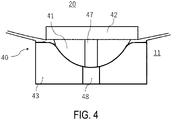
- the ball socket structure of the embodiment configures a tilting pad bearing 40 (see FIG. 4 ).
- the tilting pad bearing 40 is placed into a journal bearing 1.
- the journal bearing 1 includes housings 11, 11 shaped like half cylinders and four pads 20 disposed on the inner circumferential surfaces of the housings 11, 11.
- Reference sign 3 denotes a rotary shaft, and reference sign 50 denotes an oil supply portion.
- Each second tilting pad bearing 30 includes a liner disposed on the pad 20 and a spherical pivot disposed in the housing 11.
- the ball socket structure of the embodiment can also be applied to a tilting pad thrust bearing.
- the tilting pad bearing 40 includes a ball portion 41 and a socket portion 43.
- the ball portion 41 includes a base 411 and a PVD coating layer 413 (see FIG. 1(B) ).
- the base 411 is formed as a part of a sphere having a radius of curvature Rs and includes a convex spherical surface and an attachment portion 41b with a flat surface. A through hole 47 is bored through the center of the base 411.
- the material of the base 411 is not particularly limited as long as the material is rigid enough so that it does not deform or break under force acting on the pad 20.
- a general bearing metal such as high-chromium carbon steel can be used.
- the attachment portion 41b and an anchor member 42 are provided in a slidable state with one another, and the anchor member 42 is embedded in the pad 20.
- the PVD coating layer 413 is formed on the convex spherical surface of the base 411.
- the convex spherical surface of the base 411 with such a PVD coating corresponds to a sliding surface 41a of the ball portion 41, meaning that the sliding surface 41a is made of the PVD coating layer 413.
- the PVD coating layer 413 has a higher lubricity than that of the material of the base 411.
- the material forming the PVD coating layer 413 has a lower coefficient of friction than that of high-chromium carbon steel or similar material that forms the base 411. This reduces wear on the sliding surface 41a of the ball portion 41, and thus wear on a sliding surface 43a of the socket portion 43.
- the socket portion 43 includes a base 431 and a PVD coating layer 433 (see FIG. 1(B) ).
- a concave spherical surface is formed on the base 431.
- This concave spherical surface has the same radius of curvature Rs as the sliding surface 41a (convex spherical surface) of the ball portion 41.
- the material of the base 431 is not particularly limited as long as the material is rigid enough so that it does not deform or break under force acting on the pad 20.
- a general bearing metal such as high-chromium carbon steel can be used.
- the PVD coating layer 433 is layered on the concave spherical surface of the base 431.
- the concave spherical surface of the base 431 with such a PVD coating corresponds to the sliding surface 43a of the socket portion 43, meaning that the sliding surface 43a is made of the PVD coating layer 433.
- a through hole 48 is bored through the center of the socket portion 43.
- the through hole 48 is continuous with the through hole 47 of the ball portion 41.
- the anchor member 42 is fitted into and secured to the pad 20.
- the amount of movement of the pad 20 can be measured by a measuring device inserted in the through holes 48, 47.
- the clearance between the shaft 3 and the bearing diameter in the journal bearing 1 can be measured from the amount of movement.
- a solid lubrication layer (for example, DLC coating layer) may be layered on the surface of the attachment portion 41b of the ball portion 41 and/or the surface of the anchor member 42, with the ball portion 41 and the anchor member 42 being portions that slide against one another.
- a recessed portion for collecting lubricating oil may be formed in the sliding surface of the ball portion 41 and/or the sliding surface of the socket portion 43.
- the PVD coating layers 413 and 433 will be described below.
- the base 411 of the ball portion 41 or the base 431 of the socket portion 43 is set at the negative electrode of the sputtering device, and argon particles generated via plasma are caused to collide with the convex spherical surface of the base 411 or the concave spherical surface of the base 431.
- the coating source material is set in the sputtering device, and the coating material is deposited via vapor deposition onto the process-target surface.
- the process-target surfaces are the convex spherical surface of the base 411 of the ball portion 41 and the concave spherical surface of the base 431 of the socket portion 43.
- the electric field at the convex spherical surface which is the process-target surface of the base 411 of the ball portion 41, tends to be uniform.
- the coating layer can be uniformly layered using a general PVD process.
- the concave spherical surface which is the process-target surface of the base 431 of the socket portion 43
- the electric lines of force running out perpendicular from the surface interfere with one another, which cancels out the electric field intensity on the concave spherical surface and results in non-uniform intensity.
- the present inventors conducted diligent research in order to give the bottom portion of the concave spherical surface an electric field of the same intensity as that of other portions, and the following findings were obtained. That is, when the concave spherical surface of the socket portion 43 is designed as follows, the intensity of the electric field is stable even at the bottom portion of the concave spherical surface of the base 431 of the socket portion 43, and the PVD coating layer 433 can be uniformly layered until the bottom portion with strong adhesive strength with the base 431.
- a design condition includes: a value (Ds/Rs) of the ratio between a depth Ds of the concave spherical surface of the base 431 of the socket portion 43 and the radius of curvature Rs being from 0.05 to 0.70.
- the PVD coating layer 433 forming the sliding surface 43a is made uniform and adhesion to the base 431 is enhanced. This is because, by removing the edge from the outer periphery of the concave spherical surface, which is the process-target surface, disturbance in the electric field caused by an effect known as the edge effect can be suppressed.
- the value (Rc/Rs) of the ratio between the radius of curvature Rs of the concave spherical surface and a chamfer radius of curvature Rc of the chamfered outer periphery is 0.02 or greater (see FIG. 2(A) ).
- the value (Dc/Rs) of the ratio between the radius of curvature Rs and a depth Dc of the chamfered surface may be 0.02 or greater (see FIG. 2(B) ).
- a chamfer angle Ac is 60 degrees or less.
- the through hole 48 By forming the through hole 48 in the bottom portion of the concave spherical surface of the base 431, the electric lines of force spread out to the space of the through hole 48, and thus, the electric field on the concave spherical surface at the peripheral edge of an opening portion 48c of the through hole 48 can be strengthened. Thus, stronger energy is provided to the particles colliding with the bottom portion of the concave spherical surface.
- the peripheral edge of the opening portion 48c of the through hole 48 is preferably chamfered in a similar manner to the outer periphery of the concave spherical surface (see FIG. 3 ).
- parameters (Rs, Rc) relating to the radius of curvature of the elements are described in reference to a base of a socket portion that does not include a PVD coating layer.
- a PVD coating layer is relatively inconsequential to the value of the ratio between the radiuses of curvature.
- the invention of a ball socket structure in which a socket portion includes a PVD coating layer can be described using parameters having the same values.
- the base of the ball portion 41 and the base of the socket portion 43 according to the Examples and Comparative Examples were formed by being cut out from a bulk of high-chromium carbon steel.
- the ball portion 41 and the socket portion 43 had the following specifications.
- Tb from 6 to 30 mm
- Ts from 5 to 10 mm
- Thickness of PVD coating layer 433 from 0.1 to 10 ⁇ m
- Depth Ds of sliding surface 43a formed of concave spherical surface of socket portion 43 from 5 to 25 mm
- Thickness of PVD coating layer 413 of ball portion 41 is the same as that of socket portion 43.
- bases were formed while changing the specifications of the elements described above, and a PVD coating layer was layered on each base.
- the conditions under which plasma cleaning of the concave spherical surface of the base 431 was performed are as follows.
- Bias voltage 500 V
- pressure 0.2 Pa
- gas Ar
- duration 40 min.
- a Cr layer was deposited via vapor deposition as a primer layer on the entire surface of the concave spherical surface under the following conditions.
- Target Cr, output: 1.8 kw, bias voltage: 100 V, pressure: 0.5 Pa, gas: Ar, duration: 23 min.
- a coating layer was vapor-deposited via sputtering on the primer layer under the following conditions.
- the pad 20 was connected to the ball portion 41 of the ball socket structure of the Examples and Comparative Examples to form the tilting pad bearing 40 illustrated in FIG. 4 .
- the material of the pad 20 was a bi-metal material such as white metal, polyetheretherketone (PEEK), polytetrafluoroethylene (PTFE), or the like (specifically, a bi-metal using white metal, PEEK, PTFE, or the like as the sliding layer and steel or the like as the backing metal).
- PEEK polyetheretherketone
- PTFE polytetrafluoroethylene
- the journal bearing 1 illustrated in FIGS. 5 and 6 was configured with these tilting pad bearings 40.
- the diameter of the shaft 3 was 170 mm.
- the housing 11 of the journal bearing 1 was fixed and then the shaft 3 was rotated at 8000 rpm with a bearing surface pressure of 3 MPa.
- Example 1 Ds/Rs Rc/Rs or Dc/Rs Material of PVD coating layer Thickness of PVD coating layer in socket portion (%) Thickness of PVD coating layer in ball portion (%) Coefficient of friction Peeling ratio (%)
- Example 1 0.70 0.015 CrN 0.4000 0.4000 0.19 30
- Example 2 0.05 0.015 CrN 0.0005 0.4000 0.19 30
- Example 3 0.40 0.015 CrN 0.3000 0.4000 0.13 10
- Example 4 0.40 0.015 CrN 0.0050 0.4000 0.13 10
- Example 5 0.40 0.030 CrN 0.2500 0.4000 0.13 0 (no peeling)
- Example 6 0.40 0.030 DLC 0.2500 0.4000 0.13 0 (no peeling)
- Example 6 0.40 0.030 DLC 0.2500 0.0004 0.08 0 (no peeling)
- Example 7 0.40 0.030 DLC 0.2500 0.3000 0.05 0 (no peeling)
- Example 8 0.40
- the coefficient of friction in Table 1 was calculated from the eccentricity of the axial center.
- the peeling ratio (%) is the ratio of the area of the PVD coating layer that peeled off from the sliding surface 43a of the socket portion 43 after rotating the shaft 3 for two hours. This peeling ratio is obtained by capturing a planar image of the sliding surface 43a and performing image processing on the obtained image.
- the value (Ds/Rs) of the ratio between the depth Ds of the sliding surface, which is the concave spherical surface of the socket portion, and the radius of curvature Rs of the sliding surface is preferably from 0.05 to 0.70.
- the outer periphery of the sliding surface of the socket portion is preferably chamfered, and the value (Rc/Rs or Dc/Rs) of the ratio between the chamfer radius of curvature Rc and the radius of curvature Rs of the sliding surface is preferably 0.02 or greater.
- the thickness (%) of the PVD coating layer at the central portion of the socket portion is preferably from 0.0010 to 0.3000.
- the thickness (%) of the PVD coating layer at the central portion of the ball portion is preferably from 0.0010 to 0.3000.
Landscapes
- Engineering & Computer Science (AREA)
- General Engineering & Computer Science (AREA)
- Mechanical Engineering (AREA)
- Physics & Mathematics (AREA)
- Fluid Mechanics (AREA)
- Chemical & Material Sciences (AREA)
- Ceramic Engineering (AREA)
- Sliding-Contact Bearings (AREA)
- Pivots And Pivotal Connections (AREA)
- Physical Vapour Deposition (AREA)
Applications Claiming Priority (1)
| Application Number | Priority Date | Filing Date | Title |
|---|---|---|---|
| JP2021022886A JP7704541B2 (ja) | 2021-02-16 | 2021-02-16 | ボールソケット構造 |
Publications (2)
| Publication Number | Publication Date |
|---|---|
| EP4043741A1 true EP4043741A1 (fr) | 2022-08-17 |
| EP4043741B1 EP4043741B1 (fr) | 2024-08-07 |
Family
ID=80123045
Family Applications (1)
| Application Number | Title | Priority Date | Filing Date |
|---|---|---|---|
| EP22154139.4A Active EP4043741B1 (fr) | 2021-02-16 | 2022-01-31 | Structure de rotule sphérique |
Country Status (4)
| Country | Link |
|---|---|
| US (1) | US12055179B2 (fr) |
| EP (1) | EP4043741B1 (fr) |
| JP (1) | JP7704541B2 (fr) |
| KR (1) | KR102790729B1 (fr) |
Citations (7)
| Publication number | Priority date | Publication date | Assignee | Title |
|---|---|---|---|---|
| JPH10503827A (ja) | 1994-08-06 | 1998-04-07 | ザ グレイシャー メタル カンパニー リミテッド | 傾動パッド式ジャーナル軸受 |
| WO2001054561A2 (fr) * | 2000-01-30 | 2001-08-02 | Diamicron, Inc. | Prothese articulaire du genou |
| JP2010116956A (ja) | 2008-11-12 | 2010-05-27 | Mitsubishi Heavy Ind Ltd | ジャーナル軸受 |
| US8016889B2 (en) * | 2000-01-30 | 2011-09-13 | Diamicron, Inc | Articulating diamond-surfaced spinal implants |
| US20160265584A1 (en) * | 2013-10-17 | 2016-09-15 | Kabushiki Kaiha Somic Ishikawa | Ball seat and ball joint |
| JP2018004073A (ja) | 2016-06-30 | 2018-01-11 | ドゥサン ヘヴィー インダストリーズ アンド コンストラクション カンパニー リミテッド | ボールソケット型ティルティングパッドジャーナルベアリング |
| JP2018159126A (ja) * | 2017-03-22 | 2018-10-11 | 新日鐵住金株式会社 | チタン管成形ロール、チタン管成形装置およびチタン管の製造方法 |
Family Cites Families (14)
| Publication number | Priority date | Publication date | Assignee | Title |
|---|---|---|---|---|
| US4039228A (en) * | 1976-05-07 | 1977-08-02 | Delaval Turbine, Inc. | Tilting pad bearing |
| US6605175B1 (en) * | 1999-02-19 | 2003-08-12 | Unaxis Balzers Aktiengesellschaft | Process for manufacturing component parts, use of same, with air bearing supported workpieces and vacuum processing chamber |
| JP2001132742A (ja) | 1999-11-01 | 2001-05-18 | Mitsubishi Heavy Ind Ltd | 軸受装置、及び、ポンプ |
| KR100503827B1 (ko) | 2003-08-14 | 2005-07-27 | 가부시키가이샤 산고우샤 | 다리미 받이부재의 커버 |
| JP2007232092A (ja) | 2006-03-01 | 2007-09-13 | Ntn Corp | 球面滑り軸受 |
| DE102006020102A1 (de) | 2006-04-29 | 2007-10-31 | Leybold Vacuum Gmbh | Beschichtung für Gaslager |
| JP2009079652A (ja) | 2007-09-26 | 2009-04-16 | Minebea Co Ltd | 樹脂ライナ付き球面すべり軸受およびロッドエンド軸受 |
| DK3094870T3 (da) | 2014-01-16 | 2019-08-26 | Corebon Ab | Kinematiske par |
| CN106795619B (zh) * | 2014-09-17 | 2019-10-01 | 日本Itf株式会社 | 被覆膜及其制造方法以及pvd装置 |
| RU2743353C9 (ru) | 2016-12-19 | 2022-01-12 | СМСи КОРПОРЕЙШН | Коррозионностойкий элемент конструкции |
| JP7141633B2 (ja) | 2017-05-12 | 2022-09-26 | 京セラ株式会社 | 摺動装置 |
| FR3097785B1 (fr) | 2019-06-25 | 2021-12-03 | Ab | Couche de contact à la surface d’un élément en métal en mouvement relatif contre un autre élément en métal, et liaison d’articulation pourvue d’une telle couche de contact |
| CN111421236A (zh) | 2020-04-29 | 2020-07-17 | 沈阳建筑大学 | 一种微织构自润滑具有陶瓷涂层的球关节及其制备方法 |
| JP7261202B2 (ja) * | 2020-07-20 | 2023-04-19 | 大同メタル工業株式会社 | 軸受及びそれに用いられる連結機構、及び連結機構に用いられる予圧付与方法。 |
-
2021
- 2021-02-16 JP JP2021022886A patent/JP7704541B2/ja active Active
-
2022
- 2022-01-20 KR KR1020220008428A patent/KR102790729B1/ko active Active
- 2022-01-20 US US17/579,703 patent/US12055179B2/en active Active
- 2022-01-31 EP EP22154139.4A patent/EP4043741B1/fr active Active
Patent Citations (7)
| Publication number | Priority date | Publication date | Assignee | Title |
|---|---|---|---|---|
| JPH10503827A (ja) | 1994-08-06 | 1998-04-07 | ザ グレイシャー メタル カンパニー リミテッド | 傾動パッド式ジャーナル軸受 |
| WO2001054561A2 (fr) * | 2000-01-30 | 2001-08-02 | Diamicron, Inc. | Prothese articulaire du genou |
| US8016889B2 (en) * | 2000-01-30 | 2011-09-13 | Diamicron, Inc | Articulating diamond-surfaced spinal implants |
| JP2010116956A (ja) | 2008-11-12 | 2010-05-27 | Mitsubishi Heavy Ind Ltd | ジャーナル軸受 |
| US20160265584A1 (en) * | 2013-10-17 | 2016-09-15 | Kabushiki Kaiha Somic Ishikawa | Ball seat and ball joint |
| JP2018004073A (ja) | 2016-06-30 | 2018-01-11 | ドゥサン ヘヴィー インダストリーズ アンド コンストラクション カンパニー リミテッド | ボールソケット型ティルティングパッドジャーナルベアリング |
| JP2018159126A (ja) * | 2017-03-22 | 2018-10-11 | 新日鐵住金株式会社 | チタン管成形ロール、チタン管成形装置およびチタン管の製造方法 |
Also Published As
| Publication number | Publication date |
|---|---|
| EP4043741B1 (fr) | 2024-08-07 |
| US20220260111A1 (en) | 2022-08-18 |
| JP7704541B2 (ja) | 2025-07-08 |
| JP2022124951A (ja) | 2022-08-26 |
| KR102790729B1 (ko) | 2025-04-07 |
| US12055179B2 (en) | 2024-08-06 |
| KR20220117131A (ko) | 2022-08-23 |
Similar Documents
| Publication | Publication Date | Title |
|---|---|---|
| US6764219B2 (en) | Full complement antifriction bearing | |
| EP2554866B1 (fr) | Palier anti-friction | |
| EP3286353B1 (fr) | Élément coulissant revêtu | |
| EP0791760A2 (fr) | Palier ou joint lubrifié à l'eau | |
| JP3431152B2 (ja) | 軸 受 | |
| US11306776B2 (en) | Double-row self-aligning roller bearing | |
| EP1666628A2 (fr) | Palier avec une couche auto-lubrifiante d'un élément de palier en contact lisse avec une contre-surface trempée par nitruration d'un élément de palier en titane | |
| JP2003214444A (ja) | 転がり摺動部材および転動装置 | |
| JP7219776B2 (ja) | ピストンリング | |
| EP4043741A1 (fr) | Structure de rotule sphérique | |
| EP3859177B1 (fr) | Palier de roulement, dispositif de support d'arbre primaire pour la génération d'énergie éolienne | |
| EP1668265B1 (fr) | Paliers autolubrifiants | |
| US11773901B2 (en) | Self-aligning roller bearing | |
| JP2007327037A (ja) | 転がり摺動部材およびこれを用いた転動装置 | |
| EP3708858B1 (fr) | Demi-palier de butée, palier de butée, dispositif à paliers et moteur à combustion interne | |
| US20020186903A1 (en) | Ceramic dynamic-pressure bearing, motor having bearing, hard disk drive, polygon scanner, and method for manufacturing ceramic dynamic-pressure bearing | |
| JP3738750B2 (ja) | 耐摩耗性摺動部材 | |
| JP2009243619A (ja) | 転がり摺動部材及び鋼管成形ロール用軸受 | |
| JPH0972344A (ja) | 軸受ユニット | |
| JP2022124950A (ja) | ボールソケット構造 | |
| EP3783237B1 (fr) | Roulement à rouleaux à alignement automatique à double rangée | |
| JP2007327632A (ja) | 転がり摺動部材及び転動装置 | |
| WO2020067334A1 (fr) | Palier de roulement, dispositif de support d'arbre primaire pour la génération d'énergie éolienne | |
| JP2003222143A (ja) | 転がり摺動部材 | |
| JP6875880B2 (ja) | 転がり軸受および硬質膜成膜方法 |
Legal Events
| Date | Code | Title | Description |
|---|---|---|---|
| PUAI | Public reference made under article 153(3) epc to a published international application that has entered the european phase |
Free format text: ORIGINAL CODE: 0009012 |
|
| STAA | Information on the status of an ep patent application or granted ep patent |
Free format text: STATUS: REQUEST FOR EXAMINATION WAS MADE |
|
| 17P | Request for examination filed |
Effective date: 20220131 |
|
| AK | Designated contracting states |
Kind code of ref document: A1 Designated state(s): AL AT BE BG CH CY CZ DE DK EE ES FI FR GB GR HR HU IE IS IT LI LT LU LV MC MK MT NL NO PL PT RO RS SE SI SK SM TR |
|
| GRAP | Despatch of communication of intention to grant a patent |
Free format text: ORIGINAL CODE: EPIDOSNIGR1 |
|
| STAA | Information on the status of an ep patent application or granted ep patent |
Free format text: STATUS: GRANT OF PATENT IS INTENDED |
|
| INTG | Intention to grant announced |
Effective date: 20240301 |
|
| GRAS | Grant fee paid |
Free format text: ORIGINAL CODE: EPIDOSNIGR3 |
|
| GRAA | (expected) grant |
Free format text: ORIGINAL CODE: 0009210 |
|
| STAA | Information on the status of an ep patent application or granted ep patent |
Free format text: STATUS: THE PATENT HAS BEEN GRANTED |
|
| RAP3 | Party data changed (applicant data changed or rights of an application transferred) |
Owner name: DAIDO METAL COMPANY LTD. |
|
| AK | Designated contracting states |
Kind code of ref document: B1 Designated state(s): AL AT BE BG CH CY CZ DE DK EE ES FI FR GB GR HR HU IE IS IT LI LT LU LV MC MK MT NL NO PL PT RO RS SE SI SK SM TR |
|
| REG | Reference to a national code |
Ref country code: GB Ref legal event code: FG4D |
|
| REG | Reference to a national code |
Ref country code: CH Ref legal event code: EP |
|
| REG | Reference to a national code |
Ref country code: DE Ref legal event code: R096 Ref document number: 602022005045 Country of ref document: DE |
|
| REG | Reference to a national code |
Ref country code: IE Ref legal event code: FG4D |
|
| REG | Reference to a national code |
Ref country code: LT Ref legal event code: MG9D |
|
| REG | Reference to a national code |
Ref country code: NL Ref legal event code: MP Effective date: 20240807 |
|
| PG25 | Lapsed in a contracting state [announced via postgrant information from national office to epo] |
Ref country code: NO Free format text: LAPSE BECAUSE OF FAILURE TO SUBMIT A TRANSLATION OF THE DESCRIPTION OR TO PAY THE FEE WITHIN THE PRESCRIBED TIME-LIMIT Effective date: 20241107 |
|
| REG | Reference to a national code |
Ref country code: AT Ref legal event code: MK05 Ref document number: 1711235 Country of ref document: AT Kind code of ref document: T Effective date: 20240807 |
|
| PG25 | Lapsed in a contracting state [announced via postgrant information from national office to epo] |
Ref country code: NL Free format text: LAPSE BECAUSE OF FAILURE TO SUBMIT A TRANSLATION OF THE DESCRIPTION OR TO PAY THE FEE WITHIN THE PRESCRIBED TIME-LIMIT Effective date: 20240807 Ref country code: FI Free format text: LAPSE BECAUSE OF FAILURE TO SUBMIT A TRANSLATION OF THE DESCRIPTION OR TO PAY THE FEE WITHIN THE PRESCRIBED TIME-LIMIT Effective date: 20240807 Ref country code: PL Free format text: LAPSE BECAUSE OF FAILURE TO SUBMIT A TRANSLATION OF THE DESCRIPTION OR TO PAY THE FEE WITHIN THE PRESCRIBED TIME-LIMIT Effective date: 20240807 Ref country code: PT Free format text: LAPSE BECAUSE OF FAILURE TO SUBMIT A TRANSLATION OF THE DESCRIPTION OR TO PAY THE FEE WITHIN THE PRESCRIBED TIME-LIMIT Effective date: 20241209 Ref country code: GR Free format text: LAPSE BECAUSE OF FAILURE TO SUBMIT A TRANSLATION OF THE DESCRIPTION OR TO PAY THE FEE WITHIN THE PRESCRIBED TIME-LIMIT Effective date: 20241108 |
|
| PG25 | Lapsed in a contracting state [announced via postgrant information from national office to epo] |
Ref country code: BG Free format text: LAPSE BECAUSE OF FAILURE TO SUBMIT A TRANSLATION OF THE DESCRIPTION OR TO PAY THE FEE WITHIN THE PRESCRIBED TIME-LIMIT Effective date: 20240807 |
|
| PG25 | Lapsed in a contracting state [announced via postgrant information from national office to epo] |
Ref country code: LV Free format text: LAPSE BECAUSE OF FAILURE TO SUBMIT A TRANSLATION OF THE DESCRIPTION OR TO PAY THE FEE WITHIN THE PRESCRIBED TIME-LIMIT Effective date: 20240807 |
|
| PG25 | Lapsed in a contracting state [announced via postgrant information from national office to epo] |
Ref country code: AT Free format text: LAPSE BECAUSE OF FAILURE TO SUBMIT A TRANSLATION OF THE DESCRIPTION OR TO PAY THE FEE WITHIN THE PRESCRIBED TIME-LIMIT Effective date: 20240807 Ref country code: IS Free format text: LAPSE BECAUSE OF FAILURE TO SUBMIT A TRANSLATION OF THE DESCRIPTION OR TO PAY THE FEE WITHIN THE PRESCRIBED TIME-LIMIT Effective date: 20241207 |
|
| PG25 | Lapsed in a contracting state [announced via postgrant information from national office to epo] |
Ref country code: HR Free format text: LAPSE BECAUSE OF FAILURE TO SUBMIT A TRANSLATION OF THE DESCRIPTION OR TO PAY THE FEE WITHIN THE PRESCRIBED TIME-LIMIT Effective date: 20240807 |
|
| PG25 | Lapsed in a contracting state [announced via postgrant information from national office to epo] |
Ref country code: ES Free format text: LAPSE BECAUSE OF FAILURE TO SUBMIT A TRANSLATION OF THE DESCRIPTION OR TO PAY THE FEE WITHIN THE PRESCRIBED TIME-LIMIT Effective date: 20240807 Ref country code: RS Free format text: LAPSE BECAUSE OF FAILURE TO SUBMIT A TRANSLATION OF THE DESCRIPTION OR TO PAY THE FEE WITHIN THE PRESCRIBED TIME-LIMIT Effective date: 20241107 |
|
| PG25 | Lapsed in a contracting state [announced via postgrant information from national office to epo] |
Ref country code: RS Free format text: LAPSE BECAUSE OF FAILURE TO SUBMIT A TRANSLATION OF THE DESCRIPTION OR TO PAY THE FEE WITHIN THE PRESCRIBED TIME-LIMIT Effective date: 20241107 Ref country code: PT Free format text: LAPSE BECAUSE OF FAILURE TO SUBMIT A TRANSLATION OF THE DESCRIPTION OR TO PAY THE FEE WITHIN THE PRESCRIBED TIME-LIMIT Effective date: 20241209 Ref country code: PL Free format text: LAPSE BECAUSE OF FAILURE TO SUBMIT A TRANSLATION OF THE DESCRIPTION OR TO PAY THE FEE WITHIN THE PRESCRIBED TIME-LIMIT Effective date: 20240807 Ref country code: NO Free format text: LAPSE BECAUSE OF FAILURE TO SUBMIT A TRANSLATION OF THE DESCRIPTION OR TO PAY THE FEE WITHIN THE PRESCRIBED TIME-LIMIT Effective date: 20241107 Ref country code: NL Free format text: LAPSE BECAUSE OF FAILURE TO SUBMIT A TRANSLATION OF THE DESCRIPTION OR TO PAY THE FEE WITHIN THE PRESCRIBED TIME-LIMIT Effective date: 20240807 Ref country code: LV Free format text: LAPSE BECAUSE OF FAILURE TO SUBMIT A TRANSLATION OF THE DESCRIPTION OR TO PAY THE FEE WITHIN THE PRESCRIBED TIME-LIMIT Effective date: 20240807 Ref country code: IS Free format text: LAPSE BECAUSE OF FAILURE TO SUBMIT A TRANSLATION OF THE DESCRIPTION OR TO PAY THE FEE WITHIN THE PRESCRIBED TIME-LIMIT Effective date: 20241207 Ref country code: HR Free format text: LAPSE BECAUSE OF FAILURE TO SUBMIT A TRANSLATION OF THE DESCRIPTION OR TO PAY THE FEE WITHIN THE PRESCRIBED TIME-LIMIT Effective date: 20240807 Ref country code: GR Free format text: LAPSE BECAUSE OF FAILURE TO SUBMIT A TRANSLATION OF THE DESCRIPTION OR TO PAY THE FEE WITHIN THE PRESCRIBED TIME-LIMIT Effective date: 20241108 Ref country code: FI Free format text: LAPSE BECAUSE OF FAILURE TO SUBMIT A TRANSLATION OF THE DESCRIPTION OR TO PAY THE FEE WITHIN THE PRESCRIBED TIME-LIMIT Effective date: 20240807 Ref country code: ES Free format text: LAPSE BECAUSE OF FAILURE TO SUBMIT A TRANSLATION OF THE DESCRIPTION OR TO PAY THE FEE WITHIN THE PRESCRIBED TIME-LIMIT Effective date: 20240807 Ref country code: BG Free format text: LAPSE BECAUSE OF FAILURE TO SUBMIT A TRANSLATION OF THE DESCRIPTION OR TO PAY THE FEE WITHIN THE PRESCRIBED TIME-LIMIT Effective date: 20240807 Ref country code: AT Free format text: LAPSE BECAUSE OF FAILURE TO SUBMIT A TRANSLATION OF THE DESCRIPTION OR TO PAY THE FEE WITHIN THE PRESCRIBED TIME-LIMIT Effective date: 20240807 |
|
| PG25 | Lapsed in a contracting state [announced via postgrant information from national office to epo] |
Ref country code: DK Free format text: LAPSE BECAUSE OF FAILURE TO SUBMIT A TRANSLATION OF THE DESCRIPTION OR TO PAY THE FEE WITHIN THE PRESCRIBED TIME-LIMIT Effective date: 20240807 Ref country code: SM Free format text: LAPSE BECAUSE OF FAILURE TO SUBMIT A TRANSLATION OF THE DESCRIPTION OR TO PAY THE FEE WITHIN THE PRESCRIBED TIME-LIMIT Effective date: 20240807 |
|
| PG25 | Lapsed in a contracting state [announced via postgrant information from national office to epo] |
Ref country code: EE Free format text: LAPSE BECAUSE OF FAILURE TO SUBMIT A TRANSLATION OF THE DESCRIPTION OR TO PAY THE FEE WITHIN THE PRESCRIBED TIME-LIMIT Effective date: 20240807 |
|
| PG25 | Lapsed in a contracting state [announced via postgrant information from national office to epo] |
Ref country code: CZ Free format text: LAPSE BECAUSE OF FAILURE TO SUBMIT A TRANSLATION OF THE DESCRIPTION OR TO PAY THE FEE WITHIN THE PRESCRIBED TIME-LIMIT Effective date: 20240807 |
|
| PG25 | Lapsed in a contracting state [announced via postgrant information from national office to epo] |
Ref country code: SK Free format text: LAPSE BECAUSE OF FAILURE TO SUBMIT A TRANSLATION OF THE DESCRIPTION OR TO PAY THE FEE WITHIN THE PRESCRIBED TIME-LIMIT Effective date: 20240807 |
|
| REG | Reference to a national code |
Ref country code: DE Ref legal event code: R097 Ref document number: 602022005045 Country of ref document: DE |
|
| PLBE | No opposition filed within time limit |
Free format text: ORIGINAL CODE: 0009261 |
|
| STAA | Information on the status of an ep patent application or granted ep patent |
Free format text: STATUS: NO OPPOSITION FILED WITHIN TIME LIMIT |
|
| 26N | No opposition filed |
Effective date: 20250508 |
|
| REG | Reference to a national code |
Ref country code: CH Ref legal event code: PL |
|
| PG25 | Lapsed in a contracting state [announced via postgrant information from national office to epo] |
Ref country code: SE Free format text: LAPSE BECAUSE OF FAILURE TO SUBMIT A TRANSLATION OF THE DESCRIPTION OR TO PAY THE FEE WITHIN THE PRESCRIBED TIME-LIMIT Effective date: 20240807 |
|
| PG25 | Lapsed in a contracting state [announced via postgrant information from national office to epo] |
Ref country code: LU Free format text: LAPSE BECAUSE OF NON-PAYMENT OF DUE FEES Effective date: 20250131 Ref country code: MC Free format text: LAPSE BECAUSE OF FAILURE TO SUBMIT A TRANSLATION OF THE DESCRIPTION OR TO PAY THE FEE WITHIN THE PRESCRIBED TIME-LIMIT Effective date: 20240807 |
|
| PG25 | Lapsed in a contracting state [announced via postgrant information from national office to epo] |
Ref country code: BE Free format text: LAPSE BECAUSE OF NON-PAYMENT OF DUE FEES Effective date: 20250131 |
|
| PG25 | Lapsed in a contracting state [announced via postgrant information from national office to epo] |
Ref country code: FR Free format text: LAPSE BECAUSE OF NON-PAYMENT OF DUE FEES Effective date: 20250131 |
|
| PG25 | Lapsed in a contracting state [announced via postgrant information from national office to epo] |
Ref country code: CH Free format text: LAPSE BECAUSE OF NON-PAYMENT OF DUE FEES Effective date: 20250131 |
|
| REG | Reference to a national code |
Ref country code: BE Ref legal event code: MM Effective date: 20250131 |
|
| PG25 | Lapsed in a contracting state [announced via postgrant information from national office to epo] |
Ref country code: IE Free format text: LAPSE BECAUSE OF NON-PAYMENT OF DUE FEES Effective date: 20250131 |
|
| PG25 | Lapsed in a contracting state [announced via postgrant information from national office to epo] |
Ref country code: IT Free format text: LAPSE BECAUSE OF FAILURE TO SUBMIT A TRANSLATION OF THE DESCRIPTION OR TO PAY THE FEE WITHIN THE PRESCRIBED TIME-LIMIT Effective date: 20240807 |
|
| PGFP | Annual fee paid to national office [announced via postgrant information from national office to epo] |
Ref country code: GB Payment date: 20260123 Year of fee payment: 5 |
|
| PGFP | Annual fee paid to national office [announced via postgrant information from national office to epo] |
Ref country code: DE Payment date: 20260121 Year of fee payment: 5 |
|
| PG25 | Lapsed in a contracting state [announced via postgrant information from national office to epo] |
Ref country code: RO Free format text: LAPSE BECAUSE OF FAILURE TO SUBMIT A TRANSLATION OF THE DESCRIPTION OR TO PAY THE FEE WITHIN THE PRESCRIBED TIME-LIMIT Effective date: 20240807 |