EP4043794A1 - Appareil de cuisson - Google Patents
Appareil de cuisson Download PDFInfo
- Publication number
- EP4043794A1 EP4043794A1 EP21194002.8A EP21194002A EP4043794A1 EP 4043794 A1 EP4043794 A1 EP 4043794A1 EP 21194002 A EP21194002 A EP 21194002A EP 4043794 A1 EP4043794 A1 EP 4043794A1
- Authority
- EP
- European Patent Office
- Prior art keywords
- cooking cavity
- cooking
- contact
- air
- blower
- Prior art date
- Legal status (The legal status is an assumption and is not a legal conclusion. Google has not performed a legal analysis and makes no representation as to the accuracy of the status listed.)
- Withdrawn
Links
Images







Classifications
-
- F—MECHANICAL ENGINEERING; LIGHTING; HEATING; WEAPONS; BLASTING
- F24—HEATING; RANGES; VENTILATING
- F24C—DOMESTIC STOVES OR RANGES ; DETAILS OF DOMESTIC STOVES OR RANGES, OF GENERAL APPLICATION
- F24C7/00—Stoves or ranges heated by electric energy
- F24C7/08—Arrangement or mounting of control or safety devices
- F24C7/082—Arrangement or mounting of control or safety devices on ranges, e.g. control panels, illumination
- F24C7/085—Arrangement or mounting of control or safety devices on ranges, e.g. control panels, illumination on baking ovens
-
- A—HUMAN NECESSITIES
- A47—FURNITURE; DOMESTIC ARTICLES OR APPLIANCES; COFFEE MILLS; SPICE MILLS; SUCTION CLEANERS IN GENERAL
- A47J—KITCHEN EQUIPMENT; COFFEE MILLS; SPICE MILLS; APPARATUS FOR MAKING BEVERAGES
- A47J37/00—Baking; Roasting; Grilling; Frying
- A47J37/06—Roasters; Grills; Sandwich grills
- A47J37/0623—Small-size cooking ovens, i.e. defining an at least partially closed cooking cavity
- A47J37/0629—Small-size cooking ovens, i.e. defining an at least partially closed cooking cavity with electric heating elements
- A47J37/0641—Small-size cooking ovens, i.e. defining an at least partially closed cooking cavity with electric heating elements with forced air circulation, e.g. air fryers
-
- F—MECHANICAL ENGINEERING; LIGHTING; HEATING; WEAPONS; BLASTING
- F24—HEATING; RANGES; VENTILATING
- F24C—DOMESTIC STOVES OR RANGES ; DETAILS OF DOMESTIC STOVES OR RANGES, OF GENERAL APPLICATION
- F24C15/00—Details
- F24C15/02—Doors specially adapted for stoves or ranges
- F24C15/023—Mounting of doors, e.g. hinges, counterbalancing
-
- F—MECHANICAL ENGINEERING; LIGHTING; HEATING; WEAPONS; BLASTING
- F24—HEATING; RANGES; VENTILATING
- F24C—DOMESTIC STOVES OR RANGES ; DETAILS OF DOMESTIC STOVES OR RANGES, OF GENERAL APPLICATION
- F24C15/00—Details
- F24C15/16—Shelves, racks or trays inside ovens; Supports therefor
-
- F—MECHANICAL ENGINEERING; LIGHTING; HEATING; WEAPONS; BLASTING
- F24—HEATING; RANGES; VENTILATING
- F24C—DOMESTIC STOVES OR RANGES ; DETAILS OF DOMESTIC STOVES OR RANGES, OF GENERAL APPLICATION
- F24C15/00—Details
- F24C15/32—Arrangements of ducts for hot gases, e.g. in or around baking ovens
- F24C15/322—Arrangements of ducts for hot gases, e.g. in or around baking ovens with forced circulation
- F24C15/325—Arrangements of ducts for hot gases, e.g. in or around baking ovens with forced circulation electrically-heated
Definitions
- the invention relates to cooking appliances. More specifically, it relates to countertop electric ovens, particularly such an oven having versatility to roast, convection-bake, broil, air-fry, grill, and griddle foods, and having a convenient and safe access arrangement.
- Microwave ovens cook by directing microwave energy into moisture within food to heat it.
- Steam ovens expose food to penetrating hot steam which may be produced by a heating element immersed in water.
- Radiant ovens include a heating element that exposes the food to waves of radiant heat.
- Convection ovens include a heating element that heats air within the oven to roast or bake the food.
- fan-forced convection ovens add a fan to a convection oven to move the heated air, which is found to reduce cooking time and increase cooking evenness.
- Air Fryers are well known and are an extreme form of fan-forced convection oven in which high temperature air at a high airflow rate is applied to oily food or food that has been coated in oil to brown the food in a manner that mimics the browning, crispiness, and flavor of deep frying, but without the mess, danger, and calories.
- Surface cooking is another known method of cooking certain foods in which the food is placed onto a heated surface, such as a frying pan or a griddle, and the food is cooked from below.
- Fatty foods cooked by frying tend to simmer in their released fats, which may on one hand add flavor, but on the other hand increase calories.
- Broiling is another known method of cooking certain foods in which a heating element is disposed above the food so that the food is exposed to both convection and radiant heat from above. Broiling can better brown certain foods and while it may have a drying effect, it results in less calories provided the food is placed on a draining surface such as a grill.
- the interior of electric ovens and the food being cooked therein can obviously be very hot.
- they oven be configured to allow insertion and removal of the food with minimal exposure to that heat and the things it has heated.
- the insertion and removal can be accomplished with only one hand while access to the oven can be accomplished with only the other.
- energy efficiency it is preferable to only open the oven for the insertion and removal of food to the extent needed, according to the size of the food or the carrying it.
- the invention may be embodied in or practiced using a cooking appliance which can selectively perform one or more of the tasks of roasting, baking, air-frying, broiling, convection-baking, and surface cooking.
- the invention may be embodied in or practiced using a cooking appliance including; a housing defining a cooking cavity, a door arrangement for selectively accessing the cooking compartment, a first heating element disposed adjacent a top of the cooking cavity, a second heating element disposed adjacent a bottom of the cooking cavity, first temperature sensor disposed adjacent the top of the cooking cavity, a second temperature sensor disposed adjacent the bottom of the cooking cavity, a blower arranged to agitate air within the cooking cavity, a cookware device removably disposed atop and in thermal contact with the second heating element and the second temperature sensor, and a controller adapted to manually receiving cooking parameters from a user and sensed temperature information from the first and second temperature sensors.
- the controller may include a timer and be adapted to independently and selectively control in cooperation with the timer and according to the cooking parameters and the sensed temperature information; one or both of the blower's on/off state and the blower's speed, one or both of the first heating element's on/off state and the first heating element's speed, or one or both of the second heating element's on/off state and the second heating element's speed.
- the invention may be embodied in or practiced using such an appliance that has a door system which opens from its center outwardly, only as wide as needed to receive or release the food being cooked, and that opens symmetrically with the use of only one hand.
- the invention may be embodied in or practiced using such an appliance which includes or is adapted to receive removable cooking components such as a griddle, grill, pie plate, rice pot, casserole dish, etc.
- the invention may be embodied in or practiced using such an appliance wherein the appliance and the removable cooking components interact to optimize performance, and wherein the appliance recognizes the type of food inserted therein through user input and adjusts its performance accordingly.
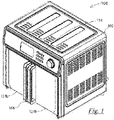
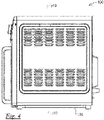
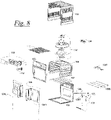
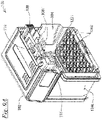
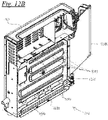
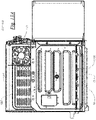
- FIG. 1 through 16 there is shown an exemplary cooking appliance, here embodied as electrical countertop grilling oven and air frying appliance 100.
- a housing 102 defines a cooking cavity 104.
- a door arrangement 106 allows the user to selectively access the cooking compartment.
- a first electrical heating element 108T is disposed adjacent a top of the cooking cavity.
- a second electrical heating element 108B is disposed adjacent a bottom of the cooking cavity.
- a blower 114 is arranged to agitate air within the cooking cavity.
- a cookware device, embodied here as griddle plate 116, is removably disposed atop and in thermal contact with the second electrical heating element.
- a controller 118 includes an input interface and a timer 112 and is adapted to manually receive cooking parameters from the user and to independently energize the electrical heating elements according thereto.
- the cooking parameters include information including when, for how long, and at what intensity to operate each of the heating elements and the blower.
- a first temperature sensor 122T is disposed near the top of the cooking cavity and is adapted to sense the air temperature within the cooking chamber and report the same to the controller.
- a second temperature sensor 122B is disposed near to the bottom of the cooking chamber and is arranged to contact the griddle plate and adapted to sense its temperature and report the same to the controller.
- the sensed temperature by the second temperature sensor is proportional to and gives the controller an indication of the temperature of the food.
- the controller energizes one or more of the electrical heating elements and the blower in accordance with the air and griddle temperatures in accordance with the cooking parameters. Energization may include, turning the blower and heating elements on and off individually and independently for intermittent periods of time according to the timer and the cooking parameters, increasing and decreasing the intensity of the blower and heating elements individually and independently for intermittent periods of time according to the timer and the cooking parameters, or increasing and decreasing the intensity of the blower and heating elements individually and independently continuously according to the timer and the cooking parameters.
- the agitated air may not always need to be hot air.
- the appliance may serve as an unheated food dehydrator or a cooked food may wish to be cooled to serving temperature by exposure to agitated cool air for a period of time.ly need to be heated.
- the door arrangement includes left and right outwardly-opening doors, 124L and 124R, respectively.
- the doors are linked together to open and close symmetrically such that opening or closing either one will cause a symmetrical opening or closing of the other.
- the sensors are NTC (negative thermal coefficient) devices adapted to alter resistant inversely according to the sensed temperature, but any known and functionally operable form of temperature detection means could be substituted therefore.
- the first electrical heating element is an air-heating element and the second electrical heating element is a contact heating element.
- the heating elements are tubular "cal-rod” type elements, but any known and functionally operable form of heating means could be substituted therefore.
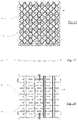
- the griddle plate has perforations 140 to allow the agitated air to pass there-through, but need not be so perforated according to the type of food being cooked and the cooking results being desired.
- fried chicken may cook best on a perforated griddle plate while fatty bacon may be better cooked on an unperforated grilling plate to capture the liquid fats produced during cooking.
- Other foods such as casseroles may be best cooked in a side-walled plate (pan). Pies may be best cooked in a pie plate.
- Deeper cookware devices such as rice pots or casserole dishes may could benefit from the heat generated at the bottom of the cavity and/or hot and/or agitated.
- the cookware device is able to contact the second temperature sensor and the cooking parameters for the food therein are properly input, the air and food can be properly monitored and the heating element and blower operation can be managed with consideration of the food temperature.
- first and second heating elements placed at the top and bottom of the cooking chamber, respectively, provides a space saving arrangement.
- this arrangement can either allow a smaller appliance to cook the certain volume of food or in a same-sized appliance to cook a larger volume of food. Because counterspace is so limited and valuable in most kitchens, this is no trivial benefit.
- the combination or high-speed air agitation with both radiant and contact heating is found to speed up cooking and improve the quality of the cooked food in both mouth-appeal and eye-appeal. Exposing the food to fast-flowing heated air during cooking results in a vaporization of the grease produced during cooking so that it does not burn on the griddle plate and cause smoke, and so that it can be removed from the food and cooking cavity and collected by the exhaust filter, which is adapted to capture both smoke and grease and be easily removed for cleaning or replacement.
- Such advances far exceed the performance of existing ovens, toaster ovens, griddles, convection ovens, air fryers, etc., beyond what one would normally anticipate, thereby providing an unexpected result not made obvious by those individual appliances of the prior art.
- blower While the blower is shown positioned at the top of the cooking cavity, its position is not critical so long as it fully agitates the air throughout the cavity. It pulls fresh air into the cooking cavity and expels the hot, smokey, and greasy air out through exhaust filter 138 to provide rapid recycling of the air and constant interchange of the air inside the housing of the oven and outside air so that the food is cooked in clean air, which improved taste and appearance. As such, this arrangement, including the efficient exhaust filter, is especially well-adapted to reducing smoke and odor, as compared to exiting cooking ovens which agitate but do not recycle the air.
- the precisely temperature-controlled cookware device inside the cooking cavity in combination with a rapid air agitator provides an unexpectedly efficient means of reducing the smoke normally generated from such cooking, at least by removing the grease faster and more efficiently.
Landscapes
- Engineering & Computer Science (AREA)
- Chemical & Material Sciences (AREA)
- Combustion & Propulsion (AREA)
- Mechanical Engineering (AREA)
- General Engineering & Computer Science (AREA)
- Food Science & Technology (AREA)
- Baking, Grill, Roasting (AREA)
Applications Claiming Priority (1)
| Application Number | Priority Date | Filing Date | Title |
|---|---|---|---|
| US17/176,838 US11175048B2 (en) | 2020-02-28 | 2021-02-16 | Cooking appliance |
Publications (1)
| Publication Number | Publication Date |
|---|---|
| EP4043794A1 true EP4043794A1 (fr) | 2022-08-17 |
Family
ID=77563981
Family Applications (1)
| Application Number | Title | Priority Date | Filing Date |
|---|---|---|---|
| EP21194002.8A Withdrawn EP4043794A1 (fr) | 2021-02-16 | 2021-08-31 | Appareil de cuisson |
Country Status (2)
| Country | Link |
|---|---|
| EP (1) | EP4043794A1 (fr) |
| CA (1) | CA3128980A1 (fr) |
Citations (3)
| Publication number | Priority date | Publication date | Assignee | Title |
|---|---|---|---|---|
| US6355914B1 (en) * | 1999-03-30 | 2002-03-12 | Edward E. Stockley | Programmable oven with menu selection |
| US20040200828A1 (en) * | 2003-04-10 | 2004-10-14 | Becker Theodore A. | Menu driven control system for a cooking appliance |
| US20140070685A1 (en) * | 2012-09-13 | 2014-03-13 | General Electric Company | Oven appliance with dual opening and closing doors |
-
2021
- 2021-08-26 CA CA3128980A patent/CA3128980A1/fr active Pending
- 2021-08-31 EP EP21194002.8A patent/EP4043794A1/fr not_active Withdrawn
Patent Citations (3)
| Publication number | Priority date | Publication date | Assignee | Title |
|---|---|---|---|---|
| US6355914B1 (en) * | 1999-03-30 | 2002-03-12 | Edward E. Stockley | Programmable oven with menu selection |
| US20040200828A1 (en) * | 2003-04-10 | 2004-10-14 | Becker Theodore A. | Menu driven control system for a cooking appliance |
| US20140070685A1 (en) * | 2012-09-13 | 2014-03-13 | General Electric Company | Oven appliance with dual opening and closing doors |
Also Published As
| Publication number | Publication date |
|---|---|
| CA3128980A1 (fr) | 2022-08-16 |
Similar Documents
| Publication | Publication Date | Title |
|---|---|---|
| US11585536B2 (en) | Cooking appliance | |
| US11175048B2 (en) | Cooking appliance | |
| US7451691B2 (en) | No waste cooking oven with multiple cooking functions | |
| CA2424326C (fr) | Systeme de ventilation pour appareil de cuisson | |
| US7739948B2 (en) | Simplified device to quickly cook food | |
| US5699722A (en) | Rapid cooking device | |
| US5465651A (en) | Rapid cooking device | |
| US11937736B2 (en) | Cooking appliance with conductive heating capabilities | |
| CN222853679U (zh) | 多腔室烹饪设备 | |
| CN110200516A (zh) | 烹饪系统 | |
| JP7596529B2 (ja) | 無煙グリル兼エアフライヤー | |
| US20140245897A1 (en) | Rotisserie convection oven with rotatable cooking drum and method of use | |
| CN113317691B (zh) | 烹饪设备 | |
| WO2020163633A1 (fr) | Appareil de cuisson et son procédé d'utilisation | |
| KR102175579B1 (ko) | 다기능 에어 프라이어 | |
| JPH03178615A (ja) | 肉の直焼き方法およびそのための装置 | |
| JPH09508562A (ja) | 携帯バーベキュー用器具 | |
| EP4043794A1 (fr) | Appareil de cuisson | |
| JP4179252B2 (ja) | 組込式誘導加熱調理器 | |
| CN217365460U (zh) | 烹饪设备和电动工作台面烹饪设备 | |
| JP6374710B2 (ja) | 加熱調理器 | |
| JP2003210334A (ja) | 加熱調理方法、加熱調理容器及び加熱調理装置 | |
| KR960011445B1 (ko) | 오븐 조리장치 | |
| JPH0452567Y2 (fr) | ||
| JPH059087B2 (fr) |
Legal Events
| Date | Code | Title | Description |
|---|---|---|---|
| PUAI | Public reference made under article 153(3) epc to a published international application that has entered the european phase |
Free format text: ORIGINAL CODE: 0009012 |
|
| STAA | Information on the status of an ep patent application or granted ep patent |
Free format text: STATUS: THE APPLICATION HAS BEEN PUBLISHED |
|
| AK | Designated contracting states |
Kind code of ref document: A1 Designated state(s): AL AT BE BG CH CY CZ DE DK EE ES FI FR GB GR HR HU IE IS IT LI LT LU LV MC MK MT NL NO PL PT RO RS SE SI SK SM TR |
|
| STAA | Information on the status of an ep patent application or granted ep patent |
Free format text: STATUS: REQUEST FOR EXAMINATION WAS MADE |
|
| 17P | Request for examination filed |
Effective date: 20230208 |
|
| RBV | Designated contracting states (corrected) |
Designated state(s): AL AT BE BG CH CY CZ DE DK EE ES FI FR GB GR HR HU IE IS IT LI LT LU LV MC MK MT NL NO PL PT RO RS SE SI SK SM TR |
|
| P01 | Opt-out of the competence of the unified patent court (upc) registered |
Effective date: 20230525 |
|
| RAP1 | Party data changed (applicant data changed or rights of an application transferred) |
Owner name: GREENFIELD WORLD TRADE INC. |
|
| GRAP | Despatch of communication of intention to grant a patent |
Free format text: ORIGINAL CODE: EPIDOSNIGR1 |
|
| STAA | Information on the status of an ep patent application or granted ep patent |
Free format text: STATUS: GRANT OF PATENT IS INTENDED |
|
| RIC1 | Information provided on ipc code assigned before grant |
Ipc: A47J 37/06 20060101ALI20250521BHEP Ipc: F24C 15/02 20060101ALI20250521BHEP Ipc: F24C 15/32 20060101ALI20250521BHEP Ipc: F24C 15/16 20060101ALI20250521BHEP Ipc: F24C 7/08 20060101AFI20250521BHEP |
|
| INTG | Intention to grant announced |
Effective date: 20250620 |
|
| STAA | Information on the status of an ep patent application or granted ep patent |
Free format text: STATUS: THE APPLICATION IS DEEMED TO BE WITHDRAWN |
|
| 18D | Application deemed to be withdrawn |
Effective date: 20251021 |