EP4044497A1 - Système auditable et procédés de partage de secret - Google Patents
Système auditable et procédés de partage de secret Download PDFInfo
- Publication number
- EP4044497A1 EP4044497A1 EP21156897.7A EP21156897A EP4044497A1 EP 4044497 A1 EP4044497 A1 EP 4044497A1 EP 21156897 A EP21156897 A EP 21156897A EP 4044497 A1 EP4044497 A1 EP 4044497A1
- Authority
- EP
- European Patent Office
- Prior art keywords
- values
- share
- value
- party
- nodes
- Prior art date
- Legal status (The legal status is an assumption and is not a legal conclusion. Google has not performed a legal analysis and makes no representation as to the accuracy of the status listed.)
- Granted
Links
Images




Classifications
-
- H—ELECTRICITY
- H04—ELECTRIC COMMUNICATION TECHNIQUE
- H04L—TRANSMISSION OF DIGITAL INFORMATION, e.g. TELEGRAPHIC COMMUNICATION
- H04L9/00—Cryptographic mechanisms or cryptographic arrangements for secret or secure communications; Network security protocols
- H04L9/08—Key distribution or management, e.g. generation, sharing or updating, of cryptographic keys or passwords
- H04L9/0816—Key establishment, i.e. cryptographic processes or cryptographic protocols whereby a shared secret becomes available to two or more parties, for subsequent use
- H04L9/085—Secret sharing or secret splitting, e.g. threshold schemes
-
- H—ELECTRICITY
- H04—ELECTRIC COMMUNICATION TECHNIQUE
- H04L—TRANSMISSION OF DIGITAL INFORMATION, e.g. TELEGRAPHIC COMMUNICATION
- H04L9/00—Cryptographic mechanisms or cryptographic arrangements for secret or secure communications; Network security protocols
- H04L9/08—Key distribution or management, e.g. generation, sharing or updating, of cryptographic keys or passwords
- H04L9/0894—Escrow, recovery or storing of secret information, e.g. secret key escrow or cryptographic key storage
-
- H—ELECTRICITY
- H04—ELECTRIC COMMUNICATION TECHNIQUE
- H04L—TRANSMISSION OF DIGITAL INFORMATION, e.g. TELEGRAPHIC COMMUNICATION
- H04L9/00—Cryptographic mechanisms or cryptographic arrangements for secret or secure communications; Network security protocols
- H04L9/32—Cryptographic mechanisms or cryptographic arrangements for secret or secure communications; Network security protocols including means for verifying the identity or authority of a user of the system or for message authentication, e.g. authorization, entity authentication, data integrity or data verification, non-repudiation, key authentication or verification of credentials
- H04L9/3236—Cryptographic mechanisms or cryptographic arrangements for secret or secure communications; Network security protocols including means for verifying the identity or authority of a user of the system or for message authentication, e.g. authorization, entity authentication, data integrity or data verification, non-repudiation, key authentication or verification of credentials using cryptographic hash functions
- H04L9/3239—Cryptographic mechanisms or cryptographic arrangements for secret or secure communications; Network security protocols including means for verifying the identity or authority of a user of the system or for message authentication, e.g. authorization, entity authentication, data integrity or data verification, non-repudiation, key authentication or verification of credentials using cryptographic hash functions involving non-keyed hash functions, e.g. modification detection codes [MDCs], MD5, SHA or RIPEMD
-
- H—ELECTRICITY
- H04—ELECTRIC COMMUNICATION TECHNIQUE
- H04L—TRANSMISSION OF DIGITAL INFORMATION, e.g. TELEGRAPHIC COMMUNICATION
- H04L9/00—Cryptographic mechanisms or cryptographic arrangements for secret or secure communications; Network security protocols
- H04L9/32—Cryptographic mechanisms or cryptographic arrangements for secret or secure communications; Network security protocols including means for verifying the identity or authority of a user of the system or for message authentication, e.g. authorization, entity authentication, data integrity or data verification, non-repudiation, key authentication or verification of credentials
- H04L9/3247—Cryptographic mechanisms or cryptographic arrangements for secret or secure communications; Network security protocols including means for verifying the identity or authority of a user of the system or for message authentication, e.g. authorization, entity authentication, data integrity or data verification, non-repudiation, key authentication or verification of credentials involving digital signatures
-
- H—ELECTRICITY
- H04—ELECTRIC COMMUNICATION TECHNIQUE
- H04L—TRANSMISSION OF DIGITAL INFORMATION, e.g. TELEGRAPHIC COMMUNICATION
- H04L9/00—Cryptographic mechanisms or cryptographic arrangements for secret or secure communications; Network security protocols
- H04L9/50—Cryptographic mechanisms or cryptographic arrangements for secret or secure communications; Network security protocols using hash chains, e.g. blockchains or hash trees
-
- H—ELECTRICITY
- H04—ELECTRIC COMMUNICATION TECHNIQUE
- H04L—TRANSMISSION OF DIGITAL INFORMATION, e.g. TELEGRAPHIC COMMUNICATION
- H04L2209/00—Additional information or applications relating to cryptographic mechanisms or cryptographic arrangements for secret or secure communication H04L9/00
- H04L2209/46—Secure multiparty computation, e.g. millionaire problem
Definitions
- This invention relates to the subfield of data security known as secret sharing.
- contributors to some global result do not wish or should not share their individual contributions to the total with other contributors. This may be because the contributors may be required to keep their respective data secret from others, but may also simply be because they do not want to. For example, participants in a survey of total income levels in an area may not want to reveal their incomes to their neighbors. Similarly, assume that a central authority wants to compile information about the total available stockpile of some item (such as some drug or vaccine) among many competitors, but the individual competitors do not wish to reveal their amounts to the others.
- some item such as some drug or vaccine
- the aggregate result is the sum, or some function of the sum, of the contributions of the parties. Consequently, this form of aggregation (summation) is used below to describe different embodiments. A modification of this assumption to include other operations is also described below.
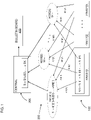
- FIG. 1 illustrates different systems (entities) and their relationships in different embodiments.
- parties PARTY[1], PARTY[2], ..., PARTY[N] (labeled collectively as 100), each of which can communicate using any known method, such as over a network, with K nodes NODE[1], NODE[2], ..., NODE[K] (collectively numbered 200), each of which can communicate with a central entity 300, which is the entity that is to aggregate the values associated with each party.
- the parties, nodes, and the central entity may be implemented by and in any known computing system.
- the parties' systems may, but need not be, smaller systems such as laptop computers, fixed-terminal systems such as desktop computers, or tablets or even smart phones, whereas the nodes and central entity may be implemented using servers.
- the parties might be individual pharmacies, which submit information from small computers or smart phones via a corresponding installed application;
- the nodes might be regional authorities or distributors, and the central entity might be a sever run by the governmental authority. This is not a requirement, however: Any computing system with sufficient computing power and connectivity with the other systems may be used.
- node NODE[1] receives the shares A[1][1], A[2][1], ..., A[N][1], which it then sums to form an intermediate sum S[1].
- N should be greater than 2.
- N>2 will typically be sufficient to maintain secrecy. As long as at least two nodes are not conspiring with any other, secrecy may be maintained for all non-conspiring nodes.
- a bulletin board 400 may be included to which parties and nodes can post authenticated messages in such a way that all other parties and nodes are guaranteed to see the same set of messages.
- the bulletin board 400 may be implemented and configured in many different ways. For example, it could be a file, database, or other data structure stored in the central server 300 itself, or some other server or site chosen for the purpose, and to which all entities are given either open access or access via credentials (such as user ID/password or the like).
- the bulletin board 400 may also be implemented using a blockchain, such as the system implemented using Guardtime KSI technology (see below), or a process and data structure that enforces a rule of allowing only one commitment (data entry) per party per round (if such a rule is desired), and preferably with no split view of the data structure.
- a blockchain such as the system implemented using Guardtime KSI technology (see below), or a process and data structure that enforces a rule of allowing only one commitment (data entry) per party per round (if such a rule is desired), and preferably with no split view of the data structure.
- the data set may be any kind of information that can be represented digitally.
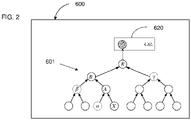
- different data sets are to form the lowest-level input "leaves" to the hash tree 601 during a given aggregation period, which may be fixed, such as every second, or variable, for example, covering the time it takes for all inputs to an aggregation round to be available.
- Figure 2 shows eight such input as the circles at the base of the hash tree, two of which are labeled ⁇ and X.
- each "circle” represents the hash value of the two values input into it from below.
- A hash(a, X), and so on
- Any hash function may be used, although known cryptographic hash functions such as the SHA-256, SHA-512, etc., offer a well-studied, high level of security.
- R hash(hash(hash(a, X), ⁇ ), ⁇ ).
- the values ⁇ , ⁇ , and ⁇ thus define a "path” or “chain” or "signature vector" ( ⁇ , ⁇ , ⁇ ) through the hash tree from the input X to the root R.
- X might include not only the corresponding raw data, but also metadata such as a user ID, a serial or index number, etc., or even a completely random number included just to increase the entropy of the input (known as a "blinding mask").
- Figure 2 also serves to summarize the Guardtime signature technique: for each of a sequence of calendar periods (typically related one-to-one with physical time units, such as one second), the Guardtime infrastructure takes digital input records as inputs. These are then cryptographically hashed together as described above in an iterative, preferably binary hash tree 601, ultimately yielding an uppermost hash value (the "calendar value" CAL 620) that encodes information in all the input records.
- the Guardtime infrastructure takes digital input records as inputs. These are then cryptographically hashed together as described above in an iterative, preferably binary hash tree 601, ultimately yielding an uppermost hash value (the "calendar value" CAL 620) that encodes information in all the input records.
- the calendar value for each calendar period may be the root value R of the "basic" hash tree.
- the infrastructure then returns a signature in the form of a vector, including, among other data, the values of sibling nodes in the hash tree that enable recomputation of the calendar value if a purported copy of the corresponding original input record is in fact identical to the original input record.
- the signature for X could be ( ⁇ , ⁇ , ⁇ , CAL).
- each calendar value CAL is mathematically combined with previous calendar values by means of a growing Merkle hash tree, whereby a top-level hash value is formed for the calendar values themselves.
- the Guardtime signatures returned to entities can then be extended after a number of calendar periods up through a progressively growing Merkle tree of calendar values, or a hash-chaining of calendar values, to a top-level publication value that is published in any widely witnessed manner, such as in a printed publication, an online database, in a ledger, in a blockchain, etc.
- the Guardtime KSI calendar itself has a structure that may be characterized as a blockchain, and may itself be sufficient even without additional hashing using a Merkle tree and publication.
- each calendar value CAL is computed according to a known time relationship, such as once per second.
- a known time relationship such as once per second.
- each signature will also be able to function as an irrefutable timestamp.
- Figure 2 thus shows a system 600, corresponding to the signature/timestamping Guardtime infrastructure, to which any of the entities 100, 200, 300, 400 may submit values to obtain corresponding signatures and timestamping.
- FIG. 3 illustrates an embodiment in which hashing is employed.
- the operations only of party PARTY[1] are illustrated, for the sake of ease of visualization; the other parties will interact with the nodes analogously.
- R[i] TREE(A[i][1], A[i][2], ..., A[i][K]).
- a module 110 is included within each party to take the share values, hash them pairwise (or in groups of three for ternary trees, or in larger groups for higher-degree hash trees) and iteratively as hash tree "leaves”, compute a corresponding root R[i], and thereby create hash chains from each share value to the root.
- Each node j is a node j:
- the central entity 300 may be the interested entity, in which case it may compute the sum S as in the basic embodiment, but, in this embodiment, any other party that has access to the information in the bulletin board may do so as well.
- each party can be verified by an independent auditing entity 1000, by the central entity, etc., after establishing what the correct value of A[i] should have been, by checking that the K shares A[i][1], A[i][2], ..., A[i][K] indeed add up to A[i]; and that the K shares A[i][1], A[i][2], ..., A[i][K], when aggregated into a hash tree, indeed result in the posted R[i]. To enable this auditing procedure, each party should either keep or be able to re-create the division of its input A[i] to the addends/shares.
- each node can also be verified by an independent auditor: First, the auditor 1000 verifies that the node has accepted only valid messages from the parties, and it then verifies that each node has correctly computed and posted its share for the sum.
- Use of hash chains (or other data structure, such as is described below) to check for agreement with a posted value R[i] is a preferred method because of both its security and its computational and administrative efficiency. To enable this aspect of auditing, each node must keep all received messages.
- FIG. 3 it may then also be possible to include a hashing module 220 within each node. (Only node 1 is show with this module, for the sake of drawing simplicity.)
- the hashing module 220 may then input the received share values A[1][1], A[2][1], ... , A[N][1] and apply them as input "leaves" for calculation of a hash tree, as described above, producing, for each node j, a corresponding node root value NR[j], which may then be stored in the bulletin board 400.
- Hash tree chains may also be computed and stored for each leaf value within the node as well.
- a node may then be audited as described above for a party.
- An encryption scheme in general consists of an encryption function ENC and corresponding decryption function DEC such that, knowing the encryption ENC(k, X) of some value X under the key k, it is computationally infeasible recover the value X without knowing the key.
- each node j first generates a key pair (EK[j], DK[j]), for example, in a corresponding software component 210. (This is shown only for NODE[1] for simplicity; other nodes will be configured analogously.) It then posts the encryption key EK[j] on the bulletin board 400 for others to access, in particular, the parties PARTY[i]. Note that this is a one-time setup; the same keys can be used to compute many sums.
- bulletin board 400 eliminates the need for each node to directly communicate its encryption key to each of the parties, but this would be a possible alternative arrangement.
- use of the bulletin board, as a common communication portal eliminates the need for direct communication between parties and nodes altogether.
- each party can be verified by an independent auditor, after establishing what the correct value of A[i] should have been, by checking that the K shares A[i][1], A[i][2], ..., A[i][K], when encrypted with the encryption keys of the nodes, indeed result in the posted B[i][1], B[i][2], ..., B[i][K].
- each party should either keep or be able to re-create the division of its input A[i] to the addends/shares.
- each node can also be verified by an independent auditor: The auditor asks the node to decrypt the shares B[1][j], B[2][j], ..., B[N][j] to recover A[1][j], A[2][j], ..., A[N][j] and then verifies that they add up to the posted S[j].
- SUM(ENC(EK, X), ENC(EK, Y)) ENC(EK, X + Y).
- ENC(EK, X) and ENC(EK, Y) of two values X and Y it is possible to compute the encryption ENC(EK, X+Y) of the sum X+Y without knowing X and Y themselves.
- Several existing semi-homomorphic asymmetric encryption schemes are known, among which are RSA and ElGamal.
- each party can be verified by an independent auditor, after establishing what the correct value of A[i] should have been, by checking that the K shares A[i][1], A[i][2], ..., A[i][K], indeed add up to correct value A[i]; and that the K shares A[i][1], A[i][2], ..., A[i][K], when encrypted with the encryption keys of the nodes, indeed result in the posted B[i][1], B[i][2], ..., B[i][K].
- each party should either keep or be able to re-create the division of its input A[i] to the addends/shares.
- both collision-resistant hashing and additively semi-homomorphic asymmetric encryption are used. See Figure 5 , in which, as before, the operations and components of only one of the parties and one of the nodes are illustrated merely for the sake of simplicity; other parties and nodes may be structured and operate analogously.
- each node j first generates a key pair (EK[j], DK[j]) and posts its encryption key on the bulletin board 400.
- Each node j upon receiving an encrypted share B[i][j] and the corresponding hash chain C[i][j] from the party i:
- each party can be verified by an independent auditor, after establishing what the correct value of A[i] should have been, by checking that the K shares A[i][1], A[i][2], ..., A[i][K], when encrypted with the encryption keys EK[j] of the nodes and aggregated into a hash tree, indeed result in the posted R[i].
- each party should either keep or be able to re-create the division of its input A[i] to the addends/shares.
- each node can also be verified by an independent auditor: First, the auditor 1000 verifies that the node has accepted only valid messages from the parties, such as by use of hash chains to check for agreement with a posted root value R[i]. The auditor then verifies that the node has correctly computed its share for the sum as follows:
- This auditing process assumes that the node being audited has kept all received messages. On the other hand, in this embodiment, the auditor never sees the plaintexts of the input shares the node received from the parties.
- each node j will be able to collect all N shares A[1][j], A[2][j], ..., A[N][j], or can derive all N of these from decryption. If all parties report all K respective shares quickly, this will generally not be a problem. This may, however, not always be so, either through deliberate failure of a party to participate completely or at all, or inadvertently, for example because of lack of network connection, unavailability of an input A[i], etc.
- One method for handling this eventuality is a time cut-off:
- the central entity (or some other superior entity, or via agreement among the nodes) sets a cut-off time t end .
- the nodes then form their values S[j] from whichever share values(plain or encrypted) they have received by t end and pass these values on to the central entity (and/or bulleting board) for aggregation into a global total value.
- Another option would be to set a minimum number of parties to collect values from, or a minimum number of shares, possibly also with a time cut-off, and the nodes then perform their usual operations based on the shares they have received. This arrangement might be useful in cases in which there is a large number of parties and the inputs of only some sub-set form a sampling that is sufficient for statistical purposes.
- the result is a sum of the inputs of the remaining parties and could still be useful. In some cases, it will be preferred to process only "complete" sets of shares for parties. If, for example, only one share from one party is not properly received, it will cause an error of unknown size in the final sum S. This may be acceptable if there is a large number of parties and total accuracy is not required, such as for sampling; otherwise, any chosen error-handling method may be applied, such as that the entire process is aborted, or that the nodes first agree on the subset of parties from which they all have shares, and then compute the sum over only those, or that a final sum is computed from whatever inputs have been received, etc.
- any of the known routines for multiplicatively semi-homomorphic asymmetric encryption may then be applied.
- the various operations of posting values to the bulletin board 400 will then not need to change and other operations may be carried out as described.
- Embodiments arranged to form the final result S from products of parties' shares may be useful in situations where each party's value A[i] represents, for example, a probability, or percentage, or fraction of some quantity that is to be combined multiplicatively with the values of other parties.
- an encryption routine should then be chosen such that it exhibits semi-homomorphism under the operation ⁇ .
- Such a global value might, for example, be used as a commonly generated, computationally verifiable key by the parties, to which each party will have contributed a term (thereby not requiring total trust of outside entities alone), but in a way that the global value cannot be easily decomposed into its constituent terms because of unknown contributions of the other parties.
- Each participating party may generate a value A[i] as above, decompose it into addends or factors (or other operands) and submit these for computation in the central entity 300 of a global final value S.
- A[p] would, as above, remain unknowable by other parties during the distributed aggregations and computations in the nodes, but could be revealed after the final result S has been produced.
- each party i may generate the first K-1 shares A[i][1], A[i][2], ..., A[i][K-1] as uniformly chosen random numbers in the range 0...2 M -1 and compute the last share A[i][K] such that the sum A[i][1]+A[i][2]+...+A[i][K], when computed modulo 2 M , equals the input A[i].
- This ensures the final share A[i][K] also has uniform distribution over the range 0...2 M -1 and thus does not leak any information about the input A[i].
- the first K-1 shares may be chosen uniformly from the range 2 M-1 ...2 M-1 -1, with the last one chosen such that the sum equals A[i], modulo 2 M , with the same security properties as in the previous case. Similar considerations can also be applied when working with fixed-point and floating-point values.
- a party may choose share values more deliberately, for example, choosing to report a relatively low value to one or more nodes while reporting higher values to other nodes.
- a party may want to choose the number and/or size of shares to correspond to some "natural" grouping for purely internal administrative purposes, such as by manufacturing batch or date, color, size, model, etc., without reporting this to nodes or other entities.
- Adi Shamir proposed a secret sharing scheme in which a secret input A can be split into K shares in such a way that any subset of M or more shares can be combined to reveal the input, but any subset of less than M shares leaks no information about the input.
- the Shamir method is yet another option for creating shares, and for the operations used to yield a global value S, for example, in the central entity.
- A[i] the sum of A[i] into addends (or corresponding elements, depending on the operation involved).
- the party starts with a known value A[i], which is wants to report yet still conceal, so it breaks it into components, that is, shares A[i][j].
- a party may not be the lowest level entity in the system, but rather may itself collect and aggregate values that it has received from other entities.
- an entity receives K payments from customers and donors, that it must keep a record of these individual payments, but that it must report only a total received amount to a central authority, while wishing to keep this total amount secret from competitor.
- a party may be willing to reveal its shares A[i][j] individually to different, respective nodes, but not its total A[i].
- A[i][1] ... A[i][K] are the given values (shares) and may be summed (or other operation applied) to yield A[i].
- the embodiments described above may still be used as described.
- Digital signatures may optionally be used for different values, or sets of values, in the various embodiments; signatures may in many cases aid in the auditing and/or verification processes. If the signatures also encode time (such as a Guardtime KSI signature), then they may also form an irrefutable timestamp. Essentially, a digital signature, in particular, a Guardtime KSI signature, will irrefutably "seal" a value (including vector) both with respect to the value itself and with respect to time, in the sense that any change will be detectable.
- any of the values, or sets of values, used in the different embodiments may be digitally signed if this is desired in a kind of "maximum auditability" implementation.
- the state of all or any portion of the data posted in the bulletin board 400 may also be digitally signed and/or timestamped, for example, at the end of each aggregation round, or even after each change of state, such as after every addition to any of the data structures (such as for EK[ ], B[ ], R[ ], S[ ], etc.), as may be the collection of node output values S[j] and/or final value S within the central entity.
- the central entity 300 Before a node can know that it is to receive N share values from the N parties, it must, at least in some embodiments, be made aware that there are N participating parties.
- the central entity 300 will know which parties it wishes to collect and aggregate share information from. For example, a public health ministry may know from which pharmacies it wants information regarding vaccine inventory, or a regional distributor may want to compile stock information from certain retailers. In these cases, the central entity may contact the parties (that is, their computing systems) and instruct or request them to register.
- the central entity may send, for example, the network addresses to the nodes to which each party is to report shares (and thus the number K), to the bulletin board, and to any other relevant entities, as well as administrative information such as access codes, time limits, information identifying what values the parties are to report, etc. Each party may then acknowledge the task and information.
- identity verification may also be implemented, for example by using standard Public Key Infrastructure (PKI) techniques.
- PKI Public Key Infrastructure
- the central entity may message the nodes information about the data that they are to accumulate.
- the nodes may then handle the task of communicating with one or more parties, exchanging necessary information, and then communicating this information to the other nodes, which may then communicate, for example, the network address of the nodes to "their" respective parties.
- Still other alternatives are possible for establishing the information needed to begin the process of parties reporting their share information.
- One such additional alternative would be for the parties themselves to initiate participation in the data-reporting procedures. In this case, a party would signal to either the central entity or to one or more of the nodes that it wishes to participate. If approved, the superior entity could then respond with the necessary network addresses, possible assignment to nodes for reporting, etc.
- the central entity may choose the phantom share values in any manner.
- One example would be to choose the phantom share values as random numbers within some predetermined range.
- This optional modification increases the entropy of the values reported by the parties such that, even if a malicious actor were to intercept all the share values sent from a party to the nodes, it would still not be able to determine what that party's actual total value A[i] is.
- This option may be useful in cases in which a party's input value A[i] may be too small to split into the requisite or chosen number of shares without using negative share values. Note that this embodiment would preserve the privacy of parties' inputs even with just one node, assuming the central entity and the node are not colluding.
- each party has a value that is to be kept secret even from the central entity, which aggregates received values to derive a previously unknown global value S.
- the central authority may know in advance what the global value S is, then decomposes it into pieces that are distributed to the respective parties, secretly, and then the parties need to submit them back, by way of any of the methods described herein.
- Such an embodiment could be used to implement, for example, multi-party authorization of some action, or to prove that all had participated in some process.
- each of K nodes NODE[j] is to receive a respective one of K shares from each of N parties.
- Each node may then maintain a simple N-element "roster" in which it indicates from which nodes it has received share values.
- This could be as simple as an N-bit word in which each bit corresponds to a node, a "1" indicates that a share value has been received and a "0" indicates the opposite, or any known data structure may be used to indicate which nodes have "reported".
- One such structure could be a list of party identifiers, which a party may send along with share values, which could be derived from the network address of the party, or otherwise.
- a node may then sum its received share values to S[j] when it has received all N values, but will be able to identify each node that has not sent a share value, for example, by some deadline.
- the node may then signal this failure to other nodes, and/or to the central entity, and/or to the node itself as a "reminder" or other type of notification.
- the nodes and/or central entity may then take any chosen remedial action, such as not completing the data accumulation round at all (where total compliance is required), computing S based on only the K values received by all nodes from fully compliant parties, computing S based on whatever share values have been received, even if not all have been received from a party, etc.
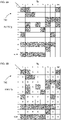
- FIGS 6A and 6B illustrate a form of roster 700, in this case a two-dimensional data structure, that may be used in not only the situation in which there are N nodes each reporting K shares to each of K nodes, but also other possibilities as well.
- the roster 700 may be established and maintained within the central entity 300, or as part of the bulletin board 400 (which may itself be within the central entity), or in some other entity with which the nodes can communicate.
- the roster 700 could also be maintained within any of the nodes, and/or duplicated and synchronized by more than one node.
- each column corresponds to one of the K nodes and each row corresponds to one of the N parties; of course other data structures may be used to store and indicate the same information.
- an unshaded cell indicates that the respective party is to send a share value to the node of the corresponding column; the row this indicates into how many shares the corresponding party will be decomposing its input value into.
- each party will create k[i] shares, which may be the same for all parties, but may also differ.
- a shaded cell indicates that the party is not going to report a share value to that node.
- party PARTY[1] is to send share values to nodes 3-7 (five shares; party PARTY[2] is to send share values to nodes 1 and 4-8; party PARTY[7] is to send share values to all K nodes; and so on.
- party PARTY[8] is sending only a single share value, to node 8, which might be because that party PARTY[8] does not care about the extra security offered by "splitting" its input value into share values that are "distributed” to different nodes. This reduces the security of other parties, however, by making it possible to subtract off a single known value from an intercepted partial sum; in other words, allowing a party to create a single "share” reduces entropy and is therefore not preferable.
- node 5 is not shown as having received any share values, which may indicate a failure of node 5 itself, or of its connection to the entity hosting the roster.
- the illustrated roster also indicates that party PARTY[9] has failed to send values to Nodes 1 and 8, in addition to whatever caused Node 5 not to report the share value A[9,5].
- the central entity may take any chosen remedial action, as mentioned above, ranging from refraining from any S computation to simply computing S based on whatever S[j] values it has received, computing S based on only S[j] values from nodes whose indications (columns) are complete, etc.
- the central entity may also contact any nodes with incomplete roster indications, for example, to request retransmission, and/or to pass on a request for the node to query and request retransmission from any parties that have "missing" shares, etc.
- the roster may be initialized in any chosen manner.
- parties upon initial registration with the central entity, to indicate how many shares they will submit, and, if not assigned by the central entity (an option), which nodes they will transmit share values to. This would enable the central entity to configure the roster (that is, the data structure that implements it) before the parties begin to transmit share values.
- K the number of nodes, is that it may not wish or be allowed to establish network communication with one or more of the nodes at all.
- the nodes might have some natural "grouping", such as geographic, such that parties in a region 1 may report only to the k[1] nodes in that region, parties in a region 2 report only to the k[2] nodes in that region, and so on.
- the central entity, or the respective regional nodes may then communicate to the respective parties to which nodes they are to submit values, and this how many shares they should divide their respective input values into.
- the information used to configure and complete the roster 700 could be conveyed as part of the share-reporting process itself.
- party i wishes to communicate to nodes how many shares it has created and which share it is sending to each node.
- Each transmission from a party to a node could then be in the form (or equivalent) of a set of data such as ⁇ ID[i], k[i], q, A[i][q] ⁇ , where ID[i] is an identifier of the party PARTY[i], k[i] indicates how many total shares party PARTY[i] is going to be transmitting, q is an index number indicating which share is being transmitted now, and A[i][q] is the actual share value.
- ⁇ ID[1], 6, 2, A[1][2] ⁇ sent to node 4 would indicate that party 1 is transmitting the share value A[1][2] as the 2 nd of 6 total shares.
- the node j could then send to the central entity all of the subsets ⁇ ID[i], k[i], q ⁇ , along with its node sum S[j]; the central entity would then be able to construct the roster.
- This procedure would also be able to detect duplicate transmissions: If two different nodes report that they have received the q-th of k[i] share from party i, this would indicate a discrepancy that could trigger remedial action.
- the roster 700 in this embodiment may be configured as in Figure 6C , in which, instead of S[j] identifiers, the columns indicate the k[i] values for the respective nodes, such that each row acts as a form of "tally" of transmitted shares.
- the roster shown in Figure 6B would then appear as in Figure 6C : party 1 has reported 4 out of 5 total shares; party 2 has reported 5 out of 6; and so on.
- This configuration would not easily detect that node 5 has failed to submit any values at all, but the cells of a roster configured as in Figure 6C could be made three-dimensional by including, instead of just a marker ("X" in the figure), the number of the node that passed the respective cell information.
- the central entity may detect failure of a node more straightforwardly, however: It would not have received information from that node at all when the node was to submit its S[j] sum.
- Figures 2 , 3 and 5 refer to the use of hash trees to aggregate sets of values into a single root value and, for each value, a unique corresponding value chain to that single root value.
- Hash trees are, however, just one option.
- any multi-element data and/or computational structure that encodes all of a set of multiple input values such as the share values A[i][j] for a party, or node input values S[i][j] for a node
- any multi-element data and/or computational structure that encodes all of a set of multiple input values (such as the share values A[i][j] for a party, or node input values S[i][j] for a node) to produce one or more output values that conceal the inputs and may be stored and used for validation may be used instead of hash trees.
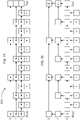
- a skip list is a data structure that comprises a hierarchy of "layers" (in Figure 7A layers 0, 1, 2, although any number may be included) of linked lists of ordered sequences of elements, each having an initial (Head) and final (Tail) value.
- the lowest layer comprises the full ordered sequence of values (such as share values).
- Higher layers contain successively sparser elements and are used to successively "bracket" values in lower layers until a desired element is located.
- arrows between "boxes" indicate pointers.
- One feature of a skip list is that it enables searching with far fewer average operations than a linear search of the lowest level linked list would require.
- Another feature is that it allows for insertions and deletions without requiring the search path of elements from Head to Tail to change.
- Figure 7B shows a modification of the skip list, in which arrows indicate hashing operations instead of simple pointers.
- the value K hash(hash(7)
- Z hash(hash(I
- I and J are the previous and K and L are the subsequent sibling values on the path from 6 to Z.
- An initial Head value A may be included to form an initial "seed" for the structure.
- the path from each element to the Tail value Z may then function in a manner similar to a hash chain.
- use of a skip list may enable an auditor to more quickly search for and find a share value in question.
- the different embodiments of the invention described above define a system of communicating computing devices that cooperate to enable accumulation of party input values A[i] in a manner that preserves the secrecy of the values.
- various data structures are created and updated. Note that some data structure, even if a simple list, may be used by each party to store its share values A[i,j], by each node to accumulate the share values it receives, and by the central entity to accumulate the node values S[j].
- Figure 8 illustrates the main hardware and software components of a computing system that may be used to implement any of the entities, that is, a party, a node, the central entity, or any system with which these communicate to implement, for example, the bulletin board 400 or signature service 600, if these are not included within one of the entities.
- each computing system 800 will include standard components such as system hardware 810 with at least one processor 811, some form of system software 820 such as an operating system 821 and/or virtual machine hypervisor, as well as volatile and/or non-volatile memory and/or storage, which is indicated “collectively" as component 812.
- system software 820 such as an operating system 821 and/or virtual machine hypervisor
- volatile and/or non-volatile memory and/or storage which is indicated “collectively" as component 812.
- the various data structures described herein, as well as the processor-executable code created to embody the software modules used to carry out the various computations and functions illustrated in Figures 1-7B may be stored and thus embodied in either or both types of memory/storage components. Especially given the proliferation of high-speed "non-volatile" storage components, the difference between these two component classes is becoming less relevant.
- the software modules will comprise processor-executable code that, when run by the processor(s) 811, cause the processor(s) to carry out the corresponding
- Standard I/O access components 814 may also be included in each device to enable communication with other entities and systems over any known type of network, wireless or wired.
- One or more entities may also include or connect to and control a display 900, with corresponding conventional drivers, etc.
- Figure 8 shows the system 800 as including an application layer 830, which comprises various software modules for performing the functions described above, for example, depending on the entity, decomposing party input values A[i] (831), computing hash values (110) and/or decryptions/encryptions (120, 210), computing node sums S[i] (832) or the final result S (833), etc. (not all of which will typically be included in one entity but are shown together for succinctness). If signatures/timestamps are used, these may be computed in an external system 600, whereby a software module 860 may also be included to format and submit requests appropriately and receive the results.
- Such an application layer is usually distinguished from the system software layer in that system software operates in a privileged mode with respect to its interaction with system hardware whereas "applications" don't.
- Rosters 700 may be created and stored within the storage component(s) 812 as other data structures, under the control of a corresponding software module 870.
Landscapes
- Engineering & Computer Science (AREA)
- Computer Security & Cryptography (AREA)
- Computer Networks & Wireless Communication (AREA)
- Signal Processing (AREA)
- Storage Device Security (AREA)
Priority Applications (1)
| Application Number | Priority Date | Filing Date | Title |
|---|---|---|---|
| EP21156897.7A EP4044497B1 (fr) | 2021-02-12 | 2021-02-12 | Système auditable et procédés de partage de secret |
Applications Claiming Priority (1)
| Application Number | Priority Date | Filing Date | Title |
|---|---|---|---|
| EP21156897.7A EP4044497B1 (fr) | 2021-02-12 | 2021-02-12 | Système auditable et procédés de partage de secret |
Publications (2)
| Publication Number | Publication Date |
|---|---|
| EP4044497A1 true EP4044497A1 (fr) | 2022-08-17 |
| EP4044497B1 EP4044497B1 (fr) | 2024-12-04 |
Family
ID=74595198
Family Applications (1)
| Application Number | Title | Priority Date | Filing Date |
|---|---|---|---|
| EP21156897.7A Active EP4044497B1 (fr) | 2021-02-12 | 2021-02-12 | Système auditable et procédés de partage de secret |
Country Status (1)
| Country | Link |
|---|---|
| EP (1) | EP4044497B1 (fr) |
Cited By (1)
| Publication number | Priority date | Publication date | Assignee | Title |
|---|---|---|---|---|
| CN116614236A (zh) * | 2023-06-05 | 2023-08-18 | 中国联合网络通信集团有限公司 | 秘钥管理方法、装置、设备和存储介质 |
Citations (2)
| Publication number | Priority date | Publication date | Assignee | Title |
|---|---|---|---|---|
| US8719576B2 (en) | 2003-12-22 | 2014-05-06 | Guardtime IP Holdings, Ltd | Document verification with distributed calendar infrastructure |
| WO2020142526A1 (fr) * | 2018-12-31 | 2020-07-09 | Guardtime Sa | Suivi vérifiable de données d'état d'objet |
-
2021
- 2021-02-12 EP EP21156897.7A patent/EP4044497B1/fr active Active
Patent Citations (2)
| Publication number | Priority date | Publication date | Assignee | Title |
|---|---|---|---|---|
| US8719576B2 (en) | 2003-12-22 | 2014-05-06 | Guardtime IP Holdings, Ltd | Document verification with distributed calendar infrastructure |
| WO2020142526A1 (fr) * | 2018-12-31 | 2020-07-09 | Guardtime Sa | Suivi vérifiable de données d'état d'objet |
Non-Patent Citations (4)
| Title |
|---|
| "Lecture Notes in Business Information Processing", 19 January 2021, SPRINGER BERLIN HEIDELBERG, DE, ISSN: 1865-1348, article SIMM JOOSEP ET AL: "Verifiable Multi-Party Business Process Automation", pages: 30 - 41, XP055820610, DOI: 10.1007/978-3-030-66498-5_3 * |
| A. SHAMIR: "How to share a secret", COMMUNICATIONS OF THE ACM, vol. 22, no. 11, 1979, pages 612 - 613, XP000565227, DOI: 10.1145/359168.359176 |
| BRIAN THOMPSON ET AL: "Privacy-Preserving Computation and Verification of Aggregate Queries on Outsourced Databases", 5 August 2009, PRIVACY ENHANCING TECHNOLOGIES, SPRINGER BERLIN HEIDELBERG, BERLIN, HEIDELBERG, PAGE(S) 185 - 201, ISBN: 978-3-642-03167-0, XP019124871 * |
| PUGH, WILLIAM: "Technical report", April 1989, DEPT. OF COMPUTER SCIENCE, article "Concurrent Maintenance of Skip Lists" |
Cited By (1)
| Publication number | Priority date | Publication date | Assignee | Title |
|---|---|---|---|---|
| CN116614236A (zh) * | 2023-06-05 | 2023-08-18 | 中国联合网络通信集团有限公司 | 秘钥管理方法、装置、设备和存储介质 |
Also Published As
| Publication number | Publication date |
|---|---|
| EP4044497B1 (fr) | 2024-12-04 |
Similar Documents
| Publication | Publication Date | Title |
|---|---|---|
| US11018856B2 (en) | Auditable system and methods for secret sharing | |
| US12395324B2 (en) | Systems and methods for communication, storage and processing of data provided by an entity over a blockchain network | |
| Syta et al. | Keeping authorities" honest or bust" with decentralized witness cosigning | |
| US11791992B2 (en) | Computer implemented method and system for transferring control of a digital asset | |
| US8572385B2 (en) | System and method for optimal verification of operations on dynamic sets | |
| US20200401726A1 (en) | System and method for private integration of datasets | |
| US7386131B2 (en) | Tolerant digital certificate distribute system and distribute method | |
| US7099471B2 (en) | Detecting compromised ballots | |
| EP4423968B1 (fr) | Schéma de signature de seuil | |
| CN112600675A (zh) | 基于群签名的电子投票方法及装置、电子设备、存储介质 | |
| EP4062299A1 (fr) | Signatures à résistance quantique multi-parties et multi-usages et établissement de clé | |
| US20140321644A1 (en) | Method and system for calculations on encrypted data | |
| Gramoli et al. | AOAB: optimal and fair ordering of financial transactions | |
| EP4044497B1 (fr) | Système auditable et procédés de partage de secret | |
| JP7849128B2 (ja) | ネストされた閾値署名 | |
| US20250125972A1 (en) | Generating digital signatures | |
| US20030028423A1 (en) | Detecting compromised ballots | |
| Eck | Mixnets in a distributed ledger remote electronic voting system | |
| US20210250337A1 (en) | Method and device for matching evaluation of structured data sets protected by encryption | |
| Bakas et al. | Heal the privacy: functional encryption and privacy-preserving analytics | |
| CN112422294A (zh) | 基于环签名的匿名投票方法及装置、电子设备、存储介质 | |
| Kaaniche et al. | SHoPS: Set homomorphic proof of data possession scheme in cloud storage applications | |
| FLORINDO | Realizing Consistency-or-Die: Verifiable Consistency for Key Logs | |
| Mandal et al. | A Code-Based Threshold Secret Sharing Scheme with Cheating Detection and Cheater Identification Mechanisms | |
| Sathya et al. | Quantum Protocols for Hash‐Based Blockchain |
Legal Events
| Date | Code | Title | Description |
|---|---|---|---|
| PUAI | Public reference made under article 153(3) epc to a published international application that has entered the european phase |
Free format text: ORIGINAL CODE: 0009012 |
|
| STAA | Information on the status of an ep patent application or granted ep patent |
Free format text: STATUS: THE APPLICATION HAS BEEN PUBLISHED |
|
| AK | Designated contracting states |
Kind code of ref document: A1 Designated state(s): AL AT BE BG CH CY CZ DE DK EE ES FI FR GB GR HR HU IE IS IT LI LT LU LV MC MK MT NL NO PL PT RO RS SE SI SK SM TR |
|
| STAA | Information on the status of an ep patent application or granted ep patent |
Free format text: STATUS: REQUEST FOR EXAMINATION WAS MADE |
|
| 17P | Request for examination filed |
Effective date: 20230217 |
|
| RBV | Designated contracting states (corrected) |
Designated state(s): AL AT BE BG CH CY CZ DE DK EE ES FI FR GB GR HR HU IE IS IT LI LT LU LV MC MK MT NL NO PL PT RO RS SE SI SK SM TR |
|
| REG | Reference to a national code |
Ref country code: DE Ref legal event code: R079 Free format text: PREVIOUS MAIN CLASS: H04L0009080000 Ipc: H04L0009000000 Ref country code: DE Ref legal event code: R079 Ref document number: 602021022683 Country of ref document: DE Free format text: PREVIOUS MAIN CLASS: H04L0009080000 Ipc: H04L0009000000 |
|
| GRAP | Despatch of communication of intention to grant a patent |
Free format text: ORIGINAL CODE: EPIDOSNIGR1 |
|
| STAA | Information on the status of an ep patent application or granted ep patent |
Free format text: STATUS: GRANT OF PATENT IS INTENDED |
|
| RIC1 | Information provided on ipc code assigned before grant |
Ipc: H04L 9/32 20060101ALI20240618BHEP Ipc: H04L 9/08 20060101ALI20240618BHEP Ipc: H04L 9/00 20220101AFI20240618BHEP |
|
| INTG | Intention to grant announced |
Effective date: 20240703 |
|
| GRAS | Grant fee paid |
Free format text: ORIGINAL CODE: EPIDOSNIGR3 |
|
| GRAA | (expected) grant |
Free format text: ORIGINAL CODE: 0009210 |
|
| STAA | Information on the status of an ep patent application or granted ep patent |
Free format text: STATUS: THE PATENT HAS BEEN GRANTED |
|
| AK | Designated contracting states |
Kind code of ref document: B1 Designated state(s): AL AT BE BG CH CY CZ DE DK EE ES FI FR GB GR HR HU IE IS IT LI LT LU LV MC MK MT NL NO PL PT RO RS SE SI SK SM TR |
|
| REG | Reference to a national code |
Ref country code: CH Ref legal event code: EP |
|
| REG | Reference to a national code |
Ref country code: DE Ref legal event code: R096 Ref document number: 602021022683 Country of ref document: DE |
|
| REG | Reference to a national code |
Ref country code: IE Ref legal event code: FG4D |
|
| REG | Reference to a national code |
Ref country code: LT Ref legal event code: MG9D |
|
| REG | Reference to a national code |
Ref country code: NL Ref legal event code: MP Effective date: 20241204 |
|
| PG25 | Lapsed in a contracting state [announced via postgrant information from national office to epo] |
Ref country code: HR Free format text: LAPSE BECAUSE OF FAILURE TO SUBMIT A TRANSLATION OF THE DESCRIPTION OR TO PAY THE FEE WITHIN THE PRESCRIBED TIME-LIMIT Effective date: 20241204 |
|
| PG25 | Lapsed in a contracting state [announced via postgrant information from national office to epo] |
Ref country code: FI Free format text: LAPSE BECAUSE OF FAILURE TO SUBMIT A TRANSLATION OF THE DESCRIPTION OR TO PAY THE FEE WITHIN THE PRESCRIBED TIME-LIMIT Effective date: 20241204 |
|
| PG25 | Lapsed in a contracting state [announced via postgrant information from national office to epo] |
Ref country code: BG Free format text: LAPSE BECAUSE OF FAILURE TO SUBMIT A TRANSLATION OF THE DESCRIPTION OR TO PAY THE FEE WITHIN THE PRESCRIBED TIME-LIMIT Effective date: 20241204 |
|
| PG25 | Lapsed in a contracting state [announced via postgrant information from national office to epo] |
Ref country code: ES Free format text: LAPSE BECAUSE OF FAILURE TO SUBMIT A TRANSLATION OF THE DESCRIPTION OR TO PAY THE FEE WITHIN THE PRESCRIBED TIME-LIMIT Effective date: 20241204 |
|
| PG25 | Lapsed in a contracting state [announced via postgrant information from national office to epo] |
Ref country code: NO Free format text: LAPSE BECAUSE OF FAILURE TO SUBMIT A TRANSLATION OF THE DESCRIPTION OR TO PAY THE FEE WITHIN THE PRESCRIBED TIME-LIMIT Effective date: 20250304 |
|
| PG25 | Lapsed in a contracting state [announced via postgrant information from national office to epo] |
Ref country code: LV Free format text: LAPSE BECAUSE OF FAILURE TO SUBMIT A TRANSLATION OF THE DESCRIPTION OR TO PAY THE FEE WITHIN THE PRESCRIBED TIME-LIMIT Effective date: 20241204 Ref country code: GR Free format text: LAPSE BECAUSE OF FAILURE TO SUBMIT A TRANSLATION OF THE DESCRIPTION OR TO PAY THE FEE WITHIN THE PRESCRIBED TIME-LIMIT Effective date: 20250305 |
|
| PG25 | Lapsed in a contracting state [announced via postgrant information from national office to epo] |
Ref country code: RS Free format text: LAPSE BECAUSE OF FAILURE TO SUBMIT A TRANSLATION OF THE DESCRIPTION OR TO PAY THE FEE WITHIN THE PRESCRIBED TIME-LIMIT Effective date: 20250304 |
|
| PG25 | Lapsed in a contracting state [announced via postgrant information from national office to epo] |
Ref country code: NL Free format text: LAPSE BECAUSE OF FAILURE TO SUBMIT A TRANSLATION OF THE DESCRIPTION OR TO PAY THE FEE WITHIN THE PRESCRIBED TIME-LIMIT Effective date: 20241204 |
|
| REG | Reference to a national code |
Ref country code: AT Ref legal event code: MK05 Ref document number: 1749306 Country of ref document: AT Kind code of ref document: T Effective date: 20241204 |
|
| PG25 | Lapsed in a contracting state [announced via postgrant information from national office to epo] |
Ref country code: SM Free format text: LAPSE BECAUSE OF FAILURE TO SUBMIT A TRANSLATION OF THE DESCRIPTION OR TO PAY THE FEE WITHIN THE PRESCRIBED TIME-LIMIT Effective date: 20241204 |
|
| PG25 | Lapsed in a contracting state [announced via postgrant information from national office to epo] |
Ref country code: PL Free format text: LAPSE BECAUSE OF FAILURE TO SUBMIT A TRANSLATION OF THE DESCRIPTION OR TO PAY THE FEE WITHIN THE PRESCRIBED TIME-LIMIT Effective date: 20241204 |
|
| PG25 | Lapsed in a contracting state [announced via postgrant information from national office to epo] |
Ref country code: IS Free format text: LAPSE BECAUSE OF FAILURE TO SUBMIT A TRANSLATION OF THE DESCRIPTION OR TO PAY THE FEE WITHIN THE PRESCRIBED TIME-LIMIT Effective date: 20250404 |
|
| PG25 | Lapsed in a contracting state [announced via postgrant information from national office to epo] |
Ref country code: PT Free format text: LAPSE BECAUSE OF FAILURE TO SUBMIT A TRANSLATION OF THE DESCRIPTION OR TO PAY THE FEE WITHIN THE PRESCRIBED TIME-LIMIT Effective date: 20250404 |
|
| PG25 | Lapsed in a contracting state [announced via postgrant information from national office to epo] |
Ref country code: EE Free format text: LAPSE BECAUSE OF FAILURE TO SUBMIT A TRANSLATION OF THE DESCRIPTION OR TO PAY THE FEE WITHIN THE PRESCRIBED TIME-LIMIT Effective date: 20241204 |
|
| PG25 | Lapsed in a contracting state [announced via postgrant information from national office to epo] |
Ref country code: RO Free format text: LAPSE BECAUSE OF FAILURE TO SUBMIT A TRANSLATION OF THE DESCRIPTION OR TO PAY THE FEE WITHIN THE PRESCRIBED TIME-LIMIT Effective date: 20241204 Ref country code: AT Free format text: LAPSE BECAUSE OF FAILURE TO SUBMIT A TRANSLATION OF THE DESCRIPTION OR TO PAY THE FEE WITHIN THE PRESCRIBED TIME-LIMIT Effective date: 20241204 |
|
| PG25 | Lapsed in a contracting state [announced via postgrant information from national office to epo] |
Ref country code: SK Free format text: LAPSE BECAUSE OF FAILURE TO SUBMIT A TRANSLATION OF THE DESCRIPTION OR TO PAY THE FEE WITHIN THE PRESCRIBED TIME-LIMIT Effective date: 20241204 |
|
| PG25 | Lapsed in a contracting state [announced via postgrant information from national office to epo] |
Ref country code: CZ Free format text: LAPSE BECAUSE OF FAILURE TO SUBMIT A TRANSLATION OF THE DESCRIPTION OR TO PAY THE FEE WITHIN THE PRESCRIBED TIME-LIMIT Effective date: 20241204 |
|
| PG25 | Lapsed in a contracting state [announced via postgrant information from national office to epo] |
Ref country code: IT Free format text: LAPSE BECAUSE OF FAILURE TO SUBMIT A TRANSLATION OF THE DESCRIPTION OR TO PAY THE FEE WITHIN THE PRESCRIBED TIME-LIMIT Effective date: 20241204 |
|
| REG | Reference to a national code |
Ref country code: DE Ref legal event code: R119 Ref document number: 602021022683 Country of ref document: DE |
|
| PG25 | Lapsed in a contracting state [announced via postgrant information from national office to epo] |
Ref country code: SE Free format text: LAPSE BECAUSE OF FAILURE TO SUBMIT A TRANSLATION OF THE DESCRIPTION OR TO PAY THE FEE WITHIN THE PRESCRIBED TIME-LIMIT Effective date: 20241204 |
|
| PG25 | Lapsed in a contracting state [announced via postgrant information from national office to epo] |
Ref country code: MC Free format text: LAPSE BECAUSE OF FAILURE TO SUBMIT A TRANSLATION OF THE DESCRIPTION OR TO PAY THE FEE WITHIN THE PRESCRIBED TIME-LIMIT Effective date: 20241204 |
|
| REG | Reference to a national code |
Ref country code: CH Ref legal event code: PL |
|
| PG25 | Lapsed in a contracting state [announced via postgrant information from national office to epo] |
Ref country code: DK Free format text: LAPSE BECAUSE OF FAILURE TO SUBMIT A TRANSLATION OF THE DESCRIPTION OR TO PAY THE FEE WITHIN THE PRESCRIBED TIME-LIMIT Effective date: 20241204 |
|
| PLBE | No opposition filed within time limit |
Free format text: ORIGINAL CODE: 0009261 |
|
| STAA | Information on the status of an ep patent application or granted ep patent |
Free format text: STATUS: NO OPPOSITION FILED WITHIN TIME LIMIT |
|
| PG25 | Lapsed in a contracting state [announced via postgrant information from national office to epo] |
Ref country code: LU Free format text: LAPSE BECAUSE OF NON-PAYMENT OF DUE FEES Effective date: 20250212 |
|
| PG25 | Lapsed in a contracting state [announced via postgrant information from national office to epo] |
Ref country code: CH Free format text: LAPSE BECAUSE OF NON-PAYMENT OF DUE FEES Effective date: 20250228 |
|
| 26N | No opposition filed |
Effective date: 20250905 |
|
| GBPC | Gb: european patent ceased through non-payment of renewal fee |
Effective date: 20250304 |
|
| REG | Reference to a national code |
Ref country code: BE Ref legal event code: MM Effective date: 20250228 |
|
| PG25 | Lapsed in a contracting state [announced via postgrant information from national office to epo] |
Ref country code: DE Free format text: LAPSE BECAUSE OF NON-PAYMENT OF DUE FEES Effective date: 20250902 |
|
| PG25 | Lapsed in a contracting state [announced via postgrant information from national office to epo] |
Ref country code: GB Free format text: LAPSE BECAUSE OF NON-PAYMENT OF DUE FEES Effective date: 20250304 |
|
| PG25 | Lapsed in a contracting state [announced via postgrant information from national office to epo] |
Ref country code: FR Free format text: LAPSE BECAUSE OF NON-PAYMENT OF DUE FEES Effective date: 20250228 |
|
| PG25 | Lapsed in a contracting state [announced via postgrant information from national office to epo] |
Ref country code: BE Free format text: LAPSE BECAUSE OF NON-PAYMENT OF DUE FEES Effective date: 20250228 |
|
| PG25 | Lapsed in a contracting state [announced via postgrant information from national office to epo] |
Ref country code: IE Free format text: LAPSE BECAUSE OF NON-PAYMENT OF DUE FEES Effective date: 20250212 |