EP4045190B1 - Verfahren und anlage zur kontinuierlichen lufttechnischen abscheidung von teilchenmaterial, das aus einer mischung von teilchen besteht, die sowohl in bezug auf die teilchengrösse als auch auf die dichte heterogen sind - Google Patents
Verfahren und anlage zur kontinuierlichen lufttechnischen abscheidung von teilchenmaterial, das aus einer mischung von teilchen besteht, die sowohl in bezug auf die teilchengrösse als auch auf die dichte heterogen sind Download PDFInfo
- Publication number
- EP4045190B1 EP4045190B1 EP20803898.4A EP20803898A EP4045190B1 EP 4045190 B1 EP4045190 B1 EP 4045190B1 EP 20803898 A EP20803898 A EP 20803898A EP 4045190 B1 EP4045190 B1 EP 4045190B1
- Authority
- EP
- European Patent Office
- Prior art keywords
- particles
- fraction
- aeraulic
- inlet
- classifier
- Prior art date
- Legal status (The legal status is an assumption and is not a legal conclusion. Google has not performed a legal analysis and makes no representation as to the accuracy of the status listed.)
- Active
Links
Images


Classifications
-
- B—PERFORMING OPERATIONS; TRANSPORTING
- B02—CRUSHING, PULVERISING, OR DISINTEGRATING; PREPARATORY TREATMENT OF GRAIN FOR MILLING
- B02C—CRUSHING, PULVERISING, OR DISINTEGRATING IN GENERAL; MILLING GRAIN
- B02C23/00—Auxiliary methods or auxiliary devices or accessories specially adapted for crushing or disintegrating not provided for in preceding groups or not specially adapted to apparatus covered by a single preceding group
- B02C23/08—Separating or sorting of material, associated with crushing or disintegrating
- B02C23/10—Separating or sorting of material, associated with crushing or disintegrating with separator arranged in discharge path of crushing or disintegrating zone
- B02C23/12—Separating or sorting of material, associated with crushing or disintegrating with separator arranged in discharge path of crushing or disintegrating zone with return of oversize material to crushing or disintegrating zone
-
- B—PERFORMING OPERATIONS; TRANSPORTING
- B02—CRUSHING, PULVERISING, OR DISINTEGRATING; PREPARATORY TREATMENT OF GRAIN FOR MILLING
- B02C—CRUSHING, PULVERISING, OR DISINTEGRATING IN GENERAL; MILLING GRAIN
- B02C23/00—Auxiliary methods or auxiliary devices or accessories specially adapted for crushing or disintegrating not provided for in preceding groups or not specially adapted to apparatus covered by a single preceding group
- B02C23/18—Adding fluid, other than for crushing or disintegrating by fluid energy
- B02C23/20—Adding fluid, other than for crushing or disintegrating by fluid energy after crushing or disintegrating
- B02C23/22—Adding fluid, other than for crushing or disintegrating by fluid energy after crushing or disintegrating with recirculation of material to crushing or disintegrating zone
-
- B—PERFORMING OPERATIONS; TRANSPORTING
- B02—CRUSHING, PULVERISING, OR DISINTEGRATING; PREPARATORY TREATMENT OF GRAIN FOR MILLING
- B02C—CRUSHING, PULVERISING, OR DISINTEGRATING IN GENERAL; MILLING GRAIN
- B02C23/00—Auxiliary methods or auxiliary devices or accessories specially adapted for crushing or disintegrating not provided for in preceding groups or not specially adapted to apparatus covered by a single preceding group
- B02C23/08—Separating or sorting of material, associated with crushing or disintegrating
- B02C23/14—Separating or sorting of material, associated with crushing or disintegrating with more than one separator
-
- B—PERFORMING OPERATIONS; TRANSPORTING
- B03—SEPARATION OF SOLID MATERIALS USING LIQUIDS OR USING PNEUMATIC TABLES OR JIGS; MAGNETIC OR ELECTROSTATIC SEPARATION OF SOLID MATERIALS FROM SOLID MATERIALS OR FLUIDS; SEPARATION BY HIGH-VOLTAGE ELECTRIC FIELDS
- B03B—SEPARATING SOLID MATERIALS USING LIQUIDS OR USING PNEUMATIC TABLES OR JIGS
- B03B9/00—General arrangement of separating plant, e.g. flow sheets
- B03B9/06—General arrangement of separating plant, e.g. flow sheets specially adapted for refuse
-
- B—PERFORMING OPERATIONS; TRANSPORTING
- B03—SEPARATION OF SOLID MATERIALS USING LIQUIDS OR USING PNEUMATIC TABLES OR JIGS; MAGNETIC OR ELECTROSTATIC SEPARATION OF SOLID MATERIALS FROM SOLID MATERIALS OR FLUIDS; SEPARATION BY HIGH-VOLTAGE ELECTRIC FIELDS
- B03B—SEPARATING SOLID MATERIALS USING LIQUIDS OR USING PNEUMATIC TABLES OR JIGS
- B03B9/00—General arrangement of separating plant, e.g. flow sheets
- B03B9/06—General arrangement of separating plant, e.g. flow sheets specially adapted for refuse
- B03B9/061—General arrangement of separating plant, e.g. flow sheets specially adapted for refuse the refuse being industrial
-
- B—PERFORMING OPERATIONS; TRANSPORTING
- B07—SEPARATING SOLIDS FROM SOLIDS; SORTING
- B07B—SEPARATING SOLIDS FROM SOLIDS BY SIEVING, SCREENING, SIFTING OR BY USING GAS CURRENTS; SEPARATING BY OTHER DRY METHODS APPLICABLE TO BULK MATERIAL, e.g. LOOSE ARTICLES FIT TO BE HANDLED LIKE BULK MATERIAL
- B07B7/00—Selective separation of solid materials carried by, or dispersed in, gas currents
- B07B7/08—Selective separation of solid materials carried by, or dispersed in, gas currents using centrifugal force
- B07B7/083—Selective separation of solid materials carried by, or dispersed in, gas currents using centrifugal force generated by rotating vanes, discs, drums, or brushes
-
- B—PERFORMING OPERATIONS; TRANSPORTING
- B07—SEPARATING SOLIDS FROM SOLIDS; SORTING
- B07B—SEPARATING SOLIDS FROM SOLIDS BY SIEVING, SCREENING, SIFTING OR BY USING GAS CURRENTS; SEPARATING BY OTHER DRY METHODS APPLICABLE TO BULK MATERIAL, e.g. LOOSE ARTICLES FIT TO BE HANDLED LIKE BULK MATERIAL
- B07B7/00—Selective separation of solid materials carried by, or dispersed in, gas currents
- B07B7/08—Selective separation of solid materials carried by, or dispersed in, gas currents using centrifugal force
- B07B7/086—Selective separation of solid materials carried by, or dispersed in, gas currents using centrifugal force generated by the winding course of the gas stream
-
- Y—GENERAL TAGGING OF NEW TECHNOLOGICAL DEVELOPMENTS; GENERAL TAGGING OF CROSS-SECTIONAL TECHNOLOGIES SPANNING OVER SEVERAL SECTIONS OF THE IPC; TECHNICAL SUBJECTS COVERED BY FORMER USPC CROSS-REFERENCE ART COLLECTIONS [XRACs] AND DIGESTS
- Y02—TECHNOLOGIES OR APPLICATIONS FOR MITIGATION OR ADAPTATION AGAINST CLIMATE CHANGE
- Y02W—CLIMATE CHANGE MITIGATION TECHNOLOGIES RELATED TO WASTEWATER TREATMENT OR WASTE MANAGEMENT
- Y02W30/00—Technologies for solid waste management
- Y02W30/50—Reuse, recycling or recovery technologies
- Y02W30/52—Mechanical processing of waste for the recovery of materials, e.g. crushing, shredding, separation or disassembly
Definitions
- the present invention generally relates to treatments for grinding and aeraulic separation of particulate materials, and more particularly to treatments for separating particulate materials that are heterogeneous in terms of size, density and shape. It applies to various fields and in particular to the processing of ores, waste from construction and public works, plant or animal materials (eg biomass, food products), waste of electronic origin, etc.
- the treatments for separating heterogeneous particulate materials M with a view to separating constituents of different natures from each other generally comprise a 1st grinding phase composed of a grinder B combined with a CL1 classification by size intended to separate the particles into the coarsest particles and into the finest particles until a certain particle size range is reached, and a 2 nd CL2 classification phase following the 1 st grinding phase intended to separate the finest particles and/or particles with different properties (typically a densimetric classification to separate the denser particles from the less dense particles).
- the densest particles are metals that are desired to be recovered from waste.
- the coarsest particles from the first separation step are reinjected at the inlet of the mill to be further subdivided.
- the present invention aims to remedy these drawbacks with a totally innovative approach.
- the present invention aims to improve the separation processes of existing heterogeneous materials and to allow, by a new simultaneous combination of grinding with the 2 aeraulic classifications, to generate a fraction containing particles classified both in terms of particle size and density and another fraction also classified in terms of particle size and density (for example, a fraction with finer and denser particles and a second fraction with coarser and less dense particles.
- the first a Vogellic separation comprises a dynamic classification associated with a recovery of particles.
- the first fraction is recovered outside the gas flow and is mechanically conveyed towards a gas flow supplying the second aeraulic separation unit.
- the second aeraulic separation comprises a dynamic classification associated with a recovery of particles.
- the third or the fourth fraction is recovered outside the gas flow and is conveyed mechanically or via the gas flow towards the inlet of the grinding stage.
- step (e) comprises the reinjection of the third fraction at the inlet grinding to recover a second fraction comprising particles of the finest grain size with an increased proportion of metallic materials compared to the starting particles, and a fourth fraction comprising particles of the coarsest and least dense grain size with a proportion of materials not -metallic increased compared to the starting particles.
- the first a Vogellic classifier comprises a dynamic classifier associated with a particle recuperator.
- the installation further comprises a pipe for reinjecting the flow of clean air at the outlet of the recuperator at the inlet of the grinder.
- it also comprises a means for mechanically conveying the particles of the first fraction to a diffuser interposed on an inlet pipe of the second aeraulic classifier.
- the second a somehowlic classifier comprises a second dynamic classifier associated with a second particle collector.
- the installation further comprises a pipe for reinjecting the flow of clean air at the outlet of the second particle recuperator at the inlet of the second dynamic classifier, or possibly at the inlet of the crusher if the fourth fraction returns to the latter.
- the installation further comprises a means of mechanical or a somehowlic conveying of the particles of the third or of the fourth fraction to the inlet of the grinder.
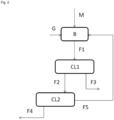
- the starting material M is introduced into a grinder B also receiving a flow of gas G (typically air or another gas) in such a way to generate an airflow F1 containing particles in a relatively wide particle size range, with a maximum size for example less than 500 ⁇ m.
- a flow of gas G typically air or another gas
- This flow F1 is applied to the input of a first classification unit CL1 intended to separate the particles into a flow F2 of the coarsest particles and a flow F3 of the finest particles.
- this flow is here simultaneously subjected to a second classification (particle size and/or densimetric) at the level of a second classifier CL2 which generates a fourth stream F4 of the least coarse and/or least dense particles and a third stream F5 of the coarsest and/or densest particles.
- a second classification particle size and/or densimetric
- the coarsest and/or densest particles are redirected towards the entrance of the grinder B, while the stream F4 of the less coarse and/or less dense particles is recovered as a finished or intermediate product.
- stream F4 the less coarse and/or less dense particles (stream F4) are redirected to the inlet of mill B, while the coarser and/or denser particle stream F5 is recovered as finished product or intermediate.
- the implementation of the Figure 2 is applicable for example to recover metal products in a starting material consisting of waste (electronic waste, waste from the manufacturing industry in general, construction, etc.).
- waste electronic waste, waste from the manufacturing industry in general, construction, etc.
- the lightest particles here the non-metallic materials: polymers, various minerals, etc.
- a particularly efficient process is obtained for obtaining, at the level of the flow F3, particles that are both fine and substantially more concentrated in metals (denser) than the starting material.
- This stream F3 thus directly constitutes the finished or intermediate product mainly sought.
- the flow F4 made up depending on the case of minerals, polymers, etc., also constitutes another finished or intermediate product of the treatment, which can be reused in an appropriate manner depending on its nature and the intended application, and for example supply the recycling industry.
- the implementation of the picture 3 is applicable in particular in the case where the most desirable fraction of the starting product is the least dense fraction (case for example of fruit shells to be recovered as fuel).
- the rapid extraction of the coarsest and densest fraction F5 (here fruit shells, which can for example be palletized to form a fuel) makes it possible to recover in a particularly efficient manner at the level of the flow F3 a intermediate or finished product of fine particle size and low density (here the internal part of the fruit transformed into powder for food application for example).
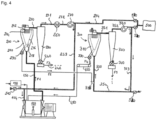
- This installation first of all comprises a crusher 100 (crusher B of the Figure 2 ) receiving as input (for example via a pneumatic conveyor, not illustrated) particulate matter 102, for example electronic waste pre-shredded in an initial stage not illustrated, in a particle size comprised for example between 0 and 10 mm.
- a crusher 100 (crusher B of the Figure 2 ) receiving as input (for example via a pneumatic conveyor, not illustrated) particulate matter 102, for example electronic waste pre-shredded in an initial stage not illustrated, in a particle size comprised for example between 0 and 10 mm.
- the grinder also receives, via a pipe 104, a flow of clean or slightly dusty gas (generally air) intended to convey the particles leaving the grinder 100.
- a flow of clean or slightly dusty gas generally air
- This crusher can be made using any known technology and one of the known crushing processes (compression, impact, attrition, depending on the nature and size of the input material to be crushed and the targeted fineness) and designed to reduce the initial fragments by a powder with a particle size typically less than about 500 ⁇ m.
- this maximum particle size is chosen to ensure an effective physical separation between the metallic particles and the non-metallic particles in the particulate material, avoiding as far as possible the presence of grains containing both metallic and non-metallic materials.
- the particles leaving the grinder are conveyed by the flow of gas passing through the grinder, in a pipe 150 (flow F1), to a first aeraulic separation station 200, this station comprising here a dynamic turbine classifier 210, of the type known in itself, associated with one or more collectors 220 of the particles contained in the air, for example of the cyclone type, bag filters, bag filters, all known per se.
- a dynamic turbine classifier 210 of the type known in itself, associated with one or more collectors 220 of the particles contained in the air, for example of the cyclone type, bag filters, bag filters, all known per se.
- the classifier 210 schematically comprises a rotor 212 having blades 214 rotating at an adjusted speed above a collection hopper 216.
- the air flow F1 conveying the particles is conveyed by the base of the device through a peripheral space 218 in the form of a frustoconical ring located between the outer wall of the separator and the hopper 216.
- the particles are secured at the level of the blades 214 from the rotor to a combined effect of centrifugation, drive aeraulic and gravity fall, so that in the end the finest particles pass through the rotor and exit in the air flow in an upper outlet duct 250 of the separator, and that the coarsest particles are kept at the outside of the rotor and accumulate at the bottom of the hopper, from where they are extracted for example by a honeycomb lock 230.
- This separator with a powder containing metals and non-metals, makes it possible to ensure a first recovery, in the flow of air leaving the upper part, of fines having a proportion of metal particles that is significantly greater than in the shredded departure, with as a corollary a reduced proportion of non-metallic particles, while the coarser particles are recovered at the bottom of the separator 210 and extracted via the alveolar airlock 230 to simultaneously undergo a second classification as we will see below (flow F2 )
- the pipe 250 is connected to the inlet of the particle collector 220, for example one or more cyclones, bag filters or pocket filters, the parameters of which are adjusted so as to eliminate the greatest part of the fines from the air flow. suspended in it. As has been said, these particles are fine particles with an increased proportion of metals, and constitute a first product resulting from the treatment. These particles are recovered by an airlock 240 to form a finished product or to be directed (arrow 242) to another treatment (flow F3).
- the particle collector 220 for example one or more cyclones, bag filters or pocket filters, the parameters of which are adjusted so as to eliminate the greatest part of the fines from the air flow. suspended in it.
- these particles are fine particles with an increased proportion of metals, and constitute a first product resulting from the treatment.
- These particles are recovered by an airlock 240 to form a finished product or to be directed (arrow 242) to another treatment (flow F3).
- the air flow leaving the particle collector 220 circulates in a pipe 251 towards a heat exchanger 260 then towards an extraction fan 270 which generates the air flow in the crusher and in the separation station 200.
- This flow of air which can remain very lightly charged with particles, is reinjected at the inlet of the grinder 100 via a pipe 253.
- the heat exchanger 260 makes it possible to cool the air before its return to the inlet of the crusher, in particular when the latter generates by its operating principle a significant rise in the temperature of the air flow and the particles transported (grinding heat).
- the dynamic turbine classifier 210 is advantageously of the type having an adjustable separation threshold, and for example chosen so as to admit as input a particle size of up to 5 mm, with a particle size separation threshold adjustable between 3 and 400 ⁇ m.
- This first separation station 200 is functionally connected to a second separation station 300 consisting here also of a dynamic turbine classifier 310 of a type known per se, combined with one or more other particle recoverers 320, preferably of the same type as the recuperator(s) 220.
- the fraction F2 from the airlock 230 associated with the classifier 210 is conveyed by a gravity or mechanical conveyor (line 231) and injected via a diffuser 335 into a air flow conveyed in a pipe 350, which supplies the base of the classifier 310.
- This classifier 310 advantageously has the same structure as that of the classifier 210, a structure which will not be described again, it being recalled that such classifiers are known in self.
- This classifier is set so that the coarsest and/or densest particles are kept outside the turbine and accumulate at the bottom of the hopper. They are collected by an airlock 330 and reinjected via a gravity or mechanical transport line 450 at the inlet of the crusher 100 (flow F5).
Landscapes
- Engineering & Computer Science (AREA)
- Food Science & Technology (AREA)
- Combined Means For Separation Of Solids (AREA)
- Disintegrating Or Milling (AREA)
- Manufacture And Refinement Of Metals (AREA)
Claims (13)
- Verfahren zur kontinuierlichen lufttechnischen Abscheidung von Teilchenmaterialien, die aus einer sowohl in Bezug auf die Teilchengröße als auch die Dichte heterogenen Teilchenmischung bestehen, dadurch gekennzeichnet, dass es die folgenden Schritte umfasst:(a) Zerkleinern der Materialteilchen,(b) Erzeugen eines Gasstroms, der die zerkleinerten Teilchen befördert,(c) erste lufttechnische Abscheidung aus dem Gasstrom in einer ersten lufttechnischen Abscheidungseinheit, um die Teilchen abzuscheiden, die er enthält, in eine erste Fraktion, die aus den gröbsten Teilchen mit variablen Dichten besteht, und eine zweite Fraktion, die aus den feinsten Teilchen besteht,(d) zweite lufttechnische Abscheidung aus der ersten Fraktion in einer zweiten lufttechnischen Abscheidungseinheit, um die Teilchen abzuscheiden, die sie enthält, in eine dritte Fraktion, die aus den gröbsten und/oder den dichtesten Teilchen besteht und eine vierte Fraktion, die aus den am wenigsten groben und/oder den wenigsten dichten Teilchen besteht,(e) erneutes Einleiten der dritten Fraktion oder der vierten Fraktion in den Zerkleinerungseinlass, und(f) gleichzeitiges Rückgewinnen der zweiten Fraktion sowie der vierten Fraktion oder beziehungsweise der dritten Fraktion als Ausgangsprodukte.
- Verfahren nach Anspruch 1, dadurch gekennzeichnet, dass die erste lufttechnische Abscheidung eine dynamische Klassifizierung umfasst, die einer Teilchenrückgewinnung zugeordnet ist.
- Verfahren nach Anspruch 1 oder Anspruch 2, dadurch gekennzeichnet, dass die erste Fraktion aus dem Gasstrom zurückgewonnen und mechanisch zu einem Gasstrom geleitet wird, der die zweite lufttechnische Abscheidungseinheit versorgt.
- Verfahren nach einem der Ansprüche 1 bis 3, dadurch gekennzeichnet, dass die zweite lufttechnische Abscheidung eine dynamische Klassifizierung umfasst, die einer Teilchenrückgewinnung zugeordnet ist.
- Verfahren nach einem der Ansprüche 1 bis 4, dadurch gekennzeichnet, dass die dritte oder die vierte Fraktion aus dem Gasstrom zurückgewonnen und mechanisch oder über den Gasstrom zum Einlass des Zerkleinerungsschritts geleitet wird.
- Verfahren nach Anspruch 1, das auf die Abscheidung von Teilchenmaterialien angewendet wird, die metallische Materialien und nichtmetallische Materialien enthalten, die leichter als die metallischen Materialien sind, dadurch gekennzeichnet, dass der Schritt (e) das erneute Einleiten der dritten Fraktion in den Zerkleinerungseinlass umfasst, um eine zweite Fraktion zurückzugewinnen, die Teilchen mit der feinsten Teilchengröße mit einem erhöhten Anteil an metallischen Materialien im Verhältnis zu den Ausgangsteilchen umfasst, und eine vierte Fraktion, die Teilchen mit der gröbsten und am wenigsten dichten Teilchengröße mit einem erhöhten Anteil an nichtmetallische Materialien im Verhältnis zu den Ausgangsteilchen umfasst.
- Anlage für die kontinuierliche lufttechnische Abscheidung von Teilchenmaterialien, die aus einer sowohl in Bezug auf die Teilchengröße als auch die Dichte heterogenen Teilchenmischung bestehen, dadurch gekennzeichnet, dass sie Folgendes umfasst:- Einen Zerkleinerer (100), der mit einer heterogenen Teilchenmischung versorgt wird, die zu bearbeiten ist,- eine Einrichtung (510, 104), um am Auslass des Zerkleinerers einen Gasstrom (F1) zu erzeugen, der die Teilchen im Ergebnis der Zerkleinerung enthält,- einen ersten lufttechnischen Klassierer (200), der den Gasstrom empfängt und imstande ist, eine erste Fraktion (F2) zu erzeugen, die die gröbsten Teilchen mit variablen Dichten enthält, und eine zweite Fraktion (F3), die die feinsten Teilchen enthält,- einen zweiten lufttechnischen Klassierer (300), der die erste Fraktion empfängt und imstande ist, eine dritte Fraktion (F5) zu erzeugen, die die gröbsten und/oder die dichtesten Teilchen enthält und eine vierte Fraktion (F4), die die am wenigsten groben und/oder die am wenigsten dichten Teilchen enthält, und- Einrichtungen (450), um die dritte Fraktion (F5) oder die vierte Fraktion (F4) zum Einlass des Zerkleinerers zu befördern.
- Anlage nach Anspruch 7, dadurch gekennzeichnet, dass der erste lufttechnische Klassierer (200) einen dynamischen Klassierer (210) umfasst, der einem Teilchenrückgewinner (220) zugeordnet ist.
- Anlage nach Anspruch 8, dadurch gekennzeichnet, dass sie ferner eine Leitung (253) umfasst, um den am Auslass des Rückgewinners (220) sauberen Luftstrom erneut in den Einlass des Zerkleinerers (100) einzuleiten.
- Anlage nach Anspruch 8 oder 9, dadurch gekennzeichnet, dass sie ferner eine Einrichtung zur mechanischen Beförderung der Teilchen der ersten Fraktion (F2) bis zu einem Diffusor (335) umfasst, der auf einer Einlassleitung (350) des zweiten lufttechnischen Klassierers (300) zwischengestellt ist.
- Anlage nach einem der Ansprüche 7 bis 10, dadurch gekennzeichnet, dass der zweite lufttechnische Klassierer (300) einen zweiten dynamischen Klassierer (310) umfasst, der einem zweiten Teilchenrückgewinner (320) zugeordnet ist.
- Anlage nach Anspruch 11, dadurch gekennzeichnet, dass sie ferner eine Leitung (353) umfasst, um den am Auslass des zweiten Teilchenrückgewinners (320) sauberen Luftstrom erneut in den Einlass des zweiten dynamischen Klassierers (310) oder gegebenenfalls in den Einlass des Zerkleinerers (100) einzuleiten, sofern die vierte Fraktion (F5) zu diesem zurückkehrt.
- Anlage nach Anspruch 11 oder 12, dadurch gekennzeichnet, dass sie ferner eine Einrichtung zur mechanischen oder lufttechnischen Beförderung der Teilchen der dritten oder der vierten Fraktion bis zum Einlass des Zerkleinerers (100) umfasst.
Applications Claiming Priority (2)
| Application Number | Priority Date | Filing Date | Title |
|---|---|---|---|
| FR1911440A FR3101791B1 (fr) | 2019-10-15 | 2019-10-15 | Procédé et installation de séparation aéraulique en continu de matériaux particulaires constitués d’un mélange de particules hétérogène à la fois en granulométrie et en densité |
| PCT/FR2020/051821 WO2021074528A1 (fr) | 2019-10-15 | 2020-10-14 | Procédé et installation de séparation aéraulique en continu de matériaux particulaires constitués d'un mélange de particules hétérogène à la fois en granulométrie et en densité |
Publications (3)
| Publication Number | Publication Date |
|---|---|
| EP4045190A1 EP4045190A1 (de) | 2022-08-24 |
| EP4045190B1 true EP4045190B1 (de) | 2023-08-09 |
| EP4045190C0 EP4045190C0 (de) | 2023-08-09 |
Family
ID=69699980
Family Applications (1)
| Application Number | Title | Priority Date | Filing Date |
|---|---|---|---|
| EP20803898.4A Active EP4045190B1 (de) | 2019-10-15 | 2020-10-14 | Verfahren und anlage zur kontinuierlichen lufttechnischen abscheidung von teilchenmaterial, das aus einer mischung von teilchen besteht, die sowohl in bezug auf die teilchengrösse als auch auf die dichte heterogen sind |
Country Status (8)
| Country | Link |
|---|---|
| US (1) | US12048933B2 (de) |
| EP (1) | EP4045190B1 (de) |
| CN (1) | CN114555233B (de) |
| AU (1) | AU2020365494B2 (de) |
| CA (1) | CA3152903A1 (de) |
| ES (1) | ES2960908T3 (de) |
| FR (1) | FR3101791B1 (de) |
| WO (1) | WO2021074528A1 (de) |
Families Citing this family (4)
| Publication number | Priority date | Publication date | Assignee | Title |
|---|---|---|---|---|
| FR3101791B1 (fr) * | 2019-10-15 | 2021-09-17 | Broyeurs Poittemill Ingenierie | Procédé et installation de séparation aéraulique en continu de matériaux particulaires constitués d’un mélange de particules hétérogène à la fois en granulométrie et en densité |
| BE1030126B1 (nl) | 2021-12-27 | 2023-07-24 | Reazn Belgium | Verbeterde werkwijze voor het recycleren van zink (Zn) |
| CN114985747A (zh) * | 2022-06-14 | 2022-09-02 | 山东泰山钢铁集团有限公司 | 一种一次粉松装密度快速调节方法 |
| CN114804688B (zh) * | 2022-06-27 | 2022-09-16 | 山西工程科技职业大学 | 一种再生混合细集料级配及混合比确定方法 |
Family Cites Families (29)
| Publication number | Priority date | Publication date | Assignee | Title |
|---|---|---|---|---|
| DE1281817B (de) * | 1964-04-08 | 1968-10-31 | Kloeckner Humboldt Deutz Ag | Mahltrocknungsanlage |
| DE1607642A1 (de) * | 1966-10-22 | 1969-09-18 | Miag Muehlenbau & Ind Gmbh | Verfahren und Vorrichtung zum Abtrennen einer Grobfraktion aus einem pneumatisch gefoerderten Schuettgutstrom |
| US3490702A (en) * | 1966-10-24 | 1970-01-20 | D Ore Mills Inc | Method of accelerating production of portland cement and similar material |
| GB1323295A (en) * | 1970-01-06 | 1973-07-11 | Smidth & Co As F L | Dry grinding of raw materials |
| DE2364277C2 (de) * | 1973-12-22 | 1983-03-17 | O & K Orenstein & Koppel Ag, 1000 Berlin | Verfahren zur Herstellung eines Mahlgutes |
| DE2620461A1 (de) * | 1976-05-08 | 1977-11-24 | Kloeckner Humboldt Deutz Ag | Mahltrocknungsanlage |
| DE3042899C2 (de) * | 1980-11-13 | 1983-02-10 | BKMI Industrieanlagen GmbH, 8000 München | Verfahren zur Abtrennung von Papier und Folien aus Müll |
| US5111998A (en) * | 1990-03-30 | 1992-05-12 | Canon Kabushiki Kaisha | Process for producing toner for developing electrostatic image and apparatus system therefor |
| CH684225A5 (de) * | 1992-09-02 | 1994-07-29 | Inter Recycling Ag | Verfahren zum Entsorgen von Nickel-Cadmium- oder Nickel-Hydrid-Zellen. |
| DK12893A (da) * | 1993-02-04 | 1994-08-05 | Smidth & Co As F L | Fremgangsmåde til fremstilling af normal såvel som ultrafin cement |
| DE4324237A1 (de) * | 1993-07-20 | 1995-01-26 | Metallgesellschaft Ag | Verfahren und Vorrichtung zur Aufbereitung von Formkörpern aus unterschiedlichen Polymeren |
| DE19726105A1 (de) * | 1997-06-19 | 1998-12-24 | Hamos Gmbh Recycling Und Separ | Verfahren und Anlage zur Aufbereitung von Elektronik-Schrott und zur Anreicherung verwertbarer, insbesondere Edelmetalle enthaltender Bestandteile |
| US7028847B2 (en) * | 2003-05-29 | 2006-04-18 | Alstom Technology Ltd | High efficiency two-stage dynamic classifier |
| TW200940619A (en) * | 2007-10-09 | 2009-10-01 | Cbp Carbon Ind Inc | Elastomer composition with reclaimed filler materials |
| CN201320533Y (zh) * | 2008-08-15 | 2009-10-07 | 费建祖 | 高效粒度分级组合装置 |
| DE102008056311A1 (de) * | 2008-11-07 | 2010-05-12 | Apk Aluminium Und Kunststoffe Ag | Verfahren zum Abtrennen einzelner Wertstoffe aus gemischtem, insbesondere zerkleinertem Kunststoffabfall |
| US8393558B2 (en) * | 2009-12-30 | 2013-03-12 | Organic Energy Corporation | Mechanized separation and recovery system for solid waste |
| CN101947483B (zh) * | 2010-08-12 | 2012-03-14 | 河南醒狮高新技术股份有限公司 | 半导体材料及超硬材料线切割专用刃料颗粒成型的方法 |
| CN103476516B (zh) * | 2010-11-24 | 2017-07-18 | 有机能量公司 | 固体废弃物流中的湿物料和干物料的机械化分离 |
| FR2976194B1 (fr) * | 2011-06-08 | 2014-01-10 | Pa Technologies | Separateur dynamique pour materiaux pulverulents |
| FR2986445B1 (fr) * | 2012-02-08 | 2014-02-21 | Vicat | Presse integrale ventilee |
| WO2015173807A1 (en) * | 2014-05-11 | 2015-11-19 | Infimer Technologies Ltd. | Method of separating waste material |
| CN106660054A (zh) * | 2014-05-22 | 2017-05-10 | Tav控股有限公司 | 用于从废物流回收金属的系统和方法 |
| FR3025806B1 (fr) * | 2014-09-15 | 2019-09-06 | Bigarren Bizi | Procede de traitement et d'extraction de dechets electroniques en vue de la recuperation des constituants inclus dans de tel dechets |
| AT516381B1 (de) * | 2014-12-04 | 2016-05-15 | Andritz Ag Maschf | Verfahren zur Aufbereitung elektrischer und elektronischer Bauteile zur Rückgewinnung von Wertstoffen |
| GB201521624D0 (en) * | 2015-12-08 | 2016-01-20 | Fiberight Ltd | Waste processing |
| US10864528B2 (en) * | 2016-05-11 | 2020-12-15 | Anglo American Services (UK) Ltd. | Reducing the need for tailings storage dams in the iron ore industry |
| FR3085867A1 (fr) * | 2018-09-17 | 2020-03-20 | Bigarren Bizi | Procede et installation de separation aeraulique |
| FR3101791B1 (fr) * | 2019-10-15 | 2021-09-17 | Broyeurs Poittemill Ingenierie | Procédé et installation de séparation aéraulique en continu de matériaux particulaires constitués d’un mélange de particules hétérogène à la fois en granulométrie et en densité |
-
2019
- 2019-10-15 FR FR1911440A patent/FR3101791B1/fr active Active
-
2020
- 2020-10-14 WO PCT/FR2020/051821 patent/WO2021074528A1/fr not_active Ceased
- 2020-10-14 AU AU2020365494A patent/AU2020365494B2/en active Active
- 2020-10-14 CA CA3152903A patent/CA3152903A1/fr active Pending
- 2020-10-14 ES ES20803898T patent/ES2960908T3/es active Active
- 2020-10-14 CN CN202080072145.6A patent/CN114555233B/zh active Active
- 2020-10-14 US US17/754,780 patent/US12048933B2/en active Active
- 2020-10-14 EP EP20803898.4A patent/EP4045190B1/de active Active
Also Published As
| Publication number | Publication date |
|---|---|
| US12048933B2 (en) | 2024-07-30 |
| EP4045190A1 (de) | 2022-08-24 |
| BR112022006904A2 (pt) | 2022-07-05 |
| US20230080044A1 (en) | 2023-03-16 |
| FR3101791B1 (fr) | 2021-09-17 |
| WO2021074528A1 (fr) | 2021-04-22 |
| CN114555233A (zh) | 2022-05-27 |
| AU2020365494A1 (en) | 2022-05-05 |
| AU2020365494B2 (en) | 2026-01-08 |
| ES2960908T3 (es) | 2024-03-07 |
| CN114555233B (zh) | 2024-02-13 |
| EP4045190C0 (de) | 2023-08-09 |
| FR3101791A1 (fr) | 2021-04-16 |
| CA3152903A1 (fr) | 2021-04-22 |
Similar Documents
| Publication | Publication Date | Title |
|---|---|---|
| CA3152903A1 (fr) | Procede et installation de separation aeraulique en continu de materiaux particulaires constitues d'un melange de particules heterogene a la fois en granulometrie et en densite | |
| WO2020058847A2 (fr) | Procédé et installation de séparation aéraulique | |
| JP6057425B2 (ja) | 自動車シュレッダーダストの分別装置 | |
| FR2479025A1 (de) | ||
| EP2595784A1 (de) | Simultane vorkonzentration und vorauswahl von zumindest einer gruppe an aufwertbaren polymermaterialien aus zerkleinerungsresten langlebiger güter am ende ihrer lebensdauer | |
| EP0278858B1 (de) | Verfahren zur Zerkleinerung von mineralischen Stoffen und Anlage zur Durchführung des Verfahrens | |
| CA2797004C (fr) | Procede et installation de broyage d'une matiere minerale contenant au moins du calcium et des impuretes metalliques | |
| EP0888192B1 (de) | Verfahren und anlage für die gleichzeitige und kontinuierliche herstellung mehrerer granulatfraktionen eines mineralischen materials | |
| EP1534487A2 (de) | Verfahren zur vorkonzentration von aus dem zerkleinern von gütern, die das ende ihrer lebensdauer erreicht haben, stammenden haltbaren organischen synthetischen materialien | |
| US20050061716A1 (en) | Separation system for single stream compressed recyclables | |
| EP3164217B1 (de) | Verfahren und vorrichtung zum trocknen und zerkleinern von feuchten materialien | |
| EP0489633A1 (de) | Verfahren zur Zerkleinerung von sprödem Mahlgut mit einer selektiven Desagglomeration, Durchführung des Verfahrens sowie Anlage zur Durchführung des Verfahrens | |
| WO2012020201A1 (fr) | Dispositif de separation de produits ferreux et non ferreux issus de broyage, d'incineration ou autre | |
| BE892501A (fr) | Classificateur centrifuge pneumatique de solides pulverulents | |
| HK40067661B (zh) | 由颗粒尺寸和密度皆不均匀的颗粒混合物组成的颗粒材料的连续气动分离方法和装置 | |
| FR2962924A1 (fr) | Procede et dispositif de traitement de dechets, notamment de residus de broyage legers | |
| HK40067661A (en) | Method and facility for continuous aeraulic separation of particulate materials consisting of a mixture of particles heterogeneous in both particle size and density | |
| BR112022006904B1 (pt) | Método e instalação para separação aeráulica contínua de materiais particulados constituídos por uma mistura de partículas heterogêneas em tamanho e densidade de partícula | |
| FR2635279A1 (fr) | Classificateur des materiaux pulverulents par gravite | |
| FR2920321A1 (fr) | Methode et installation de recyclage des cartouches d'encre | |
| BE472368A (de) |
Legal Events
| Date | Code | Title | Description |
|---|---|---|---|
| STAA | Information on the status of an ep patent application or granted ep patent |
Free format text: STATUS: UNKNOWN |
|
| STAA | Information on the status of an ep patent application or granted ep patent |
Free format text: STATUS: THE INTERNATIONAL PUBLICATION HAS BEEN MADE |
|
| PUAI | Public reference made under article 153(3) epc to a published international application that has entered the european phase |
Free format text: ORIGINAL CODE: 0009012 |
|
| STAA | Information on the status of an ep patent application or granted ep patent |
Free format text: STATUS: REQUEST FOR EXAMINATION WAS MADE |
|
| 17P | Request for examination filed |
Effective date: 20220329 |
|
| AK | Designated contracting states |
Kind code of ref document: A1 Designated state(s): AL AT BE BG CH CY CZ DE DK EE ES FI FR GB GR HR HU IE IS IT LI LT LU LV MC MK MT NL NO PL PT RO RS SE SI SK SM TR |
|
| DAX | Request for extension of the european patent (deleted) | ||
| RAV | Requested validation state of the european patent: fee paid |
Extension state: TN Effective date: 20220329 Extension state: MA Effective date: 20220329 Extension state: KH Effective date: 20220329 |
|
| GRAP | Despatch of communication of intention to grant a patent |
Free format text: ORIGINAL CODE: EPIDOSNIGR1 |
|
| STAA | Information on the status of an ep patent application or granted ep patent |
Free format text: STATUS: GRANT OF PATENT IS INTENDED |
|
| RIC1 | Information provided on ipc code assigned before grant |
Ipc: B07B 7/086 20060101ALI20230221BHEP Ipc: B07B 7/083 20060101ALI20230221BHEP Ipc: B03B 9/06 20060101ALI20230221BHEP Ipc: B02C 23/14 20060101ALI20230221BHEP Ipc: B02C 23/12 20060101AFI20230221BHEP |
|
| INTG | Intention to grant announced |
Effective date: 20230316 |
|
| GRAS | Grant fee paid |
Free format text: ORIGINAL CODE: EPIDOSNIGR3 |
|
| GRAA | (expected) grant |
Free format text: ORIGINAL CODE: 0009210 |
|
| STAA | Information on the status of an ep patent application or granted ep patent |
Free format text: STATUS: THE PATENT HAS BEEN GRANTED |
|
| AK | Designated contracting states |
Kind code of ref document: B1 Designated state(s): AL AT BE BG CH CY CZ DE DK EE ES FI FR GB GR HR HU IE IS IT LI LT LU LV MC MK MT NL NO PL PT RO RS SE SI SK SM TR |
|
| REG | Reference to a national code |
Ref country code: GB Ref legal event code: FG4D Free format text: NOT ENGLISH |
|
| REG | Reference to a national code |
Ref country code: CH Ref legal event code: EP |
|
| REG | Reference to a national code |
Ref country code: IE Ref legal event code: FG4D Free format text: LANGUAGE OF EP DOCUMENT: FRENCH |
|
| REG | Reference to a national code |
Ref country code: DE Ref legal event code: R096 Ref document number: 602020015591 Country of ref document: DE |
|
| U01 | Request for unitary effect filed |
Effective date: 20230830 |
|
| U07 | Unitary effect registered |
Designated state(s): AT BE BG DE DK EE FI FR IT LT LU LV MT NL PT SE SI Effective date: 20230905 |
|
| U20 | Renewal fee for the european patent with unitary effect paid |
Year of fee payment: 4 Effective date: 20231123 |
|
| PG25 | Lapsed in a contracting state [announced via postgrant information from national office to epo] |
Ref country code: GR Free format text: LAPSE BECAUSE OF FAILURE TO SUBMIT A TRANSLATION OF THE DESCRIPTION OR TO PAY THE FEE WITHIN THE PRESCRIBED TIME-LIMIT Effective date: 20231110 |
|
| PG25 | Lapsed in a contracting state [announced via postgrant information from national office to epo] |
Ref country code: IS Free format text: LAPSE BECAUSE OF FAILURE TO SUBMIT A TRANSLATION OF THE DESCRIPTION OR TO PAY THE FEE WITHIN THE PRESCRIBED TIME-LIMIT Effective date: 20231209 |
|
| PG25 | Lapsed in a contracting state [announced via postgrant information from national office to epo] |
Ref country code: RS Free format text: LAPSE BECAUSE OF FAILURE TO SUBMIT A TRANSLATION OF THE DESCRIPTION OR TO PAY THE FEE WITHIN THE PRESCRIBED TIME-LIMIT Effective date: 20230809 Ref country code: NO Free format text: LAPSE BECAUSE OF FAILURE TO SUBMIT A TRANSLATION OF THE DESCRIPTION OR TO PAY THE FEE WITHIN THE PRESCRIBED TIME-LIMIT Effective date: 20231109 Ref country code: IS Free format text: LAPSE BECAUSE OF FAILURE TO SUBMIT A TRANSLATION OF THE DESCRIPTION OR TO PAY THE FEE WITHIN THE PRESCRIBED TIME-LIMIT Effective date: 20231209 Ref country code: HR Free format text: LAPSE BECAUSE OF FAILURE TO SUBMIT A TRANSLATION OF THE DESCRIPTION OR TO PAY THE FEE WITHIN THE PRESCRIBED TIME-LIMIT Effective date: 20230809 Ref country code: GR Free format text: LAPSE BECAUSE OF FAILURE TO SUBMIT A TRANSLATION OF THE DESCRIPTION OR TO PAY THE FEE WITHIN THE PRESCRIBED TIME-LIMIT Effective date: 20231110 |
|
| PG25 | Lapsed in a contracting state [announced via postgrant information from national office to epo] |
Ref country code: PL Free format text: LAPSE BECAUSE OF FAILURE TO SUBMIT A TRANSLATION OF THE DESCRIPTION OR TO PAY THE FEE WITHIN THE PRESCRIBED TIME-LIMIT Effective date: 20230809 |
|
| REG | Reference to a national code |
Ref country code: ES Ref legal event code: FG2A Ref document number: 2960908 Country of ref document: ES Kind code of ref document: T3 Effective date: 20240307 |
|
| PG25 | Lapsed in a contracting state [announced via postgrant information from national office to epo] |
Ref country code: SM Free format text: LAPSE BECAUSE OF FAILURE TO SUBMIT A TRANSLATION OF THE DESCRIPTION OR TO PAY THE FEE WITHIN THE PRESCRIBED TIME-LIMIT Effective date: 20230809 Ref country code: RO Free format text: LAPSE BECAUSE OF FAILURE TO SUBMIT A TRANSLATION OF THE DESCRIPTION OR TO PAY THE FEE WITHIN THE PRESCRIBED TIME-LIMIT Effective date: 20230809 Ref country code: CZ Free format text: LAPSE BECAUSE OF FAILURE TO SUBMIT A TRANSLATION OF THE DESCRIPTION OR TO PAY THE FEE WITHIN THE PRESCRIBED TIME-LIMIT Effective date: 20230809 Ref country code: SK Free format text: LAPSE BECAUSE OF FAILURE TO SUBMIT A TRANSLATION OF THE DESCRIPTION OR TO PAY THE FEE WITHIN THE PRESCRIBED TIME-LIMIT Effective date: 20230809 |
|
| REG | Reference to a national code |
Ref country code: DE Ref legal event code: R097 Ref document number: 602020015591 Country of ref document: DE |
|
| PG25 | Lapsed in a contracting state [announced via postgrant information from national office to epo] |
Ref country code: MC Free format text: LAPSE BECAUSE OF FAILURE TO SUBMIT A TRANSLATION OF THE DESCRIPTION OR TO PAY THE FEE WITHIN THE PRESCRIBED TIME-LIMIT Effective date: 20230809 |
|
| PLBE | No opposition filed within time limit |
Free format text: ORIGINAL CODE: 0009261 |
|
| STAA | Information on the status of an ep patent application or granted ep patent |
Free format text: STATUS: NO OPPOSITION FILED WITHIN TIME LIMIT |
|
| 26N | No opposition filed |
Effective date: 20240513 |
|
| U20 | Renewal fee for the european patent with unitary effect paid |
Year of fee payment: 5 Effective date: 20241025 |
|
| PG25 | Lapsed in a contracting state [announced via postgrant information from national office to epo] |
Ref country code: CY Free format text: LAPSE BECAUSE OF FAILURE TO SUBMIT A TRANSLATION OF THE DESCRIPTION OR TO PAY THE FEE WITHIN THE PRESCRIBED TIME-LIMIT; INVALID AB INITIO Effective date: 20201014 |
|
| PG25 | Lapsed in a contracting state [announced via postgrant information from national office to epo] |
Ref country code: HU Free format text: LAPSE BECAUSE OF FAILURE TO SUBMIT A TRANSLATION OF THE DESCRIPTION OR TO PAY THE FEE WITHIN THE PRESCRIBED TIME-LIMIT; INVALID AB INITIO Effective date: 20201014 |
|
| VS25 | Lapsed in a validation state [announced via postgrant information from nat. office to epo] |
Ref country code: MA Free format text: FAILURE TO ELECT DOMICILE IN THE NATIONAL COUNTRY Effective date: 20231110 |
|
| REG | Reference to a national code |
Ref country code: CH Ref legal event code: U11 Free format text: ST27 STATUS EVENT CODE: U-0-0-U10-U11 (AS PROVIDED BY THE NATIONAL OFFICE) Effective date: 20251101 |
|
| U20 | Renewal fee for the european patent with unitary effect paid |
Year of fee payment: 6 Effective date: 20251028 |
|
| PG25 | Lapsed in a contracting state [announced via postgrant information from national office to epo] |
Ref country code: TR Free format text: LAPSE BECAUSE OF FAILURE TO SUBMIT A TRANSLATION OF THE DESCRIPTION OR TO PAY THE FEE WITHIN THE PRESCRIBED TIME-LIMIT Effective date: 20230809 |
|
| PGFP | Annual fee paid to national office [announced via postgrant information from national office to epo] |
Ref country code: GB Payment date: 20251022 Year of fee payment: 6 |
|
| PGFP | Annual fee paid to national office [announced via postgrant information from national office to epo] |
Ref country code: CH Payment date: 20251101 Year of fee payment: 6 |
|
| PGFP | Annual fee paid to national office [announced via postgrant information from national office to epo] |
Ref country code: IE Payment date: 20251024 Year of fee payment: 6 |
|
| PGFP | Annual fee paid to national office [announced via postgrant information from national office to epo] |
Ref country code: ES Payment date: 20251216 Year of fee payment: 6 |
|
| VS25 | Lapsed in a validation state [announced via postgrant information from nat. office to epo] |
Ref country code: MA Free format text: LAPSE BECAUSE OF FAILURE TO SUBMIT A TRANSLATION OF THE DESCRIPTION OR TO PAY THE FEE WITHIN THE PRESCRIBED TIME-LIMIT Effective date: 20230809 |