EP4047598B1 - Procédé de mise en correspondance vocale et dispositif associé - Google Patents
Procédé de mise en correspondance vocale et dispositif associé Download PDFInfo
- Publication number
- EP4047598B1 EP4047598B1 EP20893436.4A EP20893436A EP4047598B1 EP 4047598 B1 EP4047598 B1 EP 4047598B1 EP 20893436 A EP20893436 A EP 20893436A EP 4047598 B1 EP4047598 B1 EP 4047598B1
- Authority
- EP
- European Patent Office
- Prior art keywords
- information
- audio
- lip movement
- user
- feature
- Prior art date
- Legal status (The legal status is an assumption and is not a legal conclusion. Google has not performed a legal analysis and makes no representation as to the accuracy of the status listed.)
- Active
Links
Images








Classifications
-
- G—PHYSICS
- G10—MUSICAL INSTRUMENTS; ACOUSTICS
- G10L—SPEECH ANALYSIS TECHNIQUES OR SPEECH SYNTHESIS; SPEECH RECOGNITION; SPEECH OR VOICE PROCESSING TECHNIQUES; SPEECH OR AUDIO CODING OR DECODING
- G10L15/00—Speech recognition
- G10L15/24—Speech recognition using non-acoustical features
- G10L15/25—Speech recognition using non-acoustical features using position of the lips, movement of the lips or face analysis
-
- G—PHYSICS
- G10—MUSICAL INSTRUMENTS; ACOUSTICS
- G10L—SPEECH ANALYSIS TECHNIQUES OR SPEECH SYNTHESIS; SPEECH RECOGNITION; SPEECH OR VOICE PROCESSING TECHNIQUES; SPEECH OR AUDIO CODING OR DECODING
- G10L17/00—Speaker identification or verification techniques
- G10L17/06—Decision making techniques; Pattern matching strategies
- G10L17/10—Multimodal systems, i.e. based on the integration of multiple recognition engines or fusion of expert systems
-
- G—PHYSICS
- G10—MUSICAL INSTRUMENTS; ACOUSTICS
- G10L—SPEECH ANALYSIS TECHNIQUES OR SPEECH SYNTHESIS; SPEECH RECOGNITION; SPEECH OR VOICE PROCESSING TECHNIQUES; SPEECH OR AUDIO CODING OR DECODING
- G10L15/00—Speech recognition
- G10L15/22—Procedures used during a speech recognition process, e.g. man-machine dialogue
-
- G—PHYSICS
- G06—COMPUTING OR CALCULATING; COUNTING
- G06V—IMAGE OR VIDEO RECOGNITION OR UNDERSTANDING
- G06V10/00—Arrangements for image or video recognition or understanding
- G06V10/70—Arrangements for image or video recognition or understanding using pattern recognition or machine learning
- G06V10/82—Arrangements for image or video recognition or understanding using pattern recognition or machine learning using neural networks
-
- G—PHYSICS
- G06—COMPUTING OR CALCULATING; COUNTING
- G06V—IMAGE OR VIDEO RECOGNITION OR UNDERSTANDING
- G06V40/00—Recognition of biometric, human-related or animal-related patterns in image or video data
- G06V40/10—Human or animal bodies, e.g. vehicle occupants or pedestrians; Body parts, e.g. hands
- G06V40/16—Human faces, e.g. facial parts, sketches or expressions
-
- G—PHYSICS
- G10—MUSICAL INSTRUMENTS; ACOUSTICS
- G10L—SPEECH ANALYSIS TECHNIQUES OR SPEECH SYNTHESIS; SPEECH RECOGNITION; SPEECH OR VOICE PROCESSING TECHNIQUES; SPEECH OR AUDIO CODING OR DECODING
- G10L15/00—Speech recognition
- G10L15/02—Feature extraction for speech recognition; Selection of recognition unit
-
- G—PHYSICS
- G10—MUSICAL INSTRUMENTS; ACOUSTICS
- G10L—SPEECH ANALYSIS TECHNIQUES OR SPEECH SYNTHESIS; SPEECH RECOGNITION; SPEECH OR VOICE PROCESSING TECHNIQUES; SPEECH OR AUDIO CODING OR DECODING
- G10L15/00—Speech recognition
- G10L15/06—Creation of reference templates; Training of speech recognition systems, e.g. adaptation to the characteristics of the speaker's voice
- G10L15/063—Training
-
- G—PHYSICS
- G10—MUSICAL INSTRUMENTS; ACOUSTICS
- G10L—SPEECH ANALYSIS TECHNIQUES OR SPEECH SYNTHESIS; SPEECH RECOGNITION; SPEECH OR VOICE PROCESSING TECHNIQUES; SPEECH OR AUDIO CODING OR DECODING
- G10L25/00—Speech or voice analysis techniques not restricted to a single one of groups G10L15/00 - G10L21/00
- G10L25/48—Speech or voice analysis techniques not restricted to a single one of groups G10L15/00 - G10L21/00 specially adapted for particular use
- G10L25/51—Speech or voice analysis techniques not restricted to a single one of groups G10L15/00 - G10L21/00 specially adapted for particular use for comparison or discrimination
- G10L25/63—Speech or voice analysis techniques not restricted to a single one of groups G10L15/00 - G10L21/00 specially adapted for particular use for comparison or discrimination for estimating an emotional state
-
- G—PHYSICS
- G06—COMPUTING OR CALCULATING; COUNTING
- G06F—ELECTRIC DIGITAL DATA PROCESSING
- G06F2218/00—Aspects of pattern recognition specially adapted for signal processing
- G06F2218/08—Feature extraction
-
- G—PHYSICS
- G06—COMPUTING OR CALCULATING; COUNTING
- G06V—IMAGE OR VIDEO RECOGNITION OR UNDERSTANDING
- G06V10/00—Arrangements for image or video recognition or understanding
- G06V10/70—Arrangements for image or video recognition or understanding using pattern recognition or machine learning
- G06V10/77—Processing image or video features in feature spaces; using data integration or data reduction, e.g. principal component analysis [PCA] or independent component analysis [ICA] or self-organising maps [SOM]; Blind source separation
- G06V10/774—Generating sets of training patterns; Bootstrap methods, e.g. bagging or boosting
-
- G—PHYSICS
- G10—MUSICAL INSTRUMENTS; ACOUSTICS
- G10L—SPEECH ANALYSIS TECHNIQUES OR SPEECH SYNTHESIS; SPEECH RECOGNITION; SPEECH OR VOICE PROCESSING TECHNIQUES; SPEECH OR AUDIO CODING OR DECODING
- G10L17/00—Speaker identification or verification techniques
- G10L17/04—Training, enrolment or model building
-
- G—PHYSICS
- G10—MUSICAL INSTRUMENTS; ACOUSTICS
- G10L—SPEECH ANALYSIS TECHNIQUES OR SPEECH SYNTHESIS; SPEECH RECOGNITION; SPEECH OR VOICE PROCESSING TECHNIQUES; SPEECH OR AUDIO CODING OR DECODING
- G10L17/00—Speaker identification or verification techniques
- G10L17/18—Artificial neural networks; Connectionist approaches
-
- G—PHYSICS
- G10—MUSICAL INSTRUMENTS; ACOUSTICS
- G10L—SPEECH ANALYSIS TECHNIQUES OR SPEECH SYNTHESIS; SPEECH RECOGNITION; SPEECH OR VOICE PROCESSING TECHNIQUES; SPEECH OR AUDIO CODING OR DECODING
- G10L17/00—Speaker identification or verification techniques
- G10L17/22—Interactive procedures; Man-machine interfaces
-
- G—PHYSICS
- G10—MUSICAL INSTRUMENTS; ACOUSTICS
- G10L—SPEECH ANALYSIS TECHNIQUES OR SPEECH SYNTHESIS; SPEECH RECOGNITION; SPEECH OR VOICE PROCESSING TECHNIQUES; SPEECH OR AUDIO CODING OR DECODING
- G10L15/00—Speech recognition
- G10L15/22—Procedures used during a speech recognition process, e.g. man-machine dialogue
- G10L2015/223—Execution procedure of a spoken command
-
- G—PHYSICS
- G10—MUSICAL INSTRUMENTS; ACOUSTICS
- G10L—SPEECH ANALYSIS TECHNIQUES OR SPEECH SYNTHESIS; SPEECH RECOGNITION; SPEECH OR VOICE PROCESSING TECHNIQUES; SPEECH OR AUDIO CODING OR DECODING
- G10L15/00—Speech recognition
- G10L15/22—Procedures used during a speech recognition process, e.g. man-machine dialogue
- G10L2015/225—Feedback of the input speech
Definitions
- the present invention relates to the field of human-computer interaction technologies, and in particular, to an audio matching method and a related device.
- Human-computer interaction (Human-Computer Interaction, HCI) mainly studies information exchange between humans and computers, mainly including information exchange from humans to computers and information exchange from computers to humans. Human-computer interaction is a comprehensive subject closely related to cognitive psychology, ergonomics, multimedia technologies, and virtual reality technologies.
- a multimodal interaction device is an interaction device that implements in parallel a plurality of interaction modes such as speech interaction, somatosensory interaction, and touch interaction.
- user information is collected by a plurality of tracking modules (face, gesture, posture, audio, and rhythm) in the interaction device, and is then interpreted, processed, and managed to form a virtual user expression module; and an interactive dialog is carried on with a computer. In this way, user interaction experience is greatly improved.
- robots are used to replace people as spiritual companions to accompany the elderly and kids.
- friendliness in the human-computer interaction represents a higher requirement of people as served objects for a robot system.
- a human-computer dialog is implemented in a manner of natural communication that is closer to communication between people.
- a robot needs to fully understand intent of a user first, understand a psychological and emotional change of the user, and perform personalized interaction based on characteristics and requirements of different users.
- 3D Convolutional Neural Networks for Cross Audio-Visual Matching Recognition ARXIV.ORG, DOI:10.1109/ACCESS.2017.21761539 (19-06-2017 ), a 3D Convolutional Neural Network architecture that can map audio and video modalities into a representation space to evaluate the correspondence of audio-visual streams using learned multimodal features.
- the present invention provides an audio matching method according to claim 1, a smart device according to claim 7, a chip system according to claim 13, a computer-readable medium according to claim 14 and a computer-program according to claim 15 to improve audio matching efficiency and human-computer interaction experience in a multi-person scenario.
- a component may be but is not limited to a process that runs on a processor, a processor, an object, an executable file, an execution thread, a program, and/or a computer.
- a computing device and an application that runs on the computing device may be components.
- One or more components may reside within a process and/or an execution thread, and a component may be located on one computer and/or distributed between two or more computers.
- these components may be executed from various computer-readable media that store various data structures.
- the components may communicate by using a local and/or remote process and based on, for example, a signal having one or more data packets (for example, data from two components interacting with another component in a local system and/or a distributed system, and/or across a network such as the internet interacting with other systems by using the signal).
- a signal having one or more data packets (for example, data from two components interacting with another component in a local system and/or a distributed system, and/or across a network such as the internet interacting with other systems by using the signal).
- the neural network may include neurons.
- the neuron may be an operation unit for which x s and an intercept of 1 are used as inputs.
- s 1, 2, ..., or n
- n is a natural number greater than 1
- W s is a weight of x s
- b is bias of the neuron.
- f is an activation function (activation functions) of the neuron, and is used to introduce a nonlinear feature into the neural network, to convert an input signal in the neuron into an output signal.
- the output signal of the activation function may be used as an input of a next convolutional layer.
- the activation function may be a sigmoid function.
- the neural network is a network formed by connecting many single neurons together. To be specific, an output of a neuron may be an input of another neuron. An input of each neuron may be connected to a local receptive field of a previous layer to extract a feature of the local receptive field.
- the local receptive field may be a region including several neurons.
- the deep neural network (deep neural network, DNN) is also referred to as a multi-layer neural network, and may be understood as a neural network having many hidden layers. There is no special measurement criterion for the "many” herein.
- the DNN is divided based on locations of different layers, and a neural network in the DNN may be classified into three types: an input layer, a hidden layer, and an output layer. Usually, the first layer is the input layer, the last layer is the output layer, and all middle layers are hidden layers. Layers are fully connected. To be specific, any neuron at an i th layer is definitely connected to any neuron at an (i+1) th layer.
- the output vector y is obtained by performing such a simple operation on the input vector x.
- W weight matrix
- a linear coefficient from a fourth neuron at a second layer to a second neuron at a third layer is defined as W 24 3 .
- the superscript 3 represents a layer at which the coefficient W is located, and the subscript corresponds to an output third-layer index 2 and an input second-layer index 4.
- a coefficient from a k th neuron at an (L-1) th layer to a j th neuron at an L th layer is defined as W jk L . It should be noted that there is no parameter W at the input layer.
- W jk L there is no parameter W at the input layer.
- more hidden layers make the network more capable of describing a complex case in the real world.
- a model with more parameters indicates higher complexity and a larger "capacity", and indicates that the model can be used to complete a more complex learning task.
- Training the deep neural network is a process of learning a weight matrix, and a final objective of the training is to obtain a weight matrix of all layers of a trained deep neural network (a weight matrix formed by vectors W at many layers).
- the convolutional neural network (CNN, convolutional neuron network) is a deep neural network with a convolutional structure.
- the convolutional neural network includes a feature extractor including a convolutional layer and a sub-sampling layer.
- the feature extractor may be considered as a filter.
- a convolution process may be considered as using a trainable filter to perform convolution on an input image or a convolutional feature map (feature map).
- the convolutional layer is a neuron layer that is in the convolutional neural network and at which convolution processing is performed on an input signal. At the convolutional layer in the convolutional neural network, one neuron may be connected to only some adjacent-layer neurons.
- One convolutional layer usually includes several feature maps, and each feature map may include some rectangularly-arranged neurons.
- Weight sharing may be understood as: An image information extraction manner is unrelated to a location. A principle implied herein is that statistical information of a part of an image is the same as that of other parts. This means that image information learned for a part can also be used for other parts. Therefore, same learned image information can be used for all locations in the image.
- a plurality of convolution kernels may be used to extract different image information. Usually, a larger quantity of convolution kernels indicates richer image information reflected in a convolution operation.
- the convolution kernel may be initialized in a form of a random-size matrix.
- the convolution kernel may obtain an appropriate weight through learning.
- direct benefits brought by weight sharing are as follows: Connections between layers of the convolutional neural network are reduced, and an overfitting risk is lowered.
- a current predicted value of the network and an actually desired target value may be compared, and then a weight vector of each layer of the neural network is updated based on a difference between the current predicted value and the target value (certainly, there is usually a process before the first update, to be specific, parameters are preconfigured for all layers in the deep neural network). For example, if the predicted value of the network is larger, the weight vector is adjusted to lower the predicted value until the deep neural network can predict the actually desired target value or a value that more approximates to the actually desired target value.
- loss function loss function
- objective function object function
- the loss function and the objective function are important equations used to measure the difference between the predicted value and the target value.
- the loss function is used as an example. A higher output value (loss) of the loss function indicates a larger difference. In this case, training of the deep neural network is a process of minimizing the loss as much as possible.
- a convolutional neural network may refine a value of a parameter in the convolutional neural network in a training process by using an error back propagation (back propagation, BP) algorithm, so that a reconstruction error loss of the convolutional neural network is increasingly smaller.
- BP back propagation
- an input signal is transferred forward until an error loss is caused during output, and the parameter in the convolutional neural network is updated by using back propagation error loss information, to make the error loss converge.
- the back propagation algorithm is back propagation motion dominated by an error loss, and is intended to obtain a parameter, such as a weight matrix, of an optimal convolutional neural network.
- a pixel value of an image may be a red green blue (RGB) color value, and the pixel value may be a long integer representing a color.
- the pixel value is 256 x Red + 100 x Green + 76 x Blue, where Blue represents a blue component, Green represents a green component, and Red represents a red component.
- Blue represents a blue component
- Green represents a green component
- Red represents a red component.
- a smaller value indicates lower brightness
- a larger value indicates higher brightness.
- a pixel value may be a grayscale value.
- a voiceprint is a sound wave spectrum that is displayed by an electrical acoustic instrument and that carries language information.
- the voiceprint is a biological feature that includes more than 100 feature dimensions such as a wavelength, a frequency, and intensity.
- Voiceprint recognition is a technology in which an unknown sound is recognized by analyzing one or more features of one or more audio signals. Briefly, voiceprint recognition is a technology used to recognize whether a sentence is spoken by a specific person. An identity of a speaker may be determined based on a voiceprint, and therefore a targeted answer can be provided.
- Solution 1 mainly includes two phases: a registration phase and a verification phase. In the registration phase, a corresponding voiceprint model is established based on a voiceprint feature of audio of a speaker. In the verification phase, the audio of the speaker is received, the voiceprint feature of the audio is extracted, and the voiceprint feature is matched with the voiceprint model established in the registration phase. If the matching succeeds, it indicates that the speaker is the originally registered speaker.
- the voiceprint recognition has some disadvantages during application. For example, a sound of a same person is easy to change, and is easily affected by a physical condition, age, emotion, and the like. For example, different microphones and channels exert impact on recognition performance. For example, an environmental noise interferes with the recognition. For another example, when a plurality of speakers simultaneously talk, it is difficult to extract a voiceprint feature of a person.
- a sound source localization technology is a technology in which acoustics and electronic apparatuses are used to receive target sound field information to determine a location of a target sound source.
- the microphone array is used to pick up sound source signals, analyze and process a plurality of channels of sound signals, and extract one or more sound source planes or spatial coordinates in a space domain, namely, obtain the location of the sound source. Further, a beam of the microphone array is controlled to aim at a speaker.
- a technical problem to be resolved in this application is how to accurately distinguish between different speakers and perform targeted personalized interaction when a robot or another smart device interacts with a plurality of users face to face (multi-person teaching, a game, family daily life, and the like).
- An audio matching method provided in the embodiments of this application can be applied to human-computer interaction scenarios for smart devices such as a smart robot, a smart speaker, a smart wearable device, and a smartphone.
- smart devices such as a smart robot, a smart speaker, a smart wearable device, and a smartphone.
- the following describes examples of human-computer interaction scenarios to which the audio matching method in this application is applied, and the following three scenarios may be included.
- Scenario 1 a robot is used to implement human-computer interaction.
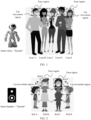
- FIG. 1 is a schematic diagram of a scenario in which a robot interacts with a plurality of persons according to an embodiment of the present invention.
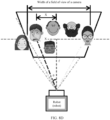
- the application scenario includes a smart robot and a plurality of users ( FIG. 1 shows an example in which a group of friends, a user A, a user B, a user C, a user D, and a user E, participate in a party).
- FIG. 1 shows an example in which a group of friends, a user A, a user B, a user C, a user D, and a user E, participate in a party).
- the user C in the group of friends wants to ask the smart robot to bring a glass of juice
- the user C sends an audio request "Xiaozhi, please bring me a glass of juice, thank you”.
- the smart robot Xiaozhi first needs to collect audio data and video data in the current party scenario, where the audio data includes the audio request "Xiaozhi, please bring me a glass of juice, thank you” sent by the user C, and the video data includes lip movement information of all the users in a same time period in which the audio request is sent.
- the smart robot Xiaozhi performs processing and analysis based on the to-be-recognized audio information and the lip movement information of the plurality of users, to determine, from the user A, the user B, the user C, the user D, and the user E, a user who specifically sends the audio request. Further, the smart robot "Xiaozhi" controls, based on a determining result, the smart robot to send, to the user C, the specified juice or a glass of juice selected through determining.
- Scenario 2 a smart speaker is used to implement human-computer interaction.
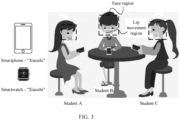
- FIG. 2 is a schematic diagram of a scenario in which a smart speaker interacts with a plurality of persons according to an embodiment of the present invention.
- the application scenario includes a smart speaker and a plurality of users ( FIG. 1 shows an example in which a group of kids, a kid A, a kid B, a kid C, a kid D, a kid E, and a kid F, play games on a playground).
- FIG. 1 shows an example in which a group of kids, a kid A, a kid B, a kid C, a kid D, a kid E, and a kid F, play games on a playground.
- the kid B wants to ask the smart speaker to order a favorite song to liven up the atmosphere, the kid B sends an audio request "Xiaozhi, please play the song 'Xiao Tai Yang' that I have heard last time”.
- the smart speaker needs to further determine a specific version of a song that needs to be played currently.
- the smart speaker Xiaozhi first needs to collect audio data and video data in the current game scenario, where the audio data includes the audio request "Xiaozhi, please play the song 'Xiao Tai Yang' that I have heard last time” sent by the kid B, and the video data includes lip movement information of all the kids in a same time period in which the audio request is sent; and the smart speaker Xiaozhi performs processing and analysis based on the to-be-recognized audio information and the lip movement information of the plurality of kids, to determine, from the kid A, the kid B, the kid C, the kid D, the kid E, and the kid F, a kid who specifically sends the audio request. Further, the smart speaker "Xiaozhi" searches a playback record of the kid B for
- Scenario 3 a smartphone/smartwatch is used to implement human-computer interaction.
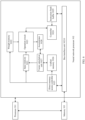
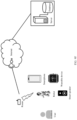
- FIG. 3 is a schematic diagram of a scenario in which a smartphone/smartwatch interacts with a plurality of persons according to an embodiment of the present invention.
- the application scenario includes a smartphone/smartwatch and a plurality of users ( FIG. 1 shows an example in which a group of students, a student A, a student B, and a student C, order meals together).
- FIG. 1 shows an example in which a group of students, a student A, a student B, and a student C, order meals together.
- the students A, B, and C may order meals by using the smartphone or smartwatch of the student B (there may be a discount for ordering meals together, and it is convenient to place the order).
- three persons need to send audio instructions for meal ordering to the smartphone or smartwatch of the student B.
- the student B says to the smartphone, "Xiaozhi, I want to order the sweet and sour pork ribs from the restaurant XX”
- the student A says to the smartphone of the student B: “Xiaozhi, I want to order the boiled fish with Sichuan pickles from the restaurant XXXX”
- the student C says to the smartphone of the student B: "Xiaozhi, I want to order the soup with pepper and the seaweed rice rolls from the restaurant XXX”.
- the smartphone may encounter a problem of splitting a fee for the three students.
- the smartphone first needs to collect audio data and video data in a current table-sharing dining scenario, where the audio data includes the audio instructions for meal ordering respectively sent by the student A, the student B, and the student C, and the video data includes lip movement information of all the three students in a same time period in which the audio instructions are sent by the three students.
- the smartphone performs processing and analysis based on the to-be-recognized audio information (three instructions for meal ordering) and the lip movement information of the three students, to determine the corresponding students that respectively send the three audio instructions for meal ordering, and calculates a meal fee for each student after the discount based on the determining.
- the smartphone may separately initiate a corresponding request for meal fee payment to the students A and C by using a corresponding client on the smartphone. In this way, the smartphone implements a function of ordering meals by the plurality of persons through audio and a charging function.
- FIG. 1, FIG. 2 , and FIG. 3 are merely several example implementations in the embodiments of the present invention, and application scenarios in the embodiments of the present invention include but are not limited to the foregoing application scenarios.
- the audio matching method in this application may be further applied to a scenario in which an intelligent computer interacts with a plurality of persons in a meeting, an intelligent computer interacts with a plurality of persons in a game, or a smart caravan interacts with a plurality of persons, and the like.
- Other scenarios and examples are not listed and described one by one.
- Any neural network training method provided in this application relates to computer auditory and visual fusion processing, and may be specifically applied to data processing methods such as data training, machine learning, and deep learning methods, to perform symbolic and formal intelligent information modeling, extraction, pre-processing, training, and the like on training data (for example, lip movement information of a trained user and M pieces of audio information in this application), to finally obtain a trained target feature matching model.
- the trained target feature matching model may be used.
- input data for example, to-be-recognized audio information and lip movement information of N users in this application
- output data for example, a matching degree between each of the lip movement information of the N users and the to-be-recognized audio information in this application.
- a neural network training method and an audio matching method that are provided in the embodiments of this application are inventions generated based on a same concept, and may also be understood as two parts of a system or two phases of an entire process, for example, a model training phase and a model application phase.
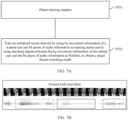
- FIG. 4 shows a system architecture 100 according to an embodiment of the present invention.
- a data collection device 160 is configured to collect training data.
- the data collection device 160 may include a microphone and a camera.
- the training data (that is, input data on a model training side) may include video sample data and audio sample data that are respectively lip movement information of a trained user and M pieces of audio information in this embodiment of the present invention.
- the M pieces of audio information may include audio information that matches the lip movement information of the trained user.
- the video sample data is a sequence of lip movement images when a trained user sends audio: "It's a very nice day today.
- the audio sample data includes an audio waveform sequence (used as a positive audio sample) of the audio "It's a very nice day today. Where shall we go for an outing?" sent by the trained user and (M-1) other audio waveform sequences (used as a negative audio sample).
- the video sample data and the audio sample data may be collected by the data collection device 160, or may be downloaded from a cloud.
- FIG. 4 merely shows an example architecture, and does not constitute a limitation. Further, the data collection device 160 stores the training data into a database 130.
- a training device 120 obtains a target feature matching model/rule 101 through training based on the training data maintained in the database 130 (the target feature matching model 101 herein is the target feature matching model in the embodiments of the present invention; for example, the target feature matching model 101 is a model obtained through training in the foregoing training phase, and a neural network model that may be used for feature matching between audio and a lip movement trajectory).
- the target feature matching model 101 herein is the target feature matching model in the embodiments of the present invention; for example, the target feature matching model 101 is a model obtained through training in the foregoing training phase, and a neural network model that may be used for feature matching between audio and a lip movement trajectory).
- the target feature matching model/rule 101 can be used to implement any audio matching method provided in the embodiments of the present invention. To be specific, related preprocessing is performed on the audio data and the video data that are obtained by the data collection device 160 and then input into the target feature matching model/rule 101, to obtain a matching degree/confidence level between each of lip movement image sequence features of a plurality of users and a to-be-recognized audio feature.
- the target feature matching model/rule 101 in this embodiment of the present invention may be specifically a spatio-temporal convolutional network (STCNN).
- the spatio-temporal convolutional network may be obtained by training a convolutional neural network.
- the training data maintained in the database 130 is not all collected by the data collection device 160, and may be received from another device.
- the training device 120 does not necessarily perform training completely based on the training data maintained in the database 130 to obtain the target feature matching model/rule 101, and may obtain training data from a cloud or another place for model training.
- the foregoing description shall not be construed as a limitation on this embodiment of the present invention.
- the target feature matching model/rule 101 is obtained through training by the training device 120.
- the target feature matching model/rule 101 may be referred to as an audio-visual cross convolutional neural network (V&A Cross CNN)/a spatio-temporal convolutional neural network in this embodiment of the present invention.
- the target feature matching model provided in this embodiment of the present invention may include a first model, a second model, and a third model.
- the first model is used to extract an audio feature
- the second model is used to extract lip movement image sequence features of a plurality of users (N users in this application)
- the third model is used to calculate matching degrees/confidence levels between the audio feature and the image sequence features of the N users.
- the first model, the second model, and the third model each may be a convolutional neural network.
- the target feature matching model/rule 101 may be considered as an entire spatio-temporal convolutional neural network, and the spatio-temporal convolutional neural network further includes a plurality of independent networks, for example, the first model, the second model, and the third model.
- the target feature matching model/rule 101 obtained through training by the training device 120 may be applied to different systems or devices, for example, applied to an execution device 110 shown in FIG. 4 .
- the execution device 110 may be a terminal such as a mobile phone, a tablet computer, a notebook computer, an augmented reality (Augmented Reality, AR)/virtual reality (Virtual Reality, VR) device, a smart wearable device, a smart robot, or an in-vehicle terminal, or may be a server, a cloud, or the like.
- an I/O interface 112 is configured for the execution device 110, and is configured to exchange data with an external device.
- a user may input data into the I/O interface 112 by using a client device 140 (the client device in this application may also include a data collection device such as a microphone and a camera).
- the input data (namely, data input on a model application side) may include to-be-recognized audio information and lip movement information of N users.
- the to-be-recognized audio information includes an audio waveform sequence in a target time period, and each of the lip movement information of the N users includes a sequence of lip movement images of a corresponding user in the target time period. For example, currently, when a specific person who sends audio information of "What's the weather like tomorrow?
- an audio waveform sequence corresponding to "What's the weather like tomorrow? Where is suitable for an outing?" and sequences of lip movement images corresponding to all the persons are used as input data. It may be understood that the input data herein may be input by a user, or may be provided by a related database, and varies according to a specific application scenario. This is not specifically limited in this embodiment of the present invention.
- the client device 140 and the execution device 110 may be located on a same device; and the data collection device 160, the database 130, and the training device 120 may also be located on a same device as the execution device 110 and the client device 140.
- an execution body in this application is a robot. After the robot obtains, through extraction, the to-be-recognized audio information and the lip movement information of the N users from the collected audio data and video data by using a client device 140 (including a microphone, a camera, and a processor), an execution device 110 in the robot may further perform feature matching between the extracted audio information and the lip movement information, and finally output a result to the client device 140.
- the processor in the client device 140 obtains, through analysis, a target user that is in the N users and to which the to-be-recognized audio information belongs.
- devices a data collection device 160, a database 130, and a training device 120
- a model training side may be located in the robot or on a cloud.
- the robot may be considered that the robot has a model training function or a model update and optimization function.
- the robot not only has a function of the model training side, but also has a function of the model application side.
- the devices are located on the cloud, the robot has only the function of the model application side.
- the client device 140 and the execution device 110 may alternatively be not located on a same device.
- collection of the audio data and the video data and extraction of the to-be-recognized audio information and the lip movement information of the N users may be performed by the client device 140 (for example, a smartphone or a smart robot), and a process of performing feature matching between the to-be-recognized audio information and the lip movement information of the N users may be performed by the execution device 110 (for example, a cloud server or a server).
- the execution device 110 for example, a cloud server or a server.
- collection of the audio data and the video data is performed by the client device 140, and extraction of the to-be-recognized audio information and the lip movement information of the N users, and a process of performing feature matching between the to-be-recognized audio information and the lip movement information of the N users are performed by the execution device 110.
- a user may manually provide the input data.
- the manual provision may be performed in an interface provided by the I/O interface 112.
- the client device 140 may automatically send the input data to the I/O interface 112. If the client device 140 is required to automatically send the input data, the client device 140 needs to obtain authorization from a user, and the user may set corresponding permission on the client device 140.
- the user may view, on the client device 140, a result output by the execution device 110. Specifically, the result may be displayed or may be presented in a form of a sound, an action, or the like.
- the client device 140 may also be used as a data collection end (for example, a microphone or a camera), to collect the input data that is to be input into the I/O interface 112 and an output result that is to be output from the I/O interface 112, as shown in the figure, use the input data and the output result as new sample data, and store the new sample data into the database 130.
- the client device 140 may alternatively not perform collection, and the I/O interface 112 directly stores, into the database 130 as new sample data, the input data that is input into the I/O interface 112 and an output result that is output from the I/O interface 112, as shown in the figure.
- a preprocessing module 113 is configured to perform preprocessing based on the input data (for example, the audio data) received through the I/O interface 112.
- the preprocessing module 113 may be configured to preprocess the audio data, for example, extract the to-be-recognized audio information from the audio data.
- a preprocessing module 114 is configured to perform preprocessing based on the input data (for example, the video data) received through the I/O interface 112.
- the preprocessing module 114 may be configured to preprocess the video data, for example, extract, from the video data, the lip movement information of the N users corresponding to the to-be-recognized audio information.
- the execution device 110 may invoke data, code, and the like in a data storage system 150 for corresponding processing, and may further store data, instructions, and the like obtained through corresponding processing into the data storage system 150.
- the I/O interface 112 returns, to the client device 140, an output result such as a matching degree between each of the lip movement information of the N users and the to-be-recognized audio information or a target user ID corresponding to a highest matching degree in this embodiment of the present invention; and the client device 140 determines user information of the target user based on the matching degree, and generates, based on the user information, a control instruction that matches the user information.
- an output result such as a matching degree between each of the lip movement information of the N users and the to-be-recognized audio information or a target user ID corresponding to a highest matching degree in this embodiment of the present invention.
- the training device 120 may generate corresponding target feature matching models/rules 101 for different objectives or different tasks based on different training data.
- the corresponding target feature matching models/rules 101 may be used to achieve the objectives or complete the tasks. In this way, desired results are provided for users.
- FIG. 4 is merely a schematic diagram of the system architecture provided in this embodiment of the present invention.
- a location relationship between the devices, the components, the modules, and the like shown in the figure does not constitute any limitation.
- the data storage system 150 is an external memory relative to the execution device 110.
- the data storage system 150 may alternatively be disposed in the execution device 110.
- the convolutional neural network CNN is a deep neural network with a convolutional structure, and is a deep learning (deep learning) architecture.
- the deep learning architecture performs a plurality of levels of learning at different abstract layers by using a machine learning algorithm.
- the CNN is a feed-forward (feed-forward) artificial neural network. Neurons in the feed-forward artificial neural network respond to an overlapping region in images input into the CNN.
- FIG. 5 is a schematic diagram of a convolutional neural suitable for implementing the target feature matching model of the invention.
- the convolutional neural network (CNN) 200 may include an input layer 210, a convolutional layer/pooling layer 220, and a neural network layer 230.
- the pooling layer is optional.
- the convolutional layer/pooling layer 120 may include layers 221 to 226.
- the layer 221 is a convolutional layer
- the layer 222 is a pooling layer
- the layer 223 is a convolutional layer
- the layer 224 is a pooling layer
- the layer 225 is a convolutional layer
- the layer 226 is a pooling layer.
- the layers 221 and 222 are convolutional layers
- the layer 223 is a pooling layer
- the layers 224 and 225 are convolutional layers
- the layer 226 is a pooling layer.
- an output of a convolutional layer may be used as an input of a subsequent pooling layer, or may be used as an input of another convolutional layer for continuing to perform a convolution operation.
- the convolutional layer 221 is used as an example.
- the convolutional layer 221 may include a plurality of convolution operators.
- the convolution operator is also referred to as a kernel.
- the convolution operator functions as a filter that extracts specific information from an input image matrix.
- the convolution operator may essentially be a weight matrix, and the weight matrix is usually predefined.
- the weight matrix is usually used to process pixels at a granularity level of one pixel (or two pixels, depending on a value of a stride (stride)) in a horizontal direction on an input image, to extract a specific feature from the image.
- a size of the weight matrix should be related to a size of the image.
- a depth dimension (depth dimension) of the weight matrix is the same as a depth dimension of the input image.
- the weight matrix extends to an entire depth of the input image. Therefore, a convolutional output of a single depth dimension is generated through convolution with a single weight matrix.
- a single weight matrix is not used, but a plurality of weight matrices with a same dimension are applied. Outputs of the weight matrices are stacked to form a depth dimension of a convolutional image. Different weight matrices may be used to extract different features from the image.
- one weight matrix is used to extract edge information of the image
- another weight matrix is used to extract a specific color of the image
- still another weight matrix is used to blur unnecessary noises in the image
- so on because the plurality of weight matrices have the same dimension, feature maps extracted by using the plurality of weight matrices also have a same dimension. Then, the plurality of extracted feature maps with the same dimension are combined to form an output of the convolution operation.
- weight matrices formed by using the weight values obtained through training may be used to extract information from the input image, to help the convolutional neural network 200 to perform correct prediction.
- the convolutional neural network 200 When the convolutional neural network 200 includes a plurality of convolutional layers, a relatively large quantity of general features are usually extracted at an initial convolutional layer (for example, 221).
- the general feature may also be referred to as a low-level feature.
- a feature for example, a high-level semantic feature, extracted at a subsequent convolutional layer (for example, 226) becomes more complex.
- a feature with higher-level semantics is more appropriate for a to-be-resolved problem.
- a pooling layer often needs to be periodically introduced after a convolutional layer.
- one convolutional layer may be followed by one pooling layer, or a plurality of convolutional layers may be followed by one or more pooling layers.
- the pooling layer is only used to reduce a space size of an image.
- the pooling layer may include an average pooling operator and/or a maximum pooling operator, to perform sampling on an input image to obtain an image with a relatively small size.
- the average pooling operator may be used to calculate pixel values of an image in a specific range, to generate an average value.
- the maximum pooling operator may be used to select a pixel with a maximum value in a specific range as a maximum pooling result.
- an operator at the pooling layer also needs to be related to the size of the image.
- a size of a processed image output from the pooling layer may be less than a size of an image input into the pooling layer.
- Each pixel in the image output from the pooling layer represents an average value or a maximum value of a corresponding sub-region of the image input into the pooling layer.
- the convolutional neural network 100 After processing performed at the convolutional layer/pooling layer 220, the convolutional neural network 100 is not ready to output desired output information. As described above, at the convolutional layer/pooling layer 220, only a feature is extracted, and parameters resulting from an input image are reduced. However, to generate final output information (desired class information or other related information), the convolutional neural network 200 needs to use the neural network layer 230 to generate an output of one desired class or outputs of a group of desired classes. Therefore, the neural network layer 230 may include a plurality of hidden layers (231, 232, ..., and 23n shown in FIG. 5 ) and an output layer 240. Parameters included in the plurality of hidden layers may be obtained through pre-training based on related training data of a specific task type. For example, the task types may include image recognition, image categorization, and super-resolution image reconstruction.
- the plurality of hidden layers are followed by the output layer 240, namely, the last layer of the entire convolutional neural network 200.
- the output layer 240 has a loss function similar to a categorical cross-entropy loss, and the loss function is specifically used to calculate a prediction error.
- the convolutional neural network 200 shown in FIG. 5 is merely used as an example of a convolutional neural network.
- the convolutional neural network may alternatively exist in a form of another network model, for example, a plurality of parallel convolutional layers/pooling layers, and extracted features are all input into the entire neural network layer 230 for processing.
- a normalization layer in this application is used as a function layer of the CNN.
- the normalization layer may be implemented after or before any one of the foregoing layers of the CNN.
- a feature matrix output from a previous layer is used as an input of the normalization layer, and an output of the normalization layer may also be used as an input of any function layer of the CNN.
- the normalization layer is usually implemented after a convolutional layer.
- a feature matrix output from the convolutional layer is used as an input matrix.
- FIG. 6 is a diagram of a hardware structure of a neural network processor suitable for implementing the target feature matching model of the invention.
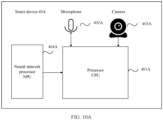
- a neural network processor NPU 302 is mounted to a CPU 301 (for example, a host CPU) as a coprocessor, and the host CPU 301 allocates a task.
- the CPU 301 may be located in the client device 140, and is configured to extract to-be-recognized audio information and lip movement information of N users from audio data and video data; and the NPU 302 may be located in the calculation module 111, and is configured to perform feature extraction and feature matching on the to-be-recognized audio information and the lip movement information of the N users that are extracted by the CPU 301, to send a matching result to the CPU 301 for further calculation. Details are not described herein.
- the CPU and the NPU may be located in different devices, and may be disposed in a different manner based on an actual requirement of a product.
- the NPU is located on a cloud server, and the CPU is located on user equipment (such as a smartphone or a smart robot).
- user equipment such as a smartphone or a smart robot.
- both the CPU and the NPU are located on a client device (such as a smartphone or a smart robot).
- a core part of the NPU 302 is an operation circuit 3023.
- the operation circuit 3023 is controlled by a controller 3024 to extract matrix data in a memory and perform a multiplication operation.
- the operation circuit 3023 includes a plurality of process engines (Process Engine, PE). In some implementations, the operation circuit 3023 is a two-dimensional systolic array. The operation circuit 3023 may alternatively be a one-dimensional systolic array or another electronic circuit that can perform mathematical operations such as multiplication and addition. In some implementations, the operation circuit 3023 is a general-purpose matrix processor.
- PE Process Engine
- the operation circuit 3023 is a two-dimensional systolic array.
- the operation circuit 3023 may alternatively be a one-dimensional systolic array or another electronic circuit that can perform mathematical operations such as multiplication and addition.
- the operation circuit 3023 is a general-purpose matrix processor.
- the operation circuit fetches data corresponding to the matrix B from a weight memory 3022, and buffers the data on each PE of the operation circuit.
- the operation circuit fetches data of the matrix A from an input memory 3021, to perform a matrix operation on the data of the matrix A and the matrix B, obtains a partial result or a final result of a matrix, and stores the result in an accumulator (accumulator) 3028.
- a unified memory 3026 is configured to store input data and output data. Weight data is directly transferred to the weight memory 3022 by using a direct memory access controller (Direct Memory Access Controller, DMAC) 30212. The input data is also transferred to the unified memory 3026 by using the DMAC.
- DMAC Direct Memory Access Controller
- a BIU is a bus interface unit, namely, a bus interface unit 1210, and is used for interaction between an AXI bus and the DMAC and between the AXI bus and an instruction fetch buffer (Instruction Fetch Buffer) 3029.
- instruction fetch buffer Instruction Fetch Buffer
- the bus interface unit (Bus Interface Unit, BIU for short) 1210 is used by the instruction fetch buffer 3029 to obtain an instruction from an external memory, and is further used by the direct memory access controller 30212 to obtain original data of the input matrix A or the weight matrix B from the external memory.
- the DMAC is mainly configured to transfer the input data in the external memory DDR to the unified memory 3026, transfer the weight data to the weight memory 3022, or transfer the input data to the input memory 3021.
- a vector calculation unit 3027 includes a plurality of operation processing units, and if necessary, performs further processing such as vector multiplication, vector addition, an exponential operation, a logarithmic operation, or value comparison on outputs of the operation circuit.
- the vector calculation unit 3027 is mainly configured to perform network calculation at a non-convolutionallFC layer in a neural network, for example, pooling (pooling), batch normalization (batch normalization), or local response normalization (local response normalization).
- the vector calculation unit 3027 can store a processed output vector into a unified buffer 3026.
- the vector calculation unit 3027 may apply a non-linear function to the outputs of the operation circuit 3023.
- the non-linear function is applied to a vector of an accumulated value to generate an activation value.
- the vector calculation unit 3027 generates a normalized value, a combined value, or both the normalized value and the combined value.
- the processed output vector can be used as an activation input to the operation circuit 3023, for example, used at a subsequent layer in the neural network.
- the instruction fetch buffer (instruction fetch buffer) 3029 connected to the controller 3024 is configured to store instructions used by the controller 3024.
- the unified memory 3026, the input memory 3021, the weight memory 3022, and the instruction fetch buffer 3029 are all on-chip memories.
- the external memory is private to the hardware architecture of the NPU.
- related functions such as feature extraction of and feature matching between to-be-recognized audio information and lip movement information of N users in any audio matching method embodiment of this application and feature extraction of and feature matching between lip movement information of a trained user and M pieces of audio information in any neural network training method embodiment in this application may be implemented by related functional units in the neural network processor (NPU) 302, or may be jointly implemented by the processor 301 and the neural network processor 302. Details are not described herein.
- NPU neural network processor
- the system architecture, the structure of the convolutional neural network, and the structure of the neural network processor the following describes, from a model training side and a model application side, a neural network training method embodiment and an audio matching method embodiment that are provided in this application, and specifically analyzes and resolves the technical problems described in this application.
- FIG. 7A is a schematic flowchart of a neural network training method according to an embodiment of the present invention.
- the method may be applied to the application scenario in FIG. 1, FIG. 2 , or FIG. 3 and the foregoing system architecture, and may be specifically applied to the training device 120 in FIG. 4 .
- the following provides descriptions with reference to FIG. 7 A by using an example in which an execution body is the training device 120 in FIG. 4 or a device including the training device 120.
- the method may include the following steps S701 and S702.
- S701 Obtain training samples, where the training samples include lip movement information of a trained user and M pieces of audio information.
- the lip movement information of the trained user is audio information sent by a user Xiaofang: "Hello, my name is Xiaofang. I'm from Hunan, China. How about you?" Corresponding lip movement information is a lip movement video or a sequence of consecutive lip movement images. Therefore, the M pieces of audio information include the audio information "Hello, my name is Xiaofang. I'm from Hunan, China. How about you?” that is used as a positive audio sample and other audio information such as "Hello, have you had supper?", "It's a very nice day today. Where have you been?", and "Help me find a travel route from Hunan to Beijing?" that are used as negative samples.
- the M pieces of audio information include audio information that matches the lip movement information of the trained user and (M-1) pieces of audio information that do not match the lip movement information of the trained user.
- the lip movement information of the trained user includes a sequence of lip movement images of the trained user
- the M pieces of audio information include one audio waveform sequence that matches the sequence of lip movement images of the trained user and (M-1) audio waveform sequences that do not match the sequence of lip movement images of the trained user.
- the lip movement information is a sequence of consecutive lip movement images (namely, a video of mouth shapes) corresponding to the audio information sent by the user Xiaofang: "Hello, my name is Xiaofang. I'm from Hunan, China.
- the M pieces of audio information include the audio waveform sequence corresponding to the positive audio sample and (M-1) audio waveform sequences corresponding to the negative samples. It may be understood that the M pieces of audio information may alternatively include a plurality of positive samples and a plurality of negative samples. In other words, a quantity of positive samples and a quantity of negative samples are not specifically limited, provided that both a positive sample and a negative sample are included.
- FIG. 7B is a schematic diagram of sampling a training sample according to an embodiment of the present invention.
- the initialized neural network model may be trained in a self-supervised training manner, and no additional ground truth is required.
- a sampling policy in a training process is shown in FIG. 7B .
- a solid rectangle shows an audio segment (that is, a positive sample) corresponding to a face of a speaker
- a dashed-line rectangle shows an unmatched audio segment (namely, a negative sample, where the negative sample is generated and obtained by offsetting audio by ⁇ t based on the positive sample).
- S702 Train an initialized neural network by using the lip movement information of the trained user and the M pieces of audio information as training inputs and by using matching degrees between the lip movement information of the trained user and the M pieces of audio information as M labels, to obtain a target feature matching model.
- the target feature matching model to be used in this application may be obtained by training the initialized neural network model by using the training inputs and the preset labels.
- the target feature matching model may be used to obtain a matching relationship between to-be-recognized audio information and lip movement information of a plurality of users, to implement any audio matching method in this application.
- the training an initialized neural network by using the lip movement information of the trained user and the M pieces of audio information as training inputs and by using matching degrees between the lip movement information of the trained user and the M pieces of audio information as M labels, to obtain a target feature matching model includes: inputting the lip movement information of the trained user and the M pieces of audio information into the initialized neural network, and calculating the matching degrees between the M pieces of audio information and the lip movement information of the trained user; and comparing the calculated matching degrees between the M pieces of audio information and the lip movement information of the trained user with the M labels, and training the initialized neural network, to obtain the target feature matching model.
- the target feature matching model includes a first model, a second model, and a third model; and the inputting the lip movement information of the trained user and the M pieces of audio information into the initialized neural network, and calculating the matching degrees between the M pieces of audio information and the lip movement information of the trained user includes: inputting the M pieces of audio information into the first model, to obtain M audio features, where each of the M audio features is a K-dimensional audio feature, and K is an integer greater than 0; inputting the lip movement information of the trained user into the second model, to obtain an image sequence feature of the trained user, where the image sequence feature of the trained user is a K-dimensional image sequence feature; and inputting the M audio features and the image sequence feature of the trained user into the third model, to calculate matching degrees between the M audio features and the image sequence feature of the trained user.
- the target feature matching model is obtained by training the initialized neural network model by using lip movement information of a trained user, audio information that matches the lip movement information of the trained user, and a plurality of pieces of audio information that do not match the lip movement information of the trained user as inputs of the initialized neural network and by using actual matching degrees between the M pieces of audio information and the lip movement information of the trained user as labels.
- a matching degree corresponding to complete matching namely, a label
- a matching degree corresponding to non-matching namely, a label
- FIG. 8A is a schematic flowchart of an audio matching method according to an embodiment of the present invention.
- the method may be applied to the application scenario in FIG. 1, FIG. 2 , or FIG. 3 and the foregoing system architecture, and may be specifically applied to the client device 140 and the execution device 110 in FIG. 4 .
- the client device 140 and the execution device 110 may be located on a same physical device, for example, a smart robot, a smartphone, a smart terminal, or a smart wearable device.
- the following provides descriptions with reference to FIG. 8A by using an example in which an execution body is a smart device including the client device 140 and the execution device 110.
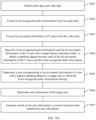
- the method may include the following steps S801 to S805.
- Step S801 Obtain audio data and video data.
- obtaining the audio data and the video data means that, for example, the smart device obtains the audio data by using a microphone and obtains the video data by using a camera.
- Original audio data and video data in a time period are an audio data source and a video data source.
- the audio data and the video data are collected in a same time period in a same scenario, in other words, the audio data is audio data corresponding to the video data.
- the robot obtains, by using a processor, audio data that is collected by using a microphone in a time period in a scenario, and obtains video data that is collected by using a camera in the time period in the scenario.
- Step S802 Extract to-be-recognized audio information from the audio data.
- the to-be-recognized audio information includes an audio waveform sequence in a target time period.
- the to-be-recognized audio information includes an audio waveform sequence in a specific time period.
- a format of the audio data is an uncompressed wav format.
- the wav format is one of most common sound file formats, and is for a standard digital audio file.
- the file can record various mono or stereo sound information, and can ensure that a sound is not distorted.
- sound quality of a sound restored from the wav file depends on a size of a sample obtained by sampling by an audio adapter. A higher sampling frequency indicates better sound quality, higher overheads, and a larger wav file.
- FIG. 8B is an example diagram of a sound waveform according to an embodiment of the present invention.
- the audio data includes audio that is sent by a plurality of users at the same time
- a specific user that sends a segment of audio information needs to be determined.
- target audio information namely, the to-be-recognized audio information
- the smart device only needs to recognize a segment of audio information.
- the segment of audio information is the to-be-recognized audio information.
- the smart device extracts an audio feature from the audio data obtained by a microphone array in S801. A specific method is shown in FIG. 8C.
- FIG. 8C is a schematic diagram of performing audio feature extraction by using a mel-frequency cepstrum coefficient according to an embodiment of the present invention.
- a 40-dimensional feature is extracted from data with a frame length of 20 ms by using the mel-frequency cepstrum coefficient (MFCC). Frames do not overlap with each other (non-overlapping). Every 15 frames (corresponding to an audio segment of 0.3 second) are concatenated (concat) into a cube whose dimension is 15 x 40 x 3 (where 15 represents a temporal feature, and 40 x 3 represents a 2d spatial feature).
- An audio waveform sequence in 0.3s is used as an input of the audio feature, and 0.3s is the target time period.
- a manner of extracting the to-be-recognized audio information from the audio data includes: recognizing audio data with different spectrums from the audio data based on a spectrum recognition algorithm, and recognizing audio data with a target spectrum as the to-be-recognized audio information. Spectrums corresponding to sounds sent by different users are usually different. Therefore, in this embodiment of the present invention, the audio data with the different spectrums is first recognized from the audio data, and the audio data with the target spectrum is then recognized as the to-be-recognized audio information, to implement the function of extracting the to-be-recognized audio information from the audio data.
- Step S803 Extract lip movement information of N users from the video data.
- each of the lip movement information of the N users includes a sequence of lip movement images of a corresponding user in the target time period, and N is an integer greater than 1.
- a lip video of each user namely, a sequence of consecutive lip movement images, is extracted from the original video data, and includes features of continuous mouth changes of the corresponding user.
- a user may include a person, or may include another robot, a biochemical person, a toy pet, a real pet, or the like that can send audio information.
- a format of each frame of image in the video data collected by using the camera is a 24-bit BMP bitmap.
- a BMP image file (Bitmap-File) format is a format used in Windows for storing an image file.
- FIG. 8D is a schematic diagram of a scenario in which a robot interacts with members in a family according to an embodiment of the present invention. In this figure, six face IDs may be extracted from an obtained video).
- Frame rate Quantity of frames (Frames)/Time (Time), unit: frames per second (f/s, frames per second, fps)).
- Nine consecutive image frames form a video stream with a length of 0.3 second.
- Video data of the nine image frames (video speed: 30 fps) is concatenated (concat) into a cube whose dimension is 9 x 60 x 100, where 9 represents a quantity of frames (a temporal feature) indicating time information.
- Each channel represents a 60 x 100 grayscale image (a 2d spatial feature) for a mouth cavity region.
- a sequence of lip movement images corresponding to each of the N users in 0.3s is used as an input of a video feature, and 0.3s is the target time period.
- a specific manner of extracting the lip movement information of N users from the video data includes: recognizing N face regions in the video data based on a face recognition algorithm, and extracting a lip movement video in each of the N face regions; and determining the lip movement information of the N users based on the lip movement video in each face region.
- the face regions are first recognized from the video data, then the lip movement video in each face region is extracted based on the face regions, and the lip movement information of the N users, namely, sequences of lip movement images of corresponding users, are determined based on lip movement videos.
- the smart device obtains, based on the face recognition algorithm, at least one face region from the video data obtained by the camera, and further extracts a video sequence stream for a mouth region by using each face region as a unit.
- Step S804 Input the to-be-recognized audio information and the lip movement information of the N users into a target feature matching model, to obtain a matching degree between each of the lip movement information of the N users and the to-be-recognized audio information.
- the audio waveform sequence in the target time period and the sequence of lip movement images of each of the N users in the target time period are respectively used as the input of the audio feature and the input of the video feature and input into the target feature matching model, to calculate a matching degree between the audio feature and each of lip movement features of the N users. For example, if the audio feature matches a lip movement feature of a user, a calculated matching degree has a value of 1; or if the audio feature does not match a lip movement feature of a user, a calculated matching degree has a value of 0.
- Step S805 Determine a user corresponding to lip movement information of a user with a highest matching degree as a target user to which the to-be-recognized audio information belongs.
- a corresponding mouth shape namely, the lip movement information
- the to-be-recognized audio information and the lip movement information of the N users are input into, for example, a trained neural network model (for example, the target feature matching model in this application), and the target user to which the to-be-recognized audio information belongs is determined from the N users.
- a trained neural network model for example, the target feature matching model in this application
- audio data and video data may be collected, and audio information in the audio data may be matched with lip movement information in the video data, so that a target user to which a to-be-recognized audio information belongs can be determined.
- an audio feature is matched with lip movement features of a plurality of users, to recognize a specific user that sends a piece of to-be-recognized audio information, and then further control or a further operation may be performed based on a recognition result.
- the method in this embodiment of the present invention does not depend on a sound of a person (a voiceprint is easily affected by a physical condition, age, emotion, and the like of the person), is not interfered by an environment (for example, noise interference in the environment), provides a strong anti-interference capability, and has high recognition efficiency and accuracy.
- the to-be-recognized audio information includes an audio waveform sequence in a specific time period
- the lip movement information of the N users includes sequences of lip movement images (namely, lip movement videos) of the plurality of users in the time period in the same scenario, to facilitate subsequent related feature extraction and feature matching.
- the target feature matching model is used, the to-be-recognized audio information and the lip movement information of the N users are used as inputs of the target feature matching model, the matching degree between each of the lip movement information of the N users and the to-be-recognized audio information is used as an output of the target feature matching model, and the target user to which the to-be-recognized audio information belongs is determined based on the matching degree.
- the target feature matching model is a neural network model.
- FIG. 9A is a schematic flowchart of another audio matching method according to an embodiment of the present invention.
- the method may be applied to the application scenario in FIG. 1, FIG. 2 , or FIG. 3 and the foregoing system architecture, and may be specifically applied to the client device 140 and the execution device 110 in FIG. 4 .
- the client device 140 and the execution device 110 may be located on a same physical device, for example, a smart robot, a smartphone, a smart terminal, or a smart wearable device.
- the following provides descriptions with reference to FIG. 9A by using an example in which an execution body is a smart device including the client device 140 and the execution device 110.
- the method may include the following steps S901 to S905.
- the method may further include steps S906 and S907.
- Step S901 Obtain audio data and video data, where the audio data and the video data are collected in a same scenario.
- Step S902 Extract to-be-recognized audio information from the audio data.
- Step S903 Extract lip movement information of N users from the video data, where N is an integer greater than 1.
- step S901 to step S903 refer to related descriptions in step S801 to step S803. Details are not described herein again.
- Step S904 Input the to-be-recognized audio information and the lip movement information of the N users into a target feature matching model, to obtain a matching degree between each of the lip movement information of the N users and the to-be-recognized audio information.
- a sound feature and a visual feature are two modes that differ greatly in essence, and usually have different original frame rates.
- An audio frame rate is 100 frames per second
- a video frame rate is 24 frames per second.
- two neural network encoders may be separately used to perform layer-by-layer feature extraction on input sequences with different modes, to obtain a higher-layer feature expression.
- the target feature matching model includes a first model, a second model, and a third model; and the inputting the to-be-recognized audio information and the lip movement information of the N users into a target feature matching model, to obtain a matching degree between each of the lip movement information of the N users and the to-be-recognized audio information includes the following steps S904-A to S904-C.
- Step S904-A Input the to-be-recognized audio information into the first model, to obtain an audio feature, where the audio feature is a K-dimensional audio feature, and M is an integer greater than 0.
- Step S904-B Input the lip movement information of the N users into the second model, to obtain N image sequence features, where each of the N image sequence features is a K-dimensional image sequence feature.
- the smart device uses the foregoing extracted video sequence and audio sequence as inputs, and performs feature normalization on the input video sequence and the input audio sequence by respectively using the first model and the second model.
- a video feature and an audio feature are extracted as features with a same dimension, and both the features are K-dimensional features. This facilitates subsequent feature matching, and facilitates further determining of a face ID corresponding to lip movement information that matches the to-be-recognized audio information.
- a specific procedure is as follows:
- a target feature matching network in this application includes two parts: a feature analysis subnet and a feature matching subnet.
- both the first model and the second model are feature analysis subnets
- the third model is a feature matching subnet.
- FIG. 9B is a schematic structural diagram of a first model and a second model according to an embodiment of the present invention.
- the first model and the second model each are used to perform feature normalization on a video sequence stream and an audio feature, and a normalized network type for the first model and the second model is an STCNN (spatio-temporal convolutional network).
- STCNN spatial-temporal convolutional network
- the second model on the left side in FIG. 9B processes a video stream, and specific compositions include three 3D convolutional and pooling layers (convolution+pooling layer) and two fully connected layers (FC layer).
- An output is a 64-dimensional feature representation of a sequence of continuous videos.
- the spatio-temporal convolutional network is used to extract a 2d spatial feature and a temporal feature for both the audio stream and the video stream.
- An output is a 64-dimensional feature representation of a sequence of continuous audio. In other words, K is equal to 64.
- Step S904-C Input the audio feature and the N image sequence features into the third model, to obtain a matching degree between each of the N image sequence features and the audio feature.
- FIG. 9C is a schematic structural diagram of a third model according to an embodiment of the present invention.
- a model training process is shown on the left side in FIG. 9C .
- a multi-way cross-entropy loss (Multi-way cross-Entropy Loss) is used as a loss function
- a basic network includes one concatenation layer (concat layer), two FC layers, and one softmax layer (softmax function: normalized exponential function).
- concat layer concat layer
- FC layers concat layer
- softmax layer softmax function: normalized exponential function
- the third model is used to simultaneously compare lip sequence features of all faces in a field of view with a separated audio sequence feature, to obtain a face ID corresponding to a highest matching degree.
- the right side in FIG. 9C shows a model application process. Based on equivalence between an audio feature and a video feature (which means that features obtained from the audio data and the video data by using the feature analysis networks are all 64-dimensional features), a 1-to-N case is converted into an N-to-1 case, and during inference, the video and the audio are input in the ratio of N:1 (N segments of videos and one segment of audio). Input content is 64-dimensional audio and video features output from the feature analysis subnets in step 3, and an output is an audio and video pair with a highest similarity.
- Step S905 Determine a user corresponding to lip movement information of a user with a highest matching degree as a target user to which the to-be-recognized audio information belongs.
- Step S906 Determine user information of the target user, where the user information includes one or more of character attribute information, facial expression information corresponding to the to-be-recognized audio information, and environment information corresponding to the to-be-recognized audio information.
- Step S907 Generate, based on the user information, a control instruction that matches the user information.
- the control instruction for example, an audio instruction or an operation instruction
- the control instruction may be determined based on the attribute information (for example, gender, age, and personality) of the user, the facial expression information (for example, an expression corresponding to the to-be-recognized audio information sent by the target user), and the corresponding environment information (for example, the target user is currently in an office environment, a home environment, or an entertainment environment).
- a smart robot is controlled to send audio, an operation, or the like that matches the expression data, the character attribute information, and the like to the target user, where the audio or the operation includes a tone of the robot, a head turning of the robot, and reply content of the robot.
- FIG. 9D is a schematic diagram of a robot interaction scenario according to an embodiment of the present invention.
- an audio and video pair with a highest similarity is a video including Tom's face and audio sent by Tom. Therefore, in this step, it can be determined that a face ID for sending the instruction is a face ID corresponding to Tom.
- ⁇ arctan(x/f).
- FIG. 9E is a schematic diagram of a functional module and an entire procedure according to an embodiment of the present invention.
- multimodal input includes a user-side terminal device (in this embodiment of the present invention, a robot is used as an example):
- the camera is configured to obtain an image/video.
- the obtained image/video includes information from a plurality of persons.
- the microphone is configured to pick up audio.
- the obtained image/video includes information from a plurality of persons.
- a neural network processor namely, the feature extraction module, may be a part of a processing module (not shown in the figure) of the user-side terminal device, and may be implemented by software, for example, a segment of code.
- the feature extraction module is configured to: obtain, based on a face recognition algorithm, at least one face region from video data obtained by the camera, and extract a video sequence stream for a mouth region in each face region.
- the feature extraction module is further configured to extract an audio feature from audio data obtained by a microphone array.
- the multimodal feature matching module is configured to obtain, by using a V&A Cross CNN and based on the video sequence stream and the audio feature that are extracted by the feature extraction module, a mouth shape and a face ID that matches the audio.
- the matching result post-processing module is configured to obtain a detailed user profile (user profile, or referred to as a user profile) of the user based on the face ID obtained by the multimodal feature matching module and a knowledge graph stored in a storage module (not shown in the figure, where the storage module may be a cloud server, or may be deployed on the robot, or may be partially deployed on a cloud and partially deployed on the robot).
- a storage module may be a cloud server, or may be deployed on the robot, or may be partially deployed on a cloud and partially deployed on the robot.
- a common processor namely, the matching result post-processing module, is further configured to obtain latest real-time facial expression data by using a facial expression network and based on the face region that is obtained by the feature extraction module and that corresponds to the face ID.
- the matching result post-processing module is further configured to calculate a movement angle of a mechanical structure of the robot based on a boundary/bounding box (bounding box/bbox) and a preset algorithm.
- the dialog and control system processing module includes a dialog module and a control module.
- the dialog module is configured to derive a reply to the audio based on the user profile and the facial expression data that are obtained by the matching result post-processing module.
- the control module is configured to: control, based on the movement angle obtained by the matching result post-processing module and by using a motor control system (where the motor is also referred to as a servomotor, and was first used to implement a steering function on a ship; and the motor is widely applied to various joint movements of the robot because a rotation angle of the motor can be continuously controlled by using a program), to drive the robot to turn to the user.
- a motor control system where the motor is also referred to as a servomotor, and was first used to implement a steering function on a ship; and the motor is widely applied to various joint movements of the robot because a rotation angle of the motor can be continuously controlled by using a program
- An embodiment of the present invention further provides another audio matching method.
- the method may be applied to the application scenario in FIG. 1, FIG. 2 , or FIG. 3 and the foregoing system architecture, and may be specifically applied to the execution device 110 in FIG. 4 . It may be understood that, in this case, the client device 140 and the execution device 110 may not be located on a same physical device.
- FIG. 9F is an architectural diagram of an audio matching system according to an embodiment of the present invention.
- a client device 140 is a smart robot, a smartphone, a smart speaker, or a smart wearable device.
- the client device 140 is used as a device for collecting audio data and video data.
- the client device 140 may be used as a device for extracting to-be-recognized audio information and lip information of N users, whereas a server/service device/service apparatus/cloud service device on which the execution device 110 is located may perform matching between the extracted to-be-recognized audio information and the extracted lip information of the N users.
- extraction of the to-be-recognized audio information and the N pieces of user lip information may also be performed on a device side on which the execution device 110 is located. This is not specifically limited in this embodiment of the present invention.
- the following provides descriptions with reference to FIG. 9F by using an example in which an execution body is a cloud service device including the execution device 110.
- the method may include the following steps S1001 to S1003:
- Step S1001 Obtain to-be-recognized audio information and lip movement information of N users, where the to-be-recognized audio information includes an audio waveform sequence in a target time period, each of the lip movement information of the N users includes a sequence of lip movement images of a corresponding user in the target time period, and N is an integer greater than 1.
- Step S1002 Input the to-be-recognized audio information and the lip movement information of the N users into a target feature matching model, to obtain a matching degree between each of the lip movement information of the N users and the to-be-recognized audio information.
- Step S1003 Determine a user corresponding to lip movement information of a user with a highest matching degree as a target user to which the to-be-recognized audio information belongs.
- the target feature matching model includes a first model, a second model, and a third model; and the inputting the to-be-recognized audio information and the lip movement information of the N users into a target feature matching model, to obtain a matching degree between each of the lip movement information of the N users and the to-be-recognized audio information includes:
- the target feature matching model is a feature matching model obtained through training by using lip movement information of a trained user and M pieces of audio information as inputs and by using matching degrees between the lip movement information of the trained user and the M pieces of audio information as M labels.
- the method further includes:
- the method further includes: extracting the lip movement information of the N users from video data. Further, the extracting the lip movement information of the N users from video data includes:
- the method further includes: extracting the to-be-recognized audio information from the audio data. Further, the extracting the to-be-recognized audio information from the audio data includes: recognizing audio data with different spectrums from the audio data based on a spectrum recognition algorithm, and recognizing audio data with a target spectrum as the to-be-recognized audio information.
- FIG. 10A is a schematic structural diagram of a smart device according to an embodiment of the present invention
- FIG. 10A is a schematic diagram of a function principle of the smart device according to this embodiment of the present invention.
- the smart device may be a smart robot, a smartphone, a smart speaker, a smart wearable device, or the like.
- the smart device 40A may include a processor 401A, and a microphone 402A, a camera 403A, and a neural network processor 404A that are coupled to the processor 401A.
- the microphone 402A is configured to collect audio data.
- the camera 403A is configured to collect video data, where the audio data and the video data are collected in a same scenario.
- the processor 401A is configured to: obtain the audio data and the video data; extract to-be-recognized audio information from the audio data; and extract lip movement information of N users from the video data, where N is an integer greater than 1.
- the neural network processor 404A is configured to determine, from the N users based on the to-be-recognized audio information and the lip movement information of the N users, a target user to which the to-be-recognized audio information belongs.
- the to-be-recognized audio information includes an audio waveform sequence in a target time period; and each of the lip movement information of the N users includes a sequence of lip movement images of a corresponding user in the target time period.
- the neural network processor 404A is specifically configured to: input the to-be-recognized audio information and the lip movement information of the N users into a target feature matching model, to obtain a matching degree between each of the lip movement information of the N users and the to-be-recognized audio information; and determine a user corresponding to lip movement information of a user with a highest matching degree as the target user to which the to-be-recognized audio information belongs.
- the target feature matching model includes a first model, a second model, and a third model; and the neural network processor 404A is specifically configured to: input the to-be-recognized audio information into the first model, to obtain an audio feature, where the audio feature is a K-dimensional audio feature, and K is an integer greater than 0; input the lip movement information of the N users into the second model, to obtain N image sequence features, where each of the N image sequence features is a K-dimensional image sequence feature; and input the audio feature and the N image sequence features into the third model, to obtain a matching degree between each of the N image sequence features and the audio feature.
- the target feature matching model is a feature matching model obtained through training by using lip movement information of a trained user and M pieces of audio information as inputs and by using matching degrees between the lip movement information of the trained user and the M pieces of audio information as M labels, where the M pieces of audio information include audio information that matches the lip movement information of the trained user.
- the processor 401A is further configured to: determine user information of the target user, where the user information includes one or more of character attribute information, facial expression information corresponding to the to-be-recognized audio information, and environment information corresponding to the to-be-recognized audio information; and generate, based on the user information, a control instruction that matches the user information.
- the processor 401A is specifically configured to: recognize N face regions in the video data based on a face recognition algorithm, and extract a lip movement video in each of the N face regions; and determine the lip movement information of the N users based on the lip movement video in each face region.
- the processor 401A is specifically configured to: recognize audio data with different spectrums from the audio data based on a spectrum recognition algorithm, and recognize audio data with a target spectrum as the to-be-recognized audio information.
- Each unit in FIG. 10A may be implemented by software, hardware, or a combination thereof.
- a unit implemented by hardware may include a logic circuit, an algorithm circuit, an analog circuit, or the like.
- a unit implemented by software may include a program instruction, is considered as a software product stored in a memory, and may be run by a processor to implement a related function. For details, refer to the foregoing descriptions.
- FIG. 10B is a schematic structural diagram of another smart device according to an embodiment of the present invention
- FIG. 10B is a schematic diagram of a function principle of the smart device according to this embodiment of the present invention.
- the smart device may be a smart robot, a smartphone, a smart speaker, a smart wearable device, or the like.
- the smart device 40B may include a processor 401B, and a microphone 402B and a camera 403B that are coupled to the processor 401B.
- the microphone 402B is configured to collect audio data.
- the camera 403B is configured to collect video data, where the audio data and the video data are collected in a same scenario.
- the processor 401B is configured to:
- the to-be-recognized audio information includes an audio waveform sequence in a target time period; and each of the lip movement information of the N users includes a sequence of lip movement images of a corresponding user in the target time period.
- the processor 404B is specifically configured to: input the to-be-recognized audio information and the lip movement information of the N users into a target feature matching model, to obtain a matching degree between each of the lip movement information of the N users and the to-be-recognized audio information; and determine a user corresponding to lip movement information of a user with a highest matching degree as the target user to which the to-be-recognized audio information belongs.
- the target feature matching model includes a first model, a second model, and a third model; and the neural network processor 404B is specifically configured to: input the to-be-recognized audio information into the first model, to obtain an audio feature, where the audio feature is a K-dimensional audio feature, and K is an integer greater than 0; input the lip movement information of the N users into the second model, to obtain N image sequence features, where each of the N image sequence features is a K-dimensional image sequence feature; and input the audio feature and the N image sequence features into the third model, to obtain a matching degree between each of the N image sequence features and the audio feature.
- the target feature matching model is a feature matching model obtained through training by using lip movement information of a trained user and M pieces of audio information as inputs and by using matching degrees between the lip movement information of the trained user and the M pieces of audio information as M labels, where the M pieces of audio information include audio information that matches the lip movement information of the trained user.
- the processor 401B is further configured to: determine user information of the target user, where the user information includes one or more of character attribute information, facial expression information corresponding to the to-be-recognized audio information, and environment information corresponding to the to-be-recognized audio information; and generate, based on the user information, a control instruction that matches the user information.
- the processor 401B is specifically configured to: recognize N face regions in the video data based on a face recognition algorithm, and extract a lip movement video in each of the N face regions; and determine the lip movement information of the N users based on the lip movement video in each face region.
- the processor 401B is specifically configured to: recognize audio data with different spectrums from the audio data based on a spectrum recognition algorithm, and recognize audio data with a target spectrum as the to-be-recognized audio information.
- Each unit in FIG. 10B may be implemented by software, hardware, or a combination thereof.
- a unit implemented by hardware may include a logic circuit, an algorithm circuit, an analog circuit, or the like.
- a unit implemented by software may include a program instruction, is considered as a software product stored in a memory, and may be run by a processor to implement a related function. For details, refer to the foregoing descriptions.
- FIG. 11 is a schematic structural diagram of an audio matching apparatus according to an embodiment of the present invention
- FIG. 11 is a schematic diagram of a function principle of a smart device according to an embodiment of the present invention.
- the smart device may be a smart robot, a smartphone, a smart speaker, a smart wearable device, or the like.
- the audio matching apparatus 50 may include an obtaining unit 501, a first extraction unit 502, a second extraction unit 503, and a matching unit 504.
- the obtaining unit 501 is configured to obtain audio data and video data.
- the first extraction unit 502 is configured to extract to-be-recognized audio information from the audio data, where the to-be-recognized audio information includes an audio waveform sequence in a target time period.
- the second extraction unit 503 is configured to extract lip movement information of N users from the video data, where each of the lip movement information of the N users includes a sequence of lip movement images of a corresponding user in the target time period, and N is an integer greater than 1.
- the matching unit 504 is configured to input the to-be-recognized audio information and the lip movement information of the N users into a target feature matching model, to obtain a matching degree between each of the lip movement information of the N users and the to-be-recognized audio information.
- a user determining unit 505 is configured to determine a user corresponding to lip movement information of a user with a highest matching degree as a target user to which the to-be-recognized audio information belongs.
- the target feature matching model includes a first network, a second network, and a third network; and the matching unit 504 is specifically configured to:
- the target feature matching model is a feature matching model obtained through training by using lip movement information of a trained user and M pieces of audio information as inputs and by using matching degrees between the lip movement information of the trained user and the M pieces of audio information as M labels.
- the M pieces of audio information include audio information that matches the lip movement information of the trained user and (M-1) pieces of audio information that do not match the lip movement information of the trained user.
- the apparatus further includes:
- the first extraction unit 502 is specifically configured to: recognize audio data with different spectrums from the audio data based on a spectrum recognition algorithm, and recognize audio data with a target spectrum as the to-be-recognized audio information.
- the second extraction unit 503 is specifically configured to:
- Each unit in FIG. 11 may be implemented by software, hardware, or a combination thereof.
- a unit implemented by hardware may include a logic circuit, an algorithm circuit, an analog circuit, or the like.
- a unit implemented by software may include a program instruction, is considered as a software product stored in a memory, and may be run by a processor to implement a related function. For details, refer to the foregoing descriptions.
- FIG. 12 is a schematic structural diagram of a neural network training apparatus according to an embodiment of the present invention
- FIG. 12 is a schematic diagram of a function principle of a smart device according to an embodiment of the present invention.
- the neural network training apparatus may be a smart robot, a smartphone, a smart speaker, a smart wearable device, or the like.
- the neural network training apparatus 60 may include an obtaining unit 601 and a training unit 602.
- the obtaining unit 601 is configured to obtain training samples, where the training samples include lip movement information of a trained user and M pieces of audio information.
- the M pieces of audio information include audio information that matches the lip movement information of the trained user and (M-1) pieces of audio information that do not match the lip movement information of the trained user.
- the training unit 602 is configured to train an initialized neural network by using the lip movement information of the trained user and the M pieces of audio information as training inputs and by using matching degrees between the lip movement information of the trained user and the M pieces of audio information as M labels, to obtain a target feature matching model.
- the lip movement information of the trained user includes a sequence of lip movement images of the trained user
- the M pieces of audio information include one audio waveform sequence that matches the sequence of lip movement images of the trained user and (M-1) audio waveform sequences that do not match the sequence of lip movement images of the trained user.
- the training unit 602 is specifically configured to:
- the target feature matching model includes a first model, a second model, and a third model; and the training unit 602 is specifically configured to:
- Each unit in FIG. 12 may be implemented by software, hardware, or a combination thereof.
- a unit implemented by hardware may include a logic circuit, an algorithm circuit, an analog circuit, or the like.
- a unit implemented by software may include a program instruction, is considered as a software product stored in a memory, and may be run by a processor to implement a related function. For details, refer to the foregoing descriptions.
- FIG. 13 is a schematic structural diagram of another smart device according to an embodiment of the present invention.
- the smart device may be a smart robot, a smartphone, a smart speaker, a smart wearable device, or the like.
- the smart device 70 may include a processor 701, and a microphone 702 and a camera 703 that are coupled to the processor 701.
- the microphone 702 is configured to collect audio data.
- the camera 703 is configured to collect video data.
- the processor 701 is configured to: obtain the audio data and the video data;
- FIG. 14 is a schematic structural diagram of a service apparatus according to an embodiment of the present invention.
- the service apparatus may be a server, a cloud server, or the like.
- the service apparatus 80 may include a processor.
- the processor may include a neural network processor 801 and a processor 802 coupled to the neural network processor 801.
- the neural network processor 801 is configured to:
- the target feature matching model includes a first model, a second model, and a third model; and the neural network processor 801 is specifically configured to:
- the target feature matching model is a feature matching model obtained through training by using lip movement information of a trained user and M pieces of audio information as inputs and by using matching degrees between the lip movement information of the trained user and the M pieces of audio information as M labels.
- the server further includes the processor 802, and the processor 802 is configured to:
- the server further includes the processor 802, and the processor 802 is further configured to:
- the server further includes the processor 802, and the processor 802 is further configured to: recognize audio data with different spectrums from the audio data based on a spectrum recognition algorithm, and recognize audio data with a target spectrum as the to-be-recognized audio information.
- FIG. 15 shows another audio matching system 200 according to an embodiment of the present invention.
- the system includes the foregoing smart device 70 and the foregoing service apparatus 80.
- the smart device 70 and the service apparatus 80 interact with each other to implement any one of the audio matching methods in this application.
- For functions of the system refer to the foregoing related method embodiments in FIG. 1 to FIG. 9F . Details are not described herein again.
- An embodiment of the present invention further provides a computer storage medium.
- the computer storage medium may store a program, and when the program is executed, some or all of the steps described in any one of the foregoing method embodiments may be performed.
- An embodiment of the present invention further provides a computer program.
- the computer program includes instructions.
- the computer program is executed by a computer, the computer is enabled to perform some or all of the steps described in any one of the foregoing method embodiments.
- the disclosed apparatus may be implemented in another manner.
- the described apparatus embodiment is merely an example.
- division into the units is merely logical function division and may be other division in an actual implementation.
- a plurality of units or components may be combined or integrated into another system, or some features may be ignored or not performed.
- the displayed or discussed mutual couplings or direct couplings or communication connections may be implemented through some interfaces.
- the indirect couplings or communication connections between the apparatuses or units may be implemented in electronic or other forms.
- the foregoing units described as separate parts may or may not be physically separate, and parts displayed as units may or may not be physical units, may be located in one position, or may be distributed on a plurality of network units. Some or all of the units may be selected based on actual requirements to achieve the objectives of the solutions of the embodiments.
- functional units in the embodiments of this application may be integrated into one processing unit, or each of the units may exist alone physically, or two or more units are integrated into one unit.
- the integrated unit may be implemented in a form of hardware, or may be implemented in a form of a software functional unit.
- the integrated unit When the foregoing integrated unit is implemented in the form of a software functional unit and sold or used as an independent product, the integrated unit may be stored in a computer-readable storage medium.
- the computer software product is stored in a storage medium and includes several instructions for instructing a computer device (which may be a personal computer, a server, a network device, or the like, and may be specifically a processor in the computer device) to perform all or some of the steps of the methods described in the embodiments of this application.
- the storage medium may include any medium that can store program code, such as a USB flash drive, a removable hard disk, a magnetic disk, an optical disc, a read-only memory (Read-Only Memory, ROM for short), or a random access memory (Random Access Memory, RAM for short).
- program code such as a USB flash drive, a removable hard disk, a magnetic disk, an optical disc, a read-only memory (Read-Only Memory, ROM for short), or a random access memory (Random Access Memory, RAM for short).
Landscapes
- Engineering & Computer Science (AREA)
- Health & Medical Sciences (AREA)
- Physics & Mathematics (AREA)
- Multimedia (AREA)
- Human Computer Interaction (AREA)
- Audiology, Speech & Language Pathology (AREA)
- Acoustics & Sound (AREA)
- Computational Linguistics (AREA)
- Computer Vision & Pattern Recognition (AREA)
- Artificial Intelligence (AREA)
- Theoretical Computer Science (AREA)
- General Health & Medical Sciences (AREA)
- Evolutionary Computation (AREA)
- General Physics & Mathematics (AREA)
- Oral & Maxillofacial Surgery (AREA)
- Software Systems (AREA)
- Medical Informatics (AREA)
- Databases & Information Systems (AREA)
- Computing Systems (AREA)
- Business, Economics & Management (AREA)
- Game Theory and Decision Science (AREA)
- Child & Adolescent Psychology (AREA)
- Hospice & Palliative Care (AREA)
- Psychiatry (AREA)
- Signal Processing (AREA)
- Image Analysis (AREA)
Claims (15)
- Procédé de mise en correspondance audio, comprenant :l'obtention de données audio et de données vidéo ;l'extraction d'informations audio à reconnaître des données audio, dans lequel les informations audio à reconnaître comprennent une séquence de forme d'onde audio dans une période de temps cible ;l'extraction d'informations de mouvement des lèvres de N utilisateurs des données vidéo, dans lequel chacune des informations de mouvement des lèvres des N utilisateurs comprend une séquence d'images de mouvement des lèvres d'un utilisateur correspondant dans la période de temps cible, et N est un entier supérieur à 1 ;l'entrée des informations audio à reconnaître et des informations de mouvement des lèvres des N utilisateurs dans un modèle de correspondance de caractéristique cible, pour obtenir un degré de correspondance entre chacune des informations de mouvement des lèvres des N utilisateurs et les informations audio à reconnaître ; etla détermination d'un utilisateur correspondant aux informations de mouvement des lèvres d'un utilisateur ayant le degré de correspondance le plus élevé en tant qu'utilisateur cible auquel appartiennent les informations audio à reconnaître.
- Procédé selon la revendication 1, dans lequel le modèle de correspondance de caractéristique cible comprend un premier modèle, un deuxième modèle, et un troisième modèle ; et
l'entrée des informations audio à reconnaître et des informations de mouvement des lèvres des N utilisateurs dans un modèle de correspondance de caractéristique cible, pour obtenir un degré de correspondance entre chacune des informations de mouvement des lèvres des N utilisateurs et les informations audio à reconnaître comprend :l'entrée des informations audio à reconnaître dans le premier modèle, pour obtenir une caractéristique audio, dans lequel la caractéristique audio est une caractéristique audio à K dimensions, et K est un entier supérieur à 0 ;l'entrée des informations de mouvement des lèvres des N utilisateurs dans le deuxième modèle, pour obtenir N caractéristiques de séquence d'image, dans lequel chacune des N caractéristiques de séquence d'image est une caractéristique de séquence d'image à K dimensions ; etl'entrée de la caractéristique audio et des N caractéristiques de séquence d'image dans le troisième modèle, pour obtenir un degré de correspondance entre chacune des N caractéristiques de séquence d'image et la caractéristique audio. - Procédé selon la revendication 1 ou 2, dans lequel le modèle de correspondance de caractéristique cible est un modèle de correspondance de caractéristique obtenu par l'intermédiaire de l'entraînement à l'aide d'informations de mouvement des lèvres d'un utilisateur entraîné et de M informations audio en tant qu'entrées et à l'aide de degrés de correspondance entre les informations de mouvement des lèvres de l'utilisateur entraîné et des M informations audio en tant que M étiquettes.
- Procédé selon l'une quelconque des revendications 1 à 3, dans lequel le procédé comprend en outre :la détermination d'informations d'utilisateur de l'utilisateur cible, dans lequel les informations d'utilisateur comprennent une ou plusieurs informations parmi des informations d'attributs de personne, des informations d'expression faciale correspondant aux informations audio à reconnaître, et des informations d'environnement correspondant aux informations audio à reconnaître ; etla génération, sur la base des informations d'utilisateur, d'une instruction de commande qui correspond aux informations d'utilisateur.
- Procédé selon l'une quelconque des revendications 1 à 4, dans lequel l'extraction des informations de mouvement des lèvres de N utilisateurs des données vidéo comprend :la reconnaissance de N régions du visage dans les données vidéo sur la base d'un algorithme de reconnaissance faciale, et l'extraction d'une vidéo de mouvement des lèvres dans chacune des N régions du visage ; etla détermination des informations de mouvement des lèvres des N utilisateurs sur la base de la vidéo de mouvement des lèvres dans chaque région du visage.
- Procédé selon l'une quelconque des revendications 1 à 5, dans lequel l'extraction des informations audio à reconnaître des données audio comprend :
la reconnaissance de données audio ayant différents spectres parmi les données audio sur la base d'un algorithme de reconnaissance de spectre, et la reconnaissance de données audio ayant un spectre cible en tant qu'informations audio à reconnaître. - Dispositif intelligent, comprenant un processeur, et un microphone et une caméra qui sont couplés au processeur, dans lequelle microphone est configuré pour recueillir des données audio ;la caméra est configurée pour recueillir des données vidéo ; etle processeur est configuré pour :obtenir les données audio et les données vidéo ;extraire des informations audio à reconnaître des données audio, dans lequel les informations audio à reconnaître comprennent une séquence de forme d'onde audio dans une période de temps cible ;extraire des informations de mouvement des lèvres de N utilisateurs des données vidéo, dans lequel chacune des informations de mouvement des lèvres des N utilisateurs comprend une séquence d'images de mouvement des lèvres d'un utilisateur correspondant dans la période de temps cible, et N est un entier supérieur à 1 ;entrer les informations audio à reconnaître et les informations de mouvement des lèvres des N utilisateurs dans un modèle de correspondance de caractéristique cible, pour obtenir un degré de correspondance entre chacune des informations de mouvement des lèvres des N utilisateurs et les informations audio à reconnaître ; etdéterminer un utilisateur correspondant aux informations de mouvement des lèvres d'un utilisateur ayant le degré de correspondance le plus élevé en tant qu'utilisateur cible auquel appartiennent les informations audio à reconnaître.
- Dispositif intelligent selon la revendication 7, dans lequel le modèle de correspondance de caractéristique cible comprend un premier modèle, un deuxième modèle, et un troisième modèle ; et le processeur est spécifiquement configuré pour :entrer les informations audio à reconnaître dans le premier modèle, pour obtenir une caractéristique audio, dans lequel la caractéristique audio est une caractéristique audio à K dimensions, et K est un entier supérieur à 0 ;entrer les informations de mouvement des lèvres des N utilisateurs dans le deuxième modèle, pour obtenir N caractéristiques de séquence d'image, dans lequel chacune des N caractéristiques de séquence d'image est une caractéristique de séquence d'image à K dimensions ; etentrer la caractéristique audio et des N caractéristiques de séquence d'image dans le troisième modèle, pour obtenir un degré de correspondance entre chacune des N caractéristiques de séquence d'image et la caractéristique audio.
- Dispositif intelligent selon la revendication 7 ou 8, dans lequel le modèle de correspondance de caractéristique cible est un modèle de correspondance de caractéristique obtenu par l'intermédiaire de l'entraînement à l'aide d'informations de mouvement des lèvres d'un utilisateur entraîné et de M informations audio en tant qu'entrées et à l'aide de degrés de correspondance entre les informations de mouvement des lèvres de l'utilisateur entraîné et les M informations audio en tant que M étiquettes.
- Dispositif intelligent selon l'une quelconque des revendications 7 à 9, dans lequel le processeur est en outre configuré pour :déterminer des informations d'utilisateur de l'utilisateur cible, dans lequel les informations d'utilisateur comprennent un ou plusieurs éléments parmi des informations d'attributs de personne, des informations d'expression faciale correspondant aux informations audio à reconnaître, et des informations d'environnement correspondant aux informations audio à reconnaître ; etgénérer, sur la base des informations d'utilisateur, une instruction de commande qui correspond aux informations d'utilisateur.
- Dispositif intelligent selon l'une quelconque des revendications 7 à 10, dans lequel le processeur est spécifiquement configuré pour :reconnaître N régions du visage dans les données vidéo sur la base d'un algorithme de reconnaissance faciale, et extraire une vidéo de mouvement des lèvres dans chacune des N régions du visage ; etdéterminer les informations de mouvement des lèvres des N utilisateurs sur la base de la vidéo de mouvement des lèvres dans chaque région du visage.
- Dispositif intelligent selon l'une quelconque des revendications 7 à 11, dans lequel le processeur est spécifiquement configuré pour :
reconnaître des données audio ayant différents spectres parmi les données audio sur la base d'un algorithme de reconnaissance de spectre, et reconnaître des données audio ayant un spectre cible en tant qu'informations audio à reconnaître. - Système à puce, dans lequel le système à puce comprend au moins un processeur, une mémoire, et un circuit d'interface, la mémoire, le circuit d'interface et l'au moins un processeur sont interconnectés par une ligne, l'au moins une mémoire stocke des instructions, et lorsque les instructions sont exécutées par le processeur, le procédé selon l'une quelconque des revendications 1 à 6 est exécuté.
- Support de stockage lisible par ordinateur, dans lequel le support lisible par ordinateur est configuré pour stocker un code de programme, et le code de programme comprend des instructions utilisées pour exécuter le procédé selon l'une quelconque des revendications 1 à 6.
- Programme informatique, dans lequel le programme informatique stocke des instructions, et lorsque le programme informatique est exécuté, le procédé selon l'une quelconque des revendications 1 à 6 est exécuté.
Applications Claiming Priority (2)
| Application Number | Priority Date | Filing Date | Title |
|---|---|---|---|
| CN201911209345.7A CN111091824B (zh) | 2019-11-30 | 2019-11-30 | 一种语音匹配方法及相关设备 |
| PCT/CN2020/129464 WO2021104110A1 (fr) | 2019-11-30 | 2020-11-17 | Procédé de mise en correspondance vocale et dispositif associé |
Publications (3)
| Publication Number | Publication Date |
|---|---|
| EP4047598A1 EP4047598A1 (fr) | 2022-08-24 |
| EP4047598A4 EP4047598A4 (fr) | 2022-11-30 |
| EP4047598B1 true EP4047598B1 (fr) | 2024-03-06 |
Family
ID=70393888
Family Applications (1)
| Application Number | Title | Priority Date | Filing Date |
|---|---|---|---|
| EP20893436.4A Active EP4047598B1 (fr) | 2019-11-30 | 2020-11-17 | Procédé de mise en correspondance vocale et dispositif associé |
Country Status (4)
| Country | Link |
|---|---|
| US (1) | US12400657B2 (fr) |
| EP (1) | EP4047598B1 (fr) |
| CN (1) | CN111091824B (fr) |
| WO (1) | WO2021104110A1 (fr) |
Families Citing this family (44)
| Publication number | Priority date | Publication date | Assignee | Title |
|---|---|---|---|---|
| US11615781B2 (en) * | 2019-10-18 | 2023-03-28 | Google Llc | End-to-end multi-speaker audio-visual automatic speech recognition |
| CN111091824B (zh) * | 2019-11-30 | 2022-10-04 | 华为技术有限公司 | 一种语音匹配方法及相关设备 |
| WO2021192991A1 (fr) * | 2020-03-23 | 2021-09-30 | ソニーグループ株式会社 | Dispositif de traitement d'informations, procédé de traitement d'informations, et programme |
| CN111583916B (zh) * | 2020-05-19 | 2023-07-25 | 科大讯飞股份有限公司 | 一种语音识别方法、装置、设备及存储介质 |
| CN111640438B (zh) * | 2020-05-26 | 2023-09-05 | 同盾控股有限公司 | 音频数据处理方法、装置、存储介质及电子设备 |
| CN111756814A (zh) * | 2020-05-29 | 2020-10-09 | 北京京福安科技股份有限公司 | 居家养老精准化服务系统 |
| CN113963692B (zh) * | 2020-07-03 | 2025-08-01 | 深圳引望智能技术有限公司 | 一种车舱内语音指令控制方法及相关设备 |
| CN111860335A (zh) * | 2020-07-22 | 2020-10-30 | 安徽兰臣信息科技有限公司 | 一种基于人脸识别的智能穿戴设备 |
| CN112069897B (zh) * | 2020-08-04 | 2023-09-01 | 华南理工大学 | 基于知识图谱的语音和微表情识别自杀情绪感知方法 |
| CN114141230A (zh) * | 2020-08-14 | 2022-03-04 | 华为终端有限公司 | 电子设备及其语音识别方法和介质 |
| CN112633136B (zh) * | 2020-12-18 | 2024-03-22 | 深圳追一科技有限公司 | 视频分析方法、装置、电子设备及存储介质 |
| CN112770062B (zh) * | 2020-12-22 | 2024-03-08 | 北京奇艺世纪科技有限公司 | 一种图像生成方法及装置 |
| CN114694641B (zh) * | 2020-12-31 | 2025-07-25 | 华为技术有限公司 | 语音识别方法及电子设备 |
| CN112906650B (zh) * | 2021-03-24 | 2023-08-15 | 百度在线网络技术(北京)有限公司 | 教学视频的智能处理方法、装置、设备和存储介质 |
| CN115131871B (zh) * | 2021-03-25 | 2025-03-21 | 华为技术有限公司 | 一种手势识别系统、方法及计算设备 |
| CN113158917B (zh) * | 2021-04-26 | 2024-05-14 | 维沃软件技术有限公司 | 行为模式识别方法及装置 |
| CN114822543B (zh) * | 2021-06-09 | 2026-04-21 | 华为技术有限公司 | 唇语识别方法、样本标注方法、模型训练方法及装置、设备、存储介质 |
| CN113571060B (zh) * | 2021-06-10 | 2023-07-11 | 西南科技大学 | 一种基于视听觉融合的多人对话点餐方法及系统 |
| CN113506578A (zh) * | 2021-06-30 | 2021-10-15 | 中汽创智科技有限公司 | 一种语音与图像的匹配方法、装置、存储介质及设备 |
| CN113241060B (zh) * | 2021-07-09 | 2021-12-17 | 明品云(北京)数据科技有限公司 | 一种安保预警方法及系统 |
| CN113625662B (zh) * | 2021-07-30 | 2022-08-30 | 广州玺明机械科技有限公司 | 用于摇饮料机器人的数据采集传输的律动动感控制系统 |
| CN113744731B (zh) * | 2021-08-10 | 2023-07-21 | 浙江大学 | 多模态语音识别方法、系统及计算机可读存储介质 |
| CN113852851B (zh) * | 2021-08-12 | 2023-04-18 | 国网浙江省电力有限公司营销服务中心 | 一种基于并行流模型的快速唇动-语音对齐方法 |
| CN113835065B (zh) * | 2021-09-01 | 2024-05-17 | 深圳壹秘科技有限公司 | 基于深度学习的声源方向确定方法、装置、设备及介质 |
| CN114466179B (zh) * | 2021-09-09 | 2024-09-06 | 马上消费金融股份有限公司 | 语音与图像同步性的衡量方法及装置 |
| CN114494930B (zh) * | 2021-09-09 | 2023-09-22 | 马上消费金融股份有限公司 | 语音与图像同步性衡量模型的训练方法及装置 |
| US20250006200A1 (en) * | 2021-11-17 | 2025-01-02 | Sony Group Corporation | Information processing device, information processing method, and information processing program |
| CN114408115A (zh) * | 2022-01-19 | 2022-04-29 | 中国人民解放军海军特色医学中心 | 一种便于人机交互的船舶用操作台 |
| CN114821622B (zh) * | 2022-03-10 | 2023-07-21 | 北京百度网讯科技有限公司 | 文本抽取方法、文本抽取模型训练方法、装置及设备 |
| CN114666639B (zh) * | 2022-03-18 | 2023-11-03 | 海信集团控股股份有限公司 | 视频播放方法及显示设备 |
| CN114663981A (zh) * | 2022-04-07 | 2022-06-24 | 贝壳找房网(北京)信息技术有限公司 | 设备控制方法和装置、存储介质和程序产品 |
| CN114708642B (zh) * | 2022-05-24 | 2022-11-18 | 成都锦城学院 | 商务英语仿真实训装置、系统、方法及存储介质 |
| CN114786033B (zh) * | 2022-06-23 | 2022-10-21 | 中译文娱科技(青岛)有限公司 | 一种基于人工智能的视听数据智能分析管理系统 |
| CN115204301A (zh) * | 2022-07-22 | 2022-10-18 | 腾讯科技(深圳)有限公司 | 视频文本匹配模型训练、视频文本匹配方法和装置 |
| CN117793607A (zh) * | 2022-09-28 | 2024-03-29 | 华为技术有限公司 | 一种播放控制方法及装置 |
| CN116362596A (zh) * | 2023-03-10 | 2023-06-30 | 领途教育咨询(北京)有限公司 | 一种基于元宇宙vr的大数据人才评测系统 |
| CN116386670A (zh) * | 2023-04-24 | 2023-07-04 | 京东方科技集团股份有限公司 | 音口同步识别方法、音口同步识别网络的训练方法及装置 |
| CN120047146A (zh) * | 2023-11-27 | 2025-05-27 | 深圳市腾讯计算机系统有限公司 | 基于面部识别的支付处理方法、装置、设备和介质 |
| CN118587951A (zh) * | 2024-05-17 | 2024-09-03 | 广东工业大学 | 基于游戏模式的消防安全教育系统 |
| CN119807365A (zh) * | 2024-12-18 | 2025-04-11 | 陕西省地质科技中心 | 智能情感交互的数字人实时问答方法、系统、设备和介质 |
| CN119864040B (zh) * | 2025-03-20 | 2025-07-08 | 北京特医互联生物科技有限公司 | 一种语音驱动数字人口型的方法 |
| CN120015040A (zh) * | 2025-04-18 | 2025-05-16 | 飞虎互动科技(北京)有限公司 | 基于声纹特征和唇同步的贷款者语音交互风控方法及系统 |
| CN120544552A (zh) * | 2025-07-18 | 2025-08-26 | 杭州秋果计划科技有限公司 | 一种基于智能眼镜的目标语音调控方法、装置及设备 |
| CN120766685B (zh) * | 2025-09-09 | 2025-11-18 | 成都理工大学 | 一种基于sasfv聚合模型的说话人确认方法 |
Family Cites Families (26)
| Publication number | Priority date | Publication date | Assignee | Title |
|---|---|---|---|---|
| JP2011186351A (ja) * | 2010-03-11 | 2011-09-22 | Sony Corp | 情報処理装置、および情報処理方法、並びにプログラム |
| CN102682273A (zh) * | 2011-03-18 | 2012-09-19 | 夏普株式会社 | 嘴唇运动检测设备和方法 |
| US20120249468A1 (en) * | 2011-04-04 | 2012-10-04 | Microsoft Corporation | Virtual Touchpad Using a Depth Camera |
| US20150088515A1 (en) * | 2013-09-25 | 2015-03-26 | Lenovo (Singapore) Pte. Ltd. | Primary speaker identification from audio and video data |
| US10178301B1 (en) * | 2015-06-25 | 2019-01-08 | Amazon Technologies, Inc. | User identification based on voice and face |
| CN106055662A (zh) | 2016-06-02 | 2016-10-26 | 竹间智能科技(上海)有限公司 | 基于情感的智能对话方法及系统 |
| CN106127156A (zh) | 2016-06-27 | 2016-11-16 | 上海元趣信息技术有限公司 | 基于声纹和人脸识别的机器人交互方法 |
| CN107293300A (zh) * | 2017-08-01 | 2017-10-24 | 珠海市魅族科技有限公司 | 语音识别方法及装置、计算机装置及可读存储介质 |
| CN108121823A (zh) | 2018-01-11 | 2018-06-05 | 哈尔滨工业大学 | Babbling情感对话生成系统及方法 |
| WO2019150708A1 (fr) * | 2018-02-01 | 2019-08-08 | ソニー株式会社 | Dispositif de traitement d'informations, système de traitement d'informations, procédé de traitement d'informations et programme |
| WO2019161196A2 (fr) * | 2018-02-15 | 2019-08-22 | DMAI, Inc. | Système et procédé pour désambiguïser une source de son sur la base d'un mouvement de lèvre détecté |
| US10878824B2 (en) * | 2018-02-21 | 2020-12-29 | Valyant Al, Inc. | Speech-to-text generation using video-speech matching from a primary speaker |
| CN108564943B (zh) | 2018-04-27 | 2021-02-12 | 京东方科技集团股份有限公司 | 语音交互方法及系统 |
| US10621991B2 (en) * | 2018-05-06 | 2020-04-14 | Microsoft Technology Licensing, Llc | Joint neural network for speaker recognition |
| US10847162B2 (en) * | 2018-05-07 | 2020-11-24 | Microsoft Technology Licensing, Llc | Multi-modal speech localization |
| US10841115B2 (en) * | 2018-11-07 | 2020-11-17 | Theta Lake, Inc. | Systems and methods for identifying participants in multimedia data streams |
| CN109410954A (zh) | 2018-11-09 | 2019-03-01 | 杨岳川 | 一种基于音视频的无监督的多说话人识别装置和方法 |
| CN109410957B (zh) | 2018-11-30 | 2023-05-23 | 福建实达电脑设备有限公司 | 基于计算机视觉辅助的正面人机交互语音识别方法及系统 |
| US11705133B1 (en) * | 2018-12-06 | 2023-07-18 | Amazon Technologies, Inc. | Utilizing sensor data for automated user identification |
| US11875796B2 (en) * | 2019-04-30 | 2024-01-16 | Microsoft Technology Licensing, Llc | Audio-visual diarization to identify meeting attendees |
| CN110276259B (zh) | 2019-05-21 | 2024-04-02 | 平安科技(深圳)有限公司 | 唇语识别方法、装置、计算机设备及存储介质 |
| CN110475093A (zh) | 2019-08-16 | 2019-11-19 | 北京云中融信网络科技有限公司 | 一种活动调度方法、装置及存储介质 |
| CN110517295A (zh) * | 2019-08-30 | 2019-11-29 | 上海依图信息技术有限公司 | 一种结合语音识别的实时人脸轨迹跟踪方法及装置 |
| US12334054B2 (en) * | 2019-11-18 | 2025-06-17 | Google Llc | Rescoring automatic speech recognition hypotheses using audio-visual matching |
| US11227602B2 (en) * | 2019-11-20 | 2022-01-18 | Facebook Technologies, Llc | Speech transcription using multiple data sources |
| CN111091824B (zh) | 2019-11-30 | 2022-10-04 | 华为技术有限公司 | 一种语音匹配方法及相关设备 |
-
2019
- 2019-11-30 CN CN201911209345.7A patent/CN111091824B/zh active Active
-
2020
- 2020-11-17 EP EP20893436.4A patent/EP4047598B1/fr active Active
- 2020-11-17 WO PCT/CN2020/129464 patent/WO2021104110A1/fr not_active Ceased
- 2020-11-17 US US17/780,384 patent/US12400657B2/en active Active
Also Published As
| Publication number | Publication date |
|---|---|
| EP4047598A4 (fr) | 2022-11-30 |
| EP4047598A1 (fr) | 2022-08-24 |
| WO2021104110A1 (fr) | 2021-06-03 |
| US12400657B2 (en) | 2025-08-26 |
| CN111091824A (zh) | 2020-05-01 |
| US20230008363A1 (en) | 2023-01-12 |
| CN111091824B (zh) | 2022-10-04 |
Similar Documents
| Publication | Publication Date | Title |
|---|---|---|
| EP4047598B1 (fr) | Procédé de mise en correspondance vocale et dispositif associé | |
| CN111930992B (zh) | 神经网络训练方法、装置及电子设备 | |
| US20230129816A1 (en) | Speech instruction control method in vehicle cabin and related device | |
| WO2021203880A1 (fr) | Procédé d'amélioration de la parole, procédé d'entraînement de réseau de neurones artificiels et dispositif associé | |
| Lee et al. | Multi-view automatic lip-reading using neural network | |
| CN116171473A (zh) | 用于视听事件定位的双模态关系网络 | |
| CN114995657A (zh) | 一种智能机器人的多模态融合自然交互方法、系统及介质 | |
| CN115631267A (zh) | 生成动画的方法及装置 | |
| CN116794602B (zh) | 一种应用于干扰环境下的毫米波雷达动态手势识别方法 | |
| WO2022048239A1 (fr) | Procédé et dispositif de traitement audio | |
| CN118535005B (zh) | 虚拟数字人的交互装置、系统及其方法 | |
| CN113611318A (zh) | 一种音频数据增强方法及相关设备 | |
| US20250209802A1 (en) | Artificial intelligence device for light transformer-based emotion recognition (lter) and method thereof | |
| Adiga et al. | Multimodal emotion recognition for human robot interaction | |
| CN118093840A (zh) | 视觉问答方法、装置、设备及存储介质 | |
| Kadyrov et al. | Speaker recognition from spectrogram images | |
| CN115881095A (zh) | 视听语音识别方法、装置、设备、介质及产品 | |
| CN109961152B (zh) | 虚拟偶像的个性化互动方法、系统、终端设备及存储介质 | |
| US20250232122A1 (en) | Artificial intelligence device for emotion recognition using joint and unimodal representation learning with late fusion and method thereof | |
| US12307214B2 (en) | Hybrid language translation on mobile devices | |
| Gaus et al. | Automatic affective dimension recognition from naturalistic facial expressions based on wavelet filtering and PLS regression | |
| Sheshpoli et al. | Temporal and spatial features for visual speech recognition | |
| CN119002702B (zh) | 基于毫米波点云的虚拟现实时空数据压缩与语义增强方法 | |
| CHANDRA | INTEGRATED SYSTEM FOR INTER-CONVERSION OF SPEECH AND INDIAN SIGN LANGUAGE | |
| CN116414234A (zh) | 基于跨模态学习的小样本声波感知手势识别方法 |
Legal Events
| Date | Code | Title | Description |
|---|---|---|---|
| STAA | Information on the status of an ep patent application or granted ep patent |
Free format text: STATUS: THE INTERNATIONAL PUBLICATION HAS BEEN MADE |
|
| PUAI | Public reference made under article 153(3) epc to a published international application that has entered the european phase |
Free format text: ORIGINAL CODE: 0009012 |
|
| STAA | Information on the status of an ep patent application or granted ep patent |
Free format text: STATUS: REQUEST FOR EXAMINATION WAS MADE |
|
| 17P | Request for examination filed |
Effective date: 20220520 |
|
| AK | Designated contracting states |
Kind code of ref document: A1 Designated state(s): AL AT BE BG CH CY CZ DE DK EE ES FI FR GB GR HR HU IE IS IT LI LT LU LV MC MK MT NL NO PL PT RO RS SE SI SK SM TR |
|
| A4 | Supplementary search report drawn up and despatched |
Effective date: 20221103 |
|
| RIC1 | Information provided on ipc code assigned before grant |
Ipc: G10L 17/04 20130101ALN20221027BHEP Ipc: G10L 17/18 20130101ALI20221027BHEP Ipc: G10L 17/10 20130101ALI20221027BHEP Ipc: G10L 15/22 20060101ALI20221027BHEP Ipc: G10L 15/24 20130101AFI20221027BHEP |
|
| DAV | Request for validation of the european patent (deleted) | ||
| DAX | Request for extension of the european patent (deleted) | ||
| GRAP | Despatch of communication of intention to grant a patent |
Free format text: ORIGINAL CODE: EPIDOSNIGR1 |
|
| STAA | Information on the status of an ep patent application or granted ep patent |
Free format text: STATUS: GRANT OF PATENT IS INTENDED |
|
| RIC1 | Information provided on ipc code assigned before grant |
Ipc: G10L 17/04 20130101ALN20230828BHEP Ipc: G06V 40/16 20220101ALI20230828BHEP Ipc: G06V 10/82 20220101ALI20230828BHEP Ipc: G10L 17/18 20130101ALI20230828BHEP Ipc: G10L 17/10 20130101ALI20230828BHEP Ipc: G10L 15/22 20060101ALI20230828BHEP Ipc: G10L 15/24 20130101AFI20230828BHEP |
|
| INTG | Intention to grant announced |
Effective date: 20230922 |
|
| GRAS | Grant fee paid |
Free format text: ORIGINAL CODE: EPIDOSNIGR3 |
|
| GRAA | (expected) grant |
Free format text: ORIGINAL CODE: 0009210 |
|
| STAA | Information on the status of an ep patent application or granted ep patent |
Free format text: STATUS: THE PATENT HAS BEEN GRANTED |
|
| AK | Designated contracting states |
Kind code of ref document: B1 Designated state(s): AL AT BE BG CH CY CZ DE DK EE ES FI FR GB GR HR HU IE IS IT LI LT LU LV MC MK MT NL NO PL PT RO RS SE SI SK SM TR |
|
| REG | Reference to a national code |
Ref country code: CH Ref legal event code: EP |
|
| REG | Reference to a national code |
Ref country code: IE Ref legal event code: FG4D |
|
| REG | Reference to a national code |
Ref country code: DE Ref legal event code: R096 Ref document number: 602020027010 Country of ref document: DE |
|
| REG | Reference to a national code |
Ref country code: LT Ref legal event code: MG9D |
|
| PG25 | Lapsed in a contracting state [announced via postgrant information from national office to epo] |
Ref country code: LT Free format text: LAPSE BECAUSE OF FAILURE TO SUBMIT A TRANSLATION OF THE DESCRIPTION OR TO PAY THE FEE WITHIN THE PRESCRIBED TIME-LIMIT Effective date: 20240306 |
|
| REG | Reference to a national code |
Ref country code: NL Ref legal event code: MP Effective date: 20240306 |
|
| PG25 | Lapsed in a contracting state [announced via postgrant information from national office to epo] |
Ref country code: GR Free format text: LAPSE BECAUSE OF FAILURE TO SUBMIT A TRANSLATION OF THE DESCRIPTION OR TO PAY THE FEE WITHIN THE PRESCRIBED TIME-LIMIT Effective date: 20240607 |
|
| PG25 | Lapsed in a contracting state [announced via postgrant information from national office to epo] |
Ref country code: RS Free format text: LAPSE BECAUSE OF FAILURE TO SUBMIT A TRANSLATION OF THE DESCRIPTION OR TO PAY THE FEE WITHIN THE PRESCRIBED TIME-LIMIT Effective date: 20240606 Ref country code: HR Free format text: LAPSE BECAUSE OF FAILURE TO SUBMIT A TRANSLATION OF THE DESCRIPTION OR TO PAY THE FEE WITHIN THE PRESCRIBED TIME-LIMIT Effective date: 20240306 |
|
| PG25 | Lapsed in a contracting state [announced via postgrant information from national office to epo] |
Ref country code: ES Free format text: LAPSE BECAUSE OF FAILURE TO SUBMIT A TRANSLATION OF THE DESCRIPTION OR TO PAY THE FEE WITHIN THE PRESCRIBED TIME-LIMIT Effective date: 20240306 |
|
| PG25 | Lapsed in a contracting state [announced via postgrant information from national office to epo] |
Ref country code: RS Free format text: LAPSE BECAUSE OF FAILURE TO SUBMIT A TRANSLATION OF THE DESCRIPTION OR TO PAY THE FEE WITHIN THE PRESCRIBED TIME-LIMIT Effective date: 20240606 Ref country code: NO Free format text: LAPSE BECAUSE OF FAILURE TO SUBMIT A TRANSLATION OF THE DESCRIPTION OR TO PAY THE FEE WITHIN THE PRESCRIBED TIME-LIMIT Effective date: 20240606 Ref country code: LT Free format text: LAPSE BECAUSE OF FAILURE TO SUBMIT A TRANSLATION OF THE DESCRIPTION OR TO PAY THE FEE WITHIN THE PRESCRIBED TIME-LIMIT Effective date: 20240306 Ref country code: HR Free format text: LAPSE BECAUSE OF FAILURE TO SUBMIT A TRANSLATION OF THE DESCRIPTION OR TO PAY THE FEE WITHIN THE PRESCRIBED TIME-LIMIT Effective date: 20240306 Ref country code: GR Free format text: LAPSE BECAUSE OF FAILURE TO SUBMIT A TRANSLATION OF THE DESCRIPTION OR TO PAY THE FEE WITHIN THE PRESCRIBED TIME-LIMIT Effective date: 20240607 Ref country code: FI Free format text: LAPSE BECAUSE OF FAILURE TO SUBMIT A TRANSLATION OF THE DESCRIPTION OR TO PAY THE FEE WITHIN THE PRESCRIBED TIME-LIMIT Effective date: 20240306 Ref country code: ES Free format text: LAPSE BECAUSE OF FAILURE TO SUBMIT A TRANSLATION OF THE DESCRIPTION OR TO PAY THE FEE WITHIN THE PRESCRIBED TIME-LIMIT Effective date: 20240306 Ref country code: BG Free format text: LAPSE BECAUSE OF FAILURE TO SUBMIT A TRANSLATION OF THE DESCRIPTION OR TO PAY THE FEE WITHIN THE PRESCRIBED TIME-LIMIT Effective date: 20240306 |
|
| REG | Reference to a national code |
Ref country code: AT Ref legal event code: MK05 Ref document number: 1664362 Country of ref document: AT Kind code of ref document: T Effective date: 20240306 |
|
| PG25 | Lapsed in a contracting state [announced via postgrant information from national office to epo] |
Ref country code: SE Free format text: LAPSE BECAUSE OF FAILURE TO SUBMIT A TRANSLATION OF THE DESCRIPTION OR TO PAY THE FEE WITHIN THE PRESCRIBED TIME-LIMIT Effective date: 20240306 Ref country code: LV Free format text: LAPSE BECAUSE OF FAILURE TO SUBMIT A TRANSLATION OF THE DESCRIPTION OR TO PAY THE FEE WITHIN THE PRESCRIBED TIME-LIMIT Effective date: 20240306 |
|
| PG25 | Lapsed in a contracting state [announced via postgrant information from national office to epo] |
Ref country code: NL Free format text: LAPSE BECAUSE OF FAILURE TO SUBMIT A TRANSLATION OF THE DESCRIPTION OR TO PAY THE FEE WITHIN THE PRESCRIBED TIME-LIMIT Effective date: 20240306 |
|
| PG25 | Lapsed in a contracting state [announced via postgrant information from national office to epo] |
Ref country code: NL Free format text: LAPSE BECAUSE OF FAILURE TO SUBMIT A TRANSLATION OF THE DESCRIPTION OR TO PAY THE FEE WITHIN THE PRESCRIBED TIME-LIMIT Effective date: 20240306 |
|
| PG25 | Lapsed in a contracting state [announced via postgrant information from national office to epo] |
Ref country code: IS Free format text: LAPSE BECAUSE OF FAILURE TO SUBMIT A TRANSLATION OF THE DESCRIPTION OR TO PAY THE FEE WITHIN THE PRESCRIBED TIME-LIMIT Effective date: 20240706 |
|
| PG25 | Lapsed in a contracting state [announced via postgrant information from national office to epo] |
Ref country code: SM Free format text: LAPSE BECAUSE OF FAILURE TO SUBMIT A TRANSLATION OF THE DESCRIPTION OR TO PAY THE FEE WITHIN THE PRESCRIBED TIME-LIMIT Effective date: 20240306 Ref country code: PT Free format text: LAPSE BECAUSE OF FAILURE TO SUBMIT A TRANSLATION OF THE DESCRIPTION OR TO PAY THE FEE WITHIN THE PRESCRIBED TIME-LIMIT Effective date: 20240708 |
|
| PG25 | Lapsed in a contracting state [announced via postgrant information from national office to epo] |
Ref country code: CZ Free format text: LAPSE BECAUSE OF FAILURE TO SUBMIT A TRANSLATION OF THE DESCRIPTION OR TO PAY THE FEE WITHIN THE PRESCRIBED TIME-LIMIT Effective date: 20240306 Ref country code: EE Free format text: LAPSE BECAUSE OF FAILURE TO SUBMIT A TRANSLATION OF THE DESCRIPTION OR TO PAY THE FEE WITHIN THE PRESCRIBED TIME-LIMIT Effective date: 20240306 |
|
| PG25 | Lapsed in a contracting state [announced via postgrant information from national office to epo] |
Ref country code: AT Free format text: LAPSE BECAUSE OF FAILURE TO SUBMIT A TRANSLATION OF THE DESCRIPTION OR TO PAY THE FEE WITHIN THE PRESCRIBED TIME-LIMIT Effective date: 20240306 |
|
| PG25 | Lapsed in a contracting state [announced via postgrant information from national office to epo] |
Ref country code: PL Free format text: LAPSE BECAUSE OF FAILURE TO SUBMIT A TRANSLATION OF THE DESCRIPTION OR TO PAY THE FEE WITHIN THE PRESCRIBED TIME-LIMIT Effective date: 20240306 |
|
| PG25 | Lapsed in a contracting state [announced via postgrant information from national office to epo] |
Ref country code: SK Free format text: LAPSE BECAUSE OF FAILURE TO SUBMIT A TRANSLATION OF THE DESCRIPTION OR TO PAY THE FEE WITHIN THE PRESCRIBED TIME-LIMIT Effective date: 20240306 |
|
| PG25 | Lapsed in a contracting state [announced via postgrant information from national office to epo] |
Ref country code: SM Free format text: LAPSE BECAUSE OF FAILURE TO SUBMIT A TRANSLATION OF THE DESCRIPTION OR TO PAY THE FEE WITHIN THE PRESCRIBED TIME-LIMIT Effective date: 20240306 Ref country code: SK Free format text: LAPSE BECAUSE OF FAILURE TO SUBMIT A TRANSLATION OF THE DESCRIPTION OR TO PAY THE FEE WITHIN THE PRESCRIBED TIME-LIMIT Effective date: 20240306 Ref country code: RO Free format text: LAPSE BECAUSE OF FAILURE TO SUBMIT A TRANSLATION OF THE DESCRIPTION OR TO PAY THE FEE WITHIN THE PRESCRIBED TIME-LIMIT Effective date: 20240306 Ref country code: PT Free format text: LAPSE BECAUSE OF FAILURE TO SUBMIT A TRANSLATION OF THE DESCRIPTION OR TO PAY THE FEE WITHIN THE PRESCRIBED TIME-LIMIT Effective date: 20240708 Ref country code: PL Free format text: LAPSE BECAUSE OF FAILURE TO SUBMIT A TRANSLATION OF THE DESCRIPTION OR TO PAY THE FEE WITHIN THE PRESCRIBED TIME-LIMIT Effective date: 20240306 Ref country code: IS Free format text: LAPSE BECAUSE OF FAILURE TO SUBMIT A TRANSLATION OF THE DESCRIPTION OR TO PAY THE FEE WITHIN THE PRESCRIBED TIME-LIMIT Effective date: 20240706 Ref country code: EE Free format text: LAPSE BECAUSE OF FAILURE TO SUBMIT A TRANSLATION OF THE DESCRIPTION OR TO PAY THE FEE WITHIN THE PRESCRIBED TIME-LIMIT Effective date: 20240306 Ref country code: CZ Free format text: LAPSE BECAUSE OF FAILURE TO SUBMIT A TRANSLATION OF THE DESCRIPTION OR TO PAY THE FEE WITHIN THE PRESCRIBED TIME-LIMIT Effective date: 20240306 Ref country code: AT Free format text: LAPSE BECAUSE OF FAILURE TO SUBMIT A TRANSLATION OF THE DESCRIPTION OR TO PAY THE FEE WITHIN THE PRESCRIBED TIME-LIMIT Effective date: 20240306 |
|
| PG25 | Lapsed in a contracting state [announced via postgrant information from national office to epo] |
Ref country code: IT Free format text: LAPSE BECAUSE OF FAILURE TO SUBMIT A TRANSLATION OF THE DESCRIPTION OR TO PAY THE FEE WITHIN THE PRESCRIBED TIME-LIMIT Effective date: 20240306 |
|
| REG | Reference to a national code |
Ref country code: DE Ref legal event code: R097 Ref document number: 602020027010 Country of ref document: DE |
|
| PG25 | Lapsed in a contracting state [announced via postgrant information from national office to epo] |
Ref country code: IT Free format text: LAPSE BECAUSE OF FAILURE TO SUBMIT A TRANSLATION OF THE DESCRIPTION OR TO PAY THE FEE WITHIN THE PRESCRIBED TIME-LIMIT Effective date: 20240306 |
|
| PLBE | No opposition filed within time limit |
Free format text: ORIGINAL CODE: 0009261 |
|
| STAA | Information on the status of an ep patent application or granted ep patent |
Free format text: STATUS: NO OPPOSITION FILED WITHIN TIME LIMIT |
|
| PG25 | Lapsed in a contracting state [announced via postgrant information from national office to epo] |
Ref country code: DK Free format text: LAPSE BECAUSE OF FAILURE TO SUBMIT A TRANSLATION OF THE DESCRIPTION OR TO PAY THE FEE WITHIN THE PRESCRIBED TIME-LIMIT Effective date: 20240306 |
|
| PG25 | Lapsed in a contracting state [announced via postgrant information from national office to epo] |
Ref country code: DK Free format text: LAPSE BECAUSE OF FAILURE TO SUBMIT A TRANSLATION OF THE DESCRIPTION OR TO PAY THE FEE WITHIN THE PRESCRIBED TIME-LIMIT Effective date: 20240306 |
|
| 26N | No opposition filed |
Effective date: 20241209 |
|
| PG25 | Lapsed in a contracting state [announced via postgrant information from national office to epo] |
Ref country code: SI Free format text: LAPSE BECAUSE OF FAILURE TO SUBMIT A TRANSLATION OF THE DESCRIPTION OR TO PAY THE FEE WITHIN THE PRESCRIBED TIME-LIMIT Effective date: 20240306 |
|
| REG | Reference to a national code |
Ref country code: CH Ref legal event code: PL |
|
| PG25 | Lapsed in a contracting state [announced via postgrant information from national office to epo] |
Ref country code: MC Free format text: LAPSE BECAUSE OF FAILURE TO SUBMIT A TRANSLATION OF THE DESCRIPTION OR TO PAY THE FEE WITHIN THE PRESCRIBED TIME-LIMIT Effective date: 20240306 |
|
| PG25 | Lapsed in a contracting state [announced via postgrant information from national office to epo] |
Ref country code: LU Free format text: LAPSE BECAUSE OF NON-PAYMENT OF DUE FEES Effective date: 20241117 |
|
| REG | Reference to a national code |
Ref country code: CH Ref legal event code: PL |
|
| PG25 | Lapsed in a contracting state [announced via postgrant information from national office to epo] |
Ref country code: CH Free format text: LAPSE BECAUSE OF NON-PAYMENT OF DUE FEES Effective date: 20241130 |
|
| REG | Reference to a national code |
Ref country code: BE Ref legal event code: MM Effective date: 20241130 |
|
| PG25 | Lapsed in a contracting state [announced via postgrant information from national office to epo] |
Ref country code: BE Free format text: LAPSE BECAUSE OF NON-PAYMENT OF DUE FEES Effective date: 20241130 |
|
| PGFP | Annual fee paid to national office [announced via postgrant information from national office to epo] |
Ref country code: GB Payment date: 20250930 Year of fee payment: 6 |
|
| PG25 | Lapsed in a contracting state [announced via postgrant information from national office to epo] |
Ref country code: FR Free format text: LAPSE BECAUSE OF NON-PAYMENT OF DUE FEES Effective date: 20241130 |
|
| PG25 | Lapsed in a contracting state [announced via postgrant information from national office to epo] |
Ref country code: IE Free format text: LAPSE BECAUSE OF NON-PAYMENT OF DUE FEES Effective date: 20241117 |
|
| PGFP | Annual fee paid to national office [announced via postgrant information from national office to epo] |
Ref country code: DE Payment date: 20250930 Year of fee payment: 6 |
|
| PG25 | Lapsed in a contracting state [announced via postgrant information from national office to epo] |
Ref country code: HU Free format text: LAPSE BECAUSE OF FAILURE TO SUBMIT A TRANSLATION OF THE DESCRIPTION OR TO PAY THE FEE WITHIN THE PRESCRIBED TIME-LIMIT; INVALID AB INITIO Effective date: 20201117 |
|
| PG25 | Lapsed in a contracting state [announced via postgrant information from national office to epo] |
Ref country code: CY Free format text: LAPSE BECAUSE OF FAILURE TO SUBMIT A TRANSLATION OF THE DESCRIPTION OR TO PAY THE FEE WITHIN THE PRESCRIBED TIME-LIMIT; INVALID AB INITIO Effective date: 20201117 |