EP4047829B1 - System und verfahren zur uplink-koordinierten übertragung in einem offenen funkzugangsnetzwerk - Google Patents
System und verfahren zur uplink-koordinierten übertragung in einem offenen funkzugangsnetzwerk Download PDFInfo
- Publication number
- EP4047829B1 EP4047829B1 EP21305208.7A EP21305208A EP4047829B1 EP 4047829 B1 EP4047829 B1 EP 4047829B1 EP 21305208 A EP21305208 A EP 21305208A EP 4047829 B1 EP4047829 B1 EP 4047829B1
- Authority
- EP
- European Patent Office
- Prior art keywords
- vector
- unit
- radio
- communication system
- selection
- Prior art date
- Legal status (The legal status is an assumption and is not a legal conclusion. Google has not performed a legal analysis and makes no representation as to the accuracy of the status listed.)
- Active
Links
Images



Classifications
-
- H—ELECTRICITY
- H04—ELECTRIC COMMUNICATION TECHNIQUE
- H04W—WIRELESS COMMUNICATION NETWORKS
- H04W28/00—Network traffic management; Network resource management
- H04W28/02—Traffic management, e.g. flow control or congestion control
- H04W28/06—Optimizing the usage of the radio link, e.g. header compression, information sizing, discarding information
-
- H—ELECTRICITY
- H04—ELECTRIC COMMUNICATION TECHNIQUE
- H04B—TRANSMISSION
- H04B7/00—Radio transmission systems, i.e. using radiation field
- H04B7/02—Diversity systems; Multi-antenna system, i.e. transmission or reception using multiple antennas
- H04B7/022—Site diversity; Macro-diversity
- H04B7/024—Co-operative use of antennas of several sites, e.g. in co-ordinated multipoint or co-operative multiple-input multiple-output [MIMO] systems
-
- H—ELECTRICITY
- H04—ELECTRIC COMMUNICATION TECHNIQUE
- H04B—TRANSMISSION
- H04B7/00—Radio transmission systems, i.e. using radiation field
- H04B7/02—Diversity systems; Multi-antenna system, i.e. transmission or reception using multiple antennas
- H04B7/04—Diversity systems; Multi-antenna system, i.e. transmission or reception using multiple antennas using two or more spaced independent antennas
- H04B7/0413—MIMO systems
- H04B7/0456—Selection of precoding matrices or codebooks, e.g. using matrices antenna weighting
-
- H—ELECTRICITY
- H04—ELECTRIC COMMUNICATION TECHNIQUE
- H04W—WIRELESS COMMUNICATION NETWORKS
- H04W88/00—Devices specially adapted for wireless communication networks, e.g. terminals, base stations or access point devices
- H04W88/08—Access point devices
- H04W88/085—Access point devices with remote components
Definitions
- the invention generally relates to communication system and in particular to a communication system implemented according to an open Radio Access Network (O-RAN) and a coordination method implemented in such communication system.
- OF-RAN Radio Access Network
- RANs have traditionally used proprietary network equipment from a small group of network equipment manufacturers.
- O-RAN open RAN
- the O-RAN architecture introduces three distinct components :
- the Open Radio Access Network has been developed to cope with the dominant inter-cell interference and to boost the network performance, by enabling the joint encoding (downlink DL) and decoding (uplink UL) at the O-DU.
- OFDMA Open Radio Access Network
- UL uplink scenario
- each O-RU needs to firstly compress/quantize the signal and then transmit it to the O-DU via the fronthaul link in a distributed way.
- These two coding schemes are based on shifting the computational complexity from encoder to decoder, which is adapted to a O-RAN system (cloud RAN) since the computational load is shifted from O-RUs to the O-DU while in O-RAN most of the computations should be at the O-DU.
- both schemes are based on the rate-distortion theory which assumes the infinite blocklength for the source coding, while this assumption cannot be validated in the real system.
- the computational complexity to obtain these two schemes are prohibitive as it requires solving non convex optimization problems, especially in the case where the O-RUs are equipped with large amount of antennas.
- a communication system having to an open radio access network architecture, said communication system comprising a number of user equipments configured to exchange messages through the communication system, each user equipment comprising a number of antennas, the communication system comprising one or more radio unit and a distributed unit.
- Each radio unit is connected to the distributed unit through a fronthaul link having a given capacity.
- the communication system comprises a coordination system configured to coordinate the exchanges between the radio units of the system and the distributed unit, in response to a message being received by the radio units from a user equipment, the message received at each radio unit being represented by a signal vector.
- the coordination system is configured to send a signalling message to each radio unit comprising data stream selection information.
- Each radio unit comprises:
- the distributed unit comprises a reconstruction unit configured to perform a reconstruction of the received signal vector based on the quantized vectors received from all the radio units, which provides a reconstructed signal vector, and a decoder configured to decode the reconstructed signal vector to determine an estimate of the signal transmitted by the user equipment.
- the data stream selection information received through a signalling message by a given radio unit may comprise a selection vector, associated with said radio unit, the selection vector having a length corresponding to the number of receiving antennas at the radio units.
- the data stream selection unit of the given radio unit may be configured to extract the selection vector corresponding to the given radio unit from the signalling message, and perform the matrix multiplication between the extracted selection vector V n and the transformed vector, which provides a vector of selected data streams, the quantizer of the given radio-unit being applied to vector of selected data streams.
- the selection vector associated with each radio unit may be determined from the Channel State Information.
- the i -th coefficient of the selection vector associated with the given radio unit may have a value equal to 1 if the i -th component of the transformed vector has to be sent from the given radio unit to the distributed unit, and otherwise may have a value equal to 0 if the i-th component of the transformed vector is not to be sent from the given radio unit to the distributed unit.
- Each selection vector may be determined based on the eigenvalues of a covariance channel matrix.
- the selection vectors may be determined by the distributed unit.
- the selection vectors associated with the radio units may only depend on statistical information of the channel matrix.
- each selection vector ( V j ) may be defined such that the component Vj ( k ) of the selection vector is equal to the value one and the component Vj (m) of the selection vector is equal to the value one.
- the selection vectors associated with the radio units may only depend on instantaneous realizations of the channel matrix.
- the selection vectors associated with the radio units may be determined based on a Received Signal-to-noise Ratio priority.
- the coordination system may be configured to send auxiliary signalling messages between the radio units to exchange priority indexes.
- the selection vectors associated with the radio units may be determined based on a condition number of channel matrix priority (CNP).
- CNP channel matrix priority
- a coordination method implemented in a communication system having an open radio access network architecture, the communication system comprising a number of user equipments exchanging messages through the communication system, the communication system comprising one or more radio unit and a distributed unit each radio unit being connected to the distributed unit through a fronthaul link having a given capacity.
- the coordination method comprises coordinating the exchanges between the radio units of the system and the distributed unit, in response to the receipt of a message by the radio units (5) transmitted from a user equipment, the message received at each radio unit being represented by a signal vector.
- the method comprises sending a signalling message to each radio unit comprising data stream selection information.
- the method further comprises, at each radio unit:
- Figure 1 represents a wireless communication system 100 implemented according to a O-RAN architecture.
- the O-RAN is configured to provide network services to one or more User Equipment (UE) 3 via wireless radio signals.
- UE User Equipment
- Each user equipment 3 may be a stationary or fixed wireless portable device configured to communicate using wireless connections, such as a cellular phone, a handheld device, a tablet, a laptop computer, or a smart phone, etc.
- the O-RAN architecture comprises one or more multiple radio unit O-RAN Radio Unit O-RUs 5 (also referred to as Radio Head), a O-RAN Distributed Unit O-DU 6 (also called "Central Processor” or CP) and a O-RAN centralized unit O-CU 7.
- O-RAN Radio Unit O-RUs 5 also referred to as Radio Head
- O-RAN Distributed Unit O-DU 6 also called "Central Processor” or CP
- An O-RU 5 provides wireless service to one or more User Equipments 3.
- An O-RU 5 comprises one or more antennas. Each User Equipment 3 has at least one antenna.
- Each O-RAN Radio Unit (O-RU) 5 is connected to the O-RAN Distributed Unit (O-DU) 6 through a O-RAN Fronthaul link (FH) 4.
- the Fronthaul link 4 is a noiseless fronthaul link which is assumed to have a limited capacity C i so that the received signals at the O-RUs 5 need to be compressed in a distributed way to fulfill the capacity constraints before forwarded to the O-DU 6.
- the communication system 100 comprises a coordination system 20 to coordinate the exchanges between the O-RUs 5 and the O-DU.
- the coordination system 20 implement a coordinated compression scheme among O-RUs 6 that enhance the decoding performance at O-DU 6, by further reducing the dimension of data streams sent from the O-RUs to the O-DU 6.
- the communication system 100 may be used in many applications, such as for example in MU-MIMO communication, wireless sensor networks, or NR 5G systems.
- the communication network 100 may implement a MIMO based technique (such as MIMO or MU-MIMO) for transmission of data packets (also called data 'frames') in the O-RAN network.
- a MIMO based technique such as MIMO or MU-MIMO
- data packets also called data 'frames'
- the coordination system 20 is configured to perform a compression of the signals received by the O-RUs 5 in a coordinated way by use of a signalling message.
- the i-th fronthaul link 4 between the i -th O-RU and the O-DU is considered to have an individual and same capacity constraint C i inferior or equal to a capacity threshold C ( C i ⁇ C ).
- a message transmitted by a user i , equipped with a user equipment 3, is denoted as x i and belongs to a finite constellation .
- a signal x i emitted by a user equipment i is received by each radio units O-RU j (5).
- H ji ⁇ C N r ⁇ N t denotes the channel matrix between O-RU j and user i
- z j ⁇ CN 0 , ⁇ 2 I N r denotes the received noise at O-RU j.
- H j ( H j 1 ,..., H j K ) represents H i represents the channel matrix ( H j ⁇ C N r ⁇ KN t ) and H ij represents the channel vector between a user i and an O-RU j ( H ji ⁇ C N r ⁇ N t ).
- the communication system 100 comprises K user equipments 3, each comprising a N t antenna, and N O-RUs 5 with N r receiving antennas ( N r >> K ).
- FIG. 1 represents the structure of an O-RU 5 according to the claimed of the invention.
- Each O-RU n (5) comprises a transformation unit 50 configured to apply a transformation operation T y n to the received signal y n to transform the received signal vector y n into a transformed vector to reduce the dimension of the received signal.
- the superscript (.) H designates the Hermitian transposition operator.
- Each O-RU n further comprises a data stream selection unit 52 configured to select a number K n of components of the transformed vector H n H y n , in response to a signalling message received from the coordination system 20, using the information comprised in the signalling message.
- an O-RU n In response to the receipt of the signalling message, an O-RU n extracts the value K n from the signalling message, the value K n indicating the number of components that are to be sent by the O-RU n to the O-DU 6.
- the data stream selection unit 52 of the O-RU n uses the number K n to determine K n data streams to the O-DU 6.
- the coordination system 20 may be configured to measure the eigenvalues of the covariance channel matrix at each O-RU 5 or at the O-DU 6. The eigenvalues may be exchanged between the O-RUs 6 and used by the data stream selection unit 52 of each O-RU 5 to determine the data streams to be sent from each O-RU 5 to the O-DU 6.
- the coordination system 20 may be configured to exchange a threshold TH of eigenvalues among the O-RUs 5, using a signalling message, the data stream selection unit 52 of each O-RU 5 further using this threshold to determine which data streams to be sent from each O-RU to an O-DU 6.
- the data stream selection unit 52 of an O-RU n receiving the signalling message may be configured to select the components of the transformed vector corresponding to eigenvalues of the covariance channel matrix that are higher to the threshold TH.
- the signalling message sent to each O-Ru n may comprise a selection vector V n of length N r , with N r representing the number of receiving antennas at the O-RUs.
- the matrix diag ( V n ) represents a diagonal matrix comprising on its main diagonal the elements of the vector V n .
- the i-th component V n ( i ) of the vector V n has a value equal to 1 if the i -th component of the transformed vector has to be sent by the O-RU n to O-DU 6, and otherwise has a value equal to 0 if the i -th component of the transformed vector is not to be sent by the O-RU n to O-DU 6.
- i -th component of a vector refers to an element of the vector defined by index i.
- a component of a matrix refers to an element of the matrix defined by a row index and a column index.
- the selection vector V n may be determined based on the eigenvalues of the covariance channel matrix H n H H n .
- the i -th coefficient V n ( i ) of the vector V n has a value equal to 1 if the i -th eigenvalue of the covariance channel matrix is higher or equal to the threshold TH, and otherwise has a value equal to 0 if the i -th eigenvalue of the covariance channel matrix is lower to the threshold TH.
- r n designates the vector of selected data stream.
- the quantized vector is then sent by the O-RU n to the O-DU 6.
- the quantized vector thus comprises K n data streams corresponding to K n components of the transformed vector.
- Figure 3 represents the structure of the O-DU 6 according to some embodiments.
- the O-DU 6 may comprise a reconstruction unit 60 configured to reconstruct the received signal y from the quantized vectors ( r ⁇ 1 , ..., r ⁇ n , ... r ⁇ N ) received from all the O-RUs 5.
- the reconstruction unit 60 of the O-DU 6 may be configured to perform a reconstruction of the received signal vector, based on the quantized vectors r ⁇ 1 , ... , r ⁇ n , ... r ⁇ N received from all the O-RUs 5 (O-RU 1, ..., O-RU n, ... O-RU N), which provides a reconstructed vector r ⁇ .
- the O-DU 6 may further comprise a decoder 62 configured to decode the reconstructed vector r to provide an estimate x ⁇ of the received signal.
- the decoder 62 may be for example a MMSE decoder or a ZFDE decoder.
- the coordination system 20 By sending a reduced number of data streams from each O-RU 5 to the O-DU and concatenating all the data streams received from the different O-RUs 5 in the O-DU 6, the coordination system 20 enables reducing the quantization noise compared to a conventional scheme. Indeed, by enabling selection of the best N j ( N j ⁇ KN t ) entries in the vector H n H y n at O-RU n instead of transmitting the whole vector H n H y n , the coordination system 20 makes it possible to mitigate the degradation induced by the quantization performed by the quantizer 54. This also obviates receiving at the O-DU 6, N times number of observations than the number of user messages to be decoded (i.e. the dimension of x ).
- the coordination system 20 may be a centralized coordination system.
- the coordination system 20 may be a distributed coordination system.
- the signalling message may be constructed and sent by the O-DU 6 to each O-RU 5 (O-Ru 1,..., O-Ru n ,...O-Ru N ).
- the signalling message may be related to the Channel State Information (CSI), assuming that the CSIs are perfectly known at O-DU 6.
- CSI Channel State Information
- the O-DU 6 may determine the selection vectors ( V 1 , ... V n ,... V N ) associated with the respective O-RUs (O-RU 1, ..., O-RU n ,...O-RU N) from information related to the covariance channel matrix (for example the eigenvalues of the covariance channel matrix or the determinant of the covariance channel matrix).
- the O-DU 6 may send a signalling message to each O-RU 5, O-RU after O-RU or alternatively send the signalling message to all the O-RUs simultaneously or according to a particular order or an arbitrary order.
- the signalling message may depend on the channel state information CSI, which comprises information related to the channel matrix H.
- the transmission of a signalling message to the O-RUs 5 may be performed dynamically.
- the O-DU 6 may dynamically determine and send the selection vectors ( V 1 , ... V n ,... V N ) to the different O-RU (O-RU 1, ..., O-RU n, ... O-RU N ), independently of the receipt of a signal by the O-RUs from a user.
- the transmission of ⁇ V n ⁇ vectors may be done in a manner characterized by the constant change in the CSI.
- the O-RU 5 when an O-RU 5 receives a signal from a user, the O-RU 5 thus has already the knowledge of the selection vector V n it has to apply to select K n data streams so that it can perform the selection of the data streams and the quantization of the selected data stream without waiting for the receipt of a signalling message from the O-DU 6. Accordingly, instead of sending all the KN t components of the transformed H n H y n from each O-RU n to the O-DU 6, the coordination system 20 uses the diagonal matrix diag( V j ) to select a subset of K n components in H j H y j ( K n selected data streams) to be transmitted from each O-RU n (5) to the O-DU 6, in a coordinated manner. The coordination system 20 thereby makes it possible to better exploit the quantization resources and enhance the O-DU (6) reconstruction quality.
- the number of observations received at O-DU 6 from all O-RUs 5 is assumed to be superior or equal to the number of user messages to be decoded.
- the coordination system 20 may be configured to define the selection vectors ⁇ V n ⁇ so as to fulfill the following two constraints:
- an uplink O-RAN architecture is considered with Gaussian input at users and Gaussian quantization at the O-RUs 5.
- the coordination system 20 enables achieving a better sum-rate than a classical scheme where an O-RU j quantizes H j H y j and forwards it to the O-DU 6.
- the achievable sum-rate of quantizing diag V j H j H y j and the achievable sum-rate of quantizing H j H y j can be compared.
- the coordination system 20 may comprise a selection vector determination unit 63 configured to appropriately select the selection vectors ⁇ V n ⁇ , in order to enhance the decoding performance at the O-DU 6.
- the selection vector determination unit 63 may be included in the O-DU 6, as shown in Figure 4 .
- the description of the determination of the selection vectors ⁇ V j ⁇ will be made with reference to an exemplary implementation of the communication system 100 comprising two O-RU 5 although the skilled person will readily understand that the invention more generally apply to any number of O-RUs.
- the selection vector determination unit 63 may determine the selection vectors ⁇ V j ⁇ according to two determination schemes:
- the set of selection vectors ⁇ V j ⁇ may be fixed and not relevant to the instantaneous channel information.
- the non-zero entries of diag V j H j H y j correspond to the data streams (observations) that are to be quantized and forwarded to the O-DU 6.
- RSNRP is the acronym for "Received Signal-to-noise Ratio Priority”
- the second determination scheme implemented by the vector determination unit 63 may consist in selecting the best K 1 channel vectors among the KN t channel vectors at the first O-RU 5 to maximize the received signal-to-noise ratio (SNR), as expressed by (13): arg max k ⁇ h 1 , k H H 1 ⁇ 2 2 ⁇ h 1 , k H ⁇ 2 2
- the priority indexes i 1 , ... , i K 1 may be exchanged between the O-RUs 5 such that the two O-RUs 5 can send selected data stream in a coordinated way.
- the exchange of the priority indexes i 1 , ..., i K 1 may be performed between the O-RUs 5 using an auxiliary signalling message between O-RUs 5.
- CNP Condition number priority
- the vector determination unit 63 may be configured to select a combination of V 1 and V 2 in a way that maximizes the fraction between :
- ⁇ min designates the minimum eigenvalue
- ⁇ max designates the maximum eigenvalue
- a significant gain might be achieved by a selection of the data streams to be sent by each O-RU that ensures a well-conditioned matrix at the O-DU 6.
- the implementation may involve different features.
- the first determination scheme can be implemented by the vector determination unit 63 offline, without requiring additional signalling, as the vectors V j only depend on the channel statistical information in such embodiment.
- the second determination scheme may be implemented by the vector determination unit 63 online by exchanging the instantaneous channel information.
- the second determination scheme related to RSNRP may be less difficult to implement in comparison with the second determination scheme related to CNP since the information that is needed to be exchanged for this scheme may be exchanged in a distributed way among O-RUs 5, unlike the CNP scheme which needs a centralized entity (the O-DU) to jointly determine the V j and send them to each O-RU 5.
- the performance of the coordination system 20 according to the embodiments of the invention has been compared with a conventional approach where the H j H y j are quantized and forwarded to the O-DU 6.
- the symbol error rate (SER) of different techniques have been compared, considering the example of a communication system 100 consisting of four single antenna users and two O-RUs 5 equipped with ten receiving antennas.
- element-wise uniform quantization is used at each O-RU 5.
- the fronthaul link capacity can be represented by R, which denotes the number of overall quantization bits per O-RU 5.
- the overall quantization bits per O-RU is assumed to be uniformly allocated to all non-zero entries.
- the user message is assumed to follow the 16QAM constellation. All the channels are assumed to be independent, identically distributed (i.i.d.) and to follow a normal distribution
- the decoder 62 used at the O-DU 6 is a ZF decoder which is configured to multiply the (pseudo) inverse matrix to reconstruct the user messages.
- the signal received from an O-RU j at the O-DU 6 is denoted s j i with i ⁇ ⁇ Con, Nov ⁇ , where Con designates the conventional approach consisting in sending all the components of H j H y j to the O-DU and Nov represents the coordination system 20 according to the embodiments of the invention configured to send diag V j H j H y j to the O-DU 6.
- the embodiments of the invention therefore provide a coordination system 20 that enables performing a distributed compression at the O-RUs such that the O-DU can better jointly decode the user messages.
- the coordination system 20 enables sending the useful information as much as possible from O-RUs to the O-DU 6.
- the compression system 100 uses a signalling message to transmit information on the different channels, sent or exchanged between the O-RUs to exploit the correlations between the signals received at the different O-RUs 5.
- Such signalling message forms a coordination key that enables all the O-RUs to compress the received signals in a cooperative manner, thereby enhancing the performance of the coordinated compression scheme between the multiple O-RUs and enhancing the joint decoding performance at the Open Distributed unit O-DU 6.
- the coordination system 20 enables determining which data streams to be sent by each O-RU and how to combine/concatenate all these data streams received at the O-DU 6 to better decode the user messages.
- the embodiments of the invention enable transforming the signal received at each O-RU into a smaller size vector, and transmission of these vectors to the O-DU 6 in a coordinated way to mitigate the noise induced by quantization, while ensuring the decoding performance at O-DU 6.
- the coordination system 20 implements coordination between the O-RUs either by information exchange among the O-RUs (distributed approach), or by feeding back the information from the O-DU 6 to O-RUs (centralized approach) using a signalling message.
- each O-RU can determine how many data streams need to be sent to the O-DU 6 and which data streams need to be sent to the O-DU 6, in a cooperative manner such that the O-DU can achieve better decoding performance in the presence of quantization noise.
- the structure of the signalling message incorporating the data stream selection information is simple, thereby resulting in a low overhead.
- Figure 4 is a flowchart depicting the coordination method performed at an O-RU j to transmit selected data streams to the O-DU 6.
- step 400 a user message is received by the O-RUs 5, the message received at each radio unit (5) being represented by a signal vector.
- step 402 a signalling message is received at the O-RU j comprising data stream selection information.
- step 404 a transformation operation is applied to the signal vector received by the O-RU j 5, which provides a transformed vector, the transformation being defined to reduce the dimension of the received signal vector;
- step 406 a number of data streams corresponding to components of the transformed vector are selected using the data stream selection information (selection vector V n for example) comprised in the signalling message.
- step 408 a quantization operation is applied to the selected data streams, which provides quantized vectors,
- step 410 the quantized vectors are sent from the O-RU j to the distributed unit (6).
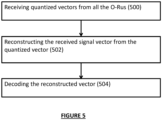
- Figure 5 is a flowchart depicting the processing performed at the O-DU 6 to decode the received signal vector.
- step 500 the quantized vectors from all the O-RU 6 are received by the O-DU 6.
- the O-DU 6 thereby receives K n data streams from each O-RU n.
- step 502 a summation of all the quantized vectors received at the O-DU 6 is performed to reconstruct the received signal.
- step 504 the reconstructed signal is decoded to determine an estimate of the signal transmitted by the user.
- the coordination method may further comprise determining at the O-DU 6, the data stream selection information to be sent to all O-RU (selection vectors ⁇ V n ⁇ for example) and sending a signalling message encompassing the data stream selection information.
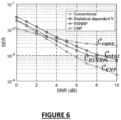
- Figure 6 is a diagram depicting the Symbol Error Rate (SER) as a function of the Signal-To-Noise Ratio (SNR) using different embodiments of the invention, in comparison with a conventional approach.
- the SNR defined by P ⁇ 2 .
- SER Symbol Error Rate
- SNR Signal-To-Noise Ratio
- Figure 6 also shows that the different techniques represented by the curves and to determine the selection vectors V n provide a lower SER when more information is required at O-RUs 5.
- the embodiments of the invention are more efficient at reconstructing the user messages, when the channel noise received at O-RUs 5 does not dominate the quantization noise.
- Figure 7 is a diagram depicting the Symbol Error Rate (SER) as a function of the overall number of quantization bits per O-RU according to a CNP embodiment of the invention in comparison with a conventional approach.
- SER Symbol Error Rate
- Figure 7 depicts the impact of fronthaul link capacity and provides a comparison of SER with different number of quantization.
- the gains brought by the vector determination schemes are illustrated as a function of the overall number of quantization bits per O-RU 5, that is, the fronthaul capacity.
- the CNP determination scheme can reduce the SER up to ten times since the quantization noise substantially impacts on the decoding performance. Nevertheless, when the number of quantization bits is sufficiently large (e.g., 32 bits), the quantization noise can be negligible.
- the coordination system 20 can bring large improvement when the quantization noise is not negligible.
- the coordination system 20 thereby enables enhancing the SER performance in cloud RAN systems. They enable improving efficiency with respect to conventional scheme approaches in an asymptotical regime where the fronthaul capacity is assumed to be very small. Further, significant gain is obtained with the use of the selection vectors in low and moderate resolution regimes.
- each O-RU 5 may exchange the eigenvalues of the covariance channel matrix, or more generally data stream selection information, with other O-RUs 5.
- Embodiments of the present invention can take the form of an embodiment containing software only, hardware only or both hardware and software elements.
- the methods described herein, the O-RU 5 and/or the O-DU 6 according to embodiments of the invention can be implemented according to a hardware and/or software implementation.
- the methods described herein can be implemented by computer program instructions supplied to the processor of any type of computer to produce a machine with a processor that executes the instructions to implement the functions/acts specified herein.
- These computer program instructions may also be stored in a computer-readable medium that can direct a computer to function in a particular manner. To that end, the computer program instructions may be loaded onto a computer to cause the performance of a series of operational steps and thereby produce a computer implemented process such that the executed instructions provide processes for implementing the functions specified herein.
- any of the flow charts, sequence diagrams, and/or block diagrams may include more or fewer blocks than those illustrated consistent with embodiments of the invention.
Landscapes
- Engineering & Computer Science (AREA)
- Computer Networks & Wireless Communication (AREA)
- Signal Processing (AREA)
- Mobile Radio Communication Systems (AREA)
- Radio Transmission System (AREA)
Claims (15)
- Kommunikationssystem (100) mit einer offenen Funkzugangsnetzarchitektur, wobei das Kommunikationssystem eine Anzahl (K) von Benutzergeräten (3) umfasst, die so konfiguriert sind, dass sie Nachrichten über das Kommunikationssystem austauschen, wobei ein Benutzergerät eine Anzahl von Sendeantennen umfasst, wobei das Kommunikationssystem eine oder mehrere Funkeinheiten (5) und eine verteilte Einheit (6) umfasst, wobei jede Funkeinheit (5) mit der verteilten Einheit über eine Fronthaulverbindung (4) mit einer gegebenen Kapazität verbunden ist, wobei das Kommunikationssystem ein Koordinationssystem (20) umfasst, wobei das Koordinationssystem (20) so konfiguriert ist, dass es den Austausch zwischen den Funkeinheiten des Systems und der verteilten Einheit (6) als Reaktion auf eine Nachricht koordiniert, die von den Funkeinheiten (5) von einem Benutzergerät (3) empfangen wird, wobei die an jeder Funkeinheit (5) empfangene Nachricht durch einen Signalvektor dargestellt wird, wobei das Koordinationssystem (20) so konfiguriert ist, dass es eine Signalisierungsnachricht an jede Funkeinheit (5) sendet, die Datenstromauswahlinformationen umfasst, wobei jede Funkeinheit umfasst:- eine Transformationseinheit (50), die so konfiguriert ist, dass sie auf den von der Funkeinheit (5) empfangenen Signalvektor eine Transformationsoperation anwendet, die einen transformierten Vektor bereitstellt, wobei die Transformationsoperation so definiert ist, dass sie die Dimension des empfangenen Signalvektors reduziert;- eine Datenstromauswahleinheit (52), die so konfiguriert ist, dass sie eine Anzahl von Datenströmen auswählt, die Komponenten des transformierten Vektors entsprechen, unter Verwendung der in der Signalisierungsnachricht enthaltenen Datenstromauswahlinformationen,- einen Quantisierer, der so konfiguriert ist, dass er eine Quantisierungsoperation auf die ausgewählten Datenströme anwendet, die quantisierte Vektoren bereitstellt,wobei die Funkeinheit (5) so konfiguriert ist, dass sie die quantisierten Vektoren an die verteilte Einheit (6) sendet,wobei die Summe, über alle an die Verteilungseinheit (6) angeschlossenen Funkeinheiten, der Anzahlen der an jeder Funkeinheit (5) ausgewählten Datenströme größer oder gleich dem Produkt aus der Anzahl von Benutzergeräten (K) und der Anzahl von Antennen eines Benutzergeräts ist.
- Kommunikationssystem nach Anspruch 1, wobei die verteilte Einheit (6) eine Rekonstruktionseinheit (60) umfasst, die dafür konfiguriert ist, eine Rekonstruktion des empfangenen Signalvektors auf der Grundlage der von allen Funkeinheiten empfangenen quantisierten Vektoren auszuführen, welche einen rekonstruierten Signalvektor bereitstellt, und einen Decoder (62), der so konfiguriert ist, dass er den rekonstruierten Signalvektor decodiert, um eine Schätzung des von dem Benutzergerät (3) übertragenen Signals zu bestimmen.
- Kommunikationssystem nach einem der vorhergehenden Ansprüche, wobei die durch eine Signalisierungsnachricht von einer gegebenen Funkeinheit empfangenen Datenstromauswahlinformationen einen Auswahlvektor (Vj ) umfassen, der der gegebenen Funkeinheit zugeordnet ist, wobei der Auswahlvektor eine Länge (Nr ) aufweist, die der Anzahl der in jeder Funkeinheit enthaltenen Empfangsantennen entspricht, wobei die Datenauswahleinheit (52) der gegebenen Funkeinheit so konfiguriert ist, dass sie den der gegebenen Funkeinheit entsprechenden Auswahlvektor aus der Signalisierungsnachricht extrahiert, und die Matrixmultiplikation zwischen einer Diagonalmatrix, die eine durch die Komponenten des Auswahlvektors Vn gebildete Diagonale umfasst, und dem transformierten Vektor ausführt, der einen Vektor ausgewählter Datenströme bereitstellt, wobei der Quantisierer der gegebenen Funkeinheit auf den Vektor der ausgewählten Datenströme angewendet wird.
- Kommunikationssystem nach Anspruch 3, wobei der jeder Funkeinheit zugeordnete Auswahlvektor aus den Kanalzustandsinformationen bestimmt wird.
- Kommunikationssystem nach Anspruch 4, wobei der i-te Koeffizient Vn (i) des Auswahlvektors Vn, der der gegebenen Funkeinheit zugeordnet ist, einen Wert gleich 1 aufweist, wenn die i-te Komponente des transformierten Vektors von der gegebenen Funkeinheit an die verteilte Einheit (6) gesendet werden soll, und andernfalls einen Wert gleich 0 aufweist, wenn die i-te Komponente des transformierten Vektors nicht von der gegebenen Funkeinheit an die verteilte Einheit (6) gesendet werden soll.
- Kommunikationssystem nach einem der vorhergehenden Ansprüche 3 bis 5, wobei jeder Auswahlvektor (Vn ) auf der Grundlage der Eigenwerte einer Kovarianzkanalmatrix bestimmt wird.
- Kommunikationssystem nach einem der vorhergehenden Ansprüche 3 bis 6, wobei der Satz von Auswahlvektoren (V1 , ... Vn, ... VN ), die allen Funkeinheiten (5) zugeordnet sind, so bestimmt wird, dass:

- Kommunikationssystem nach einem der vorhergehenden Ansprüche 3 bis 7, wobei die Auswahlvektoren von der verteilten Einheit bestimmt werden.
- Kommunikationssystem nach einem der vorhergehenden Ansprüche 3 bis 8, wobei die den Funkeinheiten zugeordneten Auswahlvektoren nur von statistischen Informationen der Kanalmatrix abhängen.
- Kommunikationssystem nach Anspruch 9, wobei wenn die k-ten und m-ten Einträge der Kovarianzmatrix des transformierten Vektors (

- Kommunikationssystem nach einem der vorhergehenden Ansprüche 3 bis 7, wobei die Auswahlvektoren, die den Funkeinheiten zugeordnet sind, nur von den momentanen Realisierungen der Kanalmatrix abhängen.
- Kommunikationssystem nach Anspruch 11, wobei die den Funkeinheiten zugeordneten Auswahlvektoren auf der Grundlage einer Priorität des empfangenen Signal-Rausch-Verhältnisses bestimmt werden.
- Kommunikationssystem nach Anspruch 12, wobei das Koordinationssystem (20) so konfiguriert ist, dass es Hilfssignalisierungsnachrichten zwischen den Funkeinheiten sendet, um Prioritätsindizes auszutauschen.
- Kommunikationssystem nach Anspruch 10, wobei die den Funkeinheiten zugeordneten Auswahlvektoren auf der Grundlage einer Zustandszahlpriorität der Kanalmatrix bestimmt werden.
- Koordinationsverfahren, das in einem Kommunikationssystem mit einer offenen Funkzugangsnetzwerkarchitektur implementiert wird, wobei das Kommunikationssystem eine Anzahl (K) von Benutzergeräten (3) umfasst, die Nachrichten über das Kommunikationssystem austauschen, wobei ein Benutzergerät eine Anzahl von Antennen umfasst, wobei das Kommunikationssystem eine oder mehrere Funkeinheiten (5) und eine verteilte Einheit (6) umfasst, wobei jede Funkeinheit (5) mit der verteilten Einheit über eine Fronthaulverbindung (4) verbunden ist, die eine gegebene Kapazität aufweist, wobei das Koordinationsverfahren das Koordinieren des Austauschs zwischen den Funkeinheiten des Systems und der verteilten Einheit (6) umfasst, als Reaktion auf den Empfang einer Nachricht durch die Funkeinheiten (5), welche von einem Benutzergerät (3) übertragen wird, wobei die bei jeder Funkeinheit (5) empfangene Nachricht durch einen Signalvektor dargestellt wird, wobei das Verfahren das Senden einer Signalisierungsnachricht an jede Funkeinheit (5) umfasst, die Datenstromauswahlinformationen umfasst, wobei das Verfahren ferner bei jeder Funkeinheit umfasst:- Anwenden einer Transformationsoperation auf den von der Funkeinheit (5) empfangenen Signalvektor, die einen transformierten Vektor bereitstellt, wobei die Transformation so definiert ist, dass sie die Dimension des empfangenen Signalvektors reduziert;- Auswählen einer Anzahl von Datenströmen, die Komponenten des transformierten Vektors entsprechen, unter Verwendung der in der Signalisierungsnachricht enthaltenen Datenstromauswahlinformationen,- Anwenden einer Quantisierungsoperation auf die ausgewählten Datenströme, die quantisierte Vektoren bereitstellt,wobei das Verfahren das Senden der quantisierten Vektoren von der Funkeinheit (5) an die verteilte Einheit (6) umfasst,wobei die Summe über alle mit der Verteilungseinheit (6) verbundenen Funkeinheiten der Anzahlen der an jeder Funkeinheit ausgewählten Datenströme größer oder gleich dem Produkt aus der Anzahl von Benutzergeräten (K) und der Anzahl von Antennen eines Benutzergeräts ist.
Priority Applications (4)
| Application Number | Priority Date | Filing Date | Title |
|---|---|---|---|
| EP21305208.7A EP4047829B1 (de) | 2021-02-19 | 2021-02-19 | System und verfahren zur uplink-koordinierten übertragung in einem offenen funkzugangsnetzwerk |
| US18/274,233 US12155424B2 (en) | 2021-02-19 | 2022-02-03 | System and method for uplink coordinated transmission in an open radio access network |
| PCT/EP2022/052552 WO2022175098A1 (en) | 2021-02-19 | 2022-02-03 | System and method for uplink coordinated transmission in an open radio access network |
| CN202280015651.0A CN116918375A (zh) | 2021-02-19 | 2022-02-03 | 用于开放无线电接入网中的上行协调传输的系统和方法 |
Applications Claiming Priority (1)
| Application Number | Priority Date | Filing Date | Title |
|---|---|---|---|
| EP21305208.7A EP4047829B1 (de) | 2021-02-19 | 2021-02-19 | System und verfahren zur uplink-koordinierten übertragung in einem offenen funkzugangsnetzwerk |
Publications (2)
| Publication Number | Publication Date |
|---|---|
| EP4047829A1 EP4047829A1 (de) | 2022-08-24 |
| EP4047829B1 true EP4047829B1 (de) | 2023-09-27 |
Family
ID=74858379
Family Applications (1)
| Application Number | Title | Priority Date | Filing Date |
|---|---|---|---|
| EP21305208.7A Active EP4047829B1 (de) | 2021-02-19 | 2021-02-19 | System und verfahren zur uplink-koordinierten übertragung in einem offenen funkzugangsnetzwerk |
Country Status (4)
| Country | Link |
|---|---|
| US (1) | US12155424B2 (de) |
| EP (1) | EP4047829B1 (de) |
| CN (1) | CN116918375A (de) |
| WO (1) | WO2022175098A1 (de) |
Families Citing this family (1)
| Publication number | Priority date | Publication date | Assignee | Title |
|---|---|---|---|---|
| CN114362793B (zh) * | 2020-10-13 | 2024-06-14 | 中兴通讯股份有限公司 | 信号处理装置及信号处理方法 |
Family Cites Families (10)
| Publication number | Priority date | Publication date | Assignee | Title |
|---|---|---|---|---|
| US6850497B1 (en) * | 1995-09-19 | 2005-02-01 | Mobile Satellite Ventures, Lp | Satellite trunked radio service system |
| CN102307372B (zh) * | 2011-08-26 | 2014-12-17 | 电信科学技术研究院 | 一种基于Lloyd-Max量化器的数据压缩方法和设备 |
| WO2016007757A1 (en) * | 2014-07-11 | 2016-01-14 | Huawei Technologies Co., Ltd. | Systems and methods for optimized beamforming and compression for uplink mimo cloud radio access networks |
| WO2017167370A1 (en) * | 2016-03-31 | 2017-10-05 | Huawei Technologies Co., Ltd. | Radio system and decoding device for distributed compression |
| US10348386B1 (en) * | 2018-08-09 | 2019-07-09 | At&T Intellectual Property I, L.P. | Facilitation of user equipment specific compression of beamforming coefficients for fronthaul links for 5G or other next generation network |
| US12040861B2 (en) * | 2018-11-30 | 2024-07-16 | Telefonaktiebolaget Lm Ericsson (Publ) | Communicating using beamforming weights determined at a radio unit |
| US10834618B1 (en) * | 2019-08-05 | 2020-11-10 | Sprint Communications Company L.P. | Wireless communication network access using different functionality splits for different communication services |
| KR102931951B1 (ko) * | 2020-02-05 | 2026-02-26 | 콤스코프 테크놀로지스, 엘엘씨 | 고급 분할-무선 액세스 네트워크(ran) 시스템을 위한 프론트홀 인터페이스 |
| JP7771106B2 (ja) * | 2020-06-30 | 2025-11-17 | コムスコープ テクノロジーズ リミティド ライアビリティ カンパニー | 複数の機能分割、複数のワイヤレスインターフェースプロトコル、複数世代の無線アクセス技術、及び複数の無線周波数帯をサポートする統一された遠隔ユニットを有するオープン無線アクセスネットワーク |
| US12615671B2 (en) * | 2021-10-15 | 2026-04-28 | Qualcomm Incorporated | Support for demodulation reference signal bundling by a base station |
-
2021
- 2021-02-19 EP EP21305208.7A patent/EP4047829B1/de active Active
-
2022
- 2022-02-03 US US18/274,233 patent/US12155424B2/en active Active
- 2022-02-03 WO PCT/EP2022/052552 patent/WO2022175098A1/en not_active Ceased
- 2022-02-03 CN CN202280015651.0A patent/CN116918375A/zh active Pending
Also Published As
| Publication number | Publication date |
|---|---|
| US12155424B2 (en) | 2024-11-26 |
| EP4047829A1 (de) | 2022-08-24 |
| US20240106498A1 (en) | 2024-03-28 |
| CN116918375A (zh) | 2023-10-20 |
| WO2022175098A1 (en) | 2022-08-25 |
Similar Documents
| Publication | Publication Date | Title |
|---|---|---|
| US7428280B2 (en) | Receiving apparatus and transceiver | |
| KR100952351B1 (ko) | 유한 레이트 채널 상태 정보 피드백을 가지는 2×2 mimo사전-코더들을 위한 교호 채널 델타 양자화기를 위한 방법및 시스템 | |
| US7330701B2 (en) | Low complexity beamformers for multiple transmit and receive antennas | |
| US8023457B2 (en) | Feedback reduction for MIMO precoded system by exploiting channel correlation | |
| KR100956327B1 (ko) | 레이트 감소 사전-코딩 행렬들을 위한 방법 및 시스템 | |
| US20200136700A1 (en) | Channel Prediction for Adaptive Channel State Information (CSI) Feedback Overhead Reduction | |
| US8412242B2 (en) | Method and apparatus for sending and receiving channel state information in multiple-input multiple-output network wireless communication systems | |
| US20120069833A1 (en) | Channel state information reporting for a successively decoded, precoded multi-antenna transmission | |
| Park et al. | Optimization of mixed-ADC multi-antenna systems for cloud-RAN deployments | |
| Cheng et al. | Generalized compute-compress-and-forward | |
| CN104283634B (zh) | 一种数据的发送方法、接收方法、系统及装置 | |
| EP4047829B1 (de) | System und verfahren zur uplink-koordinierten übertragung in einem offenen funkzugangsnetzwerk | |
| Khorsandmanesh et al. | Quantization-aware precoding for MU-MIMO with limited-capacity fronthaul | |
| Jiang et al. | Channel smoothing for 802.11 ax beamformed MIMO-OFDM | |
| Koyuncu et al. | Interleaving channel estimation and limited feedback for point-to-point systems with a large number of transmit antennas | |
| Hasabelnaby et al. | Multi-pair computation for c-ran with intra-cloud and inter-cloud communications | |
| Zhang et al. | Quantization-Aware Processing for Massive MIMO Uplink Cloud RAN | |
| Caire et al. | Achievable rates of MIMO downlink beamforming with non-perfect CSI: a comparison between quantized and analog feedback | |
| Shanechi et al. | Comparison of practical feedback algorithms for multiuser MIMO | |
| CN107689932B (zh) | 一种降低粗量化中继系统中误比特率的方法 | |
| Dai et al. | An efficient greedy scheduler for zero-forcing dirty-paper coding | |
| Yeung et al. | Enhanced trellis based vector quantization for coordinated beamforming | |
| Peng et al. | Multi-task semantic communication for image transmission over MIMO channel | |
| Liu et al. | Overhead-performance tradeoff for MISO broadcast channels with zero-forcing precoder | |
| Sohtsinda et al. | Amplifier-aware content-based precoder design for hierarchical image transmission over a realistic MIMO-OFDM channel |
Legal Events
| Date | Code | Title | Description |
|---|---|---|---|
| PUAI | Public reference made under article 153(3) epc to a published international application that has entered the european phase |
Free format text: ORIGINAL CODE: 0009012 |
|
| STAA | Information on the status of an ep patent application or granted ep patent |
Free format text: STATUS: THE APPLICATION HAS BEEN PUBLISHED |
|
| AK | Designated contracting states |
Kind code of ref document: A1 Designated state(s): AL AT BE BG CH CY CZ DE DK EE ES FI FR GB GR HR HU IE IS IT LI LT LU LV MC MK MT NL NO PL PT RO RS SE SI SK SM TR |
|
| STAA | Information on the status of an ep patent application or granted ep patent |
Free format text: STATUS: REQUEST FOR EXAMINATION WAS MADE |
|
| 17P | Request for examination filed |
Effective date: 20230210 |
|
| RBV | Designated contracting states (corrected) |
Designated state(s): AL AT BE BG CH CY CZ DE DK EE ES FI FR GB GR HR HU IE IS IT LI LT LU LV MC MK MT NL NO PL PT RO RS SE SI SK SM TR |
|
| REG | Reference to a national code |
Ref country code: DE Ref legal event code: R079 Ipc: H04W0028060000 Ref country code: DE Ref legal event code: R079 Ref document number: 602021005461 Country of ref document: DE Free format text: PREVIOUS MAIN CLASS: H04B0007041300 Ipc: H04W0028060000 |
|
| GRAP | Despatch of communication of intention to grant a patent |
Free format text: ORIGINAL CODE: EPIDOSNIGR1 |
|
| STAA | Information on the status of an ep patent application or granted ep patent |
Free format text: STATUS: GRANT OF PATENT IS INTENDED |
|
| RIC1 | Information provided on ipc code assigned before grant |
Ipc: H04W 88/08 20090101ALN20230417BHEP Ipc: H04B 7/024 20170101ALI20230417BHEP Ipc: H04W 28/06 20090101AFI20230417BHEP |
|
| INTG | Intention to grant announced |
Effective date: 20230523 |
|
| GRAS | Grant fee paid |
Free format text: ORIGINAL CODE: EPIDOSNIGR3 |
|
| GRAA | (expected) grant |
Free format text: ORIGINAL CODE: 0009210 |
|
| STAA | Information on the status of an ep patent application or granted ep patent |
Free format text: STATUS: THE PATENT HAS BEEN GRANTED |
|
| AK | Designated contracting states |
Kind code of ref document: B1 Designated state(s): AL AT BE BG CH CY CZ DE DK EE ES FI FR GB GR HR HU IE IS IT LI LT LU LV MC MK MT NL NO PL PT RO RS SE SI SK SM TR |
|
| REG | Reference to a national code |
Ref country code: GB Ref legal event code: FG4D |
|
| REG | Reference to a national code |
Ref country code: CH Ref legal event code: EP |
|
| REG | Reference to a national code |
Ref country code: DE Ref legal event code: R096 Ref document number: 602021005461 Country of ref document: DE |
|
| REG | Reference to a national code |
Ref country code: IE Ref legal event code: FG4D |
|
| REG | Reference to a national code |
Ref country code: LT Ref legal event code: MG9D |
|
| PG25 | Lapsed in a contracting state [announced via postgrant information from national office to epo] |
Ref country code: GR Free format text: LAPSE BECAUSE OF FAILURE TO SUBMIT A TRANSLATION OF THE DESCRIPTION OR TO PAY THE FEE WITHIN THE PRESCRIBED TIME-LIMIT Effective date: 20231228 |
|
| PG25 | Lapsed in a contracting state [announced via postgrant information from national office to epo] |
Ref country code: SE Free format text: LAPSE BECAUSE OF FAILURE TO SUBMIT A TRANSLATION OF THE DESCRIPTION OR TO PAY THE FEE WITHIN THE PRESCRIBED TIME-LIMIT Effective date: 20230927 Ref country code: RS Free format text: LAPSE BECAUSE OF FAILURE TO SUBMIT A TRANSLATION OF THE DESCRIPTION OR TO PAY THE FEE WITHIN THE PRESCRIBED TIME-LIMIT Effective date: 20230927 Ref country code: NO Free format text: LAPSE BECAUSE OF FAILURE TO SUBMIT A TRANSLATION OF THE DESCRIPTION OR TO PAY THE FEE WITHIN THE PRESCRIBED TIME-LIMIT Effective date: 20231227 Ref country code: LV Free format text: LAPSE BECAUSE OF FAILURE TO SUBMIT A TRANSLATION OF THE DESCRIPTION OR TO PAY THE FEE WITHIN THE PRESCRIBED TIME-LIMIT Effective date: 20230927 Ref country code: LT Free format text: LAPSE BECAUSE OF FAILURE TO SUBMIT A TRANSLATION OF THE DESCRIPTION OR TO PAY THE FEE WITHIN THE PRESCRIBED TIME-LIMIT Effective date: 20230927 Ref country code: HR Free format text: LAPSE BECAUSE OF FAILURE TO SUBMIT A TRANSLATION OF THE DESCRIPTION OR TO PAY THE FEE WITHIN THE PRESCRIBED TIME-LIMIT Effective date: 20230927 Ref country code: GR Free format text: LAPSE BECAUSE OF FAILURE TO SUBMIT A TRANSLATION OF THE DESCRIPTION OR TO PAY THE FEE WITHIN THE PRESCRIBED TIME-LIMIT Effective date: 20231228 Ref country code: FI Free format text: LAPSE BECAUSE OF FAILURE TO SUBMIT A TRANSLATION OF THE DESCRIPTION OR TO PAY THE FEE WITHIN THE PRESCRIBED TIME-LIMIT Effective date: 20230927 |
|
| REG | Reference to a national code |
Ref country code: NL Ref legal event code: MP Effective date: 20230927 |
|
| REG | Reference to a national code |
Ref country code: AT Ref legal event code: MK05 Ref document number: 1616591 Country of ref document: AT Kind code of ref document: T Effective date: 20230927 |
|
| PG25 | Lapsed in a contracting state [announced via postgrant information from national office to epo] |
Ref country code: NL Free format text: LAPSE BECAUSE OF FAILURE TO SUBMIT A TRANSLATION OF THE DESCRIPTION OR TO PAY THE FEE WITHIN THE PRESCRIBED TIME-LIMIT Effective date: 20230927 |
|
| PG25 | Lapsed in a contracting state [announced via postgrant information from national office to epo] |
Ref country code: IS Free format text: LAPSE BECAUSE OF FAILURE TO SUBMIT A TRANSLATION OF THE DESCRIPTION OR TO PAY THE FEE WITHIN THE PRESCRIBED TIME-LIMIT Effective date: 20240127 |
|
| PG25 | Lapsed in a contracting state [announced via postgrant information from national office to epo] |
Ref country code: AT Free format text: LAPSE BECAUSE OF FAILURE TO SUBMIT A TRANSLATION OF THE DESCRIPTION OR TO PAY THE FEE WITHIN THE PRESCRIBED TIME-LIMIT Effective date: 20230927 |
|
| PG25 | Lapsed in a contracting state [announced via postgrant information from national office to epo] |
Ref country code: ES Free format text: LAPSE BECAUSE OF FAILURE TO SUBMIT A TRANSLATION OF THE DESCRIPTION OR TO PAY THE FEE WITHIN THE PRESCRIBED TIME-LIMIT Effective date: 20230927 |
|
| PG25 | Lapsed in a contracting state [announced via postgrant information from national office to epo] |
Ref country code: SM Free format text: LAPSE BECAUSE OF FAILURE TO SUBMIT A TRANSLATION OF THE DESCRIPTION OR TO PAY THE FEE WITHIN THE PRESCRIBED TIME-LIMIT Effective date: 20230927 Ref country code: RO Free format text: LAPSE BECAUSE OF FAILURE TO SUBMIT A TRANSLATION OF THE DESCRIPTION OR TO PAY THE FEE WITHIN THE PRESCRIBED TIME-LIMIT Effective date: 20230927 Ref country code: IS Free format text: LAPSE BECAUSE OF FAILURE TO SUBMIT A TRANSLATION OF THE DESCRIPTION OR TO PAY THE FEE WITHIN THE PRESCRIBED TIME-LIMIT Effective date: 20240127 Ref country code: ES Free format text: LAPSE BECAUSE OF FAILURE TO SUBMIT A TRANSLATION OF THE DESCRIPTION OR TO PAY THE FEE WITHIN THE PRESCRIBED TIME-LIMIT Effective date: 20230927 Ref country code: EE Free format text: LAPSE BECAUSE OF FAILURE TO SUBMIT A TRANSLATION OF THE DESCRIPTION OR TO PAY THE FEE WITHIN THE PRESCRIBED TIME-LIMIT Effective date: 20230927 Ref country code: CZ Free format text: LAPSE BECAUSE OF FAILURE TO SUBMIT A TRANSLATION OF THE DESCRIPTION OR TO PAY THE FEE WITHIN THE PRESCRIBED TIME-LIMIT Effective date: 20230927 Ref country code: AT Free format text: LAPSE BECAUSE OF FAILURE TO SUBMIT A TRANSLATION OF THE DESCRIPTION OR TO PAY THE FEE WITHIN THE PRESCRIBED TIME-LIMIT Effective date: 20230927 Ref country code: SK Free format text: LAPSE BECAUSE OF FAILURE TO SUBMIT A TRANSLATION OF THE DESCRIPTION OR TO PAY THE FEE WITHIN THE PRESCRIBED TIME-LIMIT Effective date: 20230927 Ref country code: PT Free format text: LAPSE BECAUSE OF FAILURE TO SUBMIT A TRANSLATION OF THE DESCRIPTION OR TO PAY THE FEE WITHIN THE PRESCRIBED TIME-LIMIT Effective date: 20240129 |
|
| PG25 | Lapsed in a contracting state [announced via postgrant information from national office to epo] |
Ref country code: PL Free format text: LAPSE BECAUSE OF FAILURE TO SUBMIT A TRANSLATION OF THE DESCRIPTION OR TO PAY THE FEE WITHIN THE PRESCRIBED TIME-LIMIT Effective date: 20230927 Ref country code: IT Free format text: LAPSE BECAUSE OF FAILURE TO SUBMIT A TRANSLATION OF THE DESCRIPTION OR TO PAY THE FEE WITHIN THE PRESCRIBED TIME-LIMIT Effective date: 20230927 |
|
| REG | Reference to a national code |
Ref country code: DE Ref legal event code: R097 Ref document number: 602021005461 Country of ref document: DE |
|
| PG25 | Lapsed in a contracting state [announced via postgrant information from national office to epo] |
Ref country code: DK Free format text: LAPSE BECAUSE OF FAILURE TO SUBMIT A TRANSLATION OF THE DESCRIPTION OR TO PAY THE FEE WITHIN THE PRESCRIBED TIME-LIMIT Effective date: 20230927 |
|
| PG25 | Lapsed in a contracting state [announced via postgrant information from national office to epo] |
Ref country code: DK Free format text: LAPSE BECAUSE OF FAILURE TO SUBMIT A TRANSLATION OF THE DESCRIPTION OR TO PAY THE FEE WITHIN THE PRESCRIBED TIME-LIMIT Effective date: 20230927 |
|
| PLBE | No opposition filed within time limit |
Free format text: ORIGINAL CODE: 0009261 |
|
| STAA | Information on the status of an ep patent application or granted ep patent |
Free format text: STATUS: NO OPPOSITION FILED WITHIN TIME LIMIT |
|
| 26N | No opposition filed |
Effective date: 20240628 |
|
| PG25 | Lapsed in a contracting state [announced via postgrant information from national office to epo] |
Ref country code: MC Free format text: LAPSE BECAUSE OF FAILURE TO SUBMIT A TRANSLATION OF THE DESCRIPTION OR TO PAY THE FEE WITHIN THE PRESCRIBED TIME-LIMIT Effective date: 20230927 |
|
| REG | Reference to a national code |
Ref country code: CH Ref legal event code: PL |
|
| PG25 | Lapsed in a contracting state [announced via postgrant information from national office to epo] |
Ref country code: LU Free format text: LAPSE BECAUSE OF NON-PAYMENT OF DUE FEES Effective date: 20240219 |
|
| PG25 | Lapsed in a contracting state [announced via postgrant information from national office to epo] |
Ref country code: CH Free format text: LAPSE BECAUSE OF NON-PAYMENT OF DUE FEES Effective date: 20240229 |
|
| PG25 | Lapsed in a contracting state [announced via postgrant information from national office to epo] |
Ref country code: SI Free format text: LAPSE BECAUSE OF FAILURE TO SUBMIT A TRANSLATION OF THE DESCRIPTION OR TO PAY THE FEE WITHIN THE PRESCRIBED TIME-LIMIT Effective date: 20230927 |
|
| PG25 | Lapsed in a contracting state [announced via postgrant information from national office to epo] |
Ref country code: SI Free format text: LAPSE BECAUSE OF FAILURE TO SUBMIT A TRANSLATION OF THE DESCRIPTION OR TO PAY THE FEE WITHIN THE PRESCRIBED TIME-LIMIT Effective date: 20230927 Ref country code: LU Free format text: LAPSE BECAUSE OF NON-PAYMENT OF DUE FEES Effective date: 20240219 Ref country code: CH Free format text: LAPSE BECAUSE OF NON-PAYMENT OF DUE FEES Effective date: 20240229 |
|
| PG25 | Lapsed in a contracting state [announced via postgrant information from national office to epo] |
Ref country code: BG Free format text: LAPSE BECAUSE OF FAILURE TO SUBMIT A TRANSLATION OF THE DESCRIPTION OR TO PAY THE FEE WITHIN THE PRESCRIBED TIME-LIMIT Effective date: 20230927 |
|
| PG25 | Lapsed in a contracting state [announced via postgrant information from national office to epo] |
Ref country code: BG Free format text: LAPSE BECAUSE OF FAILURE TO SUBMIT A TRANSLATION OF THE DESCRIPTION OR TO PAY THE FEE WITHIN THE PRESCRIBED TIME-LIMIT Effective date: 20230927 |
|
| REG | Reference to a national code |
Ref country code: BE Ref legal event code: MM Effective date: 20240229 |
|
| PG25 | Lapsed in a contracting state [announced via postgrant information from national office to epo] |
Ref country code: BE Free format text: LAPSE BECAUSE OF NON-PAYMENT OF DUE FEES Effective date: 20240229 |
|
| PG25 | Lapsed in a contracting state [announced via postgrant information from national office to epo] |
Ref country code: IE Free format text: LAPSE BECAUSE OF NON-PAYMENT OF DUE FEES Effective date: 20240219 |
|
| PG25 | Lapsed in a contracting state [announced via postgrant information from national office to epo] |
Ref country code: IE Free format text: LAPSE BECAUSE OF NON-PAYMENT OF DUE FEES Effective date: 20240219 Ref country code: BE Free format text: LAPSE BECAUSE OF NON-PAYMENT OF DUE FEES Effective date: 20240229 |
|
| PG25 | Lapsed in a contracting state [announced via postgrant information from national office to epo] |
Ref country code: CY Free format text: LAPSE BECAUSE OF FAILURE TO SUBMIT A TRANSLATION OF THE DESCRIPTION OR TO PAY THE FEE WITHIN THE PRESCRIBED TIME-LIMIT; INVALID AB INITIO Effective date: 20210219 |
|
| PG25 | Lapsed in a contracting state [announced via postgrant information from national office to epo] |
Ref country code: HU Free format text: LAPSE BECAUSE OF FAILURE TO SUBMIT A TRANSLATION OF THE DESCRIPTION OR TO PAY THE FEE WITHIN THE PRESCRIBED TIME-LIMIT; INVALID AB INITIO Effective date: 20210219 |
|
| PG25 | Lapsed in a contracting state [announced via postgrant information from national office to epo] |
Ref country code: TR Free format text: LAPSE BECAUSE OF FAILURE TO SUBMIT A TRANSLATION OF THE DESCRIPTION OR TO PAY THE FEE WITHIN THE PRESCRIBED TIME-LIMIT Effective date: 20230927 |
|
| PGFP | Annual fee paid to national office [announced via postgrant information from national office to epo] |
Ref country code: GB Payment date: 20260128 Year of fee payment: 6 |
|
| PGFP | Annual fee paid to national office [announced via postgrant information from national office to epo] |
Ref country code: DE Payment date: 20260121 Year of fee payment: 6 |
|
| PGFP | Annual fee paid to national office [announced via postgrant information from national office to epo] |
Ref country code: FR Payment date: 20260121 Year of fee payment: 6 |