EP4048004A1 - Direktzugriffsverfahren und -vorrichtung - Google Patents
Direktzugriffsverfahren und -vorrichtung Download PDFInfo
- Publication number
- EP4048004A1 EP4048004A1 EP19951643.6A EP19951643A EP4048004A1 EP 4048004 A1 EP4048004 A1 EP 4048004A1 EP 19951643 A EP19951643 A EP 19951643A EP 4048004 A1 EP4048004 A1 EP 4048004A1
- Authority
- EP
- European Patent Office
- Prior art keywords
- random access
- access procedure
- terminal device
- message
- priority value
- Prior art date
- Legal status (The legal status is an assumption and is not a legal conclusion. Google has not performed a legal analysis and makes no representation as to the accuracy of the status listed.)
- Pending
Links
Images

Classifications
-
- H—ELECTRICITY
- H04—ELECTRIC COMMUNICATION TECHNIQUE
- H04W—WIRELESS COMMUNICATION NETWORKS
- H04W74/00—Wireless channel access
- H04W74/08—Non-scheduled access, e.g. ALOHA
- H04W74/0808—Non-scheduled access, e.g. ALOHA using carrier sensing, e.g. carrier sense multiple access [CSMA]
-
- H—ELECTRICITY
- H04—ELECTRIC COMMUNICATION TECHNIQUE
- H04W—WIRELESS COMMUNICATION NETWORKS
- H04W74/00—Wireless channel access
- H04W74/08—Non-scheduled access, e.g. ALOHA
- H04W74/0833—Random access procedures, e.g. with 4-step access
-
- H—ELECTRICITY
- H04—ELECTRIC COMMUNICATION TECHNIQUE
- H04W—WIRELESS COMMUNICATION NETWORKS
- H04W74/00—Wireless channel access
- H04W74/08—Non-scheduled access, e.g. ALOHA
- H04W74/0833—Random access procedures, e.g. with 4-step access
- H04W74/0836—Random access procedures, e.g. with 4-step access with 2-step access
Definitions
- This application relates to the communication field, and more specifically, to a random access method and apparatus.
- the 3rd Generation Partnership Project (3rd generation partnership project, 3GPP) approved a proposal of supporting a two-step random access procedure in Release 16 (release 16, Rel. 16) of a 5th generation (5th generation, 5G) communication system.
- 3rd generation partnership project, 3GPP 3rd generation partnership project
- a terminal device accesses a network device by performing a two-step procedure in which the terminal device sends a first-step message and the network device sends a second-step message to respond to the first-step message sent by the terminal device.
- 3rd generation partnership project, 3GPP approved a proposal of supporting a two-step random access procedure in Release 16 (release 16, Rel. 16) of a 5th generation (5th generation, 5G) communication system.
- 3rd generation partnership project, 3GPP approved a proposal of supporting a two-step random access procedure in Release 16 (release 16, Rel. 16) of a 5th generation (5th generation, 5G) communication system.
- This application provides a random access method and apparatus, so that a terminal device can quickly access a network.
- a random access method is provided.
- the method may be performed by a terminal device or a module (for example, a chip) configured in the terminal device.
- a module for example, a chip configured in the terminal device.
- An example in which the method is performed by the terminal device is used for description below.
- the method includes: The terminal device receives first information sent by a network device, where the first information includes a priority value of a first parameter used for a random access procedure. The terminal device initiates the random access procedure based on the priority value.
- the terminal device can preferentially select, based on the priority value of the first parameter, a two-step random access procedure or send a message in the random access procedure by using high power, to quickly access a network and reduce an access delay.
- the first parameter includes one or more of the following: a maximum transmission count of a first message, an uplink shared channel PUSCH power ramping step, or a reference signal received power threshold.
- the method further includes: The terminal device determines whether the priority value of the first parameter is configured. That the terminal device initiates the random access procedure based on the priority value includes: The terminal device initiates the random access procedure based on the priority value when a determining result is yes; or the terminal device initiates the random access procedure based on a first value of the first parameter when the terminal device determines that the priority value is not configured, where the first value of the first parameter is used for a non-preferred random access procedure.
- the priority value is an optional configuration parameter.
- the terminal device initiates the random access procedure by using the priority value, to quickly access the network and reduce the delay.
- the first parameter includes the maximum transmission count of the first message
- the first message is a message sent in a first step in a two-step random access procedure. That the terminal device initiates the random access procedure based on the priority value includes: The terminal device initiates the two-step random access procedure after determining that a transmission count of the first message is less than or equal to a priority value of the maximum transmission count of the first message; or the terminal device initiates a four-step random access procedure after determining that a transmission count of the first message is greater than a priority value of the maximum transmission count of the first message.
- the network device configures the priority value of the maximum transmission count of the first message for the terminal device, so that the terminal device can access the network by using the two-step random access procedure when the transmission count of the first message is within a range of the priority value, to quickly access the network and reduce the delay.
- the first parameter includes the uplink shared channel PUSCH power ramping step
- the PUSCH power ramping step is used by the terminal device to increase transmit power of a PUSCH included in the first message
- the first message is the message sent in the first step in the two-step random access procedure. That the terminal device initiates the random access procedure based on the priority value includes: The terminal device sends the PUSCH by using a sum of a power value of a PUSCH included in a first message sent last time and a priority value of the PUSCH power ramping step as power of the PUSCH.
- the network device configures the priority value of the PUSCH power ramping step for the terminal device, so that the terminal device can perform power ramping on the PUSCH based on the priority value, to quickly access the network and reduce the delay.
- the first parameter includes the reference signal received power threshold. That the terminal device initiates the random access procedure based on the priority value includes: The terminal device initiates the two-step random access procedure after determining that reference signal received power is greater than a priority value of the reference signal received power threshold; or the terminal device initiates the four-step random access procedure after determining that reference signal received power is less than or equal to a priority value of the reference signal received power threshold.
- the network device configures the priority value of the reference signal received power threshold for the terminal device, so that the terminal device can preferentially access the network by using the two-step random access procedure, to quickly access the network and reduce the delay.
- the random access procedure is used for beam failure recovery or switching.
- the random access procedure is initiated by using the priority value of the first parameter, so that the terminal device can quickly recover a network connection or quickly switches to another cell.
- a random access method is provided.
- the method may be performed by a network device or a module (for example, a chip) configured in the network device.
- a module for example, a chip configured in the network device.
- An example in which the method is performed by the network device is used for description below.
- the method includes: The network device sends first information to a terminal device, where the first information includes a priority value of a first parameter used for a random access procedure.
- the network device receives a message sent by the terminal device in the random access procedure.
- the first parameter includes one or more of the following: a maximum transmission count of a first message, an uplink shared channel PUSCH power ramping step, or a reference signal received power threshold.
- the first parameter includes the maximum transmission count of the first message
- the first message is a message sent in a first step in a two-step random access procedure
- the maximum transmission count of the first message is used by the terminal device to choose to initiate the two-step random access procedure or a four-step random access procedure.
- the first parameter includes the uplink shared channel PUSCH power ramping step
- the PUSCH power ramping step is used by the terminal device to increase transmit power of a PUSCH included in the first message
- the first message is the message sent in the first step in the two-step random access procedure.
- the first parameter includes the reference signal received power threshold, and the reference signal received power threshold is used by the terminal device to choose to initiate the two-step random access procedure or the four-step random access procedure.
- the random access procedure is used for beam failure recovery or switching.
- a communication apparatus configured in a terminal device or the apparatus is the terminal device, and includes: a transceiver unit, configured to receive first information, where the first information includes a priority value of a first parameter used for a random access procedure; and a processing unit, configured to initiate the random access procedure based on the priority value.
- the first parameter includes one or more of the following: a maximum transmission count of a first message, an uplink shared channel PUSCH power ramping step, or a reference signal received power threshold.
- the processing unit is further configured to determine whether the priority value of the first parameter is configured.
- the initiating the random access procedure based on the priority value includes: The processing unit initiates the random access procedure based on the priority value when a determining result is yes; or the terminal device initiates the random access procedure based on a first value of the first parameter when determining that the priority value is not configured, where the first value of the first parameter is used for a non-preferred random access procedure.
- the first parameter includes the maximum transmission count of the first message
- the first message is a message sent in a first step in a two-step random access procedure.
- the initiating the random access procedure based on the priority value includes: The processing unit initiates the two-step random access procedure after determining that a transmission count of the first message is less than or equal to a priority value of the maximum transmission count of the first message; or the processing unit initiates a four-step random access procedure after determining that a transmission count of the first message is greater than a priority value of the maximum transmission count of the first message.
- the first parameter includes the uplink shared channel PUSCH power ramping step
- the PUSCH power ramping step is used by the processing unit to increase transmit power of a PUSCH included in the first message
- the first message is the message sent in the first step in the two-step random access procedure.
- the initiating the random access procedure based on the priority value includes: The processing unit sends the PUSCH by using a sum of a power value of a PUSCH included in a first message sent last time and a priority value of the PUSCH power ramping step as power of the PUSCH.
- the first parameter includes the reference signal received power threshold.
- the initiating the random access procedure based on the priority value includes: The processing unit initiates the two-step random access procedure after determining that reference signal received power is greater than a priority value of the reference signal received power threshold; or the processing unit initiates the four-step random access procedure after determining that reference signal received power is less than or equal to a priority value of the reference signal received power threshold.
- the random access procedure is used for beam failure recovery or switching.
- a communication apparatus may be configured in a network device or the apparatus is the network device, and includes: a transceiver unit, configured to send first information, where the first information includes a priority value of a first parameter used for a random access procedure.
- the transceiver unit is further configured to receive a message sent by a terminal device in the random access procedure.
- the first parameter includes one or more of the following: a maximum transmission count of a first message, an uplink shared channel PUSCH power ramping step, or a reference signal received power threshold.
- the first parameter includes the maximum transmission count of the first message
- the first message is a message sent in a first step in a two-step random access procedure
- the maximum transmission count of the first message is used by the terminal device to choose to initiate the two-step random access procedure or a four-step random access procedure.
- the first parameter includes the uplink shared channel PUSCH power ramping step
- the PUSCH power ramping step is used by the terminal device to increase transmit power of a PUSCH included in the first message
- the first message is the message sent in the first step in the random access procedure.
- the first parameter includes the reference signal received power threshold, and the reference signal received power threshold is used by the terminal device to choose to initiate the two-step random access procedure or the four-step random access procedure.
- the random access procedure is used for beam failure recovery or switching.
- a communication method is provided.
- the method may be performed by a terminal device or a module (for example, a chip) configured in the terminal device.
- a terminal device for example, a chip
- An example in which the method is performed by a terminal device is used for description below.
- the method includes: The terminal device determines that a listen before talk LBT failure counter for a first bandwidth reaches a first value, where the LBT failure counter is used to record an LBT failure count.
- the terminal device initiates a first random access procedure after switching an active bandwidth to a second bandwidth.
- the method further includes: The terminal device stops a second random access procedure on the first bandwidth.
- the second bandwidth includes resources of a plurality of types of random access procedures
- the terminal device selects one type of random access procedure to initiate the first random access procedure, where the plurality of types of random access procedures include a two-step random access procedure and a four-step random access procedure.
- the terminal device determines, based on a reference signal received power threshold, whether to initiate the two-step random access procedure or the four-step random access procedure on the second bandwidth.
- the first random access procedure is initiated by using a resource for a random access procedure whose type is the same as that of the second random access procedure.
- the foregoing two implementations may be combined.
- the first random access procedure uses a resource for a random access procedure whose type is the same as that of the second random access procedure.
- a resource for selecting a random access procedure used in the first random access procedure is determined based on a reference signal received power threshold.
- the terminal device when a resource for only one random access procedure is configured for the second bandwidth, the terminal device initiates the random access procedure based on the configured resource for the random access procedure.
- the network device configures, for the terminal device, a type of a random access procedure that is initiated after the bandwidth is switched because the LBT failure count reaches a maximum count.
- the terminal device chooses to switch to the second bandwidth based on the type of the random access procedure that is configured by the network device, where the second bandwidth includes a resource for the random access procedure of this type.
- the method further includes one or more of the following: resetting the LBT failure counter, stopping an LBT failure detection timer, stopping an LBT failure count timer, setting a preamble transmission counter to 1, setting a preamble power ramping counter to 1, setting a preamble power ramping counter in MsgA of the two-step random access procedure to 1, setting a backoff indicator to 0, setting a PUSCH power ramping counter in MsgA of the two-step random access procedure to 1, setting a counter in MsgA of the two-step random access procedure to 1, flushing a Msg3 buffer of the four-step random access procedure, and/or flushing a MsgA buffer of the two-step random access procedure.
- each counter and timer are reset, so that a value recorded in the previous bandwidth does not affect communication on the bandwidth after the switching.
- the method further includes: maintaining content in the Msg3 buffer of the four-step random access procedure after the second bandwidth is switched to, and/or maintaining content in the MsgA buffer of the two-step random access procedure after the second bandwidth is switched to.
- the content in the buffer can be read immediately after the bandwidth switching, thereby avoiding re-assembly.
- a communication apparatus configured in a terminal device or the apparatus is the terminal device, and includes: a processing unit, configured to determine that a listen before talk LBT failure counter for a first bandwidth reaches a first value, where the LBT failure counter is used to record an LBT failure count, where the processing unit is further configured to switch an active bandwidth to a second bandwidth; and a transceiver unit, configured to initiate a first random access procedure.
- the processing unit is further configured to stop a second random access procedure on the first bandwidth.
- the second bandwidth includes resources of a plurality of types of random access procedures
- the processing unit selects one type of random access procedure to initiate the first random access procedure, where the plurality of types of random access procedures include a two-step random access procedure and a four-step random access procedure.
- the processing unit determines, based on a reference signal received power threshold, whether to initiate the two-step random access procedure or the four-step random access procedure on the second bandwidth.
- the first random access procedure is initiated by using a resource for a random access procedure whose type is the same as that of the second random access procedure.
- the foregoing two implementations may be combined.
- the first random access procedure uses a resource for a random access procedure whose type is the same as that of the second random access procedure.
- the processing unit determines a resource for selecting a random access procedure used in the first random access procedure based on a reference signal received power threshold.
- the processing unit when a resource for only one random access procedure is configured for the second bandwidth, the processing unit initiates the random access procedure based on the configured resource for the random access procedure.
- the transceiver unit receives a type that is configured by the network device and that is of a random access procedure initiated after the bandwidth is switched because the LBT failure count reaches a maximum count.
- the processing unit chooses to switch to the second bandwidth based on the type of the random access procedure that is configured by the network device, where the second bandwidth includes a resource for the random access procedure of this type.
- the processing unit is further configured to perform one or more of the following: resetting the LBT failure counter, stopping an LBT failure detection timer, stopping an LBT failure count timer, setting a preamble transmission counter to 1, setting a preamble power ramping counter to 1, setting a preamble power ramping counter in MsgA of the two-step random access procedure to 1, setting a backoff indicator to 0, setting a PUSCH power ramping counter in MsgA of the two-step random access procedure to 1, setting a counter in MsgA of the two-step random access procedure to 1, flushing a Msg3 buffer of the four-step random access procedure, and/or flushing a MsgA buffer of the two-step random access procedure.
- the processing unit is further configured to: maintain content in the Msg3 buffer of the four-step random access procedure after the second bandwidth is switched to, and/or maintain content in the MsgA buffer of the two-step random access procedure after the second bandwidth is switched to.
- a communication apparatus includes a processor.
- the processor is coupled to a memory, and may be configured to execute instructions in the memory, to implement the method according to any one of the first aspect or the third aspect and the possible implementations of the first aspect or the third aspect.
- the communication apparatus further includes the memory.
- the communication apparatus further includes a communication interface, and the processor is coupled to the communication interface.
- the communication apparatus is a terminal device.
- the communication interface may be a transceiver or an input/output interface.
- the communication apparatus is a chip configured in the terminal device.
- the communication interface may be an input/output interface.
- the transceiver may be a transceiver circuit.
- the input/output interface may be an input/output circuit.
- a communication apparatus includes a processor.
- the processor is coupled to a memory, and may be configured to execute instructions in the memory, to implement the method according to any one of the second aspect and the possible implementations of the second aspect.
- the communication apparatus further includes the memory.
- the communication apparatus further includes a communication interface, and the processor is coupled to the communication interface.
- the communication apparatus is a network device.
- the communication interface may be a transceiver or an input/output interface.
- the communication apparatus is a chip configured in the network device.
- the communication interface may be an input/output interface.
- the transceiver may be a transceiver circuit.
- the input/output interface may be an input/output circuit.
- a processor includes an input circuit, an output circuit, and a processing circuit.
- the processing circuit is configured to: receive a signal by using the input circuit, and transmit the signal by using the output circuit, so that the processor performs the method according to any one of the first aspect to the third aspect and the possible implementations of the first aspect to the third aspect.
- the processor may be one or more chips
- the input circuit may be an input pin
- the output circuit may be an output pin
- the processing circuit may be a transistor, a gate circuit, a trigger, any logic circuit, or the like.
- An input signal received by the input circuit may be received and input by, for example, but not limited to, a receiver
- a signal output by the output circuit may be output to, for example, but not limited to, a transmitter and transmitted by the transmitter
- the input circuit and the output circuit may be a same circuit, where the circuit is used as the input circuit and the output circuit at different moments.
- Specific implementations of the processor and the circuits are not limited in embodiments of this application.
- a processing apparatus includes a processor and a memory.
- the processor is configured to read instructions stored in the memory, and may receive a signal by using a receiver, and transmit a signal by using a transmitter, to perform the method according to any one of the first aspect to the third aspect and the possible implementations of the first aspect to the third aspect.
- processors there are one or more processors, and there are one or more memories.
- the memory may be integrated with the processor, or the memory and the processor are disposed separately.
- the memory may be a non-transitory (non-transitory) memory, for example, a read-only memory (read-only memory, ROM).
- the memory and the processor may be integrated on a same chip, or may be separately disposed on different chips.
- a type of the memory and a manner of disposing the memory and the processor are not limited in embodiments of this application.
- a related data exchange process such as sending of indication information may be a process of outputting the indication information from the processor, and receiving of capability information may be a process of receiving input capability information by the processor.
- data output by the processor may be output to the transmitter, and input data received by the processor may be from the receiver.
- the transmitter and the receiver may be collectively referred to as a transceiver.
- the processing apparatus may be one or more chips.
- the processor in the processing apparatus may be implemented by using hardware, or may be implemented by using software.
- the processor When the processor is implemented by using the hardware, the processor may be a logic circuit, an integrated circuit, or the like.
- the processor When the processor is implemented by using the software, the processor may be a general-purpose processor, and is implemented by reading software code stored in the memory.
- the memory may be integrated into the processor, or may be located outside the processor and exist independently.
- a computer program product includes a computer program (also referred to as code or instructions).
- a computer program also referred to as code or instructions.
- a computer is enabled to perform the method according to any one of the first aspect to the third aspect and the possible implementations of the first aspect to the third aspect.
- a computer-readable medium stores a computer program (also referred to as code or instructions).
- a computer program also referred to as code or instructions.
- the computer program When the computer program is run on a computer, the computer is enabled to perform the method according to any one of the first aspect to the third aspect and the possible implementations of the first aspect to the third aspect.
- a communication system includes the foregoing network device and terminal device.
- GSM global system for mobile communications
- CDMA code division multiple access
- WCDMA wideband code division multiple access
- general packet radio service general packet radio service
- GPRS general packet radio service
- LTE long term evolution
- LTE frequency division duplex frequency division duplex
- TDD time division duplex
- UMTS universal mobile telecommunications system
- WiMAX worldwide interoperability for microwave access
- 5G future 5th generation
- 5G new radio
- NR new radio
- FIG. 1 is a schematic diagram of a wireless communication system 100 applicable to an embodiment of this application.
- the wireless communication system 100 may include at least one network device, for example, a network device 110 shown in FIG. 1 .
- the wireless communication system 100 may further include at least one terminal device, for example, a terminal device 120 shown in FIG. 1 .
- the terminal device may access the network device by using a random access procedure.
- the terminal device in embodiments of this application may also be referred to as user equipment (user equipment, UE), an access terminal, a subscriber unit, a subscriber station, a mobile station, a remote station, a remote terminal, a mobile device, a user terminal, a terminal, a wireless communication device, a user agent, or a user apparatus.
- user equipment user equipment
- UE user equipment
- an access terminal a subscriber unit, a subscriber station, a mobile station, a remote station, a remote terminal, a mobile device, a user terminal, a terminal, a wireless communication device, a user agent, or a user apparatus.
- the terminal device in embodiments of this application may be a mobile phone (mobile phone), a tablet computer (pad), a computer having a wireless transceiver function, a virtual reality (virtual reality, VR) terminal device, an augmented reality (augmented reality, AR) terminal device, a wireless terminal in industrial control (industrial control), a wireless terminal in self driving (self driving), a wireless terminal in telemedicine (remote medical), a wireless terminal in a smart grid (smart grid), a wireless terminal in transportation safety (transportation safety), a wireless terminal in a smart city (smart city), a wireless terminal in a smart home (smart home), a cellular phone, a cordless phone, a session initiation protocol (session initiation protocol, SIP) phone, a wireless local loop (wireless local loop, WLL) station, a personal digital assistant (personal digital assistant, PDA), a handheld device having a wireless communication function, a computing device or another processing device connected to a wireless modem, a vehicle-mounted device, a
- the wearable device may also be referred to as a wearable intelligent device, and is a general term for wearable devices such as glasses, gloves, watches, clothes, and shoes that are developed by applying wearable technologies to intelligent designs of daily wear.
- the wearable device is a portable device that can be directly worn by a user or integrated into clothes or an accessory of the user.
- the wearable device is not only a hardware device, but also implements a powerful function through software support, data exchange, and cloud interaction.
- wearable intelligent devices include full-featured and large-sized devices that can implement complete or partial functions without depending on smartphones, such as smart watches or smart glasses, and devices that focus on only one type of application function and need to work with other devices such as smartphones, such as various smart bands or smart jewelry for monitoring physical signs.
- the terminal device may alternatively be a terminal device in an internet of things (internet of things, IoT) system.
- IoT internet of things
- the IoT is an important part in development of future information technologies.
- a main technical feature of the IoT is to connect an object to a network by using a communication technology, to implement an intelligent network for human-machine interconnection and thing-thing interconnection.
- the network device in embodiments of this application may be any device having a wireless transceiver function.
- the device includes but is not limited to an evolved NodeB (evolved NodeB, eNB), a radio network controller (Radio Network Controller, RNC), a NodeB (NodeB, NB), a base station controller (Base Station Controller, BSC), a base transceiver station (Base Transceiver Station, BTS), a home base station (for example, a Home evolved NodeB, or a Home NodeB, HNB), a baseband unit (BaseBand Unit, BBU), an access point (Access Point, AP) in a wireless fidelity (Wireless Fidelity, Wi-Fi) system, a wireless relay node, a wireless backhaul node, a transmission point (transmission point, TP), a transmission reception point (transmission reception point, TRP), or the like.
- eNB evolved NodeB
- RNC Radio Network Controller
- NodeB Node
- the network device may be a gNB or a transmission point (TRP or TP) in a 5G system (for example, an NR system), one antenna panel or a group of antenna panels (including a plurality of antenna panels) of a base station in a 5G system, or a network node, for example, a baseband unit (BBU) or a distributed unit (distributed unit, DU), that constitutes a gNB or a transmission point.
- a 5G system for example, an NR system
- a network node for example, a baseband unit (BBU) or a distributed unit (distributed unit, DU), that constitutes a gNB or a transmission point.
- BBU baseband unit
- DU distributed unit
- the gNB may include a centralized unit (centralized unit, CU) and the DU.
- the gNB may further include an active antenna unit (active antenna unit, AAU for short).
- the CU implements some functions of the gNB, and the DU implements some functions of the gNB.
- the CU is responsible for processing a non-real-time protocol and service, and implements functions of a radio resource control (radio resource control, RRC) layer and a packet data convergence protocol (packet data convergence protocol, PDCP) layer.
- RRC radio resource control
- PDCP packet data convergence protocol
- the DU is responsible for processing a physical layer protocol and a real-time service, and implements functions of a radio link control (radio link control, RLC) layer, a media access control (media access control, MAC) layer, and a physical (physical, PHY) layer.
- RLC radio link control
- MAC media access control
- PHY physical (physical, PHY) layer.
- the AAU implements some physical layer processing functions, radio frequency processing, and a function related to an active antenna.
- Information at the RRC layer is eventually converted into information at the PHY layer, or is converted from information at the PHY layer. Therefore, in this architecture, higher layer signaling such as RRC layer signaling may also be considered as being sent by the DU or sent by the DU and the AAU.
- the network device may be a device including one or more of a CU node, a DU node, and an AAU node.
- the CU may be classified into a network device in an access network (radio access network, RAN), or the CU may be classified into a network device in a core network (core network, CN). This is not limited in this application.
- the network device provides a cell with a service, and a terminal device communicates with the cell by using a transmission resource (for example, a frequency domain resource or a spectrum resource) allocated by the network device.
- the cell may belong to a macro base station (for example, a macro eNB or a macro gNB), or may belong to a base station corresponding to a small cell (small cell).
- the small cell herein may include a metro cell (metro cell), a micro cell (micro cell), a pico cell (pico cell), a femto cell (femto cell), and the like. These small cells have characteristics of small coverage and low transmit power, and are applicable to providing a high-rate data transmission service.
- “used to indicate” may include “used to directly indicate” and “used to indirectly indicate”.
- the indication information may be used to directly indicate A or used to indirectly indicate A, but it does not necessarily mean that the indication information includes A.
- preset may include “indicated by a network device by using signaling” or "predefined”, for example, “defined in a protocol”.
- predefined may be implemented in a manner in which corresponding code, a table, or other related indication information is pre-stored in a device (for example, including user equipment and a network device). A specific implementation thereof is not limited in this application.
- a "protocol” in embodiments of this application may be a standard protocol in the communication field, for example, may include an LTE protocol, an NR protocol, and a related protocol applied to a future communication system. This is not limited in this application.
- a random access procedure usually needs to be performed in the following several cases:
- the terminal device switches from an idle mode to a connected mode when initially accessing the LTE system and the 5G NR system; a radio resource control (radio resource control, RRC) connection is reestablished after a radio connection is interrupted; the terminal device needs to establish uplink synchronization with a target cell during switching; when the terminal device is in a connected mode but uplink synchronization is not performed on the terminal device, uplink data or downlink data arrives, and the uplink synchronization needs to be established through random access; user positioning is performed based on uplink measurement; and when no dedicated scheduling request resource is allocated on a physical uplink control channel (physical uplink control channel, PUCCH), an uplink resource is applied for through random access.
- RRC radio resource control
- DL data downlink data
- UL data uplink data
- inactive mode is changed;
- the terminal device requests on-demand (On-demand) system information (System Information, SI); the terminal device sends a beam failure recovery request (Beam Failure Recovery Request); and the terminal device requests system information (request for other SI).
- SI On-demand system information
- Beam Failure Recovery Request beam failure recovery request
- Contention-based random access of the LTE system and the 5G NR system includes the following procedures.
- the random access procedure is triggered by using a physical downlink control channel (physical downlink control channel, PDCCH) order or by a MAC sublayer or an RRC sublayer. If the terminal device receives a PDCCH transmission that is scrambled by a cell radio network temporary identifier (cell radio network temporary identifier, C-RNTI) and consistent with the PDCCH order (order), the random access procedure is triggered.
- the PDCCH order or an RRC message can indicate preamble (Preamble) indexes RA-Preamble Index (64 preamble indexes in total) and physical random access channel indexes RA-PRACH-Mask Index (16 PRACH mask indexes in total) that are used during resource selection in the random access procedure.
- the preamble index is used to indicate a preamble for random access.
- a value of the preamble index is 000000, it indicates that the random access is initiated by the MAC sublayer, that is, the preamble is selected by the MAC sublayer, and correspondingly, contention random access is performed.
- the value of the preamble index is not 000000, UE performs random access by using a preamble indicated by the preamble index, that is, performs non-contention-based random access.
- the physical layer access channel index RA-PRACH-Mask Index is used to indicate a specific subframe in a system frame, where the terminal device may send a preamble on a PRACH corresponding to the subframe. The terminal device may search a correspondence table by using the RA-PRACH-Mask Index, to determine the preamble and an available physical resource.
- the parameters need to be configured for random access initialization.
- the parameters include: a PRACH resource set (for example, PRACH-Config Index) that may be used to transmit a random access preamble; an available group of random access preambles (a group A or a group B) and an available preamble set in each group; a maximum preamble transmission count (preamble Trans-Max); preamble initial transmit power (preamble Initial Received Target power); a power ramping step (power Ramping Step); a random access response window (RA-Response window Size); a maximum HARQ retransmission count of a third message (Msg3) (max HARQ-Msg3); and a contention resolution timer (mac-Contention Resolution Timer).
- PRACH resource set for example, PRACH-Config Index
- the terminal device performs the following operations: flushing a Msg3 buffer; setting a preamble transmission count (PREAMBLE_TRANSMISSION_COUNTER) to 1; setting a preamble power ramping count (PREAMBLE_POWER_RAMPING_COUNTER) to 1; and setting a backoff (backoff) parameter value saved by the terminal device to 0 ms, and entering a random access resource selection phase.
- PREAMBLE_TRANSMISSION_COUNTER setting a preamble power ramping count
- backoff backoff
- the terminal device sends a random access preamble (random access preamble, RAP) to the network device.
- RAP random access preamble
- the RAP is carried in a first message (Msg1).
- Msg1 A main function of the RAP is to notify the network device that there is a random access request, and enable the network device to estimate a transmission delay between the network device and the terminal device, so that an access network device can calibrate an uplink advance (uplink timing) and notify the terminal device of calibration information by using a timing advance command (Timing Advance command).
- the random access may also be used for another request of the terminal device in the new scenario.
- the RAP may alternatively be used to indicate to send an on-demand system information request, or be used to indicate to send a beam failure recovery request. This is not limited in this application.
- the terminal device may preconfigure the RAP, or receive the RAP configured by the access network device.
- the UE increases power by powerRampingStep from previous transmit power to send a next preamble, to increase a transmission success rate.
- PREAMBLE_POWER_RAMPING_COUNTER is increased by 1.
- the terminal receives a random access response (random access response, RAR) sent by the network device.
- RAR random access response
- the terminal device may monitor a PDCCH by using a random access radio network temporary identifier (random access radio network temporary identifier, RA-RNTI). If receiving scheduling information, namely, downlink control information (downlink control information, DCI), that belongs to the terminal device, the terminal device receives, on a PDSCH based on the DCI, a RAR message delivered by the network device.
- DCI downlink control information
- the DCI includes related content such as resource block (Resource Block, RB) allocation information and a modulation and coding scheme (Modulation and Coding Scheme, MCS).
- the random access response is carried in a second message (Msg2).
- the terminal device monitors a corresponding PDCCH within the RAR response window based on an RA-RNTI value corresponding to the preamble. If a preamble carried in the response received by the terminal device is consistent with the preamble sent in Msg1, the terminal device stops monitoring the RAR. Specifically, the network device may send the RAR to the terminal device by using the PDSCH.
- the RAR includes an uplink timing advance, an uplink grant (UL grant) allocated to the third message (Msg3), a C-RNTI allocated by a network side, and the like.
- the PDCCH carrying a Msg2 scheduling message is scrambled by using the RA-RNTI.
- the terminal device sends a message (namely, Msg3) that is based on scheduled transmission (scheduled transmission) to the network device.
- the terminal device sends Msg3 to the network device by using a physical uplink shared channel (PUSCH) based on the uplink grant and uplink timing advance information in Msg2.
- PUSCH physical uplink shared channel
- content of Msg3 may alternatively be different based on different statuses of the terminal device and different application scenarios.
- the network device sends a MAC PDU to a plurality of terminal devices, all the terminal devices may receive different RARs. Correspondingly, behavior of all the terminal devices may also be different.
- the terminal device may send Msg3 to the access network device based on specific content included in the RAR.
- a Msg3 buffer (Msg3 buffer) is used to store Msg3.
- Msg3 may be classified into the following types: an RRC connection request, a tracking area data update, a resource scheduling request, and the like. Some examples of Msg3 are provided in Table 1. Table 1 Random access reason Message type Terminal device identifier Initial network access RRC connection request NAS terminal device ID (S-TMSI) or random number RRC connection reestablishment RRC connection reestablishment request C-RNTI Switching Switching message C-RNTI Downlink data arrival C-RNTI MAC control element C-RNTI Uplink data arrival C-RNTI MAC control element C-RNTI
- the terminal device receives contention resolution, namely, a fourth message Msg4, sent by the network device.
- Contention occurs when the plurality of terminal devices use a same preamble to initiate random access. A maximum of one terminal device in terminal devices contending for a same resource can succeed in accessing.
- the network device sends a contention resolution message to the terminal device by using a physical downlink shared channel (PDSCH).
- PDSCH physical downlink shared channel
- the terminal device After sending Msg3, the terminal device starts the contention resolution timer (mac-Contention Resolution Timer), and monitors the PDCCH by using the temporary C-RNTI (Temporary C-RNTI) indicated in the RAR or a C-RNTI preconfigured by the network device. If the terminal device receives, before the contention resolution timer expires, the contention resolution message sent by the network device to the terminal device, it is considered that the random access procedure succeeds.
- the contention resolution timer a temporary C-RNTI (Temporary C-RNTI) indicated in the RAR or a C-RNTI preconfigured by the network device.
- a process of two-step random access is as follows:
- MsgA includes a random access signal and payload data (PUSCH).
- the random access signal may include a preamble (Preamble) and/or a demodulation reference signal (demodulation reference signal, DMRS).
- the random access signal is used to receive the payload data.
- a transmission boundary for example, a start location and an end location of a slot (slot) for transmitting the payload data
- demodulation of the payload data may be determined based on the random access signal.
- the payload data may be control plane data and/or user plane data.
- the payload data may correspond to the content included in Msg3 in the foregoing four-step random access mechanism.
- the payload data may include any one of an RRC connection request, an identifier of the terminal device, a scheduling request, a buffer status report (buffer status report, BSR), real service data, and the like.
- a MsgA buffer (MsgA buffer) is redefined in a two-step RACH, is similar to the Msg3 buffer (Msg3 buffer) in the four-step random access procedure, and is used to store the payload data of MsgA.
- the identifier of the terminal device may be a C-RNTI, a serving-temporary mobile subscriber identity (serving-temporary mobile subscriber identity, s-TMSI), an identifier (resumeIdentity) of the terminal in an inactive mode, or the like.
- a specific identifier carried depends on different random access trigger events, and is not limited.
- the identifier of the terminal device may be all carried in the payload data, or may be partially carried in the payload data, and partially carried in the random access signal. Being carried in the random access signal may be understood as that different sequences or same sequences with different cyclic shifts represent different bit values.
- the network device After receiving MsgA, the network device decodes the random access signal and the payload data, to obtain decoding states including: (1) “successfully decoded” and (2) “unsuccessfully decoded”.
- possible relationships between a resource on which the random access signal is located and a resource on which the payload data is located are as follows: (1) There is an overlapping area in time domain, and there is no overlapping area in frequency domain; (2) there is no overlapping area in time domain, and there may be or may not be an overlapping area in frequency domain.
- the resource on which the random access signal is located and the resource on which the payload data is located may be configured by the network device.
- the network device sends MsgB (MsgB) to the terminal device.
- MsgB is used to carry a response message for the random access signal and the payload data.
- the response message may include at least one of the following: information about the temporary C-RNTI, information about a timing advance command (TA command), information about an uplink grant, information about a contention resolution identity (contention resolution ID), and the like.
- the contention resolution identity may be a part or all of content of the payload data.
- an RAR may further include one of the following: an RRC setup (RRCSetup) message, an RRC reestablishment (RRCReestablishment) message, an RRC resume (RRCResume) message, and the like.
- the response message in this application is a response message for requesting random access, and may also be referred to as a random access response (message).
- NR has a large spectrum bandwidth.
- a BWP technology namely, a bandwidth part technology
- the base station may activate different BWPs for the UE based on load of the base station and a service requirement of the UE. For example, when the UE performs a large quantity of data services, the base station activates a wide BWP for the UE. When finding that a BWP currently activated by the UE has heavy load, the base station activates another idle BWP for the UE.
- the base station configures initial uplink and downlink BWPs for a cell. After the UE accesses the cell, the base station configures a maximum of four dedicated BWPs for the UE and activates one of the BWPs as required. Only one BWP can be activated for one UE in one cell at a time.
- a basis of wireless communication is a spectrum resource, and the spectrum resource may be classified into two types: a licensed spectrum and an unlicensed spectrum.
- the licensed spectrum can be used only by a specific operator in a place, and the unlicensed spectrum can be used by any operator and is a shared spectrum resource.
- Embodiments of the present invention is mainly for the unlicensed spectrum.
- the unlicensed spectrum because the unlicensed spectrum is a shared spectrum, there are a plurality of different air interface technologies, such as Wi-Fi, LTE licensed assisted access (licensed assisted access, LAA), and LTE Multefire.
- Wi-Fi Wi-Fi
- LAA licensed assisted access
- LAA licensed assisted access
- LTE Multefire LTE Multefire
- the LBT refers to a channel access procedure that needs to be performed before a device performs data transmission. If the channel access procedure succeeds, data transmission can be performed. If the channel access procedure fails, data transmission cannot be performed.
- the channel access procedure includes two types.
- a first type is energy detection that is based on fixed duration. The device detects strength of a signal on an unlicensed spectrum resource. If the strength is greater than a preset threshold, it is considered that a channel is busy; or if the strength is not greater than a preset threshold, it is considered that the channel is idle.
- a second type is energy detection based on a backoff mechanism. The device randomly selects a value A from a window [minimum value, maximum value]. A channel is considered idle only after at least A idle slots for energy detection are detected; otherwise, the channel is considered busy. The device can perform data transmission only when the channel is considered idle.
- FIG. 2 is a flowchart of an example of a random access method according to an embodiment of this application.
- a network device sends information #1 (namely, an example of first information) to a terminal device, where the information #1 includes a priority value of a parameter #1 (namely, an example of a first parameter) used for a random access procedure.
- S220 The terminal device determines whether the priority value of the parameter #1 is configured.
- the network device configures the priority value of the parameter #1 in the random access procedure for the terminal device by using the information #1. Before initiating the random access procedure, the terminal device determines whether the network device configures the priority value of the parameter #1 for the terminal device. When the network device configures the priority value of the parameter #1 for the terminal device, the terminal device initiates the random access procedure based on the priority value of the parameter #1. When the priority value of the parameter #1 is not configured, the terminal device initiates the random access procedure based on a first value of the parameter #1. The network device configures the first value of the parameter #1 for the terminal device by using information #2. That is, the network device separately configures the priority value of the parameter #1 and the first value of the parameter #1 for the terminal device by using two different pieces of configuration information.
- the network device configures the priority value of the parameter of the random access procedure for the terminal device, so that the terminal device can initiate the random access procedure based on the priority value of the parameter, to quickly access a network.
- the priority value of the parameter #1 is used for a random access procedure initiated due to beam failure recovery or switching.
- the beam failure recovery includes but is limited to a process in which the terminal device recovers a serving beam connection to the network device. For example, when the terminal device detects that quality of a serving beam is poor (that is, receive power of a beam failure detection reference signal is less than a threshold), the terminal device initiates the random access procedure to recover the connection between the terminal device and the network device.
- the switching may include, but is not limited to, switching of a serving cell. For example, when the serving cell of the terminal device is switched, the terminal device needs to initiate the random access procedure to access a target serving cell.
- the terminal device When detecting that a serving beam reference signal is less than the threshold, the terminal device determines that the beam failure recovery and/or switching are/is preferred random access procedures/random access procedure.
- the terminal device When initiating the random access procedure used for the beam failure recovery and/or switching, the terminal device needs to determine whether the network device configures the priority value of the parameter #1 for the terminal device. If the priority value is configured, the terminal device initiates the random access procedure based on the priority value of the parameter #1.
- the terminal device when detecting a beam failure, the terminal device needs to initiate the random access procedure used for beam failure recovery. In this case, the terminal device first determines whether the network device configures the priority value of the parameter #1 for the terminal device. When the priority value of the parameter #1 is configured, the terminal device initiates the random access procedure based on the priority value of the parameter #1. When the priority value of the parameter #1 is not configured, the terminal device initiates the random access procedure based on the first value of the parameter #1.
- the terminal device when the terminal device needs to initiate the random access procedure because the terminal device determines to switch to another cell, the terminal device first determines whether the network device configures the priority value of the parameter #1 for the terminal device. When the priority value of the parameter #1 is configured, the terminal device initiates the random access procedure based on the priority value of the parameter #1. When the priority value of the parameter #1 is not configured, the terminal device initiates the random access procedure based on the first value of the parameter #1.
- the parameter #1 includes but is not limited to one or more of the following parameters: a parameter a, a parameter b, and a parameter c.
- the parameter a is a maximum transmission count of MsgA.
- MsgA is a message sent in a first step in the two-step random access procedure.
- the maximum transmission count of MsgA is used by the terminal device to determine, after comparing a transmission count of MsgA with a value of the parameter a (namely, the maximum transmission count of MsgA), whether to initiate the two-step random access procedure or initiate the four-step random access procedure.
- the terminal device When the transmission count of MsgA is less than or equal to the value of the parameter a, the terminal device initiates the two-step random access procedure.
- the terminal device When the transmission count of MsgA is greater than the value of the parameter a, the terminal device initiates the four-step random access procedure.
- the terminal device may alternatively initiate the four-step random access procedure.
- the terminal device When needing to initiate the random access procedure, the terminal device first determines whether a priority value of the maximum transmission count of MsgA is configured. When the priority value of the maximum transmission count of MsgA is configured, the terminal device compares the transmission count of MsgA with the priority value of the maximum transmission count of MsgA, and the terminal device initiates the two-step random access procedure when the transmission count of MsgA is less than or equal to the priority value of the maximum transmission count of MsgA, or the terminal device initiates the four-step random access procedure when the transmission count of MsgA is greater than the priority value of the maximum transmission count of MsgA.
- the terminal device compares the transmission count of MsgA with a first value of the maximum transmission count of MsgA, and the terminal device initiates the two-step random access procedure when the transmission count of MsgA is less than or equal to the first value of the maximum transmission count of MsgA, or the terminal device initiates the four-step random access procedure when the transmission count of MsgA is greater than the first value of the maximum transmission count of MsgA.
- the information #1 may include but is not limited to the following format: where RA-Prioritization represents the information #1, and MsgA-TransMaxHighPriority is used to configure the priority value of the maximum transmission count of MsgA, where the priority value may be one selected from ⁇ A, B, C, D ⁇ .
- the information #2 may include but is not limited to the following format: where RACH-ConfigGenericTwoStepRA represents the information #2, and MsgA-TransMax is used to configure the first value of the maximum transmission count of MsgA, where the first value may be one selected from ⁇ E, F, G, H ⁇ .
- an optional value of the priority value of the parameter #1 may be the same as or different from an optional value of the first value of the parameter #1. This is not limited in this application.
- the optional values ⁇ A, B, C, D ⁇ of the priority value and the optional values ⁇ E, F, G, H ⁇ of the first value may include same values, or may include at least one different value.
- the priority value of the maximum transmission count of MsgA configured by the network device for the terminal device is greater than the first value of the maximum transmission count of MsgA. This application is not limited thereto.
- the parameter b is a PUSCH power ramping step.
- the PUSCH power ramping step is used by the terminal device to determine transmit power of a PUSCH included in a first-step message in the two-step random access procedure.
- the terminal device calculates a sum of transmit power of a PUSCH included in a first-step message sent last time and a value of the PUSCH power ramping step, and sends the PUSCH by using the sum as transmit power.
- the terminal device determines whether the network device configures a priority value of the PUSCH power ramping step for the terminal device. When the priority value of the PUSCH power ramping step is configured, the terminal device calculates the transmit power of the PUSCH based on the priority value of the PUSCH power ramping step. When the priority value of the PUSCH power ramping step is not configured, the terminal device calculates the transmit power of the PUSCH based on a first value of the PUSCH power ramping step.
- the information #1 may include but is not limited to the following format: where RA-Prioritization represents the information #1, and MsgA-PUSCH-powerRampingStepHighPriority is used to configure the priority value of the PUSCH power ramping step, where the priority value may be one selected from ⁇ A, B, C, D ⁇ .
- the information #2 may include but is not limited to the following format: where RACH-ConfigGenericTwoStepRA represents the information #2, and MsgA-PUSCH-powerRampingStep is used to configure the first value of the PUSCH power ramping step, where the first value may be one selected from ⁇ E, F, G, H ⁇ .
- an optional value of the priority value of the PUSCH power ramping step may be the same as or different from an optional value of the first value of the PUSCH power ramping step.
- the optional values ⁇ A, B, C, D ⁇ of the priority value and the optional values ⁇ E, F, G, H ⁇ of the first value may include same values, or may include at least one different value.
- the priority value of the PUSCH power ramping step configured by the network device for the terminal device is greater than the first value of the PUSCH power ramping step.
- the parameter c is a reference signal received power threshold.
- the reference signal received power threshold is used by the terminal device to compare reference signal received power with a configured reference signal received power threshold, to determine whether to use the two-step random access procedure or the four-step random access procedure.
- the terminal device initiates the two-step random access procedure.
- the terminal device initiates the four-step random access procedure.
- the terminal device may alternatively initiate the two-step random access procedure.
- the reference signal may be a downlink path loss reference signal.
- the terminal device When needing to initiate the random access procedure, the terminal device first determines whether a priority value of the reference signal received power threshold is configured. When the priority value of the reference signal received power threshold is configured, the terminal device compares the reference signal received power with the priority value of the reference signal received power threshold, and the terminal device initiates the two-step random access procedure when the reference signal received power is greater than the priority value of the reference signal received power threshold, or the terminal device initiates the four-step random access procedure when the reference signal received power is less than or equal to the priority value of the reference signal received power threshold.
- the terminal device compares the reference signal received power with a first value of the reference signal received power threshold, and the terminal device initiates the two-step random access procedure when the reference signal received power is greater than the first value of the reference signal received power threshold, or the terminal device initiates the four-step random access procedure when the reference signal received power is less than or equal to the first value of the reference signal received power threshold.
- the information #1 may include but is not limited to the following format: where RA-Prioritization represents the information #1, and rsrp-ThresholdSSB-TwoStepHighPriority is used to configure the priority value of the reference signal received power threshold, where the priority value may be one selected from ⁇ A, B, C, D ⁇ .
- the information #2 may include but is not limited to the following format: where RACH-ConfigCommonTwoStepRA represents the information #2, and rsrp-ThresholdSSB-TwoStep is used to configure the first value of the reference signal received power threshold, where the first value may be one selected from ⁇ E, F, G, H ⁇ .
- an optional value of the priority value of the reference signal received power threshold may be the same as or different from an optional value of the first value of the reference signal received power threshold. This is not limited in this application.
- the optional values ⁇ A, B, C, D ⁇ of the priority value and the optional values ⁇ E, F, G, H ⁇ of the first value may include same values, or may include at least one different value.
- the priority value of the reference signal received power threshold configured by the network device for the terminal device is less than the first value of the reference signal received power threshold. This application is not limited thereto.
- the parameter #1 may include but is not limited to one or more of the foregoing parameter a, parameter b, or parameter c.
- the parameter #1 includes the parameter a and the parameter b, that is, includes the PUSCH power ramping step and the maximum transmission count of MsgA.
- the information #1 may include but is not limited to the following format:
- the parameter #1 includes the foregoing three parameters, that is, includes the maximum transmission count of MsgA, the PUSCH power ramping step, and the reference signal received power threshold.
- the information #1 may be a dedicated configuration for the two-step random access procedure. That is, the information #1 is used to configure a parameter with a priority value for the two-step random access procedure.
- the information #1 may alternatively be a common parameter of the two-step random access procedure and the four-step random access procedure. That is, a parameter with a priority value in the random access procedure (regardless of the two-step random access procedure or the four-step random access procedure) is included in the information #1.
- the information #1 includes priority value configurations of the PUSCH power ramping step, a preamble power ramping step, and a backoff indication.
- the preamble power ramping step may be used to calculate transmit power of a preamble (namely, a random access preamble) sent in the four-step random access procedure, and may also be used to calculate transmit power of a preamble (which may include the random access preamble and/or a DMRS) sent in the two-step random access procedure.
- the backoff indication is used by the terminal device to calculate time for which the terminal device needs to wait before retransmitting the preamble.
- the backoff indication may be used in both the four-step random access procedure and the two-step random access procedure.
- the information #1 is carried in a system information block (system information block, SIB) or an RRC message.
- SIB system information block
- RRC message an RRC message
- representation names of the information #1, the information #2, and the parameter #1 are merely examples in this solution. This application is not limited thereto.
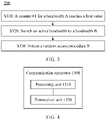
- FIG. 3 is a flowchart of another example of a random access method according to an embodiment of this application.
- a counter #1 for a bandwidth A (namely, an example of a first bandwidth) reaches a first value.
- S320 Switch an active bandwidth to a bandwidth B (namely, an example of a second bandwidth).
- S330 Initiate a random access procedure B (namely, an example of a first random access procedure).
- the terminal device when a terminal device operates on a bandwidth A and the counter # 1 reaches the first value, the terminal device switches the active bandwidth to the bandwidth B.
- the counter #1 is used to record an LBT failure count detected by the terminal device.
- the bandwidth may be a BWP.
- the active bandwidth may be an active BWP, and may also be referred to as an operating bandwidth, namely, a bandwidth used for communication. This application is not limited thereto.
- the first value is a maximum value of an LBT failure count that is specified in a protocol or preset in a system, or the first value is a maximum value of an LBT failure count that is configured by a network device for the terminal device.
- the terminal device After the active bandwidth of the terminal device is switched from the bandwidth A to the bandwidth B, the terminal device needs to perform random access initialization when initiating random access. This includes but is not limited to one or more of the following cases.
- the random access procedure A is stopped. After the active bandwidth is switched to the bandwidth B, the terminal device initiates the random access procedure B.
- the terminal device selects a random access procedure type to initiate the random access procedure B.
- the terminal device determines, based on a reference signal received power threshold, whether to initiate the two-step random access procedure or the four-step random access procedure on the bandwidth B.
- the terminal device determines that reference signal received power is greater than the threshold, the terminal device initiates the two-step random access procedure (where the random access procedure B is the two-step random access procedure); or when the terminal device determines that reference signal received power is less than or equal to the threshold, the terminal device initiates the four-step random access procedure (where the random access procedure B is the four-step random access procedure).
- the reference signal may be a downlink path loss reference signal.
- the terminal device initiates the random access procedure B by using a type of the ongoing random access procedure A on the bandwidth A. For example, if the random access procedure A is the two-step random access procedure, the terminal device initiates the two-step random access procedure on the bandwidth B (that is, the random access procedure B is the two-step random access procedure). For another example, the random access procedure A is the four-step random access procedure. In this case, the terminal device initiates the four-step random access procedure on the bandwidth B (that is, the random access procedure B is the four-step random access procedure).
- the foregoing two implementations may be combined.
- the type of the random access procedure B is the same as that of the random access procedure A.
- the type of the random access procedure B is determined based on the reference signal received power threshold.
- the terminal device When a resource of only one random access procedure is configured for the bandwidth B, the terminal device initiates random access based on the configured resource of the random access procedure. For example, when a resource of only the two-step random access procedure is configured for the bandwidth B, the terminal device initiates the two-step random access procedure on the bandwidth B (that is, the random access procedure B is the two-step random access procedure). For another example, when a resource of only the four-step random access procedure is configured for the bandwidth B, the terminal device initiates the four-step random access procedure on the bandwidth B (that is, the random access procedure B is the four-step random access procedure).
- the terminal device chooses, based on a type that is configured by the network device and that is of a random access procedure to be initiated after bandwidth switching is performed because the LBT failure count reaches the maximum count, to switch to a bandwidth including a resource of a random access procedure of this type, to initiate the random access procedure of this type.
- the network device configures, for the terminal device, a type of a random access procedure to be initiated after bandwidth switching is performed because the LBT failure count reaches the maximum count. That is, the network device configures a type of the random access procedure B for the terminal device, for example, a two-step random access procedure. After the LBT failure count reaches the maximum count, the terminal device switches to a bandwidth including a resource of the two-step random access procedure. That is, the terminal device determines that the bandwidth B includes the resource of the two-step random access procedure. In this case, the terminal device switches to the bandwidth B, and initiates the two-step random access procedure on the bandwidth B.
- the terminal device resets the counter #1, for example, resets the counter #1 to 0.
- This application is not limited thereto. This can avoid frequent bandwidth switching caused because the counter that records the LBT failure count keeps the first value.
- a name of the counter #1 may be represented as LBT_FAIL_COUNTER. This application is not limited thereto.
- the terminal device stops the timer #1, where the timer #1 is configured to maintain the counter #1. If no LBT detection failure occurs during running of the timer #1 (that is, a recorded value of the counter #1 is not increased), the counter #1 is reset.
- the timer #1 is started or restarted once. In other words, when the counter #1 is increased by 1, the timer #1 is started or restarted.
- a name of the timer may be an LBT failure detection timer (lbtFailureDetectionTimer). This application is not limited thereto. Case 4
- a timer #2 may be an LBT failure count timer (lbtFailureCountTimer). This application is not limited thereto.
- the terminal device flushes a Msg3 buffer of a four-step random access procedure. If needing to initiate the four-step random access procedure on the bandwidth B, the terminal device needs to re-assemble Msg3.
- the terminal device flushes a MsgA buffer of a two-step random access procedure. If needing to initiate the two-step random access procedure on the bandwidth B, the terminal device needs to re-assemble MsgA.
- the terminal device After switching to the bandwidth B, the terminal device keeps a Msg3 buffer of a four-step random access procedure. If needing to initiate the four-step random access procedure on the bandwidth B, the terminal device obtains a packet from the Msg3 buffer and sends the packet without reassembling the packet.
- the terminal device After switching to the bandwidth B, the terminal device keeps a MsgA buffer of a two-step random access procedure. If needing to initiate the two-step random access procedure on the bandwidth B, the terminal device obtains a packet from the MsgA buffer and sends the packet without reassembling the packet.
- the terminal device sets a preamble transmission counter (PREAMBLE_TRANSMISSION_COUNTER) to 1, so that a recorded value in a previous bandwidth does not affect normal communication on a bandwidth after switching.
- the preamble counter is used to record a preamble transmission count, and may be a preamble counter of a four-step random access procedure, or may be a preamble counter shared by a two-step random access procedure and the four-step random access procedure. If a preamble counter is independently used for a preamble in MsgA of the two-step random access procedure, the preamble counter is set to 1 after the terminal device switches to the bandwidth B.
- a name of the preamble counter may be MSGA_TRANSMISSION_COUNTER. This application is not limited thereto.
- the terminal device sets a preamble power ramping counter (PREAMBLE_POWER_RAMPING_COUNTER) to 1, so that a recorded value in a previous bandwidth does not affect normal communication on the bandwidth after the switching.
- the preamble power ramping counter is used to record a preamble power ramping count.
- the preamble power ramping counter may be a preamble power ramping counter of a four-step random access procedure, or may be a preamble power ramping counter shared by a two-step random access procedure and the four-step random access procedure. If a power ramping counter is independently used for a preamble in MsgA of the two-step random access procedure, the preamble power ramping counter is set to 1 after the terminal device switches to the bandwidth B.
- a name of the preamble power ramping counter may be MsgA_PREAMBLE_POWER_RAMPING_COUNTER. This application is not limited thereto.
- the terminal device sets a PUSCH power ramping counter in MsgA of a two-step random access procedure to 1, so that a recorded value in a previous bandwidth does not affect normal communication on the bandwidth after the switching.
- the power ramping counter is used to record a PUSCH power ramping count in MsgA.
- a name of the PUSCH power ramping counter may be MsgA_PUSCH_POWER_RAMPING_COUNTER. This application is not limited thereto.
- the terminal device sets a backoff indicator (backoff indicator, BI) to 0 ms. In this way, the terminal device can immediately initiate the random access procedure after switching to the bandwidth B, to reduce an access delay.
- backoff indicator backoff indicator
- the BI is used to indicate a range of time for which the terminal device needs to wait before retransmitting a preamble. If the terminal device does not receive an RAR within an RAR time window, or no preamble in a received RAR matches with the preamble sent by the terminal device, the terminal device determines that the RAR fails to be received. The terminal device needs to wait for a BI value before initiating random access. Waiting time is a random value selected from 0 to a waiting time interval specified by the BI. A name of the BI may be PREAMBLE BACKOFF. This application is not limited thereto. A two-step random access procedure and the four-step random access procedure may share a same configured BI.
- one BI configured by the network device for the terminal device is used for both the two-step random access procedure and the four-step random access procedure.
- the network device may separately configure, for the terminal device, a BI used for the four-step random access procedure and a BI used for the two-step random access procedure.
- the BI used for the two-step random access procedure and the BI used for the four-step random access procedure have a same or similar function. For brevity, details are not described herein.
- the preamble of the four-step random access procedure mentioned above is a random access preamble
- the preamble of the two-step random access is a random access preamble and/or a DMRS.
- FIG. 4 is a schematic block diagram of a communication apparatus according to an embodiment of this application.
- the communication apparatus 1500 may include a processing unit 1510 and a transceiver unit 1520.
- the communication apparatus 1500 may correspond to the terminal device in the foregoing method embodiments, for example, may be a terminal device or a chip disposed in the terminal device.
- the communication apparatus 1500 may correspond to the terminal device in the methods according to embodiments of this application, and the communication apparatus 1500 may include units configured to perform the method performed by the terminal device in the method 200 in FIG. 2 and the method 300 in FIG. 3 .
- the units in the communication apparatus 1500 and the foregoing other operations and/or functions are respectively used to implement corresponding procedures in the methods 200 and 300 in FIG. 2 and FIG. 3 .
- the transceiver unit 1520 may be configured to perform S210 in the method 200
- the processing unit 1510 may be configured to perform S220 and S230 in the method 200
- the processing unit 1510 may be configured to perform S310, S320, and S330 in the method 300.
- the transceiver unit 1520 in the communication apparatus 1500 may correspond to a transceiver 2020 in a terminal device 2000 shown in FIG. 5
- the processing unit 1510 in the communication apparatus 1500 may correspond to a processor 2010 in the terminal device 2000 shown in FIG. 5 .
- the transceiver unit 1520 in the communication apparatus 1500 may be implemented by using a communication interface (for example, a transceiver or an input/output interface), for example, may correspond to the transceiver 2020 in the terminal device 2000 shown in FIG. 5
- the processing unit 1510 in the communication apparatus 1500 may be implemented by using at least one processor, for example, may correspond to the processor 2010 in the terminal device 2000 shown in FIG. 5
- the processing unit 1510 in the communication apparatus 1500 may be implemented by using at least one logical circuit.
- the communication apparatus 1500 may further include the processing unit 1510.
- the processing unit 1510 may be configured to process instructions or data, to implement a corresponding operation.
- the communication apparatus 1500 may further include a storage unit.
- the storage unit may be configured to store instructions or data.
- the processing unit may invoke the instructions or the data stored in the storage unit, to implement a corresponding operation.
- the communication apparatus 1500 may correspond to the network device in the foregoing method embodiments, for example, may be a network device or a chip disposed in the network device.
- the communication apparatus 1500 may correspond to the network device in the method 200 according to embodiments of this application, and the communication apparatus 1500 may include a unit configured to perform the method performed by the network device in the method 200 in FIG. 2 .
- the units in the communication apparatus 1500 and the foregoing other operations and/or functions are respectively used to implement corresponding procedures in the methods 200 and 300 in FIG. 2 and FIG. 3 .
- the transceiver unit 1520 may be configured to perform S210 in the method 200. It should be understood that, a specific process in which each unit performs the foregoing corresponding step has been described in detail in the foregoing method embodiments. For brevity, details are not described herein again.
- the transceiver unit in the communication apparatus 1500 may correspond to the transceiver 3100 in the network device 3000 shown in FIG. 6
- the processing unit 1510 in the communication apparatus 1500 may correspond to the processor 3202 in the network device 3000 shown in FIG. 6 .
- the communication apparatus 1500 may further include the processing unit 1510.
- the processing unit 1510 may be configured to process instructions or data, to implement a corresponding operation.
- the communication apparatus 1500 may further include a storage unit.
- the storage unit may be configured to store instructions or data.
- the processing unit may invoke the instructions or the data stored in the storage unit, to implement a corresponding operation.
- the transceiver unit 1520 in the communication apparatus 1500 may be implemented by using a communication interface (for example, a transceiver or an input/output interface), for example, may correspond to the transceiver 3100 in the network device 3000 shown in FIG. 6
- the processing unit 1510 in the communication apparatus 1500 may be implemented by using at least one processor, for example, may correspond to the processor 3202 in the network device 3000 shown in FIG. 6
- the processing unit 1510 in the communication apparatus 1500 may be implemented by using at least one logical circuit.
- FIG. 5 is a schematic diagram of a structure of a terminal device 2000 according to an embodiment of this application.
- the terminal device 2000 may be used in the system shown in FIG. 1 , to perform a function of the terminal device in the foregoing method embodiments.
- the terminal device 2000 includes a processor 2010 and a transceiver 2020.
- the terminal device 2000 further includes a memory 2030.
- the processor 2010, the transceiver 2020, and the memory 2030 may communicate with each other through an internal connection path, to transfer a control signal and/or a data signal.
- the memory 2030 is configured to store a computer program.
- the processor 2010 is configured to invoke and run the computer program in the memory 2030, to control the transceiver 2020 to receive or send a signal.
- the terminal device 2000 may further include an antenna 2040, configured to send, by using a radio signal, uplink data or uplink control signaling output by the transceiver 2020.
- the processor 2010 and the memory 2030 may be integrated into one processing apparatus.
- the processor 2010 is configured to execute program code stored in the memory 2030 to implement the foregoing functions.
- the memory 2030 may alternatively be integrated into the processor 2010, or may be independent of the processor 2010.
- the processor 2010 may correspond to the processing unit in FIG. 4 .
- the transceiver 2020 may correspond to the transceiver unit in FIG. 4 .
- the transceiver 2020 may include a receiver (or referred to as a receiver machine or a receiver circuit) and a transmitter (or referred to as a transmitter machine or a transmitter circuit).
- the receiver is configured to receive a signal
- the transmitter is configured to transmit a signal.
- the terminal device 2000 shown in FIG. 5 can implement each process related to the terminal device in the method embodiments shown in FIG. 2 and FIG. 3 .
- Operations and/or functions of the modules in the terminal device 2000 are intended to implement the corresponding procedures in the foregoing method embodiments.
- the processor 2010 may be configured to perform an action that is implemented inside the terminal device and that is described in the foregoing method embodiments.
- the transceiver 2020 may be configured to perform a sending action by the terminal device for the network device or a receiving operation from the network device in the foregoing method embodiments. For details, refer to the descriptions in the foregoing method embodiments. Details are not described herein again.
- the terminal device 2000 may further include a power supply 2050, configured to supply power to various components or circuits in the terminal device.
- the terminal device 2000 may further include one or more of an input unit 2060, a display unit 2070, an audio circuit 2080, a camera 2090, a sensor 2100, and the like, and the audio circuit may further include a speaker 2082, a microphone 2084, and the like.
- FIG. 6 is a schematic diagram of a structure of a network device according to an embodiment of this application, for example, may be a schematic diagram of a related structure of the network device.
- the network device 3000 shown in FIG. 6 can implement each process related to the network device in the method embodiment shown in FIG. 2 .
- Operations and/or functions of modules in the network device 3000 are intended to implement corresponding procedures in the foregoing method embodiments.
- the network device 3000 shown in FIG. 6 is merely a possible architecture of the network device, and should not constitute any limitation on this application.
- the method provided in this application is applicable to a network device in another architecture, for example, a network device including a CU, a DU, and an AAU.
- a specific architecture of the network device is not limited in this application.
- An embodiment of this application further provides a processing apparatus, including a processor and an interface.
- the processor is configured to perform the method in any one of the foregoing method embodiments.
- the processing apparatus may be one or more chips.
- the processing apparatus may be a field programmable gate array (field programmable gate array, FPGA), an application-specific integrated chip (application-specific integrated circuit, ASIC), a system on chip (system on chip, SoC), a central processing unit (central processor unit, CPU), a network processor (network processor, NP), a digital signal processing circuit (digital signal processor, DSP), a microcontroller unit (micro controller unit, MCU), a programmable controller (programmable logic device, PLD), or another integrated chip.
- the steps in the foregoing methods can be implemented by using a hardware integrated logic circuit in the processor, or by using instructions in a form of software.
- the steps of the method disclosed with reference to embodiments of this application may be directly performed by a hardware processor, or may be performed by a combination of hardware and software modules in the processor.
- the software module may be located in a mature storage medium in the art, such as a random access memory, a flash memory, a read-only memory, a programmable read-only memory, an electrically erasable programmable memory, or a register.
- the storage medium is located in the memory.
- the processor reads information in the memory, and completes the steps of the foregoing method in combination with hardware of the processor. To avoid repetition, details are not described herein again.
- the processor in this embodiment of this application may be an integrated circuit chip, and has a signal processing capability.
- the steps in the foregoing methods can be implemented by using a hardware integrated logic circuit in the processor, or by using instructions in a form of software.
- the foregoing processor may be a general-purpose processor, a digital signal processor (DSP), an application-specific integrated circuit (ASIC), a field programmable gate array (FPGA) or another programmable logic device, a discrete gate or a transistor logic device, or a discrete hardware component.
- DSP digital signal processor
- ASIC application-specific integrated circuit
- FPGA field programmable gate array
- the processor may implement or perform the methods, steps, and logical block diagrams that are disclosed in embodiments of this application.
- the general-purpose processor may be a microprocessor, or the processor may be any conventional processor or the like.
- the steps of the method disclosed with reference to embodiments of this application may be directly performed by a hardware processor, or may be performed by a combination of hardware and software modules in the processor.
- the software module may be located in a mature storage medium in the art, such as a random access memory, a flash memory, a read-only memory, a programmable read-only memory, an electrically erasable programmable memory, or a register.
- the storage medium is located in the memory.
- the processor reads information in the memory, and completes the steps of the foregoing method in combination with hardware of the processor.
- the memory in embodiments of this application may be a volatile memory or a non-volatile memory, or may include both the volatile memory and the non-volatile memory.
- the non-volatile memory may be a read-only memory (read-only memory, ROM), a programmable read-only memory (programmable ROM, PROM), an erasable programmable read-only memory (erasable PROM, EPROM), an electrically erasable programmable read-only memory (electrically EPROM, EEPROM), or a flash memory.
- the volatile memory may be a random access memory (random access memory, RAM), used as an external cache.
- RAMs in many forms may be used, for example, a static random access memory (static RAM, SRAM), a dynamic random access memory (dynamic RAM, DRAM), a synchronous dynamic random access memory (synchronous DRAM, SDRAM), a double data rate synchronous dynamic random access memory (double data rate SDRAM, DDR SDRAM), an enhanced synchronous dynamic random access memory (enhanced SDRAM, ESDRAM), a synchlink dynamic random access memory (synchlink DRAM, SLDRAM), and a direct rambus random access memory (direct rambus RAM, DR RAM).
- static random access memory static random access memory
- DRAM dynamic random access memory
- DRAM dynamic random access memory
- SDRAM synchronous dynamic random access memory
- double data rate SDRAM double data rate SDRAM
- DDR SDRAM double data rate SDRAM
- ESDRAM enhanced synchronous dynamic random access memory
- synchlink dynamic random access memory synchlink dynamic random access memory
- direct rambus RAM direct rambus RAM
- this application further provides a computer program product.
- the computer program product includes computer program code.
- the computer program code When the computer program code is run on a computer, the computer is enabled to perform the methods in the embodiments shown in FIG. 2 and FIG. 3 .
- this application further provides a computer-readable medium.
- the computer-readable medium stores program code.
- the program code When the program code is run on a computer, the computer is enabled to perform the methods in the embodiments shown in FIG. 2 and FIG. 3 .
- this application further provides a system.
- the system includes the foregoing one or more terminal devices and the foregoing one or more network devices.
- the network device and the terminal device in the foregoing apparatus embodiments completely correspond to the network device and the terminal device in the method embodiments.
- a corresponding module or unit performs a corresponding step.
- the communication unit (the transceiver) performs a receiving or sending step in the method embodiments, and a step other than the sending step and the receiving step may be performed by the processing unit (the processor).
- the processing unit the processor
- All or some of the foregoing embodiments may be implemented by using software, hardware, firmware, or any combination thereof.
- all or some of the embodiments may be implemented in a form of a computer program product.
- the computer program product includes one or more computer instructions. When the computer instructions are loaded and executed on a computer, the procedures or functions according to the embodiments of this application are all or partially generated.
- the computer may be a general-purpose computer, a dedicated computer, a computer network, or another programmable apparatus.
- the computer instructions may be stored in a computer-readable storage medium, or may be transmitted from a computer-readable storage medium to another computer-readable storage medium.
- the computer instructions may be transmitted from a website, computer, server, or data center to another website, computer, server, or data center in a wired (for example, a coaxial cable, an optical fiber, or a digital subscriber line (digital subscriber line, DSL)) or wireless (for example, infrared, radio, or microwave) manner.
- the computer-readable storage medium may be any usable medium accessible by a computer, or a data storage device, such as a server or a data center, integrating one or more usable media.
- the usable medium may be a magnetic medium (for example, a floppy disk, a hard disk, or a magnetic tape), an optical medium (for example, a high-density digital video disc (digital video disc, DVD)), a semiconductor medium (for example, a solid-state drive (solid state disc, SSD)), or the like.
- a magnetic medium for example, a floppy disk, a hard disk, or a magnetic tape
- an optical medium for example, a high-density digital video disc (digital video disc, DVD)
- a semiconductor medium for example, a solid-state drive (solid state disc, SSD)
- the network device and the terminal device in the foregoing apparatus embodiments completely correspond to the network device and the terminal device in the method embodiments.
- a corresponding module or unit performs a corresponding step.
- the communication unit (the transceiver) performs a receiving or sending step in the method embodiments, and a step other than the sending step and the receiving step may be performed by the processing unit (the processor).
- the processing unit the processor
- ком ⁇ онент used in this specification are used to indicate a computer-related entity, hardware, firmware, a combination of hardware and software, software, or software being executed.
- the component may be but is not limited to a process that runs on a processor, a processor, an object, an executable file, an execution thread, a program, and/or a computer.
- a computing device and an application that runs on the computing device may be components.
- One or more components may reside within a process and/or an execution thread, and a component may be located on one computer and/or distributed between two or more computers.
- these components may be executed by various computer-readable media that store various data structures.
- the components may perform communication by using a local and/or remote process and based on, for example, a signal having one or more data packets (for example, data from two components interacting with another component in a local system, a distributed system, and/or across a network such as an internet interacting with another system by using the signal).
- a signal having one or more data packets (for example, data from two components interacting with another component in a local system, a distributed system, and/or across a network such as an internet interacting with another system by using the signal).
- the disclosed system, apparatus, and method may be implemented in other manners.
- the described apparatus embodiments are merely examples.
- the unit division is merely logical function division and may be other division during actual implementation.
- a plurality of units or components may be combined or integrated into another system, or some features may be ignored or not performed.
- the displayed or discussed mutual couplings or direct couplings or communication connections may be implemented by using some interfaces.
- the indirect couplings or communication connections between the apparatuses or units may be implemented in electronic, mechanical, or other forms.
- the units described as separate parts may or may not be physically separate, and parts displayed as units may or may not be physical units, may be located in one location, or may be distributed on a plurality of network units. A part or all of the units may be selected based on actual requirements to achieve the objectives of the solutions of embodiments.
- function units in embodiments of this application may be integrated into one processing unit, or each of the units may exist alone physically, or two or more units are integrated into one unit.
- all or some of the functions of the function units may be implemented by using software, hardware, firmware, or any combination thereof.
- all or some of the embodiments may be implemented in a form of a computer program product.
- the computer program product includes one or more computer instructions (programs).
- programs When the computer program instructions (programs) are loaded and executed on a computer, the procedures or functions according to embodiments of this application are all or partially generated.
- the computer may be a general-purpose computer, a dedicated computer, a computer network, or another programmable apparatus.
- the computer instructions may be stored in a computer-readable storage medium, or may be transmitted from a computer-readable storage medium to another computer-readable storage medium.
- the computer instructions may be transmitted from a website, computer, server, or data center to another website, computer, server, or data center in a wired (for example, a coaxial cable, an optical fiber, or a digital subscriber line (digital subscriber line, DSL)) or wireless (for example, infrared, radio, or microwave) manner.
- the computer-readable storage medium may be any usable medium accessible by a computer, or a data storage device, such as a server or a data center, integrating one or more usable media.
- the usable medium may be a magnetic medium (for example, a floppy disk, a hard disk, or a magnetic tape), an optical medium (for example, a DVD), a semiconductor medium (for example, a solid-state drive (solid state disk, SSD)), or the like.
- a magnetic medium for example, a floppy disk, a hard disk, or a magnetic tape
- an optical medium for example, a DVD
- a semiconductor medium for example, a solid-state drive (solid state disk, SSD)
- the functions When the functions are implemented in the form of a software function unit and sold or used as an independent product, the functions may be stored in a computer-readable storage medium. Based on such an understanding, the technical solutions of this application essentially, or the part contributing to the current technology, or some of the technical solutions may be implemented in a form of a software product.
- the computer software product is stored in a storage medium, and includes several instructions for instructing a computer device (which may be a personal computer, a server, or a network device) to perform all or some of the steps of the methods described in embodiments of this application.
- the foregoing storage medium includes: any medium that can store program code, such as a USB flash drive, a removable hard disk, a read-only memory (Read-Only Memory, ROM), a random access memory (Random Access Memory, RAM), a magnetic disk, or an optical disc.
- program code such as a USB flash drive, a removable hard disk, a read-only memory (Read-Only Memory, ROM), a random access memory (Random Access Memory, RAM), a magnetic disk, or an optical disc.
Landscapes
- Engineering & Computer Science (AREA)
- Computer Networks & Wireless Communication (AREA)
- Signal Processing (AREA)
- Mobile Radio Communication Systems (AREA)
Applications Claiming Priority (1)
| Application Number | Priority Date | Filing Date | Title |
|---|---|---|---|
| PCT/CN2019/116425 WO2021087929A1 (zh) | 2019-11-07 | 2019-11-07 | 一种随机接入的方法和装置 |
Publications (2)
| Publication Number | Publication Date |
|---|---|
| EP4048004A1 true EP4048004A1 (de) | 2022-08-24 |
| EP4048004A4 EP4048004A4 (de) | 2022-09-07 |
Family
ID=75849119
Family Applications (1)
| Application Number | Title | Priority Date | Filing Date |
|---|---|---|---|
| EP19951643.6A Pending EP4048004A4 (de) | 2019-11-07 | 2019-11-07 | Direktzugriffsverfahren und -vorrichtung |
Country Status (4)
| Country | Link |
|---|---|
| US (1) | US12452914B2 (de) |
| EP (1) | EP4048004A4 (de) |
| CN (1) | CN114731632B (de) |
| WO (1) | WO2021087929A1 (de) |
Cited By (1)
| Publication number | Priority date | Publication date | Assignee | Title |
|---|---|---|---|---|
| WO2024196495A1 (en) * | 2023-03-23 | 2024-09-26 | Qualcomm Incorporated | Channel access priority class (capc) for sidelink positioning |
Families Citing this family (6)
| Publication number | Priority date | Publication date | Assignee | Title |
|---|---|---|---|---|
| WO2021157969A1 (en) * | 2020-02-07 | 2021-08-12 | Samsung Electronics Co., Ltd. | Method and apparatus for random access preamble group selection in wireless communication system |
| GB2592061A (en) * | 2020-02-14 | 2021-08-18 | Nec Corp | Communication system |
| CN115915471A (zh) * | 2021-08-06 | 2023-04-04 | 华为技术有限公司 | 一种随机接入的方法及装置 |
| US11848731B2 (en) * | 2021-08-19 | 2023-12-19 | Qualcomm Incorporated | Techniques for adapting communications upon channel unreliability event |
| CN116456502A (zh) * | 2022-01-07 | 2023-07-18 | 华为技术有限公司 | 随机接入的方法和通信装置 |
| CN116471704B (zh) * | 2022-01-10 | 2026-02-10 | 大唐移动通信设备有限公司 | 发送物理随机接入信道prach的方法、装置及存储介质 |
Family Cites Families (9)
| Publication number | Priority date | Publication date | Assignee | Title |
|---|---|---|---|---|
| CN103200663B (zh) * | 2012-01-09 | 2016-03-09 | 华为技术有限公司 | 上行信道功率控制方法、装置及系统 |
| CN108811119B (zh) * | 2017-05-05 | 2021-06-08 | 华为技术有限公司 | 随机接入方法、设备和系统 |
| CN109495977A (zh) * | 2017-09-11 | 2019-03-19 | 华为技术有限公司 | 一种随机接入方法和设备 |
| EP3528561A1 (de) * | 2018-02-15 | 2019-08-21 | Panasonic Intellectual Property Corporation of America | Benutzergerät und basisstation mit beteiligung an verbesserten paging-verfahren |
| US10993283B2 (en) * | 2018-04-06 | 2021-04-27 | Apple Inc. | Enhancements on random access for NR-unlicensed |
| WO2020061866A1 (zh) * | 2018-09-26 | 2020-04-02 | 富士通株式会社 | Lbt监测失败的处理方法、装置和系统 |
| US10925093B2 (en) * | 2018-11-13 | 2021-02-16 | Mediatek Singapore Pte. Ltd. | Method and apparatus for detecting consistent listen before talk failure in mobile communications |
| EP4042817A1 (de) * | 2019-10-03 | 2022-08-17 | Telefonaktiebolaget LM Ericsson (publ) | Meldung von hören-vor-sprechen-fehlern in einem drahtlosen netzwerk |
| US12262232B2 (en) * | 2019-11-01 | 2025-03-25 | Telefonaktiebolaget Lm Ericsson (Publ) | Handling consistent uplink listen-before-talk failure |
-
2019
- 2019-11-07 WO PCT/CN2019/116425 patent/WO2021087929A1/zh not_active Ceased
- 2019-11-07 CN CN201980102068.1A patent/CN114731632B/zh active Active
- 2019-11-07 EP EP19951643.6A patent/EP4048004A4/de active Pending
-
2022
- 2022-05-09 US US17/740,053 patent/US12452914B2/en active Active
Cited By (1)
| Publication number | Priority date | Publication date | Assignee | Title |
|---|---|---|---|---|
| WO2024196495A1 (en) * | 2023-03-23 | 2024-09-26 | Qualcomm Incorporated | Channel access priority class (capc) for sidelink positioning |
Also Published As
| Publication number | Publication date |
|---|---|
| US20220279591A1 (en) | 2022-09-01 |
| CN114731632B (zh) | 2025-09-05 |
| EP4048004A4 (de) | 2022-09-07 |
| WO2021087929A1 (zh) | 2021-05-14 |
| CN114731632A (zh) | 2022-07-08 |
| US12452914B2 (en) | 2025-10-21 |
Similar Documents
| Publication | Publication Date | Title |
|---|---|---|
| US12452914B2 (en) | Random access method and apparatus | |
| US11564255B2 (en) | Method and apparatus for processing LBT monitoring failures and system | |
| JP7332750B2 (ja) | ビーム障害回復に対するランダムアクセスのための方法およびデバイス | |
| US11843441B2 (en) | Mobility robustness optimization (MRO) for new radio | |
| US12356467B2 (en) | Random access method and device and communication system | |
| US12250732B2 (en) | Methods and devices for transmitting and receiving random access response and communication system | |
| TW202008810A (zh) | 隨機接入的方法、終端設備和網路設備 | |
| US20220078849A1 (en) | Method and device for reporting random access statistical information | |
| US20210289560A1 (en) | Method for selecting random access procedure, terminal device and network device | |
| EP4080972B1 (de) | Kommunikationsverfahren und -vorrichtung | |
| EP3911104A1 (de) | Direktzugriffsverfahren und -vorrichtung | |
| WO2021217363A1 (zh) | 无线通信方法、终端设备和网络设备 | |
| WO2021077343A1 (zh) | 无线通信方法和终端设备 | |
| WO2020020352A1 (zh) | 随机接入方法、终端设备和网络设备 | |
| CN118451772A (zh) | 通信方法和设备 | |
| JP2022510620A (ja) | ランダムアクセス方法及び装置 | |
| US12336011B2 (en) | Communication method and apparatus | |
| US20220159685A1 (en) | Data transmission method and apparatus | |
| WO2021156796A1 (en) | Methods for controlling channel access mode in unlicensed spectrum | |
| US20240349358A1 (en) | Method for processing random access procedure, terminal device, and network device | |
| WO2025160747A1 (zh) | 传输方式的转换方法、装置、设备、介质和程序产品 | |
| WO2021062639A1 (zh) | 随机接入方法、装置和通信系统 | |
| KR20220006538A (ko) | 사이드 링크 모니터링 방법 및 디바이스 |
Legal Events
| Date | Code | Title | Description |
|---|---|---|---|
| STAA | Information on the status of an ep patent application or granted ep patent |
Free format text: STATUS: THE INTERNATIONAL PUBLICATION HAS BEEN MADE |
|
| PUAI | Public reference made under article 153(3) epc to a published international application that has entered the european phase |
Free format text: ORIGINAL CODE: 0009012 |
|
| STAA | Information on the status of an ep patent application or granted ep patent |
Free format text: STATUS: REQUEST FOR EXAMINATION WAS MADE |
|
| REG | Reference to a national code |
Ref country code: DE Ref legal event code: R079 Free format text: PREVIOUS MAIN CLASS: H04W0072040000 Ipc: H04W0074080000 |
|
| 17P | Request for examination filed |
Effective date: 20220518 |
|
| AK | Designated contracting states |
Kind code of ref document: A1 Designated state(s): AL AT BE BG CH CY CZ DE DK EE ES FI FR GB GR HR HU IE IS IT LI LT LU LV MC MK MT NL NO PL PT RO RS SE SI SK SM TR |
|
| A4 | Supplementary search report drawn up and despatched |
Effective date: 20220809 |
|
| RIC1 | Information provided on ipc code assigned before grant |
Ipc: H04W 76/20 20180101ALI20220803BHEP Ipc: H04L 5/00 20060101ALI20220803BHEP Ipc: H04W 74/08 20090101AFI20220803BHEP |
|
| DAV | Request for validation of the european patent (deleted) | ||
| DAX | Request for extension of the european patent (deleted) | ||
| STAA | Information on the status of an ep patent application or granted ep patent |
Free format text: STATUS: EXAMINATION IS IN PROGRESS |
|
| 17Q | First examination report despatched |
Effective date: 20250114 |