EP4049476B1 - Dispositif pour tester une station de base - Google Patents
Dispositif pour tester une station de base Download PDFInfo
- Publication number
- EP4049476B1 EP4049476B1 EP19839473.6A EP19839473A EP4049476B1 EP 4049476 B1 EP4049476 B1 EP 4049476B1 EP 19839473 A EP19839473 A EP 19839473A EP 4049476 B1 EP4049476 B1 EP 4049476B1
- Authority
- EP
- European Patent Office
- Prior art keywords
- protocol
- test case
- namespace
- radio units
- layer
- Prior art date
- Legal status (The legal status is an assumption and is not a legal conclusion. Google has not performed a legal analysis and makes no representation as to the accuracy of the status listed.)
- Active
Links
Images




Classifications
-
- H—ELECTRICITY
- H04—ELECTRIC COMMUNICATION TECHNIQUE
- H04W—WIRELESS COMMUNICATION NETWORKS
- H04W88/00—Devices specially adapted for wireless communication networks, e.g. terminals, base stations or access point devices
- H04W88/08—Access point devices
- H04W88/085—Access point devices with remote components
-
- H—ELECTRICITY
- H04—ELECTRIC COMMUNICATION TECHNIQUE
- H04W—WIRELESS COMMUNICATION NETWORKS
- H04W24/00—Supervisory, monitoring or testing arrangements
- H04W24/08—Testing, supervising or monitoring using real traffic
-
- H—ELECTRICITY
- H04—ELECTRIC COMMUNICATION TECHNIQUE
- H04L—TRANSMISSION OF DIGITAL INFORMATION, e.g. TELEGRAPHIC COMMUNICATION
- H04L43/00—Arrangements for monitoring or testing data switching networks
- H04L43/50—Testing arrangements
-
- H—ELECTRICITY
- H04—ELECTRIC COMMUNICATION TECHNIQUE
- H04W—WIRELESS COMMUNICATION NETWORKS
- H04W24/00—Supervisory, monitoring or testing arrangements
- H04W24/06—Testing, supervising or monitoring using simulated traffic
Definitions
- the current disclosure relates to testing and simulation devices, and more particularly, in relation to testing devices used for testing base stations and other radio equipment associated with cellular networks.
- Current testing systems used for testing of front haul networks are often software-based test systems and utilize software for test case creation, test case analysis, etc. Therefore, for configuration of a test case, a plurality of parameter lists are relied upon.
- US 2004/068681 A1 discloses such a software-based test system and uses a XML protocol description to generate a packet for a multi-layer protocol stack.
- the current disclosure relates to testing and simulation systems / devices used for testing base stations and other radio equipment used in cellular networks. Often in these test cases, a plurality of communication operations are simulated amongst the various software/hardware components of the base station to ensure that these components are compatible with each other.
- testing device for testing a base station with radio units and a baseband unit.
- These testing devices often include a configuration module to generate various test case configurations in relation to various test scenarios in relation to the radio units and the baseband unit.
- test configurations include a plurality of parameters used by the testing devices for simulation of the test cases. These parameters are associated with the type of packets to be simulated in the test case, payload of the packets, frequency of the packets, protocol stack associated with the packet, etc.
- the parameters associated with the protocol stack define the various protocols of the protocol stack which are layered one other to process packets according to the protocol specifications. Examples of such protocols include IP protocol (on a network layer), UDP protocol (on a transport layer), TCP protocol (on a transport layer), etc.
- streams allow users to define the communication parameters of a set of packets belonging to a single stream in a single declaration. For example, for a particular stream (i.e. stream 1), one or more parameters associated with a protocol stack of the packets belonging to stream 1 may be defined or declared using a stream level protocol parameter.
- the current disclosure proposes a device for testing a base station.
- the base station comprises one or more radio units and a baseband unit connectable to the one or more radio units.
- the device comprises a configuration module configured to generate a first test case configuration associated with the radio units and the baseband unit.
- the first test case configuration includes a first protocol stack comprising a first protocol associated with a first layer and a second protocol associated with a second layer.
- the device is characterized in that a first set of protocol parameters associated with the first protocol is in a first namespace and a second set of protocol parameters associated with the second protocol is in a second namespace wherein the second namespace distinct from the first name space.
- protocol parameters of each protocol are in a separate namespace, making modification to a specific protocol parameter does not require the user to check protocol parameters of other protocols for consistency.
- At least one parameter from the first set of protocol parameters associated with the first protocol includes a value indicative of the second protocol.
- the second protocol immediately succeeds the first protocol in the first protocol stack. This helps in checking if the namespace as specified by the user for the second protocol is inline with the value as specified in the first protocol.
- a name of each parameter from the first set of protocol parameters is based on the first protocol and a name of each parameter from the second set of protocol parameters is based on the second protocol. This helps in easily identifying which protocol, the corresponding parameter is related to. Accordingly, there is less need for proprietary parameter names and helps in improving the usability of the testing device.
- the device for testing the base station further comprises a simulation module to simulate one or more operations between the one or more radio units and the baseband unit in accordance with the first test case configuration.
- a simulation module to simulate one or more operations between the one or more radio units and the baseband unit in accordance with the first test case configuration. This allows for testing of software aspects of the base station without requiring expensive equipment.
- the first protocol stack is associated with a first stream
- the simulation module is configured to generate a plurality of packets based on the first stream, such that each packet from the plurality of packets includes a packet header based on the first protocol stack.
- the first test case configuration includes a second protocol stack comprising a third protocol associated with the first layer and a fourth protocol associated with the second layer.
- the second protocol stack is associated with a second stream. Accordingly, two or more streams may be configured according to the invention for simulation of multiple types of packets.
- the configuration module includes a graphical user interface (GUI) for receiving a plurality of values associated with the first and second set of protocol parameters associated with the first and second protocols of the first protocol stack.
- GUI graphical user interface
- the current invention discloses a method for testing a base station.
- the method comprises generating a first test case configuration associated with the one or more radio units and the baseband unit and simulating one or more operations between the one or more radio units and the baseband unit. Simulating the one or more operations comprising generating one or more packets based on the first test case configuration, each packet from the one or more packets comprising a packet header based on the first protocol stack.
- the first set of protocol parameters associated with the first protocol are in a first namespace and the second set of protocol parameters associated with the second protocol are in a second namespace, the second namespace distinct from the first name space.
- generating the first test case configuration comprises receiving a plurality of values associated with the first and second set of protocol parameters associated with the first and second protocols using a graphical user interface (GUI).
- GUI graphical user interface
- the current invention discloses a test case configuration repository one or more test case configurations including the first test case configuration.
- the current invention discloses a non-transitory storage medium for testing a base station.
- the non-transitory storage medium has a plurality of machine-readable instructions stored therein, which when executed by one or more processors, cause the one or more processors to generate a first test case configuration associated with the one or more radio units and the baseband unit, wherein the first test case configuration includes a first protocol stack comprising a first protocol associated with a first layer and a second protocol associated with a second layer; and simulate one or more operations between the one or more radio units and the baseband unit, wherein simulating the one or more operations comprising generating one or more packets based on the first test case configuration, each packet from the one or more packets comprising a packet header based on the first protocol stack; wherein a first set of protocol parameters associated with the first protocol are in a first namespace and wherein a second set of protocol parameters associated with the second protocol are in a second namespace, the second namespace distinct from the first name space.
- Figure 1 illustrates an example system 100 for testing a base station 120.
- the base station 120 may be connected to a cellular network (not shown in figure 1 ) comprising of other base stations and the network core.
- the base station 120 comprises a central unit 130, one or more distributed units (shown in figure 1 as distributed unit 140), and one or more radio units (shown in figure 1 as radio units 155, 165).
- the central unit 130 and the distributed unit 140 is jointly referred to as baseband unit 125.
- the central unit 130 processes non-real time protocols and services, and the distributed unit 140 processes physical level protocols and latency-critical real time services.
- the radio units carry out link layer and physical layer signal processing when transmitting and receiving radio signals.
- the connections between the various radio units (155, 165) and the distributed unit 140 are based ethernet based protocol stacks and focus on various aspects in relation to the radio units such as antenna data, beamforming control, management, and synchronization.
- Examples of such protocol stacks include O-RAN with eCPRI or IEEE1914.3 (RoE) as antenna data transport layer and optional UDP over IPv4 or IPv6 as the routable transport layer, etc.
- base station 120 may be a part of a radio access network of a wireless communication system, e.g. a cellular communication system.
- the wireless communication system may operate according to specifications of Universal Mobile Telecommunication System or any one of its evolution versions, e.g. Long-Term Evolution (LTE) or LTE-Advanced, a second-generation mobile telecommunication system such as Global System for Mobile Communications, or a system operating strictly on unlicensed frequency bands.
- LTE Long-Term Evolution
- LTE-Advanced LTE-Advanced
- a second-generation mobile telecommunication system such as Global System for Mobile Communications
- An example of a system operating on the unlicensed bands is IEEE 802.11 (Wi-Fi) and, as a consequence, the base station may be considered broadly as an access point providing a terminal device with wireless access to other networks such as the Internet.
- Wi-Fi IEEE 802.11
- the system 100 comprises a testing device 110 for testing and simulation of various operations amongst the components of the base station 120.
- the testing device 110 is be connected to one or more interfaces of the base station 120 so as to test one or more features or performance of the base station 120. Examples of the interfaces include an interface between the baseband unit 125 and the radio units (155, 165), the interface between the base band unit 125 and the core network, etc.
- the base station 120 may comprise physical connectors to which the testing device 110 may be connected in order to test the operation and performance of the base station.
- Such physical connectors may include BNC connectors, optical connectors such as LC, SMA connectors, RJ45 connectors, small form-factor (SFP or SFP+) connectors, quad SFP(+) connectors etc.
- the testing device 110 may comprise a network interface connecting the testing the device 110 to a communication network (not shown in figure 1 ).
- the communication network may comprise a local area network (LAN), a wide area network (WAN), and/or the Internet.
- the network interface may enable remote controlling of the testing device, connection with a remote database storing test programs and/or test results, and/or communication between two or more mutually remote testing devices.
- a user interface device such as a personal computer or a laptop computer may be connected to the communication network and configured to control the testing of the base station.
- the testing device 110 is configured to generate a plurality of packets to be transmitted between the various components of the base station 120.
- the testing device 110 includes a configuration module which is configured to generate one or more test case configurations.
- Each test case configuration from the one or more test case configurations includes a plurality of parameters in accordance to which the packets are generated by a simulation module of the testing device 110.
- the configuration module includes a graphical user interface for receiving a plurality of values for the plurality of parameters of the test case configurations.
- Figure 2 illustrates a test case configuration 200 (also referred to as first test case configuration 200) for testing the base station 120.
- the first test case configuration 200 is generated by the configuration module based one or more user inputs.
- the first test case configuration 200 includes a first protocol stack associated with a first stream (also referred to as stream 1 in figure 2 ).
- the first protocol stack as defined in the configuration 200 is used by the simulation module for generating packets associated with the first stream. For example, the packet headers of the packets belonging to the first stream are generated in accordance with the first protocol stack associated with the first stream.
- the first protocol stack comprises a plurality of protocols running concurrently for processing protocol data units (such as datagrams, data frames, packets, etc.) in accordance with the specifications of each protocol of the protocol stack.
- protocol data units such as datagrams, data frames, packets, etc.
- Each protocol from the protocol stack is associated with a layer of an interconnection suite (similar to the layers of OSI interconnection model or TCP/IP interconnection model).
- Each protocol is stacked on top of a preceding protocol in the protocol stack. This means that a data unit received is first processed by the preceding protocol and then by the succeeding protocol. Similarly, a data unit to be transmitted is first processed by the succeeding protocol and then by the preceding protocol.
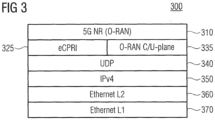
- An example first protocol stack is illustrated in figure 3 .
- Figure 3 illustrates (a diagrammatic representation) of the first protocol stack 300.
- the first protocol stack 300 comprises six protocols stacked on each other to form the protocol stack 300.
- the first layer of the protocol stack 300 is based on ethernet protocol (shown as protocol block 370).
- the second layer of the protocol stack 300 is based on ethernet protocol (shown as protocol block 360).
- the third layer of the protocol stack 300 is based on internet protocol (IP) (shown as protocol block 350).
- the fourth layer of the protocol stack 300 is based on user datagram protocol (UDP) (shown as protocol block 340).
- the fifth layer of the protocol stack 300 is based on eCPRI (shown as protocol block 325) and O-RAN C/U plane specifications (shown as protocol block 335).
- the sixth layer of the first protocol stack 300 is based on the 5G New Radio specifications (shown as protocol block 310).
- the protocols of the first protocol stack 300 and associated protocol parameters are defined in the test case configuration 200.
- each set of protocol parameters associated with a corresponding protocol is in a separate and distinct namespace from other sets of protocol parameters associated with the other protocols of the protocol stack 300.
- Namespace herein refers to a logical area accommodating a plurality of parameter names such that two parameters having the same parameter name can co-exist in two separate namespaces without conflict.
- each namespace provides a logical context in which those parameters may exist without overlapping with parameters in other namespaces.
- each namespace associated with the corresponding protocol is specified as a token in parameter name of each protocol parameter associated with the corresponding protocol.
- parameters associated with the IP protocol on layer 3 are defined in code segment 220 of the test case configuration 200.
- the protocol parameters associated with IP protocol (such as source IP address, destination IP address, etc.,) are in a first namespace associated with the IP protocol (IPv4 in the current example). Accordingly, each protocol parameter name includes a 'IPv4' token in its name to indicate the first namespace associated with the IPv4 protocol.
- parameters associated with the UDP protocol on layer 4 are defined in code segment 230 of the test case configuration 200.
- the protocol parameters associated with UDP protocol (such as source UDP port, destination UDP port, etc.,) are in a second namespace associated with the UDP protocol. Accordingly, each protocol parameter name includes a 'UDP' token in its name to indicate the second namespace associated with the UDP protocol.
- a parameter indicative of version of the IP protocol can have the parameter name ⁇ version' along with the parameter indicative of the version of the UDP protocol without any conflict.
- the parameter name of the parameter indicative of version of the IP protocol includes the namespace token 'IPv4' (i.e. stream1.IPv4.version) and similarly, the parameter name of the parameter indicative of version of the UDP protocol includes the namespace token 'UDP' (i.e. stream1.UDP.version).
- parameters associated with the eCRPI protocol on layer 5 are defined in code segment 240 of the test case configuration 200.
- the protocol parameters associated with eCPRI protocol (such as type, RTC_ID, etc.,) are in a third namespace associated with the eCPRI protocol. Accordingly, each protocol parameter name includes a 'eCPRI' token in its name to indicate the third namespace associated with the eCPRI protocol.
- parameters associated with the O-RAN NR protocol on layer 6 i.e. protocol block 310) are defined in code segment 250 of the test case configuration 200.
- the protocol parameters associated with O-RAN NR protocol are in a fourth namespace associated with the O-RAN NR protocol. Accordingly, each protocol parameter name includes a 'ORAN' token in its name to indicate the fourth namespace associated with the O-RAN NR protocol.
- parameters associated with the ethernet protocol on layer 2 i.e. protocol block 360
- the protocol parameters associated with ethernet protocol are in a fourth namespace associated with the ethernet protocol.
- At least one parameter from the first set of protocol parameters associated with the first protocol includes a value indicative of the second protocol.
- the second protocol is a layer immediately succeeding the first protocol in the first protocol stack.
- the ethernet protocol (protocol block 360) includes a parameter 'ethertype' which includes a value indicative of the next protocol 'IPv4' as shown on line 215.
- the IP protocol (protocol block 350) includes a parameter 'protocol' which includes a value indicative of the next protocol 'UDP' as shown on line 225.
- the UDP protocol (protocol block 340) includes a parameter 'NextHeader' which includes a value indicative of the next protocol 'eCPRI' as shown on line 235.
- the configuration module is configured to set the following namespace of the succeeding protocol.
- the first test case configuration 200 is used by the simulation module of the testing device 110 to simulate the one or more operations between the radio units (155, 165) and the baseband unit (125).
- the one or more operations include simulation of transmission and reception of packets in relation to the base station 120.
- the simulation module generates a plurality of packets in accordance with the first stream as defined in the first test case configuration 200.
- a plurality of stream properties may be defined in relation to first stream in the first test case configuration 200.
- Some examples of the stream properties include stream direction (indicative of whether a stream of packets is in the Uplink direction i.e. up from the UE towards core network, or Downlink direction i.e.
- stream types include Control Plane Downlink (CP_DL), Control Plane Uplink (CP_UL), User Plane DL (UP_DL), and User Plane Uplink (UP_UL) streams for carrying antenna data between O-DU and O-RU.
- CP_DL Control Plane Downlink
- CP_UL Control Plane Uplink
- UP_DL User Plane DL
- UP_UL User Plane Uplink
- each packet of the first stream has a packet header format 400 in accordance to the protocol stack 300.
- the packet header format 400 includes ethernet header comprising a plurality of sections (for example destination address section 410, source address section 420, ethertype section 430).
- the ethernet header is associated with the ethernet protocol (i.e. protocol block 360).
- the packet header format 400 includes an IP-UDP header (shown as IP-UDP sections 440-450).
- the IP-UDP header is associated with the IP and UDP protocols of the first protocol stack 300 (i.e. protocol blocks 350 and 340).
- the packet header format 400 includes an eCPRI header (shown as section 460).
- the eCPRI header is associated with the eCPRI protocol of the first protocol stack 300 (i.e. protocol block 325).
- the packet header format 400 includes an O-RAN header (shown as section 470).
- the O-RAN header is associated with the O-RAN 5G NR protocols of the first protocol stack 300 (i.e. protocol blocks 310).
- the first test case configuration 200 includes a plurality of streams and a plurality of corresponding protocol stacks. Accordingly, the first test case configuration 200 may include a second stream and a second protocol stack.
- the second protocol stack may include the same number of layers as the first protocol stack while having different protocols from the first protocol stack 300. For example, instead of UDP protocol in the fourth layer, the second protocol stack may include TCP protocol (also known as third protocol) in the fourth layer. Similarly, instead of IPv4 protocol in the third layer, the second protocol stack may include IPv6 (also known as fourth protocol) in the third layer.
- Figure 5 illustrates a method 500 for testing a base station 110.
- the method 500 is realized by the testing device 110.
- the method 500 comprises generating (shown in figure 5 as step 510) by the configuration module of the device 110, the first test case configuration 200 associated with the one or more radio units (155, 165) and the baseband unit 125.
- the first test case configuration 200 includes the first protocol stack 300.
- the first protocol stack 300 comprises two or more protocols including a first protocol (for example protocol block 325) associated with a first layer and a second protocol (for example protocol block 310) associated with a second layer.
- the configuration module includes a graphical user interface (GUI) for receiving a plurality of values associated with first and second set of protocol parameters associated with the first and second protocols.
- GUI graphical user interface
- the simulation module of the device 110 simulates one or more operations between the one or more radio units and the baseband unit. For simulating the one or more operations, the simulation module generates one or more packets based on the first test case configuration.
- each packet of one or more packets of the first stream comprise a packet header based on the first protocol stack 300.
- the first set of protocol parameters associated with the first protocol 325 are in a first namespace 240 and similarly, the second set of protocol parameters associated with the second protocol 310 are in the second namespace 250, the second namespace 250 being distinct from the first name space 240.
- the present disclosure can take a form of a computer program product comprising program modules accessible from computer-usable or computer-readable medium storing program code for use by or in connection with one or more computers, processing units, or instruction execution system.
- the configuration module may be realized across one or more devices.
- the testing device 600 includes an Input/Output (I/O) module 640, one or more processors 630 and a non-transitory storage medium 670.
- the non-transitory storage medium 670 contains a plurality of instructions 660 for testing the base station 120.
- the configuration module 610 and the simulation module 620 are realized by the one or more processors 630.
- the one or more processors Upon execution of the instructions 660, the one or more processors to generate a first test case configuration associated with the one or more radio units and the baseband unit, wherein the first test case configuration includes a first protocol stack comprising a first protocol associated with a first layer and a second protocol associated with a second layer; and simulate one or more operations between the one or more radio units and the baseband unit, wherein simulating the one or more operations comprising generating one or more packets based on the first test case configuration, each packet from the one or more packets comprising a packet header based on the first protocol stack; wherein a first set of protocol parameters associated with the first protocol are in a first namespace and wherein a second set of protocol parameters associated with the second protocol are in a second namespace, the second namespace distinct from the first name space.
- testing device 600 may be a software component and may be realized within the base station 120 or any other management device in the network.
- one or more components of the base station 120 may be actual physical components or logical simulations simulated with the testing device 110 or any other testing/simulation device connected to the testing device 110.
- the one or more radio units (155, 165) may be simulated on another testing device connected to the baseband unit 125 and the testing device 110.
- the non-transitory storage medium 670 includes configuration repository 650.
- the configuration repository 670 (also referred to as test case configuration repository 650) includes one or more test case configurations generated by the configuration module 610.
- the one or more test case configurations includes the first test case configuration 200.
- a test personnel can select a test case configuration from the test case configurations to be tested using the simulation module 620 for testing the base station 120.
- a computer-usable or computer-readable non-transitory storage medium can be any apparatus that can contain, store, communicate, propagate, or transport the program for use by or in connection with the instruction execution system, apparatus, or device.
- the medium can be electronic, magnetic, optical, electromagnetic, infrared, or semiconductor system (or apparatus or device) or a propagation mediums in and of themselves as signal carriers are not included in the definition of physical computer-readable medium include a semiconductor or solid state memory, magnetic tape, a removable computer diskette, random access memory (RAM), a read only memory (ROM), a rigid magnetic disk and optical disk such as compact disk read-only memory (CD-ROM), compact disk read/write, and DVD.
- RAM random access memory
- ROM read only memory
- CD-ROM compact disk read-only memory
- DVD compact disk read/write
Landscapes
- Engineering & Computer Science (AREA)
- Computer Networks & Wireless Communication (AREA)
- Signal Processing (AREA)
- Mobile Radio Communication Systems (AREA)
Claims (10)
- Dispositif (110) pour tester une station (120) de base comprenant une ou plusieurs unités (155, 165) radio et une unité (125) à bande de base pouvant être reliée à la une ou
au plusieurs unités (155, 165) radio, le dispositif (110) comprenant :a. un module (610) de configuration configuré pour produire une première configuration (200) de cas de test associée à la une ou plusieurs unités (155, 165) radio et à l'unité (125) à bande de base, dans lequel la première configuration (200) de cas de test comprend une première pile (300) de protocoles comprenant un premier protocole (325) associé à une première couche et un deuxième protocole (310) associé à une deuxième couche ;le dispositif (110) étant caractérisé en ce qu'un premier ensemble de paramètres de protocole associé au premier protocole (325) est dans un deuxième espace (240) de dénomination et dans lequel un deuxième ensemble de protocoles associé au deuxième protocole (310) est dans un deuxième espace (250) de dénomination, le deuxième espace (250) de dénomination étant distinct du premier espace (240) de dénomination,dans lequel au moins un paramètre (245) du premier ensemble de paramètres de protocole associé au premier protocole (325) comprend une valeur indicatrice du deuxième protocole (310) et dans lequel le deuxième protocole (310) est empilé au-dessus du premier protocole (325) dans la première pile (300) de protocoles. - Dispositif (110) suivant la revendication 1, dans lequel la dénomination de chaque paramètre du premier ensemble de paramètres de protocole repose sur le premier protocole (325) et la dénomination de chaque paramètre du deuxième ensemble de paramètres de protocole repose sur le deuxième protocole (310).
- Dispositif (110) suivant la revendication 1, dans lequel le dispositif (110) comprend en outre un module (620) de simulation pour simuler une ou plusieurs opérations entre la une ou les plusieurs unités (155, 165) radio et l'unité (125) à bande de base en accord avec la première configuration (200) de cas de test.
- Dispositif (110) suivant la revendication 1, dans lequel la première configuration (200) de cas de test comprend une deuxième pile de protocoles associée à un deuxième flux, la deuxième pile de protocoles comprenant un troisième protocole associé à la première couche et un quatrième protocole associé à la deuxième couche.
- Dispositif (110) suivant la revendication 1, dans lequel le module (610) de configuration comprend une interface (GUI) d'utilisateur graphique pour recevoir une pluralité de valeurs associées au premier et au deuxième jeux de paramètres de protocole associés au premier ou au deuxième protocoles (325, 310).
- Dispositif (110) suivant la revendication 1, dans lequel une dénomination de chaque paramètre du premier ensemble de paramètres de protocole comprend un jeton d'espace de dénomination associé au premier protocole (325).
- Dispositif (110) suivant la revendication 3, dans lequel la première pile (300) de protocoles est associée à un premier flux, dans lequel le module (620) de simulation est configuré pour produire une pluralité de paquets sur la base du premier flux, chaque paquet de la pluralité de paquets comprend une entête (400) de paquet sur la base de la première pile (300) de protocoles.
- Procédé (500) pour tester une station (110) de base comprenant une ou plusieurs unités (155, 165) radio et une unité (125) à bande de base pouvant être reliée à la une ou aux plusieurs unités (155, 165) radio, le procédé (500) comprenant :a. produire (510) une première configuration (200) de cas de test associée à la une ou aux plusieurs unités (155, 165) radio et à l'unité (125) à bande de base, dans lequel la première configuration (200) de cas de test comprend une première pile (300) de protocoles comprenant un premier protocole (325) associé à une première couche et un deuxième protocole (310) associé à une deuxième couche ; etb. simuler (520) une ou plusieurs opérations entre la une ou les plusieurs unités (155, 165) radio et l'unité (125) à bande de base, dans lequel simuler la une ou les plusieurs opérations comprend produire un ou plusieurs paquets sur la base de la première configuration (200) de cas de test, chaque paquet du un ou des plusieurs paquets comprenant une entête (400) de paquet sur la base de la première pile (300) de protocoles ;dans lequel un premier ensemble de paramètres de protocole associé au premier protocole (325) est dans un deuxième espace (240) de dénomination et dans lequel un deuxième ensemble de protocoles associé au deuxième protocole (310) est dans un deuxième espace (250) de dénomination, le deuxième espace (250) de dénomination étant distinct du premier espace (240) de dénomination et dans lequel au moins un paramètre (245) du premier ensemble de paramètres de protocole associé au premier protocole (325) comprend une valeur indicatrice du deuxième protocole (310) et dans lequel le deuxième protocole (310) est empilé au-dessus du premier protocole (325) dans la première pile (300) de protocoles.
- Procédé (500) suivant la revendication 8, dans lequel produire (510) la première configuration (200) de cas de test comprend recevoir une pluralité de valeurs associées au premier et au deuxième ensembles de paramètres de protocole associées au premier et au deuxième protocoles (325, 310) en utilisant une interface (GUI) d'utilisateur graphique.
- Support (670) de mémoire non transitoire pour tester une station (110) de base comprenant une ou plusieurs unités (155, 165) radio et une unité (125) à bande de base pouvant être reliée à la une ou aux plusieurs unités (155, 165) radio, le support (670) de mémoire non transitoire ayant des instructions (660), déchiffrables par machine, qui y sont mises en mémoire et qui, lorsqu'elles sont exécutées par un ou par plusieurs processeurs (630), font que le un ou que les plusieurs processeurs (630) :a. produisent une première configuration (200) de cas de test associée à la une ou aux plusieurs unités (155, 165) radio et l'unité (125) à bande de base, dans lequel la première configuration (200) de cas de test comprend une première pile (300) de protocoles comprenant un premier protocole (325) associé à une première couche et un deuxième protocole (310) associé à une deuxième couche ; etb. simulent une ou plusieurs opérations entre la une ou les plusieurs unités (155, 165) radio et l'unité (125) à bande de base, dans lequel simuler la une ou les plusieurs opérations comprend produire un ou plusieurs paquets sur la base de la première configuration (200) de cas de test, chaque paquet du un ou des plusieurs paquets comprenant une entête de paquet sur la base de la première pile (300) de protocoles ;dans lequel un premier ensemble de paramètres de protocole associé au premier protocole (325) est dans un deuxième espace (240) de dénomination et dans lequel un deuxième ensemble de protocoles associé au deuxième protocole (310) et dans un deuxième espace (250) de dénomination, le deuxième espace (250) de dénomination étant distinct du premier espace (240) de dénomination et dans lequel au moins un paramètre (245) du premier ensemble de paramètres de protocole associé au premier protocole (325) comprend une valeur indicatrice du deuxième protocole (310) et dans lequel le deuxième protocole (310) est empilé au-dessus du premier protocole (325) dans la première pile (300) de protocoles.
Applications Claiming Priority (1)
| Application Number | Priority Date | Filing Date | Title |
|---|---|---|---|
| PCT/US2019/066507 WO2021126147A1 (fr) | 2019-12-16 | 2019-12-16 | Dispositif pour tester une station de base |
Publications (3)
| Publication Number | Publication Date |
|---|---|
| EP4049476A1 EP4049476A1 (fr) | 2022-08-31 |
| EP4049476B1 true EP4049476B1 (fr) | 2024-09-04 |
| EP4049476C0 EP4049476C0 (fr) | 2024-09-04 |
Family
ID=69182606
Family Applications (1)
| Application Number | Title | Priority Date | Filing Date |
|---|---|---|---|
| EP19839473.6A Active EP4049476B1 (fr) | 2019-12-16 | 2019-12-16 | Dispositif pour tester une station de base |
Country Status (4)
| Country | Link |
|---|---|
| US (1) | US12335758B2 (fr) |
| EP (1) | EP4049476B1 (fr) |
| CN (1) | CN114830711B (fr) |
| WO (1) | WO2021126147A1 (fr) |
Families Citing this family (6)
| Publication number | Priority date | Publication date | Assignee | Title |
|---|---|---|---|---|
| US12289137B2 (en) * | 2021-08-12 | 2025-04-29 | Viavi Solutions Inc. | Test device with distributed unit emulation for testing in open radio access network |
| CN114143243B (zh) * | 2021-11-30 | 2023-12-22 | 航天新通科技有限公司 | 一种射频测试方法及系统 |
| CN114401212B (zh) * | 2022-01-22 | 2023-08-04 | 海南电网有限责任公司电力科学研究院 | 一种双主站通信规约测试的方法 |
| JP7457746B2 (ja) | 2022-03-31 | 2024-03-28 | アンリツ株式会社 | 測定装置および測定方法 |
| EP4483550A1 (fr) * | 2022-06-08 | 2025-01-01 | Siemens Industry Software Inc. | Précision de synchronisation d'un ou plusieurs paquets de données radio |
| CN115529623B (zh) * | 2022-11-24 | 2023-05-02 | 广州世炬网络科技有限公司 | 一种基带单元测试装置、方法、终端设备以及存储介质 |
Family Cites Families (11)
| Publication number | Priority date | Publication date | Assignee | Title |
|---|---|---|---|---|
| KR20030080443A (ko) | 2002-04-08 | 2003-10-17 | (주) 위즈네트 | 하드웨어 프로토콜 프로세싱 로직으로 구현된 인터넷 통신프로토콜 장치 및 상기 장치를 통한 데이터 병렬 처리 방법 |
| US7278061B2 (en) * | 2002-10-08 | 2007-10-02 | Agilent Technologies, Inc. | Building packets of data for testing a communication network |
| EP1594285B1 (fr) | 2004-05-05 | 2006-09-13 | Research In Motion Limited | Méthode et dispositif de routage de données au travers de couches logiques d'un dispositif de communication |
| US8576815B2 (en) | 2009-12-04 | 2013-11-05 | Verizon Patent And Licensing Inc. | Long term evolution (LTE) mobile anchoring |
| CN102420713A (zh) | 2010-09-28 | 2012-04-18 | 大唐移动通信设备有限公司 | 一种测试数据包封装方法及设备 |
| US8612530B1 (en) * | 2011-05-27 | 2013-12-17 | Mu Dynamics, Inc. | Pass-through testing using message exchange identifiers |
| US9001688B2 (en) * | 2012-08-10 | 2015-04-07 | Ixia | Dynamic balancing of a traffic mix for data center device testing |
| CN104883266B (zh) | 2014-02-28 | 2018-10-12 | 新华三技术有限公司 | 网络配置访问方法及装置 |
| CN105142159B (zh) | 2015-08-20 | 2018-08-21 | 武汉邮电科学研究院 | 一种lte基站中l2的测试系统 |
| CN107070862B (zh) | 2016-12-28 | 2019-08-16 | 优刻得科技股份有限公司 | 网关的数据分流方法、数据分流装置以及网关系统 |
| US10917326B1 (en) * | 2019-08-23 | 2021-02-09 | Keysight Technologies, Inc. | Methods, systems, and computer readable media for debugging test traffic generation |
-
2019
- 2019-12-16 WO PCT/US2019/066507 patent/WO2021126147A1/fr not_active Ceased
- 2019-12-16 US US17/785,473 patent/US12335758B2/en active Active
- 2019-12-16 CN CN201980103011.3A patent/CN114830711B/zh active Active
- 2019-12-16 EP EP19839473.6A patent/EP4049476B1/fr active Active
Also Published As
| Publication number | Publication date |
|---|---|
| CN114830711B (zh) | 2024-10-01 |
| US20230021816A1 (en) | 2023-01-26 |
| EP4049476A1 (fr) | 2022-08-31 |
| CN114830711A (zh) | 2022-07-29 |
| WO2021126147A1 (fr) | 2021-06-24 |
| EP4049476C0 (fr) | 2024-09-04 |
| US12335758B2 (en) | 2025-06-17 |
Similar Documents
| Publication | Publication Date | Title |
|---|---|---|
| EP4049476B1 (fr) | Dispositif pour tester une station de base | |
| US20250159529A1 (en) | Communication method and apparatus, electronic device, and storage medium | |
| US20200007445A1 (en) | Enhanced service function chain | |
| US8654654B2 (en) | Traffic distribution control | |
| EP4145729A1 (fr) | Procédé , appareil, système de configuration d'état de ports et support de stockage | |
| US20200257602A1 (en) | High Order Layer Intrusion Detection Using Neural Networks | |
| Hoebeke et al. | A cloud-based virtual network operator for managing multimodal LPWA networks and devices | |
| CN114024598B (zh) | 前传接口测试方法及装置 | |
| CN104994022A (zh) | 一种报文传输的方法和业务板 | |
| US12452148B2 (en) | Method of determining a bit length of an IQ sample | |
| CN114157632A (zh) | 网络隔离方法、装置、设备和存储介质 | |
| US9654334B2 (en) | System and method for fast compatibility verification of REST API based on REST Chart | |
| CN115065613B (zh) | 一种基于防火墙配置的网络连通性分析系统及分析方法 | |
| CN114554537B (zh) | 一种基于软件通信体系结构的mac组件一致性测试方法 | |
| CN114039770B (zh) | 访问控制方法、装置、存储介质及电子设备 | |
| US20260006483A1 (en) | Communication method and apparatus, electronic device, and storage medium | |
| CN116233907B (zh) | 基于模拟多并发sta的ap性能检测方法及检测系统 | |
| CN115087012B (zh) | 灵活帧结构仿真系统的上行信号检测方法及装置 | |
| US11722381B1 (en) | Method and system for building potential wireless access node based on software-and-hardware separation techniques | |
| WO2024225829A1 (fr) | Procédés et systèmes de découverte et de sélection de multiples serveurs d'application | |
| WO2025099049A1 (fr) | Procédé de division d'un graphe de modèle de réseau neuronal | |
| CN117156522A (zh) | 一种多路拨号的方法及相关设备 | |
| WO2025025032A1 (fr) | Procédé de communication et appareil de communication | |
| CN121357442A (zh) | 以太网卡、通信模组和服务器 | |
| WO2025099036A1 (fr) | Procédé de transmission d'informations de point de division |
Legal Events
| Date | Code | Title | Description |
|---|---|---|---|
| STAA | Information on the status of an ep patent application or granted ep patent |
Free format text: STATUS: UNKNOWN |
|
| STAA | Information on the status of an ep patent application or granted ep patent |
Free format text: STATUS: THE INTERNATIONAL PUBLICATION HAS BEEN MADE |
|
| PUAI | Public reference made under article 153(3) epc to a published international application that has entered the european phase |
Free format text: ORIGINAL CODE: 0009012 |
|
| STAA | Information on the status of an ep patent application or granted ep patent |
Free format text: STATUS: REQUEST FOR EXAMINATION WAS MADE |
|
| 17P | Request for examination filed |
Effective date: 20220523 |
|
| AK | Designated contracting states |
Kind code of ref document: A1 Designated state(s): AL AT BE BG CH CY CZ DE DK EE ES FI FR GB GR HR HU IE IS IT LI LT LU LV MC MK MT NL NO PL PT RO RS SE SI SK SM TR |
|
| DAV | Request for validation of the european patent (deleted) | ||
| DAX | Request for extension of the european patent (deleted) | ||
| GRAP | Despatch of communication of intention to grant a patent |
Free format text: ORIGINAL CODE: EPIDOSNIGR1 |
|
| STAA | Information on the status of an ep patent application or granted ep patent |
Free format text: STATUS: GRANT OF PATENT IS INTENDED |
|
| RIC1 | Information provided on ipc code assigned before grant |
Ipc: H04L 43/50 20220101ALI20240416BHEP Ipc: H04W 88/08 20090101ALI20240416BHEP Ipc: H04W 24/06 20090101AFI20240416BHEP |
|
| INTG | Intention to grant announced |
Effective date: 20240506 |
|
| GRAS | Grant fee paid |
Free format text: ORIGINAL CODE: EPIDOSNIGR3 |
|
| GRAA | (expected) grant |
Free format text: ORIGINAL CODE: 0009210 |
|
| STAA | Information on the status of an ep patent application or granted ep patent |
Free format text: STATUS: THE PATENT HAS BEEN GRANTED |
|
| AK | Designated contracting states |
Kind code of ref document: B1 Designated state(s): AL AT BE BG CH CY CZ DE DK EE ES FI FR GB GR HR HU IE IS IT LI LT LU LV MC MK MT NL NO PL PT RO RS SE SI SK SM TR |
|
| REG | Reference to a national code |
Ref country code: GB Ref legal event code: FG4D |
|
| REG | Reference to a national code |
Ref country code: CH Ref legal event code: EP |
|
| REG | Reference to a national code |
Ref country code: IE Ref legal event code: FG4D |
|
| REG | Reference to a national code |
Ref country code: DE Ref legal event code: R096 Ref document number: 602019058437 Country of ref document: DE |
|
| U01 | Request for unitary effect filed |
Effective date: 20240904 |
|
| U07 | Unitary effect registered |
Designated state(s): AT BE BG DE DK EE FI FR IT LT LU LV MT NL PT RO SE SI Effective date: 20240910 |
|
| PG25 | Lapsed in a contracting state [announced via postgrant information from national office to epo] |
Ref country code: NO Free format text: LAPSE BECAUSE OF FAILURE TO SUBMIT A TRANSLATION OF THE DESCRIPTION OR TO PAY THE FEE WITHIN THE PRESCRIBED TIME-LIMIT Effective date: 20241204 |
|
| PG25 | Lapsed in a contracting state [announced via postgrant information from national office to epo] |
Ref country code: GR Free format text: LAPSE BECAUSE OF FAILURE TO SUBMIT A TRANSLATION OF THE DESCRIPTION OR TO PAY THE FEE WITHIN THE PRESCRIBED TIME-LIMIT Effective date: 20241205 Ref country code: PL Free format text: LAPSE BECAUSE OF FAILURE TO SUBMIT A TRANSLATION OF THE DESCRIPTION OR TO PAY THE FEE WITHIN THE PRESCRIBED TIME-LIMIT Effective date: 20240904 |
|
| U20 | Renewal fee for the european patent with unitary effect paid |
Year of fee payment: 6 Effective date: 20241219 |
|
| PG25 | Lapsed in a contracting state [announced via postgrant information from national office to epo] |
Ref country code: HR Free format text: LAPSE BECAUSE OF FAILURE TO SUBMIT A TRANSLATION OF THE DESCRIPTION OR TO PAY THE FEE WITHIN THE PRESCRIBED TIME-LIMIT Effective date: 20240904 |
|
| PG25 | Lapsed in a contracting state [announced via postgrant information from national office to epo] |
Ref country code: ES Free format text: LAPSE BECAUSE OF FAILURE TO SUBMIT A TRANSLATION OF THE DESCRIPTION OR TO PAY THE FEE WITHIN THE PRESCRIBED TIME-LIMIT Effective date: 20240904 Ref country code: RS Free format text: LAPSE BECAUSE OF FAILURE TO SUBMIT A TRANSLATION OF THE DESCRIPTION OR TO PAY THE FEE WITHIN THE PRESCRIBED TIME-LIMIT Effective date: 20241204 |
|
| PG25 | Lapsed in a contracting state [announced via postgrant information from national office to epo] |
Ref country code: RS Free format text: LAPSE BECAUSE OF FAILURE TO SUBMIT A TRANSLATION OF THE DESCRIPTION OR TO PAY THE FEE WITHIN THE PRESCRIBED TIME-LIMIT Effective date: 20241204 Ref country code: PL Free format text: LAPSE BECAUSE OF FAILURE TO SUBMIT A TRANSLATION OF THE DESCRIPTION OR TO PAY THE FEE WITHIN THE PRESCRIBED TIME-LIMIT Effective date: 20240904 Ref country code: NO Free format text: LAPSE BECAUSE OF FAILURE TO SUBMIT A TRANSLATION OF THE DESCRIPTION OR TO PAY THE FEE WITHIN THE PRESCRIBED TIME-LIMIT Effective date: 20241204 Ref country code: HR Free format text: LAPSE BECAUSE OF FAILURE TO SUBMIT A TRANSLATION OF THE DESCRIPTION OR TO PAY THE FEE WITHIN THE PRESCRIBED TIME-LIMIT Effective date: 20240904 Ref country code: GR Free format text: LAPSE BECAUSE OF FAILURE TO SUBMIT A TRANSLATION OF THE DESCRIPTION OR TO PAY THE FEE WITHIN THE PRESCRIBED TIME-LIMIT Effective date: 20241205 Ref country code: ES Free format text: LAPSE BECAUSE OF FAILURE TO SUBMIT A TRANSLATION OF THE DESCRIPTION OR TO PAY THE FEE WITHIN THE PRESCRIBED TIME-LIMIT Effective date: 20240904 |
|
| PG25 | Lapsed in a contracting state [announced via postgrant information from national office to epo] |
Ref country code: IS Free format text: LAPSE BECAUSE OF FAILURE TO SUBMIT A TRANSLATION OF THE DESCRIPTION OR TO PAY THE FEE WITHIN THE PRESCRIBED TIME-LIMIT Effective date: 20250104 |
|
| PG25 | Lapsed in a contracting state [announced via postgrant information from national office to epo] |
Ref country code: SM Free format text: LAPSE BECAUSE OF FAILURE TO SUBMIT A TRANSLATION OF THE DESCRIPTION OR TO PAY THE FEE WITHIN THE PRESCRIBED TIME-LIMIT Effective date: 20240904 |
|
| PG25 | Lapsed in a contracting state [announced via postgrant information from national office to epo] |
Ref country code: CZ Free format text: LAPSE BECAUSE OF FAILURE TO SUBMIT A TRANSLATION OF THE DESCRIPTION OR TO PAY THE FEE WITHIN THE PRESCRIBED TIME-LIMIT Effective date: 20240904 |
|
| PG25 | Lapsed in a contracting state [announced via postgrant information from national office to epo] |
Ref country code: SK Free format text: LAPSE BECAUSE OF FAILURE TO SUBMIT A TRANSLATION OF THE DESCRIPTION OR TO PAY THE FEE WITHIN THE PRESCRIBED TIME-LIMIT Effective date: 20240904 |
|
| PG25 | Lapsed in a contracting state [announced via postgrant information from national office to epo] |
Ref country code: MC Free format text: LAPSE BECAUSE OF FAILURE TO SUBMIT A TRANSLATION OF THE DESCRIPTION OR TO PAY THE FEE WITHIN THE PRESCRIBED TIME-LIMIT Effective date: 20240904 |
|
| PLBE | No opposition filed within time limit |
Free format text: ORIGINAL CODE: 0009261 |
|
| STAA | Information on the status of an ep patent application or granted ep patent |
Free format text: STATUS: NO OPPOSITION FILED WITHIN TIME LIMIT |
|
| REG | Reference to a national code |
Ref country code: CH Ref legal event code: PL |
|
| 26N | No opposition filed |
Effective date: 20250605 |
|
| GBPC | Gb: european patent ceased through non-payment of renewal fee |
Effective date: 20241216 |
|
| PG25 | Lapsed in a contracting state [announced via postgrant information from national office to epo] |
Ref country code: GB Free format text: LAPSE BECAUSE OF NON-PAYMENT OF DUE FEES Effective date: 20241216 |
|
| PG25 | Lapsed in a contracting state [announced via postgrant information from national office to epo] |
Ref country code: CH Free format text: LAPSE BECAUSE OF NON-PAYMENT OF DUE FEES Effective date: 20241231 |
|
| PG25 | Lapsed in a contracting state [announced via postgrant information from national office to epo] |
Ref country code: IE Free format text: LAPSE BECAUSE OF NON-PAYMENT OF DUE FEES Effective date: 20241216 |
|
| U20 | Renewal fee for the european patent with unitary effect paid |
Year of fee payment: 7 Effective date: 20251219 |