EP4049950A1 - Transport pneumatique d'insectes - Google Patents
Transport pneumatique d'insectes Download PDFInfo
- Publication number
- EP4049950A1 EP4049950A1 EP21159057.5A EP21159057A EP4049950A1 EP 4049950 A1 EP4049950 A1 EP 4049950A1 EP 21159057 A EP21159057 A EP 21159057A EP 4049950 A1 EP4049950 A1 EP 4049950A1
- Authority
- EP
- European Patent Office
- Prior art keywords
- insects
- channel
- room
- media flow
- transport
- Prior art date
- Legal status (The legal status is an assumption and is not a legal conclusion. Google has not performed a legal analysis and makes no representation as to the accuracy of the status listed.)
- Pending
Links
Images

Classifications
-
- B—PERFORMING OPERATIONS; TRANSPORTING
- B65—CONVEYING; PACKING; STORING; HANDLING THIN OR FILAMENTARY MATERIAL
- B65G—TRANSPORT OR STORAGE DEVICES, e.g. CONVEYORS FOR LOADING OR TIPPING, SHOP CONVEYOR SYSTEMS OR PNEUMATIC TUBE CONVEYORS
- B65G53/00—Conveying materials in bulk through troughs, pipes or tubes by floating the materials or by flow of gas, liquid or foam
- B65G53/04—Conveying materials in bulk pneumatically through pipes or tubes; Air slides
- B65G53/06—Gas pressure systems operating without fluidisation of the materials
- B65G53/08—Gas pressure systems operating without fluidisation of the materials with mechanical injection of the materials, e.g. by screw
-
- B—PERFORMING OPERATIONS; TRANSPORTING
- B65—CONVEYING; PACKING; STORING; HANDLING THIN OR FILAMENTARY MATERIAL
- B65G—TRANSPORT OR STORAGE DEVICES, e.g. CONVEYORS FOR LOADING OR TIPPING, SHOP CONVEYOR SYSTEMS OR PNEUMATIC TUBE CONVEYORS
- B65G53/00—Conveying materials in bulk through troughs, pipes or tubes by floating the materials or by flow of gas, liquid or foam
- B65G53/34—Details
- B65G53/36—Arrangements of containers
-
- B—PERFORMING OPERATIONS; TRANSPORTING
- B65—CONVEYING; PACKING; STORING; HANDLING THIN OR FILAMENTARY MATERIAL
- B65G—TRANSPORT OR STORAGE DEVICES, e.g. CONVEYORS FOR LOADING OR TIPPING, SHOP CONVEYOR SYSTEMS OR PNEUMATIC TUBE CONVEYORS
- B65G53/00—Conveying materials in bulk through troughs, pipes or tubes by floating the materials or by flow of gas, liquid or foam
- B65G53/34—Details
- B65G53/52—Adaptations of pipes or tubes
- B65G53/526—Adaptations of pipes or tubes with means for special treatment to facilitate transport
-
- B—PERFORMING OPERATIONS; TRANSPORTING
- B65—CONVEYING; PACKING; STORING; HANDLING THIN OR FILAMENTARY MATERIAL
- B65G—TRANSPORT OR STORAGE DEVICES, e.g. CONVEYORS FOR LOADING OR TIPPING, SHOP CONVEYOR SYSTEMS OR PNEUMATIC TUBE CONVEYORS
- B65G2201/00—Indexing codes relating to handling devices, e.g. conveyors, characterised by the type of product or load being conveyed or handled
- B65G2201/02—Articles
- B65G2201/0202—Agricultural and processed food products
-
- B—PERFORMING OPERATIONS; TRANSPORTING
- B65—CONVEYING; PACKING; STORING; HANDLING THIN OR FILAMENTARY MATERIAL
- B65G—TRANSPORT OR STORAGE DEVICES, e.g. CONVEYORS FOR LOADING OR TIPPING, SHOP CONVEYOR SYSTEMS OR PNEUMATIC TUBE CONVEYORS
- B65G53/00—Conveying materials in bulk through troughs, pipes or tubes by floating the materials or by flow of gas, liquid or foam
- B65G53/34—Details
- B65G53/52—Adaptations of pipes or tubes
- B65G53/521—Adaptations of pipes or tubes means for preventing the accumulation or for removal of deposits
Definitions
- the invention relates to a device and a method for conveying or transporting a large number of insects via a channel, and the use of a media flow for this purpose, in particular for a plant for automated rearing and handling of the insects. Furthermore, the invention relates to a development station for insects and an automated rearing and handling system for insects with at least one device for conveying or transporting a large number of insects via a channel. In addition, the invention relates to the use of a carrier aid for the gentle transport of insects or small animals in a media flow.
- insects In the field of insect rearing, it is usually necessary to move insects from one place to another in order to provide different environments or living conditions selected for the respective developmental stage of the insect.
- the transport of insects known in the prior art is expensive. So far, when rearing insects, the insect larvae in particular have mostly even been carried by the user in a container from one place to another, or containers with the insects have been moved using mechanical transport devices.
- Known more complex transport devices for piece goods or feed are not used for the transport of live animals and, above all, do not promise sufficiently gentle transport of the insects. Considerable shearing forces usually arise at the air speeds required for the airflow-induced feed transport.
- the object of the invention is to provide a method, a device and a use with which the disadvantages associated with the transport of insects associated with the prior art can be at least partially overcome.
- the animals are moved from a room to a place outside the room by means of a media stream via a channel.
- a force can be exerted on the insects with the media flow in order to achieve this.
- the invention allows a transport that is sufficiently gentle on the animals, causes little stress on the animals and can nevertheless be automated.
- the transport is advantageously possible with or without feed and in particular also together with the excretions of the animals.
- Insects that are not able to fly can also be transported easily and gently and with little stress by means of a media flow, which can be designed in particular as an air flow.
- the insects can also be moved without having to be arranged in a transport container.
- media flow also includes a combination of several components, so that other gaseous, liquid, solid and/or fluid components can be present in addition to the air flow.
- transport includes any type of movement from one location to another location.
- insects as used in the description can be any insect or its fertilized or unfertilized eggs, or insects at any stage of life, particularly when they are not able to fly on their own.
- the insect may be live insects of the genus "hermetia illucens” with potentially rapid and high weight gain.
- the invention is not limited to insects in any of its configurations, but is suitable for any type of living beings.
- a "room” in the sense of the description can be any volume bounded on one or more sides, which can contain the insects.
- the space is suitable to be connected to the duct, preferably detachably.
- the duct is connected to the room while the transport is being carried out.
- the space can be provided with a sluice and/or a funnel in order to fill or introduce the several insects into the space.
- the term “channel” includes an elongate body with a volume that is designed to guide the flow of media or impose a directed movement on the flow of media.
- the channel can in particular be a tube or a tube section with any desired cross section, which can in particular be designed to be flexible. It is possible for the channel to have a different configuration in sections.
- the channel can also be designed at least partially or completely as a shaft or shaft system.
- the duct can be part of a (duct) system in which, for example, there can be a number of sections which are connected to one another by means of fixed or flexible connecting elements.
- the "place" as used in the description can be the transport destination for the insects, which can be selected to provide living conditions adapted to the life stage or stage of development of the insect or handling conditions intended for processing.
- the location can in particular represent a temporary reception station for the insects.
- the term "media stream” can be understood to mean a stream containing a gaseous, liquid or finely divided solid substance.
- the medium can be a gas, in particular air, a liquid or a fluid which has both gaseous and liquid or solid components. Combinations of the mentioned states of aggregation of substances are freely selectable.
- a carrier excipient can be added to the media stream to protect the animals from injury during transport.
- the auxiliary carrier can be part of the space, which can initially be present in the space in a freely movable manner, or the auxiliary carrier can be added separately to the media flow.
- carrier auxiliary can be understood to mean synthetic or natural, preferably elastic materials that can be added to the media flow, which are suitable for improving transport and, for example, the creatures to be transported and / or objects, such as insects, during transport against injury or to protect against damage. These fabrics preferably have a particular softness and a low volume weight.
- the carrier adjuvant can be a loose web of soft fibers such as cotton wool or a bulky substance such as wheat bran.
- the carrier aid can at least partially surround the objects, in particular the insects, and/or the objects, in particular the insects, can lie against the carrier aid or be embedded in the carrier aid or blown with the carrier aid.
- the carrier aid can have a low density combined with high toughness, so that in the event of a possible deformation in the media flow, for example caused by bends or curves in the channel, primarily the carrier aid can be deformed without the animals surrounded by the carrier aid being able to be harmed.
- To the Carrier aid can have a function including shock absorption, in that the carrier aid absorbs shocks and/or forces and keeps them away from the animals or buffers them.
- Chambers such as air chambers, may be present in the carrier vehicle which upon application of a shear, compression and/or other force can be deformed and/or compressed to absorb and/or deflect the forces from the animals.
- the chambers can be designed to reset at least to a certain extent when the force is no longer acting on the carrier aid or in a different direction.
- the carrier aid can be in lumps, in which case the carrier aid can in particular be solid and, due to the dimensions of the individual lumpy solid components, forms spaces in which the living beings and/or objects to be transported are or will be arranged.
- a non-compressible lump formation may allow the overall shape of the carrier vehicle to be adjusted in bends and/or kinks of the channel, but may also allow spaces between the lump solid components to be substantially preserved.
- a feed or foodstuff can be arranged on or in the carrier adjuvant.
- the auxiliary carrier substance is designed essentially as a feed.
- the feed may be provided as an enticement for the animals to cause a plurality of the animals to occupy the position(s) of the feed.
- the feed may be surrounded by the carrier adjuvant; it can also be provided that several separate volumes of the feed are each surrounded by the excipient, whereby the excipient can be handled as a unit by a user.
- the excipient can be continuous, which can simplify handling. In the case of a loose structure of threads or fibers, the excipient can be easily "portioned", which allows for easy handling.
- the amount or the volume of the auxiliary carrier can be adapted to the amount or number of animals to be transported, so that resource-saving transport can be possible. Repeated use of an excipient, which may have been purified, can lead to improved transport, with special consideration being given to sustainability. It can also be provided that the auxiliary carrier can be processed after use, for example by loosening the structure of the auxiliary carrier again and/or restoring or activating chambers of the auxiliary carrier that are used for shock absorption.
- the insects are actively moved from space to location by the action of a media flow
- this is to be understood as meaning that the media flow is essentially the cause of the transport of the insects.
- an additional component in particular along a section of the channel, which is caused, for example, by gravity or the effect of gravitational acceleration or other active measures or the insect's own activity.
- active movement it is sufficient that the insect is moved over at least a portion between the space and the location essentially by the action of the media flow.
- insects are moved to multiple rooms or locations.
- the room can optionally be connected to the location or another room by means of a channel and the media flow can be generated in order to actively move the insects there, at least in part.
- the optional feed can take place.
- the channel can be moved at least in sections in at least one spatial direction, in particular in two spatial directions, particularly preferably in three spatial directions, in order to either move the insects from the room to different locations or rooms.
- feed can be added to the medium flow beforehand or with the insects during transport, the amount of which is preferably measured as a function of the amount of insects moved.
- insect larvae can first be introduced into the room in doses, the feed being fed into the room, in particular in the form of wheat bran, and the insects being moved with the feed to the room or to the further location or room.
- the invention also provides a device for transporting insects, in particular insect larvae, from a room to a location, with a channel connecting the room with the location and a device for generating a media flow being provided. With the media flow, the insects can be at least partially actively moved from the room to the location.
- the channel can be designed to selectively connect the room to different locations or rooms.
- insects can be conveyed from a room additionally or alternatively in a channel system to selected locations or rooms.
- One or more introduction openings can be provided in the channel system or in a room through which the insects and/or feed are fed be able.
- a funnel arranged on the channel or space can be used. The insects or the feed or a mixture of both can be fed through the funnel to a lock and thus to the media flow.
- the device has a lock, which can have a moving lock wheel, in particular rotating about an axis allow living beings and/or carrier aids or feedstuffs to be transported or moved, the channel being essentially closed in the discharge direction at the introduction opening.
- the slats of the sluice wheel can have a soft material, in particular a soft plastic, for example a rubber with a low Shore density, or essentially consist of one or the soft material.
- the soft material can in particular be a plastic.
- the lamellae can extend in a curved or curved manner in relation to the extension away from the axis of rotation, with a rearward bend in relation to the direction of rotation being preferred.
- a rearward (rearward) curvature or bend of the fins may be formed with respect to the direction of rotation. Shear forces can be reduced. Shearing can be mitigated to just a light crush.
- a sluice wheel rotating about an axis of rotation can be arranged at an insertion opening. Slats extending from the axis of rotation can be arranged on the lock wheel. A section can be formed between two adjacent slats, into which living beings and/or objects, optionally with carrier aids and/or feed, can reach, in particular under the influence of gravity, and can be moved in the direction of rotation by the rotation of the sluice wheel.
- the living beings and/or objects can be discharged into the channel, optionally with carrier aid and/or feed, in particular under the influence of gravity.
- the living beings and/or objects, optionally with carrier aids and/or feed can then be moved or transported in the channel under the influence of the media flow.
- an additional and/or alternative introduction of a media stream can take place in the area of a bend, a curve and/or a bend, for example by supplying an air stream in the region of the bend, the bend and/or the bend.
- An additional flow of media can be introduced into the channel, which can be guided in the area of the arch, curve and/or bend through a section of the channel that is at least partially permeable to the flow of media.
- the section of the channel that is permeable to the media stream can have one or more passages through which the media stream can be introduced; by loading the passages with the media stream be achieved that at the passages no living beings and/or objects to be transported, possibly with carrier aids or feed, emerge from the channel.
- a media flow for example a gas, in particular air, can be introduced in a targeted manner in order to reduce friction and/or shearing force. Provision can be made for a porous material to be lined with a porous material in the arch, curve and/or bend on the wall on which the additional medium flow is to be introduced; the wall can have a feed from the additional media flow and can diffuse through the porous material into the channel.
- the channel from the room to the place can be designed without flaps, so that there is essentially a free passage between the room and the place and in particular there is no closure—not even temporarily—between the room and the place.
- a temporarily closable valve that may be formed at the end of the channel in the immediate vicinity of the location can be excluded from this.
- the device for generating a media stream is designed to generate a media stream with a speed in a range from 0.1 m/s to 80 m/s, preferably 4 m/s to 12 m/s. It has been shown that the insects survive the movement unscathed at the media flow speeds mentioned.
- the device for generating a media flow is designed as a side channel compressor or as a piston compressor, etc.
- a multiple compression of the media flow can be achieved by means of a compressor station, as a result of which, in particular, significantly higher differential pressures can be generated.
- Gentle transport is ensured according to the invention and can be further increased by the described use of a carrier aid, the described introduction into the channel by means of an introduction opening and, if necessary, a sluice and the introduction of an additional media flow in the area of an arc, a curve and/or bend.
- a nozzle is provided in the end area of the channel at the outlet, ie in particular at the location, which provides for a partial deflection of the medium flow over the cross section at the outlet.
- a wall of the channel can be bent into the channel in the end area, so that the wall is bent transversely to the longitudinal direction of the channel in the end area;
- the media flow can be deflected in a partial area of the cross section by more than 45°, in particular more than 55°, in particular more than 65°, in particular more than 75°, in particular more than 85°, to the previously selected direction in the channel .
- a nozzle can be formed at the outlet.
- the nozzle can be a "continuation" of the channel and in a peripheral area a rounding transverse to the longitudinal extension of the channel in the sense of a reduction in cross-section, which may include an area of a bend or curve; the angular range of the "continuation” can be in the range from 90° to 200° of the circumference, the angular range of the rounding can be in the range from 90° to 200° of the circumference. Due to the partial deflection, a reduction in the overall speed in one direction of the duct can be achieved in that the duct at the outlet has a partially different orientation or direction with regard to the outlet direction than the duct up to the outlet.
- the discharge of the objects or living beings at the area of the outlet can be deflected, for example, by 20° to 90°, in particular 30° to 80°, in particular 40° to 70°, in particular 40° to 60°.
- any components of the channel system that may be present can be designed in a particularly animal-friendly manner.
- a specially shaped, for example rounded, end piece can thus allow the animals to be introduced in a targeted manner into a defined area within a specific location without particularly stressing the animals.
- temperature control of the intake air e.g. to 20-50 °C, preferably to 40 °C
- the channel is heated at least in sections, so that a temperature of 20°C to 50°C, in particular 30°C to 45°C, preferably 40°C, is present inside the channel.
- An insect development station may include an area or a complete system for insect rearing where insects are purposefully propagated or produced and bred.
- insects can be bred for the purpose of providing them as feed animals or processed as feedstuffs, in particular for domestic or livestock animals.
- living animals are continuously moved or transported between different areas designed for the respective stage of life or processing.
- the transport represents a burden both for the animals and for the people involved in the transport.
- the transport or movement from the place of origin should be carried out as quickly and gently as possible.
- the present invention demonstrably makes this possible because, with the type of transport according to the invention, the growth time of the insects until a desired final weight is reached is reduced and the mortality rate can be demonstrably reduced.
- the invention also creates an automated rearing and handling system for insects with at least one described device, the insects being provided in different stations and the stations being operated automatically with regard to handling and transport.
- the invention also proposes the use of a device for generating a media flow for transporting a large number of insects, in particular insect larvae, from a room to a location via a channel.
- the invention also proposes the use of a carrier aid for the gentle transport of insects or small animals in a media flow, in which case a device or device described can be used in particular.
- the living being can also be a mammal, a small animal or a small animal.
- Numerical information within the meaning of the description is information that may have a tolerance of +/- 10%, in particular +/- 5%, so that the numerical information not only describes one value, but a range of values, in particular tolerance ranges that are production-related may be to take into account.
- figure 1 shows a device for transporting objects and/or living beings in a schematic, partially sectioned representation.
- insects in particular insect larvae
- the device has a space 1 into which insects can be filled or the insects are present in the space 1 .
- the device also has a channel 2 .
- the channel 2 connects the room 1 with a place 3 to which the insects are transported.
- the insects or insect larvae can be transported at least partially actively from room 1 to location 2 by means of the media flow.
- the space 1 has an introduction opening 6 through which the insects can be introduced.
- the space 1 can be separated from a lock 8 designed as a cellular wheel lock by means of a slide 7 .
- the insects or insect larvae can be fed to the channel 2 by means of the lock 8 .
- the sluice 8 is designed as a cellular wheel sluice and has a sluice wheel 9 which rotates about an axis of rotation which runs perpendicularly to the paper axis and intersects the center point D of the sluice wheel 9 .
- the sluice wheel has slats 10 that are curved transversely to the axis of rotation in the plane.
- the wall of the channel 2 in this area has a feed 11 for the feed of the additional media flow, which is arranged on the outside of the curve, the arch or the bend.
- the inner wall of the channel 2 which is adjacent to the outside of the curve is lined with porous Material 12 disguised.
- porous Material 12 disguised.
- a media flow cushion 13 can form between the porous material 12 and the free section of the channel 2 .
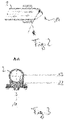
- figure 2 shows in a sectional view the area X of the figure 1 .
- an outlet opening 14 is provided, in which the wall of the channel 2 is bent over an angular area of the circumference in the end area.
- the figure 2 1 shows a curved "upper” area in which a radius is indicated schematically transverse to the longitudinal extent of the channel 2.
- FIG. The “lower” area at the outlet opening 14 runs straight transversely to the longitudinal extension of the channel 2 .
Landscapes
- Engineering & Computer Science (AREA)
- Mechanical Engineering (AREA)
- Catching Or Destruction (AREA)
Priority Applications (5)
| Application Number | Priority Date | Filing Date | Title |
|---|---|---|---|
| EP21159057.5A EP4049950A1 (fr) | 2021-02-24 | 2021-02-24 | Transport pneumatique d'insectes |
| US18/277,241 US20240124249A1 (en) | 2021-02-24 | 2022-02-23 | Pneumatic Transport of Insects |
| MX2023009845A MX2023009845A (es) | 2021-02-24 | 2022-02-23 | Transporte neumatico de insectos. |
| CA3211805A CA3211805A1 (fr) | 2021-02-24 | 2022-02-23 | Transport pneumatique d'insectes |
| PCT/EP2022/054578 WO2022180129A1 (fr) | 2021-02-24 | 2022-02-23 | Transport pneumatique d'insectes |
Applications Claiming Priority (1)
| Application Number | Priority Date | Filing Date | Title |
|---|---|---|---|
| EP21159057.5A EP4049950A1 (fr) | 2021-02-24 | 2021-02-24 | Transport pneumatique d'insectes |
Publications (1)
| Publication Number | Publication Date |
|---|---|
| EP4049950A1 true EP4049950A1 (fr) | 2022-08-31 |
Family
ID=74853511
Family Applications (1)
| Application Number | Title | Priority Date | Filing Date |
|---|---|---|---|
| EP21159057.5A Pending EP4049950A1 (fr) | 2021-02-24 | 2021-02-24 | Transport pneumatique d'insectes |
Country Status (5)
| Country | Link |
|---|---|
| US (1) | US20240124249A1 (fr) |
| EP (1) | EP4049950A1 (fr) |
| CA (1) | CA3211805A1 (fr) |
| MX (1) | MX2023009845A (fr) |
| WO (1) | WO2022180129A1 (fr) |
Families Citing this family (1)
| Publication number | Priority date | Publication date | Assignee | Title |
|---|---|---|---|---|
| CN116548390B (zh) * | 2023-05-18 | 2025-10-31 | 湖南自然创造生物科技有限公司 | 一种自动化分虫投虫系统及其操作方法 |
Citations (6)
| Publication number | Priority date | Publication date | Assignee | Title |
|---|---|---|---|---|
| DE2253886A1 (de) * | 1972-09-26 | 1974-05-22 | N Proiswodstwennoje Ob Jedinen | Verfahren zur massenzuechtung von schmarotzenden insekten |
| US4411220A (en) * | 1979-07-10 | 1983-10-25 | Inst. Nat. De La Recherche Agronomique | Mass production unit for producing eggs of an insect |
| DE102016007061A1 (de) * | 2016-06-03 | 2017-12-07 | Walter Kramer | Förderanlage für Schüttgut, insbesondere Kunststoffgranulat, und Verfahren zum Fördern von Schüttgut, insbesondere Kunststoffgranulat |
| US20180049417A1 (en) * | 2016-08-21 | 2018-02-22 | Daniel Michael Leo | Insect production systems and methods |
| US10647527B2 (en) * | 2017-04-24 | 2020-05-12 | Coperion Gmbh | Method for pneumatically conveying plastic pellets |
| WO2020246873A1 (fr) * | 2019-06-06 | 2020-12-10 | Protix B.V. | Dispositif de transport d'insectes vivants |
Family Cites Families (3)
| Publication number | Priority date | Publication date | Assignee | Title |
|---|---|---|---|---|
| NL169022C (nl) * | 1972-09-26 | 1982-06-01 | N Proizv Objedinenie Agropribo | Werkwijze voor het zich op grote schaal laten voortplanten van parasitaire insekten. |
| US4014577A (en) * | 1974-07-15 | 1977-03-29 | Henry Simon Limited | Pneumatic conveying systems |
| FI124335B (fi) * | 2012-09-26 | 2014-07-15 | Maricap Oy | Laite virtaustien vaihtamiseksi ja materiaalin keräily- ja siirtojärjestelmä |
-
2021
- 2021-02-24 EP EP21159057.5A patent/EP4049950A1/fr active Pending
-
2022
- 2022-02-23 CA CA3211805A patent/CA3211805A1/fr active Pending
- 2022-02-23 WO PCT/EP2022/054578 patent/WO2022180129A1/fr not_active Ceased
- 2022-02-23 US US18/277,241 patent/US20240124249A1/en active Pending
- 2022-02-23 MX MX2023009845A patent/MX2023009845A/es unknown
Patent Citations (6)
| Publication number | Priority date | Publication date | Assignee | Title |
|---|---|---|---|---|
| DE2253886A1 (de) * | 1972-09-26 | 1974-05-22 | N Proiswodstwennoje Ob Jedinen | Verfahren zur massenzuechtung von schmarotzenden insekten |
| US4411220A (en) * | 1979-07-10 | 1983-10-25 | Inst. Nat. De La Recherche Agronomique | Mass production unit for producing eggs of an insect |
| DE102016007061A1 (de) * | 2016-06-03 | 2017-12-07 | Walter Kramer | Förderanlage für Schüttgut, insbesondere Kunststoffgranulat, und Verfahren zum Fördern von Schüttgut, insbesondere Kunststoffgranulat |
| US20180049417A1 (en) * | 2016-08-21 | 2018-02-22 | Daniel Michael Leo | Insect production systems and methods |
| US10647527B2 (en) * | 2017-04-24 | 2020-05-12 | Coperion Gmbh | Method for pneumatically conveying plastic pellets |
| WO2020246873A1 (fr) * | 2019-06-06 | 2020-12-10 | Protix B.V. | Dispositif de transport d'insectes vivants |
Also Published As
| Publication number | Publication date |
|---|---|
| WO2022180129A1 (fr) | 2022-09-01 |
| US20240124249A1 (en) | 2024-04-18 |
| MX2023009845A (es) | 2023-11-09 |
| CA3211805A1 (fr) | 2022-09-01 |
Similar Documents
| Publication | Publication Date | Title |
|---|---|---|
| EP3261894B1 (fr) | Dispositif de refoulement pneumatique et installation de dosage ainsi qu'installation de sablage comprenant une pompe à jet de produit coulant | |
| DE1211107B (de) | Staubgutbehaelter mit einer in ihn eingebauten Entleerungsvorrichtung | |
| DE2122858A1 (de) | Verfahren und Vorrichtung für die pneumatische Materialförderung | |
| EP1712116A1 (fr) | Sémoir monogerme pneumatique | |
| WO2022180129A1 (fr) | Transport pneumatique d'insectes | |
| DE202005005276U1 (de) | Pneumatisch arbeitende Verteilmaschine | |
| DE3540505C1 (de) | Sackfuellmaschine | |
| EP2636294B1 (fr) | Installation d'absorption d'énergie dans un canal d'acheminement d'un soc | |
| DE2708249A1 (de) | Druckausgleichventil fuer schachtoefen | |
| EP0987202A2 (fr) | Convoyeur pneumatique avec alimentation uniforme en air by-pass | |
| DE10140773B4 (de) | Vorrichtung zum Zuführen von Samenkörnern zu einer Einzelkornsämaschine | |
| DE2803889C3 (de) | Maschine zum Ausbringen von körnigem Material | |
| DE10140342B4 (de) | Vorrichtung zum Verteilen von Samenkörnern | |
| DE2608847C3 (fr) | ||
| AT11685U1 (de) | Abscheidebehälter | |
| DE1295470B (de) | Saugvorrichtung zum Zufuehren von Schuettgut oder staubfoermigem Gut in eine Foerderleitung | |
| WO1998040294A1 (fr) | Dispositif pour fluidiser et transporter des materiaux a grain fin pulverulents ou a fibres courtes dans un flexible, un tuyau ou un recipient | |
| EP3989700A1 (fr) | Semoir agricole doté d'une conduite d'acheminement de longueur variable souple | |
| DE102018127013A1 (de) | Behälter für eine Sämaschine | |
| EP4410708A1 (fr) | Dispositif de fluidisation métallique incurvé, conteneur avec un tel dispositif et méthode de fluidisation d'un matériau en vrac | |
| DE20217390U1 (de) | Druckluftbetriebene Sandstreuvorrichtung | |
| DE102018130703B3 (de) | Absaugvorrichtung für Sauggut aus einem Tierstall | |
| AT227013B (de) | Einzelkornsämaschine mit Zellenrad | |
| DE956928C (de) | Doppelwandige Saugduese fuer pneumatische Foerdervorrichtungen | |
| DE2209572A1 (de) | Vorrichtung und verfahren zum verladen und transportieren von gefluegel |
Legal Events
| Date | Code | Title | Description |
|---|---|---|---|
| PUAI | Public reference made under article 153(3) epc to a published international application that has entered the european phase |
Free format text: ORIGINAL CODE: 0009012 |
|
| STAA | Information on the status of an ep patent application or granted ep patent |
Free format text: STATUS: THE APPLICATION HAS BEEN PUBLISHED |
|
| AK | Designated contracting states |
Kind code of ref document: A1 Designated state(s): AL AT BE BG CH CY CZ DE DK EE ES FI FR GB GR HR HU IE IS IT LI LT LU LV MC MK MT NL NO PL PT RO RS SE SI SK SM TR |
|
| STAA | Information on the status of an ep patent application or granted ep patent |
Free format text: STATUS: REQUEST FOR EXAMINATION WAS MADE |
|
| 17P | Request for examination filed |
Effective date: 20230228 |
|
| RAV | Requested validation state of the european patent: fee paid |
Extension state: TN Effective date: 20230228 Extension state: MA Effective date: 20230228 |
|
| RBV | Designated contracting states (corrected) |
Designated state(s): AL AT BE BG CH CY CZ DE DK EE ES FI FR GB GR HR HU IE IS IT LI LT LU LV MC MK MT NL NO PL PT RO RS SE SI SK SM TR |
|
| STAA | Information on the status of an ep patent application or granted ep patent |
Free format text: STATUS: EXAMINATION IS IN PROGRESS |
|
| 17Q | First examination report despatched |
Effective date: 20240516 |