EP4050568B1 - Verfahren zur simulierung der beleuchtung einer innenraumszene, die von einer durch aussenlicht beleuchteten kamera beobachtet wird - Google Patents
Verfahren zur simulierung der beleuchtung einer innenraumszene, die von einer durch aussenlicht beleuchteten kamera beobachtet wird Download PDFInfo
- Publication number
- EP4050568B1 EP4050568B1 EP21159737.2A EP21159737A EP4050568B1 EP 4050568 B1 EP4050568 B1 EP 4050568B1 EP 21159737 A EP21159737 A EP 21159737A EP 4050568 B1 EP4050568 B1 EP 4050568B1
- Authority
- EP
- European Patent Office
- Prior art keywords
- scene
- sun
- contribution
- normalized
- illumination
- Prior art date
- Legal status (The legal status is an assumption and is not a legal conclusion. Google has not performed a legal analysis and makes no representation as to the accuracy of the status listed.)
- Active
Links
Images



Classifications
-
- G—PHYSICS
- G06—COMPUTING OR CALCULATING; COUNTING
- G06T—IMAGE DATA PROCESSING OR GENERATION, IN GENERAL
- G06T15/00—Three-dimensional [3D] image rendering
- G06T15/50—Lighting effects
- G06T15/55—Radiosity
-
- H—ELECTRICITY
- H04—ELECTRIC COMMUNICATION TECHNIQUE
- H04N—PICTORIAL COMMUNICATION, e.g. TELEVISION
- H04N13/00—Stereoscopic video systems; Multi-view video systems; Details thereof
- H04N13/20—Image signal generators
- H04N13/204—Image signal generators using stereoscopic image cameras
- H04N13/254—Image signal generators using stereoscopic image cameras in combination with electromagnetic radiation sources for illuminating objects
-
- F—MECHANICAL ENGINEERING; LIGHTING; HEATING; WEAPONS; BLASTING
- F21—LIGHTING
- F21V—FUNCTIONAL FEATURES OR DETAILS OF LIGHTING DEVICES OR SYSTEMS THEREOF; STRUCTURAL COMBINATIONS OF LIGHTING DEVICES WITH OTHER ARTICLES, NOT OTHERWISE PROVIDED FOR
- F21V33/00—Structural combinations of lighting devices with other articles, not otherwise provided for
- F21V33/0004—Personal or domestic articles
- F21V33/0052—Audio or video equipment, e.g. televisions, telephones, cameras or computers; Remote control devices therefor
-
- G—PHYSICS
- G06—COMPUTING OR CALCULATING; COUNTING
- G06T—IMAGE DATA PROCESSING OR GENERATION, IN GENERAL
- G06T15/00—Three-dimensional [3D] image rendering
- G06T15/06—Ray-tracing
-
- H—ELECTRICITY
- H04—ELECTRIC COMMUNICATION TECHNIQUE
- H04N—PICTORIAL COMMUNICATION, e.g. TELEVISION
- H04N13/00—Stereoscopic video systems; Multi-view video systems; Details thereof
- H04N13/20—Image signal generators
- H04N13/275—Image signal generators from three-dimensional [3D] object models, e.g. computer-generated stereoscopic image signals
-
- F—MECHANICAL ENGINEERING; LIGHTING; HEATING; WEAPONS; BLASTING
- F21—LIGHTING
- F21S—NON-PORTABLE LIGHTING DEVICES; SYSTEMS THEREOF; VEHICLE LIGHTING DEVICES SPECIALLY ADAPTED FOR VEHICLE EXTERIORS
- F21S10/00—Lighting devices or systems producing a varying lighting effect
-
- F—MECHANICAL ENGINEERING; LIGHTING; HEATING; WEAPONS; BLASTING
- F21—LIGHTING
- F21W—INDEXING SCHEME ASSOCIATED WITH SUBCLASSES F21K, F21L, F21S and F21V, RELATING TO USES OR APPLICATIONS OF LIGHTING DEVICES OR SYSTEMS
- F21W2121/00—Use or application of lighting devices or systems for decorative purposes, not provided for in codes F21W2102/00 – F21W2107/00
- F21W2121/008—Use or application of lighting devices or systems for decorative purposes, not provided for in codes F21W2102/00 – F21W2107/00 for simulation of a starry sky or firmament
-
- G—PHYSICS
- G06—COMPUTING OR CALCULATING; COUNTING
- G06T—IMAGE DATA PROCESSING OR GENERATION, IN GENERAL
- G06T2215/00—Indexing scheme for image rendering
- G06T2215/16—Using real world measurements to influence rendering
Definitions
- the present disclosure is related to the field of image processing, in particular to a method and system for simulating the illumination of an indoor scene observed by a camera.
- Visual camera tracking, or egomotion estimation has been an important research field in robotics and computer vision. These methods provide the pose of a camera observing a scene.
- Direct methods to estimate a pose which are based on measurements made from all the pixels to estimate the pose, have been observed to be more precise and robust than feature-based methods which only rely on a limited number of pixels.
- Outdoor illumination has been studied in different fields and more precisely in the field of augmented reality. Typically, outdoor illumination is taken into account to render a virtual object into a real scene. These solutions do not aim at obtaining a simulation of the illumination of the scene which matches the actual scene.
- Daylight modeling has also been used in architectural design and document " Daylight coefficients" ( P. R. Tregenza and I. Waters, Lighting Research & Technology, vol. 15, no. 2, pp. 65-71, 1983 ) discloses an illumination one such illumination model.
- Documents " Standard daylight coefficient model for dynamic daylighting simulations” (D. Bourgeois, C. F. Reinhart, and G. Ward, Building Research & Information, vol. 36, no. 1, pp. 68-82, 2008 ) and " A radiosity-based methodology considering urban environments for assessing daylighting," (G. Besuievsky, E. Fern 'andez, J. P. Aguerre, and B. Beckers in Journal of Physics: Conference Series, vol. 1343, no. 1. IOP Publishing, 2019, p. 012156 ) disclose improvements to this model. These solutions cannot handle rapid changes of lights.
- the present disclosure overcomes one or more deficiencies of the prior art by proposing a method for simulating, at an instant, the illumination of an indoor scene observed by a camera and being illuminated by outdoor light, the method implementing the steps according to claim 1.
- the above method applies to indoor scenes which have an opening on the outside (windows, doors, etcs) though which outdoor illumination can propagate.
- the normalized radiosity maps and the corresponding brightness scale parameters form the simulation of the illumination of the indoor scene at the instant.
- the method proposes to leverage the lighting intensity obtained from the image acquired in the third phase to reflect the actual brightness in the scene, whereas many methods of the prior art propose to use an analytical model to obtain the brightness of various components.
- the preliminary phase can be performed once for an indoor scene.
- the second phase can be performed regularly, typically every 5 minutes (the first duration can be of the order of several minutes), as the sun moves slowly during the day.
- the third phase allows performing nearly real time computation and the second duration can be of less than a second, for example to reflect the framerate of the camera.
- the reflectance is defined as the ratio between the incoming light and the reflected light (the radiosity) and can be defined for each vertex of the 3D geometry model.
- Document " Building dense reflectance maps of indoor environments using an rgb-d camera” (M. Krawez, T. Caselitz, D. Büscher, M. Van Loock, and W. Burgard, in 2018 IEEE/RSJ International Conference on Intelligent Robots and Systems (IROS). IEEE, 2018, pp. 3210-3217 ) discloses how to obtain reflectance maps and radiosity maps.
- the present method is based on the "radiosity transport” methods.
- normalized radiosity maps are first obtained before radiosity maps.
- the wording "normalized” indicates that a scale parameter can multiply the normalized radiosity to obtain an actual radiosity map.
- a normalized radiosity map indicates the spatial light distribution in the scene induced by a light source (here light sources associated with the sky, the ground, and the sun, in other words outdoor light sources), with values being scalable so as to reach the actual light source brightness.
- Elaborating a normalized radiosity map includes affecting a normalized radiosity value to light sources corresponding to either the ground, the sky, or the sun.
- These light sources can be virtual (i.e. only existing in the calculations of the present method) and located (or considered to be located as they are virtual) where the sun/ground/sky are expected to be.
- the inventors of the present invention have observed that a good simulation is obtained by separating the light from the sky, the ground, and the sun (direct illumination) so that the third phase mainly comprises a determination of three brightness scale parameters: the computational complexity of the third phase is limited and the simulation is satisfactory.
- the light sources which are considered for the radiosity transport method are simulated light sources placed along a sphere.
- the number of light sources (points in space) to be considered can be chosen in accordance with an accuracy parameter depending on the application.
- the outside environment is thus simplified and does not take into account the exact geometry of, for example, buildings outside the indoor scene.
- radiosity light impinging on each surface
- the radiosity is considered to originate from one of these points (the above mentioned virtual light sources).
- the expression "considered” indicates that each point will be taken into account for the calculation of the reflectance. Indeed, measured radiosity values can be obtained to recover the reflectance values in a manner known in itself in the art (for example known for indoor light sources).
- elaborating a normalized radiosity map for the contribution of the sky to the outdoor illumination based on the reflectance map comprises only considering the light sources in the upper half of the sphere, and elaborating a normalized radiosity map for the contribution of the ground to the outdoor illumination based on the reflectance map comprises only considering the light sources in the lower half of the sphere.
- the above mentioned sphere is cut in half horizontally to obtain two hemispheres, one used in the calculation of the radiosity map for illumination coming from the sky, one for the illumination coming from the ground.
- the preliminary phase comprises a ray-tracing step to determine the visibility of each vertex of the 3D geometric model, the method further comprising using the visibilities to obtain the normalized radiosity maps for the contribution of the sky, of the ground, and of the sun.
- This ray-tracing step can use predetermined pose information for the camera.
- the visibility can be used in the step of obtaining a reflectance map.
- obtaining the reflectance map comprises using image information of the scene acquired when there is no direct sunlight entering the scene.
- This particular embodiment is adapted for indoor scenes that do not receive direct sunlight because of their orientation (and more precisely the direction in which their openings are facing).
- obtaining the reflectance map comprises using image information of the scene acquired when there is direct sunlight entering the scene at different instants associated with different positons of the sun.
- the method comprises (in the third phase) rendering a normalized image of the scene for the contribution of the sky to the outdoor illumination of the scene based on the normalized radiosity map for the contribution of the sky to the outdoor illumination,
- determining from the image a brightness scale parameter for the contribution of the ground, a brightness scale parameter for the contribution of the sky, and a brightness scale parameter for the contribution of the sun comprises minimizing a difference between the image and a linear combination of the products of each brightness scale parameter with the corresponding normalized image.
- the third phase comprises acquiring a plurality of images of the scenes at different instants and determining the brightness scale parameters uses the plurality of images.
- a sliding window may be used to collect continuously images of the scene and these images may also be used in the above mentioned minimization to obtain the brightness scale parameters.
- the method comprises elaborating an image of the scene from the normalized images of the scene and the brightness scale parameters.
- the invention also proposes a method for tracking the position of a camera observing a scene (also called visual odometry or egomotion) over a plurality of instants, using the simulated illumination of the indoor scene by the method for simulating the illumination of an indoor scene as defined above at every instant of the plurality of instants.
- the invention proposes to leverage information from the simulation results to perform the tracking, as this has been observed to be more robust than by using only images from the camera.
- the invention is therefore perfectly applicable in contexts where the pose of the camera changes.
- the method for simulating the illumination of an indoor scene is the method as defined above wherein normalized images rendered in accordance with the particular embodiment defined above, and wherein tracking is performed on the image elaborated from the normalized images of the scene and the brightness scale parameters.
- the invention also provides a system comprising a camera (RGB or RBGD) and a control unit configured to perform any embodiment of the method for simulating or the method for tracking as defined above.
- a camera RGB or RBGD
- control unit configured to perform any embodiment of the method for simulating or the method for tracking as defined above.
- this system can be a computer system.
- the invention also provides a vehicle including this system.
- the steps of the method are determined by computer program instructions.
- the invention is also directed to a computer program for executing the steps of a method as described above when this program is executed by a computer.
- This program can use any programming language and take the form of source code, object code or a code intermediate between source code and object code, such as a partially compiled form, or any other desirable form.
- the invention is also directed to a computer-readable information medium containing instructions of a computer program as described above.
- the information medium can be any entity or device capable of storing the program.
- the medium can include storage means such as a ROM, for example a CD ROM or a microelectronic circuit ROM, or magnetic storage means, for example a diskette (floppy disk) or a hard disk.
- the information medium can be an integrated circuit in which the program is incorporated, the circuit being adapted to execute the method in question or to be used in its execution.
- This method aims at simulating the illumination of an indoor scene at a given instant, typically in near real time. Also, in the present description, the simulation is aimed at performing a tracking of the position of the camera observing the scene.
- the invention is however not limited to tracking this position and can also be applied to other applications in which it is required to use a simulation of the illumination.
- the method is advantageous as it limits the computational load to be performed in near real-time. This results from the fact that a portion of the computations is performed once, another portion is performed for example every five minutes, and the final portion is done in real time.
- Figure 1 shows the steps of a method according to an example.
- the method comprises a step S001 of reconstructing the 3D geometry of the scene. This can be done on the basis of an image of the scene (an RGB image or preferably an RGBD image, and eventually a plurality of images), and preferably the pose of the camera (at this stage, this pose can be provided).
- the output of this step is the 3D geometric model of the scene in the form of a 3D mesh.
- the 3D geometric model of the scene can be obtained by means of Truncated Signed Distance Field (TSDF) integration, which requires a depth image stream scanning the scene and the corresponding camera poses.
- TSDF Truncated Signed Distance Field
- the invention is not limited to the use of images to reconstruct the 3D geometry of the scene and can also use 3D geometry models prepared by an operator.
- This step uses as input the 3D geometry model of the scene, images of the scene and preferably camera poses.
- steps S002, S003, and S004 are three alternative steps that can be used to obtain reflectance maps from image information (one or more images).
- Step S002 is an alternative which is only represented for the sake of completeness as it represents a case where there is no outdoor illumination.
- This step implements the method of document "Camera tracking in lighting adaptable maps of indoor environments” further discloses how to obtain radiosity maps/reflectance maps and of European Patent Application 20 154 742.9 filed on January 30, 2020 .
- Radiosity values B ( v i ) are recovered from scanning the scene with an RGB camera while varying the camera's exposure time.
- Step S003 actually part of the present invention, is a first alternative step of obtaining a reflectance map of the scene for the contribution of outdoor illumination to the scene based on the 3D geometry model of the scene.
- This alternative is particularly suitable for scenes which receive outdoor light but not direct sunlight.
- the brightness of the sky is low enough to be directly measured on image information with a consumer grade RGB(D) camera (i.e. the image information can be obtained by acquiring at least one image of the scene with this outside illumination).
- the image information can be obtained by acquiring at least one image of the scene with this outside illumination.
- it is considered that light is passing for example through a window but no direct sunlight is visible in the scene itself.
- the radiosity can be measured as in the above described step S002, while the geometry outside this window is still missing (there are no vertices onto which the radiosity can be projected).
- the outdoor geometry is modeled as a sphere or a sky sphere. This sphere is formed by a set of sample points (i.e. light sources) placed on the sphere. Each point l ⁇ is associated with a direction n ( l ) and a radiosity B ( l ) .
- Step S004 is another alternative for recovering the reflectance map. This alternative is particularly suitable for applications where the scene will receive direct sunlight.
- the sun is considered to be directly visible from the inside, in the scene. Theoretically, this could be handled analogously to step S003, however, the minimal exposure time of most RGBD cameras is not short enough to capture the sun's radiosity. In other words, orienting a camera directly towards the sun does not allow measuring B ( l ) for a point placed on the sphere where the sun is l ⁇ , with being a set of points placed where the sun is, better described hereinafter in reference to figure 2 .
- a meaningful scene reflectance can be estimated, in particular by using at least two images of the scene (from the image information) where the scene receives outdoor illumination and direct sunlight, taken at different instants associated with different positions of the sun.
- L t 1 sun be a set of points arranged on the above-mentioned sphere within the sun circle (the circle appearing where the sun is located), or in other words the sky area covered by the sun at time t 1 (an instant at which a first image has been captured). Further, let V t 1 sun be the set of vertices lit by direct sun light, i.e. v ⁇ V t 1 sun if and only if F ( v, l ) G ( v, l ) > 0 for a given l ⁇ L t 1 sun .
- B t 1 ( l ) is the same for all l ⁇ L t 1 sun , and this leads to only having one unknown, the sun radiosity denoted B t 1 sun . It should be noted that for all other vertices not in V t 1 sun , it is possible to recover the reflectance as they only depend on the scene or sky radiosities, which can be measured.
- V t 2 sun be defined similarly to V t 1 sun and V t 1 ⁇ t 2 sun the set of vertices in V t 1 sun but not in V t 2 sun , i.e. lit by direct sunlight at t 1 but not at t 2 .
- E s ti v and E l ti v being respectively the irradiance from the scene and from the sky at instant ti .
- E l t 1 v E sky t 1 v + B t 1 sun ⁇ l ⁇ L t 1 sun F l v G l v
- Step S005 can then be carried out (this step is carried out before steps S003 and steps S004 as its output can be used in these steps) in which a ray tracing step is performed to determine the visibility of each vertex of the 3D geometric model.
- This step uses the 3D geometric model as input and the sky sphere separated into points/light sources, as defined above. This allows obtaining the visibility G in equations 4 and 5, for example through a pre-computation so that these equations can be solved later. This eliminates the main bulk of computation during illumination estimation.
- Step S006 can then be carried out in which a normalized radiosity map ( B ⁇ sky ) for the contribution of the sky to the outdoor illumination based on the reflectance map (obtained using either S003 or S004) is elaborated, and in which a normalized radiosity map ( B ⁇ gr )for the contribution of the ground to the outdoor illumination based on the reflectance map is elaborated.
- a normalized radiosity map B ⁇ sky
- B ⁇ gr a normalized radiosity map
- obtaining a normalized radiosity map is performed using the algorithm known to the person skilled in the art as the radiosity algorithm ( Cindy M. Goral, Kenneth E. Torrance, Donald P. Greenberg, and Bennett Battaile. 1984. "Modeling the interaction of light between diffuse surfaces”. SIGGRAPH Comput. Graph. 18, 3 (July 1984), 213-222 ).
- the radiosity algorithm Go M. Goral, Kenneth E. Torrance, Donald P. Greenberg, and Bennett Battaile. 1984. "Modeling the interaction of light between diffuse surfaces”. SIGGRAPH Comput. Graph. 18, 3 (July 1984), 213-222 ).
- an iterative version of the radiosity algorithm is used.
- each vertex v ⁇ V has a reflectance p ( v )
- the radiosity B ( v ) here is the amount of light reflected by the surface patch at v
- B x ( v ) is the radiosity from light source .
- B x ( v ) it is possible to first compute the radiosity B l ( v ) induced by a single directional light source l ⁇ and then to sum up these components.
- G ( l, v i ) 1 only when the ray with direction n ( l ) , starting at v i , does not intersect with any scene geometry.
- B x v i ⁇ l ⁇ L x B l v i .
- Setting S l to 1 in the above equation provides a normalized radiosity B ⁇ x .
- a simplified model consisting of sun, sky, and ground light components.
- the sky and ground components are computed by first splitting the sky sphere into two disjoints sets and , and adding the set of bins describing the sun area. Then, equation 3 can be used to compute the radiosity contributions of each of the three light sources.
- the sun, sky, and ground bins l have the same radiosities (or brightness scales) S sun , S sky , and S gr respectively, such that the term B ( l ) in equation 5 can be replaced by the proper brightness scale parameter S x , with x ⁇ ⁇ sun, sky, gr ⁇ (with gr for ground).
- B ⁇ x is called a normalized radiosity.
- a second phase P2 can be carried out.
- this second phase can be carried out every 5 minutes, or any duration of the order of 5 minutes, as the sun moves slowly throughout the day.
- step S007 of the second phase the position of the sun is computed using the scene geolocation (i.e. latitude and longitude), the orientation of the scene, the time (i.e. yyyy.mm.dd.hh.mm.ss).
- the position of the sun can be expressed as a direction vector to reflect the sun direction relative to the scene.
- This step uses the sun position (for example expressed as a direction), it is possible to obtain the normalized radiosity map ( B ⁇ sun ) for the contribution of the sun to the outdoor illumination.
- This step also uses the reflectance map, the visibility terms G, and the 3D geometric model of the scene.
- B ⁇ sun should therefore be computed for every new sun position. Given that the sun area is much smaller than that of sky or ground, B ⁇ sun is obtained within a couple of minutes using GPU acceleration. Even though this update is not real-time, the sun position varies only very little in the course of minutes, and performing the steps of the second phase can be performed every couple minutes, typically every five minutes.
- the final and third phase P3 can be carried out in near real-time, that is to say within a duration which is less than the frame rate from the instant (t) at which it is desired to simulate the illumination.
- This phase comprises step S009 in which a normalized image I ⁇ t sun of the scene for the contribution of the sun to the outdoor illumination of the scene is rendered on the basis of B ⁇ sun .
- This step can use an initial pose estimate T t ⁇ .
- This pose is obtained because a frame-to-frame tracking method is used here.
- the change of camera pose is computed by matching an input image at instant t to the image of instant t-1.
- This tracking process is described in more detail in document " Camera Tracking in Lighting Adaptable Maps of Indoor Environments” (T. Caselitz, M. Krawez, J. Sundram, M. Van Loock and W. Burgard, 2020 IEEE International Conference on Robotics and Automation (ICRA), Paris, France, 2020, pp. 3334-3340 ).
- the tracking may be done using the method described in the previously mentioned European Patent Application.
- Step S010 comprises analogous steps for B ⁇ sky and B ⁇ gr in which normalized images are rendered (respectively I ⁇ t sky and I ⁇ t gr ) .
- the normalized images can be combined in step S011.
- an image I C of the scene is acquired with the camera in step S012.
- the subsequent steps will describe how the brightness scale parameters) S sun , S sky , and S g r are estimated from the normalized images and the acquired image.
- step S013 a subset of pixels ⁇ of the pixels of the image I C are selected so as to represent the image areas with the most information about illumination and containing the least amount of noise/errors.
- the brightness scale estimation is carried out in step S014.
- I B ( u ) ⁇ x ⁇ sun,sky,gr ⁇ S x Î x (u), CRF () being the camera response function, and et the exposure time of I C .
- the brightness scale parameters are obtained by minimizing Err over S x . This minimization can be performed by means of a least squares solver.
- step S015 can be performed in which several frames are used.
- the simulated image I C ref in step S017 can be rendered using the rendered normalized images and the brightness scale parameters S sun , S sky , and S grd .
- Tracking of the camera position can then be performed in step S018 by comparing I C ref and I C .
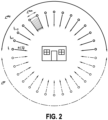
- FIG 2 is a 2D representation of a cross section of the above-mentioned sphere centered on the scene.
- the points considered to be light sources are aligned on the sphere. More precisely, the points of are aligned in the upper hemisphere while the points are aligned in the lower hemisphere. These points are spaced regularly around the sphere.
- a radiosity value is affected by projecting a portion of the image to the point li , as explained above.
- FIG. 3 shows a system 200 configured to perform the method described in reference to figure 1 .
- This system is equipped with a camera 201 (for example an RGBD camera), and has a computer structure.
- the system comprises a processor 202, and a nonvolatile memory 203.
- this nonvolatile memory 203 a set of computer program instructions is stored. When these instructions are executed by processor 202, the steps of the above defined method are performed.
- Figure 4A is an image rendered by the present method, while Figure 4B is the actual image acquired by the camera. It can be scene that the illumination simulation provides a good simulation of the actual scene.
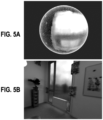
- Figure 5A is an image of a sphere of bins centered around the scene and determined in the above steps.
- Figure 5B shows how this sphere is seen from the camera: this is an approximation of the outside which does not take into account the exact geometry of the outside but provides a good estimation of the illumination.
Landscapes
- Engineering & Computer Science (AREA)
- Multimedia (AREA)
- Physics & Mathematics (AREA)
- Signal Processing (AREA)
- Computer Graphics (AREA)
- General Physics & Mathematics (AREA)
- Theoretical Computer Science (AREA)
- General Engineering & Computer Science (AREA)
- Electromagnetism (AREA)
- Image Processing (AREA)
- Image Generation (AREA)
Claims (11)
- Verfahren zum Simulieren, zu einem Zeitpunkt, der Beleuchtung einer Innenraumszene, die von einer Kamera beobachtet und von Außenlicht beleuchtet wird, das Verfahren umfassend:
eine erste Vorphase (P1), die Folgendes beinhaltet:Erlangen (S001) eines geometrischen 3D-Modells der Szene,Erlangen von Bildinformationen der Szene, die von einem RGB- oder einem RGBD-Sensor erfasst werden,Erlangen (S003, S004) einer Reflexionskarte der Szene für den Beitrag der Außenbeleuchtung zu der Szene basierend auf dem geometrischen 3D-Modell der Szene und den Bildinformationen der Szene, umfassend ein Berücksichtigen einer Vielzahl von Lichtquellen (), die auf einer Kugel angeordnet sind, die auf die Szene zentriert ist, Erstellen (S006) einer normalisierten Radiosity-Karte (B̂Himmel ) für den Beitrag des Himmels zu der Außenbeleuchtung basierend auf der Reflexionskarte,Erstellen (S006) einer normalisierten Radiosity-Karte ((B̂Bd ) für den Beitrag des Bodens zu der Außenbeleuchtung basierend auf der Reflexionskarte,wobei ein Erstellen einer normalisierten Radiosity-Karte für den Beitrag des Himmels zu der Außenbeleuchtung basierend auf der Reflexionskarte nur ein Berücksichtigen der Lichtquellen in der oberen Hälfte der Kugel umfasst, und ein Erstellen einer normalisierten Radiosity-Karte für den Beitrag des Bodens zu der Außenbeleuchtung basierend auf der Reflexionskarte nur ein Berücksichtigen der Lichtquellen in der unteren Hälfte der Kugel umfasst,eine zweite Phase (P2), die innerhalb einer ersten gegebenen Dauer ab dem Zeitpunkt durchgeführt wird, die Folgendes beinhaltet:Erlangen (S007) des der Position der Sonne unter Verwendung der Geolokalisierung, der Uhrzeit und der Ausrichtung der Szene,Erlangen (S008) einer normalisierten Radiosity-Karte für den Beitrag der Sonne (B̂Sonne ) zu der Außenbeleuchtung, basierend auf der Position der Sonne und der Reflexionskarte,eine dritte Phase (P3), die innerhalb einer zweiten gegebenen Dauer ab dem Zeitpunkt (t) durchgeführt wird, die kürzer ist als die erste gegebene Dauer, die Folgendes beinhaltet:Aufnehmen von mindestens einem Bild (Ic ) der Szene,Bestimmen (S014, S015), anhand des mindestens einen Bilds, eines Helligkeitsskalenparameters für den Beitrag des Bodens (SBd ), eines Helligkeitsskalenparameters für den Beitrag des Himmels (SHimmel ) und eines Helligkeitsskalenparameters für den Beitrag der Sonne (SSonne ),Rendern (S010) eines normalisierten Bilds der Szene für den Beitrag des Himmels zu der Außenbeleuchtung der Szene (
 Rendern (S010) eines normalisierten Bilds der Szene für den Beitrag des Bodens zu der Außenbeleuchtung der Szene (
 Rendern (S009) eines normalisierten Bilds der Szene für den Beitrag der Sonne zu der Außenbeleuchtung der Szene (
 wobei das Verfahren ein Erstellen (S017) eines Bilds der Szene anhand der normalisierten Bilder der Szene und der Helligkeitsskalenparametern umfasst.
 - Verfahren nach Anspruch 1, wobei die Vorphase einen Strahlenverfolgungsschritt (S005) umfasst, um die Sichtbarkeit von jedem Scheitelpunkt des geometrischen 3D-Modells zu bestimmen, das Verfahren ferner umfassend ein Verwenden der Sichtbarkeiten, um die normalisierten Radiosity-Karten für den Beitrag des Himmels, des Bodens und der Sonne zu erlangen.
- Verfahren nach einem der Ansprüche 1 bis 2, wobei ein Erlangen (S003) der Reflexionskarte ein Verwenden von Bildinformationen der Szene umfasst, die erfasst werden, wenn kein direktes Sonnenlicht auf die Szene fällt.
- Verfahren nach einem der Ansprüche 1 bis 3, wobei ein Erlangen (S004) der Reflexionskarte ein Verwenden von Bildinformationen der Szene umfasst, die erfasst werden, wenn zu verschiedenen Zeitpunkten, die mit verschiedenen Positionen der Sonne assoziiert sind, direktes Sonnenlicht auf die Szene fällt.
- Verfahren nach Anspruch 1, wobei ein Bestimmen, anhand des Bilds, eines Helligkeitsskalenparameters für den Beitrag des Bodens, eines Helligkeitsskalenparameters für den Beitrag des Himmels und eines Helligkeitsskalenparameters für den Beitrag der Sonne ein Minimieren einer Differenz (Err) zwischen dem Bild und einer linearen Kombination der Produkte von jedem Helligkeitsskalenparameters mit dem entsprechenden normalisierten Bild umfasst.
- Verfahren nach einem der Ansprüche 1 bis 5, wobei die dritte Phase ein Aufnehmen einer Vielzahl von Bildern der Szenen zu verschiedenen Zeitpunkten und ein Bestimmen der Helligkeitsskalenparameter die Vielzahl von Bildern verwendet.
- Verfahren zum Verfolgen der Position einer Kamera, die eine Szene über eine Vielzahl von Zeitpunkten beobachtet, unter Verwendung der simulierten Beleuchtung der Innenraumszene durch das Verfahren zum Simulieren der Beleuchtung einer Innenraumszene nach einem der Ansprüche 1 bis 6 zu jedem Zeitpunkt der Vielzahl von Zeitpunkten.
- Verfahren nach Anspruch 7, wobei das Verfahren zum Simulieren der Beleuchtung einer Innenraumszene das Verfahren nach Anspruch 1 ist, und wobei das Verfolgen auf dem Bild durchgeführt wird, das anhand der normalisierten Bilder der Szene und der Helligkeitsskalenparameter erstellt wird.
- System, umfassend eine Kamera und eine Steuereinheit zum Durchführen des Verfahrens nach einem der Ansprüche 1 bis 8.
- Computerprogramm, das Anweisungen zum Ausführen der Schritte eines Verfahrens nach einem der Ansprüche 1 bis 8 beinhaltet, wenn das Programm von einem Computer ausgeführt wird.
- Aufzeichnungsmedium, das von einem Computer lesbar ist und auf dem ein Computerprogramm aufgezeichnet ist, das Anweisungen zum Ausführen der Schritte eines Verfahrens nach einem der Ansprüche 1 bis 8 beinhaltet.
Priority Applications (2)
| Application Number | Priority Date | Filing Date | Title |
|---|---|---|---|
| EP21159737.2A EP4050568B1 (de) | 2021-02-26 | 2021-02-26 | Verfahren zur simulierung der beleuchtung einer innenraumszene, die von einer durch aussenlicht beleuchteten kamera beobachtet wird |
| US17/679,597 US12160557B2 (en) | 2021-02-26 | 2022-02-24 | Method for simulating the illumination of an indoor scene observed by a camera illuminated by outdoor light and system |
Applications Claiming Priority (1)
| Application Number | Priority Date | Filing Date | Title |
|---|---|---|---|
| EP21159737.2A EP4050568B1 (de) | 2021-02-26 | 2021-02-26 | Verfahren zur simulierung der beleuchtung einer innenraumszene, die von einer durch aussenlicht beleuchteten kamera beobachtet wird |
Publications (2)
| Publication Number | Publication Date |
|---|---|
| EP4050568A1 EP4050568A1 (de) | 2022-08-31 |
| EP4050568B1 true EP4050568B1 (de) | 2025-06-25 |
Family
ID=74844703
Family Applications (1)
| Application Number | Title | Priority Date | Filing Date |
|---|---|---|---|
| EP21159737.2A Active EP4050568B1 (de) | 2021-02-26 | 2021-02-26 | Verfahren zur simulierung der beleuchtung einer innenraumszene, die von einer durch aussenlicht beleuchteten kamera beobachtet wird |
Country Status (2)
| Country | Link |
|---|---|
| US (1) | US12160557B2 (de) |
| EP (1) | EP4050568B1 (de) |
Families Citing this family (3)
| Publication number | Priority date | Publication date | Assignee | Title |
|---|---|---|---|---|
| MX2023011296A (es) * | 2021-04-07 | 2023-12-14 | Interdigital Ce Patent Holdings Sas | Video volumétrico que soporta efectos de luz. |
| US11962880B2 (en) | 2021-10-29 | 2024-04-16 | Comcast Cable Communications, Llc | Systems and methods for enhanced performance of camera devices |
| CN117689596A (zh) * | 2022-09-01 | 2024-03-12 | 完美世界(北京)软件科技发展有限公司 | 光照信息计算方法及装置、存储介质、计算机设备 |
Family Cites Families (3)
| Publication number | Priority date | Publication date | Assignee | Title |
|---|---|---|---|---|
| US10289094B2 (en) * | 2011-04-14 | 2019-05-14 | Suntracker Technologies Ltd. | System and method for the optimization of radiance modelling and controls in predictive daylight harvesting |
| US10290148B2 (en) * | 2011-04-14 | 2019-05-14 | Suntracker Technologies Ltd. | System and method for real time dynamic lighting simulation |
| EP3859684A1 (de) | 2020-01-30 | 2021-08-04 | Toyota Jidosha Kabushiki Kaisha | Verfahren und system zur erstellung einer an die beleuchtung anpassbaren karte einer innenszene und deren verwendung zur schätzung einer unbekannten lichteinstellung |
-
2021
- 2021-02-26 EP EP21159737.2A patent/EP4050568B1/de active Active
-
2022
- 2022-02-24 US US17/679,597 patent/US12160557B2/en active Active
Also Published As
| Publication number | Publication date |
|---|---|
| US20220279156A1 (en) | 2022-09-01 |
| US12160557B2 (en) | 2024-12-03 |
| EP4050568A1 (de) | 2022-08-31 |
Similar Documents
| Publication | Publication Date | Title |
|---|---|---|
| US12160557B2 (en) | Method for simulating the illumination of an indoor scene observed by a camera illuminated by outdoor light and system | |
| Ikeuchi et al. | Determining reflectance properties of an object using range and brightness images | |
| US10636151B2 (en) | Method for estimating the speed of movement of a camera | |
| KR20210119417A (ko) | 깊이 추정법 | |
| US20050212794A1 (en) | Method and apparatus for removing of shadows and shadings from texture images | |
| EP2199983A1 (de) | Verfahren zur Schätzung einer Bewegung eines Systems mit mehreren Kameras, System mit mehreren Kameras und Computerprogrammprodukt | |
| WO2014202258A1 (en) | A method for mapping an environment | |
| US11082633B2 (en) | Method of estimating the speed of displacement of a camera | |
| CN116580161B (zh) | 基于图像及NeRF模型的建筑三维模型构建方法及系统 | |
| CN119828161A (zh) | 基于激光slam的移动机器人定位与导航方法 | |
| CN119048603B (zh) | 一种基于3dgs的相机位姿求解方法、系统及终端 | |
| US20240386656A1 (en) | Deferred neural lighting in augmented image generation | |
| Lee et al. | Unified calibration for multi-camera multi-lidar systems using a single checkerboard | |
| CN113269861A (zh) | 构建室内场景的光照自适应地图并用其估计未知光设置的方法和系统 | |
| CN120252680A (zh) | 一种基于多传感器融合的slam定位方法及系统 | |
| WO2024043263A1 (ja) | 情報処理装置、情報処理システム、情報処理方法及びコンピュータプログラム | |
| US12541916B2 (en) | Method for assessing the physically based simulation quality of a glazed object | |
| Piccolo et al. | Resource-Constrained Vision-Based Relative Navigation About Small Bodies | |
| CN120014147A (zh) | 静态场景模型的训练方法、装置、设备、介质及产品 | |
| Eapen et al. | Narpa: Navigation and rendering pipeline for astronautics | |
| Bradley et al. | Georeferenced mosaics for tracking fires using unmanned miniature air vehicles | |
| Bender et al. | Scaling the world of monocular SLAM with INS-measurements for UAS navigation | |
| Lee et al. | Online Image Pre-processing Using Bayesian Optimization for Visual-inertial Odometry | |
| CN113155140A (zh) | 用于室外特征稀疏环境下的机器人slam方法及系统 | |
| Rowell et al. | Autonomous visual recognition of known surface landmarks for optical navigation around asteroids |
Legal Events
| Date | Code | Title | Description |
|---|---|---|---|
| PUAI | Public reference made under article 153(3) epc to a published international application that has entered the european phase |
Free format text: ORIGINAL CODE: 0009012 |
|
| STAA | Information on the status of an ep patent application or granted ep patent |
Free format text: STATUS: REQUEST FOR EXAMINATION WAS MADE |
|
| 17P | Request for examination filed |
Effective date: 20210226 |
|
| AK | Designated contracting states |
Kind code of ref document: A1 Designated state(s): AL AT BE BG CH CY CZ DE DK EE ES FI FR GB GR HR HU IE IS IT LI LT LU LV MC MK MT NL NO PL PT RO RS SE SI SK SM TR |
|
| GRAP | Despatch of communication of intention to grant a patent |
Free format text: ORIGINAL CODE: EPIDOSNIGR1 |
|
| STAA | Information on the status of an ep patent application or granted ep patent |
Free format text: STATUS: GRANT OF PATENT IS INTENDED |
|
| INTG | Intention to grant announced |
Effective date: 20250212 |
|
| GRAS | Grant fee paid |
Free format text: ORIGINAL CODE: EPIDOSNIGR3 |
|
| GRAA | (expected) grant |
Free format text: ORIGINAL CODE: 0009210 |
|
| STAA | Information on the status of an ep patent application or granted ep patent |
Free format text: STATUS: THE PATENT HAS BEEN GRANTED |
|
| AK | Designated contracting states |
Kind code of ref document: B1 Designated state(s): AL AT BE BG CH CY CZ DE DK EE ES FI FR GB GR HR HU IE IS IT LI LT LU LV MC MK MT NL NO PL PT RO RS SE SI SK SM TR |
|
| REG | Reference to a national code |
Ref country code: GB Ref legal event code: FG4D |
|
| REG | Reference to a national code |
Ref country code: CH Ref legal event code: EP |
|
| REG | Reference to a national code |
Ref country code: CH Ref legal event code: EP |
|
| REG | Reference to a national code |
Ref country code: IE Ref legal event code: FG4D |
|
| REG | Reference to a national code |
Ref country code: DE Ref legal event code: R096 Ref document number: 602021032672 Country of ref document: DE |
|
| REG | Reference to a national code |
Ref country code: DE Ref legal event code: R081 Ref document number: 602021032672 Country of ref document: DE Owner name: ALBERT-LUDWIGS-UNIVERSITAET FREIBURG, KOERPERS, DE Free format text: FORMER OWNER: ANMELDERANGABEN UNKLAR / UNVOLLSTAENDIG, 80297 MUENCHEN, DE Ref country code: DE Ref legal event code: R081 Ref document number: 602021032672 Country of ref document: DE Owner name: TOYOTA JIDOSHA KABUSHIKI KAISHA, TOYOTA-SHI, JP Free format text: FORMER OWNER: ANMELDERANGABEN UNKLAR / UNVOLLSTAENDIG, 80297 MUENCHEN, DE |
|
| PG25 | Lapsed in a contracting state [announced via postgrant information from national office to epo] |
Ref country code: FI Free format text: LAPSE BECAUSE OF FAILURE TO SUBMIT A TRANSLATION OF THE DESCRIPTION OR TO PAY THE FEE WITHIN THE PRESCRIBED TIME-LIMIT Effective date: 20250625 |
|
| REG | Reference to a national code |
Ref country code: LT Ref legal event code: MG9D |
|
| PG25 | Lapsed in a contracting state [announced via postgrant information from national office to epo] |
Ref country code: NO Free format text: LAPSE BECAUSE OF FAILURE TO SUBMIT A TRANSLATION OF THE DESCRIPTION OR TO PAY THE FEE WITHIN THE PRESCRIBED TIME-LIMIT Effective date: 20250925 Ref country code: GR Free format text: LAPSE BECAUSE OF FAILURE TO SUBMIT A TRANSLATION OF THE DESCRIPTION OR TO PAY THE FEE WITHIN THE PRESCRIBED TIME-LIMIT Effective date: 20250926 |
|
| PG25 | Lapsed in a contracting state [announced via postgrant information from national office to epo] |
Ref country code: BG Free format text: LAPSE BECAUSE OF FAILURE TO SUBMIT A TRANSLATION OF THE DESCRIPTION OR TO PAY THE FEE WITHIN THE PRESCRIBED TIME-LIMIT Effective date: 20250625 |
|
| PG25 | Lapsed in a contracting state [announced via postgrant information from national office to epo] |
Ref country code: HR Free format text: LAPSE BECAUSE OF FAILURE TO SUBMIT A TRANSLATION OF THE DESCRIPTION OR TO PAY THE FEE WITHIN THE PRESCRIBED TIME-LIMIT Effective date: 20250625 |
|
| PG25 | Lapsed in a contracting state [announced via postgrant information from national office to epo] |
Ref country code: RS Free format text: LAPSE BECAUSE OF FAILURE TO SUBMIT A TRANSLATION OF THE DESCRIPTION OR TO PAY THE FEE WITHIN THE PRESCRIBED TIME-LIMIT Effective date: 20250925 |
|
| PG25 | Lapsed in a contracting state [announced via postgrant information from national office to epo] |
Ref country code: LV Free format text: LAPSE BECAUSE OF FAILURE TO SUBMIT A TRANSLATION OF THE DESCRIPTION OR TO PAY THE FEE WITHIN THE PRESCRIBED TIME-LIMIT Effective date: 20250625 |
|
| REG | Reference to a national code |
Ref country code: NL Ref legal event code: MP Effective date: 20250625 |
|
| PG25 | Lapsed in a contracting state [announced via postgrant information from national office to epo] |
Ref country code: NL Free format text: LAPSE BECAUSE OF FAILURE TO SUBMIT A TRANSLATION OF THE DESCRIPTION OR TO PAY THE FEE WITHIN THE PRESCRIBED TIME-LIMIT Effective date: 20250625 |
|
| PG25 | Lapsed in a contracting state [announced via postgrant information from national office to epo] |
Ref country code: PT Free format text: LAPSE BECAUSE OF FAILURE TO SUBMIT A TRANSLATION OF THE DESCRIPTION OR TO PAY THE FEE WITHIN THE PRESCRIBED TIME-LIMIT Effective date: 20251027 |
|
| REG | Reference to a national code |
Ref country code: AT Ref legal event code: MK05 Ref document number: 1807330 Country of ref document: AT Kind code of ref document: T Effective date: 20250625 |
|
| PG25 | Lapsed in a contracting state [announced via postgrant information from national office to epo] |
Ref country code: IS Free format text: LAPSE BECAUSE OF FAILURE TO SUBMIT A TRANSLATION OF THE DESCRIPTION OR TO PAY THE FEE WITHIN THE PRESCRIBED TIME-LIMIT Effective date: 20251025 |
|
| PG25 | Lapsed in a contracting state [announced via postgrant information from national office to epo] |
Ref country code: AT Free format text: LAPSE BECAUSE OF FAILURE TO SUBMIT A TRANSLATION OF THE DESCRIPTION OR TO PAY THE FEE WITHIN THE PRESCRIBED TIME-LIMIT Effective date: 20250625 Ref country code: SM Free format text: LAPSE BECAUSE OF FAILURE TO SUBMIT A TRANSLATION OF THE DESCRIPTION OR TO PAY THE FEE WITHIN THE PRESCRIBED TIME-LIMIT Effective date: 20250625 |
|
| PG25 | Lapsed in a contracting state [announced via postgrant information from national office to epo] |
Ref country code: CZ Free format text: LAPSE BECAUSE OF FAILURE TO SUBMIT A TRANSLATION OF THE DESCRIPTION OR TO PAY THE FEE WITHIN THE PRESCRIBED TIME-LIMIT Effective date: 20250625 |
|
| PG25 | Lapsed in a contracting state [announced via postgrant information from national office to epo] |
Ref country code: PL Free format text: LAPSE BECAUSE OF FAILURE TO SUBMIT A TRANSLATION OF THE DESCRIPTION OR TO PAY THE FEE WITHIN THE PRESCRIBED TIME-LIMIT Effective date: 20250625 |
|
| PG25 | Lapsed in a contracting state [announced via postgrant information from national office to epo] |
Ref country code: EE Free format text: LAPSE BECAUSE OF FAILURE TO SUBMIT A TRANSLATION OF THE DESCRIPTION OR TO PAY THE FEE WITHIN THE PRESCRIBED TIME-LIMIT Effective date: 20250625 |
|
| PG25 | Lapsed in a contracting state [announced via postgrant information from national office to epo] |
Ref country code: SK Free format text: LAPSE BECAUSE OF FAILURE TO SUBMIT A TRANSLATION OF THE DESCRIPTION OR TO PAY THE FEE WITHIN THE PRESCRIBED TIME-LIMIT Effective date: 20250625 |
|
| PG25 | Lapsed in a contracting state [announced via postgrant information from national office to epo] |
Ref country code: ES Free format text: LAPSE BECAUSE OF FAILURE TO SUBMIT A TRANSLATION OF THE DESCRIPTION OR TO PAY THE FEE WITHIN THE PRESCRIBED TIME-LIMIT Effective date: 20250625 |
|
| PG25 | Lapsed in a contracting state [announced via postgrant information from national office to epo] |
Ref country code: DK Free format text: LAPSE BECAUSE OF FAILURE TO SUBMIT A TRANSLATION OF THE DESCRIPTION OR TO PAY THE FEE WITHIN THE PRESCRIBED TIME-LIMIT Effective date: 20250625 |
|
| PGFP | Annual fee paid to national office [announced via postgrant information from national office to epo] |
Ref country code: DE Payment date: 20260102 Year of fee payment: 6 |
|
| PG25 | Lapsed in a contracting state [announced via postgrant information from national office to epo] |
Ref country code: IT Free format text: LAPSE BECAUSE OF FAILURE TO SUBMIT A TRANSLATION OF THE DESCRIPTION OR TO PAY THE FEE WITHIN THE PRESCRIBED TIME-LIMIT Effective date: 20250625 |