EP4050959A1 - Procédé de confirmation de reprise sur défaillance de faisceau, dispositif terminal et support de stockage - Google Patents
Procédé de confirmation de reprise sur défaillance de faisceau, dispositif terminal et support de stockage Download PDFInfo
- Publication number
- EP4050959A1 EP4050959A1 EP20883690.8A EP20883690A EP4050959A1 EP 4050959 A1 EP4050959 A1 EP 4050959A1 EP 20883690 A EP20883690 A EP 20883690A EP 4050959 A1 EP4050959 A1 EP 4050959A1
- Authority
- EP
- European Patent Office
- Prior art keywords
- random access
- access process
- pdcch
- beam failure
- terminal device
- Prior art date
- Legal status (The legal status is an assumption and is not a legal conclusion. Google has not performed a legal analysis and makes no representation as to the accuracy of the status listed.)
- Pending
Links
Images

Classifications
-
- H—ELECTRICITY
- H04—ELECTRIC COMMUNICATION TECHNIQUE
- H04B—TRANSMISSION
- H04B1/00—Details of transmission systems, not covered by a single one of groups H04B3/00 - H04B13/00; Details of transmission systems not characterised by the medium used for transmission
- H04B1/74—Details of transmission systems, not covered by a single one of groups H04B3/00 - H04B13/00; Details of transmission systems not characterised by the medium used for transmission for increasing reliability, e.g. using redundant or spare channels or apparatus
-
- H—ELECTRICITY
- H04—ELECTRIC COMMUNICATION TECHNIQUE
- H04W—WIRELESS COMMUNICATION NETWORKS
- H04W74/00—Wireless channel access
- H04W74/002—Transmission of channel access control information
- H04W74/004—Transmission of channel access control information in the uplink, i.e. towards network
-
- H—ELECTRICITY
- H04—ELECTRIC COMMUNICATION TECHNIQUE
- H04L—TRANSMISSION OF DIGITAL INFORMATION, e.g. TELEGRAPHIC COMMUNICATION
- H04L1/00—Arrangements for detecting or preventing errors in the information received
- H04L1/12—Arrangements for detecting or preventing errors in the information received by using return channel
- H04L1/16—Arrangements for detecting or preventing errors in the information received by using return channel in which the return channel carries supervisory signals, e.g. repetition request signals
- H04L1/18—Automatic repetition systems, e.g. Van Duuren systems
- H04L1/1822—Automatic repetition systems, e.g. Van Duuren systems involving configuration of automatic repeat request [ARQ] with parallel processes
-
- H—ELECTRICITY
- H04—ELECTRIC COMMUNICATION TECHNIQUE
- H04L—TRANSMISSION OF DIGITAL INFORMATION, e.g. TELEGRAPHIC COMMUNICATION
- H04L1/00—Arrangements for detecting or preventing errors in the information received
- H04L1/12—Arrangements for detecting or preventing errors in the information received by using return channel
- H04L1/16—Arrangements for detecting or preventing errors in the information received by using return channel in which the return channel carries supervisory signals, e.g. repetition request signals
- H04L1/18—Automatic repetition systems, e.g. Van Duuren systems
- H04L1/1829—Arrangements specially adapted for the receiver end
- H04L1/1864—ARQ related signaling
-
- H—ELECTRICITY
- H04—ELECTRIC COMMUNICATION TECHNIQUE
- H04L—TRANSMISSION OF DIGITAL INFORMATION, e.g. TELEGRAPHIC COMMUNICATION
- H04L1/00—Arrangements for detecting or preventing errors in the information received
- H04L1/12—Arrangements for detecting or preventing errors in the information received by using return channel
- H04L1/16—Arrangements for detecting or preventing errors in the information received by using return channel in which the return channel carries supervisory signals, e.g. repetition request signals
- H04L1/18—Automatic repetition systems, e.g. Van Duuren systems
- H04L1/1867—Arrangements specially adapted for the transmitter end
- H04L1/1896—ARQ related signaling
-
- H—ELECTRICITY
- H04—ELECTRIC COMMUNICATION TECHNIQUE
- H04W—WIRELESS COMMUNICATION NETWORKS
- H04W72/00—Local resource management
- H04W72/20—Control channels or signalling for resource management
- H04W72/23—Control channels or signalling for resource management in the downlink direction of a wireless link, i.e. towards a terminal
-
- H—ELECTRICITY
- H04—ELECTRIC COMMUNICATION TECHNIQUE
- H04W—WIRELESS COMMUNICATION NETWORKS
- H04W74/00—Wireless channel access
- H04W74/002—Transmission of channel access control information
- H04W74/006—Transmission of channel access control information in the downlink, i.e. towards the terminal
-
- H—ELECTRICITY
- H04—ELECTRIC COMMUNICATION TECHNIQUE
- H04W—WIRELESS COMMUNICATION NETWORKS
- H04W74/00—Wireless channel access
- H04W74/08—Non-scheduled access, e.g. ALOHA
- H04W74/0833—Random access procedures, e.g. with 4-step access
-
- H—ELECTRICITY
- H04—ELECTRIC COMMUNICATION TECHNIQUE
- H04W—WIRELESS COMMUNICATION NETWORKS
- H04W76/00—Connection management
- H04W76/10—Connection setup
- H04W76/18—Management of setup rejection or failure
-
- H—ELECTRICITY
- H04—ELECTRIC COMMUNICATION TECHNIQUE
- H04W—WIRELESS COMMUNICATION NETWORKS
- H04W76/00—Connection management
- H04W76/10—Connection setup
- H04W76/19—Connection re-establishment
-
- H—ELECTRICITY
- H04—ELECTRIC COMMUNICATION TECHNIQUE
- H04W—WIRELESS COMMUNICATION NETWORKS
- H04W16/00—Network planning, e.g. coverage or traffic planning tools; Network deployment, e.g. resource partitioning or cells structures
- H04W16/24—Cell structures
- H04W16/28—Cell structures using beam steering
-
- H—ELECTRICITY
- H04—ELECTRIC COMMUNICATION TECHNIQUE
- H04W—WIRELESS COMMUNICATION NETWORKS
- H04W72/00—Local resource management
- H04W72/04—Wireless resource allocation
- H04W72/044—Wireless resource allocation based on the type of the allocated resource
- H04W72/046—Wireless resource allocation based on the type of the allocated resource the resource being in the space domain, e.g. beams
-
- H—ELECTRICITY
- H04—ELECTRIC COMMUNICATION TECHNIQUE
- H04W—WIRELESS COMMUNICATION NETWORKS
- H04W74/00—Wireless channel access
- H04W74/08—Non-scheduled access, e.g. ALOHA
- H04W74/0833—Random access procedures, e.g. with 4-step access
- H04W74/0836—Random access procedures, e.g. with 4-step access with 2-step access
Definitions
- Embodiments of the present disclosure relate to the field of communications technologies, and in particular, to a method for determining beam failure recovery, a terminal device, and a storage medium.
- BFR beam failure recovery
- a terminal device may not be able to complete the BFR, which has a negative impact on transmission of a wireless signal.
- Embodiments of the present disclosure provide a method for determining beam failure recovery, a terminal device, and a storage medium, to resolve the problem of negative impact on signal transmission.
- an embodiment of the present disclosure provides a method for determining beam failure recovery, applied to a terminal device.
- the method includes: in a case of a beam failure, initiating a contention-based random access process triggered for beam failure recovery; and receiving a downlink response message and determining that the beam failure recovery is completed, where the downlink response message is a response message corresponding to the random access process.
- an embodiment of the present disclosure provides a terminal device, including: an access initiation module, configured to: in a case of a beam failure, initiate a contention-based random access process triggered for beam failure recovery; and a receiving module, configured to receive a downlink response message and determine that the beam failure recovery is completed, where the downlink response message is a response message corresponding to the random access process.
- an embodiment of the present disclosure provides a terminal device, including a processor, a memory, and a computer program stored in the memory and executable on the processor, where when the computer program is executed by the processor, the steps in the method for determining beam failure recovery in the technical solution of the first aspect are implemented.
- an embodiment of the present disclosure provides a computer-readable storage medium, where the computer-readable storage medium stores a computer program, and when the computer program is executed by a processor, the steps in the method for determining beam failure recovery in the technical solution of the first aspect are implemented.
- the terminal device may initiate a contention-based random access process triggered for beam failure recovery.
- the terminal device receives the downlink response message indicating a response to a random access message, and determines that the BFR is completed, that is, determines that the BFR ends. In this way, completion of the BFR can be determined, thereby avoiding that the UE cannot complete the BFR. This avoids negative impact on signal transmission between the terminal device and a network device, and improves signal transmission between the terminal device and a network device.
- the embodiments of the present disclosure provide a method for determining beam failure recovery, a terminal device, and a storage medium, which can be applied to a scenario in which a terminal device such as user equipment (User Equipment, UE) has a beam failure, and beam failure recovery (Beam Failure Recovery, BFR) is initiated through contention-based random access.
- the terminal device may specifically be a device with a communication function, such as a mobile phone, a computer, a tablet computer, and a smart home appliance. This is not limited herein.
- the network device may specifically be a device such as a base station. This is not limited herein.
- FIG. 1 is a flowchart of a method for determining beam failure recovery according to an embodiment of the present disclosure.
- the method for determining beam failure recovery may be applied to a terminal device. As shown in FIG. 1 , the method for determining beam failure recovery may include step S101 and step S102.
- Step S101 In a case of a beam failure, initiate a contention-based random access process triggered for beam failure recovery.
- the beam terminal device may initiate a contention-based random access process.
- the random access process is used for beam failure recovery.
- the beam failure may specifically occur in a primary cell (Primary Cell, PCell) or in a secondary cell (Secondary Cell, SCell). This is not limited herein.
- a contention-based random access process may be initiated in the PCell.
- the random access process may include sending a message 3 (msg3), where the msg3 includes a beam failure recovery medium access control control element (Beam Failure Recovery Medium Access Control Element, BFR MAC CE).
- the BFR process of the SCell can be initiated through the MAC CE included in the msg3.
- the random access process can include sending a message A (msgA), where the msgA includes a BFR MAC CE.
- the BFR process of the SCell can be initiated through the MAC CE of the msgA.
- the terminal device may send a random access message for initiating the contention-based random access process triggered by the BFR, to initiate the contention-based random access process triggered by the BFR. That is, the contention-based random access process triggered for beam failure recovery in step S101 can be specifically: sending a random access message.
- the contention-based random access message may include a random access message corresponding to a 4-step random access process. In some other examples, the contention-based random access message may include a random access message corresponding to a 2-step random access process.
- step S102 the downlink response message is received, and it is determined that the beam failure recovery is completed.
- the downlink response message is a response message corresponding to the random access process.
- the terminal device receives the downlink response message, and determines that the random access process is completed. Therefore, it can be determined that the beam failure recovery is completed.
- the downlink response message may include a random access response message corresponding to the random access process.
- the random access response message may be a response message of the random access message.
- the terminal device can determine that the BFR is completed, that is, the terminal device can determine the BFR is finished.
- the downlink response message may include a random access response message corresponding to the 4-step random access process. In some other examples, the downlink response message may include a random access response message corresponding to a 2-step random access process.
- the terminal device may initiate a contention-based random access process triggered for beam failure recovery.
- the terminal device receives the downlink response message indicating a response to a random access message, and determines that the BFR is completed, that is, determines that the BFR ends. In this way, completion of the BFR can be determined, thereby avoiding that the UE cannot complete the BFR. This avoids negative impact on signal transmission between the terminal device and a network device, and improves signal transmission between the terminal device and a network device.
- the random access message when the random access process is a 4-step random access process, may include a message 1 (msgl) in the 4-step random access process or a message 3 (msg3) in the 4-step random access process.
- the downlink response message may include a message 4 (msg4) in the 4-step random access process.
- the msgl may include a physical random access channel (Physical Random Access Channel, PRACH).
- PRACH Physical Random Access Channel
- the msg3 may include a physical uplink shared channel (PUSCH) scheduled by a random access response (RAR).
- PUSCH physical uplink shared channel
- RAR random access response
- the msg4 may include one or more of the following:
- the msg4 is received before a contention resolution timer (that is, contention resolution timer) expires.
- the terminal device When the BFR is triggered in the PCell, if the terminal device successfully receives the msg4 in the 4-step random access process, this means that the terminal device has completed the random access process triggered by the BFR.
- the terminal device When the BFR is triggered in the SCell, if the terminal device successfully receives the msg4 in the 4-step random access process and uses the msg4 as a success response of the BFR of the SCell initiated on the MAC CE of the msg3, this means that the terminal device has completed the BFR.
- the following uses several examples to describe the method for determining beam failure recovery when the random access process is a 4-step random access process.
- the terminal device such as UE initiates a contention-based 4-step random access process triggered by the BFR in a Pcell, and before a contention resolution timer expires, the UE receives a PDCCH scrambled by a C-RNTI, where the PDCCH is detected in a CSS or a USS, the UE determines that the contention-based 4-step random access process triggered by the BFR is successfully completed, that is, determines that the BFR is completed.
- a terminal device such as UE initiates a contention-based 4-step random access process triggered by the BFR in the SCell, and the UE receives a msg4 of the 4-step random access process before a contention resolution timer expires
- the UE determines that the 4-step random access process triggered by the BFR is successfully completed, or the UE successfully responds to a message related to the BFR of the SCell carried by the MAC CE of the msg3 of the 4-step random access process.
- the received msg4 refer to the description in the foregoing embodiment, and details are not repeated herein.
- the random access message when the random access process is a 2-step random access process, may include a message A (msgA) in the 2-step random access process.
- the downlink response message may include a message B (msgB) in the 2-step random access process.
- the msgA may include a PRACH and a PUSCH.
- the msgB includes one or more of the following:
- the PDSCH is scheduled by a downlink grant (Downlink grant, DL grant) carried by the PDCCH, and/or the PDSCH includes a timing advance command (Timing Advance command, TA command).
- Downlink grant Downlink grant, DL grant
- TA command Timing Advance command
- the msgB is received before a msgB timer expires.
- the terminal device When the BFR is triggered in the PCell, if the terminal device successfully receives the msg4 in the 4-step random access process, this means that the terminal device has completed the random access process triggered by the BFR.
- the terminal device When the BFR is triggered in the SCell, if the terminal device successfully receives the msg4 in the 4-step random access process and uses the msg4 as a success response of the BFR of the SCell initiated on the MAC CE of the msg3, this means that the terminal device has completed the BFR.
- the random access process initiated by the terminal device may fall back from a 2-step random access process to a 4-step random access process, and correspondingly, the downlink response message includes a msg4 in the 4-step random access process.
- the following uses several examples to describe the method for determining beam failure recovery when the random access process is a 2-step random access process.
- the terminal device such as UE initiates a contention-based 2-step random access process triggered by the BFR in a Pcell, and before a msgB timer expires, the UE receives a PDCCH scrambled by a C-RNTI, where the PDCCH is detected in a CSS or a USS, the UE determines that the contention-based 2-step random access process triggered by the BFR is successfully completed, that is, determines that the BFR is completed.
- the terminal device such as UE initiates a contention-based 2-step random access process triggered by the BFR in a Pcell, and before a msgB timer expires, the UE receives a PDCCH scrambled by a C-RNTI, where the PDCCH is detected in a CSS or a USS, the UE determines that the contention-based 2-step random access process triggered by the BFR is successfully completed, that is, determines that the BFR is completed.
- all control resource sets (CORESET) associated with the CSS or the USS and synchronization signal and physical broadcast channel blocks (Synchronization Signal and Physical Broadcast Channel block, SSB) associated with the msgA in the 2-step random access process have the same beam information or are quasi co-located (QCL).
- CORESET Control Resource Set
- SSB Synchronization Signal and Physical Broadcast Channel block
- the CSS is a search space corresponding to random access, that is, ra-search space.
- the received downlink response message includes a random access response message such as the msg4 corresponding to the 4-step random access process.
- the UE receives a PDCCH scrambled by a C-RNTI before the contention resolution timer expires, and the PDCCH is detected in the CSS or the USS. In this case, it is determined that the BFR is completed.
- the terminal device such as UE initiates a contention-based 2-step random access process triggered by the BFR in a Pcell, and before a msgB timer expires, the UE receives a PDCCH scrambled by a C-RNTI, where the PDCCH is detected in a CSS, the UE determines that the 2-step random access process triggered by the BFR is successfully completed, that is, determines that the BFR is completed.
- all CORESETs associated with the CSS and SSBs associated with the msgA of the 2-step random access process have the same beam information or are quasi co-located.
- the CSS is a search space corresponding to random access, that is, ra-search space.
- the received downlink response message includes a random access response message such as the msg4 corresponding to the 4-step random access process.
- the UE receives a PDCCH scrambled by a C-RNTI before the contention resolution timer expires, and the PDCCH is detected in the CSS or the USS. In this case, it is determined that the BFR is completed.
- the terminal device such as UE initiates a contention-based 2-step random access process triggered by the BFR in a Scell, and before a msgB timer expires, the UE receives a PDCCH scrambled by a C-RNTI, where the PDCCH is detected in a CSS or a USS, the UE determines that the contention-based 2-step random access process triggered by the BFR is successfully completed, or the UE successfully responds to a message related to the BFR of the SCell carried by the MAC CE of the msgA of the 2-step random access process, that is, determines that the BFR is completed.
- the terminal device such as UE initiates a contention-based 2-step random access process triggered by the BFR in a Scell, and before a msgB timer expires, the UE receives a PDCCH scrambled by a C-RNTI, where the PDCCH is detected in a CSS, the UE determines that the contention-based 2-step random access process triggered by the BFR is successfully completed, or the UE successfully responds to a message related to the BFR of the SCell carried by the MAC CE of the msgA of the 2-step random access process, that is, determines that the BFR is completed.
- the CSS is a search space corresponding to random access, that is, ra-search space.
- the received downlink response message includes a random access response message such as the msg4 corresponding to the 4-step random access process.
- the UE receives a PDCCH scrambled by a C-RNTI before the contention resolution timer expires, and the PDCCH is detected in the CSS or the USS. In this case, it is determined that the BFR is completed.
- the terminal device such as UE initiates a contention-based 2-step random access process triggered by the BFR in a Scell, and before a msgB timer expires, the UE receives a PDCCH scrambled by a C-RNTI, where the PDCCH is detected in a CSS or a USS, the UE determines that the contention-based 2-step random access process triggered by the BFR is successfully completed, or the UE successfully responds to a message related to the BFR of the SCell carried by the MAC CE of the msgA of the 2-step random access process, that is, determines that the BFR is completed.
- all CORESETs and SSBs associated with the msgA have the same beam information or are quasi co-located.
- all CORESETs associated with the CSS and SSBs associated with the msgA have the same beam information or are quasi co-located.
- the CSS is a search space corresponding to random access, that is, ra-search space.
- the received downlink response message includes a random access response message such as the msg4 corresponding to the 4-step random access process.
- the UE receives a PDCCH scrambled by a C-RNTI before the contention resolution timer expires, and the PDCCH is detected in the CSS or the USS. In this case, it is determined that the BFR is completed.
- the terminal device such as UE is in uplink synchronization and uplink data arrives, if the terminal device such as UE initiates a contention-based 2-step random access process triggered by the BFR in the SCell, and the UE receives a msgB before a msgB timer expires, the UE determines that the contention-based 2-step random access process triggered by the BFR is successfully completed, or the UE successfully responds to a message related to the BFR of the SCell carried by the MAC CE of the msgA of the 2-step random access process, that is, determines that the BFR is completed.
- the msgB may include the PDCCH scrambled by the C-RNTI, and the PDCCH carries the uplink grant.
- the PDCCH is used to schedule a new transmission.
- a HARQ process number of PUSCH transmission of the msgA may be defined as 0.
- the uplink grant indicates a HARQ process number that is the same as a HARQ process number for the PUSCH transmission of the msgA.
- the msgB may include the PDCCH scrambled by the C-RNTI, and the PDCCH carries the uplink grant.
- the uplink grant is not limited.
- the terminal device such as UE is in uplink synchronization and no uplink data arrives, if the terminal device such as UE initiates a contention-based 2-step random access process triggered by the BFR in the SCell, and the UE receives a msgB before a msgB timer expires, the UE determines that the contention-based 2-step random access process triggered by the BFR is successfully completed, or the UE successfully responds to a message related to the BFR of the SCell carried by the MAC CE of the msgA of the 2-step random access process, that is, determines that the BFR is completed.
- the msgB may include the PDCCH scrambled by the C-RNTI, and the PDCCH carries the uplink grant.
- the PDCCH is used to schedule a new transmission.
- a HARQ process number of PUSCH transmission of the msgA may be defined as 0.
- the uplink grant indicates a HARQ process number that is the same as a HARQ process number for the PUSCH transmission of the msgA.
- the msgB may include the PDCCH scrambled by the C-RNTI and the corresponding PDSCH scheduled by the PDCCH.
- the PDSCH is scheduled by the downlink grant carried by the PDCCH.
- the PDSCH includes a TA command.
- the terminal device such as UE is out-of-uplink synchronization and uplink data arrives, if the terminal device such as UE initiates a contention-based 2-step random access process triggered by the BFR in the SCell, and the UE receives a msgB before a msgB timer expires, the UE determines that the contention-based 2-step random access process triggered by the BFR is successfully completed, or the UE successfully responds to a message related to the BFR of the SCell carried by the MAC CE of the msgA, that is, determines that the BFR is completed.
- the msgB may include a PDCCH scrambled by a C-RNTI, and the PDCCH carries an uplink grant.
- the PDCCH is used to schedule a new transmission.
- a HARQ process number of PUSCH transmission of the msgA may be defined as 0.
- the uplink grant indicates a HARQ process number that is the same as a HARQ process number for the PUSCH transmission of the msgA.
- the msgB may include the PDCCH scrambled by the C-RNTI and the corresponding PDSCH scheduled by the PDCCH.
- the PDSCH is scheduled by the downlink grant carried by the PDCCH.
- the PDSCH includes a TA command.
- the msgB may further include a PDCCH scrambled by the C-RNTI and carrying the uplink grant.
- the terminal device such as UE is out-of-uplink synchronization and no uplink data arrives
- the terminal device such as UE initiates a contention-based 2-step random access process triggered by the BFR in a Scell
- the UE receives a msgB
- the UE determines that the contention-based 2-step random access process triggered by the BFR is successfully completed, or the UE successfully responds to a message related to the BFR of the SCell carried by the MAC CE of the msgA, that is, determines that the BFR is completed.
- the msgB may include the PDCCH scrambled by the C-RNTI, and the PDCCH carries the uplink grant.
- the PDCCH is used to schedule a new transmission.
- a HARQ process number of PUSCH transmission of the msgA may be defined as 0.
- the uplink grant indicates a HARQ process number that is the same as a HARQ process number for the PUSCH transmission of the msgA.
- the msgB may include the PDCCH scrambled by the C-RNTI and the corresponding PDSCH scheduled by the PDCCH.
- the PDSCH is scheduled by the downlink grant carried by the PDCCH.
- the PDSCH includes a TA command.
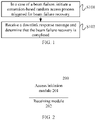
- FIG. 2 is a schematic structural diagram of a terminal device according to an embodiment of the present disclosure. As shown in FIG. 2 , the terminal device 200 includes an access initiation module 201 and a receiving module 202.
- the access initiation module 201 is configured to: in a case of a beam failure, initiate a contention-based random access process triggered for beam failure recovery.
- beam failure occurs in a PCell or a SCell.
- the random access process includes sending a msg3, where the msg3 includes a BFR MAC CE; or the random access process includes sending a msgA, where the msgA includes a BFR MAC CE.
- the access initiation module 201 may be configured to send a random access message.
- the random access message includes any one of the following: a msgl in the 4-step random access process, a msg3 in the 4-step random access process, and a msgA in the 2-step random access process.
- the receiving module 202 is configured to receive the downlink response message, and determine that the beam failure recovery is completed.
- the downlink response message is a response message corresponding to the random access process.
- the terminal device may initiate a contention-based random access process triggered for beam failure recovery.
- the terminal device receives the downlink response message indicating a response to a random access message, and determines that the BFR is completed, that is, determines that the BFR ends. In this way, completion of the BFR can be determined, thereby avoiding that the UE cannot complete the BFR. This avoids negative impact on signal transmission between the terminal device and a network device, and improves signal transmission between the terminal device and a network device.
- the downlink response message includes a msg4 in the 4-step random access process.
- the msg4 includes one or more of the following:
- the downlink response message includes a msgB in the 2-step random access process.
- the msgB includes one or more of the following:
- the downlink response message includes a msg4 in the 4-step random access process.
- FIG. 3 is a schematic structural diagram of hardware of a terminal device in the embodiments of this disclosure.
- the terminal device 300 includes but is not limited to: a radio frequency unit 301, a network module 302, an audio output unit 303, an input unit 304, a sensor 305, a display unit 306, a user input unit 307, an interface unit 308, a memory 309, a processor 310, a power supply 311, and other components.
- the terminal device structure shown in FIG. 3 does not constitute any limitation on the terminal device, and the terminal device may include more or fewer components than those shown in the figure, or combine some components, or have different component arrangements.
- the terminal device includes but is not limited to a mobile phone, a tablet computer, a notebook computer, a palmtop computer, an in-vehicle terminal, a wearable device, a pedometer, and the like.
- the radio frequency unit 301 is configured to: in a case of a beam failure, initiate a contention-based random access process triggered for beam failure recovery; and is configured to receive a downlink response message.
- the processor 310 is configured to determine that the beam failure recovery is completed when the radio frequency unit 301 receives the downlink response message.
- the downlink response message is a response message corresponding to the random access process.
- the terminal device may initiate a contention-based random access process triggered for beam failure recovery.
- the terminal device receives the downlink response message indicating a response to a random access message, and determines that the BFR is completed, that is, determines that the BFR ends. In this way, completion of the BFR can be determined, thereby avoiding that the UE cannot complete the BFR. This avoids negative impact on signal transmission between the terminal device and a network device, and improves signal transmission between the terminal device and a network device.
- the radio frequency unit 301 may be configured to receive and transmit information, or receive and transmit signals during a call. Specifically, the radio frequency unit receives downlink data from a base station, and transmits the downlink data to the processor 310 for processing; and in addition, transmits uplink data to the base station.
- the radio frequency unit 301 includes but is not limited to: an antenna, at least one amplifier, a transceiver, a coupler, a low noise amplifier, a duplexer, and the like.
- the radio frequency unit 301 may also communicate with a network and other devices through a wireless communication system.
- the terminal device provides wireless broadband Internet access for the user by using the network module 302, for example, helping the user to send and receive an e-mail, brows a web page, and access streaming media.
- the audio output unit 303 may convert audio data received by the radio frequency unit 301 or the network module 302 or stored in the memory 309 into an audio signal and output the audio signal as a sound.
- the audio output unit 303 may further provide audio output (for example, call signal receiving sound or message receiving sound) related to a specific function performed by the terminal device 300.
- the audio output unit 303 includes a speaker, a buzzer, a telephone receiver, and the like.
- the input unit 304 is configured to receive audio or radio frequency signals.
- the input unit 304 may include a graphics processing unit (Graphics Processing Unit, GPU) 3041 and a microphone 3042.
- the graphics processing unit 3041 is configured to process image data of a static picture or a video obtained by an image capturing device (for example, a camera) in a video capturing mode or an image capturing mode.
- a processed image frame may be displayed on the display unit 306.
- the image frame processed by the graphics processing unit 3041 may be stored in the memory 309 (or another storage medium) or sent by using the radio frequency unit 301 or the network module 302.
- the microphone 3042 may receive sound and can process such sound into audio data.
- the audio data obtained through processing may be converted, in a telephone call mode, into a format that may be sent to a mobile communication base station via the radio frequency unit 301 for output.
- the terminal device 300 further includes at least one sensor 305, such as an optical sensor, a motion sensor, and other sensors.
- the light sensor includes an ambient light sensor and a proximity sensor.
- the ambient light sensor may adjust luminance of the display panel 3031 based on brightness of ambient light.
- the proximity sensor may turn off the display panel 3031 and/or backlight when the terminal device 300 moves to an ear.
- an accelerometer sensor may detect an acceleration value in each direction (generally, three axes), and detect a value and a direction of gravity when the accelerometer sensor is static, and may be used in an application for recognizing a posture of the terminal device (such as screen switching between landscape and portrait modes, a related game, or magnetometer posture calibration), a function related to vibration recognition (such as a pedometer or a knock), and the like.
- the sensor 305 may further include a fingerprint sensor, a pressure sensor, an iris sensor, a molecular sensor, a gyroscope, a barometer, a hygrometer, a thermometer, an infrared sensor, and the like. Details are not described herein.
- the display unit 306 is configured to display information entered by the user or information provided for the user.
- the display unit 306 may include the display panel 3061, and the display panel 3061 may be configured in a form of a liquid crystal display (Liquid Crystal Display, LCD), an organic light-emitting diode (Organic Light-Emitting Diode, OLED), or the like.
- LCD Liquid Crystal Display
- OLED Organic Light-Emitting Diode
- the user input unit 307 may be configured to receive input digit or character information, and generate a key signal input related to a user setting and function control of the terminal device.
- the user input unit 307 includes a touch panel 3071 and another input device 3072.
- the touch panel 3071 also called a touch screen, may collect touch operation on or near the touch panel by users (for example, operation on the touch panel 3071 or near the touch panel 3071 by fingers or any suitable objects or accessories such as a touch pen by the users).
- the touch panel 3071 may include two parts: a touch detection apparatus and a touch controller.
- the touch detection apparatus detects a touch position of the user, detects a signal brought by the touch operation, and transmits the signal to the touch controller.
- the touch controller receives touch information from the touch detection apparatus, converts the touch information into contact coordinates, sends the contact coordinates to the processor 310, and can receive and execute a command sent by the processor 310.
- the touch panel 3071 may be implemented by various types such as a resistive type, a capacitive type, an infrared ray type or a surface acoustic wave type.
- the user input unit 307 may further include other input devices 3072.
- the other input devices 3072 may include but are not limited to: a physical keyboard, a function key (such as a volume control key, a switch key), a trackball, a mouse, and a joystick, which is no longer repeated here.
- the touch panel 3071 may cover the display panel 3031.
- the touch panel 3071 transmits the touch operation to the processor 310 to determine a type of a touch event, and then the processor 310 provides corresponding visual output on the display panel 3031 based on the type of the touch event.
- the touch panel 3071 and the display panel 3031 are used as two independent parts to implement input and output functions of the terminal device, in some embodiments, the touch panel 3071 and the display panel 3031 may be integrated to implement the input and output functions of the terminal device. This is not specifically limited herein.
- the interface unit 308 is an interface for connecting an external apparatus with the terminal device 300.
- the external apparatus may include a wired or wireless headset port, an external power supply (or battery charger) port, a wired or wireless data port, a storage card port, a port configured to connect to an apparatus having an identification module, an audio input/output (I/O) port, a video I/O port, a headset port, and the like.
- the interface unit 308 may be configured to receive an input (for example, data information or power) from an external apparatus and transmit the received input to one or more elements in the terminal device 300, or transmit data between the terminal device 300 and the external apparatus.
- the memory 309 may be configured to store a software program and various data.
- the memory 309 may mainly include a program storage area and a data storage area.
- the program storage area may store an operating system, an application required by at least one function (for example, a sound play function or an image display function), and the like.
- the data storage area may store data (for example, audio data or an address book) or the like created based on use of the mobile phone.
- the memory 309 may include a high-speed random access memory or a nonvolatile memory, for example, at least one disk storage device, a flash memory, or other volatile solid-state storage devices.
- the processor 310 is a control center of the terminal device, is connected to each part of the entire terminal device by using various interfaces and lines, and performs various functions of the terminal device and data processing by running or executing the software program and/or the module that are/is stored in the memory 309 and invoking data stored in the memory 309, to perform overall monitoring on the terminal device.
- the processor 310 may include one or more processing units.
- the processor 310 may integrate an application processor and a modem processor.
- the application processor mainly deals with an operating system, a user interface, an application, and the like.
- the modem processor mainly deals with wireless communication. It may be understood that the modem processor may not be integrated into the processor 310.
- the terminal device 300 may further include the power supply 311 (for example, a battery) configured to supply power to various components.
- the power supply 311 may be logically connected to the processor 310 through a power management system, so as to implement functions such as managing charging, discharging, and power consumption through the power management system.
- the terminal device 300 includes some function modules not shown. Details are not described herein.
- the embodiment of the present disclosure further provides a terminal device, including a processor 310, a memory 309, and a computer program stored in the memory 309 and capable of running on the processor 310.
- a terminal device including a processor 310, a memory 309, and a computer program stored in the memory 309 and capable of running on the processor 310.
- the computer program is executed by the processor 310, the processes of the foregoing embodiment of the method for determining beam failure recovery are implemented, and a same technical effect can be achieved. To avoid repetition, details are not described herein again.
- An embodiment of the present disclosure further provides a computer-readable storage medium.
- the computer-readable storage medium stores a computer program, and when executing the computer program, a processor implements the processes of the foregoing embodiments of the method for determining beam failure recovery and a same technical effect can be achieved. To avoid repetition, details are not described herein again.
- the computer-readable storage medium may include a non-transitory memory, for example, a read-only memory (ROM for short), a random access memory (RAM for short), a magnetic disk, or an optical disc.
- the method for determining beam failure recovery, the terminal device, and the storage medium in the foregoing embodiments can be applied to 5G communication systems and subsequent communication systems, which are not limited herein.
- the method in the foregoing embodiment may be implemented by software in addition to a necessary universal hardware platform or by hardware only. In most circumstances, the former is a preferred implementation manner.
- the technical solutions of the present disclosure essentially, or the part contributing to the prior art may be implemented in a form of a software product.
- the computer software product is stored in a storage medium (for example, a ROM/RAM, a magnetic disk, or a compact disc), and includes a plurality of instructions for instructing a terminal (which may be a mobile phone, a computer, a server, an air conditioner, a network device, or the like) to perform the method described in the embodiments of the present disclosure.
- the processor may be but is not limited to a general purpose processor, a dedicated processor, a special application processor, or a field programmable logic circuit. It should be further understood that each block in the block diagram or the flowchart and a combination of blocks in the block diagram or the flowchart may be implemented by using dedicated hardware that performs a specified function or operation, or may be implemented by using a combination of dedicated hardware and a computer instruction.
Landscapes
- Engineering & Computer Science (AREA)
- Computer Networks & Wireless Communication (AREA)
- Signal Processing (AREA)
- Mobile Radio Communication Systems (AREA)
Applications Claiming Priority (2)
| Application Number | Priority Date | Filing Date | Title |
|---|---|---|---|
| CN201911083599.9A CN112788772B (zh) | 2019-11-07 | 2019-11-07 | 波束失败恢复的确认方法、终端设备及存储介质 |
| PCT/CN2020/126111 WO2021088791A1 (fr) | 2019-11-07 | 2020-11-03 | Procédé de confirmation de reprise sur défaillance de faisceau, dispositif terminal et support de stockage |
Publications (2)
| Publication Number | Publication Date |
|---|---|
| EP4050959A1 true EP4050959A1 (fr) | 2022-08-31 |
| EP4050959A4 EP4050959A4 (fr) | 2022-11-23 |
Family
ID=75748008
Family Applications (1)
| Application Number | Title | Priority Date | Filing Date |
|---|---|---|---|
| EP20883690.8A Pending EP4050959A4 (fr) | 2019-11-07 | 2020-11-03 | Procédé de confirmation de reprise sur défaillance de faisceau, dispositif terminal et support de stockage |
Country Status (5)
| Country | Link |
|---|---|
| US (1) | US20220263539A1 (fr) |
| EP (1) | EP4050959A4 (fr) |
| JP (1) | JP2022554209A (fr) |
| CN (1) | CN112788772B (fr) |
| WO (1) | WO2021088791A1 (fr) |
Families Citing this family (2)
| Publication number | Priority date | Publication date | Assignee | Title |
|---|---|---|---|---|
| US12200513B2 (en) * | 2020-09-29 | 2025-01-14 | Qualcomm Incorporated | Beam group specific medium access control-control element (MAC-CE) based beam failure recovery (BFR) requests |
| CN116367307A (zh) * | 2021-12-24 | 2023-06-30 | 展讯通信(上海)有限公司 | 波束失败确定方法及装置、计算机可读存储介质 |
Family Cites Families (14)
| Publication number | Priority date | Publication date | Assignee | Title |
|---|---|---|---|---|
| CN103796315B (zh) * | 2012-11-02 | 2018-12-11 | 南京中兴软件有限责任公司 | 用户设备专用搜索空间的物理资源块配置方法和装置 |
| US10813097B2 (en) * | 2017-06-14 | 2020-10-20 | Qualcomm Incorporated | System and method for transmitting beam failure recovery request |
| CN109962756A (zh) * | 2017-12-22 | 2019-07-02 | 华为技术有限公司 | 通信方法和装置 |
| US20190215706A1 (en) * | 2018-01-11 | 2019-07-11 | Asustek Computer Inc. | Method and apparatus of beam failure recovery via random access procedure in a wireless communication system |
| CN110324908B (zh) * | 2018-03-28 | 2022-08-02 | 维沃移动通信有限公司 | 波束失败处理方法、终端及网络设备 |
| US11039350B2 (en) * | 2018-04-02 | 2021-06-15 | Comcast Cable Communications, Llc | Beam failure recovery |
| CN110351875A (zh) * | 2018-04-04 | 2019-10-18 | 电信科学技术研究院有限公司 | 一种辅小区波束失败恢复方法、终端及基站 |
| US10939442B2 (en) * | 2018-04-06 | 2021-03-02 | Mediatek Inc. | Beam selection and resource allocation for beam-formed random access procedure |
| US11991728B2 (en) * | 2019-08-27 | 2024-05-21 | Intel Corporation | Techniques for high frequency wireless communication |
| WO2021062767A1 (fr) * | 2019-09-30 | 2021-04-08 | Oppo广东移动通信有限公司 | Procédé et appareil d'accès aléatoire en deux étapes sur une base sans conflit, terminal et support de stockage |
| JP7288267B2 (ja) * | 2019-10-03 | 2023-06-07 | オフィノ, エルエルシー | 2ステップランダムアクセス手順の不連続受信 |
| EP4038996A1 (fr) * | 2019-10-04 | 2022-08-10 | Lenovo (Singapore) Pte. Ltd. | Procédé et appareil destinés à une procédure d'accès aléatoire en deux étapes |
| US11381300B2 (en) * | 2019-10-25 | 2022-07-05 | FG Innovation Company Limited | Method and apparatus for performing random access procedure for beam failure recovery |
| CN114009083A (zh) * | 2019-11-01 | 2022-02-01 | Oppo广东移动通信有限公司 | 用于辅小区的波束失败恢复的装置和方法 |
-
2019
- 2019-11-07 CN CN201911083599.9A patent/CN112788772B/zh active Active
-
2020
- 2020-11-03 WO PCT/CN2020/126111 patent/WO2021088791A1/fr not_active Ceased
- 2020-11-03 EP EP20883690.8A patent/EP4050959A4/fr active Pending
- 2020-11-03 JP JP2022524234A patent/JP2022554209A/ja active Pending
-
2022
- 2022-05-06 US US17/739,041 patent/US20220263539A1/en active Pending
Also Published As
| Publication number | Publication date |
|---|---|
| JP2022554209A (ja) | 2022-12-28 |
| WO2021088791A1 (fr) | 2021-05-14 |
| US20220263539A1 (en) | 2022-08-18 |
| CN112788772B (zh) | 2023-05-26 |
| EP4050959A4 (fr) | 2022-11-23 |
| CN112788772A (zh) | 2021-05-11 |
Similar Documents
| Publication | Publication Date | Title |
|---|---|---|
| US11343855B2 (en) | Method and device for random access and terminal | |
| US12004230B2 (en) | Random access method and related device | |
| CN109587789B (zh) | 随机接入方法、移动终端及网络设备 | |
| US12193060B2 (en) | Random access method and apparatus, and communications device | |
| JP7210755B2 (ja) | ランダムアクセス方法及び機器 | |
| CN110035473B (zh) | 一种系统信息的传输方法和用户终端 | |
| CN110324914B (zh) | 波束失败的处理方法和终端 | |
| EP3813469A1 (fr) | Procédé d'accès aléatoire et dispositif de communication | |
| US20220263539A1 (en) | Beam failure recovery determining method, terminal device, and storage medium | |
| CN111757535A (zh) | 一种随机接入方法、指示方法、网络设备及终端 | |
| CN111615204A (zh) | 一种随机接入消息的处理方法和终端 | |
| US11523442B2 (en) | Random access resource selection method and terminal device | |
| CN111836400B (zh) | 非授权频段的随机接入消息发送方法和终端 | |
| US20210204329A1 (en) | Random access method and terminal | |
| CN113133126B (zh) | 变换工作频点的方法、终端及网络设备 | |
| JP7474241B2 (ja) | ランダムアクセス方法及び端末装置 | |
| HK40047580A (en) | Random access method and terminal | |
| HK40047580B (en) | Random access method and terminal |
Legal Events
| Date | Code | Title | Description |
|---|---|---|---|
| STAA | Information on the status of an ep patent application or granted ep patent |
Free format text: STATUS: THE INTERNATIONAL PUBLICATION HAS BEEN MADE |
|
| PUAI | Public reference made under article 153(3) epc to a published international application that has entered the european phase |
Free format text: ORIGINAL CODE: 0009012 |
|
| STAA | Information on the status of an ep patent application or granted ep patent |
Free format text: STATUS: REQUEST FOR EXAMINATION WAS MADE |
|
| 17P | Request for examination filed |
Effective date: 20220524 |
|
| AK | Designated contracting states |
Kind code of ref document: A1 Designated state(s): AL AT BE BG CH CY CZ DE DK EE ES FI FR GB GR HR HU IE IS IT LI LT LU LV MC MK MT NL NO PL PT RO RS SE SI SK SM TR |
|
| A4 | Supplementary search report drawn up and despatched |
Effective date: 20221024 |
|
| RIC1 | Information provided on ipc code assigned before grant |
Ipc: H04W 76/19 20180101ALI20221018BHEP Ipc: H04W 76/18 20180101ALI20221018BHEP Ipc: H04W 74/08 20090101ALI20221018BHEP Ipc: H04W 74/00 20090101AFI20221018BHEP |
|
| DAV | Request for validation of the european patent (deleted) | ||
| DAX | Request for extension of the european patent (deleted) | ||
| STAA | Information on the status of an ep patent application or granted ep patent |
Free format text: STATUS: EXAMINATION IS IN PROGRESS |
|
| 17Q | First examination report despatched |
Effective date: 20250213 |