EP4051048B1 - Öffnungssystem mit licht und entsprechender aktenkoffer - Google Patents
Öffnungssystem mit licht und entsprechender aktenkoffer Download PDFInfo
- Publication number
- EP4051048B1 EP4051048B1 EP20797783.6A EP20797783A EP4051048B1 EP 4051048 B1 EP4051048 B1 EP 4051048B1 EP 20797783 A EP20797783 A EP 20797783A EP 4051048 B1 EP4051048 B1 EP 4051048B1
- Authority
- EP
- European Patent Office
- Prior art keywords
- opening
- luminous flux
- peripheral groove
- frame
- volume
- Prior art date
- Legal status (The legal status is an assumption and is not a legal conclusion. Google has not performed a legal analysis and makes no representation as to the accuracy of the status listed.)
- Active
Links
Images

Classifications
-
- A—HUMAN NECESSITIES
- A45—HAND OR TRAVELLING ARTICLES
- A45C—PURSES; LUGGAGE; HAND CARRIED BAGS
- A45C15/00—Purses, bags, luggage or other receptacles covered by groups A45C1/00 - A45C11/00, combined with other objects or articles
- A45C15/06—Purses, bags, luggage or other receptacles covered by groups A45C1/00 - A45C11/00, combined with other objects or articles with illuminating devices
-
- A—HUMAN NECESSITIES
- A45—HAND OR TRAVELLING ARTICLES
- A45C—PURSES; LUGGAGE; HAND CARRIED BAGS
- A45C3/00—Flexible luggage; Handbags
- A45C3/02—Briefcases or the like
Definitions
- the field of the invention is that of opening systems and more particularly opening systems implementing an opening mounted movably on a frame between a closed position and an open position.
- the invention applies to any type of opening between a first volume and a second volume and can therefore be integrated into any type of container, such as boxes or cases, and in particular to briefcases of the “attache case” type.
- Attache-case briefcases allow you to transport documents or other objects easily and safely.
- the first volume is a closed internal volume and the second volume is an external volume which may for example be a medium surrounding the internal volume.
- the first volume is the internal volume of the briefcase
- the second volume is the medium surrounding the briefcase.
- KR 2012 0029740 describes an opening system comprising illumination means.
- some opening systems may include locking means such as key or code locks, or latches.
- some opening systems may include lighting means which emit a luminous flux to illuminate the first volume and/or the second volume.
- These lighting means comprise at least one luminous flux emission member coupled to a device for detecting the opening in its open position to supply electrical energy to the emission member.
- lighting means are widespread in all types of container which combine the opening of the opening with lighting of the internal volume in particular.
- the invention aims in particular to propose an opening system adaptable to a briefcase, which offers an effect of wonder or surprise to its user.
- the invention also aims to create the effect of wonder and/or surprise in a particular condition of use of the opening system, for example when the opening adopts an interstitial position in which the opening is contiguous to an opening plane of the frame and provides an interstitial passage with the frame.
- the invention further aims to enable the creation of this effect of wonder and/or surprise without reducing the space of the first volume and without increasing the size of the briefcase.
- the luminous flux makes it possible to create a luminous halo around the opening, simulating for example the presence of a precious object in the first volume.
- the presence of at least one diffusion element makes it possible to diffuse the luminous flux leaving the emission member in several distinct directions.
- the light flux guiding subsystem thus provides a dual effect. First, it enables a dispersed and diffuse light flux to be generated from a light organ and, second, it enables the dispersed and diffuse light flux to be guided and oriented towards the opening of the peripheral groove.
- the luminous flux which is multidirectional at the exit of the emission organ, is guided to become unidirectional or almost so.
- the light flux is then directed towards the opening of the peripheral groove to create the light halo.
- the housing forms an elbow with the peripheral groove. This elbow makes it possible to mask the origin of the light radiation, in particular to reinforce a magical effect linked to lighting.
- the presence of the elbow ensures good compactness of the opening system.
- the grooves on the second side allow the light flux to diverge in several different predetermined directions.
- the luminous flux emerging from the diffusion element is multidirectional such that it is not possible, or at least not obvious, to know in which direction the emitting member emits.
- the opening system comprises two diffusion elements superimposed on each other.
- the peripheral groove and the housing form an L, the housing being positioned above the peripheral groove relative to the opening plane.
- the emitting organ does not emit directly towards the opening.
- the emitting organ is not directly visible to the user, which further reinforces the creation of an effect of the presence of a precious object in the first volume.
- the peripheral groove forms a ring around the entire periphery of the opening.
- the light halo effect is then achieved around the entire perimeter of the opening. There is therefore no break in the halo, which reinforces the desired visual effect.
- the emitting member is a strip provided with a plurality of diodes.
- Such an emission organ makes it possible to obtain several origins for the luminous flux.
- the intensity of the light halo can then be constant at any point of the halo, or almost.
- the opening system also comprises means for triggering the emission of a luminous flux by the emission member, in the interstitial position of the opening.
- the emitting organ thus only emits its luminous flux when the opening is in its interstitial position. This has the advantage of reducing the usage time of the emitting organ and therefore extending its service life. Furthermore, this increases the creation of the visual effect of the luminous halo which is only created when the opening is in its interstitial position.
- the light guide has an emission face flush with the edge of the opening.
- the flushness of the light guide emission face with the edge of the opening provides a good finish for the opening.
- the light guide is thus perfectly integrated into the opening and can, for example, blend into the opening to such an extent that it is invisible, or almost so.
- the light guide preferably has a tint treatment.
- the light flux emission organ is not perceptible to the user, which reinforces the aesthetics of the opening system.
- the light guide may be difficult to perceive for the user, which reinforces the “magical” effect when creating the light halo.
- the frame is a chassis of a briefcase and the opening is a cover of the briefcase.
- the creation of the luminous halo thus makes it possible to simulate the presence of a precious object inside the frame of the briefcase.
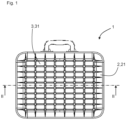
- FIG. 1 illustrates a briefcase 1 comprising a frame 2 and a cover 3 movable relative to the frame 2.
- the opening system is thus inserted between a first volume 4 and a second volume 5 to authorize, or on the contrary prohibit, communication between the first volume 4 and the second volume 5.
- first volume 4 is the internal volume of the briefcase 1 and the second volume 5 is a volume external to the briefcase 1.
- the emitting member 6 is a strip provided with a plurality of diodes each emitting light radiation.
- the emitting member 6 comprises several diodes spaced apart from each other, each forming a starting point for the light flux.
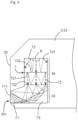
- the opening 31 has an edge 32 provided with a peripheral groove 33 having an opening 331 opening onto the edge 32.
- peripheral groove 33 is extended by a housing 34 which forms, with the peripheral groove 33, an elbow inside the opening 31.
- the peripheral groove 33 and the housing 34 together form an L, the housing 34 being positioned above the peripheral groove 33 relative to the opening plane 22.
- the housing 34 is positioned above the peripheral groove 33 relative to a bottom of the frame 21, that is to say of the chassis 2, of the briefcase 1.
- the peripheral groove 33 is therefore located between the housing 34 and the frame 21 in the interstitial position of the frame 21.
- the peripheral groove 33 forms a ring around the entire periphery of the opening 31.
- the light guide 71 is positioned in the peripheral groove 33 and has an emission face 711 which is flush with the edge 32 of the opening 31.
- the emission face 711 is therefore located in the opening 331 of the peripheral groove 33.
- the light guide 71 advantageously has a tint treatment.
- This tint treatment can in particular correspond to a color of the opening 31.
- the light guide 71 is merged with the opening 31, thus making it possible to act as a trompe l'oeil so that the user does not detect the presence of the light guide 71 at a glance.
- the tint treatment may contrast with the color of the opening 31 to form an aesthetic and/or technical demarcation.
- the tint treatment particularly makes it possible to eliminate the “spot” effect generated by the positioning of the different diodes.
- the diodes form significant points of luminosity which can be detected by the user.
- the dyeing of the light guide 71 and the presence of at least one diffusion element 72 make it possible to eliminate the black areas between two diodes and to generate a continuous light strip.
- the light escaping through the opening 331 of the peripheral groove 33 makes it possible to create a light halo effect which fades and stops when the opening leaves its interstitial position, without the user noticing that the light necessarily comes from the opening 31, as explained below.
- the second face 721 has a series of grooves making it possible to separate the light flux into several divergent rays as explained below.
- each groove allows the light beam to be cut along a single axis, allowing only part of the light beam to pass through.
- the light guide subsystem 7 comprises two diffusion elements 72 superimposed on each other.
- the second face 722 of the first diffusion element 72 bears on the first face of the second diffusion element 72, in a chosen direction of emission of the luminous flux.
- the reflection element 73 is, for its part, located in the peripheral groove 33, between the bottom of the peripheral groove 33 and the light guide 71.
- the reflection element 73 is intended to direct the luminous flux that it receives towards the opening 331.
- the opening system also comprises triggering means (not visible in the figures) for the emission of a luminous flux by the emission member 6, these triggering means being actuated when the opening 31 is in its interstitial position.
- the triggering means control the emission member 6 so that it emits a luminous flux in the direction of the peripheral groove 33.
- the luminous flux is advantageously composed of a multitude of divergent light rays each emitted by one of the diodes of the emitting member 6.
- the light ray thus leaves the emitting member and propagates through the two diffusion elements 72 to reach the light guide.
- the ray When the ray reaches the second face 722 of a diffusion element 72, it is then split into several rays (in this case and for illustration purposes three rays), independent of each other and each directed in a different direction. This is notably due to the presence of the striations on the second face 722 of the diffusion element 72.
- the light rays When the light rays have passed through each of the diffusion elements 72, and have possibly split again, they are directed towards the opening 331 of the groove 33. More particularly, the light rays are either directly directed towards the opening 331, or directed in a direction other than that of the opening 331.
- the rays bounce against the reflection element 73 which has an inclined surface so as to redirect them and make them bounce towards the opening 331. More particularly, the light rays are oriented to impact the emission face 711 in an upward direction as illustrated in the figure 3 .
- the light rays are directed in a multitude of upward directions, which makes it possible to create a luminous halo at the opening 331 of the peripheral groove 33.
- the light rays impact the emission face 711 of the light guide 71. This is verified on the assumption that the light guide subsystem 7 comprises diffusion elements 72 and that on contact with the second face 722 a light ray is divided into several light rays in a common direction.
- a luminous effect in the form of a halo, is created around the opening plane 22, giving the effect of the presence of an object. precious and radiant inside the first volume 4, that is to say in the frame 2 of the briefcase 1.
- the triggering means act on the emission member 6 so as to stop the emission of a luminous flux.
- the briefcase 1 comprises an energy source to which the transmission member 6 is connected, this energy source being able, if necessary, to be recharged using ad hoc means.
- the opening 31 at least of the briefcase 1 is made of a metallic material, or any other material impermeable to light rays. These materials make it possible in particular to facilitate the rebound of the light rays, and in particular to confine the light flux in the housing 34 on the one hand and then in the peripheral groove 33 on the other hand, so as to guide the light flux towards the emission face 711 of the light guide 71 to ensure the desired light halo effect.
Landscapes
- Arrangement Of Elements, Cooling, Sealing, Or The Like Of Lighting Devices (AREA)
- Planar Illumination Modules (AREA)
- Casings For Electric Apparatus (AREA)
Claims (10)
- Öffnungssystem, das zwischen einem ersten Volumen (4) und einem zweiten Volumen (5) zwischengestellt ist, umfassend:- einen Rahmen (21), der eine Öffnungsebene (22) zwischen dem ersten Volumen (4) und dem zweiten Volumen (5) aufweist;- einen Flügel (31), der in Bezug auf den Rahmen (21) beweglich und imstande ist, eine Spaltposition einzunehmen, in der der Flügel (31) an die Öffnungsebene (22) angrenzt;- mindestens ein Organ (6) zum Senden eines Lichtstroms, das dazu bestimmt ist, in der Spaltposition des Flügels (31) einen Lichtstrom zu senden,dadurch gekennzeichnet, dass:- der Flügel (31) eine Kante (32) aufweist, die mit einer Umfangsnut (33) versehen ist, die eine Öffnung (331) aufweist, die auf der Kante (32) ausmündet, wobei die Umfangsnut (33) durch eine Aufnahme (34) verlängert ist, die das Sendeorgan (6) aufnimmt;und dass der Flügel (31) in die Umfangsnut (33) ein Untersystem (7) zur Führung des Lichtstroms integriert, wobei dieses Untersystem (7) umfasst:- einen Lichtleiter (71), der in der Öffnung (331) positioniert ist;- mindestens ein Diffusionselement (72), das in der Aufnahme (34) zwischen dem Sendeorgan (6) und der Umfangsnut (33) positioniert ist und den gesamten Lichtstrom empfängt, der vom Sendeorgan (6) kommt;- ein Reflexionselement (73), das zumindest einen Teil des von dem oder jedem Diffusionselement (72) kommenden Lichtstroms empfängt, um ihn zu der Öffnung (331) zu lenken, und dass die Aufnahme (34) ein Knie mit der Umfangsnut (33) bildet.
- Öffnungssystem nach Anspruch 1, dadurch gekennzeichnet, dass das Diffusionselement (72) aufweist:- eine erste Fläche (721), über die der Lichtstrom in das Diffusionselement (72) eintritt;- eine zweite, gegenüberliegende Fläche (722), über die der Lichtstrom das Diffusionselement (72) verlässt,wobei die zweite Fläche (722) eine Reihe von Rillen aufweist, die es gestatten, den Lichtstrom in mehrere, zueinander parallele Strahlen zu teilen.
- Öffnungssystem nach einem der Ansprüche 1 oder 2, dadurch gekennzeichnet, dass es zwei übereinander angeordnete Diffusionselemente (72) umfasst.
- Öffnungssystem nach einem der vorhergehenden Ansprüche, dadurch gekennzeichnet, dass die Umfangsnut (33) und die Aufnahme (34) ein L bilden, wobei die Aufnahme (34) in Bezug auf die Öffnungsebene (22) oberhalb der Umfangsnut (33) positioniert ist.
- Öffnungssystem nach einem der vorhergehenden Ansprüche, dadurch gekennzeichnet, dass die Umfangsnut (33) einen Ring über dem gesamten Umfang des Flügels (31) bildet.
- Öffnungssystem nach einem der vorhergehenden Ansprüche, dadurch gekennzeichnet, dass das Sendeorgan (6) ein Streifen ist, der mit einer Vielzahl von Dioden versehen ist.
- Öffnungssystem nach einem der vorhergehenden Ansprüche, dadurch gekennzeichnet, dass es ebenfalls Mittel zum Auslösen des Sendens eines Lichtstroms durch das Sendeorgan (6) in der Spaltposition des Flügels (31) umfasst.
- Öffnungssystem nach einem der vorhergehenden Ansprüche, dadurch gekennzeichnet, dass der Lichtleiter (71) eine Sendefläche (711) aufweist, die mit der Kante (32) des Flügels (31) bündig ist.
- Öffnungssystem nach einem der vorhergehenden Ansprüche, dadurch gekennzeichnet, dass der Lichtleiter (71) eine Tönungsbehandlung aufweist.
- Öffnungssystem nach einem der vorhergehenden Ansprüche, dadurch gekennzeichnet, dass der Rahmen (21) ein Gestell (2) eines Dokumentenkoffers (1) ist und der Flügel (31) ein Deckel (3) des Dokumentenkoffers (1) ist.
Applications Claiming Priority (2)
| Application Number | Priority Date | Filing Date | Title |
|---|---|---|---|
| FR1912561A FR3102917B1 (fr) | 2019-11-08 | 2019-11-08 | Système d’ouverture à effet lumineux et mallette porte-documents intégrant un tel système d’ouverture |
| PCT/EP2020/080815 WO2021089542A1 (fr) | 2019-11-08 | 2020-11-03 | Système d'ouverture à effet lumineux et mallette porte-documents intégrant un tel système d'ouverture |
Publications (3)
| Publication Number | Publication Date |
|---|---|
| EP4051048A1 EP4051048A1 (de) | 2022-09-07 |
| EP4051048B1 true EP4051048B1 (de) | 2025-01-01 |
| EP4051048C0 EP4051048C0 (de) | 2025-01-01 |
Family
ID=69743363
Family Applications (1)
| Application Number | Title | Priority Date | Filing Date |
|---|---|---|---|
| EP20797783.6A Active EP4051048B1 (de) | 2019-11-08 | 2020-11-03 | Öffnungssystem mit licht und entsprechender aktenkoffer |
Country Status (3)
| Country | Link |
|---|---|
| EP (1) | EP4051048B1 (de) |
| FR (1) | FR3102917B1 (de) |
| WO (1) | WO2021089542A1 (de) |
Family Cites Families (3)
| Publication number | Priority date | Publication date | Assignee | Title |
|---|---|---|---|---|
| US8277073B2 (en) * | 2009-01-21 | 2012-10-02 | Wells William K | Portable light apparatus and method of attachment |
| KR101200047B1 (ko) * | 2010-09-17 | 2012-11-12 | (주)알텍테크놀로지스 | 조명 창호 |
| US9726424B1 (en) * | 2014-05-04 | 2017-08-08 | Liddup, Llc | Cooler with secondary lid |
-
2019
- 2019-11-08 FR FR1912561A patent/FR3102917B1/fr active Active
-
2020
- 2020-11-03 EP EP20797783.6A patent/EP4051048B1/de active Active
- 2020-11-03 WO PCT/EP2020/080815 patent/WO2021089542A1/fr not_active Ceased
Also Published As
| Publication number | Publication date |
|---|---|
| FR3102917B1 (fr) | 2024-05-10 |
| EP4051048A1 (de) | 2022-09-07 |
| FR3102917A1 (fr) | 2021-05-14 |
| WO2021089542A1 (fr) | 2021-05-14 |
| EP4051048C0 (de) | 2025-01-01 |
Similar Documents
| Publication | Publication Date | Title |
|---|---|---|
| EP0978084A1 (de) | Optoelektronisches bilderfassungsgerät, insbesondere für strichkodes | |
| FR2979873A1 (fr) | Procede d'ouverture d'un ouvrant de vehicule automobile | |
| WO2022128061A1 (fr) | Boite a illumination homogene pour imagerie photographique ou par camera | |
| EP4176201A1 (de) | Optische anordnung für einen projektor und projektor mit solch einer optischen anordnung | |
| EP4051048B1 (de) | Öffnungssystem mit licht und entsprechender aktenkoffer | |
| FR2987797A1 (fr) | Tablette d'un dispositif d'eclairage d'une zone d'un habitacle de vehicule | |
| EP3899361B1 (de) | Lichtelement für karosseriebauteil aus spritzgegossenem polycarbonat | |
| EP2418539A1 (de) | Beleuchtungs- und Auflagevorrichtung zum Fotografieren eines Objekts | |
| FR3009878A1 (fr) | Dispositif de decision prevu pour decider si un œil est vrai ou faux | |
| FR3048063A1 (fr) | Dispositif d'eclairage interieur d'un habitacle de vehicule automobile | |
| EP3898332A1 (de) | Beleuchtungseinrichtung für fahrzeugdeckenleuchte | |
| FR3010484A1 (fr) | Dispositif d'eclairage d'un habitacle de vehicule automobile | |
| EP3785061B1 (de) | Lichtleiter für gestendetektionsschnittstellenmodul | |
| FR2922832A1 (fr) | Systeme d'eclairage dans l'habitacle d'un vehicule et vehicule comportant un tel systeme d'eclairage | |
| EP2102706B1 (de) | System zum aufnehmen von bildern des gesichts eines individuums | |
| FR2858278A3 (fr) | Dispositif d'eclairage pour une immatriculation de vehicule automobile | |
| EP3009999A1 (de) | Eingebauter linearer rauchdetektor | |
| FR3043415B1 (fr) | Dispositif de signalisation lumineux | |
| FR3101028A1 (fr) | Pièce de véhicule avec interface utilisateur | |
| EP2646753A1 (de) | Luftschleuse mit beleuchtungsvorrichtung | |
| EP4575631B1 (de) | Kameraklappenpositionsdetektion mittels hintergrundbeleuchtung | |
| EP3785060B1 (de) | Lichtleiter für gestendetektionsschnittstellenmodul | |
| FR3101015A1 (fr) | Livre éclairé à effet lévitation. | |
| FR3116104A1 (fr) | Système de génération d’un effet lumineux | |
| FR2880157A1 (fr) | Dispositif optique de capture biometrique avec affichage d'information a destination de l'utilisateur |
Legal Events
| Date | Code | Title | Description |
|---|---|---|---|
| STAA | Information on the status of an ep patent application or granted ep patent |
Free format text: STATUS: UNKNOWN |
|
| STAA | Information on the status of an ep patent application or granted ep patent |
Free format text: STATUS: THE INTERNATIONAL PUBLICATION HAS BEEN MADE |
|
| PUAI | Public reference made under article 153(3) epc to a published international application that has entered the european phase |
Free format text: ORIGINAL CODE: 0009012 |
|
| STAA | Information on the status of an ep patent application or granted ep patent |
Free format text: STATUS: REQUEST FOR EXAMINATION WAS MADE |
|
| 17P | Request for examination filed |
Effective date: 20220601 |
|
| AK | Designated contracting states |
Kind code of ref document: A1 Designated state(s): AL AT BE BG CH CY CZ DE DK EE ES FI FR GB GR HR HU IE IS IT LI LT LU LV MC MK MT NL NO PL PT RO RS SE SI SK SM TR |
|
| DAV | Request for validation of the european patent (deleted) | ||
| DAX | Request for extension of the european patent (deleted) | ||
| GRAP | Despatch of communication of intention to grant a patent |
Free format text: ORIGINAL CODE: EPIDOSNIGR1 |
|
| STAA | Information on the status of an ep patent application or granted ep patent |
Free format text: STATUS: GRANT OF PATENT IS INTENDED |
|
| INTG | Intention to grant announced |
Effective date: 20240712 |
|
| GRAS | Grant fee paid |
Free format text: ORIGINAL CODE: EPIDOSNIGR3 |
|
| GRAA | (expected) grant |
Free format text: ORIGINAL CODE: 0009210 |
|
| STAA | Information on the status of an ep patent application or granted ep patent |
Free format text: STATUS: THE PATENT HAS BEEN GRANTED |
|
| AK | Designated contracting states |
Kind code of ref document: B1 Designated state(s): AL AT BE BG CH CY CZ DE DK EE ES FI FR GB GR HR HU IE IS IT LI LT LU LV MC MK MT NL NO PL PT RO RS SE SI SK SM TR |
|
| REG | Reference to a national code |
Ref country code: GB Ref legal event code: FG4D Free format text: NOT ENGLISH |
|
| REG | Reference to a national code |
Ref country code: DE Ref legal event code: R096 Ref document number: 602020044124 Country of ref document: DE |
|
| REG | Reference to a national code |
Ref country code: CH Ref legal event code: EP |
|
| REG | Reference to a national code |
Ref country code: IE Ref legal event code: FG4D Free format text: LANGUAGE OF EP DOCUMENT: FRENCH |
|
| U01 | Request for unitary effect filed |
Effective date: 20250103 |
|
| U07 | Unitary effect registered |
Designated state(s): AT BE BG DE DK EE FI FR IT LT LU LV MT NL PT RO SE SI Effective date: 20250115 |
|
| PG25 | Lapsed in a contracting state [announced via postgrant information from national office to epo] |
Ref country code: PL Free format text: LAPSE BECAUSE OF FAILURE TO SUBMIT A TRANSLATION OF THE DESCRIPTION OR TO PAY THE FEE WITHIN THE PRESCRIBED TIME-LIMIT Effective date: 20250101 |
|
| PG25 | Lapsed in a contracting state [announced via postgrant information from national office to epo] |
Ref country code: ES Free format text: LAPSE BECAUSE OF FAILURE TO SUBMIT A TRANSLATION OF THE DESCRIPTION OR TO PAY THE FEE WITHIN THE PRESCRIBED TIME-LIMIT Effective date: 20250101 |
|
| PG25 | Lapsed in a contracting state [announced via postgrant information from national office to epo] |
Ref country code: NO Free format text: LAPSE BECAUSE OF FAILURE TO SUBMIT A TRANSLATION OF THE DESCRIPTION OR TO PAY THE FEE WITHIN THE PRESCRIBED TIME-LIMIT Effective date: 20250401 Ref country code: IS Free format text: LAPSE BECAUSE OF FAILURE TO SUBMIT A TRANSLATION OF THE DESCRIPTION OR TO PAY THE FEE WITHIN THE PRESCRIBED TIME-LIMIT Effective date: 20250501 |
|
| PG25 | Lapsed in a contracting state [announced via postgrant information from national office to epo] |
Ref country code: HR Free format text: LAPSE BECAUSE OF FAILURE TO SUBMIT A TRANSLATION OF THE DESCRIPTION OR TO PAY THE FEE WITHIN THE PRESCRIBED TIME-LIMIT Effective date: 20250101 |
|
| PG25 | Lapsed in a contracting state [announced via postgrant information from national office to epo] |
Ref country code: GR Free format text: LAPSE BECAUSE OF FAILURE TO SUBMIT A TRANSLATION OF THE DESCRIPTION OR TO PAY THE FEE WITHIN THE PRESCRIBED TIME-LIMIT Effective date: 20250402 |
|
| PG25 | Lapsed in a contracting state [announced via postgrant information from national office to epo] |
Ref country code: CZ Free format text: LAPSE BECAUSE OF FAILURE TO SUBMIT A TRANSLATION OF THE DESCRIPTION OR TO PAY THE FEE WITHIN THE PRESCRIBED TIME-LIMIT Effective date: 20250101 |
|
| PG25 | Lapsed in a contracting state [announced via postgrant information from national office to epo] |
Ref country code: SM Free format text: LAPSE BECAUSE OF FAILURE TO SUBMIT A TRANSLATION OF THE DESCRIPTION OR TO PAY THE FEE WITHIN THE PRESCRIBED TIME-LIMIT Effective date: 20250101 |
|
| PG25 | Lapsed in a contracting state [announced via postgrant information from national office to epo] |
Ref country code: SK Free format text: LAPSE BECAUSE OF FAILURE TO SUBMIT A TRANSLATION OF THE DESCRIPTION OR TO PAY THE FEE WITHIN THE PRESCRIBED TIME-LIMIT Effective date: 20250101 |
|
| U20 | Renewal fee for the european patent with unitary effect paid |
Year of fee payment: 6 Effective date: 20250919 |
|
| PLBE | No opposition filed within time limit |
Free format text: ORIGINAL CODE: 0009261 |
|
| STAA | Information on the status of an ep patent application or granted ep patent |
Free format text: STATUS: NO OPPOSITION FILED WITHIN TIME LIMIT |
|
| REG | Reference to a national code |
Ref country code: CH Ref legal event code: L10 Free format text: ST27 STATUS EVENT CODE: U-0-0-L10-L00 (AS PROVIDED BY THE NATIONAL OFFICE) Effective date: 20251112 |
|
| REG | Reference to a national code |
Ref country code: CH Ref legal event code: U11 Free format text: ST27 STATUS EVENT CODE: U-0-0-U10-U11 (AS PROVIDED BY THE NATIONAL OFFICE) Effective date: 20251201 |
|
| 26N | No opposition filed |
Effective date: 20251002 |
|
| PGFP | Annual fee paid to national office [announced via postgrant information from national office to epo] |
Ref country code: GB Payment date: 20251121 Year of fee payment: 6 |
|
| PGFP | Annual fee paid to national office [announced via postgrant information from national office to epo] |
Ref country code: MC Payment date: 20251121 Year of fee payment: 6 |
|
| PGFP | Annual fee paid to national office [announced via postgrant information from national office to epo] |
Ref country code: CH Payment date: 20251201 Year of fee payment: 6 |