EP4052894A1 - Feuille composite de résine renforcée par des fibres, matériau composite de résine renforcée par des fibres, et article moulé en résine les comportant - Google Patents
Feuille composite de résine renforcée par des fibres, matériau composite de résine renforcée par des fibres, et article moulé en résine les comportant Download PDFInfo
- Publication number
- EP4052894A1 EP4052894A1 EP20900982.8A EP20900982A EP4052894A1 EP 4052894 A1 EP4052894 A1 EP 4052894A1 EP 20900982 A EP20900982 A EP 20900982A EP 4052894 A1 EP4052894 A1 EP 4052894A1
- Authority
- EP
- European Patent Office
- Prior art keywords
- fiber
- reinforced resin
- resin composite
- composite material
- laminated
- Prior art date
- Legal status (The legal status is an assumption and is not a legal conclusion. Google has not performed a legal analysis and makes no representation as to the accuracy of the status listed.)
- Withdrawn
Links
- 239000000805 composite resin Substances 0.000 title claims abstract description 199
- 239000000463 material Substances 0.000 title claims description 188
- 229920005989 resin Polymers 0.000 title claims description 45
- 239000011347 resin Substances 0.000 title claims description 45
- 239000012783 reinforcing fiber Substances 0.000 claims abstract description 109
- 229920006122 polyamide resin Polymers 0.000 claims abstract description 104
- OFOBLEOULBTSOW-UHFFFAOYSA-N Malonic acid Chemical compound OC(=O)CC(O)=O OFOBLEOULBTSOW-UHFFFAOYSA-N 0.000 claims abstract description 22
- 150000004985 diamines Chemical class 0.000 claims abstract description 22
- KKEYFWRCBNTPAC-UHFFFAOYSA-N Terephthalic acid Chemical compound OC(=O)C1=CC=C(C(O)=O)C=C1 KKEYFWRCBNTPAC-UHFFFAOYSA-N 0.000 claims abstract description 18
- SXJVFQLYZSNZBT-UHFFFAOYSA-N nonane-1,9-diamine Chemical compound NCCCCCCCCCN SXJVFQLYZSNZBT-UHFFFAOYSA-N 0.000 claims abstract description 14
- GAGWMWLBYJPFDD-UHFFFAOYSA-N 2-methyloctane-1,8-diamine Chemical compound NCC(C)CCCCCCN GAGWMWLBYJPFDD-UHFFFAOYSA-N 0.000 claims abstract description 13
- 239000000835 fiber Substances 0.000 claims description 26
- 229920000049 Carbon (fiber) Polymers 0.000 claims description 20
- 239000004917 carbon fiber Substances 0.000 claims description 20
- 239000003733 fiber-reinforced composite Substances 0.000 claims description 16
- 238000010030 laminating Methods 0.000 claims description 13
- XLYOFNOQVPJJNP-UHFFFAOYSA-N water Substances O XLYOFNOQVPJJNP-UHFFFAOYSA-N 0.000 description 72
- 238000012360 testing method Methods 0.000 description 61
- 230000008859 change Effects 0.000 description 34
- 238000000034 method Methods 0.000 description 30
- 238000010438 heat treatment Methods 0.000 description 28
- 229920002292 Nylon 6 Polymers 0.000 description 22
- 230000000052 comparative effect Effects 0.000 description 22
- 238000010521 absorption reaction Methods 0.000 description 20
- 238000004519 manufacturing process Methods 0.000 description 19
- 230000000704 physical effect Effects 0.000 description 19
- 229920006128 poly(nonamethylene terephthalamide) Polymers 0.000 description 19
- 230000007246 mechanism Effects 0.000 description 14
- 229920005992 thermoplastic resin Polymers 0.000 description 13
- 238000011282 treatment Methods 0.000 description 12
- 238000001816 cooling Methods 0.000 description 10
- -1 aliphatic dicarboxylic acids Chemical class 0.000 description 8
- 239000003795 chemical substances by application Substances 0.000 description 8
- 238000011156 evaluation Methods 0.000 description 7
- 238000002844 melting Methods 0.000 description 7
- 230000008018 melting Effects 0.000 description 7
- 238000000465 moulding Methods 0.000 description 7
- 229920000299 Nylon 12 Polymers 0.000 description 6
- 230000000694 effects Effects 0.000 description 5
- 239000011159 matrix material Substances 0.000 description 5
- 239000000203 mixture Substances 0.000 description 5
- 229920002239 polyacrylonitrile Polymers 0.000 description 5
- 239000000654 additive Substances 0.000 description 4
- 230000001771 impaired effect Effects 0.000 description 4
- 238000006116 polymerization reaction Methods 0.000 description 4
- 239000000126 substance Substances 0.000 description 4
- PNEYBMLMFCGWSK-UHFFFAOYSA-N aluminium oxide Inorganic materials [O-2].[O-2].[O-2].[Al+3].[Al+3] PNEYBMLMFCGWSK-UHFFFAOYSA-N 0.000 description 3
- 239000011248 coating agent Substances 0.000 description 3
- 238000000576 coating method Methods 0.000 description 3
- 238000009841 combustion method Methods 0.000 description 3
- 239000006185 dispersion Substances 0.000 description 3
- 239000003365 glass fiber Substances 0.000 description 3
- 230000009477 glass transition Effects 0.000 description 3
- 238000007654 immersion Methods 0.000 description 3
- 238000003475 lamination Methods 0.000 description 3
- 230000003014 reinforcing effect Effects 0.000 description 3
- 238000003892 spreading Methods 0.000 description 3
- 230000007480 spreading Effects 0.000 description 3
- 229920001187 thermosetting polymer Polymers 0.000 description 3
- 238000004804 winding Methods 0.000 description 3
- ZOXJGFHDIHLPTG-UHFFFAOYSA-N Boron Chemical compound [B] ZOXJGFHDIHLPTG-UHFFFAOYSA-N 0.000 description 2
- VTYYLEPIZMXCLO-UHFFFAOYSA-L Calcium carbonate Chemical compound [Ca+2].[O-]C([O-])=O VTYYLEPIZMXCLO-UHFFFAOYSA-L 0.000 description 2
- OAICVXFJPJFONN-UHFFFAOYSA-N Phosphorus Chemical compound [P] OAICVXFJPJFONN-UHFFFAOYSA-N 0.000 description 2
- 239000004952 Polyamide Substances 0.000 description 2
- 229910052581 Si3N4 Inorganic materials 0.000 description 2
- VYPSYNLAJGMNEJ-UHFFFAOYSA-N Silicium dioxide Chemical compound O=[Si]=O VYPSYNLAJGMNEJ-UHFFFAOYSA-N 0.000 description 2
- PPBRXRYQALVLMV-UHFFFAOYSA-N Styrene Chemical compound C=CC1=CC=CC=C1 PPBRXRYQALVLMV-UHFFFAOYSA-N 0.000 description 2
- QAOWNCQODCNURD-UHFFFAOYSA-N Sulfuric acid Chemical compound OS(O)(=O)=O QAOWNCQODCNURD-UHFFFAOYSA-N 0.000 description 2
- 239000002253 acid Substances 0.000 description 2
- WNLRTRBMVRJNCN-UHFFFAOYSA-N adipic acid Chemical compound OC(=O)CCCCC(O)=O WNLRTRBMVRJNCN-UHFFFAOYSA-N 0.000 description 2
- 239000004760 aramid Substances 0.000 description 2
- 229920006231 aramid fiber Polymers 0.000 description 2
- TZCXTZWJZNENPQ-UHFFFAOYSA-L barium sulfate Chemical compound [Ba+2].[O-]S([O-])(=O)=O TZCXTZWJZNENPQ-UHFFFAOYSA-L 0.000 description 2
- 229910052796 boron Inorganic materials 0.000 description 2
- 238000000354 decomposition reaction Methods 0.000 description 2
- 238000001125 extrusion Methods 0.000 description 2
- QQVIHTHCMHWDBS-UHFFFAOYSA-N isophthalic acid Chemical compound OC(=O)C1=CC=CC(C(O)=O)=C1 QQVIHTHCMHWDBS-UHFFFAOYSA-N 0.000 description 2
- 238000005259 measurement Methods 0.000 description 2
- 229910052751 metal Inorganic materials 0.000 description 2
- 239000002184 metal Substances 0.000 description 2
- VNWKTOKETHGBQD-UHFFFAOYSA-N methane Chemical compound C VNWKTOKETHGBQD-UHFFFAOYSA-N 0.000 description 2
- BDJRBEYXGGNYIS-UHFFFAOYSA-N nonanedioic acid Chemical compound OC(=O)CCCCCCCC(O)=O BDJRBEYXGGNYIS-UHFFFAOYSA-N 0.000 description 2
- WLJVNTCWHIRURA-UHFFFAOYSA-N pimelic acid Chemical compound OC(=O)CCCCCC(O)=O WLJVNTCWHIRURA-UHFFFAOYSA-N 0.000 description 2
- 229920002647 polyamide Polymers 0.000 description 2
- 238000006068 polycondensation reaction Methods 0.000 description 2
- 229920000728 polyester Polymers 0.000 description 2
- 229920000642 polymer Polymers 0.000 description 2
- KIDHWZJUCRJVML-UHFFFAOYSA-N putrescine Chemical compound NCCCCN KIDHWZJUCRJVML-UHFFFAOYSA-N 0.000 description 2
- 230000009467 reduction Effects 0.000 description 2
- 239000012779 reinforcing material Substances 0.000 description 2
- CXMXRPHRNRROMY-UHFFFAOYSA-N sebacic acid Chemical compound OC(=O)CCCCCCCCC(O)=O CXMXRPHRNRROMY-UHFFFAOYSA-N 0.000 description 2
- HQVNEWCFYHHQES-UHFFFAOYSA-N silicon nitride Chemical compound N12[Si]34N5[Si]62N3[Si]51N64 HQVNEWCFYHHQES-UHFFFAOYSA-N 0.000 description 2
- 239000007787 solid Substances 0.000 description 2
- 239000007790 solid phase Substances 0.000 description 2
- TYFQFVWCELRYAO-UHFFFAOYSA-N suberic acid Chemical compound OC(=O)CCCCCCC(O)=O TYFQFVWCELRYAO-UHFFFAOYSA-N 0.000 description 2
- 239000001993 wax Substances 0.000 description 2
- XBTRYWRVOBZSGM-UHFFFAOYSA-N (4-methylphenyl)methanediamine Chemical compound CC1=CC=C(C(N)N)C=C1 XBTRYWRVOBZSGM-UHFFFAOYSA-N 0.000 description 1
- WZCQRUWWHSTZEM-UHFFFAOYSA-N 1,3-phenylenediamine Chemical compound NC1=CC=CC(N)=C1 WZCQRUWWHSTZEM-UHFFFAOYSA-N 0.000 description 1
- PXGZQGDTEZPERC-UHFFFAOYSA-N 1,4-cyclohexanedicarboxylic acid Chemical compound OC(=O)C1CCC(C(O)=O)CC1 PXGZQGDTEZPERC-UHFFFAOYSA-N 0.000 description 1
- CBCKQZAAMUWICA-UHFFFAOYSA-N 1,4-phenylenediamine Chemical compound NC1=CC=C(N)C=C1 CBCKQZAAMUWICA-UHFFFAOYSA-N 0.000 description 1
- PWGJDPKCLMLPJW-UHFFFAOYSA-N 1,8-diaminooctane Chemical compound NCCCCCCCCN PWGJDPKCLMLPJW-UHFFFAOYSA-N 0.000 description 1
- RTBFRGCFXZNCOE-UHFFFAOYSA-N 1-methylsulfonylpiperidin-4-one Chemical compound CS(=O)(=O)N1CCC(=O)CC1 RTBFRGCFXZNCOE-UHFFFAOYSA-N 0.000 description 1
- GBURUDXSBYGPBL-UHFFFAOYSA-N 2,2,3-trimethylhexanedioic acid Chemical compound OC(=O)C(C)(C)C(C)CCC(O)=O GBURUDXSBYGPBL-UHFFFAOYSA-N 0.000 description 1
- JCUZDQXWVYNXHD-UHFFFAOYSA-N 2,2,4-trimethylhexane-1,6-diamine Chemical compound NCCC(C)CC(C)(C)CN JCUZDQXWVYNXHD-UHFFFAOYSA-N 0.000 description 1
- WKRCUUPMCASSBN-UHFFFAOYSA-N 2,2-diethylbutanedioic acid Chemical compound CCC(CC)(C(O)=O)CC(O)=O WKRCUUPMCASSBN-UHFFFAOYSA-N 0.000 description 1
- BTUDGPVTCYNYLK-UHFFFAOYSA-N 2,2-dimethylglutaric acid Chemical compound OC(=O)C(C)(C)CCC(O)=O BTUDGPVTCYNYLK-UHFFFAOYSA-N 0.000 description 1
- DPQHRXRAZHNGRU-UHFFFAOYSA-N 2,4,4-trimethylhexane-1,6-diamine Chemical compound NCC(C)CC(C)(C)CCN DPQHRXRAZHNGRU-UHFFFAOYSA-N 0.000 description 1
- JZUMVFMLJGSMRF-UHFFFAOYSA-N 2-Methyladipic acid Chemical compound OC(=O)C(C)CCCC(O)=O JZUMVFMLJGSMRF-UHFFFAOYSA-N 0.000 description 1
- ZVMAGJJPTALGQB-UHFFFAOYSA-N 2-[3-(carboxymethoxy)phenoxy]acetic acid Chemical compound OC(=O)COC1=CC=CC(OCC(O)=O)=C1 ZVMAGJJPTALGQB-UHFFFAOYSA-N 0.000 description 1
- DNXOCFKTVLHUMU-UHFFFAOYSA-N 2-[4-(carboxymethoxy)phenoxy]acetic acid Chemical compound OC(=O)COC1=CC=C(OCC(O)=O)C=C1 DNXOCFKTVLHUMU-UHFFFAOYSA-N 0.000 description 1
- NWYDEWXSKCTWMJ-UHFFFAOYSA-N 2-methylcyclohexane-1,1-diamine Chemical compound CC1CCCCC1(N)N NWYDEWXSKCTWMJ-UHFFFAOYSA-N 0.000 description 1
- RNLHGQLZWXBQNY-UHFFFAOYSA-N 3-(aminomethyl)-3,5,5-trimethylcyclohexan-1-amine Chemical compound CC1(C)CC(N)CC(C)(CN)C1 RNLHGQLZWXBQNY-UHFFFAOYSA-N 0.000 description 1
- FJSUFIIJYXMJQO-UHFFFAOYSA-N 3-methylpentane-1,5-diamine Chemical compound NCCC(C)CCN FJSUFIIJYXMJQO-UHFFFAOYSA-N 0.000 description 1
- YBRVSVVVWCFQMG-UHFFFAOYSA-N 4,4'-diaminodiphenylmethane Chemical compound C1=CC(N)=CC=C1CC1=CC=C(N)C=C1 YBRVSVVVWCFQMG-UHFFFAOYSA-N 0.000 description 1
- WVDRSXGPQWNUBN-UHFFFAOYSA-N 4-(4-carboxyphenoxy)benzoic acid Chemical compound C1=CC(C(=O)O)=CC=C1OC1=CC=C(C(O)=O)C=C1 WVDRSXGPQWNUBN-UHFFFAOYSA-N 0.000 description 1
- NEQFBGHQPUXOFH-UHFFFAOYSA-N 4-(4-carboxyphenyl)benzoic acid Chemical compound C1=CC(C(=O)O)=CC=C1C1=CC=C(C(O)=O)C=C1 NEQFBGHQPUXOFH-UHFFFAOYSA-N 0.000 description 1
- HLBLWEWZXPIGSM-UHFFFAOYSA-N 4-Aminophenyl ether Chemical compound C1=CC(N)=CC=C1OC1=CC=C(N)C=C1 HLBLWEWZXPIGSM-UHFFFAOYSA-N 0.000 description 1
- VTDMBRAUHKUOON-UHFFFAOYSA-N 4-[(4-carboxyphenyl)methyl]benzoic acid Chemical compound C1=CC(C(=O)O)=CC=C1CC1=CC=C(C(O)=O)C=C1 VTDMBRAUHKUOON-UHFFFAOYSA-N 0.000 description 1
- MBRGOFWKNLPACT-UHFFFAOYSA-N 5-methylnonane-1,9-diamine Chemical compound NCCCCC(C)CCCCN MBRGOFWKNLPACT-UHFFFAOYSA-N 0.000 description 1
- 229920002748 Basalt fiber Polymers 0.000 description 1
- XMWRBQBLMFGWIX-UHFFFAOYSA-N C60 fullerene Chemical class C12=C3C(C4=C56)=C7C8=C5C5=C9C%10=C6C6=C4C1=C1C4=C6C6=C%10C%10=C9C9=C%11C5=C8C5=C8C7=C3C3=C7C2=C1C1=C2C4=C6C4=C%10C6=C9C9=C%11C5=C5C8=C3C3=C7C1=C1C2=C4C6=C2C9=C5C3=C12 XMWRBQBLMFGWIX-UHFFFAOYSA-N 0.000 description 1
- OKTJSMMVPCPJKN-UHFFFAOYSA-N Carbon Chemical compound [C] OKTJSMMVPCPJKN-UHFFFAOYSA-N 0.000 description 1
- MQJKPEGWNLWLTK-UHFFFAOYSA-N Dapsone Chemical compound C1=CC(N)=CC=C1S(=O)(=O)C1=CC=C(N)C=C1 MQJKPEGWNLWLTK-UHFFFAOYSA-N 0.000 description 1
- PIICEJLVQHRZGT-UHFFFAOYSA-N Ethylenediamine Chemical compound NCCN PIICEJLVQHRZGT-UHFFFAOYSA-N 0.000 description 1
- 229920000106 Liquid crystal polymer Polymers 0.000 description 1
- 239000004977 Liquid-crystal polymers (LCPs) Substances 0.000 description 1
- GRYLNZFGIOXLOG-UHFFFAOYSA-N Nitric acid Chemical compound O[N+]([O-])=O GRYLNZFGIOXLOG-UHFFFAOYSA-N 0.000 description 1
- 229910019142 PO4 Inorganic materials 0.000 description 1
- 239000004696 Poly ether ether ketone Substances 0.000 description 1
- 239000004695 Polyether sulfone Substances 0.000 description 1
- 239000004642 Polyimide Substances 0.000 description 1
- 239000004721 Polyphenylene oxide Substances 0.000 description 1
- 239000004734 Polyphenylene sulfide Substances 0.000 description 1
- 239000004793 Polystyrene Substances 0.000 description 1
- 239000006087 Silane Coupling Agent Substances 0.000 description 1
- KDYFGRWQOYBRFD-UHFFFAOYSA-N Succinic acid Natural products OC(=O)CCC(O)=O KDYFGRWQOYBRFD-UHFFFAOYSA-N 0.000 description 1
- 239000006096 absorbing agent Substances 0.000 description 1
- 150000008065 acid anhydrides Chemical class 0.000 description 1
- 229920002877 acrylic styrene acrylonitrile Polymers 0.000 description 1
- 229920000122 acrylonitrile butadiene styrene Polymers 0.000 description 1
- 239000001361 adipic acid Substances 0.000 description 1
- 235000011037 adipic acid Nutrition 0.000 description 1
- 125000002723 alicyclic group Chemical group 0.000 description 1
- 125000003368 amide group Chemical group 0.000 description 1
- 150000001408 amides Chemical class 0.000 description 1
- JFCQEDHGNNZCLN-UHFFFAOYSA-N anhydrous glutaric acid Natural products OC(=O)CCCC(O)=O JFCQEDHGNNZCLN-UHFFFAOYSA-N 0.000 description 1
- 239000002518 antifoaming agent Substances 0.000 description 1
- 239000003963 antioxidant agent Substances 0.000 description 1
- 230000003078 antioxidant effect Effects 0.000 description 1
- 150000004984 aromatic diamines Chemical class 0.000 description 1
- 230000008901 benefit Effects 0.000 description 1
- 238000007664 blowing Methods 0.000 description 1
- KDYFGRWQOYBRFD-NUQCWPJISA-N butanedioic acid Chemical compound O[14C](=O)CC[14C](O)=O KDYFGRWQOYBRFD-NUQCWPJISA-N 0.000 description 1
- 229910000019 calcium carbonate Inorganic materials 0.000 description 1
- 239000000378 calcium silicate Substances 0.000 description 1
- 229910052918 calcium silicate Inorganic materials 0.000 description 1
- OYACROKNLOSFPA-UHFFFAOYSA-N calcium;dioxido(oxo)silane Chemical compound [Ca+2].[O-][Si]([O-])=O OYACROKNLOSFPA-UHFFFAOYSA-N 0.000 description 1
- 238000003490 calendering Methods 0.000 description 1
- 239000004918 carbon fiber reinforced polymer Substances 0.000 description 1
- 229910021393 carbon nanotube Inorganic materials 0.000 description 1
- 239000002041 carbon nanotube Substances 0.000 description 1
- 238000005266 casting Methods 0.000 description 1
- 239000001913 cellulose Substances 0.000 description 1
- 229920002678 cellulose Polymers 0.000 description 1
- 239000003086 colorant Substances 0.000 description 1
- 239000004020 conductor Substances 0.000 description 1
- 239000000470 constituent Substances 0.000 description 1
- 239000002826 coolant Substances 0.000 description 1
- 239000012809 cooling fluid Substances 0.000 description 1
- 239000011162 core material Substances 0.000 description 1
- 238000005260 corrosion Methods 0.000 description 1
- 230000007797 corrosion Effects 0.000 description 1
- 229910002026 crystalline silica Inorganic materials 0.000 description 1
- 238000005520 cutting process Methods 0.000 description 1
- YMHQVDAATAEZLO-UHFFFAOYSA-N cyclohexane-1,1-diamine Chemical compound NC1(N)CCCCC1 YMHQVDAATAEZLO-UHFFFAOYSA-N 0.000 description 1
- LNGJOYPCXLOTKL-UHFFFAOYSA-N cyclopentane-1,3-dicarboxylic acid Chemical compound OC(=O)C1CCC(C(O)=O)C1 LNGJOYPCXLOTKL-UHFFFAOYSA-N 0.000 description 1
- YQLZOAVZWJBZSY-UHFFFAOYSA-N decane-1,10-diamine Chemical compound NCCCCCCCCCCN YQLZOAVZWJBZSY-UHFFFAOYSA-N 0.000 description 1
- 230000032798 delamination Effects 0.000 description 1
- 238000007607 die coating method Methods 0.000 description 1
- 235000014113 dietary fatty acids Nutrition 0.000 description 1
- OREAFAJWWJHCOT-UHFFFAOYSA-N dimethylmalonic acid Chemical compound OC(=O)C(C)(C)C(O)=O OREAFAJWWJHCOT-UHFFFAOYSA-N 0.000 description 1
- 238000002845 discoloration Methods 0.000 description 1
- 239000002270 dispersing agent Substances 0.000 description 1
- QFTYSVGGYOXFRQ-UHFFFAOYSA-N dodecane-1,12-diamine Chemical compound NCCCCCCCCCCCCN QFTYSVGGYOXFRQ-UHFFFAOYSA-N 0.000 description 1
- 239000000806 elastomer Substances 0.000 description 1
- 229920001971 elastomer Polymers 0.000 description 1
- 150000002148 esters Chemical class 0.000 description 1
- 230000001747 exhibiting effect Effects 0.000 description 1
- 239000000194 fatty acid Substances 0.000 description 1
- 229930195729 fatty acid Natural products 0.000 description 1
- 150000004665 fatty acids Chemical class 0.000 description 1
- 239000003063 flame retardant Substances 0.000 description 1
- 239000012530 fluid Substances 0.000 description 1
- 229910003472 fullerene Inorganic materials 0.000 description 1
- 239000005350 fused silica glass Substances 0.000 description 1
- 238000007756 gravure coating Methods 0.000 description 1
- 150000004820 halides Chemical class 0.000 description 1
- NAQMVNRVTILPCV-UHFFFAOYSA-N hexane-1,6-diamine Chemical compound NCCCCCCN NAQMVNRVTILPCV-UHFFFAOYSA-N 0.000 description 1
- 238000005470 impregnation Methods 0.000 description 1
- 230000006872 improvement Effects 0.000 description 1
- 239000003112 inhibitor Substances 0.000 description 1
- 239000012784 inorganic fiber Substances 0.000 description 1
- 239000011256 inorganic filler Substances 0.000 description 1
- 229910003475 inorganic filler Inorganic materials 0.000 description 1
- JEIPFZHSYJVQDO-UHFFFAOYSA-N iron(III) oxide Inorganic materials O=[Fe]O[Fe]=O JEIPFZHSYJVQDO-UHFFFAOYSA-N 0.000 description 1
- 239000004611 light stabiliser Substances 0.000 description 1
- 229940018564 m-phenylenediamine Drugs 0.000 description 1
- 238000000691 measurement method Methods 0.000 description 1
- 239000000155 melt Substances 0.000 description 1
- 229910000000 metal hydroxide Inorganic materials 0.000 description 1
- 150000004692 metal hydroxides Chemical class 0.000 description 1
- 229910044991 metal oxide Inorganic materials 0.000 description 1
- 150000004706 metal oxides Chemical class 0.000 description 1
- 238000012986 modification Methods 0.000 description 1
- 230000004048 modification Effects 0.000 description 1
- 150000002763 monocarboxylic acids Chemical class 0.000 description 1
- 239000000178 monomer Substances 0.000 description 1
- GKTNLYAAZKKMTQ-UHFFFAOYSA-N n-[bis(dimethylamino)phosphinimyl]-n-methylmethanamine Chemical class CN(C)P(=N)(N(C)C)N(C)C GKTNLYAAZKKMTQ-UHFFFAOYSA-N 0.000 description 1
- 239000002121 nanofiber Substances 0.000 description 1
- ABMFBCRYHDZLRD-UHFFFAOYSA-N naphthalene-1,4-dicarboxylic acid Chemical compound C1=CC=C2C(C(=O)O)=CC=C(C(O)=O)C2=C1 ABMFBCRYHDZLRD-UHFFFAOYSA-N 0.000 description 1
- RXOHFPCZGPKIRD-UHFFFAOYSA-N naphthalene-2,6-dicarboxylic acid Chemical compound C1=C(C(O)=O)C=CC2=CC(C(=O)O)=CC=C21 RXOHFPCZGPKIRD-UHFFFAOYSA-N 0.000 description 1
- WPUMVKJOWWJPRK-UHFFFAOYSA-N naphthalene-2,7-dicarboxylic acid Chemical compound C1=CC(C(O)=O)=CC2=CC(C(=O)O)=CC=C21 WPUMVKJOWWJPRK-UHFFFAOYSA-N 0.000 description 1
- 229910017604 nitric acid Inorganic materials 0.000 description 1
- 229920001778 nylon Polymers 0.000 description 1
- 239000012766 organic filler Substances 0.000 description 1
- NWVVVBRKAWDGAB-UHFFFAOYSA-N p-methoxyphenol Chemical compound COC1=CC=C(O)C=C1 NWVVVBRKAWDGAB-UHFFFAOYSA-N 0.000 description 1
- 239000008188 pellet Substances 0.000 description 1
- 235000021317 phosphate Nutrition 0.000 description 1
- 150000003013 phosphoric acid derivatives Chemical class 0.000 description 1
- 150000003014 phosphoric acid esters Chemical class 0.000 description 1
- 229910052698 phosphorus Inorganic materials 0.000 description 1
- 239000011574 phosphorus Substances 0.000 description 1
- 238000013001 point bending Methods 0.000 description 1
- 229920001643 poly(ether ketone) Polymers 0.000 description 1
- 229920003229 poly(methyl methacrylate) Polymers 0.000 description 1
- 229920002492 poly(sulfone) Polymers 0.000 description 1
- 229920001230 polyarylate Polymers 0.000 description 1
- 239000004417 polycarbonate Substances 0.000 description 1
- 229920000515 polycarbonate Polymers 0.000 description 1
- 229920000570 polyether Polymers 0.000 description 1
- 229920006393 polyether sulfone Polymers 0.000 description 1
- 229920002530 polyetherether ketone Polymers 0.000 description 1
- 229920001721 polyimide Polymers 0.000 description 1
- 239000004926 polymethyl methacrylate Substances 0.000 description 1
- 229920000098 polyolefin Polymers 0.000 description 1
- 229920001955 polyphenylene ether Polymers 0.000 description 1
- 229920000069 polyphenylene sulfide Polymers 0.000 description 1
- 229920002223 polystyrene Polymers 0.000 description 1
- 239000004810 polytetrafluoroethylene Substances 0.000 description 1
- 229920001343 polytetrafluoroethylene Polymers 0.000 description 1
- 239000004800 polyvinyl chloride Substances 0.000 description 1
- 229920000915 polyvinyl chloride Polymers 0.000 description 1
- 239000000843 powder Substances 0.000 description 1
- 238000003825 pressing Methods 0.000 description 1
- 238000012545 processing Methods 0.000 description 1
- AOHJOMMDDJHIJH-UHFFFAOYSA-N propylenediamine Chemical compound CC(N)CN AOHJOMMDDJHIJH-UHFFFAOYSA-N 0.000 description 1
- 230000008439 repair process Effects 0.000 description 1
- 239000011342 resin composition Substances 0.000 description 1
- 238000010079 rubber tapping Methods 0.000 description 1
- 150000003839 salts Chemical class 0.000 description 1
- 235000012239 silicon dioxide Nutrition 0.000 description 1
- 229920002545 silicone oil Polymers 0.000 description 1
- 238000004513 sizing Methods 0.000 description 1
- 229910001220 stainless steel Inorganic materials 0.000 description 1
- 239000010935 stainless steel Substances 0.000 description 1
- 238000003860 storage Methods 0.000 description 1
- 238000004381 surface treatment Methods 0.000 description 1
- 239000000454 talc Substances 0.000 description 1
- 229910052623 talc Inorganic materials 0.000 description 1
- 238000010345 tape casting Methods 0.000 description 1
- 238000010998 test method Methods 0.000 description 1
- 229920002725 thermoplastic elastomer Polymers 0.000 description 1
- 230000009466 transformation Effects 0.000 description 1
- 229920002554 vinyl polymer Polymers 0.000 description 1
Images


Classifications
-
- B—PERFORMING OPERATIONS; TRANSPORTING
- B29—WORKING OF PLASTICS; WORKING OF SUBSTANCES IN A PLASTIC STATE IN GENERAL
- B29C—SHAPING OR JOINING OF PLASTICS; SHAPING OF MATERIAL IN A PLASTIC STATE, NOT OTHERWISE PROVIDED FOR; AFTER-TREATMENT OF THE SHAPED PRODUCTS, e.g. REPAIRING
- B29C70/00—Shaping composites, i.e. plastics material comprising reinforcements, fillers or preformed parts, e.g. inserts
- B29C70/003—Shaping composites, i.e. plastics material comprising reinforcements, fillers or preformed parts, e.g. inserts characterised by the matrix material, e.g. material composition or physical properties
- B29C70/0035—Shaping composites, i.e. plastics material comprising reinforcements, fillers or preformed parts, e.g. inserts characterised by the matrix material, e.g. material composition or physical properties comprising two or more matrix materials
-
- B—PERFORMING OPERATIONS; TRANSPORTING
- B32—LAYERED PRODUCTS
- B32B—LAYERED PRODUCTS, i.e. PRODUCTS BUILT-UP OF STRATA OF FLAT OR NON-FLAT, e.g. CELLULAR OR HONEYCOMB, FORM
- B32B27/00—Layered products comprising a layer of synthetic resin
- B32B27/12—Layered products comprising a layer of synthetic resin next to a fibrous or filamentary layer
-
- B—PERFORMING OPERATIONS; TRANSPORTING
- B29—WORKING OF PLASTICS; WORKING OF SUBSTANCES IN A PLASTIC STATE IN GENERAL
- B29C—SHAPING OR JOINING OF PLASTICS; SHAPING OF MATERIAL IN A PLASTIC STATE, NOT OTHERWISE PROVIDED FOR; AFTER-TREATMENT OF THE SHAPED PRODUCTS, e.g. REPAIRING
- B29C70/00—Shaping composites, i.e. plastics material comprising reinforcements, fillers or preformed parts, e.g. inserts
- B29C70/04—Shaping composites, i.e. plastics material comprising reinforcements, fillers or preformed parts, e.g. inserts comprising reinforcements only, e.g. self-reinforcing plastics
- B29C70/06—Fibrous reinforcements only
- B29C70/10—Fibrous reinforcements only characterised by the structure of fibrous reinforcements, e.g. hollow fibres
- B29C70/12—Fibrous reinforcements only characterised by the structure of fibrous reinforcements, e.g. hollow fibres using fibres of short length, e.g. in the form of a mat
- B29C70/14—Fibrous reinforcements only characterised by the structure of fibrous reinforcements, e.g. hollow fibres using fibres of short length, e.g. in the form of a mat oriented
-
- B—PERFORMING OPERATIONS; TRANSPORTING
- B29—WORKING OF PLASTICS; WORKING OF SUBSTANCES IN A PLASTIC STATE IN GENERAL
- B29C—SHAPING OR JOINING OF PLASTICS; SHAPING OF MATERIAL IN A PLASTIC STATE, NOT OTHERWISE PROVIDED FOR; AFTER-TREATMENT OF THE SHAPED PRODUCTS, e.g. REPAIRING
- B29C70/00—Shaping composites, i.e. plastics material comprising reinforcements, fillers or preformed parts, e.g. inserts
- B29C70/04—Shaping composites, i.e. plastics material comprising reinforcements, fillers or preformed parts, e.g. inserts comprising reinforcements only, e.g. self-reinforcing plastics
- B29C70/28—Shaping operations therefor
- B29C70/54—Component parts, details or accessories; Auxiliary operations, e.g. feeding or storage of prepregs or SMC after impregnation or during ageing
- B29C70/545—Perforating, cutting or machining during or after moulding
-
- B—PERFORMING OPERATIONS; TRANSPORTING
- B32—LAYERED PRODUCTS
- B32B—LAYERED PRODUCTS, i.e. PRODUCTS BUILT-UP OF STRATA OF FLAT OR NON-FLAT, e.g. CELLULAR OR HONEYCOMB, FORM
- B32B27/00—Layered products comprising a layer of synthetic resin
- B32B27/06—Layered products comprising a layer of synthetic resin as the main or only constituent of a layer, which is next to another layer of the same or of a different material
- B32B27/08—Layered products comprising a layer of synthetic resin as the main or only constituent of a layer, which is next to another layer of the same or of a different material of synthetic resin
-
- B—PERFORMING OPERATIONS; TRANSPORTING
- B32—LAYERED PRODUCTS
- B32B—LAYERED PRODUCTS, i.e. PRODUCTS BUILT-UP OF STRATA OF FLAT OR NON-FLAT, e.g. CELLULAR OR HONEYCOMB, FORM
- B32B27/00—Layered products comprising a layer of synthetic resin
- B32B27/18—Layered products comprising a layer of synthetic resin characterised by the use of special additives
- B32B27/20—Layered products comprising a layer of synthetic resin characterised by the use of special additives using fillers, pigments, thixotroping agents
-
- B—PERFORMING OPERATIONS; TRANSPORTING
- B32—LAYERED PRODUCTS
- B32B—LAYERED PRODUCTS, i.e. PRODUCTS BUILT-UP OF STRATA OF FLAT OR NON-FLAT, e.g. CELLULAR OR HONEYCOMB, FORM
- B32B27/00—Layered products comprising a layer of synthetic resin
- B32B27/34—Layered products comprising a layer of synthetic resin comprising polyamides
-
- B—PERFORMING OPERATIONS; TRANSPORTING
- B32—LAYERED PRODUCTS
- B32B—LAYERED PRODUCTS, i.e. PRODUCTS BUILT-UP OF STRATA OF FLAT OR NON-FLAT, e.g. CELLULAR OR HONEYCOMB, FORM
- B32B37/00—Methods or apparatus for laminating, e.g. by curing or by ultrasonic bonding
- B32B37/02—Methods or apparatus for laminating, e.g. by curing or by ultrasonic bonding characterised by a sequence of laminating steps, e.g. by adding new layers at consecutive laminating stations
- B32B37/025—Transfer laminating
-
- B—PERFORMING OPERATIONS; TRANSPORTING
- B32—LAYERED PRODUCTS
- B32B—LAYERED PRODUCTS, i.e. PRODUCTS BUILT-UP OF STRATA OF FLAT OR NON-FLAT, e.g. CELLULAR OR HONEYCOMB, FORM
- B32B5/00—Layered products characterised by the non- homogeneity or physical structure, i.e. comprising a fibrous, filamentary, particulate or foam layer; Layered products characterised by having a layer differing constitutionally or physically in different parts
- B32B5/02—Layered products characterised by the non- homogeneity or physical structure, i.e. comprising a fibrous, filamentary, particulate or foam layer; Layered products characterised by having a layer differing constitutionally or physically in different parts characterised by structural features of a fibrous or filamentary layer
- B32B5/022—Non-woven fabric
-
- B—PERFORMING OPERATIONS; TRANSPORTING
- B32—LAYERED PRODUCTS
- B32B—LAYERED PRODUCTS, i.e. PRODUCTS BUILT-UP OF STRATA OF FLAT OR NON-FLAT, e.g. CELLULAR OR HONEYCOMB, FORM
- B32B5/00—Layered products characterised by the non- homogeneity or physical structure, i.e. comprising a fibrous, filamentary, particulate or foam layer; Layered products characterised by having a layer differing constitutionally or physically in different parts
- B32B5/02—Layered products characterised by the non- homogeneity or physical structure, i.e. comprising a fibrous, filamentary, particulate or foam layer; Layered products characterised by having a layer differing constitutionally or physically in different parts characterised by structural features of a fibrous or filamentary layer
- B32B5/10—Layered products characterised by the non- homogeneity or physical structure, i.e. comprising a fibrous, filamentary, particulate or foam layer; Layered products characterised by having a layer differing constitutionally or physically in different parts characterised by structural features of a fibrous or filamentary layer characterised by a fibrous or filamentary layer reinforced with filaments
-
- C—CHEMISTRY; METALLURGY
- C08—ORGANIC MACROMOLECULAR COMPOUNDS; THEIR PREPARATION OR CHEMICAL WORKING-UP; COMPOSITIONS BASED THEREON
- C08G—MACROMOLECULAR COMPOUNDS OBTAINED OTHERWISE THAN BY REACTIONS ONLY INVOLVING UNSATURATED CARBON-TO-CARBON BONDS
- C08G69/00—Macromolecular compounds obtained by reactions forming a carboxylic amide link in the main chain of the macromolecule
- C08G69/02—Polyamides derived from amino-carboxylic acids or from polyamines and polycarboxylic acids
- C08G69/26—Polyamides derived from amino-carboxylic acids or from polyamines and polycarboxylic acids derived from polyamines and polycarboxylic acids
-
- C—CHEMISTRY; METALLURGY
- C08—ORGANIC MACROMOLECULAR COMPOUNDS; THEIR PREPARATION OR CHEMICAL WORKING-UP; COMPOSITIONS BASED THEREON
- C08J—WORKING-UP; GENERAL PROCESSES OF COMPOUNDING; AFTER-TREATMENT NOT COVERED BY SUBCLASSES C08B, C08C, C08F, C08G or C08H
- C08J5/00—Manufacture of articles or shaped materials containing macromolecular substances
- C08J5/04—Reinforcing macromolecular compounds with loose or coherent fibrous material
-
- C—CHEMISTRY; METALLURGY
- C08—ORGANIC MACROMOLECULAR COMPOUNDS; THEIR PREPARATION OR CHEMICAL WORKING-UP; COMPOSITIONS BASED THEREON
- C08J—WORKING-UP; GENERAL PROCESSES OF COMPOUNDING; AFTER-TREATMENT NOT COVERED BY SUBCLASSES C08B, C08C, C08F, C08G or C08H
- C08J5/00—Manufacture of articles or shaped materials containing macromolecular substances
- C08J5/04—Reinforcing macromolecular compounds with loose or coherent fibrous material
- C08J5/0405—Reinforcing macromolecular compounds with loose or coherent fibrous material with inorganic fibres
- C08J5/042—Reinforcing macromolecular compounds with loose or coherent fibrous material with inorganic fibres with carbon fibres
-
- C—CHEMISTRY; METALLURGY
- C08—ORGANIC MACROMOLECULAR COMPOUNDS; THEIR PREPARATION OR CHEMICAL WORKING-UP; COMPOSITIONS BASED THEREON
- C08K—Use of inorganic or non-macromolecular organic substances as compounding ingredients
- C08K7/00—Use of ingredients characterised by shape
- C08K7/02—Fibres or whiskers
- C08K7/04—Fibres or whiskers inorganic
- C08K7/06—Elements
-
- B—PERFORMING OPERATIONS; TRANSPORTING
- B29—WORKING OF PLASTICS; WORKING OF SUBSTANCES IN A PLASTIC STATE IN GENERAL
- B29K—INDEXING SCHEME ASSOCIATED WITH SUBCLASSES B29B, B29C OR B29D, RELATING TO MOULDING MATERIALS OR TO MATERIALS FOR MOULDS, REINFORCEMENTS, FILLERS OR PREFORMED PARTS, e.g. INSERTS
- B29K2077/00—Use of PA, i.e. polyamides, e.g. polyesteramides or derivatives thereof, as moulding material
-
- B—PERFORMING OPERATIONS; TRANSPORTING
- B29—WORKING OF PLASTICS; WORKING OF SUBSTANCES IN A PLASTIC STATE IN GENERAL
- B29K—INDEXING SCHEME ASSOCIATED WITH SUBCLASSES B29B, B29C OR B29D, RELATING TO MOULDING MATERIALS OR TO MATERIALS FOR MOULDS, REINFORCEMENTS, FILLERS OR PREFORMED PARTS, e.g. INSERTS
- B29K2105/00—Condition, form or state of moulded material or of the material to be shaped
- B29K2105/06—Condition, form or state of moulded material or of the material to be shaped containing reinforcements, fillers or inserts
- B29K2105/12—Condition, form or state of moulded material or of the material to be shaped containing reinforcements, fillers or inserts of short lengths, e.g. chopped filaments, staple fibres or bristles
- B29K2105/128—Condition, form or state of moulded material or of the material to be shaped containing reinforcements, fillers or inserts of short lengths, e.g. chopped filaments, staple fibres or bristles in the form of a mat
-
- B—PERFORMING OPERATIONS; TRANSPORTING
- B29—WORKING OF PLASTICS; WORKING OF SUBSTANCES IN A PLASTIC STATE IN GENERAL
- B29K—INDEXING SCHEME ASSOCIATED WITH SUBCLASSES B29B, B29C OR B29D, RELATING TO MOULDING MATERIALS OR TO MATERIALS FOR MOULDS, REINFORCEMENTS, FILLERS OR PREFORMED PARTS, e.g. INSERTS
- B29K2105/00—Condition, form or state of moulded material or of the material to be shaped
- B29K2105/06—Condition, form or state of moulded material or of the material to be shaped containing reinforcements, fillers or inserts
- B29K2105/12—Condition, form or state of moulded material or of the material to be shaped containing reinforcements, fillers or inserts of short lengths, e.g. chopped filaments, staple fibres or bristles
- B29K2105/14—Condition, form or state of moulded material or of the material to be shaped containing reinforcements, fillers or inserts of short lengths, e.g. chopped filaments, staple fibres or bristles oriented
- B29K2105/145—Condition, form or state of moulded material or of the material to be shaped containing reinforcements, fillers or inserts of short lengths, e.g. chopped filaments, staple fibres or bristles oriented and crossing at substantial angles
-
- B—PERFORMING OPERATIONS; TRANSPORTING
- B29—WORKING OF PLASTICS; WORKING OF SUBSTANCES IN A PLASTIC STATE IN GENERAL
- B29K—INDEXING SCHEME ASSOCIATED WITH SUBCLASSES B29B, B29C OR B29D, RELATING TO MOULDING MATERIALS OR TO MATERIALS FOR MOULDS, REINFORCEMENTS, FILLERS OR PREFORMED PARTS, e.g. INSERTS
- B29K2307/00—Use of elements other than metals as reinforcement
- B29K2307/04—Carbon
-
- B—PERFORMING OPERATIONS; TRANSPORTING
- B29—WORKING OF PLASTICS; WORKING OF SUBSTANCES IN A PLASTIC STATE IN GENERAL
- B29L—INDEXING SCHEME ASSOCIATED WITH SUBCLASS B29C, RELATING TO PARTICULAR ARTICLES
- B29L2007/00—Flat articles, e.g. films or sheets
- B29L2007/002—Panels; Plates; Sheets
-
- B—PERFORMING OPERATIONS; TRANSPORTING
- B29—WORKING OF PLASTICS; WORKING OF SUBSTANCES IN A PLASTIC STATE IN GENERAL
- B29L—INDEXING SCHEME ASSOCIATED WITH SUBCLASS B29C, RELATING TO PARTICULAR ARTICLES
- B29L2009/00—Layered products
-
- B—PERFORMING OPERATIONS; TRANSPORTING
- B32—LAYERED PRODUCTS
- B32B—LAYERED PRODUCTS, i.e. PRODUCTS BUILT-UP OF STRATA OF FLAT OR NON-FLAT, e.g. CELLULAR OR HONEYCOMB, FORM
- B32B2250/00—Layers arrangement
- B32B2250/24—All layers being polymeric
-
- B—PERFORMING OPERATIONS; TRANSPORTING
- B32—LAYERED PRODUCTS
- B32B—LAYERED PRODUCTS, i.e. PRODUCTS BUILT-UP OF STRATA OF FLAT OR NON-FLAT, e.g. CELLULAR OR HONEYCOMB, FORM
- B32B2250/00—Layers arrangement
- B32B2250/44—Number of layers variable across the laminate
-
- B—PERFORMING OPERATIONS; TRANSPORTING
- B32—LAYERED PRODUCTS
- B32B—LAYERED PRODUCTS, i.e. PRODUCTS BUILT-UP OF STRATA OF FLAT OR NON-FLAT, e.g. CELLULAR OR HONEYCOMB, FORM
- B32B2260/00—Layered product comprising an impregnated, embedded, or bonded layer wherein the layer comprises an impregnation, embedding, or binder material
- B32B2260/02—Composition of the impregnated, bonded or embedded layer
-
- B—PERFORMING OPERATIONS; TRANSPORTING
- B32—LAYERED PRODUCTS
- B32B—LAYERED PRODUCTS, i.e. PRODUCTS BUILT-UP OF STRATA OF FLAT OR NON-FLAT, e.g. CELLULAR OR HONEYCOMB, FORM
- B32B2260/00—Layered product comprising an impregnated, embedded, or bonded layer wherein the layer comprises an impregnation, embedding, or binder material
- B32B2260/04—Impregnation, embedding, or binder material
- B32B2260/046—Synthetic resin
-
- B—PERFORMING OPERATIONS; TRANSPORTING
- B32—LAYERED PRODUCTS
- B32B—LAYERED PRODUCTS, i.e. PRODUCTS BUILT-UP OF STRATA OF FLAT OR NON-FLAT, e.g. CELLULAR OR HONEYCOMB, FORM
- B32B2262/00—Composition or structural features of fibres which form a fibrous or filamentary layer or are present as additives
- B32B2262/10—Inorganic fibres
- B32B2262/106—Carbon fibres, e.g. graphite fibres
-
- B—PERFORMING OPERATIONS; TRANSPORTING
- B32—LAYERED PRODUCTS
- B32B—LAYERED PRODUCTS, i.e. PRODUCTS BUILT-UP OF STRATA OF FLAT OR NON-FLAT, e.g. CELLULAR OR HONEYCOMB, FORM
- B32B2307/00—Properties of the layers or laminate
- B32B2307/50—Properties of the layers or laminate having particular mechanical properties
- B32B2307/514—Oriented
-
- B—PERFORMING OPERATIONS; TRANSPORTING
- B32—LAYERED PRODUCTS
- B32B—LAYERED PRODUCTS, i.e. PRODUCTS BUILT-UP OF STRATA OF FLAT OR NON-FLAT, e.g. CELLULAR OR HONEYCOMB, FORM
- B32B2307/00—Properties of the layers or laminate
- B32B2307/50—Properties of the layers or laminate having particular mechanical properties
- B32B2307/54—Yield strength; Tensile strength
-
- B—PERFORMING OPERATIONS; TRANSPORTING
- B32—LAYERED PRODUCTS
- B32B—LAYERED PRODUCTS, i.e. PRODUCTS BUILT-UP OF STRATA OF FLAT OR NON-FLAT, e.g. CELLULAR OR HONEYCOMB, FORM
- B32B2307/00—Properties of the layers or laminate
- B32B2307/50—Properties of the layers or laminate having particular mechanical properties
- B32B2307/546—Flexural strength; Flexion stiffness
-
- B—PERFORMING OPERATIONS; TRANSPORTING
- B32—LAYERED PRODUCTS
- B32B—LAYERED PRODUCTS, i.e. PRODUCTS BUILT-UP OF STRATA OF FLAT OR NON-FLAT, e.g. CELLULAR OR HONEYCOMB, FORM
- B32B2307/00—Properties of the layers or laminate
- B32B2307/70—Other properties
- B32B2307/732—Dimensional properties
-
- B—PERFORMING OPERATIONS; TRANSPORTING
- B32—LAYERED PRODUCTS
- B32B—LAYERED PRODUCTS, i.e. PRODUCTS BUILT-UP OF STRATA OF FLAT OR NON-FLAT, e.g. CELLULAR OR HONEYCOMB, FORM
- B32B2309/00—Parameters for the laminating or treatment process; Apparatus details
- B32B2309/08—Dimensions, e.g. volume
- B32B2309/10—Dimensions, e.g. volume linear, e.g. length, distance, width
- B32B2309/105—Thickness
-
- B—PERFORMING OPERATIONS; TRANSPORTING
- B32—LAYERED PRODUCTS
- B32B—LAYERED PRODUCTS, i.e. PRODUCTS BUILT-UP OF STRATA OF FLAT OR NON-FLAT, e.g. CELLULAR OR HONEYCOMB, FORM
- B32B2419/00—Buildings or parts thereof
- B32B2419/06—Roofs, roof membranes
-
- B—PERFORMING OPERATIONS; TRANSPORTING
- B32—LAYERED PRODUCTS
- B32B—LAYERED PRODUCTS, i.e. PRODUCTS BUILT-UP OF STRATA OF FLAT OR NON-FLAT, e.g. CELLULAR OR HONEYCOMB, FORM
- B32B2603/00—Vanes, blades, propellers, rotors with blades
-
- B—PERFORMING OPERATIONS; TRANSPORTING
- B32—LAYERED PRODUCTS
- B32B—LAYERED PRODUCTS, i.e. PRODUCTS BUILT-UP OF STRATA OF FLAT OR NON-FLAT, e.g. CELLULAR OR HONEYCOMB, FORM
- B32B2605/00—Vehicles
- B32B2605/08—Cars
-
- B—PERFORMING OPERATIONS; TRANSPORTING
- B32—LAYERED PRODUCTS
- B32B—LAYERED PRODUCTS, i.e. PRODUCTS BUILT-UP OF STRATA OF FLAT OR NON-FLAT, e.g. CELLULAR OR HONEYCOMB, FORM
- B32B2605/00—Vehicles
- B32B2605/10—Trains
-
- B—PERFORMING OPERATIONS; TRANSPORTING
- B32—LAYERED PRODUCTS
- B32B—LAYERED PRODUCTS, i.e. PRODUCTS BUILT-UP OF STRATA OF FLAT OR NON-FLAT, e.g. CELLULAR OR HONEYCOMB, FORM
- B32B2605/00—Vehicles
- B32B2605/12—Ships
-
- B—PERFORMING OPERATIONS; TRANSPORTING
- B32—LAYERED PRODUCTS
- B32B—LAYERED PRODUCTS, i.e. PRODUCTS BUILT-UP OF STRATA OF FLAT OR NON-FLAT, e.g. CELLULAR OR HONEYCOMB, FORM
- B32B2605/00—Vehicles
- B32B2605/18—Aircraft
-
- C—CHEMISTRY; METALLURGY
- C08—ORGANIC MACROMOLECULAR COMPOUNDS; THEIR PREPARATION OR CHEMICAL WORKING-UP; COMPOSITIONS BASED THEREON
- C08J—WORKING-UP; GENERAL PROCESSES OF COMPOUNDING; AFTER-TREATMENT NOT COVERED BY SUBCLASSES C08B, C08C, C08F, C08G or C08H
- C08J2377/00—Characterised by the use of polyamides obtained by reactions forming a carboxylic amide link in the main chain; Derivatives of such polymers
- C08J2377/06—Polyamides derived from polyamines and polycarboxylic acids
Definitions
- the present invention relates to a fiber-reinforced resin composite sheet comprising a polyamide resin film and reinforcing fibers.
- Fiber-reinforced resin composite materials are lightweight, have high strength, and have high rigidity, and thus are widely used in sporting and leisure applications and industrial applications such as automobiles and aircrafts.
- a method for producing such a fiber-reinforced resin composite material there is a method for using an intermediate material, that is a prepreg, obtained by impregnating a reinforcing material composed of long fibers (continuous fibers) such as reinforcing fibers into a matrix resin.
- This method has an advantage that the content of the reinforcing fibers in the resulting fiber-reinforced resin composite material is likely to be managed, and the content can be designed to be higher.
- thermosetting resin has been often used as a matrix resin from the viewpoint of excellent strength and rigidity (see, for example, Patent Document 1).
- the prepreg using the thermosetting resin has problems that impact resistance is low and secondary processability and mass productivity are difficult. Therefore, in recent years, a prepreg in which reinforcing fibers are impregnated into a thermoplastic resin as a matrix resin has been widely developed. Since such a prepreg is easily melted by heating and solidified by cooling, the prepreg has excellent operability during molding processing of a fiber-reinforced resin composite material, and an effect such as reduction in a production time is also expected, leading to cost reduction.
- Patent Literature 1 Japanese Unexamined Patent Application Publication No. HEI 08-118381
- a polyamide resin may be used as the thermoplastic resin from the viewpoint of excellent physical properties such as impact resistance, toughness, and flexibility.
- polyamide 6 polycaproamide
- polyamide 6 is inexpensive and available in large quantities, is likely to maintain strength in a wide temperature range, has excellent impregnation properties with reinforcing fibers, is compatible with a sizing agent, and has also excellent handling.
- polyamide 6 cannot be said to have sufficiently low water absorbability, the absorption of moisture may affect the physical property value of the fiber-reinforced resin composite material. Specifically, the absorption of moisture may cause a decrease in physical property values such as strength of the fiber-reinforced resin composite material and a dimensional change. Therefore, polyamide 6 may be unsuitable for application to, for example, a molded article that may be wetted with water or infiltrated into water, or a molded article to be used under a surrounding environment having rainwater or much moisture, or the like.
- the dimensional change is a concept including also the meaning of a mass change.
- polyamide 12 (polydodecanamide) among the polyamide resins has remarkably low water absorbency.
- polyamide 12 has a low glass transition temperature Tg and a low melting point Tm in its physical property values. Therefore, it is assumed that a fiber-reinforced resin composite material having sufficient strength cannot be produced.
- the fiber-reinforced resin composite sheet to be an intermediate material of the fiber-reinforced resin composite material has low water absorbency, does not cause a dimensional change due to water absorption, and has sufficient strength
- the fiber-reinforced resin composite material and a molded resin article as a final molded article can be used in a wider range of applications and under a surrounding environment and the like, which is preferable.
- an object of the present invention is to provide a fiber-reinforced resin composite sheet having low water absorbency and excellent strength.
- a fiber-reinforced resin composite sheet comprises: a polyamide resin film containing a dicarboxylic acid component (a) and a diamine component (b); and a plurality of reinforcing fibers laminated in a state of being oriented in a same direction on the polyamide resin film, the reinforcing fibers being obtained by opening a reinforcing fiber bundle, wherein the dicarboxylic acid component (a) contains 60 mol% or more and 100 mol% or less of terephthalic acid; the diamine component (b) contains 60 mol% or more and 100 mol% or less of 1,9-nonanediamine and 2-methyl-1,8 octanediamine; and the fiber-reinforced resin composite sheet has a volume content rate Vf of the reinforcing fibers of 20% or more and 70% or less and a thickness of 20 ⁇ m or more and 70 ⁇ m or less.
- the fiber-reinforced resin composite sheet having low water absorbency and excellent strength can be provided.
- the fiber-reinforced resin composite sheet according to the present invention not only has excellent strength but also has no change in physical properties such as strength due to a dimensional change caused by water absorption. Therefore, the fiber-reinforced resin composite sheet is suitably used as a material for producing, for example, a molded article that may be wetted with water or infiltrated into water, or a molded article to be used under a surrounding environment having rainwater or much moisture, or the like.
- a fiber-reinforced resin composite sheet in the present embodiment comprises a polyamide resin film and a plurality of reinforcing fibers laminated on the polyamide resin film.
- the plurality of reinforcing fibers are laminated in a state of being oriented in the same direction on the polyamide resin film, the reinforcing fibers being obtained by opening a reinforcing fiber bundle.
- the term “laminated” used in the phrase “laminated on a polyamide resin film” in the entire present specification also includes the meanings of "laminated in a state of being fused in at least a part", “laminated in a state of being adhered in at least a part”, and “laminated in a state of being pressure-bonded in at least a part", depending on the physical property value and shape of the polyamide resin film, and the type and condition of treatment performed for laminating the polyamide resin film, and the like. More specifically, heating, cooling, and/or pressurization treatment may be performed as necessary at the time of "laminating".
- the polyamide resin film can be obtained by forming a polyamide resin composed of a dicarboxylic acid component (a) and a diamine component (b) into a film.
- the polyamide resin film may contain other thermoplastic resins and other additives and the like in addition to the polyamide resin composed of the dicarboxylic acid component (a) and the diamine component (b).
- components contained in the polyamide resin film will be described.
- the dicarboxylic acid component (a) contains 60 mol% or more and 100 mol% or less of terephthalic acid. This is because when the content of the terephthalic acid in the dicarboxylic acid component (a) is less than 60 mol%, physical properties such as heat resistance and chemical resistance of the resulting polyamide resin are deteriorated.
- the terephthalic acid accounts for preferably 75 mol% or more, more preferably 80 mol% or more, still more preferably 85 mol% or more, and yet still more preferably 90 mol% or more, 95 mol% or more, 99 mol% or more, 99.9 mol% or more, or 100 mol% in the dicarboxylic acid component (a).
- the other dicarboxylic acid component (a) other than terephthalic acid is not particularly limited, and examples thereof include aliphatic dicarboxylic acids (malonic acid, dimethylmalonic acid, succinic acid, glutaric acid, adipic acid, 2-methyladipic acid, trimethyladipic acid, pimelic acid, 2,2-dimethylglutaric acid, 3,3-diethylsuccinic acid, azelaic acid, sebacic acid, and suberic acid and the like), an alicyclic dicarboxylic acid (1,3-cyclopentanedicarboxylic acid and 1,4-cyclohexanedicarboxylic acid and the like), aromatic dicarboxylic acids (isophthalic acid, 2,6-naphthalenedicarboxylic acid, 2,7-naphthalenedicarboxylic acid, 1,4-naphthalenedicarboxylic acid, 1,4-phenylenedioxydiacetic acid, 1,3-phenylenedi
- the other dicarboxylic acid component (a) other than terephthalic acid can also be used within a range in which the effects of having low water absorbency and excellent strength of the fiber-reinforced resin composite sheet in the present embodiment are not impaired when the fiber-reinforced resin composite sheet is produced.
- the diamine component (b) contains 60 mol% or more and 100 mol% or less of 1,9-nonanediamine and 2-methyl-1,8 octanediamine.
- the diamine component (b) contains 60 mol% or more of 1,9-nonanediamine and 2-methyl-1,8 octanediamine, a polyamide resin excellent in low water absorbency, high heat resistance, and impact resistance and having a wide moldable temperature range can be obtained.
- 1,9-nonanediamine and 2-methyl-1,8 octanediamine account for preferably 75 mol% or more, more preferably 80 mol% or more, still more preferably 85 mol% or more, and yet still more preferably 90 mol% or more, 95 mol% or more, 99 mol% or more, 99.9 mol% or more, or 100 mol% of the total amount of the diamine component (b).
- the diamine component (b) may contain any of 1,9-nonanediamine and 2-methyl-1,8 octanediamine may be contained. In this case, it is preferable to contain 1,9-nonanediamine because it hardly affects the physical properties of low water absorbency of the resulting polyamide resin.
- the diamine component (b) contains both 1,9-nonanediamine and 2-methyl-1,8 octanediamine
- the molar ratio of 1,9-nonanediamine and 2-methyl-1,8-octanediamine is preferably 60:40 to 99: 1, more preferably 70:30 to 95:5, and still more preferably 80:20 to 95:5.
- the diamine component (b) contains 1,9-nonanediamine in a relatively higher molar ratio than that of 2-methyl-1,8-octanediamine, a polyamide resin having a wide moldable temperature range, remarkably excellent molding processability, and excellent impact resistance can be obtained.
- the other diamine component (b) other than 1,9-nonanediamine and 2-methyl-1,8-octanediamine is not particularly limited, and examples thereof include aliphatic diamines (ethylenediamine, propylenediamine, 1,4-butanediamine, 1,6-hexanediamine, 1,8-octanediamine, 1,10-decanediamine, 1,12-dodecanediamine, 3-methyl-1,5-pentanediamine, 2,2,4-trimethyl-1,6-hexanediamine, 2,4,4-trimethyl-1,6-hexanediamine, and 5-methyl-1,9-nonanediamine and the like), alicyclic diamines (cyclohexanediamine, methylcyclohexanediamine, and isophoronediamine and the like), aromatic diamines (p-phenylenediamine, m-phenylenediamine, xylenediamine, 4,4'-diaminodiphenylmethane, 4,4'
- the other diamine component (b) other than 1,9-nonanediamine and 2-methyl-1,8-octanediamine can also be used as long as the effects of having low water absorbency and excellent strength of the present invention are not impaired when the fiber-reinforced resin composite sheet is produced.
- the molar amount of the whole diamine component (b) is preferably 0.9 or more and 1.2 or less, more preferably 0.95 or more and 1.1 or less, and still more preferably 0.98 or more and 1.05 or less, based on 1 of the molar amount of the whole dicarboxylic acid component (a).
- the polyamide resin composed of these components can be produced using any method known to those skilled in the art as a method for producing a polyamide resin.
- a thermal melt polycondensation method in which a mixture of a dicarboxylic acid component (a) and a diamine component (b), or the like is heated and polymerized while the molten state is maintained
- a thermal melt polymerization-solid phase polymerization method in which the degree of polymerization of a polyamide resin obtained by the thermal melt polycondensation method is increased while the solid state of the polyamide resin is maintained at a temperature equal to or lower than the melting point
- a solid phase polymerization method in which a mixture of a dicarboxylic acid component (a) and a diamine component (b) is polymerized while the solid state of the mixture is maintained.
- the ends of the resulting polyamide resin are sealed with any end-capping agent known to those skilled in the art.
- the end-capping agent is not particularly limited, and examples thereof include monocarboxylic acids, monoamines, acid anhydrides, monoisocyanates, monoacid halides, monoesters, and monoalcohols. These end-capping agents can be used singly or in combination of two or more thereof as appropriate.
- the polyamide resin end-capped with the end-capping agent tends to be more excellent in heat resistance, fluidity, toughness, low water absorbency, and rigidity.
- the resulting polyamide resin film and the fiber-reinforced resin composite sheet produced using the polyamide resin film in the present embodiment have physical properties such as low water absorbency and high heat resistance.
- polyamide 9T polynonamethylene terephthalamide
- Table 1 shows, as reference, approximate physical property values of polyamide 9T as compared with polyamide 6 and polyamide 12.
- Water absorption ratios (%) in the following Table 1 are measured values under the conditions of 23°C, relative humidity (RH) of 100%, and 24 hours (for polyamide 6 and polyamide 12, refer to page 174 of "Revised New Edition of Engineering Polymer” (Chemical Daily Co., Ltd.), and for polyamide 9T, refer to basic physical property values of PA9T of "Genestar” (registered trademark) manufactured by Kuraray Co., Ltd.).
- polyamide 9T has a higher glass transition temperature Tg and a higher melting point Tm than those of polyamide 6 and polyamide 12. Therefore, when polyamide 9T is applied to a fiber-reinforced resin composite sheet, and a fiber-reinforced resin composite material and a molded resin article using the fiber-reinforced resin composite sheet, low water absorbency and high heat resistance are particularly expected.
- Examples of a commercially available product of such polyamide 9T include "Genestar” (registered trademark) (manufactured by Kuraray Co., Ltd.) (Grade: N1000A, N1001A, N1002A, N1006A, N1006D, and N1001D and the like) having a melting point Tm (°C) of 250°C to 320°C.
- the polyamide resin film may contain other thermoplastic resins other than the polyamide resin composed of the dicarboxylic acid component (a) and the diamine component (b). This is because resin flow control is improved when the reinforcing fibers are laminated on the polyamide resin film and/or an additional function such as toughness is imparted to the fiber-reinforced resin composite sheet.
- thermoplastic resins are not particularly limited, and examples thereof include polyesters, polyamides which do not correspond to the above-described polyamide resins, polycarbonate, polyethersulfone, polyphenylene ether, polyphenylene sulfide, polyetheretherketone, polyetherketone, polyimide, polytetrafluoroethylene, polyether, polyolefin, liquid crystal polymers, polyarylate, polysulfone, polyacrylonitrile styrene, polystyrene, polyacrylonitrile, polymethyl methacrylate, ABS, AES, ASA, polyvinyl chloride, polyvinyl formal resins, and block polymers. These thermoplastic resins can be used singly or in combination of two or more thereof as appropriate.
- the content thereof is preferably 20 parts by mass or less, more preferably 15 parts by mass or less, still more preferably 10 parts by mass or less, and yet still more preferably 5 parts by mass or less with respect to 100 parts by mass of the polyamide resin described above.
- the content of the other thermoplastic resins other than the polyamide resin is 20 parts by mass or less, an additional function can be easily imparted while the effects of low water absorbency and impact resistance of the polyamide resin film are also maintained.
- the polyamide resin film may contain various known additives as necessary as long as the effects of the present invention are not impaired.
- various known additives for example, in order to improve the storage stability of the polyamide resin film and to avoid the discoloration or transformation of a cured product, an antioxidant, a light stabilizer, and a weather resistance improver and the like can be added.
- thermosetting elastomers examples thereof include thermosetting elastomers, thermoplastic elastomers, flame retardants (for example, phosphorus-containing polyamide resins, red phosphorus, phosphazene compounds, phosphates, and phosphate esters and the like), silicone oils, wet dispersants, antifoaming agents, defoamers, natural waxes, synthetic waxes, metal salts of linear fatty acids, acid amides, esters, and release agents such as paraffins, powders, metal oxides, and metal hydroxides such as crystalline silica, fused silica, calcium silicate, alumina, calcium carbonate, talc, and barium sulfate, inorganic fillers such as glass fibers, carbon nanotubes, and fullerenes, carbon fibers, organic fillers such as cellulose nanofibers, colorants such as red iron oxide, silane coupling agents, conductive materials, slipping agents, leveling agents, polymerization inhibitors such as hydroquinon
- the polyamide resin film containing the components as described above can be produced by applying any method known to those skilled in the art.
- the method for producing the film is not particularly limited, and examples thereof include roll coating, reverse coating, comma coating, knife coating, die coating, gravure coating, a melt extrusion molding method, a solution casting method, a T-die method, and a calendering method.
- a co-extrusion method or a lamination method a polyamide resin film having an increased thickness can be produced, or a polyamide resin film in which resin films having different resin compositions are laminated can be produced.
- the lower limit of the thickness of the polyamide resin film is not particularly limited, but when the thickness is preferably 5 ⁇ m or more, the form of the film is likely to be satisfactorily maintained during film molding.
- the thickness of the polyamide resin film is preferably 50 ⁇ m or less, more preferably 45 ⁇ m or less, still more preferably 40 ⁇ m or less, and yet still more preferably 30 ⁇ m or less.
- Such a polyamide resin film is an intermediate material for producing the fiber-reinforced resin composite sheet in the present embodiment.
- the plurality of reinforcing fibers obtained by opening the reinforcing fiber bundle are laminated on one or both surfaces of the polyamide resin film in a state of being oriented in the same direction, and subjected to heating, cooling, and/or pressure treatment, thereby obtaining the fiber-reinforced resin composite sheet in the present embodiment.
- the plurality of reinforcing fibers obtained by opening the reinforcing fiber bundle are laminated in a state of being oriented in the same direction on the polyamide resin film.
- the "state where a plurality of reinforcing fibers are oriented in the same direction” means a state where each of the plurality of reinforcing fibers extends in a substantially parallel direction.
- the material of the reinforcing fiber is not particularly limited, but may be appropriately selected from those known as reinforcing fibers constituting the fiber-reinforced resin composite sheet according to the application and the like.
- various inorganic fibers or organic fibers such as carbon fibers, aramid fibers, nylon fibers, high-strength polyester fibers, glass fibers, boron fibers, alumina fibers, silicon nitride fibers, and basalt fibers can be used.
- carbon fibers, aramid fibers, glass fibers, boron fibers, alumina fibers, and silicon nitride fibers are preferable from the viewpoint of specific strength and specific elasticity.
- carbon fibers are more preferable.
- the carbon fibers it is preferable to use PAN (polyacrylonitrile)-based carbon fibers having particularly high strength.
- the carbon fibers may be subjected to surface treatment with a metal.
- the reinforcing fibers obtained by opening the reinforcing fiber bundle can be used singly or in combination of two or more kinds thereof as long as the reinforcing fibers are oriented in the same direction.
- the volume content rate Vf of the reinforcing fibers in the fiber-reinforced resin composite sheet is 20% or more and 70% or less.
- the volume content rate Vf of the reinforcing fibers is preferably 25% or more, more preferably 30% or more, still more preferably 40% or more, and still more preferably 45% or more.
- the volume content rate Vf of the reinforcing fibers is preferably 65% or less, more preferably 60% or less, and still more preferably 55% or less.
- the volume content rate Vf of the reinforcing fibers in the fiber-reinforced resin composite sheet can be adjusted to fall within the above range by appropriately controlling not only the type and thickness of the reinforcing fibers, a fiber width in which the reinforcing fibers are oriented, and the thickness of the polyamide resin film, and the like, but also a temperature and pressure and the like applied during the production of the fiber-reinforced resin composite sheet.
- the volume content rate Vf of the reinforcing fibers can be measured by a combustion method, a nitric acid decomposition method, and a sulfuric acid decomposition method and the like, and the volume content rate Vf of the reinforcing fibers in the present specification is a value measured by the same combustion method as that in Examples.
- the thickness of the fiber-reinforced resin composite sheet in the present embodiment is 20 ⁇ m or more and 70 ⁇ m or less.
- the thickness of the fiber-reinforced resin composite sheet is preferably 25 ⁇ m or more, more preferably 30 ⁇ m or more, still more preferably 35 ⁇ m or more, and yet still more preferably 40 ⁇ m or more.
- the thickness of the fiber-reinforced resin composite sheet is preferably 65 ⁇ m or less, more preferably 60 ⁇ m or less, and still more preferably 55 ⁇ m or less.
- the thickness of the fiber-reinforced resin composite sheet as thin as possible within the above range, the polyamide resin and the reinforcing fibers are laminated after being mostly fused, so that the strength of the reinforcing fibers can be sufficiently exhibited. Further, when stress is applied, the delamination of a laminated body (a fiber-reinforced resin composite material described later) formed of the fiber-reinforced composite sheet is less likely to occur, whereby the laminated body has excellent fatigue characteristics. Furthermore, in the case of using the fiber-reinforced resin composite sheet, molding processability is more excellent.
- the thickness of the fiber-reinforced resin composite sheet is also affected by the thickness of the polyamide resin film, but the thickness of the fiber-reinforced resin composite sheet can be set within the above range by appropriately controlling a temperature and pressure and the like applied at the time of producing the fiber-reinforced resin composite sheet.
- the fiber-reinforced resin composite sheet in the present embodiment not only has physical properties of low water absorbency and high heat resistance, but also has an excellent reinforcing effect and fatigue resistance due to the volume content rate Vf of the reinforcing fibers occupying a sufficient value, and excellent molding processability due to the relatively small thickness of the fiber-reinforced resin composite sheet. That is, the fiber-reinforced resin composite sheet in the present embodiment has low water absorbency, whereby the fiber-reinforced resin composite sheet is suitably used as a material for producing, for example, a molded resin article that may be wetted with water or infiltrated into water, or a molded resin article to be used under a surrounding environment having rainwater or much moisture, or the like.
- FIG. 1 represents a fiber-reinforced resin composite sheet production device 1, a reinforcing fiber bundle F0, a reinforcing fiber (reinforcing fiber obtained by opening (the reinforcing fiber bundle)) F, a polyamide resin film R0, a heating roller 2, a cooling roller 3, an endless belt 4, a draw-out roller 5, a bobbin 6, and a fiber-reinforced resin composite sheet S.
- the fiber-reinforced resin composite sheet S can be continuously produced using, for example, the fiber-reinforced resin composite sheet production device 1 shown in FIG. 1 .
- the fiber-reinforced resin composite sheet production device 1 is a device for continuously producing the fiber-reinforced resin composite sheet S from the reinforcing fiber bundle F0 and the polyamide resin film R0.
- the fiber-reinforced resin composite sheet production device 1 includes a plurality of pairs (two pairs in FIG. 1 ) of heating rollers 2 vertically arranged, a plurality of pairs (two pairs in FIG. 1 ) of cooling rollers 3 vertically arranged below the heating rollers 2, a pair of endless belts 4 wound around the heating rollers 2 and the cooling rollers 3, a pair of draw-out rollers 5 located below the endless belts 4, and a winding bobbin 6 arranged below the draw-out rollers 5.
- an opening mechanism of opening and expanding the reinforcing fiber bundle F0 in a band shape is provided in the vicinity of the heating roller 2 at the uppermost stage.
- This opening mechanism continuously opens the reinforcing fiber bundle F0, whereby a large number of continuous reinforcing fibers F can be formed while being spread so as to be oriented and extended in the same direction.
- the opening mechanism may be any mechanism allowing such treatment, and various mechanisms such as a mechanism of tapping and spreading the reinforcing fiber bundle F0, a mechanism of blowing and spreading the reinforcing fiber bundle F0, and a mechanism of applying ultrasonic waves to the reinforcing fiber bundle F0 and spreading it can be used.
- the opening mechanism includes a mechanism of supplying the opened reinforcing fibers F to one surface of the polyamide resin film R0 and a mechanism for supplying the opened reinforcing fibers F to the other surface of the polyamide resin film R0.
- the former mechanism is provided so as to introduce the reinforcing fibers F between one surface of the polyamide resin film R0 and the heating roller 2 in contact with the surface
- the latter mechanism is provided so as to introduce the reinforcing fibers F between the other surface of the polyamide resin film R0 and the heating roller 2 in contact with the surface.
- the opening mechanism may supply the reinforcing fibers F only to one surface of the polyamide resin film R0.
- the heating roller 2 is a high-temperature roller heated by an electric heater or a heating medium, or the like (for example, a heating fluid).
- the two pairs of heating rollers 2 heat the polyamide resin film R0 and the reinforcing fibers F introduced onto both surfaces of the polyamide resin film R0 while sandwiching the polyamide resin film R0 and the reinforcing fibers F from both sides with the endless belt 4 sandwiched therebetween, thereby continuously laminating the reinforcing fibers F on the polyamide resin film R0.
- the reinforcing fibers F are laminated on the polyamide resin film R0 in a state of being oriented in the same direction (in a state of being aligned in a vertical direction in FIG. 1 ).
- the cooling roller 3 is a low-temperature roller cooled by a cooling medium or the like (for example, a cooling fluid).
- the cooling roller 3 cools the polyamide resin film R0 with the reinforcing fibers F laminated thereon while sandwiching the polyamide resin film R0 from both sides with the endless belt 4 sandwiched therebetween, thereby fixing the reinforcing fibers F to the polyamide resin film R0.
- the fiber-reinforced resin composite sheet S in which the polyamide resin film R0 (matrix resin) and the reinforcing fibers F are integrated is molded.
- the draw-out roller 5 is a roller that draws out the molded fiber-reinforced resin composite sheet S downward while applying tension to the fiber-reinforced resin composite sheet S.
- the winding bobbin 6 is a core material for winding the fiber-reinforced resin composite sheet S.
- the bobbin 6 is rotatably driven by a drive source such as a motor, and sequentially winds the fiber-reinforced resin composite sheet S drawn out by the draw-out roller 5 to form the roll-shaped fiber-reinforced resin composite sheet S.
- the fiber-reinforced resin composite sheet S can also be produced by a method in which the polyamide resin film R0 and the opened reinforcing fibers are caused to flow together in the same direction without using the endless belt 4 shown in FIG. 1 and are wound.
- the reinforcing fibers F shown in FIG. 1 are fed from one side without being fed from both sides to obtain the fiber-reinforced resin composite sheet S in which the reinforcing fibers F are laminated on one surface of the polyamide resin film.
- the fiber-reinforced resin composite material in the present embodiment is a fiber-reinforced composite material in which a plurality of fiber-reinforced resin composite sheets in the above-described embodiment are laminated in a thickness direction.
- the term “laminated” used in "the fiber-reinforced resin composite sheet (or the chopped material thereof) is laminated" in the entire present specification also includes the meanings of “laminated after fixed in at least a part”, “laminated after bonded in at least a part”, “laminated after fused in at least a part”, “laminated after adhered in at least a part”, and “laminated after pressure-bonded in at least a part” depending on the physical property value, shape, type of treatment performed for lamination, and conditions thereof and the like of the fiber-reinforced resin composite sheet (or the chopped material thereof). More specifically, heating, cooling, and/or pressurization treatment may be performed as necessary at the time of "laminating".
- the fiber-reinforced resin composite sheets to be laminated may be chopped or the like as necessary according to a desired shape of the fiber-reinforced resin composite material, and laminated.
- the number of the fiber-reinforced resin composite sheets laminated is also not particularly limited, and may be appropriately set according to the desired size of the fiber-reinforced resin composite material or the like.
- the fiber-reinforced resin composite sheet may be laminated in any state in the fiber direction of the reinforcing fibers, but is preferably laminated in a state where the fiber directions of the reinforcing fibers of the plurality of fiber-reinforced resin composite sheets have an angular difference in a two-dimensional direction.
- Examples thereof include a fiber-reinforced composite material in which two or more, preferably 4 ⁇ n (n is an integer of 1 or more) fiber-reinforced resin composite sheets are laminated in a thickness direction such that the fiber directions of reinforcing fibers have an angular difference of about 45° in a two-dimensional direction, in other words, a four-axis direction (hereinafter, also referred to as "four-axis direction with an angle difference of 45°”) of 0°, 45°, -45° and 90° in a two-dimensional plane.
- a fiber-reinforced composite material in which two or more, preferably 4 ⁇ n (n is an integer of 1 or more) fiber-reinforced resin composite sheets are laminated in a thickness direction such that the fiber directions of reinforcing fibers have an angular difference of about 45° in a two-dimensional direction, in other words, a four-axis direction (hereinafter, also referred to as "four-axis direction with an angle difference
- the tensile strength and flexural strength of each of the fiber-reinforced resin composite sheets along the fiber directions of the reinforcing fibers can be improved, whereby the overall strength of the fiber-reinforced resin composite material can be effectively improved.
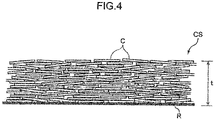
- the fiber-reinforced resin composite sheets in the above-described embodiment may be laminated in the thickness direction in the shapes of a plurality of chopped materials.
- a plurality of chopped materials can be produced, for example, by chopping the fiber-reinforced resin composite sheet S shown in FIG. 1 in the above-described embodiment in a longitudinal direction and a width direction.
- the chopped material can be produced by the following procedure.
- FIG. 2 represents a fiber-reinforced resin composite sheet S, a section I, a cut X continuous in a longitudinal direction, a section II, a cut Y continuous from one end to the other end in a width direction, and a chopped material C.
- the cut X extending in the longitudinal direction is formed. That is, while the fiber-reinforced resin composite sheet S is fed in the longitudinal direction, a large number of cuts X continuous in the longitudinal direction are formed in the section I in the middle of the feeding path.
- the cuts X can be formed using, for example, a chopping device including a large number of blades arranged at equal intervals in the width direction of the fiber-reinforced resin composite sheet S.
- cuts Y continuous from one end to the other end in the width direction of the fiber-reinforced resin composite sheet S are formed.
- the cuts Y can be formed using, for example, a rotary cutter or the like.
- the cuts Y are formed every time the fiber-reinforced resin composite sheet S is fed by a certain distance in the longitudinal direction.
- a large number of rectangular chopped materials C having a short side having a length corresponding to the pitch of the cuts X and a long side having a length corresponding to the pitch of the cuts Y are cut out.
- the fiber-reinforced resin composite sheet S is a sheet in which a large number of reinforcing fibers F are laminated in a state of being oriented in the same direction in the longitudinal direction thereof. Therefore, in each of the chopped materials C cut out from the fiber-reinforced resin composite sheet S, a large number of reinforcing fibers F are also laminated in a state of being oriented in the same direction in the longitudinal direction (long side direction) thereof. That is, the chopped material C includes a polyamide resin film R0 and a large number of reinforcing fibers F laminated on the polyamide resin film R0 in a state of being oriented in the same direction.
- the chopped material C can be appropriately determined to have a suitable size in consideration of the shapability and the like of the fiber-reinforced resin composite material and the molded resin article produced using the chopped material C.
- the chopped material C is formed in a rectangular shape with a short side length of 2 mm or more and 50 mm or less and a long side length of 2 mm or more and 80 mm or less.
- the fiber-reinforced resin composite material and the molded resin article produced using the chopped material C are not required to be mass-produced in an extremely large size or in a short time, the strengths of the fiber-reinforced resin composite material and the molded resin article can be more effectively enhanced by reducing the lengths of the short and long sides of the chopped material C. Meanwhile, in the case of producing a molded resin article having an extremely large size, by increasing the lengths of the short and long sides of the chopped material C to such an extent that the strength is not extremely impaired, the fiber-reinforced resin composite material and the molded resin article can be more efficiently produced in a short time.
- the length of the short side of the chopped material C is preferably 2 mm or more, more preferably 3 mm or more, still more preferably 4 mm or more, yet still more preferably 4.5 mm or more, and is preferably 50 mm or less, more preferably 40 mm or less, still more preferably 30 mm or less, yet still more preferably 20 mm or less, and further preferably 15 mm or less or 10 mm or less.
- the length of the long side of the chopped material C is preferably 2 mm or more, more preferably 4 mm or more, still more preferably 6 mm or more, and yet still more preferably 8 mm or more or 10 mm or more, and is preferably 80 mm or less, more preferably 70 mm or less, still more preferably 60 mm or less, and yet still more preferably 50 mm or less or 45 mm or less.
- the thickness of the chopped material C is the same as the thickness of the fiber-reinforced resin composite sheet in the above-described embodiment, and is 20 ⁇ m or more and 70 ⁇ m or less.
- the preferable thickness is also the same as the thickness of the fiber-reinforced resin composite sheet in the above-described embodiment. That is, similarly to the fiber-reinforced resin composite sheet in the above-described embodiment, the plurality of the chopped materials C can be laminated in a small size while the number of voids is reduced as much as possible because of the thinness. Therefore, it is possible to produce a fiber-reinforced resin composite material having a higher density and remarkably excellent strength and low water absorbency, and a molded resin article using the fiber-reinforced resin composite material. Furthermore, by the shape of the chopped material C, the shapability is improved, whereby a molded resin article having a complicated shape can also be produced.
- the plurality of chopped materials C may be laminated in a state where the fiber directions of the reinforcing fibers are any directions, but are preferably laminated in a state where the fiber directions of the reinforcing fibers of the chopped materials C are two-dimensionally random (quasi-isotropic).
- a large number of chopped materials C are arranged while being dispersed on the upper surface of a belt conveyor which is substantially horizontally arranged and rotates.
- a dropping device that drops the chopped material C from above the belt conveyor while vibrating the chopped material C can be used.
- the density of the chopped materials C and the number of the laminated chopped materials C on the upper surface of the belt conveyor are increased.
- the chopped materials C are laminated on the belt conveyor such that the fiber directions of the reinforcing fibers F contained in each of the chopped materials C (in other words, the longitudinal directions of the chopped materials C) vary in various directions on a horizontal plane, and the plurality of chopped materials C are stacked in the thickness direction.
- the chopped materials C laminated on the upper surface of the belt conveyor are subjected to pressurizing and heating treatments using a heating roller with a heat-resistant endless belt or a release film sandwiched therebetween to integrate the large number of chopped materials C. That is, the laminated chopped materials C are bonded to each other by the pressurizing and heating treatments using the heating roller. In this manner, the dispersion and lamination of the large number of the chopped materials C on the upper surface of the belt conveyor and the pressurizing and heating treatments using the heating roller are continuously performed.
- the dropping operation of the chopped material C may be repeated at a plurality of places in the rotation direction of the belt conveyor as in an example of a producing method in the case of using a carrier sheet as described later, and as a result, the density of the chopped materials C and the number of the laminated chopped materials C may be increased.
- a laminated chopped sheet in which the plurality of chopped materials C are integrated and laminated is continuously molded in a roll shape.
- the continuously molded shape is not illustrated, but a partial cross section of the wound laminated chopped sheet has a shape in which a carrier sheet R is omitted in FIG. 4 described later.
- the thickness of the laminated chopped sheet can be appropriately set.
- FIGS. 3 and 4 represent a carrier sheet R, a section XI, a chopped material C, a section XII, a section XIII, a laminated chopped sheet (fiber-reinforced composite material) CS, and the thickness t of the laminated chopped sheet CS.
- a large number of chopped materials C are arranged while being dispersed on the upper surface of the carrier sheet R.
- the same dropping device as described above can be used from above the carrier sheet R.
- the carrier sheet R by repeatedly performing the dropping operation of the chopped material C using the dropping device, the large number of chopped materials C are laminated on the carrier sheet R such that the fiber directions of the reinforcing fibers F contained in each chopped material C vary in various directions on the horizontal plane and the plurality of chopped materials C are stacked in the thickness direction.
- the carrier sheet R and the chopped material C thereon are pressurized and heated using the heating roller to integrate the carrier sheet R and the chopped material C with each other. That is, by the pressurizing and heat treatments using the heating roller, the chopped materials C are supported on the carrier sheet R in a laminated state, and the stacked chopped materials C are bonded to each other.
- a laminated chopped sheet CS in which the plurality of chopped materials C are laminated on the upper surface of the carrier sheet R is molded.
- the thickness t of the laminated chopped sheet CS that is, the total thickness of the carrier sheet R and the plurality or more of chopped materials C laminated thereon can be appropriately set.
- the material of the carrier sheet R basically the same polyamide resin as the resin of the chopped material C, or the other thermoplastic resins as described above can be used.
- the carrier sheet R is turned over such that the lower surface of the carrier sheet R is placed above, and in this state, the operation of laminating the chopped materials C is similarly repeated. As a result, a laminated chopped sheet in which the chopped materials C are laminated on both the surfaces of the carrier sheet R can be produced.
- a molded resin article in the present embodiment comprises the fiber-reinforced resin composite material in the above-described embodiment.
- the molded resin article may be any molded article having any shape that can be produced using the fiber-reinforced resin composite material in the above-described embodiment by any molding method known to those skilled in the art. Examples thereof include molded products in general industrial applications, sporting applications, and aerospace applications and the like. Specific examples thereof include molded products used for various vehicles such as automobiles, bicycles, two-wheeled automobiles, and railway vehicles, and moving bodies such as ships.
- examples thereof include molded products for various vehicles such as a brake pedal, an under cover, a front end, a seat shell, and a drive shaft, and other molded products such as a leaf spring, a windmill blade, a pressure vessel, a fly wheel, a papermaking roller, a roof member, a cable, a repair reinforcing material, a golf shaft, a fishing rod, a tennis or badminton racket, a hockey stick, and a ski pole.
- molded products for various vehicles such as a brake pedal, an under cover, a front end, a seat shell, and a drive shaft
- other molded products such as a leaf spring, a windmill blade, a pressure vessel, a fly wheel, a papermaking roller, a roof member, a cable, a repair reinforcing material, a golf shaft, a fishing rod, a tennis or badminton racket, a hockey stick, and a ski pole.
- the method for producing a molded resin article in the present embodiment is not particularly limited.
- a plurality of plate-shaped laminated chopped sheets CS described in the above-described embodiment and cut into a predetermined size are prepared, and arranged in a mold such as a heat press machine while being stacked in a thickness direction.
- the plurality of stacked chopped sheets CS are subjected to heating and/or pressurizing treatment and cooling treatment as necessary, whereby the molded resin article can be produced.
- the polyamide resin film R0 having low water absorbency is used as the thermoplastic resin, which make it possible to obtain a molded resin article in which a decrease in physical property value or a dimensional change of the molded resin article due to water absorption hardly occurs. Furthermore, the molded resin article is molded using the laminated chopped sheet CS containing a sufficient amount of the reinforcing fibers F such that the volume content rate Vf of the reinforcing fibers is 20% or more and 70% or less, whereby an excellent reinforcing effect due to the reinforcing fibers F can be obtained, and the strength of the molded resin article can be increased.
- the laminated chopped sheet CS in which the reinforcing fibers F of the plurality of chopped materials C are laminated in a state where the fiber directions of the reinforcing fibers F are two-dimensionally random (quasi-isotropic) can reduce the possibility that the reinforcing fibers F are chopped when the laminated chopped sheet CS is pressed, and can promote the flow of the resin during the pressing to increase the degree of freedom in the shape of the molded resin article. This makes it possible to mold molded resin articles having various shapes without any problem while isotropically exhibiting the reinforcing effect due to the reinforcing fibers F.
- a fiber-reinforced resin composite sheet comprises: a polyamide resin film containing a dicarboxylic acid component (a) and a diamine component (b); and a plurality of reinforcing fibers laminated in a state of being oriented in a same direction on the polyamide resin film, the reinforcing fibers being obtained by opening a reinforcing fiber bundle.
- the dicarboxylic acid component (a) contains 60 mol% or more and 100 mol% or less of terephthalic acid.
- the diamine component (b) contains 60 mol% or more and 100 mol% or less of 1,9-nonanediamine and 2-methyl-1,8 octanediamine.
- the fiber-reinforced resin composite sheet has a volume content rate Vf of the reinforcing fibers of 20% or more and 70% or less and a thickness of 20 ⁇ m or more and 70 ⁇ m or less.
- the fiber-reinforced resin composite sheet having such a configuration has low water absorbency and excellent strength.
- the fiber-reinforced resin composite sheet not only has excellent strength but also has no change in physical properties such as strength due to a dimensional change caused by water absorption. Therefore, the fiber-reinforced resin composite sheet is suitably used as a material for producing, for example, a molded article that may be wetted with water or infiltrated into water, or a molded article to be used under a surrounding environment having rainwater or much moisture, or the like.
- the polyamide resin film has a thickness of 5 ⁇ m or more and 50 ⁇ m or less, and the reinforcing fibers are laminated on one or both surfaces of the polyamide resin film.
- the reinforcing fibers are more preferably carbon fibers.
- a fiber-reinforced resin composite material is a fiber-reinforced composite material obtained by laminating a plurality of fiber-reinforced resin composite sheets according to one aspect of the present invention described above in a thickness direction, wherein the fiber-reinforced composite material is laminated in a state where fiber directions of the reinforcing fibers of the plurality of fiber-reinforced resin composite sheets have an angular difference in a two-dimensional direction.
- the fiber-reinforced resin composite material having such a configuration has low water absorbency and excellent strength.
- a fiber-reinforced resin composite material is a fiber-reinforced composite material obtained by laminating the fiber-reinforced resin composite sheets in shapes of a plurality of chopped materials in a thickness direction, wherein the chopped materials are formed such that the fiber-reinforced resin composite sheet has a rectangular shape with a short side length of 2 mm or more and 50 mm or less and a long side length of 2 mm or more and 80 mm or less; and the fiber-reinforced composite material is laminated in a state where fiber directions of the reinforcing fibers of the plurality of chopped materials are two-dimensionally random.
- the fiber-reinforced resin composite material having such a configuration has low water absorbency and excellent strength.
- the fiber-reinforced resin composite material further comprises a carrier sheet, and the carrier sheet supports the plurality of chopped materials in a laminated state on one or both surfaces thereof.
- a molded resin article according to still another aspect of the present invention contains the above-described fiber-reinforced resin composite material according to another aspect of the present invention.
- the molded resin article having such a configuration has low water absorbency and excellent strength.
- the molded resin article not only has excellent strength but also has no change in physical properties such as strength due to a dimensional change caused by water absorption. Therefore, the molded resin article can be suitably used, for example, even under an environment where the molded resin article may be wetted with water or infiltrated into water, or a surrounding environment having rainwater or much moisture, or the like.
- Fiber-reinforced resin composite material test pieces in Examples 1 and 2 and Comparative Examples 1 and 2 were produced as follows.
- a polyamide resin film was produced. Pellets of polyamide 9T ("Genestar” (registered trademark) manufactured by Kuraray Co., Ltd.) were molded at a molding temperature of 290°C to 310°C using an extruder equipped with a T-die to obtain a polyamide resin film of polyamide 9T having a thickness of 20 ⁇ m.
- Genestar registered trademark
- the fiber-reinforced resin composite sheet in the present embodiment described above was obtained while a carbon fiber bundle was opened by a production device shown in FIG. 1 .
- a roll temperature (the temperature of a heating roller 2 shown in FIG. 1 ) was set to 280°C, and a feeding speed was set to 20 m/min.
- the resulting fiber-reinforced resin composite sheet is obtained by laminating the opened carbon fiber bundle on both surfaces of the polyamide resin film.
- the volume content rate Vf of the carbon fibers in the fiber-reinforced resin composite sheet was similarly 53%, and the thickness of the fiber-reinforced resin composite sheet was 40 ⁇ m to 50 ⁇ m.
- the volume content rate Vf of the reinforcing fibers was measured by a combustion method.
- the forty-eight fiber-reinforced resin composite sheets obtained were laminated such that the opened carbon fibers were in a four-axis direction with an angular difference of 45°.
- the laminated fiber-reinforced resin composite sheets were put into a mold, pressurized under the conditions of 300°C and 2 MPa while being heated for 15 minutes, and then pressurized under the conditions of normal temperature and 3 MPa while being cooled for 10 minutes.
- a fiber-reinforced resin composite material of 300 mm ⁇ 300 mm ⁇ 2 mm (thickness) was taken out from the mold.
- the fiber-reinforced resin composite material was cut into predetermined various sizes.
- a fiber-reinforced resin composite material test piece having a four-axis direction laminated structure with an angular difference of 45° was obtained.
- the fiber-reinforced resin composite material test piece was cut into a size of 25 mm (length in a short axis direction) ⁇ 250 mm (length in a long axis direction) ⁇ 2 mm (thickness), a size of 15 mm (length in a short axis direction) ⁇ 100 mm (length in a long axis direction) ⁇ 2 mm (thickness), and a size of 50 mm ⁇ 50 mm ⁇ 2 mm (thickness).
- the volume content rate Vf of the carbon fibers of the test piece was also 53%.
- a fiber-reinforced resin composite sheet obtained by the same method as in Example 1 was chopped by a method shown in FIG. 2 to produce a plurality of chopped materials having a rectangular shape with a short side length of 5 mm and a long side length of 20 mm.
- the thickness of the chopped material is 40 ⁇ m to 50 ⁇ m because it is the same as that of the fiber-reinforced resin composite sheet.
- the chopped materials were put and laminated in a mold such that the opened carbon fibers had a quasi-isotropic shape as shown in FIGS. 2 to 4 , that is, the fiber directions of the carbon fibers of the chopped materials were two-dimensionally random (quasi-isotropic).
- the chopped materials laminated in the mold were pressurized while being heated for 15 minutes under the conditions of 300°C and 2 MPa, and then pressurized while being cooled for 10 minutes under the conditions of normal temperature and 3 MPa.
- a fiber-reinforced resin composite material of 300 mm ⁇ 300 mm ⁇ 2 mm (thickness) was taken out from the mold.
- the fiber-reinforced resin composite material was cut into predetermined various sizes. Finally, a fiber-reinforced resin composite material test piece having a quasi-isotropic laminated structure was obtained.
- the fiber-reinforced resin composite material test piece was cut into a size of 25 mm (length in a short axis direction) ⁇ 250 mm (length in a long axis direction) ⁇ 2 mm (thickness), a size of 15 mm (length in a short axis direction) ⁇ 100 mm (length in a long axis direction) ⁇ 2 mm (thickness), and a size of 50 mm ⁇ 50 mm ⁇ 2 mm (thickness).
- the volume content rate Vf of the carbon fibers of the test piece was 50%.
- a polyamide resin film of polyamide 6 having a thickness of 20 ⁇ m was obtained in the same manner as in Example 1 except that polyamide 6 ("DIAMIRON” manufactured by Mitsubishi Chemical Corporation, grade: C-Z (melting point: Tm 225°C)) was used as a polyamide resin.
- polyamide 6 "DIAMIRON" manufactured by Mitsubishi Chemical Corporation, grade: C-Z (melting point: Tm 225°C)
- fiber-reinforced resin composite material test pieces having a four-axis direction laminated structure with an angular difference of 45°, and having a size of 25 mm (length in a short axis direction) ⁇ 250 mm (length in a long axis direction) ⁇ 2 mm (thickness), a size of 15 mm (length in a short axis direction) ⁇ 100 mm (length in a long axis direction) ⁇ 2 mm (thickness), and a size of 50 mm ⁇ 50 mm ⁇ 2 mm (thickness) were obtained.
- a polyamide resin film of polyamide 6 having a thickness of 20 ⁇ m was obtained in the same manner as in Example 1 except that polyamide 6 ("DIAMIRON” manufactured by Mitsubishi Chemical Corporation, grade: C-Z (melting point: Tm 225°C)) was used as a polyamide resin.
- polyamide 6 "DIAMIRON" manufactured by Mitsubishi Chemical Corporation, grade: C-Z (melting point: Tm 225°C)
- fiber-reinforced resin composite material test pieces having a quasi-isotropic laminated structure and having a size of 25 mm (length in a short axis direction) ⁇ 250 mm (length in a long axis direction) ⁇ 2 mm (thickness), a size of 15 mm (length in a short axis direction) ⁇ 100 mm (length in a long axis direction) ⁇ 2 mm (thickness), and a size of 50 mm ⁇ 50 mm ⁇ 2 mm (thickness) were obtained in the same manner as in Example 2.
- the tensile strength, tensile elastic modulus, flexural strength, and flexural elastic modulus of each of the cut fiber-reinforced resin composite material test pieces were measured by the following methods, and the water absorbability of each of the test pieces was evaluated by the following method.
- the tensile strength and tensile elastic modulus of the fiber-reinforced resin composite material test pieces having a size of 25 mm (length in the short axis direction) ⁇ 250 mm (length in the long axis direction) ⁇ 2 mm (thickness) were measured.
- the tensile strength and tensile elastic modulus of each of the fiber-reinforced resin composite material test pieces of Examples 1 and 2 and Comparative Examples 1 and 2 were measured in accordance with JIS K 7164: 2005.
- the flexural strength and flexural elastic modulus of each of the fiber-reinforced resin composite material test pieces having a size of 15 mm (length in the short axis direction) ⁇ 100 mm (length in the long axis direction) ⁇ 2 mm (thickness) were measured.
- the tensile strength and tensile elastic modulus of each of the fiber-reinforced resin composite material test pieces of Examples 1 and 2 and Comparative Examples 1 and 2 were measured in accordance with the flexural test method in 4-point bending (Method B) of carbon fiber-reinforced plastic in JIS K 7074: 1988.
- the water absorbency of the fiber-reinforced resin composite material test piece having a size of 50 mm ⁇ 50 mm ⁇ 2 mm (thickness) was evaluated.
- the fiber-reinforced resin composite material test piece was placed in an oven at 80°C for 6 hours to be in an absolute dry state. Subsequently, room temperature water was placed in a stainless steel tray of 210 mm ⁇ 297 mm up to a depth of about 10 mm, and the fiber-reinforced resin composite material test piece in an absolute dry state was immersed in the tray. At this time, the surrounding environment was an air atmosphere. At every lapse of a predetermined time, the fiber-reinforced resin composite material test piece was taken out from water, and the mass thereof was measured with an electronic balance.
- the fiber-reinforced resin composite material test piece produced using the film of polyamide 9T has substantially excellent tensile properties and flexural properties and sufficiently excellent strength as compared with the case of using the film of polyamide 6. Furthermore, as is apparent from the results in Table 3 above, the fiber-reinforced resin composite material test piece produced using the film of polyamide 9T had remarkably low water absorbability as compared with the case of using the film of polyamide 6. The average mass change rate remained at 0.2% or less even when measured for 24 hours to 149 hours after the start of immersion, and almost no mass change occurred.
- test piece having a size of 25 mm (length in a short axis direction) ⁇ 250 mm (length in a long axis direction) ⁇ 2 mm (thickness) was used.
- the test piece was produced and cut out by the same method as in Example 1 and Comparative Example 1 described above, and had a four-axis direction laminated structure with an angular difference of 45°.
- the fiber-reinforced resin composite material test piece used had a different size, and the surrounding environment when the fiber-reinforced resin composite material test piece was immersed was an environment of constant temperature and constant humidity at a temperature of 23°C and a humidity of 50% RH, the fiber-reinforced resin composite material test piece was taken out from water every predetermined time by the same method as in the water absorbency evaluation test described above, and the mass of the test piece was measured with an electronic balance.
- evaluation tests were performed for the six fiber-reinforced resin composite material test pieces of each of Example 1 and Comparative Example 1 in the size described above.
- An average mass (g), an average mass change amount (g) from an absolute dry state, and an average mass change rate from an absolute dry state (average mass change amount/average mass in absolute dry state) (%) were calculated in the same manner as described above.
- Example 1 As is apparent from the results in Table 4 above, the test piece in Example 1 produced using the film of polyamide 9T had an average mass change rate of 0.26% even after elapse of 864 hours after the start of immersion, and hardly caused a mass change even under a constant temperature and constant humidity environment. Meanwhile, the test piece in Comparative Example 1 produced using the film of polyamide 6 had an average mass change rate of 2.42% after 864 hours after the start of immersion, and a mass change occurred due to water absorption.
- test piece after the water absorption test under the constant temperature and constant humidity environment described above was used. Evaluation tests of tensile properties and flexural properties of the fiber-reinforced resin composite material test piece after water absorption were performed. Specifically, the test pieces of Example 1 and Comparative Example 1 after water absorption immersed in water for 864 hours under a constant temperature and constant humidity environment at 23°C and 50% RH were used as the test piece of Example 3 and the test piece of Comparative Example 3, and the tensile strength, tensile elastic modulus, flexural strength, and flexural elastic modulus of the test pieces were measured. The measurement method is the same as the method described above.
- Example 3 (test piece after water absorption (864 h) in Example 1) Comparative Example 3 (test piece after water absorption (864 h) in Comparative Example 1)
- Type of polyamide resin Polyamide 9T Polyamide 6 Laminated structure Four-axis direction with angular difference of 45° Four-axis direction with angular difference of 45°
- Tensile strength (MPa) 932.6 762.8
- Tensile elastic modulus (GPa) 44.2 37.9 Flexural strength (MPa) 955.2 424.5 Flexural elastic modulus (GPa) 42.0 35.7
- test piece of Example 3 produced using the film of polyamide 9T had remarkably excellent tensile properties and flexural properties as compared with the test piece of Comparative Example 3 produced using the film of polyamide 6. This is considered to be because in the test piece of Comparative Example 3 produced using the film of polyamide 6, a mass change occurs due to water absorption, and therefore physical property values such as strength decrease.
- the degree of crystallinity of the fiber-reinforced resin composite sheet produced using the film of polyamide 6 is reduced by bonding between an amide group and water molecules under an environment where the fiber-reinforced resin composite sheet is wetted with water due to moisture and rainwater and the like, thereby causing a dimensional change (specifically, a mass change), and physical property values such as strength are significantly reduced as compared with the present invention example.
- the fiber-reinforced resin composite sheet having low water absorbency and excellent strength can be provided. Therefore, the fiber-reinforced resin composite sheet in the present invention can be suitably used for a wide range of products as a material for producing, for example, a molded resin article that may be wetted with water or infiltrated into water, or a molded resin article to be used under a surrounding environment having rainwater or much moisture, or the like.
Landscapes
- Chemical & Material Sciences (AREA)
- Engineering & Computer Science (AREA)
- Health & Medical Sciences (AREA)
- Organic Chemistry (AREA)
- Polymers & Plastics (AREA)
- Medicinal Chemistry (AREA)
- Chemical Kinetics & Catalysis (AREA)
- Mechanical Engineering (AREA)
- Composite Materials (AREA)
- Mathematical Physics (AREA)
- Physics & Mathematics (AREA)
- Textile Engineering (AREA)
- Manufacturing & Machinery (AREA)
- Materials Engineering (AREA)
- Inorganic Chemistry (AREA)
- Reinforced Plastic Materials (AREA)
- Laminated Bodies (AREA)
- Polyamides (AREA)
Applications Claiming Priority (2)
| Application Number | Priority Date | Filing Date | Title |
|---|---|---|---|
| JP2019227455 | 2019-12-17 | ||
| PCT/JP2020/045029 WO2021124907A1 (fr) | 2019-12-17 | 2020-12-03 | Feuille composite de résine renforcée par des fibres, matériau composite de résine renforcée par des fibres, et article moulé en résine les comportant |
Publications (2)
| Publication Number | Publication Date |
|---|---|
| EP4052894A1 true EP4052894A1 (fr) | 2022-09-07 |
| EP4052894A4 EP4052894A4 (fr) | 2024-02-14 |
Family
ID=76477294
Family Applications (1)
| Application Number | Title | Priority Date | Filing Date |
|---|---|---|---|
| EP20900982.8A Withdrawn EP4052894A4 (fr) | 2019-12-17 | 2020-12-03 | Feuille composite de résine renforcée par des fibres, matériau composite de résine renforcée par des fibres, et article moulé en résine les comportant |
Country Status (6)
| Country | Link |
|---|---|
| US (1) | US20230025079A1 (fr) |
| EP (1) | EP4052894A4 (fr) |
| JP (1) | JP7368499B2 (fr) |
| KR (1) | KR20220107258A (fr) |
| CN (1) | CN114829144A (fr) |
| WO (1) | WO2021124907A1 (fr) |
Families Citing this family (4)
| Publication number | Priority date | Publication date | Assignee | Title |
|---|---|---|---|---|
| JP7273785B2 (ja) * | 2020-12-28 | 2023-05-15 | フクビ化学工業株式会社 | 繊維強化樹脂シート及び繊維強化複合材並びに成形品 |
| JPWO2023120462A1 (fr) * | 2021-12-20 | 2023-06-29 | ||
| WO2025215619A1 (fr) * | 2024-04-12 | 2025-10-16 | Comas - Costruzioni Macchine Speciali - S.P.A. | Procédé et machine de fabrication d'une couche continue semi-finie |
| WO2026029153A1 (fr) * | 2024-08-02 | 2026-02-05 | Ube株式会社 | Matériau de base en résine thermoplastique renforcée par des fibres continues et son procédé de production |
Family Cites Families (20)
| Publication number | Priority date | Publication date | Assignee | Title |
|---|---|---|---|---|
| CA2137477C (fr) * | 1993-12-24 | 2002-05-07 | Hideaki Oka | Composition a base de polyamides |
| JPH08118381A (ja) | 1994-10-19 | 1996-05-14 | Mitsubishi Rayon Co Ltd | Cfrp成形物の製造方法 |
| JP2006083227A (ja) * | 2004-09-14 | 2006-03-30 | Mitsubishi Engineering Plastics Corp | 長繊維強化ポリアミド樹脂製外装成形体 |
| EP1860134B1 (fr) * | 2005-03-18 | 2015-05-27 | Kuraray Co., Ltd. | Resine polyamide semi-aromatique |
| JP4707431B2 (ja) * | 2005-03-29 | 2011-06-22 | 株式会社クラレ | 長繊維強化半芳香族ポリアミド樹脂組成物 |
| JP4206454B2 (ja) * | 2006-08-18 | 2009-01-14 | 福井県 | 多軸補強積層成型品及びその製造方法 |
| WO2008062818A1 (fr) * | 2006-11-22 | 2008-05-29 | Fukui Prefectural Government | Matériau en feuille multicouche de résine thermoplastique renforcé, procédé de fabrication de celui-ci et procédé de façonnage d'un matériau composite de résine thermoplastique moulé |
| JP2010084111A (ja) * | 2008-10-03 | 2010-04-15 | Kuraray Co Ltd | 長繊維強化ポリアミド組成物 |
| JP2011068874A (ja) * | 2009-08-25 | 2011-04-07 | Asahi Kasei Chemicals Corp | ポリアミド組成物を含む自動車部品 |
| JP5592775B2 (ja) * | 2010-07-01 | 2014-09-17 | ダイセルポリマー株式会社 | 炭素繊維巻きテープとその製造方法 |
| JP5922867B2 (ja) * | 2010-12-22 | 2016-05-24 | ダイセルポリマー株式会社 | 耐摩耗性成形体用の樹脂組成物 |
| CN103958612B (zh) * | 2011-11-29 | 2016-08-24 | 东丽株式会社 | 碳纤维增强热塑性树脂组合物、该组合物的粒料和成型品 |
| JP6247906B2 (ja) * | 2012-11-12 | 2017-12-13 | 株式会社クラレ | 長繊維強化ポリアミド樹脂組成物 |
| WO2015053181A1 (fr) * | 2013-10-11 | 2015-04-16 | 東レ株式会社 | Composition de résine renforcée par des fibres de carbone, pellets, objet moulé et boîtier pour dispositif électronique |
| JP6638131B2 (ja) * | 2014-07-08 | 2020-01-29 | 福井県 | 擬似等方補強シート材及びその製造方法 |
| JP6431546B2 (ja) * | 2014-09-30 | 2018-11-28 | 積水化成品工業株式会社 | 樹脂複合体 |
| EP4079479A1 (fr) * | 2015-12-24 | 2022-10-26 | Mitsubishi Chemical Corporation | Matériau en résine renforcé par des fibres |
| JP2018161799A (ja) * | 2017-03-27 | 2018-10-18 | 三菱ケミカル株式会社 | 炭素繊維強化シートおよびその製造方法 |
| JP6866245B2 (ja) * | 2017-06-30 | 2021-04-28 | 株式会社クラレ | 繊維強化ポリアミドシートまたはテープ |
| CN110315660B (zh) * | 2018-03-28 | 2022-06-10 | 福美化学工业株式会社 | 准各向同性补强片材、frp成型体和frp成型体的制造方法 |
-
2020
- 2020-12-03 WO PCT/JP2020/045029 patent/WO2021124907A1/fr not_active Ceased
- 2020-12-03 KR KR1020227022105A patent/KR20220107258A/ko not_active Ceased
- 2020-12-03 US US17/784,774 patent/US20230025079A1/en not_active Abandoned
- 2020-12-03 CN CN202080084135.4A patent/CN114829144A/zh active Pending
- 2020-12-03 EP EP20900982.8A patent/EP4052894A4/fr not_active Withdrawn
- 2020-12-03 JP JP2021565458A patent/JP7368499B2/ja active Active
Also Published As
| Publication number | Publication date |
|---|---|
| JPWO2021124907A1 (fr) | 2021-06-24 |
| JP7368499B2 (ja) | 2023-10-24 |
| WO2021124907A1 (fr) | 2021-06-24 |
| US20230025079A1 (en) | 2023-01-26 |
| CN114829144A (zh) | 2022-07-29 |
| KR20220107258A (ko) | 2022-08-02 |
| EP4052894A4 (fr) | 2024-02-14 |
Similar Documents
| Publication | Publication Date | Title |
|---|---|---|
| EP4052894A1 (fr) | Feuille composite de résine renforcée par des fibres, matériau composite de résine renforcée par des fibres, et article moulé en résine les comportant | |
| EP3278945B1 (fr) | Matériau composite et procédé de production de ce matériau composite | |
| JP3466821B2 (ja) | ポリアミド12マトリックスを基材とする熱可塑的に成形可能な複合材料の製造方法 | |
| US20120238164A1 (en) | Composite polyamide article | |
| CN108602246B (zh) | 立体结构物的制造方法 | |
| JP4894982B1 (ja) | ポリアミド樹脂系複合材およびその製造方法 | |
| KR102006511B1 (ko) | 개선된 충격 강도를 갖는 복합 라미네이트 및 그의 용도 | |
| ES2624694T3 (es) | Material de moldeo, preimpregnado, material compuesto reforzado con fibras y proceso para la producción de un material de base de moldeo reforzado con fibras | |
| US20130115836A1 (en) | Composite polyamide article | |
| CN101243121A (zh) | 各向同性的纤维增强热塑性树脂片材及其制造方法和成型板 | |
| WO2014204522A1 (fr) | Composites thermoplastiques hybrides de fibres de verre et de fibres de carbone | |
| JP6149579B2 (ja) | 巻き取り品 | |
| JP6981405B2 (ja) | 材料および成形品 | |
| EP3744768B1 (fr) | Mat de fibres de renforcement, et matériau de moulage de résine renforcé par des fibres et procédé de production associé | |
| CN111491769B (zh) | 带状预浸料及其制造方法 | |
| JP2015098613A (ja) | 低分子量ポリアミド樹脂を基材とする複合物品 | |
| CN111971343A (zh) | 热塑性树脂组合物、纤维强化塑料成型用材料及成型物 | |
| JP6468030B2 (ja) | 複合フィルムの製造方法および複合材料 | |
| JP2008238809A (ja) | 積層体の製造方法 | |
| EP3597388B1 (fr) | Matériau, procédé de fabrication de matériau, matériau partiellement soudé, matériau composite et procédé de fabrication d'article moulé | |
| US11932741B2 (en) | Method for manufacturing molded article, and composite material | |
| JP6597131B2 (ja) | 長繊維強化複合材料の製造方法および長繊維強化複合材料 | |
| WO2026029153A1 (fr) | Matériau de base en résine thermoplastique renforcée par des fibres continues et son procédé de production | |
| WO2025047461A1 (fr) | Matériau composite, corps moulé et procédé de fabrication de matériau composite |
Legal Events
| Date | Code | Title | Description |
|---|---|---|---|
| STAA | Information on the status of an ep patent application or granted ep patent |
Free format text: STATUS: THE INTERNATIONAL PUBLICATION HAS BEEN MADE |
|
| TPAC | Observations filed by third parties |
Free format text: ORIGINAL CODE: EPIDOSNTIPA |
|
| PUAI | Public reference made under article 153(3) epc to a published international application that has entered the european phase |
Free format text: ORIGINAL CODE: 0009012 |
|
| STAA | Information on the status of an ep patent application or granted ep patent |
Free format text: STATUS: REQUEST FOR EXAMINATION WAS MADE |
|
| 17P | Request for examination filed |
Effective date: 20220603 |
|
| AK | Designated contracting states |
Kind code of ref document: A1 Designated state(s): AL AT BE BG CH CY CZ DE DK EE ES FI FR GB GR HR HU IE IS IT LI LT LU LV MC MK MT NL NO PL PT RO RS SE SI SK SM TR |
|
| DAV | Request for validation of the european patent (deleted) | ||
| DAX | Request for extension of the european patent (deleted) | ||
| A4 | Supplementary search report drawn up and despatched |
Effective date: 20240116 |
|
| RIC1 | Information provided on ipc code assigned before grant |
Ipc: B32B 27/08 20060101ALI20240110BHEP Ipc: B32B 27/20 20060101ALI20240110BHEP Ipc: C08K 7/06 20060101ALI20240110BHEP Ipc: C08J 5/04 20060101ALI20240110BHEP Ipc: C08G 69/26 20060101ALI20240110BHEP Ipc: B32B 27/34 20060101ALI20240110BHEP Ipc: B32B 5/08 20060101ALI20240110BHEP Ipc: B32B 5/00 20060101AFI20240110BHEP |
|
| STAA | Information on the status of an ep patent application or granted ep patent |
Free format text: STATUS: THE APPLICATION IS DEEMED TO BE WITHDRAWN |
|
| 18D | Application deemed to be withdrawn |
Effective date: 20240803 |