EP4053246A1 - Procédé d'estimation de tension superficielle de structure inerte dans du charbon, procédé d'estimation de tension superficielle de charbon et procédé de production de coke - Google Patents
Procédé d'estimation de tension superficielle de structure inerte dans du charbon, procédé d'estimation de tension superficielle de charbon et procédé de production de coke Download PDFInfo
- Publication number
- EP4053246A1 EP4053246A1 EP20882743.6A EP20882743A EP4053246A1 EP 4053246 A1 EP4053246 A1 EP 4053246A1 EP 20882743 A EP20882743 A EP 20882743A EP 4053246 A1 EP4053246 A1 EP 4053246A1
- Authority
- EP
- European Patent Office
- Prior art keywords
- coal
- surface tension
- estimating
- inerts
- estimated
- Prior art date
- Legal status (The legal status is an assumption and is not a legal conclusion. Google has not performed a legal analysis and makes no representation as to the accuracy of the status listed.)
- Pending
Links
Images

Classifications
-
- G—PHYSICS
- G01—MEASURING; TESTING
- G01N—INVESTIGATING OR ANALYSING MATERIALS BY DETERMINING THEIR CHEMICAL OR PHYSICAL PROPERTIES
- G01N13/00—Investigating surface or boundary effects, e.g. wetting power; Investigating diffusion effects; Analysing materials by determining surface, boundary, or diffusion effects
- G01N13/02—Investigating surface tension of liquids
-
- C—CHEMISTRY; METALLURGY
- C10—PETROLEUM, GAS OR COKE INDUSTRIES; TECHNICAL GASES CONTAINING CARBON MONOXIDE; FUELS; LUBRICANTS; PEAT
- C10B—DESTRUCTIVE DISTILLATION OF CARBONACEOUS MATERIALS FOR PRODUCTION OF GAS, COKE, TAR, OR SIMILAR MATERIALS
- C10B57/00—Other carbonising or coking processes; Features of destructive distillation processes in general
- C10B57/04—Other carbonising or coking processes; Features of destructive distillation processes in general using charges of special composition
-
- C—CHEMISTRY; METALLURGY
- C10—PETROLEUM, GAS OR COKE INDUSTRIES; TECHNICAL GASES CONTAINING CARBON MONOXIDE; FUELS; LUBRICANTS; PEAT
- C10B—DESTRUCTIVE DISTILLATION OF CARBONACEOUS MATERIALS FOR PRODUCTION OF GAS, COKE, TAR, OR SIMILAR MATERIALS
- C10B45/00—Other details
-
- C—CHEMISTRY; METALLURGY
- C10—PETROLEUM, GAS OR COKE INDUSTRIES; TECHNICAL GASES CONTAINING CARBON MONOXIDE; FUELS; LUBRICANTS; PEAT
- C10L—FUELS NOT OTHERWISE PROVIDED FOR; NATURAL GAS; SYNTHETIC NATURAL GAS OBTAINED BY PROCESSES NOT COVERED BY SUBCLASSES C10G OR C10K; LIQUIFIED PETROLEUM GAS; USE OF ADDITIVES TO FUELS OR FIRES; FIRE-LIGHTERS
- C10L5/00—Solid fuels
- C10L5/02—Solid fuels such as briquettes consisting mainly of carbonaceous materials of mineral or non-mineral origin
- C10L5/04—Raw material of mineral origin to be used; Pretreatment thereof
-
- G—PHYSICS
- G01—MEASURING; TESTING
- G01N—INVESTIGATING OR ANALYSING MATERIALS BY DETERMINING THEIR CHEMICAL OR PHYSICAL PROPERTIES
- G01N13/00—Investigating surface or boundary effects, e.g. wetting power; Investigating diffusion effects; Analysing materials by determining surface, boundary, or diffusion effects
-
- G—PHYSICS
- G01—MEASURING; TESTING
- G01N—INVESTIGATING OR ANALYSING MATERIALS BY DETERMINING THEIR CHEMICAL OR PHYSICAL PROPERTIES
- G01N33/00—Investigating or analysing materials by specific methods not covered by groups G01N1/00 - G01N31/00
- G01N33/22—Fuels; Explosives
-
- G—PHYSICS
- G01—MEASURING; TESTING
- G01N—INVESTIGATING OR ANALYSING MATERIALS BY DETERMINING THEIR CHEMICAL OR PHYSICAL PROPERTIES
- G01N33/00—Investigating or analysing materials by specific methods not covered by groups G01N1/00 - G01N31/00
- G01N33/22—Fuels; Explosives
- G01N33/222—Solid fuels, e.g. coal
-
- G—PHYSICS
- G01—MEASURING; TESTING
- G01N—INVESTIGATING OR ANALYSING MATERIALS BY DETERMINING THEIR CHEMICAL OR PHYSICAL PROPERTIES
- G01N13/00—Investigating surface or boundary effects, e.g. wetting power; Investigating diffusion effects; Analysing materials by determining surface, boundary, or diffusion effects
- G01N13/02—Investigating surface tension of liquids
- G01N2013/0283—Investigating surface tension of liquids methods of calculating surface tension
-
- G—PHYSICS
- G01—MEASURING; TESTING
- G01N—INVESTIGATING OR ANALYSING MATERIALS BY DETERMINING THEIR CHEMICAL OR PHYSICAL PROPERTIES
- G01N2203/00—Investigating strength properties of solid materials by application of mechanical stress
- G01N2203/02—Details not specific for a particular testing method
- G01N2203/022—Environment of the test
- G01N2203/0222—Temperature
- G01N2203/0226—High temperature; Heating means
Definitions
- the present invention relates to a method for estimating the surface tension of coal inerts, a method for estimating the surface tension of coal, and a method for producing coke.
- Coke used as a blast furnace raw material for pig iron production in blast furnaces preferably has high strength. This is because coke having low strength degrades in blast furnaces to inhibit gas permeability in blast furnaces, which hinders stable production of pig iron.
- Coke is produced by carbonizing coal. Carbonization is a process for heating coal at a pyrolysis temperature or higher (about 300°C or higher) in a non-oxidizing atmosphere. Coal that softens and melts at 350°C to 600°C in a carbonization process is preferably used as a raw material of coke. When softening and melting, coal powder or particles adhere to and fuse with each other to form lump coke.
- coal particles preferably adhere well to each other.
- the surface tension of heat-treated coal is used as a physical property value for evaluating the adhesiveness of the coal.
- Examples of the method for measuring the surface tension of materials include a capillary-rise method, a maximum bubble pressure method, a drop weight method, a pendant drop method, a ring method, a Wilhelmy method, an advancing/receding contact angle method, a tilting plate method, and a film flotation method. Since coal is composed of various molecular structures and thus expected to have uneven surface tension, the film flotation method in Non Patent Literature 1 or Patent Literature 1 expected to evaluate the surface tension distribution is said to be the most reasonable measurement method.
- the film flotation method is a technique based on the idea that pulverized sample particles placed in liquid and starting to sink from floating state have the same surface tension as the liquid have. Sample particles are dropped into liquids having various surface tensions, and the mass ratio of sample particles that float in each liquid is determined. The surface tension distribution is obtained from the result.
- the film flotation method can measure the surface tension of any coal, regardless of the type of coal, such as hard coking coal, non- or slightly caking coal, anthracite, and heat-treated coal (semicoke) made by treating such coal with heat.
- NPL 1 D. W. Fuerstenau: International Journal of Mineral Processing, 20 (1987), 153
- the film flotation method has a problem of taking a long time (about one day) to measure the surface tension of coal and is not effective in terms of time.
- the film flotation method also has a problem of a complicated process for measuring the surface tension, and only skilled measurers can stably measure the surface tension.
- the present invention solves these problems that occur in measuring the surface tension of coal and provides a method for easily estimating the surface tension of coal.
- the surface tension of inerts can be easily estimated by carrying out the method for estimating the surface tension of coal inerts according to the present invention, and the surface tension of coal can be easily estimated by using the surface tension of the inerts.
- the estimated value of the surface tension can be used to investigate blending of coals, which enables production of coke with high quality.
- the present invention will be described below through embodiments of the present invention.
- the following description mainly focuses on embodiments of the method for estimating the surface tension of coal.
- the method for estimating the surface tension of coal inerts and the method for producing coke will be described in the embodiments.
- the inventors of the present invention focus on coal components that soften and melt with heat (hereinafter referred as reactives) and coal components that neither soften nor melt with heat (hereinafter referred to as inerts).
- reactives coal components that soften and melt with heat
- inerts coal components that neither soften nor melt with heat
- ⁇ the surface tension of coal
- coal inerts are harder than reactives, the inerts tend to concentrate in coarse particles of coal after pulverizing. This tendency is used to prepare samples having different inert contents from the same brand of coal by pulverizing and sifting.
- the total inert content (hereinafter may be referred to as TI) of each of the samples having different inert contents prepared in this way is measured, and the samples are each treated with heat at a predetermined temperature to form semicokes.
- the TI is the total inert content defined in JIS M 8816 and indicates the proportion (vol%) of inerts contained in coal.
- the coal of which the surface tension is to be estimated includes heat-treated coal, that is, semicoke.
- the method for estimating the surface tension of coal according to this embodiment can be applied to coal without a heat treatment as well as semicoke. Since the surface tension of semicoke is particularly useful for predicting coke strength and producing coke with high strength, the method for measuring the surface tension of semicoke, which is heat-treated coal, will be described in this embodiment.
- the semicoke is produced in the following (a) to (c).
- the coal is preferably heated to a temperature between 350°C at which the coal starts to soften and melt and 800°C at which coking is complete, based on the idea that the surface tension has an effect on adhesion between coal particles.
- the temperature that particularly contributes to adhesion is 350°C to 550°C which is a temperature of softening and melting, and the adhesion structure may be set around 500°C.
- the heating temperature is particularly preferably 480°C to 520°C, which is around 500°C, and the heating temperature is set to 500°C in this embodiment.
- Heating is preferably performed in an inert gas (e.g., nitrogen, argon, helium) atmosphere, which is unreactive with coal.
- Cooling is preferably performed in an inert gas atmosphere, which is unreactive with coal.
- the heat-treated coal is preferably rapidly cooled at a cooling rate of 10 °C/sec or more.
- the reason for the rapid cooling is to maintain a molecular structure in the reactive state, and the cooling rate is preferably 10 °C/sec or higher at which the molecular structure may not change.
- the rapid cooling may be performed by using liquid nitrogen, iced water, water, or an inert gas, such as a nitrogen gas.
- the rapid cooling is preferably performed by using liquid nitrogen.
- the surface tension of the coal can be measured by using the film flotation method described in Non Patent Literature 1.
- This method can be used for both coal and semicoke made from the coal, and the surface tension distribution can be obtained by using a finely pulverized sample.
- the mean of the obtained surface tension distribution is defined as a surface tension (hereinafter may be referred to as ⁇ ) of the sample.
- the measurement of the surface tension of semicoke using the film flotation method is specifically described in Patent Literature 1.
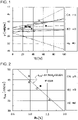
- Fig. 1 is a graph showing plots (3 points) of the surface tension (mean of surface tension distribution) of samples having different inert contents and the regression line of the plots for each of 6 brands (A to F) of coal treated with heat at 500°C (semicokes).
- the horizontal axis represents TI (%)
- the vertical axis represents ⁇ (mN/m). Table 1 shows the properties of the coals A to F.
- Each regression line in Fig. 1 is a simple regression equation of ⁇ against TI and calculated by using the least squares method so as to minimize the error between the simple regression equation and each plot in each coal.
- the plots of each coal are on the regression line, and an approximately linear relationship is observed between TI and ⁇ .
- the reactives constitute 100% of coal
- the inerts constitute 0% of coal.
- logMF log/ddpm
- Ro a physical property value used in this embodiment as an example measure of coal rank and is a mean maximum vitrinite reflectance in JIS M 8816.
- TI a total inert content (vol%) and calculated in accordance with Methods of microscopical measurement for the macerals for coal and coal blend in JIS M 8816 and the following formula (1) based on the Parr formula described in explanation of the Methods.
- Inert content vol % fusinite vol % + micrinite vol % + 2 / 3 ⁇ semifusinite vol % + mineral matter vol %
- ⁇ (mN/m) is the surface tension (mean of surface tension distribution) of semicokes made by treating coals A to F, which have been pulverized to a predetermined particle size, with heat at 500°C in accordance with the film flotation method.
- Fig. 1 shows that ⁇ 0 has a tendency of convergence to a substantially constant value, regardless of the brand of coal. However, ⁇ 100 does not have a tendency of convergence to a constant value and greatly varies according to the brand of coal. Since ⁇ 0 has a tendency of convergence to a substantially constant value, the representative value of ⁇ 0 can be predetermined from ⁇ 0 calculated for different brands of coal. In this embodiment, the representative value of ⁇ 0 is defined as an arithmetic mean of ⁇ 0 of different brands of coal.
- Fig. 2 is a graph showing the relationship between ⁇ 100 and the mean maximum vitrinite reflectance (hereinafter may be referred to as Ro) of coal.
- Ro mean maximum vitrinite reflectance
- the horizontal axis represents Ro (%)
- the vertical axis represents ⁇ 100 (mN/m).
- the method for estimating the surface tension of coal inerts will be described with reference to Fig. 2 .
- Table 2 shows the properties of coal G, which is not used to establish the first relational expression.
- Table 3 shows ⁇ 100 calculated by using Ro shown in Table 1 and the formula (2) above.
- ⁇ 100 of coal G which is not used to establish the formula (2) above, is calculated by using Ro shown in Table 2 and the formula (2) and found to be 41.1 mN/m.
- ⁇ of each of semicokes made by treating three samples having different inert contents with heat at 500°C is measured, and ⁇ 100 calculated from the simple regression equation of ⁇ is 41.2 mN/m.
- the simple regression equation in Fig. 2 has a coefficient of determination R 2 of 0.86, which is close to 1.
- the coefficient of determination R 2 is a measure of the degree of correlation in the regression equation.
- the method for estimating the surface tension of coal inerts includes determining in advance the first relational expression representing the relationship between ⁇ 100 and Ro, measuring Ro of a coal of which ⁇ 100 is to be estimated, and calculating the surface tension of inerts in the coal by using the measured Ro and the first relational expression.
- ⁇ 100 it is necessary to prepare two or more samples having different inert contents, measure the surface tension of each of the samples using the film flotation method after converting the samples into semicoke, and determine the simple regression equation of the surface tension.
- the first relational expression representing the relationship between ⁇ 100 and Ro is determined in advance as shown in Fig. 2
- ⁇ 100 can be calculated, only by measuring Ro of a target of which ⁇ 100 is to be estimated, from the first relational expression and the measured Ro.
- ⁇ 100 can be easily estimated by using the method for estimating the surface tension of coal inerts.
- the relational expression representing the relationship between ⁇ and TI corresponding to the simple regression equation shown in Fig. 1 can be calculated by using a predetermined representative value of ⁇ 0 and the estimated ⁇ 100 .
- This relational expression is the second relational expression representing the relationship between y and TI.
- the second relational expression can be represented by the following formula (3).
- the method for estimating the surface tension of coal includes determining in advance the second relational expression calculated from predetermined ⁇ 0 and ⁇ 100 , measuring the TI of a coal of which ⁇ is to be estimated, and calculating the surface tension of the coal from the measured value of TI and the second relational expression.
- the method for estimating the surface tension of coal according to this embodiment uses, as ⁇ 0 , a predetermined representative value of ⁇ 0 and uses, as ⁇ 100 , the estimated ⁇ 100 calculated by using the method for estimating the surface tension of coal inerts.
- the surface tension of coal can be calculated, only by measuring TI of a coal of which the surface tension is to be estimated, from the second relational expression and the measured TI.
- the surface tension of the coal can thus be easily estimated by using the method for estimating the surface tension of coal according to this embodiment.
- Table 4 shows ⁇ 0 (representative value) and ⁇ 100 (estimated value) used to determine the second relational expression and ⁇ (estimated value) of coals A to F.
- ⁇ (estimated value) is calculated by using the TI shown in Table 1 or Table 2 and the second relational expression of each of coals A to F determined from ⁇ 0 (typical value) and ⁇ 100 (estimated value) .
- Fig. 3 is a graph showing the relationship between the measured surface tensions and the estimated surface tensions.
- the horizontal axis represents measured ⁇ (mN/m), which is ⁇ shown in Table 1 or Table 2.
- the vertical axis represents estimated ⁇ (mN/m), which is ⁇ (estimated value) shown in Table 4.
- the circle plots represent coals A to F, and the solid square plots represent coal G.
- Fig. 3 indicates a very strong correlation between measured ⁇ and estimated ⁇ . This result demonstrates that ⁇ can be accurately estimated by using the method for estimating the surface tension of coal according to this embodiment.
- Fig. 2 and Fig. 3 show an example of estimating the surface tension of coals treated with heat at 500°C, but the heat treatment temperature of coals in this embodiment is not limited to 500°C.
- the method for estimating the surface tension of coal according to this embodiment is not limited to the case of heat treatment at 500°C, it is determined whether the relationship between TI and surface tension shown in Fig. 1 is also established at other heat treatment temperatures.
- Samples having different TI contents are prepared by the above method using 3 brands (H, I, J) of coal.
- the samples are converted into semicokes according to the method including (a) to (c) described above under the same conditions except that only the heat treatment temperature is changed to 400°C and 600°C.
- the surface tension of each semicoke is measured, and the relationship between TI and surface tension is determined in the same manner as in Fig. 1 .
- Table 5 below shows the properties of the coals H to J. [Table 5] Brand logMF (log/ddpm) Ro (%) TI (%) H 0.85 1.51 41.04 I 0.95 1.32 43.86 J 1.83 1.02 50.25
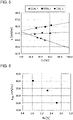
- Fig. 4 is a graph showing plots (3 points) of the surface tension of samples having different inert contents and the regression line of the plots for each of 3 brands (H, I, J) of coal with a heat treatment temperature of 400°C.
- Fig. 5 is a graph showing plots (3 points) of the surface tension of samples having different inert contents and the regression line of the plots for each of 3 brands (H, I, J) of coal with a heat treatment temperature of 600°C.
- the horizontal axis represents TI (%)
- the vertical axis represents ⁇ (mN/m).
- Fig. 6 is a graph showing the relationship between ⁇ 100 and Ro of coals with a heat treatment temperature of 400°C.
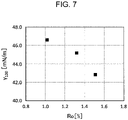
- Fig. 7 is a graph showing the relationship between ⁇ 100 and Ro of coals with a heat treatment temperature of 600°C.
- the horizontal axis represents Ro (%)
- the vertical axis represents ⁇ 100 (mN/m).
- a strong correlation is found between ⁇ 100 and Ro as in Fig. 2 even when the heat treatment temperature is changed to 400°C and 600°C.
- Patent Literature 1 also discloses that the surface tensions of semicokes prepared at heat treatment temperatures of 350°C or higher and 800°C or lower show the same tendency regardless of the type of coal. This indicates that the method for estimating the surface tension of coal according to this embodiment can be used for semicokes prepared at a temperature of 350°C or higher and 800°C or lower as well as semicokes made by a heat treatment at 500°C.
- estimation of the surface tension of inerts in a coal treated with heat at a predetermined temperature of 350°C or higher and 800°C or lower can be done by using the first relational expression representing the relationship between the surface tension of inerts in a semicoke made by a heat treatment at the predetermined temperature and the physical property value representing a coal rank. Accordingly, ⁇ 100 , which is the surface tension of inerts in a coal treated with heat at the predetermined temperature can be estimated.
- Estimation of the surface tension of the coal treated with heat at a predetermined temperature of 350°C or higher and 800°C or lower can be done by using the second relational expression representing the relationship between the surface tension and the total inert content of the coal obtained from ⁇ 100 of the coal estimated at the predetermined temperature and ⁇ 0 at a predetermined temperature.
- the surface tension of the coal treated with heat at the predetermined temperature can be estimated accordingly.
- the coals shown in Tables 1, 2, and 5 are examples of coal commonly used as a coke raw material.
- Coal used as a coke raw material has an MF of 0 to 60000 ddpm (log MF: 4.8 or less), a Ro of 0.6% to 1.8%, and a TI of 3 to 50 vol%.
- the method for estimating the surface tension of coal according to this embodiment can be particularly preferably used for coals in such ranges.
- Ro is used as a physical property value representing a coal rank.
- Other physical property values representing coal ranks include the volatile matter of coal, the carbon content, and the re-solidification temperature in softening and melting. These physical property values all show a good correlation with Ro. Therefore, the physical property value representing a coal rank may be a physical property value that correlates with the coal rank, such as the volatile matter of coal, the carbon content, and the re-solidification temperature in softening and melting, instead of RO.
- the strength of a coke made from a coal blend containing a mixture of coals with similar ⁇ is higher than that of a coke made from a coal blend containing a mixture of coals with different ⁇ . If ⁇ can be easily estimated by using the method for estimating the surface tension of coal according to this embodiment, the estimated ⁇ can be used to investigate blending of coals. The use of a coal blend having the blending ratio set by the blending investigation to produce coke thus enables production of coke with high quality.
Landscapes
- Chemical & Material Sciences (AREA)
- Life Sciences & Earth Sciences (AREA)
- Health & Medical Sciences (AREA)
- Engineering & Computer Science (AREA)
- Biochemistry (AREA)
- Physics & Mathematics (AREA)
- General Health & Medical Sciences (AREA)
- General Physics & Mathematics (AREA)
- Immunology (AREA)
- Pathology (AREA)
- Analytical Chemistry (AREA)
- Organic Chemistry (AREA)
- Oil, Petroleum & Natural Gas (AREA)
- Materials Engineering (AREA)
- Medicinal Chemistry (AREA)
- Food Science & Technology (AREA)
- Environmental & Geological Engineering (AREA)
- General Life Sciences & Earth Sciences (AREA)
- Geochemistry & Mineralogy (AREA)
- Geology (AREA)
- Coke Industry (AREA)
- Investigating Or Analyzing Materials Using Thermal Means (AREA)
- Financial Or Insurance-Related Operations Such As Payment And Settlement (AREA)
Applications Claiming Priority (2)
| Application Number | Priority Date | Filing Date | Title |
|---|---|---|---|
| JP2019194865 | 2019-10-28 | ||
| PCT/JP2020/038830 WO2021085146A1 (fr) | 2019-10-28 | 2020-10-14 | Procédé d'estimation de tension superficielle de structure inerte dans du charbon, procédé d'estimation de tension superficielle de charbon et procédé de production de coke |
Publications (2)
| Publication Number | Publication Date |
|---|---|
| EP4053246A1 true EP4053246A1 (fr) | 2022-09-07 |
| EP4053246A4 EP4053246A4 (fr) | 2022-12-14 |
Family
ID=75715914
Family Applications (1)
| Application Number | Title | Priority Date | Filing Date |
|---|---|---|---|
| EP20882743.6A Pending EP4053246A4 (fr) | 2019-10-28 | 2020-10-14 | Procédé d'estimation de tension superficielle de structure inerte dans du charbon, procédé d'estimation de tension superficielle de charbon et procédé de production de coke |
Country Status (9)
| Country | Link |
|---|---|
| US (1) | US12110457B2 (fr) |
| EP (1) | EP4053246A4 (fr) |
| JP (1) | JP7010419B2 (fr) |
| KR (1) | KR102720002B1 (fr) |
| CN (1) | CN114556079B (fr) |
| AU (1) | AU2020373691B2 (fr) |
| CA (1) | CA3152872A1 (fr) |
| TW (1) | TWI793466B (fr) |
| WO (1) | WO2021085146A1 (fr) |
Family Cites Families (26)
| Publication number | Priority date | Publication date | Assignee | Title |
|---|---|---|---|---|
| US4135983A (en) * | 1970-12-28 | 1979-01-23 | Kureha Kagaku Kogyo Kabushiki Kaisha | Method for improving coking property of coal for use in production of cokes |
| JPS53143416A (en) | 1977-05-20 | 1978-12-13 | Fujitsu Ltd | Rockagle member supporting mechanism for line printer |
| JPS6229968Y2 (fr) | 1980-08-12 | 1987-08-01 | ||
| JPS6095354A (ja) * | 1983-10-31 | 1985-05-28 | Nippon Steel Chem Co Ltd | 石炭組織の自動分析法 |
| JPH08176553A (ja) * | 1994-12-22 | 1996-07-09 | Kawasaki Steel Corp | 非・微粘結炭の流動性等推定方法 |
| JP4547766B2 (ja) | 1999-04-13 | 2010-09-22 | Jfeスチール株式会社 | 石炭のコークス強度の測定方法およびコークスの製造方法 |
| JP4147986B2 (ja) * | 2003-03-14 | 2008-09-10 | Jfeスチール株式会社 | 石炭のコークス強度の測定方法及びコークスの製造方法 |
| JP4299680B2 (ja) * | 2004-01-06 | 2009-07-22 | 新日本製鐵株式会社 | コークス強度の推定方法 |
| JP4385816B2 (ja) * | 2004-03-29 | 2009-12-16 | Jfeスチール株式会社 | 配合炭のコークス強度推定方法及びコークスの製造方法 |
| JP4121523B2 (ja) * | 2005-11-10 | 2008-07-23 | 独立行政法人海洋研究開発機構 | ビトリニット反射率測定方法およびビトリニット反射率測定装置 |
| JP2011213827A (ja) * | 2010-03-31 | 2011-10-27 | Nippon Steel Corp | 高炉用コークスの製造方法 |
| JP5071578B2 (ja) * | 2010-09-01 | 2012-11-14 | Jfeスチール株式会社 | コークス製造用石炭の調製方法 |
| IN2014MN00818A (fr) * | 2011-10-14 | 2015-06-12 | Jfe Steel Corp | |
| EP2980187B1 (fr) * | 2012-03-27 | 2021-01-13 | JFE Steel Corporation | Procédé de préparation d'un mélange de charbon pour la production de coke, mélange de charbon et procédé de production de coke |
| IN2014MN01678A (fr) * | 2012-03-27 | 2015-07-03 | Jfe Steel Corp | |
| EP2832822B1 (fr) * | 2012-03-27 | 2020-06-17 | JFE Steel Corporation | Procédé de mélange de charbon pour fabrication de coke, procédé de fabrication de coke |
| WO2013145677A1 (fr) * | 2012-03-27 | 2013-10-03 | Jfeスチール株式会社 | Procédé pour évaluer l'adhérence entre charbons |
| KR101735231B1 (ko) * | 2013-02-21 | 2017-05-12 | 제이에프이 스틸 가부시키가이샤 | 야금용 코크스의 제조 방법 |
| JP5910659B2 (ja) | 2013-04-09 | 2016-04-27 | Jfeスチール株式会社 | 配合炭の製造方法及びそれを用いたコークスの製造方法 |
| JP5812037B2 (ja) * | 2013-04-09 | 2015-11-11 | Jfeスチール株式会社 | 表面張力測定方法 |
| RU2640183C2 (ru) | 2013-04-12 | 2017-12-26 | ДжФЕ СТИЛ КОРПОРЕЙШН | Способ оценки степени выветривания угля, способ оценки коксуемости выветренного угля, способ контроля степени выветривания угля и способ изготовления кокса |
| JP6036891B2 (ja) * | 2014-03-28 | 2016-11-30 | Jfeスチール株式会社 | コークスの製造方法 |
| CN104090084B (zh) * | 2014-06-27 | 2016-03-09 | 江苏省沙钢钢铁研究院有限公司 | 一种配合煤镜质组反射率分布的预测方法的应用 |
| JP6379934B2 (ja) * | 2014-09-29 | 2018-08-29 | 新日鐵住金株式会社 | コークス強度の推定方法 |
| JP6874524B2 (ja) * | 2017-05-24 | 2021-05-19 | 日本製鉄株式会社 | コークス強度の推定方法 |
| JP6870528B2 (ja) * | 2017-08-09 | 2021-05-12 | 日本製鉄株式会社 | 高炉用コークスの製造方法 |
-
2020
- 2020-10-14 WO PCT/JP2020/038830 patent/WO2021085146A1/fr not_active Ceased
- 2020-10-14 KR KR1020227012969A patent/KR102720002B1/ko active Active
- 2020-10-14 EP EP20882743.6A patent/EP4053246A4/fr active Pending
- 2020-10-14 AU AU2020373691A patent/AU2020373691B2/en active Active
- 2020-10-14 CA CA3152872A patent/CA3152872A1/fr active Pending
- 2020-10-14 US US17/770,573 patent/US12110457B2/en active Active
- 2020-10-14 CN CN202080072507.1A patent/CN114556079B/zh active Active
- 2020-10-14 JP JP2021549615A patent/JP7010419B2/ja active Active
- 2020-10-23 TW TW109136838A patent/TWI793466B/zh active
Also Published As
| Publication number | Publication date |
|---|---|
| EP4053246A4 (fr) | 2022-12-14 |
| JPWO2021085146A1 (ja) | 2021-12-16 |
| TWI793466B (zh) | 2023-02-21 |
| US12110457B2 (en) | 2024-10-08 |
| US20220290054A1 (en) | 2022-09-15 |
| KR20220065830A (ko) | 2022-05-20 |
| TW202132551A (zh) | 2021-09-01 |
| CA3152872A1 (fr) | 2021-05-06 |
| CN114556079B (zh) | 2024-04-09 |
| AU2020373691B2 (en) | 2023-03-30 |
| AU2020373691A1 (en) | 2022-05-12 |
| JP7010419B2 (ja) | 2022-01-26 |
| CN114556079A (zh) | 2022-05-27 |
| WO2021085146A1 (fr) | 2021-05-06 |
| KR102720002B1 (ko) | 2024-10-18 |
| BR112022007327A2 (pt) | 2022-07-05 |
Similar Documents
| Publication | Publication Date | Title |
|---|---|---|
| US9845439B2 (en) | Method for blending coals for cokemaking and method for producing coke | |
| US10802011B2 (en) | Coal-to-coal adhesiveness evaluation method | |
| EP4053247B1 (fr) | Procédé d'estimation de la tension superficielle du charbon et procédé de production de coke | |
| EP2832824B1 (fr) | Procédé de préparation pour un mélange de charbon pour une fabrication de coke et procédé de fabrication de coke | |
| EP4053246A1 (fr) | Procédé d'estimation de tension superficielle de structure inerte dans du charbon, procédé d'estimation de tension superficielle de charbon et procédé de production de coke | |
| RU2803512C1 (ru) | Способ оценки поверхностного натяжения инертных компонентов угля, способ оценки поверхностного натяжения угля и способ получения кокса | |
| EP4089157B1 (fr) | Procédé de production de charbon mélangé et procédé de production de coke | |
| RU2794598C1 (ru) | Способ оценки поверхностного натяжения угля и способ получения кокса | |
| BR112022007327B1 (pt) | Método para estimar uma tensão superficial de inertes de carvão, método para estimar uma tensão superficial de carvão e método para produzir coque | |
| BR112022007374B1 (pt) | Método para estimar uma tensão superficial de carvão e método para produzir coque |
Legal Events
| Date | Code | Title | Description |
|---|---|---|---|
| STAA | Information on the status of an ep patent application or granted ep patent |
Free format text: STATUS: THE INTERNATIONAL PUBLICATION HAS BEEN MADE |
|
| PUAI | Public reference made under article 153(3) epc to a published international application that has entered the european phase |
Free format text: ORIGINAL CODE: 0009012 |
|
| STAA | Information on the status of an ep patent application or granted ep patent |
Free format text: STATUS: REQUEST FOR EXAMINATION WAS MADE |
|
| 17P | Request for examination filed |
Effective date: 20220419 |
|
| AK | Designated contracting states |
Kind code of ref document: A1 Designated state(s): AL AT BE BG CH CY CZ DE DK EE ES FI FR GB GR HR HU IE IS IT LI LT LU LV MC MK MT NL NO PL PT RO RS SE SI SK SM TR |
|
| A4 | Supplementary search report drawn up and despatched |
Effective date: 20221115 |
|
| RIC1 | Information provided on ipc code assigned before grant |
Ipc: G01N 13/02 20060101ALI20221109BHEP Ipc: G01N 33/22 20060101ALI20221109BHEP Ipc: C10B 57/04 20060101AFI20221109BHEP |
|
| DAV | Request for validation of the european patent (deleted) | ||
| DAX | Request for extension of the european patent (deleted) | ||
| STAA | Information on the status of an ep patent application or granted ep patent |
Free format text: STATUS: EXAMINATION IS IN PROGRESS |
|
| 17Q | First examination report despatched |
Effective date: 20250925 |