EP4054216A1 - Appareil de communication sans fil qui gère un processus en usine et procédé de gestion de processus - Google Patents
Appareil de communication sans fil qui gère un processus en usine et procédé de gestion de processus Download PDFInfo
- Publication number
- EP4054216A1 EP4054216A1 EP22168397.2A EP22168397A EP4054216A1 EP 4054216 A1 EP4054216 A1 EP 4054216A1 EP 22168397 A EP22168397 A EP 22168397A EP 4054216 A1 EP4054216 A1 EP 4054216A1
- Authority
- EP
- European Patent Office
- Prior art keywords
- wireless communication
- communication portion
- data
- communication apparatus
- memory
- Prior art date
- Legal status (The legal status is an assumption and is not a legal conclusion. Google has not performed a legal analysis and makes no representation as to the accuracy of the status listed.)
- Withdrawn
Links
Images


Classifications
-
- G—PHYSICS
- G05—CONTROLLING; REGULATING
- G05B—CONTROL OR REGULATING SYSTEMS IN GENERAL; FUNCTIONAL ELEMENTS OF SUCH SYSTEMS; MONITORING OR TESTING ARRANGEMENTS FOR SUCH SYSTEMS OR ELEMENTS
- G05B19/00—Program-control systems
- G05B19/02—Program-control systems electric
- G05B19/418—Total factory control, i.e. centrally controlling a plurality of machines, e.g. direct or distributed numerical control [DNC], flexible manufacturing systems [FMS], integrated manufacturing systems [IMS] or computer integrated manufacturing [CIM]
-
- H—ELECTRICITY
- H04—ELECTRIC COMMUNICATION TECHNIQUE
- H04W—WIRELESS COMMUNICATION NETWORKS
- H04W4/00—Services specially adapted for wireless communication networks; Facilities therefor
- H04W4/30—Services specially adapted for particular environments, situations or purposes
- H04W4/38—Services specially adapted for particular environments, situations or purposes for collecting sensor information
-
- H—ELECTRICITY
- H04—ELECTRIC COMMUNICATION TECHNIQUE
- H04W—WIRELESS COMMUNICATION NETWORKS
- H04W48/00—Access restriction; Network selection; Access point selection
- H04W48/16—Discovering, processing access restriction or access information
-
- H—ELECTRICITY
- H04—ELECTRIC COMMUNICATION TECHNIQUE
- H04W—WIRELESS COMMUNICATION NETWORKS
- H04W88/00—Devices specially adapted for wireless communication networks, e.g. terminals, base stations or access point devices
- H04W88/02—Terminal devices
- H04W88/06—Terminal devices adapted for operation in multiple networks or having at least two operational modes, e.g. multi-mode terminals
-
- H—ELECTRICITY
- H04—ELECTRIC COMMUNICATION TECHNIQUE
- H04W—WIRELESS COMMUNICATION NETWORKS
- H04W92/00—Interfaces specially adapted for wireless communication networks
- H04W92/04—Interfaces between hierarchically different network devices
- H04W92/08—Interfaces between hierarchically different network devices between user and terminal device
Definitions
- the present invention relates to a wireless communication apparatus for managing a process in a factory, and a process management method.
- a communication facility for managing a process at each machine and apparatus is set up in a factory.
- PTL 1 discloses a factory communication system using both a wired network and a wireless network.
- a mesh-type wireless communication is used between work units, and a peer-to-peer wireless communication is used between process units.
- PTL 2 discloses a process management wireless communication system that switches a communication mode between a mesh communication mode and a point-to-point communication mode.
- PTL 3 discusses a wireless communication system that collects data at various kinds of processes.
- the present invention has been contrived to solve at least a part of the above-described problems, and can be embodied as, for example, the following embodiments.
- a wireless communication apparatus configured to manage a process in a factory.
- This wireless communication apparatus includes an interface connected to a device and usable to receive data from the device, a first wireless communication portion, a second wireless communication portion, and a controller configured to, to wirelessly transmit the data received via the interface, select one of the first wireless communication portion and the second wireless communication portion according to this data.
- the first wireless communication portion is configured to carry out communication at a higher speed and with a larger capacity than the second wireless communication portion.
- the second wireless communication portion is configured to carry out more reliable communication than the first wireless communication portion.
- the first wireless communication portion and the second wireless communication having different characteristics from each other are selectively used according to the data received from the device, and therefore the communication can be carried out suitably to a characteristic of the data that should be transmitted.
- the controller selects one of the first wireless communication portion and the second wireless communication portion based on a data size of the data.
- the communication can be carried out suitably to the data size of the data.
- the controller selects one of the first wireless communication portion and the second wireless communication portion based on a type of the data. According to this configuration, the communication can be carried out suitably to the type of the data.
- the wireless communication apparatus further includes a memory.
- the controller scans a superior-side communication apparatus connected or connectable to the first wireless communication portion, and stores the data into the memory if the connected or connectable superior-side communication apparatus is not detected. According to this configuration, the data failed to be transmitted can be acquired later and used.
- the controller when the data is stored in the memory, transmits information indicating that the data is stored in the memory to the superior-side communication apparatus via the second wireless communication portion.
- the superior-side communication apparatus can recognize that the data is stored in the memory of the wireless communication apparatus. A worker can go to a location where the wireless communication apparatus is set up and collect the data stored in the memory based on this information.
- the controller when the data is stored in the memory, the controller regularly repeats the scan, and transmits the data stored in the memory to the connected or connectable superior-side communication apparatus via the first wireless communication portion upon succeeding in confirming presence of the connected or connectable superior-side communication apparatus. According to this configuration, all data can be automatically transmitted to the superior-side communication apparatus in the end even without requiring the worker to go to the location of the wireless communication apparatus.
- the second wireless communication portion receives control data for controlling the device.
- the second wireless communication portion can carry out the more reliable communication than the first wireless communication portion, and therefore the device can be securely controlled according to this configuration.
- the first wireless communication portion is configured to establish a point-to-point connection to an access point or a router.
- the second wireless communication portion is configured to be able to construct mesh-type topology, and is also configured to be able to construct a network capable of self-healing a communication failure with the aid of a route detour.
- the first to seventh embodiments can be preferably realized.
- a process management method in a factory includes steps of preparing a wireless communication apparatus including a first wireless communication portion and a second wireless communication portion, causing the wireless communication apparatus to receive data from a device connected to the wireless communication apparatus, and causing the wireless communication apparatus to, to wirelessly transmit the received data, select one of the first wireless communication portion and the second wireless communication portion according to this data.
- the first wireless communication portion is configured to carry out communication at a higher speed and with a larger capacity than the second wireless communication portion.
- the second wireless communication portion is configured to carry out more reliable communication than the first wireless communication portion.
- the process management method further includes steps of causing the wireless communication apparatus to scan a superior-side communication apparatus connected or connectable to the first wireless communication portion and store the data into the memory if the connected or connectable superior-side communication apparatus is not detected when the first wireless communication portion is selected, causing the wireless communication apparatus to transmit information indicating that the data is stored in the memory to the superior-side communication apparatus via the second wireless communication portion when the data is stored in the memory, and causing a worker to receive the data stored in the memory with use of a wirelessly communicable mobile terminal.
- the worker can easily collect the data stored in the memory by going to a location where the wireless communication apparatus is set up and using the mobile terminal.
- the process management method further includes a step of causing the worker to overwrite a program installed in the device with use of the wirelessly communicable mobile terminal.
- the program is updated at the location where the wireless communication apparatus is set up, and therefore the program that may have a relatively large volume does not have to be transmitted via the first wireless communication portion. Therefore, when the data received from the device always has a small volume, a setup of an access point for this first wireless communication portion may be able to be omitted in some cases. Therefore, the number of setups of access points can be reduced as a whole of the factory, and this is economical.
- the present invention can be realized as various kinds of embodiments in addition to the above-described embodiments.
- the present invention can also be realized as a program readable by a computer for realizing any of the first to eleventh embodiments, a storage medium storing this program, a network system, and the like.
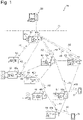
- Fig. 1 illustrates a schematic configuration of a process management system 20 constructed with use of a wireless communication apparatus 40 according to one embodiment of the present invention.
- the process management system 20 is a system for managing a process at a facility set up inside a factory in any factory (a rice milling plant in the present embodiment).
- the process management system 20 includes a process monitoring host computer 30, wireless communication apparatuses 40a to 40h (hereinafter also collectively referred to as the wireless communication apparatus 40), a wireless communication apparatus 50, and a gateway 61.
- the process monitoring host computer 30 centrally controls an operation of each facility in the factory, and also accumulates various kinds of data collected from each facility (for example, data acquired from various kinds of sensors and data indicating an operational status of each facility). This data may be accumulated as big data, and used for an automatic operation using AI.
- the wireless communication apparatus 40a is connected to the gateway 61 via an interface.
- the gateway 61 is connected to the process monitoring host computer 30 via a LAN interface 61a and an Ethernet (registered trademark) network 31.
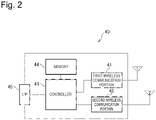
- Fig. 2 illustrates a schematic configuration of the wireless communication apparatus 40.
- the wireless communication apparatus 40 includes a first wireless communication portion 41, a second wireless communication portion 42, a controller 43, a memory 44, and an interface 45.
- the first wireless communication portion 41 is configured to carry out communication at a higher speed and with a larger capacity than the second wireless communication portion 42.
- the second wireless communication portion 42 is configured to carry out more reliable communication than the first wireless communication portion 41.
- the first wireless communication portion 41 is a Wi-Fi (registered trademark) communication module.
- a module in compliance with IEEE 802.11, 11b, 11g, 11n, or 11a can be used as the Wi-Fi communication module.
- the first wireless communication portion 41 of the wireless communication apparatus 40a functions as a wireless parent device, i.e., an access point.
- the wireless communication apparatuses 40b to 40h function as wireless child devices.
- the second wireless communication portion 42 is a SmartMesh (registered trademark) communication module.
- the SmartMesh communication module complies with IEEE 802.15.4e, and can construct a mesh-type network topology. Further, the SmartMesh communication module is configured to be able to construct a network capable of self-healing a communication failure with the aid of a route detour, i.e., be able to autonomously construct a network topology according to a radio wave status or the like. Further, the SmartMesh communication module employs the TSCH (Time Slotted Channel Hopping) method, and increases reliability of the communication by achieving frequency redundancy based on channel hopping.
- TSCH Time Slotted Channel Hopping
- the TSCH (Time Slotted Channel Hopping) method can also achieve power saving by carrying out temporally synchronous communication. Examples of the communication method satisfying these conditions include, for example, WirelessHART and ISA 100.11a.
- a condition for the communication method employed for the first wireless communication portion 41 may be satisfaction with at least one of (1) allowing the first wireless communication portion 41 to be configured to establish a point-to-point connection with an access point or a router, (2) prohibiting the first wireless communication portion 41 from communicating with the first wireless communication portion 41 of another wireless communication apparatus 40 (functioning as the wireless child device), (3) prohibiting multi-hopping by the first wireless communication portion 41, and (4) causing the first wireless communication portion 41 to use IEEE 802.11, 11b, 11g, 11n, 11a, or 11ac for the physical layer of the OSI reference model.
- condition for the communication method employed for the second wireless communication portion 42 may be satisfaction with at least one of (1) allowing the second wireless communication portion 42 to construct a network capable of self-healing a communication failure with the aid of a route detour, (2) allowing the second wireless communication portion 42 to construct a mesh-type topology or a line-type topology, (3) causing the second wireless communication portion 42 to have the router function and the multi-hopping function, and (4) causing the second wireless communication portion 42 to use IEEE 802.15.4 or IEEE 802.15.4g for the physical layer of the OSI reference model.
- Examples of the communication method satisfying these conditions include, for example, Thread, ZigbeePro, and SmartHop.
- the interface 45 is an interface for connecting to any of various kinds of devices in the factory that is targeted for the process management, and providing/receiving data between this device and the wireless communication apparatus 40.
- the type of the interface 45 is determined according to the type of the connected device.
- the interface 45 may be, for example, USB, SPI, or URAT.
- the interface 45 may be USB, SPI, or URAT.
- the interface 45 may be SPI or URAT.
- the controller 43 realizes various kinds of functions by executing a program stored in the memory 44. For example, the controller 43 controls operations of the first wireless communication portion 41 and the second wireless communication portion 42. Further, to transmit the data received from the device via the interface 45, the controller 43 selects one of the first wireless communication portion 41 and the second wireless communication portion 42 according to this data. Details of this processing (referred to as data transmission processing) will be described below.
- the memory 44 is a nonvolatile storage medium, and the data received from the device via the interface 45 is stored in the memory 44 in addition to the above-described program.
- the various kinds of devices are connected to the wireless communication apparatuses 40b to 40h via the interfaces 45, respectively.
- an optical sorter 62 is connected to the wireless communication apparatus 40b.
- a measuring and packing machine or weighing and packing machine 63 is connected to the wireless communication apparatus 40c.
- An environmental sensor 64 (for example, a temperature sensor, a humidity sensor, an atmospheric pressure sensor, and a vibration sensor) attached to various kinds of devices is connected to the wireless communication apparatus 40d.
- a contact input 65 of various kinds of devices is connected to the wireless communication apparatus 40e.
- a contact output 66 of various kinds of devices (a motor and an electromagnetic valve in the present example) is connected to the wireless communication apparatus 40f.
- An environmental sensor 67 mounted on various kinds of devices is connected to the wireless communication apparatus 40g.
- a rice milling machine 68 is connected to the wireless communication apparatus 40h.
- the wireless communication apparatus 50 is different from the wireless communication apparatus 40 in terms of being equipped with only the first wireless communication portion 41 and unequipped with the second wireless communication portion 42.
- a CCD camera is connected to the wireless communication apparatus 50 via an interface.
- the process management system 20 configured in this manner uses both the wireless communication by the first wireless communication portion 41 and the wireless communication by the second wireless communication portion 42.
- the wireless communication by the first wireless communication portion 41 is indicated by dotted lines
- the wireless communication by the second wireless communication portion 42 is indicated by alternate long and short dash lines.
- the wireless communication by the first wireless communication portion 41 is established by a point-to-point connection between the wireless communication apparatus 40a (the access point) and each of the wireless communication apparatus 50, the wireless communication apparatus 40b, and the wireless communication apparatus 40c.
- the wireless communication by the second wireless communication portion 42 constructs the mesh-type topology among the wireless communication apparatuses 40a to 40h.
- the wireless communication apparatus 40a is a communication apparatus on a superior side (the process monitoring host computer 30 side) as viewed from the wireless communication apparatuses 40b to 40h.
- An arrow A1 indicates how video data acquired by the CCD camera is transmitted from the wireless communication apparatus 50 to the wireless communication apparatus 40a. This video data is received and stored by the process monitoring host computer 30.
- Arrows A2 indicate how update programs are transmitted from the process monitoring host computer 30 to the individual devices via the wireless communication apparatuses 40, respectively.
- the wireless communication by the first wireless communication portion 41 is used for the transmission of the update programs.
- the wireless communication apparatuses 40b and 40c are set up in a distance range communicable with the wireless communication apparatus 40a using the first wireless communication portion 41, and therefore the update programs are transmitted from the process monitoring host computer 30 to the wireless communication apparatuses 40b and 40c via the wireless communication apparatus 40a, respectively, and are installed in the optical sorter 62 and the measuring and packing machine 63, respectively.
- the wireless communication apparatuses 40d to 40h are not set up within the distance range communicable with the wireless communication apparatus 40a using the first wireless communication portion 41.
- a worker may install the update program by going to the location where the rice milling machine 68 is set up, and establishing wireless communication between a mobile terminal 71 and the first wireless communication portion 41 of the wireless communication apparatus 40 with use of the mobile terminal 71 (for example, a smart-phone or a tablet PC).
- a mobile terminal 71 for example, a smart-phone or a tablet PC.
- An arrow A3 indicates how contact input data is transmitted from the contact input 65 to the process monitoring host computer 30 side via the second wireless communication portion 42 of the wireless communication apparatus 40e.
- An arrow A4 indicates how environmental data (the data acquired by the environmental sensor 64) is transmitted from the environmental sensor 64 to the process monitoring host computer 30 side via the second wireless communication portion 42 of the wireless communication apparatus 40d.
- An arrow A5 indicates how contact control data is transmitted from the process monitoring host computer 30 to the contact output 66 via the second wireless communication portion 42 of the wireless communication apparatus 40f.
- An arrow A6 indicates how environmental data is transmitted from the environmental sensor 67 to the process monitoring host computer 30 side via the second wireless communication portion 42 of the wireless communication apparatus 40g.
- An arrow A7 indicates how rice milling machine control data is transmitted from the process monitoring host computer 30 to the rice milling machine 68 via the second wireless communication portion 42 of the wireless communication apparatus 40h, and, along therewith, how rice milling operational data is transmitted from the rice milling machine 68 to the process monitoring host computer 30 side via the second wireless communication portion 42 of the wireless communication apparatus 40h.
- An arrow A8 indicates how optical sorter control data is transmitted from the process monitoring host computer 30 to the optical sorter 62 via the second wireless communication portion 42 of the wireless communication apparatus 40b, and, along therewith, how sorting result data is transmitted from the optical sorter 62 to the process monitoring host computer 30 side via the second wireless communication portion 42 of the wireless communication apparatus 40b.
- An arrow A9 indicates how measuring and packing machine control data is transmitted from the process monitoring host computer 30 to the measuring and packing machine 63 via the second wireless communication portion 42 of the wireless communication apparatus 40c, and, along therewith, how measured result data is transmitted from the measuring and packing machine 63 to the process monitoring host computer 30 side via the second wireless communication portion 42 of the wireless communication apparatus 40c.
- Fig. 3 is a flowchart illustrating one example of the data transmission processing performed in the wireless communication apparatuses 40b to 40h. This processing is performed by the controller 43. In the present example, the data transmission processing will be described assuming that this processing is performed by the wireless communication apparatus 40g connected to the environmental sensor 67.
- a sensor substrate provided to the environmental sensor 67 calculates a calculation value (for example, an acceleration effective value, a speed acquired by integrating this acceleration effective value, and a displacement acquired by integrating this speed) based on raw data indicating a sensor detection value (for example, waveform data indicating the acceleration). Then, the sensor substrate determines whether this sensor detection value is a normal value by comparing the acquired calculation value with a predetermined threshold value.
- a calculation value for example, an acceleration effective value, a speed acquired by integrating this acceleration effective value, and a displacement acquired by integrating this speed
- the sensor substrate If the sensor detection value is normal, the sensor substrate outputs only the calculation value to the interface 45 as text data, and discards the raw data. On the other hand, if the sensor detection value is abnormal, the sensor substrate outputs the raw data to the interface 45 as binary data in addition to outputting the calculation value to the interface 45 as the text data. This raw data is used for the process monitoring host computer 30 to estimate the state of the device.
- the controller 43 first receives an input of data that should be transmitted (hereinafter referred to as transmission data) from the device connected to the interface 45 (step S100). Next, the controller 43 determines whether the received transmission data is video data or audio data (step S110). For example, in the case where the interface 45 is USB, the controller 43 can determine the type of the transmission data by reading out a device descriptor contained in the transmission data.
- step S110 determines whether the transmission data is neither video data nor audio data (step S110: NO).
- step S120 determines whether the data size of the transmission data is equal to or greater than a preset threshold value (step S120).
- This threshold value is set so as to allow the controller 43 to determine whether the data received by the interface 45 from the environmental sensor 64 is the text data or the binary data.
- the flowchart may be set so as to omit step S110 and proceed from step S100 to step S120.
- step S120: NO the controller 43 selects the second wireless communication portion 42 capable of carrying out the communication that is relatively low-speed and small-capacity but highly reliable, and transmits the transmission data to the process monitoring host computer 30 side via the second wireless communication portion 42 (step S130).
- the controller 43 determines presence or absence of the superior-side communication apparatus (the wireless communication apparatus 40a in the present example) connected or connectable to the first wireless communication portion 41 of the apparatus that the controller 43 itself is mounted (the wireless communication apparatus 40g) (step S140). This determination is made by, for example, carrying out active scan.
- step S140 If the connected or connectable superior-side communication apparatus is detected (step S140: DETECTED), the controller 43 selects the first wireless communication portion 41 capable of carrying out the relatively high-speed and large-capacity communication and transmits the transmission data to the process monitoring host computer 30 side via the first wireless communication portion 41 (step S150). On the other hand, if the connected or connectable superior-side communication apparatus is not detected (step S140: UNDETECTED), the controller 43 stores the transmission data into the memory 44 (step S160). Then, the controller 43 transmits information indicating that the transmission data is stored in the memory 44 (hereinafter referred to as memory storage information) to the process monitoring host computer 30 with use of the second wireless communication portion 42 (step S170).
- memory storage information information indicating that the transmission data is stored in the memory 44
- the controller 43 returns the processing to step S140, and repeats the processing in steps S140 to S170. Due to this repetition, the controller 43 can automatically transmit the data stored in the memory 44 to the process monitoring host computer 30 in the end, i.e., when the controller 43 can confirm the presence of the connected or connectable superior-side communication apparatus.
- the worker can be aware that the transmission data is stored in the memory 44 by the process monitoring host computer 30 receiving the memory storage information. Therefore, when wanting to collect this stored transmission data quickly, the worker can collect the transmission data stored in the memory 44 by going to the location where the wireless communication apparatus 40g is set up and using a mobile terminal 72 as indicated by an arrow A10 in Fig. 1 .
- the first wireless communication portion 41 and the second wireless communication 42 having different characteristics from each other are selectively used according to the data received from the device connected to the interface 45, i.e., any one of the first wireless communication portion 41 and the second wireless communication portion 42 is selected so as to make utilization of the advantages of the first wireless communication portion 41 and the second wireless communication portion 42. Therefore, the communication can be carried out suitably to the characteristic of the transmission data.
- control data for controlling the device is received with use of the relatively highly reliable second wireless communication portion 42, and therefore the device can be securely controlled.
- the number of setups of access points can be reduced by installing the update program or collecting the transmission data stored in the memory 44 via the first wireless communication portion 41 near the location where the wireless communication apparatus 40 is set up with use of the mobile terminal 71 or 72.
- Fig. 4 illustrates the process management system 20 according to an alternative embodiment.
- the same reference numerals as Fig. 1 are assigned to components and communication shared with Fig. 1 .
- Fig. 4 will be described focusing only on differences from Fig. 1 .
- the second wireless communication portion 42 is configured to be able to construct a line-type topology instead of the mesh-type topology.
- the line-type topology can be configured, for example, when SmartHop is employed as the communication method. SmartHop allows the second wireless communication portion 42 to self-heal a communication failure with the aid of a route detour between routers, thereby allowing it to achieve more reliable communication than the first wireless communication portion 41.
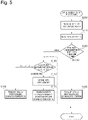
- Fig. 5 is a flowchart illustrating a flow of data transmission processing according to the alternative embodiment.
- the same step numbers as Fig. 3 are assigned to steps shared with Fig. 3 .
- Fig. 5 will be described focusing only on differences from Fig. 3 .
- the controller 43 determines the data type of the transmission data (step S210). In the case where the interface 45 is USB, the controller 43 can determine the type of the transmission data by reading out the device descriptor contained in the transmission data as described above.
- the controller 43 can determine the type of the transmission data by reading out a region storing information for identifying the data format in header information contained in the transmission data. This information for identifying the data format is added according to the type of the data output from the device by the device.
- the controller 43 determines whether the data type of the transmission data is a data type associated with the first wireless communication portion 41 in advance or a data type associated with the second wireless communication portion 42 in advance (step S220). Then, if the data type of the transmission data is the data type associated with the first wireless communication portion 41 in advance (step S220: FIRST), the controller 43 causes the processing to proceed to step S140. On the other hand, if the data type of the transmission data is the data type associated with the second wireless communication portion 42 in advance (step S220: SECOND), the controller 43 causes the processing to proceed to step S130.
- Such data transmission processing also allows the communication to be carried out suitably to the characteristic of the transmission data similarly to Fig. 3 .
Landscapes
- Engineering & Computer Science (AREA)
- Computer Networks & Wireless Communication (AREA)
- Signal Processing (AREA)
- Physics & Mathematics (AREA)
- Manufacturing & Machinery (AREA)
- Quality & Reliability (AREA)
- General Engineering & Computer Science (AREA)
- General Physics & Mathematics (AREA)
- Automation & Control Theory (AREA)
- Computer Security & Cryptography (AREA)
- Mobile Radio Communication Systems (AREA)
- General Factory Administration (AREA)
- Selective Calling Equipment (AREA)
- Testing And Monitoring For Control Systems (AREA)
Applications Claiming Priority (3)
| Application Number | Priority Date | Filing Date | Title |
|---|---|---|---|
| JP2017227391A JP7098101B2 (ja) | 2017-11-28 | 2017-11-28 | 工場において工程管理するための無線通信装置および工程管理方法 |
| PCT/JP2018/043492 WO2019107329A1 (fr) | 2017-11-28 | 2018-11-27 | Appareil de communication sans fil pour effectuer une commande de processus en usine, et procédé de commande de processus |
| EP18884014.4A EP3720158A4 (fr) | 2017-11-28 | 2018-11-27 | Appareil de communication sans fil pour effectuer une commande de processus en usine, et procédé de commande de processus |
Related Parent Applications (1)
| Application Number | Title | Priority Date | Filing Date |
|---|---|---|---|
| EP18884014.4A Division EP3720158A4 (fr) | 2017-11-28 | 2018-11-27 | Appareil de communication sans fil pour effectuer une commande de processus en usine, et procédé de commande de processus |
Publications (1)
| Publication Number | Publication Date |
|---|---|
| EP4054216A1 true EP4054216A1 (fr) | 2022-09-07 |
Family
ID=66665048
Family Applications (2)
| Application Number | Title | Priority Date | Filing Date |
|---|---|---|---|
| EP22168397.2A Withdrawn EP4054216A1 (fr) | 2017-11-28 | 2018-11-27 | Appareil de communication sans fil qui gère un processus en usine et procédé de gestion de processus |
| EP18884014.4A Withdrawn EP3720158A4 (fr) | 2017-11-28 | 2018-11-27 | Appareil de communication sans fil pour effectuer une commande de processus en usine, et procédé de commande de processus |
Family Applications After (1)
| Application Number | Title | Priority Date | Filing Date |
|---|---|---|---|
| EP18884014.4A Withdrawn EP3720158A4 (fr) | 2017-11-28 | 2018-11-27 | Appareil de communication sans fil pour effectuer une commande de processus en usine, et procédé de commande de processus |
Country Status (7)
| Country | Link |
|---|---|
| US (1) | US11194315B2 (fr) |
| EP (2) | EP4054216A1 (fr) |
| JP (1) | JP7098101B2 (fr) |
| KR (1) | KR102455348B1 (fr) |
| CN (1) | CN111279727B (fr) |
| BR (1) | BR112020008217A2 (fr) |
| WO (1) | WO2019107329A1 (fr) |
Families Citing this family (2)
| Publication number | Priority date | Publication date | Assignee | Title |
|---|---|---|---|---|
| CN112689255B (zh) * | 2020-12-21 | 2022-05-03 | 重庆邮电大学 | 一种基于6TiSCH的无线传感信息监测系统及其方法 |
| US20230103932A1 (en) * | 2021-10-06 | 2023-04-06 | Finch Technologies Ltd. | Motion Sensor Modules with Dynamic Protocol Support for Communications with a Computing Device |
Citations (6)
| Publication number | Priority date | Publication date | Assignee | Title |
|---|---|---|---|---|
| JP2006352893A (ja) | 2005-06-17 | 2006-12-28 | Fisher Rosemount Syst Inc | 工程管理システム用ワイヤレスアーキテクチャおよびサポート |
| JP2008282188A (ja) | 2007-05-10 | 2008-11-20 | Koyo Electronics Ind Co Ltd | 通信システム |
| JP2010282269A (ja) | 2009-06-02 | 2010-12-16 | Hitachi High-Tech Control Systems Corp | 無線ネットワークプロセス監視システム |
| EP2995017A1 (fr) * | 2013-05-07 | 2016-03-16 | Samsung Electronics Co., Ltd. | Appareil et procédé de transmettre de contenu dans un terminal portable |
| US20170164291A1 (en) * | 2015-12-03 | 2017-06-08 | Google Inc. | Power sensitive wireless communication radio management |
| CN107046655A (zh) * | 2017-04-25 | 2017-08-15 | 苏州大学 | 一种移动群智感知方法及系统 |
Family Cites Families (14)
| Publication number | Priority date | Publication date | Assignee | Title |
|---|---|---|---|---|
| US20050130647A1 (en) * | 2003-10-22 | 2005-06-16 | Brother Kogyo Kabushiki Kaisha | Wireless lan system, communication terminal and communication program |
| US7650144B2 (en) | 2005-03-01 | 2010-01-19 | Omron Corporation | Monitoring control apparatus, monitoring system, monitoring method, wireless communication apparatus and wireless communication system |
| JP2006279927A (ja) * | 2005-03-01 | 2006-10-12 | Omron Corp | 監視制御装置、監視システム、監視方法、プログラムおよび記録媒体 |
| US20070288709A1 (en) * | 2006-06-13 | 2007-12-13 | Xerox Corporation | Systems and methods for scheduling a device |
| US9001682B2 (en) * | 2011-07-21 | 2015-04-07 | Movik Networks | Content and RAN aware network selection in multiple wireless access and small-cell overlay wireless access networks |
| CN102883283A (zh) * | 2012-09-06 | 2013-01-16 | 东莞中山大学研究院 | 基于移动代理的无线接入点实现信息服务的方法及系统 |
| US9078283B2 (en) * | 2012-11-16 | 2015-07-07 | Franklin Wireless Corporation | Mobile convergence terminal |
| US9668196B2 (en) * | 2013-01-29 | 2017-05-30 | Cooper Technologies Company | Network administrator interface systems and methods for monitoring industrial wireless, self-organizing mesh communication networks |
| JPWO2014203335A1 (ja) * | 2013-06-18 | 2017-02-23 | 株式会社パトライト | 通信システム |
| US9973299B2 (en) * | 2014-10-14 | 2018-05-15 | At&T Intellectual Property I, L.P. | Method and apparatus for adjusting a mode of communication in a communication network |
| JP6390382B2 (ja) * | 2014-11-27 | 2018-09-19 | 株式会社バッファロー | 無線中継装置、通信チャンネル決定方法、及び通信チャンネル決定プログラム |
| JP6430856B2 (ja) * | 2015-02-24 | 2018-11-28 | 日本電信電話株式会社 | 無線通信システムおよび無線通信方法 |
| JP2017038276A (ja) * | 2015-08-11 | 2017-02-16 | Kddi株式会社 | 基地局装置、通信装置、制御方法及びプログラム |
| US10244467B2 (en) * | 2017-05-26 | 2019-03-26 | Mediatek Singapore Pte. Ltd. | Power-save operations for access points |
-
2017
- 2017-11-28 JP JP2017227391A patent/JP7098101B2/ja active Active
-
2018
- 2018-11-27 WO PCT/JP2018/043492 patent/WO2019107329A1/fr not_active Ceased
- 2018-11-27 KR KR1020207013121A patent/KR102455348B1/ko active Active
- 2018-11-27 US US16/760,937 patent/US11194315B2/en active Active
- 2018-11-27 EP EP22168397.2A patent/EP4054216A1/fr not_active Withdrawn
- 2018-11-27 CN CN201880069527.6A patent/CN111279727B/zh active Active
- 2018-11-27 BR BR112020008217-1A patent/BR112020008217A2/pt unknown
- 2018-11-27 EP EP18884014.4A patent/EP3720158A4/fr not_active Withdrawn
Patent Citations (6)
| Publication number | Priority date | Publication date | Assignee | Title |
|---|---|---|---|---|
| JP2006352893A (ja) | 2005-06-17 | 2006-12-28 | Fisher Rosemount Syst Inc | 工程管理システム用ワイヤレスアーキテクチャおよびサポート |
| JP2008282188A (ja) | 2007-05-10 | 2008-11-20 | Koyo Electronics Ind Co Ltd | 通信システム |
| JP2010282269A (ja) | 2009-06-02 | 2010-12-16 | Hitachi High-Tech Control Systems Corp | 無線ネットワークプロセス監視システム |
| EP2995017A1 (fr) * | 2013-05-07 | 2016-03-16 | Samsung Electronics Co., Ltd. | Appareil et procédé de transmettre de contenu dans un terminal portable |
| US20170164291A1 (en) * | 2015-12-03 | 2017-06-08 | Google Inc. | Power sensitive wireless communication radio management |
| CN107046655A (zh) * | 2017-04-25 | 2017-08-15 | 苏州大学 | 一种移动群智感知方法及系统 |
Non-Patent Citations (2)
| Title |
|---|
| DELGADO MARIA T. ET AL: "Underlying connectivity mechanisms for multi-radio wireless sensor and actuator networks", 1 October 2013 (2013-10-01), pages 408 - 413, XP055810036, ISBN: 978-1-4799-0428-0, Retrieved from the Internet <URL:http://dx.doi.org/10.1109/WiMOB.2013.6673392> DOI: 10.1109/WiMOB.2013.6673392 * |
| RAO NAVEED RAIS ET AL: "Message delivery in heterogeneous networks prone to episodic connectivity", WIRELESS NETWORKS, ACM, 2 PENN PLAZA, SUITE 701 - NEW YORK USA, vol. 17, no. 8, 1 November 2011 (2011-11-01), pages 1775 - 1794, XP058006234, ISSN: 1022-0038, DOI: 10.1007/S11276-011-0377-0 * |
Also Published As
| Publication number | Publication date |
|---|---|
| KR102455348B1 (ko) | 2022-10-18 |
| EP3720158A4 (fr) | 2021-10-13 |
| EP3720158A1 (fr) | 2020-10-07 |
| BR112020008217A2 (pt) | 2020-10-06 |
| US11194315B2 (en) | 2021-12-07 |
| US20200301397A1 (en) | 2020-09-24 |
| CN111279727A (zh) | 2020-06-12 |
| JP7098101B2 (ja) | 2022-07-11 |
| JP2019097130A (ja) | 2019-06-20 |
| CN111279727B (zh) | 2022-04-19 |
| WO2019107329A1 (fr) | 2019-06-06 |
| KR20200089262A (ko) | 2020-07-24 |
Similar Documents
| Publication | Publication Date | Title |
|---|---|---|
| EP2225854B1 (fr) | Procédé et dispositif de communication d'informations de changement de valeur dans un système d'automatisation de bâtiment | |
| US8224282B2 (en) | Method and device to manage power of wireless multi-sensor devices | |
| US7263366B2 (en) | Channel selection method, and wireless station and wireless terminal employing it | |
| EP2076839B1 (fr) | Système de gestion de puissance destiné à un dispositif de terrain d'un réseau sans fil | |
| EP3506719A1 (fr) | Systèmes et procédés d'utilisation efficace de largeur de bande sans fil | |
| JP5625679B2 (ja) | 車載装置および輻輳制御方法 | |
| JP5507856B2 (ja) | 無線通信システム | |
| CA2481441A1 (fr) | Systeme et procede permettant de fournir un stockage telematique sans fil et de reacheminer une messagerie entre homologues et entre homologues et infrastructure dans un reseau de communications | |
| US10887166B2 (en) | Mesh network node | |
| US11194315B2 (en) | Wireless communication apparatus that manages process in factory, and process management method | |
| CN103826277A (zh) | 多跳通信终端、多跳通信系统和多跳通信方法 | |
| US10523510B2 (en) | Method for configuring a wireless fire detection system | |
| US9419678B2 (en) | Fast frequency hopping adapted to the environment | |
| Panga et al. | Leveraging wake-up radios in UAV-Aided LoRa networks: Some preliminary results on a random-access scheme | |
| JP6098698B2 (ja) | 車載装置および輻輳制御方法 | |
| EP3742414B1 (fr) | Dispositif de communication d'informations détectées, système de communication d'informations détectées, système de communication, procédé de radiocommunication et programme | |
| CN103576664A (zh) | 一种智能家居系统中传送值变化信息的自动化组件和方法 | |
| JP2019176390A (ja) | 通信ネットワークシステム及び通信ネットワーク方法 | |
| GB2621142A (en) | Wireless communication | |
| CN120659161A (zh) | 无线自组网的通信方法及系统 | |
| KR101430920B1 (ko) | 사물지능통신용 라우터 및 그 동작 방법 | |
| JPWO2020021779A1 (ja) | 通信システム、上位装置、収集装置および通信方法 | |
| JP2014241653A (ja) | 移動体無線通信装置および輻輳制御方法 |
Legal Events
| Date | Code | Title | Description |
|---|---|---|---|
| PUAI | Public reference made under article 153(3) epc to a published international application that has entered the european phase |
Free format text: ORIGINAL CODE: 0009012 |
|
| STAA | Information on the status of an ep patent application or granted ep patent |
Free format text: STATUS: REQUEST FOR EXAMINATION WAS MADE |
|
| 17P | Request for examination filed |
Effective date: 20220414 |
|
| AC | Divisional application: reference to earlier application |
Ref document number: 3720158 Country of ref document: EP Kind code of ref document: P |
|
| AK | Designated contracting states |
Kind code of ref document: A1 Designated state(s): AL AT BE BG CH CY CZ DE DK EE ES FI FR GB GR HR HU IE IS IT LI LT LU LV MC MK MT NL NO PL PT RO RS SE SI SK SM TR |
|
| STAA | Information on the status of an ep patent application or granted ep patent |
Free format text: STATUS: THE APPLICATION IS DEEMED TO BE WITHDRAWN |
|
| 18D | Application deemed to be withdrawn |
Effective date: 20230308 |