EP4055320B1 - Beleuchtungsvorrichtung für einen kraftfahrzeugscheinwerfer - Google Patents
Beleuchtungsvorrichtung für einen kraftfahrzeugscheinwerfer Download PDFInfo
- Publication number
- EP4055320B1 EP4055320B1 EP20824080.4A EP20824080A EP4055320B1 EP 4055320 B1 EP4055320 B1 EP 4055320B1 EP 20824080 A EP20824080 A EP 20824080A EP 4055320 B1 EP4055320 B1 EP 4055320B1
- Authority
- EP
- European Patent Office
- Prior art keywords
- light
- lighting device
- light source
- deflection
- expansion
- Prior art date
- Legal status (The legal status is an assumption and is not a legal conclusion. Google has not performed a legal analysis and makes no representation as to the accuracy of the status listed.)
- Active
Links
Images
Classifications
-
- F—MECHANICAL ENGINEERING; LIGHTING; HEATING; WEAPONS; BLASTING
- F21—LIGHTING
- F21S—NON-PORTABLE LIGHTING DEVICES; SYSTEMS THEREOF; VEHICLE LIGHTING DEVICES SPECIALLY ADAPTED FOR VEHICLE EXTERIORS
- F21S41/00—Illuminating devices specially adapted for vehicle exteriors, e.g. headlamps
- F21S41/10—Illuminating devices specially adapted for vehicle exteriors, e.g. headlamps characterised by the light source
- F21S41/14—Illuminating devices specially adapted for vehicle exteriors, e.g. headlamps characterised by the light source characterised by the type of light source
- F21S41/141—Light emitting diodes [LED]
- F21S41/147—Light emitting diodes [LED] the main emission direction of the LED being angled to the optical axis of the illuminating device
-
- F—MECHANICAL ENGINEERING; LIGHTING; HEATING; WEAPONS; BLASTING
- F21—LIGHTING
- F21S—NON-PORTABLE LIGHTING DEVICES; SYSTEMS THEREOF; VEHICLE LIGHTING DEVICES SPECIALLY ADAPTED FOR VEHICLE EXTERIORS
- F21S41/00—Illuminating devices specially adapted for vehicle exteriors, e.g. headlamps
- F21S41/20—Illuminating devices specially adapted for vehicle exteriors, e.g. headlamps characterised by refractors, transparent cover plates, light guides or filters
- F21S41/285—Refractors, transparent cover plates, light guides or filters not provided in groups F21S41/24 - F21S41/2805
-
- F—MECHANICAL ENGINEERING; LIGHTING; HEATING; WEAPONS; BLASTING
- F21—LIGHTING
- F21S—NON-PORTABLE LIGHTING DEVICES; SYSTEMS THEREOF; VEHICLE LIGHTING DEVICES SPECIALLY ADAPTED FOR VEHICLE EXTERIORS
- F21S41/00—Illuminating devices specially adapted for vehicle exteriors, e.g. headlamps
- F21S41/30—Illuminating devices specially adapted for vehicle exteriors, e.g. headlamps characterised by reflectors
- F21S41/32—Optical layout thereof
-
- F—MECHANICAL ENGINEERING; LIGHTING; HEATING; WEAPONS; BLASTING
- F21—LIGHTING
- F21S—NON-PORTABLE LIGHTING DEVICES; SYSTEMS THEREOF; VEHICLE LIGHTING DEVICES SPECIALLY ADAPTED FOR VEHICLE EXTERIORS
- F21S41/00—Illuminating devices specially adapted for vehicle exteriors, e.g. headlamps
- F21S41/30—Illuminating devices specially adapted for vehicle exteriors, e.g. headlamps characterised by reflectors
- F21S41/32—Optical layout thereof
- F21S41/36—Combinations of two or more separate reflectors
- F21S41/365—Combinations of two or more separate reflectors successively reflecting the light
-
- F—MECHANICAL ENGINEERING; LIGHTING; HEATING; WEAPONS; BLASTING
- F21—LIGHTING
- F21S—NON-PORTABLE LIGHTING DEVICES; SYSTEMS THEREOF; VEHICLE LIGHTING DEVICES SPECIALLY ADAPTED FOR VEHICLE EXTERIORS
- F21S41/00—Illuminating devices specially adapted for vehicle exteriors, e.g. headlamps
- F21S41/60—Illuminating devices specially adapted for vehicle exteriors, e.g. headlamps characterised by a variable light distribution
- F21S41/63—Illuminating devices specially adapted for vehicle exteriors, e.g. headlamps characterised by a variable light distribution by acting on refractors, filters or transparent cover plates
- F21S41/64—Illuminating devices specially adapted for vehicle exteriors, e.g. headlamps characterised by a variable light distribution by acting on refractors, filters or transparent cover plates by changing their light transmissivity, e.g. by liquid crystal or electrochromic devices
- F21S41/645—Illuminating devices specially adapted for vehicle exteriors, e.g. headlamps characterised by a variable light distribution by acting on refractors, filters or transparent cover plates by changing their light transmissivity, e.g. by liquid crystal or electrochromic devices by electro-optic means, e.g. liquid crystal or electrochromic devices
-
- F—MECHANICAL ENGINEERING; LIGHTING; HEATING; WEAPONS; BLASTING
- F21—LIGHTING
- F21S—NON-PORTABLE LIGHTING DEVICES; SYSTEMS THEREOF; VEHICLE LIGHTING DEVICES SPECIALLY ADAPTED FOR VEHICLE EXTERIORS
- F21S41/00—Illuminating devices specially adapted for vehicle exteriors, e.g. headlamps
- F21S41/60—Illuminating devices specially adapted for vehicle exteriors, e.g. headlamps characterised by a variable light distribution
- F21S41/67—Illuminating devices specially adapted for vehicle exteriors, e.g. headlamps characterised by a variable light distribution by acting on reflectors
- F21S41/675—Illuminating devices specially adapted for vehicle exteriors, e.g. headlamps characterised by a variable light distribution by acting on reflectors by moving reflectors
Definitions
- the invention relates to a lighting device for a motor vehicle headlight, according to the preamble of claim 1.
- the light image is described by means of a projection onto a vertical surface in accordance with the relevant standards relating to automotive lighting technology, wherein a variably controllable reflector surface is formed from a plurality of micromirrors and reflects light rays emitted by a first illuminant in a radiation direction of the headlight.
- Any lighting function with different light distributions can be implemented, such as a low beam light distribution, a cornering light distribution, a city light distribution, a motorway light distribution, a curve light distribution, a high beam light distribution or the representation of glare-free high beam.
- Symbol projections can also be made, such as hazard symbols, navigation arrows, manufacturer logos or similar.
- the so-called "Digital Light Processing" projection technology - DLP for short - is preferably used for the micromirror arrangement, in which images are generated by modulating a digital image onto a light beam.
- the light beam is broken down into sub-areas by a rectangular arrangement of movable micromirrors, also known as pixels, and then reflected or redirected pixel by pixel either into or out of the projection path.
- the basis for this technology is preferably an optoelectronic component that contains the rectangular arrangement in the form of a matrix of micromirrors and their control technology, for example a "Digital Micromirror Device” - DMD for short.
- a DMD microsystem is a spatial light modulator (SLM) that consists of micromirror actuators arranged in a matrix, i.e. tiltable or pivotable reflective surfaces, for example with an edge length of about 7 ⁇ m.
- SLM spatial light modulator
- the mirror surfaces are designed in such a way that they can be moved by the action of electrostatic fields.
- Each micromirror can be individually adjusted in angle and usually has two stable end states, between which it can switch up to 5000 times within one second, for example.
- micromirrors corresponds to the resolution of the projected image, whereby a micromirror can represent one or more pixels.
- DMD chips with high resolutions in the megapixel range are now available.
- the light distribution generated for example for a glare-free high beam, can be dynamically controlled in such a way that oncoming vehicles are detected and the light distribution generated, for example, by a matrix of LED light sources is darkened in the direction of the oncoming vehicle.
- DMD lighting flat surfaces must always be illuminated. Unlike with cinema or business meeting projectors, where the aim is to achieve uniform or homogeneous illumination of the entire DMD surface, in automotive applications the aim is to adapt the lighting to the typical light distribution, for example a high beam. This usually means a maximum of brightness in the middle of the DMD or the illuminated DMD surface with a decrease in illuminance towards the edges.
- the lighting device comprises at least two expansion optics with a focal point, preferably exactly two expansion optics, wherein each light source is assigned exactly one expansion optic, which is configured to expand the light beam emitted by the light source in the direction of the first emission direction, wherein the expanded light beams partially overlap, and wherein the at least two light sources are arranged in the direction of the first emission direction between the at least one expansion optic and the focal point of the expansion optic.
- expansion refers to an increase in the diameter of an optical beam to a certain size. Expansion can be achieved using various optical lens systems. However, this is known to a person skilled in the art and is only mentioned here for the sake of completeness.
- the at least one light source is arranged between the expansion optics and the focal point of the expansion optics, the light source or the luminous surface of the light source is virtually imaged behind the light source, opposite to the first radiation direction or the main radiation direction of the light source.
- the emitted light beam is enlarged at the first deflection device. This has the effect that a larger area of the first deflection device can be irradiated, while at the same time minimizing the optical path between the light source and the first deflection device, i.e. the overall installation space of the lighting device can be reduced.
- main radiation direction means the direction in which at least one light source emits the strongest or most light due to its directional effect.
- the second deflection device is designed as a digital micromirror array with a plurality of micromirrors arranged next to one another in an array and controllable individually or in groups.
- the second deflection device can be designed as a DMD.
- Each micromirror can be individually adjusted in its angle and usually has two stable end states between which it can be tilted.
- the shape of the light distribution of the lighting device and also the light intensity distribution within the light distribution can be varied.
- the light distribution can thus be dynamically changed both in terms of its shape (extension and/or extent) and in terms of its brightness distribution.
- the control of the deflection elements, and thus the variation of the light distribution can take place depending on the operating parameters of the motor vehicle (e.g. vehicle speed, load, steering angle, lateral acceleration, etc.).
- environmental parameters of the vehicle e.g. outside temperature, precipitation, other road users detected in the vicinity of the vehicle, etc.
- environmental parameters of the vehicle e.g. outside temperature, precipitation, other road users detected in the vicinity of the vehicle, etc.
- the at least two light sources are each designed as at least one light-emitting diode.
- the lighting device comprises at least two light sources, preferably exactly two light sources.
- the respectively expanded light beams are arranged partially overlapping.
- the desired overlap can be adjusted and the center of the second deflection device can be illuminated with greater brightness.
- the lighting device has at least two Expansion optics, preferably exactly two expansion optics, wherein each light source is assigned exactly one expansion optic.
- the first radiation direction is parallel to the third radiation direction.
- the deflection surface of the first deflection device is designed as a hyperbolic, parabolic or ellipsoidal reflector.
- the first deflection device focuses the light beam of the at least one light source onto a point which is located behind the second deflection device in the direction of the second radiation direction.
- the object is also achieved by a motor vehicle headlight with at least one lighting device according to the invention.
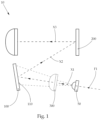
- Fig. 1 a schematic representation of an exemplary lighting device.
- Fig. 1 shows an exemplary lighting device 10 for a motor vehicle headlight, which lighting device 10 comprises a light source 50 for emitting a light beam in a first emission direction X1 , wherein the light source 50 is designed as a light-emitting diode or LED, and a first deflection device 100 with a deflection surface 110 , which is designed to deflect at least part of the light beam of the light source 50 in a second emission direction X2 .
- the lighting device 10 comprises a second deflection device 200 with a plurality of independently controllable and movable deflection elements for deflecting at least a portion of the light beam of the light beam deflected by the first deflection device 100 in a third radiation direction X3 and for generating a light distribution in front of the lighting device 10 .
- the second deflection device 200 is designed as a digital micromirror array (also called DMD) with a plurality of micromirrors arranged next to one another in an array and controllable individually or in groups.
- DMD digital micromirror array
- the lighting device 10 has an expansion optic 300 with a focal point F1 , which expansion optic 300 is assigned to the light source 50 and is configured to expand the light beam emitted by the light source 50 in the direction of the first emission direction X1 , wherein the light source 50 is arranged in the direction of the first emission direction X1 between the expansion optic 300 and the focal point F1 of the expansion optic 300 .
- expansion refers to an increase in the diameter of an optical beam to a certain size. Expansion can be achieved, for example, using various optical lens systems. In the example shown, however, it is a single expansion optic 300 or lens and not an optical system consisting of several lenses.
- the beam of rays emitted by the light source 50 which strikes the expansion optics 300 , has a certain beam diameter on the light entry side of the expansion optics 300 , wherein the beam diameter of the light beam has a larger beam diameter due to the expansion optics 300 after leaving the light exit side of the expansion optics 300 .
- the light source 50 is arranged between the expansion optics 300 and the focal point F1 of the expansion optics 300 , the light source 50 or the luminous surface of the light source 50 is virtually imaged behind the light source 50 against the first emission direction X1 or the main emission direction of the light source 50.
- the emitted light beam is enlarged at the first deflection device 100. This has the effect that a larger area of the first deflection device 100 can be irradiated, while at the same time minimizing the optical path between the light source 50 and the first deflection device 100 , i.e. overall the installation space of the lighting device 100 can be reduced.
- main radiation direction is understood to mean the direction in which the light source 50 emits the strongest or most light due to its directivity.
- the deflection surface 110 of the first deflection device 100 is designed as a hyperbolic, parabolic or ellipsoidal reflector. Furthermore, the first deflection device 100 focuses the light beam of the light source 50 onto a point, which point is located behind the second deflection device 200 in the direction of the second radiation direction X2 .
- Exactly two light sources can also be provided, with each light source being assigned exactly one expansion optic.
- lighting device 10 light source 50
- Second deflection device 200 expansion optics 300 focal point F1 First radiation direction X1 Second radiation direction X2 Third radiation direction X3
Landscapes
- Engineering & Computer Science (AREA)
- General Engineering & Computer Science (AREA)
- Chemical & Material Sciences (AREA)
- Crystallography & Structural Chemistry (AREA)
- Physics & Mathematics (AREA)
- Microelectronics & Electronic Packaging (AREA)
- Optics & Photonics (AREA)
- Non-Portable Lighting Devices Or Systems Thereof (AREA)
- Lighting Device Outwards From Vehicle And Optical Signal (AREA)
Description
- Die Erfindung betrifft eine Beleuchtungsvorrichtung für einen Kraftfahrzeugscheinwerfer, nach dem Oberbegriff des Anspruchs 1.
- Bei der Entwicklung der gegenwärtigen Scheinwerfersysteme steht immer mehr der Wunsch im Vordergrund, ein möglichst hochaufgelöstes Lichtbild auf die Fahrbahn projizieren zu können, welches schnell geändert und den jeweiligen Verkehrs-, Straßen- und Lichtbedingungen angepasst werden kann, wobei auch eine möglichst kompakte Bauform bzw. Baugröße gewünscht ist.
- Der Begriff "Fahrbahn" wird hier zur vereinfachten Darstellung verwendet, denn selbstverständlich hängt es von den örtlichen Gegebenheiten ab, ob sich ein Lichtbild tatsächlich auf der Fahrbahn befindet oder sich darüber hinaus erstreckt, beispielsweise auf den Fahrbahnrand.
- Prinzipiell wird das Lichtbild anhand einer Projektion auf eine vertikale Fläche entsprechend der einschlägigen Normen, die sich auf die KFZ-Beleuchtungstechnik beziehen, beschrieben, wobei eine variabel ansteuerbare Reflektorfläche aus einer Mehrzahl von Mikrospiegeln gebildet ist und von einem ersten Leuchtmittel emittierende Lichtstrahlen, in eine Abstrahlrichtung des Scheinwerfers reflektiert.
- Dabei sind beliebige Lichtfunktionen mit unterschiedlichen Lichtverteilungen realisierbar, wie beispielsweise eine Abblendlicht-Lichtverteilung, eine Abbiegelicht-Lichtverteilung, eine Stadtlicht-Lichtverteilung, eine Autobahnlicht-Lichtverteilung, eine Kurvenlicht-Lichtverteilung, eine Fernlicht-Lichtverteilung oder die Abbildung von blendfreiem Fernlicht. Weiters können auch Symbolprojektionen erfolgen, wie zum Beispiel Gefahrensymbole, Navigationspfeile, Herstellerlogos oder Ähnliches.
- Für die Mikrospiegelanordnung kommt vorzugsweise die sogenannte "Digital Light Processing"-Projektionstechnik - kurz DLP genannt - zum Einsatz, bei der Bilder dadurch erzeugt werden, dass ein digitales Bild auf einen Lichtstrahl aufmoduliert wird. Dabei wird durch eine rechteckige Anordnung von beweglichen Mikrospiegeln, auch als Pixel bezeichnet, der Lichtstrahl in Teilbereiche zerlegt und anschließend pixelweise entweder in den Projektionsweg hinein oder aus dem Projektionsweg hinaus reflektiert bzw. umgelenkt.
- Basis für diese Technik bildet vorzugsweise ein optoelektronisches Bauteil, das die rechteckige Anordnung in Form einer Matrix von Mikrospiegeln und deren Ansteuerungstechnik enthält, beispielsweise ein "Digital Micromirror Device" - kurz DMD genannt.
- Bei einem DMD-Mikrosystem handelt es sich um einen Flächenlichtmodulator (Spatial Light Modulator, SLM), der aus matrixförmig angeordneten Mikrospiegelaktoren, d.h. verkippbaren bzw. verschwenkbaren spiegelnden Flächen besteht, beispielsweise mit einer Kantenlänge von etwa 7 µm. Die Spiegelflächen sind derart konstruiert, dass sie durch die Einwirkung elektrostatischer Felder beweglich sind.
- Jeder Mikrospiegel ist im Winkel einzeln verstellbar und weist in der Regel zwei stabile Endzustände auf, zwischen denen beispielsweise innerhalb einer Sekunde bis zu 5000 Mal gewechselt werden kann.
- Die Anzahl der Mikrospiegel entspricht der Auflösung des projizierten Bildes, wobei ein Mikrospiegel ein oder mehrere Pixel darstellen kann. Mittlerweile sind DMD-Chips mit hohen Auflösungen im Megapixel-Bereich erhältlich.
- Bei derzeit eingesetzten Kraftfahrzeugscheinwerfern kann die erzeugte Lichtverteilung, beispielsweise für ein blendfreies Fernlicht, derart dynamisch gesteuert werden, dass entgegenkommende Fahrzeuge detektiert werden und die beispielsweise durch eine Matrix aus LED-Lichtquellen erzeugte Lichtverteilung in Richtung des entgegenkommenden Fahrzeuges abgedunkelt wird.
- Bei DMD-Beleuchtungen müssen immer plane Flächen ausgeleuchtet werden, wobei anders als bei Kino- oder Businessmeeting-Projektoren, bei welchen nach einer gleichmäßig bzw. homogenen Beleuchtung der gesamten DMD-Fläche gestrebt wird, versucht man bei Anwendungen im Automotive-Bereich die Beleuchtung der typischen Lichtverteilungen, beispielsweise eines Fernlichtes, anzupassen. In der Regel bedeutet dies ein Maximum an Helligkeit in der Mitte des DMD bzw. der beleuchteten DMD-Fläche mit einem Abfall der Beleuchtungsstärke zu den Rändern hin.
- Generell besteht im Bereich hochauflösender Lichtsysteme, insbesondere im Bereich der DMD-Technologie, das Problem, dass aufgrund von Beschränkungen durch die Lichtquelle, die für die Beleuchtung des DMD verwendet werden kann, keine vollfunktionale Lichtfunktion zu erwarten ist. Insbesondere ein vollfunktionales Fernlicht mit einem hohen Maximum (größer als 100 lx) und einer Breite von +/- 20° (gemessen nach einem ECE-Messschirm) kann nicht erzielt werden. Die durch ein DMD bzw. DLP-Modul erzeugbare Fernlichtverteilung ist relativ schmal mit maximal zu erwartenden Breiten von +/- 10°. Beleuchtungsvorrichtungen sind aus den
DE 10 2015 221049 A1 ,US 2018/031202 A1 ,DE 10 2018 204282 A1 oderDE 10 2014 013202 B3 bekannt. - Aus diesem Grund müssen weitere Zusatzmodule hinzugefügt werden, welche die volle Breite des Fernlichts bzw. der Fernlichtverteilung erzeugen, wobei diese Zusatzmodule typischerweise irgendwo im Scheinwerfer platziert werden müssen und bezüglich des Designs und des weggenommenen Bauraums im Kraftfahrzeugscheinwerfer unerwünscht sind.
- Es ist eine Aufgabe der Erfindung eine verbesserte Beleuchtungsvorrichtung bereitzustellen.
- Diese Aufgabe wird dadurch gelöst, dass die Beleuchtungsvorrichtung zumindest zwei Aufweitungsoptiken mit einem Brennpunkt umfassen, vorzugsweise genau zwei Aufweitungsoptiken, wobei jeder Lichtquelle genau eine Aufweitungsoptik zugeordnet ist, welche eingerichtet ist, das von der Lichtquelle emittierte Lichtbündel in Richtung der ersten Abstrahlrichtung aufzuweiten, wobei die aufgeweiteten Lichtbündel teilweise überlappen, und wobei die zumindest zwei Lichtquellen in Richtung der ersten Abstrahlrichtung zwischen der zumindest einen Aufweitungsoptik und dem Brennpunkt der Aufweitungsoptik angeordnet sind.
- Unter dem Begriff "Aufweitung" bzw. "aufweiten" wird eine Vergrößerung eines optischen Strahldurchmessers auf eine bestimmte Größe verstanden. Eine Aufweitung kann durch verschiedene optische Linsensysteme erreicht werden. Dies ist jedoch einem Fachmann bekannt und ist hier nur der Vollständigkeit halber nochmals festgehalten.
- Dadurch dass die zumindest eine Lichtquelle zwischen der Aufweitungsoptik und dem Brennpunkt der Aufweitungsoptik angeordnet ist, wird die Lichtquelle bzw. die Leuchtfläche der Lichtquelle entgegen der ersten Abstrahlrichtung bzw. der Hauptabstrahlrichtung der Lichtquelle hinter die Lichtquelle virtuell abgebildet. Durch das virtuelle Abbilden der Lichtquelle wird das abgestrahlte Lichtbündel an der ersten Umlenkeinrichtung vergrößert. Dies hat den Effekt, dass eine größere Fläche der ersten Umlenkeinrichtung bestrahlt werden kann, bei gleichzeitiger Minimierung der optischen Wegstrecke zwischen Lichtquelle und erster Umlenkeinrichtung, d.h. insgesamt kann der Bauraum der Beleuchtungsvorrichtung verringert werden.
- Unter "Hauptabstrahlrichtung" ist die Richtung zu verstehen, in der die zumindest eine Lichtquelle infolge ihrer Richtwirkung am stärksten bzw. am meisten Licht abstrahlt.
- Es kann vorgesehen sein, dass die zweite Umlenkeinrichtung als digitales Mikrospiegelarray mit einer Vielzahl von arrayartig nebeneinander angeordneten, einzeln oder gruppenweise ansteuerbaren Mikrospiegeln ausgebildet ist.
- Vorteilhafterweise kann die zweite Umlenkeinrichtung als DMD ausgebildet sein.
- Bei Verwendung eines DMD sollte darauf geachtet werden mit sehr kleinen Lichteintrittswinkelbereichen zu arbeiten, d.h. treffen Lichtstrahlen zu steil oder zu flach auf die Mikrospiegel des DMD kann dies zu einem Hinterleuchten der Mikrospiegel führen, was wiederum zu Streulicht im projizierenden Lichtbild und somit zu einem schlechten Hell-Dunkel Kontrast führt, welcher bei Verwendung für einen Kraftfahrzeugscheinwerfer äußert wichtig ist.
- Jeder Mikrospiegel lässt sich in seinem Winkel einzeln verstellen und besitzt in der Regel zwei stabile Endzustände, zwischen denen er verkippt werden kann.
- Durch gezieltes Bewegen von einzelnen oder einer Gruppe von ausgewählten Umlenkelementen kann die Form der Abstrahllichtverteilung der Beleuchtungsvorrichtung aber auch die Lichtstärkeverteilung innerhalb der Abstrahllichtverteilung variiert werden. Die Abstrahllichtverteilung ist somit sowohl hinsichtlich ihrer Form (Ausdehnung und/oder Erstreckung) als auch hinsichtlich ihrer Helligkeitsverteilung dynamisch veränderbar. Die Ansteuerung der Umlenkelemente, und damit die Variation der Abstrahllichtverteilung, kann in Abhängigkeit von Betriebsparametern des Kraftfahrzeugs (z.B. FahrzeugGeschwindigkeit, Beladung, Lenkwinkel, Querbeschleunigung, etc.) erfolgen. Bei der Ansteuerung der Umlenkelemente können auch Umgebungsparameter des Fahrzeugs (z.B. Außentemperatur, Niederschlag, detektierte andere Verkehrsteilnehmer im Umfeld des Fahrzeugs, etc.) berücksichtigt werden.
- Es ist vorgesehen, dass die zumindest zwei Lichtquellen jeweils als zumindest eine Leuchtdiode ausgebildet sind.
- Die Beleuchtungsvorrichtung umfasst zumindest zwei Lichtquellen, vorzugsweise genau zwei Lichtquellen.
- Bei der erfindungsgemäßen Verwendung von zwei Lichtquellen mit je einer Aufweitungsoptik werden die jeweils aufgeweiteten Lichtbündel teilweise überlappt angeordnet.
- Mit der Vergrößerung der Lichtbündel kann man die gewünschte Überschneidung einstellen und somit die Mitte der zweiten Umlenkeinrichtung mit einer stärkeren Helligkeit bestrahlen.
- Es ist vorgesehen, dass die Beleuchtungsvorrichtung zumindest zwei Aufweitungsoptiken, vorzugsweise genau zwei Aufweitungsoptiken, umfasst, wobei jeder Lichtquelle genau eine Aufweitungsoptik zugeordnet ist.
- Es kann vorgesehen sein, dass die erste Abstrahlrichtung parallel zur dritten Abstrahlrichtung ist.
- Es ist vorgesehen, dass die Umlenkfläche der ersten Umlenkeinrichtung als hyperbolischer, parabolischer oder als ellipsoider Reflektor ausgebildet ist.
- Es kann vorgesehen sein, dass die erste Umlenkeinrichtung das Lichtbündel der zumindest einen Lichtquelle auf einen Punkt bündelt, welcher sich in Richtung der zweiten Abstrahlrichtung hinter der zweiten Umlenkeinrichtung befindet.
- Die Aufgabe wird ebenso gelöst durch einen Kraftfahrzeugscheinwerfer mit zumindest einer erfindungsgemäßen Beleuchtungsvorrichtung.
- Nachfolgend wird die Erfindung anhand von beispielhaften Zeichnungen näher erläutert.
-
Fig. 1 eine schematische Darstellung einer beispielhaften Beleuchtungsvorrichtung. -
Fig. 1 zeigt eine beispielhafte Beleuchtungsvorrichtung 10 für einen Kraftfahrzeugscheinwerfer, welche Beleuchtungsvorrichtung 10 eine Lichtquelle 50 zur Ausstrahlung eines Lichtbündels in eine erste Abstrahlrichtung X1, wobei die Lichtquelle 50 als Leuchtdiode bzw. LED ausgebildet ist, und eine erste Umlenkeinrichtung 100 mit einer Umlenkfläche 110, welche dazu eingerichtet ist, zumindest einen Teil des Lichtbündels der Lichtquelle 50 in eine zweite Abstrahlrichtung X2 umzulenken umfasst. - Ferner umfasst die Beleuchtungsvorrichtung 10 eine zweite Umlenkeinrichtung 200 mit einer Vielzahl von unabhängig voneinander ansteuerbaren und bewegbaren Umlenkelementen zum Umlenken zumindest eines Teils des Lichtbündels des von der ersten Umlenkeinrichtung 100 umgelenkten Lichtbündels in eine dritte Abstrahlrichtung X3 und zur Erzeugung einer Lichtverteilung vor die Beleuchtungsvorrichtung 10.
- Die zweite Umlenkeinrichtung 200 ist in dem gezeigten Beispiel als digitales Mikrospiegelarray (auch DMD genannt) mit einer Vielzahl von arrayartig nebeneinander angeordneten, einzeln oder gruppenweise ansteuerbaren Mikrospiegeln ausgebildet.
- Ferner weist die Beleuchtungsvorrichtung 10 eine Aufweitungsoptik 300 mit einem Brennpunkt F1 auf, welche Aufweitungsoptik 300 der Lichtquelle 50 zugeordnet ist und eingerichtet ist, das von der Lichtquelle 50 emittierte Lichtbündel in Richtung der ersten Abstrahlrichtung X1 aufzuweiten, wobei die Lichtquelle 50 in Richtung der ersten Abstrahlrichtung X1 zwischen der Aufweitungsoptik 300 und dem Brennpunkt F1 der Aufweitungsoptik 300 angeordnet ist.
- Unter dem Begriff "Aufweitung" bzw. "aufweiten" wird eine Vergrößerung eines optischen Strahldurchmessers auf eine bestimmte Größe verstanden. Eine Aufweitung kann beispielsweise durch verschiedene optische Linsensysteme erreicht werden. In dem gezeigten Beispiel handelt es sich jedoch um eine einzige Aufweitungsoptik 300 bzw. Linse und nicht um ein optisches System, welches aus mehreren Linsen besteht.
- Das heißt, dass das von der Lichtquelle 50 abgestrahlte Strahlenbündel, welches auf die Aufweitungsoptik 300 trifft, auf der Lichteintrittsseite der Aufweitungsoptik 300 einen bestimmten Strahldurchmesser aufweist, wobei der Strahldurchmesser des Lichtbündels aufgrund der Aufweitungsoptik 300 nach Verlassen der Lichtaustrittsseite der Aufweitungsoptik 300 einen größeren Strahldurchmesser besitzt.
- Dadurch dass die Lichtquelle 50 zwischen der Aufweitungsoptik 300 und dem Brennpunkt F1 der Aufweitungsoptik 300 angeordnet ist, wird die Lichtquelle 50 bzw. die Leuchtfläche der Lichtquelle 50 entgegen der ersten Abstrahlrichtung X1 bzw. der Hauptabstrahlrichtung der Lichtquelle 50 hinter die Lichtquelle 50 virtuell abgebildet. Durch das virtuelle Abbilden der Lichtquelle 50 wird das abgestrahlte Lichtbündel an der ersten Umlenkeinrichtung 100 vergrößert. Dies hat den Effekt, dass eine größere Fläche der ersten Umlenkeinrichtung 100 bestrahlt werden kann, bei gleichzeitiger Minimierung der optischen Wegstrecke zwischen Lichtquelle 50 und erster Umlenkeinrichtung 100, d.h. insgesamt kann der Bauraum der Beleuchtungsvorrichtung 100 verringert werden.
- Unter "Hauptabstrahlrichtung" ist die Richtung zu verstehen, in der die eine Lichtquelle 50 infolge ihrer Richtwirkung am stärksten bzw. am meisten Licht abstrahlt.
- Es ist vorgesehen, dass die Umlenkfläche 110 der ersten Umlenkeinrichtung 100 als hyperbolischer, parabolischer oder als ellipsoider Reflektor ausgebildet ist. Ferner kann die erste Umlenkeinrichtung 100 das Lichtbündel der Lichtquelle 50 auf einen Punkt bündeln, welcher Punkt sich in Richtung der zweiten Abstrahlrichtung X2 hinter der zweiten Umlenkeinrichtung 200 befindet.
- Als Weiterbildung der beispielhaften Beleuchtungsvorrichtung in
Fig. 1 können auch genau zwei Lichtquellen vorgesehen sein, wobei jeder Lichtquelle genau eine Aufweitungsoptik zugeordnet ist. -
Beleuchtungsvorrichtung 10 Lichtquelle 50 Erste Umlenkeinrichtung 100 Umlenkfläche 110 Zweite Umlenkeinrichtung 200 Aufweitungsoptik 300 Brennpunkt F1 Erste Abstrahlrichtung X1 Zweite Abstrahlrichtung X2 Dritte Abstrahlrichtung X3
Claims (5)
- Beleuchtungsvorrichtung (10) für einen Kraftfahrzeugscheinwerfer, welche Beleuchtungsvorrichtung Folgendes umfasst:- zumindest zwei Lichtquellen (50) zur Ausstrahlung zumindest zweier Lichtbündel in eine erste Abstrahlrichtung (X1), vorzugsweise genau zwei Lichtquellen (50), wobei die zumindest zwei Lichtquellen (50) jeweils als zumindest eine Leuchtdiode ausgebildet sind,- eine erste Umlenkeinrichtung (100) mit einer Umlenkfläche (110), welche dazu eingerichtet ist, zumindest einen Teil des jeweiligen Lichtbündels jeder der zumindest zwei Lichtquellen (50) in eine zweite Abstrahlrichtung (X2) umzulenken, wobei die Umlenkfläche (110) der ersten Umlenkeinrichtung (100) als hyperbolischer, parabolischer oder als ellipsoider Reflektor ausgebildet ist, und- eine zweite Umlenkeinrichtung (200) mit einer Vielzahl von unabhängig voneinander ansteuerbaren und bewegbaren Umlenkelementen zum Umlenken zumindest eines Teils des Lichtbündels des von der ersten Umlenkeinrichtung (100) umgelenkten Lichtbündels in eine dritte Abstrahlrichtung (X3) und zur Erzeugung einer Lichtverteilung vor die Beleuchtungsvorrichtung (10),dadurch gekennzeichnet, dass
die Beleuchtungsvorrichtung zumindest zwei Aufweitungsoptiken (300) mit einem Brennpunkt (F1) umfassen, vorzugsweise genau zwei Aufweitungsoptiken (300), wobei jeder Lichtquelle (50) genau eine Aufweitungsoptik (300) zugeordnet ist, welche eingerichtet ist, das von der Lichtquelle (50) emittierte Lichtbündel in Richtung der ersten Abstrahlrichtung (X1) aufzuweiten, wobei die aufgeweiteten Lichtbündel teilweise überlappen, und wobei die zumindest zwei Lichtquellen (50) in Richtung der ersten Abstrahlrichtung (X1) zwischen der zumindest einen Aufweitungsoptik (300) und dem Brennpunkt (F1) der Aufweitungsoptik (300) angeordnet sind. - Beleuchtungsvorrichtung nach Anspruch 1, dadurch gekennzeichnet, dass die zweite Umlenkeinrichtung (200) als digitales Mikrospiegelarray mit einer Vielzahl von arrayartig nebeneinander angeordneten, einzeln oder gruppenweise ansteuerbaren Mikrospiegeln ausgebildet ist.
- Beleuchtungsvorrichtung nach einem der Ansprüche 1 oder 2, dadurch gekennzeichnet, dass die erste Abstrahlrichtung (X1) parallel zur dritten Abstrahlrichtung (X3) ist.
- Beleuchtungsvorrichtung nach einem der Ansprüche 1 bis 3, dadurch gekennzeichnet, dass die erste Umlenkeinrichtung (100) das Lichtbündel der zumindest einen Lichtquelle (50) auf einen Punkt bündelt, welcher sich in Richtung der zweiten Abstrahlrichtung (X2) hinter der zweiten Umlenkeinrichtung (200) befindet.
- Kraftfahrzeugscheinwerfer mit zumindest einer Beleuchtungsvorrichtung nach einem der Ansprüche 1 bis 4.
Applications Claiming Priority (2)
| Application Number | Priority Date | Filing Date | Title |
|---|---|---|---|
| EP19208028.1A EP3819534A1 (de) | 2019-11-08 | 2019-11-08 | Beleuchtungsvorrichtung für einen kraftfahrzeugscheinwerfer |
| PCT/EP2020/079705 WO2021089332A1 (de) | 2019-11-08 | 2020-10-22 | Beleuchtungsvorrichtung für einen kraftfahrzeugscheinwerfer |
Publications (2)
| Publication Number | Publication Date |
|---|---|
| EP4055320A1 EP4055320A1 (de) | 2022-09-14 |
| EP4055320B1 true EP4055320B1 (de) | 2024-12-04 |
Family
ID=68501447
Family Applications (2)
| Application Number | Title | Priority Date | Filing Date |
|---|---|---|---|
| EP19208028.1A Withdrawn EP3819534A1 (de) | 2019-11-08 | 2019-11-08 | Beleuchtungsvorrichtung für einen kraftfahrzeugscheinwerfer |
| EP20824080.4A Active EP4055320B1 (de) | 2019-11-08 | 2020-10-22 | Beleuchtungsvorrichtung für einen kraftfahrzeugscheinwerfer |
Family Applications Before (1)
| Application Number | Title | Priority Date | Filing Date |
|---|---|---|---|
| EP19208028.1A Withdrawn EP3819534A1 (de) | 2019-11-08 | 2019-11-08 | Beleuchtungsvorrichtung für einen kraftfahrzeugscheinwerfer |
Country Status (6)
| Country | Link |
|---|---|
| US (1) | US11774058B2 (de) |
| EP (2) | EP3819534A1 (de) |
| JP (1) | JP7383813B2 (de) |
| KR (1) | KR102749273B1 (de) |
| CN (1) | CN114641651A (de) |
| WO (1) | WO2021089332A1 (de) |
Families Citing this family (2)
| Publication number | Priority date | Publication date | Assignee | Title |
|---|---|---|---|---|
| CN118575473B (zh) * | 2022-03-09 | 2025-11-07 | 青岛海信激光显示股份有限公司 | 图像显示方法、装置、激光投影设备及存储介质 |
| CN119508761A (zh) * | 2025-01-20 | 2025-02-25 | 深圳拜波赫技术有限公司 | 智能车灯和车辆 |
Citations (1)
| Publication number | Priority date | Publication date | Assignee | Title |
|---|---|---|---|---|
| WO2017020055A1 (de) * | 2015-08-03 | 2017-02-09 | Zkw Group Gmbh | Verfahren zum ansteuern einer laserbeleuchtungsvorrichtung für einen fahrzeugscheinwerfer |
Family Cites Families (16)
| Publication number | Priority date | Publication date | Assignee | Title |
|---|---|---|---|---|
| DE102012214138B4 (de) * | 2012-08-09 | 2021-01-28 | Automotive Lighting Reutlingen Gmbh | Lichtmodul einer Kfz-Beleuchtungseinrichtung mit Linsenelement und Reflektor |
| JP5948194B2 (ja) * | 2012-09-13 | 2016-07-06 | 株式会社小糸製作所 | 車両用灯具の制御方法および車両用灯具 |
| DE102012220472A1 (de) * | 2012-11-09 | 2014-05-15 | Automotive Lighting Reutlingen Gmbh | Kfz.-Beleuchtungsvorrichtung |
| DE102014203335A1 (de) * | 2014-02-25 | 2015-08-27 | Automotive Lighting Reutlingen Gmbh | Lichtmodul eines Kraftfahrzeugscheinwerfers und Scheinwerfer mit einem solchen Lichtmodul |
| DE102014013202B3 (de) | 2014-09-06 | 2016-02-04 | Audi Ag | Scheinwerfer für einen Kraftwagen sowie ein Kraftwagen |
| KR101755841B1 (ko) * | 2015-09-11 | 2017-07-10 | 현대자동차주식회사 | 차량용 램프 장치 |
| DE102015221049A1 (de) * | 2015-10-28 | 2017-05-04 | Osram Gmbh | Fahrzeug-Beleuchtungsvorrichtung |
| JP6746896B2 (ja) * | 2015-11-10 | 2020-08-26 | 市光工業株式会社 | 車両用灯具 |
| US10180224B2 (en) * | 2016-07-26 | 2019-01-15 | Texas Instruments Incorporated | Quasi-sparse optical illumination |
| AT519055B1 (de) * | 2016-09-08 | 2018-06-15 | Zkw Group Gmbh | Fahrzeugscheinwerfer |
| AT519118B1 (de) * | 2016-11-24 | 2018-04-15 | Zkw Group Gmbh | Scheinwerfermodul für Fahrzeuge |
| DE102017207350B4 (de) | 2017-05-02 | 2019-05-09 | Volkswagen Aktiengesellschaft | Scheinwerfersystem für ein Kraftfahrzeug |
| FR3072531B1 (fr) | 2017-10-13 | 2021-01-29 | Valeo Vision | Procede et systeme ajustant selectivement des pixels, dans un module optique, pour rattraper des defauts geometriques dus aux tolerances de fabrication |
| JP6932610B2 (ja) * | 2017-10-19 | 2021-09-08 | 株式会社小糸製作所 | 車両用灯具システム、車両用灯具の制御装置および車両用灯具の制御方法 |
| DE102018204282A1 (de) * | 2018-03-20 | 2019-09-26 | Osram Gmbh | Beleuchtungsvorrichtung |
| DE102018107678A1 (de) * | 2018-03-29 | 2019-10-02 | Automotive Lighting Reutlingen Gmbh | Mikrospiegel aufweisendes Lichtmodul für einen Kraftfahrzeugscheinwerfer |
-
2019
- 2019-11-08 EP EP19208028.1A patent/EP3819534A1/de not_active Withdrawn
-
2020
- 2020-10-22 KR KR1020227010563A patent/KR102749273B1/ko active Active
- 2020-10-22 CN CN202080077222.7A patent/CN114641651A/zh active Pending
- 2020-10-22 EP EP20824080.4A patent/EP4055320B1/de active Active
- 2020-10-22 WO PCT/EP2020/079705 patent/WO2021089332A1/de not_active Ceased
- 2020-10-22 US US17/771,713 patent/US11774058B2/en active Active
- 2020-10-22 JP JP2022526043A patent/JP7383813B2/ja active Active
Patent Citations (1)
| Publication number | Priority date | Publication date | Assignee | Title |
|---|---|---|---|---|
| WO2017020055A1 (de) * | 2015-08-03 | 2017-02-09 | Zkw Group Gmbh | Verfahren zum ansteuern einer laserbeleuchtungsvorrichtung für einen fahrzeugscheinwerfer |
Also Published As
| Publication number | Publication date |
|---|---|
| JP7383813B2 (ja) | 2023-11-20 |
| WO2021089332A1 (de) | 2021-05-14 |
| JP2023501350A (ja) | 2023-01-18 |
| US20220373150A1 (en) | 2022-11-24 |
| EP4055320A1 (de) | 2022-09-14 |
| US11774058B2 (en) | 2023-10-03 |
| KR20220051394A (ko) | 2022-04-26 |
| CN114641651A (zh) | 2022-06-17 |
| KR102749273B1 (ko) | 2025-01-03 |
| EP3819534A1 (de) | 2021-05-12 |
Similar Documents
| Publication | Publication Date | Title |
|---|---|---|
| EP3379142B9 (de) | Lichtmodul für einen kraftfahrzeugscheinwerfer und scheinwerfer mit einem solchen lichtmodul | |
| DE102017129254B4 (de) | Fahrzeugscheinwerfer | |
| EP3543593B1 (de) | Beleuchtungsvorrichtung für einen kraftfahrzeugscheinwerfer | |
| EP3420269B1 (de) | Scheinwerfer für fahrzeuge | |
| AT519055B1 (de) | Fahrzeugscheinwerfer | |
| DE102008013603B4 (de) | Lichtmodul für eine Beleuchtungseinrichtung | |
| EP2934945B1 (de) | Beleuchtungsvorrichtung für ein kraftfahrzeug | |
| DE102018008760B4 (de) | Fahrzeugscheinwerfer mit einer Lichtquelle | |
| EP3092438B1 (de) | Leuchtvorrichtung mit mikrospiegeln für ein kraftfahrzeug und verfahren zur steuerung der leuchtvorrichtung | |
| DE102015222188B3 (de) | Lichtmodul für einen Fahrzeugscheinwerfer und Kraftfahrzeugscheinwerfer mit einem solchen Lichtmodul | |
| EP3755579B1 (de) | Lichtmodul für einen kraftfahrzeugscheinwerfer | |
| DE102016111578A1 (de) | Scheinwerfer für Fahrzeuge, insbesondere für einspurige Kraftfahrzeuge | |
| EP2984396A2 (de) | Leuchteinheit mit blende mit zumindest einem lichtfenster | |
| EP3203140A1 (de) | Beleuchtungseinrichtung für ein fahrzeug und zugehöriges betriebsverfahren | |
| EP4055320B1 (de) | Beleuchtungsvorrichtung für einen kraftfahrzeugscheinwerfer | |
| DE102017223441A1 (de) | Lichtsteuerungsvorrichtung zur Einteilung einer Lichtverteilung | |
| EP3757451B1 (de) | Beleuchtungsvorrichtung für ein kraftfahrzeug | |
| EP3914857B1 (de) | Beleuchtungsvorrichtung für einen kraftfahrzeugscheinwerfer | |
| EP3650744B1 (de) | Kraftfahrzeugscheinwerferlichtmodul | |
| WO2025209846A1 (de) | Lichtmodul, insbesondere für eine kraftfahrzeug-beleuchtungseinrichtung, und verfahren zu dessen betrieb | |
| DE102019125971A1 (de) | Kraftfahrzeugscheinwerfer mit einem Lichtmodul und breit ausgeleuchteter Lichtaustrittslinse |
Legal Events
| Date | Code | Title | Description |
|---|---|---|---|
| STAA | Information on the status of an ep patent application or granted ep patent |
Free format text: STATUS: UNKNOWN |
|
| STAA | Information on the status of an ep patent application or granted ep patent |
Free format text: STATUS: THE INTERNATIONAL PUBLICATION HAS BEEN MADE |
|
| PUAI | Public reference made under article 153(3) epc to a published international application that has entered the european phase |
Free format text: ORIGINAL CODE: 0009012 |
|
| STAA | Information on the status of an ep patent application or granted ep patent |
Free format text: STATUS: REQUEST FOR EXAMINATION WAS MADE |
|
| 17P | Request for examination filed |
Effective date: 20220315 |
|
| AK | Designated contracting states |
Kind code of ref document: A1 Designated state(s): AL AT BE BG CH CY CZ DE DK EE ES FI FR GB GR HR HU IE IS IT LI LT LU LV MC MK MT NL NO PL PT RO RS SE SI SK SM TR |
|
| DAV | Request for validation of the european patent (deleted) | ||
| DAX | Request for extension of the european patent (deleted) | ||
| REG | Reference to a national code |
Ref country code: DE Free format text: PREVIOUS MAIN CLASS: F21S0041200000 Ref country code: DE Ref legal event code: R079 Ref document number: 502020009918 Country of ref document: DE Free format text: PREVIOUS MAIN CLASS: F21S0041200000 Ipc: F21S0041365000 |
|
| RIC1 | Information provided on ipc code assigned before grant |
Ipc: F21S 41/32 20180101ALI20240502BHEP Ipc: F21S 41/147 20180101ALI20240502BHEP Ipc: F21S 41/20 20180101ALI20240502BHEP Ipc: F21S 41/675 20180101ALI20240502BHEP Ipc: F21S 41/365 20180101AFI20240502BHEP |
|
| GRAP | Despatch of communication of intention to grant a patent |
Free format text: ORIGINAL CODE: EPIDOSNIGR1 |
|
| STAA | Information on the status of an ep patent application or granted ep patent |
Free format text: STATUS: GRANT OF PATENT IS INTENDED |
|
| GRAJ | Information related to disapproval of communication of intention to grant by the applicant or resumption of examination proceedings by the epo deleted |
Free format text: ORIGINAL CODE: EPIDOSDIGR1 |
|
| STAA | Information on the status of an ep patent application or granted ep patent |
Free format text: STATUS: REQUEST FOR EXAMINATION WAS MADE |
|
| INTG | Intention to grant announced |
Effective date: 20240620 |
|
| INTC | Intention to grant announced (deleted) | ||
| RIN1 | Information on inventor provided before grant (corrected) |
Inventor name: PUERSTINGER, JOSEF Inventor name: PUEHRINGER, JAKOB Inventor name: KNOBLOCH, CHRISTIAN Inventor name: PLANK, JOSEF Inventor name: DANNER, MARKUS Inventor name: REISINGER, BETTINA |
|
| GRAP | Despatch of communication of intention to grant a patent |
Free format text: ORIGINAL CODE: EPIDOSNIGR1 |
|
| STAA | Information on the status of an ep patent application or granted ep patent |
Free format text: STATUS: GRANT OF PATENT IS INTENDED |
|
| GRAS | Grant fee paid |
Free format text: ORIGINAL CODE: EPIDOSNIGR3 |
|
| INTG | Intention to grant announced |
Effective date: 20240905 |
|
| GRAA | (expected) grant |
Free format text: ORIGINAL CODE: 0009210 |
|
| STAA | Information on the status of an ep patent application or granted ep patent |
Free format text: STATUS: THE PATENT HAS BEEN GRANTED |
|
| AK | Designated contracting states |
Kind code of ref document: B1 Designated state(s): AL AT BE BG CH CY CZ DE DK EE ES FI FR GB GR HR HU IE IS IT LI LT LU LV MC MK MT NL NO PL PT RO RS SE SI SK SM TR |
|
| REG | Reference to a national code |
Ref country code: CH Ref legal event code: EP |
|
| REG | Reference to a national code |
Ref country code: DE Ref legal event code: R096 Ref document number: 502020009918 Country of ref document: DE |
|
| REG | Reference to a national code |
Ref country code: IE Ref legal event code: FG4D Free format text: LANGUAGE OF EP DOCUMENT: GERMAN |
|
| P01 | Opt-out of the competence of the unified patent court (upc) registered |
Free format text: CASE NUMBER: APP_5241/2025 Effective date: 20250131 |
|
| REG | Reference to a national code |
Ref country code: LT Ref legal event code: MG9D |
|
| REG | Reference to a national code |
Ref country code: NL Ref legal event code: MP Effective date: 20241204 |
|
| PG25 | Lapsed in a contracting state [announced via postgrant information from national office to epo] |
Ref country code: HR Free format text: LAPSE BECAUSE OF FAILURE TO SUBMIT A TRANSLATION OF THE DESCRIPTION OR TO PAY THE FEE WITHIN THE PRESCRIBED TIME-LIMIT Effective date: 20241204 |
|
| PG25 | Lapsed in a contracting state [announced via postgrant information from national office to epo] |
Ref country code: FI Free format text: LAPSE BECAUSE OF FAILURE TO SUBMIT A TRANSLATION OF THE DESCRIPTION OR TO PAY THE FEE WITHIN THE PRESCRIBED TIME-LIMIT Effective date: 20241204 |
|
| PG25 | Lapsed in a contracting state [announced via postgrant information from national office to epo] |
Ref country code: BG Free format text: LAPSE BECAUSE OF FAILURE TO SUBMIT A TRANSLATION OF THE DESCRIPTION OR TO PAY THE FEE WITHIN THE PRESCRIBED TIME-LIMIT Effective date: 20241204 |
|
| PG25 | Lapsed in a contracting state [announced via postgrant information from national office to epo] |
Ref country code: ES Free format text: LAPSE BECAUSE OF FAILURE TO SUBMIT A TRANSLATION OF THE DESCRIPTION OR TO PAY THE FEE WITHIN THE PRESCRIBED TIME-LIMIT Effective date: 20241204 |
|
| PG25 | Lapsed in a contracting state [announced via postgrant information from national office to epo] |
Ref country code: NO Free format text: LAPSE BECAUSE OF FAILURE TO SUBMIT A TRANSLATION OF THE DESCRIPTION OR TO PAY THE FEE WITHIN THE PRESCRIBED TIME-LIMIT Effective date: 20250304 |
|
| PG25 | Lapsed in a contracting state [announced via postgrant information from national office to epo] |
Ref country code: LV Free format text: LAPSE BECAUSE OF FAILURE TO SUBMIT A TRANSLATION OF THE DESCRIPTION OR TO PAY THE FEE WITHIN THE PRESCRIBED TIME-LIMIT Effective date: 20241204 Ref country code: GR Free format text: LAPSE BECAUSE OF FAILURE TO SUBMIT A TRANSLATION OF THE DESCRIPTION OR TO PAY THE FEE WITHIN THE PRESCRIBED TIME-LIMIT Effective date: 20250305 |
|
| PG25 | Lapsed in a contracting state [announced via postgrant information from national office to epo] |
Ref country code: RS Free format text: LAPSE BECAUSE OF FAILURE TO SUBMIT A TRANSLATION OF THE DESCRIPTION OR TO PAY THE FEE WITHIN THE PRESCRIBED TIME-LIMIT Effective date: 20250304 |
|
| PG25 | Lapsed in a contracting state [announced via postgrant information from national office to epo] |
Ref country code: NL Free format text: LAPSE BECAUSE OF FAILURE TO SUBMIT A TRANSLATION OF THE DESCRIPTION OR TO PAY THE FEE WITHIN THE PRESCRIBED TIME-LIMIT Effective date: 20241204 |
|
| PG25 | Lapsed in a contracting state [announced via postgrant information from national office to epo] |
Ref country code: SM Free format text: LAPSE BECAUSE OF FAILURE TO SUBMIT A TRANSLATION OF THE DESCRIPTION OR TO PAY THE FEE WITHIN THE PRESCRIBED TIME-LIMIT Effective date: 20241204 |
|
| PG25 | Lapsed in a contracting state [announced via postgrant information from national office to epo] |
Ref country code: PL Free format text: LAPSE BECAUSE OF FAILURE TO SUBMIT A TRANSLATION OF THE DESCRIPTION OR TO PAY THE FEE WITHIN THE PRESCRIBED TIME-LIMIT Effective date: 20241204 |
|
| PG25 | Lapsed in a contracting state [announced via postgrant information from national office to epo] |
Ref country code: IS Free format text: LAPSE BECAUSE OF FAILURE TO SUBMIT A TRANSLATION OF THE DESCRIPTION OR TO PAY THE FEE WITHIN THE PRESCRIBED TIME-LIMIT Effective date: 20250404 |
|
| PG25 | Lapsed in a contracting state [announced via postgrant information from national office to epo] |
Ref country code: PT Free format text: LAPSE BECAUSE OF FAILURE TO SUBMIT A TRANSLATION OF THE DESCRIPTION OR TO PAY THE FEE WITHIN THE PRESCRIBED TIME-LIMIT Effective date: 20250404 |
|
| PG25 | Lapsed in a contracting state [announced via postgrant information from national office to epo] |
Ref country code: EE Free format text: LAPSE BECAUSE OF FAILURE TO SUBMIT A TRANSLATION OF THE DESCRIPTION OR TO PAY THE FEE WITHIN THE PRESCRIBED TIME-LIMIT Effective date: 20241204 |
|
| PG25 | Lapsed in a contracting state [announced via postgrant information from national office to epo] |
Ref country code: RO Free format text: LAPSE BECAUSE OF FAILURE TO SUBMIT A TRANSLATION OF THE DESCRIPTION OR TO PAY THE FEE WITHIN THE PRESCRIBED TIME-LIMIT Effective date: 20241204 |
|
| PG25 | Lapsed in a contracting state [announced via postgrant information from national office to epo] |
Ref country code: SK Free format text: LAPSE BECAUSE OF FAILURE TO SUBMIT A TRANSLATION OF THE DESCRIPTION OR TO PAY THE FEE WITHIN THE PRESCRIBED TIME-LIMIT Effective date: 20241204 |
|
| PG25 | Lapsed in a contracting state [announced via postgrant information from national office to epo] |
Ref country code: CZ Free format text: LAPSE BECAUSE OF FAILURE TO SUBMIT A TRANSLATION OF THE DESCRIPTION OR TO PAY THE FEE WITHIN THE PRESCRIBED TIME-LIMIT Effective date: 20241204 |
|
| PG25 | Lapsed in a contracting state [announced via postgrant information from national office to epo] |
Ref country code: IT Free format text: LAPSE BECAUSE OF FAILURE TO SUBMIT A TRANSLATION OF THE DESCRIPTION OR TO PAY THE FEE WITHIN THE PRESCRIBED TIME-LIMIT Effective date: 20241204 |
|
| REG | Reference to a national code |
Ref country code: DE Ref legal event code: R097 Ref document number: 502020009918 Country of ref document: DE |
|
| PG25 | Lapsed in a contracting state [announced via postgrant information from national office to epo] |
Ref country code: SE Free format text: LAPSE BECAUSE OF FAILURE TO SUBMIT A TRANSLATION OF THE DESCRIPTION OR TO PAY THE FEE WITHIN THE PRESCRIBED TIME-LIMIT Effective date: 20241204 |
|
| PG25 | Lapsed in a contracting state [announced via postgrant information from national office to epo] |
Ref country code: DK Free format text: LAPSE BECAUSE OF FAILURE TO SUBMIT A TRANSLATION OF THE DESCRIPTION OR TO PAY THE FEE WITHIN THE PRESCRIBED TIME-LIMIT Effective date: 20241204 |
|
| PLBE | No opposition filed within time limit |
Free format text: ORIGINAL CODE: 0009261 |
|
| STAA | Information on the status of an ep patent application or granted ep patent |
Free format text: STATUS: NO OPPOSITION FILED WITHIN TIME LIMIT |
|
| 26N | No opposition filed |
Effective date: 20250905 |
|
| PGFP | Annual fee paid to national office [announced via postgrant information from national office to epo] |
Ref country code: DE Payment date: 20251020 Year of fee payment: 6 |
|
| PGFP | Annual fee paid to national office [announced via postgrant information from national office to epo] |
Ref country code: GB Payment date: 20251024 Year of fee payment: 6 |
|
| PGFP | Annual fee paid to national office [announced via postgrant information from national office to epo] |
Ref country code: FR Payment date: 20251029 Year of fee payment: 6 |