EP4055826B1 - Dispositif et procédé de codage de données vidéo - Google Patents
Dispositif et procédé de codage de données vidéo Download PDFInfo
- Publication number
- EP4055826B1 EP4055826B1 EP20911086.5A EP20911086A EP4055826B1 EP 4055826 B1 EP4055826 B1 EP 4055826B1 EP 20911086 A EP20911086 A EP 20911086A EP 4055826 B1 EP4055826 B1 EP 4055826B1
- Authority
- EP
- European Patent Office
- Prior art keywords
- block
- value
- unit
- equal
- implementation
- Prior art date
- Legal status (The legal status is an assumption and is not a legal conclusion. Google has not performed a legal analysis and makes no representation as to the accuracy of the status listed.)
- Active
Links
Images


Classifications
-
- H—ELECTRICITY
- H04—ELECTRIC COMMUNICATION TECHNIQUE
- H04N—PICTORIAL COMMUNICATION, e.g. TELEVISION
- H04N19/00—Methods or arrangements for coding, decoding, compressing or decompressing digital video signals
- H04N19/10—Methods or arrangements for coding, decoding, compressing or decompressing digital video signals using adaptive coding
- H04N19/102—Methods or arrangements for coding, decoding, compressing or decompressing digital video signals using adaptive coding characterised by the element, parameter or selection affected or controlled by the adaptive coding
- H04N19/119—Adaptive subdivision aspects, e.g. subdivision of a picture into rectangular or non-rectangular coding blocks
-
- H—ELECTRICITY
- H04—ELECTRIC COMMUNICATION TECHNIQUE
- H04N—PICTORIAL COMMUNICATION, e.g. TELEVISION
- H04N19/00—Methods or arrangements for coding, decoding, compressing or decompressing digital video signals
- H04N19/10—Methods or arrangements for coding, decoding, compressing or decompressing digital video signals using adaptive coding
- H04N19/134—Methods or arrangements for coding, decoding, compressing or decompressing digital video signals using adaptive coding characterised by the element, parameter or criterion affecting or controlling the adaptive coding
-
- H—ELECTRICITY
- H04—ELECTRIC COMMUNICATION TECHNIQUE
- H04N—PICTORIAL COMMUNICATION, e.g. TELEVISION
- H04N19/00—Methods or arrangements for coding, decoding, compressing or decompressing digital video signals
- H04N19/10—Methods or arrangements for coding, decoding, compressing or decompressing digital video signals using adaptive coding
- H04N19/134—Methods or arrangements for coding, decoding, compressing or decompressing digital video signals using adaptive coding characterised by the element, parameter or criterion affecting or controlling the adaptive coding
- H04N19/157—Assigned coding mode, i.e. the coding mode being predefined or preselected to be further used for selection of another element or parameter
-
- H—ELECTRICITY
- H04—ELECTRIC COMMUNICATION TECHNIQUE
- H04N—PICTORIAL COMMUNICATION, e.g. TELEVISION
- H04N19/00—Methods or arrangements for coding, decoding, compressing or decompressing digital video signals
- H04N19/10—Methods or arrangements for coding, decoding, compressing or decompressing digital video signals using adaptive coding
- H04N19/169—Methods or arrangements for coding, decoding, compressing or decompressing digital video signals using adaptive coding characterised by the coding unit, i.e. the structural portion or semantic portion of the video signal being the object or the subject of the adaptive coding
- H04N19/17—Methods or arrangements for coding, decoding, compressing or decompressing digital video signals using adaptive coding characterised by the coding unit, i.e. the structural portion or semantic portion of the video signal being the object or the subject of the adaptive coding the unit being an image region, e.g. an object
- H04N19/176—Methods or arrangements for coding, decoding, compressing or decompressing digital video signals using adaptive coding characterised by the coding unit, i.e. the structural portion or semantic portion of the video signal being the object or the subject of the adaptive coding the unit being an image region, e.g. an object the region being a block, e.g. a macroblock
-
- H—ELECTRICITY
- H04—ELECTRIC COMMUNICATION TECHNIQUE
- H04N—PICTORIAL COMMUNICATION, e.g. TELEVISION
- H04N19/00—Methods or arrangements for coding, decoding, compressing or decompressing digital video signals
- H04N19/10—Methods or arrangements for coding, decoding, compressing or decompressing digital video signals using adaptive coding
- H04N19/169—Methods or arrangements for coding, decoding, compressing or decompressing digital video signals using adaptive coding characterised by the coding unit, i.e. the structural portion or semantic portion of the video signal being the object or the subject of the adaptive coding
- H04N19/184—Methods or arrangements for coding, decoding, compressing or decompressing digital video signals using adaptive coding characterised by the coding unit, i.e. the structural portion or semantic portion of the video signal being the object or the subject of the adaptive coding the unit being bits, e.g. of the compressed video stream
-
- H—ELECTRICITY
- H04—ELECTRIC COMMUNICATION TECHNIQUE
- H04N—PICTORIAL COMMUNICATION, e.g. TELEVISION
- H04N19/00—Methods or arrangements for coding, decoding, compressing or decompressing digital video signals
- H04N19/46—Embedding additional information in the video signal during the compression process
- H04N19/463—Embedding additional information in the video signal during the compression process by compressing encoding parameters before transmission
-
- H—ELECTRICITY
- H04—ELECTRIC COMMUNICATION TECHNIQUE
- H04N—PICTORIAL COMMUNICATION, e.g. TELEVISION
- H04N19/00—Methods or arrangements for coding, decoding, compressing or decompressing digital video signals
- H04N19/70—Methods or arrangements for coding, decoding, compressing or decompressing digital video signals characterised by syntax aspects related to video coding, e.g. related to compression standards
Definitions
- the present disclosure is generally related to video coding, and specifically, to a method of decoding a bitstream by an electronic device, a method of encoding video data by an electronic device and an electronic device.
- Geometric partitioning mode is a coding tool in a video coding method.
- an encoder may select two of a plurality of merge candidates for predicting a block unit in an image frame and provide two merge indices into a bitstream for a decoder to recognize the selected merge candidates.
- the encoder and the decoder may split the block unit in the image frame along a partition line to generate a plurality of sub-blocks when the geometric partitioning mode is applied on the block unit. Some of the sub-blocks may be predicted based on only one of the two merge candidates, and other of the sub-blocks may be predicted based on both of the two merge candidates. Therefore, the encoder needs to select a prediction result of the block unit from a plurality of candidate results including a geometric result when the encoder tries a plurality of prediction modes including the geometric partitioning mode for predicting the block unit.
- the encoder it is too complex for the encoder to predict the block unit in the geometric partitioning mode to generate the geometric result by selecting the partition line from a plurality of candidate lines and selecting the two merge candidates from the plurality of merge candidates. Therefore, in order to decrease the complexity of the encoding process, it may be important for the encoder to restrict the usage of the geometric partitioning mode for predicting the block unit.
- the decoder also needs to know how to determine that the geometric partitioning mode is disabled.
- WO2021129694A1 which is state of the art under Art. 54(3) EPC, describes a method of video processing, comprising: determining, for a conversion between a current video block of a video and a bitstream representation of the video, an applicability of a geometric partitioning mode based on a rule; and performing the conversion based on the determining, an wherein the rule depends on a block width, a block height, and/or an aspect ratio of the current video block.
- any disclosed coding function(s) or algorithm(s) described in the present disclosure may be implemented by hardware, software or a combination of software and hardware.
- Disclosed functions may correspond to modules that are software, hardware, firmware, or any combination thereof.
- a software implementation may include a program having computer executable instructions stored on computer readable medium such as memory or other type of storage devices.
- computer readable medium such as memory or other type of storage devices.
- one or more microprocessors or general-purpose computers with communication processing capability may be programmed with executable instructions and perform the disclosed function(s) or algorithm(s).
- the microprocessors or general-purpose computers may be formed of applications specific integrated circuitry (ASIC), programmable logic arrays, and/or using one or more digital signal processors (DSPs).
- ASIC applications specific integrated circuitry
- DSPs digital signal processors
- the computer readable medium includes but is not limited to random-access memory (RAM), read-only memory (ROM), erasable programmable read-only memory (EPROM), electrically erasable programmable read-only memory (EEPROM), flash memory, compact disc read-only memory (CD ROM), magnetic cassettes, magnetic tape, magnetic disk storage, or any other equivalent medium capable of storing computer-readable instructions.
- FIG. 1 illustrates a block diagram of a system configured to encode and decode video data according to an example implementation of the present disclosure.
- the system 100 includes a first electronic device 110, a second electronic device 120, and a communication medium 130.
- the first electronic device 110 may be a source device including any device configured to encode video data and transmit encoded video data to the communication medium 130.
- the second electronic device 120 may be a destination device including any device configured to receive encoded video data via the communication medium 130 and to decode encoded video data.
- the first electronic device 110 may communicate via wire or wirelessly with the second electronic device 120 via the communication medium 130.
- the first electronic device 110 may include a source module 112, an encoder module 114, and a first interface 116.
- the second electronic device 120 may include a display module 122, a decoder module 124, and a second interface 126.
- the first electronic device 110 may be a video encoder and the second electronic device 120 may be a video decoder.
- the first electronic device 110 and/or the second electronic device 120 may be a mobile phone, a tablet, a desktop, a notebook, or other electronic devices.
- FIG. 1 illustrates one example of the first electronic device 110 and the second electronic device 120.
- the first electronic device 110 and second electronic device 120 may include more or less components than illustrated or have a different configuration of the various illustrated components.
- the source module 112 may include a video capture device to capture new video, a video archive to store previously captured video, and/or a video feed interface to receive video from a video content provider.
- the source module 112 may generate computer graphics-based data as the source video or generate a combination of live video, archived video, and computer-generated video as the source video.
- the video capture device may be a charge-coupled device (CCD) image sensor, a complementary metal-oxide-semiconductor (CMOS) image sensor, or a camera.
- CCD charge-coupled device
- CMOS complementary metal-oxide-semiconductor
- the encoder module 114 and the decoder module 124 may each be implemented as any of a variety of suitable encoder/decoder circuitry such as one or more microprocessors, a central processing unit (CPU), a graphic processing unit (GPU), a system on chip (SoC), digital signal processors (DSPs), application specific integrated circuits (ASICs), field programmable gate arrays (FPGAs), discrete logic, software, hardware, firmware or any combinations thereof.
- a device may store the program having instructions for the software in a suitable, non-transitory computer-readable medium and execute the instructions in hardware using one or more processors to perform the disclosed methods.
- each of the encoder module 114 and the decoder module 124 may be included in one or more encoders or decoders, any of which may be integrated as part of a combined encoder/decoder (CODEC) in a device.
- CDEC combined encoder/decoder
- the first interface 116 and the second interface 126 may utilize customized protocols or follow existing standards or de facto standards including, but not limited to, Ethernet, IEEE 802.11 or IEEE 802.15 series, Wireless USB or telecommunication standards including, but not limited to, Global System for Mobile Communications (GSM), Code-Division Multiple Access 2000 (CDMA2000), Time Division Synchronous Code Division Multiple Access (TD-SCDMA), Worldwide Interoperability for Microwave Access (WiMAX), Third Generation Partnership Project Long-Term Evolution (3GPP-LTE) or Time-Division LTE (TD-LTE).
- the first interface 116 and the second interface 126 may each include any device configured to transmit and/or store a compliant video bitstream via the communication medium 130 and to receive the compliant video bitstream via the communication medium130.
- the first interface 116 and the second interface 126 may include a computer system interface that enables a compliant video bitstream to be stored on a storage device or to be received from the storage device.
- the first interface 116 and the second interface 126 may include a chipset supporting Peripheral Component Interconnect (PCI) and Peripheral Component Interconnect Express (PCIe) bus protocols, proprietary bus protocols, Universal Serial Bus (USB) protocols, I2C, or any other logical and physical structure that may be used to interconnect peer devices.
- PCI Peripheral Component Interconnect
- PCIe Peripheral Component Interconnect Express
- the display module 122 may include a display using liquid crystal display (LCD) technology, plasma display technology, organic light emitting diode (OLED) display technology, or light emitting polymer display (LPD) technology with other display technologies used in other implementations.
- the display module 122 may include a high-definition display or an ultra-high-definition display.
- FIG. 2 illustrates a block diagram of the decoder module 124 of the second electronic device 120 illustrated in FIG. 1 according to an example implementation of the present disclosure.
- the decoder module 124 includes an entropy decoder (e.g., entropy decoding unit 2241), a prediction processor (e.g., prediction process unit 2242), an inverse quantization/inverse transform processor (e.g., inverse quantization/inverse transform unit 2243), a summer (e.g., summer 2244), a filter (e.g., filtering unit 2245), and a decoded picture buffer (e.g., decoded picture buffer 2246).
- entropy decoder e.g., entropy decoding unit 2241
- a prediction processor e.g., prediction process unit 2242
- an inverse quantization/inverse transform processor e.g., inverse quantization/inverse transform unit 2243
- a summer e.g., summer 2244
- a filter e.
- the prediction process unit 2242 further includes an intra prediction processor (e.g., intra prediction unit 22421) and an inter prediction processor (e.g., inter prediction unit 22422).
- the decoder module 124 receives a bitstream and decodes the bitstream to output decoded video.
- the entropy decoding unit 2241 may receive the bitstream including a plurality of syntax elements from the second interface 126 in FIG. 1 and perform a parsing operation on the bitstream to extract syntax elements from the bitstream. As part of the parsing operation, the entropy decoding unit 2241 may entropy decode the bitstream to generate quantized transform coefficients, quantization parameters, transform data, motion vectors, intra modes, partition information, and other syntax information.
- the entropy decoding unit 2241 may perform context adaptive variable length coding (CAVLC), context adaptive binary arithmetic coding (CABAC), syntax-based context-adaptive binary arithmetic coding (SBAC), probability interval partitioning entropy (PIPE) coding or another entropy coding technique to generate the quantized transform coefficients.
- the entropy decoding unit 2241 may provide the quantized transform coefficients, the quantization parameters, and the transform data to the inverse quantization/inverse transform unit 2243 and provide the motion vectors, the intra modes, the partition information, and other syntax information to the prediction process unit 2242.
- the prediction process unit 2242 may receive syntax elements such as motion vectors, intra modes, partition information, and other syntax information from the entropy decoding unit 2241.
- the prediction process unit 2242 may receive the syntax elements including the partition information and divide image frames according to the partition information.
- each of the image frames may be divided into at least one image block according to the partition information.
- the at least one image block may include a luminance block for reconstructing a plurality of luminance samples and at least one chrominance block for reconstructing a plurality of chrominance samples.
- the luminance block and the at least one chrominance block may be further divided to generate macroblocks, coding tree units (CTUs), coding blocks (CBs), sub-divisions thereof, and/or another equivalent coding unit.
- CTUs coding tree units
- CBs coding blocks
- the prediction process unit 2242 may receive predicted data including the intra mode or the motion vector for a current image block of a specific one of the image frames.
- the current image block may be the luminance block or one of the chrominance blocks in the specific image frame.
- the intra prediction unit 22421 may perform intra-predictive coding of a current block unit relative to one or more neighboring blocks in the same frame as the current block unit based on syntax elements related to the intra mode in order to generate a predicted block.
- the intra mode may specify the location of reference samples selected from the neighboring blocks within the current frame.
- the intra prediction unit 22421 may reconstruct a plurality of chroma components of the current block unit based on a plurality of luma components of the current block unit when the chroma components are reconstructed by the prediction process unit 2242.
- the intra prediction unit 22421 may reconstruct a plurality of chroma components of the current block unit based on the plurality of luma components of the current block unit when the luma components of the current block are reconstructed by the prediction process unit 2242.
- the inter prediction unit 22422 may perform inter-predictive coding of the current block unit relative to one or more blocks in one or more reference image blocks based on syntax elements related to the motion vector in order to generate the predicted block.
- the motion vector may indicate a displacement of the current block unit within the current image block relative to a reference block unit within the reference image block.
- the reference block unit is a block determined to closely match the current block unit.
- the inter prediction unit 22422 may receive the reference image block stored in the decoded picture buffer 2246 and reconstruct the current block unit based on the received reference image blocks.
- the inverse quantization/inverse transform unit 2243 may apply inverse quantization and inverse transformation to reconstruct the residual block in the pixel domain.
- the inverse quantization/inverse transform unit 2243 may apply inverse quantization to the residual quantized transform coefficient to generate a residual transform coefficient and then apply inverse transformation to the residual transform coefficient to generate the residual block in the pixel domain.
- the inverse transformation may be inversely applied by the transformation process such as discrete cosine transform (DCT), discrete sine transform (DST), adaptive multiple transform (AMT), mode-dependent non-separable secondary transform (MDNSST), hypercube-givens transform (HyGT), signal dependent transform, Karhunen-Loéve transform (KLT), wavelet transform, integer transform, sub-band transform or a conceptually similar transform.
- DCT discrete cosine transform
- DST discrete sine transform
- AMT adaptive multiple transform
- MDNSST mode-dependent non-separable secondary transform
- HyGT hypercube-givens transform
- KLT Karhunen-Loéve transform
- wavelet transform integer transform
- sub-band transform sub-band transform or a conceptually similar transform.
- the inverse transformation may convert the residual information from a transform domain, such as a frequency domain, back to the pixel domain.
- the degree of inverse quantization may be modified by adjusting a quantization parameter.
- the summer 2244 adds the residual block to the predicted block from the prediction process unit 2242 to produce a reconstructed block.
- the summer 2244 adds the reconstructed residual block to the predicted block provided from the prediction process unit 2242 to produce a reconstructed block.
- the filtering unit 2245 may include a deblocking filter, a sample adaptive offset (SAO) filter, a bilateral filter, and/or an adaptive loop filter (ALF) to remove blocking artifacts from the reconstructed block. Additional filters (in loop or post loop) may also be used in addition to the deblocking filter, the SAO filter, the bilateral filter and the ALF. Such filters are not explicitly illustrated for brevity but may filter the output of the summer 2244.
- SAO sample adaptive offset
- ALF adaptive loop filter
- the filtering unit 2245 may output the decoded video to the display module 122 or other video receiving unit after the filtering unit 2245 performs the filtering process for the reconstructed blocks of the specific image frame.
- the decoded picture buffer 2246 may be a reference picture memory that stores the reference block for use by the prediction process unit 2242 in decoding the bitstream (in inter coding modes).
- the decoded picture buffer 2246 may be formed by any of a variety of memory devices such as dynamic random-access memory (DRAM), including synchronous DRAM (SDRAM), magneto-resistive RAM (MRAM), resistive RAM (RRAM), or other types of memory devices.
- DRAM dynamic random-access memory
- SDRAM synchronous DRAM
- MRAM magneto-resistive RAM
- RRAM resistive RAM
- the decoded picture buffer 2246 may be on-chip with other components of the decoder module 124 or off-chip relative to those components.
- FIG. 3 illustrates a flowchart of a method 300 for encoding and decoding video data by an electronic device according to an example implementation of the present disclosure.
- the method 300 is an example only as there are a variety of ways to perform the method.
- the method 300 for decoding a bitstream and reconstructing a block unit may be performed using the configurations illustrated in FIG. 1 and FIG. 2 and various elements of these figures are referenced with regard to the method 300.
- Each block illustrated in FIG. 3 may represent one or more processes, methods, or subroutines performed.
- FIG. 3 The order of blocks in FIG. 3 is illustrative only and may change. Additional blocks may be added or less blocks may be utilized without departing from the present disclosure.
- the decoder module 124 receives an image frame of video data.
- the video data may be a bitstream.
- the second electronic device 120 may receive the bitstream from an encoder, such as the first electronic device 110, or other video providers via the second interface 126.
- the second interface 126 may provide the bitstream to the decoder module 124.
- the entropy decoding unit 2241 may decode the bitstream to determine a plurality of prediction indications and a plurality of partitioning indications for the image frame and the decoder module 124 may further reconstruct the image frame based on the prediction indications and the partitioning indications.
- the prediction indications and the partitioning indications may include a plurality of flags and a plurality of indices.
- the decoder module 124 determines a block unit having a block width and a block height from the received video data.
- the decoder module 124 may divide the image frame to determine the block unit according to the partition indications included in the bitstream. For example, the decoder module 124 may divide the image frames to generate a plurality of coding tree units and may further divide one of the coding tree units to determine the block unit according to the partition indications (e.g., based on a video coding standard).
- FIG. 4A- FIG. 4C are schematic illustrations of a block unit having different block sizes according to example implementations of the present disclosure.
- a block size of the block unit may include a block height Hb and a block width Wb.
- the block size of the block unit 410 includes the block height H410 and the block width W410
- the block size of the block unit 430 includes the block height H430 and the block width W430
- the block size of the block unit 450 includes the block height H450 and the block width W450.
- the block height H410 may be equal to the block width W410
- the block width W430 may be equal to 8 ⁇ H430
- the block height H450 may be equal to 4 ⁇ W450.
- the decoder module 124 determines a comparison between the block width and the block height. With further reference to FIG. 1 and FIG. 2 , the decoder module 124 may determine the comparison between the block width and the block height based on an inequality.
- the decoder module 124 may determine a ratio parameter RP computed based on the block width Wb and the block height Hb.
- a first ratio parameter RP1 may be computed based on division.
- the first ratio parameter RP1 may be computed by dividing the block width Wb by the block height Hb, when the block width Wb is greater than the block height Hb. Therefore, the first ratio parameter RP1 may be computed by dividing the block height Hb by the block width Wb, when the block width Wb is less than or equal to the block height Hb.
- the first ratio parameter RP1 may be equal to two to the power of the second ratio parameter RP2.
- the decoder module 124 may compare the ratio parameter RP with a ratio threshold RT. The decoder module 124 may determine that the comparison indicates that the ratio value R is greater than the threshold value T when the ratio parameter RP is greater than the ratio threshold RT. The decoder module 124 may determine that the comparison indicates that the ratio value R is equal to the threshold value T when the ratio parameter RP is equal to the ratio threshold RT. The decoder module 124 may determine that the comparison indicates that the ratio value R is less than the threshold value T when the ratio parameter RP is less than the ratio threshold RT.
- the decoder module 124 may compare the ratio parameter RP with a first ratio threshold RT1 when the first ratio parameter RP1 is set as the ratio parameter RP. In one implementation, the decoder module 124 may determine that the comparison indicates that the ratio value R is greater than or equal to the threshold value T when the first ratio parameter RP1 is greater than or equal to the first ratio threshold RT1. The decoder module 124 may determine that the comparison indicates that the ratio value R is less than the threshold value T when the first ratio parameter RP1 is less than the first ratio threshold RT1.
- the decoder module 124 may determine that the comparison indicates that the ratio value R is less than or equal to the threshold value T when the first ratio parameter RP1 is less than or equal to the first ratio threshold RT1.
- the first ratio threshold RT1 may be a positive integer.
- the first ratio threshold RT1 may be equal to two to the power of n, and the number n is a positive integer.
- the first ratio threshold RT1 may be preset to 1, 2, 4 or 8.
- the decoder module 124 may compare the ratio parameter RP with a second ratio threshold RT2 when the second ratio parameter RP2 is set as the ratio parameter RP. The decoder module 124 may determine that the comparison indicates that the ratio value R is greater than or equal to the threshold value T when the second ratio parameter RP2 is greater than or equal to the second ratio threshold RT2. The decoder module 124 may determine that the comparison indicates that the ratio value R is less than the threshold value T when the second ratio parameter RP2 is less than the second ratio threshold RT2. The decoder module 124 may determine that the comparison indicates that the ratio value R is less than or equal to the threshold value T when the second ratio parameter RP2 is less than or equal to the second ratio threshold RT2.
- the second ratio threshold RT2 may be a positive integer.
- the second ratio threshold RT2 may be preset to 1, 2, 3 or 4.
- the second ratio parameter RP2 of the block unit 410 equal to 0 and the second ratio parameter RP2 of the block unit 450 equal to 2 are less than the second ratio threshold RT2 when the second ratio threshold RT2 is equal to 3.
- the second ratio parameter RP2 of the block unit 430 equal to 3 is not less than the second ratio threshold RT2 when the second ratio threshold RT2 is equal to 3.
- the first ratio threshold RT1 may be equal to two to the power of the second ratio threshold RT2 since the first ratio parameter RP1 is equal to two to the power of the second ratio parameter RP2. Therefore, the result of the comparison may be unchanged when the decoder module 124 changes the comparison from a first inequality RP1 ⁇ RT1 to a second inequality RP2 ⁇ RT2.
- the decoder module 124 compares the block width Wb with a first magnified value N1 generated from the block height Hb and compare the block height Hb with a second magnified value N2 generated from the block width Wb when the decoder module 124 determines the comparison between the block width Wb and the block height Hb.
- the first magnified value N1 is computed by multiplying the block height Hb by the threshold value T
- the decoder module 124 may determine the comparison indicates that the ratio value R is less than the threshold value T when the block width Wb is less than the first magnified value N1 and the block height Hb is less than the second magnified value N2.
- the decoder module 124 may determine the comparison indicates that the ratio value R is greater than or equal to the threshold value T when the block width Wb is greater than or equal to the first magnified value N1.
- the decoder module 124 may determine the comparison indicates that the ratio value R is greater than or equal to the threshold value T when the block height Hb is greater than or equal to the second magnified value N2.
- the threshold value T may be equal to the first ratio threshold RT1 when the decoder module 124 determines the comparison based on the first magnified value N1 and the second magnified value N2.
- the first ratio threshold RT1 may be preset to 1, 2, 4 or 8. Therefore, the threshold value T is preset to 8 when the decoder module 124 determines the comparison based on the first magnified value N1 and the second magnified value N2.
- a first division value Hb/Wb may be less than 1 when the block width Wb is greater than the block height Hb. Therefore, the first division value Hb/Wb is also less than the threshold value T and the fourth inequality Hb ⁇ RT1 ⁇ Wb is true when the block width Wb is greater than the block height Hb.
- a second division value Wb/Hb may be less than 1 when the block width Wb is less than the block height Hb. Therefore, the second division value Wb/Hb is also less than the threshold value T and the third inequality Wb ⁇ RT1 ⁇ Hb is true when the block width Wb is less than the block height Hb and the threshold value T is preset to 1, 2, 4 or 8.
- the first division value and the second division value may be equal to 1 when the block width Wb is equal to the block height Hb. Therefore, the first division value and the second division value is less than the threshold value T and the third inequality and the fourth inequality is true when the block width Wb is equal to the block height Hb and the threshold value T is preset to 2, 4 or 8.
- the decoder module 124 determines whether a geometric partitioning mode is disabled for the block unit based on the comparison.
- the method 300 may proceed to block 350 when the decoder module 124 determines that the geometric partitioning mode is disabled for the block unit.
- the method may proceed to block 360 when the decoder module 124 determines the geometric partitioning mode is enabled for the block unit.
- the decoder module 124 may determine that the geometric partitioning mode is disabled for the block unit when the comparison indicates that the ratio value R between the block width Wb and the block height Hb is greater than or equal to the threshold value T.
- the decoder module 124 may determine that the geometric partitioning mode is enabled for the block unit when the comparison indicates that the ratio value R between the block width Wb and the block height Hb is less than the threshold value T.
- the decoder module 124 may determine the comparison between the block width and the block height to restrict the usage of the geometric partitioning mode.
- the prediction results of different neighboring partition lines may be similar to each other.
- the block unit may be further divided along a horizontal direction or a vertical direction to generate two block units to be predicted respectively when the block unit is too narrow.
- the geometric partitioning mode may be disabled when the block unit is too narrow.
- the geometric partitioning mode may be disabled when the block width is greater than or equal to T times the block height, or the block height is greater than or equal to T times the block width.
- the threshold value T may be equal to 2, 4 or 8.
- the geometric partitioning mode may be disabled for the block unit when the decoder module 124 determines that the first ratio parameter RP1 is greater than or equal to the first ratio threshold RT1.
- the geometric partitioning mode may be enabled for the block unit when the decoder module 124 determines that the first ratio parameter RP1 is less than the first ratio threshold RT1.
- the first ratio threshold RT1 may be equal to eight. Therefore, the geometric partitioning mode may be disabled for the block unit when the first ratio parameter RP1 of the block unit is greater than or equal to 8.
- the geometric partitioning mode may be disabled for the block unit when the decoder module 124 determines that the second ratio parameter RP2 is greater than or equal to the second ratio threshold RT2.
- the geometric partitioning mode may be enabled for the block unit when the decoder module 124 determines that the second ratio parameter RP2 is less than the second ratio threshold RT2.
- the geometric partitioning mode may not be applied on the block unit having the block size 64 ⁇ 8 or 8 ⁇ 64 when the second ratio threshold RT2 is equal to three.
- the geometric partitioning mode may not be applied on the block unit having the block size 64 ⁇ 8, 64 ⁇ 16, 32 ⁇ 8, 8 ⁇ 64, 16 ⁇ 64 or 8 ⁇ 32 when the second ratio threshold RT2 is equal to two.
- the geometric partitioning mode may be disabled for the block unit when the decoder module 124 determines that the block width Wb is greater than or equal to the first magnified value N1. In another implementation, the geometric partitioning mode may be disabled for the block unit when the decoder module 124 determines that the block height Hb is greater than or equal to the second magnified value N2. The geometric partitioning mode may be enabled for the block unit when the block width Wb is less than the first magnified value N1 and the block height Hb is less than the second magnified value N2.
- the geometric partitioning mode may not be applied on the block unit having the block size 64 ⁇ 8 or 8 ⁇ 64 when the threshold value T is equal to eight.
- the geometric partitioning mode may not be applied on the block unit having the block size 64 ⁇ 8 or 8 ⁇ 64 when the block width Wb is greater than or equal to the first magnified value 8 ⁇ Hb or block height Hb is greater than or equal to the second magnified value 8 ⁇ Wb.
- the geometric partitioning mode may not be applied on the block unit having the block size 64 ⁇ 8, 64 ⁇ 16, 32 ⁇ 8, 8 ⁇ 64, 16 ⁇ 64 or 8 ⁇ 32 when the block width Wb is greater than or equal to the first magnified value 4 ⁇ Hb or block height Hb is greater than or equal to the second magnified value 4 ⁇ Wb.
- the decoder module 124 predicts the block unit by using a first prediction mode different from the geometric partitioning mode to generate a predicted block.
- the decoder module 124 may select the first prediction mode and predict the block unit based on the first prediction mode to generate the predicted block when the geometric partitioning mode is disabled for the block unit.
- the decoder module 124 may predict the block unit based on the first prediction mode to generate the predicted block when the comparison indicates that the ratio value R between the block width Wb and the block height Hb is greater than or equal to the threshold value T.
- the first prediction mode may be selected from a plurality of option modes. Each of the option modes is different from the geometric partitioning mode.
- the option modes may be determined for selecting the first prediction mode by a first merge index. Therefore, the first prediction mode may be the one of the option modes selected based on the first merge index.
- the first merge index may indicate the first prediction mode included in a merge candidate list.
- the option modes may be a plurality of merge candidate modes in the merge candidate list determined from a plurality of spatial motion prediction modes of a plurality of neighboring blocks neighboring the block unit, a plurality of temporal motion prediction modes of a plurality of collocated blocks, history-based motion prediction modes stored in a first-in-first-out (FIFO) table, a plurality of pair-wise average motion prediction modes, and a zero motion mode.
- FIFO first-in-first-out
- the decoder module 124 predicts the block unit by using a second prediction mode selected from a plurality of candidate modes including the geometric partitioning mode to generate the predicted block.
- the decoder module 124 may select the second prediction mode and predict the block unit based on the second prediction mode to generate the predicted block when the geometric partitioning mode is enabled for the block unit.
- the decoder module 124 may predict the block unit based on the second prediction mode to generate the predicted block when the comparison indicates the ratio value R is less than the threshold value T.
- the second prediction mode may be selected from the candidate modes.
- the candidate modes may include the geometric partitioning mode.
- the candidate modes may include the option modes and the geometric partitioning mode.
- the decoder module 124 may determine a partition index, a second merge index and a third merge index of the block unit from the bitstream when the geometric partitioning mode is applied on the block unit for predicting the block unit.
- FIG. 5A and FIG. 5B are schematic illustrations of a block unit having different sub-blocks separated based on a partition line, according to example implementations of the present disclosure.
- the decoder module 124 may divide the block unit 510 to generate a first sub-block 512, a second sub-block 514 and a third sub-block 516 based on a partition line 511 determined from the partition index.
- the partition index may indicate the partition line 511 of the block unit 510. In at least one implementation, the partition index may indicate a partition angle index and a partition distance index. The partition angle index may indicate a split angle of the partition line, and the partition distance index may indicate a split distance between the partition line and a center point of the block unit.
- the decoder module 124 may determine the partition line based on the split angle and the split distance indicated by the partition index.
- the bitstream may directly include the partition angle index and the partition distance index.
- the decoder module 124 may predict the plurality of sub-blocks 512, 514 and 516 based on second motion information and third motion information determined from the merge candidate modes by the second merge index and the third merge index.
- the second motion information indicated by the second merge index may be one of the merge candidate modes included in the merge candidate list
- the third motion information indicated by the third merge index may also be one of the merge candidate modes included in the merge candidate list.
- the second motion information may indicate a second reference frame and a second reference vector V1
- the third motion information may indicate a third reference frame and a third reference vector V2.
- the second reference frame and the third reference frame may be selected from the plurality of reference lists. In one implementation, the second reference frame and the third reference frame may be selected from the same one of the reference lists. In other implementations, the second reference frame and the third reference frame may be selected from different reference lists. In at least one implementation, the reference lists may be set as L0 and L1 when the number of the reference lists may be equal to 2.
- the second motion information may include a second list flag for selecting the second reference frame and the third motion information may include a third list flag for selecting the third motion information.
- the second reference frame and the third reference frame may be selected from the same reference list when the second list flag is equal to the third list flag.
- the second reference frame and the third reference frame may be selected from different reference lists when the second list flag is different from the third list flag.
- a plurality of first sub-block components in the first sub-block 512 may be predicted based on the second reference vector V1 and the second reference frame.
- a plurality of second sub-block components in the second sub-block 514 may be predicted based on the third reference vector V2 and the third reference frame.
- a plurality of third sub-block components in the third sub-block 516 may be predicted based on the second reference vector V1, the third reference vector V2, the second reference frame and the third reference frame.
- the third sub-block components in the third sub-block 516 may be predicted by deriving a plurality of first reference samples determined based on the second reference vector V1 and the second reference frame and a plurality of second reference samples determined based on the third reference vector V2 and the third reference frame and merging the second reference samples and the third reference samples based on a plurality of blending weights.
- the blending weights may be derived based on a plurality of component distances between the partition line 511 and the third sub-block components in the third prediction area 516.
- the decoder module 124 reconstructs the block unit based on the predicted block. With further reference to FIG. 1 and FIG. 2 , the decoder module 124 may determine a plurality of residual components from the bitstream for the block unit, and add the residual components into the predicted block to reconstruct the block unit. The decoder module 222 may reconstruct all of the other block units in the image frame for reconstructing the image frame and the video.
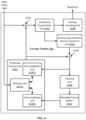
- FIG. 6 illustrates a block diagram of the encoder module 114 of the first electronic device illustrated in FIG. 1 according to an example implementation of the present disclosure.
- the encoder module 114 may include a prediction processor (e.g., prediction process unit 6141), at least a first summer (e.g., first summer 6142) and a second summer (e.g., second summer 6145), a transform/quantization processor (e.g., transform/quantization unit 6143), an inverse quantization/inverse transform processor (e.g., inverse quantization/inverse transform unit 6144), a filter (e.g., filtering unit 6146), a decoded picture buffer (e.g., decoded picture buffer 6147), and an entropy encoder (e.g., entropy encoding unit 6148).
- a prediction processor e.g., prediction process unit 6141
- at least a first summer e.g., first summer 6142
- a second summer e.g., second summer 6145
- the prediction process unit 6141 of the encoder module 114 may further include a partition processor (e.g., partition unit 61411), an intra prediction processor (e.g., intra prediction unit 61412), and an inter prediction processor (e.g., inter prediction unit 61413).
- a partition processor e.g., partition unit 61411
- an intra prediction processor e.g., intra prediction unit 61412
- an inter prediction processor e.g., inter prediction unit 61413
- the encoder module 114 may receive the source video and encode the source video to output a bitstream.
- the encoder module 114 may receive source video including a plurality of image frames and then divide the image frames according to a coding structure. Each of the image frames may be divided into at least one image block.
- the at least one image block may include a luminance block having a plurality of luminance samples and at least one chrominance block having a plurality of chrominance samples.
- the luminance block and the at least one chrominance block may be further divided to generate macroblocks, coding tree units (CTUs), coding blocks (CBs), sub-divisions thereof, and/or another equivalent coding unit.
- CTUs coding tree units
- CBs coding blocks
- the encoder module 114 may perform additional sub-divisions of the source video. It should be noted that the disclosed implementations are generally applicable to video coding regardless of how the source video is partitioned prior to and/or during the encoding.
- the prediction process unit 6141 may receive a current image block of a specific one of the image frames.
- the current image block may be the luminance block or one of the chrominance blocks in the specific image frame.
- the partition unit 61411 may divide the current image block into multiple block units.
- the intra prediction unit 61412 may perform intra-predictive coding of a current block unit relative to one or more neighboring blocks in the same frame as the current block unit in order to provide spatial prediction.
- the inter prediction unit 61413 may perform inter-predictive coding of the current block unit relative to one or more blocks in one or more reference image blocks to provide temporal prediction.
- the prediction process unit 6141 may select one of the coding results generated by the intra prediction unit 61412 and the inter prediction unit 61413 based on a mode selection method, such as a cost function.
- the mode selection method may be a rate-distortion optimization (RDO) process.
- the prediction process unit 6141 may determine the selected coding result and provide a predicted block corresponding to the selected coding result to the first summer 6142 for generating a residual block and to the second summer 6145 for reconstructing the encoded block unit.
- the prediction process unit 6141 may further provide syntax elements such as motion vectors, intra mode indicators, partition information, and other syntax information to the entropy encoding unit 6148.
- the intra prediction unit 61412 may intra predict the current block unit.
- the intra prediction unit 61412 may determine an intra prediction mode directed toward a reconstructed sample neighboring the current block unit in order to encode the current block unit.
- the intra prediction unit 61412 may encode the current block unit using various intra prediction modes.
- the intra prediction unit 61412 or the prediction process unit 6141 may select an appropriate intra prediction mode from the selected modes.
- the intra prediction unit 61412 may encode the current block unit using a cross component prediction mode to predict one of the two chroma components of the current block unit based on the luma components of the current block unit.
- the intra prediction unit 61412 may predict a first one of the two chroma components of the current block unit based on the second of the two chroma components of the current block unit.
- the inter prediction unit 61413 may inter predict the current block unit as an alternative to the intra prediction performed by the intra prediction unit 61412.
- the inter prediction unit 61413 may perform motion estimation to estimate motion of the current block unit for generating a motion vector.
- the motion vector may indicate a displacement of the current block unit within the current image block relative to a reference block unit within a reference image block.
- the inter prediction unit 61413 may receive at least one reference image block stored in the decoded picture buffer 6147 and estimate the motion based on the received reference image blocks to generate the motion vector.
- the first summer 6142 may generate the residual block by subtracting the prediction block determined by the prediction process unit 6141 from the original current block unit.
- the first summer 6142 may represent the component or components that perform this subtraction.
- the transform/quantization unit 6143 may apply a transform to the residual block in order to generate a residual transform coefficient and then quantize the residual transform coefficients to further reduce bit rate.
- the transform may be one of a DCT, DST, AMT, MDNSST, HyGT, signal dependent transform, KLT, wavelet transform, integer transform, sub-band transform or a conceptually similar transform.
- the transform may convert the residual information from a pixel value domain to a transform domain, such as a frequency domain.
- the degree of quantization may be modified by adjusting a quantization parameter.
- the transform/quantization unit 6143 may perform a scan of the matrix including the quantized transform coefficients.
- the entropy encoding unit 6148 may perform the scan.
- the entropy encoding unit 6148 may receive a plurality of syntax elements from the prediction process unit 6141 and the transform/quantization unit 6143 including a quantization parameter, transform data, motion vectors, intra modes, partition information, and other syntax information.
- the entropy encoding unit 6148 may encode the syntax elements into the bitstream.
- the entropy encoding unit 6148 may entropy encode the quantized transform coefficients by performing CAVLC, CABAC, SBAC, PIPE coding or another entropy coding technique to generate an encoded bitstream.
- the encoded bitstream may be transmitted to another device (i.e., the second electronic device 120 in FIG. 1 ) or archived for later transmission or retrieval.
- the inverse quantization/inverse transform unit 6144 may apply inverse quantization and inverse transformation to reconstruct the residual block in the pixel domain for later use as a reference block.
- the second summer 6145 may add the reconstructed residual block to the prediction block provided from the prediction process unit 6141 in order to produce a reconstructed block for storage in the decoded picture buffer 6147.
- the filtering unit 6146 may include a deblocking filter, a SAO filter, a bilateral filter, and/or an ALF to remove blocking artifacts from the reconstructed block. Additional filters (in loop or post loop) may be used in addition to the deblocking filter, the SAO filter, the bilateral filter and the ALF. Such filters are not illustrated for brevity and may filter the output of the second summer 6145.
- the decoded picture buffer 6147 may be a reference picture memory that stores the reference block for use by the encoder module 114 to encode video, such as in intra or inter coding modes.
- the decoded picture buffer 6147 may include a variety of memory devices such as DRAM, including SDRAM, MRAM, RRAM, or other types of memory devices.
- the decoded picture buffer 6147 may be on-chip with other components of the encoder module 114 or off-chip relative to those components.
- the encoder module 114 may perform the method 300 for encoding a video and reconstructing a block unit as illustrated in FIG. 3 .
- the method 300 may be performed using the configurations illustrated in FIG. 1 and FIG. 8 and various elements of these figures are referenced with regard to the method 300.
- Each block illustrated in FIG. 3 may represent one or more processes, methods, or subroutines performed.
- FIG. 3 The order of blocks in FIG. 3 is illustrative only and may change. Additional blocks may be added or less blocks may be utilized without departing from the present disclosure.
- an encoder module 114 receives an image frame of video data.
- the video data may be video.
- the first electronic device 110 may receive the video via the source module 112.
- the encoder module 114 may determine the image frame from the video.
- an encoder module 114 determines a block unit having a block width and a block height from the received video data.
- the encoder module 114 may divide the image frame to determine the block unit.
- the prediction process unit 6141 of the first electronic device 110 may determine the block unit from the video via the partition unit 61411 and the encoder module 114 may provide a plurality of partition indications into a bitstream based on a partition result of the partition unit 61411.
- the encoder module 114 may divide the image frames to generate a plurality of coding tree units and may further divide one of the coding tree units to determine the block unit (e.g., based on a video coding standard).
- the block height H410 is equal to the block width W410
- the block width W430 is equal to 8 ⁇ H430
- the block height H450 is equal to 4 ⁇ W450.
- the encoder module 114 determines a comparison between the block width and the block height. With reference to FIG. 1 and FIG. 6 , the encoder module 114 may determine the comparison between the block width and the block height based on an inequality. For example, a ratio value R between the block width Wb and the block height Hb is greater than or equal to a threshold value T (i.e., R ⁇ T). The ratio value R between the width Wb and the block height Hb may be less than the threshold value T (i.e., R ⁇ T).
- the encoder module 114 may compare the ratio parameter RP with a ratio threshold RT. In the implementation, the encoder module 114 may determine that the comparison indicates that the ratio value R is greater than or equal to the threshold value T when the ratio parameter RP is greater than or equal to the ratio threshold RT. The encoder module 114 may determine that the comparison indicates that the ratio value R is less than the threshold value T when the ratio parameter RP is less than the ratio threshold RT.
- the encoder module 114 may compare the ratio parameter RP with a first ratio threshold RT1 when the first ratio parameter RP1 is set as the ratio parameter RP. In at least one implementation, the encoder module 114 may compare the ratio parameter RP with a second ratio threshold RT2 when the second ratio parameter RP2 is set as the ratio parameter RP.
- the encoder module 114 may determine that the comparison indicates that the ratio value R is greater than or equal to the threshold value T when the first ratio parameter RP1 is greater than or equal to the first ratio threshold RT1 or the second ratio parameter RP2 is greater than or equal to the second ratio threshold RT2.
- the encoder module 114 may determine that the comparison indicates that the ratio value R is less than the threshold value T when the first ratio parameter RP1 is less than the first ratio threshold RT1 or the second ratio parameter RP2 is less than the second ratio threshold RT2.
- the first ratio threshold RT1 and the second ratio threshold RT2 may be a positive integer. In at least one implementation, the first ratio threshold RT1 may be equal to two to the power of n, and the number n is a positive integer. The first ratio threshold RT1 may be preset to 1, 2, 4 or 8, and the second ratio threshold RT2 may be preset to 1, 2, 3 or 4.
- the first ratio threshold RT1 may be equal to two to the power of the second ratio threshold RT2 since the first ratio parameter RP1 is equal to two to the power of the second ratio parameter RP2. Therefore, the result of the comparison may be unchanged when the encoder module 114 changes the comparison from a first inequality RP1 ⁇ RT1 to a second inequality RP2 ⁇ RT2.
- the encoder module 114 may compare the block width Wb with a first magnified value N1 computed by multiplying the block height Hb by the threshold value T and compare the block height Hb with a second magnified value N2 computed by multiplying the block width Wb by the threshold value T when the encoder module 114 determines the comparison between the block width Wb and the block height Hb.
- the encoder module 114 may determine the comparison indicates that the ratio value R is less than the threshold value T when the block width Wb is less than the first magnified value N1 and the block height Hb is less than the second magnified value N2. In another implementation, the encoder module 114 may determine the comparison indicates that the ratio value R is greater than or equal to the threshold value T when the block width Wb is greater than or equal to the first magnified value N1 or the block height Hb is greater than or equal to the second magnified value N2.
- the threshold value T may be equal to the first ratio threshold RT1 when the encoder module 114 determines the comparison based on the first magnified value N1 and the second magnified value N2.
- the encoder module 114 determines whether a geometric partitioning mode is disabled for the block unit based on the comparison.
- the method 300 may proceed to block 350 when the encoder module 114 determines that the geometric partitioning mode is disabled for the block unit.
- the method may proceed to block 360 when the encoder module 114 determines the geometric partitioning mode is enabled for the block unit.
- the encoder module 114 determines that the geometric partitioning mode is disabled for the block unit when the comparison indicates that the ratio value R is greater than or equal to the threshold value T.
- the encoder module 114 determines that the geometric partitioning mode is enabled for the block unit when the comparison indicates that the ratio value R is less than the threshold value T.
- the encoder module 114 may select the first prediction mode from a plurality of option modes when the geometric partitioning mode is disabled for the block unit. In the implementation, the encoder module 114 may predict the block unit based on the first prediction mode to generate the predicted block when the comparison indicates that the ratio value R is greater than or equal to the threshold value T. Each of the option modes is different from the geometric partitioning mode. In at least one implementation, the option modes may include a plurality of merge candidate modes in a merge candidate list.
- the encoder module 114 predicts the block unit by using a second prediction mode selected from a plurality of candidate modes including the geometric partitioning mode to generate the predicted block.
- the encoder module 114 may generate the coding results generated by the intra prediction unit 61412 and the inter prediction unit 61413. Then, the encoder module 114 may select one of the coding results based on the mode selection method.
- the encoder module 114 may select the second prediction mode from a plurality of candidate modes when the geometric partitioning mode is enabled for the block unit. In the implementation, the encoder module 114 may predict the block unit based on the second prediction mode to generate the predicted block when the comparison indicates that the ratio value R is less than the threshold value T. In at least one implementation, the candidate modes may include the option modes and the geometric partitioning modes.
- the encoder module 114 reconstructs the block unit based on the predicted block.
- the block unit may include a plurality of block elements.
- each of the block elements may be a pixel element.
- the encoder module 114 may determine a plurality of residual components by subtracting the predicted block from the block elements and provide the bitstream including a plurality of coefficients corresponding to the residual components. The encoder module 114 may return the residual components based on the coefficients, and add the returned residual components into the predicted block to generate a reconstructed block units.
Landscapes
- Engineering & Computer Science (AREA)
- Multimedia (AREA)
- Signal Processing (AREA)
- Compression Or Coding Systems Of Tv Signals (AREA)
Claims (5)
- Procédé de décodage d'un train de bits par un dispositif électronique (120), le procédé comprenant :la réception (310) d'une trame d'images du train de bits ;la détermination (320) d'une unité de bloc, présentant une certaine largeur de bloc et une certaine hauteur de bloc, à partir de la trame d'images reçue ;la détermination (340) de la désactivation ou non d'un mode de partitionnement géométrique pour l'unité de bloc sur la base d'une comparaison entre la largeur du bloc et la hauteur du bloc, dans laquelle :le mode de partitionnement géométrique est désactivé pour l'unité de bloc lorsque la comparaison indique qu'une valeur du rapport entre la largeur du bloc et la hauteur du bloc est supérieure ou égale à une valeur seuil,le mode de partitionnement géométrique n'est pas désactivé lorsque la comparaison indique que la valeur du rapport est inférieure à la valeur seuil,la largeur du bloc est comparée avec une première valeur augmentée générée en multipliant la hauteur du bloc par la valeur seuil,la hauteur du bloc est comparée avec une seconde valeur augmentée générée en multipliant la largeur du bloc par la valeur seuil, la valeur seuil utilisée pour générer la première valeur augmentée et la seconde valeur augmentée étant égale à 8,la comparaison indique que la valeur du rapport est inférieure à la valeur seuil lorsque la largeur du bloc est inférieure à la première valeur augmentée et que la hauteur du bloc est inférieure à la seconde valeur augmentée,la comparaison indique que la valeur du rapport est supérieure ou égale à la valeur seuil lorsque la largeur du bloc est supérieure ou égale à la première valeur augmentée,la comparaison indique que la valeur du rapport est supérieure ou égale à la valeur seuil lorsque la hauteur du bloc est supérieure ou égale à la seconde valeur augmentée, etl'unité de bloc est divisée afin de générer une pluralité de sous-blocs prédits à l'aide de différents candidats de fusion de l'unité de bloc lorsque le mode de partitionnement géométrique est appliqué sur l'unité de bloc ;la génération d'un bloc prédit au moyen de la prédiction (350) de l'unité de bloc sur la base d'un mode de prédiction différent du mode de partitionnement géométrique lorsque le mode de partitionnement géométrique est désactivé pour l'unité de bloc ; etla reconstruction (370) de l'unité de bloc sur la base du bloc prédit.
- Le procédé selon la revendication 1, comprenant en outre :la détermination d'un index de partition, d'un premier index de fusion et d'un second index de fusion de l'unité de bloc lorsque l'unité de bloc est prédite à l'aide du mode de partitionnement géométrique ;la division de l'unité de bloc afin de générer un premier sous-bloc et un second sous-bloc sur la base de l'index de partition ; etla prédiction du premier sous-bloc à l'aide d'un premier mode de fusion choisi parmi une pluralité de candidats de fusion sur la base du premier index de fusion, et la prédiction du second sous-bloc à l'aide d'un second mode de fusion choisi parmi la pluralité de candidats de fusion sur la base du second index de fusion, afin de générer le bloc prédit.
- Procédé de codage de données vidéo par un dispositif électronique (110), le procédé comprenant :la réception (310) d'une trame d'images des données vidéo ;la détermination (320) d'une unité de bloc, présentant une certaine largeur de bloc et une certaine hauteur de bloc, à partir de la trame d'images reçue ;la détermination (340) de la désactivation ou non d'un mode de partitionnement géométrique pour l'unité de bloc sur la base d'une comparaison entre la largeur du bloc et la hauteur du bloc, dans laquelle :le mode de partitionnement géométrique est désactivé pour l'unité de bloc lorsque la comparaison indique qu'une valeur du rapport entre la largeur du bloc et la hauteur du bloc est supérieure ou égale à une valeur seuil,le mode de partitionnement géométrique n'est pas désactivé lorsque la comparaison indique que la valeur du rapport est inférieure à la valeur seuil,la largeur du bloc est comparée avec une première valeur augmentée générée en multipliant la hauteur du bloc par la valeur seuil,la hauteur du bloc est comparée avec une seconde valeur augmentée générée en multipliant la largeur du bloc par la valeur seuil, la valeur seuil utilisée pour générer la première valeur augmentée et la seconde valeur augmentée étant égale à 8,la comparaison indique que la valeur du rapport est inférieure à la valeur seuil lorsque la largeur du bloc est inférieure à la première valeur augmentée et que la hauteur du bloc est inférieure à la seconde valeur augmentée,la comparaison indique que la valeur du rapport est supérieure ou égale à la valeur seuil lorsque la largeur du bloc est supérieure ou égale à la première valeur augmentée,la comparaison indique que la valeur du rapport est supérieure ou égale à la valeur seuil lorsque la hauteur du bloc est supérieure ou égale à la seconde valeur augmentée, etl'unité de bloc est divisée afin de générer une pluralité de sous-blocs prédits à l'aide de différents candidats de fusion de l'unité de bloc lorsque le mode de partitionnement géométrique est appliqué sur l'unité de bloc ;la génération (350) d'un bloc prédit au moyen de la prédiction de l'unité de bloc sur la base d'un mode de prédiction différent du mode de partitionnement géométrique lorsque le mode de partitionnement géométrique est désactivé pour l'unité de bloc ; etla reconstruction (370) de l'unité de bloc sur la base du bloc prédit.
- Le procédé selon la revendication 3, comprenant en outre :la détermination d'un index de partition, d'un premier index de fusion et d'un second index de fusion de l'unité de bloc lorsque l'unité de bloc est prédite à l'aide du mode de partitionnement géométrique ;la division de l'unité de bloc afin de générer un premier sous-bloc et un second sous-bloc sur la base de l'index de partition ; etla prédiction du premier sous-bloc à l'aide d'un premier mode de fusion choisi parmi une pluralité de candidats de fusion sur la base du premier index de fusion, et la prédiction du second sous-bloc à l'aide d'un second mode de fusion choisi parmi la pluralité de candidats de fusion sur la base du second index de fusion, afin de générer le bloc prédit.
- Dispositif électronique (110, 120) comprenant :au moins un processeur ; etun dispositif de stockage accouplé au ou aux processeurs et destiné à stocker un programme, lequel, lors de son exécution par le ou les processeurs, amène le dispositif électronique à effectuer le procédé de l'une quelconque des revendications 1 à 4.
Applications Claiming Priority (2)
| Application Number | Priority Date | Filing Date | Title |
|---|---|---|---|
| US201962955228P | 2019-12-30 | 2019-12-30 | |
| PCT/CN2020/141275 WO2021136349A1 (fr) | 2019-12-30 | 2020-12-30 | Dispositif et procédé de codage de données vidéo |
Publications (3)
| Publication Number | Publication Date |
|---|---|
| EP4055826A1 EP4055826A1 (fr) | 2022-09-14 |
| EP4055826A4 EP4055826A4 (fr) | 2023-11-22 |
| EP4055826B1 true EP4055826B1 (fr) | 2025-06-04 |
Family
ID=76545708
Family Applications (1)
| Application Number | Title | Priority Date | Filing Date |
|---|---|---|---|
| EP20911086.5A Active EP4055826B1 (fr) | 2019-12-30 | 2020-12-30 | Dispositif et procédé de codage de données vidéo |
Country Status (7)
| Country | Link |
|---|---|
| US (3) | US11284078B2 (fr) |
| EP (1) | EP4055826B1 (fr) |
| JP (1) | JP7499854B2 (fr) |
| KR (1) | KR102925056B1 (fr) |
| CN (1) | CN114902663B (fr) |
| MX (1) | MX2022007973A (fr) |
| WO (1) | WO2021136349A1 (fr) |
Families Citing this family (4)
| Publication number | Priority date | Publication date | Assignee | Title |
|---|---|---|---|---|
| EP3967035A4 (fr) * | 2019-05-10 | 2023-01-25 | Beijing Dajia Internet Information Technology Co., Ltd. | Procédés et appareils de codage vidéo à prédiction de triangle |
| CN121691691A (zh) | 2019-08-15 | 2026-03-17 | 阿里巴巴集团控股有限公司 | 用于视频编解码的块划分方法 |
| EP4042686A4 (fr) * | 2019-10-10 | 2022-12-07 | Beijing Dajia Internet Information Technology Co., Ltd. | Procédés et appareils de codage vidéo faisant appel à la partition triangulaire |
| WO2025216553A1 (fr) * | 2024-04-10 | 2025-10-16 | 엘지전자 주식회사 | Procédé et appareil de codage et de décodage d'image, et support d'enregistrement stockant un flux binaire |
Family Cites Families (38)
| Publication number | Priority date | Publication date | Assignee | Title |
|---|---|---|---|---|
| US6519005B2 (en) * | 1999-04-30 | 2003-02-11 | Koninklijke Philips Electronics N.V. | Method of concurrent multiple-mode motion estimation for digital video |
| JP4015934B2 (ja) * | 2002-04-18 | 2007-11-28 | 株式会社東芝 | 動画像符号化方法及び装置 |
| US7295711B1 (en) * | 2002-10-23 | 2007-11-13 | Altera Corporation | Method and apparatus for merging related image segments |
| JP2009545919A (ja) * | 2006-08-02 | 2009-12-24 | トムソン ライセンシング | ビデオ復号処理のためにアダブティブなジオメトリック分割を行う方法および装置 |
| CN101731012B (zh) * | 2007-04-12 | 2013-10-16 | 汤姆森特许公司 | 用于视频编码器中的快速几何模式判定的方法和设备 |
| KR101579394B1 (ko) * | 2007-10-16 | 2015-12-21 | 톰슨 라이센싱 | 기하학적으로 분할된 수퍼 블록들의 비디오 인코딩 및 디코딩 방법 및 장치 |
| EP2093699A1 (fr) * | 2008-02-19 | 2009-08-26 | British Telecommunications Public Limited Company | Détermination d'un état d'objet mobile |
| JP5422168B2 (ja) * | 2008-09-29 | 2014-02-19 | 株式会社日立製作所 | 動画像符号化方法および動画像復号化方法 |
| US8879632B2 (en) * | 2010-02-18 | 2014-11-04 | Qualcomm Incorporated | Fixed point implementation for geometric motion partitioning |
| US9363520B2 (en) * | 2010-05-04 | 2016-06-07 | Lg Electronics Inc. | Method and apparatus for processing a video signal |
| KR101484281B1 (ko) * | 2010-07-09 | 2015-01-21 | 삼성전자주식회사 | 블록 병합을 이용한 비디오 부호화 방법 및 그 장치, 블록 병합을 이용한 비디오 복호화 방법 및 그 장치 |
| JP2012023597A (ja) | 2010-07-15 | 2012-02-02 | Sony Corp | 画像処理装置及び画像処理方法 |
| US20120147961A1 (en) * | 2010-12-09 | 2012-06-14 | Qualcomm Incorporated | Use of motion vectors in evaluating geometric partitioning modes |
| US9532066B2 (en) * | 2011-01-21 | 2016-12-27 | Qualcomm Incorporated | Motion vector prediction |
| US9736489B2 (en) * | 2011-09-17 | 2017-08-15 | Qualcomm Incorporated | Motion vector determination for video coding |
| EP2770738A4 (fr) * | 2011-10-19 | 2016-07-27 | Panasonic Ip Corp America | Procédé de codage d'image, dispositif de codage d'image, procédé de décodage d'image et dispositif de décodage d'image |
| US20130114717A1 (en) * | 2011-11-07 | 2013-05-09 | Qualcomm Incorporated | Generating additional merge candidates |
| US9451277B2 (en) * | 2012-02-08 | 2016-09-20 | Qualcomm Incorporated | Restriction of prediction units in B slices to uni-directional inter prediction |
| US9426463B2 (en) * | 2012-02-08 | 2016-08-23 | Qualcomm Incorporated | Restriction of prediction units in B slices to uni-directional inter prediction |
| US9532057B2 (en) * | 2012-12-28 | 2016-12-27 | Qualcomm Incorporated | Inter-layer prediction using sample-adaptive adjustments for bit depth scalable video coding |
| US9826244B2 (en) * | 2013-01-08 | 2017-11-21 | Qualcomm Incorporated | Device and method for scalable coding of video information based on high efficiency video coding |
| KR102179383B1 (ko) | 2013-08-09 | 2020-11-16 | 삼성전자주식회사 | 병합 모드 결정 방법 및 장치 |
| US10863186B2 (en) | 2016-08-26 | 2020-12-08 | Sharp Kabushiki Kaisha | Image decoding apparatus and image coding apparatus |
| EP3632107A1 (fr) * | 2017-06-30 | 2020-04-08 | Huawei Technologies Co., Ltd. | Codeur, décodeur, programme informatique et produit de programme informatique destiné à traiter une trame d'une séquence vidéo |
| CN111213379B (zh) | 2017-10-16 | 2023-11-21 | 数字洞察力有限公司 | 用于将图像编码/解码的方法、装置和存储比特流的记录介质 |
| CN111316640B (zh) | 2017-11-17 | 2023-09-26 | 鸿颖创新有限公司 | 基于调整的帧内模式列表以编码视频数据的设备及方法 |
| CN111543057B (zh) | 2017-12-29 | 2022-05-03 | 鸿颖创新有限公司 | 基于包含不同模式组的模式列表以编码视频数据的设备及方法 |
| WO2019151279A1 (fr) | 2018-01-30 | 2019-08-08 | パナソニック インテレクチュアル プロパティ コーポレーション オブ アメリカ | Dispositif de codage, dispositif de décodage, procédé de codage, et procédé de décodage |
| CN111903130B (zh) * | 2018-03-28 | 2022-06-17 | 鸿颖创新有限公司 | 在多参考列预测中编码视频数据的设备及方法 |
| US11109057B2 (en) | 2018-04-16 | 2021-08-31 | Mediatek Inc. | Overlapped block motion compensation based on blended predictors |
| US20190342546A1 (en) | 2018-05-03 | 2019-11-07 | FG Innovation Company Limited | Device and method for coding video data based on different reference sets in linear model prediction |
| US11695967B2 (en) * | 2018-06-22 | 2023-07-04 | Op Solutions, Llc | Block level geometric partitioning |
| CN121284231A (zh) | 2018-11-08 | 2026-01-06 | Oppo广东移动通信有限公司 | 图像信号编码/解码方法、设备及介质 |
| JP7678578B2 (ja) * | 2019-01-28 | 2025-05-16 | オーピー ソリューションズ, エルエルシー | 適応的な数の領域を伴う幾何学的分割におけるインター予測 |
| US11412221B2 (en) * | 2019-06-24 | 2022-08-09 | Alibaba Group Holding Limited | Method and apparatus for motion field storage in triangle partition mode and geometric partition mode |
| CN114303382B (zh) | 2019-09-01 | 2025-10-28 | 北京字节跳动网络技术有限公司 | 视频编解码中预测权重的对准 |
| BR112022010230A2 (pt) | 2019-11-30 | 2023-03-14 | Beijing Bytedance Network Tech Co Ltd | Método de processamento de dados de vídeo, aparelho para processar dados de vídeo, meio de armazenamento não transitório legível por computador e meio de gravação não transitório legível por computador |
| WO2021129694A1 (fr) | 2019-12-24 | 2021-07-01 | Beijing Bytedance Network Technology Co., Ltd. | Syntaxe à haut niveau pour prédiction inter à l'aide du partitionnement géométrique |
-
2020
- 2020-12-30 KR KR1020227025262A patent/KR102925056B1/ko active Active
- 2020-12-30 JP JP2022528269A patent/JP7499854B2/ja active Active
- 2020-12-30 WO PCT/CN2020/141275 patent/WO2021136349A1/fr not_active Ceased
- 2020-12-30 MX MX2022007973A patent/MX2022007973A/es unknown
- 2020-12-30 US US17/138,795 patent/US11284078B2/en active Active
- 2020-12-30 EP EP20911086.5A patent/EP4055826B1/fr active Active
- 2020-12-30 CN CN202080088003.9A patent/CN114902663B/zh active Active
-
2022
- 2022-02-11 US US17/670,179 patent/US20220166978A1/en not_active Abandoned
-
2023
- 2023-11-15 US US18/510,445 patent/US12155828B2/en active Active
Also Published As
| Publication number | Publication date |
|---|---|
| WO2021136349A1 (fr) | 2021-07-08 |
| JP2023501726A (ja) | 2023-01-18 |
| CN114902663A (zh) | 2022-08-12 |
| EP4055826A4 (fr) | 2023-11-22 |
| US12155828B2 (en) | 2024-11-26 |
| US11284078B2 (en) | 2022-03-22 |
| EP4055826A1 (fr) | 2022-09-14 |
| MX2022007973A (es) | 2022-07-05 |
| KR102925056B1 (ko) | 2026-02-10 |
| US20240089432A1 (en) | 2024-03-14 |
| JP7499854B2 (ja) | 2024-06-14 |
| KR20220113533A (ko) | 2022-08-12 |
| CN114902663B (zh) | 2025-12-16 |
| US20210203931A1 (en) | 2021-07-01 |
| US20220166978A1 (en) | 2022-05-26 |
Similar Documents
| Publication | Publication Date | Title |
|---|---|---|
| EP3844950B1 (fr) | Dispositif et procédé de codage de données vidéo | |
| US12621497B2 (en) | Device and method for coding video data | |
| US20190342546A1 (en) | Device and method for coding video data based on different reference sets in linear model prediction | |
| WO2023036341A1 (fr) | Dispositif et procédé pour des prédictions intra dans un codage vidéo | |
| US11272179B2 (en) | Device and method for coding video data | |
| US12155828B2 (en) | Device and method for coding video data for geometric partitioning mode | |
| EP4117285B1 (fr) | Dispositif et procédé de codage de données vidéo avec une pluralité de modes intra | |
| EP3987797B1 (fr) | Dispositif et procédé de codage de données vidéo | |
| US11368704B2 (en) | Device and method for coding video data | |
| US11985345B2 (en) | Device and method for coding video data | |
| WO2023051541A1 (fr) | Dispositif et procédé de codage de données vidéo | |
| US20220329813A1 (en) | Device and method for coding video data | |
| US12375681B2 (en) | Device and method for coding video data | |
| WO2025075186A1 (fr) | Dispositif de codage, dispositif de décodage et support non transitoire lisible par ordinateur pour train de bits | |
| US20260113467A1 (en) | Encoding device, decoding device, and non-transitory machine-readable medium for encoding/decoding video data | |
| WO2022095918A1 (fr) | Dispositif et procédé de codage de données vidéo |
Legal Events
| Date | Code | Title | Description |
|---|---|---|---|
| STAA | Information on the status of an ep patent application or granted ep patent |
Free format text: STATUS: THE INTERNATIONAL PUBLICATION HAS BEEN MADE |
|
| PUAI | Public reference made under article 153(3) epc to a published international application that has entered the european phase |
Free format text: ORIGINAL CODE: 0009012 |
|
| STAA | Information on the status of an ep patent application or granted ep patent |
Free format text: STATUS: REQUEST FOR EXAMINATION WAS MADE |
|
| 17P | Request for examination filed |
Effective date: 20220610 |
|
| AK | Designated contracting states |
Kind code of ref document: A1 Designated state(s): AL AT BE BG CH CY CZ DE DK EE ES FI FR GB GR HR HU IE IS IT LI LT LU LV MC MK MT NL NO PL PT RO RS SE SI SK SM TR |
|
| DAV | Request for validation of the european patent (deleted) | ||
| DAX | Request for extension of the european patent (deleted) | ||
| A4 | Supplementary search report drawn up and despatched |
Effective date: 20231020 |
|
| RIC1 | Information provided on ipc code assigned before grant |
Ipc: H04N 19/463 20140101ALI20231016BHEP Ipc: H04N 19/157 20140101ALI20231016BHEP Ipc: H04N 19/70 20140101ALI20231016BHEP Ipc: H04N 19/134 20140101ALI20231016BHEP Ipc: H04N 19/176 20140101ALI20231016BHEP Ipc: H04N 19/119 20140101AFI20231016BHEP |
|
| STAA | Information on the status of an ep patent application or granted ep patent |
Free format text: STATUS: EXAMINATION IS IN PROGRESS |
|
| 17Q | First examination report despatched |
Effective date: 20240719 |
|
| RAP1 | Party data changed (applicant data changed or rights of an application transferred) |
Owner name: SHARP KABUSHIKI KAISHA |
|
| GRAP | Despatch of communication of intention to grant a patent |
Free format text: ORIGINAL CODE: EPIDOSNIGR1 |
|
| STAA | Information on the status of an ep patent application or granted ep patent |
Free format text: STATUS: GRANT OF PATENT IS INTENDED |
|
| INTG | Intention to grant announced |
Effective date: 20250117 |
|
| RAP3 | Party data changed (applicant data changed or rights of an application transferred) |
Owner name: SHARP KABUSHIKI KAISHA |
|
| GRAS | Grant fee paid |
Free format text: ORIGINAL CODE: EPIDOSNIGR3 |
|
| GRAA | (expected) grant |
Free format text: ORIGINAL CODE: 0009210 |
|
| STAA | Information on the status of an ep patent application or granted ep patent |
Free format text: STATUS: THE PATENT HAS BEEN GRANTED |
|
| AK | Designated contracting states |
Kind code of ref document: B1 Designated state(s): AL AT BE BG CH CY CZ DE DK EE ES FI FR GB GR HR HU IE IS IT LI LT LU LV MC MK MT NL NO PL PT RO RS SE SI SK SM TR |
|
| REG | Reference to a national code |
Ref country code: GB Ref legal event code: FG4D |
|
| REG | Reference to a national code |
Ref country code: CH Ref legal event code: EP |
|
| REG | Reference to a national code |
Ref country code: DE Ref legal event code: R096 Ref document number: 602020052474 Country of ref document: DE |
|
| REG | Reference to a national code |
Ref country code: IE Ref legal event code: FG4D |
|
| REG | Reference to a national code |
Ref country code: NL Ref legal event code: MP Effective date: 20250604 |
|
| PG25 | Lapsed in a contracting state [announced via postgrant information from national office to epo] |
Ref country code: FI Free format text: LAPSE BECAUSE OF FAILURE TO SUBMIT A TRANSLATION OF THE DESCRIPTION OR TO PAY THE FEE WITHIN THE PRESCRIBED TIME-LIMIT Effective date: 20250604 Ref country code: ES Free format text: LAPSE BECAUSE OF FAILURE TO SUBMIT A TRANSLATION OF THE DESCRIPTION OR TO PAY THE FEE WITHIN THE PRESCRIBED TIME-LIMIT Effective date: 20250604 |
|
| REG | Reference to a national code |
Ref country code: LT Ref legal event code: MG9D |
|
| PG25 | Lapsed in a contracting state [announced via postgrant information from national office to epo] |
Ref country code: NO Free format text: LAPSE BECAUSE OF FAILURE TO SUBMIT A TRANSLATION OF THE DESCRIPTION OR TO PAY THE FEE WITHIN THE PRESCRIBED TIME-LIMIT Effective date: 20250904 Ref country code: GR Free format text: LAPSE BECAUSE OF FAILURE TO SUBMIT A TRANSLATION OF THE DESCRIPTION OR TO PAY THE FEE WITHIN THE PRESCRIBED TIME-LIMIT Effective date: 20250905 |
|
| PG25 | Lapsed in a contracting state [announced via postgrant information from national office to epo] |
Ref country code: PL Free format text: LAPSE BECAUSE OF FAILURE TO SUBMIT A TRANSLATION OF THE DESCRIPTION OR TO PAY THE FEE WITHIN THE PRESCRIBED TIME-LIMIT Effective date: 20250604 |
|
| PG25 | Lapsed in a contracting state [announced via postgrant information from national office to epo] |
Ref country code: BG Free format text: LAPSE BECAUSE OF FAILURE TO SUBMIT A TRANSLATION OF THE DESCRIPTION OR TO PAY THE FEE WITHIN THE PRESCRIBED TIME-LIMIT Effective date: 20250604 |
|
| PG25 | Lapsed in a contracting state [announced via postgrant information from national office to epo] |
Ref country code: HR Free format text: LAPSE BECAUSE OF FAILURE TO SUBMIT A TRANSLATION OF THE DESCRIPTION OR TO PAY THE FEE WITHIN THE PRESCRIBED TIME-LIMIT Effective date: 20250604 |
|
| PG25 | Lapsed in a contracting state [announced via postgrant information from national office to epo] |
Ref country code: RS Free format text: LAPSE BECAUSE OF FAILURE TO SUBMIT A TRANSLATION OF THE DESCRIPTION OR TO PAY THE FEE WITHIN THE PRESCRIBED TIME-LIMIT Effective date: 20250904 |
|
| PG25 | Lapsed in a contracting state [announced via postgrant information from national office to epo] |
Ref country code: LV Free format text: LAPSE BECAUSE OF FAILURE TO SUBMIT A TRANSLATION OF THE DESCRIPTION OR TO PAY THE FEE WITHIN THE PRESCRIBED TIME-LIMIT Effective date: 20250604 |
|
| PG25 | Lapsed in a contracting state [announced via postgrant information from national office to epo] |
Ref country code: NL Free format text: LAPSE BECAUSE OF FAILURE TO SUBMIT A TRANSLATION OF THE DESCRIPTION OR TO PAY THE FEE WITHIN THE PRESCRIBED TIME-LIMIT Effective date: 20250604 |
|
| PG25 | Lapsed in a contracting state [announced via postgrant information from national office to epo] |
Ref country code: PT Free format text: LAPSE BECAUSE OF FAILURE TO SUBMIT A TRANSLATION OF THE DESCRIPTION OR TO PAY THE FEE WITHIN THE PRESCRIBED TIME-LIMIT Effective date: 20251006 |
|
| REG | Reference to a national code |
Ref country code: AT Ref legal event code: MK05 Ref document number: 1801491 Country of ref document: AT Kind code of ref document: T Effective date: 20250604 |
|
| PG25 | Lapsed in a contracting state [announced via postgrant information from national office to epo] |
Ref country code: IS Free format text: LAPSE BECAUSE OF FAILURE TO SUBMIT A TRANSLATION OF THE DESCRIPTION OR TO PAY THE FEE WITHIN THE PRESCRIBED TIME-LIMIT Effective date: 20251004 |
|
| PGFP | Annual fee paid to national office [announced via postgrant information from national office to epo] |
Ref country code: DE Payment date: 20251211 Year of fee payment: 6 |
|
| PGFP | Annual fee paid to national office [announced via postgrant information from national office to epo] |
Ref country code: GB Payment date: 20251219 Year of fee payment: 6 |
|
| PG25 | Lapsed in a contracting state [announced via postgrant information from national office to epo] |
Ref country code: SM Free format text: LAPSE BECAUSE OF FAILURE TO SUBMIT A TRANSLATION OF THE DESCRIPTION OR TO PAY THE FEE WITHIN THE PRESCRIBED TIME-LIMIT Effective date: 20250604 Ref country code: AT Free format text: LAPSE BECAUSE OF FAILURE TO SUBMIT A TRANSLATION OF THE DESCRIPTION OR TO PAY THE FEE WITHIN THE PRESCRIBED TIME-LIMIT Effective date: 20250604 |
|
| PGFP | Annual fee paid to national office [announced via postgrant information from national office to epo] |
Ref country code: FR Payment date: 20251229 Year of fee payment: 6 |
|
| PG25 | Lapsed in a contracting state [announced via postgrant information from national office to epo] |
Ref country code: CZ Free format text: LAPSE BECAUSE OF FAILURE TO SUBMIT A TRANSLATION OF THE DESCRIPTION OR TO PAY THE FEE WITHIN THE PRESCRIBED TIME-LIMIT Effective date: 20250604 |
|
| PG25 | Lapsed in a contracting state [announced via postgrant information from national office to epo] |
Ref country code: EE Free format text: LAPSE BECAUSE OF FAILURE TO SUBMIT A TRANSLATION OF THE DESCRIPTION OR TO PAY THE FEE WITHIN THE PRESCRIBED TIME-LIMIT Effective date: 20250604 |
|
| PG25 | Lapsed in a contracting state [announced via postgrant information from national office to epo] |
Ref country code: SK Free format text: LAPSE BECAUSE OF FAILURE TO SUBMIT A TRANSLATION OF THE DESCRIPTION OR TO PAY THE FEE WITHIN THE PRESCRIBED TIME-LIMIT Effective date: 20250604 |
|
| PG25 | Lapsed in a contracting state [announced via postgrant information from national office to epo] |
Ref country code: IT Free format text: LAPSE BECAUSE OF FAILURE TO SUBMIT A TRANSLATION OF THE DESCRIPTION OR TO PAY THE FEE WITHIN THE PRESCRIBED TIME-LIMIT Effective date: 20250604 |
|
| PG25 | Lapsed in a contracting state [announced via postgrant information from national office to epo] |
Ref country code: RO Free format text: LAPSE BECAUSE OF FAILURE TO SUBMIT A TRANSLATION OF THE DESCRIPTION OR TO PAY THE FEE WITHIN THE PRESCRIBED TIME-LIMIT Effective date: 20250604 |
|
| REG | Reference to a national code |
Ref country code: DE Ref legal event code: R097 Ref document number: 602020052474 Country of ref document: DE |
|
| PLBE | No opposition filed within time limit |
Free format text: ORIGINAL CODE: 0009261 |
|
| STAA | Information on the status of an ep patent application or granted ep patent |
Free format text: STATUS: NO OPPOSITION FILED WITHIN TIME LIMIT |
|
| PG25 | Lapsed in a contracting state [announced via postgrant information from national office to epo] |
Ref country code: DK Free format text: LAPSE BECAUSE OF FAILURE TO SUBMIT A TRANSLATION OF THE DESCRIPTION OR TO PAY THE FEE WITHIN THE PRESCRIBED TIME-LIMIT Effective date: 20250604 |
|
| REG | Reference to a national code |
Ref country code: CH Ref legal event code: L10 Free format text: ST27 STATUS EVENT CODE: U-0-0-L10-L00 (AS PROVIDED BY THE NATIONAL OFFICE) Effective date: 20260416 |
|
| 26N | No opposition filed |
Effective date: 20260305 |