EP4056530A1 - Procédés de traitement des liquides et/ou des suspensions et de génération de l'hydrogène à partir de composés chimiques contenant de l'hydrogène - Google Patents
Procédés de traitement des liquides et/ou des suspensions et de génération de l'hydrogène à partir de composés chimiques contenant de l'hydrogène Download PDFInfo
- Publication number
- EP4056530A1 EP4056530A1 EP22161189.0A EP22161189A EP4056530A1 EP 4056530 A1 EP4056530 A1 EP 4056530A1 EP 22161189 A EP22161189 A EP 22161189A EP 4056530 A1 EP4056530 A1 EP 4056530A1
- Authority
- EP
- European Patent Office
- Prior art keywords
- liquids
- suspensions
- hydrogen
- treatment
- plasma
- Prior art date
- Legal status (The legal status is an assumption and is not a legal conclusion. Google has not performed a legal analysis and makes no representation as to the accuracy of the status listed.)
- Pending
Links
Images
Classifications
-
- C—CHEMISTRY; METALLURGY
- C01—INORGANIC CHEMISTRY
- C01B—NON-METALLIC ELEMENTS; COMPOUNDS THEREOF; METALLOIDS OR COMPOUNDS THEREOF NOT COVERED BY SUBCLASS C01C
- C01B3/00—Hydrogen; Gaseous mixtures containing hydrogen; Separation of hydrogen from mixtures containing it; Purification of hydrogen; Reversible storage of hydrogen
- C01B3/02—Production of hydrogen; Production of gaseous mixtures containing hydrogen
- C01B3/22—Production of hydrogen; Production of gaseous mixtures containing hydrogen by decomposition of gaseous or liquid organic compounds
- C01B3/24—Production of hydrogen; Production of gaseous mixtures containing hydrogen by decomposition of gaseous or liquid organic compounds of hydrocarbons
-
- C—CHEMISTRY; METALLURGY
- C01—INORGANIC CHEMISTRY
- C01B—NON-METALLIC ELEMENTS; COMPOUNDS THEREOF; METALLOIDS OR COMPOUNDS THEREOF NOT COVERED BY SUBCLASS C01C
- C01B3/00—Hydrogen; Gaseous mixtures containing hydrogen; Separation of hydrogen from mixtures containing it; Purification of hydrogen; Reversible storage of hydrogen
- C01B3/02—Production of hydrogen; Production of gaseous mixtures containing hydrogen
- C01B3/04—Production of hydrogen; Production of gaseous mixtures containing hydrogen by decomposition of inorganic compounds
-
- C—CHEMISTRY; METALLURGY
- C01—INORGANIC CHEMISTRY
- C01B—NON-METALLIC ELEMENTS; COMPOUNDS THEREOF; METALLOIDS OR COMPOUNDS THEREOF NOT COVERED BY SUBCLASS C01C
- C01B3/00—Hydrogen; Gaseous mixtures containing hydrogen; Separation of hydrogen from mixtures containing it; Purification of hydrogen; Reversible storage of hydrogen
- C01B3/02—Production of hydrogen; Production of gaseous mixtures containing hydrogen
- C01B3/04—Production of hydrogen; Production of gaseous mixtures containing hydrogen by decomposition of inorganic compounds
- C01B3/042—Decomposition of water
- C01B3/045—Decomposition of water in gaseous phase
-
- C—CHEMISTRY; METALLURGY
- C01—INORGANIC CHEMISTRY
- C01B—NON-METALLIC ELEMENTS; COMPOUNDS THEREOF; METALLOIDS OR COMPOUNDS THEREOF NOT COVERED BY SUBCLASS C01C
- C01B3/00—Hydrogen; Gaseous mixtures containing hydrogen; Separation of hydrogen from mixtures containing it; Purification of hydrogen; Reversible storage of hydrogen
- C01B3/02—Production of hydrogen; Production of gaseous mixtures containing hydrogen
- C01B3/04—Production of hydrogen; Production of gaseous mixtures containing hydrogen by decomposition of inorganic compounds
- C01B3/047—Decomposition of ammonia
-
- C—CHEMISTRY; METALLURGY
- C01—INORGANIC CHEMISTRY
- C01B—NON-METALLIC ELEMENTS; COMPOUNDS THEREOF; METALLOIDS OR COMPOUNDS THEREOF NOT COVERED BY SUBCLASS C01C
- C01B3/00—Hydrogen; Gaseous mixtures containing hydrogen; Separation of hydrogen from mixtures containing it; Purification of hydrogen; Reversible storage of hydrogen
- C01B3/02—Production of hydrogen; Production of gaseous mixtures containing hydrogen
- C01B3/22—Production of hydrogen; Production of gaseous mixtures containing hydrogen by decomposition of gaseous or liquid organic compounds
-
- C—CHEMISTRY; METALLURGY
- C12—BIOCHEMISTRY; BEER; SPIRITS; WINE; VINEGAR; MICROBIOLOGY; ENZYMOLOGY; MUTATION OR GENETIC ENGINEERING
- C12N—MICROORGANISMS OR ENZYMES; COMPOSITIONS THEREOF; PROPAGATING, PRESERVING, OR MAINTAINING MICROORGANISMS; MUTATION OR GENETIC ENGINEERING; CULTURE MEDIA
- C12N13/00—Treatment of microorganisms or enzymes with electrical or wave energy, e.g. magnetism, sonic waves
-
- C—CHEMISTRY; METALLURGY
- C12—BIOCHEMISTRY; BEER; SPIRITS; WINE; VINEGAR; MICROBIOLOGY; ENZYMOLOGY; MUTATION OR GENETIC ENGINEERING
- C12P—FERMENTATION OR ENZYME-USING PROCESSES TO SYNTHESISE A DESIRED CHEMICAL COMPOUND OR COMPOSITION OR TO SEPARATE OPTICAL ISOMERS FROM A RACEMIC MIXTURE
- C12P5/00—Preparation of hydrocarbons or halogenated hydrocarbons
- C12P5/02—Preparation of hydrocarbons or halogenated hydrocarbons acyclic
- C12P5/023—Methane
-
- C—CHEMISTRY; METALLURGY
- C01—INORGANIC CHEMISTRY
- C01B—NON-METALLIC ELEMENTS; COMPOUNDS THEREOF; METALLOIDS OR COMPOUNDS THEREOF NOT COVERED BY SUBCLASS C01C
- C01B2203/00—Integrated processes for the production of hydrogen or synthesis gas
- C01B2203/08—Methods of heating or cooling
- C01B2203/0805—Methods of heating the process for making hydrogen or synthesis gas
- C01B2203/0861—Methods of heating the process for making hydrogen or synthesis gas by plasma
-
- C—CHEMISTRY; METALLURGY
- C01—INORGANIC CHEMISTRY
- C01B—NON-METALLIC ELEMENTS; COMPOUNDS THEREOF; METALLOIDS OR COMPOUNDS THEREOF NOT COVERED BY SUBCLASS C01C
- C01B2203/00—Integrated processes for the production of hydrogen or synthesis gas
- C01B2203/14—Details of the flowsheet
- C01B2203/148—Details of the flowsheet involving a recycle stream to the feed of the process for making hydrogen or synthesis gas
Definitions
- the invention relates to a device and a method for the multi-stage or cyclical treatment of liquids containing organic components for the extraction of hydrogen and its use in a closed process sequence based on ultrasound and plasma-generating components, which represents an improvement over the invention, which is the unreleased as of March 9, 2021 European patent application no. 20194897.3 was described.
- the core of the invention consists in providing thermal and physical as well as chemical conditions through the combination of plasma and ultrasound, in which processes for steam reforming and thermal dissociation (separation of hydrogen from chemical compounds containing hydrogen) are generated.
- ultrasonic devices or systems Widely used in the application of ultrasound in liquid or free-flowing media and substances are ultrasonic devices or systems based on indirect sonication by vibrators or oscillating structures applied to carrier surfaces, which indirectly enter the treatment substances and their streams in the flowing or their containers perform in batch process.
- Methods or devices that work with direct contact to the liquid or free-flowing media to be treated have an inflow or flow system of chambers or pipelines for the oscillating bodies of the ultrasonic component, which enable cyclic or continuous sonication.
- Devices for ultrasonic treatment with direct sound input into the suspension have reached a position that makes them significantly more energy-efficient and effective for other disintegration processes in wastewater treatment and digestate treatment.
- thermohydraulic sound sources that have spherical shell-shaped electrodes between which cavitation is to be generated. Piezoelectric driven ultrasonic vibrators are not mentioned there.
- DE 20 2012 010 605 U1 discloses a source of high frequency mechanical vibration to break down and exhaust gases. It is used to produce hydrogen and oxygen. No piezoelectrically generated vibration via booster and horn is mentioned, and no design acting directly in a flowing liquid.
- WO 2014/181284 A1 describes the increase in the amount of polyphenols in olive oil during its production using ultrasound.
- the sonotrodes are not in the liquid, but attached to the "external surface" on the outside.
- EP1173387 discloses a method for disinfecting and cleaning liquids and gases.
- EP1 276556 B1 the ultrasound treatment is carried out by ultrasound-producing transducers which are arranged asymmetrically around a line segment.
- the frequency range is mainly 0.5 and 5MHz, not around 20kHz.
- the working basis for this goal is the climate protection program 2030.
- This organic waste requires extensive treatment in order to convert the pollutants it contains into usable substances or to use them to avoid harmful influences.
- Anaerobic treatment processes are practiced worldwide in waste water treatment plants and biogas plants in waste and agriculture in order to gain use and to develop economic potential.
- the process described here and the device that forms the basis is about the procedural linkage and gradual coupling of the plasmas generated in the liquid with the vibrations introduced directly into the liquids by ultrasonic sources.
- reaction zones for solo ultrasound and solo plasma generation as well as reaction zones designed jointly by plasma and ultrasound flow through these reaction chambers.
- ultrasonic treatment can break down organic conglomerates, fibers and particles down to the molecular level.
- liquid biomass to be treated is considered.
- a first process step in the treatment of liquid biomass serves to further break down the structures of the organic components in the liquid.
- ultrasound is significantly promoted from components radiating ultrasound over which the liquid flows. This results in a direct explanation in terms of the effects relevant to ultrasound.
- the high degree of exposure from the first stage creates the prerequisite for a high effectiveness of the action of the ultrasound together with the plasma in an overlapping and complementary treatment space, in which both the ultrasonic vibrations and the plasma areas propagate, overlap and complement each other.
- This area of treatment represents the second stage.
- the substrate or liquid to be treated is removed from active reaction containers or reaction vessels in which the substrates to be treated are exposed to specific other reactions such as fermentation, for example, by means of feed devices such as pumps.
- the substrate can also be removed continuously or cyclically from storage containers without an active reaction determination in a similar manner.
- An example of an active container is the removal from a biogas-producing container system.
- inactive storage containers for example, there is a container for process wastewater or manure storage.
- the substrate is fed back to the starting container or system (bypass treatment) in order to continue the main reaction or fed to a further process stage (flow-through treatment).
- This removal of the substrate after treatment is carried out by means of pumps, injection jet systems or by draining off using geodetic height differences.
- Emitters from various ultrasonic sources with varying or identical properties with regard to their power, frequency and amplitude are located in the space through which the air flows in these areas.
- the medium to be treated flows around the emitting ultrasonic sources directly, indirectly, continuously or cyclically.
- the description of the effective areas of the plasma treatment corresponds to that of the ultrasonic treatment, with the difference that this is an arrangement of plasma sources of the same or different technical origin.
- cold and thermal plasmas of different origins can be used here.
- spark plasmas corona plasmas, microwave plasmas or torch plasmas, which form directly in the liquid to be treated.
- the effective areas of the combined treatment correspond to their description from 1.4.1 and 1.4.2 with the difference that the ultrasonic emitters and the plasma-forming components are arranged in such a way that their main reaction areas, the formation of the main cavitation zones and the areas in which the plasma are spatially formed adjacent or overlapping.
- the device consists of the following main assemblies:
- Component for accommodating all electrical parts required for controlling and regulating the process of the linked elements of the device Component for accommodating all electrical parts required for controlling and regulating the process of the linked elements of the device.
- the device is connected to the containers or plants that provide them by pumps or other conveying devices for suspensions and liquids.
- the substrate is fed to the treatment areas of the device by the conveying devices and also conveyed further, discharged from the device.
- the flow through the device is continuous or cyclical
- the ultrasonic energy introduced into the suspension and the parallel or subsequently supplied plasma-based energy supply are optimally regulated via the controller on the volume flow or the substrate quantity to be treated.
- the system temperature, the substrate temperature, the pressure conditions and the gas removal and treatment are controlled, monitored and archived as well as teletransmitted by the automation.
- the substrate treatment takes place in the three different reaction chambers forming areas through which the suspension flows.
- the ultrasonic treatment is carried out by means of pathogens introduced into the flow for cavitation propagation and the associated sonophysical effects, mostly by Shear forces of implosion characterized outcrop effects on particles and molecules.
- the plasma treatment takes place by means of the formation of cold or thermal plasmas in the suspension or liquid to be treated.
- the plasma partially forms temperatures of 2000-4000 K and thus forms reaction zones in which the substances contained in the medium to be treated show special reactions.
- the partially occurring high temperatures create conditions for the thermal dissociation of molecules.
- the conditions that arise in and around the plasma that forms also correspond to the conditions for the steam reforming process for generating hydrogen from biomass.
- the combination of the formation of ultrasonic active areas and the formation of plasmas in the medium to be treated to form parallel and partially overlapping active areas is generated in areas through which the medium flows of the parts of the device formed from pipelines and reaction chambers.
- the process is carried out in stages through the design of the device via the ultrasonic treatment as a pre-treatment, the combination treatment as the main stage and the plasma treatment as the post-treatment stage.
- the process steps can be repeated or carried out in a different order depending on the suspension properties with regard to the breakdown of organic components and the hydrogen potential.
- the salient point of the invention is the gradual arrangement of the reaction spaces of the ultrasound for the purpose of the physical reactions of the particulate decomposition, mainly brought about by cavitation, in the first stage, then in the second stage the arrangement of the combined reaction spaces, the ultrasound plus plasma for triggering, takes place the disproportionate effects compared to those equipped with only ultrasound or only plasma.
- the effects here are a disproportionate particle splitting of the organic components of the suspension or liquid plus, as well as a disproportionate plasma-chemical reaction for the molecular splitting of organic ingredients, such as hydrocarbons, by means of thermal dissociation and steam reforming as well as the splitting of ammonium and ammonia and hydrogen sulfide into the basic elements and hydrogen.
- the efficiency of the system is increased by the adjoining and overlapping of the main reaction zones of the US and the plasma and their adjustment, regulation of the performance parameters of both systems with the aim of suspension/liquid-specific hydrogen splitting from hydrocarbons and other hydrogen-containing compounds and ultimately from in the suspension or .Water contained liquid achieved.
- the liquid to be treated flows through reaction chambers of stage one and stage two, if necessary, repeatedly in this or a different order, with the parameters of the ultrasound varying in frequency, power and amplitude and the plasmas, which propagate in the suspension, from changing plasma sources such as microwave plasmas , Spark plasmas or Torch plasmas are generated.
- What is special is the targeted juxtaposition of special reaction spaces to optimize the target reactions for splitting the particles and molecules of organic liquid media with the aim of increasing the biological efficiency of the primary process, such as biogas production in an anaerobic reactor.
- This positive influence on the primary process is mainly generated by increasing the dissolved COD content and splitting off and extracting hydrogen from the primary process's own ingredients and compounds.
- the device has suitable communication elements with regard to the methane production of the main process.
- the hydrogen production of the combined process is adjusted to the capacity of the biomass processing plant by means of power control.
- the process is so scalable that the production of hydrogen from the treatment medium takes place to such an extent through the decomposition of ammonia into hydrogen and process-harmless nitrogen that organic waste or manure with toxic ammonia content can be fermented in monofermentation processes by reducing the process described or only a comparatively small dilution of the substances in the desired anaerobic plants is required.
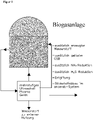
- the figure 1 shows schematically the method according to the invention.
- Liquid containing organic components is taken from a biogas plant. This liquid is first treated with ultrasound, then combined with US and plasma, and finally with plasma post-treated and returned to the biogas plant.
- the generated hydrogen can also be fed to the biogas plant to increase the CH 4 production or used externally. Detoxification is also achieved through NH 3 breakdown.
- Plasma e.g. microwave plasma
Landscapes
- Chemical & Material Sciences (AREA)
- Organic Chemistry (AREA)
- Engineering & Computer Science (AREA)
- Health & Medical Sciences (AREA)
- General Health & Medical Sciences (AREA)
- Inorganic Chemistry (AREA)
- Combustion & Propulsion (AREA)
- Life Sciences & Earth Sciences (AREA)
- Wood Science & Technology (AREA)
- Zoology (AREA)
- Genetics & Genomics (AREA)
- Bioinformatics & Cheminformatics (AREA)
- Biochemistry (AREA)
- General Engineering & Computer Science (AREA)
- Microbiology (AREA)
- Biotechnology (AREA)
- General Chemical & Material Sciences (AREA)
- Chemical Kinetics & Catalysis (AREA)
- Biomedical Technology (AREA)
- Physical Water Treatments (AREA)
Applications Claiming Priority (1)
| Application Number | Priority Date | Filing Date | Title |
|---|---|---|---|
| DE102021105704 | 2021-03-09 |
Publications (1)
| Publication Number | Publication Date |
|---|---|
| EP4056530A1 true EP4056530A1 (fr) | 2022-09-14 |
Family
ID=80999238
Family Applications (1)
| Application Number | Title | Priority Date | Filing Date |
|---|---|---|---|
| EP22161189.0A Pending EP4056530A1 (fr) | 2021-03-09 | 2022-03-09 | Procédés de traitement des liquides et/ou des suspensions et de génération de l'hydrogène à partir de composés chimiques contenant de l'hydrogène |
Country Status (1)
| Country | Link |
|---|---|
| EP (1) | EP4056530A1 (fr) |
Citations (7)
| Publication number | Priority date | Publication date | Assignee | Title |
|---|---|---|---|---|
| EP1173387A1 (fr) | 1999-04-23 | 2002-01-23 | Atlantium Ltd. | Procede de desinfection et de purification de liquides et gaz |
| EP1276556A2 (fr) | 2000-04-28 | 2003-01-22 | Battelle Memorial Institute | Appareil et procede de traitement d'un liquide aux ultrasons |
| DE10230897A1 (de) | 2002-07-09 | 2004-01-29 | Siemens Ag | Nachrichtenübertragungsverfahren und -system |
| DE202012010605U1 (de) | 2012-10-31 | 2013-01-17 | Graforce Hydro GmbH | Vorrichtung zur Spaltung von Wasser mit gezieltem Energieübertrag in das intramolekulare Wassernetzwerk |
| WO2014181284A1 (fr) | 2013-05-08 | 2014-11-13 | Insono S.R.L. | Réacteur pour accroitre la quantité de polyphénols et/ou la stabilité de turbidité d'huile d'olive extra-vierge, système et procédé utilisant ledit réacteur |
| DE102016002599A1 (de) | 2016-03-06 | 2017-09-07 | WindplusSonne GmbH | Vorrichtung und Verfahren zum Aggregieren von Feststoffpartikeln und -fasern eines Flüssigwerkstoffs |
| EP3603812A1 (fr) | 2018-07-31 | 2020-02-05 | Leibniz-Institut für Plasmaforschung und Technologie e.V. | Dispositif et procédé de modification chimio-physique de particules d'une suspension |
-
2022
- 2022-03-09 EP EP22161189.0A patent/EP4056530A1/fr active Pending
Patent Citations (8)
| Publication number | Priority date | Publication date | Assignee | Title |
|---|---|---|---|---|
| EP1173387A1 (fr) | 1999-04-23 | 2002-01-23 | Atlantium Ltd. | Procede de desinfection et de purification de liquides et gaz |
| DE60001230T2 (de) | 1999-04-23 | 2003-11-13 | Atlantium Ltd., Harey Yehuda | Methode und reaktor zur desinfektion und reinigung von flüssigkeiten und gasen |
| EP1276556A2 (fr) | 2000-04-28 | 2003-01-22 | Battelle Memorial Institute | Appareil et procede de traitement d'un liquide aux ultrasons |
| DE10230897A1 (de) | 2002-07-09 | 2004-01-29 | Siemens Ag | Nachrichtenübertragungsverfahren und -system |
| DE202012010605U1 (de) | 2012-10-31 | 2013-01-17 | Graforce Hydro GmbH | Vorrichtung zur Spaltung von Wasser mit gezieltem Energieübertrag in das intramolekulare Wassernetzwerk |
| WO2014181284A1 (fr) | 2013-05-08 | 2014-11-13 | Insono S.R.L. | Réacteur pour accroitre la quantité de polyphénols et/ou la stabilité de turbidité d'huile d'olive extra-vierge, système et procédé utilisant ledit réacteur |
| DE102016002599A1 (de) | 2016-03-06 | 2017-09-07 | WindplusSonne GmbH | Vorrichtung und Verfahren zum Aggregieren von Feststoffpartikeln und -fasern eines Flüssigwerkstoffs |
| EP3603812A1 (fr) | 2018-07-31 | 2020-02-05 | Leibniz-Institut für Plasmaforschung und Technologie e.V. | Dispositif et procédé de modification chimio-physique de particules d'une suspension |
Non-Patent Citations (7)
| Title |
|---|
| BUNDHOO ZUMAR M.A. ET AL: "Ultrasound-assisted biological conversion of biomass and waste materials to biofuels: A review", ULRASONICS SONOCHEMISTRY, vol. 40, 18 July 2017 (2017-07-18), GB, pages 298 - 313, XP055948539, ISSN: 1350-4177, DOI: 10.1016/j.ultsonch.2017.07.025 * |
| BYONG-HUN JEON ET AL: "Ultrasonic disintegration of microalgal biomass and consequent improvement of bioaccessibility/bioavailability in microbial fermentation", BIOTECHNOLOGY FOR BIOFUELS,, vol. 6, no. 1, 18 March 2013 (2013-03-18), pages 37, XP021145820, ISSN: 1754-6834, DOI: 10.1186/1754-6834-6-37 * |
| CRAVOTTO A ET AL: "ULTRASOUND-MICROWAVE COUPLING: AN EFFICIENT TOOL FOR CHEMICAL-PROCESS INTENSIFICATION", 26 March 2018 (2018-03-26), GPE-EPIC, 2nd International Congress on Green Process Engineering, 2nd European Process Intensification Conference 14-17 june 2009 - Venice (Italy), XP055948524, Retrieved from the Internet <URL:https://iris.unito.it/retrieve/e27ce42c-4963-2581-e053-d805fe0acbaa/GPE_EPIC%202009.pdf> [retrieved on 20220803] * |
| SYAHRIAL FADHLI ET AL: "Hydrogen Production from Glucose and Cellulose Using Radio Frequency In-Liquid Plasma and Ultrasonic Irradiation", NIHON ENERUGI GAKKAISHI - JOURNAL OF THE JAPAN INSTITUTE OF ENERGY, vol. 93, no. 11, 26 March 2014 (2014-03-26), JP, pages 1207 - 1212, XP055948521, ISSN: 0916-8753, DOI: 10.3775/jie.93.1207 * |
| SYAHRIAL FADHLI ET AL: "Synergetic effects of radio-frequency (RF) in-liquid plasma and ultrasonic vibration on hydrogen production from glucose", INTERNATIONAL JOURNAL OF HYDROGEN ENERGY, vol. 40, no. 35, 1 September 2015 (2015-09-01), AMSTERDAM, NL, pages 11399 - 11405, XP055948522, ISSN: 0360-3199, DOI: 10.1016/j.ijhydene.2015.04.152 * |
| WRIGHT ALEXANDER ET AL: "Plasma-assisted pre-treatment of lignocellulosic biomass for anaerobic digestion", FOOD AND BIOPRODUCTS PROCESSING, INSTITUTION OF CHEMICAL ENGINEERS, RUGBY, GB, vol. 124, 18 September 2020 (2020-09-18), pages 287 - 295, XP086351202, ISSN: 0960-3085, [retrieved on 20200918], DOI: 10.1016/J.FBP.2020.09.005 * |
| XUMING ZHANG ET AL: "The reformation of liquid hydrocarbons in an aqueous discharge reactor", JOURNAL OF PHYSICS D: APPLIED PHYSICS, INSTITUTE OF PHYSICS PUBLISHING, BRISTOL, GB, vol. 48, no. 21, 21 April 2015 (2015-04-21), pages 215201, XP020285078, ISSN: 0022-3727, [retrieved on 20150421], DOI: 10.1088/0022-3727/48/21/215201 * |
Similar Documents
| Publication | Publication Date | Title |
|---|---|---|
| DE60008252T2 (de) | Verfahren zur Behandlung von stabilisiertem in einem Abwasserbehandlungssystem erzeugten Schlamm | |
| EP3887318B1 (fr) | Procédé et dispositif de purification d'eau induite par plasma | |
| EP3197839B1 (fr) | Procédé et dispositif de traitement des eaux usées | |
| WO2009117754A1 (fr) | Procédé pour la production de biogaz | |
| EP1008556A2 (fr) | Procédé et dispositif pour la décontamination des eaux chargées de polluants | |
| EP4482790B1 (fr) | Procédé d'élimination et d'immobilisation du dioxyde de carbone de l'atmosphère et/ou d'un gaz d'échappement | |
| WO2007115660A2 (fr) | Procédé et dispositif de production d'engrais azotés à partir de substances biogènes | |
| Lippert et al. | Full-scale assessment of ultrasonic sewage sludge pretreatment using a novel double-tube reactor | |
| EP2794492A1 (fr) | Procédé pour traiter une liqueur résiduaire contenant des sulfures | |
| EP0808803A1 (fr) | Procédé et dispositif pour la désintégration continuelle de boue activée | |
| EP3393624B1 (fr) | Procédé et dispositif servant au dégazage sélectif du méthane d'un liquide de lavage | |
| DE19532802C1 (de) | Verfahren und Vorrichtung zur Verwertung von Schleifschlämmen | |
| DE102008042461B3 (de) | Verfahren und Vorrichtung zur Behandlung biogener Stoffe zur Erzeugung von Biogas | |
| EP4056530A1 (fr) | Procédés de traitement des liquides et/ou des suspensions et de génération de l'hydrogène à partir de composés chimiques contenant de l'hydrogène | |
| EP3118167A1 (fr) | Procede et installation de traitement d'eaux usees contenant de l'ammonium | |
| DE4030668A1 (de) | Verfahren und anlage zum minimieren von biologischem schlamm | |
| DE4204607C2 (de) | Verfahren und Vorrichtung zur biologischen Abwasserreinigung | |
| EP4368695A1 (fr) | Procédé et dispositif pour le traitement de substrats organiques liquides dans des installations et processus anaérobies par combinaison de traitement mécanique, sous vide, par ultrasons et par plasma en plusieurs étapes | |
| DE102004017975A1 (de) | Verfahren und Vorrichtung zum Aufschluss von organischem Material in einem fließfähigen Stoffsystem | |
| DE102019131391A1 (de) | Verfahren zur Klärschlammaufbereitung sowie Klärschlammanlage | |
| DE102019123990A1 (de) | Vorrichtung und Verfahren zur Konzentration der Energiedichte für eine Hochleistungs-Ultraschallbehandlung von Suspensionen und Flüssigkeiten | |
| Nykyforov et al. | Energy and Fertilizer Recovery from Cavitated Cyanobacterial Slurries | |
| DE102021129443A1 (de) | Verfahren und vorrichtung zur aufbereitung von flüssigen organischen substraten in anaeroben anlagen und prozessen mittels verknüpfung von mechanischer, vacuum- sowie mehrstufiger ultraschall- und plasma behandlung | |
| DE10118839B4 (de) | Bioreaktor | |
| DE10322119A1 (de) | Verfahren und Vorrichtung zur intensivierten Biogasgewinnung |
Legal Events
| Date | Code | Title | Description |
|---|---|---|---|
| PUAI | Public reference made under article 153(3) epc to a published international application that has entered the european phase |
Free format text: ORIGINAL CODE: 0009012 |
|
| STAA | Information on the status of an ep patent application or granted ep patent |
Free format text: STATUS: THE APPLICATION HAS BEEN PUBLISHED |
|
| AK | Designated contracting states |
Kind code of ref document: A1 Designated state(s): AL AT BE BG CH CY CZ DE DK EE ES FI FR GB GR HR HU IE IS IT LI LT LU LV MC MK MT NL NO PL PT RO RS SE SI SK SM TR |
|
| STAA | Information on the status of an ep patent application or granted ep patent |
Free format text: STATUS: REQUEST FOR EXAMINATION WAS MADE |
|
| 17P | Request for examination filed |
Effective date: 20230314 |
|
| RBV | Designated contracting states (corrected) |
Designated state(s): AL AT BE BG CH CY CZ DE DK EE ES FI FR GB GR HR HU IE IS IT LI LT LU LV MC MK MT NL NO PL PT RO RS SE SI SK SM TR |