EP4057065A1 - Verfahren zur musterübertragung - Google Patents
Verfahren zur musterübertragung Download PDFInfo
- Publication number
- EP4057065A1 EP4057065A1 EP21161882.2A EP21161882A EP4057065A1 EP 4057065 A1 EP4057065 A1 EP 4057065A1 EP 21161882 A EP21161882 A EP 21161882A EP 4057065 A1 EP4057065 A1 EP 4057065A1
- Authority
- EP
- European Patent Office
- Prior art keywords
- substrate
- molding layer
- template
- imprint
- temperature
- Prior art date
- Legal status (The legal status is an assumption and is not a legal conclusion. Google has not performed a legal analysis and makes no representation as to the accuracy of the status listed.)
- Withdrawn
Links
Images

Classifications
-
- B—PERFORMING OPERATIONS; TRANSPORTING
- B29—WORKING OF PLASTICS; WORKING OF SUBSTANCES IN A PLASTIC STATE IN GENERAL
- B29C—SHAPING OR JOINING OF PLASTICS; SHAPING OF MATERIAL IN A PLASTIC STATE, NOT OTHERWISE PROVIDED FOR; AFTER-TREATMENT OF THE SHAPED PRODUCTS, e.g. REPAIRING
- B29C59/00—Surface shaping of articles, e.g. embossing; Apparatus therefor
- B29C59/002—Component parts, details or accessories; Auxiliary operations
-
- G—PHYSICS
- G03—PHOTOGRAPHY; CINEMATOGRAPHY; ANALOGOUS TECHNIQUES USING WAVES OTHER THAN OPTICAL WAVES; ELECTROGRAPHY; HOLOGRAPHY
- G03F—PHOTOMECHANICAL PRODUCTION OF TEXTURED OR PATTERNED SURFACES, e.g. FOR PRINTING, FOR PROCESSING OF SEMICONDUCTOR DEVICES; MATERIALS THEREFOR; ORIGINALS THEREFOR; APPARATUS SPECIALLY ADAPTED THEREFOR
- G03F7/00—Photomechanical, e.g. photolithographic, production of textured or patterned surfaces, e.g. printing surfaces; Materials therefor, e.g. comprising photoresists; Apparatus specially adapted therefor
- G03F7/0002—Lithographic processes using patterning methods other than those involving the exposure to radiation, e.g. by stamping
-
- B—PERFORMING OPERATIONS; TRANSPORTING
- B29—WORKING OF PLASTICS; WORKING OF SUBSTANCES IN A PLASTIC STATE IN GENERAL
- B29C—SHAPING OR JOINING OF PLASTICS; SHAPING OF MATERIAL IN A PLASTIC STATE, NOT OTHERWISE PROVIDED FOR; AFTER-TREATMENT OF THE SHAPED PRODUCTS, e.g. REPAIRING
- B29C59/00—Surface shaping of articles, e.g. embossing; Apparatus therefor
- B29C59/02—Surface shaping of articles, e.g. embossing; Apparatus therefor by mechanical means, e.g. pressing
- B29C59/026—Surface shaping of articles, e.g. embossing; Apparatus therefor by mechanical means, e.g. pressing of layered or coated substantially flat surfaces
-
- B—PERFORMING OPERATIONS; TRANSPORTING
- B29—WORKING OF PLASTICS; WORKING OF SUBSTANCES IN A PLASTIC STATE IN GENERAL
- B29K—INDEXING SCHEME ASSOCIATED WITH SUBCLASSES B29B, B29C OR B29D, RELATING TO MOULDING MATERIALS OR TO MATERIALS FOR MOULDS, REINFORCEMENTS, FILLERS OR PREFORMED PARTS, e.g. INSERTS
- B29K2023/00—Use of polyalkenes or derivatives thereof as moulding material
- B29K2023/38—Polymers of cycloalkenes, e.g. norbornene or cyclopentene
-
- B—PERFORMING OPERATIONS; TRANSPORTING
- B29—WORKING OF PLASTICS; WORKING OF SUBSTANCES IN A PLASTIC STATE IN GENERAL
- B29K—INDEXING SCHEME ASSOCIATED WITH SUBCLASSES B29B, B29C OR B29D, RELATING TO MOULDING MATERIALS OR TO MATERIALS FOR MOULDS, REINFORCEMENTS, FILLERS OR PREFORMED PARTS, e.g. INSERTS
- B29K2025/00—Use of polymers of vinyl-aromatic compounds or derivatives thereof as moulding material
- B29K2025/04—Polymers of styrene
- B29K2025/06—PS, i.e. polystyrene
-
- B—PERFORMING OPERATIONS; TRANSPORTING
- B29—WORKING OF PLASTICS; WORKING OF SUBSTANCES IN A PLASTIC STATE IN GENERAL
- B29K—INDEXING SCHEME ASSOCIATED WITH SUBCLASSES B29B, B29C OR B29D, RELATING TO MOULDING MATERIALS OR TO MATERIALS FOR MOULDS, REINFORCEMENTS, FILLERS OR PREFORMED PARTS, e.g. INSERTS
- B29K2067/00—Use of polyesters or derivatives thereof, as moulding material
- B29K2067/003—PET, i.e. poylethylene terephthalate
-
- B—PERFORMING OPERATIONS; TRANSPORTING
- B29—WORKING OF PLASTICS; WORKING OF SUBSTANCES IN A PLASTIC STATE IN GENERAL
- B29K—INDEXING SCHEME ASSOCIATED WITH SUBCLASSES B29B, B29C OR B29D, RELATING TO MOULDING MATERIALS OR TO MATERIALS FOR MOULDS, REINFORCEMENTS, FILLERS OR PREFORMED PARTS, e.g. INSERTS
- B29K2069/00—Use of PC, i.e. polycarbonates or derivatives thereof, as moulding material
-
- B—PERFORMING OPERATIONS; TRANSPORTING
- B29—WORKING OF PLASTICS; WORKING OF SUBSTANCES IN A PLASTIC STATE IN GENERAL
- B29K—INDEXING SCHEME ASSOCIATED WITH SUBCLASSES B29B, B29C OR B29D, RELATING TO MOULDING MATERIALS OR TO MATERIALS FOR MOULDS, REINFORCEMENTS, FILLERS OR PREFORMED PARTS, e.g. INSERTS
- B29K2105/00—Condition, form or state of moulded material or of the material to be shaped
- B29K2105/0085—Copolymers
-
- B—PERFORMING OPERATIONS; TRANSPORTING
- B29—WORKING OF PLASTICS; WORKING OF SUBSTANCES IN A PLASTIC STATE IN GENERAL
- B29K—INDEXING SCHEME ASSOCIATED WITH SUBCLASSES B29B, B29C OR B29D, RELATING TO MOULDING MATERIALS OR TO MATERIALS FOR MOULDS, REINFORCEMENTS, FILLERS OR PREFORMED PARTS, e.g. INSERTS
- B29K2995/00—Properties of moulding materials, reinforcements, fillers, preformed parts or moulds
- B29K2995/0012—Properties of moulding materials, reinforcements, fillers, preformed parts or moulds having particular thermal properties
-
- B—PERFORMING OPERATIONS; TRANSPORTING
- B29—WORKING OF PLASTICS; WORKING OF SUBSTANCES IN A PLASTIC STATE IN GENERAL
- B29K—INDEXING SCHEME ASSOCIATED WITH SUBCLASSES B29B, B29C OR B29D, RELATING TO MOULDING MATERIALS OR TO MATERIALS FOR MOULDS, REINFORCEMENTS, FILLERS OR PREFORMED PARTS, e.g. INSERTS
- B29K2995/00—Properties of moulding materials, reinforcements, fillers, preformed parts or moulds
- B29K2995/0037—Other properties
- B29K2995/0077—Yield strength; Tensile strength
Definitions
- the present disclosure relates to the field of pattern transfer, wherein a structured surface of a template is brought into contact with a moldable layer of a target surface of a substrate.
- the solutions relate to methods where heat is applied in the pattern transfer process.
- the proposed solutions may e.g. be employed in imprint lithography.
- nanoimprint lithography an inverted copy of the surface pattern of a template is transferred into an object, comprising a substrate having a moldable surface layer.
- the substrate may be entirely formed of a moldable material.
- the substrate may comprise a carrier body onto which the moldable layer, often called a resist, is applied.
- the moldable layer comprises a photo-resist material, i.e. a material which is sensitive to radiation.
- a photo-resist material i.e. a material which is sensitive to radiation.
- An example is a polymer or a pre-polymer which is cured into a polymer by cross-linking upon exposure to e.g. ultraviolet (UV) radiation. This requires that either the substrate or the stamp is transparent to the applied radiation.
- heat is used in the pattern transfer process, such as to soften or liquify the moldable layer.
- the patterned surface of the template is placed in contact with the moldable layer, such that the template and the substrate form a sandwich arrangement.
- a suitable temperature such as above a glass transition temperature of a polymer material of the moldable layer
- the template is pressed towards the moldable layer such that an imprint of the template pattern is formed or embossed in the moldable layer.
- cooling so as to solidify the imprinted moldable layer, before dismembering of the template from the substrate. Further post processing of the patterned substrate may take place.
- the template and the substrate, or at least the moldable layer are made of different materials.
- the heat coefficient of these materials may be quite different, such that the relative expansion or contraction between the molding step temperature and the temperature at which the dismantling of the substrate takes place, may be different.
- cooling may be carried out at a controlled rate.
- handling of the sandwich material at the elevated molding step temperature normally well over 100 degrees Celsius, is typically problematic.
- the sandwich arrangement is therefore normally allowed to cool down before being removed from the imprint machine passed forward for dismantling. As a result, the imprint process is a time-consuming process.
- the proposed solution provides a method for transferring a pattern of a structured surface of a template onto a target surface of a substrate, comprising:
- imprint process refers to a process for the creation of an inverted copy of a surface pattern of a template or stamp, which is generated by pressing the stamp into a moldable layer, such as a polymer or pre-polymer, in order to deform the layer.
- a moldable layer such as a polymer or pre-polymer
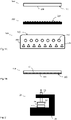
- Fig. 1A schematically illustrates various elements that may be involved in an imprint process. It shall be noted, though, that other elements may typically also be involved, some of which will be mentioned in reference, but which do not form part of the substantial elements of the proposed solution.
- the object of the imprint process is to create a structured pattern of intended shape and dimension in the surface of an object.
- this object is referred to as a substrate 100, and is illustrated as a substantially flat sheet or disc.
- other shapes of the substrate are plausible, e.g. with a curved surface.
- the substrate 100 has a target surface 110, onto which the pattern is to be created.
- the target surface 110 forms a moldable layer 120, in which the pattern may be formed.
- the substrate has an integral structure, in which the entire substrate 100 is made of the same material.
- the moldable layer 120 may thus be seen as a surface layer part of the substrate 100, e.g. defined as a portion stretching from the target surface 110 of the substrate down to a certain depth into the bulk of the substrate 100.
- the moldable layer 120 may be provided as a coating on a carrier element 130.
- the application of the moldable layer 120 as a separate layer may be carried out in a separate prior process, or immediately before the imprint process.
- material types usable in the proposed method will be described in various places below.
- the template 200 is a master which has a structured surface 210.
- the shape of the structures in the surface 210 are formed as an inverse of the intended pattern to be created on the substrate 100.
- the template 200 may be of any material which remains solid in the temperatures at which the imprint process may take place.
- the template may be made of a metal, glass, a transparent crystal material etc.
- the template 300 may be made of a flexible material, such as a polymer.
- a temperature-regulated support element 300 may be used in an imprint process of the proposed method.
- the support element 300 may serve as a direct support to the template or the substrate during the imprint process.
- the support element 300 may thus serve as a counter element for providing pressure when the template 200 and the substrate 100 are pressed together in the imprint apparatus.
- the support element may comprise, or be connected to, a heating element 320.
- the heating element may e.g. comprise an electric heating mechanism, with heating electrodes incorporated in or connected to the support element 300. In operation, heat may be provided by means of the heating element 320, so as to elevate the temperature of the support element 300 in a controlled manner.
- the support element 300 may optionally comprise a cooling element 330, such as ducts for a cooling fluid, formed in the support element 300.
- Fig. 2 schematically illustrates an imprint apparatus 20, in which an imprint process may be carried out.
- the imprint apparatus may comprise a frame structure 21, which holds or supports the support element 300 at an imprint position.
- a pressure member 22 is suspended adjacent the support element 300, and is connected to the frame structure 21 such that the pressure member 22 and the support member 300 may be displaced away from each other for loading of a substrate 100 and a template 200 in an imprint position 24.
- the pressure member 24 may subsequently be operated to apply pressure during the imprint process, so as to press the substrate 100 and the template together.
- the imprint apparatus may further comprise a control mechanism (not shown) for controlling heating and cooling of the support element 300 during the imprint process, and for controlling the applied pressure.
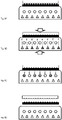
- Figs 3A-3D schematically illustrate various steps carried out in an imprint process according to the state of the art.
- Fig. 3A the substrate 100 and the template 200 are placed together in a sandwich arrangement and placed at the support element 300. While these drawings show the substrate 100 on top of the template 200, the opposite arrangement may alternatively be used in some embodiments.
- thermoplastic polymer a thermoplastic polymer
- Tg a glass transition temperature of the thermoplastic polymer of the substrate 100.
- pressure is further applied such that the structure of the patterned template surface 210 is embossed in the moldable substrate layer of the substrate 100, so as to make an imprint of the pattern.
- the cooling element 330 is operated to cool down the entire sandwich arrangement of the substrate 100 and the template 200. This may be carried out while maintaining pressure, so as to ensure that the intended pattern transfer is obtained. Where the moldable layer of the substrate 100 is a thermoplastic polymer, cooling may be carried out until a temperature T ⁇ Tg or lower is reached.
- Fig. 3D schematically illustrates that, after cooling, the sandwich arrangement may be taken out from the imprint position, and dismembered.
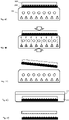
- Figs 4A-4E schematically illustrate various steps of an imprint process according to the proposed solution.
- the process steps carried out in Figs 4A and 4B may be similar to the process steps of Figs 3A and 3B .
- the substrate 100 may include a thermoplastic polymer and is placed in contact with the patterned surface 210 of the template 200, in a sandwich arrangement. This may be carried out prior to placing the sandwich arrangement in contact with the support element 300 in the imprint machine 20.
- the substrate 100 may be entirely formed of the thermoplastic material, or the thermoplastic material 120 may be a coating provided on a carrier element 130, wherein the carrier element 130 may be formed of a different material.
- Fig. 4A the substrate 100 and the template 200 are shown when placed together in a sandwich arrangement onto the support element 300. While these drawings show the substrate 100 on top of the template 200, the opposite arrangement may alternatively be used in some embodiments.
- the support element 300 acts as a temperature-regulated heater block, provided in the imprint apparatus 20.
- heat is applied using the heating element 320.
- the moldable layer of the substrate 100 may be affected to soften.
- heat is applied to raise the temperature T in the support element 300, and in consequence the substrate 100, so as to exceed a glass transition temperature Tg of the thermoplastic polymer of the substrate 100.
- pressure is further applied such that the structure of the patterned template surface 210 is embossed in the moldable substrate layer of the substrate 100, so as to make an imprint of the pattern.
- Fig. 4C illustrates that, in contrast to the method of Fig. 3 , the combined substrate 100 and template 200 sandwich arrangement is removed from the support element, without or substantially without cooling, thus holding a raised temperature T>Tg.
- Fig. 4D further illustrates that instead of cooling the sandwich arrangement by means of the support element 300, the combined substrate 100 and template 200 are subsequently subjected to a cooling environment, preferably a liquid bath provided by a cooling liquid 40 in a vessel 41, which holds a temperature T ⁇ Tg.
- a cooling environment preferably a liquid bath provided by a cooling liquid 40 in a vessel 41, which holds a temperature T ⁇ Tg.
- Fig. 4E illustrates that, after removing the combined substrate 100 and template 200 from the liquid bath, the imprinted substrate 100 is dismembered from the template 200. This may e.g. be carried out by means of a peeling process.
- the patterned substrate 100 can subsequently be used as a new template in a second pattern transfer process, or e.g. for forming components onto the substrate 100.
- the invention as defined by these steps provides improved process efficiency.
- One technical effect is that the cooling step is shortened.
- the process is simplified since no cooling arrangement in the imprint apparatus is required or needs controlling.
- Fig. 5 shows a flowchart comprising various process steps of a method for transferring a pattern of a structured surface 210 of a template 200 onto a target surface 110 of a substrate 100.
- step S510 the template 200 and the substrate 100 are provided in a sandwich arrangement with the structured 210 surface in contact with the target surface 110, into an imprint machine 20.
- step S520 heat is applied to soften a molding layer 100, 120 on the substrate surface 110.
- the target temperature is typically dependent on the material of the moldable layer of the target surface 110.
- step S530 the sandwich arrangement is pressed together to imprint the pattern into the heated molding layer.
- step S540 the pressure is released upon which the sandwich structure is removed from the imprint position of the imprint machine. This may be carried out by an automatic discharge mechanism, or potentially manually. Heating of the support element 300 may also be terminated, e.g. just before or in conjunction with pressure release.
- step S550 the sandwich arrangement is subjected to a cooling liquid, such as by being submerged into a liquid bath, to harden the molding layer of the substrate 100.
- step S560 the sandwich structure is dismantled so as to separate the template 200 from the now patterned substrate 100. This step may be carried out after first removing the sandwich structure from the liquid bath.
- the molding layer comprises a thermoplastic polymer.
- the moldable layer 120 of the substrate may be formed of a material selected from polymethylmethacrylate (PMMA), cyclic olefin copolymer (COC), polycarbonate (PC), polyester terephthalate (PET), polystyrene (PS), polyvinyl alcohol (PVA), polypropylene (PP) or other.
- the substrate 100 is entirely formed of a thermoplastic polymer, which forms the moldable layer 120.
- the material of the substrate may e.g. be one of PC, PMMA, COC polymer, PS, or PP.
- the molding layer 120 is a coating provided on a substrate carrier element 130, formed of a different material than said molding layer 120.
- the carrier may be formed of one, or a combination, of metal, Silicon, Quartz, and polymers capable of withstanding Tg of the functional material of the molding layer 120.
- the substrate 100 may be formed of a composite material, e.g. reinforced plastics such as glass reinforced PP, wherein the composite material comprises a thermoplastic material.
- the step of applying heat comprises heating the sandwich structure to a temperature T1 which exceeds a glass transition temperature Tg of the thermoplastic polymer.
- the thermoplastic polymer may be a crystalline thermoplastic.
- the step of applying heat may comprise heating the sandwich structure to a temperature T1 which exceeds a melting point of the crystalline thermoplastics.
- the cooling liquid 40 holds a temperature T2 which is lower than Tg, and wherein the step of submerging is carried out when the sandwich structure holds a temperature exceeding Tg.
- the cooling liquid comprises one or more components selected from water, alcohols, toluene, solvents like acetone, etc.
- imprint is carried out using a nickel template 200 having a surface 219 which exhibits a BluRay pattern having structure heights in the range of 100nm and widths in the range of 150 nm.
- the pattern is imprinted into substrate 100 in the form of a Zeonor ZF14 foil, which is a COC (Cyclo-olefin Coploymer) from ZEOn Chemicals, at 150°C at 50 bar for 3 min in an imprint machine 20.
- the Zeonor foil along with the Ni template was unloaded from the imprint machine 20 and immersed into a bath of water at about room temperature of 15-25°C, such as 19°C.
- the cooling to well below a glass transition temperature T g is substantially instantaneous, and occurs with a few milliseconds.
- the sandwiched template and substrate may be maintained in the bath for a time which is sufficient, given the water temperature, such as at least 3 in the present example.
- the substrate 100 was thereafter dismembered from the template 200.
- a Silicon template 200 with nano-patterned pillars with diameter of 340 nm and depth of 470 nm has been imprinted into a PC (Markofol foils) substrate 100 at 170°C at 35 bar for 5 minutes.
- the imprint was then cooled to 160°C, using a cooling element 320 in the support element 300.
- the purpose of this pre-cooling stage is to bring the sandwich structure, comprising the template and the substrate, closer to the T g of the PC (about 145°C) before quenching. This may be particularly beneficial for finer patterns, such as the patterns transferred in this example, and serves to avoid a distortion in the structures which may be caused by quenching from higher temperatures.
- the sandwich structure comprising the PC substrate 100 along with the silicon template 200 was unloaded from the imprint machine and immersed into a bath of 15% by volume iso-propyl alcohol (IPA) in water at a temperature of 90°C. Again, this is a pattern specific solution.
- IPA iso-propyl alcohol
- the cooling is substantially instantaneous, yet only from 160 C - 90 C. Lower bath temperatures could risk distorting the structures.
- the substrate 100 was thereafter dismembered from the template 200.
- the substrate comprises a quartz substrate carrier 130.
- the quartz carrier 130 was spin coated with mr-I PMMA (Microresist GmbH) to form a moldable layer 120.
- a Ni template 200 whose surface exhibits a line pattern having a width of 80 nm and a height of 90 nm has been used to imprint the pattern into the PMMA coated substrate 100.
- the Ni surface was pre-treated to obtain a low surface energy, preferably less than 18mN/m.
- the imprint was performed at 165°C for 5 min.
- the sandwich arrangement including the template 200 and PMMA coated quartz substrate 100 were removed from the imprint machine and immersed into a bath of 5% by volume acetone mixed with water at 5°C.
- the substantially instant cooling only requires a few milliseconds, however the act of dropping it and removing from the solution may be carried out in about 3-5 seconds in total.
- Acetone has low boiling point, hence an arbitrary value much below room temperature was chosen for the experiment.
- the functional layer of PMMA could be cooled through the Quartz carrier and hence a temperature much below RT may be used.
- the substrate 100 was thereafter dismembered from the template 200.
- the corresponding process may comprise the following steps:
- time saved could vary from 120 - 720 secs per process.
- One of the reasons for this is that there is only one required step of heating up over the glass transition temperature of the system since cooling is carried out after the sandwich structure is removed from the imprint machine. This means there is no required cyclic heating and cooling between successive imprint steps.
- the cooling liquid composition used in the bath for quenching may in various embodiments comprise water.
- a solvent is added, having a lower boiling point than water, such as acetone or IPA.
- the solvent may be added to a composition of 5-10% of weight. The use of such a solvent may be beneficial when the substrate is comparatively thick, and a higher thermal energy needs to be extracted in the instant cooling.
Landscapes
- Physics & Mathematics (AREA)
- General Physics & Mathematics (AREA)
- Engineering & Computer Science (AREA)
- Mechanical Engineering (AREA)
- Shaping Of Tube Ends By Bending Or Straightening (AREA)
- Exposure Of Semiconductors, Excluding Electron Or Ion Beam Exposure (AREA)
Priority Applications (6)
| Application Number | Priority Date | Filing Date | Title |
|---|---|---|---|
| EP21161882.2A EP4057065A1 (de) | 2021-03-10 | 2021-03-10 | Verfahren zur musterübertragung |
| US18/549,312 US12515394B2 (en) | 2021-03-10 | 2022-03-05 | Method for facilitating demolding upon pattern transfer |
| PCT/EP2022/055653 WO2022189313A1 (en) | 2021-03-10 | 2022-03-05 | Method for facilitating demolding upon pattern transfer |
| DE112022001478.4T DE112022001478T5 (de) | 2021-03-10 | 2022-03-05 | Verfahren zur Erleichterung der Entformung bei der Musterübertragung |
| JP2023555374A JP2024509943A (ja) | 2021-03-10 | 2022-03-05 | パターン転写時の離型を容易にするための方法 |
| CN202280020377.6A CN117063120A (zh) | 2021-03-10 | 2022-03-05 | 在图案转印时有助于脱模的方法 |
Applications Claiming Priority (1)
| Application Number | Priority Date | Filing Date | Title |
|---|---|---|---|
| EP21161882.2A EP4057065A1 (de) | 2021-03-10 | 2021-03-10 | Verfahren zur musterübertragung |
Publications (1)
| Publication Number | Publication Date |
|---|---|
| EP4057065A1 true EP4057065A1 (de) | 2022-09-14 |
Family
ID=74870779
Family Applications (1)
| Application Number | Title | Priority Date | Filing Date |
|---|---|---|---|
| EP21161882.2A Withdrawn EP4057065A1 (de) | 2021-03-10 | 2021-03-10 | Verfahren zur musterübertragung |
Country Status (6)
| Country | Link |
|---|---|
| US (1) | US12515394B2 (de) |
| EP (1) | EP4057065A1 (de) |
| JP (1) | JP2024509943A (de) |
| CN (1) | CN117063120A (de) |
| DE (1) | DE112022001478T5 (de) |
| WO (1) | WO2022189313A1 (de) |
Families Citing this family (1)
| Publication number | Priority date | Publication date | Assignee | Title |
|---|---|---|---|---|
| TW202415843A (zh) * | 2022-06-23 | 2024-04-16 | 瑞典商瑟拉羅克創新有限公司 | 用於製造包含空腔之板元件的製程及配置 |
Citations (2)
| Publication number | Priority date | Publication date | Assignee | Title |
|---|---|---|---|---|
| JPS57102316A (en) * | 1980-12-18 | 1982-06-25 | Nitsusen Kagaku Kogyo Kk | Production of shaped polymer sheet |
| US20110085949A1 (en) * | 2009-10-08 | 2011-04-14 | Emmanuel Roy | Microfluidic device, composition and method of forming |
Family Cites Families (2)
| Publication number | Priority date | Publication date | Assignee | Title |
|---|---|---|---|---|
| EP2138896B1 (de) * | 2008-06-25 | 2014-08-13 | Obducat AB | Nanoimprint-Vorrichtung und Verfahren |
| WO2010088765A1 (en) * | 2009-02-04 | 2010-08-12 | The Governing Council Of The University Of Toronto | Method for producing a stamp for hot embossing |
-
2021
- 2021-03-10 EP EP21161882.2A patent/EP4057065A1/de not_active Withdrawn
-
2022
- 2022-03-05 WO PCT/EP2022/055653 patent/WO2022189313A1/en not_active Ceased
- 2022-03-05 JP JP2023555374A patent/JP2024509943A/ja active Pending
- 2022-03-05 DE DE112022001478.4T patent/DE112022001478T5/de active Pending
- 2022-03-05 US US18/549,312 patent/US12515394B2/en active Active
- 2022-03-05 CN CN202280020377.6A patent/CN117063120A/zh active Pending
Patent Citations (2)
| Publication number | Priority date | Publication date | Assignee | Title |
|---|---|---|---|---|
| JPS57102316A (en) * | 1980-12-18 | 1982-06-25 | Nitsusen Kagaku Kogyo Kk | Production of shaped polymer sheet |
| US20110085949A1 (en) * | 2009-10-08 | 2011-04-14 | Emmanuel Roy | Microfluidic device, composition and method of forming |
Non-Patent Citations (2)
| Title |
|---|
| EMMANUEL ROY ET AL: "Prototyping of microfluidic systems using a commercial thermoplastic elastomer", MICROFLUIDICS AND NANOFLUIDICS, SPRINGER, BERLIN, DE, vol. 11, no. 3, 26 March 2011 (2011-03-26), pages 235 - 244, XP019936131, ISSN: 1613-4990, DOI: 10.1007/S10404-011-0789-2 * |
| YU CHEN-CHIEH ET AL: "Nanoimprint technology for patterning functional materials and its applications", MICROELECTRONIC ENGINEERING, ELSEVIER PUBLISHERS BV., AMSTERDAM, NL, vol. 132, 23 October 2014 (2014-10-23), pages 98 - 119, XP029100136, ISSN: 0167-9317, DOI: 10.1016/J.MEE.2014.10.015 * |
Also Published As
| Publication number | Publication date |
|---|---|
| WO2022189313A1 (en) | 2022-09-15 |
| US12515394B2 (en) | 2026-01-06 |
| JP2024509943A (ja) | 2024-03-05 |
| CN117063120A (zh) | 2023-11-14 |
| DE112022001478T5 (de) | 2024-01-25 |
| US20240165870A1 (en) | 2024-05-23 |
Similar Documents
| Publication | Publication Date | Title |
|---|---|---|
| JP5276436B2 (ja) | 中間スタンプによるパターン複製 | |
| JP5002422B2 (ja) | ナノプリント用樹脂スタンパ | |
| CN1979336B (zh) | 具有中间模具的图案复制用装置 | |
| Lan et al. | UV-nanoimprint lithography: structure, materials and fabrication of flexible molds | |
| EP1594001B1 (de) | Gerät und Verfahren für die Imprint-Lithographie | |
| KR101366505B1 (ko) | 고리형 올레핀 공중합체를 포함하는 임프린트 스탬프 | |
| JP2008542081A5 (de) | ||
| EP3025195B1 (de) | Strukturstempelherstellungsverfahren, strukturstempel, und strukturstempelprägeverfahren | |
| EP2138896B1 (de) | Nanoimprint-Vorrichtung und Verfahren | |
| US20090120904A1 (en) | Method and device for manufacturing structure having pattern, and method for manufacturing mold | |
| US12515394B2 (en) | Method for facilitating demolding upon pattern transfer | |
| JP2008023868A (ja) | エネルギ線硬化型樹脂の転写方法、転写装置及びディスクまたは半導体デバイス | |
| JP6491928B2 (ja) | レプリカモールドおよびその製造方法 | |
| KR100724598B1 (ko) | 열가소성 고분자 필름을 이용한 나노 임프린트용 스탬프제조 방법 | |
| KR101270082B1 (ko) | 인터미디어트 스탬프를 갖는 패턴 복제를 위한 장치 | |
| KR100949603B1 (ko) | 자외선 경화와 나노 패턴 삽입 사출성형을 이용한 나노패턴이 형성된 사출성형물의 제조방법 | |
| Li et al. | Soft substrate as a sacrificial layer for fabrication free-standing SU-8-based nanofluidic system | |
| Kang et al. | Continuous roll nano-imprinting technology for large-scale nano-and microstructures | |
| HK1107804B (en) | Apparatus and method for transferring a pattern with intermediate stamp | |
| HK1121243B (en) | Pattern replication with intermediate stamp |
Legal Events
| Date | Code | Title | Description |
|---|---|---|---|
| PUAI | Public reference made under article 153(3) epc to a published international application that has entered the european phase |
Free format text: ORIGINAL CODE: 0009012 |
|
| STAA | Information on the status of an ep patent application or granted ep patent |
Free format text: STATUS: THE APPLICATION HAS BEEN PUBLISHED |
|
| AK | Designated contracting states |
Kind code of ref document: A1 Designated state(s): AL AT BE BG CH CY CZ DE DK EE ES FI FR GB GR HR HU IE IS IT LI LT LU LV MC MK MT NL NO PL PT RO RS SE SI SK SM TR |
|
| RIN1 | Information on inventor provided before grant (corrected) |
Inventor name: KRISHNAN, PRASANNA VENKATESH |
|
| STAA | Information on the status of an ep patent application or granted ep patent |
Free format text: STATUS: THE APPLICATION IS DEEMED TO BE WITHDRAWN |
|
| 18D | Application deemed to be withdrawn |
Effective date: 20230315 |