EP4059596A1 - Procédé de production de méthanol à partir de co2 avec élimination de l'eau - Google Patents
Procédé de production de méthanol à partir de co2 avec élimination de l'eau Download PDFInfo
- Publication number
- EP4059596A1 EP4059596A1 EP21162811.0A EP21162811A EP4059596A1 EP 4059596 A1 EP4059596 A1 EP 4059596A1 EP 21162811 A EP21162811 A EP 21162811A EP 4059596 A1 EP4059596 A1 EP 4059596A1
- Authority
- EP
- European Patent Office
- Prior art keywords
- reactor
- methanol
- process according
- solid sorbent
- water
- Prior art date
- Legal status (The legal status is an assumption and is not a legal conclusion. Google has not performed a legal analysis and makes no representation as to the accuracy of the status listed.)
- Withdrawn
Links
- OKKJLVBELUTLKV-UHFFFAOYSA-N Methanol Chemical compound OC OKKJLVBELUTLKV-UHFFFAOYSA-N 0.000 title claims abstract description 283
- 238000000034 method Methods 0.000 title claims abstract description 60
- XLYOFNOQVPJJNP-UHFFFAOYSA-N water Substances O XLYOFNOQVPJJNP-UHFFFAOYSA-N 0.000 title claims abstract description 35
- 238000004519 manufacturing process Methods 0.000 title claims abstract description 30
- 239000002594 sorbent Substances 0.000 claims abstract description 75
- 239000007787 solid Substances 0.000 claims abstract description 46
- 239000003054 catalyst Substances 0.000 claims abstract description 38
- 239000002245 particle Substances 0.000 claims abstract description 38
- 238000006243 chemical reaction Methods 0.000 claims abstract description 37
- 239000000203 mixture Substances 0.000 claims abstract description 24
- 238000011065 in-situ storage Methods 0.000 claims abstract description 17
- 230000003197 catalytic effect Effects 0.000 claims abstract description 11
- 239000007795 chemical reaction product Substances 0.000 claims abstract description 11
- 238000011066 ex-situ storage Methods 0.000 claims abstract description 6
- 239000007789 gas Substances 0.000 claims description 60
- VNWKTOKETHGBQD-UHFFFAOYSA-N methane Chemical compound C VNWKTOKETHGBQD-UHFFFAOYSA-N 0.000 claims description 31
- 238000003786 synthesis reaction Methods 0.000 claims description 25
- 230000015572 biosynthetic process Effects 0.000 claims description 21
- 230000008929 regeneration Effects 0.000 claims description 16
- 238000011069 regeneration method Methods 0.000 claims description 16
- 239000000376 reactant Substances 0.000 claims description 15
- VYPSYNLAJGMNEJ-UHFFFAOYSA-N Silicium dioxide Chemical compound O=[Si]=O VYPSYNLAJGMNEJ-UHFFFAOYSA-N 0.000 claims description 14
- 239000000463 material Substances 0.000 claims description 11
- PNEYBMLMFCGWSK-UHFFFAOYSA-N aluminium oxide Inorganic materials [O-2].[O-2].[O-2].[Al+3].[Al+3] PNEYBMLMFCGWSK-UHFFFAOYSA-N 0.000 claims description 10
- 229910052739 hydrogen Inorganic materials 0.000 claims description 10
- 239000001257 hydrogen Substances 0.000 claims description 10
- 150000001875 compounds Chemical class 0.000 claims description 9
- UFHFLCQGNIYNRP-UHFFFAOYSA-N Hydrogen Chemical compound [H][H] UFHFLCQGNIYNRP-UHFFFAOYSA-N 0.000 claims description 8
- 230000005611 electricity Effects 0.000 claims description 8
- 238000000926 separation method Methods 0.000 claims description 7
- 239000000377 silicon dioxide Substances 0.000 claims description 7
- 239000010457 zeolite Substances 0.000 claims description 7
- 229910021536 Zeolite Inorganic materials 0.000 claims description 6
- HNPSIPDUKPIQMN-UHFFFAOYSA-N dioxosilane;oxo(oxoalumanyloxy)alumane Chemical compound O=[Si]=O.O=[Al]O[Al]=O HNPSIPDUKPIQMN-UHFFFAOYSA-N 0.000 claims description 6
- 239000012530 fluid Substances 0.000 claims description 6
- 239000012528 membrane Substances 0.000 claims description 6
- PXHVJJICTQNCMI-UHFFFAOYSA-N Nickel Chemical compound [Ni] PXHVJJICTQNCMI-UHFFFAOYSA-N 0.000 claims description 5
- 238000010521 absorption reaction Methods 0.000 claims description 5
- 229910052593 corundum Inorganic materials 0.000 claims description 5
- 239000000446 fuel Substances 0.000 claims description 5
- 229910001845 yogo sapphire Inorganic materials 0.000 claims description 5
- XEEYBQQBJWHFJM-UHFFFAOYSA-N Iron Chemical compound [Fe] XEEYBQQBJWHFJM-UHFFFAOYSA-N 0.000 claims description 4
- BPQQTUXANYXVAA-UHFFFAOYSA-N Orthosilicate Chemical compound [O-][Si]([O-])([O-])[O-] BPQQTUXANYXVAA-UHFFFAOYSA-N 0.000 claims description 4
- GWEVSGVZZGPLCZ-UHFFFAOYSA-N Titan oxide Chemical compound O=[Ti]=O GWEVSGVZZGPLCZ-UHFFFAOYSA-N 0.000 claims description 4
- MCMNRKCIXSYSNV-UHFFFAOYSA-N Zirconium dioxide Chemical compound O=[Zr]=O MCMNRKCIXSYSNV-UHFFFAOYSA-N 0.000 claims description 4
- 239000003575 carbonaceous material Substances 0.000 claims description 4
- 238000007667 floating Methods 0.000 claims description 4
- 238000002309 gasification Methods 0.000 claims description 4
- 230000005484 gravity Effects 0.000 claims description 4
- 229930195733 hydrocarbon Natural products 0.000 claims description 4
- 150000002430 hydrocarbons Chemical class 0.000 claims description 4
- 229910052759 nickel Inorganic materials 0.000 claims description 3
- 238000000197 pyrolysis Methods 0.000 claims description 3
- 229910052707 ruthenium Inorganic materials 0.000 claims description 3
- 239000010801 sewage sludge Substances 0.000 claims description 3
- KJTLSVCANCCWHF-UHFFFAOYSA-N Ruthenium Chemical compound [Ru] KJTLSVCANCCWHF-UHFFFAOYSA-N 0.000 claims description 2
- CETPSERCERDGAM-UHFFFAOYSA-N ceric oxide Chemical compound O=[Ce]=O CETPSERCERDGAM-UHFFFAOYSA-N 0.000 claims description 2
- 229910000422 cerium(IV) oxide Inorganic materials 0.000 claims description 2
- 229910017052 cobalt Inorganic materials 0.000 claims description 2
- 239000010941 cobalt Substances 0.000 claims description 2
- GUTLYIVDDKVIGB-UHFFFAOYSA-N cobalt atom Chemical compound [Co] GUTLYIVDDKVIGB-UHFFFAOYSA-N 0.000 claims description 2
- 229910052681 coesite Inorganic materials 0.000 claims description 2
- 238000002485 combustion reaction Methods 0.000 claims description 2
- 229910052802 copper Inorganic materials 0.000 claims description 2
- 229910052906 cristobalite Inorganic materials 0.000 claims description 2
- 230000029087 digestion Effects 0.000 claims description 2
- 238000000855 fermentation Methods 0.000 claims description 2
- 230000004151 fermentation Effects 0.000 claims description 2
- 229910052733 gallium Inorganic materials 0.000 claims description 2
- 229910052738 indium Inorganic materials 0.000 claims description 2
- 229910052741 iridium Inorganic materials 0.000 claims description 2
- 229910052742 iron Inorganic materials 0.000 claims description 2
- 229910052751 metal Inorganic materials 0.000 claims description 2
- 239000002184 metal Substances 0.000 claims description 2
- 150000001247 metal acetylides Chemical class 0.000 claims description 2
- 150000002739 metals Chemical class 0.000 claims description 2
- 150000004767 nitrides Chemical class 0.000 claims description 2
- 229910052763 palladium Inorganic materials 0.000 claims description 2
- 229910052697 platinum Inorganic materials 0.000 claims description 2
- 235000012239 silicon dioxide Nutrition 0.000 claims description 2
- 229910052709 silver Inorganic materials 0.000 claims description 2
- 229910052682 stishovite Inorganic materials 0.000 claims description 2
- 229910052905 tridymite Inorganic materials 0.000 claims description 2
- 229910052725 zinc Inorganic materials 0.000 claims description 2
- 238000009833 condensation Methods 0.000 abstract description 10
- 230000005494 condensation Effects 0.000 abstract description 10
- 238000001816 cooling Methods 0.000 abstract description 7
- 238000010438 heat treatment Methods 0.000 abstract description 7
- 238000005201 scrubbing Methods 0.000 abstract description 4
- 238000000605 extraction Methods 0.000 abstract description 2
- 238000004064 recycling Methods 0.000 abstract description 2
- 239000000047 product Substances 0.000 description 17
- 239000007788 liquid Substances 0.000 description 11
- 239000002904 solvent Substances 0.000 description 7
- QGZKDVFQNNGYKY-UHFFFAOYSA-N Ammonia Chemical compound N QGZKDVFQNNGYKY-UHFFFAOYSA-N 0.000 description 4
- 239000002250 absorbent Substances 0.000 description 4
- 230000002745 absorbent Effects 0.000 description 4
- 238000002156 mixing Methods 0.000 description 4
- 239000000243 solution Substances 0.000 description 4
- UGFAIRIUMAVXCW-UHFFFAOYSA-N Carbon monoxide Chemical compound [O+]#[C-] UGFAIRIUMAVXCW-UHFFFAOYSA-N 0.000 description 3
- LCGLNKUTAGEVQW-UHFFFAOYSA-N Dimethyl ether Chemical compound COC LCGLNKUTAGEVQW-UHFFFAOYSA-N 0.000 description 3
- PEDCQBHIVMGVHV-UHFFFAOYSA-N Glycerine Chemical compound OCC(O)CO PEDCQBHIVMGVHV-UHFFFAOYSA-N 0.000 description 3
- DNIAPMSPPWPWGF-UHFFFAOYSA-N Propylene glycol Chemical compound CC(O)CO DNIAPMSPPWPWGF-UHFFFAOYSA-N 0.000 description 3
- 239000006096 absorbing agent Substances 0.000 description 3
- 230000002441 reversible effect Effects 0.000 description 3
- 238000001179 sorption measurement Methods 0.000 description 3
- RTZKZFJDLAIYFH-UHFFFAOYSA-N Diethyl ether Chemical compound CCOCC RTZKZFJDLAIYFH-UHFFFAOYSA-N 0.000 description 2
- LFQSCWFLJHTTHZ-UHFFFAOYSA-N Ethanol Chemical compound CCO LFQSCWFLJHTTHZ-UHFFFAOYSA-N 0.000 description 2
- 239000003463 adsorbent Substances 0.000 description 2
- 229910021529 ammonia Inorganic materials 0.000 description 2
- 229910002090 carbon oxide Inorganic materials 0.000 description 2
- 238000005868 electrolysis reaction Methods 0.000 description 2
- 238000005243 fluidization Methods 0.000 description 2
- 150000002431 hydrogen Chemical class 0.000 description 2
- 239000012263 liquid product Substances 0.000 description 2
- 239000003345 natural gas Substances 0.000 description 2
- 230000006978 adaptation Effects 0.000 description 1
- 239000000654 additive Substances 0.000 description 1
- 230000000996 additive effect Effects 0.000 description 1
- 230000000035 biogenic effect Effects 0.000 description 1
- 238000009835 boiling Methods 0.000 description 1
- 230000005587 bubbling Effects 0.000 description 1
- 229910052799 carbon Inorganic materials 0.000 description 1
- 229910002091 carbon monoxide Inorganic materials 0.000 description 1
- 239000003795 chemical substances by application Substances 0.000 description 1
- 238000004587 chromatography analysis Methods 0.000 description 1
- 238000010924 continuous production Methods 0.000 description 1
- 239000002826 coolant Substances 0.000 description 1
- 230000003247 decreasing effect Effects 0.000 description 1
- 230000001419 dependent effect Effects 0.000 description 1
- 238000003795 desorption Methods 0.000 description 1
- 230000018109 developmental process Effects 0.000 description 1
- 238000010790 dilution Methods 0.000 description 1
- 239000012895 dilution Substances 0.000 description 1
- 229940077445 dimethyl ether Drugs 0.000 description 1
- 238000001035 drying Methods 0.000 description 1
- 238000005516 engineering process Methods 0.000 description 1
- 150000002148 esters Chemical class 0.000 description 1
- 239000000284 extract Substances 0.000 description 1
- 230000002349 favourable effect Effects 0.000 description 1
- 239000012467 final product Substances 0.000 description 1
- 238000011010 flushing procedure Methods 0.000 description 1
- 239000008246 gaseous mixture Substances 0.000 description 1
- 239000012442 inert solvent Substances 0.000 description 1
- 230000001376 precipitating effect Effects 0.000 description 1
- 238000002203 pretreatment Methods 0.000 description 1
- 238000010791 quenching Methods 0.000 description 1
- 230000000171 quenching effect Effects 0.000 description 1
- 239000011541 reaction mixture Substances 0.000 description 1
- 238000011084 recovery Methods 0.000 description 1
- 238000005057 refrigeration Methods 0.000 description 1
- 238000007086 side reaction Methods 0.000 description 1
- 150000004760 silicates Chemical class 0.000 description 1
- 239000002002 slurry Substances 0.000 description 1
- 238000003860 storage Methods 0.000 description 1
Images


Classifications
-
- B—PERFORMING OPERATIONS; TRANSPORTING
- B01—PHYSICAL OR CHEMICAL PROCESSES OR APPARATUS IN GENERAL
- B01J—CHEMICAL OR PHYSICAL PROCESSES, e.g. CATALYSIS OR COLLOID CHEMISTRY; THEIR RELEVANT APPARATUS
- B01J8/00—Chemical or physical processes in general, conducted in the presence of fluids and solid particles; Apparatus for such processes
- B01J8/18—Chemical or physical processes in general, conducted in the presence of fluids and solid particles; Apparatus for such processes with fluidised particles
- B01J8/24—Chemical or physical processes in general, conducted in the presence of fluids and solid particles; Apparatus for such processes with fluidised particles according to "fluidised-bed" technique
-
- B—PERFORMING OPERATIONS; TRANSPORTING
- B01—PHYSICAL OR CHEMICAL PROCESSES OR APPARATUS IN GENERAL
- B01B—BOILING; BOILING APPARATUS ; EVAPORATION; EVAPORATION APPARATUS
- B01B1/00—Boiling; Boiling apparatus for physical or chemical purposes ; Evaporation in general
- B01B1/005—Evaporation for physical or chemical purposes; Evaporation apparatus therefor, e.g. evaporation of liquids for gas phase reactions
-
- C—CHEMISTRY; METALLURGY
- C07—ORGANIC CHEMISTRY
- C07C—ACYCLIC OR CARBOCYCLIC COMPOUNDS
- C07C29/00—Preparation of compounds having hydroxy or O-metal groups bound to a carbon atom not belonging to a six-membered aromatic ring
- C07C29/15—Preparation of compounds having hydroxy or O-metal groups bound to a carbon atom not belonging to a six-membered aromatic ring by reduction of oxides of carbon exclusively
- C07C29/151—Preparation of compounds having hydroxy or O-metal groups bound to a carbon atom not belonging to a six-membered aromatic ring by reduction of oxides of carbon exclusively with hydrogen or hydrogen-containing gases
- C07C29/1516—Multisteps
Definitions
- the present invention relates to a process for methanol production from CO 2 with water removal.
- Methanol production from CO 2 is a promising route for the conversion of CO 2 into valuable products.
- the hydrogen needed for this synthesis has to be generated renewably, e.g. obtained by converting, by electrolysis, electricity from wind or PV power plants, in particular excess electricity from those sources.
- the capacity of production plants for renewable methanol will be limited by the local supply of either H 2 or CO 2 . This is, for example, the case of biogas plants, where a limited amount of biogenic CO 2 is available for the reaction.
- Renewable methanol can be used both as a CO 2 -neutral fuel in engines or as an additive for gasoline. Furthermore, it is an important feedstock for organic synthesis and can be used as storage molecule for hydrogen.
- the reaction to form methanol from CO 2 is exothermic and limited by thermodynamics and thus requires an appropriate reactor design to achieve high yield. It is generally conducted on a Cu/ZnO-based catalyst, at pressure between 50-100 bar. The product is liquid at room temperature and pressure and can be easily separated from the unreacted gases. Being stored in liquid form, methanol is simply transported from the production site to the final consumers.
- the main challenge in the methanol production from CO 2 is the strict thermodynamic limit, which requires to avoid hotspots and to keep the temperature at the reactor end low and/or even constant over the complete reactor. In order to do so, the heat transfer must be kept as high as possible in the entire reactor.
- a suitable reactor concept for this scope is the fluidized bed reactor, due to the continuous back mixing caused by the catalyst in continuous movement in the reactor.
- the state of the art methanol synthesis is achieved in fixed bed catalytic reactors composed of several pipes filled with a Cu/ZnO/Al 2 O 3 catalyst.
- the heat production of the reaction is controlled by adaptation of the heat transfer on the cooling side or by use of intermediate quenching and split feed. Further, often high pressures and recirculation of unreacted compounds is applied. Due to economic reasons, these solutions cannot, however, easily be implemented at low plant capacities, that could be requested by distributed methanol production, made possible by the local availability of renewable electrical energy and by the local CO 2 sources, for example from biogas, sewage sludge and gasification.
- the reactor is operated at substantially plug flow type behavior.
- the catalyst is circulated so that the heat is captured by the catalyst and the reaction can be initiated with little to no preheating of feed. In addition, little reactor cooling is needed.
- the process refers to the production of the methanol product from synthesis gas (syngas) using a fluid bed reactor.
- Back mixing of feed and catalyst is used to balance the internal reactor heat transfer. The back mixing is controlled with a series of control points, among them superficial gas velocity, catalyst density in the reactor, reactor height to diameter ratio (especially in the dense catalyst bed region) and catalyst particle size.
- Others design a process in which methanol is produced via exothermic equilibrium reactions and methanol, water and heat are partially removed from the methanol synthesis reactor or at an intermediate point between two or more methanol synthesis reactors by means of a solvent.
- This solvent can absorb methanol, water and heat.
- the preferred reactor system comprises a first boiling water reactor and a successive reactor for the synthesis of methanol. With this method, it is possible to obtain a sufficient temperature control across the catalytic bed.
- Solvent can be an alcohol, such as propylene glycol or glycerol.
- Others disclose a system composed of a plurality of fluidized bed reactors in series for the synthesis of methanol.
- the reactants are co-fed with an inert solvent that absorbs the reaction product.
- the solvent can be water, a higher alcohol, a higher ether or a higher ester.
- the liquid mixture containing the product is separated after the reactor and the gaseous reactants are fed to the next reaction stage.
- PSA pressure swing adsorption
- Others design a slurry bed reactor for increasing the yield of equilibrium-limited reactions by means of co-feed of an absorbing agent.
- the absorbing agent reacts with one or more products and it is transmitted to a recycle or a regeneration unit.
- the absorbing agent can also be replaced by fresh material in a replacing unit.
- one also finds a system for carrying out equilibrium reactions in a two-stage process. In the first step, the process parameters are adjusted to have both reactants and products in gas phase. In the second step, the reaction is performed in the presence of an adsorbent, which captures one of the products. The adsorbed methanol is then separated in a desorption unit. Adsorbing agent and unreacted components are recycled back to the first reactor.
- a system for the production of ammonia at high conversion rates in a fluidized bed reactor is known. Sorbent particles being at least ten times smaller than the catalyst particle are co-fed in the reactor. The sorbent particle selectively remove ammonia from the reactor and are regenerated in a special unit.
- a reactor system including a fluidized bed reactor including sorbent particles that are entrained in the product stream is known, so that they can be removed at the reactor outlet and regenerated.
- the catalytic particles are sized to stay gravimetrically in the fluidized zone.
- this process achieves a simple, economically more feasible process for the generation of methanol at small scale thanks to i) an efficient removal of the heat of the reaction and to control the temperature profile; and ii) overcoming the equilibrium limitation by different means than high pressure or frequent (in series or due to recycles) intermittent steps of cooling, condensation (or scrubbing) and re-heating.
- the extraction of the loaded solid sorbent particle and the possibility to recycle the solid sorbent particles therefore opens all possibilities to control the heat removal from the reactor(s), the condensation of water and/or methanol and/or derivate molecules on the solid sorbent particles and the re-heating of the reactor by the recycling of freshly desorbed solid sorbent particles into the reactor(s).
- catalyst active at as low temperature as possible are helpful and further adding reactants in excess and removal of reaction products are favorable.
- hydrogen should be added in excess.
- Non-reacted hydrogen at the end of the synthesis could be separated and recycled to the methanol synthesis or can be fed to a subsequent process or reactor.
- the hydrogen and unconverted carbon oxides (CO, CO 2 ) could react to another useful product such as renewable methane, where it might be helpful to add another gas stream such as CO 2 , biogas or producer gas from gasification, pyrolysis or similar to obtain the correct stoichiometric ratio.
- the unreacted gas could be used thermally in a gas engine, fuel cell or gas turbine to produce electricity and heat where the heat could be used for purposes such as raising steam for high temperature electrolysis, heating of reactors or buildings, feedstock pretreatments, raising of cold by absorption refrigeration, and/or similar processes.
- (solid) sorbents inherently means that these have to be regenerated either in-situ (by stopping the methanol synthesis and flushing with gas or by decreasing the pressure) or ex-situ by removing the sorbent from the reactor and introducing fresh or regenerated sorbent.
- the reactant flow can be fed to a parallel second synthesis line to allow uninterrupted production.
- the off-heat of one process line can be helpful for the regeneration the second line.
- very close thermal contact has to be ensured, either by direct heat transfer and conduction from reactor chamber to reactor chamber or by applying suitable heat transfer media (thermo-oil loops, gas loops, heat pipes, steam cycles etc.) or by heat exchange with process streams.
- Ex-situ regeneration requires removing the (nearly) spent sorbents from the process during operation, which could happen from time to time or even continuously.
- the moving of solid sorbents through reactors is especially facilitated in fluidized bed reactors where the catalyst and the gas together form a fluid type phase.
- this reactor also comprises excellent heat transfer properties, it is especially useful for the process concept suggested here, as described in the following.
- three phase reactors such as trickle beds (preferably in countercurrent operation) and especially bubble column could be applied as well.
- CO 2 and H 2 in a ratio variable from 1:3 to 1:10, are fed into a catalytic reactor, to form at least CH 3 OH and H 2 O, but potentially also molecules derived from methanol such as dimethyl-ether and similar.
- the feed stream can also contain significant amounts of CH 4 , for example because CO 2 originates from biogas.
- the reaction occurs on an adequate catalyst and/or catalyst combinations. In the course of the reaction, heat is produced and the cooling medium (in the immersed heat exchangers or reactor shell) removes it.
- the reactor could be designed as a circulating or bubbling fluidized bed. The use of this reactor type allows an efficient removal of the reaction heat.
- the reactor can also be used for the production of methanol from biogas mixture.
- the methane present is treated as inert in the reactor and H 2 is added to the reacting mixture in an appropriate ratio to the present CO 2 , varying from 1:3 to 1:10.
- the unreacted gases can be passed in an additional reactor, over Ni, Co or Ru-based catalyst to convert the remaining and/or additional carbon oxides (CO and CO 2 ) to methane.
- unreacted gas from the methanol synthesis reactors could be converted to heat and electricity in a combined heat and power plant (CHP) such as a gas motor, (micro) gas turbine or a (high temperature) fuel cell.
- CHP combined heat and power plant
- biogas as source for CO 2
- the membrane unit could be used for upgrading of the raw biogas to biomethane.
- the classical methanol synthesis reaction requires intermediate condensation of the products in order to overcome the thermodynamic limitations.
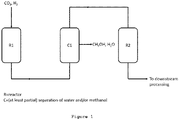
- the system may be composed of several reactors in series, with intermediate water separation steps. Water and methanol are removed in this intermediate operation by cooling and condensing the liquids or by use of an appropriate absorbing fluid or by adsorption on a specific material (solid sorbent).
- solid sorbent a specific material
- at least partially selective removal of either water or methanol or derivate molecules such as DME could be applied to facilitate later separation of the reaction products from each other.
- the remaining CO, CO 2 and H 2 are fed to the subsequent reactor.
- Figure 1 depicts schematically this process configuration.
- the reverse water-gas-shift reaction may take place as a side reaction of the methanol synthesis, the CO 2 :CO ratio is changed over the consecutive reactors, with increasing CO content in the gas stream.
- the temperature of the reactor may be varied stage-by-stage, being the optimal temperature higher with a higher amount of CO present, due to the different thermodynamic equilibrium curve.
- the fluidized bed reactor allows for a special management of the water removal. This can be obtained by a proper use of a water sorbent.
- the water sorbent can be composed of zeolites, alumina, silica, silicates, active carbons or other appropriate material.
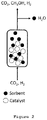
- the sorbent can be formulated, sized or designed in a different way than the catalyst, to exploit the different fluid-dynamic properties of the materials and efficiently remove the sorbent. Two different strategies can be applied, as explained in the following.
- the sorbent In the fluidized bed, the sorbent can be shaped in a way to have a lower fluidization region than the catalyst.
- the catalyst remains suspended in the dense phase of the fluidized bed while the sorbent results in entrained flow along the reactor.
- the sorbent is thus transported out of the catalytic bed by the gas flow and can be further treated at the reactor outlet.
- This process principles are depicted in figure 2 .
- the sorbent can be regenerated in various ways. In one possible solution, in the upper part of the reactor an appropriate change of temperature and/or addition of dry gas can be operated to regenerate in-situ the sorbent, which is then directly recirculated to the catalytic bed.
- the sorbent is collected at the reactor top outlet and fed to a second equipment for the regeneration.
- This equipment is operated in a circulating bed way, either continuously or batch wise.
- the regeneration can proceed via treatment at a higher temperature, lower pressure, via drying in a suitable process stream or a combination thereof.
- Another sorbent configuration allows a different separation from the catalyst. If the sorbent shows a fluidization region at significantly higher flow rates than the catalyst (e.g. because the sorbent particles are bigger than the catalyst particles or of sufficiently higher density), this separates the sorbend particles from the catalyst particles in the dense phase precipitating on the bottom of the reactor. This phenomenon can be used to design an in-situ liquid removal strategy as explained in figure 3 .
- the sorbent is fed from the top of the reactor and progressively descends the reactor towards the bottom, while collecting liquids. The spent sorbent is then collected, regenerated and fed again on the top of the reactor.
- structures containing or consisting of solid sorbent e.g. rods or particles in permeable bags or nets
- in situ above the bed with raised temperature and/or dry gas flow
- a mixture of CO 2 and H 2 in ratio 3:1 is fed to a first fluidized bed reactor R1.
- This reactor is operated between 200-300 °C and between 20-50 bar.
- the catalyst used is Cu/ZnO/Al 2 O 3 .
- the product gases from this reactor are passed through a condenser C1, where the temperature is reduced to 150 °C and the liquid products are separated.
- the remaining gas mixture, composed of CO, CO 2 and H 2 is fed to the second fluidized bed reactor.
- This second reactor is operated between 200-300 °C and in the presence of a zeolite-based sorbent.
- the sorbent is continuously fed with the reacting gases from the bottom of the second reactor and entrained by the gas flow.
- Example 1 The spent sorbent is separated from the product gases at the top of the reactor by a cyclone, sent to an appropriate regeneration unit and recycled to the reactor. The unreacted gases are recycled to the first reactor after recompression.
- the process principles of Example 1 are schematically summarized in figure 4 .
- a biogas mixture composed of CO 2 and CH 4 , is enriched in H 2 , to a stoichiometric ratio CO 2 :H 2 higher than 3:1 is fed to a first fluidized bed reactor R1 operating at 200-400 °C over a Cu/ZnO/Al 2 O 3 catalyst.
- the product liquids of this first reactor are eliminated in an appropriate unit by condensation C1.
- the remaining gas, composed of CO, CO 2 CH 4 and H 2 is fed to the second methanol reactor, where it is also in contact, in countercurrent, with a zeolite-based sorbent.
- the sorbent extracts in-situ the product water and methanol and it is collected from the bottom of the second reactor, regenerated and fed back to the second reactor.
- the remaining unreacted gases are fed to a methanation reactor R3, where the remaining CO and CO 2 is converted to methane.
- a schematic representation of this process is depicted in figure 5 .
Landscapes
- Chemical & Material Sciences (AREA)
- Organic Chemistry (AREA)
- Chemical Kinetics & Catalysis (AREA)
- Engineering & Computer Science (AREA)
- Combustion & Propulsion (AREA)
- Organic Low-Molecular-Weight Compounds And Preparation Thereof (AREA)
Priority Applications (3)
| Application Number | Priority Date | Filing Date | Title |
|---|---|---|---|
| EP21162811.0A EP4059596A1 (fr) | 2021-03-16 | 2021-03-16 | Procédé de production de méthanol à partir de co2 avec élimination de l'eau |
| EP22711937.7A EP4308284B1 (fr) | 2021-03-16 | 2022-03-04 | Procédé de production de méthanol à partir de co2 avec élimination de l'eau |
| PCT/EP2022/055600 WO2022194579A1 (fr) | 2021-03-16 | 2022-03-04 | Procédé de production de méthanol à partir de co2 et/ou de ses dérivés avec élimination de l'eau |
Applications Claiming Priority (1)
| Application Number | Priority Date | Filing Date | Title |
|---|---|---|---|
| EP21162811.0A EP4059596A1 (fr) | 2021-03-16 | 2021-03-16 | Procédé de production de méthanol à partir de co2 avec élimination de l'eau |
Publications (1)
| Publication Number | Publication Date |
|---|---|
| EP4059596A1 true EP4059596A1 (fr) | 2022-09-21 |
Family
ID=74884855
Family Applications (2)
| Application Number | Title | Priority Date | Filing Date |
|---|---|---|---|
| EP21162811.0A Withdrawn EP4059596A1 (fr) | 2021-03-16 | 2021-03-16 | Procédé de production de méthanol à partir de co2 avec élimination de l'eau |
| EP22711937.7A Active EP4308284B1 (fr) | 2021-03-16 | 2022-03-04 | Procédé de production de méthanol à partir de co2 avec élimination de l'eau |
Family Applications After (1)
| Application Number | Title | Priority Date | Filing Date |
|---|---|---|---|
| EP22711937.7A Active EP4308284B1 (fr) | 2021-03-16 | 2022-03-04 | Procédé de production de méthanol à partir de co2 avec élimination de l'eau |
Country Status (2)
| Country | Link |
|---|---|
| EP (2) | EP4059596A1 (fr) |
| WO (1) | WO2022194579A1 (fr) |
Cited By (1)
| Publication number | Priority date | Publication date | Assignee | Title |
|---|---|---|---|---|
| WO2024112376A1 (fr) * | 2022-11-23 | 2024-05-30 | University Of Southern California | Procédé de séparation réactive pour la capture de dioxyde de carbone d'un gaz de combustion |
Citations (15)
| Publication number | Priority date | Publication date | Assignee | Title |
|---|---|---|---|---|
| EP0326718A1 (fr) | 1988-02-05 | 1989-08-09 | Process Engineering Consultants Pec B.V. | Procédé pour la fabrication du méthanol |
| GB2255516A (en) | 1991-05-08 | 1992-11-11 | Shell Int Research | Process for conducting chemical equilibrium reactions |
| US5216034A (en) | 1990-10-29 | 1993-06-01 | Shell Oil Company | Process for the production of methanol |
| GB2293334A (en) | 1994-09-26 | 1996-03-27 | Shell Int Research Maatschappij B V | Process for carrying out chemical equilibrium reactions |
| US5523326A (en) | 1994-10-28 | 1996-06-04 | Uop | PSA process with reaction for reversible reactions |
| US20070299146A1 (en) | 2006-06-26 | 2007-12-27 | Lattner James R | Fast fluid bed methanol synthesis |
| US7579383B2 (en) | 2005-07-27 | 2009-08-25 | Exxonmobil Chemical Patents Inc. | Fluid bed methanol synthesis |
| US20100092381A1 (en) | 2008-10-13 | 2010-04-15 | Stewart Albert E | Reactor system and method therefore |
| US20120232174A1 (en) | 2011-03-10 | 2012-09-13 | Atomic Energy Council-Institute Of Nuclear Energy Research | Method for Increasing the Yield of a Slurry Bed Reactor |
| WO2016096425A1 (fr) | 2014-12-18 | 2016-06-23 | Haldor Topsøe A/S | Procédé et conception de réacteur pour la production de méthanol |
| WO2016128187A1 (fr) | 2015-02-13 | 2016-08-18 | Siemens Aktiengesellschaft | Procédé pour réaliser une synthèse chimique et réacteur de synthèse |
| DE102015202681A1 (de) * | 2015-02-13 | 2016-08-18 | Friedrich-Alexander-Universität Erlangen-Nürnberg | Verfahren zur Durchführung einer chemischen Synthese |
| WO2018136849A1 (fr) | 2017-01-20 | 2018-07-26 | Gas Technology Institute | Système et méthode de synthèse d'ammoniac |
| EP3492165A1 (fr) | 2017-11-29 | 2019-06-05 | Siemens Aktiengesellschaft | Complexe de réacteur permettant de réaliser les réactions limitées d'équilibre et procédé correspondant |
| EP3603790A1 (fr) * | 2018-08-02 | 2020-02-05 | Nederlandse Organisatie voor toegepast- natuurwetenschappelijk Onderzoek TNO | Amélioration de la productivité des réactions à équilibre restreint |
-
2021
- 2021-03-16 EP EP21162811.0A patent/EP4059596A1/fr not_active Withdrawn
-
2022
- 2022-03-04 EP EP22711937.7A patent/EP4308284B1/fr active Active
- 2022-03-04 WO PCT/EP2022/055600 patent/WO2022194579A1/fr not_active Ceased
Patent Citations (17)
| Publication number | Priority date | Publication date | Assignee | Title |
|---|---|---|---|---|
| EP0326718A1 (fr) | 1988-02-05 | 1989-08-09 | Process Engineering Consultants Pec B.V. | Procédé pour la fabrication du méthanol |
| US5216034A (en) | 1990-10-29 | 1993-06-01 | Shell Oil Company | Process for the production of methanol |
| GB2255516A (en) | 1991-05-08 | 1992-11-11 | Shell Int Research | Process for conducting chemical equilibrium reactions |
| GB2293334A (en) | 1994-09-26 | 1996-03-27 | Shell Int Research Maatschappij B V | Process for carrying out chemical equilibrium reactions |
| US5523326A (en) | 1994-10-28 | 1996-06-04 | Uop | PSA process with reaction for reversible reactions |
| US7579383B2 (en) | 2005-07-27 | 2009-08-25 | Exxonmobil Chemical Patents Inc. | Fluid bed methanol synthesis |
| US20070299146A1 (en) | 2006-06-26 | 2007-12-27 | Lattner James R | Fast fluid bed methanol synthesis |
| US8105541B2 (en) * | 2008-10-13 | 2012-01-31 | Pratt & Whitney Rocketdyne, Inc. | Reactor system and method therefore |
| US20100092381A1 (en) | 2008-10-13 | 2010-04-15 | Stewart Albert E | Reactor system and method therefore |
| US20120232174A1 (en) | 2011-03-10 | 2012-09-13 | Atomic Energy Council-Institute Of Nuclear Energy Research | Method for Increasing the Yield of a Slurry Bed Reactor |
| WO2016096425A1 (fr) | 2014-12-18 | 2016-06-23 | Haldor Topsøe A/S | Procédé et conception de réacteur pour la production de méthanol |
| WO2016128187A1 (fr) | 2015-02-13 | 2016-08-18 | Siemens Aktiengesellschaft | Procédé pour réaliser une synthèse chimique et réacteur de synthèse |
| DE102015202681A1 (de) * | 2015-02-13 | 2016-08-18 | Friedrich-Alexander-Universität Erlangen-Nürnberg | Verfahren zur Durchführung einer chemischen Synthese |
| WO2018136849A1 (fr) | 2017-01-20 | 2018-07-26 | Gas Technology Institute | Système et méthode de synthèse d'ammoniac |
| US20180208475A1 (en) * | 2017-01-20 | 2018-07-26 | Gas Technology Institute | System and method to synthesize ammonia |
| EP3492165A1 (fr) | 2017-11-29 | 2019-06-05 | Siemens Aktiengesellschaft | Complexe de réacteur permettant de réaliser les réactions limitées d'équilibre et procédé correspondant |
| EP3603790A1 (fr) * | 2018-08-02 | 2020-02-05 | Nederlandse Organisatie voor toegepast- natuurwetenschappelijk Onderzoek TNO | Amélioration de la productivité des réactions à équilibre restreint |
Cited By (1)
| Publication number | Priority date | Publication date | Assignee | Title |
|---|---|---|---|---|
| WO2024112376A1 (fr) * | 2022-11-23 | 2024-05-30 | University Of Southern California | Procédé de séparation réactive pour la capture de dioxyde de carbone d'un gaz de combustion |
Also Published As
| Publication number | Publication date |
|---|---|
| EP4308284A1 (fr) | 2024-01-24 |
| EP4308284B1 (fr) | 2025-06-25 |
| EP4308284C0 (fr) | 2025-06-25 |
| WO2022194579A1 (fr) | 2022-09-22 |
Similar Documents
| Publication | Publication Date | Title |
|---|---|---|
| RU2670761C9 (ru) | Регулирование кислого газа в процессе производства жидкого топлива | |
| Gómez et al. | Sorption-enhanced CO and CO2 methanation (SEM) for the production of high purity methane | |
| CN106629600B (zh) | 粗合成气吸附催化制氢工艺及其设备 | |
| WO2008069251A1 (fr) | Appareil et procédé de fabrication d'un combustible liquide à partir d'une biomasse | |
| Bayat et al. | Membrane/sorption-enhanced methanol synthesis process: Dynamic simulation and optimization | |
| Yu et al. | High-quality utilization of raw coke oven gas for hydrogen production based on CO2 adsorption-enhanced reforming | |
| WO2024217902A1 (fr) | Procédé et système de production flexible d'hydrogène et d'hydrocarbures à partir d'un produit gazeux | |
| EP4308284B1 (fr) | Procédé de production de méthanol à partir de co2 avec élimination de l'eau | |
| US8026290B2 (en) | Methods and apparatus for continuous removal of carbon dioxide from a mixture of reacting gases | |
| WO2011034853A1 (fr) | Procédés et appareils de purification de gaz à effet de serre | |
| US20240383749A1 (en) | Synthesis gas production by reverse water gas shift reaction using carbon dioxide and pyrolysis-derived hydrogen | |
| Gancedo et al. | Regeneration strategies for CaO-based sorbents in high-pressure cyclic sorption-enhanced steam reforming for hydrogen production | |
| KR102173505B1 (ko) | 유동층 반응기를 이용한 메탄 생산 방법 | |
| US12264122B2 (en) | Tail gas utilization for mixed alcohols production | |
| CN104651005B (zh) | 一种褐煤催化直接制甲烷的装置和方法 | |
| RU2792583C1 (ru) | Способ и установка для синтеза метанола | |
| Westerterp | New methanol processes | |
| US20240342697A1 (en) | Process and apparatus for regenerating catalyst from a methanol to olefins process | |
| JP2024079358A (ja) | 合成ガス製造方法および合成ガス製造設備 | |
| Renda et al. | Alternative Catalytic Reactors for CO 2 Hydrogenation to Liquid Fuels | |
| Natakaranakul | Direct synthesys of LPG from co2 by using CZZA and HY zeolite hybrid catalyst | |
| CA3261431A1 (fr) | Boucle chimique de formation de carbone utilisant de l'oxygène | |
| ELLINGTON et al. | Synfuels and Syngas. 4. Syngas/Indirect Liquefaction | |
| Campen et al. | Novel Concept For Hydrogen And CO2 Separation |
Legal Events
| Date | Code | Title | Description |
|---|---|---|---|
| PUAI | Public reference made under article 153(3) epc to a published international application that has entered the european phase |
Free format text: ORIGINAL CODE: 0009012 |
|
| STAA | Information on the status of an ep patent application or granted ep patent |
Free format text: STATUS: THE APPLICATION HAS BEEN PUBLISHED |
|
| AK | Designated contracting states |
Kind code of ref document: A1 Designated state(s): AL AT BE BG CH CY CZ DE DK EE ES FI FR GB GR HR HU IE IS IT LI LT LU LV MC MK MT NL NO PL PT RO RS SE SI SK SM TR |
|
| STAA | Information on the status of an ep patent application or granted ep patent |
Free format text: STATUS: THE APPLICATION IS DEEMED TO BE WITHDRAWN |
|
| 18D | Application deemed to be withdrawn |
Effective date: 20230322 |