EP4060332A1 - Appareil d'électrophorèse horizontale - Google Patents
Appareil d'électrophorèse horizontale Download PDFInfo
- Publication number
- EP4060332A1 EP4060332A1 EP20887058.4A EP20887058A EP4060332A1 EP 4060332 A1 EP4060332 A1 EP 4060332A1 EP 20887058 A EP20887058 A EP 20887058A EP 4060332 A1 EP4060332 A1 EP 4060332A1
- Authority
- EP
- European Patent Office
- Prior art keywords
- electrode
- electrophoretic gel
- gel
- electrophoresis apparatus
- horizontal electrophoresis
- Prior art date
- Legal status (The legal status is an assumption and is not a legal conclusion. Google has not performed a legal analysis and makes no representation as to the accuracy of the status listed.)
- Withdrawn
Links
- 238000001962 electrophoresis Methods 0.000 title claims abstract description 77
- 239000000499 gel Substances 0.000 claims description 96
- 229920002401 polyacrylamide Polymers 0.000 claims description 8
- 229920001817 Agar Polymers 0.000 claims description 7
- 239000008272 agar Substances 0.000 claims description 5
- 239000003792 electrolyte Substances 0.000 claims description 4
- 229920000642 polymer Polymers 0.000 claims description 3
- 102000004169 proteins and genes Human genes 0.000 abstract description 33
- 108090000623 proteins and genes Proteins 0.000 abstract description 33
- BASFCYQUMIYNBI-UHFFFAOYSA-N platinum Chemical compound [Pt] BASFCYQUMIYNBI-UHFFFAOYSA-N 0.000 description 8
- 238000000034 method Methods 0.000 description 5
- 238000013508 migration Methods 0.000 description 5
- 230000005012 migration Effects 0.000 description 5
- 238000002264 polyacrylamide gel electrophoresis Methods 0.000 description 4
- 238000004458 analytical method Methods 0.000 description 3
- 239000011148 porous material Substances 0.000 description 3
- YJWSBMQTQRNKPO-UHFFFAOYSA-M sodium;dodecyl sulfite Chemical compound [Na+].CCCCCCCCCCCCOS([O-])=O YJWSBMQTQRNKPO-UHFFFAOYSA-M 0.000 description 3
- 229910052697 platinum Inorganic materials 0.000 description 2
- 239000012474 protein marker Substances 0.000 description 2
- 238000000926 separation method Methods 0.000 description 2
- 238000002415 sodium dodecyl sulfate polyacrylamide gel electrophoresis Methods 0.000 description 2
- 238000001419 two-dimensional polyacrylamide gel electrophoresis Methods 0.000 description 2
- RTAQQCXQSZGOHL-UHFFFAOYSA-N Titanium Chemical compound [Ti] RTAQQCXQSZGOHL-UHFFFAOYSA-N 0.000 description 1
- XAGFODPZIPBFFR-UHFFFAOYSA-N aluminium Chemical compound [Al] XAGFODPZIPBFFR-UHFFFAOYSA-N 0.000 description 1
- 229910052782 aluminium Inorganic materials 0.000 description 1
- 239000004020 conductor Substances 0.000 description 1
- 230000000694 effects Effects 0.000 description 1
- 230000005611 electricity Effects 0.000 description 1
- 239000008151 electrolyte solution Substances 0.000 description 1
- 238000001502 gel electrophoresis Methods 0.000 description 1
- 238000005259 measurement Methods 0.000 description 1
- 102000039446 nucleic acids Human genes 0.000 description 1
- 108020004707 nucleic acids Proteins 0.000 description 1
- 150000007523 nucleic acids Chemical class 0.000 description 1
- 238000001303 quality assessment method Methods 0.000 description 1
- 239000000243 solution Substances 0.000 description 1
- 229910052719 titanium Inorganic materials 0.000 description 1
- 239000010936 titanium Substances 0.000 description 1
Images





Classifications
-
- G—PHYSICS
- G01—MEASURING; TESTING
- G01N—INVESTIGATING OR ANALYSING MATERIALS BY DETERMINING THEIR CHEMICAL OR PHYSICAL PROPERTIES
- G01N27/00—Investigating or analysing materials by the use of electric, electrochemical, or magnetic means
- G01N27/26—Investigating or analysing materials by the use of electric, electrochemical, or magnetic means by investigating electrochemical variables; by using electrolysis or electrophoresis
- G01N27/416—Systems
- G01N27/447—Systems using electrophoresis
- G01N27/44704—Details; Accessories
- G01N27/44713—Particularly adapted electric power supply
-
- G—PHYSICS
- G01—MEASURING; TESTING
- G01N—INVESTIGATING OR ANALYSING MATERIALS BY DETERMINING THEIR CHEMICAL OR PHYSICAL PROPERTIES
- G01N27/00—Investigating or analysing materials by the use of electric, electrochemical, or magnetic means
- G01N27/26—Investigating or analysing materials by the use of electric, electrochemical, or magnetic means by investigating electrochemical variables; by using electrolysis or electrophoresis
- G01N27/416—Systems
- G01N27/447—Systems using electrophoresis
- G01N27/44756—Apparatus specially adapted therefor
-
- C—CHEMISTRY; METALLURGY
- C12—BIOCHEMISTRY; BEER; SPIRITS; WINE; VINEGAR; MICROBIOLOGY; ENZYMOLOGY; MUTATION OR GENETIC ENGINEERING
- C12Q—MEASURING OR TESTING PROCESSES INVOLVING ENZYMES, NUCLEIC ACIDS OR MICROORGANISMS; COMPOSITIONS OR TEST PAPERS THEREFOR; PROCESSES OF PREPARING SUCH COMPOSITIONS; CONDITION-RESPONSIVE CONTROL IN MICROBIOLOGICAL OR ENZYMOLOGICAL PROCESSES
- C12Q1/00—Measuring or testing processes involving enzymes, nucleic acids or microorganisms; Compositions therefor; Processes of preparing such compositions
- C12Q1/68—Measuring or testing processes involving enzymes, nucleic acids or microorganisms; Compositions therefor; Processes of preparing such compositions involving nucleic acids
-
- G—PHYSICS
- G01—MEASURING; TESTING
- G01N—INVESTIGATING OR ANALYSING MATERIALS BY DETERMINING THEIR CHEMICAL OR PHYSICAL PROPERTIES
- G01N27/00—Investigating or analysing materials by the use of electric, electrochemical, or magnetic means
- G01N27/26—Investigating or analysing materials by the use of electric, electrochemical, or magnetic means by investigating electrochemical variables; by using electrolysis or electrophoresis
- G01N27/416—Systems
- G01N27/447—Systems using electrophoresis
- G01N27/44704—Details; Accessories
- G01N27/44747—Composition of gel or of carrier mixture
-
- C—CHEMISTRY; METALLURGY
- C12—BIOCHEMISTRY; BEER; SPIRITS; WINE; VINEGAR; MICROBIOLOGY; ENZYMOLOGY; MUTATION OR GENETIC ENGINEERING
- C12Q—MEASURING OR TESTING PROCESSES INVOLVING ENZYMES, NUCLEIC ACIDS OR MICROORGANISMS; COMPOSITIONS OR TEST PAPERS THEREFOR; PROCESSES OF PREPARING SUCH COMPOSITIONS; CONDITION-RESPONSIVE CONTROL IN MICROBIOLOGICAL OR ENZYMOLOGICAL PROCESSES
- C12Q2565/00—Nucleic acid analysis characterised by mode or means of detection
- C12Q2565/10—Detection mode being characterised by the assay principle
- C12Q2565/125—Electrophoretic separation
Definitions
- the present invention relates to a horizontal electrophoresis apparatus, and more particularly, to a horizontal electrophoresis apparatus which uses a first electrode and a second electrode in close contact with one side of an electrophoretic gel to prevent an electric current difference between the top and bottom of the electrophoretic gel.
- electrophoresis is generally performed for the analysis of nucleic acid molecules (DNA and RNA) or proteins.
- Polyacrylamide gel electrophoresis is a method that uses a polyacrylamide gel for gel electrophoresis.
- the polyacrylamide gel is a porous material which is much denser than an agar gel and thus can be used to separate samples with small molecular weights and small size differences compared to the use of agar.
- sodium dodecyl sulfate-polyacrylamide gel electrophoresis is a method commonly used to spread proteins in a sample in order to efficiently detect a very small amount of proteins.
- the sodium dodecyl sulfite (SDS) binds to the proteins present in the sample to cause the proteins to lose their secondary, tertiary, and quaternary structures and become linear, and provides the proteins with a high density of negative charges such that the proteins are attracted toward the positive pole of the voltage applied during electrophoresis.
- the polyacrylamide gel is a dense porous material, the proteins having a linear structure and negatively charged by SDS can be classified according to the principle that the migration speed varies due to the size of the proteins as the electrophoresis is performed.
- FIG. 1 shows a horizontal PAGE electrophoresis apparatus used for protein analysis.
- the horizontal PAGE electrophoresis for protein analysis is performed in a state where platinum wire electrodes e1 and e2 are placed on both ends of a gel g.
- the platinum wire electrodes e1 and e2 are disposed on the top side of the gel g, and thus an electric current difference occurs between the top and bottom of the gel g.
- the present invention has been made to solve the above-mentioned conventional problems, and the object of the present invention is to provide a horizontal electrophoresis apparatus which uses a first electrode and a second electrode in close contact with one side of an electrophoretic gel to prevent an electric current difference between the top and bottom of the electrophoretic gel.
- the present invention provides a horizontal electrophoresis apparatus comprising a first electrode and a second electrode disposed on both sides of an electrophoretic gel, the first electrode and the second electrode being in close contact with one side of the electrophoretic gel.
- the first electrode and the second electrode may be in close contact with both lateral sides of the electrophoretic gel to face each other with the electrophoretic gel interposed therebetween.
- the electrophoretic gel may be a polymer gel such as polyacrylamide or agar.
- One of the first electrode and the second electrode may be electrically connected to a positive terminal of an external power supply, and the other may be electrically connected to a negative terminal of the external power supply.
- the cross-sections of the first electrode and the second electrode may surround the upper, lower, and lateral sides of the edge of the electrophoretic gel.
- each of the first electrode and the second electrode may comprise two electrodes; an upper electrode and a lower electrode in contact with the upper and lower sides of the electrophoretic gel.
- the interval between the upper electrodes disposed on the upper side of the electrophoretic gel and the interval between the lower electrodes disposed on the lower side of the electrophoretic gel may be adjusted to control the amount of electric current flowing through the electrophoretic gel.
- a wick may be disposed between each of the first electrode and the second electrode and the electrophoretic gel, and the wick may comprise an electrolyte.
- the horizontal electrophoresis apparatus uses the first electrode and the second electrode in close contact with one side of the electrophoretic gel to allow the electric current to flow uniformly over the entire cross section of the electrophoretic gel, thereby preventing an electric current difference between the top and bottom of the electrophoretic gel and solving the problem that the resolution of the protein bands is reduced.
- the horizontal electrophoresis apparatus supplies sufficient electric current also to the lower side of the electrophoretic gel through the first electrode and the second electrode, which reduces the temperature difference between the top, middle and bottom of the electrophoretic gel, resulting in an improved quality of electrophoresis.
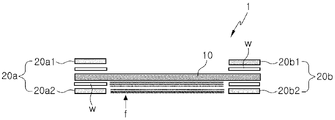
- the horizontal electrophoresis apparatus 1 comprises a first electrode 20a and a second electrode 20b disposed on both sides of an electrophoretic gel 10.
- the electrophoretic gel 10 may be a polymer gel such as polyacrylamide, agar, etc.
- the polyacrylamide gel is a porous material which is much denser than an agar gel and thus can be used to separate samples with small molecular weights and small size differences compared to the use of agar.
- the electrophoretic gel 10 may be a polyacrylamide gel (10% resolving gel), but is not limited thereto.
- first electrode 20a and the second electrode 20b may be in close contact with one side of the electrophoretic gel 10.
- the first electrode 20a and the second electrode 20b may be in close contact with both lateral sides of the electrophoretic gel 10 to face each other with the electrophoretic gel 10 interposed therebetween.
- first electrode 20a and the second electrode 20b may be connected to an electric wire to be supplied with electricity from an external power supply.
- one of the first electrode 20a and the second electrode 20b may be electrically connected to a positive terminal of the external power supply, and the other may be electrically connected to a negative terminal of the external power supply.
- each of the first electrode 20a and the second electrode 20b may be a surface electrode made of a conductive material such as platinum, aluminum, etc.
- the electrophoresis process when a protein sample is injected into wells h of the electrophoretic gel 10 and an electric current is supplied from an external power supply to the first electrode 20a and the second electrode 20b through the electric wire, the electric current flows through the electrophoretic gel 10 in close contact with the first electrode 20a and the second electrode 20b, which causes the protein sample to migrate, thereby causing protein separation and performing the electrophoresis.
- the horizontal electrophoresis apparatus 1 uses the first electrode 20a and the second electrode 20b in close contact with both lateral sides of the electrophoretic gel 10 to prevent an electric current difference between the top and bottom of the electrophoretic gel 10.
- the electric current flows uniformly over the entire cross section of the electrophoretic gel 10 through the first electrode 20a and the second electrode 20b, and thus it is possible to solve the problem that a certain portion of the protein band becomes particularly thick as a result of the electrophoresis, which results in a reduced resolution.
- the position where the first electrode 20a and the second electrode 20b are in close contact with the electrophoretic gel 10 is not limited to both lateral sides as shown in FIG. 2, and the first electrode 20a and the second electrode 20b may be disposed in various positions, such as lateral and lower sides, lateral and upper sides, etc., resulting in an improved quality of electrophoresis.
- first electrode 20a and the second electrode 20b of the present invention are used for two-dimensional polyacrylamide gel electrophoresis (2D PAGE), the electric current flows uniformly, which increases the number of protein spots, which serve as a standard for quality assessment of electrophoretic separation.
- the cross sections of the first electrode 20a and the second electrode 20b may surround the upper, lower, and lateral sides of the edge of the electrophoretic gel 10.
- a wick w may be disposed between each of the first electrode 20a and the second electrode 20b and the electrophoretic gel 10, and the wick w may comprise an electrolyte.
- the wick w may comprise a stack of filter papers and may be immersed in an electrolyte solution to allow the electric current to flow.
- the first and second electrodes 20a and 20b and the gel 10 do not directly contact one another, thereby preventing damage to the gel 10 and providing an electrolyte necessary for electrophoresis.
- a PVC film f may be disposed between the first electrode 20a and the second electrode 20b to support the lower side of the electrophoretic gel (10), whereby the electrophoretic gel (10) can be level between the first electrode 20a and the second electrode 20b.
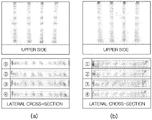
- FIG. 4(a) shows the results of the electrophoresis performed using the first electrode 20a and the second electrode 20b of which the cross sections surround the upper, lower, and lateral sides of the edge of the electrophoretic gel 10 and which have a thickness of 3 mm.
- a pre-stained protein marker was used as a sample, and the sample migrated from top to bottom in the case of the upper side image and from left to right in the case of the lateral cross-sectional image.
- FIG. 4(b) shows the results of the electrophoresis performed at 40 mA using a conventional horizontal electrophoresis apparatus
- the conventional horizontal electrophoresis apparatus has a configuration in which the wire electrodes are disposed only on both top sides of the gel, the electric current strength on the upper side of the gel is higher than that on the lower side, which causes the protein bands to be particularly thick only in a specific region, resulting in a reduced resolution.
- heat generated in the electrophoretic gel 10 during the electrophoresis process may serve to interfere with the electrophoresis.
- sufficient electric current can be also supplied to the lower side of the electrophoretic gel 10 through the first electrode 20a and the second electrode 20b of which the cross sections surround the upper, lower, and lateral sides of the edge of the electrophoretic gel 10.
- the present invention can not only prevent the protein bands from being skewed, but also reduce the temperature difference between the top, middle and bottom of the electrophoretic gel 10, thereby further improving the quality of electrophoresis.
- each of the first electrode 20a and the second electrode 20b may comprise an upper electrode 20a1, 20b1 and a lower electrode 20a2, 20b2, which are in contact with the upper and lower sides of the electrophoretic gel 10, respectively.
- the first electrode 20a disposed on the left side of the electrophoretic gel 10 as shown in FIG. 5 may comprise an upper electrode 20a1 and a lower electrode 20a2
- the second electrode 20b disposed on the right side of the electrophoretic gel 10 as shown in FIG. 5 may comprise an upper electrode 20b1 and a lower electrode 20b2.
- first electrode 20a and the second electrode 20b may be spaced about 1 cm and made of titanium coated with platinum.
- each of the first electrode 20a and the second electrode 20b comprises the upper electrode 20a1, 20b1 and the lower electrode 20a2, 20b2, respectively, which are in contact with the upper and lower sides of the electrophoretic gel 10, the process of bringing the electrodes into contact with the electrophoretic gel 10 becomes easy.
- FIG. 6 shows the amounts of electric current measured using upper electrodes only, using lower electrodes only, and using both the upper and lower electrodes, respectively.
- the thickness of the electrophoretic gel 10 was 3 mm
- the interval between the electrodes was about 6 cm
- the fixed voltage of the power supply was set to 50 V.
- an electrophoresis platform 100 may be used during the electrophoresis, and the electrophoresis platform 100 may comprise electrical terminals 110 and 120, which will be connected to a positive (+) terminal and a negative (-) terminal of a power supply (not shown), respectively, and a pair of rods 130 connected to the electrical terminals 110 and 120.
- the upper electrodes 20a1 and 20b1 and the lower electrodes 20a2 and 20b2 may be connected at their both ends to the rods 130 of the electrophoresis platform 100, respectively, to move their positions, and may be electrically connected to the power supply connected to the electrical terminals 110, 120 through the rods 130.
- grooves h are formed at both ends of the upper electrodes 20a1 and 20b1 and the lower electrodes 20a2 and 20b2. Accordingly, the pair of rods 130 provided in the electrophoresis platform 100 can be inserted into the grooves h, and thus the upper electrode 20a1 and 20b1 and the lower electrodes 20a2 and 20b2 can move their positions along the longitudinal direction of the rods 130.
- the horizontal electrophoresis apparatus 1 of another embodiment of the present invention it is possible to adjust the interval between the upper electrodes 20a1 and 20b1 disposed on the upper side of the electrophoretic gel 10 and the interval between the lower electrodes 20a2 and 20b2 disposed on the lower side of the electrophoretic gel 10.
- FIG. 10 shows the amounts of electric current flowing through the upper electrodes 20a1 and 20b1 disposed on the upper side of the electrophoretic gel 10 at different intervals.
- the fixed voltage of the power supply was set to 50 V.
- the amount of electric current increases as the interval between the upper electrodes 20a1 and 20b1 becomes narrower. That is, it can be seen that the amount of electric current flowing through the electrophoretic gel 10 can easily be controlled by adjusting the interval between the electrodes.
- the intervals between the upper electrodes 20a1 and 20b1 and the lower electrodes 20a2 and 20b2 may be independently adjusted.
- the lower electrodes 20a2 and 20b2 can be moved so that the interval between them becomes narrower
- the upper electrodes 20a1 and 20b1 can be moved so that the interval between them becomes narrower.
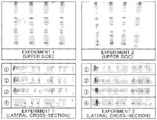
- FIGS. 12 to 14 were obtained using a gel 10 having a thickness of 3 mm
- FIG. 15 shows the results of the electrophoresis performed using a commonly used gel 10 having a thickness of 1 mm in a state where the upper electrodes 20a1 and 20b1 and the lower electrodes 20a2 and 20b2 are aligned in the same position.
- the quality of electrophoresis can be improved by adjusting the interval between the upper electrodes 20a1 and 20b1 and the interval between the lower electrodes 20a2 and 20b2 to control the amounts of electric current at the top and bottom.
Landscapes
- Life Sciences & Earth Sciences (AREA)
- Health & Medical Sciences (AREA)
- Chemical & Material Sciences (AREA)
- Molecular Biology (AREA)
- Biochemistry (AREA)
- Physics & Mathematics (AREA)
- Analytical Chemistry (AREA)
- General Health & Medical Sciences (AREA)
- Immunology (AREA)
- Chemical Kinetics & Catalysis (AREA)
- Electrochemistry (AREA)
- General Physics & Mathematics (AREA)
- Pathology (AREA)
- Organic Chemistry (AREA)
- Engineering & Computer Science (AREA)
- Zoology (AREA)
- Proteomics, Peptides & Aminoacids (AREA)
- Wood Science & Technology (AREA)
- Dispersion Chemistry (AREA)
- Biotechnology (AREA)
- Microbiology (AREA)
- Biophysics (AREA)
- Bioinformatics & Cheminformatics (AREA)
- General Engineering & Computer Science (AREA)
- Genetics & Genomics (AREA)
- Power Engineering (AREA)
- Peptides Or Proteins (AREA)
- Investigating Or Analysing Biological Materials (AREA)
Applications Claiming Priority (2)
| Application Number | Priority Date | Filing Date | Title |
|---|---|---|---|
| KR20190144489 | 2019-11-12 | ||
| PCT/KR2020/014508 WO2021096092A1 (fr) | 2019-11-12 | 2020-10-22 | Appareil d'électrophorèse horizontale |
Publications (2)
| Publication Number | Publication Date |
|---|---|
| EP4060332A1 true EP4060332A1 (fr) | 2022-09-21 |
| EP4060332A4 EP4060332A4 (fr) | 2023-12-06 |
Family
ID=75913037
Family Applications (1)
| Application Number | Title | Priority Date | Filing Date |
|---|---|---|---|
| EP20887058.4A Withdrawn EP4060332A4 (fr) | 2019-11-12 | 2020-10-22 | Appareil d'électrophorèse horizontale |
Country Status (4)
| Country | Link |
|---|---|
| US (1) | US20220397550A1 (fr) |
| EP (1) | EP4060332A4 (fr) |
| KR (1) | KR102250148B1 (fr) |
| WO (1) | WO2021096092A1 (fr) |
Families Citing this family (3)
| Publication number | Priority date | Publication date | Assignee | Title |
|---|---|---|---|---|
| KR102429563B1 (ko) | 2021-12-03 | 2022-08-04 | 주식회사 티맥 | 수평전기영동용 아크릴아마이드 겔 지지체 |
| KR102397413B1 (ko) * | 2022-02-24 | 2022-05-12 | 주식회사 미소진 | 웰 식별마크가 표시된 전기영동용 겔 |
| KR20250060378A (ko) | 2023-10-26 | 2025-05-07 | 주식회사 인텔리전트진 | 빅데이터 및 ai 기반 바이오 분석용 통합 젤 이미징 장치 |
Family Cites Families (21)
| Publication number | Priority date | Publication date | Assignee | Title |
|---|---|---|---|---|
| US3062731A (en) * | 1959-11-18 | 1962-11-06 | Beckman Instruments Inc | Agar-agar system and additive |
| US3114692A (en) * | 1961-04-27 | 1963-12-17 | Corning Glass Works | Separation process |
| SE386741B (sv) * | 1973-01-24 | 1976-08-16 | Lkb Produkter Ab | Forfarande for att vid elektrofores, spec. vid isoelektrisk fokusering, styra den tillforda effekten |
| US5084157A (en) * | 1988-03-21 | 1992-01-28 | California Institute Of Technology | Gel electrophoresis using time dependent contour controlled electric fields |
| GB8825625D0 (en) * | 1988-11-02 | 1988-12-07 | Medical Res Council | Electrophoresis method & apparatus |
| JPH0329844A (ja) * | 1989-06-28 | 1991-02-07 | Shimadzu Corp | 電気泳動装置 |
| JPH0734365U (ja) * | 1993-11-30 | 1995-06-23 | 株式会社島津製作所 | 水平ゲル電気泳動装置 |
| US5582702A (en) * | 1995-04-26 | 1996-12-10 | Ethrog Biotechnology Ltd. | Apparatus and method for electrophoresis |
| EP0830595A1 (fr) * | 1995-06-08 | 1998-03-25 | Visible Genetics Inc. | Puce de microelectrophorese pour deplacer et separer des acides nucleiques et autres molecules chargees |
| JPH10288597A (ja) * | 1997-04-14 | 1998-10-27 | Toyobo Co Ltd | 電気泳動装置 |
| DE69837899T2 (de) * | 1997-04-11 | 2008-02-14 | Toyo Boseki K.K. | Elektrophoreseapparatur |
| US5989400A (en) * | 1997-06-09 | 1999-11-23 | Hoefer Pharmacia Biotech, Inc. | Device and method for applying power to gel electrophoresis modules |
| KR20050040093A (ko) * | 2003-11-20 | 2005-05-03 | 주식회사 메덱스바이오 | 전기영동분석시스템 |
| JP2005164477A (ja) * | 2003-12-04 | 2005-06-23 | Canon Inc | 電気泳動容器 |
| US20080057557A1 (en) * | 2006-08-31 | 2008-03-06 | Invitrogen Corporation | Methods, cassettes, gels and apparatuses for isolation and collection of biomolecules from electrophoresis gels |
| JP4362659B2 (ja) * | 2007-05-31 | 2009-11-11 | シャープ株式会社 | 電気泳動装置および電気泳動方法 |
| JP2011133311A (ja) * | 2009-12-24 | 2011-07-07 | Sharp Corp | 電気泳動用器具および電気泳動装置 |
| GB201102385D0 (en) * | 2011-02-10 | 2011-03-30 | Biocule Scotland Ltd | Two-dimensional gel electrophoresis apparatus and method |
| WO2015156286A1 (fr) * | 2014-04-08 | 2015-10-15 | シャープ株式会社 | Appareil et procédé de focalisation isoélectrique |
| KR101862198B1 (ko) | 2016-09-30 | 2018-05-30 | (주)스파크바이오파마 | 2차원 겔 전기영동에서의 열 안정성 변화-기반 형광 차이를 이용한 표적 단백질의 규명 방법 |
| KR101900368B1 (ko) * | 2017-08-29 | 2018-09-20 | 국립암센터 | 프리캐스트 겔, 전기 전달 모듈, 전기영동 및 웨스턴 블롯용 장치 및 이의 제어 방법 |
-
2020
- 2020-10-22 EP EP20887058.4A patent/EP4060332A4/fr not_active Withdrawn
- 2020-10-22 WO PCT/KR2020/014508 patent/WO2021096092A1/fr not_active Ceased
- 2020-10-22 KR KR1020200137376A patent/KR102250148B1/ko active Active
- 2020-10-22 US US17/776,158 patent/US20220397550A1/en not_active Abandoned
Also Published As
| Publication number | Publication date |
|---|---|
| WO2021096092A1 (fr) | 2021-05-20 |
| US20220397550A1 (en) | 2022-12-15 |
| KR102250148B1 (ko) | 2021-05-10 |
| EP4060332A4 (fr) | 2023-12-06 |
Similar Documents
| Publication | Publication Date | Title |
|---|---|---|
| EP4060332A1 (fr) | Appareil d'électrophorèse horizontale | |
| US4139440A (en) | Electrofocusing in buffers | |
| Keir et al. | Isoelectric focusing of cerebrospinal fluid immunoglobulin G: an annotated update | |
| Kyhse-Andersen | Electroblotting of multiple gels: a simple apparatus without buffer tank for rapid transfer of proteins from polycrylamide to nitrocellulose | |
| US20010023825A1 (en) | Methods and apparatus for nonlinear mobility electrophoresis separation | |
| US9945809B2 (en) | Dry protein transfer | |
| EP1907833B1 (fr) | Separation d'analytes par masse moleculaire et charge | |
| US4670119A (en) | Isoelectric focusing device and process | |
| Nguyen et al. | Natural pH gradients in buffer mixtures: Formation in the absence of strongly acidic and basic anolyte and catholyte, gradient steepening by sucrose, and stabilization by high buffer concentrations in the electrolyte chambers | |
| EP1538440B1 (fr) | Grilles d'électrodes à onde progressive et algorithmes pour la séparation, le transport et la focalisation des biomolécules | |
| US5384025A (en) | Notched spacer for slab-gel electrophoresis | |
| EP1211510A1 (fr) | Méthodes et appareils pour des séparations électrophorétiques à mobilité non linéaire | |
| Abelev et al. | Counterflow immunoisotachophoresis on cellulose acetate membranes | |
| Chartogne et al. | Capillary electrophoretic separations of proteins using carrier ampholytes | |
| US5518604A (en) | Buffer shaping device | |
| US5458760A (en) | Gel composition in gels for submurged gel electrophoresis | |
| EP2821781A1 (fr) | Procédé d'électrophorèse à écoulement libre destiné à séparer des analytes | |
| Reichel | Application of high‐throughput IEF‐PAGE for EPO‐doping testing | |
| Altland et al. | Flattening, shifting and comparing pH gradients in slab gel electrofocusing by local increases of gel volume | |
| US20170122902A1 (en) | Separation medium cassette for sample separation adsorption and analysis device for sample separation adsorption | |
| Garfin | Electrophoretic methods | |
| JP7057728B2 (ja) | 電気泳動方法、電気泳動システム、及び電気泳動用の収容容器 | |
| Walker | Isoelectric focusing of proteins in ultra-thin polyacrylamide gels | |
| WO2015156286A1 (fr) | Appareil et procédé de focalisation isoélectrique | |
| JPH03167468A (ja) | 多電極電気泳動装置 |
Legal Events
| Date | Code | Title | Description |
|---|---|---|---|
| STAA | Information on the status of an ep patent application or granted ep patent |
Free format text: STATUS: THE INTERNATIONAL PUBLICATION HAS BEEN MADE |
|
| PUAI | Public reference made under article 153(3) epc to a published international application that has entered the european phase |
Free format text: ORIGINAL CODE: 0009012 |
|
| STAA | Information on the status of an ep patent application or granted ep patent |
Free format text: STATUS: REQUEST FOR EXAMINATION WAS MADE |
|
| 17P | Request for examination filed |
Effective date: 20220610 |
|
| AK | Designated contracting states |
Kind code of ref document: A1 Designated state(s): AL AT BE BG CH CY CZ DE DK EE ES FI FR GB GR HR HU IE IS IT LI LT LU LV MC MK MT NL NO PL PT RO RS SE SI SK SM TR |
|
| DAV | Request for validation of the european patent (deleted) | ||
| DAX | Request for extension of the european patent (deleted) | ||
| A4 | Supplementary search report drawn up and despatched |
Effective date: 20231107 |
|
| RIC1 | Information provided on ipc code assigned before grant |
Ipc: C12Q 1/68 20180101ALI20231031BHEP Ipc: G01N 27/447 20060101AFI20231031BHEP |
|
| STAA | Information on the status of an ep patent application or granted ep patent |
Free format text: STATUS: THE APPLICATION IS DEEMED TO BE WITHDRAWN |
|
| 18D | Application deemed to be withdrawn |
Effective date: 20240525 |