EP4060983B1 - Procédé d'accumulation d'événements à l'aide d'un capteur de vision basé sur des événements et de fenêtres temporelles chevauchantes - Google Patents
Procédé d'accumulation d'événements à l'aide d'un capteur de vision basé sur des événements et de fenêtres temporelles chevauchantes Download PDFInfo
- Publication number
- EP4060983B1 EP4060983B1 EP21153024.1A EP21153024A EP4060983B1 EP 4060983 B1 EP4060983 B1 EP 4060983B1 EP 21153024 A EP21153024 A EP 21153024A EP 4060983 B1 EP4060983 B1 EP 4060983B1
- Authority
- EP
- European Patent Office
- Prior art keywords
- time
- change
- event
- pixel
- image frame
- Prior art date
- Legal status (The legal status is an assumption and is not a legal conclusion. Google has not performed a legal analysis and makes no representation as to the accuracy of the status listed.)
- Active
Links
Images


Classifications
-
- G—PHYSICS
- G06—COMPUTING OR CALCULATING; COUNTING
- G06T—IMAGE DATA PROCESSING OR GENERATION, IN GENERAL
- G06T7/00—Image analysis
- G06T7/20—Analysis of motion
- G06T7/223—Analysis of motion using block-matching
-
- G—PHYSICS
- G06—COMPUTING OR CALCULATING; COUNTING
- G06T—IMAGE DATA PROCESSING OR GENERATION, IN GENERAL
- G06T7/00—Image analysis
- G06T7/20—Analysis of motion
- G06T7/269—Analysis of motion using gradient-based methods
-
- H—ELECTRICITY
- H04—ELECTRIC COMMUNICATION TECHNIQUE
- H04N—PICTORIAL COMMUNICATION, e.g. TELEVISION
- H04N25/00—Circuitry of solid-state image sensors [SSIS]; Control thereof
- H04N25/47—Image sensors with pixel address output; Event-driven image sensors; Selection of pixels to be read out based on image data
-
- G—PHYSICS
- G06—COMPUTING OR CALCULATING; COUNTING
- G06T—IMAGE DATA PROCESSING OR GENERATION, IN GENERAL
- G06T2207/00—Indexing scheme for image analysis or image enhancement
- G06T2207/10—Image acquisition modality
- G06T2207/10016—Video; Image sequence
Definitions
- the present disclosure is related to the field of event-based vision sensors and more precisely to the accumulation of events detected by these sensors.
- An event-based vision sensor is a type of sensor which produces a nearly continuous stream of temporal brightness changes. Each event, or change event, corresponds to an increase or a decrease of brightness by at least a given value. These sensors may comprise a plurality of pixels arranged in a matrix configured to that in the stream, each event is associated with a time stamp, a pixel address (the position in the matrix), and a sign (typically embodied by a value indicating whether the brightness increases or decreases, -1 or +1 for example).
- event-based vision sensors presents one major obstacle which prevents using conventional computer vision methods (i.e. feature engineering or deep learning due to the absence of frames).
- Several methods have been proposed in the prior art to obtain frames from a stream of events. Grouping events together to form a frame is usually called accumulating events into a frame, typically over a fixed duration or a fixed number of events.
- the manifold tracks the time history of each pixel, in a similar manner to what is defined in " Event-based visual flow” (Ryad Benosman, Charles Clercq, Xavier Lagorce, Sio-Hoi Ieng, and Chiara Bartolozzi. IEEE transactions on neural networks and learning systems, 25 (2):407-417, 2013 .) as the surface of active events.
- Event-based visual flow (Ryad Benosman, Charles Clercq, Xavier Lagorce, Sio-Hoi Ieng, and Chiara Bartolozzi. IEEE transactions on neural networks and learning systems, 25 (2):407-417, 2013 .) as the surface of active events.
- the known methods which deliver a series of snapshots may not represent those movements in a satisfying manner.
- the present disclosure overcomes one or more deficiencies of the prior art by proposing a method for elaborating image frames using an event-based vision sensor (PM) which comprises a plurality of pixels and is configured to output a stream of change events (ES), wherein each change event corresponds to a change in brightness detected by one pixel and comprises a time stamp, a pixel address, and a parameter describing a sign of said brightness change, wherein a first image frame and a second image frame are elaborated according to appended claim 1.
- PM event-based vision sensor
- ES stream of change events
- the inventors of the present invention have observed that by using this overlapping period of time, there are fewer differences in the events observed between the two time windows. Consequently, the precision of a subsequently used computer vision algorithm is improved when two images elaborated with the two time windows are applied to this algorithm.
- this facilitates detecting a fast moving object in the two frames when tracking objects.
- the two time windows may also be called sliding windows and that these sliding windows are offset in a manner which makes them overlap.
- the change events from the stream appear first in the first time window before appearing in the second time window.
- the image frames are continuously updated whenever there is a new change event entering the corresponding time window. This also differs from the methods of the prior art wherein image frame are formed, for example, after a certain duration has expired/after a number of events are detected.
- the invention is not limited to elaborating two image frames and may also be applied to obtaining more than two image frames, wherein there is an overlapping period of time for at least two of the time windows.
- the first length and the second length are measured in units of time or in numbers of change events.
- the lengths of the first and of the second time window can be expressed in in seconds (in most applications milliseconds) or in number of change events (which allows the duration of the time window to change). This is also the case for the first instant and the second instant which can both be measured from the present time using duration (seconds, milliseconds) or number of events.
- the first time window and the second time window are overlapping for a length measured in units of time or in numbers of change events.
- the oldest event in the buffer is removed.
- the buffer may have a first-in-first-out structure.
- elaborating an image frame comprises, for every pixel of the image frame:
- elaborating an image frame comprises, for every pixel of the image frame, adding, to the pixel value, a given value affected by a decay time coefficient (a coefficient having a value which decreases over time).
- the method comprises performing a computer vision processing on the two image frames.
- the computer vision processing on the two image frames can comprise performing a comparison of the two image frames or of portions of the two image frames. It should be noted that this make this embodiment suitable for computer vision processing methods which are usually based on consecutive frame comparisons, even if the two time windows overlap here.
- the computer vision processing comprises using a patch-matching processing.
- the patch-matching processing is used to compute optical flow.
- the patch-matching processing is used to compute optical flow can be the Lucas-Kanade method ( Simon Baker and Iain Matthews. "Lucas-kanade 20 years on: A unifying framework”. International journal of computer vision, 56(3):221-255, 2004 .) or the Horn-Schunck method ( Berthold KP Horn and Brian G Schunck. "Determining optical flow”. In Techniques and Applications of Image Understanding, volume 281, pages 319-331 . International Society for Optics and Photonics, 1981 .).
- the invention also provides a system for elaborating image frames, the system including an event-based vision sensor (PM) which comprises a plurality of pixels and is configured to output a stream of change events (ES), wherein each change event corresponds to a change in brightness detected by one pixel and comprises a time stamp, a pixel address, and a parameter describing a sign of said brightness change, the system comprising a processor configured to elaborate a first image frame and a second image frame as specified in appended claim 1.
- PM event-based vision sensor
- ES stream of change events
- This system may be configured to perform any embodiment of the above defined method.
- this system can be a computer system.
- the invention also provides a vehicle including this system.
- the steps of the method are determined by computer program instructions.
- the invention is also directed to a computer program for executing the steps of a method as described above when this program is executed by a computer.
- This program can use any programming language and take the form of source code, object code or a code intermediate between source code and object code, such as a partially compiled form, or any other desirable form.
- the invention is also directed to a computer-readable information medium containing instructions of a computer program as described above.
- the information medium can be any entity or device capable of storing the program.
- the medium can include storage means such as a ROM, for example a CD ROM or a microelectronic circuit ROM, or magnetic storage means, for example a diskette (floppy disk) or a hard disk.
- the information medium can be an integrated circuit in which the program is incorporated, the circuit being adapted to execute the method in question or to be used in its execution.
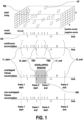
- a pixel matrix PM of an event-based vision sensor is shown and the activation in time (the detection of a change of brightness above or below a given threshold) of given pixels of this matrix is represented using rectangles CP spread at given positions along the x-y plane (of the pixel matrix PM) and along the direction orthogonal to the pixel matrix to represent when the change event is detected/when the pixel is activated.
- An event stream ES is obtained from these change events corresponding to a change in brightness detected by one pixel.
- each event comprises a time stamp (illustrated by its position in the stream), a pixel address (the x-y position), and a parameter describing a sign of said brightness change represented by an arrow pointing upwards for increases of brightness (positive event) and downwards for decreases of brightness (negative event).
- event stream ES is shown at a given instant, but as time passes, additional events may appear on the right side of the represented event stream.
- a change event can be expressed using 4 parameters: (x, y, t, p), wherein x and y indicate the pixel position, t the timestamp, and p the polarity (positive or negative event).
- the first time window TW1 starts at time t1_start and ends at time t1_end.
- the first time window has a duration expressed in units of time (seconds, milliseconds), but this window may also have a length defined in number of events that it can include, measured from the first event appearing in the stream and passing through the time window.
- the second time window TW2 start at time t2_start and ends at time t2_end.
- the second time window has a duration expressed in units of time (seconds, milliseconds), but this window may also have a length defined in number of events that it can include, measured from the first event appearing in the stream and passing through the time window.
- the starting time t2_start of the second time window is chosen so that the two time windows are overlapping (if the length of the windows is in number of events, the overlap can start after a given number of events have been observed in the first window so that the overlap contains another given number of events)On the figure, an overlapped window OW is illustrated.
- a continuous accumulation process can then be carried out in which events which appear in the first time window TW1 are accumulated in a first buffer, for example having a first-in-first-out structure: when a new event is added, the oldest event is removed.
- the buffer can store the four parameters of each event (x, y, t, p). Other structures are possible.
- each pixel value is obtained by:
- Figure 2 is a schematic representation of the implementation of a computer vision processing on bitmap frames obtained using time windows that have no overlapping windows. More precisely, three consecutive non-overlapping time windows TF01, TF02 and TF03 are shown on the figure (three buffers are also used). These are obtained by using the x and y coordinate of each change event and adding a color to each event stored in a buffer at a given instant, regardless of the polarity of the events.
- a graphical representation of the difference between image frame IF01 and image frame IF02 is shown as DF012 and a graphical representation of the difference between image frame IF02 and image frame IF03 is shown as DF023.
- the hatched portions indicate the previous frame and the greyed portions indicate the subsequent frame.
- the difference is calculated using the portions which are not both greyed and hatched. For example, for the difference DF012, the difference is 15. For difference DF023, the difference is 16.
- the information carried within the overlapping window provides a more refined gradient descent in the case of fast moving objects observed by the sensor, this gradient descent being used when computing the optical flow in a known manner.
- the accumulation method described in reference to figures 1 and 3 is also useful for image reconstruction from the event stream (for example for upsampling or deblurring).
- the conversion of events into image frames can be useful to interface the event-based sensor with conventional frame-based algorithms.
- computer program instructions 203 are stored in the nonvolatile memory 202 so that the processor can execute these instructions to be configured to elaborate a first image frame and a second image frame, the first image frame being elaborated using change events accumulated in a first buffer accumulating the change events observed in a first time window having a first length and configured to observe the stream of change events from a relative first instant measured from the present time,
Landscapes
- Engineering & Computer Science (AREA)
- Multimedia (AREA)
- Computer Vision & Pattern Recognition (AREA)
- Physics & Mathematics (AREA)
- General Physics & Mathematics (AREA)
- Theoretical Computer Science (AREA)
- Signal Processing (AREA)
- Image Analysis (AREA)
Claims (8)
- Procédé d'élaboration de trames d'image à l'aide d'un capteur de vision basé sur des événements (PM) qui comprend une pluralité de pixels et est configuré pour délivrer en sortie un flux d'événements de changement (ES), chaque événement de changement correspondant à un changement de luminosité détecté par un pixel et comprenant un horodatage, une adresse de pixel et un paramètre décrivant un signe dudit changement de luminosité,dans lequel une première trame d'image et une deuxième trame d'image sont élaborées,la première trame d'image étant élaborée à l'aide d'événements de changement accumulés dans une première mémoire-tampon accumulant les événements de changement observés dans un premier intervalle de temps ayant une première durée et configuré pour observer le flux d'événements de changement à partir d'un premier instant relatif mesuré à partir du temps actuel et pour chaque pixel de la première image, lorsqu'un événement de changement est ajouté à la première mémoire-tampon pour ce pixel, en ajoutant à la valeur du pixel une valeur donnée affectée par un coefficient de temps de décroissance,la deuxième trame d'image étant élaborée à l'aide d'événements de changement accumulés dans une deuxième mémoire-tampon accumulant les événements de changement observés dans un deuxième intervalle de temps ayant une deuxième durée et configuré pour observer le flux d'événements de changement à partir d'un deuxième instant relatif mesuré à partir du temps actuel et pour chaque pixel de la deuxième image, lorsqu'un événement de changement est ajouté à la deuxième mémoire-tampon pour ce pixel, en ajoutant à la valeur du pixel une valeur donnée affectée par un coefficient de temps de décroissance,et dans lequel le premier intervalle de temps et le deuxième intervalle de temps se chevauchent, augmentant les informations partagées entre la première trame d'image et la deuxième trame d'image,le procédé comprenant la réalisation d'un traitement de vision informatique sur les deux trames d'image, le traitement de vision informatique comprenant l'utilisation d'un traitement de correspondance de patch, et dans lequel le traitement de correspondance de patch est utilisé pour calculer un flux optique.
- Procédé selon la revendication 1, dans lequel la première durée et la deuxième durée sont mesurées en unités de temps ou en nombres d'événements de changement.
- Procédé selon la revendication 1 ou 2, dans lequel le premier intervalle de temps et le deuxième intervalle de temps se chevauchent sur une durée mesurée en unités de temps ou en nombres d'événements de changement.
- Procédé selon l'une quelconque des revendications 1 à 3, dans lequel, lorsqu'un nouvel événement est observé dans un intervalle de temps et est accumulé dans une mémoire-tampon, l'événement le plus ancien dans la mémoire-tampon est supprimé.
- Système d'élaboration de trames d'image, le système comprenant un capteur de vision basé sur des événements (PM) qui comprend une pluralité de pixels et est configuré pour délivrer en sortie un flux d'événements de changement (ES), chaque événement de changement correspondant à un changement de luminosité détecté par un pixel et comprenant un horodatage, une adresse de pixel et un paramètre décrivant un signe dudit changement de luminosité,le système comprenant un processeur configuré pour élaborer une première trame d'image et une deuxième trame d'image,la première trame d'image étant élaborée à l'aide d'événements de changement accumulés dans une première mémoire-tampon accumulant les événements de changement observés dans un premier intervalle de temps ayant une première durée et configuré pour observer le flux d'événements de changement à partir d'un premier instant relatif mesuré à partir du temps actuel et pour chaque pixel de la première image, lorsqu'un événement de changement est ajouté à la première mémoire-tampon pour ce pixel, en ajoutant à la valeur du pixel une valeur donnée affectée par un coefficient de temps de décroissance,la deuxième trame d'image étant élaborée à l'aide d'événements de changement accumulés dans une deuxième mémoire-tampon accumulant les événements de changement observés dans un deuxième intervalle de temps ayant une deuxième durée et configuré pour observer le flux d'événements de changement à partir d'un deuxième instant relatif mesuré à partir du temps actuel et pour chaque pixel de la deuxième image, lorsqu'un événement de changement est ajouté à la deuxième mémoire-tampon pour ce pixel, en ajoutant à la valeur du pixel une valeur donnée affectée par un coefficient de temps de décroissance,et dans lequel le premier intervalle de temps et le deuxième intervalle de temps se chevauchent, augmentant les informations partagées entre la première trame d'image et la deuxième trame d'image,le système étant configuré pour réaliser un traitement de vision informatique sur les deux trames d'image, le traitement de vision informatique comprenant l'utilisation d'un traitement de correspondance de patch, et dans lequel le traitement de correspondance de patch est utilisé pour calculer le flux optique.
- Véhicule comprenant le système selon la revendication 5.
- Programme informatique comprenant des instructions pour exécuter les étapes d'un procédé selon l'une quelconque des revendications 1 à 4 lorsque ledit programme est exécuté par un ordinateur.
- Support d'enregistrement lisible par un ordinateur et sur lequel est enregistré un programme informatique comprenant des instructions pour exécuter les étapes d'un procédé selon l'une quelconque des revendications 1 à 4.
Priority Applications (1)
| Application Number | Priority Date | Filing Date | Title |
|---|---|---|---|
| EP21153024.1A EP4060983B1 (fr) | 2021-01-22 | 2021-01-22 | Procédé d'accumulation d'événements à l'aide d'un capteur de vision basé sur des événements et de fenêtres temporelles chevauchantes |
Applications Claiming Priority (1)
| Application Number | Priority Date | Filing Date | Title |
|---|---|---|---|
| EP21153024.1A EP4060983B1 (fr) | 2021-01-22 | 2021-01-22 | Procédé d'accumulation d'événements à l'aide d'un capteur de vision basé sur des événements et de fenêtres temporelles chevauchantes |
Publications (2)
| Publication Number | Publication Date |
|---|---|
| EP4060983A1 EP4060983A1 (fr) | 2022-09-21 |
| EP4060983B1 true EP4060983B1 (fr) | 2025-04-09 |
Family
ID=74215729
Family Applications (1)
| Application Number | Title | Priority Date | Filing Date |
|---|---|---|---|
| EP21153024.1A Active EP4060983B1 (fr) | 2021-01-22 | 2021-01-22 | Procédé d'accumulation d'événements à l'aide d'un capteur de vision basé sur des événements et de fenêtres temporelles chevauchantes |
Country Status (1)
| Country | Link |
|---|---|
| EP (1) | EP4060983B1 (fr) |
Families Citing this family (2)
| Publication number | Priority date | Publication date | Assignee | Title |
|---|---|---|---|---|
| KR20220076944A (ko) * | 2020-12-01 | 2022-06-08 | 삼성전자주식회사 | 비전 센서, 이를 포함하는 이미지 처리 장치 및 비전 센서의 동작 방법 |
| CN116309291B (zh) * | 2022-12-29 | 2025-09-09 | 西安电子科技大学 | 一种基于动态视觉传感器的缺陷检测方法和系统 |
Family Cites Families (3)
| Publication number | Priority date | Publication date | Assignee | Title |
|---|---|---|---|---|
| US10198660B2 (en) * | 2016-01-27 | 2019-02-05 | Samsung Electronics Co. Ltd. | Method and apparatus for event sampling of dynamic vision sensor on image formation |
| EP3631756B1 (fr) | 2017-05-29 | 2022-01-19 | Universität Zürich | Flux optique à correspondance de blocs et vision stéréo pour capteurs de vision dynamique |
| EP3451288A1 (fr) * | 2017-09-04 | 2019-03-06 | Universität Zürich | Odométrie visuelle-inertielle avec caméra pour événements |
-
2021
- 2021-01-22 EP EP21153024.1A patent/EP4060983B1/fr active Active
Also Published As
| Publication number | Publication date |
|---|---|
| EP4060983A1 (fr) | 2022-09-21 |
Similar Documents
| Publication | Publication Date | Title |
|---|---|---|
| Paredes-Vallés et al. | Back to event basics: Self-supervised learning of image reconstruction for event cameras via photometric constancy | |
| KR101071352B1 (ko) | 좌표맵을 이용한 팬틸트줌 카메라 기반의 객체 추적 장치 및 방법 | |
| JP6877630B2 (ja) | アクションを検出する方法及びシステム | |
| JP7536023B2 (ja) | イベントベースセンサからの情報を処理する方法 | |
| CN111932596B (zh) | 摄像头遮挡区域的检测方法、装置、设备和存储介质 | |
| US11749004B2 (en) | Event detector and method of generating textural image based on event count decay factor and net polarity | |
| JP6226876B2 (ja) | 非同期光センサに基づいてオプティカルフローを推定する方法 | |
| CN113286194A (zh) | 视频处理方法、装置、电子设备及可读存储介质 | |
| KR100985805B1 (ko) | 적응적인 칼만필터를 이용한 영상 안정화 장치 및 방법 | |
| EP3925204B1 (fr) | Procédé de traitement d'une série d'événements reçus de manière asynchrone d'une matrice de pixels d'un capteur de lumière basé sur des événements | |
| Bhangale et al. | Near real-time crowd counting using deep learning approach | |
| CN113888607B (zh) | 基于事件相机的目标检测与跟踪方法、系统和存储介质 | |
| EP4060983B1 (fr) | Procédé d'accumulation d'événements à l'aide d'un capteur de vision basé sur des événements et de fenêtres temporelles chevauchantes | |
| KR101051389B1 (ko) | 적응적 배경 기반의 객체 검출 및 추적 장치 및 방법 | |
| CN112184767A (zh) | 对运动物体进行轨迹跟踪的方法、装置、设备及存储介质 | |
| KR101202642B1 (ko) | 배경의 특징점을 이용한 전역 움직임 추정 방법 및 장치 | |
| Li et al. | STCC-filter: A space-time-content correlation-based noise filter with self-adjusting threshold for event camera | |
| CN113936036B (zh) | 基于无人机视频的目标跟踪方法、装置及计算机设备 | |
| CN121414623A (zh) | 一种基于光流引导的灰度图像平移运动模糊恢复方法及系统 | |
| CN120894389A (zh) | 一种深度卷积神经网络的运动目标特征提取方法 | |
| JP2009244944A (ja) | 画像回復装置および撮影装置 | |
| CN103268606A (zh) | 一种运动模糊图像的深度信息补偿方法和装置 | |
| Lee et al. | Edge detection for event cameras using intra-pixel-area events | |
| Shedligeri et al. | High frame rate optical flow estimation from event sensors via intensity estimation | |
| Yun | Background-Centric Approach for Moving Object Detection in Moving Cameras |
Legal Events
| Date | Code | Title | Description |
|---|---|---|---|
| PUAI | Public reference made under article 153(3) epc to a published international application that has entered the european phase |
Free format text: ORIGINAL CODE: 0009012 |
|
| STAA | Information on the status of an ep patent application or granted ep patent |
Free format text: STATUS: REQUEST FOR EXAMINATION WAS MADE |
|
| PUAB | Information related to the publication of an a document modified or deleted |
Free format text: ORIGINAL CODE: 0009199EPPU |
|
| PUAI | Public reference made under article 153(3) epc to a published international application that has entered the european phase |
Free format text: ORIGINAL CODE: 0009012 |
|
| 17P | Request for examination filed |
Effective date: 20210122 |
|
| AK | Designated contracting states |
Kind code of ref document: A1 Designated state(s): AL AT BE BG CH CY CZ DE DK EE ES FI FR GB GR HR HU IE IS IT LI LT LU LV MC MK MT NL NO PL PT RO RS SE SI SK SM TR |
|
| STAA | Information on the status of an ep patent application or granted ep patent |
Free format text: STATUS: EXAMINATION IS IN PROGRESS |
|
| 17Q | First examination report despatched |
Effective date: 20230428 |
|
| REG | Reference to a national code |
Ref country code: DE Ref legal event code: R079 Free format text: PREVIOUS MAIN CLASS: H04N0005335000 Ipc: H04N0025000000 Ref document number: 602021028729 Country of ref document: DE |
|
| GRAP | Despatch of communication of intention to grant a patent |
Free format text: ORIGINAL CODE: EPIDOSNIGR1 |
|
| STAA | Information on the status of an ep patent application or granted ep patent |
Free format text: STATUS: GRANT OF PATENT IS INTENDED |
|
| RIC1 | Information provided on ipc code assigned before grant |
Ipc: G06T 7/223 20170101ALI20241017BHEP Ipc: H04N 25/47 20230101ALI20241017BHEP Ipc: H04N 25/00 20230101AFI20241017BHEP |
|
| INTG | Intention to grant announced |
Effective date: 20241031 |
|
| GRAS | Grant fee paid |
Free format text: ORIGINAL CODE: EPIDOSNIGR3 |
|
| GRAA | (expected) grant |
Free format text: ORIGINAL CODE: 0009210 |
|
| STAA | Information on the status of an ep patent application or granted ep patent |
Free format text: STATUS: THE PATENT HAS BEEN GRANTED |
|
| AK | Designated contracting states |
Kind code of ref document: B1 Designated state(s): AL AT BE BG CH CY CZ DE DK EE ES FI FR GB GR HR HU IE IS IT LI LT LU LV MC MK MT NL NO PL PT RO RS SE SI SK SM TR |
|
| REG | Reference to a national code |
Ref country code: GB Ref legal event code: FG4D |
|
| REG | Reference to a national code |
Ref country code: CH Ref legal event code: EP |
|
| REG | Reference to a national code |
Ref country code: DE Ref legal event code: R096 Ref document number: 602021028729 Country of ref document: DE |
|
| REG | Reference to a national code |
Ref country code: IE Ref legal event code: FG4D |
|
| REG | Reference to a national code |
Ref country code: NL Ref legal event code: MP Effective date: 20250409 |
|
| PG25 | Lapsed in a contracting state [announced via postgrant information from national office to epo] |
Ref country code: NL Free format text: LAPSE BECAUSE OF FAILURE TO SUBMIT A TRANSLATION OF THE DESCRIPTION OR TO PAY THE FEE WITHIN THE PRESCRIBED TIME-LIMIT Effective date: 20250409 |
|
| REG | Reference to a national code |
Ref country code: AT Ref legal event code: MK05 Ref document number: 1784659 Country of ref document: AT Kind code of ref document: T Effective date: 20250409 |
|
| PG25 | Lapsed in a contracting state [announced via postgrant information from national office to epo] |
Ref country code: PT Free format text: LAPSE BECAUSE OF FAILURE TO SUBMIT A TRANSLATION OF THE DESCRIPTION OR TO PAY THE FEE WITHIN THE PRESCRIBED TIME-LIMIT Effective date: 20250811 Ref country code: ES Free format text: LAPSE BECAUSE OF FAILURE TO SUBMIT A TRANSLATION OF THE DESCRIPTION OR TO PAY THE FEE WITHIN THE PRESCRIBED TIME-LIMIT Effective date: 20250409 Ref country code: FI Free format text: LAPSE BECAUSE OF FAILURE TO SUBMIT A TRANSLATION OF THE DESCRIPTION OR TO PAY THE FEE WITHIN THE PRESCRIBED TIME-LIMIT Effective date: 20250409 |
|
| REG | Reference to a national code |
Ref country code: LT Ref legal event code: MG9D |
|
| PG25 | Lapsed in a contracting state [announced via postgrant information from national office to epo] |
Ref country code: NO Free format text: LAPSE BECAUSE OF FAILURE TO SUBMIT A TRANSLATION OF THE DESCRIPTION OR TO PAY THE FEE WITHIN THE PRESCRIBED TIME-LIMIT Effective date: 20250709 Ref country code: GR Free format text: LAPSE BECAUSE OF FAILURE TO SUBMIT A TRANSLATION OF THE DESCRIPTION OR TO PAY THE FEE WITHIN THE PRESCRIBED TIME-LIMIT Effective date: 20250710 |
|
| PG25 | Lapsed in a contracting state [announced via postgrant information from national office to epo] |
Ref country code: PL Free format text: LAPSE BECAUSE OF FAILURE TO SUBMIT A TRANSLATION OF THE DESCRIPTION OR TO PAY THE FEE WITHIN THE PRESCRIBED TIME-LIMIT Effective date: 20250409 |
|
| PG25 | Lapsed in a contracting state [announced via postgrant information from national office to epo] |
Ref country code: BG Free format text: LAPSE BECAUSE OF FAILURE TO SUBMIT A TRANSLATION OF THE DESCRIPTION OR TO PAY THE FEE WITHIN THE PRESCRIBED TIME-LIMIT Effective date: 20250409 |
|
| PG25 | Lapsed in a contracting state [announced via postgrant information from national office to epo] |
Ref country code: HR Free format text: LAPSE BECAUSE OF FAILURE TO SUBMIT A TRANSLATION OF THE DESCRIPTION OR TO PAY THE FEE WITHIN THE PRESCRIBED TIME-LIMIT Effective date: 20250409 |
|
| PG25 | Lapsed in a contracting state [announced via postgrant information from national office to epo] |
Ref country code: AT Free format text: LAPSE BECAUSE OF FAILURE TO SUBMIT A TRANSLATION OF THE DESCRIPTION OR TO PAY THE FEE WITHIN THE PRESCRIBED TIME-LIMIT Effective date: 20250409 |
|
| PG25 | Lapsed in a contracting state [announced via postgrant information from national office to epo] |
Ref country code: RS Free format text: LAPSE BECAUSE OF FAILURE TO SUBMIT A TRANSLATION OF THE DESCRIPTION OR TO PAY THE FEE WITHIN THE PRESCRIBED TIME-LIMIT Effective date: 20250709 |
|
| PG25 | Lapsed in a contracting state [announced via postgrant information from national office to epo] |
Ref country code: IS Free format text: LAPSE BECAUSE OF FAILURE TO SUBMIT A TRANSLATION OF THE DESCRIPTION OR TO PAY THE FEE WITHIN THE PRESCRIBED TIME-LIMIT Effective date: 20250809 |
|
| PG25 | Lapsed in a contracting state [announced via postgrant information from national office to epo] |
Ref country code: LV Free format text: LAPSE BECAUSE OF FAILURE TO SUBMIT A TRANSLATION OF THE DESCRIPTION OR TO PAY THE FEE WITHIN THE PRESCRIBED TIME-LIMIT Effective date: 20250409 |
|
| REG | Reference to a national code |
Ref country code: DE Ref legal event code: R097 Ref document number: 602021028729 Country of ref document: DE |
|
| PG25 | Lapsed in a contracting state [announced via postgrant information from national office to epo] |
Ref country code: SM Free format text: LAPSE BECAUSE OF FAILURE TO SUBMIT A TRANSLATION OF THE DESCRIPTION OR TO PAY THE FEE WITHIN THE PRESCRIBED TIME-LIMIT Effective date: 20250409 Ref country code: DK Free format text: LAPSE BECAUSE OF FAILURE TO SUBMIT A TRANSLATION OF THE DESCRIPTION OR TO PAY THE FEE WITHIN THE PRESCRIBED TIME-LIMIT Effective date: 20250409 |
|
| PG25 | Lapsed in a contracting state [announced via postgrant information from national office to epo] |
Ref country code: CZ Free format text: LAPSE BECAUSE OF FAILURE TO SUBMIT A TRANSLATION OF THE DESCRIPTION OR TO PAY THE FEE WITHIN THE PRESCRIBED TIME-LIMIT Effective date: 20250409 |
|
| PG25 | Lapsed in a contracting state [announced via postgrant information from national office to epo] |
Ref country code: EE Free format text: LAPSE BECAUSE OF FAILURE TO SUBMIT A TRANSLATION OF THE DESCRIPTION OR TO PAY THE FEE WITHIN THE PRESCRIBED TIME-LIMIT Effective date: 20250409 |
|
| PG25 | Lapsed in a contracting state [announced via postgrant information from national office to epo] |
Ref country code: SK Free format text: LAPSE BECAUSE OF FAILURE TO SUBMIT A TRANSLATION OF THE DESCRIPTION OR TO PAY THE FEE WITHIN THE PRESCRIBED TIME-LIMIT Effective date: 20250409 |
|
| PG25 | Lapsed in a contracting state [announced via postgrant information from national office to epo] |
Ref country code: IT Free format text: LAPSE BECAUSE OF FAILURE TO SUBMIT A TRANSLATION OF THE DESCRIPTION OR TO PAY THE FEE WITHIN THE PRESCRIBED TIME-LIMIT Effective date: 20250409 |
|
| PLBE | No opposition filed within time limit |
Free format text: ORIGINAL CODE: 0009261 |
|
| STAA | Information on the status of an ep patent application or granted ep patent |
Free format text: STATUS: NO OPPOSITION FILED WITHIN TIME LIMIT |
|
| REG | Reference to a national code |
Ref country code: CH Ref legal event code: L10 Free format text: ST27 STATUS EVENT CODE: U-0-0-L10-L00 (AS PROVIDED BY THE NATIONAL OFFICE) Effective date: 20260218 |
|
| 26N | No opposition filed |
Effective date: 20260112 |
|
| PGFP | Annual fee paid to national office [announced via postgrant information from national office to epo] |
Ref country code: DE Payment date: 20251203 Year of fee payment: 6 |