EP4061046A1 - Procédé de communication basé sur un oam, dispositif et support de stockage associés - Google Patents
Procédé de communication basé sur un oam, dispositif et support de stockage associés Download PDFInfo
- Publication number
- EP4061046A1 EP4061046A1 EP20891777.3A EP20891777A EP4061046A1 EP 4061046 A1 EP4061046 A1 EP 4061046A1 EP 20891777 A EP20891777 A EP 20891777A EP 4061046 A1 EP4061046 A1 EP 4061046A1
- Authority
- EP
- European Patent Office
- Prior art keywords
- oam
- user terminal
- supported
- modalities
- downlink
- Prior art date
- Legal status (The legal status is an assumption and is not a legal conclusion. Google has not performed a legal analysis and makes no representation as to the accuracy of the status listed.)
- Granted
Links
Images






Classifications
-
- H—ELECTRICITY
- H04—ELECTRIC COMMUNICATION TECHNIQUE
- H04W—WIRELESS COMMUNICATION NETWORKS
- H04W68/00—User notification, e.g. alerting and paging, for incoming communication, change of service or the like
-
- H—ELECTRICITY
- H04—ELECTRIC COMMUNICATION TECHNIQUE
- H04W—WIRELESS COMMUNICATION NETWORKS
- H04W68/00—User notification, e.g. alerting and paging, for incoming communication, change of service or the like
- H04W68/02—Arrangements for increasing efficiency of notification or paging channel
-
- H—ELECTRICITY
- H04—ELECTRIC COMMUNICATION TECHNIQUE
- H04W—WIRELESS COMMUNICATION NETWORKS
- H04W24/00—Supervisory, monitoring or testing arrangements
- H04W24/02—Arrangements for optimising operational condition
-
- H—ELECTRICITY
- H04—ELECTRIC COMMUNICATION TECHNIQUE
- H04B—TRANSMISSION
- H04B7/00—Radio transmission systems, i.e. using radiation field
- H04B7/14—Relay systems
- H04B7/15—Active relay systems
- H04B7/185—Space-based or airborne stations; Stations for satellite systems
- H04B7/1851—Systems using a satellite or space-based relay
- H04B7/18513—Transmission in a satellite or space-based system
Definitions
- This application relates to the field of communication technologies, and in particular, to an OAM-based communication method, a related device, and a computer-readable storage medium.
- an electromagnetic wave carries not only a linear momentum along a propagation direction, but also an angular momentum perpendicular to the propagation direction.
- the angular momentum includes a spin angular momentum (SAM, Spin angular momentum) that describes a polarization status and an orbital angular momentum (OAM, Orbital angular momentum) that describes a spiral phase structure.
- SAM spin angular momentum
- OAM orbital angular momentum
- a phase factor e il ⁇ is added to a normal radio electromagnetic wave.
- a wavefront of the radio electromagnetic wave no longer has a planar structure, but rotates around a propagation direction of a beam and is changed into a spiral phase wavefront structure.
- This application provides an OAM-based communication method, a related device, and a computer-readable storage medium.
- a first aspect of this application provides an OAM-based communication method, including:
- the access network device sends a paging indication message to the user terminal, where the paging indication message carries a quantity of OAM modalities of a paging channel, the quantity of OAM modalities of the paging channel is less than or equal to a maximum quantity of downlink OAM modalities supported by the user terminal, and the maximum quantity of downlink OAM modalities supported by the user terminal can be determined based on the user terminal category or the user terminal downlink category.
- the access network device may determine, based on the user terminal category or the user terminal downlink category that is carried in the paging message, the maximum quantity of downlink OAM modalities supported by the user terminal, select an appropriate quantity of OAM modalities of a paging channel within a range of the maximum quantity of downlink OAM modalities supported by the user terminal, and send the paging indication message that carries the selected quantity of OAM modalities of the paging channel to the user terminal, to notify the user terminal that the user terminal can demodulate data in the paging channel based on the quantity of OAM modalities of the paging channel.
- the access network device receives the paging message sent by the core network, and may obtain the user terminal category or the user terminal downlink category that is carried in the paging message, the user terminal category or the user terminal downlink category may be used to determine the maximum quantity of downlink OAM modalities supported by the user terminal, and the access network device may select an appropriate quantity of OAM modalities as the quantity of OAM modalities of the paging channel based on a maximum quantity of uplink OAM modalities.
- the foregoing solution enables the access network device to select an appropriate quantity of OAM modalities for the paging channel based on the user terminal category or the user terminal downlink category, and notify the user terminal of the quantity of OAM modalities. This helps enable the user terminal to be more likely to demodulate data in the paging channel based on a more appropriate quantity of OAM modalities of the paging channel, thereby helping improve accuracy and reliability of data transmission.
- the user terminal downlink category includes one or more of the following characteristics: a maximum downlink transmission rate, whether 64QAM (Quadrature Phase Shift Keying, quadrature phase shift keying) is supported in downlink, a maximum quantity of downlink OAM modalities, or the like.
- 64QAM Quadrature Phase Shift Keying, quadrature phase shift keying
- the user terminal category may include one or more of the following characteristics: a maximum downlink transmission rate, a maximum quantity of layers supported in downlink spatial multiplexing, a maximum quantity of downlink OAM modalities, a maximum uplink transmission rate, whether 64QAM is supported in uplink, a maximum quantity of uplink OAM modalities, or the like.
- a maximum transmission rate is related to a quantity of OAM modalities supported, in addition to a modulation order supported, a quantity of carriers supported, a maximum quantity of multiple-input multiple-output layers supported, and the like.
- the following examples describe some possible manners of calculating the maximum transmission rate.
- Max Data Rate-1 indicates a maximum downlink transmission rate
- L1 indicates a quantity of downlink OAM modalities supported by the access network device
- J1 indicates a quantity of downlink carriers supported by the access network device
- ⁇ ( j 1) indicates maximum quantities of multiple-input multiple-output layers supported by different downlink carriers
- Q m j 1 indicates maximum modulation orders supported by different downlink carriers
- f ( j 1) indicates adjustable factors of different downlink carriers
- R max indicates a conversion constant
- N PRB BW j 1 ⁇ indicates quantities of physical resource blocks supported by corresponding bandwidth of different downlink carriers
- OH ( j1 ) indicates overhead values of different downlink
- Max Data Rate-2 indicates a maximum uplink transmission rate
- L2 indicates a quantity of uplink OAM modalities supported by the user terminal
- J2 indicates a quantity of uplink carriers supported by the user terminal
- ⁇ Layers j 2 indicates maximum quantities of multiple-input multiple-output layers supported by different uplink carriers
- Q m j 2 indicates maximum modulation orders supported by different uplink carriers
- f ( j 2) indicates adjustable factors of different uplink carriers
- R max indicates a conversion constant
- ⁇ indicates quantities of physical resource blocks supported by corresponding bandwidth of different uplink carriers
- T s ⁇ indicates average orthogonal frequency division multiplexing OFDM
- a second aspect of this application provides an OAM-based communication method, including: A user terminal receives a paging indication message from an access network device, where the paging indication message carries a quantity of OAM modalities of a paging channel. The user terminal demodulates data in the paging channel based on the quantity of OAM modalities of the paging channel. The quantity of OAM modalities of the paging channel is less than a maximum quantity of downlink OAM modalities supported by the user terminal.
- the access network device may select an appropriate quantity of OAM modalities as the quantity of OAM modalities of the paging channel based on a maximum quantity of uplink OAM modalities supported by the terminal, and notify the user terminal of the quantity of OAM modalities, so that the user terminal can demodulate data in the paging channel based on a more appropriate quantity of OAM modalities of the paging channel that is indicated by the access network device, thereby helping improve accuracy and reliability of data transmission.
- a third aspect of this application provides an OAM-based communication method, including: A user terminal generates a capability reporting message, where the capability reporting message carries an OAM modality capability indication, and the OAM modality capability indication indicates an OAM modality capability supported by the user terminal. The user terminal sends the capability reporting message to an access network device.
- the OAM modality capability indication includes one or more of the following information: a set of uplink OAM modalities supported by the user terminal, a set of downlink OAM modalities supported by the user terminal, a maximum quantity of uplink OAM modalities supported by the user terminal and whether an uplink negative modality is supported, a maximum quantity of downlink OAM modalities supported by the user terminal and whether a downlink negative modality is supported, an uplink OAM modality initial value and an uplink OAM modality interval supported by the user terminal, or a downlink OAM modality initial value and a downlink OAM modality interval supported by the user terminal.
- the capability reporting message is used to respond to a capability query request from the access network device (that is, the user terminal reports the OAM modality capability at the request of the access network device). In addition, the user terminal also actively reports the OAM modality capability of the user terminal to the access network device.
- the user terminal reports the OAM modality capability supported by the user terminal to the access network device.
- This helps enable the access network device to learn of OAM modality capabilities (for example, quantities of OAM modalities supported) of different user terminals, and may further implement more appropriate scheduling and transmission based on the OAM modality capabilities of the user terminals in a subsequent communication process.
- This helps implement multiplexing of different OAM modalities to increase a system capacity.
- a fourth aspect of this application provides an OAM-based communication method, including: When an access network device wants to learn of an OAM modality capability supported by a user terminal, the access network device may send a capability query request to the user terminal. An access network device receives a capability reporting message that comes from the user terminal and that is used to respond to the capability query request, where the capability reporting message carries an OAM modality capability indication, and the OAM modality capability indication indicates the OAM modality capability supported by the user terminal.
- the OAM modality capability indication includes one or more of the following information: a set of uplink OAM modalities supported by the user terminal, a set of downlink OAM modalities supported by the user terminal, a maximum quantity of uplink OAM modalities supported by the user terminal and whether an uplink negative modality is supported, a maximum quantity of downlink OAM modalities supported by the user terminal and whether a downlink negative modality is supported, an uplink OAM modality initial value and an uplink OAM modality interval supported by the user terminal, or a downlink OAM modality initial value and a downlink OAM modality interval supported by the user terminal.
- the access network device may alternatively not actively request the user equipment to report the OAM modality capability supported by the user terminal, but the user terminal may actively report the OAM modality capability of the user terminal to the access network device. In this case, the access network device may not send a capability query request to the user terminal.
- the user terminal reports, at the request of the access network device, the OAM modality capability supported by the user terminal to the access network device.
- This helps enable the access network device to learn of OAM modality capabilities of different user terminals (for example, quantities of OAM modalities supported by the user terminals), and may further implement more appropriate scheduling and transmission based on the OAM modality capabilities of the user terminals in a subsequent communication process.
- This helps implement multiplexing of different OAM modalities to increase a system capacity.
- a fifth aspect of this application provides an access network device, including:
- a sixth aspect of this application provides a user terminal.
- the user terminal may include:
- a seventh aspect of this application provides a user terminal.
- the user terminal may include:
- the OAM modality capability indication includes one or more of the following information: a set of uplink OAM modalities supported by the user terminal, a set of downlink OAM modalities supported by the user terminal, a maximum quantity of uplink OAM modalities supported by the user terminal and whether an uplink negative modality is supported, a maximum quantity of downlink OAM modalities supported by the user terminal and whether a downlink negative modality is supported, an uplink OAM modality initial value and an uplink OAM modality interval supported by the user terminal, or a downlink OAM modality initial value and a downlink OAM modality interval supported by the user terminal.
- the access network device may include:
- the OAM modality capability indication includes one or more of the following information: a set of uplink OAM modalities supported by the user terminal, a set of downlink OAM modalities supported by the user terminal, a maximum quantity of uplink OAM modalities supported by the user terminal and whether an uplink negative modality is supported, a maximum quantity of downlink OAM modalities supported by the user terminal and whether a downlink negative modality is supported, an uplink OAM modality initial value and an uplink OAM modality interval supported by the user terminal, or a downlink OAM modality initial value and a downlink OAM modality interval supported by the user terminal.
- a ninth aspect of this application provides a user terminal, including a processor and a memory that are coupled to each other.
- the processor is configured to invoke a computer program stored in the memory, to perform some or all steps of any method that may be performed by the user terminal in embodiments of this application.
- a tenth aspect of this application provides an access network device, including a processor and a memory that are coupled to each other.
- the processor is configured to invoke a computer program stored in the memory, to perform some or all steps of any method that may be performed by the access network device in embodiments of this application.
- An eleventh aspect of this application provides a computer-readable storage medium.
- the computer-readable storage medium stores a computer program.
- the computer program is executed by hardware (for example, a processor), some or all steps of any method that may be performed by an access network device in embodiments of this application can be performed.
- a twelfth aspect of this application provides a computer-readable storage medium.
- the computer-readable storage medium stores a computer program.
- the computer program is executed by hardware (for example, a processor), some or all steps of any method that may be performed by an access network device in embodiments of this application can be performed.
- a thirteenth aspect of this application provides a communication apparatus (the communication apparatus may be applied to an access network device or a user terminal).
- the communication apparatus includes at least one input end, a signal processor, and at least one output end.
- the signal processor is configured to perform some or all steps of any method that may be performed by the access network device or the user terminal in embodiments of this application.
- a fourteenth aspect of this application provides a communication apparatus (the communication apparatus may be applied to an access network device or a user terminal).
- the communication apparatus includes an input interface circuit, a logic circuit, and an output interface circuit.
- the logic circuit is configured to perform some or all steps of any method that may be performed by the access network device or the user terminal in embodiments of this application.
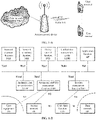
- FIG. 1-A is a schematic diagram of an architecture of an OAM communication system.
- the OAM communication system may include an access network device (for example, a base station) and a user terminal, and further includes a core network and the like.
- the access network device provides a communication service for the user terminal.
- the user terminal includes a terminal device such as a smartphone, a smartwatch, or a tablet computer.
- the access network device transmits downlink data to the user terminal.
- the data is encoded through channel encoding, and data obtained through channel encoding is transmitted to the user terminal after constellation modulation.
- the transmission is performed by using an OAM wave.
- the user terminal may transmit uplink data to the access network device.
- the uplink data may also be encoded through channel encoding, and encoded data is transmitted to the access network device after constellation modulation.
- the OAM communication system is applied to a 5G network, a 4G network, a 6G network, a satellite communication network, or another network in a complex form.
- FIG. 1-B is a schematic diagram of an example of a 5G network architecture according to an embodiment of this application.
- some function network elements for example, a mobility management entity (MME, mobility management entity)
- MME mobility management entity
- 4G network some function network elements in a 4G network are split, and a service-based architecture is defined.
- MME mobility management entity
- AMF Access and Mobility Management Function
- SMF Session Management Function
- a user terminal accesses a data network (DN, data network) or the like by accessing an operator network, and uses a service provided by an operator or a third party on the DN.
- DN data network
- the user terminal, the user equipment, a terminal device, or a terminal in embodiments of this application may be collectively referred to as UE.
- the UE described below in embodiments of this application may be replaced with the user terminal, the user equipment, the terminal device, or the terminal. Certainly, these terms may also be interchanged.
- the access and mobility management function is a control plane function in a 3GPP network, and is mainly responsible for access control and mobility management when the UE accesses the operator network.
- a security anchor function (SEAF, Security Anchor Function) may be deployed in the AMF, or deployed in a device other than the AMF.
- FIG. 1-B shows an example in which the SEAF is deployed in the AMF.
- the SEAF and the AMF may be jointly referred to as an AMF.
- the session management function is a control plane function in the 3GPP network.
- the SMF is mainly responsible for managing a data packet (PDU, Packet Data Unit) session of the UE.
- the PDU session is a channel used to transmit a PDU, and the UE and the DN may send the PDU to each other by using the PDU session.
- the SMF is responsible for management tasks such as establishment, maintenance, and deletion of the PDU session.
- the data network (DN, Data Network), also referred to as a packet data network (PDN, Packet Data Network), is a network located outside the 3GPP network.
- the 3GPP network may access a plurality of DNs, and a plurality of services provided by the operator or the third party may be deployed on the DN.
- a DN is a private network of a smart factory, a sensor installed in a workshop of the smart factory plays a role of UE, and a control server of the sensor is deployed in the DN.
- the UE communicates with the control server. After obtaining an instruction from the control server, the UE may transfer collected data to the control server according to the instruction.
- a DN is an internal office network of a company, a terminal used by an employee of the company may play a role of UE, and the UE may access internal information and other resources of the company.
- a unified data management (UDM, Unified Data Management) entity is also a control plane function in the 3GPP network.
- the UDM is mainly responsible for storing subscription data, a credential (credential), a permanent identifier (SUPI, Subscriber Permanent Identifier), and the like of a subscriber (UE) in the 3GPP network.
- the data may be used for authentication and authorization when the UE accesses the 3GPP network of the operator.
- An authentication server function (AUSF, Authentication Server Function) is also a control plane function in the 3GPP network.
- the AUSF is mainly used for first-level authentication (namely, subscriber authentication in the 3GPP network).
- a network exposure function (NEF, Network Exposure Function) is also a control plane function in the 3GPP network.
- the NEF is mainly responsible for exhibiting an external interface of the 3GPP network to the third party in a secure manner.
- the NEF may serve as a relay for communication.
- the NEF can translate internal and external identifiers when serving as the relay. For example, when sending an SUPI of the UE from the 3GPP network to a third party, the NEF may translate the SUPI into a corresponding external identity (ID, identity). Conversely, when sending an external identity ID to the 3GPP network, the NEF may translate the external identity ID into a corresponding SUPI.
- a network repository function (network repository function, NRF) is also a control-plane network element in the 3GPP network.
- the NR is mainly responsible for storing configuration service profiles (profiles) of accessible network functions (NFs), and providing network function discovery services for other network elements.
- a user plane function (UPF, User Plane Function) is a gateway for communication between the 3GPP network and the DN.
- a policy control function (PCF, Policy Control Function) is a control plane function in the 3GPP network, and is configured to provide a policy of a PDU session for the SMF.
- the policy may include charging, quality of service (QoS, Quality of Service), an authorization-related policy, and the like.
- An access network is a sub-network of the 3GPP network. To access the 3GPP network, the UE needs to first access the AN.
- the AN is also referred to as a radio access network (RAN, Radio Access Network). Therefore, terms “RAN” and "AN” are usually used interchangeably.
- the 3GPP network is a network that complies with 3GPP specifications.
- parts other than the UE and the DN may be considered as the 3GPP network.
- the 3GPP network is not limited to a 5G network defined by the 3GPP, but may further include a 2G network, a 3G network, and a 4G network.
- the 3GPP network is operated by the operator.
- N1, N2, N3, N4, N6, and the like indicate reference points (Reference Points) between related entities or network functions. Nausf, Namf, and the like represent service-oriented interfaces of related network functions.
- the 3GPP network and a non-3GPP network may coexist, and some network elements in the 5G network may also be used in some non-5G networks.
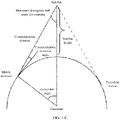
- terrestrial 5G will have a complete industry chain, a huge group of users, a flexible and efficient application service mode, and the like. Therefore, integrating a satellite communication system and the 5G network while complementing strength of each other to form a global seamless integrated comprehensive communication network of sea, land, space, and air to meet a plurality of ubiquitous service requirements of users is an important direction of communication development in the future.
- FIG. 1-C is a schematic diagram of an example of a satellite communication scenario.
- a protocol stack compatible with a 3GPP LTE/NR protocol may be used.
- a user terminal may be a common mobile terminal or a dedicated terminal, and a transmission process may comply with the LTE/NR protocol.
- the solutions discussed in this application are also applicable to a terrestrial mobile communication scenario defined in 3GPP LTE/NR, for example, a high-speed mobile communication scenario such as a high-speed railway or an aircraft, or a common low-speed mobile communication scenario.
- an electromagnetic wave has not only a linear momentum along a propagation direction, but also an angular momentum perpendicular to the propagation direction.
- the angular momentum includes a spin angular momentum (spin angular momentum, SAM) that describes a polarization status and an orbital angular momentum (orbital angular momentum, OAM) that describes a spiral phase structure.
- a phase factor e il ⁇ may be added to a radio electromagnetic wave whose wavefront has a planar structure, to obtain an electromagnetic wave that rotates around a propagation direction of a beam and whose wavefront has a spiral phase structure.
- the wavefront refers to a plane constituted by a mass point that starts to shift at a specific moment during propagation of the wave in a medium.
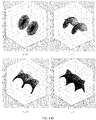
- FIG. 1-D is a schematic diagram of an electromagnetic wave with a spiral non-planar wavefront structure according to an embodiment of this application.
- FIG. 1-D shows, as examples, electromagnetic wave forms in which a quantity of OAM modalities l is 0, a quantity of OAM modalities l is 1, a quantity of OAM modalities l is 2, and a quantity of OAM modalities l is 4.
- a phase factor in which a quantity of OAM modalities l is not 0 enables an electromagnetic wave to have a spiral non-planar wavefront structure.
- a beam carrying an OAM AM may be generated by using a phased circular array with N array elements, and a dipole sub-antenna serves as an antenna array element.
- Array elements are evenly distributed on a circumference at equal spacings, and a same signal is fed to the array elements. A specific phase difference is maintained between two adjacent array elements.
- An OAM wave whose OAM modality is l can be generated based on the circular array antenna structure.
- different types of user terminals have different cost requirements and different capabilities. Therefore, if how to negotiate with a communication system on an OAM capability of a user terminal and how the communication system performs appropriate scheduling and transmission based on the OAM capability of the user terminal are not considered, service stability of the OAM communication system is very likely to be affected.
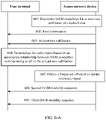
- FIG. 2 is a schematic flowchart of an OAM-based communication method according to an embodiment of this application.
- the solution in this embodiment is mainly applied to a paging scenario.
- the OAM-based communication method may include the following steps.
- the core network may send a paging message to an access network device, where the paging message carries a user terminal category or a user terminal downlink category.
- the access network device receives the paging message from the core network, and sends a paging indication message to the user terminal.
- the paging indication message carries a quantity of OAM modalities of a paging channel.
- the quantity of OAM modalities of the paging channel is less than or equal to a maximum quantity of downlink OAM modalities supported by the user terminal.
- the maximum quantity of OAM modalities supported by the user terminal can be determined based on the user terminal category or the user terminal downlink category.
- the user terminal receives the paging indication message from the access network device, where the paging indication message carries the quantity of OAM modalities of the paging channel, and the user terminal demodulates data in the paging channel based on the quantity of OAM modalities of the paging channel.
- the user terminal downlink category includes one or more of the following characteristics: a maximum downlink transmission rate supported, whether 64QAM (Quadrature Phase Shift Keying, quadrature phase shift keying) is supported in downlink, a maximum quantity of downlink OAM modalities supported, or the like.
- 64QAM Quadrature Phase Shift Keying, quadrature phase shift keying
- the user terminal category may include one or more of the following characteristics: a maximum downlink transmission rate supported, a maximum quantity of layers supported in downlink spatial multiplexing, a maximum quantity of downlink OAM modalities supported, a maximum uplink transmission rate supported, whether 64QAM is supported in uplink, a maximum quantity of uplink OAM modalities supported, or the like.
- a maximum transmission rate is related to a quantity of OAM modalities supported, in addition to a modulation order supported, a quantity of carriers supported, a maximum quantity of multiple-input multiple-output layers supported, and the like.
- the following examples describe some possible manners of calculating the maximum transmission rate.
- Max Data Rate-1 indicates a maximum downlink transmission rate
- L1 indicates a quantity of downlink OAM modalities supported by the access network device
- J1 indicates a quantity of downlink carriers supported by the access network device
- ⁇ Layers j 1 indicates maximum quantities of multiple-input multiple-output layers supported by different downlink carriers
- Q m j 1 indicates maximum modulation orders supported by different downlink carriers
- f ( j 1) indicates adjustable factors of different downlink carriers
- R max indicates a conversion constant
- N PRB BW j 1 ⁇ indicates quantities of physical resource blocks supported by corresponding bandwidth of different downlink carriers
- OH ( j1 ) indicates overhead values of different down
- Max Data Rate-2 indicates a maximum uplink transmission rate
- L2 indicates a quantity of uplink OAM modalities supported by the user terminal
- J2 indicates a quantity of uplink carriers supported by the user terminal
- ⁇ Layers j 2 indicates maximum quantities of multiple-input multiple-output layers supported by different uplink carriers
- Q m j 2 indicates maximum modulation orders supported by different uplink carriers
- f ( j 2) indicates adjustable factors of different uplink carriers
- R max indicates a conversion constant
- ⁇ indicates quantities of physical resource blocks supported by corresponding bandwidth of different uplink carriers
- T s ⁇ indicates average orthogonal frequency division multiplexing OFDM
- a manner of calculating the maximum transmission rate is not limited to the foregoing example manners, and some parameters may be alternatively added and/or replaced to perform calculation.
- the access network device receives the paging message sent by the core network, and may obtain the user terminal category or the user terminal downlink category that is carried in the paging message, and determine, based on the user terminal category or the user terminal downlink category, the maximum quantity of downlink OAM modalities supported by the user terminal, and the base station may select, based on a maximum quantity of uplink OAM modalities, an appropriate OAM modality to send the paging indication message to the user terminal.
- the foregoing solution enables the access network device to select, based on the user terminal category or a user terminal uplink category, an appropriate OAM modality to send the paging indication information, thereby helping improve accuracy and reliability of data transmission.
- FIG. 3 is a schematic flowchart of another OAM-based communication method according to an embodiment of this application.
- the solution in this embodiment is mainly applied to an OAM modality capability reporting scenario.
- the another OAM-based communication method may include the following steps.
- An access network device sends a capability query request to a user terminal.
- the access network device may send the capability query request to the user terminal in an uplink-downlink synchronization process of the user terminal or after uplink-downlink synchronization.
- the capability query request may be used to indicate the user terminal to report an OAM modality supported by the user terminal, and the like.
- the access network device may send the capability query request to the user terminal after receiving a radio resource control (RRC, Radio Resource Control) connection setup request from the user terminal.
- RRC Radio Resource Control
- the user terminal generates a capability reporting message after receiving the capability query request from the access network device, where the capability reporting message carries an OAM modality capability indication, and the OAM modality capability indication indicates an OAM modality capability supported by the user terminal.
- the user terminal sends the capability reporting message to the access network device.
- the access network device may receive the capability reporting message that comes from the user terminal and that is used to respond to the capability query request, where the capability reporting message carries the OAM modality capability indication, and the OAM modality capability indication indicates the OAM modality supported by the user terminal. Based on this, the access network device may learn of the OAM modality capability supported by the user terminal, and the access network device may further report, to a core network, the OAM modality capability supported by the user terminal.
- the user terminal mainly reports, at the request of the access network device, the OAM modality capability supported by the user terminal to the access network device.
- the user terminal may alternatively actively report the OAM modality capability supported by the user terminal. A specific implementation in this scenario is not described in detail herein.
- the OAM modality capability indication includes one or more of the following information: a set of uplink OAM modalities supported by the user terminal, a set of downlink OAM modalities supported by the user terminal, a maximum quantity of uplink OAM modalities supported by the user terminal and whether an uplink negative modality is supported, a maximum quantity of downlink OAM modalities supported by the user terminal and whether a downlink negative modality is supported, an uplink OAM modality initial value and an uplink OAM modality interval supported by the user terminal, or a downlink OAM modality initial value and a downlink OAM modality interval supported by the user terminal.
- FIG. 4 is a schematic flowchart of another OAM-based communication method according to an embodiment of this application.
- the solution in this embodiment is mainly applied to an OAM modality capability reporting scenario.
- the another OAM-based communication method may include the following steps.
- a user terminal performs downlink synchronization with an access network device.
- the access network device may send a synchronization signal to the user terminal by using a default quantity of OAM modalities.
- the user terminal receives the synchronization signal sent by the access network device, and performs downlink synchronization with the access network device based on the synchronization signal.
- the user terminal performs uplink synchronization with an access network device.
- the user terminal may select an appropriate quantity of OAM modalities to send an uplink random access signal.
- the quantity of OAM modalities may be selected based on a random access preamble, or based on a time domain location and a frequency domain location for sending the random access signal.
- the access network device receives the random access signal of the user terminal, and sends a random access response to the user terminal.
- the random access response carries a timing advance, and the random access response may be sent by using a quantity of OAM modalities that is the same as the quantity of OAM modalities in the downlink synchronization signal, or by using a quantity of OAM modalities that has a specific OAM modality interval from the quantity of OAM modalities in the downlink synchronization signal.
- the user terminal performs uplink synchronization based on the random access response from the access network device.
- the user terminal sends an RRC connection setup request message to the access network device.
- the RRC connection setup request message may be sent by using a quantity of OAM modalities that is the same as the quantity of OAM modalities in the uplink random access signal, or by using a quantity of OAM modalities that has a specific OAM modality interval from the quantity of OAM modalities in the uplink random access signal.
- the RRC connection setup request message is sent by using a quantity of OAM modalities that is indicated by the access network device.
- the access network device receives the RRC connection setup request message from the user terminal, and the access network device sends an RRC connection setup request acknowledgement message to the user terminal to respond to the RRC connection setup request message of the user terminal, so as to complete RRC connection setup for the user terminal.
- the access network device sends a capability query request to the user terminal, where the capability query request may be used to indicate the user terminal to report an OAM modality supported by the user terminal, and the like.
- the capability query request may be carried in the RRC connection setup request acknowledgement message, or the capability query request may be another message independent of the RRC connection setup request acknowledgement message.
- the access network device may select, based on a maximum quantity of OAM modalities supported by the access network device, an appropriate quantity of OAM modalities to send the capability query request. For example, the access network device may indicate, in a downlink control message, a quantity of OAM modalities used for the capability query request.
- the user terminal generates a capability reporting message after receiving the capability query request from the access network device, where the capability reporting message carries an OAM modality capability indication, and the OAM modality capability indication indicates an OAM modality capability supported by the user terminal.
- the user terminal sends the capability reporting message to the access network device.
- the access network device may receive the capability reporting message that comes from the user terminal and that is used to respond to the capability query request.
- the capability reporting message carries the OAM modality capability indication, and the OAM modality capability indication indicates the OAM modality capability supported by the user terminal.
- the access network device may learn of the OAM modality capability supported by the user terminal, and the access network device may further report, to a core network, the OAM modality capability supported by the user terminal.
- the OAM modality capability indication includes one or more of the following information: a set of uplink OAM modalities supported by the user terminal, a set of downlink OAM modalities supported by the user terminal, a maximum quantity of uplink OAM modalities supported by the user terminal and whether an uplink negative modality is supported, a maximum quantity of downlink OAM modalities supported by the user terminal and whether a downlink negative modality is supported, an uplink OAM modality initial value and an uplink OAM modality interval supported by the user terminal, or a downlink OAM modality initial value and a downlink OAM modality interval supported by the user terminal.
- a set of downlink OAM modalities supported by the user terminal may be recorded in an OAM modality list.
- the OAM modality supported by the user terminal may be represented by using an OAM modality initial value and an OAM modality interval that are supported by the UE.
- the UE reports, in OAM capability reporting, a maximum quantity of OAM modalities supported by the UE and whether a negative modality is supported (or whether a negative modality is supported is specified in a protocol in a system).
- the OAM modality interval is a default value 1.
- the UE reports that the maximum quantity of OAM modalities supported is 4.
- the user terminal may report the OAM modality capability of the user terminal to the access network device after performing downlink synchronization and uplink synchronization, to respond to the UE capability query request of the access network device.
- the OAM modality capability of the user terminal may include a set of OAM modalities supported by the user terminal, or the maximum quantity of OAM modalities supported by the user terminal and whether a negative modality is supported, or the OAM modality initial value and the OAM modality interval that are supported by the user terminal.
- This solution helps enable the access network device to learn of OAM modality capabilities of different user terminals (for example, quantities of OAM modalities supported by the user terminals), so that the access network device can implement appropriate scheduling and transmission based on the OAM modalities supported by the user terminals in a subsequent communication process. This helps implement multiplexing of different OAM modalities to increase a system capacity.
- the following describes some specific processes of OAM-based communication between an access network device and a user terminal as examples. These specific processes may be performed before or after the user terminal reports an OAM modality capability.
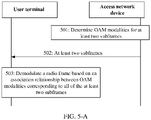
- FIG. 5-A is a schematic diagram of another OAM-based communication method according to an embodiment of this application.
- the another OAM-based communication method may include the following steps.
- An access network device determines OAM modalities for at least two subframes of a radio frame.
- At least one symbol is mapped to each of the at least two subframes.
- the at least one symbol may be at least one complex symbol of a first signal.
- the complex symbol is a modulated symbol obtained through QPSK modulation.
- a complex symbol is 1 2 ⁇ j ⁇ 1 2 , where j is an imaginary unit.
- the first signal may be a first bit sequence transmitted in a BCH.
- the first signal includes at least one of the following: a system frame number (system frame number, SFN), a frequency channel number, bandwidth, a frequency, and a quantity of OAM modalities supported by a system.
- the quantity of OAM modalities supported by the system is used to indicate a quantity of OAM modalities in an OAM modality sequence supported by the system.
- the quantity of OAM modalities supported by the system may be a quantity of OAM modalities corresponding to a first OAM modality sequence.
- FIG. 5-B is a schematic diagram of mapping a processed bit sequence to a radio frame according to an embodiment of this application.
- the access network device generates a cyclic redundancy check (cyclic redundancy check, CRC) code based on the first bit sequence; the access network device attaches the CRC code to the first bit sequence to obtain a second bit sequence; the access network device performs channel encoding on the second bit sequence to obtain a third bit sequence, where the channel encoding includes one of the following: convolutional encoding, polar encoding, or a low-density parity-check code; the access network device performs rate matching on the third bit sequence to obtain a fourth bit sequence; and the access network device scrambles the fourth bit sequence by using a scrambling bit sequence to obtain a fifth bit sequence, where the scrambling bit sequence is generated based on a cell identification code, and different cell identification codes result in different scrambling bit sequences.
- CRC cyclic redundancy check
- the access network device modulates the fifth bit sequence through QPSK.
- QPSK modulation refer to a table shown in FIG. 5-C .
- the access network device maps the at least one complex symbol of the first signal to the at least two subframes of the radio frame.
- the access network device maps the at least one complex symbol of the first signal to four subframes of the radio frame, and further determines four different OAM modalities for the four subframes. For example, a subframe A corresponds to an OAM modality 11, a subframe B corresponds to an OAM modality 12, a subframe C corresponds to an OAM modality 13, and a subframe D corresponds to an OAM modality 14.
- each of the at least two subframes corresponds to one complex symbol of the first signal, and complex symbols corresponding to all of the at least two subframes may be all the same, may be partially the same, or may be different from each other.
- a case 3 is as follows: A complex symbol corresponding to the subframe A is ⁇ 1 2 ⁇ j ⁇ 1 2 , a complex symbol corresponding to the subframe B is 1 2 + j ⁇ 1 2 ,and a complex symbol corresponding to the subframe C is 1 2 ⁇ j ⁇ 1 2 .
- Each of the at least one symbol may further include one of the following: a PSS or an SSS.
- the PSS may be used by a terminal device to perform downlink synchronization
- the SSS may be used by the terminal device to search for a cell.
- FIG. 5-D is a schematic diagram of mapping a symbol to a radio frame according to an embodiment of this application.
- a PSS, an SSS, and the like are mapped to each of two subframes of a radio frame.
- the two subframes respectively correspond to an OAM modality 11 and an OAM modality 12. That is, PSSs and SSSs in a same subframe are transmitted by using a same OAM modality.
- each of the at least two subframes corresponds to a PSS and an SSS
- all of the at least two subframes correspond to a same PSS and a same SSS.
- the at least two subframes include a subframe A and a subframe B
- the subframe A corresponds to a PSS and an SSS
- the subframe B corresponds to a PSS and an SSS.
- the PSS corresponding to the subframe A is the same as the PSS corresponding to the subframe B
- the SSS corresponding to the subframe A is the same as the SSS corresponding to the subframe B.
- the access network device may not determine an OAM modality for another subframe, or may determine an OAM modality for another subframe.
- the another subframe is at least one subframe, of the radio frame, to which no complex symbol of the first signal is mapped; or the another subframe is at least one subframe, of the radio frame, to which no PSS or SSS is mapped. This is not limited in this application.
- content included in this application may still be used. This is not limited herein.
- the adjacent subframes include subframes whose sending times are adjacent, and the sending times are times when the subframes are sent.
- the subframe C is sent after the subframe B is sent. Therefore, the subframe B and the subframe C are adjacent subframes. Further, the subframe A may correspond to an OAM modality 11, the subframe B may correspond to an OAM modality 12, and the subframe C may correspond to the OAM modality 11; or the subframe A may correspond to an OAM modality -11, the subframe B may correspond to an OAM modality 12, and the subframe C may correspond to an OAM modality 13. OAM modalities corresponding to the subframe A, the subframe B, and the subframe C are not limited in this application.
- OAM modalities corresponding to all of the at least two subframes may be different.
- the radio frame includes three subframes, and the three subframes are a subframe A, a subframe B, and a subframe C.
- the subframe A may correspond to an OAM modality 11
- the subframe B may correspond to an OAM modality 12
- the subframe C may correspond to an OAM modality 13.
- the radio frame includes a first subframe, a second subframe, a third subframe, and a fourth subframe, where the first subframe and the second subframe are adjacent subframes, the second subframe and the third subframe are adjacent subframes, and the third subframe and the fourth subframe are adjacent subframes.
- an OAM modality corresponding to the second subframe, an OAM modality corresponding to the third subframe, and an OAM modality corresponding to the fourth subframe all have an association relationship with an OAM modality corresponding to the first subframe.
- the OAM modality corresponding to the first subframe is 11
- the OAM modality corresponding to the second subframe is l 1 + ⁇ l
- the OAM modality corresponding to the third subframe is l 1 + 2 ⁇ l
- the OAM modality corresponding to the fourth subframe is l 1 + 3 ⁇ l.
- ⁇ l is a difference between adjacent OAM modalities in the OAM modality sequence supported by the system.
- an OAM modality corresponding to the third subframe has an association relationship with an OAM modality corresponding to the first subframe
- an OAM modality corresponding to the fourth subframe has an association relationship with an OAM modality corresponding to the second subframe.
- the OAM modality corresponding to the first subframe is 11
- the OAM modality corresponding to the second subframe is 12
- the OAM modality corresponding to the third subframe is l 1 + 2 ⁇ l
- the OAM modality corresponding to the fourth subframe is -12.
- the OAM modality corresponding to the subframe A in the radio frame may be l , 2 l , (5 l + ⁇ l ), or (5 l - 2 ⁇ l ).
- the quantity of OAM modalities corresponding to the first OAM modality sequence is a quantity of OAM modalities in the first OAM modality sequence.
- the first OAM modality sequence is an OAM modality sequence supported by the system.
- the quantity of OAM modalities corresponding to the first OAM modality sequence is 1.
- the OAM modality corresponding to the subframe A in the radio frame may be 2, or may be 3 ⁇ 2, that is, 6.
- the quantity of OAM modalities corresponding to the first OAM modality sequence is 4, and the difference between adjacent OAM modalities in the first OAM modality sequence is 1.
- the OAM modality corresponding to the subframe A in the radio frame may be any OAM modality in the first OAM modality sequence; or the OAM modality corresponding to the subframe A may be 3 ⁇ 2, that is, 6; or the OAM modality corresponding to the subframe A may be 3 ⁇ 2 + 2 ⁇ 1, that is, 8; or the OAM modality corresponding to the subframe A may be 2 ⁇ 2 - 5 ⁇ 1, that is, -1.
- the OAM modality corresponding to each of the at least two subframes meets the foregoing formula, thereby enriching manners of determining the OAM modality corresponding to each subframe.
- the first OAM modality sequence includes k OAM modalities.
- k is 1, each of the k OAM modalities is a non-zero integer; or when k is greater than or equal to 2, each of the k OAM modalities is a non-zero integer, and the k OAM modalities are different from each other.
- the first OAM modality sequence includes one OAM modality, and the first OAM modality sequence may be ⁇ 2 ⁇ or ⁇ -8 ⁇ ; or the first OAM modality sequence includes three OAM modalities, and the first OAM modality sequence may be ⁇ 1, 2, 3 ⁇ , ⁇ -1, 1, 2 ⁇ , or ⁇ -6, -4, -2 ⁇ .
- an OAM modality included in the first OAM modality sequence is determined based on different quantities of OAM modalities included in the first OAM modality sequence, to prepare for subsequent improvement of a diversity effect.
- the first OAM modality sequence may be ⁇ -1, 1 ⁇ , where 1 and -1 are a pair of OAM modalities, and 1 and -1 have opposite wavefront phases; or when k is 3, the first OAM modality sequence may be ⁇ -2, 2, 4 ⁇ , where 2 and -2 are a pair of OAM modalities, and 2 and -2 have opposite wavefront phases.
- OAM modalities corresponding to opposite wavefront phases may be configured by the access network device or preset.
- the first OAM modality sequence may be ⁇ -1, 5 ⁇ , where 5 and -1 are a pair of OAM modalities, and 5 and -1 have opposite wavefront phases.
- the access network device may configure any two different OAM modalities as a pair of OAM modalities that have opposite wavefront phases.
- the access network device may configure any two OAM modalities that are opposite numbers of each other as a pair of OAM modalities that have opposite wavefront phases.
- the access network device sends the at least two subframes.
- the terminal device receives the radio frame including the at least two subframes. At least one symbol is mapped to each of the at least two subframes, and OAM modalities corresponding to all of the at least two subframes have an association relationship.
- the terminal device demodulates the radio frame based on the association relationship between the OAM modalities corresponding to all of the at least two subframes.
- the terminal device may obtain the at least one symbol by demodulating the radio frame. Further, when obtaining the PSS and the SSS, the terminal device may perform downlink synchronization by using the PSS, and search for a cell by using the SSS. Further, when obtaining the at least one complex symbol of the first signal, the terminal may perform random access based on the at least one complex symbol of the first signal, to perform uplink synchronization and set up an RRC connection to the access network device.
- the OAM modalities are determined for the at least two subframes, and the OAM modalities corresponding to all of the at least two subframes have an association relationship, so that electromagnetic waves interact with each other during transmission of the at least two subframes, thereby enhancing an electromagnetic field, reducing signal fading, and helping improve a diversity effect.
- FIG. 6-A is a schematic diagram of another OAM-based communication method according to an embodiment of this application.
- the another OAM-based communication method may include the following steps.
- An access network device determines OAM modalities for at least two subframes of a radio frame.
- step 401 in the embodiment shown in FIG. 4 . Details are not described herein again.
- the access network device sends first information, where the first information includes a first field and an initial OAM modality in a first OAM modality sequence, and the first field is used to indicate ⁇ l , or the first field is used to indicate both ⁇ l and a first subcarrier spacing.
- the table shown in FIG. 6-B is a schematic diagram of a first field indication ⁇ l according to an embodiment of this application. It can be learned that, in the table shown in FIG. 6-B , two bits, namely, (00, 01, 10, and 11), are used to indicate different ⁇ l. For example, 00 indicates that ⁇ l is 1, and 11 indicates that ⁇ l is 8.
- the table shown in FIG. 6-C is a schematic diagram of a first field indication ⁇ l and a subcarrier spacing according to an embodiment of this application.
- two bits namely, (00, 01, 10, and 11), are used to indicate different ⁇ l and subcarrier spacings.
- 00 indicates that ⁇ l is 1, and also indicates that the subcarrier spacing is 15 kHz; and 11 indicates that ⁇ l is 8, and also indicates that the subcarrier spacing is 120 kHz.
- a terminal device receives the first information, where the first information includes the first field and the initial OAM modality in the first OAM modality sequence, and the first field is used to indicate ⁇ l , or the first field is used to indicate both ⁇ l and the first subcarrier spacing.
- the terminal is enabled to obtain the first information.
- the first field is used to indicate ⁇ l, or is used to indicate both ⁇ l and the first subcarrier spacing, thereby reducing overheads.
- the sending first information includes: sending the first information by using a system information block, radio resource control signaling, or downlink control information. It can be learned that, in the foregoing technical solution, manners of sending the first information are enriched.
- the receiving the first information includes: receiving the first information by using a system information block, radio resource control signaling, or downlink control information. It can be learned that, in the foregoing technical solution, manners of obtaining the first information are enriched.
- Step 602 may be alternatively performed before step 601.
- the access network device sends the at least two subframes.
- the terminal device receives the radio frame including the at least two subframes.
- the terminal device demodulates the radio frame based on an association relationship between OAM modalities corresponding to all of the at least two subframes.
- the access network device obtains a frequency offset of an uplink reference signal.
- the uplink reference signal includes a DMRS and/or an SRS.
- step 606 is performed; or if the frequency offset of the uplink reference signal is greater than the first frequency offset, step 607 is performed.
- the first frequency offset is configured by the access network device or is preset.
- step 606 may be performed, or step 607 may be performed.
- the access network device may preferentially send a second OAM modality sequence, or an initial OAM modality in the second OAM modality sequence and a difference between adjacent OAM modalities in the second OAM modality sequence; or the access network device may preferentially send a third OAM modality sequence, or an initial OAM modality in the third OAM modality sequence and a difference between adjacent OAM modalities in the third OAM modality sequence.
- a specific case of precedence is not limited in this application.
- the difference between adjacent OAM modalities in the second OAM modality sequence is less than a difference between adjacent OAM modalities in the first OAM modality interval.
- the difference between adjacent OAM modalities in the third OAM modality sequence is greater than the difference between adjacent OAM modalities in the first OAM modality, and the difference between adjacent OAM modalities in the third OAM modality sequence is greater than the difference between adjacent OAM modalities in the second OAM modality sequence.
- the access network device sends the second OAM modality sequence, or the initial OAM modality in the second OAM modality sequence and the difference between adjacent OAM modalities in the second OAM modality sequence.
- the access network device sends ⁇ 2 ⁇ ; or if the second OAM modality sequence is ⁇ 1, 3, 5, 7 ⁇ , the access network device may send ⁇ 1, 3, 5, 7 ⁇ , or may send 1 and 2, where 1 is the initial OAM modality in the second OAM modality sequence, and 2 is the difference between adjacent OAM modalities in the second OAM modality sequence.
- the terminal device receives the second OAM modality sequence, or the initial OAM modality in the second OAM modality sequence and the difference between adjacent OAM modalities in the second OAM modality sequence.
- the terminal device may receive the second OAM modality sequence.
- the second OAM modality sequence is ⁇ 2 ⁇ , or the second OAM modality sequence is ⁇ 1, 3, 5, 7 ⁇ .
- the terminal device may receive the initial OAM modality in the second OAM modality sequence and the difference between adjacent OAM modalities in the second OAM modality sequence.
- the initial OAM modality in the second OAM modality sequence is 1, and the difference between adjacent OAM modalities in the second OAM modality sequence is 2.
- the access network device sends the third OAM modality sequence, or the initial OAM modality in the third OAM modality sequence and the difference between adjacent OAM modalities in the third OAM modality sequence.
- the access network device sends ⁇ 2 ⁇ ; or if the third OAM modality sequence is ⁇ 1, 3, 5, 7 ⁇ , the access network device may send ⁇ 1, 3, 5, 7 ⁇ , or may send 1 and 2, where 1 is the initial OAM modality in the third OAM modality sequence, and 2 is the difference between adjacent OAM modalities in the third OAM modality sequence.
- the terminal device receives the third OAM modality sequence, or the initial OAM modality in the third OAM modality sequence and the difference between adjacent OAM modalities in the third OAM modality sequence.
- the terminal device may receive the third OAM modality sequence.
- the third OAM modality sequence is ⁇ 2 ⁇ , or the third OAM modality sequence is ⁇ 1, 3, 5, 7 ⁇ .
- the terminal device may receive the initial OAM modality in the third OAM modality sequence and the difference between adjacent OAM modalities in the third OAM modality sequence.
- the initial OAM modality in the third OAM modality sequence is 1, and the difference between adjacent OAM modalities in the third OAM modality sequence is 2.
- the OAM modalities are determined for the at least two subframes, and the OAM modalities corresponding to all of the at least two subframes have an association relationship, so that electromagnetic waves interact with each other during transmission of the at least two subframes, thereby enhancing an electromagnetic field, reducing signal fading, and improving a diversity effect.
- the terminal is further enabled to obtain the first information.
- the first field is used to indicate ⁇ l , or is used to indicate both ⁇ l and the first subcarrier spacing, thereby reducing overheads.
- reliability of signal transmission is further improved.
- the method further includes: sending second information, where the second information includes a second field and the initial OAM modality in the second OAM modality sequence, or the second information includes a second field and the initial OAM modality in the third OAM modality sequence.
- the second field is used to indicate the difference between adjacent OAM modalities in the second OAM modality sequence or the difference between adjacent OAM modalities in the third OAM modality sequence; or the second field is used to indicate both the difference between adjacent OAM modalities in the second OAM modality sequence and a second subcarrier spacing, or the difference between adjacent OAM modalities in the third OAM modality sequence and a third subcarrier spacing.
- the second information is the second field; or if the second OAM modality sequence is ⁇ 1, 3, 5, 7 ⁇ , the second information includes the second field and the initial OAM modality in the second OAM modality sequence.
- 1 is the initial OAM modality in the second OAM modality sequence.
- the second field is used to indicate the difference between adjacent OAM modalities in the second OAM modality sequence, namely, 2.
- the second subcarrier spacing is 15 kilohertz kHz
- the second field is used to indicate both the difference between adjacent OAM modalities in the second OAM modality sequence and the second subcarrier spacing, namely, 2 and 15 kHz.
- the second information is the second field; or if the third OAM modality sequence is ⁇ 1, 3, 5, 7 ⁇ , the second information includes the second field and the initial OAM modality in the third OAM modality sequence.
- 1 is the initial OAM modality in the third OAM modality sequence.
- the second field is used to indicate the difference between adjacent OAM modalities in the third OAM modality sequence, namely, 2. Assuming that the third subcarrier spacing is 15 kHz, the second field is used to indicate both the difference between adjacent OAM modalities in the third OAM modality sequence and the third subcarrier spacing, namely, 2 and 15 kHz.
- the access network device may send the second information by using a system information block, radio resource control signaling, or downlink control information.
- the terminal device may receive the second information by using a system information block, radio resource control signaling, or downlink control information.
- the terminal is enabled to obtain the second information.
- the second field is used to indicate information, or is used to indicate different information, thereby reducing overheads.
- manners of obtaining the second information are enriched.
- the access network device 700 may include a generation unit 710 and a communication unit 720.
- the generation unit 710 is configured to generate a capability reporting message, where the capability reporting message carries an OAM modality capability indication, and the OAM modality capability indication indicates an OAM modality capability supported by the user terminal.
- the communication unit 720 is configured to send the capability reporting message to an access network device.
- the OAM modality capability indication includes one or more of the following information: a set of uplink OAM modalities supported by the user terminal, a set of downlink OAM modalities supported by the user terminal, a maximum quantity of uplink OAM modalities supported by the user terminal and whether an uplink negative modality is supported, a maximum quantity of downlink OAM modalities supported by the user terminal and whether a downlink negative modality is supported, an uplink OAM modality initial value and an uplink OAM modality interval supported by the user terminal, or a downlink OAM modality initial value and a downlink OAM modality interval supported by the user terminal.
- each functional unit of the user terminal 700 For details about function implementation of each functional unit of the user terminal 700, for example, refer to related detailed descriptions of the method provided in the embodiment corresponding to FIG. 3 or FIG. 4 . Details are not described herein again.
- the sending unit 810 is configured to send a capability query request to a user terminal.
- the receiving unit 820 is configured to receive a capability reporting message that is used to respond to the capability query request, where the capability reporting message carries an OAM modality capability indication, and the OAM modality capability indication indicates an OAM modality capability supported by the user terminal.
- the OAM modality capability indication includes one or more of the following information: a set of uplink OAM modalities supported by the user terminal, a set of downlink OAM modalities supported by the user terminal, a maximum quantity of uplink OAM modalities supported by the user terminal and whether an uplink negative modality is supported, a maximum quantity of downlink OAM modalities supported by the user terminal and whether a downlink negative modality is supported, an uplink OAM modality initial value and an uplink OAM modality interval supported by the user terminal, or a downlink OAM modality initial value and a downlink OAM modality interval supported by the user terminal.
- each functional unit of the access network device 800 For details about function implementation of each functional unit of the access network device 800, for example, refer to related detailed descriptions of the method provided in the embodiment corresponding to FIG. 3 or FIG. 4 . Details are not described herein again.
- an embodiment of this application provides a user terminal 900.
- the user terminal 900 may include: a processor 910 and a memory 920 that are coupled to each other, where the processor 910 is configured to invoke a computer program stored in the memory 920, to perform some or all steps of any method that may be performed by the user terminal in embodiments of this application.
- an embodiment of this application provides an access network device 1000, including a processor 1010 and a memory 1020 that are coupled to each other.
- the processor 1010 is configured to invoke a computer program stored in the memory 1020, to perform some or all steps of any method that may be performed by the access network device in embodiments of this application.
- an embodiment of this application provides an access network device 1100.
- the access network device 1100 may include a receiving unit 1110 and a sending unit 1120.
- the receiving unit 1110 is configured to receive a paging message from a core network, where the paging message carries a user terminal category or a user terminal downlink category.
- the sending unit 1120 is configured to send a paging indication message to a user terminal, where the paging indication message carries a quantity of OAM modalities of a paging channel, the quantity of OAM modalities of the paging channel is less than or equal to a maximum quantity of downlink OAM modalities of the user terminal, and a maximum quantity of OAM modalities of the user terminal can be determined based on the user terminal category or the user terminal downlink category.
- the user terminal category may include one or more of the following characteristics: a maximum downlink transmission rate, a maximum quantity of layers supported in downlink spatial multiplexing, a maximum quantity of downlink OAM modalities, a maximum uplink transmission rate, whether 64QAM is supported in uplink, a maximum quantity of uplink OAM modalities, or the like.
- a maximum transmission rate is related to a quantity of OAM modalities supported, in addition to a modulation order supported, a quantity of carriers supported, a maximum quantity of multiple-input multiple-output layers supported, and the like.
- the following examples describe some possible manners of calculating the maximum transmission rate.
- Max Data Rate-1 indicates a maximum downlink transmission rate
- L1 indicates a quantity of downlink OAM modalities supported by the access network device
- J1 indicates a quantity of downlink carriers supported by the access network device
- ⁇ Layers j 1 indicates maximum quantities of multiple-input multiple-output layers supported by different downlink carriers
- Q m j 1 indicates maximum modulation orders supported by different downlink carriers
- f ( j 1) indicates adjustable factors of different downlink carriers
- R max indicates a conversion constant
- N PRB BW j 1 ⁇ indicates quantities of physical resource blocks supported by corresponding bandwidth of different downlink carriers
- OH ( j1 ) indicates overhead values of different down
- Max Data Rate-2 indicates a maximum uplink transmission rate
- L2 indicates a quantity of uplink OAM modalities supported by the user terminal
- J2 indicates a quantity of uplink carriers supported by the user terminal
- ⁇ Layers j 2 indicates maximum quantities of multiple-input multiple-output layers supported by different uplink carriers
- Q m j 2 indicates maximum modulation orders supported by different uplink carriers
- f ( j 2) indicates adjustable factors of different uplink carriers
- R max indicates a conversion constant
- ⁇ indicates quantities of physical resource blocks supported by corresponding bandwidth of different uplink carriers
- T s ⁇ indicates average orthogonal frequency division multiplexing OFDM
- each functional unit of the access network device 1100 For details about function implementation of each functional unit of the access network device 1100, for example, refer to related detailed descriptions of the method provided in the embodiment corresponding to FIG. 2 . Details are not described herein again.
- the access network device 1200 may include a communication unit 1210 and a paging processing unit 1220.
- the communication unit 1210 is configured to receive a paging indication message from an access network device, where the paging indication message carries a quantity of OAM modalities of a paging channel, and the quantity of OAM modalities of the paging channel is less than or equal to a maximum quantity of downlink OAM modalities supported by the user equipment.
- the paging processing unit 1220 is configured to demodulate, by the user terminal, data in the paging channel based on the quantity of OAM modalities of the paging channel.
- each functional unit of the user terminal 1200 For details about function implementation of each functional unit of the user terminal 1200, for example, refer to related detailed descriptions of the method provided in the embodiment corresponding to FIG. 2 . Details are not described herein again.
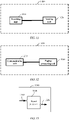
- an embodiment of this application provides a communication apparatus 1300, including: at least one input end 1310, a signal processor 1320, and at least one output end 1330.
- the signal processor 1320 is configured to perform some or all steps of any method that may be performed by an access network device or a user terminal in embodiments of this application.
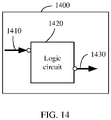
- an embodiment of this application provides a communication apparatus 1400, including: an input interface circuit 1410, a logic circuit 1420, and an output interface circuit 1430.
- the logic circuit 1420 is configured to perform some or all steps of any method that may be performed by an access network device or a user terminal in embodiments of this application.
- An embodiment of this application further provides a computer-readable storage medium.
- the computer-readable storage medium stores a computer program.
- the computer program is executed by hardware (for example, a processor), some or all steps of any method that may be performed by an access network device in embodiments of this application can be performed.
- An embodiment of this application further provides a computer-readable storage medium.
- the computer-readable storage medium stores a computer program.
- the computer program is executed by hardware (for example, a processor), some or all steps of any method that may be performed by an access network device in embodiments of this application can be performed.
- An embodiment of this application further provides a computer-readable storage medium.
- the computer-readable storage medium stores a computer program.
- the computer program is executed by hardware (for example, a processor), to perform some or all steps of any method that is performed by any device and that is in embodiments of this application.
- An embodiment of this application further provides a computer program product including instructions.
- the computer program product runs on a computer device, the computer device is enabled to perform some or all of the steps of any method in the foregoing aspects.
- the computer instructions may be transmitted from a website, computer, server, or data center to another website, computer, server, or data center in a wired (for example, a coaxial cable, an optical fiber, or a digital subscriber line) or wireless (for example, infrared, radio, or microwave) manner.
- the computer-readable storage medium may be any usable medium accessible by the computer, or a data storage device, such as a server or a data center, including one or more usable media.
- the usable medium may be a magnetic medium (for example, a floppy disk, a hard disk, or a magnetic tape), an optical medium (for example, an optical disc), a semiconductor medium (for example, a solid-state drive), or the like.
- the description of each embodiment has respective focuses. For a part that is not described in detail in an embodiment, refer to related description in other embodiments.
- the disclosed apparatus may be implemented in other manners.
- the described apparatus embodiment is merely an example.
- the unit division is merely logical function division or may be other division during actual implementation.
- a plurality of units or components may be combined or integrated into another system, or some features may be ignored or not performed.
- the displayed or discussed mutual indirect couplings or direct couplings or communication connections may be implemented through some interfaces.
- the indirect couplings or communication connections between the apparatuses or units may be implemented in electronic or other forms.
- the units described as separate parts may or may not be physically separate. Parts displayed as units may or may not be physical units, and may be located at one position or may be distributed on a plurality of network units. Some or all units may be selected based on actual needs to achieve the objectives of the solutions of the embodiments.
- functional units in embodiments of this application may be integrated into one processing unit, or each of the units may exist alone physically, or two or more units are integrated into one unit.
- the integrated unit may be implemented in a form of hardware, or may be implemented in a form of a software functional unit.
- the integrated unit When the integrated unit is implemented in the form of a software functional unit and sold or used as an independent product, the integrated unit may be stored in a computer-readable storage medium. Based on such an understanding, the technical solutions of this application essentially, or the part contributing to the conventional technology, or all or some of the technical solutions may be implemented in the form of a software product.
- the computer software product is stored in a storage medium and includes several instructions for instructing a computer device (which may be a personal computer, a server, a network device, or the like) to perform all or some of the steps of the methods described in embodiments of this application.
- the foregoing storage medium may include any medium that can store program code, such as a USB flash drive, a removable hard disk, a read-only memory (ROM, Read-Only Memory), a random access memory (RAM, Random Access Memory), a magnetic disk, or an optical disc.
- program code such as a USB flash drive, a removable hard disk, a read-only memory (ROM, Read-Only Memory), a random access memory (RAM, Random Access Memory), a magnetic disk, or an optical disc.
Landscapes
- Engineering & Computer Science (AREA)
- Computer Networks & Wireless Communication (AREA)
- Signal Processing (AREA)
- Mobile Radio Communication Systems (AREA)
Applications Claiming Priority (2)
| Application Number | Priority Date | Filing Date | Title |
|---|---|---|---|
| CN201911209235.0A CN112887989B (zh) | 2019-11-30 | 2019-11-30 | 基于oam的通信方法和相关设备及存储介质 |
| PCT/CN2020/132748 WO2021104518A1 (fr) | 2019-11-30 | 2020-11-30 | Procédé de communication basé sur un oam, dispositif et support de stockage associés |
Publications (3)
| Publication Number | Publication Date |
|---|---|
| EP4061046A1 true EP4061046A1 (fr) | 2022-09-21 |
| EP4061046A4 EP4061046A4 (fr) | 2023-01-11 |
| EP4061046B1 EP4061046B1 (fr) | 2025-02-26 |
Family
ID=76039403
Family Applications (1)
| Application Number | Title | Priority Date | Filing Date |
|---|---|---|---|
| EP20891777.3A Active EP4061046B1 (fr) | 2019-11-30 | 2020-11-30 | Radiomessagerie d'un terminal d'utilisateur utilisant modalités du moment angulaire orbital |
Country Status (3)
| Country | Link |
|---|---|
| EP (1) | EP4061046B1 (fr) |
| CN (1) | CN112887989B (fr) |
| WO (1) | WO2021104518A1 (fr) |
Families Citing this family (14)
| Publication number | Priority date | Publication date | Assignee | Title |
|---|---|---|---|---|
| US11757516B2 (en) | 2021-06-18 | 2023-09-12 | Qualcomm Incorporated | Beam management procedure for OAM in MMW and higher bands |
| US12231912B2 (en) | 2021-06-18 | 2025-02-18 | Qualcomm Incorporated | System and method for reporting orbital angular momentum waveform misalignment |
| US11849469B2 (en) | 2021-06-18 | 2023-12-19 | Qualcomm Incorporated | Orbital angular momentum capability in millimeter wave and higher frequency bands |
| US11616555B2 (en) * | 2021-06-18 | 2023-03-28 | Qualcomm Incorporated | Spatial misalignment tracking for orbital angular momentum beams in millimeter wave and higher frequency bands |
| CN115515065A (zh) * | 2021-06-21 | 2022-12-23 | 索尼集团公司 | 用于无线通信系统的基站侧电子设备和终端侧电子设备 |
| CN115550952A (zh) * | 2021-06-29 | 2022-12-30 | 华为技术有限公司 | 通信方法及装置 |
| CN115997411A (zh) * | 2021-08-20 | 2023-04-21 | 北京小米移动软件有限公司 | 基于轨道角动量oam的通信方法及其装置 |
| EP4404484A4 (fr) * | 2021-09-13 | 2024-11-20 | Beijing Xiaomi Mobile Software Co., Ltd. | Procédé, appareil et dispositif de communication reposant sur un moment cinétique orbital |
| WO2023065325A1 (fr) * | 2021-10-22 | 2023-04-27 | 北京小米移动软件有限公司 | Procédé et appareil de transmission de canal partagé sur la base d'un moment angulaire orbital |
| WO2023220899A1 (fr) * | 2022-05-16 | 2023-11-23 | 北京小米移动软件有限公司 | Procédé et appareil d'envoi d'informations de configuration de signal de référence et procédé et appareil de réception d'informations de configuration de signal de référence |
| WO2023245681A1 (fr) * | 2022-06-24 | 2023-12-28 | 北京小米移动软件有限公司 | Procédé, appareil et système de configuration de transmission en liaison montante basée sur un moment angulaire orbital |
| WO2024000527A1 (fr) * | 2022-06-30 | 2024-01-04 | 北京小米移动软件有限公司 | Procédé et appareil d'indication de mode de moment angulaire orbital (oam) |
| EP4557802A4 (fr) * | 2022-07-15 | 2025-08-06 | Beijing Xiaomi Mobile Software Co Ltd | Procédé et appareil de commutation de mode de moment angulaire orbital (oam), dispositif et support de stockage |
| CN115802352B (zh) * | 2022-11-04 | 2023-07-25 | 广州爱浦路网络技术有限公司 | 5gc设备授权的处理方法、系统、装置和存储介质 |
Family Cites Families (17)
| Publication number | Priority date | Publication date | Assignee | Title |
|---|---|---|---|---|
| WO2015065041A1 (fr) * | 2013-11-01 | 2015-05-07 | Lg Electronics Inc. | Procédé et appareil d'émission de messages de radiorecherche dans un système de communication sans fil |
| FR3014271B1 (fr) * | 2013-11-29 | 2015-12-04 | Inst Nat Sciences Appliq | Procede de transmission d'une sequence de symboles de donnees, dispositif de transmission, signal, procede de reception, dispositif de reception et programme d'ordinateur correspondants |
| EP2903363B1 (fr) * | 2014-01-30 | 2023-08-16 | Alcatel Lucent | Indiquer des propriétés d'un équipement utilisateur à un noeud de commande de réseau |
| EP3132558B1 (fr) * | 2014-04-17 | 2021-04-07 | Rai Radiotelevisione Italiana S.p.A. | Système d'émission et/ou de réception de signaux présentant des modes électromagnétiques avec moment cinétique orbital, ainsi que dispositif et procédé de celui-ci |
| EP3723401B1 (fr) * | 2014-07-02 | 2023-01-25 | Apple Inc. | Appareil et procédé pour améliorations de radiomessagerie pour équipement utilisateur de faible complexité |
| WO2016045007A1 (fr) * | 2014-09-24 | 2016-03-31 | 华为技术有限公司 | Nœud de réseau d'accès et procédé de radiomessagerie |
| US10511092B2 (en) * | 2015-10-27 | 2019-12-17 | Intel Corporation | Orbital angular momentum in millimeter-wave wireless communication |
| JP6697731B2 (ja) * | 2016-01-20 | 2020-05-27 | パナソニックIpマネジメント株式会社 | 送信装置、受信装置、および通信方法 |
| CN107872877A (zh) * | 2016-09-28 | 2018-04-03 | 中国移动通信有限公司研究院 | 一种配置寻呼区的方法、基站及核心网节点 |
| BR112020002493A2 (pt) * | 2017-08-09 | 2020-08-04 | Ntt Docomo, Inc. | estação rádio base e método de radiocomunicação |
| CN107888321A (zh) * | 2017-11-08 | 2018-04-06 | 南京邮电大学 | 一种基于oam的模分多址接入方法 |
| US10439287B2 (en) * | 2017-12-21 | 2019-10-08 | Nxgen Partners Ip, Llc | Full duplex using OAM |
| US11444814B2 (en) * | 2018-03-30 | 2022-09-13 | Eutelsat S A | Innovative use of the kalman filter in reception matrices for perfoming an improved estimation of telecommunication signals |
| CN110351815B (zh) * | 2018-04-04 | 2022-05-27 | 中兴通讯股份有限公司 | 一种寻呼方法、基站及用户设备 |
| CN109862622B (zh) * | 2019-01-16 | 2021-02-23 | 维沃移动通信有限公司 | 上报能力信息的方法、设备及系统 |
| CN112803975B (zh) * | 2019-11-14 | 2022-02-25 | 华为技术有限公司 | 确定预编码矩阵的方法、设备及系统 |
| CN114788383A (zh) * | 2019-12-24 | 2022-07-22 | Oppo广东移动通信有限公司 | 无线通信方法、终端设备和网络设备 |
-
2019
- 2019-11-30 CN CN201911209235.0A patent/CN112887989B/zh active Active
-
2020
- 2020-11-30 EP EP20891777.3A patent/EP4061046B1/fr active Active
- 2020-11-30 WO PCT/CN2020/132748 patent/WO2021104518A1/fr not_active Ceased
Also Published As
| Publication number | Publication date |
|---|---|
| EP4061046B1 (fr) | 2025-02-26 |
| EP4061046A4 (fr) | 2023-01-11 |
| CN112887989B (zh) | 2023-03-03 |
| WO2021104518A1 (fr) | 2021-06-03 |
| CN112887989A (zh) | 2021-06-01 |
Similar Documents
| Publication | Publication Date | Title |
|---|---|---|
| EP4061046B1 (fr) | Radiomessagerie d'un terminal d'utilisateur utilisant modalités du moment angulaire orbital | |
| KR102562408B1 (ko) | 차량-대-차량 통신을 위한 복조 참조 신호 설계 | |
| CN114450911B (zh) | 具有减少的开销的解调参考信号 | |
| CN114270884B (zh) | 5g广播/多播安全性密钥刷新 | |
| EP3373645A1 (fr) | Procédé et appareil de communication radio | |
| US11792805B2 (en) | Method and apparatus for non-coherent PUCCH transmission | |
| WO2021011270A1 (fr) | Procédés et appareil pour faciliter des espaces de séquences basés sur des faisceaux pour des signaux de synchronisation | |
| CN114223245A (zh) | 用于csi报告增强的频域基限制 | |
| CN115398821A (zh) | 波束增益信令 | |
| US20230055114A1 (en) | Techniques to facilitate phase jump estimation for sidelink dmrs bundling | |
| KR20220167372A (ko) | 시간 영역 리소스 할당-기반 harq-ack 피드백 생성 | |
| CN117083970A (zh) | 用于非地面网络中的两步rach的覆盖增强和配置 | |
| EP4059161A2 (fr) | Architecture de communication non cohérente dans des réseaux sans fil | |
| CN115023912A (zh) | 用于非相干通信的奇偶校验比特 | |
| CN115380498B (zh) | 用于采用跳频时的正交序列传输的方法和装置 | |
| CN114642043A (zh) | 具有非穿孔符号的无线通信 | |
| TWI859382B (zh) | 用於基於子取樣的序列設計的方法和裝置 | |
| US11876654B2 (en) | Methods and apparatus for unified codebooks for orthogonal sequence transmission | |
| CN116195196A (zh) | 针对非相干reed muller码的交织器设计 | |
| US20240259795A1 (en) | Secret key verification in wireless communication |
Legal Events
| Date | Code | Title | Description |
|---|---|---|---|
| STAA | Information on the status of an ep patent application or granted ep patent |
Free format text: STATUS: THE INTERNATIONAL PUBLICATION HAS BEEN MADE |
|
| PUAI | Public reference made under article 153(3) epc to a published international application that has entered the european phase |
Free format text: ORIGINAL CODE: 0009012 |
|
| STAA | Information on the status of an ep patent application or granted ep patent |
Free format text: STATUS: REQUEST FOR EXAMINATION WAS MADE |
|
| 17P | Request for examination filed |
Effective date: 20220617 |
|
| AK | Designated contracting states |
Kind code of ref document: A1 Designated state(s): AL AT BE BG CH CY CZ DE DK EE ES FI FR GB GR HR HU IE IS IT LI LT LU LV MC MK MT NL NO PL PT RO RS SE SI SK SM TR |
|
| REG | Reference to a national code |
Ref country code: DE Ref legal event code: R079 Free format text: PREVIOUS MAIN CLASS: H04W0024020000 Ipc: H04B0010110000 Ref country code: DE Ref legal event code: R079 Ref document number: 602020046992 Country of ref document: DE Free format text: PREVIOUS MAIN CLASS: H04W0024020000 Ipc: H04B0010110000 |
|
| A4 | Supplementary search report drawn up and despatched |
Effective date: 20221208 |
|
| RIC1 | Information provided on ipc code assigned before grant |
Ipc: H04W 68/00 20090101ALI20221202BHEP Ipc: H04B 10/11 20130101AFI20221202BHEP |
|
| DAV | Request for validation of the european patent (deleted) | ||
| DAX | Request for extension of the european patent (deleted) | ||
| STAA | Information on the status of an ep patent application or granted ep patent |
Free format text: STATUS: EXAMINATION IS IN PROGRESS |
|
| 17Q | First examination report despatched |
Effective date: 20240612 |
|
| 17Q | First examination report despatched |
Effective date: 20240625 |
|
| GRAP | Despatch of communication of intention to grant a patent |
Free format text: ORIGINAL CODE: EPIDOSNIGR1 |
|
| STAA | Information on the status of an ep patent application or granted ep patent |
Free format text: STATUS: GRANT OF PATENT IS INTENDED |
|
| INTG | Intention to grant announced |
Effective date: 20241025 |
|
| GRAS | Grant fee paid |
Free format text: ORIGINAL CODE: EPIDOSNIGR3 |
|
| GRAA | (expected) grant |
Free format text: ORIGINAL CODE: 0009210 |
|
| STAA | Information on the status of an ep patent application or granted ep patent |
Free format text: STATUS: THE PATENT HAS BEEN GRANTED |
|
| AK | Designated contracting states |
Kind code of ref document: B1 Designated state(s): AL AT BE BG CH CY CZ DE DK EE ES FI FR GB GR HR HU IE IS IT LI LT LU LV MC MK MT NL NO PL PT RO RS SE SI SK SM TR |
|
| REG | Reference to a national code |
Ref country code: GB Ref legal event code: FG4D |
|
| REG | Reference to a national code |
Ref country code: CH Ref legal event code: EP |
|
| REG | Reference to a national code |
Ref country code: DE Ref legal event code: R096 Ref document number: 602020046992 Country of ref document: DE |
|
| REG | Reference to a national code |
Ref country code: IE Ref legal event code: FG4D |
|
| REG | Reference to a national code |
Ref country code: NL Ref legal event code: MP Effective date: 20250226 |
|
| PG25 | Lapsed in a contracting state [announced via postgrant information from national office to epo] |
Ref country code: RS Free format text: LAPSE BECAUSE OF FAILURE TO SUBMIT A TRANSLATION OF THE DESCRIPTION OR TO PAY THE FEE WITHIN THE PRESCRIBED TIME-LIMIT Effective date: 20250526 |
|
| PG25 | Lapsed in a contracting state [announced via postgrant information from national office to epo] |
Ref country code: FI Free format text: LAPSE BECAUSE OF FAILURE TO SUBMIT A TRANSLATION OF THE DESCRIPTION OR TO PAY THE FEE WITHIN THE PRESCRIBED TIME-LIMIT Effective date: 20250226 |
|
| PG25 | Lapsed in a contracting state [announced via postgrant information from national office to epo] |
Ref country code: PL Free format text: LAPSE BECAUSE OF FAILURE TO SUBMIT A TRANSLATION OF THE DESCRIPTION OR TO PAY THE FEE WITHIN THE PRESCRIBED TIME-LIMIT Effective date: 20250226 |
|
| PG25 | Lapsed in a contracting state [announced via postgrant information from national office to epo] |
Ref country code: ES Free format text: LAPSE BECAUSE OF FAILURE TO SUBMIT A TRANSLATION OF THE DESCRIPTION OR TO PAY THE FEE WITHIN THE PRESCRIBED TIME-LIMIT Effective date: 20250226 |
|
| REG | Reference to a national code |
Ref country code: LT Ref legal event code: MG9D |
|
| PG25 | Lapsed in a contracting state [announced via postgrant information from national office to epo] |
Ref country code: NO Free format text: LAPSE BECAUSE OF FAILURE TO SUBMIT A TRANSLATION OF THE DESCRIPTION OR TO PAY THE FEE WITHIN THE PRESCRIBED TIME-LIMIT Effective date: 20250526 Ref country code: IS Free format text: LAPSE BECAUSE OF FAILURE TO SUBMIT A TRANSLATION OF THE DESCRIPTION OR TO PAY THE FEE WITHIN THE PRESCRIBED TIME-LIMIT Effective date: 20250626 |
|
| PG25 | Lapsed in a contracting state [announced via postgrant information from national office to epo] |
Ref country code: NL Free format text: LAPSE BECAUSE OF FAILURE TO SUBMIT A TRANSLATION OF THE DESCRIPTION OR TO PAY THE FEE WITHIN THE PRESCRIBED TIME-LIMIT Effective date: 20250226 |
|
| PG25 | Lapsed in a contracting state [announced via postgrant information from national office to epo] |
Ref country code: HR Free format text: LAPSE BECAUSE OF FAILURE TO SUBMIT A TRANSLATION OF THE DESCRIPTION OR TO PAY THE FEE WITHIN THE PRESCRIBED TIME-LIMIT Effective date: 20250226 |
|
| PG25 | Lapsed in a contracting state [announced via postgrant information from national office to epo] |
Ref country code: LV Free format text: LAPSE BECAUSE OF FAILURE TO SUBMIT A TRANSLATION OF THE DESCRIPTION OR TO PAY THE FEE WITHIN THE PRESCRIBED TIME-LIMIT Effective date: 20250226 Ref country code: PT Free format text: LAPSE BECAUSE OF FAILURE TO SUBMIT A TRANSLATION OF THE DESCRIPTION OR TO PAY THE FEE WITHIN THE PRESCRIBED TIME-LIMIT Effective date: 20250626 |
|
| PG25 | Lapsed in a contracting state [announced via postgrant information from national office to epo] |
Ref country code: BG Free format text: LAPSE BECAUSE OF FAILURE TO SUBMIT A TRANSLATION OF THE DESCRIPTION OR TO PAY THE FEE WITHIN THE PRESCRIBED TIME-LIMIT Effective date: 20250226 Ref country code: GR Free format text: LAPSE BECAUSE OF FAILURE TO SUBMIT A TRANSLATION OF THE DESCRIPTION OR TO PAY THE FEE WITHIN THE PRESCRIBED TIME-LIMIT Effective date: 20250527 |
|
| REG | Reference to a national code |
Ref country code: AT Ref legal event code: MK05 Ref document number: 1771699 Country of ref document: AT Kind code of ref document: T Effective date: 20250226 |
|
| PG25 | Lapsed in a contracting state [announced via postgrant information from national office to epo] |
Ref country code: SE Free format text: LAPSE BECAUSE OF FAILURE TO SUBMIT A TRANSLATION OF THE DESCRIPTION OR TO PAY THE FEE WITHIN THE PRESCRIBED TIME-LIMIT Effective date: 20250226 |
|
| PG25 | Lapsed in a contracting state [announced via postgrant information from national office to epo] |
Ref country code: SM Free format text: LAPSE BECAUSE OF FAILURE TO SUBMIT A TRANSLATION OF THE DESCRIPTION OR TO PAY THE FEE WITHIN THE PRESCRIBED TIME-LIMIT Effective date: 20250226 |
|
| PG25 | Lapsed in a contracting state [announced via postgrant information from national office to epo] |
Ref country code: DK Free format text: LAPSE BECAUSE OF FAILURE TO SUBMIT A TRANSLATION OF THE DESCRIPTION OR TO PAY THE FEE WITHIN THE PRESCRIBED TIME-LIMIT Effective date: 20250226 |
|
| PG25 | Lapsed in a contracting state [announced via postgrant information from national office to epo] |
Ref country code: IT Free format text: LAPSE BECAUSE OF FAILURE TO SUBMIT A TRANSLATION OF THE DESCRIPTION OR TO PAY THE FEE WITHIN THE PRESCRIBED TIME-LIMIT Effective date: 20250226 |
|
| PGFP | Annual fee paid to national office [announced via postgrant information from national office to epo] |
Ref country code: GB Payment date: 20250930 Year of fee payment: 6 |
|
| PG25 | Lapsed in a contracting state [announced via postgrant information from national office to epo] |
Ref country code: AT Free format text: LAPSE BECAUSE OF FAILURE TO SUBMIT A TRANSLATION OF THE DESCRIPTION OR TO PAY THE FEE WITHIN THE PRESCRIBED TIME-LIMIT Effective date: 20250226 |
|
| PG25 | Lapsed in a contracting state [announced via postgrant information from national office to epo] |
Ref country code: EE Free format text: LAPSE BECAUSE OF FAILURE TO SUBMIT A TRANSLATION OF THE DESCRIPTION OR TO PAY THE FEE WITHIN THE PRESCRIBED TIME-LIMIT Effective date: 20250226 Ref country code: CZ Free format text: LAPSE BECAUSE OF FAILURE TO SUBMIT A TRANSLATION OF THE DESCRIPTION OR TO PAY THE FEE WITHIN THE PRESCRIBED TIME-LIMIT Effective date: 20250226 |
|
| PG25 | Lapsed in a contracting state [announced via postgrant information from national office to epo] |
Ref country code: RO Free format text: LAPSE BECAUSE OF FAILURE TO SUBMIT A TRANSLATION OF THE DESCRIPTION OR TO PAY THE FEE WITHIN THE PRESCRIBED TIME-LIMIT Effective date: 20250226 |
|
| PG25 | Lapsed in a contracting state [announced via postgrant information from national office to epo] |
Ref country code: SK Free format text: LAPSE BECAUSE OF FAILURE TO SUBMIT A TRANSLATION OF THE DESCRIPTION OR TO PAY THE FEE WITHIN THE PRESCRIBED TIME-LIMIT Effective date: 20250226 |
|
| REG | Reference to a national code |
Ref country code: DE Ref legal event code: R097 Ref document number: 602020046992 Country of ref document: DE |
|
| PLBE | No opposition filed within time limit |
Free format text: ORIGINAL CODE: 0009261 |
|
| STAA | Information on the status of an ep patent application or granted ep patent |
Free format text: STATUS: NO OPPOSITION FILED WITHIN TIME LIMIT |
|
| 26N | No opposition filed |
Effective date: 20251127 |