EP4062865A2 - Verfahren zum ausrichten von gruppierten daten - Google Patents
Verfahren zum ausrichten von gruppierten daten Download PDFInfo
- Publication number
- EP4062865A2 EP4062865A2 EP20906611.7A EP20906611A EP4062865A2 EP 4062865 A2 EP4062865 A2 EP 4062865A2 EP 20906611 A EP20906611 A EP 20906611A EP 4062865 A2 EP4062865 A2 EP 4062865A2
- Authority
- EP
- European Patent Office
- Prior art keywords
- data
- image data
- grouped data
- grouped
- aligned
- Prior art date
- Legal status (The legal status is an assumption and is not a legal conclusion. Google has not performed a legal analysis and makes no representation as to the accuracy of the status listed.)
- Pending
Links
Images



Classifications
-
- G—PHYSICS
- G06—COMPUTING OR CALCULATING; COUNTING
- G06T—IMAGE DATA PROCESSING OR GENERATION, IN GENERAL
- G06T7/00—Image analysis
- G06T7/30—Determination of transform parameters for the alignment of images, i.e. image registration
-
- A—HUMAN NECESSITIES
- A61—MEDICAL OR VETERINARY SCIENCE; HYGIENE
- A61C—DENTISTRY; APPARATUS OR METHODS FOR ORAL OR DENTAL HYGIENE
- A61C9/00—Impression cups, i.e. impression trays; Impression methods
- A61C9/004—Means or methods for taking digitized impressions
- A61C9/0046—Data acquisition means or methods
-
- A—HUMAN NECESSITIES
- A61—MEDICAL OR VETERINARY SCIENCE; HYGIENE
- A61C—DENTISTRY; APPARATUS OR METHODS FOR ORAL OR DENTAL HYGIENE
- A61C9/00—Impression cups, i.e. impression trays; Impression methods
- A61C9/004—Means or methods for taking digitized impressions
- A61C9/0046—Data acquisition means or methods
- A61C9/0053—Optical means or methods, e.g. scanning the teeth by a laser or light beam
-
- A—HUMAN NECESSITIES
- A61—MEDICAL OR VETERINARY SCIENCE; HYGIENE
- A61C—DENTISTRY; APPARATUS OR METHODS FOR ORAL OR DENTAL HYGIENE
- A61C13/00—Dental prostheses; Making same
- A61C13/0003—Making bridge-work, inlays, implants or the like
- A61C13/0004—Computer-assisted sizing or machining of dental prostheses
-
- A—HUMAN NECESSITIES
- A61—MEDICAL OR VETERINARY SCIENCE; HYGIENE
- A61C—DENTISTRY; APPARATUS OR METHODS FOR ORAL OR DENTAL HYGIENE
- A61C13/00—Dental prostheses; Making same
- A61C13/34—Making or working of models, e.g. preliminary castings, trial dentures; Dowel pins [4]
-
- A—HUMAN NECESSITIES
- A61—MEDICAL OR VETERINARY SCIENCE; HYGIENE
- A61C—DENTISTRY; APPARATUS OR METHODS FOR ORAL OR DENTAL HYGIENE
- A61C19/00—Dental auxiliary appliances
- A61C19/04—Measuring instruments specially adapted for dentistry
-
- G—PHYSICS
- G06—COMPUTING OR CALCULATING; COUNTING
- G06T—IMAGE DATA PROCESSING OR GENERATION, IN GENERAL
- G06T15/00—Three-dimensional [3D] image rendering
- G06T15/08—Volume rendering
-
- G—PHYSICS
- G06—COMPUTING OR CALCULATING; COUNTING
- G06T—IMAGE DATA PROCESSING OR GENERATION, IN GENERAL
- G06T7/00—Image analysis
- G06T7/50—Depth or shape recovery
- G06T7/55—Depth or shape recovery from multiple images
- G06T7/579—Depth or shape recovery from multiple images from motion
-
- A—HUMAN NECESSITIES
- A61—MEDICAL OR VETERINARY SCIENCE; HYGIENE
- A61B—DIAGNOSIS; SURGERY; IDENTIFICATION
- A61B5/00—Measuring for diagnostic purposes; Identification of persons
- A61B5/0059—Measuring for diagnostic purposes; Identification of persons using light, e.g. diagnosis by transillumination, diascopy, fluorescence
- A61B5/0062—Arrangements for scanning
-
- A—HUMAN NECESSITIES
- A61—MEDICAL OR VETERINARY SCIENCE; HYGIENE
- A61B—DIAGNOSIS; SURGERY; IDENTIFICATION
- A61B5/00—Measuring for diagnostic purposes; Identification of persons
- A61B5/0059—Measuring for diagnostic purposes; Identification of persons using light, e.g. diagnosis by transillumination, diascopy, fluorescence
- A61B5/0082—Measuring for diagnostic purposes; Identification of persons using light, e.g. diagnosis by transillumination, diascopy, fluorescence adapted for particular medical purposes
- A61B5/0088—Measuring for diagnostic purposes; Identification of persons using light, e.g. diagnosis by transillumination, diascopy, fluorescence adapted for particular medical purposes for oral or dental tissue
-
- G—PHYSICS
- G06—COMPUTING OR CALCULATING; COUNTING
- G06T—IMAGE DATA PROCESSING OR GENERATION, IN GENERAL
- G06T2207/00—Indexing scheme for image analysis or image enhancement
- G06T2207/10—Image acquisition modality
- G06T2207/10016—Video; Image sequence
-
- G—PHYSICS
- G06—COMPUTING OR CALCULATING; COUNTING
- G06T—IMAGE DATA PROCESSING OR GENERATION, IN GENERAL
- G06T2207/00—Indexing scheme for image analysis or image enhancement
- G06T2207/10—Image acquisition modality
- G06T2207/10016—Video; Image sequence
- G06T2207/10021—Stereoscopic video; Stereoscopic image sequence
-
- G—PHYSICS
- G06—COMPUTING OR CALCULATING; COUNTING
- G06T—IMAGE DATA PROCESSING OR GENERATION, IN GENERAL
- G06T2207/00—Indexing scheme for image analysis or image enhancement
- G06T2207/20—Special algorithmic details
- G06T2207/20212—Image combination
- G06T2207/20221—Image fusion; Image merging
-
- G—PHYSICS
- G06—COMPUTING OR CALCULATING; COUNTING
- G06T—IMAGE DATA PROCESSING OR GENERATION, IN GENERAL
- G06T2207/00—Indexing scheme for image analysis or image enhancement
- G06T2207/30—Subject of image; Context of image processing
- G06T2207/30004—Biomedical image processing
- G06T2207/30036—Dental; Teeth
-
- G—PHYSICS
- G06—COMPUTING OR CALCULATING; COUNTING
- G06T—IMAGE DATA PROCESSING OR GENERATION, IN GENERAL
- G06T2210/00—Indexing scheme for image generation or computer graphics
- G06T2210/32—Image data format
-
- G—PHYSICS
- G06—COMPUTING OR CALCULATING; COUNTING
- G06T—IMAGE DATA PROCESSING OR GENERATION, IN GENERAL
- G06T2210/00—Indexing scheme for image generation or computer graphics
- G06T2210/41—Medical
Definitions
- the present disclosure relates to an aligning method by grouped data, and more specifically, to an aligning method by grouped data, which continuously performs a scan by generating a new group when three-dimensional volume data are not connected to each other in an aligning process while scanning an inside of an oral cavity.
- the impression of a patient's oral cavity is acquired using an alginate, and plaster or the like is poured into an acquired mold to produce the patient's tooth model.
- the accuracy of the model may be problematic, and there is a disadvantage in that when a precise model may not be produced, it is difficult to customize treatment for the patient in making a prosthetic treatment product to be applied to the patient.
- the inside of the patient's oral cavity is scanned using a three-dimensional scanner, and the scanned part is acquired as three-dimensional data, so that accurate dimensions and a shape of the inside of the oral cavity may be obtained, and the user may accurately diagnose the patient, and an appropriate prosthetic treatment may be provided to the patient.
- a user grips an intraoral scanner among three-dimensional scanners and draws a part of the scanner into or out from the oral cavity to capture the patient's affected parts (which may include teeth, gums, etc. inside the oral cavity).
- the intraoral scanner acquires the patient's captured affected part as image data, converts the image data into three-dimensional volume data using the brightness information of each data, and aligns the overlapping parts to finally generate one three-dimensional model.
- one three-dimensional model may mean the entire intraoral model data of the patient acquired by capturing the maxilla, mandible, and occlusal state of the patient.
- the aligning process there may occur a case in which the alignment is interrupted when the user does not carefully scan. There is a problem in that when the alignment is interrupted, the coupling between the three-dimensional volume data becomes incomplete, so that the precision of the patient's entire intraoral model data is lowered.
- An object of the present disclosure is to provide an aligning method by grouped data, which classifies data into at least one grouped data and supplements a data gap occurring between the grouped data in an additional alignment operation by newly generating and separating a group in which data is stored when the alignment is not performed for a certain time or more in converting images acquired from an imaging unit into three-dimensional volume data and performing the alignment.
- An aligning method by grouped data may include generating a first grouped data including at least one first image data, determining whether a second image data is aligned with the first grouped data, including the second image data in the first grouped data when the second image data is aligned with the first grouped data, generating a second grouped data to include the second image data when the second image data is not aligned with the first grouped data, and combining the first grouped data and the second grouped data.
- first image data and the second image data may be converted into three-dimensional volume data.
- the attempting of the alignment may include confirming whether the second image data is aligned with the first grouped data for the predetermined time, and updating the number of alignment attempts when the second image data is not aligned with the first grouped data in the confirming of whether the second image data is aligned with the first grouped data.
- the process may return to confirming whether the second image data is aligned with the first grouped data when the number of alignment attempts is less than the critical number of times.
- the second grouped data may be generated to include the second image data when the number of alignment attempts is greater than or equal to the critical number of times.
- At least a partial area of the first image data included in the first grouped data and at least a partial area of the second image data included in the second grouped data may be aligned.
- first image data and the second image data may be aligned through a third image data that overlaps each of the at least the partial area of the first image data and the at least the partial area of the second image data.
- an aligning method by grouped data may include an image generating operation of acquiring an image along a scan path, an aligning operation of aligning the image data continuously acquired along the scan path to be connected to each other, a grouped data storing operation of making the image data a grouped data and categorizing and storing the grouped data based on a point at which the image data are disconnected to each other in the aligning operation, and a reconnection determining operation of aligning data of the two or more grouped data to be connected to each other.
- the point at which the image data are disconnected may be determined according to an overlapping range of the continuous image data in the grouped data storing operation.
- the scan path may include a plurality of paths, the plurality of paths may have different start points and end points, and the plurality of paths may have a scan area overlapping in at least some sections.
- the number of grouped data stored in the grouped data storing operation may have the number according to the plurality of scan paths.
- the point at which the image data are disconnected to each other in the aligning operation may be the end point of each scan path.
- the method may further include displaying the point at which the image data is disconnected to each other between the grouped data on a display.
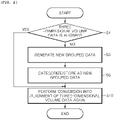
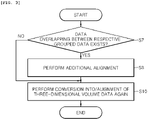
- FIGS. 1 to 3 are flowcharts of an aligning method by grouped data according to the present disclosure.
- the aligning method by grouped data includes an initial grouped data generating operation (S1) in which an initial grouped data is generated.
- S1 an initial grouped data generating operation
- a user usually a person who treats a patient or who may be a dentist
- the initial grouped data is generated.
- a point at which the initial grouped data is generated may also be performed by a processor built in the scanner or performed by a processor built in a personal computer connected to the scanner. It is preferable that the initial grouped data is generated in the processor formed inside the scanner.
- the initial grouped data means a first grouped data, it may be used interchangeably with the first grouped data for convenience in the following description.
- the imaging unit may include a single camera composed of one camera or a multi-camera including two or more cameras.
- the imaging unit may include two or more multi-cameras, two or more images may be acquired at one time point, so that it is possible to acquire more precise image data.
- Light incident on the camera may be generated as an image data by an imaging sensor electrically connected to the camera (S2).
- the image data may have the form of a two-dimensional image or may also be a voxel data that is a three-dimensional volume data.
- the image data generated by the imaging sensor may be categorized and stored as the initial grouped data (S3). In other words, when the image data is generated through the capturing, the generated image data is categorized and stored as the initial grouped data (or first grouped data).
- a path where the image data is stored may also be a storage device of a personal computer spaced apart from the scanner or may also be a storage unit built into the scanner itself.
- the initial grouped data storing operation (S3) may include a three-dimensional data converting operation (S31) of converting the image data acquired in the image generating operation (S2) into a three-dimensional volume data.
- the three-dimensional data converting operation (S31) may form a voxel data including brightness information in a pixel having a volume using brightness information of a corresponding part from the two-dimensional image data acquired from the imaging unit.
- the three-dimensional volume data formed from the three-dimensional data converting operation (S31) may be aligned so that overlapping parts are connected to form a larger chunk of data (S32).
- the alignment may mean that two or more three-dimensional volume data are merged into one three-dimensional volume data having a larger volume by the connection between three-dimensional volume data at minimum.
- a set of three-dimensional volume data for one entire mandible, a set of three-dimensional volume data for one entire maxilla, and a set of three-dimensional volume data for occlusion may be formed, and these data sets are combined to generate one complete data set for the patient's intraoral model.
- the three-dimensional data may be converted by an external processor that is formed outside the scanner, electrically connected to the scanner, and receives the image data captured and generated by the scanner.
- aligning operation (S32) When the above-described aligning operation (S32) is performed, a continuous aligning process may not be performed due to the user's inexperienced scan or for the user's intentional distinction. Conventionally, when the aligning process is not performed, the aligned result according to the user's scan may be displayed on a screen having a red edge of a display unit. When the aligned result is displayed as described above, an additional data is not acquired unless the three-dimensional volume data is generated by scanning a part overlapping the previous scan area that may be aligned.
- the aligning method by grouped data may further include a disconnect determining operation (S4) of determining whether a state in which the alignment is not performed continues for a certain time or more while the three-dimensional volume data are connected to each other in the aligning operation.
- S4 disconnect determining operation
- the state in which the alignment is not performed continues for the certain time or more, it means a state in which the three-dimensional volume data is previously generated and the alignment is performed by the overlapping data parts and then the overlapping data parts do not appear, so that the data are not overlapped and the alignment is not performed.
- the certain time may mean a specific time previously set in a program, but preferably, may be set to a time with an interval at which it is determined that the aligning process is not reasonably performed while the user performs the scan.
- the expression "disconnect” used herein should be construed as not meaning a state in which the scanner equipment is electrically disconnected to a personal computer, a server, or a power source, but meaning a state in which data are disconnected because there is no overlapping parts between the three-dimensional volume data. Meanwhile, since the three-dimensional volume data are connected by an external processor, whether to determine the disconnect may also be performed by the external processor.
- the disconnect determining operation when it is determined that the disconnect state continues for the certain time or more because there is no overlapping parts between the three-dimensional volume data, the data collection of the initial grouped data (first grouped data) is terminated, and a three-dimensional volume data lastly connected may be set to a last data.
- FIGS. 4 to 6 are views conceptually showing an embodiment of the aligning method by grouped data according to the present disclosure.
- a new grouped data may be generated (S5).
- the new grouped data generated just after the initial grouped data may be named a second grouped data.
- the second grouped data may form a data set formed to be spaced apart from the first grouped data.
- the image data generated by the imaging unit of the scanner is now categorized and stored as the new grouped data (S6).
- the image data generated after the second grouped data has been generated may be categorized and stored as the second grouped data.
- the storage of the image data as the second grouped data is terminated to generate a third grouped data, and an image data generated thereafter is categorized and stored as the third grouped data.
- These grouped data may also be stored in the storage device of the personal computer spaced apart from the scanner or stored in the storage unit built into the scanner itself.
- the data are discontinuously collected even when the aligning process is not continuously performed.
- the "discontinuous" means that the data are not overlapped between the respective grouped data, and there is the continuity between the three-dimensional volume data within each grouped data because the aligning operation has been performed therebetween.
- the user since the user is required to finally acquire the patient's entire intraoral model data, it is necessary to supplement a data gap B between the respective grouped data through subsequent scans.
- the aligning method by grouped data may further include a reconnection determining operation (S7) of checking whether the data of the initial grouped data and the new grouped data overlap.
- S7 a reconnection determining operation
- the user performs measurement from right to left based on FIG. 4 .
- an image data of a first grouped data 11 is initially converted into a volume data and an alignment is performed, and then a new second grouped data 21 is generated through the disconnect determining operation, and a second grouped data storing operation is performed, and an image data generated after the second grouped data storing operation is started is categorized and stored as the second grouped data 21.
- a part where the data is not generated because the capturing is not performed between the first grouped data 11 and the second grouped data 21 is left as the data gap B.
- the data gap B is left between the second grouped data 21 and a third grouped data 31.
- the user performs the scan again from left to right to supplement the data gap B.
- the data gaps B present between the respective grouped data 11, 21, 31, 41, 51, and 61 as a fourth grouped data 41, a fifth grouped data 51, and a sixth grouped data 61 are generated, it is possible to eventually acquire the entire intraoral model data of the patient.
- a data initially generated in the first grouped data 12 is referred to as a first group initial data 121.
- the disconnect determining operation when the state in which the three-dimensional volume data are disconnected to each other continues for the certain time or more and the second grouped data 22 is generated, the three-dimensional volume data generated and stored in the first grouped data 12 lastly before the second grouped data 22 is generated becomes a first group final data 12F.
- a data initially generated in the second grouped data 22 becomes a second grouped initial data 221
- a three-dimensional volume data generated and stored in the second grouped data 22 lastly when the third grouped data 32 is generated becomes a second grouped final data 22F.
- the third grouped data 32 when the third grouped data 32 is generated and the new data storing operation is performed, a third grouped initial data 321 overlaps the first grouped data 12 previously captured and generated as the three-dimensional volume data. Accordingly, the third grouped data 32 may have the three-dimensional volume data connected to that of the first grouped data 12 (the additional alignment operation (S8)), and supplement the data gap B between the first grouped data 12 and the second grouped data 22 previously present.
- the new grouped data overlaps the three-dimensional volume data of the previously generated grouped data (S7).
- the initial data 321 of the third grouped data 32 overlaps the three-dimensional volume data of the first grouped data 12
- a final data 32F of the third grouped data 32 overlaps the three-dimensional volume data of the second grouped data 22, and the additional alignment is performed to eventually supplement the data gap B part (S8).
- the first grouped data 13, the second grouped data 23, and the third grouped data 33 have been generated and the scan has been performed, but the data gaps B has occurred between the respective classifications 13, 23, and 33. Accordingly, the user is required to scan a wide area again after the conventional alignment error occurrence part, but by scanning only between the first grouped data and the second grouped data (between 13 and 23) and between the second grouped data and the third grouped data (between 23 and 33) in which the data gaps B occur due to the aligning method by grouped data according to the present disclosure, it is possible to minimize a range to be scanned.
- FIG. 7 is a flowchart of an aligning method by grouped data according to another embodiment of the present disclosure.
- an aligning method by grouped data according to another embodiment of the present disclosure may include an image generating operation (S110) of acquiring an image data along a scan path, and an aligning operation (S120) of aligning the image data continuously acquired along the scan path to be connected to each other.
- S110 image generating operation
- S120 aligning operation
- the image data for an object to be scanned (which means the parts inside the oral cavity) is generated.
- the image data may be an image data in which light reflected from the object to be scanned is incident into the intraoral scanner and digitalized through the imaging unit formed inside the intraoral scanner.
- the image data when the image data is continuously acquired along the scan path, overlapping areas occur between the continuous image data, and these overlapping areas may be connected and aligned with each other to appear as one connected image data again.
- the aligning operation when the aligning operation is normally performed, one mandibular data, one maxillary data, and occlusal data obtained by combining the mandibular and maxillary data may be integrated as a whole to generate the entire intraoral model data of the patient.
- the generated image data may be stored in the storage unit that may be formed inside the scanner or the external storage device.
- an aligning method by grouped data may further include a grouped data storing operation (S130) of classifying the image data into different grouped data based on the point at which the image data are disconnected to each other and categorizing and storing the grouped data in the aligning operation.
- S130 a grouped data storing operation
- the connection and alignment between the image data may not be performed because the scanning is not sufficiently performed to form the overlapping parts between the image data.
- the aligning method by grouped data according to another embodiment of the present disclosure a case in which the data gap B occurs because the overlapping range of the image data is not sufficiently formed regardless of whether the connection state of the image data continues for the certain time may be defined as the disconnect.
- the generated grouped data may be stored in the storage unit that may be formed inside the scanner or the external storage device.
- the intraoral scanner may categorize and store the image data connected before the disconnect state as an nth grouped data, and categorize and store the image data after the disconnect state as an (n+1)th grouped data.
- n may be any natural number, which means that it may have a plurality of grouped data until the scan is performed from the first grouped data to the final grouped data.
- the grouped data is classified before and after the time point when a current state is determined as the disconnect state, and the image data acquired just before the current state is determined as the disconnect state becomes the final data of the corresponding grouped data, and the image data acquired just after the current state is determined as the disconnect state becomes the initial data of the corresponding grouped data.
- the point scanned just before the current state is determined as the disconnect state is recognized as the end point of the corresponding scan path, and the point scanned just after the current state is determined as the disconnect state is recognized as the start point of the corresponding scan path.
- the two classifications have different start points and end points. This means that the disconnected points become the end points of the respective scan paths.
- the categorization of the image data into the plurality of grouped data is to distinguish the scan paths between the respective grouped data, so that the number of grouped data stored in the grouped data storing operation may correspond to the number of scan paths.
- the disconnect occurs at the end point 12F of the scan path corresponding to the first grouped data 12 to generate the first grouped data 12
- the disconnect occurs at the end point 22F of the scan path corresponding to the second grouped data 22 to generate the second grouped data 22
- the disconnect occurs at the end point 32F of the scan path corresponding to the third grouped data 32 to generate the third grouped data 32.
- a total of three grouped data may be generated.
- the user continuously performs the scan to acquire the complete intraoral model data of the patient by minimizing the data gap B.
- the image data corresponding to subsequent grouped data may have a part overlapping the image data corresponding to the previous grouped data.
- this means that the plurality of scan paths may have the scan areas overlapping each other in at least some sections, and at this time, the data gap B may be filled.
- the data gap B when the data gap B is filled, it means that the image data may be connected between different grouped data, and a reconnection determining operation (S140) of confirming the possibility of connecting and aligning the data of two or more grouped data again and aligning the data to be connected to each other may be included.
- the data for the part where the data gap B has occurred may be supplemented, and by continuously performing the scan as described above, it is possible to minimize the data gap B and as a result, complete the complete intraoral model data of the patient.
- the above-described alignment, disconnect determination, reconnection determination, and data supplementation between the image data or the three-dimensional volume data may be performed by the external processor formed outside the scanner.
- the aligning method by grouped data may further include displaying on a display the point at which the data gap B where the image data are disconnected to each other between the grouped data has occurred. Referring to FIG. 6 , it may be confirmed that the point at which the data gap B has occurred is displayed in the shape of an arrow.
- the aligning method by grouped data according to another embodiment of the present disclosure by displaying the point of the data gap B on the display with the arrow or the like so that the user may clearly confirm the point of the data gap B, the user may scan only the part where the data gap B has occurred again to minimize the data gap B, so that the data between the grouped data may be connected to each other.
- the display may mean a display device electrically connected to the scanner or the external processor, and may be a display device having a screen for notifying a user of whether the data gap B has occurred.
- FIG. 8 is a flowchart of an aligning method by grouped data according to still another embodiment of the present disclosure.
- the aligning method by grouped data includes an operation of generating the first grouped data including at least one first image data (S210) and an operation of determining whether a second image data is aligned with the first grouped data (S220).
- the scan process is started, at least one image data may be acquired by the scanner, and the image data may form one or more grouped data.
- a category of the first grouped data is generated, and the image data is included in the first grouped data as the first image data.
- the image data (the first image data and the second image data) may be two-dimensional or three-dimensional data.
- At least one first image data may be aligned to form one three-dimensional volume data.
- the lastly acquired image data may be aligned along with the three-dimensional volume data formed by aligning the previously acquired image data.
- the three-dimensional volume data may be expanded.
- one grouped data may be generated as one three-dimensional volume data by aligning at least one image data.
- the sequentially acquired image data may be aligned and generated as one three-dimensional volume data.
- the first image data is included in the first grouped data, and it may be determined whether the second image data acquired in the scan process is aligned with at least any one of the first image data. For example, it may be determined whether the second image data may overlap at least some of the first image data to be connected and aligned.
- the second image data may attempt to be aligned with at least some areas of the first image data included in the first grouped data the predetermined number of times or for a predetermined time (S230).
- the operation of attempting the alignment (S230) includes confirming whether the second image data is aligned with the first grouped data for the predetermined time (S231).
- the second image data may be included in the first grouped data (S232).
- the second image data may be aligned with at least some of the first image data included in the first grouped data to expand the three-dimensional volume data of the first grouped data.
- the data gap may occur because the scan areas do not overlap.
- the data gap may occur when the user has not carefully scanned the patient's oral cavity or has not intentionally performed the scan continuously.
- the image data acquired before the data gap occurs may be included in any one grouped data, and the image data acquired after the data gap has occurred may be included in the new grouped data.
- the number of alignment attempts may be updated (S233). For example, the number of initial alignment attempts may be set to 1. At this time, when the second image data is not aligned with the first grouped data for the predetermined time in the operation of confirming whether the second image data is aligned with the first grouped data (S231), the number of alignment attempts may be added by one.
- an operation of confirming whether the updated number of alignment attempts is less than the critical number of times may be performed.
- the critical number of times may be 10, and when the updated number of alignment attempts is less than 10, the process may return to the operation of confirming whether the second image data is aligned with the first grouped data (S231) again to confirm whether the second image data is aligned with the first grouped data.
- the second image data may not be aligned with the first grouped data and the data gap has occurred.
- the attempt to align the second image data with the first grouped data may be stopped any longer, and the new grouped data may be generated.
- the second grouped data different from the first grouped data may be generated to include the second image data (S235).
- the second image data is included in the second grouped data, so that the user may continuously perform the scan even without necessarily finding a position aligned with the first grouped data and performing the scan.
- the limitation condition of the alignment attempt has been described as the number of times, but is not limited thereto, and it is also possible to set the alignment attempt time as a critical condition.
- the order of the operation of updating the number of alignment attempts and the operation of confirming whether the updated number of alignment attempts is less than the critical number of times may be changed. For example, when the second image data is not aligned with the first grouped data in the operation of confirming whether the second image data is aligned with the first grouped data (S231), it may be determined whether the number of alignment attempts is less than the critical number of times, and the number of alignment attempts may be updated when the number of alignment attempts is less than the critical number of times. After the number of alignment attempts is updated, the operation of confirming whether the second image data is aligned with the first grouped data (S231) may be performed again.
- the user wants to generate the grouped data according to his/her intention.
- the scan environment illumination, foreign substances, or the like
- the generation of the new grouped data whenever the data gap instantaneously occurs is not only contrary to the user's intention but also causes an increase in the amount of operations for acquiring and aligning the image data and generating the grouped data. As the amount of operations increases, a scan speed of the scanner may decrease, thereby lowering scanning efficiency.
- the new grouped data when the second image data is not aligned with the first grouped data, the new grouped data is not immediately generated, and the user's intention may be confirmed through the predetermined number of alignment attempts or the predetermined alignment attempt time.
- the instantaneous alignment failure that the user does not want occurs it is possible to prevent the new grouped data from being unnecessarily generated when the image data aligned with the first grouped data within the predetermined number of alignment attempts or the predetermined alignment attempt time is input.
- the new grouped data may be generated. For example, when the user scans a right molar part and then moves to a left molar part to perform the scan, the data gap may occur between the right molar part and the left molar part. In this case, the image data representing the right molar part and the image data representing the left molar part are not aligned, and this state exceeds the predetermined number of alignment attempts or the predetermined alignment attempt time. Accordingly, the appropriate number of grouped data may be generated according to the user's intention using the predetermined number of times or the predetermined time. The user may perform the scan in a desired way without caring whether the alignment is performed, and finally acquire a sophisticated three-dimensional model.
- the operation of combining the second grouped data and the first grouped data may be performed.
- Each of the first image data included in the first grouped data and the second image data included in the second grouped data may form the three-dimensional volume data, and each of the three-dimensional volume data may configure at least a part of the overall three-dimensional model. Accordingly, all grouped data may be aligned to complete one three-dimensional model.
- the alignment may not be performed.
- the data gap may exist between the first grouped data and the second grouped data.
- the alignment may be performed through the third image data overlapping at least a partial area of the first image data and at least a partial area of the second image data, respectively.
- the third grouped data may be generated between the first grouped data and the second grouped data, and the third grouped data may include the third image data.
- the third image data may be aligned with both the first grouped data and the second grouped data. Accordingly, the first grouped data and the second grouped data may be aligned via the third grouped data.
- this is only illustrative, and a plurality of grouped data may also be generated between the first grouped data and the second grouped data to eliminate the data gap.
- the aligning method by grouped data provides the method capable of acquiring the entire three-dimensional model through the alignment between the grouped data by categorizing the aligned image data into the grouped data even when the image data acquired along the scan process are not continuously aligned.
Landscapes
- Health & Medical Sciences (AREA)
- Engineering & Computer Science (AREA)
- Life Sciences & Earth Sciences (AREA)
- Animal Behavior & Ethology (AREA)
- General Health & Medical Sciences (AREA)
- Veterinary Medicine (AREA)
- Public Health (AREA)
- Epidemiology (AREA)
- Oral & Maxillofacial Surgery (AREA)
- Dentistry (AREA)
- Physics & Mathematics (AREA)
- General Physics & Mathematics (AREA)
- Theoretical Computer Science (AREA)
- Computer Vision & Pattern Recognition (AREA)
- Computer Graphics (AREA)
- Biomedical Technology (AREA)
- Biophysics (AREA)
- Optics & Photonics (AREA)
- Apparatus For Radiation Diagnosis (AREA)
Applications Claiming Priority (2)
| Application Number | Priority Date | Filing Date | Title |
|---|---|---|---|
| KR20190175292 | 2019-12-26 | ||
| PCT/KR2020/019090 WO2021133099A2 (ko) | 2019-12-26 | 2020-12-24 | 그룹 데이터에 의한 정렬 방법 |
Publications (2)
| Publication Number | Publication Date |
|---|---|
| EP4062865A2 true EP4062865A2 (de) | 2022-09-28 |
| EP4062865A4 EP4062865A4 (de) | 2024-08-14 |
Family
ID=76573328
Family Applications (1)
| Application Number | Title | Priority Date | Filing Date |
|---|---|---|---|
| EP20906611.7A Pending EP4062865A4 (de) | 2019-12-26 | 2020-12-24 | Verfahren zum ausrichten von gruppierten daten |
Country Status (5)
| Country | Link |
|---|---|
| US (1) | US12347121B2 (de) |
| EP (1) | EP4062865A4 (de) |
| KR (1) | KR102530012B1 (de) |
| CN (1) | CN114901204B (de) |
| WO (1) | WO2021133099A2 (de) |
Family Cites Families (26)
| Publication number | Priority date | Publication date | Assignee | Title |
|---|---|---|---|---|
| EP2258303B1 (de) * | 2000-04-19 | 2013-09-18 | OraMetrix, Inc. | System zur Erstellung eines individuellen virtuellen dreidimensionalen Modells eines Zahnes |
| US6763148B1 (en) * | 2000-11-13 | 2004-07-13 | Visual Key, Inc. | Image recognition methods |
| US9421074B2 (en) * | 2001-04-13 | 2016-08-23 | Orametrix, Inc. | Unified three dimensional virtual craniofacial and dentition model and uses thereof |
| US9492245B2 (en) * | 2004-02-27 | 2016-11-15 | Align Technology, Inc. | Method and system for providing dynamic orthodontic assessment and treatment profiles |
| RU2010152658A (ru) * | 2008-05-23 | 2012-06-27 | Те Острейлиан Нэшнл Юниверсити (Au) | Обработка данных изображения |
| US8209143B1 (en) * | 2009-09-15 | 2012-06-26 | Google Inc. | Accurate alignment of multiple laser scans using a template surface |
| US20120062557A1 (en) * | 2010-09-10 | 2012-03-15 | Dimensional Photonics International, Inc. | Systems and methods for processing and displaying intra-oral measurement data |
| WO2012083968A1 (en) * | 2010-12-21 | 2012-06-28 | 3Shape A/S | Motion blur compensation |
| CN103392191B (zh) * | 2011-02-22 | 2016-09-28 | 3M创新有限公司 | 混合拼接 |
| US8542879B1 (en) * | 2012-06-26 | 2013-09-24 | Google Inc. | Facial recognition |
| US8948482B2 (en) * | 2012-11-01 | 2015-02-03 | Align Technology, Inc. | Motion compensation in a three dimensional scan |
| KR101448985B1 (ko) | 2013-03-05 | 2014-10-13 | 주식회사 메디트 | 3차원 형상 측정장치 |
| US9785818B2 (en) * | 2014-08-11 | 2017-10-10 | Synaptics Incorporated | Systems and methods for image alignment |
| KR101767661B1 (ko) * | 2016-02-22 | 2017-08-11 | 박성원 | 스캐닝 정밀도 향상용 표시자, 스캐닝 정밀도 향상용 조성물 및 물품의 스캐닝 정밀도 향상 방법 |
| KR101840444B1 (ko) * | 2016-05-04 | 2018-03-20 | 주식회사 메디트 | 치과용 3차원 데이터 처리장치 및 그 방법 |
| US10136972B2 (en) * | 2016-06-30 | 2018-11-27 | Align Technology, Inc. | Historical scan reference for intraoral scans |
| KR20190118602A (ko) * | 2017-02-15 | 2019-10-18 | 쓰리세이프 에이/에스 | 3d 스캐너의 스캔 볼륨 모니터링 |
| KR101953622B1 (ko) * | 2017-08-31 | 2019-05-23 | 주식회사 디오 | 이종의 구강 이미지 정합방법 |
| KR101930062B1 (ko) * | 2017-12-27 | 2019-03-14 | 클리어라인 주식회사 | 인공지능기술을 이용한 단계별 자동 교정 시스템 |
| US11151753B2 (en) * | 2018-09-28 | 2021-10-19 | Align Technology, Inc. | Generic framework for blurring of colors for teeth in generated images using height map |
| KR102054901B1 (ko) * | 2018-12-28 | 2019-12-12 | 주식회사 디오 | 치아 수복물 설계를 위한 이미지 데이터 처리방법 |
| US11367192B2 (en) * | 2019-03-08 | 2022-06-21 | Align Technology, Inc. | Foreign object filtering for intraoral scanning |
| WO2020185015A1 (ko) * | 2019-03-12 | 2020-09-17 | 주식회사 메디트 | 치아 보철 제조를 위한 3차원 스캔 데이터 처리 방법 |
| WO2020185019A1 (ko) * | 2019-03-12 | 2020-09-17 | 주식회사 메디트 | 디지털 스캔바디 정렬 방법 및 이를 이용하는 장치 |
| KR102269897B1 (ko) * | 2020-01-08 | 2021-06-28 | 주식회사 메디트 | 이미지 필터링 방법 |
| KR102406154B1 (ko) * | 2020-02-03 | 2022-06-08 | 오스템임플란트 주식회사 | 구강 모델 데이터 정합 방법 및 장치, 이를 위한 컴퓨터 판독 가능한 기록매체 |
-
2020
- 2020-12-24 EP EP20906611.7A patent/EP4062865A4/de active Pending
- 2020-12-24 CN CN202080090581.6A patent/CN114901204B/zh active Active
- 2020-12-24 WO PCT/KR2020/019090 patent/WO2021133099A2/ko not_active Ceased
- 2020-12-28 KR KR1020200184465A patent/KR102530012B1/ko active Active
-
2022
- 2022-06-24 US US17/848,421 patent/US12347121B2/en active Active
Also Published As
| Publication number | Publication date |
|---|---|
| EP4062865A4 (de) | 2024-08-14 |
| CN114901204A (zh) | 2022-08-12 |
| CN114901204B (zh) | 2025-05-23 |
| KR20210083204A (ko) | 2021-07-06 |
| US12347121B2 (en) | 2025-07-01 |
| WO2021133099A3 (ko) | 2021-08-19 |
| KR102530012B1 (ko) | 2023-05-08 |
| WO2021133099A2 (ko) | 2021-07-01 |
| US20220335628A1 (en) | 2022-10-20 |
Similar Documents
| Publication | Publication Date | Title |
|---|---|---|
| US12048600B2 (en) | Dental CAD automation using deep learning | |
| EP3140809B1 (de) | Identifizierung von bereichen von interesse während intraoraler abtastungen | |
| US8830309B2 (en) | Hierarchical processing using image deformation | |
| US20140080086A1 (en) | Image Navigation Integrated Dental Implant System | |
| JP2019155027A (ja) | 口腔疾患診断システム及び口腔疾患診断プログラム | |
| KR20150128713A (ko) | 교합 인기를 위한 방법 및 시스템 | |
| EP3453360B1 (de) | Vorrichtung zur verfolgung der bewegung von zähnen und verfahren dafür | |
| WO2016084066A1 (en) | Intraoral 3d scanner | |
| EP3909546A1 (de) | Bildaufnahmeunterstützungsvorrichtung, scannersystem und bildaufnahmeunterstützungsverfahren | |
| WO2021025296A1 (ko) | 크라운 모델 자동 추천방법 및 이를 수행하는 보철 캐드 장치 | |
| US20230274431A1 (en) | Image processing apparatus, method for controlling same, and storage medium | |
| KR102237711B1 (ko) | 신경관 라인 생성 방법 및 이를 위한 의료영상 처리장치 | |
| CN115607322A (zh) | 一种基于口内三维扫描的虚拟咬合检测与设计方法及系统 | |
| US20230414331A1 (en) | Capture of intraoral features from non-direct views | |
| KR20210157677A (ko) | 인공치아 제조정보 생성방법 및 인공치아 제조 시스템 | |
| KR102401135B1 (ko) | 디지털 치과 치료 시뮬레이션 방법 및 그 장치 | |
| EP4062865A2 (de) | Verfahren zum ausrichten von gruppierten daten | |
| JP2016513503A (ja) | 上顎及び下顎の模型を自動的に整合させる方法及びシステム | |
| US11263788B2 (en) | Apparatus and method for superimposing teeth data image onto face image | |
| US20250339244A1 (en) | Method for acquiring a model of a dental arch | |
| KR20240003372A (ko) | 치아교정 시뮬레이션 기반의 치아 교정 방법 | |
| KR102879835B1 (ko) | 3점 교합 정렬 가능한 구강 스캐너 시스템 및 그 제어 방법 | |
| KR102879839B1 (ko) | 버추얼 바이트를 이용하는 치과 보철물 제작 시스템 및 방법 | |
| CN115471506B (zh) | 一种口扫模型的位置调整方法、存储介质和电子设备 | |
| KR20220115661A (ko) | 디지털 의치 디자인 방법 및 그 장치 |
Legal Events
| Date | Code | Title | Description |
|---|---|---|---|
| STAA | Information on the status of an ep patent application or granted ep patent |
Free format text: STATUS: THE INTERNATIONAL PUBLICATION HAS BEEN MADE |
|
| PUAI | Public reference made under article 153(3) epc to a published international application that has entered the european phase |
Free format text: ORIGINAL CODE: 0009012 |
|
| STAA | Information on the status of an ep patent application or granted ep patent |
Free format text: STATUS: REQUEST FOR EXAMINATION WAS MADE |
|
| 17P | Request for examination filed |
Effective date: 20220624 |
|
| AK | Designated contracting states |
Kind code of ref document: A2 Designated state(s): AL AT BE BG CH CY CZ DE DK EE ES FI FR GB GR HR HU IE IS IT LI LT LU LV MC MK MT NL NO PL PT RO RS SE SI SK SM TR |
|
| DAV | Request for validation of the european patent (deleted) | ||
| DAX | Request for extension of the european patent (deleted) | ||
| RIC1 | Information provided on ipc code assigned before grant |
Ipc: G06T 7/579 20170101ALI20240416BHEP Ipc: A61C 19/04 20060101ALI20240416BHEP Ipc: A61C 13/00 20060101ALI20240416BHEP Ipc: A61C 13/34 20060101ALI20240416BHEP Ipc: A61C 9/00 20060101AFI20240416BHEP |
|
| A4 | Supplementary search report drawn up and despatched |
Effective date: 20240715 |
|
| RIC1 | Information provided on ipc code assigned before grant |
Ipc: G06T 7/579 20170101ALI20240709BHEP Ipc: A61C 19/04 20060101ALI20240709BHEP Ipc: A61C 13/00 20060101ALI20240709BHEP Ipc: A61C 13/34 20060101ALI20240709BHEP Ipc: A61C 9/00 20060101AFI20240709BHEP |