EP4062906A1 - Oral pharmaceutical composition comprising carbamate compound and preparation method therefor - Google Patents
Oral pharmaceutical composition comprising carbamate compound and preparation method therefor Download PDFInfo
- Publication number
- EP4062906A1 EP4062906A1 EP20888989.9A EP20888989A EP4062906A1 EP 4062906 A1 EP4062906 A1 EP 4062906A1 EP 20888989 A EP20888989 A EP 20888989A EP 4062906 A1 EP4062906 A1 EP 4062906A1
- Authority
- EP
- European Patent Office
- Prior art keywords
- pharmaceutical composition
- oral administration
- administration according
- active ingredient
- pharmaceutically acceptable
- Prior art date
- Legal status (The legal status is an assumption and is not a legal conclusion. Google has not performed a legal analysis and makes no representation as to the accuracy of the status listed.)
- Pending
Links
Images

Classifications
-
- A—HUMAN NECESSITIES
- A61—MEDICAL OR VETERINARY SCIENCE; HYGIENE
- A61K—PREPARATIONS FOR MEDICAL, DENTAL OR TOILETRY PURPOSES
- A61K9/00—Medicinal preparations characterised by special physical form
- A61K9/14—Particulate form, e.g. powders, Processes for size reducing of pure drugs or the resulting products, Pure drug nanoparticles
-
- A—HUMAN NECESSITIES
- A61—MEDICAL OR VETERINARY SCIENCE; HYGIENE
- A61K—PREPARATIONS FOR MEDICAL, DENTAL OR TOILETRY PURPOSES
- A61K9/00—Medicinal preparations characterised by special physical form
- A61K9/0012—Galenical forms characterised by the site of application
- A61K9/0053—Mouth and digestive tract, i.e. intraoral and peroral administration
-
- A—HUMAN NECESSITIES
- A61—MEDICAL OR VETERINARY SCIENCE; HYGIENE
- A61P—SPECIFIC THERAPEUTIC ACTIVITY OF CHEMICAL COMPOUNDS OR MEDICINAL PREPARATIONS
- A61P25/00—Drugs for disorders of the nervous system
- A61P25/08—Antiepileptics; Anticonvulsants
-
- A—HUMAN NECESSITIES
- A61—MEDICAL OR VETERINARY SCIENCE; HYGIENE
- A61K—PREPARATIONS FOR MEDICAL, DENTAL OR TOILETRY PURPOSES
- A61K31/00—Medicinal preparations containing organic active ingredients
- A61K31/33—Heterocyclic compounds
- A61K31/395—Heterocyclic compounds having nitrogen as a ring hetero atom, e.g. guanethidine or rifamycins
- A61K31/41—Heterocyclic compounds having nitrogen as a ring hetero atom, e.g. guanethidine or rifamycins having five-membered rings with two or more ring hetero atoms, at least one of which being nitrogen, e.g. tetrazole
-
- A—HUMAN NECESSITIES
- A61—MEDICAL OR VETERINARY SCIENCE; HYGIENE
- A61K—PREPARATIONS FOR MEDICAL, DENTAL OR TOILETRY PURPOSES
- A61K9/00—Medicinal preparations characterised by special physical form
-
- A—HUMAN NECESSITIES
- A61—MEDICAL OR VETERINARY SCIENCE; HYGIENE
- A61K—PREPARATIONS FOR MEDICAL, DENTAL OR TOILETRY PURPOSES
- A61K9/00—Medicinal preparations characterised by special physical form
- A61K9/20—Pills, tablets, discs, rods
-
- A—HUMAN NECESSITIES
- A61—MEDICAL OR VETERINARY SCIENCE; HYGIENE
- A61K—PREPARATIONS FOR MEDICAL, DENTAL OR TOILETRY PURPOSES
- A61K9/00—Medicinal preparations characterised by special physical form
- A61K9/20—Pills, tablets, discs, rods
- A61K9/2004—Excipients; Inactive ingredients
- A61K9/2009—Inorganic compounds
-
- A—HUMAN NECESSITIES
- A61—MEDICAL OR VETERINARY SCIENCE; HYGIENE
- A61K—PREPARATIONS FOR MEDICAL, DENTAL OR TOILETRY PURPOSES
- A61K9/00—Medicinal preparations characterised by special physical form
- A61K9/20—Pills, tablets, discs, rods
- A61K9/2004—Excipients; Inactive ingredients
- A61K9/2013—Organic compounds, e.g. phospholipids, fats
-
- A—HUMAN NECESSITIES
- A61—MEDICAL OR VETERINARY SCIENCE; HYGIENE
- A61K—PREPARATIONS FOR MEDICAL, DENTAL OR TOILETRY PURPOSES
- A61K9/00—Medicinal preparations characterised by special physical form
- A61K9/20—Pills, tablets, discs, rods
- A61K9/2004—Excipients; Inactive ingredients
- A61K9/2013—Organic compounds, e.g. phospholipids, fats
- A61K9/2018—Sugars, or sugar alcohols, e.g. lactose, mannitol; Derivatives thereof, e.g. polysorbates
-
- A—HUMAN NECESSITIES
- A61—MEDICAL OR VETERINARY SCIENCE; HYGIENE
- A61K—PREPARATIONS FOR MEDICAL, DENTAL OR TOILETRY PURPOSES
- A61K9/00—Medicinal preparations characterised by special physical form
- A61K9/20—Pills, tablets, discs, rods
- A61K9/2004—Excipients; Inactive ingredients
- A61K9/2022—Organic macromolecular compounds
- A61K9/2027—Organic macromolecular compounds obtained by reactions only involving carbon-to-carbon unsaturated bonds, e.g. polyvinyl pyrrolidone, poly(meth)acrylates
-
- A—HUMAN NECESSITIES
- A61—MEDICAL OR VETERINARY SCIENCE; HYGIENE
- A61K—PREPARATIONS FOR MEDICAL, DENTAL OR TOILETRY PURPOSES
- A61K9/00—Medicinal preparations characterised by special physical form
- A61K9/20—Pills, tablets, discs, rods
- A61K9/2004—Excipients; Inactive ingredients
- A61K9/2022—Organic macromolecular compounds
- A61K9/205—Polysaccharides, e.g. alginate, gums; Cyclodextrin
-
- A—HUMAN NECESSITIES
- A61—MEDICAL OR VETERINARY SCIENCE; HYGIENE
- A61K—PREPARATIONS FOR MEDICAL, DENTAL OR TOILETRY PURPOSES
- A61K9/00—Medicinal preparations characterised by special physical form
- A61K9/20—Pills, tablets, discs, rods
- A61K9/2004—Excipients; Inactive ingredients
- A61K9/2022—Organic macromolecular compounds
- A61K9/205—Polysaccharides, e.g. alginate, gums; Cyclodextrin
- A61K9/2054—Cellulose; Cellulose derivatives, e.g. hydroxypropyl methylcellulose
-
- A—HUMAN NECESSITIES
- A61—MEDICAL OR VETERINARY SCIENCE; HYGIENE
- A61K—PREPARATIONS FOR MEDICAL, DENTAL OR TOILETRY PURPOSES
- A61K9/00—Medicinal preparations characterised by special physical form
- A61K9/20—Pills, tablets, discs, rods
- A61K9/2004—Excipients; Inactive ingredients
- A61K9/2022—Organic macromolecular compounds
- A61K9/205—Polysaccharides, e.g. alginate, gums; Cyclodextrin
- A61K9/2059—Starch, including chemically or physically modified derivatives; Amylose; Amylopectin; Dextrin
-
- A—HUMAN NECESSITIES
- A61—MEDICAL OR VETERINARY SCIENCE; HYGIENE
- A61K—PREPARATIONS FOR MEDICAL, DENTAL OR TOILETRY PURPOSES
- A61K9/00—Medicinal preparations characterised by special physical form
- A61K9/20—Pills, tablets, discs, rods
- A61K9/2072—Pills, tablets, discs, rods characterised by shape, structure or size; Tablets with holes, special break lines or identification marks; Partially coated tablets; Disintegrating flat shaped forms
- A61K9/2077—Tablets comprising drug-containing microparticles in a substantial amount of supporting matrix; Multiparticulate tablets
-
- A—HUMAN NECESSITIES
- A61—MEDICAL OR VETERINARY SCIENCE; HYGIENE
- A61K—PREPARATIONS FOR MEDICAL, DENTAL OR TOILETRY PURPOSES
- A61K9/00—Medicinal preparations characterised by special physical form
- A61K9/20—Pills, tablets, discs, rods
- A61K9/2095—Tabletting processes
-
- A—HUMAN NECESSITIES
- A61—MEDICAL OR VETERINARY SCIENCE; HYGIENE
- A61K—PREPARATIONS FOR MEDICAL, DENTAL OR TOILETRY PURPOSES
- A61K9/00—Medicinal preparations characterised by special physical form
- A61K9/20—Pills, tablets, discs, rods
- A61K9/28—Dragees; Coated pills or tablets, e.g. with film or compression coating
- A61K9/2806—Coating materials
- A61K9/282—Organic compounds, e.g. fats
- A61K9/2826—Sugars or sugar alcohols, e.g. sucrose; Derivatives thereof
-
- A—HUMAN NECESSITIES
- A61—MEDICAL OR VETERINARY SCIENCE; HYGIENE
- A61K—PREPARATIONS FOR MEDICAL, DENTAL OR TOILETRY PURPOSES
- A61K9/00—Medicinal preparations characterised by special physical form
- A61K9/20—Pills, tablets, discs, rods
- A61K9/28—Dragees; Coated pills or tablets, e.g. with film or compression coating
- A61K9/2806—Coating materials
- A61K9/2833—Organic macromolecular compounds
- A61K9/286—Polysaccharides, e.g. gums; Cyclodextrin
- A61K9/2866—Cellulose; Cellulose derivatives, e.g. hydroxypropyl methylcellulose
-
- A—HUMAN NECESSITIES
- A61—MEDICAL OR VETERINARY SCIENCE; HYGIENE
- A61K—PREPARATIONS FOR MEDICAL, DENTAL OR TOILETRY PURPOSES
- A61K9/00—Medicinal preparations characterised by special physical form
- A61K9/48—Preparations in capsules, e.g. of gelatin, of chocolate
Definitions
- the present invention relates to a pharmaceutical composition for oral administration comprising a carbamate compound of the following Formula 1, an isomer thereof, or a pharmaceutically acceptable salt, solvate or hydrate thereof as an active ingredient, and a preparation method therefor: wherein, R 1 , R 2 , A 1 and A 2 are the same as defined herein.
- the carbamate compound (carbamic acid aryl-2-tetrazolyl ethyl ester) represented by the following Formula 1 and the preparation method therefor are described in detail in International Patent Publication Nos. WO 2006/112685 A1 , WO 2010/150946 A1 and WO 2011/046380 A2 , which are incorporated herein by reference: wherein R 1 and R 2 are each independently selected from the group consisting of hydrogen, halogen, C 1 -C 8 perfluoroalkyl, C 1 -C 8 alkyl, C 1 -C 8 thioalkoxy and C 1 -C 8 alkoxy; and one of A 1 and A 2 is CH, and the other is N.
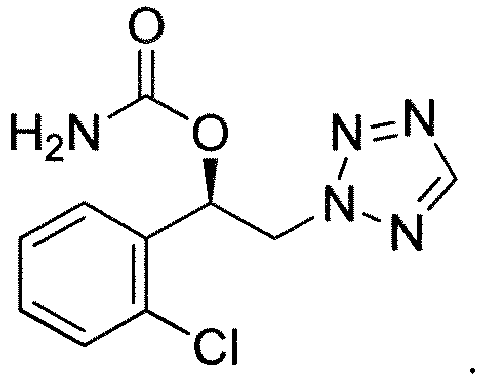
- carbamate compound of Formula 1 may be a carbamate compound of the following Formula 2 (carbamic acid (R)-1-(2-chlorophenyl)-2-tetrazol-2-yl-ethyl ester):
- the carbamate compound of Formula 2 is known as an effective anti-epileptic drug used for central nervous system diseases, but studies about a specific formulation for oral administration for applying it to the human body have not been disclosed. In order for drugs to be applied to the human body, formulation design is essential. In order to be effective as drugs, specific formulations such as tablets, capsules, injections and ointments are required.
- the solubility (1.8 to 2.0 mg/mL) of the carbamate compound of Formula 1 in the in vivo pH range (pH 1.2 to 6.8) does not limit the absorption of tablets having an active ingredient of 12.5 to 400 mg (BCS; Amidon, G.L. et al., Pharmaceutical research, 12: 413-420 (1995 )).
- the particle size of the compound is not expected to have a significant effect on uniformity of dosage units. Rather, micronization is not recommended for the purpose of uniformity of dosage units since it directly affects the flowability and stability of the active pharmaceutical ingredient, thereby affecting the content uniformity and content.
- the present inventors have found that the dissolution rate of the carbamate compound of Formula 1 is variable despite its high solubility.
- the dissolution rate of the formulation is a necessary condition for rapid and consistent therapeutic effect, and quality control.
- the dissolution rate is variable, it may cause problems in the quality control of the formulation. Therefore, the present inventors have conducted repeated studies to solve such problems.
- the present inventors have conceived the dosage form which can consistently achieve an excellent dissolution rate by controlling the average particle size of the particles of the carbamate compound of Formula 1 included therein by micronization. That is, the present invention is surprising in that a person skilled in the art would not have easily conceived that the dissolution rate of the carbamate compound of Formula 1 can be adjusted by micronization.
- an object of the present invention is the provision of a pharmaceutical composition for oral administration comprising a carbamate compound of Formula 1, an isomer thereof, or a pharmaceutically acceptable salt, solvate or hydrate thereof as an active ingredient, and a preparation method therefor.
- a pharmaceutical composition for oral administration comprising particles of a carbamate compound of the following Formula 1, an isomer thereof, or a pharmaceutically acceptable salt, solvate or hydrate thereof as an active ingredient; and a pharmaceutically acceptable carrier; wherein a particle diameter d(0.9) of the active ingredient particles is less than 300 ⁇ m: wherein,
- a method for preparing a pharmaceutical composition for oral administration comprising a step of mixing particles of the carbamate compound of the above Formula 1, an isomer thereof, or a pharmaceutically acceptable salt, solvate or hydrate thereof as an active ingredient with a pharmaceutically acceptable carrier, and tableting; wherein a particle diameter d(0.9) of the active ingredient particles is less than 300 ⁇ m.
- an oral solid dosage form that shows rapid and consistent therapeutic effects by accomplishing excellent disintegration and a rapid dissolution.
- Figure 1 is a graph showing the dissolution test results of Examples 1 to 5 and Comparative Examples 1 to 3.
- the term "particle” refers to individual drug substance particles, whether the particles exist alone or aggregated. That is, the pharmaceutical composition of the present invention comprising the carbamate compound of Formula 1 may contain aggregates having a particle diameter d(0.9) of 300 ⁇ m or more. However, in the case in which the particle diameter d(0.9) of the main drug particles constituting the aggregate is less than 300 ⁇ m, 250 ⁇ m or less, 200 ⁇ m or less, 150 ⁇ m or less, 130 ⁇ m or less, or 100 ⁇ m or less, it is considered that the aggregate itself satisfies the particle size constraints defined herein, and the composition is within the scope of the present invention.
- reference to particle size such as particle diameter d(0.9) and particle diameter d(0.5) means that the average of particles of the carbamate compound of Formula 1 in the sample has an estimated volume less than or equal to the volume calculated for spherical particles with a diameter equal to a given diameter, based on the assumption that the shape of the particles is spherical.
- the particle size distribution is well known to those skilled in the art and can be measured by a laser light scattering technique such as that disclosed and discussed below.
- the particle size of the carbamate compound of Formula 1 was measured by the use of a Malvern particle size analyzer.
- d(0.9) means that 90% of the particle volume has a diameter in a specific diameter d range. Specifically, it means that the particle diameter d(0.9) of the point where the cumulative frequency of the volume distribution reaches 90% by accumulating from the particle of the smaller particle diameter is within the range of the specific diameter d.
- d(0.5) means that 50% of the particle volume has a diameter in a specific diameter d range. Specifically, it means that the particle diameter d(0.5) of the point where the cumulative frequency of the volume distribution reaches 50% by accumulating from the particle of the smaller particle diameter is within the range of the specific diameter d.
- the present invention provides an oral pharmaceutical composition containing the carbamate compound of Formula 1, an isomer thereof, or a pharmaceutically acceptable salt, solvate or hydrate thereof, and a preparation method therefor.
- the carbamate compound of Formula 1, an isomer thereof, or a pharmaceutically acceptable salt, solvate or hydrate thereof may have a particle size distribution in which the particle diameter d(0.9) of the point where the cumulative frequency of the volume distribution reaches 90% by accumulating from the particle of the smaller particle diameter is less than 300 ⁇ m, and more specifically, may have a particle diameter distribution in which the particle diameter d(0.9) is 250 ⁇ m or less, 200 ⁇ m or less, 150 ⁇ m or less, 130 ⁇ m or less, or 100 ⁇ m or less.
- the lower limit of the particle diameter d(0.9) is not specifically limited, and may be, for example, greater than 0 ⁇ m, 30 ⁇ m or more, or 50 ⁇ m or more, but is not limited thereto.
- the particle diameter d(0.5) of the point where the cumulative frequency of the volume distribution reaches 50% by accumulating from the particle of the smaller particle diameter may be in the range of 5 to 80 ⁇ m, and more specifically, the particle diameter d(0.5) may be in the range of 7 to 70 ⁇ m, 10 to 60 ⁇ m, or 15 to 50 ⁇ m.
- the pharmaceutical composition of the present invention may be any solid dosage form known in this technical field.
- the solid dosage form may be in the form of tablets or capsules, and more specifically, may be in the form of compressed tablets, multi-compressed tablets, sugar-coated tablets, film-coated tablets, hard capsules or soft capsules.
- the solid dosage form may be in the form of tablets, particularly in the form of compressed tablets or film-coated tablets, but is not limited thereto.
- the oral solid dosage form according to the present invention preferably shows the following dissolution criteria when tested for in vitro dissolution. That is, the oral solid dosage form shows dissolution properties in which an amount of the drug exceeding 81% by weight is dissolved within 30 minutes. Preferably, the oral solid dosage form shows dissolution properties in which 85% by weight or more, more preferably 90% by weight or more, and even more preferably 91% by weight or more of the drug is dissolved within 30 minutes.
- dissolution tests are established as an average over a given number-usually six (6) administration forms (e.g., tablets, capsules, suspensions or other administration forms).
- Dissolution tests are typically performed in aqueous medium buffered to the pH range observed in the gastrointestinal tract (pH 1 to 7.4) and adjusted to 37°C ( ⁇ 1°C) to maintain physiologically relevant conditions.
- the administration form being tested is a tablet, a paddle rotating at 50 to 75 rpm is typically used to test the dissolution rate of the tablet.
- the amount of dissolved carbamate compound of Formula 1 can be determined routinely by HPLC.
- the dissolution test serves as a quality control tool.
- the pharmaceutical composition for oral administration of the present invention may comprise the active ingredient (i.e., the carbamate compound of Formula 1, an isomer thereof, or a pharmaceutically acceptable salt, solvate or hydrate thereof) in a dose-range of 5 mg to 400 mg. More specifically, the active ingredient may be comprised in a dose of 12.5 mg, 25 mg, 50 mg, 100 mg, 150 mg or 200 mg.
- the tablet when the pharmaceutical composition for oral administration of the present invention is a tablet, the tablet may be prepared by direct mixing of the carbamate compound of Formula 1, an isomer thereof, or a pharmaceutically acceptable salt, solvate or hydrate thereof with a pharmaceutically acceptable carrier, or by dry/wet granulation tableting.
- the pharmaceutically acceptable carrier may be selected from the group consisting of a diluent, a disintegrant, a lubricant and any combination thereof, but is not limited thereto.
- the pharmaceutically acceptable carrier may further comprise a surfactant.
- the diluent may be one or more selected from the group consisting of corn starch, pre-gelatinized starch, potato starch, wheat flour starch, glutinous rice starch, sweet potato starch, tapioca starch, rice starch, beeswax corn starch, sucrose, anhydrous lactose, lactose hydrate, mannitol, sorbitol, xylitol, lactitol, maltitol, erythritol, synthetic aluminum silicate, hydroxypropyl starch, microcrystalline cellulose and crystalline cellulose.
- the diluent may be one or more selected from the group consisting of lactose hydrate, synthetic aluminum silicate, hydroxypropyl starch, microcrystalline cellulose and crystalline cellulose. More specifically, the diluent may be one or more selected from the group consisting of lactose hydrate and microcrystalline cellulose, but is not limited thereto. In addition, in one embodiment, microcrystalline cellulose may be used as the first diluent, and lactose may be used as the second diluent.
- the disintegrant may be one or more selected from the group consisting of low-substituted hydroxypropyl cellulose, microcrystalline cellulose, starch, anhydrous lactose, lactose hydrate, sodium starch glycolate, crospovidone, carboxymethyl cellulose and a pharmaceutically acceptable salt thereof, hydroxypropyl cellulose, corn starch, and croscarmellose and a pharmaceutically acceptable salt thereof.
- the disintegrant may be one or more selected from the group consisting of sodium starch glycolate, crospovidone, carboxymethylcellulose and a pharmaceutically acceptable salt thereof, hydroxypropyl cellulose, corn starch, and croscarmellose and a pharmaceutically acceptable salt thereof. More specifically, the disintegrant may be sodium starch glycolate, but is not limited thereto.
- the lubricant may be one or more selected from the group consisting of silicon dioxide, colloidal anhydrous silica, magnesium trisilicate, tribasic calcium phosphate, calcium silicate, magnesium silicate, colloidal silicon dioxide, powdered cellulose, starch, magnesium stearate, talc, light anhydrous silicic acid, sodium stearyl fumarate, polyethylene glycol, mineral oil, hydrogenated vegetable oil, zinc stearate and stearic acid. More specifically, the lubricant may be colloidal silicon dioxide, magnesium stearate or a combination thereof, but is not limited thereto.
- the surfactant may be one or more selected from the group consisting of polysorbate 80, oleoyl macrogol glyceride, linoleoyl, caprylocaproyl macrogol glyceride, polyoxylglyceride, hydroxypropyl methylcellulose (HPMC), hydroxypropyl cellulose (HPC), sodium carboxymethylcellulose, polyvinylpyrrolidone, sodium lauryl sulfate, sodium oleate and sodium dioctyl sulfosuccinate.
- the surfactant may be one or more selected from the group consisting of sodium lauryl sulfate, sodium oleate, and sodium dioctyl sulfosuccinate. More specifically, the surfactant may be sodium lauryl sulfate, but is not limited thereto.
- the pharmaceutical composition for oral administration of the present invention may comprise the following components when it is prepared by a direct compression method: 5 to 35% by weight of the active ingredient, 55 to 90% by weight of the diluent, 2 to 6% by weight of the disintegrant and 0.1 to 4% by weight of the lubricant, based on the total weight of the pharmaceutical composition.
- the pharmaceutical composition for oral administration of the present invention may comprise the following components when it is prepared by a direct compression method: 10 to 30% by weight of the active ingredient, 65 to 85% by weight of the diluent, 3 to 5% by weight of the disintegrant and 0.3 to 1% by weight of the lubricant, based on the total weight of the pharmaceutical composition.
- the pharmaceutical composition of the present invention may further comprise other components such as a binder, a film coating agent, a colorant, a fragrance, a sweetener, a flavoring agent and a preservative within a range that does not impair the purpose of the present invention.
- the pharmaceutical composition when the pharmaceutical composition according to the present invention is in the form of a film-coated tablet, the pharmaceutical composition may comprise a film coating agent.
- the film coating agent may be comprised in an amount of 2 to 4% by weight based on the total weight of the pharmaceutical composition, and which includes a film-forming agent, a plasticizer, a lubricant and optionally one or more pigments.
- the film-coated tablet may be prepared by additionally carrying out a coating step after direct compression.
- a conventional film coating agent such as Opadry may be used as the film coating agent.
- a preferred active ingredient is a carbamate compound of the following Formula 2, an isomer thereof, or a pharmaceutically acceptable salt, solvate or hydrate thereof:
- the present invention provides a method for preparing a pharmaceutical composition for oral administration comprising a step of mixing particles of the carbamate compound of Formula 1, an isomer thereof, or a pharmaceutically acceptable salt, solvate or hydrate thereof as an active ingredient with a pharmaceutically acceptable carrier, and tableting; wherein the average particle size of the lower 90% of the active ingredient particles (d(0.9)) is less than 300 ⁇ m.
- the tableting may be carried out according to any method known in this technical field, and preferably may be direct compression.
- the pharmaceutical composition for oral administration prepared by the above method may be the shape-for example, round, oval, oblong, rectangular, cylindrical or other suitable shape.
- the size may be changed according to the concentration of the active ingredient.
- the step of coating after tableting may be further comprised.
- the coated tablet may be a film-coated tablet.
- the film coating agent may be comprised in an amount of 2% by weight to 4% by weight based on the total weight of the pharmaceutical composition.
- the film coating agent may include a film-forming agent, a plasticizer, a lubricant and optionally one or more pigments.
- a conventional film coating agent such as Opadry may be used as Opadry.
- the pharmaceutical composition provided according to the present invention can be used for preventing or treating diseases of the central nervous system.
- the central nervous system disease may be selected from anxiety, depression, convulsion, epilepsy, migraine, bipolar disorder, drug abuse, smoking, attention deficit hyperactivity disorder (ADHD), obesity, sleep disorders, stroke, neuropathic pain, cognitive disorders, neurodegeneration and muscle spasm, but is not limited thereto.
- ADHD attention deficit hyperactivity disorder
- prevent refers to reducing or eliminating the likelihood of a disease.
- treat refers to eliminating a disease and/or its accompanying symptoms altogether or in part.
Landscapes
- Health & Medical Sciences (AREA)
- Life Sciences & Earth Sciences (AREA)
- Chemical & Material Sciences (AREA)
- Pharmacology & Pharmacy (AREA)
- Veterinary Medicine (AREA)
- Public Health (AREA)
- Animal Behavior & Ethology (AREA)
- Medicinal Chemistry (AREA)
- General Health & Medical Sciences (AREA)
- Epidemiology (AREA)
- Engineering & Computer Science (AREA)
- Bioinformatics & Cheminformatics (AREA)
- Nuclear Medicine, Radiotherapy & Molecular Imaging (AREA)
- Organic Chemistry (AREA)
- General Chemical & Material Sciences (AREA)
- Pain & Pain Management (AREA)
- Chemical Kinetics & Catalysis (AREA)
- Neurosurgery (AREA)
- Neurology (AREA)
- Biomedical Technology (AREA)
- Molecular Biology (AREA)
- Biophysics (AREA)
- Physiology (AREA)
- Nutrition Science (AREA)
- Inorganic Chemistry (AREA)
- Medicinal Preparation (AREA)
- Pharmaceuticals Containing Other Organic And Inorganic Compounds (AREA)
- Acyclic And Carbocyclic Compounds In Medicinal Compositions (AREA)
Abstract
Description
- The present invention relates to a pharmaceutical composition for oral administration comprising a carbamate compound of the following
Formula 1, an isomer thereof, or a pharmaceutically acceptable salt, solvate or hydrate thereof as an active ingredient, and a preparation method therefor:
R1, R2, A1 and A2 are the same as defined herein. - The carbamate compound (carbamic acid aryl-2-tetrazolyl ethyl ester) represented by the following
Formula 1 and the preparation method therefor are described in detail in International Patent Publication Nos.WO 2006/112685 A1 ,WO 2010/150946 A1 andWO 2011/046380 A2 , which are incorporated herein by reference:
- A specific example of the carbamate compound of
Formula 1 may be a carbamate compound of the following Formula 2 (carbamic acid (R)-1-(2-chlorophenyl)-2-tetrazol-2-yl-ethyl ester):
- The carbamate compound of Formula 2 is known as an effective anti-epileptic drug used for central nervous system diseases, but studies about a specific formulation for oral administration for applying it to the human body have not been disclosed. In order for drugs to be applied to the human body, formulation design is essential. In order to be effective as drugs, specific formulations such as tablets, capsules, injections and ointments are required.
- In the case of obtaining pharmacological activity by administering said compound, it is required that the effect must appear quickly, and it must be suitable to secure a uniform concentration of the active ingredient in the blood by repeating administration over an extended treatment period. In order to obtain a quick effect, an injection preparation may be appropriate, but there is a disadvantage in that use is limited due to the route of administration. As such, there is increased demand for developing a novel oral solid dosage form for achieving this purpose.
- The solubility (1.8 to 2.0 mg/mL) of the carbamate compound of
Formula 1 in the in vivo pH range (pH 1.2 to 6.8) does not limit the absorption of tablets having an active ingredient of 12.5 to 400 mg (BCS; Amidon, G.L. et al., Pharmaceutical research, 12: 413-420 (1995)). In addition, based on the above dose, the particle size of the compound is not expected to have a significant effect on uniformity of dosage units. Rather, micronization is not recommended for the purpose of uniformity of dosage units since it directly affects the flowability and stability of the active pharmaceutical ingredient, thereby affecting the content uniformity and content. - However, the present inventors have found that the dissolution rate of the carbamate compound of Formula 1 is variable despite its high solubility. The dissolution rate of the formulation is a necessary condition for rapid and consistent therapeutic effect, and quality control. In addition, if the dissolution rate is variable, it may cause problems in the quality control of the formulation. Therefore, the present inventors have conducted repeated studies to solve such problems.
- Meanwhile, in general, micronization of particles is not adopted since it may directly affect the flowability and stability of drugs, thereby affecting the content uniformity and content of dosage forms. However, through repeated studies, the present inventors have conceived the dosage form which can consistently achieve an excellent dissolution rate by controlling the average particle size of the particles of the carbamate compound of Formula 1 included therein by micronization. That is, the present invention is surprising in that a person skilled in the art would not have easily conceived that the dissolution rate of the carbamate compound of Formula 1 can be adjusted by micronization.
- Accordingly, an object of the present invention is the provision of a pharmaceutical composition for oral administration comprising a carbamate compound of Formula 1, an isomer thereof, or a pharmaceutically acceptable salt, solvate or hydrate thereof as an active ingredient, and a preparation method therefor.
- According to one aspect of the present invention, there is provided a pharmaceutical composition for oral administration comprising particles of a carbamate compound of the following
Formula 1, an isomer thereof, or a pharmaceutically acceptable salt, solvate or hydrate thereof as an active ingredient; and a pharmaceutically acceptable carrier; wherein a particle diameter d(0.9) of the active ingredient particles is less than 300 µm:
- R1 and R2 are each independently selected from the group consisting of hydrogen, halogen, C1-C8 perfluoroalkyl, C1-C8 alkyl, C1-C8 thioalkoxy and C1-C8 alkoxy; and
- one of A1 and A2 is CH, and the other is N.
- According to another aspect of the present invention, there is provided a method for preparing a pharmaceutical composition for oral administration comprising a step of mixing particles of the carbamate compound of the
above Formula 1, an isomer thereof, or a pharmaceutically acceptable salt, solvate or hydrate thereof as an active ingredient with a pharmaceutically acceptable carrier, and tableting; wherein a particle diameter d(0.9) of the active ingredient particles is less than 300 µm. - According to the present invention, it is possible to provide an oral solid dosage form that shows rapid and consistent therapeutic effects by accomplishing excellent disintegration and a rapid dissolution.
-
Figure 1 is a graph showing the dissolution test results of Examples 1 to 5 and Comparative Examples 1 to 3. - The present invention is described in detail hereinafter.
- All technical terms used in the present invention, unless otherwise defined, have the same meaning as commonly understood by a person skilled in the art of the present invention. In addition, although preferred methods and samples are described herein, similar or equivalent ones are also included within the scope of the present invention.
- It should be understood that all numerical designations-for example, pH, temperature, time, concentration, d(0.9) and d(0.5)-used throughout the instant specification may be modified by the term "about" in all instances. When the term "about" is used in the description of the present invention, it may mean ±10%, ±5%, ±2% or ±1 % in reference to a percentage. In one embodiment, it may mean ±5%, ±2% or ±1%. For example, "about 5" is meant to include any value between 4.5 and 5.5, between 4.75 and 5.25, between 4.9 and 5.1, or between 4.95 and 5.05.
- As used herein, the term "particle" refers to individual drug substance particles, whether the particles exist alone or aggregated. That is, the pharmaceutical composition of the present invention comprising the carbamate compound of Formula 1 may contain aggregates having a particle diameter d(0.9) of 300 µm or more. However, in the case in which the particle diameter d(0.9) of the main drug particles constituting the aggregate is less than 300 µm, 250 µm or less, 200 µm or less, 150 µm or less, 130 µm or less, or 100 µm or less, it is considered that the aggregate itself satisfies the particle size constraints defined herein, and the composition is within the scope of the present invention.
- Herein, with respect to the particles of the carbamate compound of
Formula 1, reference to particle size such as particle diameter d(0.9) and particle diameter d(0.5) means that the average of particles of the carbamate compound ofFormula 1 in the sample has an estimated volume less than or equal to the volume calculated for spherical particles with a diameter equal to a given diameter, based on the assumption that the shape of the particles is spherical. The particle size distribution is well known to those skilled in the art and can be measured by a laser light scattering technique such as that disclosed and discussed below. In one embodiment of the present invention, the particle size of the carbamate compound of Formula 1 was measured by the use of a Malvern particle size analyzer. - As used herein, "d(0.9)" means that 90% of the particle volume has a diameter in a specific diameter d range. Specifically, it means that the particle diameter d(0.9) of the point where the cumulative frequency of the volume distribution reaches 90% by accumulating from the particle of the smaller particle diameter is within the range of the specific diameter d.
- As used herein, "d(0.5)" means that 50% of the particle volume has a diameter in a specific diameter d range. Specifically, it means that the particle diameter d(0.5) of the point where the cumulative frequency of the volume distribution reaches 50% by accumulating from the particle of the smaller particle diameter is within the range of the specific diameter d.
- The present invention provides an oral pharmaceutical composition containing the carbamate compound of Formula 1, an isomer thereof, or a pharmaceutically acceptable salt, solvate or hydrate thereof, and a preparation method therefor.
- All specific details related to the present invention described below can be clearly applied to the pharmaceutical composition for oral administration of the present invention as well as the preparation method therefor.

- R1 and R2 are each independently selected from the group consisting of hydrogen, halogen, C1-C8 perfluoroalkyl, C1-C8 alkyl, C1-C8 thioalkoxy and C1-C8 alkoxy; and
- one of A1 and A2 is CH, and the other is N.
- In the present invention, the carbamate compound of Formula 1, an isomer thereof, or a pharmaceutically acceptable salt, solvate or hydrate thereof may have a particle size distribution in which the particle diameter d(0.9) of the point where the cumulative frequency of the volume distribution reaches 90% by accumulating from the particle of the smaller particle diameter is less than 300 µm, and more specifically, may have a particle diameter distribution in which the particle diameter d(0.9) is 250 µm or less, 200 µm or less, 150 µm or less, 130 µm or less, or 100 µm or less. The lower limit of the particle diameter d(0.9) is not specifically limited, and may be, for example, greater than 0 µm, 30 µm or more, or 50 µm or more, but is not limited thereto.
- In one embodiment of the present invention, in the carbamate compound of Formula 1, an isomer thereof, or a pharmaceutically acceptable salt, solvate or hydrate thereof, the particle diameter d(0.5) of the point where the cumulative frequency of the volume distribution reaches 50% by accumulating from the particle of the smaller particle diameter may be in the range of 5 to 80 µm, and more specifically, the particle diameter d(0.5) may be in the range of 7 to 70 µm, 10 to 60 µm, or 15 to 50 µm.
- The pharmaceutical composition of the present invention may be any solid dosage form known in this technical field. Specifically, the solid dosage form may be in the form of tablets or capsules, and more specifically, may be in the form of compressed tablets, multi-compressed tablets, sugar-coated tablets, film-coated tablets, hard capsules or soft capsules. Preferably, the solid dosage form may be in the form of tablets, particularly in the form of compressed tablets or film-coated tablets, but is not limited thereto.
- The oral solid dosage form according to the present invention preferably shows the following dissolution criteria when tested for in vitro dissolution. That is, the oral solid dosage form shows dissolution properties in which an amount of the drug exceeding 81% by weight is dissolved within 30 minutes. Preferably, the oral solid dosage form shows dissolution properties in which 85% by weight or more, more preferably 90% by weight or more, and even more preferably 91% by weight or more of the drug is dissolved within 30 minutes.
- Conventionally, the results of dissolution tests are established as an average over a given number-usually six (6) administration forms (e.g., tablets, capsules, suspensions or other administration forms). Dissolution tests are typically performed in aqueous medium buffered to the pH range observed in the gastrointestinal tract (
pH 1 to 7.4) and adjusted to 37°C (±1°C) to maintain physiologically relevant conditions. When the administration form being tested is a tablet, a paddle rotating at 50 to 75 rpm is typically used to test the dissolution rate of the tablet. The amount of dissolved carbamate compound ofFormula 1 can be determined routinely by HPLC. The dissolution test serves as a quality control tool. - In one embodiment, the pharmaceutical composition for oral administration of the present invention may comprise the active ingredient (i.e., the carbamate compound of
Formula 1, an isomer thereof, or a pharmaceutically acceptable salt, solvate or hydrate thereof) in a dose-range of 5 mg to 400 mg. More specifically, the active ingredient may be comprised in a dose of 12.5 mg, 25 mg, 50 mg, 100 mg, 150 mg or 200 mg. - In one embodiment, when the pharmaceutical composition for oral administration of the present invention is a tablet, the tablet may be prepared by direct mixing of the carbamate compound of
Formula 1, an isomer thereof, or a pharmaceutically acceptable salt, solvate or hydrate thereof with a pharmaceutically acceptable carrier, or by dry/wet granulation tableting. - In one embodiment, the pharmaceutically acceptable carrier may be selected from the group consisting of a diluent, a disintegrant, a lubricant and any combination thereof, but is not limited thereto.
- In one embodiment, the pharmaceutically acceptable carrier may further comprise a surfactant.
- In one embodiment, the diluent may be one or more selected from the group consisting of corn starch, pre-gelatinized starch, potato starch, wheat flour starch, glutinous rice starch, sweet potato starch, tapioca starch, rice starch, beeswax corn starch, sucrose, anhydrous lactose, lactose hydrate, mannitol, sorbitol, xylitol, lactitol, maltitol, erythritol, synthetic aluminum silicate, hydroxypropyl starch, microcrystalline cellulose and crystalline cellulose. Specifically, the diluent may be one or more selected from the group consisting of lactose hydrate, synthetic aluminum silicate, hydroxypropyl starch, microcrystalline cellulose and crystalline cellulose. More specifically, the diluent may be one or more selected from the group consisting of lactose hydrate and microcrystalline cellulose, but is not limited thereto. In addition, in one embodiment, microcrystalline cellulose may be used as the first diluent, and lactose may be used as the second diluent.
- In one embodiment, the disintegrant may be one or more selected from the group consisting of low-substituted hydroxypropyl cellulose, microcrystalline cellulose, starch, anhydrous lactose, lactose hydrate, sodium starch glycolate, crospovidone, carboxymethyl cellulose and a pharmaceutically acceptable salt thereof, hydroxypropyl cellulose, corn starch, and croscarmellose and a pharmaceutically acceptable salt thereof. Specifically, the disintegrant may be one or more selected from the group consisting of sodium starch glycolate, crospovidone, carboxymethylcellulose and a pharmaceutically acceptable salt thereof, hydroxypropyl cellulose, corn starch, and croscarmellose and a pharmaceutically acceptable salt thereof. More specifically, the disintegrant may be sodium starch glycolate, but is not limited thereto.
- In one embodiment, the lubricant may be one or more selected from the group consisting of silicon dioxide, colloidal anhydrous silica, magnesium trisilicate, tribasic calcium phosphate, calcium silicate, magnesium silicate, colloidal silicon dioxide, powdered cellulose, starch, magnesium stearate, talc, light anhydrous silicic acid, sodium stearyl fumarate, polyethylene glycol, mineral oil, hydrogenated vegetable oil, zinc stearate and stearic acid. More specifically, the lubricant may be colloidal silicon dioxide, magnesium stearate or a combination thereof, but is not limited thereto.
- In one embodiment, the surfactant may be one or more selected from the group consisting of
polysorbate 80, oleoyl macrogol glyceride, linoleoyl, caprylocaproyl macrogol glyceride, polyoxylglyceride, hydroxypropyl methylcellulose (HPMC), hydroxypropyl cellulose (HPC), sodium carboxymethylcellulose, polyvinylpyrrolidone, sodium lauryl sulfate, sodium oleate and sodium dioctyl sulfosuccinate. Specifically, the surfactant may be one or more selected from the group consisting of sodium lauryl sulfate, sodium oleate, and sodium dioctyl sulfosuccinate. More specifically, the surfactant may be sodium lauryl sulfate, but is not limited thereto. - In one embodiment, the pharmaceutical composition for oral administration of the present invention may comprise the following components when it is prepared by a direct compression method:
5 to 35% by weight of the active ingredient, 55 to 90% by weight of the diluent, 2 to 6% by weight of the disintegrant and 0.1 to 4% by weight of the lubricant, based on the total weight of the pharmaceutical composition. - In another embodiment, the pharmaceutical composition for oral administration of the present invention may comprise the following components when it is prepared by a direct compression method:
10 to 30% by weight of the active ingredient, 65 to 85% by weight of the diluent, 3 to 5% by weight of the disintegrant and 0.3 to 1% by weight of the lubricant, based on the total weight of the pharmaceutical composition. - In addition to the above-mentioned components, the pharmaceutical composition of the present invention may further comprise other components such as a binder, a film coating agent, a colorant, a fragrance, a sweetener, a flavoring agent and a preservative within a range that does not impair the purpose of the present invention.
- In one embodiment, when the pharmaceutical composition according to the present invention is in the form of a film-coated tablet, the pharmaceutical composition may comprise a film coating agent. Typically, the film coating agent may be comprised in an amount of 2 to 4% by weight based on the total weight of the pharmaceutical composition, and which includes a film-forming agent, a plasticizer, a lubricant and optionally one or more pigments. As described below, the film-coated tablet may be prepared by additionally carrying out a coating step after direct compression. As the film coating agent, a conventional film coating agent such as Opadry may be used.
- In the present invention, a preferred active ingredient is a carbamate compound of the following
Formula 2, an isomer thereof, or a pharmaceutically acceptable salt, solvate or hydrate thereof:
- In addition, the present invention provides a method for preparing a pharmaceutical composition for oral administration comprising a step of mixing particles of the carbamate compound of
Formula 1, an isomer thereof, or a pharmaceutically acceptable salt, solvate or hydrate thereof as an active ingredient with a pharmaceutically acceptable carrier, and tableting; wherein the average particle size of the lower 90% of the active ingredient particles (d(0.9)) is less than 300 µm. - The tableting may be carried out according to any method known in this technical field, and preferably may be direct compression.
- The pharmaceutical composition for oral administration prepared by the above method may be the shape-for example, round, oval, oblong, rectangular, cylindrical or other suitable shape. In addition, the size may be changed according to the concentration of the active ingredient.
- In one embodiment, when the pharmaceutical composition according to the present invention is in the form of a coated tablet, the step of coating after tableting may be further comprised. Specifically, the coated tablet may be a film-coated tablet. Typically, the film coating agent may be comprised in an amount of 2% by weight to 4% by weight based on the total weight of the pharmaceutical composition. The film coating agent may include a film-forming agent, a plasticizer, a lubricant and optionally one or more pigments. As the film coating agent, a conventional film coating agent such as Opadry may be used.
- The pharmaceutical composition provided according to the present invention can be used for preventing or treating diseases of the central nervous system.
- In one embodiment, the central nervous system disease may be selected from anxiety, depression, convulsion, epilepsy, migraine, bipolar disorder, drug abuse, smoking, attention deficit hyperactivity disorder (ADHD), obesity, sleep disorders, stroke, neuropathic pain, cognitive disorders, neurodegeneration and muscle spasm, but is not limited thereto.
- As used herein, the terms "prevent," "preventing" and "prevention" refer to reducing or eliminating the likelihood of a disease.
- As used herein, the terms "treat," "treating" and "treatment" refer to eliminating a disease and/or its accompanying symptoms altogether or in part.
- Hereinafter, the present invention will be explained in more detail through working examples. However, the following working examples are only intended to illustrate one or more embodiments and are not intended to limit the scope of the invention.
- Carbamic acid (R)-1-(2-chlorophenyl)-2-tetrazol-2-yl-ethyl ester (the carbamate compound of Formula 2) was prepared according to the method described in Preparation Example 50 of
PCT Publication No. WO 2010/150946 . - According to the compositions and contents represented in Table 1, the components were mixed and tableted (direct compression). Thereafter, the tablets were film-coated with a coating agent according to a conventional coating method for tablets.
[Table 1] Item Comparative Example 1 Example 1 Example 2 Example 3 Example 4 Example 5 Comparative Example 2 Comparative Example 3 Active ingredient Carbamate compound of Formula 2 (mg) 200.0 200.0 200.0 50.0 50.0 50.0 200.0 200.0 Particle size d(0.9) 460 µm 166 µm 50 µm 112 µm 206 µm 99 µm 300 µm 300 µm Particle size d(0.5) 220 µm 37 µm 18 µm 34 µm 48 µm 24 µm - - Diluent Microcrystalline cellulose (mg) 345.20 345.20 345.20 172.60 172.60 172.60 337.20 345.20 Lactose hydrate (mg) 217.36 217.36 217.36 158.68 158.68 158.68 217.36 217.36 Disintegrant Sodium starch glycolate (mg) 30.48 30.48 30.48 15.24 15.24 15.24 30.48 30.48 Lubricant Colloidal silicon dioxide (mg) 2.24 2.24 2.24 1.12 1.12 1.12 2.24 2.24 Magnesium stearate (mg) 4.72 4.72 4.72 2.36 2.36 2.36 4.72 4.72 Surfactant Sodium lauryl sulfate (mg) - - - - - - 8 - Total weight (mg) 800 800 800 400 400 400 800 800 - A dissolution test was performed on the solid dosage forms prepared in Examples 1 to 5 and Comparative Examples 1 to 3 according to the US Pharmacopoeia under the following conditions.
-
- Dissolution media: 0.01 N hydrochloric acid aqueous solution, 900 mL
- Device: Apparatus II (paddle method), 75 rpm
- Temperature: 37°C
- The results of dissolution rate are represented in Table 2 and
Figure 1 . - After 10, 20, 30, 45 and 60 minutes from the start of the test, the samples were taken out and analyzed for Test Compound by HPLC at 215 nm.
[Table 2] Time (min.) Dissolved active ingredient (% by weight) Comparative Example 1 Example 1 Example 2 Example 3 Example 4 Example 5 Comparative Example 2 Comparative Example 3 0 0 0 0 0 0 0 0 0 10 38 85 95 91 79 91 60 57 20 58 91 98 92 86 92 71 70 30 68 95 98 93 91 93 81 80 45 75 96 99 95 95 93 86 85 60 80 98 99 96 97 94 90 89
Claims (20)
- A pharmaceutical composition for oral administration comprising particles of a carbamate compound of the following Formula 1, an isomer thereof, or a pharmaceutically acceptable salt, solvate or hydrate thereof as an active ingredient; and a pharmaceutically acceptable carrier; wherein a particle diameter d(0.9) of the active ingredient particles is less than 300 µm:
 R1 and R2 are each independently selected from the group consisting of hydrogen, halogen, C1-C8perfluoroalkyl, C1-C8 alkyl, C1-C8 thioalkoxy and C1-C8 alkoxy; andone of A1 and A2 is CH, and the other is N.
 - The pharmaceutical composition for oral administration according to Claim 1, wherein the particle diameter d(0.9) of the active ingredient particles is 250 µm or less.
- The pharmaceutical composition for oral administration according to Claim 1, wherein the particle diameter d(0.9) of the active ingredient particles is 150 µm or less.
- The pharmaceutical composition for oral administration according to any one of Claims 1 to 3, wherein the active ingredient is comprised in an amount of 5 mg to 400 mg.
- The pharmaceutical composition for oral administration according to any one of Claims 1 to 4, wherein the pharmaceutically acceptable carrier is one or more selected from the group consisting of a diluent, a disintegrant and a lubricant.
- The pharmaceutical composition for oral administration according to Claim 5, which further comprises a surfactant.
- The pharmaceutical composition for oral administration according to Claim 5 or 6, wherein the diluent is one or more selected from the group consisting of corn starch, pre-gelatinized starch, potato starch, wheat flour starch, glutinous rice starch, sweet potato starch, tapioca starch, rice starch, beeswax corn starch, sucrose, anhydrous lactose, lactose hydrate, mannitol, sorbitol, xylitol, lactitol, maltitol, erythritol, synthetic aluminum silicate, hydroxypropyl starch, microcrystalline cellulose and crystalline cellulose.
- The pharmaceutical composition for oral administration according to any one of Claims 5 to 7, wherein the disintegrant is one or more selected from the group consisting of low-substituted hydroxypropyl cellulose, microcrystalline cellulose, starch, anhydrous lactose, lactose hydrate, sodium starch glycolate, crospovidone, carboxymethyl cellulose and a pharmaceutically acceptable salt thereof, hydroxypropyl cellulose, corn starch, and croscarmellose and a pharmaceutically acceptable salt thereof.
- The pharmaceutical composition for oral administration according to any one of Claims 5 to 8, wherein the lubricant is one or more selected from the group consisting of silicon dioxide, colloidal anhydrous silica, magnesium trisilicate, tribasic calcium phosphate, calcium silicate, magnesium silicate, colloidal silicon dioxide, powdered cellulose, starch, magnesium stearate, talc, light anhydrous silicic acid, sodium stearyl fumarate, polyethylene glycol, mineral oil, hydrogenated vegetable oil, zinc stearate and stearic acid.
- The pharmaceutical composition for oral administration according to any one of Claims 5 to 9, which comprises 5 to 35% by weight of the active ingredient, 55 to 90% by weight of the diluent, 2 to 6% by weight of the disintegrant and 0.1 to 4% by weight of the lubricant, based on the total weight of the pharmaceutical composition.
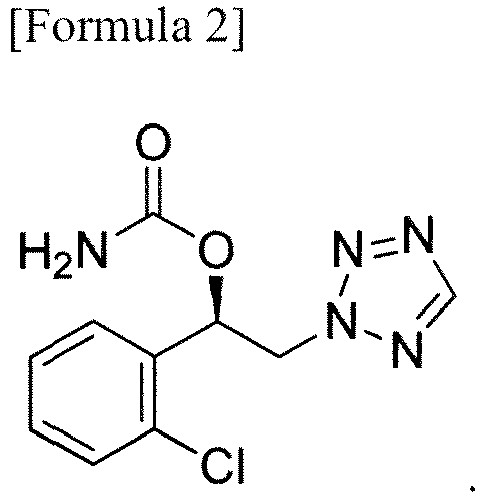
- The pharmaceutical composition for oral administration according to any one of Claims 1 to 10, wherein the active ingredient is a carbamate compound of the following Formula 2, an isomer thereof, or a pharmaceutically acceptable salt, solvate or hydrate thereof:
- The pharmaceutical composition for oral administration according to any one of Claims 1 to 11, which is in a form of compressed tablet, multi-compressed tablet, sugar-coated tablet, film-coated tablet, hard capsule or soft capsule.
- A method for preparing a pharmaceutical composition for oral administration comprising a step of mixing particles of a carbamate compound of the following Formula 1, an isomer thereof, or a pharmaceutically acceptable salt, solvate or hydrate thereof as an active ingredient with a pharmaceutically acceptable carrier, and tableting;
wherein a particle diameter d(0.9) of the active ingredient particles is less than 300 µm: R1 and R2 are each independently selected from the group consisting of hydrogen, halogen, C1-C8 perfluoroalkyl, C1-C8 alkyl, C1-C8 thioalkoxy and C1-C8 alkoxy; andone of A1 and A2 is CH, and the other is N.
 - The method for preparing a pharmaceutical composition for oral administration according to Claim 13, wherein the mixing of the active ingredient with the pharmaceutically acceptable carrier is carried out by direct compression.
- The method for preparing a pharmaceutical composition for oral administration according to Claim 13 or 14, wherein the particle diameter d(0.9) of the active ingredient particles is 250 µm or less.
- The method for preparing a pharmaceutical composition for oral administration according to any one of Claims 13 to 15, wherein the pharmaceutical composition comprises the active ingredient in an amount of 5 mg to 400 mg.
- The method for preparing a pharmaceutical composition for oral administration according to any one of Claims 13 to 16, wherein the pharmaceutically acceptable carrier is one or more selected from the group consisting of a diluent, a disintegrant and a lubricant.
- The method for preparing a pharmaceutical composition for oral administration according to Claim 17, wherein the pharmaceutically acceptable carrier further comprises a surfactant.
- The method for preparing a pharmaceutical composition for oral administration according to any one of Claims 13 to 18, wherein the active ingredient is a carbamate compound of the following Formula 2, an isomer thereof, or a pharmaceutically acceptable salt, solvate or hydrate thereof:

- The method for preparing a pharmaceutical composition for oral administration according to any one of Claims 13 to 18, wherein the pharmaceutical composition is in a form of compressed tablet, multi-compressed tablet, sugar-coated tablet, film-coated tablet, hard capsule or soft capsule.
Applications Claiming Priority (2)
| Application Number | Priority Date | Filing Date | Title |
|---|---|---|---|
| KR20190151556 | 2019-11-22 | ||
| PCT/KR2020/016427 WO2021101295A1 (en) | 2019-11-22 | 2020-11-20 | Oral pharmaceutical composition comprising carbamate compound and preparation method therefor |
Publications (2)
| Publication Number | Publication Date |
|---|---|
| EP4062906A1 true EP4062906A1 (en) | 2022-09-28 |
| EP4062906A4 EP4062906A4 (en) | 2024-01-03 |
Family
ID=75981351
Family Applications (1)
| Application Number | Title | Priority Date | Filing Date |
|---|---|---|---|
| EP20888989.9A Pending EP4062906A4 (en) | 2019-11-22 | 2020-11-20 | ORAL PHARMACEUTICAL COMPOSITION COMPRISING A CARBAMATE COMPOUND AND METHOD FOR PREPARING THIS COMPOSITION |
Country Status (13)
| Country | Link |
|---|---|
| US (3) | US20230000763A1 (en) |
| EP (1) | EP4062906A4 (en) |
| JP (2) | JP7724776B2 (en) |
| KR (1) | KR20220104746A (en) |
| CN (1) | CN114867469A (en) |
| AU (1) | AU2020389425B2 (en) |
| BR (1) | BR112022009533A2 (en) |
| CA (1) | CA3157788A1 (en) |
| CL (1) | CL2022001317A1 (en) |
| CO (1) | CO2022008616A2 (en) |
| IL (1) | IL293096A (en) |
| MX (1) | MX2022006104A (en) |
| WO (1) | WO2021101295A1 (en) |
Cited By (1)
| Publication number | Priority date | Publication date | Assignee | Title |
|---|---|---|---|---|
| EP4193987A4 (en) * | 2020-08-06 | 2024-08-21 | SK Biopharmaceuticals Co., Ltd. | SOLID ORAL COMPOSITION CONTAINING A CARBAMATE COMPOUND AND MANUFACTURING PROCESS THEREOF |
Families Citing this family (2)
| Publication number | Priority date | Publication date | Assignee | Title |
|---|---|---|---|---|
| MX2020004975A (en) * | 2017-11-14 | 2020-08-24 | Sk Biopharmaceuticals Co Ltd | Blend containing carbamate compound for prevention, mitigation, or treatment of schizophrenia. |
| AR125970A1 (en) * | 2021-05-28 | 2023-08-30 | Sk Biopharmaceuticals Co Ltd | AQUEOUS SUSPENSION FORMULATIONS FOR ORAL ADMINISTRATION COMPRISING A CARBAMATE COMPOUND |
Family Cites Families (11)
| Publication number | Priority date | Publication date | Assignee | Title |
|---|---|---|---|---|
| US5173506A (en) * | 1990-08-16 | 1992-12-22 | Schering Corporation | N-(mercaptoalkyl)ureas and carbamates |
| US7598279B2 (en) * | 2005-04-22 | 2009-10-06 | Sk Holdings Co., Ltd. | Neurotherapeutic azole compounds |
| JP5159091B2 (en) * | 2005-11-11 | 2013-03-06 | 旭化成ケミカルズ株式会社 | Solid formulation that controls the elution of active ingredients to be sustained release |
| EP2141160A4 (en) | 2007-03-23 | 2011-06-29 | Daiichi Sankyo Co Ltd | GROUND CRYSTAL OLMESARTAN MEDOXOMIL |
| PL2445890T3 (en) | 2009-06-22 | 2016-02-29 | Sk Biopharmaceuticals Co Ltd | Method for preparation of carbamic acid (r)-1-aryl-2-tetrazolyl-ethyl ester |
| US8404461B2 (en) | 2009-10-15 | 2013-03-26 | SK Biopharmaceutical Co. Ltd. | Method for preparation of carbamic acid (R)-1-aryl-2-tetrazolyl-ethyl ester |
| WO2017025981A1 (en) * | 2015-08-13 | 2017-02-16 | Msn Laboratories Private Limited | Process for the preparation of methyl 4,6-diamino-2-[l-(2-fhiorobenzvr)-lh-pyrazolo i3,4-blpvridin-3-vn-5-pyrimidinyl(methvl)carbamate and its polymorphs thereof |
| KR102489052B1 (en) * | 2016-05-19 | 2023-01-16 | 에스케이바이오팜 주식회사 | Use of carbamate compound for prevention or treatment of fibromyalgia or associated functional symptoms of fibromyalgia |
| KR102421006B1 (en) * | 2016-05-19 | 2022-07-14 | 에스케이바이오팜 주식회사 | Use of carbamate compound for prophylactic treatment of headache |
| KR102635938B1 (en) * | 2016-12-14 | 2024-02-13 | 에스케이바이오팜 주식회사 | Use of carbamate compounds for preventing, alleviating, or treating bipolar disorder |
| US12409164B2 (en) * | 2016-12-14 | 2025-09-09 | Sk Biopharmaceuticals Co., Ltd. | Orally disintegrated tablet comprising carbamate compound |
-
2020
- 2020-11-20 JP JP2022529517A patent/JP7724776B2/en active Active
- 2020-11-20 BR BR112022009533A patent/BR112022009533A2/en unknown
- 2020-11-20 CA CA3157788A patent/CA3157788A1/en active Pending
- 2020-11-20 AU AU2020389425A patent/AU2020389425B2/en active Active
- 2020-11-20 US US17/778,450 patent/US20230000763A1/en active Pending
- 2020-11-20 WO PCT/KR2020/016427 patent/WO2021101295A1/en not_active Ceased
- 2020-11-20 EP EP20888989.9A patent/EP4062906A4/en active Pending
- 2020-11-20 IL IL293096A patent/IL293096A/en unknown
- 2020-11-20 KR KR1020227019724A patent/KR20220104746A/en not_active Ceased
- 2020-11-20 CN CN202080080400.1A patent/CN114867469A/en active Pending
- 2020-11-20 MX MX2022006104A patent/MX2022006104A/en unknown
-
2022
- 2022-05-19 CL CL2022001317A patent/CL2022001317A1/en unknown
- 2022-06-21 CO CONC2022/0008616A patent/CO2022008616A2/en unknown
-
2023
- 2023-01-23 US US18/157,953 patent/US20230157947A1/en active Pending
-
2025
- 2025-08-05 JP JP2025130634A patent/JP2025169294A/en active Pending
- 2025-11-07 US US19/382,568 patent/US20260060922A1/en active Pending
Non-Patent Citations (3)
| Title |
|---|
| "Pharmaceutical Manufacturing Handbook - Production and Processes", 1 January 2008, WILEY-INTERSCIENCE, article COX SHAYNE GAD: "Pharmaceutical Manufacturing Handbook - Production and Processes; Passage", pages: 881 - 931, XP093371372 |
| See also references of WO2021101295A1 |
| SWARBRICK JAMES: "Encyclopedia of Pharmaceutical Technology", ENCYCLOPEDIA OF PHARMACEUTICAL TECHNOLOGY THIRD EDITION VOLUME 1, 1 January 2007 (2007-01-01), pages 219, XP093371386 |
Cited By (1)
| Publication number | Priority date | Publication date | Assignee | Title |
|---|---|---|---|---|
| EP4193987A4 (en) * | 2020-08-06 | 2024-08-21 | SK Biopharmaceuticals Co., Ltd. | SOLID ORAL COMPOSITION CONTAINING A CARBAMATE COMPOUND AND MANUFACTURING PROCESS THEREOF |
Also Published As
| Publication number | Publication date |
|---|---|
| US20230000763A1 (en) | 2023-01-05 |
| JP7724776B2 (en) | 2025-08-18 |
| US20230157947A1 (en) | 2023-05-25 |
| JP2025169294A (en) | 2025-11-12 |
| IL293096A (en) | 2022-07-01 |
| WO2021101295A1 (en) | 2021-05-27 |
| MX2022006104A (en) | 2022-06-14 |
| BR112022009533A2 (en) | 2022-08-02 |
| CL2022001317A1 (en) | 2023-01-20 |
| KR20220104746A (en) | 2022-07-26 |
| CO2022008616A2 (en) | 2022-08-09 |
| CA3157788A1 (en) | 2021-05-27 |
| EP4062906A4 (en) | 2024-01-03 |
| AU2020389425A1 (en) | 2022-06-02 |
| US20260060922A1 (en) | 2026-03-05 |
| JP2023503088A (en) | 2023-01-26 |
| CN114867469A (en) | 2022-08-05 |
| AU2020389425B2 (en) | 2026-03-05 |
Similar Documents
| Publication | Publication Date | Title |
|---|---|---|
| US20260060922A1 (en) | Oral pharmaceutical composition comprising carbamate compound and preparation method therefor | |
| JP6396980B2 (en) | Bendamustine solid dosage form | |
| US10441585B2 (en) | Formulations containing nalbuphine and uses thereof | |
| EP3960160B1 (en) | Bromocriptine formulations | |
| EP4424303A1 (en) | Lenvatinib composition with improved bioavailability | |
| RU2829349C1 (en) | Oral pharmaceutical composition containing carbamate compound, and method for its preparation | |
| EP2677868B1 (en) | Pharmaceutical compositions of maraviroc and process for the preparation thereof | |
| HK40072206A (en) | Oral pharmaceutical composition comprising carbamate compound and preparation method therefor | |
| EP4193987A1 (en) | Solid oral composition comprising carbamate compound, and preparation method therefor | |
| EP4255398B1 (en) | Orally-administered preparation containing solifenacin and tamsulosin | |
| WO2005016315A1 (en) | Pharmaceutical compositions of nateglinide and a high amount of a water-soluble filler | |
| EP1776102A1 (en) | Preparations of stable pharmaceutical compositions of nateglinide and processes for their preparation | |
| HK40026299A (en) | Bromocriptine formulations | |
| HK40026299B (en) | Bromocriptine formulations | |
| TW202237084A (en) | Modified release formulations and uses thereof | |
| HK1208173B (en) | Bromocriptine formulations |
Legal Events
| Date | Code | Title | Description |
|---|---|---|---|
| STAA | Information on the status of an ep patent application or granted ep patent |
Free format text: STATUS: THE INTERNATIONAL PUBLICATION HAS BEEN MADE |
|
| PUAI | Public reference made under article 153(3) epc to a published international application that has entered the european phase |
Free format text: ORIGINAL CODE: 0009012 |
|
| STAA | Information on the status of an ep patent application or granted ep patent |
Free format text: STATUS: REQUEST FOR EXAMINATION WAS MADE |
|
| 17P | Request for examination filed |
Effective date: 20220621 |
|
| AK | Designated contracting states |
Kind code of ref document: A1 Designated state(s): AL AT BE BG CH CY CZ DE DK EE ES FI FR GB GR HR HU IE IS IT LI LT LU LV MC MK MT NL NO PL PT RO RS SE SI SK SM TR |
|
| DAV | Request for validation of the european patent (deleted) | ||
| DAX | Request for extension of the european patent (deleted) | ||
| REG | Reference to a national code |
Ref country code: DE Ref legal event code: R079 Free format text: PREVIOUS MAIN CLASS: A61K0009140000 Ipc: A61K0009200000 |
|
| A4 | Supplementary search report drawn up and despatched |
Effective date: 20231206 |
|
| RIC1 | Information provided on ipc code assigned before grant |
Ipc: A61P 25/08 20060101ALI20231130BHEP Ipc: A61K 31/41 20060101ALI20231130BHEP Ipc: A61K 9/28 20060101ALI20231130BHEP Ipc: A61K 9/20 20060101AFI20231130BHEP |
|
| TPAC | Observations filed by third parties |
Free format text: ORIGINAL CODE: EPIDOSNTIPA |