EP4064178A1 - Übertragung eines modalitätsspezifischen bildmerkmals auf ein gemeinsames referenzbildmerkmal - Google Patents
Übertragung eines modalitätsspezifischen bildmerkmals auf ein gemeinsames referenzbildmerkmal Download PDFInfo
- Publication number
- EP4064178A1 EP4064178A1 EP21164280.6A EP21164280A EP4064178A1 EP 4064178 A1 EP4064178 A1 EP 4064178A1 EP 21164280 A EP21164280 A EP 21164280A EP 4064178 A1 EP4064178 A1 EP 4064178A1
- Authority
- EP
- European Patent Office
- Prior art keywords
- modality
- image data
- medical
- data
- medical image
- Prior art date
- Legal status (The legal status is an assumption and is not a legal conclusion. Google has not performed a legal analysis and makes no representation as to the accuracy of the status listed.)
- Withdrawn
Links
Images


Classifications
-
- G—PHYSICS
- G06—COMPUTING OR CALCULATING; COUNTING
- G06T—IMAGE DATA PROCESSING OR GENERATION, IN GENERAL
- G06T5/00—Image enhancement or restoration
- G06T5/50—Image enhancement or restoration using two or more images, e.g. averaging or subtraction
-
- G—PHYSICS
- G06—COMPUTING OR CALCULATING; COUNTING
- G06T—IMAGE DATA PROCESSING OR GENERATION, IN GENERAL
- G06T12/00—Tomographic reconstruction from projections
- G06T12/30—Image post-processing, e.g. metal artefact correction
-
- G—PHYSICS
- G06—COMPUTING OR CALCULATING; COUNTING
- G06T—IMAGE DATA PROCESSING OR GENERATION, IN GENERAL
- G06T5/00—Image enhancement or restoration
- G06T5/90—Dynamic range modification of images or parts thereof
- G06T5/92—Dynamic range modification of images or parts thereof based on global image properties
-
- G—PHYSICS
- G06—COMPUTING OR CALCULATING; COUNTING
- G06T—IMAGE DATA PROCESSING OR GENERATION, IN GENERAL
- G06T2207/00—Indexing scheme for image analysis or image enhancement
- G06T2207/30—Subject of image; Context of image processing
- G06T2207/30004—Biomedical image processing
Definitions
- the invention relates to a method for providing medical imaging data. Further, the invention relates to a device for providing medical imaging data, a system comprising the device, and a computer program element.
- a medical imaging facility such as a radiology department, a hospital, or the like
- medical imaging devices or systems i.e. modalities, using a same medical imaging technology, such as X-ray, CT, MRT, or the like.
- modalities may differ in terms of its vendor, a release version, a post-processing configuration, etc.
- medical image data acquired by using a first modality may have an image visualization different to the medical image data acquired by using a second modality, although the first and second modalities utilize the same medical imaging technology.
- the post-processing means of the modality may be out-of-date, so the evaluation of images may be performed on the basis of suboptimal image quality.
- a method for providing medical imaging data comprises the steps of:
- modality-specific image (post-)processing is followed by image-characteristic adjusting, further image (post-processing), wherein the latter is achieved by processing the first medical image data with the first transfer rule.
- image visualization i.e. image impression, image appearance, image style, etc.
- the method allows to adapt one or more image characteristics to a reference that is common to a number, e.g. two or more, of modalities, wherein each one of the medical image data of the number of modalities looks more like the common reference. That is, regardless of the modality with which the first image data is or was acquired, the image visualization, i.e. image appearance, of the second medical image data, due to using the same common reference, is at least similar.
- This allows to provide, e.g. display, the medical image data in a manner visually adapted to the common reference to a reader, e.g.
- the first modality may be broadly understood as a specific medical imaging device using medical imaging technology, such as X-ray, CT, MRT, or the like. Further, the first modality may be understood as a vendor-specific medical imaging device. Thereby, the first modality may be assigned to a vendor A, while a second modality may be assigned to a vendor B different to the vendor A, a third modality may be assigned to a vendor C different to the vendor A and the vendor B, and so forth. Alternatively or additionally, the first modality may also refer to a specific type, version, generation, an age, or the like, of a specific medical imaging device. The first modality may comprise one or more parameters of an image post-processing means, e.g. algorithm, differing from vendor to vendor, type to type and/or version to version of the specific medical imaging device.
- an image post-processing means e.g. algorithm
- the common reference may be provided as medical image data, as a parameter data set, or the like. It may also be referred to as a master or a master image.
- the common reference may be provided in the Digital Imaging and Communications in Medicine (DICOM) format, or any other suitable format. This is not limited herein.
- DICOM Digital Imaging and Communications in Medicine
- both the first medical image data and the second medical image data may be displayed to the user at each method step.
- the present description mainly refers to the first modality, however, the described process steps and/or functions are just as applicable to a second, third, fourth, etc., modality, although these may differ from each other.
- the present method allows for different modalities to have a common reference for the image visualization or image appearance to a user.
- the first modality of the medical imaging technology and/or the first transfer rule may be vendor specific.
- there may be a specific transfer rule as far as there are on or more parameters of e.g. an image post-processing means differing among the different vendors.
- the transfer rule can be set once at initial setup or updated on an ongoing basis by creating a rule set from an analysis of differences of the at least one image characteristic compared to the common reference image characteristic to match the at least one image characteristic to the common reference image characteristic. This allows image characteristics to be adjusted to the common reference based on the identification of a vendor alone.
- identifying the first modality may further comprise: extracting a modality identifier from meta data of the first medical image data.
- the first medical image data may be provided, e.g. exchanged, in a Digital Imaging and Communications in Medicine (DICOM) format, or in any other suitable data format.
- the meta data of the first medical image data may comprise at least one data field comprising information configured to identify a specific vendor of the medical imaging device and/or to derive imaging parameters used for acquisition of the first medical image data.
- the modality identifier may be obtained, and used, for example, to determine the first transfer rule.
- a database, a lookup table, or the like may be utilized, comprising a correspondence between the modality identifier and the transfer rule.
- the at least one image characteristic comprises one or more of a color, a sharpness, a contrast, a noise behavior, a frequency domain, an image histogram, and a grey value representation of the first medical image data or parts of it.
- the visualization of the first medical image data may be modified, and by applying the corresponding transfer rule the visualization may match the common reference image characteristic.
- the first transfer rule may comprise a set of transfer parameters configured to modify one or more of a color, a sharpness, a contrast, a noise behavior, a frequency domain, and a grey value representation of the first medical image data or parts of it, in order to transfer the at least one image characteristic towards the common reference image characteristic.
- the data processing unit may perform an image analysis, an image characteristic transformation, etc. For example, the data processing unit may determine key values k 1_1 , k 2_1 , k 1_2 , k 2_2 from the first medical image data and the common reference, e.g. by using a histogram, or the like, in particular two key values k 1_1 , k 2_1 for the first medical image data and two key values k 1_2 , k 2_2 for the common reference.
- the key values k 1_1 and k 1_2 may be 20% percentile of the respective histogram and the key values k 2_1 and k2 _2 may be 80% percentile of the respective histogram.
- the data processing unit may determine values g 1_1 , g 2_1 , g 1_2 , g 2_2 , associated with the at least one image characteristic.
- the value g 1_1 is the grey scale value at k 1_1 and the color value g 2_1 is the grey scale value at k 2 _ 1 from the first medical image data.
- the color value g 1_2 is the grey scale value at k 1_2 and the color value g 2_2 is the grey scale value at k 2_2 from the first medical image data.
- the color values g 1_1 , g 2_1 , g 1_2 , g 2_2 may be different.
- a color transformation in the form of a look-up table may be generated by the data processing unit.
- the image characteristic transformation is a pixel wise transformation.
- this approach may also be applied in a similar or the same manner to a sharpness, a contrast, a noise behavior, a frequency domain, and a grey value representation of the first medical image data 20a, 20b or parts of it.
- the data processing unit 162 may be configured to analyze a number of first medical image data 20a each acquired by the first modality 12a, and to determine the at least one image characteristic for each one of the number of first medical image data 20a. Further, the data processing unit 162 may be configured to determine, for each one of the number of first medical image data 12a, a difference between the corresponding one at least one image characteristic and the common reference image characteristic. Then, based on the determined difference, the data processing unit 162 may determine an individual set of transfer parameters for the first transfer rule 20a for each one of the number of medical image data 20a, wherein the individual set of transfer parameters is configured to transfer the corresponding one of the at least one image characteristic of the number of first medical image data 20a towards the common reference image characteristic.
- the number of first medical image data 12a may be in the range of 2 to 10, and may preferably be five.
- a number of the individual set of transfer parameters may be generated, providing n x n individual sets of transfer parameters.
- 5 x 5 individual sets of transfer parameters may be generated.
- the data processing unit 162 may be configured to determine an average or a median of the individual sets of transfer parameters, and to generate the first transfer rule 22a to be specific for the first modality 12a, based on the determined average or median.
- the data processing unit 162 may be configured to analyze a number of another first medical image data 20b each acquired by the second modality 12b, and to determine the at least one image characteristic for each one of the number of first medical image data 20b. Further, the data processing unit 162 may be configured to determine, for each one of the number of first medical image data 12b, a difference between the corresponding one at least one image characteristic and the common reference image characteristic.
- the data processing unit 162 may determine an individual set of transfer parameters for the second transfer rule 20b for each one of the number of medical image data 20b, wherein the individual set of transfer parameters is configured to transfer the corresponding one of the at least one image characteristic of the number of first medical image data 20b towards the common reference image characteristic.
- the number of first medical image data 12b may be in the range of 2 to 10, and may preferably be five.
- a number of the individual set of transfer parameters may be generated, providing n x n individual sets of transfer parameters.
- 5 x 5 individual sets of transfer parameters may be generated.
- the data processing unit 162 may be configured to determine an average or a median of the individual sets of transfer parameters, and to generate the second transfer rule 22b to be specific for the second modality 12b, based on the determined average or median.
- the first transfer rule 22a is predefined for the first modality 12a.
- the data processing unit 162 may be configured to determine the first transfer rule 22a by searching, within a data source, e.g. a database, a look-up table, or the like, the first transfer rule 22a assigned to the first modality 12a, based on the identified first modality.
- the second transfer rule 22b is predefined for the second modality 12b.
- the data processing unit 162 may be configured to determine the second transfer rule 22b by searching, within a data source, e.g. a database, a look-up table, or the like, the second transfer rule 22b assigned to the second modality 12b, based on the identified first modality.
- the first transfer rule 22a may be stored in the data source, e.g. in a database, look-up table, etc.
- the data processing unit 162 may carry out the search within the data source, wherein e.g. an identifier of the first modality may be used as a search criteria.
- each of which may have its own transfer rule assigned to it and used to generate the corresponding second medical image data.
- each one of the number of modalities may be matched with the common reference by applying the corresponding transfer rule.
- the visualization, i.e. appearance, of the second medical image data, for the generation of which the same common reference is used is at least similar.
- the first medical image data may be obtained from an image database, preferably from a picture archiving and communication system, PACS, and wherein the second medical image data is provided to the PACS.
- the first medical image data may be obtained from the first modality, and then processed with the first transfer rule to generate the second medical image data, and wherein the second medical image data is provided to an image database, preferably a picture archiving and communication system, PACS.
- the method may be applied after image acquisition and before providing the acquired image to the PACS. It may be configured whether the original image, i.e. the first medical image data, the modified image, i.e. the second medical image data, or both, the original image and the modified image, are to be provided to the image database.
- the method may be applied to a server arranged between the first modality and an image database, preferably a picture archiving and communication system, PACS.
- an image database preferably a picture archiving and communication system, PACS.
- the second medical image data may be obtained from an image database, preferably a picture archiving and communication system, PACS.
- the obtained second medical image data may be processed with the first transfer rule to generate the second medical image data with the first transfer rule, or a n-th transfer rule, etc. Then, the processed second medical image data may be provided to the image database.
- a device for providing medical imaging data comprising:
- the device may be a server connected to a data network, a workstation connected to a data network, or may be integrated into an existing medical image management system, such as the PACS.
- a medical imaging system for providing medical imaging data, comprising:
- the first modality may be a medical imaging device of a first type, a first version, etc., and/or may be a medical imaging device of a specific vendor.
- the first modality may use a first image post-processing means, e.g. algorithm, causing the first medical image data to have a specific image characteristic.
- the first modality, the image database, and/or the device may be connected to each other to exchange data, e.g. via a data network, communications network, etc.
- a computer program element which when executed by a processor is configured to carry out the method according to the first aspect, and/or to control a device according to the second aspect, and/or to control a system according to the third aspect.
- a computer-readable storage or transmission medium which has stored or which carries the computer program element according to the fourth aspect.
- the above embodiments may be combined with each other irrespective of the aspect involved. Accordingly, the method may be combined with structural features of the device and/or system of the other aspects and, likewise, the device and the system may be combined with features of each other, and may also be combined with features described above with regard to the method.
- Fig. 1 shows a system 100 that may be implemented in a hospital, or the like.
- the system 10 comprises at least two modalities 12a and 12b of a same medical imaging technology, wherein the two modalities may, for example, be two X-ray imaging devices that may be of different types or vendors. It is noted that more than two modalities 12 may be provided in the system 100, which may be referred to as a third, fourth, fifth, n-th, n+1-th, etc., modality. It is noted that in this description the designation "a" designating components, images, or the like, relates to the first modality 12a and the designation "b" relates to the second modality 12b.
- the system 100 comprises an image database 14 for storing medical image data from the modalities 12. Further, the system comprises a medical image processing device 16.
- the devices 12a, 12b, 14, and 16 may be connected via a data network 18, for example a PACS network.
- the image database 14 may be any device adapted for storing a plurality of medical images, i.e. medical image data, in digital form.
- the device 16 comprises a data processing unit 161, which may be any suitable microprocessor, CPU, GPU, FPGA, or the like, configured for image (post-)processing. Further, the device 16 comprises at least one data interface 162 that is operatively connected to the data processing unit 161 and configured to receive and/or transmit medical image data via the data network 18.
- a data processing unit 161 which may be any suitable microprocessor, CPU, GPU, FPGA, or the like, configured for image (post-)processing.
- the device 16 comprises at least one data interface 162 that is operatively connected to the data processing unit 161 and configured to receive and/or transmit medical image data via the data network 18.
- Fig. 2 shows a data flow and data types in the system 100.
- First medical image data 20a e.g. an x-ray image
- First medical image data 20a is acquired by using the first modality 12a, transmitted via the data network 18 and provided to the device 16.
- the first modality 12a of the medical imaging technology for acquiring the first medical image data is associated with at least one modality-specific image characteristic of the first medical image data 12a and at least co-determines an image visualization to a user.
- the first medical image data 20a may be stored in the database 14.
- another first medical image data 20b is acquired by using the second modality 12b, transported via the data network 18 and provided to the device 16.
- the second modality 12b of the medical imaging technology for acquiring the another first medical image data 20b is associated with at least one modality-specific image characteristic of the another first medical image data 20b and at least co-determines an image visualization to a user.
- the another first medical image data 20b may be stored in the database 14.
- the at least one image characteristic comprises one or more of a sharpness, a contrast, a noise behavior, a frequency domain, an image histogram, and a grey value representation of the first medical image data 20a, 20b or parts of it.
- the data processing unit 161 is configured to obtain the first medical image data 20a acquired by the first modality 12a, e.g. via the data interface 162.
- the data processing unit 161 is configured to identify the first modality 12a and determine, based on the identified first modality 12a, a first transfer rule 22a configured to transfer the at least one image characteristic towards a common reference image characteristic associated with a common reference image visualization.
- identifying the first modality 12a may comprise extracting a modality identifier from meta data of the first medical image data. This may be comprised by a header of the first medical image data and may be provided in suitable data format, such as DICOM.
- the data processing unit 161 is configured to identify the second modality 12b and determine, based on the identified first modality 12b, a second transfer rule 22b configured to transfer the at least one image characteristic towards a common reference image characteristic associated with a common reference image visualization.
- identifying the second modality 12b may comprise extracting a modality identifier from meta data of the first medical image data. This may be comprised by a header of the first medical image data and may be provided in suitable data format, such as DICOM.
- the first transfer rule 22a and/or second transfer rule 22b comprises a set of transfer parameters configured to modify one or more of a sharpness, a contrast, a noise behavior, a frequency domain, and a grey value representation of the first medical image data or parts of it, in order to transfer the at least one image characteristic towards the common reference image characteristic.
- the respective transfer rule 22a, 22b may be predefined for a specific vendor or type of the corresponding modality 12a, 12b, and may optionally be stored in a database, e.g. database 14, in a look-up table, or the like.
- the transfer rule 22a, 22b is functionally configured to transfer the at least one image characteristic to the specified reference common to all first medical image data 20a, 20b so that the transferred images have at least a similar visualization, appearance, etc. It is noted that the first transfer rule 22a and the second transfer rule 22b may differ from each other.
- the transfer rule and/or the set of transfer parameters may be used by the data processing unit 162 to perform an image characteristic transformation, etc.
- the data processing unit 162 may determine key values k 1_1 , k2_1 , k 1_2 , k 2_2 from the first medical image data 20a, 20b and the common reference, e.g. by using a histogram, or the like, in particular two key values k 1_1 , k 2_1 for the first medical image data and two key values k 1_2 , k2 _2 for the common reference.
- the key values k 1_1 and k 1_2 may be 20% percentile of the respective histogram and the key values k 2 _ 1 and k 2_2 may be 80% percentile of the respective histogram.
- the data processing unit 162 may determine values g 1_1 , g 2_1 , g 1_2 , g 2_2 , associated with the at least one image characteristic.
- the value g 1_1 is the grey scale value at k 1_1 and the color value g 2_1 is the grey scale value at k 2 _ 1 from the first medical image data.
- the color value g 1_2 is the grey scale value at k 1_2 and the color value g 2_2 is the grey scale value at k 2_2 from the first medical image data.
- the color values g 1_1 , g 2_1 , g 1_2 , g 2_2 may be different.
- a color transformation in the form of a look-up table may be generated by the data processing unit.
- the data processing unit 161 is configured to generate second medical image data 24a, by processing the first medical image data 20a acquired by the first modality 12a with the first transfer rule 22a.
- the data processing unit 161 is configured to generate another second medical image data 24b, by processing the another first medical image data 20b of the second modality 12b with the second transfer rule 22b.
- the second medical image data 24a and 24b, or generally 24n, 24n+1, etc. have at least a similar visualization, appearance, etc., which in turn is at least similar to the common reference.
- the data processing unit 161 is configured to provide the second medical image data 24a, 24b, e.g. to a display, the database 14, etc.
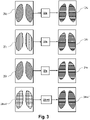
- Fig. 3 shows schematically different first medical image data 20a, which is acquired by using the first modality 12a, first medical image data 20b, which is acquired by using the second modality 12b, first medical image data 20n, which is acquired by using an n-th modality 12n, and first medical image data n+1, which acquired by using an n-th+1 modality 12n+1.
- the first medical image data 20a, 20b, 20n and 20n+1 may differ from each other in at least one image characteristic, as explained above.
- the first medical image data 20a, 20b, 20n and 20n+1 may be e.g. X-ray images.
- the different at least one image characteristics resulting from using the different modalities 12a, 12b, 12n, 12n+1 are shown only schematically by using different hatchings.
- the at least one image characteristic may be one or more of a sharpness, a contrast, a noise behavior, a frequency domain, and a grey value representation of the first medical image data 20a, 20b, 20n and 20n+1, or parts of it.
- the at least one image characteristic may be modified towards the common reference, meaning that in the resulting second image data 24a, 24b, 24n, 24n+1, the at least one image characteristic is at least similar among all medical images, irrespective of the modality 12a, 12b, 12n, 12n+1 used for acquiring the first medical image data 20a, 20b, 20n and 20n+1.
- the modified image characteristic is shown only schematically by using a hatching common to all second image data 24a, 24b, 24n, 24n+1.
- Fig. 4 shows in a flow chart a method for providing medical imaging data. It may be computer-implemented and may be applied to the system 100 as explained above. The method comprises the following steps:
- the data processing unit 162 obtains the first medical image data 20a acquired by the first modality 12a, wherein using the first modality 12a is associated with at least one modality-specific image characteristic of the first medical image data 20a at least co-determining an image visualization to a user.
- the data processing unit 162 identifies the first modality 12a, and determines, based on the identified first modality 12a, the first transfer rule 22a configured to transfer the at least one image characteristic towards the common reference image characteristic associated with a common reference image visualization.
- the data processing unit 162 generates the second medical image data 24a, by processing the first medical image data 20a with the first transfer rule 22a.
- the data processing unit 162 provides the second medical image data 24a, e.g. for displaying it to a user and/or for storing in the database 14.
- a computer program or computer program element is provided that is characterized by being configured to execute the method steps of the method according to one of the preceding embodiments, on an appropriate system.
- the computer program element might therefore be stored on a data processing unit, which might also be part of an embodiment.
- This data processing unit may be configured to perform or induce performing of the steps of the method described above. Moreover, it may be configured to operate the components of the above described device and/or system.
- the computing unit can be configured to operate automatically and/or to execute the orders of a user.
- a computer program may be loaded into a working memory of a data processor.
- the data processor may thus be equipped to carry out the method according to one of the preceding embodiments.
- the computer program element might be able to provide all necessary steps to fulfill the procedure of an exemplary embodiment of the method as described above.
- a computer readable medium such as a CD-ROM, USB stick or the like
- the computer readable medium has a computer program element stored on it which computer program element is described by the preceding section.
- a computer program may be stored and/or distributed on a suitable medium, such as an optical storage medium or a solid state medium supplied together with or as part of other hardware, but may also be distributed in other forms, such as via the internet or other wired or wireless telecommunication systems.
- a suitable medium such as an optical storage medium or a solid state medium supplied together with or as part of other hardware, but may also be distributed in other forms, such as via the internet or other wired or wireless telecommunication systems.
- the computer program may also be presented over a network like the World Wide Web and can be downloaded into the working memory of a data processor from such a network.
- a medium for making a computer program element available for downloading is provided, which computer program element is arranged to perform a method according to one of the previously described embodiments of the invention.
Landscapes
- Physics & Mathematics (AREA)
- General Physics & Mathematics (AREA)
- Engineering & Computer Science (AREA)
- Theoretical Computer Science (AREA)
- Medical Treatment And Welfare Office Work (AREA)
- Measuring And Recording Apparatus For Diagnosis (AREA)
Priority Applications (4)
| Application Number | Priority Date | Filing Date | Title |
|---|---|---|---|
| EP21164280.6A EP4064178A1 (de) | 2021-03-23 | 2021-03-23 | Übertragung eines modalitätsspezifischen bildmerkmals auf ein gemeinsames referenzbildmerkmal |
| US18/281,795 US20240153040A1 (en) | 2021-03-23 | 2022-03-16 | Transfering a modality-specific image characteristic to a common reference image characteristic |
| DE112022001634.5T DE112022001634T5 (de) | 2021-03-23 | 2022-03-16 | Übertragung eines modalitätsspezifischen bildmerkmals auf ein gemeinsames referenzbildmerkmal |
| PCT/EP2022/056795 WO2022200143A1 (en) | 2021-03-23 | 2022-03-16 | Transfering a modality-specific image characteristic to a common reference image characteristic |
Applications Claiming Priority (1)
| Application Number | Priority Date | Filing Date | Title |
|---|---|---|---|
| EP21164280.6A EP4064178A1 (de) | 2021-03-23 | 2021-03-23 | Übertragung eines modalitätsspezifischen bildmerkmals auf ein gemeinsames referenzbildmerkmal |
Publications (1)
| Publication Number | Publication Date |
|---|---|
| EP4064178A1 true EP4064178A1 (de) | 2022-09-28 |
Family
ID=75202992
Family Applications (1)
| Application Number | Title | Priority Date | Filing Date |
|---|---|---|---|
| EP21164280.6A Withdrawn EP4064178A1 (de) | 2021-03-23 | 2021-03-23 | Übertragung eines modalitätsspezifischen bildmerkmals auf ein gemeinsames referenzbildmerkmal |
Country Status (4)
| Country | Link |
|---|---|
| US (1) | US20240153040A1 (de) |
| EP (1) | EP4064178A1 (de) |
| DE (1) | DE112022001634T5 (de) |
| WO (1) | WO2022200143A1 (de) |
Citations (2)
| Publication number | Priority date | Publication date | Assignee | Title |
|---|---|---|---|---|
| WO2013042018A1 (en) * | 2011-09-19 | 2013-03-28 | Koninklijke Philips Electronics N.V. | Adapting an x-ray slave image to an x-ray master image |
| US20190012815A1 (en) * | 2015-07-23 | 2019-01-10 | Koninklijke Philps N.V. | Computed tomography visualization adjustment |
Family Cites Families (2)
| Publication number | Priority date | Publication date | Assignee | Title |
|---|---|---|---|---|
| JP3952096B2 (ja) * | 1997-08-29 | 2007-08-01 | 富士フイルム株式会社 | 画像処理システム |
| JP2003233674A (ja) * | 2002-02-06 | 2003-08-22 | Hitachi Medical Corp | 医用情報管理システム |
-
2021
- 2021-03-23 EP EP21164280.6A patent/EP4064178A1/de not_active Withdrawn
-
2022
- 2022-03-16 WO PCT/EP2022/056795 patent/WO2022200143A1/en not_active Ceased
- 2022-03-16 US US18/281,795 patent/US20240153040A1/en active Pending
- 2022-03-16 DE DE112022001634.5T patent/DE112022001634T5/de not_active Withdrawn
Patent Citations (2)
| Publication number | Priority date | Publication date | Assignee | Title |
|---|---|---|---|---|
| WO2013042018A1 (en) * | 2011-09-19 | 2013-03-28 | Koninklijke Philips Electronics N.V. | Adapting an x-ray slave image to an x-ray master image |
| US20190012815A1 (en) * | 2015-07-23 | 2019-01-10 | Koninklijke Philps N.V. | Computed tomography visualization adjustment |
Also Published As
| Publication number | Publication date |
|---|---|
| DE112022001634T5 (de) | 2024-01-18 |
| WO2022200143A1 (en) | 2022-09-29 |
| US20240153040A1 (en) | 2024-05-09 |
Similar Documents
| Publication | Publication Date | Title |
|---|---|---|
| US10839955B2 (en) | Methods and systems for electronically receiving, modifying and distributing three-dimensional medical images | |
| US9542082B1 (en) | Systems and methods for matching, naming, and displaying medical images | |
| US8786601B2 (en) | Generating views of medical images | |
| JP2022517098A (ja) | 患者固有の解剖学的構造の3d印刷可能モデルを発生させるための方法 | |
| US10453182B2 (en) | Medical imaging reconstruction optimized for recipient | |
| CN112651885A (zh) | 用于减少图像记录噪声的方法和装置 | |
| US8620689B2 (en) | System and method for patient synchronization between independent applications in a distributed environment | |
| JP6463970B2 (ja) | 医療選択システム | |
| US10817753B2 (en) | Learning assistance device, method of operating learning assistance device, learning assistance program, learning assistance system, and terminal device | |
| EP3195162B1 (de) | Bildfingerabdrucknahme | |
| US6323869B1 (en) | Method and system for modality dependent tone scale adjustment | |
| WO2019146358A1 (ja) | 学習システム、方法及びプログラム | |
| US8725801B2 (en) | Systems and methods for image sharing in a healthcare setting while maintaining diagnostic image quality | |
| CN113658175A (zh) | 一种征象数据的确定方法及装置 | |
| US11244754B2 (en) | Artificial neural network combining sensory signal classification and image generation | |
| EP4064178A1 (de) | Übertragung eines modalitätsspezifischen bildmerkmals auf ein gemeinsames referenzbildmerkmal | |
| EP2979161B1 (de) | Erzeugung einer auf benutzerpräferenzen basierenden bevorzugten ansicht auf strukturebene | |
| US10599812B2 (en) | Preprocessing image data based on scan protocols | |
| US20080120140A1 (en) | Managing medical imaging data | |
| JP6338525B2 (ja) | X線スレーブ画像のx線マスタ画像への適合 | |
| US8005790B2 (en) | Object cloning management system and method | |
| CN110750224A (zh) | Dicom图像的处理方法、装置、设备及可读介质 | |
| JP2018201682A (ja) | 情報処理装置、その制御方法、及びプログラム | |
| US20060045319A1 (en) | Image processing method and apparatus |
Legal Events
| Date | Code | Title | Description |
|---|---|---|---|
| PUAI | Public reference made under article 153(3) epc to a published international application that has entered the european phase |
Free format text: ORIGINAL CODE: 0009012 |
|
| STAA | Information on the status of an ep patent application or granted ep patent |
Free format text: STATUS: THE APPLICATION HAS BEEN PUBLISHED |
|
| AK | Designated contracting states |
Kind code of ref document: A1 Designated state(s): AL AT BE BG CH CY CZ DE DK EE ES FI FR GB GR HR HU IE IS IT LI LT LU LV MC MK MT NL NO PL PT RO RS SE SI SK SM TR |
|
| STAA | Information on the status of an ep patent application or granted ep patent |
Free format text: STATUS: THE APPLICATION IS DEEMED TO BE WITHDRAWN |
|
| 18D | Application deemed to be withdrawn |
Effective date: 20230329 |