EP4064223A1 - Procédé et dispositif de vérification de l'authenticité d'un objet - Google Patents
Procédé et dispositif de vérification de l'authenticité d'un objet Download PDFInfo
- Publication number
- EP4064223A1 EP4064223A1 EP22160166.9A EP22160166A EP4064223A1 EP 4064223 A1 EP4064223 A1 EP 4064223A1 EP 22160166 A EP22160166 A EP 22160166A EP 4064223 A1 EP4064223 A1 EP 4064223A1
- Authority
- EP
- European Patent Office
- Prior art keywords
- obj
- image
- fingerprint
- data
- object fingerprint
- Prior art date
- Legal status (The legal status is an assumption and is not a legal conclusion. Google has not performed a legal analysis and makes no representation as to the accuracy of the status listed.)
- Pending
Links
Images

Classifications
-
- G—PHYSICS
- G06—COMPUTING OR CALCULATING; COUNTING
- G06V—IMAGE OR VIDEO RECOGNITION OR UNDERSTANDING
- G06V20/00—Scenes; Scene-specific elements
- G06V20/80—Recognising image objects characterised by unique random patterns
-
- G—PHYSICS
- G06—COMPUTING OR CALCULATING; COUNTING
- G06V—IMAGE OR VIDEO RECOGNITION OR UNDERSTANDING
- G06V10/00—Arrangements for image or video recognition or understanding
- G06V10/20—Image preprocessing
- G06V10/22—Image preprocessing by selection of a specific region containing or referencing a pattern; Locating or processing of specific regions to guide the detection or recognition
- G06V10/225—Image preprocessing by selection of a specific region containing or referencing a pattern; Locating or processing of specific regions to guide the detection or recognition based on a marking or identifier characterising the area
-
- G—PHYSICS
- G06—COMPUTING OR CALCULATING; COUNTING
- G06V—IMAGE OR VIDEO RECOGNITION OR UNDERSTANDING
- G06V10/00—Arrangements for image or video recognition or understanding
- G06V10/40—Extraction of image or video features
- G06V10/44—Local feature extraction by analysis of parts of the pattern, e.g. by detecting edges, contours, loops, corners, strokes or intersections; Connectivity analysis, e.g. of connected components
-
- G—PHYSICS
- G07—CHECKING-DEVICES
- G07D—HANDLING OF COINS OR VALUABLE PAPERS, e.g. TESTING, SORTING BY DENOMINATIONS, COUNTING, DISPENSING, CHANGING OR DEPOSITING
- G07D7/00—Testing specially adapted to determine the identity or genuineness of valuable papers or for segregating those which are unacceptable, e.g. banknotes that are alien to a currency
- G07D7/20—Testing patterns thereon
- G07D7/202—Testing patterns thereon using pattern matching
- G07D7/2033—Matching unique patterns, i.e. patterns that are unique to each individual paper
Definitions
- the invention is based on a device or a method according to the species of the independent claims.
- the subject matter of the present invention is also a computer program.
- a verification of an authenticity of an object can be achieved using optically recognizable random features that are unique to the object on the basis of suitable image processing for generating a fingerprint of the object in question which the verification can take place.
- the forgery-proof identification of objects of all kinds can be made possible, for example banknotes, papers, packaging for medicines or original parts, even living or dead creatures or plants.
- an authenticity check in particular with a client and a server, can also be made possible, in which case a forgery-proof, naturally present property of the object can optionally be combined with an obvious code, such as a serial number, of the object.
- a method for verifying the authenticity of an object is presented, the object having optically recognizable random features that are unique to the object, the method having the following steps: Reading in image data, which represent at least one partial section of the object, in particular the optically recognizable random features unique to the object (OBJ), from an interface to an image recording device of a device for object assessment; and
- Verifying the authenticity can be understood to mean that the object is uniquely identified, such as from a plurality of similar objects.
- the method for identifying the object can be executed.
- verifying the authenticity can be understood to mean that it can be checked whether the object is genuine or a forgery.
- the object can be, for example, a banknote, a certificate, a certified object of value, a medication, a replacement part, an original part, a work of art or the like.
- the optically recognizable random features that are unique to the object can be due, for example, to the fact that a material of the object has at least one Has characteristic property that results from chance or from a random process, for example during its production, is at most partially imitable and offers sufficient clarity.
- the optically recognizable random features that are unique to the object can also be referred to as forgery-proof random features.
- An object fingerprint may be a digital representation of the tamper-proof random feature or features.
- a signature value can be a bit sequence, which can also be understood as a number and which characterizes an image content of a local environment around a position under consideration, for example around a current pixel.
- the device for assessing objects can be embodied, for example, as a mobile user terminal, a mobile phone, a money counting device, a money dispenser, a cash payment terminal, a cash register check device or the like.
- each of the signature values can be determined using a descriptor with a plurality of different filters.
- the descriptor can be designed to describe an image content in a local environment around a pixel in a compact form.
- a signature value can describe a value of the descriptor for a pixel, for example in a binary representation or a representation with several bits or a data word.
- Each signature value can have a sign for each filter of the descriptor, which can correspond to the sign of the filter response at the appropriate place.
- Such an embodiment offers the advantage that a particularly reliable and precise test object fingerprint can be generated in order to enable secure and unambiguous verification.
- the verification can be reliably carried out independently of a current state of the object compared to an original state or reference state of the object.
- the method can also have a step of carrying out a comparison of the test object fingerprint with at least one reference object fingerprint.
- a reference data record with a true reference object fingerprint can be retrieved for each object previously confirmed as genuine be.
- the method can also have a step of providing result data for verifying the authenticity of the object depending on a result of the comparison carried out in the carrying out step.
- the result data can be provided depending on a match between the verification data and a reference data record.
- the result data can include, for example, identification information for identifying the object, verification information about the authenticity of the object and, additionally or alternatively, additional information regarding the object.
- the reference data set can include reference image data that represents the object that has been confirmed in advance as genuine.
- the reference object fingerprint can be generated using the reference image data.
- test object fingerprint can relate to a smaller section of the object than the reference object fingerprint. This can make it possible for a user to select an image section for recording the image data himself as he wishes or, in order to be able to be particularly sure about the authenticity, to carry out several authenticity checks with different image sections.
- the verification object fingerprint in the processing step, can be combined with at least part of an identification code uniquely assigned to the object in order to add the at least part of the identification code to the verification data.
- the identification code can be arranged on the object, for example printed on it or the like.
- the at least one part of the identification code in response to a user input from a user interface of a device Object assessment are read and additionally or alternatively recognized using the image data.
- the at least one part of the identification code can be recognized in the processing step using the image data.
- the method can also have a step of carrying out a comparison of the test object fingerprint with at least one reference object fingerprint.
- a reference data record with a true reference object fingerprint and a true identification code can be retrieved for each object previously confirmed as authentic.
- the at least one reference object fingerprint can be selected depending on the at least one part of the identification code.
- the method can also have a step of providing result data for verifying the authenticity of the object depending on a result of the comparison carried out in the carrying out step.
- the result data can be provided depending on a match between the verification data and a reference data set.
- the result data can include, for example, verification information about the authenticity of the object and, additionally or alternatively, additional information about the object.
- the reference data set can include reference image data that represents the object that has been confirmed in advance as genuine.
- the reference object fingerprint can be generated using the reference image data.
- test object fingerprint can be combined with a part of the identification code in the processing step.
- result data can be provided that include the complete identification code.
- the test object fingerprint can be used in order to update the reference object fingerprint that matches the same and additionally or alternatively to carry out a status assessment of the object.
- the result data comprising the condition assessment can be provided.
- the result data can include or represent the status assessment.
- signature values of the test object fingerprint can be compared with signature values of a reference object fingerprint in order to find a correspondence between the test object fingerprint and a reference object fingerprint that matches the same.
- the correspondence can be found using a lookup table and a reconciliation screen.
- Signature values can serve as addresses for the lookup table.
- the look-up table can include a local offset of a pixel position of a reference pixel of the signature value relative to a reference position for each entered signature value.
- the voting image can be given voting weights for the reference position using the look-up table and, additionally or alternatively, the voting image can be filtered to identify a global maximum in the voting image as the reference position. A global maximum can correspond to a found correspondence.
- An offset for example, of the associated central pixel in relation to a common reference position, can be assigned to each signature value.
- the reference position can be, for example, the center of an image section or a position of a prominent and unambiguous point or feature on the object.
- the stored offset can be applied to the current position in the reference object fingerprint, in particular it can be added.
- a vote can be cast that votes for the location of the corresponding position to be searched for. This procedure for a large number of descriptors from the reference object fingerprint leads to a concentrated accumulation of votes at the corresponding position, which usually emerges as the winner from the vote.
- the optional filtering can be done using a smoothing filter applied to voting weights of the vote, where in particular sidelobes can be suppressed while the global maximum sought remains elevated.
- a smoothing filter applied to voting weights of the vote, where in particular sidelobes can be suppressed while the global maximum sought remains elevated.
- image data in the step of reading in, can be read in that represent at least one recording of the at least one partial section of the object.
- the at least one recording can be created using at least one illumination setting predefined for the recording.
- a first recording can be recorded with a first illumination setting and a second recording can be recorded with a second illumination setting that is different from the first.
- This method can be implemented, for example, in software or hardware or in a mixed form of software and hardware, for example in a control unit.
- the approach presented here also creates a device that is designed to carry out, control or implement the steps of a variant of a method presented here in corresponding devices.
- the object on which the invention is based can also be achieved quickly and efficiently by this embodiment variant of the invention in the form of a device.
- the device can have at least one computing unit for processing signals or data, at least one memory unit for storing signals or data, at least one interface to a sensor or an actuator for reading in sensor signals from the sensor or for outputting data or control signals to the Have actuator and / or at least one communication interface for reading or outputting data that are embedded in a communication protocol.
- the arithmetic unit can be, for example, a signal processor, a microcontroller or the like, with the memory unit being able to be a flash memory, an EEPROM or a magnetic memory unit.
- the communication interface can be designed to read in or output data wirelessly and/or by wire, wherein a communication interface that can read in or output wire-bound data can, for example, read this data electrically or optically from a corresponding data transmission line or can output it to a corresponding data transmission line.
- a device can be understood to mean an electrical device that processes sensor signals and, depending thereon, outputs control and/or data signals.
- the sensor signals can be image signals from the image recording device, for example.
- the sensor signals can thus be signals from a camera or the like.
- the control and/or data signals can be signals which are sent to a control unit, for example inside or outside the device. The control unit can then use these signals to decide whether and/or which actions are to be initiated or recommended.
- the device can have an interface that can be configured as hardware and/or software. In the case of a hardware design, the interfaces can be part of a so-called system ASIC, for example, which contains a wide variety of functions of the device.
- the interfaces can have their own integrated circuits or at least in part to consist of discrete components exist.
- the interfaces can be software modules which are present, for example, on a microcontroller alongside other software modules.
- a computer program product or computer program with program code which can be stored on a machine-readable carrier or storage medium such as a semiconductor memory, a hard disk memory or an optical memory and for carrying out, implementing and/or controlling the steps of the method according to one of the embodiments described above, is also advantageous used, especially when the program product or program is run on a computer or device.
- a device for object assessment is also presented, the device having an embodiment of the aforementioned device, the device having the image recording device, the image recording device and the device being connected to one another in a data-transmitting manner.
- the device can have a function or functionality for object assessment and optionally additionally at least one further function or functionality independent of the object assessment.
- the device can advantageously be employed or used in connection with the device for verifying the authenticity of an object.
- the device can be designed to carry out the verification on a client-server basis. Client and server can also be executable on the same device.
- a forgery-proof identification of objects and/or a scalable verification method can be provided, for example in a client-server-based manner.
- FIG. 12 shows a schematic representation of a device 100 for object assessment with a device 110 for verifying an authenticity of an object OBJ according to an exemplary embodiment.
- the device 100 for object evaluation is embodied as, for example, a mobile user terminal, a mobile phone, a money counting device, a money dispenser, a cash payment terminal, a cash register checker or the like.
- the device 100 includes the device 110.
- the device 100 also includes an image recording device 102.
- the image recording device 102 and the device 110 are connected to one another in a data-transmitting manner.
- the image recording device 102 is designed as a camera.
- Image data 103 which represent at least a partial section of the object OBJ can be generated by means of the image recording device 102 .
- the object OBJ includes optical recognizable random features unique to the object.
- the at least one section of the object OBJ preferably has the optically recognizable random features that are unique to the object (OBJ).
- the device 100 also includes a user interface 106.
- the user interface 106 and the device 100 are also connected to one another in a data-transmitting manner.
- the device 110 is designed to enable and/or effect verification of the authenticity of the object OBJ.
- the device 110 comprises a reading device 112 and a processing device 114.
- the reading device 112 is designed to read the image data 103 from an interface 111 or input interface of the device 110 to the image recording device 102.
- the reading-in device 112 is designed to forward the read-in image data 103 to the processing device 114 .
- the processing device 114 is designed to process the image data 103 using a processing specification 113 in order to generate a test object fingerprint of the object OBJ as verification data 115 for verification for a comparison with a reference object fingerprint.
- a plurality of signature values are determined for a plurality of pixels of an image region of the image data.
- the processing device 114 is designed to determine each of the signature values using a descriptor with a plurality of different filters.
- the descriptor is designed to describe an image content in a local environment around a pixel in a compact form.
- the device 110 also includes an implementation device 116 and a provision device 118.
- the implementation device 116 and the provision device 118 are implemented outside of the device 100 or in another device, for example in a server that is connected to the device 100 in a data-transmitting manner .
- the implementation device 116 is designed to carry out a comparison using the verification data 115 and a reference data record REF of the test object fingerprint with at least one reference object fingerprint.
- a reference data record REF with a true reference object fingerprint can be retrieved for each object OBJ previously confirmed as authentic.
- the implementation device 116 is designed to pass on comparison data 117, which represent a result of the comparison, to the provision device 118.
- the provision device 118 is designed to provide result data 119 for verifying the authenticity of the object OBJ as a function of the comparison data 117 or as a function of a result of the comparison carried out by the implementation device 116 .
- the provision device 118 is designed to provide the result data 119 depending on a match between the verification data 115 and a reference data record REF.
- the processing device 114 is designed to combine the verification object fingerprint with at least part of an identification code XYZ uniquely assigned to the object OBJ in order to add the at least part of the identification code XYZ to the verification data 115.
- the reading device 112 is designed to read in the at least part of the identification code XYZ in response to a user input in the form of an input signal 107 from the user interface 106 .
- the processing device 114 is designed to recognize the at least part of the identification code XYZ using the image data 103 .
- the implementation device 116 is also designed to compare the test object fingerprint with at least one reference object fingerprint.
- a reference data record REF with a true reference object fingerprint and a true identification code can be retrieved for each object previously confirmed as authentic.
- the implementation device 116 is designed to select the at least one reference object fingerprint for the comparison as a function of the at least one part of the identification code XYZ.
- the implementation device 116 is also designed to process comparison data 117, which is a result of the comparison represent to pass on to the provision device 118.
- the processing device 114 is designed here to combine the test object fingerprint with a part of the identification code XYZ, and the providing device 118 is designed to provide result data 119 that includes the complete identification code XYZ.
- the implementation device 116 is designed to use the test object fingerprint in order to update the reference object fingerprint of the reference data record REF that matches the same. Additionally or alternatively, the implementation device 116 is designed to use the test object fingerprint in order to carry out a status assessment of the object OBJ. In this case, the provision device 118 is designed to provide result data 119 which include the status assessment.
- implementation device 116 is designed to compare signature values of the test object fingerprint with signature values of a reference object fingerprint when performing the comparison, in order to find a correspondence between the test object fingerprint and a reference object fingerprint that matches the same.
- the implementation device 116 is designed to find the correspondence using a look-up table and a matching image.
- Signature values serve as addresses for the lookup table.
- the look-up table includes a local offset of a pixel position of a reference pixel of the signature value relative to a reference position for each signature value entered.
- voting weights are given for the reference position using the look-up table and optionally additionally the voting image is filtered to identify a global maximum in the voting image as the reference position. A global maximum corresponds to a found correspondence.
- the reading device 112 is designed to read in image data 103 that contains at least one recording of the at least represent a portion of the object OBJ.
- the at least one recording is created using at least one illumination setting predefined for the recording.
- the lighting can be important.
- light incident flat from the side can be suitable for extracting differences in brightness and thus information from a surface structure.
- well-textured surfaces e.g. Black and white marble
- the arrangement of a light source is less important.
- the light source can be implemented as part of the device 100 or separately from the device 100 .
- the sun for example, can also be suitable as a light source.
- the user interface 106 is designed to signal the verification of the authenticity of the object OBJ to a user and/or another facility or device using the result data 119 .
- FIG. 2 shows a flow chart of an embodiment of a method 200 for verifying an authenticity of an object.
- the method 200 for verifying using the device is off 1 or similar device and/or in connection with the Device 1 or a similar device executable.
- the device is off 1 or set up a similar device to carry out and/or control the steps of the method in corresponding units.
- the object includes visually recognizable random features unique to the object.
- the method 200 comprises a step 210 of reading in and a step 220 of processing.
- the method 200 also includes a step 230 of performing and a step 240 of providing.
- step 210 of reading in image data, which represent at least a partial section of the object, are read in from an interface to an image recording device of the device for object assessment.
- the at least one section of the object preferably has the optically recognizable random features that are unique to the object.
- step 220 of processing the image data are processed using a processing rule according to which a plurality of signature values for a plurality of pixels of an image region of the image data is processed to generate a test object fingerprint of the object as verification data for verification for comparison with a reference object fingerprint.
- step 230 of performing the test object fingerprint is compared with at least one reference object fingerprint.
- a reference data record with a true reference object fingerprint can be called up for each object previously confirmed as genuine.
- step 240 of providing result data for verifying the authenticity of the object are provided as a function of a result of the comparison carried out in the performing step. The result data is provided depending on a match between the verification data and a reference data set.
- the verification object fingerprint is combined with at least part of an identification code uniquely assigned to the object in order to add the at least part of the identification code to the verification data.
- the test object fingerprint is compared with at least one reference object fingerprint.
- a reference data record with a true reference object fingerprint and a true identification code can be retrieved for each object previously confirmed as genuine.
- the at least one reference object fingerprint is selected depending on the at least one part of the identification code.
- result data for verifying the authenticity of the object are provided as a function of a result of the comparison carried out in the performing step. In this case, the result data are provided depending on a match between the verification data and a reference data record.
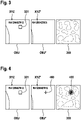
- FIG. 12 shows a schematic representation of an object OBJ with a subsection 301, an object OBJ* confirmed to be genuine and a matching image 350 in connection with the device from FIG 1 and/or with the procedure 2 .
- the object OBJ, the object OBJ* confirmed to be genuine, and the matching image 350 are each shown as images in a juxtaposition.
- the object OBJ, as well as the object OBJ* that has been confirmed as authentic, is a banknote according to the exemplary embodiment shown here, with the illustration in FIG 3 of the object OBJ and the object OBJ* which has been confirmed as authentic, only a part relevant to the verification is shown.
- the subsection 301 of the object OBJ is represented by the image data.
- the object OBJ* confirmed as genuine is used for the comparison of the object fingerprints.
- a structure of the substrate of objects OBJ and OBJ* includes and/or represents the optically recognizable random features unique to object OBJ and OBJ*.
- the matching image 350 is used in the comparison.
- the identification code XYZ comprises a serial number RA1296427812, merely by way of example, with the further identification code XYZ* comprising a serial number RA1296427803.
- FIG. 12 shows a schematic representation of an object OBJ with a subsection 301, an object OBJ* confirmed to be genuine and a matching image 350 in connection with the device from FIG 1 and/or with the procedure 2 .
- the representation in 4 corresponds to the representation 3 except that a comparison candidate other than the authenticated object OBJ* is shown, in the comparison between the object OBJ and the authenticated object OBJ* as comparison candidates, there is a match, the identification code XYZ and the other Identification codes XYZ* match, so that a clear or distinguished accumulation point or a global maximum 455 results in the matching image 350 .
- One Position 460 of this global maximum 455 in the reconciliation image 350 is also illustrated by a marker on the representation of the object OBJ* confirmed as genuine.
- the position 460 of this accumulation point or global maximum 455 on the bill corresponds to a selected reference position on the same bill recorded at a different point in time.
- An advantageous feature of embodiments and also the DE 10 2019 210 580 A1 is that the method 200 does not require a search, which makes it extremely efficient compared to previous solutions. In addition, it is extremely reliable. Instead of performing a search in which descriptor signature values would be compared for similarity, the DE 10 2019 210 580 A1 Identity of the signature values required and the respective correspondence found with the help of a lookup table or lookup table, in which the signature serves as the address. In the DE 10 2019 210 580 A1 the local relationship, also referred to below as an offset, between the respective descriptor position and reference position in a first image area is stored in a look-up table, specifically at the address corresponding to the signature value.
- a signature value in a second image leads to the readout of the lookup table at the corresponding address.
- the saved offset is applied to the current position in the second image, e.g. B. added.
- a vote is cast at the resulting position, which votes for the location of the corresponding position to be searched for. This procedure, for a large number of descriptors in the second picture, leads to a concentrated accumulation of votes at the corresponding position, which usually emerges as the winner from the vote.
- the corresponding position for the reference position from the first image is thus found in the second image.
- Level 1 features which are directly recognized by humans and can be checked without additional tools
- Level 2 features which are machine-readable and e.g. B. in counting devices of the bank or in ATMs or in test devices at cash registers.
- Level 3 features with the highest requirements for the security of authenticity recognition, which are kept secret by the central banks.
- the giver may have a different point of view, which can lead to a dispute that is difficult to resolve.
- a query is possible here for both sides, which creates clarity. If the query can be run independently by both parties if needed and come up with the same result, it creates additional clarity and trust.
- the concept according to exemplary embodiments can also be applied to objects OBJ that are already in circulation without these having to be changed. This is e.g. This is very interesting for banknotes, for example, because the means of payment already in circulation can subsequently be made identifiable in a forgery-proof manner. All they have to do is make one visit to an institution that is authorized and equipped to do so. Normal cash circulation is sufficient for this, for example. For all banknotes recorded in this way, an assignment of serial number or identification code and object fingerprint is stored, for example, on the server side. A banknote that has been hoarded in a savings stocking for a long time is not recorded in this way, ie the fingerprint of the object is not yet known for its serial number, but this represents no problem.
- This status can be reported back during the authenticity check.
- the customer can z. B. are recommended to bring the bill to a bank. If the object OBJ or the bank note arrives at the institution again, the object fingerprint can be recorded or updated again. This is particularly useful when the object OBJ changes over time, e.g. B. ages or wears out or becomes dirty. In this way, expensive classic security features could also become dispensable. The production or furnishing of banknotes, packaging for medicines, etc. could thus become simpler and therefore more cost-effective.
- the method 200 for verification or for the authenticity check is scalable. This means, for example, that only part of the serial number or identification code is transmitted from the client to the server, so that there is an ambiguity. This ambiguity is resolved on the server side using the reference object fingerprint.
- the server then sends the rest of the serial number that has not yet been exchanged back to the client in order to create trust there.
- the client decides at its own discretion how much and which part of the serial number to omit. The more he omits, the greater the security against a randomly correct answer or against an incorrect answer by a fraudulent service.
- the client can also be a human using an ordinary smartphone with a camera.
- the scalability of the concept according to an exemplary embodiment offers, for example, the possibility of delivering higher trust at the expense of higher effort, which can be billed accordingly to the customer. For example, if you omit three numerical digits from the serial number of a bill and assume that the serial numbers for these three digits are assigned without gaps, then there are 1000 bills on which the rest of the serial number can fit. In other words, there are 1000 equal opportunities for the unknown digits. So a server only needs to check these 1000 possibilities. Of course, if you leave out letters, the number of possibilities is higher than if you leave out digits, since there are only 10 different digits but more than 10 different letters. After successful verification, the server returns the three positions to the client, which the client can then check.
- the probability of correctly guessing the 3 digits is only 1/1000.
- the probability of guessing 2 digits correctly is 1/100.
- the probability of guessing correctly is therefore inversely proportional to the effort required by the server to carry out the comparisons.
- the operator can have the effort paid for and offer various modes, for example:
- the check when the complete serial number is given is offered free of charge, provided the client does not make such requests in large numbers. For example, checking if 3 digits are omitted costs 0.1 cents. For example, checking if 6 digits are omitted (1000 times the effort compared to 3 digits) costs 1 euro.
- the customer has another option for checking the verification, e.g. B. if he doubts the integrity. Namely, he can use a serial number in whole or in part from a first ticket and an object fingerprint from a second ticket with a different serial number for the request. The server will then return a counterfeit message.
- the server It must be a fake if the server knows all the serial numbers in circulation. If the serial number exists but the object fingerprint is still unknown, the result data 119 reports to the client that the check cannot be carried out or should be carried out by a bank so that e.g. B. checked with a level 3 method and, if necessary, the object fingerprint is officially recorded for the first time. If the banknote is so severely damaged that the accumulation point falls below a minimum threshold, the result data 119 is used to report to the client that the check was conditionally positive and that the banknote should be exchanged at a bank. It can still happen that the serial number was entered incompletely and it is a question of a note that has not yet been recorded. In this case, the server will not find any correspondence. However, on the server side it is known that there are unrecorded bills and how many and what serial numbers they are. A corresponding feedback can be given or the client can be asked to enter the complete serial number or the complete identification code XYZ for clarification.
- the concept according to exemplary embodiments can be used in devices 100 for object assessment such as money counting devices and money dispensing devices and terminals
- Cash payment and test devices can be integrated into cash registers. In this way, counterfeit money can be reliably detected and immediately rejected or marked or confiscated or destroyed.
- these devices 100 it makes sense to carry out the authenticity check with automatic detection and transmission of the full serial number in order to keep the search effort low. Dispelling suspicions (by omitting digits of the serial number) or scalability is usually not necessary here.
- additional benefits can be drawn from requests to the server, in particular after positive verification, for example: Use of the test object fingerprint sent by the client, for example to update the stored reference object fingerprint or to assess the aging status.
- the coincidence lies in the arrangement of the mostly cotton-containing fibers in the substrate.
- the position of the mottled fibers in the substrate is just as random. These are mixed colored fibers that glow in different colors under UV light.
- the useful randomness lies in the arrangement of the pulp fibers.
- the useful coincidence lies in the arrangement and color of the fibers.
- With a metallic paint surface the useful coincidence lies in the arrangement and alignment of the metallic reflecting particles.
- the useful coincidence lies in the arrangement and composition of the grains of sand on the surface.
- the useful chance lies in its texture.
- the usable chance is in the wood grain.
- the exploitable randomness lies in the structure of the crystalline surface.
- the usable coincidence lies in the arrangement of the folds and pores or hair roots. It is similar with the skin of a fruit or the skin or carapace of an animal.
- the useful coincidence lies in the fine structure of the fibers on the back of the canvas. This list could be continued indefinitely. It is important that the material has at least one characteristic that results from chance, cannot be completely imitated and offers sufficient clarity. This is the case for all of the examples given.
- a piece of paper or substrate measuring a few square millimeters is so clear that confusion with a second piece can be ruled out with certainty.
- an attempt at counterfeiting could be undertaken, e.g. B. by artificial imitation of a natural fiber surface by photo printing.
- such a counterfeit attempt is almost always very easy to unmask or circumvent, e.g. B. by always photographing the surface structure twice for the formation of the object fingerprint, once with illumination from the left, once from the right - while the forgery could only reflect one direction of illumination.
- the formation of the object fingerprint means that the non-forgeable random feature(s) is (are) converted into a digital representation.
- This object fingerprint is generally not clearly reproducible. This may be surprising at first, but it makes sense when you consider that the object OBJ to be inspected is new and dirty or damaged, or that it is photographed, for example, by an expensive camera in a special device and by a smartphone camera. It is crucial that the object fingerprint formed allows a sufficiently reliable decision during the authenticity check.
- the formation of the object fingerprint is as follows according to the patent application DE 10 2019 210 580 A1 performed (without loss of generality). For this purpose, the object OBJ or a part thereof is photographed by a camera or image recording device 102 .
- a plurality of signature values is formed from the content of the image section.
- a signature is a bit sequence (which can also be understood as a number) that expands the image content of the local environment by a position under consideration, e.g. B. the current pixel characterized. If you execute this formation several times, e.g. B. for the vicinity of each pixel, one obtains a plurality of signatures.
- Each signature is an offset z. B. associated central pixel to a common reference position.
- the reference position can e.g. B. be the center of the image section or the position of a prominent and clear point on the banknote or the object OBJ.
- the offsets are stored using a lookup table, for example, with the signature being able to serve as a lookup address. Suggestions for dealing with ambiguous signatures are also in the patent application DE 10 2019 210 580 A1 given.
- the object fingerprint is thus formed from a recording of a part of the object OBJ, which was displayed by converting the image or image section into signatures in a lookup table that stores an offset for the respective signature.
- Alternative forms of the object fingerprint are also conceivable. For example this The above in digitally compressed form or as a preliminary stage, e.g. B. as an image (section) of signatures. It is irrelevant whether the processing steps for the formation of the test object fingerprint are already carried out on the client or only on the server. It is advantageous to have the reference object fingerprint available for a larger area on the server side, while a smaller area (image section) for the test object fingerprint is recorded on the client side. This opens up the possibility for the user to select the image section himself as he wishes or - in order to be particularly sure of the authenticity - to carry out several authenticity checks with different image sections.
- a trustworthy facility or organization that creates the object fingerprint and relates it to the reference code or identification code XYZ or XYZ* and/or keeps the stored pair available as a reference data record REF and answers requests for an authenticity check. Both tasks can also be separated.
- the creation of the object fingerprint can take place in certified machines located in bank branches, while the queries are answered by central bank servers.
- the trusted entity could e.g. B. also be a manufacturer of original spare parts, which creates the object fingerprint for the box when packaging your original spare parts and answers questions about the authenticity of customers themselves.
- the trusted entity could also be a drug manufacturer who creates the object fingerprint for the packages or the medicinal preparations themselves (particularly tablets) and answers inquiries from pharmacies, doctors, medical staff and patients about authenticity.
- the trusted entity could also be a single terminal used to verify the authenticity of objects or documents when lending and returning or receiving them. For example, in a museum that lends works of art to exhibitions, or with a mail order company that handles returns.
- the sequence of the authenticity check is described below as an exemplary embodiment and only as an example.
- the seller gives the customer a 50 euro note as change, which represents the object OBJ and which the customer wants to check as a precaution.
- the customer picks up their smartphone and photographs or films the bill with an authenticity app.
- the app recognizes the position of the note and directs the customer, for example, so that the unprinted space between the serial number and the watermark on the back of the note can be recorded.
- the structure of the substrate is particularly visible on this unprinted area. The picture is taken from a short distance and with the (side) lighting switched on.
- the user decides for himself whether to take a photo of the serial number and whether the app should recognize it automatically, or whether he should type it in himself. In this case, he types it in himself, except for the last three digits, for example RA1296427***.
- the app forms the test object fingerprint from the recording and transmits this together with the part of the serial number that has been typed in as verification data 115 to a server, for example.
- the test object fingerprint is represented as an image of signatures, one signature being stored therein per pixel.
- the server recognizes that there are 1000 bills in circulation that match the transmitted incomplete serial number, i.e. the serial numbers from RA1296427000 to RA1296427999.
- the object fingerprints for 900 of these certificates are already available in a database and are ready for comparison.
- the object fingerprints are still unknown because the bills have not reappeared in any bank branch since the introduction of the authenticity check, for example. They slumber in savings stockings and safes, for example. It is therefore relatively unlikely that the note to be tested belongs to these 100 unrecorded.
- the server begins by comparing the respective reference object fingerprint with the verification object fingerprint sent by the client for the 900 candidates of objects OBJ* previously confirmed as genuine. The comparison can be aborted as soon as the match is found.
- the comparison can proceed as follows: The server loads the next reference object fingerprint from the database into memory (and decompresses it beforehand, if necessary).
- the reference object fingerprint can be present as a lookup table that has already been filled. Alternatively, the lookup table is now filled using the reference image of signatures from the database.
- the populated lookup table contains offsets from the reference position.
- the comparison can then be carried out: For each signature of the test object fingerprint or a subset thereof, a read access to the lookup table is carried out and the offset stored for the respective signature, if any, is read out, otherwise the next signature is progressed to. This offset is added to the current test pattern pixel position.
- voting image 350 the coordinates of the matching image 350 correspond to the coordinates of the test signature image, ie they can be converted into one another or, in the simplest case, are identical.
- the customer is shown on their smartphone that the bill being examined is genuine and what the rest of the serial number is. Since the customer has not yet submitted the remaining 3 digits, he can be very sure that he was not cheated by the app or server, because this case of abuse (hacked app or fraudulent server) is also conceivable.
- the reference object fingerprint is used to write the lookup table and the test object fingerprint is used to read it.
- the order can also be reversed, with both embodiments being approximately equivalent.
- DE 10 2019 210 580 A1 suggestions are also made for non-constant voting weights, which can be used to advantage here. Other options for carrying out the comparison between the test and reference recordings are also conceivable.
- the object OBJ is located at an intended distance and alignment with respect to the camera or image recording device 102 during the image recording.
- the intended distance and orientation is ideally selected in such a way that, in the case of object agreement, the accumulation of the voice weights is as high as possible when applying the offsets to the signature positions.
- this can easily be achieved by a mechanical arrangement, e.g. B. by using a cash feeder that aligns the bill and feeds it to the camera at the intended distance.
- a hand-held arrangement e.g. B. with a smartphone camera, this would be less practical. Instead, the captured image z. B.
- a suitable algorithm can make use of existing features on the bank note, for example the known printing, in order to calculate the parameters of the necessary homographic image from their size, orientation and/or distortion.
- a differential consideration of the tuning is also carried out, ie it is determined how a slight shortening or lengthening of all offset vectors affects the level of the accumulation.
- the length of all offset vectors can thus be corrected in such a way that the accumulation is maximized, if necessary by iterative multiple application of the differential consideration.
- Analogous to the use of differential consideration in distance compensation it can also be used in orientation compensation. For example, a slight rotation between the object OBJ and the camera or image recording device 102 about the viewing axis could result in the weights no longer falling on a common center when applying the offsets to the signature positions, but being distributed around it. This error can also be corrected again using a differential consideration with a slight variation of the torsion, possibly iteratively. Analogous considerations can also be applied to the rotations, in the sense of tilting, around the other two spatial axes.
- an embodiment includes an "and/or" link between a first feature and a second feature, this should be read in such a way that the embodiment according to one embodiment includes both the first feature and the second feature and according to a further embodiment either only that having the first feature or only the second feature.
Landscapes
- Engineering & Computer Science (AREA)
- Physics & Mathematics (AREA)
- General Physics & Mathematics (AREA)
- Multimedia (AREA)
- Theoretical Computer Science (AREA)
- Computer Vision & Pattern Recognition (AREA)
- Collating Specific Patterns (AREA)
Applications Claiming Priority (1)
| Application Number | Priority Date | Filing Date | Title |
|---|---|---|---|
| DE102021203081.5A DE102021203081A1 (de) | 2021-03-26 | 2021-03-26 | Verfahren und Vorrichtung zum Verifizieren einer Echtheit eines Objekts und Gerät zur Objektbeurteilung |
Publications (1)
| Publication Number | Publication Date |
|---|---|
| EP4064223A1 true EP4064223A1 (fr) | 2022-09-28 |
Family
ID=80628805
Family Applications (1)
| Application Number | Title | Priority Date | Filing Date |
|---|---|---|---|
| EP22160166.9A Pending EP4064223A1 (fr) | 2021-03-26 | 2022-03-04 | Procédé et dispositif de vérification de l'authenticité d'un objet |
Country Status (2)
| Country | Link |
|---|---|
| EP (1) | EP4064223A1 (fr) |
| DE (1) | DE102021203081A1 (fr) |
Families Citing this family (1)
| Publication number | Priority date | Publication date | Assignee | Title |
|---|---|---|---|---|
| DE102024206420A1 (de) | 2024-07-08 | 2026-01-08 | Robert Bosch Gesellschaft mit beschränkter Haftung | Verfahren zur markierungslosen Nachverfolgung von in Abformprozessen hergestellten Bauteilen |
Citations (4)
| Publication number | Priority date | Publication date | Assignee | Title |
|---|---|---|---|---|
| DE10304805A1 (de) * | 2003-02-05 | 2004-08-19 | Informium Ag | Verfahren zur Herstellung von Sicherheitskennzeichen |
| EP3428853A1 (fr) * | 2017-07-14 | 2019-01-16 | A & R Carton GmbH | Procédé de protection d'un produit contre les falsifications |
| DE102019210580A1 (de) | 2019-07-18 | 2021-01-21 | Robert Bosch Gmbh | Verfahren zum Ermitteln einer Position eines ersten Bildbereichs in einem Korrespondenz-Bild, SoC und Steuervorrichtung und System zur Durchführung des Verfahrens, sowie Computerprogramm |
| US10956732B2 (en) * | 2014-11-21 | 2021-03-23 | Guy Le Henaff | System and method for detecting the authenticity of products |
Family Cites Families (3)
| Publication number | Priority date | Publication date | Assignee | Title |
|---|---|---|---|---|
| US8534544B1 (en) | 2012-05-18 | 2013-09-17 | Sri International | System and method for authenticating a manufactured product with a mobile device |
| US9224196B2 (en) | 2014-03-12 | 2015-12-29 | ClearMark Systems, LLC | System and method for authentication |
| US10614302B2 (en) | 2016-05-26 | 2020-04-07 | Alitheon, Inc. | Controlled authentication of physical objects |
-
2021
- 2021-03-26 DE DE102021203081.5A patent/DE102021203081A1/de active Pending
-
2022
- 2022-03-04 EP EP22160166.9A patent/EP4064223A1/fr active Pending
Patent Citations (4)
| Publication number | Priority date | Publication date | Assignee | Title |
|---|---|---|---|---|
| DE10304805A1 (de) * | 2003-02-05 | 2004-08-19 | Informium Ag | Verfahren zur Herstellung von Sicherheitskennzeichen |
| US10956732B2 (en) * | 2014-11-21 | 2021-03-23 | Guy Le Henaff | System and method for detecting the authenticity of products |
| EP3428853A1 (fr) * | 2017-07-14 | 2019-01-16 | A & R Carton GmbH | Procédé de protection d'un produit contre les falsifications |
| DE102019210580A1 (de) | 2019-07-18 | 2021-01-21 | Robert Bosch Gmbh | Verfahren zum Ermitteln einer Position eines ersten Bildbereichs in einem Korrespondenz-Bild, SoC und Steuervorrichtung und System zur Durchführung des Verfahrens, sowie Computerprogramm |
Also Published As
| Publication number | Publication date |
|---|---|
| DE102021203081A1 (de) | 2022-09-29 |
Similar Documents
| Publication | Publication Date | Title |
|---|---|---|
| DE69634583T2 (de) | System und Verfahren zum Prüfen von Identifizierungskarten | |
| EP2948891B1 (fr) | Identification de l'utilisateur | |
| EP1459266A2 (fr) | Proc d pour prot ger l'authenticit de documents | |
| DE102018115146A1 (de) | Verfahren zur Herstellung für das menschliche Auge nicht sichtbarer und nicht kopierbarer Sicherheitselemente in einer Abbildung sowie Verfahren zum Authentizitätsnachweis von Produkten auf Basis des Abgleichs von ungleichen Informationen sowie gedruckte Abbildung | |
| DE102010045879A1 (de) | Verfahren für die Bearbeitung von Banknoten | |
| DE102013108713A1 (de) | Verfahren zum Auswerten eines Dokuments | |
| EP3189465A1 (fr) | Procédé et système d'authentification pour l'enregistrement d'une caractéristique de sécurité aléatoire | |
| WO2005064548A2 (fr) | Procede permettant l'identification de billets de banque falsifies | |
| CH710713A2 (de) | Authentifizierungsverfahren unter Verwendung von Oberflächenpapiertextur. | |
| DE102007060605A1 (de) | Sichern von Personen-Identitätsdokumenten gegen Fälschung | |
| WO2015022872A1 (fr) | Procédé pour déterminer automatiquement l'authenticité d'un article individuel en utilisant comme identifiant la forme de micro-contour d'une impression | |
| DE102021203081A1 (de) | Verfahren und Vorrichtung zum Verifizieren einer Echtheit eines Objekts und Gerät zur Objektbeurteilung | |
| EP3789976B1 (fr) | Procédé de vérification de l'authenticité d'un document, produit programme informatique, appareil de vérification et système de traitement des données | |
| CH717006B1 (de) | Verfahren zur Benutzeridentifikation. | |
| EP4192692B1 (fr) | Production de modèles de documents dotés de caractéristiques de sécurité | |
| WO2009053077A1 (fr) | Procédé et dispositif de suivi de documents de valeur | |
| EP2394250A1 (fr) | Procédé et dispositif pour vérifier des documents par utilisation d'une transformation en ondelettes | |
| EP3356980B1 (fr) | Procédé et appareil pour l'authentification d'un objet ou d'une personne moyennant un élément de sécurité construit de manière modulaire | |
| DE10202696A1 (de) | Antifälschungsverfahren und -system | |
| EP3185221B1 (fr) | Dispositif d'authentification et procede de reconnaissance optique ou acoustique | |
| EP4064606B1 (fr) | Chaîne de blocs comme support spécifique au numéro de série pour terminaux portables mobiles | |
| DE102023115512A1 (de) | Sicherheitsdokument-verifizierungsvorrichtung und verfahren zum prüfen eines sicherheitsdokuments | |
| EP4205091A1 (fr) | Procédé pour produire un identifiant numérique d'un exemplaire d'un produit d'impression, ledit exemplaire présentant au moins une image d'impression, téléphone intelligent ou tablette doté(e) d'un tel dispositif et procédé d'utilisation de ce dispositif | |
| EP4182836A1 (fr) | Procédé et dispositif de vérification de documents de valeur, et procédé et dispositif de génération de paramètres de contrôle destinés à être utilisés dans un procédé de contrôle de documents de valeur | |
| DE102016118886A1 (de) | Verfahren zur Prüfung einer Darstellung eines Objekts |
Legal Events
| Date | Code | Title | Description |
|---|---|---|---|
| PUAI | Public reference made under article 153(3) epc to a published international application that has entered the european phase |
Free format text: ORIGINAL CODE: 0009012 |
|
| STAA | Information on the status of an ep patent application or granted ep patent |
Free format text: STATUS: THE APPLICATION HAS BEEN PUBLISHED |
|
| AK | Designated contracting states |
Kind code of ref document: A1 Designated state(s): AL AT BE BG CH CY CZ DE DK EE ES FI FR GB GR HR HU IE IS IT LI LT LU LV MC MK MT NL NO PL PT RO RS SE SI SK SM TR |
|
| STAA | Information on the status of an ep patent application or granted ep patent |
Free format text: STATUS: REQUEST FOR EXAMINATION WAS MADE |
|
| 17P | Request for examination filed |
Effective date: 20230328 |
|
| RBV | Designated contracting states (corrected) |
Designated state(s): AL AT BE BG CH CY CZ DE DK EE ES FI FR GB GR HR HU IE IS IT LI LT LU LV MC MK MT NL NO PL PT RO RS SE SI SK SM TR |
|
| STAA | Information on the status of an ep patent application or granted ep patent |
Free format text: STATUS: EXAMINATION IS IN PROGRESS |
|
| 17Q | First examination report despatched |
Effective date: 20240723 |
|
| GRAP | Despatch of communication of intention to grant a patent |
Free format text: ORIGINAL CODE: EPIDOSNIGR1 |
|
| STAA | Information on the status of an ep patent application or granted ep patent |
Free format text: STATUS: GRANT OF PATENT IS INTENDED |
|
| INTG | Intention to grant announced |
Effective date: 20260402 |