EP4064596B1 - Data transmission method and apparatus, and computer-readable storage medium - Google Patents
Data transmission method and apparatus, and computer-readable storage medium Download PDFInfo
- Publication number
- EP4064596B1 EP4064596B1 EP20917663.5A EP20917663A EP4064596B1 EP 4064596 B1 EP4064596 B1 EP 4064596B1 EP 20917663 A EP20917663 A EP 20917663A EP 4064596 B1 EP4064596 B1 EP 4064596B1
- Authority
- EP
- European Patent Office
- Prior art keywords
- resource
- logical channel
- available resources
- harq
- attribute
- Prior art date
- Legal status (The legal status is an assumption and is not a legal conclusion. Google has not performed a legal analysis and makes no representation as to the accuracy of the status listed.)
- Active
Links
Images




Classifications
-
- H—ELECTRICITY
- H04—ELECTRIC COMMUNICATION TECHNIQUE
- H04L—TRANSMISSION OF DIGITAL INFORMATION, e.g. TELEGRAPHIC COMMUNICATION
- H04L1/00—Arrangements for detecting or preventing errors in the information received
- H04L1/12—Arrangements for detecting or preventing errors in the information received by using return channel
- H04L1/16—Arrangements for detecting or preventing errors in the information received by using return channel in which the return channel carries supervisory signals, e.g. repetition request signals
- H04L1/18—Automatic repetition systems, e.g. Van Duuren systems
- H04L1/1822—Automatic repetition systems, e.g. Van Duuren systems involving configuration of automatic repeat request [ARQ] with parallel processes
-
- H—ELECTRICITY
- H04—ELECTRIC COMMUNICATION TECHNIQUE
- H04L—TRANSMISSION OF DIGITAL INFORMATION, e.g. TELEGRAPHIC COMMUNICATION
- H04L1/00—Arrangements for detecting or preventing errors in the information received
- H04L1/12—Arrangements for detecting or preventing errors in the information received by using return channel
- H04L1/16—Arrangements for detecting or preventing errors in the information received by using return channel in which the return channel carries supervisory signals, e.g. repetition request signals
- H04L1/18—Automatic repetition systems, e.g. Van Duuren systems
- H04L1/1812—Hybrid protocols; Hybrid automatic repeat request [HARQ]
-
- H—ELECTRICITY
- H04—ELECTRIC COMMUNICATION TECHNIQUE
- H04L—TRANSMISSION OF DIGITAL INFORMATION, e.g. TELEGRAPHIC COMMUNICATION
- H04L1/00—Arrangements for detecting or preventing errors in the information received
- H04L1/12—Arrangements for detecting or preventing errors in the information received by using return channel
- H04L1/16—Arrangements for detecting or preventing errors in the information received by using return channel in which the return channel carries supervisory signals, e.g. repetition request signals
- H04L1/18—Automatic repetition systems, e.g. Van Duuren systems
- H04L1/1867—Arrangements specially adapted for the transmitter end
- H04L1/1887—Scheduling and prioritising arrangements
-
- H—ELECTRICITY
- H04—ELECTRIC COMMUNICATION TECHNIQUE
- H04L—TRANSMISSION OF DIGITAL INFORMATION, e.g. TELEGRAPHIC COMMUNICATION
- H04L1/00—Arrangements for detecting or preventing errors in the information received
- H04L1/12—Arrangements for detecting or preventing errors in the information received by using return channel
- H04L1/16—Arrangements for detecting or preventing errors in the information received by using return channel in which the return channel carries supervisory signals, e.g. repetition request signals
- H04L1/18—Automatic repetition systems, e.g. Van Duuren systems
- H04L1/1867—Arrangements specially adapted for the transmitter end
- H04L1/1893—Physical mapping arrangements
-
- H—ELECTRICITY
- H04—ELECTRIC COMMUNICATION TECHNIQUE
- H04L—TRANSMISSION OF DIGITAL INFORMATION, e.g. TELEGRAPHIC COMMUNICATION
- H04L5/00—Arrangements affording multiple use of the transmission path
- H04L5/0091—Signalling for the administration of the divided path, e.g. signalling of configuration information
- H04L5/0096—Indication of changes in allocation
-
- H—ELECTRICITY
- H04—ELECTRIC COMMUNICATION TECHNIQUE
- H04W—WIRELESS COMMUNICATION NETWORKS
- H04W72/00—Local resource management
- H04W72/02—Selection of wireless resources by user or terminal
-
- H—ELECTRICITY
- H04—ELECTRIC COMMUNICATION TECHNIQUE
- H04W—WIRELESS COMMUNICATION NETWORKS
- H04W72/00—Local resource management
- H04W72/04—Wireless resource allocation
- H04W72/044—Wireless resource allocation based on the type of the allocated resource
- H04W72/0453—Resources in frequency domain, e.g. a carrier in FDMA
-
- H—ELECTRICITY
- H04—ELECTRIC COMMUNICATION TECHNIQUE
- H04W—WIRELESS COMMUNICATION NETWORKS
- H04W72/00—Local resource management
- H04W72/50—Allocation or scheduling criteria for wireless resources
- H04W72/56—Allocation or scheduling criteria for wireless resources based on priority criteria
Definitions
- the present application relates to the technical field of communication, and in particular, to a data transmission method and apparatus, and a device.
- a non-terrestrial network refers to a communication network between a terminal device and a satellite (also referred to as network device).
- a transmission delay between the terminal device and the network device is relatively large, thus introduction of a disable hybrid automatic repeat request (HARQ) function is discussed in a process of NTN standardization by 3GPP, so as to reduce the delay of data transmission.
- HARQ hybrid automatic repeat request
- a HARQ feedback function of a first part of the HARQ processes can be configured as an enable state
- a HARQ feedback function of a second part of the HARQ processes can be configured as a disable state.
- QoS quality of service
- the second part of HARQ processes can be adopted for data transmission
- the first part of HARQ processes can be adopted for data transmission.
- the terminal device When there is a resource conflict in the terminal device, for example, a conflict between a configured grant (CG) resource and a dynamic grant (DG) resource, the terminal device will preferentially select the DG resource for data transmission according to the existing protocol.
- CG configured grant
- DG dynamic grant
- the terminal device will preferentially select the DG resource for data transmission according to the existing protocol.
- the resource selected in such way may cause that the service QoS requirement cannot be satisfied.
- EP4008077A1 discloses methods for a wireless device. Such methods can include receiving, from a network node in a wireless network, control signaling that indicates a parameter configuration for data transmissions, by the network node or by the wireless device, that are associated with a subset of a plurality of hybrid ARQ, HARQ, processes.
- the indicated parameter configuration can be one of a plurality of parameter configurations corresponding to a respective plurality of different subsets of the HARQ processes.
- the different subsets can include a first subset of one or more HARQ processes for which HARQ feedback is disabled, and a second subset of one or more HARQ processes for which HARQ feedback is enabled.
- 3GPP DRAFT discloses logical channel selection for an UL grant based on logical channel attributes such as HARQ-ACK being enabled or not.
- the embodiments of the present application provide a data transmission method and apparatus, and a device, which can ensure transmission performance of services with different requirements.
- the present application is defined in the appended set of claims.
- the first device determines the target resource from the multiple available resources according to the states of the HARQ processes corresponding to the multiple available resources respectively, and sends data to the second device on the target resource, and the second device receives the data on the target resource and processes the data. Since the target resource used by the first device to send data is selected according to enable/disable states of the HARQ processes corresponding to the available resources, an available resource corresponding to a HARQ process in the enable state or disable state can be selected according to the service QoS demands as the target resource, thereby ensuring the transmission performance of the service with different requirements.
- Terminal device usually has a wireless transceiving functions, and the terminal device can be deployed on land, including indoor or outdoor, handheld, wearable or vehicle-mounted; the terminal device can also be deployed on water surface (such as ships, etc.); the terminal device can also be deployed in the air (such as airplanes, balloons, satellites, etc.).
- the terminal device may be a mobile phone (mobile phone), a tablet computer (Pad), a computer with wireless transceiving function, a virtual reality (VR) terminal device, an augmented reality (AR) terminal device, a wireless terminal in industrial control, a vehicle-mounted terminal device, a wireless terminal in self-driving, a wireless terminal device in remote medical, a wireless terminal device in smart grid, a wireless terminal device in transportation safety, a wireless terminal device in smart city, a wireless terminal device in smart home, and a wearable terminal device, etc.
- a mobile phone mobile phone
- a tablet computer Pad
- a computer with wireless transceiving function a virtual reality (VR) terminal device
- AR augmented reality
- a wireless terminal in industrial control a vehicle-mounted terminal device
- a wireless terminal in self-driving a wireless terminal device in remote medical
- a wireless terminal device in smart grid a wireless terminal device in transportation safety
- a wireless terminal device in smart city a wireless terminal device in smart home
- the terminal device related to the embodiments of the present application can also be referred to as a terminal, a user equipment (UE), an access terminal device, a vehicle-mounted terminal, an industrial control terminal, a UE unit, a UE station, a mobile station, a mobile platform, a remote station, a remote terminal device, a mobile device, a UE terminal device, a wireless communication device, a UE agent or a UE apparatus, etc.
- the terminal device may be fixed or mobile.
- Network device usually has wireless transceiving functions, and the network device may have mobile characteristics, for example, the network device may be a mobile device.
- the network device may be a satellite, a balloon station.
- the satellite may be a low earth orbit (LEO) satellite, a medium earth orbit (MEO) satellite, a geostationary earth orbit (GEO) satellite, a high elliptical orbit (HEO) satellite, etc.
- LEO low earth orbit
- MEO medium earth orbit
- GEO geostationary earth orbit
- HEO high elliptical orbit
- an orbital altitude range of the LEO satellite is usually 500km-1500km
- an orbital period (a period of rotation around the earth) is about 1.5hours-2hours.
- a signal propagation delay of single-hop communication between users is about 20ms, where the single-hop communication delay between users refers to a transmission delay between the terminal device and the network device, or a transmission delay between the network device and a transmission device.
- a maximum visible time of the satellite is about 20 minutes, where the maximum visible time refers to the longest time that a beam of the satellite covers a certain area of the ground.
- the LEO satellite moves relative to the ground, and with the movement of the satellite, the ground area covered by it also changes.
- the LEO satellite has a short signal propagation distance, less link loss, and low requirements for the transmission power of the terminal device.
- GEO satellite usually has an orbital altitude of 35786km and an orbital period of 24 hours.
- the signal propagation delay of single-hop communication between users is about 250ms.
- satellites can cover the ground with multiple beams.
- a satellite can form tens or hundreds of beams to cover the ground, and one beam can cover the ground area with a diameter of tens to hundreds of kilometers.
- the network device can also be a base station set up in land, water and other places.
- the network device can be a next generation NodeB (gNB) or a next generation-evolved NodeB (ng-eNB).
- the gNB provides user plane function and control plane function of new radio (NR) for the UE
- ng-eNB provides user plane function and control plane function of evolved universal terrestrial radio access (E-UTRA) for the UE.
- E-UTRA evolved universal terrestrial radio access
- gNB and ng-eNB are only names, which are used to represent base stations supporting 5G network systems, and they do not mean to limit.
- the network device may also be a base transceiver station (BTS) in a GSM system or a CDMA system, a base station (nodeB, NB) in a WCDMA system, or an evolutional node B (eNB or eNodeB) in an LTE system.
- BTS base transceiver station
- nodeB, NB base station
- eNB or eNodeB evolutional node B
- the network device may be a relay station, an access point, a vehicle-mounted device, a wearable device, a network-side device in a network after 5G, or a network device, a roadside site unit (road site unit, RSU), etc., in a future evolved PLMN network.
- a relay station an access point
- a vehicle-mounted device a wearable device
- a network-side device in a network after 5G or a network device, a roadside site unit (road site unit, RSU), etc., in a future evolved PLMN network.
- RSU roadside site unit
- Non-terrestrial network an NTN usually adopts satellite communication means to provide communication service to the users on land.
- satellite communication has many unique advantages.
- satellite communication is not limited by the user's region.
- the general land communication cannot cover the ocean, mountains, deserts and other areas where communication devices cannot be set up or do not cover due to underpopulation.
- satellite communication as a satellite can cover a relatively large ground area, and the satellite can orbit around the earth, theoretically every corner of the earth can be covered by satellite communication.
- satellite communication has great social value.
- Satellite communication can be covered at a lower cost in remote mountainous areas and poor and backward countries or regions, so that people in these regions can enjoy advanced voice communication and mobile Internet technology, which is conducive to narrowing the digital gap with developed regions and promoting the development of such regions.
- the satellite communication has a long distance, and the communication cost does not increase obviously as the communication distance increases; finally, satellite communication has high stability and is not limited by natural disasters.
- wireless communication in order to ensure the reliable data transmission, wireless communication adopts repeat mechanism.
- NR adopts two-level repeat mechanisms: a hybrid automatic repeat request (HARQ) mechanism in a medium access control (MAC) layer and an automatic repeat request (ARQ) mechanism in a radio link control (RLC) layer.
- HARQ hybrid automatic repeat request
- MAC medium access control
- ARQ automatic repeat request
- RLC radio link control
- the repeat of lost or erroneous data is mainly handled by the HARQ mechanism of the MAC layer, and is supplemented by the repeat function of the RLC layer.
- the HARQ mechanism of the MAC layer can provide fast repeat, and the ARQ mechanism of the RLC layer can provide reliable data transmission.
- a receiving end requests a sending end to repeat erroneous data messages to recover erroneous messages, which is one of the methods used in communication to deal with errors caused by a channel, and it is sometimes referred to as backward error correction (BEC).
- BEC backward error correction
- the HARQ is a technology that combines forward error correction (FEC) and ARQ.
- FEC forward error correction
- ARQ ARQ
- the HARQ sends data by using a stop-and-wait protocol.
- the stop-and-wait protocol after sending a transport block (TB), the sending end will stop to wait for confirmation information. In such way, after each transmission, the sending end will stop and wait for confirmation information, which will lead to low user throughput. Therefore, the NR uses multiple parallel HARQ processes, and when one HARQ process is waiting for confirmation information, the sending end can use another HARQ process to continue to send data.
- These HARQ processes together form a HARQ entity, and this entity combines the stop-and-wait protocol, which allows continuous data transmission.
- the HARQ is divided into uplink HARQ and downlink HARQ.
- the uplink HARQ is for uplink data transmission
- the downlink HARQ is for downlink data transmission. The two are independent from each other.
- the terminal device has a respective HARQ entity corresponding to each service cell.
- Each HARQ entity maintains a group of parallel downlink HARQ processes and a group of parallel uplink HARQ processes.
- each uplink and downlink carrier supports for a maximum of 16 HARQ processes.
- the network device can indicate the maximum number of HARQ processes to the terminal device according to network deployment circumstances by radio resource control (RRC) signaling semi-persistent configuration. If the network device does not provide corresponding configuration parameters, then the default number of downlink HARQ processes is 8, and the maximum number of HARQ processes that can be supported by each uplink carrier is always 16.
- RRC radio resource control
- Each of the HARQ processes corresponds to one HARQ process ID.
- a broadcast control channel (BCCH) uses a dedicated broadcast HARQ process.
- the transmission of Msg3 in a random procedure uses HARQ ID 0.
- each downlink HARQ process For terminal devices that do not support downlink space division multiplexing, each downlink HARQ process only processes one TB simultaneously; for terminal devices that support downlink space division multiplexing, each downlink HARQ process may process one or two TBs simultaneously. Each uplink HARQ process of the terminal device processes one TB simultaneously.
- the HARQ is divided into a synchronous type and an asynchronous type in the time domain, and is divided into a non-adaptive type and an adaptive type in the frequency domain.
- Both of uplink and downlink of NR use an asynchronous adaptive HARQ mechanism.
- repeat may occur at any moments, and a time interval between repeat and last-time transmission of the same TB is not fixed.
- MCS modulation and coding scheme
- the resource of the terminal device may include: a configured grant (CG) resource, or a dynamic grant (DG) resource.
- the CG resource refers to a resource that is pre-configured for the terminal device by the network device.
- the network device can indicate related parameters such as a period of the CG resource.
- the terminal device can send data on the CG resource according to the period of the CG resource, without being scheduled by the network device.
- the terminal device can determine a HARQ process corresponding to the CG resource according to parameters such as the period of the CG resource and the number of HARQ processes of the terminal device, etc.
- DG resource refers to a resource dynamically configured for the terminal device by the network device.
- the network device can dynamically allocate a DG resource for the terminal device through the DCI, and indicate a HARQ process corresponding to the DG resource.
- CG-CG conflict the most likely scenario in NTN is the CG-DG conflict.
- DG-DG conflict the most likely scenario in NTN is the CG-DG conflict.
- the terminal device preferentially selects the DG resource to transmit.
- FIG. 1 is a schematic architectural diagram of a communication system provided by an embodiment of the present application.
- a terminal device 101 and a satellite 102 are presented, wireless communication can be conducted between the terminal device 101 and the satellite 102.
- the network formed between the terminal device 101 and the satellite 102 can also be referred to as NTN.
- the satellite 102 has functions of the network device, the terminal device 101 can directly communicate with the satellite 102.
- FIG. 2 is a schematic architectural diagram of another communication system provided by an embodiment of the present application.
- a terminal device 201, a satellite 202 and a network device 203 are presented, wireless communication can be conducted between the terminal device 201 and the satellite 202, and communication can be conducted between the satellite 202 and the network device 203.
- the network formed among the terminal device 201, the satellite 202 and the network device 203 can also be referred to as NTN.
- the satellite 202 does not have functions of the network device, and communication between the terminal device 101 and the network device 203 requires relay of the satellite 202.
- a disable HARQ function is discussed in a process of NTN standardization by 3GPP, so as to reduce the delay of data transmission.
- configuration of the enable/disable HARQ function may be conducted based on the HARQ process. That is, for multiple HARQ processes of one terminal device, a HARQ feedback function of a part of the HARQ processes therein can be configured as an enable state, and the HARQ feedback function of another part of the HARQ processes therein can be configured as a disable state.
- the network device may do not need to wait to receive uplink transmission of the terminal device (for the uplink HARQ, the network device does not need to wait to receive the uplink data transmission of the terminal device; for downlink HARQ, the network device does not need to wait to receive ACK/NACK feedback of the downlink data transmission for this HARQ process from the terminal), but to continue scheduling the HARQ process for data transmission, which can reduce the time delay of MAC transmission.
- the network device will not schedule the HARQ process for repetition any more, reliability of the MAC transmission may be affected.
- QoS quality of service
- some services are sensitive to time delay, and some services have strict requirements for packet loss rate, etc.
- HARQ processes in different enable/disable states can be adopted for QoS requirements of different services.
- the HARQ process with the HARQ feedback function in the disable state can be adopted for transmission, thereby reducing transmission delay.
- the HARQ process with the HARQ feedback function in the enable state can be adopted for transmission, thereby improving reliability of transmission.
- a HARQ process in the enable state may be selected for the service sensitive to time delay, or, a HARQ process in the disable state may be selected for the service having strict requirements on packet loss rate, which will lead to the problem that QoS requirement of the service cannot be satisfied.
- the target resource to be preferentially transmitted is selected according to the enable/disable states of the HARQ processes corresponding to the multiple conflicting resources respectively, so that the selected target resource can satisfy the QoS requirement of the service, thereby ensuring transmission performance of services with different requirements.
- FIG. 3 is a schematic flow chart of a data transmission method provided by an embodiment of the present application.
- the method includes: S301: a first device determines a target resource from multiple available resources according to states of HARQ processes corresponding to the multiple available resources respectively.
- the state of the HARQ process refers to a state of a HARQ feedback function of the HARQ process.
- the state of each of the HARQ processes is an enable state or a disable state.
- the enable state may also be referred to as an enabled state
- the disable state may also be referred to as a disabled state.
- the state of the HARQ process being in the enable state refers to that the HARQ process enables the HARQ feedback function. That is, after transmitting data by using the HARQ process, the sending end needs to wait until receiving ACK/NACK feedback sent from the receiving end before using the HARQ process for data transmission again.
- the state of the HARQ process being in the disable state refers to that the HARQ process disables the HARQ feedback function. That is, after transmitting data by using the HARQ process, the sending end does not need to wait to receive ACK/NACK feedback of the receiving end, and the sending end can continue using the HARQ process for data transmission.
- the first terminal may be a terminal device, and the second device may be a network device.
- the first device may be a network device, and the second device may be a terminal device. That is, the present embodiment can be applied in side link/uplink data transmission process, or downlink data transmission process.
- the first device has multiple available resources.
- the available resource can also be referred to as a conflicting resource, that is, for the first device, at least two resources overlap at least in the time domain.
- the multiple available resources are CG resources.
- Each available resource of the first device corresponds to one HARQ process, and the state of the HARQ process is in the enable state.
- the first device can determine the target resource used for preferential data transmission from the multiple available resources according to the states of the HARQ processes corresponding to the multiple available resources respectively.
- the first device when determining the target resource from the multiple available resources, preferentially selects an available resource corresponding to a HARQ process in the enable state as the target resource. For example, assuming that the first device has two available resources, and a resource 1 corresponds a HARQ process in the enable state, and a resource 2 corresponds to a HARQ process in the disable state, then the first device selects the resource 1 as the target resource.
- the first device when determining the target resource from the multiple available resources, can preferentially select an available resource corresponding to the HARQ process in the disable state as the target resource. For example, assuming that the first device has two available resources, and a resource 1 corresponds a HARQ process in the enable state, and a resource 2 corresponds to a HARQ process in the disable state, then the first device selects the resource 2 as the target resource.
- the first device can adopt different preferential selection manners. For example, for services sensitive to time delay, the first device will preferentially select the HARQ process in the disable state; for services having strict requirements on packet loss rate, the first device will preferentially select the HARQ process in the enable state.
- whether the first device preferentially selects the HARQ process in the enable state or preferentially selects the HARQ process in the disable state can be determined by the first device itself, or be determined by the second device and indicated by the second device to the first device, or, certainly, be agreed in advance by the first device and the second device, which is not limited by the present embodiment.
- the first device if the first device selects multiple target resources according to the states of the HARQ processes corresponding to the multiple available resources respectively, then the first device can further continue selecting according to other information of these target resources to finally determine the resource to be used for data transmission, which is not limited by the present embodiment.
- the first device needs to acquire the states of the HARQ processes corresponding to the multiple available resources respectively.
- manners for the first device to acquire the states of the HARQ processes corresponding to the multiple available resources will be described.
- the states of the HARQ processes corresponding to the respective available resources can be acquired in several manners in the following: Manner 1: the terminal device acquires first configuration information from the network device, where the first configuration information is used to indicate the states of the HARQ processes corresponding to the respective available resources.
- the first configuration information may include any one of the following information: a state of a HARQ process configured for the terminal device; or the state of the HARQ process corresponding to the available resource (for example, the state of the HARQ process corresponding to the CG resource, or the state of the HARQ process corresponding to the DG resource).
- the terminal device can receive second information from the network device, where the second information includes the first configuration information.
- the second information may be any one of the following information: RRC configuration information, MAC control element (CE) information, downlink control information (DCI).
- the RRC configuration information that the terminal device receives from the network device may include: enable/disable states of the HARQ processes configured for the terminal device, the number of HARQ processes configured for the terminal device, the state of the HARQ feedback function configured for each of the HARQ processes (may also be referred to as HARQ enable state, for example, at least one HARQ process is in the enable state/disable state, or enabled state/disabled state).
- the RRC configuration information may include: configuring the state of the HARQ feedback function corresponding to at least one GG (or CG group) resource of the terminal device.
- the DCI that the terminal device receives from the network device may include: a DG resource scheduled for the terminal device, and a HARQ process ID corresponding to the DG resource.
- the network device can simultaneously indicate the state of the HARQ feedback function of the HARQ process corresponding to the DG resource.
- the network device can activate the CG resource; or indicate or update the state(s) of the HARQ feedback function(s) of the HARQ process(es) corresponding to one or more available resources.
- the above first configuration information is carried in the MAC CE.
- the first configuration information is carried in the MAC CE of the downlink TB.
- the types of the MAC CE carrying the first configuration information are not limited by the present embodiment.
- Manner 2 predefining the first configuration information.
- the predefined first configuration information may be preset, or agreed by the protocol.
- the terminal device independently determines the states of the HARQ feedback functions of the respective HARQ processes.
- the predefined first configuration information can be stored in the terminal device locally, and when the terminal device acquires the first configuration information, the terminal device can acquire the first configuration information locally.
- the first configuration information may be totally determined by the network device, and in manner 2, the first configuration information may be totally determined by the terminal device.
- the terminal device pre-configures the states of the HARQ feedback functions of the respective HARQ processes
- the network device can send configuration information to the terminal device according to actual needs to change the states of the HARQ feedback functions of some HARQ processes. That is, the first configuration information may be determined by both the terminal device and the network device.
- the network device can acquire the first configuration information through the following manner: the network device can predefine the first configuration information.
- the predefined first configuration information may be preset, or agreed by the protocol.
- the states of the HARQ feedback functions of some HARQ processes may not be configured.
- the first device can take them as in the enable state by default, or in the disable state by default. It is usually processed according to the former one, that is, the manner of legacy.
- the first device sends data to the second device on the determined target resource, and correspondingly, the second device receives the data on the target resource, and processes the received data.
- the way that the first device sends data to the second device and the way that the second device processes the data are similar to those in the prior art, which will not be repeated here.
- the first device determines the target resource from the multiple available resources according to the states of the HARQ processes corresponding to the multiple available resources respectively, and sends data to the second device on the target resource, and the second device receives the data on the target resource and processes the data. Since the target resource used by the first device to send data is selected according to the enable/disable states of the HARQ processes corresponding to the available resources, an available resource corresponding to a HARQ process in the enable state or disable state can be selected according to the service QoS demands as the target resource, thereby ensuring the transmission performance of the service with different requirements.
- FIG. 4 is a schematic flow chart of another data transmission method provided by an embodiment of the present application. As shown in FIG. 4 , the method may include: S401, a first device acquires first indication information.
- the first indication information is used to indicate preferential selection of an available resource corresponding to a HARQ process in an enable state as the target resource, or, is used to indicate preferential selection of an available resource corresponding to a HARQ process in a disable state as the target resource.
- the first device may be a terminal device, and the second device may be a network device, or the first device may be a network device, and the second device may be a terminal device.
- ways that the first device acquires the first indication information may also be different.
- ways that the first device acquires the first indication information will be described in the following.
- the first device may acquire the first indication information in the following manners.
- Manner 1 the terminal device acquires the first indication information from the network device.
- the terminal device receives first information from the network device, where the first information includes the first indication information.
- the first information may be any one of the following information: RRC configuration information, MAC CE, and DCI.
- the first indication information can be represented by introducing dedicated information, or multiplexing existing fields or adding new fields in the existing dedicated information. For example, a field of 1 bit may be adopted. If the field takes a value of 0, it represents preferential selection of the available resource corresponding to the HARQ process in the disable state as the target resource, and if the field takes a value of 1, it represents preferential selection of the available resource corresponding to the HARQ process in the enable state as the target resource.
- the first indication information may also simultaneously indicate an effective time period corresponding to the preferential selection manner.
- the effective time period may include a start moment and/or an end moment.
- the network device can indicate preferential selection of the HARQ process in the enable state from a moment 1, or preferential selection of the HARQ process in the disable state before a moment 2.
- the effective time period may include duration information, for example, the network device can indicate preferential selection of the HARQ process in the enable state in 5 seconds after the terminal device receives the first indication information.
- Manner 2 the terminal device predefines the first indication information.
- the first indication information may be preset by the terminal device, or be agreed by protocol.
- selection priorities of the HARQ process in the enable state and the HARQ process in the disable state can be agreed. For example, it is agreed that the selection priority of the HARQ process in the enable state is higher than the selection priority of the HARQ process in the disable state, then the terminal device preferentially selects the HARQ process in the enable state; or it is agreed that the selection priority of the HARQ process in the disable state is higher than the selection priority of the HARQ process in the enable state, then the terminal device preferentially selects the HARQ process in the disable state.
- the first indication information is determined by the network device, and the network device sends the first indication information to the terminal device.
- the terminal device can determine to preferentially select the HARQ process in the enable state/disable state based on the first indication information sent by the network device, so as to ensure that the terminal device is controllable, and ensure the high efficiency of the scheduling transmission of the network device.
- the first indication information can be determined by the terminal device, thus increasing implementation flexibility of the terminal device.
- the first device determines a target resource from multiple available resources according to the first indication information and states of HARQ processes corresponding to the multiple available resources respectively.
- the first device can determine the target resource from the multiple available resources according to the first indication information and states of the HARQ processes corresponding to the multiple available resources respectively.
- the first device has both the CG resource and the DG resource at a certain transmission moment to describe several possible circumstances for resource selection.
- the conflict between the CG resource and the DG resource is only taken as an example here, and it is also applicable to the conflict between the CG resources and the conflict between the DG resources.
- the first device if the first device selects multiple target resources according to the first indication information and states of the HARQ processes corresponding to the multiple available resources respectively, then the first device can further continue selecting according to other information of these target resources to determine the final resource to be used for data transmission.
- Manner 1 perform selection according to a resource type, for example, DG resource can be preferentially selected. That is, when the target resources selected according to S402 include both the CG resource and the DG resource, the DG resource is preferentially selected as the final target resource for data transmission.
- Manner 2 perform selection according to data amounts that the respective resources can transmit. For example, the resource over which a largest data amount can be transmitted is selected as the final target resource for data transmission.
- Manner 3 perform selection according to a criterion that repeat is preferential than the new transmission. That is, the resource for repeat is selected as the final target resource.
- Manner 4 perform selection randomly or a selection manner implemented by UE. That is, when there are multiple target resources selected according to S402, a resource is randomly selected from the multiple resources as the final target resource for data transmission.
- the above 4 selection manners can be used in combination.
- the above 4 selection manners may have corresponding priorities, and the first device can adopt the above 4 manners for selection in sequence according to their priorities, until only one target resource is finally determined.
- FIG. 5 is a schematic diagram of a resource selection procedure provided by an embodiment of the present application. As shown in FIG. 5 , it is assumed that the first device has two available resources, a resource A and a resource B respectively.
- the resource A corresponds to a HARQ process 0
- the resource B corresponds to a HARQ process 1.
- the HARQ process 0 is in the enable state
- the HARQ process 1 is in the disable state.
- the first device preferentially selects the resource B as the target resource; if the first indication information indicates preferential selection of the HARQ process in the enable state, then the first device preferentially selects the resource A as the target resource.
- the first device determines a target resource from the multiple available resources according to the first indication information and states of HARQ processes corresponding to multiple available resources respectively, so as to ensure the transmission performance of services with different requirements.
- the first indication information is from the network device, it is ensured that the terminal device is controllable, and high efficiency of the scheduling transmission of the network device is also ensured.
- the first indication information is determined by the terminal device, the implementation flexibility of the terminal device is increased.
- the selection can also be performed with reference to other information of the available resources.
- One possible implementation is provided in the following with reference to FIG. 6 .
- FIG. 6 is a schematic flow chart of another data transmission method provided by an embodiment of the present application. As shown in FIG. 6 , the method of the present embodiment may include: S601, a first device acquires second indication information.
- the second configuration information is used to indicate configuration information of a logical channel.
- the second configuration information may include: an attribute and/or priority of at least one logical channel.
- each logical channel is any one of the following: enable HARQ feedback function (activate a HARQ feedback function), disable HARQ feedback function (deactivate a HARQ feedback function), enable or disable HARQ feedback function (activate or deactivate a HARQ feedback function).
- enable HARQ feedback function activate a HARQ feedback function
- disable HARQ feedback function deactivate a HARQ feedback function
- enable or disable HARQ feedback function activate or deactivate a HARQ feedback function
- the attribute of a logical channel is "enable or disable HARQ feedback function", then it indicates that the data of the logical channel can be carried in the resource corresponding to the HARQ process in the enable state for transmission, or can be carried in the resource corresponding to the HARQ process in the disable state for transmission.
- the first device can take the attribute of the logical channel as "enable HARQ feedback function" by default, or take the attribute of the logical channel as "disable HARQ feedback function" by default, or take the attribute of the logical channel as "enable or disable HARQ feedback function" by default.
- the priority of the logical channel is used to indicate the priority sequence of the data of the logical channel to be transmitted.
- data of multiple logical channels needs to be transmitted, and the total amount of the data of the multiple the logical channels exceeds the transmission capability at the moment, it needs to be determined from one or more logical channels according to the priorities of the logical channels, data of which logical channel is to be transmitted preferentially.
- the first device may be a terminal device, and a second device may be a network device, or the first device may be a network device, and the second device may be a terminal device.
- ways that the first device acquires the second configuration information may also be different.
- ways that the first device acquires the second configuration information will be described in the following.
- the terminal device can receive dedicated information from the network device, and the dedicated information includes the second configuration information.
- the dedicated information may be any one of the following information: RRC configuration information, MAC CE, DCI.
- the network device can predefine the second configuration information.
- the predefined second configuration information may be preset, or may be agreed by the protocol.
- the first device determines a target resource from multiple available resources according to the second configuration information and states of HARQ processes corresponding to the multiple available resources respectively.
- S603 the first device sends data to the second device on the target resource.
- the first device can determine the target resource from the multiple available resources according to the attribute and/or the priority of the at least one logical channel.
- the first device can also determine the target resource from the multiple available resources according to the attribute and/or the priority of the at least one logical channel, and the states of the HARQ processes corresponding to the multiple available resources respectively.
- the first device determines the target resource from the multiple available resources according to the attribute of the at least one logical channel and the states of the HARQ processes corresponding to the multiple available resources respectively.
- logical channels that can be carried on the respective available resources are first determined according to the attribute of the at least one logical channel. For example, if the state of the HARQ process corresponding to a certain available resource is the enable state, then the available resource carries a logical channel of which the attribute is "enable HARQ feedback function", and can also carry a logical channel of which the attribute is "enable or disable HARQ feedback function". For example, if the state of the HARQ process corresponding to a certain available resource is the disable state, then the available resource can carry a logical channel of which the attribute is "disable HARQ feedback function", and can also carry a logical channel of which the attribute is "enable or disable HARQ feedback function".
- the target resource is then determined from the multiple available resources according to the states of the HARQ processes corresponding to the multiple available resources respectively. For example, it can be determined independently or according to the first indication information to select the available resource corresponding to the HARQ process in the enable state as the target resource, or to select the available resource corresponding to the HARQ process in the disable state as the target resource. In such way, after the target resource is determined, the logical channel that can be carried on the target resource is also determined. In addition, it is ensured that the state of the HARQ process corresponding to the target resource matches with the attribute of the logical channel carried thereon.
- the target resource can be first determined from the multiple available resources according to the states of the HARQ processes corresponding to the multiple available resources respectively. For example, it can be determined independently or according to the first indication information to select the available resource corresponding to the HARQ process in the enable state as the target resource, or to select the available resource corresponding to the HARQ process in the disable state as the target resource.
- the logical channel that can be carried on the target resource is then determined according to the attribute of the at least one logical channel.
- the target resource can carry a logical channel of which the attribute is "enable HARQ feedback function", and can also carry a logical channel of which the attribute is "enable or disable HARQ feedback function". If the state of the HARQ process corresponding to the target resource is the disable state, then the target resource can carry a logical channel of which the attribute is "disable HARQ feedback function", and can also carry a logical channel of which the attribute is "enable or disable HARQ feedback function".
- the target resources determined in the respective examples above have the following characteristics: the state of the HARQ process corresponding to the target resource at least matches with the attribute of the logical channel to which the data belongs.
- FIG. 7 is a schematic diagram of another resource selection procedure provided by an embodiment of the present application.
- the data to be transmitted by the first device includes 4 logical channels, which are LC1, LC2, LC3 and LC4 respectively.
- the attributes of LC1 and LC3 are both "enable HARQ feedback function", the attribute of LC2 is “disable HARQ feedback function", and the attribute of LC4 is "enable or disable HARQ feedback function".
- the first device has two available resources, a resource A and a resource B respectively.
- the resource A corresponds to a HARQ process 0
- the resource B corresponds to a HARQ process 1.
- the HARQ process 0 is in the enable state, and the HARQ process 1 is in the disable state.
- the attributes of LC1-LC4 it can be determined that the logical channels that can be carried on the resource A include LC1, LC3 and LC4, and the logical channels that can be carried on the resource B include LC2 and LC4.
- the first device preferentially selects the resource A as the target resource, and the data of LC1, LC3 and LC4 is carried on the target resource; if the first indication information indicates preferential selection of the HARQ process in the disable state, then the first device preferentially selects the resource B as the target resource, and the data of LC2 and LC4 is carried on the target resource. It can be seen that the state of the HARQ process corresponding to the target resource determined by the present embodiment matches with the attribute of the logical channel to which the data belongs.
- mapping strategies between the logical channels and the resources can also be taken into account, which will not be limited and repeated by the present embodiment.
- the first device determines the target resource from the multiple available resources according to the priority of the at least one logical channel and the states of the HARQ processes corresponding to the multiple available resources respectively.
- resource selection can first be performed based on the priority of the logical channel, and if there are still multiple selected resources, further selection is performed based on the states of the HARQ processes corresponding to these resources.
- resource selection can also be performed based on the states of the HARQ processes corresponding to the available resources, and if there are still multiple selected resources, further selection is performed based on the priority of the logical channel.
- the first device determines the target resource from the multiple available resources according to the attribute and the priority of the at least one logical channel and the states of the HARQ processes corresponding to the multiple available resources respectively.
- resource selection can first be performed based on the attribute and the priority of the logical channel, and if there are still multiple selected resources, further selection is performed based on the states of the HARQ processes corresponding to these resources.
- resource selection can also be performed based on the states of the HARQ processes corresponding to the available resources, and if there are still multiple selected resources, further selection is performed based on the attribute and the priority of the logical channel.
- Resource selection manner 1 the first device first performs first step of selection, determines the candidate resource(s) from the multiple available resources according to the states of the HARQ processes corresponding to the multiple available resources respectively. It can be understood that, the procedure of the first-step selection is similar to the embodiments shown in FIG. 3 or FIG. 4 , which will not be repeated here. If only one candidate resource is determined in the first step, then the candidate resource is taken as the target resource. If multiple candidate resources are determined in the first step, then the first device continues to perform the second step of selection, determines the target resource from the multiple candidate resources according to the attribute and the priority of the at least one logical channel.
- the procedure of the second-step selection may include: the first device determines the logical channels that can be carried on the respective candidate resources according to the attribute of the at least one logical channel, and determines the target resource from the multiple candidate resources according to the priorities of the logical channels that can be carried on the respective candidate resources.
- the first device determines the logical channels that can be carried on the respective candidate resources according to the attribute of the at least one logical channel, and determines the target resource from the multiple candidate resources according to the priorities of the logical channels that can be carried on the respective candidate resources.
- any one of the following manners can be adopted for determining the target resource from the multiple candidate resources in the second step:
- another expression of the second step may also be that the target resource determined from the multiple candidate resources satisfies any one of the following conditions:
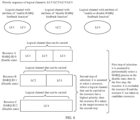
- FIG. 8 is a schematic diagram of another resource selection procedure provided by an embodiment of the present application.
- the data to be transmitted by the first device includes 4 logical channels, which are LC1, LC2, LC3 and LC4 respectively.
- the attributes of LC1 and LC3 are both "enable HARQ feedback function", the attribute of LC2 is “disable HARQ feedback function", and the attribute of LC4 is "enable or disable HARQ feedback function".
- the first device has three available resources, which are a resource A, a resource B and a resource C respectively.
- the resource A corresponds to a HARQ process 0
- the resource B corresponds to a HARQ process 1
- the resource C corresponds to a HARQ process 2.
- the HARQ process 0 is in the enable state
- the HARQ process 1 and the HARQ process 2 are in the disable state.
- the attributes of LC1-LC4 and the mapping strategy between the logical channels and the resources it can be determined that the logical channels that can be carried on the resource A include LC1, LC3 and LC4, the logical channels that can be carried on the resource B include LC2 and LC4, and the logical channels that can be carried on the resource C include LC4.
- the terminal device determines independently or determines according to the first indication information to preferentially select the HARQ process in the enable state, thus the resource A can be excluded in the first step, and the resource B and the resource C are taken as candidate resources.
- the first device can select a resource as the target resource, where a logical channel that can be carried on this resource has the highest priority. Since the highest priority that can be carried on the resource B is LC2, the highest priority that can be carried on the resource C is LC4, and LC2>LC4, thus the resource B is selected as the target resource in the second step of selection, and the data carried on LC2 and LC4 is carried on the target resource.
- Resource selection manner 2 the first step first performs first step of selection, determines the candidate resource(s) from the multiple available resources according to the attribute and the priority of the at least one logical channel. If only one candidate resource is determined in the first step, then this candidate resource is taken as the target resource. If there are multiple candidate resources determined in the first step, then the first device continues to perform the second step of selection, determines the target device from the multiple candidate devices according to the states of the HARQ processes corresponding to the multiple candidate resources respectively. It can be understood that, the procedure of the second-step selection is similar to the embodiments shown in FIG. 3 or FIG. 4 , which will not be repeated here.
- the procedure of the first-step selection may include: the first device determines the logical channels that can be carried on the respective available resources according to the attribute of the at least one logical channel, and determines the candidate resource from the multiple available resources according to the priorities of the logical channels that can be carried on the respective available resources.
- the first device determines the logical channels that can be carried on the respective available resources according to the attribute of the at least one logical channel, and determines the candidate resource from the multiple available resources according to the priorities of the logical channels that can be carried on the respective available resources.
- any one of the following manners can be adopted for determining the candidate resource from the multiple available resources in the first step:
- another expression of the first step may also be that the candidate resource determined from the multiple available resources satisfies any one of the following conditions:
- FIG. 9 is a schematic diagram of another resource selection procedure provided by an embodiment of the present application.
- the data to be transmitted by the first device includes 4 logical channels, which are LC1, LC2, LC3 and LC4 respectively.
- the attributes of LC1 and LC3 are both "enable HARQ feedback function", the attribute of LC2 is “disable HARQ feedback function", and the attribute of LC4 is "enable or disable HARQ feedback function".
- the first device has three available resources, which are a resource A, a resource B and a resource C respectively.
- the resource A corresponds to a HARQ process 0
- the resource B corresponds to a HARQ process 1
- the resource C corresponds to a HARQ process 2.
- the HARQ process 0 is in the enable state
- the HARQ process 1 and the HARQ process 2 are in the disable state.
- the attributes of LC1-LC4 and the mapping strategy between the logical channels and the resources it can be determined that the logical channels that can be carried on the resource A include LC1, LC3 and LC4, the logical channels that can be carried on the resource B include LC2 and LC4, and the logical channels that can be carried on the resource C include LC4.
- the first device can continue to select according to other information of these target resources to determine the final target resource for data transmission.
- Manner 1 perform selection according to a resource type, for example, a DG resource can be preferentially selected. That is, when the target resource selected according to S602 includes both the CG resource and the DG resource, the DG resource is preferentially selected as the final target resource for data transmission.
- Manner 2 perform selection according to data amounts that the respective resources can transmit. For example, a resource which can transmit the largest data amount is selected as the final target resource for data transmission.
- Manner 3 perform selection according to a criterion that repeat is preferential than the new transmission. That is, the resource for repeat is selected as the final target resource.
- Manner 4 perform selection randomly or perform selection UE implementation. That is, when there are multiple target resources selected according to S602, a resource is randomly selected from the multiple resources as the final target resource for data transmission.
- Manner 5 perform selection according to the second-highest priority of the logical channel that can be carried.
- the resource B and the resource C are taken as the candidate resources after the first step of selection, and the highest priorities of the logical channels that can be carried on the resource B and the resource C are the same, then selection can be performed according to the second-highest priorities of the logical channels that can be carried on the resource B and the resource C. If the second-highest priority of the logical channel that can be carried on the resource B is higher than the second-highest priority of the logical channel that can be carried on the resource C, then the resource B is selected.
- the above 5 selection manners can be used in combination.
- the above 5 selection manners may have corresponding priorities, and the first device can adopt the above 5 manners for selection in sequence according to their priorities, until only one target resource is finally determined.
- the first device can further acquire second indication information, where the second indication information is used to indicate the resource selection manner adopted by the first device, and the resource selection manner is any one of the following: performing resource selection according to the attribute and/or the priority of the logical channel first, then performing resource selection according to the states of the HARQ processes corresponding to the available resources; or, performing resource selection according to the states of the HARQ processes corresponding to the available resources first, then performing resource selection according to the attribute and/or the priority of the logical channel. That is, the second indication information is used to indicate adoption of the above resource selection manner 1, or is used to indicate adoption of the above resource selection manner 2.
- the first device can further acquire third indication information, where the third indication information is used to indicate the condition that the selected resource needs to satisfy when resource selection is performed according to the attribute and/or the priority of the logical channel. That is, the third indication information is used to indicate any one of the following conditions: a priority of a logical channel that can be carried is highest; or a priority of a logical channel that can be carried is within a preset range; or a priority of a logical channel that can be carried is within a present range, and a data amount of the logical channel that can be carried is largest.
- both the second indication information and the third indication information above can be predefined, for example, the first device sets the second indication information and the third indication information in advance, or the second indication information and the third indication information are agreed in protocol.
- the first device when the first device is a terminal device, and the second indication information and the third indication information can also be indicated by the network device.
- the first device receives dedicated information from the second device, where the dedicated information includes the second indication information and/or the third indication information.
- the dedicated information may be any one of the following information: RRC configuration information, DCI, MAC CE.
- one or more MAC CE configurations can be used to indicate the attribute of the enable state of the HARQ feedback function.
- the first device acquires the third configuration information.
- the third configuration information is used to indicate configuration information of the MAC CE.
- the third configuration information may include: the attribute of the at least one MAC CE; where the attribute of each MAC CE is any one of the following: enable HARQ feedback function (activate HARQ feedback function), disable HARQ feedback function (deactivate HARQ feedback function), enable or disable HARQ feedback function (activate or deactivate HARQ feedback function).
- the attribute of a MAC CE is "enable HARQ feedback function", then it indicates that the MAC CE needs to be carried in a resource corresponding to a HARQ process in the enable state for transmission.
- the attribute of a MAC CE is "disable HARQ feedback function”, then it indicates that the MAC CE needs to be carried in a resource corresponding to a HARQ process in the disable state for transmission.
- the attribute of a MAC CE is "enable or disable HARQ feedback function”, then it indicates that the MAC CE can be carried in the resource corresponding to the HARQ process in the enable state for transmission, or can be carried in the resource corresponding to the HARQ process in the disable state for transmission.
- the first device can take the attribute of the MAC CE as "enable HARQ feedback function" by default, or take that the attribute of the MAC CE as "disable HARQ feedback function" by default, or take that the attribute of the MAC CE as "enable or disable HARQ feedback function" by default.
- the terminal device can receive dedicated information from the network device, and the dedicated information includes the third configuration information.
- the dedicated information may be any one of the following information: RRC configuration information, MAC CE, DCI.
- the network device can predefine the third configuration information.
- the predefined third configuration information may be preset, or may be agreed by the protocol.
- the first device can consider the attributes of the respective MAC CEs when performing resource selection, so that the state of the HARQ process corresponding to the selected target resource matches with the attribute of the MAC CE in the data. Description will be made with reference to two examples in the following.
- MAC CEs that the respective available resources can carry can be first determined according to the attribute of the at least one MAC CE. For example, if the state of the HARQ process corresponding to a certain available resource is the enable state, then the available resource can carry a MAC CE of which the attribute is "enable HARQ feedback function", and can also carry a MAC CE of which the attribute is "enable or disable HARQ feedback function". For example, if the state of the HARQ process corresponding to a certain available resource is the disable state, then the available resource can carry a MAC CE of which the attribute is "disable HARQ feedback function", and can also carry a MAC CE of which the attribute is "enable or disable HARQ feedback function".
- the target resource is then determined from the multiple available resources according to the states of the HARQ processes corresponding to the multiple available resources respectively. For example, it can be determined independently or according to the first indication information to select the available resource corresponding to the HARQ process in the enable state as the target resource, or to select the available resource corresponding to the HARQ process in the disable state as the target resource. In such way, after the target resource is determined, the MAC CE that can be carried on the target resource is also determined. In addition, it is ensured that the state of the HARQ process corresponding to the target resource matches with the attribute of the MAC CE carried thereon.
- the target resource can be first determined from the multiple available resources according to the states of the HARQ processes corresponding to the multiple available resources respectively. For example, it can be determined independently or according to the first indication information to select the available resource corresponding to the HARQ process in the enable state as the target resource, or to select the available resource corresponding to the HARQ process in the disable state as the target resource.
- the MAC CE that the target resource can carry is then determined according to the attribute of the at least one MAC CE.
- the target resource can carry a MAC CE of which the attribute is "enable HARQ feedback function", and can also carry a MAC CE of which the attribute is "enable or disable HARQ feedback function". If the state of the HARQ process corresponding to the target resource is the disable state, then the target resource can carry a MAC CE of which the attribute is "disable HARQ feedback function", and can also carry a MAC CE of which the attribute is "enable or disable HARQ feedback function".
- the target resources determined in the respective examples above have the following characteristics: the state of the HARQ process corresponding to the target resource at least matches with the attribute of the MAC CE in the data.
- the first device selects the target resource from the multiple available resources according to the attribute and/or the priority of the at least one logical channel and the states of the HARQ processes corresponding to the multiple available resources, so the transmission performance of services with different requirements can be ensured; at the same time, the implementation flexibility of the terminal device is ensured, and the high efficiency of the service transmission is ensured.
- FIG. 10 is a schematic structural diagram of a data transmission apparatus provided by an embodiment of the present application.
- the data transmission apparatus 10 can be provided in the first device, and the first device can be a terminal device or a network device.
- the data transmission apparatus 10 includes a processing module 11 and a sending module 12, where,
- the data transmission apparatus provided by the embodiment of the present application can implement the technical solution described in the above method embodiments, and the implementation principle and beneficial effect thereof are similar, which will not be repeated here.
- the state of each of the HARQ processes is enable state or disable state.
- the processing module 11 is further configured to: acquire first configuration information, where the first configuration information includes any one of the following information:
- the processing module 11 is further configured to: acquire first indication information, where the first indication information is used to indicate preferential selection of an available resource corresponding to a HARQ process in an enable state as the target resource, or, is used to indicate preferential selection of an available resource corresponding to a HARQ process in a disable state as the target resource;
- the processing module 11 is further configured to: acquire second configuration information, where the second configuration information includes an attribute of at least one logical channel; where the attribute of each logical channel is any one of the following: enable HARQ feedback function, disable HARQ feedback function, enable or disable HARQ feedback function; correspondingly, a state of a HARQ process corresponding to the target resource matches with an attribute of a logical channel to which the data belongs.
- the second configuration information further includes a priority of the at least one logical channel; the processing module 11 is specifically configured to: determine, according to the attribute and/or the priority of the at least one logical channel, and the states of the HARQ processes corresponding to the multiple available resources respectively, the target resource from the multiple available resources.
- processing module 11 is specifically configured to:
- processing module 11 is specifically configured to:
- processing module 11 is specifically configured to:
- processing module 11 is specifically configured to:
- processing module 11 is further configured to:
- the first device is a terminal device, and the second device is a network device; or the first device is a network device, and the second device is a terminal device.
- FIG. 11 is a schematic structural diagram of another data transmission apparatus provided by an embodiment of the present application.
- the data transmission apparatus 10 further includes a receiving module 13, where the receiving module 13 is configured to receive first information from the second device, where the first information includes the first indication information, and the first information is any one of the following: downlink control information DCI, MAC CE, and radio resource control RRC configuration information.
- the receiving module 13 is configured to receive dedicated information from the second device, where the dedicated information includes the second configuration information.
- the receiving module 13 is configured to receive dedicated information from the second device, where the dedicated information includes the third configuration information.
- the processing module 11 is further configured to: acquire second indication information, where the second indication information is used to indicate a resource selection manner, and the resource selection manner is any one of the following:
- the processing module 11 is further configured to: acquire third indication information, where the third indication information is used to indicate that a resource which is selected according to the attribute and/or the priority of the logical channel satisfies any one of the following conditions:
- the data transmission apparatus provided by the embodiment of the present application can implement the technical solution described in the above method embodiments, and the implementation principle and beneficial effect thereof are similar, which will not be repeated here.
- FIG. 12 is a schematic structural diagram of another data transmission apparatus provided by an embodiment of the present application.
- the data transmission apparatus 20 can be provided in the second device, and the second device can be a terminal device or a network device.
- the first device shown in FIG. 10-FIG. 11 is a terminal device
- the second device is a network device
- the first device is a network device
- the second device is a terminal device.
- the data transmission apparatus 20 includes a receiving module 21 and a processing module 22, where,
- the data transmission apparatus provided by the embodiment of the present application can implement the technical solution described in the above method embodiments, and the implementation principle and beneficial effect thereof are similar, which will not be repeated here.
- the state of each of the HARQ processes is enable state or disable state.
- the first device is a terminal device, and the second device is a network device; or the first device is a network device, and the second device is a terminal device.
- FIG. 13 is a schematic structural diagram of another data transmission apparatus provided by an embodiment of the present application.
- the data transmission apparatus 20 further includes a sending module 23, where the sending module 23 is configured to send first configuration information to the first device, where the first configuration information includes any one of the following information:
- the sending module 23 is specifically configured to: send second information to the first device, where the second information includes the first configuration information, and the second information is any one of the following: radio resource control RRC configuration information, media access control MAC control element CE, and downlink control information DCI.
- the sending module 23 is configured to send first indication information to the first device, where the first indication information is used to indicate preferential selection of an available resource corresponding to a HARQ process in an enable state as the target resource, or, is used to indicate preferential selection of an available resource corresponding to a HARQ process in a disable state as the target resource.
- the sending module 23 is specifically configured to: send first information to the first device, where the first information includes the first indication information; the first information is any one of the following: DCI, MAC CE, RRC configuration information.
- the sending module 23 is configured to send second configuration information to the first device, where the second configuration information includes an attribute of at least one logical channel, where the attribute of each logical channel is any one of the following: enable HARQ feedback function, disable HARQ feedback function, enable or disable HARQ feedback function; where a state of a HARQ process corresponding to the target resource matches with an attribute of a logical channel to which the data belongs.
- the second configuration information further includes a priority of the at least one logical channel, and the attribute and/or the priority of the at least one logical channel is used by the first device to select the target resource from the multiple available resources.
- the sending module 23 is configured to send third configuration information to the first device, where the third configuration information includes: an attribute of at least one media access control MAC control element CE; where the attribute of each MAC CE is any one of the following: enable HARQ feedback function, disable HARQ feedback function, enable or disable HARQ feedback function; where a state of a HARQ process corresponding to the target resource matches with an attribute of a MAC CE in the data.
- the sending module 23 is specifically configured to: send dedicated information to the first device, where the dedicated information includes the third configuration information.
- the sending module 23 is configured to send second indication information to the first device, where the second indication information is used to indicate a resource selection manner, and the resource selection manner is any one of the following:
- the sending module 23 is configured to send third indication information to the first device, where the third indication information is used to indicate that a resource which is selected according to the attribute and/or the priority of the logical channel satisfies any one of the following conditions:
- the data transmission apparatus provided by the embodiment of the present application can implement the technical solution described in the above method embodiments, and the implementation principle and beneficial effect thereof are similar, which will not be repeated here.
- FIG. 14 is a schematic structural diagram of a terminal device provided by an embodiment of the present application.
- a terminal device 30 may include: a transceiver 31, a memory 32 and a processor 33.
- the transceiver 31 may include: a transmitter and/or a receiver.
- the transmitter can also be referred to as a transmitting component, a transmitting machine, a transmitting interface, a transmitting access, and other similar expressions
- the receiver can also be referred to as a receiving component, a receiving machine, a receiving interface, a receiving access or other similar expressions.
- the respective components of the transceiver 31, the memory 32 and the processor 33 are mutually connected through a bus 34.
- the memory 32 is configured to store a program instruction; the processor 33 is configured to execute the program instruction stored in the memory, to cause the terminal device 30 to implement the data transmission method according to any one of the above.
- the receiver of the transceiver 31 can be configured to execute the receiving function of the terminal device in the above data transmission method.
- the transmitter of the transceiver 31 can be configured to execute the sending function of the terminal device in the above data transmission method.
- FIG. 15 is a schematic structural diagram of a network device provided by an embodiment of the present application.
- a network device 40 may include: a transceiver 41, a memory 42 and a processor 43.
- the transceiver 41 may include: a transmitter and/or a receiver.
- the transmitter can also be referred to as a transmitting component, a transmitting machine, a transmitting interface, a transmitting access, and other similar expressions
- the receiver can also be referred to as a receiving component, a receiving machine, a receiving interface, a receiving access or other similar expressions.
- the respective components of the transceiver 41, the memory 42 and the processor 43 are mutually connected through a bus 44.
- the memory 42 is configured to store a program instruction; the processor 43 is configured to execute the program instruction stored in the memory, to cause the terminal device 30 to implement the data transmission method according to any one of the above.
- the transmitter of the transceiver 41 can be configured to execute the sending function of the network device in the above data transmission method.
- An embodiment of the present application provides a computer-readable storage medium, where the computer-readable storage medium stores a computer-executable instruction, and the computer-executable instruction, when executed by a processor, is used to implement the above data transmission method.
- An embodiment of the present application may further provide a computer program product, where the computer program product can be executed by a processor, and the computer program product, when executed, can implement any one of the above data transmission methods implemented by the terminal device as shown above.
- An embodiment of the present application may further provide a computer program product, where the computer program product can be executed by a processor, and the computer program product, when executed, can implement any one of the above data transmission methods implemented by the network device as shown above.
- the terminal device, computer-readable storage medium and computer program product of the embodiments of the present application can implement the data transmission method implemented by the terminal device, and the specific implementation process and beneficial effects thereof are described above, which will not be repeated here.
- the network device, computer-readable storage medium and computer program product of the embodiments of the present application can implement the data transmission method implemented by the network device, and the specific implementation process and beneficial effects thereof are described above, which will not be repeated here.
- the above mentioned program can be stored in a readable memory.
- the above mentioned memory includes: a read-only memory (abbreviated as ROM), an RAM, a flash memory, a hard disk, a solid-state disk, a magnetic tape, a floppy disk, an optical disk (English: optical disc) and any combination thereof.
- Embodiments of the present application are described with reference to flowcharts and/or block diagrams of methods, devices (systems), and computer program products according to embodiments of the present application. It should be understood that each flow and/or block in flowchart and/or block diagram, and combinations of flows and/or blocks in flowchart and/or block diagram can be implemented by computer program instructions. These computer program instructions may be provided to the processing unit of a general-purpose computer, a special-purpose computer, an embedded processor or other programmable data processing device to produce a machine, so that the instructions executed by the processing unit of the computer or other programmable data processing device generate a means configured to implement the functions specified in one or more flow charts and/or one or more blocks of the block diagram.
- These computer program instructions can also be stored in a computer-readable memory that can direct a computer or other programmable data processing device to work in a specific way, so that the instructions stored in the computer-readable memory produce a manufacture including instruction means that implement the functions specified in one or more flow charts and/or one or more blocks of the block diagrams.
- These computer program instructions can also be loaded on a computer or other programmable data processing device, so that a series of operation steps are executed on the computer or other programmable device to produce a computer-implemented process, so that the instructions executed on the computer or other programmable devices provide steps for implementing the functions specified in one or more flows of the flowchart and/or one or more blocks of the block diagram.
Landscapes
- Engineering & Computer Science (AREA)
- Signal Processing (AREA)
- Computer Networks & Wireless Communication (AREA)
- Mobile Radio Communication Systems (AREA)
Applications Claiming Priority (1)
| Application Number | Priority Date | Filing Date | Title |
|---|---|---|---|
| PCT/CN2020/074532 WO2021155590A1 (zh) | 2020-02-07 | 2020-02-07 | 数据传输方法、装置及设备 |
Publications (3)
| Publication Number | Publication Date |
|---|---|
| EP4064596A1 EP4064596A1 (en) | 2022-09-28 |
| EP4064596A4 EP4064596A4 (en) | 2022-11-16 |
| EP4064596B1 true EP4064596B1 (en) | 2025-06-11 |
Family
ID=77199695
Family Applications (1)
| Application Number | Title | Priority Date | Filing Date |
|---|---|---|---|
| EP20917663.5A Active EP4064596B1 (en) | 2020-02-07 | 2020-02-07 | Data transmission method and apparatus, and computer-readable storage medium |
Country Status (4)
| Country | Link |
|---|---|
| US (1) | US12308973B2 (zh) |
| EP (1) | EP4064596B1 (zh) |
| CN (2) | CN115767754B (zh) |
| WO (1) | WO2021155590A1 (zh) |
Families Citing this family (7)
| Publication number | Priority date | Publication date | Assignee | Title |
|---|---|---|---|---|
| CN113271180B (zh) * | 2020-02-14 | 2023-05-23 | 华为技术有限公司 | 混合自动重传请求harq位图信息的反馈方法及相关设备 |
| US20230188268A1 (en) * | 2020-05-22 | 2023-06-15 | Lenovo (Beijing) Ltd. | Hybrid automatic repeat request process number determination |
| EP4224969A4 (en) * | 2020-10-21 | 2023-11-08 | Huawei Technologies Co., Ltd. | COMMUNICATION METHOD AND APPARATUS |
| KR102694868B1 (ko) * | 2022-03-02 | 2024-08-13 | 한국과학기술정보연구원 | 광 네트워크 운용장치 및 그 동작 방법 |
| WO2023212937A1 (en) * | 2022-05-06 | 2023-11-09 | Zte Corporation | Systems and methods for enabling or disabling harq feedback |
| CN115333677A (zh) * | 2022-08-25 | 2022-11-11 | 中国电信股份有限公司 | 云业务处理方法、系统、装置、设备及存储介质 |
| EP4633261A1 (en) * | 2022-12-08 | 2025-10-15 | Guangdong Oppo Mobile Telecommunications Corp., Ltd. | Method and apparatus for processing wireless transmission, device, storage medium, and product |
Family Cites Families (13)
| Publication number | Priority date | Publication date | Assignee | Title |
|---|---|---|---|---|
| CN101098295B (zh) | 2006-06-27 | 2010-10-20 | 大唐移动通信设备有限公司 | 高速下行分组接入媒介接入控制的多队列传输方法及装置 |
| CN101222303B (zh) | 2007-01-09 | 2011-08-10 | 中兴通讯股份有限公司 | 一种媒体接入控制层上行反馈的实现方法 |
| CN101998501A (zh) | 2009-08-18 | 2011-03-30 | 中兴通讯股份有限公司 | Harq失败指示方法、harq失败指示数据帧及服务节点b |
| WO2016114587A1 (en) * | 2015-01-15 | 2016-07-21 | Lg Electronics Inc. | Method for transmitting multiplexed harq feedbacks in a carrier aggregation system and a device therefor |
| EP3319390A1 (en) | 2016-11-04 | 2018-05-09 | Panasonic Intellectual Property Corporation of America | Collision handling of multiple dci |
| US10667239B2 (en) | 2017-03-10 | 2020-05-26 | Futurewei Technologies, Inc. | Method for resource selection |
| CN108633021B (zh) | 2017-03-23 | 2024-01-19 | 华为技术有限公司 | 一种上行控制信道的资源映射方法及装置 |
| CN108631964B (zh) * | 2017-03-24 | 2023-11-21 | 华为技术有限公司 | 一种数据传输方法和相关设备 |
| CN108737036B (zh) * | 2017-04-18 | 2020-11-06 | 华为技术有限公司 | 反馈信息接收方法、发送方法、装置及系统 |
| US11272573B2 (en) * | 2017-09-27 | 2022-03-08 | Sony Corporation | Communication systems for allocating resources for feedback between devices |
| EP3963783A2 (en) * | 2019-04-30 | 2022-03-09 | IDAC Holdings, Inc. | Open loop harq in wireless systems |
| US12323257B2 (en) * | 2019-08-02 | 2025-06-03 | Telefonaktiebolaget Lm Ericsson (Publ) | Transmission parameter configuration |
| KR20220005649A (ko) * | 2019-08-05 | 2022-01-13 | 엘지전자 주식회사 | Nr v2x에서 자원 선택을 위한 방법 및 장치 |
-
2020
- 2020-02-07 CN CN202211097960.5A patent/CN115767754B/zh active Active
- 2020-02-07 CN CN202080084513.9A patent/CN114762281A/zh active Pending
- 2020-02-07 EP EP20917663.5A patent/EP4064596B1/en active Active
- 2020-02-07 WO PCT/CN2020/074532 patent/WO2021155590A1/zh not_active Ceased
-
2022
- 2022-06-29 US US17/853,651 patent/US12308973B2/en active Active
Non-Patent Citations (1)
| Title |
|---|
| NOKIA ET AL: "Discussion on LCP procedure for NTN", vol. RAN WG2, no. Prague, Czech Republic; 20190826 - 20190830, 16 August 2019 (2019-08-16), XP051769043, Retrieved from the Internet <URL:http://www.3gpp.org/ftp/tsg_ran/WG2_RL2/TSGR2_107/Docs/R2-1911286.zip> [retrieved on 20190816] * |
Also Published As
| Publication number | Publication date |
|---|---|
| CN115767754B (zh) | 2025-01-03 |
| CN115767754A (zh) | 2023-03-07 |
| WO2021155590A1 (zh) | 2021-08-12 |
| EP4064596A1 (en) | 2022-09-28 |
| EP4064596A4 (en) | 2022-11-16 |
| CN114762281A (zh) | 2022-07-15 |
| US12308973B2 (en) | 2025-05-20 |
| US20220337350A1 (en) | 2022-10-20 |
Similar Documents
| Publication | Publication Date | Title |
|---|---|---|
| EP4064596B1 (en) | Data transmission method and apparatus, and computer-readable storage medium | |
| JP6961798B2 (ja) | 無線通信システムにおけるコンテンションウィンドウ大きさ調整方法及び前記方法を利用する装置 | |
| JP7546149B2 (ja) | 無線通信システムにおいて端末が上りリンク信号を送信する方法及びそのための装置 | |
| EP3874647B1 (en) | Lch mapping to harq process id for non-terrestrial networks | |
| US20220078881A1 (en) | Method and user equipment for hybrid automatic repeat request process operation in non-terrestrial network | |
| EP3654715A1 (en) | Communication method and device | |
| EP4280504A1 (en) | Method by which terminal transmits feedback signal in wireless communication system, and apparatus therefor | |
| EP4322605A1 (en) | Communication parameter indication method and apparatus | |
| CN113678531B (zh) | 上行逻辑信道复用的方法和终端设备 | |
| US12425174B2 (en) | Channel processing method, apparatus, device and storage medium | |
| CN114902783A (zh) | 两步随机接入msg a资源的配置方法及相关装置 | |
| WO2021184266A1 (zh) | 一种数据包重组方法、电子设备及存储介质 | |
| US20230328798A1 (en) | Random access methods, terminal device and network device | |
| US20240155692A1 (en) | Communication method, terminal device and network device | |
| US20230422240A1 (en) | Wireless communication method, terminal device, and network device | |
| EP4236538A1 (en) | Method for performing switching of bwp by terminal in wireless communication system and device therefor | |
| US20230065090A1 (en) | Method for being allocated, by ue, resource related to full-duplex radio in wireless communication system and device therefor | |
| CN118077296B (zh) | 用于无线通信的方法及装置 | |
| KR102927712B1 (ko) | Nr v2x에서 prach 전송을 수행하는 방법 및 장치 | |
| WO2023097421A1 (zh) | 信息上报方法、装置、设备、存储介质及程序产品 | |
| WO2026030994A1 (en) | Uplink scheduling schemes under beam hopping for non-terrestrial networks | |
| WO2024255571A1 (zh) | 通信方法及相关装置 | |
| CN120958939A (zh) | 一种用于无线通信的节点中的方法以及装置 | |
| CN121442469A (zh) | 无线通信方法及相关装置 |
Legal Events
| Date | Code | Title | Description |
|---|---|---|---|
| STAA | Information on the status of an ep patent application or granted ep patent |
Free format text: STATUS: THE INTERNATIONAL PUBLICATION HAS BEEN MADE |
|
| PUAI | Public reference made under article 153(3) epc to a published international application that has entered the european phase |
Free format text: ORIGINAL CODE: 0009012 |
|
| STAA | Information on the status of an ep patent application or granted ep patent |
Free format text: STATUS: REQUEST FOR EXAMINATION WAS MADE |
|
| 17P | Request for examination filed |
Effective date: 20220624 |
|
| AK | Designated contracting states |
Kind code of ref document: A1 Designated state(s): AL AT BE BG CH CY CZ DE DK EE ES FI FR GB GR HR HU IE IS IT LI LT LU LV MC MK MT NL NO PL PT RO RS SE SI SK SM TR |
|
| A4 | Supplementary search report drawn up and despatched |
Effective date: 20221014 |
|
| RIC1 | Information provided on ipc code assigned before grant |
Ipc: H04W 72/02 20090101ALI20221010BHEP Ipc: H04L 1/18 20060101AFI20221010BHEP |
|
| DAV | Request for validation of the european patent (deleted) | ||
| DAX | Request for extension of the european patent (deleted) | ||
| STAA | Information on the status of an ep patent application or granted ep patent |
Free format text: STATUS: EXAMINATION IS IN PROGRESS |
|
| 17Q | First examination report despatched |
Effective date: 20230705 |
|
| REG | Reference to a national code |
Ref country code: DE Ref legal event code: R079 Ipc: H04L0001182200 Ref country code: DE Ref legal event code: R079 Ref document number: 602020052770 Country of ref document: DE Free format text: PREVIOUS MAIN CLASS: H04L0001180000 Ipc: H04L0001182200 |
|
| GRAP | Despatch of communication of intention to grant a patent |
Free format text: ORIGINAL CODE: EPIDOSNIGR1 |
|
| STAA | Information on the status of an ep patent application or granted ep patent |
Free format text: STATUS: GRANT OF PATENT IS INTENDED |
|
| RIC1 | Information provided on ipc code assigned before grant |
Ipc: H04L 1/1867 20230101ALI20250121BHEP Ipc: H04L 1/1822 20230101AFI20250121BHEP |
|
| INTG | Intention to grant announced |
Effective date: 20250129 |
|
| GRAS | Grant fee paid |
Free format text: ORIGINAL CODE: EPIDOSNIGR3 |
|
| GRAA | (expected) grant |
Free format text: ORIGINAL CODE: 0009210 |
|
| STAA | Information on the status of an ep patent application or granted ep patent |
Free format text: STATUS: THE PATENT HAS BEEN GRANTED |
|
| AK | Designated contracting states |
Kind code of ref document: B1 Designated state(s): AL AT BE BG CH CY CZ DE DK EE ES FI FR GB GR HR HU IE IS IT LI LT LU LV MC MK MT NL NO PL PT RO RS SE SI SK SM TR |
|
| REG | Reference to a national code |
Ref country code: GB Ref legal event code: FG4D |
|
| REG | Reference to a national code |
Ref country code: CH Ref legal event code: EP |
|
| REG | Reference to a national code |
Ref country code: DE Ref legal event code: R096 Ref document number: 602020052770 Country of ref document: DE |
|
| REG | Reference to a national code |
Ref country code: IE Ref legal event code: FG4D |
|
| P01 | Opt-out of the competence of the unified patent court (upc) registered |
Free format text: CASE NUMBER: UPC_APP_5307_4064596/2025 Effective date: 20250829 |
|
| PG25 | Lapsed in a contracting state [announced via postgrant information from national office to epo] |
Ref country code: ES Free format text: LAPSE BECAUSE OF FAILURE TO SUBMIT A TRANSLATION OF THE DESCRIPTION OR TO PAY THE FEE WITHIN THE PRESCRIBED TIME-LIMIT Effective date: 20250611 Ref country code: FI Free format text: LAPSE BECAUSE OF FAILURE TO SUBMIT A TRANSLATION OF THE DESCRIPTION OR TO PAY THE FEE WITHIN THE PRESCRIBED TIME-LIMIT Effective date: 20250611 |
|
| REG | Reference to a national code |
Ref country code: LT Ref legal event code: MG9D |
|
| PG25 | Lapsed in a contracting state [announced via postgrant information from national office to epo] |
Ref country code: GR Free format text: LAPSE BECAUSE OF FAILURE TO SUBMIT A TRANSLATION OF THE DESCRIPTION OR TO PAY THE FEE WITHIN THE PRESCRIBED TIME-LIMIT Effective date: 20250912 Ref country code: NO Free format text: LAPSE BECAUSE OF FAILURE TO SUBMIT A TRANSLATION OF THE DESCRIPTION OR TO PAY THE FEE WITHIN THE PRESCRIBED TIME-LIMIT Effective date: 20250911 |
|
| REG | Reference to a national code |
Ref country code: NL Ref legal event code: MP Effective date: 20250611 |
|
| PG25 | Lapsed in a contracting state [announced via postgrant information from national office to epo] |
Ref country code: BG Free format text: LAPSE BECAUSE OF FAILURE TO SUBMIT A TRANSLATION OF THE DESCRIPTION OR TO PAY THE FEE WITHIN THE PRESCRIBED TIME-LIMIT Effective date: 20250611 |
|
| PG25 | Lapsed in a contracting state [announced via postgrant information from national office to epo] |
Ref country code: HR Free format text: LAPSE BECAUSE OF FAILURE TO SUBMIT A TRANSLATION OF THE DESCRIPTION OR TO PAY THE FEE WITHIN THE PRESCRIBED TIME-LIMIT Effective date: 20250611 |
|
| PG25 | Lapsed in a contracting state [announced via postgrant information from national office to epo] |
Ref country code: RS Free format text: LAPSE BECAUSE OF FAILURE TO SUBMIT A TRANSLATION OF THE DESCRIPTION OR TO PAY THE FEE WITHIN THE PRESCRIBED TIME-LIMIT Effective date: 20250911 |
|
| PG25 | Lapsed in a contracting state [announced via postgrant information from national office to epo] |
Ref country code: LV Free format text: LAPSE BECAUSE OF FAILURE TO SUBMIT A TRANSLATION OF THE DESCRIPTION OR TO PAY THE FEE WITHIN THE PRESCRIBED TIME-LIMIT Effective date: 20250611 |
|
| PG25 | Lapsed in a contracting state [announced via postgrant information from national office to epo] |
Ref country code: NL Free format text: LAPSE BECAUSE OF FAILURE TO SUBMIT A TRANSLATION OF THE DESCRIPTION OR TO PAY THE FEE WITHIN THE PRESCRIBED TIME-LIMIT Effective date: 20250611 |
|
| PG25 | Lapsed in a contracting state [announced via postgrant information from national office to epo] |
Ref country code: PT Free format text: LAPSE BECAUSE OF FAILURE TO SUBMIT A TRANSLATION OF THE DESCRIPTION OR TO PAY THE FEE WITHIN THE PRESCRIBED TIME-LIMIT Effective date: 20251013 |
|
| REG | Reference to a national code |
Ref country code: AT Ref legal event code: MK05 Ref document number: 1803104 Country of ref document: AT Kind code of ref document: T Effective date: 20250611 |
|
| PG25 | Lapsed in a contracting state [announced via postgrant information from national office to epo] |
Ref country code: IS Free format text: LAPSE BECAUSE OF FAILURE TO SUBMIT A TRANSLATION OF THE DESCRIPTION OR TO PAY THE FEE WITHIN THE PRESCRIBED TIME-LIMIT Effective date: 20251011 |
|
| PG25 | Lapsed in a contracting state [announced via postgrant information from national office to epo] |
Ref country code: AT Free format text: LAPSE BECAUSE OF FAILURE TO SUBMIT A TRANSLATION OF THE DESCRIPTION OR TO PAY THE FEE WITHIN THE PRESCRIBED TIME-LIMIT Effective date: 20250611 Ref country code: SM Free format text: LAPSE BECAUSE OF FAILURE TO SUBMIT A TRANSLATION OF THE DESCRIPTION OR TO PAY THE FEE WITHIN THE PRESCRIBED TIME-LIMIT Effective date: 20250611 |
|
| PG25 | Lapsed in a contracting state [announced via postgrant information from national office to epo] |
Ref country code: CZ Free format text: LAPSE BECAUSE OF FAILURE TO SUBMIT A TRANSLATION OF THE DESCRIPTION OR TO PAY THE FEE WITHIN THE PRESCRIBED TIME-LIMIT Effective date: 20250611 |
|
| PG25 | Lapsed in a contracting state [announced via postgrant information from national office to epo] |
Ref country code: PL Free format text: LAPSE BECAUSE OF FAILURE TO SUBMIT A TRANSLATION OF THE DESCRIPTION OR TO PAY THE FEE WITHIN THE PRESCRIBED TIME-LIMIT Effective date: 20250611 |
|
| PG25 | Lapsed in a contracting state [announced via postgrant information from national office to epo] |
Ref country code: EE Free format text: LAPSE BECAUSE OF FAILURE TO SUBMIT A TRANSLATION OF THE DESCRIPTION OR TO PAY THE FEE WITHIN THE PRESCRIBED TIME-LIMIT Effective date: 20250611 |
|
| PG25 | Lapsed in a contracting state [announced via postgrant information from national office to epo] |
Ref country code: SK Free format text: LAPSE BECAUSE OF FAILURE TO SUBMIT A TRANSLATION OF THE DESCRIPTION OR TO PAY THE FEE WITHIN THE PRESCRIBED TIME-LIMIT Effective date: 20250611 |
|
| REG | Reference to a national code |
Ref country code: DE Ref legal event code: R097 Ref document number: 602020052770 Country of ref document: DE |
|
| PG25 | Lapsed in a contracting state [announced via postgrant information from national office to epo] |
Ref country code: DK Free format text: LAPSE BECAUSE OF FAILURE TO SUBMIT A TRANSLATION OF THE DESCRIPTION OR TO PAY THE FEE WITHIN THE PRESCRIBED TIME-LIMIT Effective date: 20250611 |
|
| PGFP | Annual fee paid to national office [announced via postgrant information from national office to epo] |
Ref country code: DE Payment date: 20260223 Year of fee payment: 7 |
|
| PG25 | Lapsed in a contracting state [announced via postgrant information from national office to epo] |
Ref country code: IT Free format text: LAPSE BECAUSE OF FAILURE TO SUBMIT A TRANSLATION OF THE DESCRIPTION OR TO PAY THE FEE WITHIN THE PRESCRIBED TIME-LIMIT Effective date: 20250611 |
|
| PLBE | No opposition filed within time limit |
Free format text: ORIGINAL CODE: 0009261 |
|
| STAA | Information on the status of an ep patent application or granted ep patent |
Free format text: STATUS: NO OPPOSITION FILED WITHIN TIME LIMIT |
|
| REG | Reference to a national code |
Ref country code: CH Ref legal event code: L10 Free format text: ST27 STATUS EVENT CODE: U-0-0-L10-L00 (AS PROVIDED BY THE NATIONAL OFFICE) Effective date: 20260423 |