EP4064729A1 - Detektion und quantifizierung einer flüssigkeits- und/oder nahrungsaufnahme eines hörgeräteträgers - Google Patents
Detektion und quantifizierung einer flüssigkeits- und/oder nahrungsaufnahme eines hörgeräteträgers Download PDFInfo
- Publication number
- EP4064729A1 EP4064729A1 EP21163914.1A EP21163914A EP4064729A1 EP 4064729 A1 EP4064729 A1 EP 4064729A1 EP 21163914 A EP21163914 A EP 21163914A EP 4064729 A1 EP4064729 A1 EP 4064729A1
- Authority
- EP
- European Patent Office
- Prior art keywords
- user
- hearing device
- liquid
- hearing
- drinking
- Prior art date
- Legal status (The legal status is an assumption and is not a legal conclusion. Google has not performed a legal analysis and makes no representation as to the accuracy of the status listed.)
- Withdrawn
Links
Images
Classifications
-
- H—ELECTRICITY
- H04—ELECTRIC COMMUNICATION TECHNIQUE
- H04R—LOUDSPEAKERS, MICROPHONES, GRAMOPHONE PICK-UPS OR LIKE ACOUSTIC ELECTROMECHANICAL TRANSDUCERS; ELECTRIC HEARING AIDS; PUBLIC ADDRESS SYSTEMS
- H04R25/00—Electric hearing aids
-
- A—HUMAN NECESSITIES
- A61—MEDICAL OR VETERINARY SCIENCE; HYGIENE
- A61B—DIAGNOSIS; SURGERY; IDENTIFICATION
- A61B5/00—Measuring for diagnostic purposes; Identification of persons
- A61B5/48—Other medical applications
- A61B5/4869—Determining body composition
- A61B5/4875—Hydration status, fluid retention of the body
-
- A—HUMAN NECESSITIES
- A61—MEDICAL OR VETERINARY SCIENCE; HYGIENE
- A61B—DIAGNOSIS; SURGERY; IDENTIFICATION
- A61B5/00—Measuring for diagnostic purposes; Identification of persons
- A61B5/68—Arrangements of detecting, measuring or recording means, e.g. sensors, in relation to patient
- A61B5/6801—Arrangements of detecting, measuring or recording means, e.g. sensors, in relation to patient specially adapted to be attached to or worn on the body surface
- A61B5/6802—Sensor mounted on worn items
- A61B5/6803—Head-worn items, e.g. helmets, masks, headphones or goggles
-
- A—HUMAN NECESSITIES
- A61—MEDICAL OR VETERINARY SCIENCE; HYGIENE
- A61B—DIAGNOSIS; SURGERY; IDENTIFICATION
- A61B5/00—Measuring for diagnostic purposes; Identification of persons
- A61B5/72—Signal processing specially adapted for physiological signals or for diagnostic purposes
- A61B5/7235—Details of waveform analysis
- A61B5/7264—Classification of physiological signals or data, e.g. using neural networks, statistical classifiers, expert systems or fuzzy systems
- A61B5/7267—Classification of physiological signals or data, e.g. using neural networks, statistical classifiers, expert systems or fuzzy systems involving training the classification device
-
- G—PHYSICS
- G06—COMPUTING OR CALCULATING; COUNTING
- G06N—COMPUTING ARRANGEMENTS BASED ON SPECIFIC COMPUTATIONAL MODELS
- G06N3/00—Computing arrangements based on biological models
- G06N3/02—Neural networks
- G06N3/04—Architecture, e.g. interconnection topology
-
- G—PHYSICS
- G06—COMPUTING OR CALCULATING; COUNTING
- G06N—COMPUTING ARRANGEMENTS BASED ON SPECIFIC COMPUTATIONAL MODELS
- G06N3/00—Computing arrangements based on biological models
- G06N3/02—Neural networks
- G06N3/04—Architecture, e.g. interconnection topology
- G06N3/044—Recurrent networks, e.g. Hopfield networks
- G06N3/0442—Recurrent networks, e.g. Hopfield networks characterised by memory or gating, e.g. long short-term memory [LSTM] or gated recurrent units [GRU]
-
- G—PHYSICS
- G06—COMPUTING OR CALCULATING; COUNTING
- G06N—COMPUTING ARRANGEMENTS BASED ON SPECIFIC COMPUTATIONAL MODELS
- G06N3/00—Computing arrangements based on biological models
- G06N3/02—Neural networks
- G06N3/08—Learning methods
-
- G—PHYSICS
- G06—COMPUTING OR CALCULATING; COUNTING
- G06N—COMPUTING ARRANGEMENTS BASED ON SPECIFIC COMPUTATIONAL MODELS
- G06N3/00—Computing arrangements based on biological models
- G06N3/02—Neural networks
- G06N3/08—Learning methods
- G06N3/09—Supervised learning
-
- G—PHYSICS
- G06—COMPUTING OR CALCULATING; COUNTING
- G06N—COMPUTING ARRANGEMENTS BASED ON SPECIFIC COMPUTATIONAL MODELS
- G06N3/00—Computing arrangements based on biological models
- G06N3/02—Neural networks
- G06N3/08—Learning methods
- G06N3/092—Reinforcement learning
-
- G—PHYSICS
- G16—INFORMATION AND COMMUNICATION TECHNOLOGY [ICT] SPECIALLY ADAPTED FOR SPECIFIC APPLICATION FIELDS
- G16H—HEALTHCARE INFORMATICS, i.e. INFORMATION AND COMMUNICATION TECHNOLOGY [ICT] SPECIALLY ADAPTED FOR THE HANDLING OR PROCESSING OF MEDICAL OR HEALTHCARE DATA
- G16H20/00—ICT specially adapted for therapies or health-improving plans, e.g. for handling prescriptions, for steering therapy or for monitoring patient compliance
- G16H20/10—ICT specially adapted for therapies or health-improving plans, e.g. for handling prescriptions, for steering therapy or for monitoring patient compliance relating to drugs or medications, e.g. for ensuring correct administration to patients
-
- G—PHYSICS
- G16—INFORMATION AND COMMUNICATION TECHNOLOGY [ICT] SPECIALLY ADAPTED FOR SPECIFIC APPLICATION FIELDS
- G16H—HEALTHCARE INFORMATICS, i.e. INFORMATION AND COMMUNICATION TECHNOLOGY [ICT] SPECIALLY ADAPTED FOR THE HANDLING OR PROCESSING OF MEDICAL OR HEALTHCARE DATA
- G16H40/00—ICT specially adapted for the management or administration of healthcare resources or facilities; ICT specially adapted for the management or operation of medical equipment or devices
- G16H40/60—ICT specially adapted for the management or administration of healthcare resources or facilities; ICT specially adapted for the management or operation of medical equipment or devices for the operation of medical equipment or devices
- G16H40/63—ICT specially adapted for the management or administration of healthcare resources or facilities; ICT specially adapted for the management or operation of medical equipment or devices for the operation of medical equipment or devices for local operation
-
- G—PHYSICS
- G16—INFORMATION AND COMMUNICATION TECHNOLOGY [ICT] SPECIALLY ADAPTED FOR SPECIFIC APPLICATION FIELDS
- G16H—HEALTHCARE INFORMATICS, i.e. INFORMATION AND COMMUNICATION TECHNOLOGY [ICT] SPECIALLY ADAPTED FOR THE HANDLING OR PROCESSING OF MEDICAL OR HEALTHCARE DATA
- G16H40/00—ICT specially adapted for the management or administration of healthcare resources or facilities; ICT specially adapted for the management or operation of medical equipment or devices
- G16H40/60—ICT specially adapted for the management or administration of healthcare resources or facilities; ICT specially adapted for the management or operation of medical equipment or devices for the operation of medical equipment or devices
- G16H40/67—ICT specially adapted for the management or administration of healthcare resources or facilities; ICT specially adapted for the management or operation of medical equipment or devices for the operation of medical equipment or devices for remote operation
-
- G—PHYSICS
- G16—INFORMATION AND COMMUNICATION TECHNOLOGY [ICT] SPECIALLY ADAPTED FOR SPECIFIC APPLICATION FIELDS
- G16H—HEALTHCARE INFORMATICS, i.e. INFORMATION AND COMMUNICATION TECHNOLOGY [ICT] SPECIALLY ADAPTED FOR THE HANDLING OR PROCESSING OF MEDICAL OR HEALTHCARE DATA
- G16H50/00—ICT specially adapted for medical diagnosis, medical simulation or medical data mining; ICT specially adapted for detecting, monitoring or modelling epidemics or pandemics
- G16H50/30—ICT specially adapted for medical diagnosis, medical simulation or medical data mining; ICT specially adapted for detecting, monitoring or modelling epidemics or pandemics for calculating health indices; for individual health risk assessment
-
- H—ELECTRICITY
- H04—ELECTRIC COMMUNICATION TECHNIQUE
- H04R—LOUDSPEAKERS, MICROPHONES, GRAMOPHONE PICK-UPS OR LIKE ACOUSTIC ELECTROMECHANICAL TRANSDUCERS; ELECTRIC HEARING AIDS; PUBLIC ADDRESS SYSTEMS
- H04R1/00—Details of transducers, loudspeakers or microphones
- H04R1/08—Mouthpieces; Microphones; Attachments therefor
-
- H—ELECTRICITY
- H04—ELECTRIC COMMUNICATION TECHNIQUE
- H04R—LOUDSPEAKERS, MICROPHONES, GRAMOPHONE PICK-UPS OR LIKE ACOUSTIC ELECTROMECHANICAL TRANSDUCERS; ELECTRIC HEARING AIDS; PUBLIC ADDRESS SYSTEMS
- H04R1/00—Details of transducers, loudspeakers or microphones
- H04R1/10—Earpieces; Attachments therefor ; Earphones; Monophonic headphones
- H04R1/1016—Earpieces of the intra-aural type
-
- A—HUMAN NECESSITIES
- A61—MEDICAL OR VETERINARY SCIENCE; HYGIENE
- A61B—DIAGNOSIS; SURGERY; IDENTIFICATION
- A61B2560/00—Constructional details of operational features of apparatus; Accessories for medical measuring apparatus
- A61B2560/02—Operational features
- A61B2560/0242—Operational features adapted to measure environmental factors, e.g. temperature, pollution
-
- A—HUMAN NECESSITIES
- A61—MEDICAL OR VETERINARY SCIENCE; HYGIENE
- A61B—DIAGNOSIS; SURGERY; IDENTIFICATION
- A61B2562/00—Details of sensors; Constructional details of sensor housings or probes; Accessories for sensors
- A61B2562/02—Details of sensors specially adapted for in-vivo measurements
- A61B2562/0204—Acoustic sensors
-
- A—HUMAN NECESSITIES
- A61—MEDICAL OR VETERINARY SCIENCE; HYGIENE
- A61B—DIAGNOSIS; SURGERY; IDENTIFICATION
- A61B2562/00—Details of sensors; Constructional details of sensor housings or probes; Accessories for sensors
- A61B2562/02—Details of sensors specially adapted for in-vivo measurements
- A61B2562/0219—Inertial sensors, e.g. accelerometers, gyroscopes, tilt switches
-
- A—HUMAN NECESSITIES
- A61—MEDICAL OR VETERINARY SCIENCE; HYGIENE
- A61B—DIAGNOSIS; SURGERY; IDENTIFICATION
- A61B5/00—Measuring for diagnostic purposes; Identification of persons
- A61B5/0002—Remote monitoring of patients using telemetry, e.g. transmission of vital signals via a communication network
- A61B5/0015—Remote monitoring of patients using telemetry, e.g. transmission of vital signals via a communication network characterised by features of the telemetry system
- A61B5/002—Monitoring the patient using a local or closed circuit, e.g. in a room or building
-
- A—HUMAN NECESSITIES
- A61—MEDICAL OR VETERINARY SCIENCE; HYGIENE
- A61B—DIAGNOSIS; SURGERY; IDENTIFICATION
- A61B5/00—Measuring for diagnostic purposes; Identification of persons
- A61B5/02—Detecting, measuring or recording for evaluating the cardiovascular system, e.g. pulse, heart rate, blood pressure or blood flow
- A61B5/024—Measuring pulse rate or heart rate
-
- A—HUMAN NECESSITIES
- A61—MEDICAL OR VETERINARY SCIENCE; HYGIENE
- A61B—DIAGNOSIS; SURGERY; IDENTIFICATION
- A61B5/00—Measuring for diagnostic purposes; Identification of persons
- A61B5/103—Measuring devices for testing the shape, pattern, colour, size or movement of the body or parts thereof, for diagnostic purposes
- A61B5/11—Measuring movement of the entire body or parts thereof, e.g. head or hand tremor or mobility of a limb
- A61B5/1118—Determining activity level
-
- A—HUMAN NECESSITIES
- A61—MEDICAL OR VETERINARY SCIENCE; HYGIENE
- A61B—DIAGNOSIS; SURGERY; IDENTIFICATION
- A61B5/00—Measuring for diagnostic purposes; Identification of persons
- A61B5/24—Detecting, measuring or recording bioelectric or biomagnetic signals of the body or parts thereof
- A61B5/316—Modalities, i.e. specific diagnostic methods
- A61B5/369—Electroencephalography [EEG]
-
- A—HUMAN NECESSITIES
- A61—MEDICAL OR VETERINARY SCIENCE; HYGIENE
- A61B—DIAGNOSIS; SURGERY; IDENTIFICATION
- A61B5/00—Measuring for diagnostic purposes; Identification of persons
- A61B5/48—Other medical applications
- A61B5/4833—Assessment of subject's compliance to treatment
-
- A—HUMAN NECESSITIES
- A61—MEDICAL OR VETERINARY SCIENCE; HYGIENE
- A61B—DIAGNOSIS; SURGERY; IDENTIFICATION
- A61B5/00—Measuring for diagnostic purposes; Identification of persons
- A61B5/68—Arrangements of detecting, measuring or recording means, e.g. sensors, in relation to patient
- A61B5/6801—Arrangements of detecting, measuring or recording means, e.g. sensors, in relation to patient specially adapted to be attached to or worn on the body surface
- A61B5/6802—Sensor mounted on worn items
- A61B5/681—Wristwatch-type devices
-
- A—HUMAN NECESSITIES
- A61—MEDICAL OR VETERINARY SCIENCE; HYGIENE
- A61B—DIAGNOSIS; SURGERY; IDENTIFICATION
- A61B5/00—Measuring for diagnostic purposes; Identification of persons
- A61B5/74—Details of notification to user or communication with user or patient; User input means
- A61B5/7405—Details of notification to user or communication with user or patient; User input means using sound
- A61B5/7415—Sound rendering of measured values, e.g. by pitch or volume variation
-
- G—PHYSICS
- G16—INFORMATION AND COMMUNICATION TECHNOLOGY [ICT] SPECIALLY ADAPTED FOR SPECIFIC APPLICATION FIELDS
- G16H—HEALTHCARE INFORMATICS, i.e. INFORMATION AND COMMUNICATION TECHNOLOGY [ICT] SPECIALLY ADAPTED FOR THE HANDLING OR PROCESSING OF MEDICAL OR HEALTHCARE DATA
- G16H20/00—ICT specially adapted for therapies or health-improving plans, e.g. for handling prescriptions, for steering therapy or for monitoring patient compliance
- G16H20/60—ICT specially adapted for therapies or health-improving plans, e.g. for handling prescriptions, for steering therapy or for monitoring patient compliance relating to nutrition control, e.g. diets
-
- G—PHYSICS
- G16—INFORMATION AND COMMUNICATION TECHNOLOGY [ICT] SPECIALLY ADAPTED FOR SPECIFIC APPLICATION FIELDS
- G16H—HEALTHCARE INFORMATICS, i.e. INFORMATION AND COMMUNICATION TECHNOLOGY [ICT] SPECIALLY ADAPTED FOR THE HANDLING OR PROCESSING OF MEDICAL OR HEALTHCARE DATA
- G16H50/00—ICT specially adapted for medical diagnosis, medical simulation or medical data mining; ICT specially adapted for detecting, monitoring or modelling epidemics or pandemics
- G16H50/20—ICT specially adapted for medical diagnosis, medical simulation or medical data mining; ICT specially adapted for detecting, monitoring or modelling epidemics or pandemics for computer-aided diagnosis, e.g. based on medical expert systems
Definitions
- the invention relates to a method, a computer program and a computer-readable medium for detecting and quantifying a liquid and/or food intake of a user wearing a hearing device which comprises at least one microphone. Furthermore, the invention relates to a hearing system which comprises at least one hearing device of this kind and optionally a connected user device, such as a smartphone.
- Hearing devices are generally small and complex devices. Hearing devices can include a processor, microphone, an integrated loudspeaker as a sound output device, memory, housing, and other electronical and mechanical components. Some example hearing devices are Behind-The-Ear (BTE), Receiver-In-Canal (RIC), In-The-Ear (ITE), Completely-In-Canal (CIC), and Invisible-In-The-Canal (IIC) devices. A user can prefer one of these hearing devices compared to another device based on hearing loss, aesthetic preferences, lifestyle needs, and budget.
- BTE Behind-The-Ear
- RIC Receiver-In-Canal
- ITE In-The-Ear
- CIC Completely-In-Canal
- IIC Invisible-In-The-Canal
- Hearing devices can be used to monitor the drinking behavior of their users and to counsel the users by helping them to develop a healthy hydrated lifestyle. To this end, the hearing system shall detect automatically the fluid intake of a user.
- DE 10 2018 204 695 A1 discloses using hearing systems, which comprise hearing devices or other devices worn by the user on his head, such as earphones or headsets, for health monitoring.
- the document proposes recognizing a large variety of specific symptoms or irregularities in the breathing, speaking, sleeping, walking, chewing, swallowing or other body functions of the user by means of sensors such as microphones, vibration sensors or accelerometers e. g. integrated in the hearing device worn by the user.
- Use cases address symptoms of various diseases such as Parkinson, traumatic brain injury, tics, bruxism, hiccup, allergic reactions, coughing fits and many more.
- swallowing is proposed to be recognized by sensing a typical sound moving downwards away from the hearing device with a microphone, in combination with multiple characteristic muscle contractions sensed by a vibration sensor in the ear canal. It is also mentioned that a single gulp may be interpreted as swallowing saliva, but possibly also as medication intake, which may be used to monitor the latter. It is also briefly mentioned that a drinking process might be detected as more or less regular gulps by a microphone or a vibration sensor, and that the user may also be reminded to drink. However, no detailed evaluation algorithms are described for these different use cases.
- a specific method of detecting a dehydration by measuring a water level in the brain of the hearing device users, or a bio impedance is disclosed in US 2017/0289704 A1 , based on the hypothesis that the magnetic/electric conductance in the head varies with the relative water level in the head, at least on a short term. If the measured water level is below a predefined threshold, a reminder signal reminding the user to drink something is generated by at least one of the hearing devices and sent to the user via e.g. a smartphone or as a direct audio reminder, e.g. a speech message.
- Another problem known in the art is that the elderly often lose their appetite, whereas bad eating habits may increase obesity or the risk of heart diseases.
- a first aspect of the invention relates to a method for detecting and quantifying a liquid and/or food intake of a user wearing a hearing device which comprises at least one microphone.
- the method may be a computer-implemented method, which may be performed automatically in the hearing device and/or in another device of a hearing system, part of which the user's hearing device is.
- the hearing system may consist of the hearing device alone, or may be a binaural hearing system comprising two hearing devices worn by the same user, or may comprise the hearing device and a remote device portable by the user, such as a smartphone or smartwatch, connected to the hearing device.
- One or both of the hearing devices may be worn on and/or in an ear of the user.
- a hearing device may be a hearing aid, which may be adapted for compensating a hearing loss of the user.
- a cochlear implant may be a hearing device.
- the method comprises receiving an audio signal from the at least one microphone and/or a sensor signal from at least one further sensor.
- the further sensors may include any types of physical or physiological sensors - e.g. movement sensors, such as accelerometers, and/or optical sensors, such as cameras, and/or temperature sensors and/or heart rate sensors etc. - integrated in the hearing device or possibly also in a connected user device, such as a smartphone or a smartwatch.
- the method further comprises collecting and analyzing the received audio signal and/or further sensor signals so as to detect each time the user drinks and/or eats something, wherein drinking is distinguished from eating.
- the analysis further includes determining values indicative of how often this is detected and/or a respective amount of liquid and/or food ingested by the user.
- the determined values are then stored in the hearing system and, based on the stored values, a predetermined type of output is generated, in particular, to the user and/or to a third party, such as a person close to the user and/or a health care professional.
- the predetermined type of output may, for example, include one or more of the following: a textual, acoustical, graphical, vibrational output, as well as an output generated using augmented reality and/or an interactive user interface etc.
- the specific choice of a suitable output may, for instance, depend on the specific goals and use cases addressed in the different embodiments of the invention as described herein below.
- the above-mentioned step of analyzing includes applying one or more machine learning algorithms, subsequently and/or in parallel, in the hearing device or in the hearing system or in a remote server or cloud connected to the hearing device or system.
- a suitable machine learning algorithm By applying a suitable machine learning algorithm, a most reliable and/or robust method of detecting and quantifying the liquid and/or food intake of the user may be provided.
- This may, for example, be achieved due to the capability of a machine learning algorithm to automatically adapt the analysis to individual drinking and/or eating habits of the user, which may also take into account that habits of one and the same user are often changing with time, e.g. vary from season to season or may even rapidly change with a changing life style when the user moves to another country, changes his job, marries etc.
- the reliability and robustness may also be increased by a machine learning algorithm which is configured to automatically supplement the analysis by adding new sensor-based recognition criteria of the user's drinking and eating behavior, after having started with some basic or initial recognition criteria.
- sensor signals of additional sensors provided in the hearing system may be automatically included in the analysis algorithm by machine learning.
- At least one of the machine learning algorithms may be applied in its training phase so as to learn user-specific manners of drinking and/or eating, in order to reliably detect whenever the user drinks or eats something and to distinguish eating from drinking.
- the machine learning algorithms may be applied to learn that - or how exactly - the user typically elevates his head slightly to take a gulp from a bottle or a sip from a glass or cup of liquid; or to learn that - or how exactly - the user is typically lowering his head when taking a bite when eating.
- the newly learned user-specific manners are then incorporated in the future analysis step. Further details and examples are described herein below.
- Any method features described herein with respect to a drinking process may also be applied by analogy to detecting and quantifying an eating process (food intake) of the hearing device user.
- the detection algorithm is then correspondingy adapted to use and interpret the collected sensor signals so as to distinguish eating from drinking and so as to learn the respective specific recognition and quantification criteria.
- respective output generation in either case are described in more detail herein below. They provide, for example, novel and/or improved methods of dehydration detection, verification of a medication intake, enhancement of a liquid intake desire and/or enhancement of an eating or drinking experience of the hearing device user, so as to raise the user's life quality and support a healthy living style.
- two or more different (in particular, subsequent) phases of drinking or, respectively, eating are distinguished in the course of detecting a liquid and/or food intake of the user.
- the robustness and reliability of the method may be increased.
- the analysis of the different phases may be based on signals from at least partly different sensors or groups of sensors.
- the analysis of different phases may also be performed by at least partly different machine learning algorithms.
- the respective algorithms may also be applied in a corresponding subsequent manner.
- the different phases of drinking may, for example, comprise one or more of the following phases (whereas the different phases of eating may be defined in a similar manner by analogy):
- the detection algorithm might also consist of three parts, which are processed in a timely sequence, according to the described three drinking phases.
- another number and/or types of different phases may be identifiable in the course of detecting a drinking or eating process of the user, for example two or four subsequent phases.
- At least one of the machine learning algorithms applied in the analysis step is based on an artificial neural network.
- the input data set for the neural network is provided at a respective time point by the sensor data collected over a predetermined period of time up to this time point.
- the output data set for the respective time point includes a frequency or number of detected liquid and/or food intakes as well as a respective or an overall amount of the liquid and/or food ingested by the user and/or a duration of the detected liquid and/or food intakes.
- the artificial neural network may, for example, be a deep neural network including one or multiple hidden layers.
- the training phase of the (deep) neural network may be implemented by a supervised learning, in which the algorithm is trained using a database of labeled input sensor data with corresponding output data sets.
- a suitable database of training data contains, for example, recorded swallowing or, respectively, gulping sounds of a large number of people - in this example approximately 1000 adults.
- representative sound recordings of drinking, swallowing, gulping, chewing people available in the Internet may also be used as training data.
- the training phase may be implemented by an unsupervised learning in an environment with still more information available (Internet of Things), e.g. by using data transmitted from smart devices related to drinking and eating, such as smart water bottles known in the art, and/or additional information within a smart home and/or input from the user via an interactive user interface as described herein below.
- the training phase may also comprise reinforcement learning or deep reinforcement learning.
- the detection and/or quantification algorithm mentioned herein above and below might be a (deep) neural network, a statistical approach known as a multivariate analysis of variance (Manova), Support Vector Machines (SVM) or any other machine learning algorithm, pattern recognition algorithm or statistical approach.
- the detection algorithm might consist of three parts, which are processed in a timely sequence, according to the three drinking phases described above. This is, however, not necessary. Instead of processing the three phases in a temporal manner and separately, the drinking (and, by analogy, eating) procedure might also be detected without distinguishing any phases.
- a deep learning algorithm might find other criteria during a training phase.
- a temporal dynamic behavior of the drinking process may be incorporated by applying a Hidden Markow Model (HMM) or a recurrent neural network (RNN), such as a long short-term memory (LSTM) or a gated recurrent unit (GRU).
- HMM Hidden Markow Model
- RNN recurrent neural network
- LSTM long short-term memory
- GRU gated recurrent unit
- An artificial neural network or other machine learning algorithms as described herein may be implemented directly in the hearing device, e.g. in a chip with a high degree of parallel processing, being integrated in the hearing device to this end. Alternatively or additionally, this may also be implemented in any other device of the hearing system. Since the analysis steps of drinking or eating detection and quantification, or further items such as dehydration detection described herein above and below, must not necessarily be solved in real time and must not necessarily be all processed within the hearing device itself, diverse and more complex algorithms and processes than in the cited prior art are implementable.
- the hearing device or system may be configured to combine and analyse signals of several sensors from the following exemplary list of sensors.
- Corresponding detection criteria are, in general, user-specific and/or use-case specific. This may be learned by a suitable machine learning algorithm, as described herein above and in the following.
- a combination of several sensors may, for instance, be suitable to detect all the above-mentioned phases of the drinking (or eating) procedure:
- a dehydration risk of the hearing device user is estimated depending on the determined values of the amount and of a frequency (i. e. of how often he has drunk) of the user's liquid intake.
- the risk of dehydration may be estimated depending on the drinking behavior, e.g. the determined amount of liquid intake is compared with a predetermined value "Dmin" which describes the minimum amount of drinking the user needs to take.
- Dmin a predetermined value which describes the minimum amount of drinking the user needs to take.
- This value can be a fixed number or might be calculated depending on the environmental conditions, such as the ambient temperature, on the activity behavior of the user, e.g. walking or sitting, and/or on medical conditions, such as weight etc.
- the value "Dmin" can be adapted by the user via the interactive user interface described below and/or by his doctor.
- the generated output may be configured depending on the estimated dehydration risk so as to counsel the user to ingest a lacking amount of liquid and/or so as to inform the user and/or a person close to the user and/or a health care professional about the estimated dehydration risk.
- Counselling the user may be implemented e.g. using a smartphone app and/or acoustically via an integrated loudspeaker of the hearing device and/or via vibration on devices such as wristband, smartwatch, and/or via augmented reality using the user's glasses to generate a virtual image of a glass or bottle.
- the system design may enhance the desire to drink when dehydration is detected. This type of output depending on the estimated dehydration risk is described in more detail further below.
- an interactive user interface is provided in the hearing system and the steps of analyzing and/or generating an output are supplemented by an interaction with the user via the interactive user interface, wherein the user is enabled to input additional information pertaining to his liquid and/or food intake.
- such an interface may be configured such as to enable the user to manually enter the data for drinking behaviour and/or to correct and/or specify the liquid intake. It might further provide the user with a possibility to add comments about subjective descriptions and ratings about his health state, mental condition, feelings, thirst, appetite, social condition (e.g. alone or with company), cause of fluid intake, intake of medication, etc.
- the hearing system might ask the user proactively whether he has taken medication right after the system has detected fluid intake.
- the proactive questioning might be during a specific time predefined and stored in the hearing system, such as the morning, the evening, just before or after taking a meal, which, in turn, might be determined using the analysis algorithms described herein. This proactive question shall help the user to keep track about the intake of medication.
- the interactive user interface might also help to improve the accuracy of the detection in general or within a learning phase of the analysis algorithm. It may also serve for a more elaborated therapy.
- the interactive user interface might comprise one or more of the following types of user interface:
- additional information about a need to take a predetermined medication is stored in the hearing system.
- the output is generated depending on this additional information and comprises questioning the user, via the interactive user interface, whether he has taken the predetermined medication.
- the user's response to this question via the interactive user interface may then be, for example, stored in the hearing system and/or transmitted to the user and/or to a third person close to the user and/or a health care professional, so as to verify that the user has taken the predetermined medication.
- detecting the intake of medication may also be based on the fluid intake detection in combination with the analysis of head movements of the user. This may also be implemented by the sensor-based machine learning algorithm as described herein above and below.
- an output configured such as to enhance the user's desire to drink or, respectively, eat something is generated by augmented reality means in the hearing system.
- this may be an output generated upon estimating a dehydration risk in the embodiment described further above, as alternative to an output which admonishes the user to drink more.
- an output configured to enhance the user's desire to drink or eat something may, for example, be reached with suitable sound, smell and video effects and methods. This may include augmenting specific sounds or music associated by the user with drinking or suitable to enhance a drinking experience. This may also be achieved by presenting specific sounds or music associated by the user with eating and/or which can lead to an enhanced tasting-experience.
- the suitable effects may be very user-specific and be determined as additional information by machine learning in the analysis step of the present method, and/or indicated by the user via the above-described interactive user interface.
- the sounds or optical effects to be presented in order to enhance the user's desire to drink might, for example, strongly differ dependent on the drink to be taken and on the user's cultural background and music preference, which may be evaluated by the hearing system in the analysis step. Same also applies to flavor effects. Furthermore, it is also known that there may be a strong user-specific correlation between smell and sound, for instance bound to certain situations in life remembered by the user, so that a suitable combination of smell and sound may lead to a still stronger desire of the user to drink or, respectively, eat something special in this embodiment. All this also applies to video in addition to or instead of sound effects.
- one or more of the following outputs may be generated by the hearing system in this embodiment:
- an output configured such as to enhance the user's experience of drinking or, respectively, eating is generated by augmented reality means in the hearing system depending on this (in particular multisensory) detection.
- augmented reality means in the hearing system depending on this (in particular multisensory) detection.
- the tasting experience may be enriched with multisensory cues and sounds designed such as to enhance the eating or drinking experience.
- Chewing sounds may be augmented so as as to let the meal appear more fresh and/or crisp.
- the perceived taste of food may be influenced (e.g. low pitch sounds relate to bitter, salty flavors. High pitch sounds relate to sweet, sour flavors). This may be determined so as to stimulate the consumption of certain types of aliments, which better suit the dietary requirements of the user.
- the user may enter the kind of drink or food via the above-described user interface, or a barcode on the drink or food package may be scanned with the connected user device such as smartphone.
- obesity and a risk of heart deseases due to bad eating (or also drinking) habits of the users may be effectively reduced.
- the computer program may be executed in a processor of a hearing device, which hearing device, for example, may be carried by the person behind the ear.
- the computer-readable medium may be a memory of this hearing device.
- the computer program also may be executed by a processor of a connected user device, such as a smartphone or any other type of mobile device, which may be a part of the hearing system, and the computer-readable medium may be a memory of the connected user device. It also may be that some steps of the method are performed by the hearing device and other steps of the method are performed by the connected user device.
- a computer-readable medium may be a floppy disk, a hard disk, an USB (Universal Serial Bus) storage device, a RAM (Random Access Memory), a ROM (Read Only Memory), an EPROM (Erasable Programmable Read Only Memory) or a FLASH memory.
- a computer-readable medium may also be a data communication network, e.g. the Internet, which allows downloading a program code.
- the computer-readable medium may be a non-transitory or transitory medium.
- FIG. 1 Further aspects of the invention relate to a hearing device worn by a hearing device user and to a hearing system comprising such a hearing device, as described herein above and below.
- the hearing device or, respectively, the hearing system is adapted for performing the method described herein above and below.
- the hearing system may further include, by way of example, a second hearing device worn by the same user and/or a connected user device, such as a smartphone or other mobile device, or personal computer, used by the same user.
- the hearing device comprises: a microphone; a processor for processing a signal from the microphone; a sound output device for outputting the processed signal to an ear of the hearing device user; and, as the case may be, a transceiver for exchanging data with the connected user device and/or with another hearing device worn by the same user.
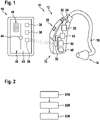
- Fig. 1 schematically shows a hearing system 10 including a hearing device 12 in the form of a behind-the-ear device carried by a hearing device user (not shown) and a connected user device 14, such as a smartphone or a tablet computer.
- a hearing device 12 is a specific embodiment and that the method described herein also may be performed with other types of hearing devices, such as in-the-ear devices.
- the hearing device 12 comprises a part 15 behind the ear and a part 16 to be put in the ear canal of the user.
- the part 15 and the part 16 are connected by a tube 18.
- at least one microphone 20, a sound processor 22 and a sound output device 24, such as a loudspeaker, are provided in the part 15, at least one microphone 20, a sound processor 22 and a sound output device 24, such as a loudspeaker, are provided.
- the microphone(s) 20 may acquire environmental sound of the user and may generate a sound signal
- the sound processor 22 may amplify the sound signal
- the sound output device 24 may generate sound that is guided through the tube 18 and the in-the-ear part 16 into the ear canal of the user.
- the hearing device 12 may comprise a processor 26 which is adapted for adjusting parameters of the sound processor 22 such that an output volume of the sound signal is adjusted based on an input volume. These parameters may be determined by a computer program run in the processor 26. For example, with a knob 28 of the hearing device 12, a user may select a modifier (such as bass, treble, noise suppression, dynamic volume, etc.) and levels and/or values of these modifiers may be selected, from this modifier, an adjustment command may be created and processed as described above and below. In particular, processing parameters may be determined based on the adjustment command and based on this, for example, the frequency dependent gain and the dynamic volume of the sound processor 22 may be changed. All these functions may be implemented as computer programs stored in a memory 30 of the hearing device 12, which computer programs may be executed by the processor 26 and/or sound processor 22.
- a modifier such as bass, treble, noise suppression, dynamic volume, etc.
- the hearing device 12 further comprises a transceiver 32 which may be adapted for wireless data communication with a transceiver 34 of the connected user device 14, which may be a smartphone or tablet computer. It is also possible that the above-mentioned modifiers and their levels and/or values are adjusted with the connected user device 14 and/or that the adjustment command is generated with the connected user device 14. This may be performed with a computer program run in a processor 36 of the connected user device 14 and stored in a memory 38 of the connected user device 14. The computer program may provide a graphical user interface 40 on a display 42 of the connected user device 14.
- the graphical user interface 40 may comprise a control element 44, such as a slider.
- a control element 44 such as a slider.
- an adjustment command may be generated, which will change the sound processing of the hearing device 12 as described above and below.
- the user may adjust the modifier with the hearing device 12 itself, for example via the knob 28.
- the user interface 40 also may comprise an indicator element 46, which, for example, displays a currently determined listening situation.
- the hearing device 12 further comprises at least one further sensor 50, the position of which in the part 15 of the hearing device 12 is to be understood as only symbolical, i.e. the further sensors 50 may also be provided in other parts and at other positions in the hearing device 12.
- the microphone(s) 20 and the further sensor(s) 50 enable the hearing device 12 or the hearing system 10 to perform a multi-sensor-based analysis for detecting and quantifying a liquid and/or food intake of a user as described herein.
- the further sensor(s) 50 may be integrated not only in the hearing device 12, but additionally also in the connected user devices such as the connected user device 14 shown in Fig. 1 , or a wearable such as a wrist band etc. (not shown).
- the further sensors 50 may include any types of physical or physiological sensors - e.g. movement sensors, such as accelerometers, and/or optical sensors, such as cameras, and/or temperature sensors and/or heart rate sensors etc.
- the hearing system 10 shown in Fig. 1 is adapted for performing a method according to the present invention for detecting and quantifying a liquid and/or food intake of a user wearing the hearing device 12, as described in more detail herein above.
- Fig. 2 shows an example for a flow diagram of this method according to an embodiment of the invention.
- the method may be a computer-implemented method performed automatically in the hearing system 10 of Fig. 1 .
- a first step S10 of the method an audio signal from the at least one microphone 20 and/or a sensor signal from the at least one further sensor 50 is received, e.g. by the sound processor 22 and the processor 26 of the hearing device 12.
- the signal(s) received in step S10 are collected and analyzed in the hearing device 12 or in the hearing system 10, so as to detect each time the user drinks and/or eats something, wherein drinking is distinguished from eating, and so as to determine values indicative of how often this is detected and/or a respective amount of liquid and/or food ingested by the user.
- the step of analyzing includes applying one or more machine learning algorithms, which may be implemented on a processor chip integrated in the hearing device 12, or alternatively in the connected user device 14 or somewhere else in the hearing system or in a remote server or cloud connected to it.
- a predetermined type of output as described in more detail herein above and below is generated, for example, to the user and/or to a third party, such as a person close to the user and/or a health care professional.
- the method of the present invention will be illustrated, by way of example only, for estimating a risk of dehydration of the user and generating a corresponding output to counsel the user to drink more, and for verifying a medication intake based on the detected liquid intake. It may also be applied in a similar manner for other use cases described in detail herein above and in the claims, such as enhancing the user's desire to drink or enhancing the eating or drinking experience of the user.
- the solution according to the present method comprises a so-called “sensory part”, which may cover the above step S10 and at least a part of step S20 and comprise detecting how many times and how long the user is drinking. It further comprises a so-called “actuator part”, which may cover the above step S30 and at least a part of step S20 and comprise storing the detected values into the memory of the hearing device or into the memory of an additional device such as a smartwatch, a wristband, a cloud etc.; estimating the risk of dehydration and counseling the user and/or, if the user agrees, informing a third party about his drinking behavior, such as a doctor, nurses or caregivers. That is, if the user agrees, his data and values determined in the analysis step of the method are sent to third parties (in addition or alternatively to counseling the user).
- the sensory part is capable to detect how often and how many swallows or gulps the user takes each time. It is also capable to distinguish between drinking and eating, own-voice and other possible confusions. Three (to four) phases of drinking might be distinguished, such as:
- the hearing device 12 or system 10 may combine and analyse signals of several sensors to detect all phases of the drinking procedure:
- the outcome of the several sensors is fed into a detection algorithm.
- the detection algorithm might consist of three parts, which are processed in a timely sequence, according to the three drinking phases described above.
- the algorithms might be a (deep) neural network, multivariate analysis of variance (Manova), Support Vector Machines (SVM) or any other machine learning algorithm, pattern recognition algorithm or statistical approach.
- the drinking procedure might be also detected without distinguishing any phases.
- a deep learning algorithm might find other criteria during a training phase. Since dehydration and drinking detection must not be solved in real time and must not be processed within the hearing device 12, diverse and more complex algorithms and processes are applicable.
- the learning part can be supervised and trained with a database of sensor data.
- a suitable database of training data based on the audio signal from a microphone contains recorded swallowing or gulping sound data of a large number of people - in this example 1000 randomly selected persons.
- representative sound data of drinking, swallowing, gulping, chewing etc. available in the Internet may be used as training data.
- the training can also be unsupervised by learning in an environment with more information available, such as using smart water bottles and/or information within a smart home and/or input from the user.
- Reinforcement learning or "deep reinforcement learning” as a third category of machine learning paradigms beside supervised and unsupervised learning, proposes different algorithms, which may be applied in the present method as well.
- HMM Hidden Markow Model
- RNN recurrent neural networks
- GRU might be more suited to the application due to less computational effort.
- the analysis may be implemented by parallel decision units in the hearing device 12 or in the hearing system 10. That is, instead of using one algorithm, several machine learning (ML) algorithms might be applied in parallel to compute the detection probabilities.
- ML machine learning
- the sensor data might be collected and analysed in different types of analysis units, for example:
- the “actuator part” of the method consists of several steps in this example: storing the detected values in a memory, estimation of a dehydration risk, counseling the user, informing third party about drinking behaviour of the user. Two of these steps are further described in the following:
- the risk of dehydration is estimated dependent on the detected drinking behavior, e.g. the determined amount of liquid ingested by the user is compared with a certain value "Dmin” describing the necessary minimum amount of drinking. This value can be a fixed number or might be calculated depending on one or more of the following factors:
- the values "Dmin” might be stored in a table including predetermined values or calculated with a regression equation, e.g. as known from medical studies. Alternatively or in addition, the value "Dmin” can also be adapted by the user or a doctor.
- step of counseling the user might include several options, such as one or more of the following:
- an interactive user interface is provided in the hearing system 10 and the steps of analyzing (S20) and/or generating an output (S30) are supplemented by an interaction with the user via this user interface, wherein the user is enabled to input additional information pertaining to his liquid intake.
- such an interface may be configured such as to enable the user to manually enter the data for drinking behaviour and/or to correct and/or specify the liquid intake. It might further provide the user with a possibility to add comments about subjective descriptions and ratings about his health state, mental condition, feelings, thirst, appetite, social condition (e.g. alone or with company), cause of fluid intake, intake of medication, etc.
- the hearing system 10 might ask the user proactively whether he has taken medication right after the system has detected fluid intake in step S20.
- the proactive questioning might be during a specific time predefined and stored in the hearing system 10, such as in the morning, in the evening, just before or after taking a meal, which, in turn, might be determined using the analysis algorithm in step S20. This proactive question shall help the user to keep track about the intake of medication.
- the interactive user interface might also help to improve the accuracy of the detection in general or within a learning phase of the analysis algorithm in step S20. It may also serve for a more elaborated therapy.
- the interactive user interface (also denoted as Ul) might comprise one or more of the following types of user interface:
Landscapes
- Engineering & Computer Science (AREA)
- Health & Medical Sciences (AREA)
- Physics & Mathematics (AREA)
- General Health & Medical Sciences (AREA)
- Life Sciences & Earth Sciences (AREA)
- Biomedical Technology (AREA)
- Theoretical Computer Science (AREA)
- Public Health (AREA)
- Medical Informatics (AREA)
- Biophysics (AREA)
- Molecular Biology (AREA)
- Artificial Intelligence (AREA)
- Data Mining & Analysis (AREA)
- Mathematical Physics (AREA)
- Evolutionary Computation (AREA)
- Software Systems (AREA)
- General Physics & Mathematics (AREA)
- General Engineering & Computer Science (AREA)
- Computational Linguistics (AREA)
- Epidemiology (AREA)
- Primary Health Care (AREA)
- Computing Systems (AREA)
- Signal Processing (AREA)
- Pathology (AREA)
- Acoustics & Sound (AREA)
- Heart & Thoracic Surgery (AREA)
- Surgery (AREA)
- Veterinary Medicine (AREA)
- Animal Behavior & Ethology (AREA)
- General Business, Economics & Management (AREA)
- Business, Economics & Management (AREA)
- Chemical & Material Sciences (AREA)
- Bioinformatics & Cheminformatics (AREA)
- Medicinal Chemistry (AREA)
- Databases & Information Systems (AREA)
- Nutrition Science (AREA)
- Otolaryngology (AREA)
- Neurosurgery (AREA)
- Fuzzy Systems (AREA)
- Computer Vision & Pattern Recognition (AREA)
Priority Applications (2)
| Application Number | Priority Date | Filing Date | Title |
|---|---|---|---|
| EP21163914.1A EP4064729A1 (de) | 2021-03-22 | 2021-03-22 | Detektion und quantifizierung einer flüssigkeits- und/oder nahrungsaufnahme eines hörgeräteträgers |
| US17/690,958 US20220301683A1 (en) | 2021-03-22 | 2022-03-09 | Detecting and quantifying a liquid and/or food intake of a user wearing a hearing device |
Applications Claiming Priority (1)
| Application Number | Priority Date | Filing Date | Title |
|---|---|---|---|
| EP21163914.1A EP4064729A1 (de) | 2021-03-22 | 2021-03-22 | Detektion und quantifizierung einer flüssigkeits- und/oder nahrungsaufnahme eines hörgeräteträgers |
Publications (1)
| Publication Number | Publication Date |
|---|---|
| EP4064729A1 true EP4064729A1 (de) | 2022-09-28 |
Family
ID=75143494
Family Applications (1)
| Application Number | Title | Priority Date | Filing Date |
|---|---|---|---|
| EP21163914.1A Withdrawn EP4064729A1 (de) | 2021-03-22 | 2021-03-22 | Detektion und quantifizierung einer flüssigkeits- und/oder nahrungsaufnahme eines hörgeräteträgers |
Country Status (2)
| Country | Link |
|---|---|
| US (1) | US20220301683A1 (de) |
| EP (1) | EP4064729A1 (de) |
Families Citing this family (2)
| Publication number | Priority date | Publication date | Assignee | Title |
|---|---|---|---|---|
| WO2025196450A1 (en) * | 2024-03-22 | 2025-09-25 | Emteq Limited | Monitoring mouth activities |
| CN119560094A (zh) * | 2024-10-18 | 2025-03-04 | 深圳清华大学研究院 | 基于助听器的服药提醒方法、装置、设备、存储介质及计算机程序产品 |
Citations (7)
| Publication number | Priority date | Publication date | Assignee | Title |
|---|---|---|---|---|
| US20060064037A1 (en) * | 2004-09-22 | 2006-03-23 | Shalon Ventures Research, Llc | Systems and methods for monitoring and modifying behavior |
| US20150379238A1 (en) * | 2012-06-14 | 2015-12-31 | Medibotics Llc | Wearable Imaging Device for Monitoring Food Consumption Using Gesture Recognition |
| US20170289704A1 (en) | 2016-03-30 | 2017-10-05 | Oticon A/S | Hearing device and monitoring system thereof |
| DE102018204695A1 (de) | 2017-06-08 | 2018-12-13 | Sivantos Pte. Ltd. | Verwendung eines Hörsystems für ein Gesundheitsmonitoring |
| US20190231253A1 (en) * | 2018-02-01 | 2019-08-01 | Invensense, Inc. | Using a hearable to generate a user health indicator |
| US20190394586A1 (en) * | 2018-06-22 | 2019-12-26 | Oticon A/S | Hearing device comprising an acoustic event detector |
| US20200268315A1 (en) * | 2019-02-26 | 2020-08-27 | Starkey Laboratories, Inc. | System and method for managing pharmacological therapeutics including a health monitoring device |
-
2021
- 2021-03-22 EP EP21163914.1A patent/EP4064729A1/de not_active Withdrawn
-
2022
- 2022-03-09 US US17/690,958 patent/US20220301683A1/en active Pending
Patent Citations (7)
| Publication number | Priority date | Publication date | Assignee | Title |
|---|---|---|---|---|
| US20060064037A1 (en) * | 2004-09-22 | 2006-03-23 | Shalon Ventures Research, Llc | Systems and methods for monitoring and modifying behavior |
| US20150379238A1 (en) * | 2012-06-14 | 2015-12-31 | Medibotics Llc | Wearable Imaging Device for Monitoring Food Consumption Using Gesture Recognition |
| US20170289704A1 (en) | 2016-03-30 | 2017-10-05 | Oticon A/S | Hearing device and monitoring system thereof |
| DE102018204695A1 (de) | 2017-06-08 | 2018-12-13 | Sivantos Pte. Ltd. | Verwendung eines Hörsystems für ein Gesundheitsmonitoring |
| US20190231253A1 (en) * | 2018-02-01 | 2019-08-01 | Invensense, Inc. | Using a hearable to generate a user health indicator |
| US20190394586A1 (en) * | 2018-06-22 | 2019-12-26 | Oticon A/S | Hearing device comprising an acoustic event detector |
| US20200268315A1 (en) * | 2019-02-26 | 2020-08-27 | Starkey Laboratories, Inc. | System and method for managing pharmacological therapeutics including a health monitoring device |
Non-Patent Citations (6)
| Title |
|---|
| CROFTON E C ET AL: "Potential applications for virtual and augmented reality technologies in sensory science", INNOVATIVE FOOD SCIENCE AND EMERGING TECHNOLOGIES, ELSEVIER, AMSTERDAM, NL, vol. 56, 19 June 2019 (2019-06-19), XP085746979, ISSN: 1466-8564, [retrieved on 20190619], DOI: 10.1016/J.IFSET.2019.102178 * |
| GAO YANG ET AL: "iHear Food: Eating Detection Using Commodity Bluetooth Headsets", 2016 IEEE FIRST INTERNATIONAL CONFERENCE ON CONNECTED HEALTH: APPLICATIONS, SYSTEMS AND ENGINEERING TECHNOLOGIES (CHASE), IEEE, 27 June 2016 (2016-06-27), pages 163 - 172, XP032945823, DOI: 10.1109/CHASE.2016.14 * |
| KANAK ALPER ET AL: "An intelligent dining scene experience", 2018 26TH SIGNAL PROCESSING AND COMMUNICATIONS APPLICATIONS CONFERENCE (SIU), IEEE, 2 May 2018 (2018-05-02), pages 1 - 3, XP033373676, DOI: 10.1109/SIU.2018.8404549 * |
| LEHMAN SARAH ET AL: "A Mobile Augmented Reality Game to Encourage Hydration in the Elderly", 7 June 2018, ICIAP: INTERNATIONAL CONFERENCE ON IMAGE ANALYSIS AND PROCESSING, 17TH INTERNATIONAL CONFERENCE, NAPLES, ITALY, SEPTEMBER 9-13, 2013. PROCEEDINGS; [LECTURE NOTES IN COMPUTER SCIENCE; LECT.NOTES COMPUTER], SPRINGER, BERLIN, HEIDELBERG, PAGE(S) 98 - 10, ISBN: 978-3-642-17318-9, XP047478368 * |
| MIRTCHOUK MARK ET AL: "Automated estimation of food type and amount consumed from body-worn audio and motion sensors", USER INTERFACE SOFTWARE AND TECHNOLOGY, ACM, 2 PENN PLAZA, SUITE 701 NEW YORK NY 10121-0701 USA, 12 September 2016 (2016-09-12), pages 451 - 462, XP058518375, ISBN: 978-1-4503-4531-6, DOI: 10.1145/2971648.2971677 * |
| TAKUJI NARUMI: "Multi-sensorial virtual reality and augmented human food interaction", MULTI-SENSORIAL APPROACHES TO HUMAN-FOOD INTERACTION, ACM, 2 PENN PLAZA, SUITE 701 NEW YORK NY 10121-0701 USA, 16 November 2016 (2016-11-16), pages 1 - 6, XP058307747, ISBN: 978-1-4503-4561-3, DOI: 10.1145/3007577.3007587 * |
Also Published As
| Publication number | Publication date |
|---|---|
| US20220301683A1 (en) | 2022-09-22 |
Similar Documents
| Publication | Publication Date | Title |
|---|---|---|
| CN113035322B (zh) | 用于跟踪食物摄入和其它行为并提供相关反馈的方法和设备 | |
| JP6815486B2 (ja) | 精神障害の療法のためのモバイルおよびウェアラブルビデオ捕捉およびフィードバックプラットフォーム | |
| CN103561652B (zh) | 用于辅助患者的方法和系统 | |
| CN114569132B (zh) | 一种基于示教的婴儿训练系统的云服务器 | |
| CN103081513B (zh) | 听力装置的基于视觉的选配 | |
| US20160026767A1 (en) | Non-invasive nutrition monitor | |
| US20110125063A1 (en) | Systems and Methods for Monitoring and Modifying Behavior | |
| US20220148597A1 (en) | Local artificial intelligence assistant system with ear-wearable device | |
| EP2972678A1 (de) | Tragbare berechnungsvorrichtung und -verfahren | |
| US20240090808A1 (en) | Multi-sensory ear-worn devices for stress and anxiety detection and alleviation | |
| US20230390608A1 (en) | Systems and methods including ear-worn devices for vestibular rehabilitation exercises | |
| US20220301683A1 (en) | Detecting and quantifying a liquid and/or food intake of a user wearing a hearing device | |
| US20230181869A1 (en) | Multi-sensory ear-wearable devices for stress related condition detection and therapy | |
| US20250213868A1 (en) | Assessing responses to sensory events and performing treatment actions based thereon | |
| US12458281B2 (en) | Ear-wearable devices and methods for migraine detection | |
| US20230210444A1 (en) | Ear-wearable devices and methods for allergic reaction detection | |
| US20230301580A1 (en) | Ear-worn devices with oropharyngeal event detection | |
| US20230329912A1 (en) | New tinnitus management techniques | |
| JP2023003299A (ja) | 生体情報処理装置 | |
| US20260048513A1 (en) | Care robot providing care service | |
| US11769595B2 (en) | Information processing apparatus and non-transitory computer readable medium | |
| US20240196138A1 (en) | Operating a hearing device to assist the user in engaging in a healthy living style | |
| US20230364424A1 (en) | Augmenting reality | |
| US20240265826A1 (en) | Detecting Unhealthy Food and Using Tactile and/or Haptic Sensations to Reduce a Person's Consumption of the Unhealthy Food | |
| Ueshima et al. | SipSense: Acoustic Sensing of Beverage Type and Volume Using Dual-Microphone Wearable System |
Legal Events
| Date | Code | Title | Description |
|---|---|---|---|
| PUAI | Public reference made under article 153(3) epc to a published international application that has entered the european phase |
Free format text: ORIGINAL CODE: 0009012 |
|
| STAA | Information on the status of an ep patent application or granted ep patent |
Free format text: STATUS: THE APPLICATION HAS BEEN PUBLISHED |
|
| AK | Designated contracting states |
Kind code of ref document: A1 Designated state(s): AL AT BE BG CH CY CZ DE DK EE ES FI FR GB GR HR HU IE IS IT LI LT LU LV MC MK MT NL NO PL PT RO RS SE SI SK SM TR |
|
| STAA | Information on the status of an ep patent application or granted ep patent |
Free format text: STATUS: THE APPLICATION IS DEEMED TO BE WITHDRAWN |
|
| 18D | Application deemed to be withdrawn |
Effective date: 20230329 |