EP4066079B1 - Flugzeugsteuerungssystem - Google Patents
Flugzeugsteuerungssystem Download PDFInfo
- Publication number
- EP4066079B1 EP4066079B1 EP20811355.5A EP20811355A EP4066079B1 EP 4066079 B1 EP4066079 B1 EP 4066079B1 EP 20811355 A EP20811355 A EP 20811355A EP 4066079 B1 EP4066079 B1 EP 4066079B1
- Authority
- EP
- European Patent Office
- Prior art keywords
- control
- aircraft
- piloting
- operator
- interface
- Prior art date
- Legal status (The legal status is an assumption and is not a legal conclusion. Google has not performed a legal analysis and makes no representation as to the accuracy of the status listed.)
- Active
Links
Images

Classifications
-
- G—PHYSICS
- G05—CONTROLLING; REGULATING
- G05D—SYSTEMS FOR CONTROLLING OR REGULATING NON-ELECTRIC VARIABLES
- G05D1/00—Control of position, course, altitude or attitude of land, water, air or space vehicles, e.g. using automatic pilots
- G05D1/08—Control of attitude, i.e. control of roll, pitch, or yaw
- G05D1/0808—Control of attitude, i.e. control of roll, pitch, or yaw specially adapted for aircraft
- G05D1/0816—Control of attitude, i.e. control of roll, pitch, or yaw specially adapted for aircraft to ensure stability
- G05D1/0833—Control of attitude, i.e. control of roll, pitch, or yaw specially adapted for aircraft to ensure stability using limited authority control
-
- B—PERFORMING OPERATIONS; TRANSPORTING
- B64—AIRCRAFT; AVIATION; COSMONAUTICS
- B64C—AEROPLANES; HELICOPTERS
- B64C13/00—Control systems or transmitting systems for actuating flying-control surfaces, lift-increasing flaps, air brakes, or spoilers
- B64C13/02—Initiating means
- B64C13/04—Initiating means actuated personally
-
- B—PERFORMING OPERATIONS; TRANSPORTING
- B64—AIRCRAFT; AVIATION; COSMONAUTICS
- B64C—AEROPLANES; HELICOPTERS
- B64C13/00—Control systems or transmitting systems for actuating flying-control surfaces, lift-increasing flaps, air brakes, or spoilers
- B64C13/02—Initiating means
- B64C13/16—Initiating means actuated automatically, e.g. responsive to gust detectors
- B64C13/18—Initiating means actuated automatically, e.g. responsive to gust detectors using automatic pilot
-
- B—PERFORMING OPERATIONS; TRANSPORTING
- B64—AIRCRAFT; AVIATION; COSMONAUTICS
- B64C—AEROPLANES; HELICOPTERS
- B64C13/00—Control systems or transmitting systems for actuating flying-control surfaces, lift-increasing flaps, air brakes, or spoilers
- B64C13/02—Initiating means
- B64C13/16—Initiating means actuated automatically, e.g. responsive to gust detectors
- B64C13/22—Initiating means actuated automatically, e.g. responsive to gust detectors readily revertible to personal control
-
- B—PERFORMING OPERATIONS; TRANSPORTING
- B64—AIRCRAFT; AVIATION; COSMONAUTICS
- B64C—AEROPLANES; HELICOPTERS
- B64C27/00—Rotorcraft; Rotors peculiar thereto
- B64C27/54—Mechanisms for controlling blade adjustment or movement relative to rotor head, e.g. lag-lead movement
- B64C27/56—Mechanisms for controlling blade adjustment or movement relative to rotor head, e.g. lag-lead movement characterised by the control initiating means, e.g. manually actuated
-
- B—PERFORMING OPERATIONS; TRANSPORTING
- B64—AIRCRAFT; AVIATION; COSMONAUTICS
- B64C—AEROPLANES; HELICOPTERS
- B64C27/00—Rotorcraft; Rotors peculiar thereto
- B64C27/54—Mechanisms for controlling blade adjustment or movement relative to rotor head, e.g. lag-lead movement
- B64C27/56—Mechanisms for controlling blade adjustment or movement relative to rotor head, e.g. lag-lead movement characterised by the control initiating means, e.g. manually actuated
- B64C27/57—Mechanisms for controlling blade adjustment or movement relative to rotor head, e.g. lag-lead movement characterised by the control initiating means, e.g. manually actuated automatic or condition responsive, e.g. responsive to rotor speed, torque or thrust
-
- G—PHYSICS
- G08—SIGNALLING
- G08G—TRAFFIC CONTROL SYSTEMS
- G08G5/00—Traffic control systems for aircraft
- G08G5/20—Arrangements for acquiring, generating, sharing or displaying traffic information
- G08G5/21—Arrangements for acquiring, generating, sharing or displaying traffic information located onboard the aircraft
-
- G—PHYSICS
- G08—SIGNALLING
- G08G—TRAFFIC CONTROL SYSTEMS
- G08G5/00—Traffic control systems for aircraft
- G08G5/30—Flight plan management
- G08G5/34—Flight plan management for flight plan modification
-
- G—PHYSICS
- G08—SIGNALLING
- G08G—TRAFFIC CONTROL SYSTEMS
- G08G5/00—Traffic control systems for aircraft
- G08G5/50—Navigation or guidance aids
- G08G5/54—Navigation or guidance aids for approach or landing
-
- G—PHYSICS
- G08—SIGNALLING
- G08G—TRAFFIC CONTROL SYSTEMS
- G08G5/00—Traffic control systems for aircraft
- G08G5/50—Navigation or guidance aids
- G08G5/55—Navigation or guidance aids for a single aircraft
-
- G—PHYSICS
- G08—SIGNALLING
- G08G—TRAFFIC CONTROL SYSTEMS
- G08G5/00—Traffic control systems for aircraft
- G08G5/80—Anti-collision systems
-
- G—PHYSICS
- G08—SIGNALLING
- G08G—TRAFFIC CONTROL SYSTEMS
- G08G5/00—Traffic control systems for aircraft
- G08G5/50—Navigation or guidance aids
- G08G5/57—Navigation or guidance aids for unmanned aircraft
Definitions
- the present invention relates to an aircraft piloting system comprising an on-board automatic piloting system and a man-machine interface comprising control elements operable by an operator.
- the invention lies in the field of aeronautics, and more particularly in the field of aircraft piloting.
- VTOL for “Vertical Take-Off and Landing” air taxi type aircraft are being developed, which are intended for the transport of passengers, for example in urban areas. Due to their number, these devices are ultimately intended to be monitored remotely without a pilot on board.
- the document WO2019/135791 A2 relates to a vertical take-off/landing (VTOL) transport aircraft, and more particularly describes the automation of operations between the aircraft and the landing/take-off stations, and the connection between the aircraft and land vehicles .
- VTOL vertical take-off/landing
- WO2019/130280 A2 describes systems and methods for controlling autonomous aircraft.
- WO2019/116101 A1 describes a VTOL type aircraft with variable geometry, for autonomous or semi-autonomous passenger transport.
- the object of the invention is to respond to these problems.
- the invention proposes an aircraft piloting system comprising a control system configured to operate flight controls of the aircraft according to a pre-programmed flight trajectory in accordance with claim 1.
- the proposed aircraft piloting system comprises a control interface having a limited number of control members allowing only piloting commands to be performed among a predetermined set of piloting commands.
- the function of piloting by a human operator is reduced, and therefore the training for piloting an aircraft using such a piloting system is also reduced.
- the aircraft piloting system according to the invention may also have one or more of the characteristics of claims 2 to 12.
- FIG. 1 schematically illustrates a system 2 for piloting an aircraft, which comprises a control system 4 adapted to control systems 6 for controlling the aircraft.
- the control systems 6 include in particular, in a known manner, elevators and direction control surfaces, a device for controlling the engine(s) and/or the pitch of the thrusters, an aerodynamic braking system, etc.
- the control system 4 is configured to cause a change in the trajectory and orientation of the aircraft via its action on the control systems 6.
- the control system 4 is, in one embodiment, an electronic device configured to implement an automatic pilot system 8 and a pilot system 10 which is configured to carry out piloting by receiving commands from a pilot operator .
- the action of the control system 4 on the control systems 6 is carried out by known aircraft piloting technologies.
- the control system 4 is further adapted to communicate with an anti-collision detection system 12, a navigation system 14, and optionally with an interface system 16 with remote air traffic control and an interface system 18 with a ground operations management station.
- the anti-collision detection system 12 uses various sensors not shown, for example cameras in the visible and/or infrared domain, as well as radars or lidars, and software for detecting intruders or obstacles. , for example by automatic image analysis, calculation of collision risk and avoidance proposal to the control system 4.
- An avoidance proposal consists, in one embodiment, of an appropriate maneuver, for example: climb or descend, swerve, slow down, hover.
- the navigation system 14 uses sensors, for example satellite geolocation signal receivers, to calculate the geolocated position of the aircraft in real time.
- the navigation system 14 also implements, in one embodiment, sensors such as radars, lidars and cameras in the visible and/or infrared domain, as well as software for estimating the position, speed and the route of the aircraft in real time.
- sensors such as radars, lidars and cameras in the visible and/or infrared domain
- software for estimating the position, speed and the route of the aircraft in real time here we mean by road the horizontal direction of the speed vector of the aircraft.
- the navigation system 14 implements visual odometry and image/geographic map correlation methods.
- Various modes of implementing these methods are known in the field of aeronautics.
- conventional techniques using navigation instruments such as magnetometers, inclinometers, accelerometers, gyrometers and Pitot tubes are used.
- the system 16 for interfacing with remote air traffic control includes for example a radio link communication system, also called DATALINK, with air traffic control systems on the ground making it possible to provide information relating to the flight of the aircraft in operation. other aircraft.
- DATALINK radio link communication system
- the interface system 18 with a ground operations management station also includes a radio link communication system and makes it possible to receive commands from ground operators relating to the mission of the aircraft, for example a change of plan flight during mission.
- the automatic pilot system 8 is configured to control the flight of the aircraft according to a pre-programmed flight path, while taking into consideration information received from the anti-collision detection systems 12, navigation 14, as well as information or commands received via interface systems 16 and 18.
- control system 2 further comprises a man-machine interface (HMI) 20 intended for a human operator who performs certain control functions, who will be called “control operator” below.
- HMI man-machine interface
- the piloting operator cannot take control of all the piloting functionalities, but only has access to a limited and predetermined number of piloting commands, this limited number being strictly less than the number of piloting commands intended for a qualified pilot in a conventional piloting system. As such, the pilot operator does not need to be a qualified pilot on a given type of aircraft.
- the HMI 20 includes, in the embodiment of the figure 1 , a display device 22, for example a head-up viewfinder also called HUD for "Head-Up Display", which allows the pilot operator to view the exterior of the aircraft with additional information displayed superimposed on its sound. field of visualization, according to augmented reality principles.
- a HUD type display is carried out on a semi-transparent and semi-reflective optical device, for example a glass slide, positioned between the position of the pilot operator and the window of the cockpit of the aircraft, in the viewing direction of the piloting operator.
- the HUD type display is carried out on a screen located in front of one eye or both eyes of the pilot operator and fixed via a helmet or glasses to the pilot's head (visor worn on head or Head Mounted Display).
- the HUD type display device provides a synthetic representation of the terrain or landscape of the SVS type, from the English Synthetic Vision System.
- Head-mounted viewfinder type display devices include sensors for the direction of the line of sight (or direction of gaze) of the piloting operator, allowing the operator to easily designate remarkable points in the landscape ( by superposition with a displayed symbol which represents the line of sight).
- a display device 22 as described above with an audio headset, comprising for example a microphone and headphones, which allows the use of voice recognition software to obtain voice commands from the pilot operator.
- audio headset comprising for example a microphone and headphones
- voice recognition software to obtain voice commands from the pilot operator.
- various information for example transmitted by the interface systems 16, 18, are vocalized by a voice synthesis system and transmitted to the pilot operator via the headphones.
- the HMI 20 further includes situation and dialogue screens 24, 26, making it possible to provide the pilot operator with useful additional information. For example, a map of an area flown over, updated in real time, is displayed on the screen 24, and additional information, for example information relating to environmental constraints received (e.g. information relating to weather conditions ) of the interface systems 16, 18, are displayed on the screen 26.
- additional information for example information relating to environmental constraints received (e.g. information relating to weather conditions ) of the interface systems 16, 18, are displayed on the screen 26.
- the HMI 20 further comprises a control element interface 28, which includes for example physical buttons and/or buttons implemented on a touch screen, the control elements being actuable by the control operator.
- the commands are transmitted to the piloting system 10 which is configured to control the aircraft control systems 6.
- the pilot system 10 takes control in place of the automatic pilot system 8, within the limits of the planned functionalities.
- control members 28 accessible to the pilot operator are limited in number and functionalities: the pilot operator can only carry out commands from a predetermined set of commands. Other piloting commands are solely assigned to the automatic piloting system 8.
- a nominal flight trajectory corresponding to a mission, is pre-programmed and recorded in a memory of the control system 4.
- any command from the pilot operator is followed by a resumption of the on-board automatic pilot system 8 for a return to the nominal trajectory.
- the pilot operator can control via the interface of control elements 28 an obstacle avoidance detected visually, the avoidance being carried out within authorized deviation margins, memorized relative to the pre-programmed flight path.
- This type of functionality is also called “see and avoid”.
- the pilot operator has the possibility of ordering a readjustment of the navigation position.
- the piloting operator has the possibility of controlling maneuvers (e.g. obstacle avoidance), in cases where the level of operational safety of the anti-collision detection systems and the navigation system is less than or equal to a predetermined threshold level, corresponding to a required security level.
- maneuvers e.g. obstacle avoidance
- the pilot operator also has commands to carry out a flight in semi-automatic mode.
- the set of predetermined commands includes direction commands (set route) for movement of the aircraft, for modification of the altitude of the aircraft.
- Speed and slope ranges are limited within margins calculated to ensure flight safety with respect to known mechanical limits and environmental limits (e.g. minimum flight altitude).
- the phases of initial climb on takeoff and descent on landing are not controllable by the pilot operator, but are carried out by the onboard automatic pilot system 8.
- the pilot operator also has a control allowing to switch between automatic pilot mode and semi-automatic pilot mode.
- the piloting system 2 also implements a module 25 for recording the commands and interventions of the piloting operator, in connection with information received from the anti-collision detection systems 12, navigation systems 14 and optionally from the navigation systems. interface 16, 18, in order to record non-detections, false alarms, position drifts for the purpose of subsequent analysis and improvement of these systems 12, 14.
- control system 4 is implemented by a programmable electronic device such as an on-board computer, comprising an electronic memory, adapted to memorize data in the form of files or registers for example, and at least one processor, adapted to execute calculations and computer program code instructions when the control device 4 is powered up .
- a programmable electronic device such as an on-board computer, comprising an electronic memory, adapted to memorize data in the form of files or registers for example, and at least one processor, adapted to execute calculations and computer program code instructions when the control device 4 is powered up .
- control device is produced in the form of a programmable logic component, such as an FPGA ( Field Programmable Gate Array), a GPU (graphics processor) or a GPGPU (General- purpose processing on graphics processing ), or even in the form of a dedicated integrated circuit, such as an ASIC (from the English Application Specifies Integrated Circuit).
- a programmable logic component such as an FPGA ( Field Programmable Gate Array), a GPU (graphics processor) or a GPGPU ( General- purpose processing on graphics processing ), or even in the form of a dedicated integrated circuit, such as an ASIC (from the English Application Specifies Integrated Circuit).
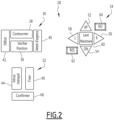
- FIG. 2 illustrates an embodiment of the interface of control elements 28 which are accessible to the pilot operator.
- control element interface 28 comprises three sets of control buttons: a first set of control buttons 30, a second set of control buttons 32, a third set of control buttons 34.
- control buttons are produced, as indicated above, either in the form of graphic elements selectable on a touch screen, or in the form of mechanically actuable buttons.
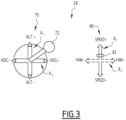
- FIG. 3 schematically illustrates complementary control elements of the control element interface 28, accessible to the piloting operator for the implementation of semi-automatic piloting.
- control elements illustrated in Figure 3 are presented in addition to the control elements described above with reference to the figure 2 .
- the control members 70 are intended to control the trajectory in semi-automatic mode. They include, for example, a handle or a joystick 72, which is different from a conventional control stick.
- the handle 72 is adapted to be moved along two orthogonal axes A 1 , A 2 , to modify a flight parameter making it possible to modify the height or altitude of the aircraft and the target route of the aircraft.
- the movement along the axis A 1 is a first type of command applied to the handle 72
- the movement along the axis A 2 is a second type of control applied to the handle 72.
- moving the stick 72 on the axis A 1 in the direction of ALT+ makes it possible to increase the altitude
- moving the stick 72 on the axis A 1 in the direction of ALT- makes it possible to reduce the altitude. 'altitude.
- Moving the stick on axis A 2 makes it possible to modify the setpoint route, increasing the speed component to the right by moving the stick 72 towards HDG+ or to the left by moving the stick 72 towards HDG-.
- control member 72 is not a handle, but the respective movements on the axes A 1 , A 2 are carried out by means of cursors.
- a visual indicator not shown is displayed on the display device 22 (head-up display) or on one of the display screens 24, 26 to indicate to the pilot operator the altitude and the route thus controlled by relative to the current altitude and route.
- control member 80 intended to control the speed and trajectory in semi-automatic mode.
- the control member 80 comprises a cursor 82, adapted to be moved along a first axis B 1 to control variations in the longitudinal speed (ie of the module of the speed vector) in addition (by moving the cursor 82 towards SPEED+) or less (by moving cursor 82 towards SPEED-), within an authorized speed variation range around a nominal speed value.
- control elements are also provided for this use case.
- Moving the cursor 82 on a second axis B 2 makes it possible to cause the aircraft to rotate on itself, the direction of rotation being defined by the direction of movement of the cursor 82 (directions YAW+ or YAW-). Furthermore, advantageously, on an aircraft of this type, once in hover, the stick 72 can be used to cause lateral movements in translation according to the movement along the axis A 2 or vertical movements in translation according to the movements of the handle 72 along axis A 1 .
- Exiting hovering flight mode can be controlled by actuation of the “RES” button 62, and returning to following a pre-programmed flight path by actuation of the “START” button 42.
- the transition to semi-automatic mode is for example controlled by an action of the pilot operator on the handle 72.
- control elements illustrated schematically in figure 2 And 3 are all present in the control member interface 28 and are adapted to cooperate as described above.
- buttons 52, 54, 56, 58 and 60 are deleted.
- control members is configured to be used on various types of aircraft, having different aerodynamic and power formulas: fixed-wing aircraft, helicopter, multi-rotor aircraft, hybrid aircraft having both wings and rotors. sustainers.
- a set of minimized and space-saving control elements is implemented, and the pilot operator has access to a limited set of commands, other commands being reserved exclusively for the automatic pilot system.
- the on-board automatic piloting system can execute piloting commands from said anti-collision detection system and navigation system, with the capacity to inhibit them or supplement them by the piloting operator if these anti-collision detection and navigation systems have a level of operational safety less than or equal to a required safety level.
- said anti-collision detection system and navigation system can be on-board and used to gain experience and improve them even though they do not yet have the level of operational safety required to be autonomous.
- the proposed piloting system is compact, suitable for various types of aircraft and easy to use by the same pilot operator on various types of aircraft.
- the training of pilot operators is greatly reduced.
Landscapes
- Engineering & Computer Science (AREA)
- Aviation & Aerospace Engineering (AREA)
- Physics & Mathematics (AREA)
- General Physics & Mathematics (AREA)
- Automation & Control Theory (AREA)
- Mechanical Engineering (AREA)
- Computer Security & Cryptography (AREA)
- Radar, Positioning & Navigation (AREA)
- Remote Sensing (AREA)
- Control Of Position, Course, Altitude, Or Attitude Of Moving Bodies (AREA)
- User Interface Of Digital Computer (AREA)
- Selective Calling Equipment (AREA)
- Traffic Control Systems (AREA)
Claims (12)
- System zur Steuerung eines Luftfahrzeugs, wobei das System ein Steuersystem (4) umfasst, das dazu ausgelegt ist, Kontrollen (6) des Flugs des Luftfahrzeugs gemäß einer vorprogrammierten Flugbahn zu betätigen, wobei das Steuersystem ein automatisches Steuerungssystem (8) aufweist, wobei das System zur Steuerung eines Luftfahrzeugs (2) ferner eine Mensch-Maschine-Schnittstelle (20) mit einer Steuerorganschnittstelle (28) aufweist, die von einem Piloten betätigbar sind, um Kontrollen zu betätigen und den Flug des Luftfahrzeugs zu verändern, wobei die Steuerorganschnittstelle (28) eine begrenzte Anzahl von Steuerorganen umfasst, die von dem Piloten betätigbar sind, die gestatten, nur Steuerungsbefehle aus einer zuvor festgelegten Gruppe von Steuerungsbefehlen auszuführen, wobei die begrenzte Anzahl von Steuerorganen kleiner als die Gesamtheit der verfügbaren Steuerungsfunktionen ist, wobei die Gruppe von Befehlen Befehle zur Vermeidung von Hindernissen auf Sicht aufweist, die von Steuerorganen der zugeordneten Steuerorganschnittstelle (28) betätigt werden, dadurch gekennzeichnet dass die Steuerorganschnittstelle (28) ein Organ (48) aufweist, das gestattet, eine Hindernisdetektion zu bestätigen, Steuerorgane (52, 54, 56, 58) zur Änderung der Richtung und der Ausrichtung des Luftfahrzeugs sowie:. Steuerorgane (32, 44, 46), die gestatten, ein Hindernis und/oder einen bemerkenswerten Punkt zu melden, wobei die Mensch-Maschine-Schnittstelle (20) dazu ausgelegt ist, dem Piloten zu ermöglichen, eine Position des Hindernisses in Bezug auf eine Position des Luftfahrzeugs anzuzeigen, und. ein Steuerorgan (64), das gestattet, ein automatisches Hindernisausweichmanöver zu unterbinden.
- System zur Steuerung eines Luftfahrzeugs nach Anspruch 1, wobei die zuvor festgelegte Gruppe von Befehlen Befehle aufweist, die gestatten, vorprogrammierte Notmanöver durchzuführen.
- System zur Steuerung eines Luftfahrzeugs nach Anspruch 2, wobei eins der vorprogrammierten Notmanöver eine Notlandung ist, wobei die Steuerorganschnittstelle (28) ein Notlandesteuerorgan (40) aufweist.
- System zur Steuerung eines Luftfahrzeugs nach einem der Ansprüche 2 oder 3, wobei eins der vorprogrammierten Notmanöver ein Befehl zum Abbrechen der Landung durch Betätigen eines zugeordneten Steuerorgans (38) ist, wobei die Betätigung einen Flug gemäß einer vordefinierten automatischen Schleife und eine automatische Durchführung eines neuen Landeversuchs befiehlt oder eine automatische Umlenkung zu einem anderen Ziel befiehlt.
- System zur Steuerung eines Luftfahrzeugs nach einem der Ansprüche 1 bis 4, wobei die Gruppe von Befehlen ferner aufweist:. einen Befehl zum Auslösen und anschließenden Ausführen einer Positionsneubestimmung des Luftfahrzeugs, der von einem zugeordneten Steuerorgan (36) gegeben wird,. einen Befehl zur Rückkehr zum vorprogrammierten Flugweg, der vom Autopiloten gesteuert wird, der von einem zugeordneten Steuerorgan (62) gegeben wird.
- System zur Steuerung eines Luftfahrzeugs nach einem der Ansprüche 1 bis 5, wobei die Mensch-Maschine-Schnittstelle (20) eine Head-up-Display-Vorrichtung (22) aufweist, die vom Piloten getragen werden kann und auf der Informationen in Bezug auf eine sichtbare Umgebung des Flugzeugs überlagert angezeigt werden.
- System zur Steuerung eines Luftfahrzeugs nach einem der Ansprüche 1 bis 6, wobei die Steuerorganschnittstelle (28) ferner Steuerorgane (70, 80) für eine Steuerung im halbautomatischen Modus durch den Piloten umfasst.
- System zur Steuerung eines Luftfahrzeugs nach Anspruch 7, wobei das Luftfahrzeug einer Flugbahn mit einer zugeordneten Höhe und einem zugeordneten Sollkurs folgt, wobei die Steuerorgane für die Steuerung im halbautomatischen Modus ein Steuerorgan (72) umfassen, das geeignet ist, gemäß einem ersten Befehlstyp zur Änderung eines Flugparameters gesteuert zu werden, der es gestattet, die Höhe des Luftfahrzeugs zu ändern, darunter die Flughöhe, die Neigung oder die Vertikalgeschwindigkeit, und geeignet ist, gemäß einem zweiten Befehlstyp zur Änderung der Sollflugbahn des Luftfahrzeugs gesteuert zu werden.
- System zur Steuerung eines Luftfahrzeugs nach Anspruch 8, wobei das Steuerorgan (72) für die Steuerung im halbautomatischen Modus ein Steuerknüppel ist, der geeignet ist, gemäß einer ersten Achse (A1) gemäß dem ersten Befehlstyp und gemäß einer zweiten Achse (A2) gemäß dem zweiten Befehlstyp bewegt zu werden.
- System zur Steuerung eines Luftfahrzeugs nach Anspruch 8 oder 9, das ferner ein Steuerorgan (82) aufweist, das dazu bestimmt ist, eine Änderung der Längsgeschwindigkeit des Luftfahrzeugs innerhalb eines zulässigen Geschwindigkeitsänderungsbereichs um einen Nenngeschwindigkeitswert zu befehlen.
- System zur Steuerung eines Luftfahrzeugs nach einem der Ansprüche 1 bis 10, wobei die Steuerorganschnittstelle (28) dazu ausgelegt ist, eine Änderung der Funktionen von mindestens einem Teil der Steuerorgane in Abhängigkeit von einem Luftfahrzeugtyp zu gestatten.
- System zur Steuerung eines Luftfahrzeugs nach einem der Ansprüche 10 bis 11, wobei das gesteuerte Flugzeug zu einem Schwebeflug fähig ist, wobei das Steuerorgan (82), das zum Befehlen einer Änderung der Längsgeschwindigkeit bestimmt ist, geeignet ist, einen Schwebeflug zu steuern, und wobei im Schwebeflug eins der Steuerorgane (72) zur Steuerung im halbautomatischen Modus vom Piloten betätigbar ist, um seitliche Translationsbewegungen und vertikale Translationsbewegungen zu bewirken.
Applications Claiming Priority (2)
| Application Number | Priority Date | Filing Date | Title |
|---|---|---|---|
| FR1913295A FR3103577B1 (fr) | 2019-11-27 | 2019-11-27 | Systeme de pilotage d'aeronef |
| PCT/EP2020/083544 WO2021105303A1 (fr) | 2019-11-27 | 2020-11-26 | Système de pilotage d'aéronef |
Publications (2)
| Publication Number | Publication Date |
|---|---|
| EP4066079A1 EP4066079A1 (de) | 2022-10-05 |
| EP4066079B1 true EP4066079B1 (de) | 2023-12-06 |
Family
ID=70456830
Family Applications (1)
| Application Number | Title | Priority Date | Filing Date |
|---|---|---|---|
| EP20811355.5A Active EP4066079B1 (de) | 2019-11-27 | 2020-11-26 | Flugzeugsteuerungssystem |
Country Status (3)
| Country | Link |
|---|---|
| EP (1) | EP4066079B1 (de) |
| FR (1) | FR3103577B1 (de) |
| WO (1) | WO2021105303A1 (de) |
Cited By (1)
| Publication number | Priority date | Publication date | Assignee | Title |
|---|---|---|---|---|
| US20240274018A1 (en) * | 2020-03-10 | 2024-08-15 | Honeywell International Inc. | Systems and methods providing assist-to-land and emergency land functions |
Families Citing this family (1)
| Publication number | Priority date | Publication date | Assignee | Title |
|---|---|---|---|---|
| WO2024193939A1 (en) * | 2023-03-22 | 2024-09-26 | Volkswagen Aktiengesellschaft | Control device for aircraft, and aircraft comprising same |
Family Cites Families (5)
| Publication number | Priority date | Publication date | Assignee | Title |
|---|---|---|---|---|
| DK3398022T3 (da) * | 2016-02-26 | 2021-02-01 | Sz Dji Technology Co Ltd | Systemer og fremgangsmåder til tilpasning af uav-bane |
| US10308358B2 (en) * | 2016-05-13 | 2019-06-04 | Top Flight Technologies, Inc. | Passenger carrying unmanned aerial vehicle powered by a hybrid generator system |
| WO2019135791A2 (en) * | 2017-08-08 | 2019-08-29 | Terrafugia, Inc. | Vertical takeoff and landing transportation system |
| CN111566008A (zh) * | 2017-12-12 | 2020-08-21 | 卡梅伦·斯潘塞 | 可变几何形状垂直起降(vtol)飞行器系统 |
| WO2019130280A2 (en) * | 2017-12-31 | 2019-07-04 | Iatas (Automatic Air Traffic Control) Ltd | Apparatuses, systems and methods for the autonomous controlling and marshalling of autonmous-enabled flying objects and autonmous-enabled transportation objects |
-
2019
- 2019-11-27 FR FR1913295A patent/FR3103577B1/fr active Active
-
2020
- 2020-11-26 EP EP20811355.5A patent/EP4066079B1/de active Active
- 2020-11-26 WO PCT/EP2020/083544 patent/WO2021105303A1/fr not_active Ceased
Cited By (2)
| Publication number | Priority date | Publication date | Assignee | Title |
|---|---|---|---|---|
| US20240274018A1 (en) * | 2020-03-10 | 2024-08-15 | Honeywell International Inc. | Systems and methods providing assist-to-land and emergency land functions |
| US12562069B2 (en) * | 2020-03-10 | 2026-02-24 | Honeywell International Inc. | Systems and methods providing assist-to-land and emergency land functions |
Also Published As
| Publication number | Publication date |
|---|---|
| EP4066079A1 (de) | 2022-10-05 |
| FR3103577B1 (fr) | 2022-09-09 |
| WO2021105303A1 (fr) | 2021-06-03 |
| FR3103577A1 (fr) | 2021-05-28 |
Similar Documents
| Publication | Publication Date | Title |
|---|---|---|
| US7106217B2 (en) | Technical design concepts to improve helicopter obstacle avoidance and operations in “brownout” conditions | |
| EP3489929B1 (de) | Elektronisches system zur fernsteuerung von drohnen, entsprechendes verfahren und computerprogramm | |
| US8781654B2 (en) | Method and device for aiding the approach of an aircraft during an approach phase for the purpose of landing | |
| US7982767B2 (en) | System and method for mounting sensors and cleaning sensor apertures for out-the-window displays | |
| CA2577594C (fr) | Procede et systeme d'evitement pour un aeronef | |
| US20230333552A1 (en) | Methods and systems for human-in-the-loop vehicular command and control using immersive synthetic vision | |
| CA2952094C (fr) | Procede et dispositif de generation d'une trajectoire de consigne resultante d'un aeronef, produit programme d'ordinateur et aeronef associes | |
| US12315268B2 (en) | Vision-based landing system | |
| US10119833B2 (en) | Projected synthetic vision | |
| US10124907B1 (en) | Autorotation guidance command system, device, and method | |
| EP3123463B1 (de) | Schwebeflugsignalisierung mit kombinierter taktiler und peripherer sichtmodalität | |
| US9616993B1 (en) | Simplified auto-flight system coupled with a touchscreen flight control panel | |
| US12332658B2 (en) | Unmanned aircraft control using engine torque control system | |
| EP3198349B1 (de) | Haptische rückmeldung für echtzeitflugbahnbeschränkungen | |
| FR3023406A1 (fr) | Procede d'aide au pilotage au sol d'un avion et systeme pour sa mise en oeuvre | |
| EP3173847B1 (de) | System zur anzeige von fov-grenzen auf huds | |
| EP3084751B1 (de) | Schwebeflugsignalisierung mit peripherer sicht | |
| EP4066079A1 (de) | Flugzeugsteuerungssystem | |
| CA3047766C (fr) | Systeme d'aide au pilotage d'un aeronef, aeronef associe et procede d'aide au pilotage de cet aeronef | |
| CN118977859A (zh) | 用于飞机驾驶舱的增强现实风挡投影的系统和方法 | |
| EP3537107A1 (de) | Bedienerterminal eines flugzeugsystems zum lenken eines luftfahrzeugs | |
| WO2026068637A1 (fr) | Procédé de contrôle d'au moins un système de vision porté par un occupant cible d'un véhicule | |
| EP3034389A1 (de) | Marineplattform, die mit einer flugzone ausgestattet ist, insbesondere für den einsatz einer drohne | |
| JP2022055024A (ja) | 操縦支援装置 |
Legal Events
| Date | Code | Title | Description |
|---|---|---|---|
| STAA | Information on the status of an ep patent application or granted ep patent |
Free format text: STATUS: UNKNOWN |
|
| STAA | Information on the status of an ep patent application or granted ep patent |
Free format text: STATUS: THE INTERNATIONAL PUBLICATION HAS BEEN MADE |
|
| PUAI | Public reference made under article 153(3) epc to a published international application that has entered the european phase |
Free format text: ORIGINAL CODE: 0009012 |
|
| STAA | Information on the status of an ep patent application or granted ep patent |
Free format text: STATUS: REQUEST FOR EXAMINATION WAS MADE |
|
| 17P | Request for examination filed |
Effective date: 20220525 |
|
| AK | Designated contracting states |
Kind code of ref document: A1 Designated state(s): AL AT BE BG CH CY CZ DE DK EE ES FI FR GB GR HR HU IE IS IT LI LT LU LV MC MK MT NL NO PL PT RO RS SE SI SK SM TR |
|
| DAV | Request for validation of the european patent (deleted) | ||
| DAX | Request for extension of the european patent (deleted) | ||
| STAA | Information on the status of an ep patent application or granted ep patent |
Free format text: STATUS: EXAMINATION IS IN PROGRESS |
|
| 17Q | First examination report despatched |
Effective date: 20230313 |
|
| P01 | Opt-out of the competence of the unified patent court (upc) registered |
Effective date: 20230425 |
|
| GRAP | Despatch of communication of intention to grant a patent |
Free format text: ORIGINAL CODE: EPIDOSNIGR1 |
|
| STAA | Information on the status of an ep patent application or granted ep patent |
Free format text: STATUS: GRANT OF PATENT IS INTENDED |
|
| INTG | Intention to grant announced |
Effective date: 20230726 |
|
| GRAS | Grant fee paid |
Free format text: ORIGINAL CODE: EPIDOSNIGR3 |
|
| GRAA | (expected) grant |
Free format text: ORIGINAL CODE: 0009210 |
|
| STAA | Information on the status of an ep patent application or granted ep patent |
Free format text: STATUS: THE PATENT HAS BEEN GRANTED |
|
| REG | Reference to a national code |
Ref country code: DE Ref legal event code: R079 Ref document number: 602020022428 Country of ref document: DE Free format text: PREVIOUS MAIN CLASS: G05D0001080000 Ipc: G05D0001490000 |
|
| AK | Designated contracting states |
Kind code of ref document: B1 Designated state(s): AL AT BE BG CH CY CZ DE DK EE ES FI FR GB GR HR HU IE IS IT LI LT LU LV MC MK MT NL NO PL PT RO RS SE SI SK SM TR |
|
| REG | Reference to a national code |
Ref country code: GB Ref legal event code: FG4D Free format text: NOT ENGLISH |
|
| REG | Reference to a national code |
Ref country code: CH Ref legal event code: EP |
|
| REG | Reference to a national code |
Ref country code: DE Ref legal event code: R096 Ref document number: 602020022428 Country of ref document: DE |
|
| REG | Reference to a national code |
Ref country code: IE Ref legal event code: FG4D Free format text: LANGUAGE OF EP DOCUMENT: FRENCH |
|
| REG | Reference to a national code |
Ref country code: LT Ref legal event code: MG9D |
|
| PG25 | Lapsed in a contracting state [announced via postgrant information from national office to epo] |
Ref country code: GR Free format text: LAPSE BECAUSE OF FAILURE TO SUBMIT A TRANSLATION OF THE DESCRIPTION OR TO PAY THE FEE WITHIN THE PRESCRIBED TIME-LIMIT Effective date: 20240307 |
|
| REG | Reference to a national code |
Ref country code: NL Ref legal event code: MP Effective date: 20231206 |
|
| PG25 | Lapsed in a contracting state [announced via postgrant information from national office to epo] |
Ref country code: LT Free format text: LAPSE BECAUSE OF FAILURE TO SUBMIT A TRANSLATION OF THE DESCRIPTION OR TO PAY THE FEE WITHIN THE PRESCRIBED TIME-LIMIT Effective date: 20231206 |
|
| PG25 | Lapsed in a contracting state [announced via postgrant information from national office to epo] |
Ref country code: ES Free format text: LAPSE BECAUSE OF FAILURE TO SUBMIT A TRANSLATION OF THE DESCRIPTION OR TO PAY THE FEE WITHIN THE PRESCRIBED TIME-LIMIT Effective date: 20231206 |
|
| PG25 | Lapsed in a contracting state [announced via postgrant information from national office to epo] |
Ref country code: LT Free format text: LAPSE BECAUSE OF FAILURE TO SUBMIT A TRANSLATION OF THE DESCRIPTION OR TO PAY THE FEE WITHIN THE PRESCRIBED TIME-LIMIT Effective date: 20231206 Ref country code: GR Free format text: LAPSE BECAUSE OF FAILURE TO SUBMIT A TRANSLATION OF THE DESCRIPTION OR TO PAY THE FEE WITHIN THE PRESCRIBED TIME-LIMIT Effective date: 20240307 Ref country code: ES Free format text: LAPSE BECAUSE OF FAILURE TO SUBMIT A TRANSLATION OF THE DESCRIPTION OR TO PAY THE FEE WITHIN THE PRESCRIBED TIME-LIMIT Effective date: 20231206 Ref country code: BG Free format text: LAPSE BECAUSE OF FAILURE TO SUBMIT A TRANSLATION OF THE DESCRIPTION OR TO PAY THE FEE WITHIN THE PRESCRIBED TIME-LIMIT Effective date: 20240306 |
|
| REG | Reference to a national code |
Ref country code: AT Ref legal event code: MK05 Ref document number: 1639012 Country of ref document: AT Kind code of ref document: T Effective date: 20231206 |
|
| PG25 | Lapsed in a contracting state [announced via postgrant information from national office to epo] |
Ref country code: NL Free format text: LAPSE BECAUSE OF FAILURE TO SUBMIT A TRANSLATION OF THE DESCRIPTION OR TO PAY THE FEE WITHIN THE PRESCRIBED TIME-LIMIT Effective date: 20231206 |
|
| PG25 | Lapsed in a contracting state [announced via postgrant information from national office to epo] |
Ref country code: SE Free format text: LAPSE BECAUSE OF FAILURE TO SUBMIT A TRANSLATION OF THE DESCRIPTION OR TO PAY THE FEE WITHIN THE PRESCRIBED TIME-LIMIT Effective date: 20231206 Ref country code: RS Free format text: LAPSE BECAUSE OF FAILURE TO SUBMIT A TRANSLATION OF THE DESCRIPTION OR TO PAY THE FEE WITHIN THE PRESCRIBED TIME-LIMIT Effective date: 20231206 Ref country code: NO Free format text: LAPSE BECAUSE OF FAILURE TO SUBMIT A TRANSLATION OF THE DESCRIPTION OR TO PAY THE FEE WITHIN THE PRESCRIBED TIME-LIMIT Effective date: 20240306 Ref country code: NL Free format text: LAPSE BECAUSE OF FAILURE TO SUBMIT A TRANSLATION OF THE DESCRIPTION OR TO PAY THE FEE WITHIN THE PRESCRIBED TIME-LIMIT Effective date: 20231206 Ref country code: LV Free format text: LAPSE BECAUSE OF FAILURE TO SUBMIT A TRANSLATION OF THE DESCRIPTION OR TO PAY THE FEE WITHIN THE PRESCRIBED TIME-LIMIT Effective date: 20231206 Ref country code: HR Free format text: LAPSE BECAUSE OF FAILURE TO SUBMIT A TRANSLATION OF THE DESCRIPTION OR TO PAY THE FEE WITHIN THE PRESCRIBED TIME-LIMIT Effective date: 20231206 |
|
| PG25 | Lapsed in a contracting state [announced via postgrant information from national office to epo] |
Ref country code: IS Free format text: LAPSE BECAUSE OF FAILURE TO SUBMIT A TRANSLATION OF THE DESCRIPTION OR TO PAY THE FEE WITHIN THE PRESCRIBED TIME-LIMIT Effective date: 20240406 |
|
| PG25 | Lapsed in a contracting state [announced via postgrant information from national office to epo] |
Ref country code: CZ Free format text: LAPSE BECAUSE OF FAILURE TO SUBMIT A TRANSLATION OF THE DESCRIPTION OR TO PAY THE FEE WITHIN THE PRESCRIBED TIME-LIMIT Effective date: 20231206 Ref country code: AT Free format text: LAPSE BECAUSE OF FAILURE TO SUBMIT A TRANSLATION OF THE DESCRIPTION OR TO PAY THE FEE WITHIN THE PRESCRIBED TIME-LIMIT Effective date: 20231206 |
|
| PG25 | Lapsed in a contracting state [announced via postgrant information from national office to epo] |
Ref country code: SK Free format text: LAPSE BECAUSE OF FAILURE TO SUBMIT A TRANSLATION OF THE DESCRIPTION OR TO PAY THE FEE WITHIN THE PRESCRIBED TIME-LIMIT Effective date: 20231206 |
|
| PG25 | Lapsed in a contracting state [announced via postgrant information from national office to epo] |
Ref country code: SM Free format text: LAPSE BECAUSE OF FAILURE TO SUBMIT A TRANSLATION OF THE DESCRIPTION OR TO PAY THE FEE WITHIN THE PRESCRIBED TIME-LIMIT Effective date: 20231206 Ref country code: SK Free format text: LAPSE BECAUSE OF FAILURE TO SUBMIT A TRANSLATION OF THE DESCRIPTION OR TO PAY THE FEE WITHIN THE PRESCRIBED TIME-LIMIT Effective date: 20231206 Ref country code: RO Free format text: LAPSE BECAUSE OF FAILURE TO SUBMIT A TRANSLATION OF THE DESCRIPTION OR TO PAY THE FEE WITHIN THE PRESCRIBED TIME-LIMIT Effective date: 20231206 Ref country code: IT Free format text: LAPSE BECAUSE OF FAILURE TO SUBMIT A TRANSLATION OF THE DESCRIPTION OR TO PAY THE FEE WITHIN THE PRESCRIBED TIME-LIMIT Effective date: 20231206 Ref country code: IS Free format text: LAPSE BECAUSE OF FAILURE TO SUBMIT A TRANSLATION OF THE DESCRIPTION OR TO PAY THE FEE WITHIN THE PRESCRIBED TIME-LIMIT Effective date: 20240406 Ref country code: EE Free format text: LAPSE BECAUSE OF FAILURE TO SUBMIT A TRANSLATION OF THE DESCRIPTION OR TO PAY THE FEE WITHIN THE PRESCRIBED TIME-LIMIT Effective date: 20231206 Ref country code: CZ Free format text: LAPSE BECAUSE OF FAILURE TO SUBMIT A TRANSLATION OF THE DESCRIPTION OR TO PAY THE FEE WITHIN THE PRESCRIBED TIME-LIMIT Effective date: 20231206 Ref country code: AT Free format text: LAPSE BECAUSE OF FAILURE TO SUBMIT A TRANSLATION OF THE DESCRIPTION OR TO PAY THE FEE WITHIN THE PRESCRIBED TIME-LIMIT Effective date: 20231206 |
|
| PG25 | Lapsed in a contracting state [announced via postgrant information from national office to epo] |
Ref country code: PL Free format text: LAPSE BECAUSE OF FAILURE TO SUBMIT A TRANSLATION OF THE DESCRIPTION OR TO PAY THE FEE WITHIN THE PRESCRIBED TIME-LIMIT Effective date: 20231206 Ref country code: PT Free format text: LAPSE BECAUSE OF FAILURE TO SUBMIT A TRANSLATION OF THE DESCRIPTION OR TO PAY THE FEE WITHIN THE PRESCRIBED TIME-LIMIT Effective date: 20240408 |
|
| PG25 | Lapsed in a contracting state [announced via postgrant information from national office to epo] |
Ref country code: PT Free format text: LAPSE BECAUSE OF FAILURE TO SUBMIT A TRANSLATION OF THE DESCRIPTION OR TO PAY THE FEE WITHIN THE PRESCRIBED TIME-LIMIT Effective date: 20240408 Ref country code: PL Free format text: LAPSE BECAUSE OF FAILURE TO SUBMIT A TRANSLATION OF THE DESCRIPTION OR TO PAY THE FEE WITHIN THE PRESCRIBED TIME-LIMIT Effective date: 20231206 |
|
| REG | Reference to a national code |
Ref country code: DE Ref legal event code: R097 Ref document number: 602020022428 Country of ref document: DE |
|
| PG25 | Lapsed in a contracting state [announced via postgrant information from national office to epo] |
Ref country code: DK Free format text: LAPSE BECAUSE OF FAILURE TO SUBMIT A TRANSLATION OF THE DESCRIPTION OR TO PAY THE FEE WITHIN THE PRESCRIBED TIME-LIMIT Effective date: 20231206 |
|
| PLBE | No opposition filed within time limit |
Free format text: ORIGINAL CODE: 0009261 |
|
| STAA | Information on the status of an ep patent application or granted ep patent |
Free format text: STATUS: NO OPPOSITION FILED WITHIN TIME LIMIT |
|
| PG25 | Lapsed in a contracting state [announced via postgrant information from national office to epo] |
Ref country code: SI Free format text: LAPSE BECAUSE OF FAILURE TO SUBMIT A TRANSLATION OF THE DESCRIPTION OR TO PAY THE FEE WITHIN THE PRESCRIBED TIME-LIMIT Effective date: 20231206 |
|
| PG25 | Lapsed in a contracting state [announced via postgrant information from national office to epo] |
Ref country code: SI Free format text: LAPSE BECAUSE OF FAILURE TO SUBMIT A TRANSLATION OF THE DESCRIPTION OR TO PAY THE FEE WITHIN THE PRESCRIBED TIME-LIMIT Effective date: 20231206 Ref country code: DK Free format text: LAPSE BECAUSE OF FAILURE TO SUBMIT A TRANSLATION OF THE DESCRIPTION OR TO PAY THE FEE WITHIN THE PRESCRIBED TIME-LIMIT Effective date: 20231206 |
|
| 26N | No opposition filed |
Effective date: 20240909 |
|
| REG | Reference to a national code |
Ref country code: CH Ref legal event code: PL |
|
| PG25 | Lapsed in a contracting state [announced via postgrant information from national office to epo] |
Ref country code: MC Free format text: LAPSE BECAUSE OF FAILURE TO SUBMIT A TRANSLATION OF THE DESCRIPTION OR TO PAY THE FEE WITHIN THE PRESCRIBED TIME-LIMIT Effective date: 20231206 |
|
| PG25 | Lapsed in a contracting state [announced via postgrant information from national office to epo] |
Ref country code: LU Free format text: LAPSE BECAUSE OF NON-PAYMENT OF DUE FEES Effective date: 20241126 |
|
| REG | Reference to a national code |
Ref country code: CH Ref legal event code: PL |
|
| GBPC | Gb: european patent ceased through non-payment of renewal fee |
Effective date: 20241126 |
|
| PG25 | Lapsed in a contracting state [announced via postgrant information from national office to epo] |
Ref country code: CH Free format text: LAPSE BECAUSE OF NON-PAYMENT OF DUE FEES Effective date: 20241130 |
|
| REG | Reference to a national code |
Ref country code: BE Ref legal event code: MM Effective date: 20241130 |
|
| PG25 | Lapsed in a contracting state [announced via postgrant information from national office to epo] |
Ref country code: FI Free format text: LAPSE BECAUSE OF FAILURE TO SUBMIT A TRANSLATION OF THE DESCRIPTION OR TO PAY THE FEE WITHIN THE PRESCRIBED TIME-LIMIT Effective date: 20231207 |
|
| PG25 | Lapsed in a contracting state [announced via postgrant information from national office to epo] |
Ref country code: GB Free format text: LAPSE BECAUSE OF NON-PAYMENT OF DUE FEES Effective date: 20241126 Ref country code: BE Free format text: LAPSE BECAUSE OF NON-PAYMENT OF DUE FEES Effective date: 20241130 |
|
| PG25 | Lapsed in a contracting state [announced via postgrant information from national office to epo] |
Ref country code: IE Free format text: LAPSE BECAUSE OF NON-PAYMENT OF DUE FEES Effective date: 20241126 |
|
| PGFP | Annual fee paid to national office [announced via postgrant information from national office to epo] |
Ref country code: DE Payment date: 20251117 Year of fee payment: 6 |
|
| PGFP | Annual fee paid to national office [announced via postgrant information from national office to epo] |
Ref country code: FR Payment date: 20251127 Year of fee payment: 6 |
|
| PG25 | Lapsed in a contracting state [announced via postgrant information from national office to epo] |
Ref country code: HU Free format text: LAPSE BECAUSE OF FAILURE TO SUBMIT A TRANSLATION OF THE DESCRIPTION OR TO PAY THE FEE WITHIN THE PRESCRIBED TIME-LIMIT; INVALID AB INITIO Effective date: 20201126 |
|
| PG25 | Lapsed in a contracting state [announced via postgrant information from national office to epo] |
Ref country code: CY Free format text: LAPSE BECAUSE OF FAILURE TO SUBMIT A TRANSLATION OF THE DESCRIPTION OR TO PAY THE FEE WITHIN THE PRESCRIBED TIME-LIMIT; INVALID AB INITIO Effective date: 20201126 |
|
| PG25 | Lapsed in a contracting state [announced via postgrant information from national office to epo] |
Ref country code: TR Free format text: LAPSE BECAUSE OF FAILURE TO SUBMIT A TRANSLATION OF THE DESCRIPTION OR TO PAY THE FEE WITHIN THE PRESCRIBED TIME-LIMIT Effective date: 20231206 |