EP4066935A1 - Procédé de fabrication d'un adsorbant au lithium - Google Patents
Procédé de fabrication d'un adsorbant au lithium Download PDFInfo
- Publication number
- EP4066935A1 EP4066935A1 EP22166362.8A EP22166362A EP4066935A1 EP 4066935 A1 EP4066935 A1 EP 4066935A1 EP 22166362 A EP22166362 A EP 22166362A EP 4066935 A1 EP4066935 A1 EP 4066935A1
- Authority
- EP
- European Patent Office
- Prior art keywords
- sub
- precursor substance
- calcination
- hours
- lithium
- Prior art date
- Legal status (The legal status is an assumption and is not a legal conclusion. Google has not performed a legal analysis and makes no representation as to the accuracy of the status listed.)
- Pending
Links
- 239000003463 adsorbent Substances 0.000 title claims abstract description 23
- WHXSMMKQMYFTQS-UHFFFAOYSA-N Lithium Chemical compound [Li] WHXSMMKQMYFTQS-UHFFFAOYSA-N 0.000 title claims abstract description 17
- 229910052744 lithium Inorganic materials 0.000 title claims abstract description 17
- 238000004519 manufacturing process Methods 0.000 title claims abstract description 12
- 239000002243 precursor Substances 0.000 claims abstract description 25
- QTBSBXVTEAMEQO-UHFFFAOYSA-N Acetic acid Chemical compound CC(O)=O QTBSBXVTEAMEQO-UHFFFAOYSA-N 0.000 claims abstract description 21
- 239000000126 substance Substances 0.000 claims abstract description 18
- 238000001354 calcination Methods 0.000 claims abstract description 13
- 229910014689 LiMnO Inorganic materials 0.000 claims abstract description 10
- 239000003480 eluent Substances 0.000 claims abstract description 10
- CHQMHPLRPQMAMX-UHFFFAOYSA-L sodium persulfate Substances [Na+].[Na+].[O-]S(=O)(=O)OOS([O-])(=O)=O CHQMHPLRPQMAMX-UHFFFAOYSA-L 0.000 claims abstract description 9
- 239000013067 intermediate product Substances 0.000 claims abstract description 5
- XLYOFNOQVPJJNP-UHFFFAOYSA-N water Chemical compound O XLYOFNOQVPJJNP-UHFFFAOYSA-N 0.000 claims abstract description 5
- 229910001870 ammonium persulfate Inorganic materials 0.000 claims abstract description 3
- 239000012153 distilled water Substances 0.000 claims abstract description 3
- 238000001035 drying Methods 0.000 claims abstract description 3
- 238000010828 elution Methods 0.000 claims abstract description 3
- 239000000203 mixture Substances 0.000 claims abstract description 3
- 238000005406 washing Methods 0.000 claims abstract description 3
- 238000000926 separation method Methods 0.000 claims abstract 2
- 239000011572 manganese Substances 0.000 claims description 27
- 238000000034 method Methods 0.000 claims description 23
- 238000001027 hydrothermal synthesis Methods 0.000 claims description 10
- WMFOQBRAJBCJND-UHFFFAOYSA-M Lithium hydroxide Chemical compound [Li+].[OH-] WMFOQBRAJBCJND-UHFFFAOYSA-M 0.000 claims description 6
- WJWZQFKHOYDCIJ-UHFFFAOYSA-N O.[O--].[O--].[Mn++].[Mn++] Chemical compound O.[O--].[O--].[Mn++].[Mn++] WJWZQFKHOYDCIJ-UHFFFAOYSA-N 0.000 claims description 6
- NUJOXMJBOLGQSY-UHFFFAOYSA-N manganese dioxide Chemical compound O=[Mn]=O NUJOXMJBOLGQSY-UHFFFAOYSA-N 0.000 claims description 6
- 125000000896 monocarboxylic acid group Chemical group 0.000 claims 1
- 239000011734 sodium Substances 0.000 claims 1
- VEXZGXHMUGYJMC-UHFFFAOYSA-N Hydrochloric acid Chemical compound Cl VEXZGXHMUGYJMC-UHFFFAOYSA-N 0.000 description 11
- HBBGRARXTFLTSG-UHFFFAOYSA-N Lithium ion Chemical compound [Li+] HBBGRARXTFLTSG-UHFFFAOYSA-N 0.000 description 8
- 229910001416 lithium ion Inorganic materials 0.000 description 8
- FBDMJGHBCPNRGF-UHFFFAOYSA-M [OH-].[Li+].[O-2].[Mn+2] Chemical compound [OH-].[Li+].[O-2].[Mn+2] FBDMJGHBCPNRGF-UHFFFAOYSA-M 0.000 description 6
- 239000012267 brine Substances 0.000 description 6
- HPALAKNZSZLMCH-UHFFFAOYSA-M sodium;chloride;hydrate Chemical compound O.[Na+].[Cl-] HPALAKNZSZLMCH-UHFFFAOYSA-M 0.000 description 6
- 238000001179 sorption measurement Methods 0.000 description 6
- PWHULOQIROXLJO-UHFFFAOYSA-N Manganese Chemical compound [Mn] PWHULOQIROXLJO-UHFFFAOYSA-N 0.000 description 5
- 229910052748 manganese Inorganic materials 0.000 description 5
- 239000000047 product Substances 0.000 description 4
- ROOXNKNUYICQNP-UHFFFAOYSA-N ammonium persulfate Chemical compound [NH4+].[NH4+].[O-]S(=O)(=O)OOS([O-])(=O)=O ROOXNKNUYICQNP-UHFFFAOYSA-N 0.000 description 3
- 239000012935 ammoniumperoxodisulfate Substances 0.000 description 3
- 238000005265 energy consumption Methods 0.000 description 3
- 229910003002 lithium salt Inorganic materials 0.000 description 3
- 159000000002 lithium salts Chemical class 0.000 description 3
- 239000000243 solution Substances 0.000 description 3
- 229910002993 LiMnO2 Inorganic materials 0.000 description 2
- 239000007864 aqueous solution Substances 0.000 description 2
- 238000004090 dissolution Methods 0.000 description 2
- 239000007788 liquid Substances 0.000 description 2
- 239000013535 sea water Substances 0.000 description 2
- 206010013786 Dry skin Diseases 0.000 description 1
- 239000002250 absorbent Substances 0.000 description 1
- 230000002745 absorbent Effects 0.000 description 1
- 239000002253 acid Substances 0.000 description 1
- 150000007513 acids Chemical class 0.000 description 1
- XAGFODPZIPBFFR-UHFFFAOYSA-N aluminium Chemical compound [Al] XAGFODPZIPBFFR-UHFFFAOYSA-N 0.000 description 1
- 229910052782 aluminium Inorganic materials 0.000 description 1
- 230000015572 biosynthetic process Effects 0.000 description 1
- 239000000919 ceramic Substances 0.000 description 1
- 239000008139 complexing agent Substances 0.000 description 1
- 125000004122 cyclic group Chemical group 0.000 description 1
- 238000010612 desalination reaction Methods 0.000 description 1
- 238000003795 desorption Methods 0.000 description 1
- 238000010586 diagram Methods 0.000 description 1
- 238000005868 electrolysis reaction Methods 0.000 description 1
- 238000001914 filtration Methods 0.000 description 1
- 239000011521 glass Substances 0.000 description 1
- 239000003673 groundwater Substances 0.000 description 1
- 239000012535 impurity Substances 0.000 description 1
- 150000002642 lithium compounds Chemical class 0.000 description 1
- 229910002102 lithium manganese oxide Inorganic materials 0.000 description 1
- VLXXBCXTUVRROQ-UHFFFAOYSA-N lithium;oxido-oxo-(oxomanganiooxy)manganese Chemical compound [Li+].[O-][Mn](=O)O[Mn]=O VLXXBCXTUVRROQ-UHFFFAOYSA-N 0.000 description 1
- 230000003446 memory effect Effects 0.000 description 1
- 150000007522 mineralic acids Chemical class 0.000 description 1
- 238000002156 mixing Methods 0.000 description 1
- 239000007800 oxidant agent Substances 0.000 description 1
- 230000001590 oxidative effect Effects 0.000 description 1
- 239000002994 raw material Substances 0.000 description 1
- 230000000630 rising effect Effects 0.000 description 1
- 239000002594 sorbent Substances 0.000 description 1
- 238000003756 stirring Methods 0.000 description 1
- 238000003786 synthesis reaction Methods 0.000 description 1
- 229920003051 synthetic elastomer Polymers 0.000 description 1
- 239000005061 synthetic rubber Substances 0.000 description 1
- 239000002699 waste material Substances 0.000 description 1
Images
Classifications
-
- B—PERFORMING OPERATIONS; TRANSPORTING
- B01—PHYSICAL OR CHEMICAL PROCESSES OR APPARATUS IN GENERAL
- B01J—CHEMICAL OR PHYSICAL PROCESSES, e.g. CATALYSIS OR COLLOID CHEMISTRY; THEIR RELEVANT APPARATUS
- B01J20/00—Solid sorbent compositions or filter aid compositions; Sorbents for chromatography; Processes for preparing, regenerating or reactivating thereof
- B01J20/02—Solid sorbent compositions or filter aid compositions; Sorbents for chromatography; Processes for preparing, regenerating or reactivating thereof comprising inorganic material
- B01J20/06—Solid sorbent compositions or filter aid compositions; Sorbents for chromatography; Processes for preparing, regenerating or reactivating thereof comprising inorganic material comprising oxides or hydroxides of metals not provided for in group B01J20/04
-
- B—PERFORMING OPERATIONS; TRANSPORTING
- B01—PHYSICAL OR CHEMICAL PROCESSES OR APPARATUS IN GENERAL
- B01J—CHEMICAL OR PHYSICAL PROCESSES, e.g. CATALYSIS OR COLLOID CHEMISTRY; THEIR RELEVANT APPARATUS
- B01J20/00—Solid sorbent compositions or filter aid compositions; Sorbents for chromatography; Processes for preparing, regenerating or reactivating thereof
- B01J20/02—Solid sorbent compositions or filter aid compositions; Sorbents for chromatography; Processes for preparing, regenerating or reactivating thereof comprising inorganic material
- B01J20/04—Solid sorbent compositions or filter aid compositions; Sorbents for chromatography; Processes for preparing, regenerating or reactivating thereof comprising inorganic material comprising compounds of alkali metals, alkaline earth metals or magnesium
- B01J20/041—Oxides or hydroxides
-
- B—PERFORMING OPERATIONS; TRANSPORTING
- B01—PHYSICAL OR CHEMICAL PROCESSES OR APPARATUS IN GENERAL
- B01J—CHEMICAL OR PHYSICAL PROCESSES, e.g. CATALYSIS OR COLLOID CHEMISTRY; THEIR RELEVANT APPARATUS
- B01J20/00—Solid sorbent compositions or filter aid compositions; Sorbents for chromatography; Processes for preparing, regenerating or reactivating thereof
- B01J20/30—Processes for preparing, regenerating, or reactivating
- B01J20/3071—Washing or leaching
-
- B—PERFORMING OPERATIONS; TRANSPORTING
- B01—PHYSICAL OR CHEMICAL PROCESSES OR APPARATUS IN GENERAL
- B01J—CHEMICAL OR PHYSICAL PROCESSES, e.g. CATALYSIS OR COLLOID CHEMISTRY; THEIR RELEVANT APPARATUS
- B01J20/00—Solid sorbent compositions or filter aid compositions; Sorbents for chromatography; Processes for preparing, regenerating or reactivating thereof
- B01J20/30—Processes for preparing, regenerating, or reactivating
- B01J20/3078—Thermal treatment, e.g. calcining or pyrolizing
-
- C—CHEMISTRY; METALLURGY
- C01—INORGANIC CHEMISTRY
- C01G—COMPOUNDS CONTAINING METALS NOT COVERED BY SUBCLASSES C01D OR C01F
- C01G45/00—Compounds of manganese
- C01G45/12—Complex oxides containing manganese and at least one other metal element
- C01G45/1221—Manganates or manganites with trivalent manganese, tetravalent manganese or mixtures thereof
-
- B—PERFORMING OPERATIONS; TRANSPORTING
- B01—PHYSICAL OR CHEMICAL PROCESSES OR APPARATUS IN GENERAL
- B01J—CHEMICAL OR PHYSICAL PROCESSES, e.g. CATALYSIS OR COLLOID CHEMISTRY; THEIR RELEVANT APPARATUS
- B01J2220/00—Aspects relating to sorbent materials
- B01J2220/40—Aspects relating to the composition of sorbent or filter aid materials
- B01J2220/48—Sorbents characterised by the starting material used for their preparation
- B01J2220/4806—Sorbents characterised by the starting material used for their preparation the starting material being of inorganic character
Definitions
- the present invention relates to a method for producing a lithium adsorbent.
- the rechargeable lithium-ion battery (more precisely: the lithium-ion accumulator) is used in notebook Computers, mobile phones and electric cars are widely used.
- the demand for lithium-ion batteries is rising sharply, among other things in the course of electromobility.
- the term “brine” includes any aqueous solution that contains lithium ions.
- groundwater and deep water as well as seawater or the “waste products" from seawater desalination plants come under the term “brine” within the meaning of the invention.
- the concentration should be 15,000 ppm or higher. Therefore, there is an interest in further developing methods to increase the lithium ion concentration of the brine to a level required for the production of lithium salts.
- the adsorbent H 1.6 Mn 1.6 O 4 is used. During the desorption of the lithium ions with a liquid eluent, this adsorbent is partially dissolved (so-called dissolution) and is then no longer available for further adsorption. Due to the dissolution, the adsorbent must be supplemented or replaced at regular intervals. The cost of the adsorbent has a significant impact on the economics of the adsorption process.
- This manufacturing process is simple and relatively inexpensive.
- the invention is based on the object from the CN 103 272554 A to further improve known processes for the production of an adsorbent.
- the inventive method has parallels to that of CN 103 272554 A known procedures.
- acetic acid, sodium peroxodisulfate and/or ammonium peroxodisulfate is used as the eluent of the precursor substance/precursor Li 1.6 Mn 1.6 O 4 in process step 3).
- the use of the eluents according to the invention shows a significantly lower release of manganese relative to hydrochloric acid from the adsorbent.
- the adsorbent can be used longer and in several cycles compared to hydrochloric acid.
- the adsorbent treated with acetic acid, ammonium peroxodisulphate and sodium peroxodisulphate contains fewer impurities and therefore has higher performance.
- hydrothermal synthesis takes place in the autoclave under pressure, the pressure being in a range between 10 bar and 200 bar.
- a pressure range of 20 bar to 50 bar is particularly preferred. This further improves the performance, duration, and efficiency of hydrothermal synthesis.
- the precursor substance di-manganese tri-oxide Mn 2 O 3 is produced from manganese dioxide (MnO 2 ) by calcination.
- the calcination of the precursor substance according to claim 3 should preferably take place at a temperature of about 650° C. and last about six hours.
- the intermediate product LiMnO 2 is formed from the manganese precursor (preferably Mn 2 O 3 ) and lithium precursor.
- the hydrothermal synthesis preferably takes place at 120° C. for 24 h at elevated pressure.
- the intermediate lithium manganese dioxide LiMnO 2 is calcined in an oxidative environment to form the sorbent precursor Li 1.6 Mn 1.6 O 4 . Extensive tests have shown that Calcination of the intermediate lithium manganese dioxide (step A in claim 1) should take place in a temperature range between 350°C to 1000°C, and more preferably at about 400°C.
- the hydrothermal synthesis of the intermediate product lithium manganese dioxide is preferably carried out at a temperature of about 100 to 200° C., preferably 120° C., at the same time as the pressure is considerably higher than in other processes, and lasts about 24 hours.
- these parameters have proven to be well suited; in particular with regard to good efficiency in the synthesis with relatively low energy consumption at the same time.
- the calcination of the precursor substance according to claim 4 should preferably take place at a temperature of about 650° C. and last about six hours.
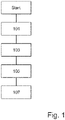
- the only figure 1 shows the course of the process according to the invention for producing an absorbent as a block diagram.
- the process begins with the starting product manganese dioxide MnO 2 .
- this starting product is calcined, preferably at a temperature of about 650° C. and over a period of time of about six hours. The calcination results in a precursor substance di-manganese tri-oxide Mn 2 O 3 being formed.
- This precursor is placed in an autoclave (block 103) along with lithium precursors (preferred) LiOH.
- the lithium manganese dioxide LiMnO 2 is produced there by hydrothermal synthesis. A temperature of around 120°C and a duration of 24 hours have proven to be suitable process parameters. It is also advantageous if the hydrothermal synthesis takes place at pressures of 10 bar or more.
- this lithium manganese dioxide is calcined, preferably at a temperature of 400° C. and for a period of four hours. This creates the precursor substance Li 1.6 Mn 1.6 O 4 of the adsorbent.
- this precursor substance is washed with acetic acid, sodium peroxodisulfate and/or ammonium peroxodisulfate.
- the proportion is preferably between 0.05% and 65%, and when ammonium peroxodisulfate is used, the proportion is between 0.05% and 65%.
- the liquid is filtered to separate the adsorbent which is in the form of a granular substance.
- This adsorbent is then washed with distilled water and then dried.
- the desired adsorbent H 1.6 Mn 1.6 O 4 is then present and can be used in an adsorption column to increase the concentration or to obtain lithium ions.
Landscapes
- Chemical & Material Sciences (AREA)
- Organic Chemistry (AREA)
- Analytical Chemistry (AREA)
- Chemical Kinetics & Catalysis (AREA)
- Inorganic Chemistry (AREA)
- Physics & Mathematics (AREA)
- Thermal Sciences (AREA)
- Solid-Sorbent Or Filter-Aiding Compositions (AREA)
Applications Claiming Priority (1)
| Application Number | Priority Date | Filing Date | Title |
|---|---|---|---|
| DE102021108442.3A DE102021108442B4 (de) | 2021-04-01 | 2021-04-01 | Verfahren zur Herstellung eines Lithium-Adsorbens |
Publications (1)
| Publication Number | Publication Date |
|---|---|
| EP4066935A1 true EP4066935A1 (fr) | 2022-10-05 |
Family
ID=81449173
Family Applications (1)
| Application Number | Title | Priority Date | Filing Date |
|---|---|---|---|
| EP22166362.8A Pending EP4066935A1 (fr) | 2021-04-01 | 2022-04-01 | Procédé de fabrication d'un adsorbant au lithium |
Country Status (3)
| Country | Link |
|---|---|
| US (1) | US20220314195A1 (fr) |
| EP (1) | EP4066935A1 (fr) |
| DE (1) | DE102021108442B4 (fr) |
Families Citing this family (3)
| Publication number | Priority date | Publication date | Assignee | Title |
|---|---|---|---|---|
| DE102021114229A1 (de) | 2021-06-01 | 2022-12-01 | EnBW Energie Baden-Württemberg AG | Verfahren zum Freimachen einer durch ein Adsorbens zugesetzten Tiefbohrung |
| DE102023118084B3 (de) | 2023-07-07 | 2024-07-04 | EnBW Energie Baden-Württemberg AG | Anlage und Verfahren zur Gewinnung von Lithium aus Lithium-haltigen Fluiden unter Verwendung eines ersten Sorbens und eines zweiten Sorbens |
| US12390788B1 (en) * | 2024-03-27 | 2025-08-19 | Lithos Industries Inc. | Method for manufacturing doped sorbent compositions with enhanced loading capacities |
Citations (3)
| Publication number | Priority date | Publication date | Assignee | Title |
|---|---|---|---|---|
| US6764584B2 (en) | 2002-10-22 | 2004-07-20 | Industrial Technology Research Institute | Process for producing lithium concentrate from brine or seawater |
| CN103272554A (zh) | 2013-06-03 | 2013-09-04 | 长沙矿冶研究院有限责任公司 | 锂锰氧化物型锂吸附剂的制备方法 |
| WO2020115948A1 (fr) * | 2018-12-07 | 2020-06-11 | 住友金属鉱山株式会社 | Procédé de production d'une solution contenant du lithium |
Family Cites Families (5)
| Publication number | Priority date | Publication date | Assignee | Title |
|---|---|---|---|---|
| EP0959044A4 (fr) * | 1997-08-18 | 2004-08-11 | Agency Ind Science Techn | Preparation d'une composition en granules a base d'un melange d'oxydes de lithium et de manganese et son utilisation pour des piles secondaires aux ions lithium |
| JP3388406B2 (ja) | 1999-09-22 | 2003-03-24 | 独立行政法人産業技術総合研究所 | リチウム吸着剤の製造方法 |
| CN101961634B (zh) * | 2010-09-16 | 2012-05-30 | 中南大学 | 一种锰系锂离子筛吸附剂及其前躯体的制备方法 |
| US10648090B2 (en) * | 2018-02-17 | 2020-05-12 | Lilac Solutions, Inc. | Integrated system for lithium extraction and conversion |
| DE102021105808A1 (de) | 2021-03-10 | 2022-09-15 | EnBW Energie Baden-Württemberg AG | Verfahren zur Gewinnung von Lithium aus Sole oder Meerwasser |
-
2021
- 2021-04-01 DE DE102021108442.3A patent/DE102021108442B4/de active Active
-
2022
- 2022-04-01 EP EP22166362.8A patent/EP4066935A1/fr active Pending
- 2022-04-01 US US17/711,349 patent/US20220314195A1/en not_active Abandoned
Patent Citations (3)
| Publication number | Priority date | Publication date | Assignee | Title |
|---|---|---|---|---|
| US6764584B2 (en) | 2002-10-22 | 2004-07-20 | Industrial Technology Research Institute | Process for producing lithium concentrate from brine or seawater |
| CN103272554A (zh) | 2013-06-03 | 2013-09-04 | 长沙矿冶研究院有限责任公司 | 锂锰氧化物型锂吸附剂的制备方法 |
| WO2020115948A1 (fr) * | 2018-12-07 | 2020-06-11 | 住友金属鉱山株式会社 | Procédé de production d'une solution contenant du lithium |
Non-Patent Citations (3)
| Title |
|---|
| LIU DONG-FAN ET AL: "Li4Mn5O12 Desorption Process with Acetic Acid and Mn Dissolution Mechanism", JOURNAL OF CHEMICAL ENGINEERING OF JAPAN, vol. 52, no. 3, 20 March 2019 (2019-03-20), JP, pages 274 - 279, XP055951618, ISSN: 0021-9592, Retrieved from the Internet <URL:http://dx.doi.org/10.1252/jcej.18we209> DOI: 10.1252/jcej.18we209 * |
| SAFARI SALMAN ET AL: "Metal oxide sorbents for the sustainable recovery of lithium from unconventional resources", APPLIED MATERIALS, vol. 19, 1 June 2020 (2020-06-01), NL, pages 100638, XP055951621, ISSN: 2352-9407, Retrieved from the Internet <URL:http://dx.doi.org/10.1016/j.apmt.2020.100638> DOI: 10.1016/j.apmt.2020.100638 * |
| XICHANG SHI ET AL: "Synthesis and properties of LiMnOand its adsorption application", HYDROMETALLURGY, ELSEVIER SCIENTIFIC PUBLISHING CY. AMSTERDAM, NL, vol. 110, no. 1, 5 September 2011 (2011-09-05), pages 99 - 106, XP028334525, ISSN: 0304-386X, [retrieved on 20110912], DOI: 10.1016/J.HYDROMET.2011.09.004 * |
Also Published As
| Publication number | Publication date |
|---|---|
| US20220314195A1 (en) | 2022-10-06 |
| DE102021108442A1 (de) | 2022-10-06 |
| DE102021108442B4 (de) | 2023-01-26 |
Similar Documents
| Publication | Publication Date | Title |
|---|---|---|
| EP4066935A1 (fr) | Procédé de fabrication d'un adsorbant au lithium | |
| DE112022001347B4 (de) | VERFAHREN ZUR HERSTELLUNG EINES POSITIVEN ELEKTRODENMATERIALS FÜR EINE PREUßISCH-BLAU-NATRIUM-IONEN-BATTERIE | |
| DE112022002319B4 (de) | Herstellungsverfahren für mit Fluor dotiertes Material für positive Elektroden von Natriumionen-Batterien vom Typ Preussisch Blau | |
| DE2419490C3 (de) | Verfahren zur Herstellung von Mangandioxid | |
| EP2678272B1 (fr) | Procédé d'épuration d'acides forts ou de milieux acides forts par la séparation d'ions métalliques bivalents et de valence supérieure | |
| DE112022000163T5 (de) | Herstellungsverfahren für schwefelarmes nano-eisenphosphat | |
| DE102013016671A1 (de) | Verfahren zur hydrometallurgischen Rückgewinnung von Lithium, Nickel, Kobalt aus der Lithium-Übergangsmetalloxid haltigen Fraktion gebrauchter galvanischer Zellen | |
| DE112022000241B4 (de) | Verfahren zur selektiven extraktion von lithium aus einer ausgedienten batterie und anwendung des verfahrens | |
| EP2906731B1 (fr) | Procédé de récupération hydrométallurgique de lithium à partir de la fraction de cellules galvaniques usagées contenant du lithium, du fer et du phosphate | |
| DE112021005630T5 (de) | Regenerationsverfahren für abfallmaterial von ternären kathoden und anwendung davon | |
| DE112014001266T5 (de) | Verfahren zur Behandlung eines Aktivmaterials der positiven Elektrode für Lithiumionen-Sekundärbatterien | |
| EP2906729B1 (fr) | Procédé de récupération hydrométallurgique de lithium à partir de la fraction de cellules galvaniques usagées contenant de l'oxyde manganeux de lithium | |
| DE112021005338T5 (de) | Herstellungsverfahren für Heterosit-Eisenphosphat und Anwendung davon | |
| DE112022002591B4 (de) | Verfahren zur herstellung eines abwasseradsorptionsmittels zur verwendung bei der behandlung von ternärem vorläuferabwasser | |
| DE102014210613B4 (de) | Verfahren zur Herstellung von sphärischen Silizium-Kohlenstoff-Nanokompositen | |
| EP1652816A1 (fr) | Procede de production de graphite oxyde | |
| DE3034578A1 (de) | Kieselsaeuregel und elektrodialyseverfahren zu seiner herstellung | |
| DE102010021268A1 (de) | Additiv zur Herstellung von positiven aktiven Massen für Bleiakkumulatoren | |
| EP0182172A1 (fr) | Procédé pour améliorer les propriétés de stabilité des particules de résine échangeuse d'ions radioactives solidifiées | |
| DE102021105808A1 (de) | Verfahren zur Gewinnung von Lithium aus Sole oder Meerwasser | |
| DD230885A1 (de) | Verfahren zur herstellung von aktivem aluminiumoxyd | |
| DE4102539C2 (de) | Verfahren zum Regenerieren einer Elektrode für elektrochemischen Ionenaustausch | |
| DE102023118084B3 (de) | Anlage und Verfahren zur Gewinnung von Lithium aus Lithium-haltigen Fluiden unter Verwendung eines ersten Sorbens und eines zweiten Sorbens | |
| DE102016213718A1 (de) | Verfahren zur Herstellung von Lithiumverbindungen | |
| WO2014079887A1 (fr) | Solution d'électrolyte à faible teneur en acide |
Legal Events
| Date | Code | Title | Description |
|---|---|---|---|
| PUAI | Public reference made under article 153(3) epc to a published international application that has entered the european phase |
Free format text: ORIGINAL CODE: 0009012 |
|
| STAA | Information on the status of an ep patent application or granted ep patent |
Free format text: STATUS: THE APPLICATION HAS BEEN PUBLISHED |
|
| AK | Designated contracting states |
Kind code of ref document: A1 Designated state(s): AL AT BE BG CH CY CZ DE DK EE ES FI FR GB GR HR HU IE IS IT LI LT LU LV MC MK MT NL NO PL PT RO RS SE SI SK SM TR |
|
| STAA | Information on the status of an ep patent application or granted ep patent |
Free format text: STATUS: REQUEST FOR EXAMINATION WAS MADE |
|
| 17P | Request for examination filed |
Effective date: 20230405 |
|
| RBV | Designated contracting states (corrected) |
Designated state(s): AL AT BE BG CH CY CZ DE DK EE ES FI FR GB GR HR HU IE IS IT LI LT LU LV MC MK MT NL NO PL PT RO RS SE SI SK SM TR |