EP4067571A1 - A method for coating a hollow container comprising molded pulp - Google Patents
A method for coating a hollow container comprising molded pulp Download PDFInfo
- Publication number
- EP4067571A1 EP4067571A1 EP21166391.9A EP21166391A EP4067571A1 EP 4067571 A1 EP4067571 A1 EP 4067571A1 EP 21166391 A EP21166391 A EP 21166391A EP 4067571 A1 EP4067571 A1 EP 4067571A1
- Authority
- EP
- European Patent Office
- Prior art keywords
- hollow container
- container
- polymeric powder
- bottle
- upper portion
- Prior art date
- Legal status (The legal status is an assumption and is not a legal conclusion. Google has not performed a legal analysis and makes no representation as to the accuracy of the status listed.)
- Withdrawn
Links
Images

Classifications
-
- D—TEXTILES; PAPER
- D21—PAPER-MAKING; PRODUCTION OF CELLULOSE
- D21H—PULP COMPOSITIONS; PREPARATION THEREOF NOT COVERED BY SUBCLASSES D21C OR D21D; IMPREGNATING OR COATING OF PAPER; TREATMENT OF FINISHED PAPER NOT COVERED BY CLASS B31 OR SUBCLASS D21G; PAPER NOT OTHERWISE PROVIDED FOR
- D21H27/00—Special paper not otherwise provided for, e.g. made by multi-step processes
- D21H27/10—Packing paper
-
- D—TEXTILES; PAPER
- D21—PAPER-MAKING; PRODUCTION OF CELLULOSE
- D21J—FIBREBOARD; MANUFACTURE OF ARTICLES FROM CELLULOSIC FIBROUS SUSPENSIONS OR FROM PAPIER-MACHE
- D21J1/00—Fibreboard
- D21J1/08—Impregnated or coated fibreboard
-
- B—PERFORMING OPERATIONS; TRANSPORTING
- B29—WORKING OF PLASTICS; WORKING OF SUBSTANCES IN A PLASTIC STATE IN GENERAL
- B29D—PRODUCING PARTICULAR ARTICLES FROM PLASTICS OR FROM SUBSTANCES IN A PLASTIC STATE
- B29D22/00—Producing hollow articles
- B29D22/003—Containers for packaging, storing or transporting, e.g. bottles, jars, cans, barrels, tanks
-
- B—PERFORMING OPERATIONS; TRANSPORTING
- B65—CONVEYING; PACKING; STORING; HANDLING THIN OR FILAMENTARY MATERIAL
- B65D—CONTAINERS FOR STORAGE OR TRANSPORT OF ARTICLES OR MATERIALS, e.g. BAGS, BARRELS, BOTTLES, BOXES, CANS, CARTONS, CRATES, DRUMS, JARS, TANKS, HOPPERS, FORWARDING CONTAINERS; ACCESSORIES, CLOSURES, OR FITTINGS THEREFOR; PACKAGING ELEMENTS; PACKAGES
- B65D1/00—Rigid or semi-rigid containers having bodies formed in one piece, e.g. by casting metallic material, by moulding plastics, by blowing vitreous material, by throwing ceramic material, by moulding pulped fibrous material or by deep-drawing operations performed on sheet material
- B65D1/02—Bottles or similar containers with necks or like restricted apertures, designed for pouring contents
- B65D1/0207—Bottles or similar containers with necks or like restricted apertures, designed for pouring contents characterised by material, e.g. composition, physical features
-
- B—PERFORMING OPERATIONS; TRANSPORTING
- B65—CONVEYING; PACKING; STORING; HANDLING THIN OR FILAMENTARY MATERIAL
- B65D—CONTAINERS FOR STORAGE OR TRANSPORT OF ARTICLES OR MATERIALS, e.g. BAGS, BARRELS, BOTTLES, BOXES, CANS, CARTONS, CRATES, DRUMS, JARS, TANKS, HOPPERS, FORWARDING CONTAINERS; ACCESSORIES, CLOSURES, OR FITTINGS THEREFOR; PACKAGING ELEMENTS; PACKAGES
- B65D1/00—Rigid or semi-rigid containers having bodies formed in one piece, e.g. by casting metallic material, by moulding plastics, by blowing vitreous material, by throwing ceramic material, by moulding pulped fibrous material or by deep-drawing operations performed on sheet material
- B65D1/02—Bottles or similar containers with necks or like restricted apertures, designed for pouring contents
- B65D1/0207—Bottles or similar containers with necks or like restricted apertures, designed for pouring contents characterised by material, e.g. composition, physical features
- B65D1/0215—Bottles or similar containers with necks or like restricted apertures, designed for pouring contents characterised by material, e.g. composition, physical features multilayered
-
- B—PERFORMING OPERATIONS; TRANSPORTING
- B65—CONVEYING; PACKING; STORING; HANDLING THIN OR FILAMENTARY MATERIAL
- B65D—CONTAINERS FOR STORAGE OR TRANSPORT OF ARTICLES OR MATERIALS, e.g. BAGS, BARRELS, BOTTLES, BOXES, CANS, CARTONS, CRATES, DRUMS, JARS, TANKS, HOPPERS, FORWARDING CONTAINERS; ACCESSORIES, CLOSURES, OR FITTINGS THEREFOR; PACKAGING ELEMENTS; PACKAGES
- B65D23/00—Details of bottles or jars not otherwise provided for
- B65D23/02—Linings or internal coatings
-
- B—PERFORMING OPERATIONS; TRANSPORTING
- B65—CONVEYING; PACKING; STORING; HANDLING THIN OR FILAMENTARY MATERIAL
- B65D—CONTAINERS FOR STORAGE OR TRANSPORT OF ARTICLES OR MATERIALS, e.g. BAGS, BARRELS, BOTTLES, BOXES, CANS, CARTONS, CRATES, DRUMS, JARS, TANKS, HOPPERS, FORWARDING CONTAINERS; ACCESSORIES, CLOSURES, OR FITTINGS THEREFOR; PACKAGING ELEMENTS; PACKAGES
- B65D23/00—Details of bottles or jars not otherwise provided for
- B65D23/08—Coverings or external coatings
- B65D23/0807—Coatings
- B65D23/0814—Coatings characterised by the composition of the material
- B65D23/0821—Coatings characterised by the composition of the material consisting mainly of polymeric materials
-
- B—PERFORMING OPERATIONS; TRANSPORTING
- B65—CONVEYING; PACKING; STORING; HANDLING THIN OR FILAMENTARY MATERIAL
- B65D—CONTAINERS FOR STORAGE OR TRANSPORT OF ARTICLES OR MATERIALS, e.g. BAGS, BARRELS, BOTTLES, BOXES, CANS, CARTONS, CRATES, DRUMS, JARS, TANKS, HOPPERS, FORWARDING CONTAINERS; ACCESSORIES, CLOSURES, OR FITTINGS THEREFOR; PACKAGING ELEMENTS; PACKAGES
- B65D65/00—Wrappers or flexible covers; Packaging materials of special type or form
- B65D65/38—Packaging materials of special type or form
- B65D65/42—Applications of coated or impregnated materials
-
- D—TEXTILES; PAPER
- D21—PAPER-MAKING; PRODUCTION OF CELLULOSE
- D21H—PULP COMPOSITIONS; PREPARATION THEREOF NOT COVERED BY SUBCLASSES D21C OR D21D; IMPREGNATING OR COATING OF PAPER; TREATMENT OF FINISHED PAPER NOT COVERED BY CLASS B31 OR SUBCLASS D21G; PAPER NOT OTHERWISE PROVIDED FOR
- D21H19/00—Coated paper; Coating material
- D21H19/02—Metal coatings
- D21H19/06—Metal coatings applied as liquid or powder
-
- D—TEXTILES; PAPER
- D21—PAPER-MAKING; PRODUCTION OF CELLULOSE
- D21H—PULP COMPOSITIONS; PREPARATION THEREOF NOT COVERED BY SUBCLASSES D21C OR D21D; IMPREGNATING OR COATING OF PAPER; TREATMENT OF FINISHED PAPER NOT COVERED BY CLASS B31 OR SUBCLASS D21G; PAPER NOT OTHERWISE PROVIDED FOR
- D21H19/00—Coated paper; Coating material
- D21H19/10—Coatings without pigments
- D21H19/14—Coatings without pigments applied in a form other than the aqueous solution defined in group D21H19/12
- D21H19/20—Coatings without pigments applied in a form other than the aqueous solution defined in group D21H19/12 comprising macromolecular compounds obtained by reactions only involving carbon-to-carbon unsaturated bonds
- D21H19/22—Polyalkenes, e.g. polystyrene
-
- D—TEXTILES; PAPER
- D21—PAPER-MAKING; PRODUCTION OF CELLULOSE
- D21H—PULP COMPOSITIONS; PREPARATION THEREOF NOT COVERED BY SUBCLASSES D21C OR D21D; IMPREGNATING OR COATING OF PAPER; TREATMENT OF FINISHED PAPER NOT COVERED BY CLASS B31 OR SUBCLASS D21G; PAPER NOT OTHERWISE PROVIDED FOR
- D21H19/00—Coated paper; Coating material
- D21H19/80—Paper comprising more than one coating
- D21H19/84—Paper comprising more than one coating on both sides of the substrate
-
- D—TEXTILES; PAPER
- D21—PAPER-MAKING; PRODUCTION OF CELLULOSE
- D21H—PULP COMPOSITIONS; PREPARATION THEREOF NOT COVERED BY SUBCLASSES D21C OR D21D; IMPREGNATING OR COATING OF PAPER; TREATMENT OF FINISHED PAPER NOT COVERED BY CLASS B31 OR SUBCLASS D21G; PAPER NOT OTHERWISE PROVIDED FOR
- D21H21/00—Non-fibrous material added to the pulp, characterised by its function, form or properties; Paper-impregnating or coating material, characterised by its function, form or properties
- D21H21/14—Non-fibrous material added to the pulp, characterised by its function, form or properties; Paper-impregnating or coating material, characterised by its function, form or properties characterised by function or properties in or on the paper
- D21H21/16—Sizing or water-repelling agents
-
- D—TEXTILES; PAPER
- D21—PAPER-MAKING; PRODUCTION OF CELLULOSE
- D21H—PULP COMPOSITIONS; PREPARATION THEREOF NOT COVERED BY SUBCLASSES D21C OR D21D; IMPREGNATING OR COATING OF PAPER; TREATMENT OF FINISHED PAPER NOT COVERED BY CLASS B31 OR SUBCLASS D21G; PAPER NOT OTHERWISE PROVIDED FOR
- D21H23/00—Processes or apparatus for adding material to the pulp or to the paper
- D21H23/02—Processes or apparatus for adding material to the pulp or to the paper characterised by the manner in which substances are added
- D21H23/22—Addition to the formed paper
- D21H23/50—Spraying or projecting
-
- D—TEXTILES; PAPER
- D21—PAPER-MAKING; PRODUCTION OF CELLULOSE
- D21H—PULP COMPOSITIONS; PREPARATION THEREOF NOT COVERED BY SUBCLASSES D21C OR D21D; IMPREGNATING OR COATING OF PAPER; TREATMENT OF FINISHED PAPER NOT COVERED BY CLASS B31 OR SUBCLASS D21G; PAPER NOT OTHERWISE PROVIDED FOR
- D21H23/00—Processes or apparatus for adding material to the pulp or to the paper
- D21H23/02—Processes or apparatus for adding material to the pulp or to the paper characterised by the manner in which substances are added
- D21H23/22—Addition to the formed paper
- D21H23/70—Multistep processes; Apparatus for adding one or several substances in portions or in various ways to the paper, not covered by another single group of this main group
- D21H23/72—Plural serial stages only
-
- D—TEXTILES; PAPER
- D21—PAPER-MAKING; PRODUCTION OF CELLULOSE
- D21J—FIBREBOARD; MANUFACTURE OF ARTICLES FROM CELLULOSIC FIBROUS SUSPENSIONS OR FROM PAPIER-MACHE
- D21J3/00—Manufacture of articles by pressing wet fibre pulp, or papier-mâché, between moulds
- D21J3/10—Manufacture of articles by pressing wet fibre pulp, or papier-mâché, between moulds of hollow bodies
-
- B—PERFORMING OPERATIONS; TRANSPORTING
- B65—CONVEYING; PACKING; STORING; HANDLING THIN OR FILAMENTARY MATERIAL
- B65D—CONTAINERS FOR STORAGE OR TRANSPORT OF ARTICLES OR MATERIALS, e.g. BAGS, BARRELS, BOTTLES, BOXES, CANS, CARTONS, CRATES, DRUMS, JARS, TANKS, HOPPERS, FORWARDING CONTAINERS; ACCESSORIES, CLOSURES, OR FITTINGS THEREFOR; PACKAGING ELEMENTS; PACKAGES
- B65D2565/00—Wrappers or flexible covers; Packaging materials of special type or form
- B65D2565/38—Packaging materials of special type or form
- B65D2565/381—Details of packaging materials of special type or form
- B65D2565/387—Materials used as gas barriers
Definitions
- the present disclosure generally relates to a method for providing a barrier coating on a hollow container comprising molded pulp.
- the method comprises providing a polymeric powder coating onto the interior surface and at least a portion of the exterior surface of the container prior to curing and/or melting the powder coatings.
- the present disclosure also relates to a hollow container formed by the method.
- Plastic containers, packaging trays and bottles are extensively used for storing food products, such as flowable food and beverages.
- Plastic articles can be easily molded, stretched, and produced at a relatively low cost.
- the use of plastics is associated with environmental concerns. In order to relieve the environmental burden, attempts have been made to replace plastic containers and bottles with renewable materials, such as molded pulp.
- Shaped pulp products such as paper containers and bottles may be formed by feeding pulp, e.g. paper pulp into a split mold and subsequently dewatering the pulp with heat and/or pressure, as disclosed in e.g. WO16055072 .
- paper Although paper is regarded as a sustainable packaging material, paper has a number of drawbacks compared to traditional plastics. Paper is generally more permeable to gases, grease, and moisture. Long-time exposure to moisture, as is typically the case during storage of beverages, may lead to deterioration of the inner walls of the paper container.
- the inner walls of the paper container may be coated with a barrier coating to protect the container from deteriorating due to liquid and moist exposure.
- Barrier coatings may also be used to control the humidity, sealing properties, aroma etc. of the container.
- Barrier coatings typically comprise polymers, such as polyolefin polymers, and may be applied to the inner container walls in various ways, e.g. by extrusion coating or applied as liquid coatings.
- a powder coating is a dry, finely divided solid material that is commonly used on electrically conductive metal substrates.
- the deposition of a powder coating is typically achieved by electrostatic forces.
- the powder may be charged by corona discharge and then sprayed onto a grounded substrate. Accordingly, a powder layer is applied to the substrate, which is subsequently heated such that the powder melts and forms a continuous film on the substrate.
- the deposition of a powder coating onto a molded pulp substrate is, however, challenging due to the inherent non-conductive properties of such a substrate.
- the coating is not assisted by electrostatic attraction, which may result in poor adhesion of the powder to the substrate, and in an uneven powder deposition.
- the complexity of depositing a powder coating increases if the product to be coated is shaped as a hollow container, e.g. a bottle. In such cases, it may also be desirable to coat the upper exterior part of the container, i.e. the portion surrounding the opening of the container. This portion of the product is typically subject to repeated exposure to moist and liquid during drinking or pouring from the container.
- a method for providing a barrier coating on a hollow container comprising molded pulp comprising:
- the present disclosure is based on the realization that both the interior surface and a portion of the exterior surface of the hollow container can be coated prior to treatment with heat or irradiation; i.e. prior to formation of a continuous barrier coating. Accordingly, the most "vulnerable" parts of the container; i.e. the parts predominantly exposed to moist and liquid during use, can be coated in one step, and only one heating or irradiation step is required in the method.
- Depositing a powder coating onto these portions of a hollow container is associated with complex processability.
- a hollow container formed according to the method of the present disclosure only requires one step of heat or irradiation treatment after the interior surface and the exterior surface of a portion of the upper portion have been coated. Accordingly, significant savings in time and costs, and a more simplified method is provided.
- the polymeric powder particles are electrically charged by means of the spraying device, and due to its negative (or positive) electric charge, the powder will seek a grounded surface which has a more positive (or negative) charge. Accordingly, the powder particles will adhere to the container surface. During the subsequent heating or irradiation step, the applied polymeric powder coating will melt and cure such that an even and durable protective barrier coating is provided.
- the inventors have found that the moisture content and relative humidity of the hollow container largely impacts the ability of the hollow container to be coated on both the interior surface and the exterior surface of at least the upper portion.
- a moisture content in the above ranges allows for at least a portion of the upper portion to be coated without connection to a grounded electrically conductive surface.
- pulp is inherently non-conductive, the presence of a grounded electrically conductive surface is required for the powder to adhere to the pulp container.
- this is not required.
- the moisture content of the hollow container may be selectively steered and controlled depending on the size of the container and depending on the use of the container. For example, in some situations, it may be desired to coat a large proportion of the upper portion of the container, whereas in others, only a smaller proportion may be desired. By tailoring the moisture content and the relative humidity level, situation-specific adjustments may be accomplished.
- the moisture content in the above mentioned range allows for the deposition of polymeric powder on both the interior and exterior surface of the container walls to be accomplished simultaneously or in consecutive order. Accordingly, no melting and/or curing step is required between steps b) and c) of the method.
- the polymeric powder deposition steps b) and c) are performed simultaneously.
- the polymeric powder deposition step c) is performed by arranging the spraying device at a distance, d1, of from 50 mm to 250 mm, preferably of from 70 mm to 150 mm from the opening of the hollow container.
- the tip of the spraying device is typically arranged along the longitudinal center line such that the flow of polymeric powder particles can cover the entire surface of the upper portion, if desired.
- the spraying device may in the first polymeric powder deposition step b), either be inserted into the opening, or arranged in proximity of the opening during spraying.
- the charged polymeric powder particles will be electrically attracted to, and allowed to adhere to the interior surface of the hollow container.
- the spraying device is removed from the container opening and arranged at the distance, d1, from the opening of the container.
- the nozzle or tip of the spraying device is typically arranged vertically from the opening of the container; i.e. along the longitudinal center line of the container. This is to secure coverage of the powder on a large surface of the upper portion of the hollow container.
- the polymeric powder deposition step b) is carried out in a molding device comprising an electrically conductive material, preferably a metal; the molding device comprising at least a first and a second removable portion, wherein the first removable portion is configured to enclose the upper portion of the hollow container and wherein the second removable portion is configured to enclose the main portion of the hollow container.
- the spraying device imparts a charged field such that the polymeric powder particles are charged and electrically attracted to the grounded and electrically conductive surfaces of the hollow container.
- the first and the second removable portions of the molding device may be arranged to enclose both the main and the upper portion of the hollow container. Accordingly, the entire interior surface of the container is electrically charged during polymeric powder deposition of the interior part of the container. A flow of electrically charged polymeric powder particles is directed to the interior surface of the hollow container and will adhere thereto.
- the electrical charge carried by the grounded surface will be spread across the entire area of the interior surface. Accordingly, an even powder coating will be applied across the interior surface of the hollow container.
- the polymeric powder deposition step b) may be carried out with only the second removable portion present.
- a spraying device such as a spray gun
- a spray gun may be inserted into the opening of the hollow container (or in proximity of the opening) in order to coat the interior surface of the container.
- the first removable portion is removed from the molding device during the polymeric powder deposition step c).
- the first removable portion (configured to enclose the upper portion of the container), is removed, and the spraying device is removed from the interior or the opening of the container and arranged at a distance from the container. Spraying of at least a portion of the upper portion of the container can then be accomplished.
- the upper portion of the container is not connected to a grounded electrically conductive surface.
- a simplified method for providing both an interior barrier coating and an exterior barrier coating is provided.
- the method only requires one or two spray sequences and only one heat or irradiation treatment following the spray sequence(s).
- the exterior surface of the upper portion will be coated.
- the exterior surface of the main portion of the container does not comprise any barrier coating. This is to yield a more paper like and "raw feel" on the main part of the container.
- the hollow container is a bottle, wherein the upper portion comprises a shoulder portion and a neck portion, wherein the neck portion has a smaller cross-sectional area than the main portion and is configured to circumferent at least the opening of the bottle and wherein the shoulder portion is arranged to taper between the main portion and the neck portion.
- At least the neck portion of the upper portion of the bottle is coated in the polymeric powder deposition step c).
- the neck portion is preferably coated since this portion is exposed to moist and liquid when a person drinks from the bottle or when flowable food or liquid is poured from the bottle.
- the entire upper portion of the hollow container is coated in the polymeric powder deposition step c).
- the moisture content of the hollow container corresponds to conditioning at an ambient relative humidity of above 70%.
- the hollow container is treated with heat or irradiation under conditions that melt and/or cure the polymeric powder after the steps b) and c).
- the curing step d) is performed by heating the hollow container at a temperature of from 150°C to 200°C, preferably from 170°C to 190°C for 5 to 30 minutes, preferably from 8 to 15 minutes.
- a uniform barrier coating is provided on the interior surface and exterior surface of the upper portion of the container.
- the thickness of the barrier coating formed in the coating step b) and/or c) is in the range of from 5 to 200 ⁇ m, e.g. from 20 to 100 ⁇ m.
- the molded pulp is formed from a mixture of a first and a second pulp, wherein
- Such a pulp mixture allows for the strength of the container walls to be enhanced, and furthermore allows for a quick dewatering of the pulp during molding.
- a hollow container formed by the method described hereinbefore.
- the hollow container comprises a main portion and an upper portion; the hollow container extending along a longitudinal center line, wherein the longitudinal extension of the upper portion corresponds to 5-30% of the maximum longitudinal extension of the hollow container, and wherein the longitudinal extension of the main portion corresponds to 70-95% of the maximum longitudinal extension of the hollow container, wherein the hollow container comprises a bottom surface and sidewalls extending from the bottom surface to an opening of the hollow container; the sidewalls and the bottom surface defining an exterior surface and an interior surface of the hollow container, wherein the hollow container comprises a barrier coating comprising polymeric powder on the interior surface of the hollow container and on the exterior surface of at least a portion of the upper portion of the hollow container.
- the hollow container is a bottle.
- the upper portion typically comprises a shoulder portion and a neck portion, wherein the neck portion has a smaller cross-sectional area than the main portion and is configured to circumferent at least the opening of the bottle, and wherein the shoulder portion is arranged to taper between the main portion and the neck portion, wherein the bottle comprises a barrier coating comprising polymeric powder on the interior surface of the bottle and on at least the exterior surface of the neck portion of the bottle.
- the exterior surface of the main portion of the bottle does not comprise any barrier coating.
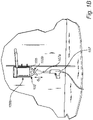
- FIG. 1a-b a method for providing a barrier coating on a hollow container comprising molded pulp is conceptually illustrated.
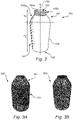
- Figure 2 illustrates a hollow container, i.e. a bottle, formed by the method of the present disclosure
- the method of the present disclosure comprises:
- the term "hollow container” means any kind of container, such as a jar, tray, cup, bowl or a bottle.
- the hollow container is a bottle.
- the hollow container has a rotational symmetry about the longitudinal center line.
- the shape of the hollow container is generally cylindrical.
- molded pulp means a pulp or a pulp mixture that is shaped, pressed and dried.
- the molded pulp is may e.g. be made from paper or wood fibers.
- the pulp may be a fibrous material produced by mechanically or chemically reducing woody plants to their component parts and then suspended in a fluid, e.g. water.
- the "interior surface" of the hollow container is defined by the sidewalls and the bottom surface of the container.
- the interior surface may also be referred to as the interior walls.
- the "exterior surface” is defined by the sidewalls and the bottom surface of the container.
- the exterior surface may also be referred to as the exterior walls.
- the polymeric powder used for coating of the hollow container is not limited.
- the powder may comprise a thermoplastic polymer selected from polyolefins, e.g. polyethylene or polypropylene and copolymers thereof, polyamides and polyesters, and copolymers thereof.
- the polymeric powder may also comprise water soluble synthetic polymers, such as polyvinyl alcohol or polysaccharides, such as cellulose.
- the powder particles typically have an average size in the range of 1 to 200 ⁇ m, e.g. from 5 to 100 ⁇ m, e.g. from 10 to 50 ⁇ m. These ranges allow for an even coating, and furthermore allow for charging of the polymeric powder particles to be accomplished by the spraying device.
- the longitudinal extension of the upper portion 102 corresponds to 5-30%, preferably 10-20% of the maximum longitudinal extension of the hollow container.
- the longitudinal extension of the upper portion is denoted e1 in figure 2 .
- the longitudinal extension of the main portion 101 corresponds to 70-95%, preferably 80-90% of the maximum longitudinal extension of the hollow container.
- the longitudinal extension of the main portion 101 is denoted e2 in figure 2 .
- a hollow container comprising molded pulp may be provided by means known to the skilled person.
- the hollow container may be provided by depositing a pulp mixture into a mold, e.g. a split-mold, activating a pressing tool, e.g. an impermeable balloon within the interior cavity of the mold such that the pulp assumes the shape of the balloon, thereby forming the interior and exterior walls of the hollow container.
- the molded pulp may then be drained such that excessive water is removed.
- a process for providing a hollow container is e.g. described in WO16055073 .
- Other means for providing a hollow container comprising molded pulp are also conceivable.
- the hollow container may then be removed from the split-mold, and is typically further conditioned prior to applying a powder coating onto the interior and exterior container walls.
- the step of providing a hollow container comprising molded pulp is achieved in the same molding device used for providing the interior and exterior coatings in steps b) and c) of the method.
- the spraying device used for polymeric powder coating is a spray gun.
- the method is by no means limited to the use of a spray gun, but any spraying device capable of charging the powder prior to or during deposition of the powder can be used.
- the powder is typically charged by corona charging; i.e. the powder particles pass through a charged corona field at the tip or nozzle of the spray gun, which applies a negative (or positive) charge to each of the polymeric powder particles. This allows for the powder particles to strongly adhere to the grounded and electrically conductive parts of the hollow container and stick thereto.
- the spraying device 107 comprises a nozzle 107a that is inserted into the hollow container; i.e. into the bottle.
- the polymeric powder deposition step b) is carried out in a molding device 108 comprising an electrically conductive material, preferably a metal; the molding device 108 comprising at least a first 108a and a second 108b removable portion, wherein the first removable portion 108a is configured to enclose the upper portion 102 of the container and wherein at least the second removable portion 108b is configured to enclose the main portion 101 of the container.
- the molding device 108 also comprises a third removable portion 108c.
- the first removable portion 108a is configured to enclose the upper portion 102 of the hollow container, and the second 108b and the third 108c removable portions are configured to enclose the main portion 101 of the hollow container.
- the term “enclose”, in this context means that the removable mold portions surround and contact the hollow container portions such that an evenly grounded and electrically conductive surface is achieved.
- the respective removable mold portions has a shape that matches the shape of the hollow container portions.
- the molding device 108 may e.g. comprise aluminum.
- the molding device 108 is configured to enclose the hollow container 100 to secure grounding and contact with an electrically conductive surface during polymeric powder deposition.
- the main portion 101 and the upper portion 102 of the container are enclosed by the molding device 108 during the polymeric powder deposition step b).
- the interior powder coating may be provided by continuously spraying the interior of the hollow container for about 1 to 20, e.g. 2 to 10 seconds. Charged particles are blown from the nozzle 107a towards the interior walls 105a of the container. An even electrical field is achieved by means of the molding device 108 enclosing the main and upper portions of the container. Accordingly, an even and uniform barrier coating covering substantially all parts of the interior walls of the container is achieved.
- Figure 1b illustrates the step of providing an exterior coating on the exterior surface of the upper portion 102 of the container 100.
- the first removable portion 108a is removed from the molding device 108.
- the tip of the spraying device 107 is arranged at an axial distance, d1, of from 50 mm to 250 mm, preferably of from 70 mm to 150 mm from the opening of the container.
- spraying is achieved by arranging the tip or the nozzle of the spraying device 107 in a vertical position with respect to the center of the opening of the container; i.e. along the longitudinal center line.
- the hollow container is preferably a bottle.
- the bottle comprises a bottom surface 104 and sidewalls 105 extending from the bottom surface 104 to an opening 106 of the bottle; the sidewalls 105 defining the main portion 101 and the upper portion 102 of the bottle.
- the bottle may have a rotational symmetry about the longitudinal center line 103.
- the bottle typically has a substantially cylindrical shape.
- the upper portion 102 comprises a shoulder portion 102a and a neck portion 102b, wherein the neck portion 102b has a smaller cross-sectional area than the main portion 101 and is configured to circumferent at least the opening 106 of the bottle, and wherein the shoulder portion 102a is arranged to taper between the main portion and the neck portion.
- the shoulder portion typically tapers at an angle of from about 5 to 75 degrees, e.g. from 20 to 60 degrees between the main portion and the neck portion.
- the neck portion 102b is threaded.
- a threaded neck portion may be beneficial in various bottle applications, but the present disclosure is not limited to the neck portion being threaded.
- the neck portion 102b of the bottle is the portion subject to most moist and liquid. This portion is coated in the step c) of the method.
- the neck portion has a smaller cross-sectional area than the remaining parts of the upper portion 102 of the bottle.
- the threaded portion typically has a trapezoidal configuration; i.e. a "screw thread profile" which enables a cap to be screwed thereto.
- the main portion 101 and the upper portion 102 (comprising the neck portion and the shoulder portion) of the hollow container are formed integrally.
- step c In the step of providing an exterior coating (step c), at least the neck portion 102b of the upper portion is coated.
- the hollow container is subject to treatment with heat and/or irradiation under conditions that melt and/or cure the polymeric powder.
- the deposited polymeric powder coatings soften, melt and/or cure and a continuous barrier coating is provided.
- the heat treatment step may vary.
- the hollow container is subject to heat treatment at a temperature of from 100°C to 300°C.
- the heat treatment time may be between 1 and 30 minutes.
- the powder coatings may be treated with ultraviolet (UV) light, which typically allows for a fast melting and curing of the powder coating.
- UV ultraviolet
- the curing step d) is performed by heating the hollow container at a temperature of from 150°C to 200°C, preferably from 170°C to 190°C for 5 to 20 minutes, preferably from 8 to 15 minutes.
- the method of the present disclosure allows for coating of both the interior surface and the exterior surface prior to heat (or irradiation) treatment. Accordingly, only one curing or melting step is required in the method. This is beneficial since the method is considerably simplified and saves time compared to if e.g. heating would have to be performed after the respective coating steps b) and c).
- the step(s) of providing the interior and the exterior coatings in the same spraying sequence(s); i.e. prior to the heating or irradiating the polymeric powder coating may be connected to the moisture content of the hollow container.
- the hollow container preferably has a moisture content corresponding to conditioning at an ambient relative humidity in the range of from 60 to 100%, preferably from 75 to 95% during the steps of polymeric powder deposition.
- moisture content corresponding to conditioning at an ambient relative humidity means that the moisture content of the container has reached the humidity that corresponds to an equilibrium with the surrounding atmosphere at room temperature.
- the term reflects the amount of moisture contained by the material of the hollow container when it is in equilibrium with that of the surrounding atmosphere and where the container will not gain or lose moisture to the atmosphere.
- This feature further allows for coating the exterior surface of the upper container portion, wherein the upper portion is not grounded or arranged in contact with an electrically conductive surface during the polymeric powder deposition.
- the method may comprise a step of
- the conditioning time may be at least 2 hours, e.g. at least 10 hours, preferably at least 15 hours at an ambient relative humidity of from 60 to 100%, e.g. from 75 to 95%.
- the hollow containers may be conditioned at room temperature.
- the polymeric powder deposition step b) is typically performed directly after the step of conditioning to maintain the relative humidity of the hollow container during powder coating.
- the molded pulp is formed from a mixture of a first and a second pulp, wherein
- Such a pulp mixture allows for an enhanced strength of the walls of the container and also affects how quickly the pulp can be dewatered in the mold. Accordingly, the step of providing a hollow container can be achieved in a quicker and more robust manner.
- the first pulp may be unrefined or only modestly refined.
- the second pulp typically has a higher degree of refining than the first pulp. Accordingly, the average fiber length is greater in the first pulp than in the second pulp.
- the first and/or the second pulp may comprise "market pulp”; i.e. pulp produced in one location, dried and shipped to another location for further processing.
- At least 50%, e.g. at least 75%, e.g. at least 90% by dry weight of the first and/or second pulp is softwood pulp.
- softwood pulp Such pulp mixture allows for stronger container walls to be provided.
- the thickness of the coating formed in the coating step b) and/or c) is in the range of from 5 to 200 ⁇ m, e.g. from 20 to 100 ⁇ m.
- a hollow container formed according to the method described hereinbefore.
- the hollow container comprises a main portion 101 and an upper portion 102; the hollow container extending along a longitudinal center line 103, wherein the longitudinal extension of the upper portion 102 corresponds to 5-30% of the maximum longitudinal extension of the hollow container 100, and wherein the longitudinal extension of the main portion 101 corresponds to 70-95% of the maximum longitudinal extension of the hollow container 100, wherein the hollow container comprises a bottom surface 104 and sidewalls 105 extending from the bottom surface 104 to an opening 106 of the hollow container; the sidewalls 105 and the bottom surface 104 defining an exterior surface and an interior surface 105a of the hollow container, wherein the hollow container comprises a barrier coating comprising polymeric powder on the interior surface 105a of the hollow container and on the exterior surface of at least a portion of the upper portion 102 of the hollow container.
- the hollow container is a bottle; the upper portion 102 comprising a shoulder portion 102a and a neck portion 102b; wherein the neck portion has a smaller cross-sectional area than the main portion and is configured to circumferent at least the opening 106 of the bottle, and wherein the shoulder portion is arranged to taper between the main portion and the neck portion; wherein the bottle comprises a barrier coating comprising polymeric powder on the interior surface 105a of the bottle and on at least the exterior surface of the neck portion 102b of the bottle.
- the exterior surface of the main portion 101 of the bottle preferably does not comprise any barrier coating. Accordingly, the main part of the exterior surface of the bottle will have a paper like appearance with no gloss.
- the aim of the test was to apply a polymer powder coating to the interior surfaces of the bottle and the exterior surfaces of the upper portion; i.e. the neck portion, of the bottle prior to subjecting the coatings to heat treatment.
- Each bottle comprised a pulp formed from a mixture of chemical and mechanical pulp.
- the bottles were mounted in an aluminum molding device, hung upside down as illustrated in figures 1a-b .
- the aluminium molding device comprised three removable portions.
- the spray gun used to deposit the powder coatings was a Nordson Encore HD automatic powder coating gun.
- the polymeric powder used was a HDPE powder with a particle size distribution of 0-80 um.
- the spray gun nozzle was inserted in each bottle approximately 10 mm from the bottom surface of the bottle.
- the spraying sequence lasted for about 5-7 seconds, and was continuous while moving the spray gun out of the bottle.
- RH relative humidity
- Figure 3a illustrates the exterior coating 103 on the upper portion of the bottle 300.
- the main portion 101 of the bottle 300 does not have any coating on the exterior walls.
- Figure 3a illustrates the bottle 300 after curing.
Landscapes
- Engineering & Computer Science (AREA)
- Mechanical Engineering (AREA)
- Manufacturing & Machinery (AREA)
- Ceramic Engineering (AREA)
- Chemical & Material Sciences (AREA)
- Chemical Kinetics & Catalysis (AREA)
- Containers Having Bodies Formed In One Piece (AREA)
- Details Of Rigid Or Semi-Rigid Containers (AREA)
- Application Of Or Painting With Fluid Materials (AREA)
Priority Applications (7)
| Application Number | Priority Date | Filing Date | Title |
|---|---|---|---|
| EP21166391.9A EP4067571A1 (en) | 2021-03-31 | 2021-03-31 | A method for coating a hollow container comprising molded pulp |
| PCT/EP2022/057989 WO2022207507A1 (en) | 2021-03-31 | 2022-03-25 | A method for coating a hollow container comprising molded pulp |
| CN202280027195.1A CN117120689A (zh) | 2021-03-31 | 2022-03-25 | 用于对包含模制浆状物的中空容器进行涂覆的方法 |
| US18/551,924 US20240167228A1 (en) | 2021-03-31 | 2022-03-25 | A method for coating a hollow container comprising molded pulp |
| PL22718203.7T PL4314408T3 (pl) | 2021-03-31 | 2022-03-25 | Sposób powlekania pustego pojemnika z uformowanej masy celulozowej |
| EP22718203.7A EP4314408B1 (en) | 2021-03-31 | 2022-03-25 | A method for coating a hollow container comprising molded pulp |
| ES22718203T ES3016482T3 (en) | 2021-03-31 | 2022-03-25 | A method for coating a hollow container comprising molded pulp |
Applications Claiming Priority (1)
| Application Number | Priority Date | Filing Date | Title |
|---|---|---|---|
| EP21166391.9A EP4067571A1 (en) | 2021-03-31 | 2021-03-31 | A method for coating a hollow container comprising molded pulp |
Publications (1)
| Publication Number | Publication Date |
|---|---|
| EP4067571A1 true EP4067571A1 (en) | 2022-10-05 |
Family
ID=75625290
Family Applications (2)
| Application Number | Title | Priority Date | Filing Date |
|---|---|---|---|
| EP21166391.9A Withdrawn EP4067571A1 (en) | 2021-03-31 | 2021-03-31 | A method for coating a hollow container comprising molded pulp |
| EP22718203.7A Active EP4314408B1 (en) | 2021-03-31 | 2022-03-25 | A method for coating a hollow container comprising molded pulp |
Family Applications After (1)
| Application Number | Title | Priority Date | Filing Date |
|---|---|---|---|
| EP22718203.7A Active EP4314408B1 (en) | 2021-03-31 | 2022-03-25 | A method for coating a hollow container comprising molded pulp |
Country Status (6)
| Country | Link |
|---|---|
| US (1) | US20240167228A1 (pl) |
| EP (2) | EP4067571A1 (pl) |
| CN (1) | CN117120689A (pl) |
| ES (1) | ES3016482T3 (pl) |
| PL (1) | PL4314408T3 (pl) |
| WO (1) | WO2022207507A1 (pl) |
Cited By (2)
| Publication number | Priority date | Publication date | Assignee | Title |
|---|---|---|---|---|
| WO2024074682A1 (de) * | 2022-10-06 | 2024-04-11 | Alpla Werke Alwin Lehner Gmbh & Co. Kg | Vorrichtung zur beschichtung von faserbasierten hohlkörpern |
| IT202300002388A1 (it) * | 2023-02-13 | 2024-08-13 | Claudia Corazzi | Sistema di realizzazione di un flacone per cosmetici in fibra di cellulosa |
Families Citing this family (5)
| Publication number | Priority date | Publication date | Assignee | Title |
|---|---|---|---|---|
| DE102022134098A1 (de) * | 2022-12-20 | 2024-06-20 | Krones Aktiengesellschaft | Verfahren zum Herstellen eines Fasern umfassenden Behälters mit einer Fasern umfassenden Krempe, Fasern umfassender Behälter und Vorrichtung zum Ausführen des Verfahrens |
| DE102022134560A1 (de) | 2022-12-22 | 2024-06-27 | Krones Aktiengesellschaft | Vorrichtung und Verfahren zum Herstellen und Beschichten eines Behälters aus Fasern umfassendem Material |
| WO2025076736A1 (en) | 2023-10-11 | 2025-04-17 | The Procter & Gamble Company | Squeezable fiber-based bottle with a personal care composition |
| WO2025076743A1 (en) | 2023-10-11 | 2025-04-17 | The Procter & Gamble Company | Squeezable fiber-based bottle |
| WO2025230930A1 (en) | 2024-05-01 | 2025-11-06 | The Procter & Gamble Company | Fiber-based container containing a liquid conditioning composition |
Citations (5)
| Publication number | Priority date | Publication date | Assignee | Title |
|---|---|---|---|---|
| US5997643A (en) * | 1994-02-18 | 1999-12-07 | Nordson Corporation | Apparatus for powder coating welding cans |
| WO2010022267A1 (en) * | 2008-08-21 | 2010-02-25 | Sacred Green, Inc. | Compostable container for storing fluids |
| WO2016055073A1 (en) | 2014-10-08 | 2016-04-14 | Ecoxpac A/S | A system and a method for producing a molded article, such as a bottle |
| WO2016055072A1 (en) | 2014-10-08 | 2016-04-14 | Ecoxpac A/S | A system and a method for producing a molded article, such as a tray |
| WO2019175610A1 (en) * | 2018-03-16 | 2019-09-19 | Longcroft James Henry Stoddart | Biodegradable coatings for biodegradable substrates |
Family Cites Families (13)
| Publication number | Priority date | Publication date | Assignee | Title |
|---|---|---|---|---|
| US4283189A (en) * | 1976-12-13 | 1981-08-11 | Onoda Cement Co., Ltd. | Method of making and seam sealing a paper container |
| US5830274A (en) * | 1995-12-20 | 1998-11-03 | Ppg Industries, Inc. | Electrostatic deposition of charged coating particles onto a dielectric substrate |
| JP2000109077A (ja) * | 1998-10-06 | 2000-04-18 | Kao Corp | 中空容器 |
| US7370788B1 (en) * | 1998-12-28 | 2008-05-13 | Kao Corporation | Formed body |
| US7048975B1 (en) * | 1999-10-15 | 2006-05-23 | Kao Corporation | Pulp molded container |
| WO2001068984A1 (fr) * | 2000-03-13 | 2001-09-20 | Kao Corporation | Moule de sechage pour corps moule a partir de pate |
| JP2002127273A (ja) * | 2000-10-26 | 2002-05-08 | Toppan Printing Co Ltd | 耐水性に優れた紙製容器の製造方法 |
| FR2965491B1 (fr) * | 2010-10-05 | 2013-05-17 | Sgd Sa | Procede de revetement et machine de revetement correspondante |
| CN102502071A (zh) * | 2011-12-15 | 2012-06-20 | 青岛人民印刷有限公司 | 一种纸质液体包装材料端面防渗析的方法 |
| WO2013192260A1 (en) * | 2012-06-19 | 2013-12-27 | Pepsico, Inc. | Method for making molded fiber bottles |
| DE102017214472A1 (de) * | 2017-08-18 | 2019-02-21 | Sig Technology Ag | Ein Behälter mit einer ungefalteten Behälterschicht, beinhaltend eine Vielzahl von Partikeln, und einer Polymerschicht |
| DE102017214473A1 (de) * | 2017-08-18 | 2019-02-21 | Sig Technology Ag | Ein Verfahren zum Herstellen eines Behälters aus einer Zusammensetzung, beinhaltend eine Flüssigkeit und eine Vielzahl von Partikeln, insbesondere unter Einhaltung einer maximalen Geschwindigkeit der Zusammensetzung |
| EP3708709A1 (en) * | 2019-03-14 | 2020-09-16 | Danmarks Tekniske Universitet | Method of manufacturing a moulded pulp product and pulp moulding apparatus |
-
2021
- 2021-03-31 EP EP21166391.9A patent/EP4067571A1/en not_active Withdrawn
-
2022
- 2022-03-25 ES ES22718203T patent/ES3016482T3/es active Active
- 2022-03-25 PL PL22718203.7T patent/PL4314408T3/pl unknown
- 2022-03-25 WO PCT/EP2022/057989 patent/WO2022207507A1/en not_active Ceased
- 2022-03-25 CN CN202280027195.1A patent/CN117120689A/zh active Pending
- 2022-03-25 US US18/551,924 patent/US20240167228A1/en active Pending
- 2022-03-25 EP EP22718203.7A patent/EP4314408B1/en active Active
Patent Citations (5)
| Publication number | Priority date | Publication date | Assignee | Title |
|---|---|---|---|---|
| US5997643A (en) * | 1994-02-18 | 1999-12-07 | Nordson Corporation | Apparatus for powder coating welding cans |
| WO2010022267A1 (en) * | 2008-08-21 | 2010-02-25 | Sacred Green, Inc. | Compostable container for storing fluids |
| WO2016055073A1 (en) | 2014-10-08 | 2016-04-14 | Ecoxpac A/S | A system and a method for producing a molded article, such as a bottle |
| WO2016055072A1 (en) | 2014-10-08 | 2016-04-14 | Ecoxpac A/S | A system and a method for producing a molded article, such as a tray |
| WO2019175610A1 (en) * | 2018-03-16 | 2019-09-19 | Longcroft James Henry Stoddart | Biodegradable coatings for biodegradable substrates |
Cited By (3)
| Publication number | Priority date | Publication date | Assignee | Title |
|---|---|---|---|---|
| WO2024074682A1 (de) * | 2022-10-06 | 2024-04-11 | Alpla Werke Alwin Lehner Gmbh & Co. Kg | Vorrichtung zur beschichtung von faserbasierten hohlkörpern |
| CH720096A1 (de) * | 2022-10-06 | 2024-04-15 | Alpla Werke Alwin Lehner Gmbh & Co Kg | Vorrichtung zur Beschichtung von faserbasierten Hohlkörpern. |
| IT202300002388A1 (it) * | 2023-02-13 | 2024-08-13 | Claudia Corazzi | Sistema di realizzazione di un flacone per cosmetici in fibra di cellulosa |
Also Published As
| Publication number | Publication date |
|---|---|
| EP4314408A1 (en) | 2024-02-07 |
| ES3016482T3 (en) | 2025-05-09 |
| EP4314408B1 (en) | 2025-01-01 |
| EP4314408C0 (en) | 2025-01-01 |
| CN117120689A (zh) | 2023-11-24 |
| WO2022207507A1 (en) | 2022-10-06 |
| PL4314408T3 (pl) | 2025-03-24 |
| US20240167228A1 (en) | 2024-05-23 |
Similar Documents
| Publication | Publication Date | Title |
|---|---|---|
| EP4067571A1 (en) | A method for coating a hollow container comprising molded pulp | |
| US20240167229A1 (en) | A method for providing a non-uniform barrier coating on a hollow container comprising molded pulp | |
| US7048975B1 (en) | Pulp molded container | |
| CA1213791A (en) | Process for coating substrates with aqueous polymer dispersions | |
| US4529464A (en) | Process for manufacturing a food container by extrusion and vacuum forming | |
| EP2033986A1 (de) | Verpackungsteil und Verfahren zu seiner Herstellung | |
| CN114585782B (zh) | 制造环保可降解纤维材料制成的成型件的纤维成型设施 | |
| KR20190133693A (ko) | 담배들에 대한 수분-보유, 품질-보존 및 향기-유지 진공 알루미늄-도금 내부 라이너 및 이의 제조 프로세스 | |
| US20260055557A1 (en) | Method and device for producing a molded fiber product | |
| US3968279A (en) | Method for applying plastisol coating of uniform thickness to glass containers | |
| US20050220997A1 (en) | Method and device for producing hollow bodies | |
| JPS649191B2 (pl) | ||
| US20030068942A1 (en) | Polymer coated wall covering material | |
| CN119998048A (zh) | 用于涂覆纤维基中空主体的装置 | |
| US6331331B1 (en) | Decorated polyester tube package for aqueous compositions | |
| EP0706879B1 (fr) | Conditionnement thermoplastique bicouche, son procédé de fabrication | |
| US20240066809A1 (en) | Method for producing a container and a device for carrying out the method | |
| US20160236393A1 (en) | Coated Preform for Container and Method for Producing Same | |
| DE1636057A1 (de) | Kunststoffauflagen auf Behaeltern zum Zweck der Verschliessung | |
| JP3457505B2 (ja) | 容器蓋体 | |
| CN105921366A (zh) | 圆盘基材施胶机 | |
| CZ20024182A3 (cs) | Způsob elektrostatického nanášení práškových nátěrových hmot na nevodivé materiály |
Legal Events
| Date | Code | Title | Description |
|---|---|---|---|
| PUAI | Public reference made under article 153(3) epc to a published international application that has entered the european phase |
Free format text: ORIGINAL CODE: 0009012 |
|
| STAA | Information on the status of an ep patent application or granted ep patent |
Free format text: STATUS: THE APPLICATION HAS BEEN PUBLISHED |
|
| AK | Designated contracting states |
Kind code of ref document: A1 Designated state(s): AL AT BE BG CH CY CZ DE DK EE ES FI FR GB GR HR HU IE IS IT LI LT LU LV MC MK MT NL NO PL PT RO RS SE SI SK SM TR |
|
| RAP3 | Party data changed (applicant data changed or rights of an application transferred) |
Owner name: BILLERUD AKTIEBOLAG (PUBL) |
|
| STAA | Information on the status of an ep patent application or granted ep patent |
Free format text: STATUS: THE APPLICATION IS DEEMED TO BE WITHDRAWN |
|
| 18D | Application deemed to be withdrawn |
Effective date: 20230406 |