EP4068244A1 - Hilfsverfahren zur steuerung von luftfahrzeugen - Google Patents
Hilfsverfahren zur steuerung von luftfahrzeugen Download PDFInfo
- Publication number
- EP4068244A1 EP4068244A1 EP22165059.1A EP22165059A EP4068244A1 EP 4068244 A1 EP4068244 A1 EP 4068244A1 EP 22165059 A EP22165059 A EP 22165059A EP 4068244 A1 EP4068244 A1 EP 4068244A1
- Authority
- EP
- European Patent Office
- Prior art keywords
- aircraft
- mission
- resolution
- module
- capability
- Prior art date
- Legal status (The legal status is an assumption and is not a legal conclusion. Google has not performed a legal analysis and makes no representation as to the accuracy of the status listed.)
- Withdrawn
Links
Images

Classifications
-
- G—PHYSICS
- G08—SIGNALLING
- G08G—TRAFFIC CONTROL SYSTEMS
- G08G5/00—Traffic control systems for aircraft
- G08G5/20—Arrangements for acquiring, generating, sharing or displaying traffic information
- G08G5/26—Transmission of traffic-related information between aircraft and ground stations
-
- G—PHYSICS
- G08—SIGNALLING
- G08G—TRAFFIC CONTROL SYSTEMS
- G08G5/00—Traffic control systems for aircraft
- G08G5/30—Flight plan management
-
- G—PHYSICS
- G08—SIGNALLING
- G08G—TRAFFIC CONTROL SYSTEMS
- G08G5/00—Traffic control systems for aircraft
- G08G5/20—Arrangements for acquiring, generating, sharing or displaying traffic information
- G08G5/21—Arrangements for acquiring, generating, sharing or displaying traffic information located onboard the aircraft
-
- G—PHYSICS
- G08—SIGNALLING
- G08G—TRAFFIC CONTROL SYSTEMS
- G08G5/00—Traffic control systems for aircraft
- G08G5/30—Flight plan management
- G08G5/34—Flight plan management for flight plan modification
-
- G—PHYSICS
- G08—SIGNALLING
- G08G—TRAFFIC CONTROL SYSTEMS
- G08G5/00—Traffic control systems for aircraft
- G08G5/50—Navigation or guidance aids
- G08G5/53—Navigation or guidance aids for cruising
-
- G—PHYSICS
- G08—SIGNALLING
- G08G—TRAFFIC CONTROL SYSTEMS
- G08G5/00—Traffic control systems for aircraft
- G08G5/50—Navigation or guidance aids
- G08G5/55—Navigation or guidance aids for a single aircraft
-
- G—PHYSICS
- G08—SIGNALLING
- G08G—TRAFFIC CONTROL SYSTEMS
- G08G5/00—Traffic control systems for aircraft
- G08G5/70—Arrangements for monitoring traffic-related situations or conditions
- G08G5/72—Arrangements for monitoring traffic-related situations or conditions for monitoring traffic
- G08G5/723—Arrangements for monitoring traffic-related situations or conditions for monitoring traffic from the aircraft
-
- G—PHYSICS
- G08—SIGNALLING
- G08G—TRAFFIC CONTROL SYSTEMS
- G08G5/00—Traffic control systems for aircraft
- G08G5/70—Arrangements for monitoring traffic-related situations or conditions
- G08G5/74—Arrangements for monitoring traffic-related situations or conditions for monitoring terrain
-
- G—PHYSICS
- G08—SIGNALLING
- G08G—TRAFFIC CONTROL SYSTEMS
- G08G5/00—Traffic control systems for aircraft
- G08G5/70—Arrangements for monitoring traffic-related situations or conditions
- G08G5/76—Arrangements for monitoring traffic-related situations or conditions for monitoring atmospheric conditions
Definitions
- the invention is in the technical field of aircraft mission management, and relates more particularly to an aircraft piloting assistance device.
- FWS Alert or "Flight Warning System”
- FMS Management or “Flight Management System”
- Surveillance type systems systems of the Alert or "Flight Warning System” (FWS) type, systems of the Management or “Flight Management System” (FMS) type, and Surveillance type systems.
- FWS Alert or "Flight Warning System”
- FMS Management or “Flight Management System”
- Alert type systems are currently implemented on all types of aircraft. Their usefulness is twofold: to alert the pilot when an abnormal situation arises, and if necessary to present the procedures for dealing with the failure to return to a situation under control, guaranteeing the safety of the flight and the return to the ground of the aircraft. .
- the FWS also offers a list of inoperative systems (“INOP SYS”) as well as actions, to be processed later, to cover the repercussions of the failure on the rest of the mission (“DEFFERRED PROCEDURE / LIMITATIONS”) ).
- IOP SYS inoperative systems
- actions to be processed later, to cover the repercussions of the failure on the rest of the mission
- LIMITATIONS inoperative systems
- the systems are increasingly interconnected, and the number of failures which can be generated by the system can turn out to be relatively high. In this case, it is the pilot who must manage and interpret the accumulation of information and limitations which may be applicable to his situation.
- the information to be presented to the crew is determined statically by an analysis which is made during the design of the system and of the device. This analysis is made by considering all of the missions of the aircraft including the worst case, which is not necessarily the case of the mission in progress.
- FMS flight management systems
- Guidance devices that aim to calculate a route to perform the guidance of the device. These devices guide the aircraft, possibly while checking the active trajectory and triggering an alert to the crew or a reconfiguration when the situation deteriorates. This type of device only covers the current flight plan which is calculated by the device and not alternative flight plans.
- TCAS traffic alert and collision avoidance systems
- TAWS terrain and obstacles
- ISS weather radar systems
- the pilot must content himself with analyzing a subset of data that seems relevant to him, because he has neither the time nor the capacity to reconsider the context as a whole, the information being too numerous. Also, the pilot is generally content to consider that the only changes vis-à-vis the initial situation are those that triggered the analysis. However, this is not necessarily the case. For example, the weather at one of the possible diversion airports may have changed between the preparation of the flight and its execution, and then render the diversion solution at this airport inoperative.
- the pilot can rely on the airplane type documentation (QRH) ("Quick Reference Handbook"), either in paper form or digitized through an (EFB) ("Electronic Flight Bag”), in order to seek the main elements and information to be taken into account and cross-checked to analyze the situation.
- QRH airplane type documentation
- EFB Electronic Flight Bag
- the known assistance systems aim to provide aids to the pilot to enable him to analyze the impact of a change of context on a mission in progress.
- the known assistance solutions are rather based on the definition of a score which allows the pilot to see the status of various possible diversion airports, but they do not describe how to carry out the solution.
- Open mode systems cover hardware that can accommodate software that is not certified but submitted to “OPS-Approval” by the operator.
- the open world has the advantage of having fewer development constraints, with shorter development and deployment processes and finally a possible connection to “cloud” type servers that can share data via Internet networks.
- the "Avionics” is in the "CLOSED” category, and in opposition the "Open World” is not in the "CLOSED” category.
- Avionics systems primarily deal with the tactical and safety aspects of a change of context, i.e. oriented towards an immediate reaction that the pilot must have, and they do not analyze the medium/long term consequences. . Even if these systems were to evolve in order to integrate suggestion capacities, they would soon find themselves limited in terms of computing power and also in terms of capacities for collecting new data, in particular because their development and evolution cycles are long cycles, due in particular to certification constraints.
- Open world systems (therefore not certified) are not connected to avionics. They therefore have a fragmented view of a current situation because they do not continuously integrate the state of the aircraft and the evolution of the planned mission.
- the current systems do not take into account either all of the data originating from the aircraft, or various services originating from the open world.
- the information that the pilot retrieves is then fragmented and does not allow him to make a decision with an overall view of the flight context and the environmental context.
- Such systems and methods must make it possible to correlate all of the information that is available and make it possible to provide a pilot or a crew with the best options in order to enable him/them to make a decision.
- An object of the present invention is a device for assistance to a crew or "Pilot assistant" which comprises means making it possible to analyze then to reliably correlate all relevant information concerning a device, as well as its environment, in order to determine whether an adaptation of a current situation must be carried out and, if necessary, to propose solutions which appear most relevant for this adjustment.
- Another object of the invention is a piloting assistance method which comprises steps making it possible to recover context data from different sources (i.e. aircraft avionics, ground data, open world data); to build a coherent overall context; to identify gaps between this context and the initial context of the mission as planned; and to resolve these discrepancies by proposing different alternatives, in order to allow the pilot to choose among the alternatives proposed or to study others.
- sources i.e. aircraft avionics, ground data, open world data
- the device of the invention is able to adapt to any avionics, without the principles and concepts described and used in the suggestion mechanisms being affected.
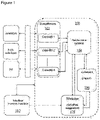
- the figure 1 illustrates an example of architecture of a piloting assistance system according to the invention.
- the aircraft piloting assistance device (100) of the invention generally comprises at least one skills module (102), a management module (104), a processing module (106) and a resolution module (108).
- the management module (104) is configured to manage contentions and flow priorities transiting between different modules and to direct the exchanges between the different modules of the device.
- the piloting assistance device of the invention further comprises an HMI man-machine interface (110) configured to manage the various human-machine interactions in the context of the use of the piloting assistance device of the invention .
- the HMI is configured (i.e. comprises different interfaces adapted to the type of interaction) to allow one or more operators to interact with different modules of the assistance device or "Assistant", and with different services and/or components of the avionics and/or the open world, on board and/or on the ground.
- the skills module (102) comprises at least one “Management of avionic systems” capability, one “Mission management” capability, and one “Environment management” capability.
- the architecture of the “Management of avionic systems” capability relies on several functional components which are a “System Management Driver”, a “System Management Service” and a “System Management Skill”.
- the “System Management Driver” is configured to perform the role/function of abstracting the utility architecture from the systems in order to “trivialize” the link between an inoperative system and the resulting limitations.
- FCOM Fluor Crew Operating Manual
- the architecture of the systems differing from one carrier to another, the limitations can be triggered by different root causes (for example a single or double failure).
- the components of the systems rarely have the same names from one wearer to another.
- the “System Management Driver” module makes it possible to avoid this problem by absorbing the associated variability. To do this, each inoperative system is associated with a failure family and an unmarked limitation family, per configuration file.
- the “commoditization” component thus makes it possible to acquire all the useful data while freeing itself from the constraints inherent to the carrier (name of the data, source selection logic). This is the case, for example, for data such as aircraft weight, heading, radio frequencies, fuel flow, etc.
- the architecture of the “Mission Management” capability relies on several functional components which are an “FMS Driver”, a “Leg Services”, a “Mission Skill”.
- the device of the invention allows, via a capability register (208) coupled to a capability database (210), adding and/or removing application components to the skill module (102).
- a capability register (208) coupled to a capability database (210)
- Each component once registered according to its field of competence, can organize the calls to the various respective services and systems (avionics; non-avionics; ground) making it possible to carry out the functions of event calculation (204) and request processing (206 ).
- the skill domain of a capability is declared in the capabilities register (208) and recorded in the capabilities database (210) in order to indicate the functional domain of the application component, the nature of the data relating to this functional domain , the type/format of data the capability will need to perform the event computation (204) and request processing (206) functions, and the type/format of data the capability will produce.
- the “event calculation” function (204) of an application component is responsible for consolidating the information received before sending and soliciting an event from the Assistant. It is configured to prevent mass solicitations and ensure more relevant notifications are sent. Indeed, it must be ensured that the context leading to the notification corresponds to a stable state. For example, an engine failure will cause the loss of several systems. This loss is not simultaneous. It is therefore necessary to wait until the situation is stable before notifying. The risk if this is not done is to trigger irrelevant calculations and suggestions towards the pilot because only taking into account part of the situation which is not stabilized.
- the event calculation function essentially consists in calculating the operational limitations of the aircraft.
- the event calculation function essentially consists of generating mission data.
- the event calculation function essentially consists of calculating meteorological events.
- the "Process requests" function (206) of an application component consists in receiving, via the management module (104), resolution requests sent by the resolution module (108), then in processing these requests by requesting the services and appropriate systems to retrieve data, and return a response to the resolution module via the management module.
- the request processing function essentially consists of checking the status of the systems and performing a "what if” simulation (for example, what would be the impacts on the aircraft if such an avionic system were in failure?: "I lost system 1, I have an alternate route suggestion that relies on using system 2, what happens if I lose system 2? If I have another alternative more robust in case of loss of system 2, it is perhaps better to favor this one”).
- the request processing function essentially consists of checking the compliance of the mission, calculating a mission update and promoting the flight plan, i.e. providing the flight plan to avionics systems (notably FMS) for acceptance.
- Verification of mission compliance essentially consists of verifying that all the minimum information necessary for the conduct of a mission (eg type of aircraft, departure and arrival airport, weight and fuel data, etc.) are available and that the mission is feasible from the point of view of the environment and the state of the aircraft, i.e. the aircraft will not land at an airport with high winds on arrival if the aircraft is not I'm not able to, nor go to divert on an airport which one cannot reach for lack of sufficient fuel or because of an altitude too high taking into account the performances.
- a mission eg type of aircraft, departure and arrival airport, weight and fuel data, etc.
- the request processing function essentially consists of checking the conformity of the weather forecast, i.e. checking that the weather forecast is compatible with the mission (the mission can be carried out under the weather conditions forecast on its route , on airports).
- the device of the invention comprises a processing module (106).
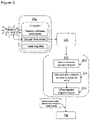
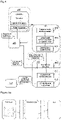
- the processing module is configured on the one hand to determine what are the possible impacts on the mission in progress from the events which are calculated by the application components (illustrated in picture 3 ), and on the other hand to perform solution relevance checks that are generated by the application components to adapt the current mission (shown in figure 4 ).
- the picture 3 illustrates the configuration of the components of the processing module (106) implemented during the processing of an event, to determine whether or not the event has an impact on the mission.
- the processing module receives as input the data routed by the management module (104).
- the management module transmits the information calculated or transmitted by the various skills modules, either during the calculation of an event (for example the wind values updated in the case of a weather event notification by the " management of the environment”), or when processing a request for resolution (for example the impacts on the aircraft's capacities in the event of a failure).
- the information supplied to the management module is calculated from data acquired from various sources of certified avionics and/or non-certified avionics, from sources external and/or internal to the aircraft. The data is put into a format usable by open world (non-avionics) systems.
- the “Systems management” capability calculates an event from information on the state of the aircraft systems which is collected from the avionics part, and in the example chosen, reporting a “system failure”.
- the processing carried out by the processing module (106) is based on an analysis according to an ontology.
- the processing carried out by the processing module (106) is based on an analysis according to predefined rules.
- the impact which is determined consists in the fact that a diversion of the aircraft is required or recommended.
- the figure 4 illustrates the elements used to determine a suggestion for adapting a mission.
- the figure 4 illustrates the components of the resolution module (108) and the configuration of the components of the processing module (106) to perform verifications of the relevance of resolution proposals to adapt the current mission.
- the resolution requests component (402) Based on the impact information on the current mission, for example a required diversion, the resolution requests component (402) generates corresponding requests.
- the requests are routed to the capacities which must process them via the management module (104), based on the information available in the capacities register (208).
- requests are established to interrogate at least the "Mission management" capability in order to obtain proposals for diversion to airports able to offer it.
- the example is simplified but that more or less complex resolution requests can be sent to one or more capacities depending on the nature of the impact that has been calculated.
- the requests are processed by the respective capabilities from data acquired from different sources of certified avionics or non-certified avionics, from sources external or internal to the aircraft.
- the impact resolution proposals received are evaluated via the processing module (106).
- the evaluation of a proposal successively implements the functionalities of the context component (404) by calculating a context resulting from the mission if the solution of the proposal was implemented, from the component of discrepancies (406) between the resulting context and the initial context, and the impact component (408) by determining what the impact on the mission would be if the solution of the proposal were implemented.
- the processing carried out by the processing module (106) is based on an analysis according to an ontology.
- the processing carried out by the processing module (106) is based on an analysis according to predefined rules.
- the resolution request component (402) can generate new requests according to the impact which has been calculated, and receive new solution proposals which are evaluated by the processing module (106).
- the sorting component (410) is configured to weight the solutions found, according to sorting criteria adapted to the situation and to the problems of the crew.
- the weighting criteria can be adapted a posteriori in order to stick better and better to the situation over time.
- this makes it possible to enrich the knowledge of the device in post analysis.
- the suggestion component (412) is configured to structure the selected suggestions, so as to be able to notify the crew and present them (110) the elements with the associated rationale.
- a minimum of three suggestions is offered to the crew.
- the recording of this information makes it possible to enrich the search for a solution which becomes more efficient over time.
- the device of the invention makes it possible to transfer the elements of this alternative on the avionics side, or even on the ground side, so that it becomes the new mission reference.
- the device makes it possible to follow the execution of the new reference in order to detect deviations.
- the device makes it possible to contextualize the use of the various services according to the policies of the airline companies and of the users of the system (pilots).
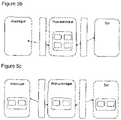
- the figure 5a illustrates an example of implementation of the piloting assistance device of the invention where all the modules are integrated on a certified avionics computing platform.
- the figure 5b illustrates another example of implementation of the piloting assistance device of the invention where all the modules are integrated on a non-certified avionics computing platform.
- the figure 5c illustrates another example of implementation of the pilot assistance device of the invention where the modules are distributed between certified avionics computing platforms, non-certified avionics computing platforms and computing platforms of ground infrastructure.
- the processing and resolution components are implemented on a non-certified avionics computing platform.
- the ground infrastructure platform is connected to the avionics platform by a data link.
Landscapes
- Engineering & Computer Science (AREA)
- Aviation & Aerospace Engineering (AREA)
- Physics & Mathematics (AREA)
- General Physics & Mathematics (AREA)
- Management, Administration, Business Operations System, And Electronic Commerce (AREA)
- Traffic Control Systems (AREA)
Applications Claiming Priority (1)
| Application Number | Priority Date | Filing Date | Title |
|---|---|---|---|
| FR2103184A FR3121256B1 (fr) | 2021-03-29 | 2021-03-29 | Procédé d’assistance au pilotage d’aéronefs |
Publications (1)
| Publication Number | Publication Date |
|---|---|
| EP4068244A1 true EP4068244A1 (de) | 2022-10-05 |
Family
ID=77317050
Family Applications (1)
| Application Number | Title | Priority Date | Filing Date |
|---|---|---|---|
| EP22165059.1A Withdrawn EP4068244A1 (de) | 2021-03-29 | 2022-03-29 | Hilfsverfahren zur steuerung von luftfahrzeugen |
Country Status (3)
| Country | Link |
|---|---|
| US (1) | US20220343766A1 (de) |
| EP (1) | EP4068244A1 (de) |
| FR (1) | FR3121256B1 (de) |
Citations (5)
| Publication number | Priority date | Publication date | Assignee | Title |
|---|---|---|---|---|
| US20090276149A1 (en) * | 2008-05-02 | 2009-11-05 | Honeywell International Inc. | Cognitive aricraft hazard advisory system (cahas) |
| US20170011635A1 (en) * | 2014-03-13 | 2017-01-12 | Honeywell International Inc. | System and method for intelligently mining information and briefing an aircrew on conditions outside the aircraft |
| US20180075758A1 (en) * | 2016-09-13 | 2018-03-15 | Thales | Decision-making aid for revising a flight plan |
| US10096253B2 (en) | 2015-11-30 | 2018-10-09 | Honeywell International Inc. | Methods and systems for presenting diversion destinations |
| US10109203B2 (en) | 2016-09-07 | 2018-10-23 | Honeywell International Inc. | Methods and systems for presenting en route diversion destinations |
-
2021
- 2021-03-29 FR FR2103184A patent/FR3121256B1/fr active Active
-
2022
- 2022-03-28 US US17/706,525 patent/US20220343766A1/en not_active Abandoned
- 2022-03-29 EP EP22165059.1A patent/EP4068244A1/de not_active Withdrawn
Patent Citations (5)
| Publication number | Priority date | Publication date | Assignee | Title |
|---|---|---|---|---|
| US20090276149A1 (en) * | 2008-05-02 | 2009-11-05 | Honeywell International Inc. | Cognitive aricraft hazard advisory system (cahas) |
| US20170011635A1 (en) * | 2014-03-13 | 2017-01-12 | Honeywell International Inc. | System and method for intelligently mining information and briefing an aircrew on conditions outside the aircraft |
| US10096253B2 (en) | 2015-11-30 | 2018-10-09 | Honeywell International Inc. | Methods and systems for presenting diversion destinations |
| US10109203B2 (en) | 2016-09-07 | 2018-10-23 | Honeywell International Inc. | Methods and systems for presenting en route diversion destinations |
| US20180075758A1 (en) * | 2016-09-13 | 2018-03-15 | Thales | Decision-making aid for revising a flight plan |
Also Published As
| Publication number | Publication date |
|---|---|
| FR3121256A1 (fr) | 2022-09-30 |
| US20220343766A1 (en) | 2022-10-27 |
| FR3121256B1 (fr) | 2024-02-16 |
Similar Documents
| Publication | Publication Date | Title |
|---|---|---|
| EP1955305B1 (de) | Einrichtung und verfahren zum dynamischen aktualisieren verbotener flugbereiche in einem flugzeug | |
| CA2291865C (fr) | Procede de mise en oeuvre d'une unite de service de trafic air | |
| FR3035534B1 (fr) | Procede et systeme de communication et de partage d'informations pour aeronef | |
| FR3035711A1 (fr) | Systemes et procedes pour fournir des donnees actualisees a un aeronef | |
| FR3038750A1 (fr) | Procede d'integration d'un nouveau service de navigation dans un systeme avionique embarque a architecture ouverte de type client-serveur, en particulier d'un service de manoeuvre fim | |
| FR2958418A1 (fr) | Systeme de gestion de vol d'un aeronef sans pilote a bord de l'aeronef | |
| FR2945360A1 (fr) | Procede et dispositif pour faciliter la realisation d'une maneuvre de changement d'altitude avec espacements reduits d'un avion | |
| FR2820867A1 (fr) | Procede automatise de suivi et d'organisation de deplacement de vehicules au sol et d'identification de corps etrangers sur les pistes dans une zone aeroportuaire | |
| FR2898972A1 (fr) | Procede et dispositif de surveillance de l'altitude de vol minimum d'un aeronef | |
| FR3093221A1 (fr) | Procédé et système de mise à jour automatique d’un plan de vol courant d’un aéronef. | |
| FR3038751A1 (fr) | Procede d'integration d'une application d'optimisation de route (s) sous contraintes dans un systeme embarque avionique a architecture ouverte de type client serveur | |
| FR3000195A1 (fr) | Architecture hybride pour systeme aeronautique | |
| FR3072795A1 (fr) | Procede de controle de la restitution d'alerte(s) et/ou de procedure(s) de reconfiguration systeme(s), produit programme d'ordinateur et systeme de controle associes | |
| CA3037319A1 (fr) | Systeme d'etablissement de plan de vol operationnel d'aeronef et procede associe | |
| FR2983326A1 (fr) | Systeme et procede pour gerer l'exploitation d'une ligne aerienne | |
| FR3030805A1 (fr) | Qualite de service d'un systeme de gestion de vol | |
| FR2982381A1 (fr) | Dispositif et procede pour regrouper des informations de gestion de controles techniques | |
| FR3122490A1 (fr) | Gestion optimisée du trafic aérien de véhicules aériens sans pilotes | |
| FR3072816A1 (fr) | Procede de determination de point(s) limite (s) de decision relative au declenchement d'une manoeuvre d'evitement par un aeronef, dispositif et programme d'ordinateur associes | |
| EP2656221B1 (de) | Zentralisierte wartungsvorrichtung für flugzeuge | |
| FR3083897A1 (fr) | Systeme de gestion de taches d'un equipage d'aeronef lors d'une mission et procede associe | |
| WO2021249821A1 (fr) | Systeme et methode pour la determination amelioree de parametres de trajectoire d'aeronefs | |
| CA2772516A1 (fr) | Dispositif et procede d'evaluation des capacites operationnelles d'un aeronef | |
| EP4068244A1 (de) | Hilfsverfahren zur steuerung von luftfahrzeugen | |
| EP4068245A1 (de) | Hilfsvorrichtung zur steuerung von luftfahrzeugen |
Legal Events
| Date | Code | Title | Description |
|---|---|---|---|
| PUAI | Public reference made under article 153(3) epc to a published international application that has entered the european phase |
Free format text: ORIGINAL CODE: 0009012 |
|
| STAA | Information on the status of an ep patent application or granted ep patent |
Free format text: STATUS: THE APPLICATION HAS BEEN PUBLISHED |
|
| AK | Designated contracting states |
Kind code of ref document: A1 Designated state(s): AL AT BE BG CH CY CZ DE DK EE ES FI FR GB GR HR HU IE IS IT LI LT LU LV MC MK MT NL NO PL PT RO RS SE SI SK SM TR |
|
| STAA | Information on the status of an ep patent application or granted ep patent |
Free format text: STATUS: REQUEST FOR EXAMINATION WAS MADE |
|
| 17P | Request for examination filed |
Effective date: 20230309 |
|
| RBV | Designated contracting states (corrected) |
Designated state(s): AL AT BE BG CH CY CZ DE DK EE ES FI FR GB GR HR HU IE IS IT LI LT LU LV MC MK MT NL NO PL PT RO RS SE SI SK SM TR |
|
| P01 | Opt-out of the competence of the unified patent court (upc) registered |
Effective date: 20230427 |
|
| STAA | Information on the status of an ep patent application or granted ep patent |
Free format text: STATUS: EXAMINATION IS IN PROGRESS |
|
| 17Q | First examination report despatched |
Effective date: 20250318 |
|
| STAA | Information on the status of an ep patent application or granted ep patent |
Free format text: STATUS: THE APPLICATION IS DEEMED TO BE WITHDRAWN |
|
| 18D | Application deemed to be withdrawn |
Effective date: 20250719 |