EP4069710B1 - Pd(i)-komplexe, verfahren zu ihrer herstellung und ihre verwendung als antitumormittel - Google Patents
Pd(i)-komplexe, verfahren zu ihrer herstellung und ihre verwendung als antitumormittel Download PDFInfo
- Publication number
- EP4069710B1 EP4069710B1 EP20828523.9A EP20828523A EP4069710B1 EP 4069710 B1 EP4069710 B1 EP 4069710B1 EP 20828523 A EP20828523 A EP 20828523A EP 4069710 B1 EP4069710 B1 EP 4069710B1
- Authority
- EP
- European Patent Office
- Prior art keywords
- compound
- general formula
- anion
- palladium
- complex
- Prior art date
- Legal status (The legal status is an assumption and is not a legal conclusion. Google has not performed a legal analysis and makes no representation as to the accuracy of the status listed.)
- Active
Links
Images

Classifications
-
- C—CHEMISTRY; METALLURGY
- C07—ORGANIC CHEMISTRY
- C07F—ACYCLIC, CARBOCYCLIC OR HETEROCYCLIC COMPOUNDS CONTAINING ELEMENTS OTHER THAN CARBON, HYDROGEN, HALOGEN, OXYGEN, NITROGEN, SULFUR, SELENIUM OR TELLURIUM
- C07F15/00—Compounds containing elements of Groups 8, 9, 10 or 18 of the Periodic Table
- C07F15/0006—Compounds containing elements of Groups 8, 9, 10 or 18 of the Periodic Table compounds of the platinum group
- C07F15/006—Palladium compounds
-
- A—HUMAN NECESSITIES
- A61—MEDICAL OR VETERINARY SCIENCE; HYGIENE
- A61P—SPECIFIC THERAPEUTIC ACTIVITY OF CHEMICAL COMPOUNDS OR MEDICINAL PREPARATIONS
- A61P35/00—Antineoplastic agents
Definitions
- the present invention relates to the sector of chemotherapy compounds and in particular of the metal complexes used for the purpose.
- the invention also relates to a process for the synthesis of these complexes and the therapeutic use thereof.
- cisplatin cis-diamine-dichloroplatinum(II)
- Food and Drug Administration paved the way for the use of inorganic compounds as chemotherapy agents.
- cisplatin has some important limitations, connected on one hand with its nephro- and neuro-toxicity and, on the other hand, with its inefficacy towards some types of tumours or induced resistance phenomena on others.
- this element enables complexes to be obtained that are more soluble in water and moreover in some cases have a different primary target from the DNA. This latter characteristic explains the marked anti-proliferative activity of some of these compounds towards cisplatin-resistant cell lines.
- a critical feature of palladium compounds relates to their higher hydrolysis speed with respect to platinum ones, with a consequent dissociation of the ligands and serious speciation problems (i.e. the formation of different species containing palladium derived from the starting one); this can cause greater collateral toxicity, due to the lack of control over the species effectively introduced into the organism.
- N- heterocyclic carbenes N- heterocyclic carbenes
- Pd(II) complexes containing these ligands have provoked a certain amount of interest, thanks to their high anti-proliferative activity on different, both cisplatin-sensitive and cisplatin-resistant, tumour lines.
- Pd(II) complexes of this type are for example the subject matter of patent applications US 2018/194789 A1 and CN 108558952 A .
- the object of the present invention is to provide a new family of palladium (I) complexes provided with antitumour activity, and to provide the process for the production thereof.
- the invention relates to a process for producing compounds of general formula (A) or (B), which consists in reacting a compound of general formula (C) or of general formula (D) with a palladium (II) complex, according to the following diagrams: wherein R1, R2, R3, m, n and X have the meanings reported above, Cpx(Pd(II)) indicates a complex of palladium in oxidation state +2, and MX generally indicates a salt containing the monovalent or bivalent anion X defined above.
- the stoichiometric coefficient p is 2 if Cpx(Pd(II)) contains a single Pd atom, and is 1 if Cpx(Pd(II)) contains two Pd atoms, so as to keep a 1:1 molar ratio between compound (C) or (D) and Pd.
- the stoichiometric coefficient q is 1 in the event in which the anion X is bivalent and is 2 in the event in which the anion X is monovalent, regardless of the oxidation number of the metal M.
- the salt will have the formula M 1 X 1 in the event in which the metal M and the anion X are both monovalent (respectively, cation with oxidation number +1 and anion with charge -1) or both bivalent (cation with oxidation number +2 and anion with charge -2); formula M 1 X 2 (cation with oxidation number +2 and anion with charge -1); or formula M 2 X 1 (cation with oxidation number +1 and anion with charge -2).
- the invention relates to new palladium (I) complexes, provided with antitumour activity, having general formula (A) or (B).
- the compounds of the invention are formed by heterocyclic units, in particular imidazolidines (general formula (A)) and benzimidazolidines (general formula (B)) with a carbon of the carbene type between two nitrogen atoms in the heterocyclic ring; the carbene carbon atoms complex two palladium atoms, which have a direct bond with each other, producing a dimeric species in which palladium is in oxidation state +1 (Pd(I)).
- heterocyclic units in particular imidazolidines (general formula (A)) and benzimidazolidines (general formula (B)) with a carbon of the carbene type between two nitrogen atoms in the heterocyclic ring; the carbene carbon atoms complex two palladium atoms, which have a direct bond with each other, producing a dimeric species in which palladium is in oxidation state +1 (Pd(I)).
- R1 is an alkyl radical or a phenyl radical optionally substituted with one or more C 1 -C 3 alkyl groups.
- the preferred alkyl radicals for the purposes of the invention are tert-butyl and 1-adamantyl, whereas preferred aromatic radicals are 2,4,6-trimethylphenyl (commonly referred to as mesityl) and 2,6-diisopropylphenyl.
- the substituents R2 and R3 may be a linear or branched C 1 -C 6 alkyl radical.
- X is a pharmaceutically acceptable monovalent or bivalent anion, chosen among those known by the skilled in the art; preferred monovalent anions for the purposes of the invention are chloride, perchlorate (ClO 4 - ), tetrafluroborate (BF 4 - ) and hexafluorophosphate (PF 6 - ); examples of possible bivalent anions, typically used in the pharmaceutical sector, are sulphate, oxalate, maleate and fumarate.
- the preferred compounds of the invention have the formulae A1 and B1 reported below: wherein Mes indicates the mesityl radical.
- the invention relates to a process for the synthesis of the compounds of general formula (A) and (B), consisting in reacting a compound of general formula (C) or of general formula (D) with a palladium (II) complex, as reported above.
- the compound of general formula (C) reported above which is used as a reactant in the process of the invention for the preparation of a compound of general formula (A), can be obtained by reaction between the corresponding imidazolium salt and silver oxide according to the conditions reported in literature (" An unusually static, sterically hindered silver bis(n-heterocyclic carbene) complex and its use in transmetalation", Y. A. Wanniarachchi et al., Organometallics, 2004, 23, 5881-5884 ).
- the second reactant of the process of the invention is a Pd(II) complex, indicated generally as Cpx(Pd(II)).
- the palladium complex must have one or more sufficiently labile coordination sites for the introduction of the biscarbene ligand and a sufficiently hindered allyl fragment.
- Preferred palladium complexes are [Pd( ⁇ -Cl)( ⁇ 3 -1,1-dimethylallyl)] 2 and [(MePyCH 2 SPh)Pd( ⁇ 3 -1,1-dimethylallyl)]ClO 4 , having the following structural formulae:
- Pd(II) complexes can be prepared with methods known to those skilled in the art of coordination chemistry.
- the complex Pd(1,1-dimethylallyl)Clz can be prepared by suspending PdCl 2 powders in a solution of 1,1-dimethyl-propyl-1-ene in methanol; both these reactants are commonly available on the market.
- the complex [Pd(NS)(1,1-dimethylallyl)]X can be prepared by dissolving the complex Pd(1,1-dimethylallyl)Clz in dichloromethane in the presence of the ligand 2-(phenylthiomethyl)-6-methyl-pyridine, according to the methods described in the article " Mechanism of the reaction of allyl amination of Pd(II) allyl complexes containing chelating pyridine-chalcogen ligands. A surprisingly low influence of the chalcogen atom", L. Canovese, Polyhedron 20 (2001) 3171-3181 .
- the synthesis of the ligand 2-(phenylthiomethyl)-6-methyl-pyridine consists of reacting thiophenol and 2-chloromethyl-6-methylpyridine hydrochloride in a solution of potassium hydroxide in dimethyl sulfoxide, followed by usual work-up operations (addition of water, separation of the phases, concentration of the organic phase and purification of the product by chromatography).
- the reactant MX has the function of introducing the anion X into the reaction, to compensate for the charge of the Pd(I) complex that is produced in the process.
- the anion is selected from the pharmaceutically acceptable ones, and preferably from chloride, perchlorate, tetrafluoborate and hexafluorophosphate, whereas the cation is preferably selected from silver and alkali metals (Li, Na and K).
- the reaction is carried out in an organic solvent, preferably dichloromethane, at a temperature between 0 °C and 35 °C, for times generally between 5 minutes and 1 hour.
- the stoichiometry of the reaction requires the use of the compound of formula (C) or (D) in a molar ratio 1:1 with respect to the Pd(II) complex when this contains a single Pd atom, and in a molar ratio 2:1 with respect to the Pd(II) complex when this contains two Pd atoms.
- the invention relates to the Pd(I) complexes described above for use in the treatment of tumours by administration of said complexes to a patient affected by a tumour, possibly in combination with at least one cytostatic or cytotoxic agent and, possibly, in the form of a combined preparation for simultaneous, separate or sequential use in the antitumour therapy.
- the complexes of the invention are particularly effective in the treatment of ovarian, cervical, colon and lung cancers.
- Said complexes may be administered by the typical routes of chemotherapy, for example in the form of intravenous solutions (the most frequent), intramuscular or subcutaneous, or orally through capsules or tablets.
- Tecan analyser mod. Infinite ® M1000.
- This example relates to the preparation of the compound (A1) of the invention.
- This example relates to an alternative preparation of the compound (A1) of the invention.
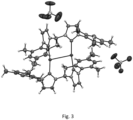
- This example relates to the structural characterization of the compound (A1) produced in Example 1.
- This example relates to the evaluation of the therapeutic efficacy of the compounds of the invention.
- Tests were performed for the purpose of determining the inhibitory concentration (IC 50 ) of a compound of the invention towards tumour cell lines and on a control cell line; for comparative purposes, the same tests were performed with the cisplatin compound.
- the tested cell lines were: A2780, A2780cis, OVCAR5, OVCAR3 e KURAMOCHI (ovarian cancer), A549 (lung cancer), HeLa (cervical cancer), DLD1 (colon cancer) and MRC-5 (control; lung fibroblasts).
- the mother solutions were obtained in dimethyl sulfoxide for the Pd(I) compound and in H 2 O for cisplatin.
- the cells were kept, according to the protocols indicated by the suppliers, at 37 °C in an atmosphere containing 5% carbon dioxide. About 500 cells were plated on 96 different well-plates and kept under such conditions for 96 hours.
- the viability of the cells was determined, after treatment of the cells with a 1:1 CellTiter-Glo ® solution (registered trademark of Promega Corp., Madison, Wisconsin, USA) and DPBS, with the Tecan Infinite ® M1000 instrument.
- the IC 50 values were calculated by the response curves to the dose.
- the means and standard deviations were obtained from triplicate measurements. The test results are shown in the following table.
Landscapes
- Chemical & Material Sciences (AREA)
- Organic Chemistry (AREA)
- Health & Medical Sciences (AREA)
- Chemical Kinetics & Catalysis (AREA)
- General Chemical & Material Sciences (AREA)
- Medicinal Chemistry (AREA)
- Nuclear Medicine, Radiotherapy & Molecular Imaging (AREA)
- Pharmacology & Pharmacy (AREA)
- Life Sciences & Earth Sciences (AREA)
- Animal Behavior & Ethology (AREA)
- General Health & Medical Sciences (AREA)
- Public Health (AREA)
- Veterinary Medicine (AREA)
- Pharmaceuticals Containing Other Organic And Inorganic Compounds (AREA)
Claims (11)
- Verbindung der allgemeinen Formel (A) oder der allgemeinen Formel (B):
 - R1 ein Alkylrest oder ein Phenylrest ist, der gegebenenfalls mit einer oder mehreren C1-C3 -Alkylgruppen substituiert ist;- R2 ein linearer oder verzweigter C1-C6 -Alkylrest ist;- R3 ein linearer oder verzweigter C1-C6 -Alkylrest ist;- m = 0, 1 oder 2 ist;- n = 0, 1, 2, 3 oder 4 ist;- 2XΘ zwei pharmazeutisch annehmbare einwertige Anionen oder ein pharmazeutisch annehmbares zweiwertiges Anion bezeichnet.
 - Verbindung nach Anspruch 1, wobei R1 ausgewählt ist aus tert-Butyl, 1-Adamantyl, 2,4,6-Trimethylphenyl (Mesityl) und 2,6-Diisopropylphenyl.
- Verbindung nach einem der Ansprüche 1 oder 2, wobei das pharmazeutisch annehmbare einwertige Anion ausgewählt ist aus Chlorid (Cl-), Perchlorat (ClO4 -), Tetrafluorborat (BF4 -) und Hexafluorphosphat (PF6 -).
- Verbindung nach Anspruch 1, worin R1 2,4,6-Trimethylphenyl (Mesityl) ist, m = 0, n = 0 und das einwertige Anion Perchlorat ist.
- Verfahren zur Synthese einer Verbindung nach einem der Ansprüche 1 bis 4, das darin besteht, eine Verbindung der allgemeinen Formel (C) oder eine Verbindung der allgemeinen Formel (D) mit einem Palladium(II)-Komplex nach einem der folgenden Schemata umzusetzen:

 - R1 ein Alkylrest oder ein Phenylrest ist, der gegebenenfalls mit einer oder mehreren C1-C3 -Alkylgruppen substituiert ist;- R2 ein linearer oder verzweigter C1-C6 -Alkylrest ist;- R3 ein linearer oder verzweigter C1-C6 -Alkylrest ist;- m = 0, 1 oder 2 ist;- n = 0, 1, 2, 3 oder 4 ist;- Cpx(Pd(II)) ein Palladium(II)-Komplex ist;- MX ein Salz eines pharmazeutisch annehmbaren einwertigen oder zweiwertigen Anions ist;- p = 2 ist, wenn Cpx(Pd(II)) ein einzelnes Pd-Atom enthält, und p = 1 ist, wenn Cpx(Pd(II)) zwei Pd-Atome enthält;- q = 1 ist, wenn das Anion ein zweiwertiges Anion ist, und q = 2 ist, wenn das Anion ein einwertiges Anion ist.
 - Verfahren nach Anspruch 5, wobei die Verbindung der Formel (C1) als Verbindung der allgemeinen Formel (C) verwendet wird oder die Verbindung der Formel (D1) als Verbindung der allgemeinen Formel (D) verwendet wird:

- Verfahren nach einem der Ansprüche 5 oder 6, wobei der als Reaktant verwendete Palladium(II)-Komplex ausgewählt ist aus [Pd(µ-Cl)(η3-1,1-dimethylallyl)]2 und [(MePyCH2SPh)Pd(η3-1,1-dimethylallyl)]ClO4:

- Verfahren nach einem der Ansprüche 5 bis 7, wobei das Kation des MX-Salzes ausgewählt ist aus Silber, Lithium, Natrium und Kalium.
- Verfahren nach einem der Ansprüche 5 bis 8, dadurch gekennzeichnet, dass die Reaktion einer Verbindung der allgemeinen Formel (C) oder der allgemeinen Formel (D) mit einem Palladium(II)-Komplex in einem organischen Lösungsmittel, vorzugsweise Dichlormethan, bei einer Temperatur zwischen 0 °C und 35 °C für eine Zeit zwischen 5 Minuten und einer Stunde durchgeführt wird.
- Verbindung der allgemeinen Formel (A) oder (B), wie in Anspruch 1 definiert, zur Verwendung als therapeutisches Antitumormittel.
- Verbindung nach Anspruch 10 zur Verwendung bei der Behandlung von Eierstock-, Gebärmutterhals-, Kolon- und Lungenkrebs.
Applications Claiming Priority (2)
| Application Number | Priority Date | Filing Date | Title |
|---|---|---|---|
| IT102019000023079A IT201900023079A1 (it) | 2019-12-05 | 2019-12-05 | Complessi di pd(i), processo per la loro preparazione e loro impiego come antitumorali |
| PCT/EP2020/084360 WO2021110790A1 (en) | 2019-12-05 | 2020-12-03 | Pd(i) complexes, process for their preparation and use thereof as antitumour agents |
Publications (3)
| Publication Number | Publication Date |
|---|---|
| EP4069710A1 EP4069710A1 (de) | 2022-10-12 |
| EP4069710B1 true EP4069710B1 (de) | 2023-10-04 |
| EP4069710C0 EP4069710C0 (de) | 2023-10-04 |
Family
ID=70154914
Family Applications (1)
| Application Number | Title | Priority Date | Filing Date |
|---|---|---|---|
| EP20828523.9A Active EP4069710B1 (de) | 2019-12-05 | 2020-12-03 | Pd(i)-komplexe, verfahren zu ihrer herstellung und ihre verwendung als antitumormittel |
Country Status (3)
| Country | Link |
|---|---|
| EP (1) | EP4069710B1 (de) |
| IT (1) | IT201900023079A1 (de) |
| WO (1) | WO2021110790A1 (de) |
Families Citing this family (1)
| Publication number | Priority date | Publication date | Assignee | Title |
|---|---|---|---|---|
| CN116284152B (zh) * | 2023-02-14 | 2025-07-15 | 合肥工业大学 | 一种双氮杂环卡宾-金属绿色催化剂及其合成方法 |
Family Cites Families (6)
| Publication number | Priority date | Publication date | Assignee | Title |
|---|---|---|---|---|
| US8618318B2 (en) | 2009-07-30 | 2013-12-31 | Johnson Matthey Public Limited Co. | Process for the preparation of palladium (I) tri-tert-butylphosphine bromide dimer |
| JP6054386B2 (ja) | 2011-06-29 | 2016-12-27 | ユミコア・アクチエンゲゼルシャフト・ウント・コムパニー・コマンディットゲゼルシャフトUmicore AG & Co.KG | パラジウム(I)トリ−t−ブチルホスフィンブロミド二量体の製造方法および異性化反応においてそれを使用するプロセス |
| WO2018073559A1 (en) | 2016-10-21 | 2018-04-26 | Johnson Matthey Public Limited Company | Process |
| US10421769B2 (en) | 2017-01-07 | 2019-09-24 | India Institute of Technology Bombay | Anticancer property studies of chiral palladium N-heterocyclic carbene complexes and process for preparation thereof |
| WO2019158978A1 (en) * | 2018-02-16 | 2019-08-22 | University Of Stellenbosch | Binuclear palladacycles and their use in the treatment of cancer |
| CN108558952B (zh) | 2018-05-22 | 2020-05-05 | 玉林师范学院 | 一种2-苯基吡啶双核钯(ii)配合物及其制备方法和应用 |
-
2019
- 2019-12-05 IT IT102019000023079A patent/IT201900023079A1/it unknown
-
2020
- 2020-12-03 WO PCT/EP2020/084360 patent/WO2021110790A1/en not_active Ceased
- 2020-12-03 EP EP20828523.9A patent/EP4069710B1/de active Active
Also Published As
| Publication number | Publication date |
|---|---|
| EP4069710A1 (de) | 2022-10-12 |
| WO2021110790A1 (en) | 2021-06-10 |
| IT201900023079A1 (it) | 2021-06-05 |
| EP4069710C0 (de) | 2023-10-04 |
Similar Documents
| Publication | Publication Date | Title |
|---|---|---|
| Sundquist et al. | Synthesis, characterization, and biological activity of cis-diammineplatinum (II) complexes of the DNA intercalators 9-aminoacridine and chloroquine | |
| Keppler et al. | Synthesis, molecular structure, and tumor-inhibiting properties of imidazolium trans-bis (imidazole) tetrachlororuthenate (III) and its methyl-substituted derivatives | |
| Sinisi et al. | Dependence of the reduction products of platinum (IV) prodrugs upon the configuration of the substrate, bulk of the carrier ligands, and nature of the reducing agent | |
| Müller et al. | Affinity of the iminooxo tautomer anion of 1‐methylcytosine in trans‐[Pt (NH3) 2 (1‐MeC‐N4) 2] 2+ for heterometals | |
| EP1322654B1 (de) | Platin-verbindungen als antitumorwirkstoffe | |
| Rehm et al. | Synthesis, structures and cytotoxic effects in vitro of cis-and trans-[Pt IV Cl 4 (NHC) 2] complexes and their Pt II precursors | |
| Łakomska et al. | Platinum (IV) complexes with purine analogs. Studies of molecular structure and antiproliferative activity in vitro | |
| Brown et al. | Combining aspects of the platinum anticancer drugs picoplatin and BBR3464 to synthesize a new family of sterically hindered dinuclear complexes; their synthesis, binding kinetics and cytotoxicity | |
| Nagy et al. | Promising anticancer mono-and dinuclear ruthenium (III) dithiocarbamato complexes: systematic solution studies | |
| Zhu et al. | Syntheses, Crystal Structures and Cytotoxities of Silver (I) Complexes of 2, 2′‐Bipyridines and 1, 10‐Phenanthroline | |
| US8324197B2 (en) | Transplatinum complexes with N2O2 donor sets as cytotoxic and antitumor agents | |
| WO2021110790A1 (en) | Pd(i) complexes, process for their preparation and use thereof as antitumour agents | |
| Lee et al. | Cationic diamineplatinum (II) complexes of nalidixic acid | |
| NL2019752B1 (en) | Cytotoxic Complexes | |
| Hudson et al. | Synthesis and characterization of gold (III) complexes possessing 2, 9-dialkylphenanthroline ligands: to bind or not to bind? | |
| Arpalahti et al. | Linkage Isomerization in PtII–9‐Methyladenine Complexes | |
| Ravera et al. | Synthesis, characterization, structure, molecular modeling studies and biological activity of sterically crowded Pt (II) complexes containing bis (imidazole) ligands | |
| Aranowska et al. | Antitumor effect of Pt (II) amine phosphonate complexes on sarcoma Sa-180 in mice. Crystal structure of cis-dichlorobis (diethyl-4-pyridylmethyl-phosphonate-κN) platinum (II) hydrate, cis-[PtCl2 (4-pmpe) 2]· H2O | |
| WO1998000431A1 (en) | New salts of anionic complexes of ru(iii), as antimetastatic and antineoplastic agents | |
| AU763823B2 (en) | Water soluble transplatinum complexes with anti-cancer activity and method of using same | |
| Berardini et al. | Heterobimetallic platinum-titanium complexes: potential anticancer drugs | |
| Arpalahti et al. | Facile Preparation of PtII‐Nucleobase Monoadducts with trans Geometry: Structural Characterization and Kinetics for Cl− Hydrolysis Reactions of trans‐[PtCl (NH3) 2 (L‐N7)] n+ (L= 9‐Methyladenine or 9‐Methylhypoxanthine) | |
| Yılmaz | Synthesis, spectroscopic characterization, crystal structure and DNA docking studies of a new trans-platinum saccharinate complex containing aqua and dimethyl sulfoxide ligands | |
| Fuks et al. | Structure and vibrational spectra of fac-ReI (CO) 3+ complex with N-methyl-2-pyridinecarbothioamide | |
| Lu et al. | Synthesis and X-ray characterization of two isomeric dichloro bis-{1-(phenylazo) isoquinoline} complexes of ruthenium (II) |
Legal Events
| Date | Code | Title | Description |
|---|---|---|---|
| STAA | Information on the status of an ep patent application or granted ep patent |
Free format text: STATUS: UNKNOWN |
|
| STAA | Information on the status of an ep patent application or granted ep patent |
Free format text: STATUS: THE INTERNATIONAL PUBLICATION HAS BEEN MADE |
|
| PUAI | Public reference made under article 153(3) epc to a published international application that has entered the european phase |
Free format text: ORIGINAL CODE: 0009012 |
|
| STAA | Information on the status of an ep patent application or granted ep patent |
Free format text: STATUS: REQUEST FOR EXAMINATION WAS MADE |
|
| 17P | Request for examination filed |
Effective date: 20220628 |
|
| AK | Designated contracting states |
Kind code of ref document: A1 Designated state(s): AL AT BE BG CH CY CZ DE DK EE ES FI FR GB GR HR HU IE IS IT LI LT LU LV MC MK MT NL NO PL PT RO RS SE SI SK SM TR |
|
| DAV | Request for validation of the european patent (deleted) | ||
| DAX | Request for extension of the european patent (deleted) | ||
| GRAP | Despatch of communication of intention to grant a patent |
Free format text: ORIGINAL CODE: EPIDOSNIGR1 |
|
| STAA | Information on the status of an ep patent application or granted ep patent |
Free format text: STATUS: GRANT OF PATENT IS INTENDED |
|
| INTG | Intention to grant announced |
Effective date: 20230424 |
|
| GRAS | Grant fee paid |
Free format text: ORIGINAL CODE: EPIDOSNIGR3 |
|
| GRAA | (expected) grant |
Free format text: ORIGINAL CODE: 0009210 |
|
| STAA | Information on the status of an ep patent application or granted ep patent |
Free format text: STATUS: THE PATENT HAS BEEN GRANTED |
|
| AK | Designated contracting states |
Kind code of ref document: B1 Designated state(s): AL AT BE BG CH CY CZ DE DK EE ES FI FR GB GR HR HU IE IS IT LI LT LU LV MC MK MT NL NO PL PT RO RS SE SI SK SM TR |
|
| REG | Reference to a national code |
Ref country code: GB Ref legal event code: FG4D |
|
| REG | Reference to a national code |
Ref country code: CH Ref legal event code: EP |
|
| REG | Reference to a national code |
Ref country code: IE Ref legal event code: FG4D |
|
| REG | Reference to a national code |
Ref country code: DE Ref legal event code: R096 Ref document number: 602020018799 Country of ref document: DE |
|
| U01 | Request for unitary effect filed |
Effective date: 20231103 |
|
| U07 | Unitary effect registered |
Designated state(s): AT BE BG DE DK EE FI FR IT LT LU LV MT NL PT SE SI Effective date: 20231109 |
|
| U20 | Renewal fee for the european patent with unitary effect paid |
Year of fee payment: 4 Effective date: 20240108 |
|
| PG25 | Lapsed in a contracting state [announced via postgrant information from national office to epo] |
Ref country code: GR Free format text: LAPSE BECAUSE OF FAILURE TO SUBMIT A TRANSLATION OF THE DESCRIPTION OR TO PAY THE FEE WITHIN THE PRESCRIBED TIME-LIMIT Effective date: 20240105 |
|
| PG25 | Lapsed in a contracting state [announced via postgrant information from national office to epo] |
Ref country code: IS Free format text: LAPSE BECAUSE OF FAILURE TO SUBMIT A TRANSLATION OF THE DESCRIPTION OR TO PAY THE FEE WITHIN THE PRESCRIBED TIME-LIMIT Effective date: 20240204 |
|
| PG25 | Lapsed in a contracting state [announced via postgrant information from national office to epo] |
Ref country code: ES Free format text: LAPSE BECAUSE OF FAILURE TO SUBMIT A TRANSLATION OF THE DESCRIPTION OR TO PAY THE FEE WITHIN THE PRESCRIBED TIME-LIMIT Effective date: 20231004 |
|
| PG25 | Lapsed in a contracting state [announced via postgrant information from national office to epo] |
Ref country code: IS Free format text: LAPSE BECAUSE OF FAILURE TO SUBMIT A TRANSLATION OF THE DESCRIPTION OR TO PAY THE FEE WITHIN THE PRESCRIBED TIME-LIMIT Effective date: 20240204 Ref country code: GR Free format text: LAPSE BECAUSE OF FAILURE TO SUBMIT A TRANSLATION OF THE DESCRIPTION OR TO PAY THE FEE WITHIN THE PRESCRIBED TIME-LIMIT Effective date: 20240105 Ref country code: ES Free format text: LAPSE BECAUSE OF FAILURE TO SUBMIT A TRANSLATION OF THE DESCRIPTION OR TO PAY THE FEE WITHIN THE PRESCRIBED TIME-LIMIT Effective date: 20231004 |
|
| PG25 | Lapsed in a contracting state [announced via postgrant information from national office to epo] |
Ref country code: RS Free format text: LAPSE BECAUSE OF FAILURE TO SUBMIT A TRANSLATION OF THE DESCRIPTION OR TO PAY THE FEE WITHIN THE PRESCRIBED TIME-LIMIT Effective date: 20231004 Ref country code: PL Free format text: LAPSE BECAUSE OF FAILURE TO SUBMIT A TRANSLATION OF THE DESCRIPTION OR TO PAY THE FEE WITHIN THE PRESCRIBED TIME-LIMIT Effective date: 20231004 Ref country code: NO Free format text: LAPSE BECAUSE OF FAILURE TO SUBMIT A TRANSLATION OF THE DESCRIPTION OR TO PAY THE FEE WITHIN THE PRESCRIBED TIME-LIMIT Effective date: 20240104 Ref country code: HR Free format text: LAPSE BECAUSE OF FAILURE TO SUBMIT A TRANSLATION OF THE DESCRIPTION OR TO PAY THE FEE WITHIN THE PRESCRIBED TIME-LIMIT Effective date: 20231004 |
|
| REG | Reference to a national code |
Ref country code: DE Ref legal event code: R097 Ref document number: 602020018799 Country of ref document: DE |
|
| PG25 | Lapsed in a contracting state [announced via postgrant information from national office to epo] |
Ref country code: CZ Free format text: LAPSE BECAUSE OF FAILURE TO SUBMIT A TRANSLATION OF THE DESCRIPTION OR TO PAY THE FEE WITHIN THE PRESCRIBED TIME-LIMIT Effective date: 20231004 |
|
| PG25 | Lapsed in a contracting state [announced via postgrant information from national office to epo] |
Ref country code: SK Free format text: LAPSE BECAUSE OF FAILURE TO SUBMIT A TRANSLATION OF THE DESCRIPTION OR TO PAY THE FEE WITHIN THE PRESCRIBED TIME-LIMIT Effective date: 20231004 |
|
| PG25 | Lapsed in a contracting state [announced via postgrant information from national office to epo] |
Ref country code: SM Free format text: LAPSE BECAUSE OF FAILURE TO SUBMIT A TRANSLATION OF THE DESCRIPTION OR TO PAY THE FEE WITHIN THE PRESCRIBED TIME-LIMIT Effective date: 20231004 Ref country code: SK Free format text: LAPSE BECAUSE OF FAILURE TO SUBMIT A TRANSLATION OF THE DESCRIPTION OR TO PAY THE FEE WITHIN THE PRESCRIBED TIME-LIMIT Effective date: 20231004 Ref country code: RO Free format text: LAPSE BECAUSE OF FAILURE TO SUBMIT A TRANSLATION OF THE DESCRIPTION OR TO PAY THE FEE WITHIN THE PRESCRIBED TIME-LIMIT Effective date: 20231004 Ref country code: CZ Free format text: LAPSE BECAUSE OF FAILURE TO SUBMIT A TRANSLATION OF THE DESCRIPTION OR TO PAY THE FEE WITHIN THE PRESCRIBED TIME-LIMIT Effective date: 20231004 |
|
| REG | Reference to a national code |
Ref country code: CH Ref legal event code: PL |
|
| PLBE | No opposition filed within time limit |
Free format text: ORIGINAL CODE: 0009261 |
|
| STAA | Information on the status of an ep patent application or granted ep patent |
Free format text: STATUS: NO OPPOSITION FILED WITHIN TIME LIMIT |
|
| PG25 | Lapsed in a contracting state [announced via postgrant information from national office to epo] |
Ref country code: MC Free format text: LAPSE BECAUSE OF FAILURE TO SUBMIT A TRANSLATION OF THE DESCRIPTION OR TO PAY THE FEE WITHIN THE PRESCRIBED TIME-LIMIT Effective date: 20231004 |
|
| PG25 | Lapsed in a contracting state [announced via postgrant information from national office to epo] |
Ref country code: MC Free format text: LAPSE BECAUSE OF FAILURE TO SUBMIT A TRANSLATION OF THE DESCRIPTION OR TO PAY THE FEE WITHIN THE PRESCRIBED TIME-LIMIT Effective date: 20231004 |
|
| 26N | No opposition filed |
Effective date: 20240705 |
|
| REG | Reference to a national code |
Ref country code: IE Ref legal event code: MM4A |
|
| PG25 | Lapsed in a contracting state [announced via postgrant information from national office to epo] |
Ref country code: IE Free format text: LAPSE BECAUSE OF NON-PAYMENT OF DUE FEES Effective date: 20231203 |
|
| PG25 | Lapsed in a contracting state [announced via postgrant information from national office to epo] |
Ref country code: CH Free format text: LAPSE BECAUSE OF NON-PAYMENT OF DUE FEES Effective date: 20231231 |
|
| PG25 | Lapsed in a contracting state [announced via postgrant information from national office to epo] |
Ref country code: IE Free format text: LAPSE BECAUSE OF NON-PAYMENT OF DUE FEES Effective date: 20231203 Ref country code: CH Free format text: LAPSE BECAUSE OF NON-PAYMENT OF DUE FEES Effective date: 20231231 |
|
| U20 | Renewal fee for the european patent with unitary effect paid |
Year of fee payment: 5 Effective date: 20241220 |
|
| PG25 | Lapsed in a contracting state [announced via postgrant information from national office to epo] |
Ref country code: CY Free format text: LAPSE BECAUSE OF FAILURE TO SUBMIT A TRANSLATION OF THE DESCRIPTION OR TO PAY THE FEE WITHIN THE PRESCRIBED TIME-LIMIT; INVALID AB INITIO Effective date: 20201203 |
|
| PG25 | Lapsed in a contracting state [announced via postgrant information from national office to epo] |
Ref country code: HU Free format text: LAPSE BECAUSE OF FAILURE TO SUBMIT A TRANSLATION OF THE DESCRIPTION OR TO PAY THE FEE WITHIN THE PRESCRIBED TIME-LIMIT; INVALID AB INITIO Effective date: 20201203 |
|
| GBPC | Gb: european patent ceased through non-payment of renewal fee |
Effective date: 20241203 |
|
| PG25 | Lapsed in a contracting state [announced via postgrant information from national office to epo] |
Ref country code: GB Free format text: LAPSE BECAUSE OF NON-PAYMENT OF DUE FEES Effective date: 20241203 |
|
| PG25 | Lapsed in a contracting state [announced via postgrant information from national office to epo] |
Ref country code: TR Free format text: LAPSE BECAUSE OF FAILURE TO SUBMIT A TRANSLATION OF THE DESCRIPTION OR TO PAY THE FEE WITHIN THE PRESCRIBED TIME-LIMIT Effective date: 20231004 |
|
| U20 | Renewal fee for the european patent with unitary effect paid |
Year of fee payment: 6 Effective date: 20251218 |