EP4070022B1 - Behälter zum lagern und servieren von gefrorenen süsswaren - Google Patents
Behälter zum lagern und servieren von gefrorenen süsswaren Download PDFInfo
- Publication number
- EP4070022B1 EP4070022B1 EP20811245.8A EP20811245A EP4070022B1 EP 4070022 B1 EP4070022 B1 EP 4070022B1 EP 20811245 A EP20811245 A EP 20811245A EP 4070022 B1 EP4070022 B1 EP 4070022B1
- Authority
- EP
- European Patent Office
- Prior art keywords
- thermally insulated
- product storage
- frozen confectionery
- storage assembly
- thermally
- Prior art date
- Legal status (The legal status is an assumption and is not a legal conclusion. Google has not performed a legal analysis and makes no representation as to the accuracy of the status listed.)
- Active
Links
Images



Classifications
-
- F—MECHANICAL ENGINEERING; LIGHTING; HEATING; WEAPONS; BLASTING
- F25—REFRIGERATION OR COOLING; COMBINED HEATING AND REFRIGERATION SYSTEMS; HEAT PUMP SYSTEMS; MANUFACTURE OR STORAGE OF ICE; LIQUEFACTION SOLIDIFICATION OF GASES
- F25D—REFRIGERATORS; COLD ROOMS; ICE-BOXES; COOLING OR FREEZING APPARATUS NOT OTHERWISE PROVIDED FOR
- F25D11/00—Self-contained movable devices, e.g. domestic refrigerators
- F25D11/006—Self-contained movable devices, e.g. domestic refrigerators with cold storage accumulators
-
- B—PERFORMING OPERATIONS; TRANSPORTING
- B64—AIRCRAFT; AVIATION; COSMONAUTICS
- B64D—EQUIPMENT FOR FITTING IN OR TO AIRCRAFT; FLIGHT SUITS; PARACHUTES; ARRANGEMENT OR MOUNTING OF POWER PLANTS OR PROPULSION TRANSMISSIONS IN AIRCRAFT
- B64D11/00—Passenger or crew accommodation; Flight-deck installations not otherwise provided for
- B64D11/0007—Devices specially adapted for food or beverage distribution services
-
- F—MECHANICAL ENGINEERING; LIGHTING; HEATING; WEAPONS; BLASTING
- F25—REFRIGERATION OR COOLING; COMBINED HEATING AND REFRIGERATION SYSTEMS; HEAT PUMP SYSTEMS; MANUFACTURE OR STORAGE OF ICE; LIQUEFACTION SOLIDIFICATION OF GASES
- F25D—REFRIGERATORS; COLD ROOMS; ICE-BOXES; COOLING OR FREEZING APPARATUS NOT OTHERWISE PROVIDED FOR
- F25D3/00—Devices using other cold materials; Devices using cold-storage bodies
-
- F—MECHANICAL ENGINEERING; LIGHTING; HEATING; WEAPONS; BLASTING
- F25—REFRIGERATION OR COOLING; COMBINED HEATING AND REFRIGERATION SYSTEMS; HEAT PUMP SYSTEMS; MANUFACTURE OR STORAGE OF ICE; LIQUEFACTION SOLIDIFICATION OF GASES
- F25D—REFRIGERATORS; COLD ROOMS; ICE-BOXES; COOLING OR FREEZING APPARATUS NOT OTHERWISE PROVIDED FOR
- F25D3/00—Devices using other cold materials; Devices using cold-storage bodies
- F25D3/12—Devices using other cold materials; Devices using cold-storage bodies using solidified gases, e.g. carbon-dioxide snow
- F25D3/125—Movable containers
-
- Y—GENERAL TAGGING OF NEW TECHNOLOGICAL DEVELOPMENTS; GENERAL TAGGING OF CROSS-SECTIONAL TECHNOLOGIES SPANNING OVER SEVERAL SECTIONS OF THE IPC; TECHNICAL SUBJECTS COVERED BY FORMER USPC CROSS-REFERENCE ART COLLECTIONS [XRACs] AND DIGESTS
- Y02—TECHNOLOGIES OR APPLICATIONS FOR MITIGATION OR ADAPTATION AGAINST CLIMATE CHANGE
- Y02T—CLIMATE CHANGE MITIGATION TECHNOLOGIES RELATED TO TRANSPORTATION
- Y02T50/00—Aeronautics or air transport
- Y02T50/40—Weight reduction
Definitions
- the present invention relates to a thermally insulated container for storing and serving frozen confectionery items, and particularly to such containers which are designed to be removably mountable within a service cart.
- Inflight service carts i.e. wheeled trolleys
- Inflight service carts are commonly used for storing and dispensing food and beverages on modern commercial aircraft. Such carts facilitate at-seat service of these products during the flight. Similar service carts are used on other modes of transport (e.g. on trains). Keeping the foodstuffs at an appropriate temperature within such carts is a recognised problem.
- WO 2012/056086 A1 relates to a refrigerator unit for an inflight service cart which utilises dry ice in such a way that it releases chilled air evenly, and without freezing the products.
- GB 2 543 837 A relates to an in-flight service cart and a thermally insulated container for an in-flight service cart.
- US 4,898,294 describes a frozen food container for aircraft usage.
- the container comprises bottom, end, side and top walls formed of a thermally insulating material contained between an inner and outer shell, the top wall having an insulated lid formed in the forward portion thereof.
- the container is provided with one or more receptacles adapted to receive dry ice, with the top wall of the container comprising these dry ice storage chambers.
- the invention relates to a thermally insulated container for storing and serving frozen confectionery items, and suitable for mounting within a service cart, the thermally insulated container being unpowered and comprising: a thermally insulated housing having an inner surface, defining an enclosed insulated chamber, and an outer surface for mounting engagement with a service cart, the thermally insulated housing having at least one openable portion to allow access to the enclosed insulated chamber through both the inner and outer surfaces; a product storage assembly, mounted within the enclosed insulated chamber, having an outer surface and an inner surface, the inner surface defining an internal product storage chamber, the internal product storage chamber being accessible via the openable portion of the thermally insulated housing, and the outer surface being substantially parallel to but spaced away from at least 90% of the surface area of the inner surface of the thermally insulated housing, the average spacing being from 1 to 10 mm; at least one frozen confectionery item support positioned in the internal product storage chamber, the frozen confectionery item support having an outer surface facing away from a supported item in use and an inner surface facing towards a
- the present invention relates to a service cart comprising a thermally insulated unpowered container as described herein.
- the present invention relates to a thermally insulated container for storing and serving frozen confectionery items.
- frozen confectionery items include ice cream, gelato, frozen yoghurt, sorbet, granita, water ice, and the like.
- the thermally insulated container of the present invention comprises a thermally insulated housing.
- the interior walls prescribing an inner surface define an enclosed insulated chamber.
- the exterior walls, prescribing an outer surface are preferably cuboid, with 6 thermally insulated sidewalls.
- the outer surface is designed to engage with a service cart and will contain the necessary mechanical interlocking arrangement, such as ridges, latches and interconnections to enable such engagement according to the particular design of the service cart.
- the thermally insulated housing has at least one openable portion to allow access to the enclosed insulated chamber.
- the enclosed thermally insulated chamber is sealed when the openable portion is in a closed position and accessible when the openable portion is in an open position.
- the openable portion is a portion or the whole of one side of the thermally insulated housing. It will be apparent that it is not necessary for the entire side to open - merely that a portion of the side is openable so as to allow access to the enclosed insulated chamber.
- the openable side is a door component which is hingedly attached to one of the other sides. Additionally or alternatively, the openable portion can be a removably engageable lid component.
- the thermally insulated housing can be made from any suitable material having thermal insulation properties.
- the thermally insulated outer housing comprises a material selected from: expanded polypropylene (EPP), polyurethane (PU), Aerogel, and vacuum panels.
- EPP expanded polypropylene
- PU polyurethane
- Aerogel Aerogel
- Suitable thermally insulated outer housings are described in WO 2008/104639 A1 , which is hereby mentioned.
- the thermal insulated container also comprises a product storage assembly mounted within the enclosed insulated chamber.
- the product storage assembly is removably mounted within the enclosed insulated chamber, since this allows it to be cleaned separately from the thermally insulated housing.
- the product storage assembly it is also possible for the product storage assembly to be permanently mounted within the outer housing.
- the product storage assembly has an inner surface defining an internal product storage chamber.
- the product storage assembly also has an outer surface, defining its outer perimeter within the enclosed insulated chamber.
- the product storage assembly is positioned within the enclosed insulated chamber such that there is a gap between the outer surface of the product storage assembly and the inner surface of the thermally insulated housing.
- the gap or spacing has a magnitude of 1 to 10 mm. This has been found to provide a good balance between providing additional thermal insulation (provided by the spacing) without compromising the size of the internal product storage chamber.
- the gap has a width of at least 2 mm, more preferably at least 2.5 mm, and most preferably at least 3 mm. In order to maximise the space available for storing frozen confections within the insulated container, it is preferred that the gap has a width of no more than 8 mm, preferably no more than 6 mm, and most preferably no more than 5 mm.
- the outer surface of the product storage assembly is spaced away from at least 90% of the surface area of the inner surface of the thermally insulated housing, preferably at least 95%.
- the inner surface of the thermally insulated housing can have moulded protrusions (e.g. one at each corner) which hold the product storage assembly in place so as to maintain the necessary spacing. Since such protrusions are only in contact with the outer surface of the product storage assembly over a very limited surface area, and since they are made of the same insulating material as the thermally insulated outer housing, there is little thermal energy transfer between the product storage assembly and the outer housing.
- the product storage assembly can have pins which interact with moulded grooves in the outer housing, thus enabling the product storage assembly to "hang" within the insulated chamber.
- a further option is for the product storage assembly to be supported by an insulated stand having legs which are embedded in the outer housing such that these legs are the only contact points between the product storage assembly and the outer housing, with the product storage assembly and the stand being in tight contact, such that the product storage assembly is held firmly by the stand, ensuring that the product storage assembly does not move about and thus that the outer surface of the product storage assembly remains spaced from the inner surface of the thermally insulated housing.
- the internal product storage chamber is accessible via the openable portion of the thermally insulated housing. This may be provided by an opening, i.e. an absence of any inner or outer surface, adjacent to the openable portion in the thermally insulated housing.
- the product storage assembly preferably has at least an upper wall and a lower wall which are connected by two side walls, thereby delineating a four-sided thermally perimeter within the outer housing, leaving two faces open for access to the internal product storage chamber.
- one of the open faces would align with the openable portion in the thermally insulated housing.
- thermally insulated container of the present invention is designed to be transportable and may be rotated during use. Therefore, the designation "upper wall”, “lower wall” and “sidewall” should not be read as limiting the orientation of the frame per se.
- the product storage assembly additionally comprises a back plate. Where such a back plate is present the product storage chamber delimits a five-sided boundary within the outer housing, with a single open face.
- the open face will be aligned with the openable portion in the thermally insulated housing.
- the product storage assembly could additionally comprise a front plate. Where both a back plate and a front plate are present, the product storage assembly delimits a six-sided boundary within the outer housing. Where such an arrangement is present, at least one side of the product storage assembly is openable - preferably the front plate and/or the back plate, and most conveniently the front plate. Whichever plate is openable will be aligned with the openable portion in the thermally insulated housing, to provide access to the internal product storage chamber.
- the product storage assembly preferably has a thickness of no more than 5 mm, more preferably no more than 4 mm, or even no more than 3 mm.
- the product storage assembly preferably has a thickness of at least 0.5 mm, more preferably at least 0.8 mm, still more preferably at least 1 mm or even at least 1.5 mm.
- the upper wall, lower wall and side walls can be continuous sheets of material, this is not necessary. Indeed, one or more of these walls could have a partially discontinuous structure (e.g. a mesh-like or lattice-like structure).
- one or more of the walls could comprise a perforated metal sheet or a wire mesh.
- the front and/or back plate where present.
- Such a partially discontinuous structure may be advantageous as it has the potential to reduce the overall weight of the product storage chamber.
- there is an additional barrier layer to help maintain the gap between the product storage assembly and the thermally insulated housing.
- such a barrier layer could be provided by a reservoir of phase change material, product drawer and/or any secondary packaging.
- the product storage assembly comprises at least one frozen confectionery item support positioned in the internal product storage chamber, the frozen confectionery item support having an outer surface facing away from a supported item in use and an inner surface facing towards a supported item in use.
- the frozen confectionery item support may be a simple shelf, the upper surface of which being the inner surface and the lower surface of which being the outer surface.
- the frozen confectionery item support is a drawer, which could be considered to be a shelf but with upstanding side walls. In both cases it is preferably that the frozen confectionery item support is removable from the product storage assembly, e.g. in a slideable manner, via the openable portion in the thermally insulated housing.
- a product storage assembly may comprise one, two, three or more such shelves or drawers, as desired.
- a reservoir of phase change material is provided between the inner and outer surfaces of the product storage assembly and/or between the inner and outer surfaces of the at least one frozen confectionery item support.
- phase change material is provided within the walls of either the product storage assembly, or within the walls of the frozen confectionery item support, or in both.
- the inner surface of the internal product storage chamber comprises an inner thermally conductive sheet
- the outer surface of the internal product storage chamber comprises an outer thermally conductive sheet
- the inner and outer thermally conductive sheets enclosing between them an enclosed space comprising a reservoir of phase change material.
- the inner and outer surfaces could be made from a thermally insulating material, although this is understood to be less effective.
- the inner surface of the at least one frozen confectionery item support comprise an inner thermally conductive sheet
- the outer surface of the at least one frozen confectionery item support comprises an outer thermally conductive sheet, the inner and outer thermally conductive sheets enclosing between them an enclosed space comprising a reservoir of phase change material.
- the inner and outer surfaces could be made from a thermally insulating material, although this is understood to be less effective.
- the inner and outer thermally conductive sheets are bonded metal sheets, produced in a roll bond method of manufacture.
- the sheets would not be planar but instead comprise depressions within the sheet, which align with a depression in the bonded sheet to provide a contained cavity, within which the phase change material is provided.
- the melting temperature of the phase change material is preferably -30°C to -6°C, -27°C to -12°C, -25°C to -15°C, or even -22°C to -18°C.
- Eutectic material is a preferred example of a suitable phase change material. Melting temperatures at the lower ends of these ranges are preferred where longer storage periods are anticipated (e.g. if the frozen confectionery items are to be served on a long-haul flight), whereas for shorter storage periods a melting temperature at the upper end of these ranges may be more appropriate (i.e. to ensure that the frozen confectionery items are served at a temperature where they can be consumed straight away on removal from the thermally insulated container).
- the ratio of the amount of phase change material (kg) to the volume of enclosed insulated chamber (litre) is in the range of from 1:25 to 1:5.
- the thermally insulated storage container of the present invention permits frozen confectionery items to be stored and served without the need for using dry ice as a coolant. Nevertheless, if it is important to store the confectionery items for a prolonged period prior to serving them (e.g. if the frozen confectionery items are to be served on a long-haul flight), then it is preferred that the container comprises dry ice in addition to the reservoir(s) of phase change material.
- the stored frozen confectionery items can optionally be enclosed within secondary packaging, such as a cardboard or paperboard carton. Where such secondary packaging is present, this can be in addition to a product drawer and/or shelf (i.e. the secondary packaging containing the frozen confectionery items can be placed within the product drawer or on the shelf).
- secondary packaging such as a cardboard or paperboard carton.
- the thermally insulated container of the present invention is relatively compact, and therefore has particular application where storage space is limited.
- the container can be used with inflight service carts, which have dimensional challenges due to their need to be stowed during take/off and manoeuvred through the narrow aircraft aisles.
- the arrangement allows frozen confectionery items to be kept remote from a storage freezer for a significant period of time (typically up to 24 hours), and facilitates serving during this storage time.
- the invention relates to an inflight service cart comprising at least one thermally insulated container according to the first aspect of the invention.
- the thermally insulated container is preferably unpowered. This means that the container does not comprise any refrigeration cycle apparatus components (such as a pump and compressor) and is not connectable to an exterior power supply.
- the thermally insulated container of the present invention is preferably arranged to be removably mounted within a service cart, preferably an inflight service cart.
- a service cart comprising a thermally insulated container as described herein.
- Inflight service carts have been used for decades on commercial flights. They conventionally take the form of a rigid box, with casters at each corner of the base that can be locked to hold the cart in position. Both full and half size carts are available, which differ in their length: approximately 80 cm for a full size cart and 40 cm for a half size cart. Both full and half size carts are approximately 30 cm wide and around 1m tall. Doors are typically provided at both the front and back of the cart in the case of full size carts, and just at the front for half size carts. The skilled person would be able to provide an insulated box which could be removably mounted within a conventional inflight service cart. Especially as there are only 3 major configurations of airline service carts available: ACE, ATLAS and KSSU, with each of these configurations being internationally recognised within the airline industry.
- the present invention also relates to a method for storing and serving frozen confectionery items using the thermally insulated container of the first aspect of the invention.
- the method comprises the step of cooling the reservoir of phase change material provided between the inner and outer surfaces of the product storage assembly and/or between the inner and outer surfaces of the at least one frozen confectionery item support to a temperature of less than -6°C.
- the reservoir(s) of phase change material are stored for a period of at least 2 hours in a freezer operating below a temperature of -6°C.
- the freezer operates at a temperature below -12°C, more preferably below -15°C or even below -18°C.
- the lower limit of the freezer temperature is not especially important, and will largely depend on the operating parameters of the available freezer(s). Whilst there are commercially available freezers which operate at very low temperatures (e.g.
- the product storage assembly is mounted within the enclosed insulated chamber of the thermally insulated housing.
- the product storage assembly is positioned within the enclosed insulated chamber such that there is a gap between the outer surface of the product storage assembly and the inner surface of the thermally insulated housing, the gap having a width of 1 to 10 mm.
- a plurality of frozen confectionery items are loaded within the product storage assembly, which may be before or after the freezing step discussed above. However it is preferred that the frozen confectionery items are added after the freezing step.
- the frozen confectionery items are stored within the internal product storage chamber for a period of up to 24 hours. This time period relates to the storage of the frozen confectionery items remote from a freezer.
- the frozen confectionery items are served during this storage period by opening the openable portion of the thermally insulated housing and removing at least one of the frozen confectionery items from the internal product storage chamber, and then preferably closing the openable portion of the thermally insulated housing.
- the frozen confectionery items are loaded into the product storage assembly by placing the frozen confectionery items into a drawer and engaging the drawer within the product storage assembly such that the drawer can be moved relative to the product storage assembly in a slideable manner between an open position and a closed position.
- the frozen confectionery items can then be served by opening the openable portion of the thermally insulated housing, sliding the drawer to the open position and removing at least one of the frozen confectionery items, and then preferably sliding the drawer to the closed position and closing the openable portion of the thermally insulated housing. It will be appreciated that a plurality of drawers can be used (as already discussed above).
- figure 1 shows an in-flight service cart 10 comprising a first thermally insulated container 12 and a second thermally insulated container 14.
- the first thermally insulated container 12 has an openable portion 16 permitting access to its internal product storage chamber.
- the second thermally insulated container 14 has an openable portion 18 permitting access to its internal product storage chamber.
- Figure 2 is a front sectional view through a first thermally insulated container 20 comprising a thermally insulated housing 22 having an inner surface 24 and an outer surface 26.
- the outer surface 26 is designed to engage with a service cart and will contain the necessary mechanical interlocking arrangement, such as ridges, latches and interconnections to enable such engagement according to the particular design of the service cart, however these are not shown in the figure.
- the inner surface 24 encompasses an enclosed insulated chamber 28.
- a product storage assembly 30 Mounted within the enclosed insulated chamber 28 is a product storage assembly 30 having an inner surface 32 and an outer surface 34.
- the product storage assembly 30 is mounted in the enclosed insulated chamber by pins 38, which provide a stable yet minimal degree of physical contact between the product storage chamber 30 and the thermally insulated housing 22.
- the product storage assembly 30 is comprised of four sides, a top, bottom and two sides, leaving the front and back open to expose the internal product storage chamber.
- the gap between the outer surface 34 of the product storage assembly 30 and the inner surface 24 of the thermally insulated housing 22 is approximately 6mm, but can be from 1 to 10mm as desired.
- first drawer 40 and second drawer 42 Positioned within the product storage assembly 30 are a first drawer 40 and second drawer 42 providing a pair of frozen confectionery item supports.
- the drawers 40, 42 are made from plastic material, although they could be made from a conductive material such as metal.
- thermally insulated housing 22 is openable to expose the drawers 40, 42 so that they can be withdrawn from the product storage assembly 30.
- Each of the four walls of the product storage chamber 30 are made from a pair of roll-bonded aluminium metal sheets.
- One or both sheets comprise a series of depressions, so that a series of cavities are produced between the inner 32 and outer 34 surfaces. Phase change material is contained within the cavities.
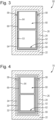
- Figure 3 shows a front sectional view through a second thermally insulated container 50.
- the thermally insulated housing 22 is essentially the same as that shown in figure 2 .
- Mounted within the enclosed insulated chamber 28 is a product storage assembly 52 having an inner surface 53 and an outer surface 54.
- the product storage assembly 52 is mounted in the enclosed insulated chamber by pins 58, which provide a stable yet minimal degree of physical contact between the product storage assembly 52 and the thermally insulated housing 22. Other mounting arrangements are possible.
- the product storage assembly 52 is comprised of four sides, a top, bottom and two sides, leaving the front and back open to expose the internal product storage chamber.
- the gap between the outer surface 54 of the product storage assembly 52 and the inner surface 24 of the thermally insulated housing 22 is approximately 6 mm, but can be from 1 to 10 mm as desired.
- the product storage assembly 52 is made from plastic material, although they could be made from a conductive material such as metal.
- first drawer 60 and second drawer 62 Positioned within the product storage assembly 52 are a first drawer 60 and second drawer 62 providing a pair of frozen confectionery item supports.
- the drawers 60, 62 each have an inner surface 64 and an outer surface 66.
- thermally insulated housing 22 is openable to expose the drawers 60, 62 so that they can be withdrawn from the product storage assembly 52.
- Each of the walls of the drawers 60, 62 are made from a pair of roll-bonded aluminium metal sheets. Each sheet comprises a series of complementary depressions, so that a series of cavities are produced between the inner 64 and outer 66 surfaces. Phase change material 69 is contained within the cavities.
- Figure 4 shows a front sectional view through a third thermally insulated container 70.
- the thermally insulated container comprises a product storage assembly 52 as shown in figure 3 , combined with a first drawer 60 and second drawer 62 providing a pair of frozen confectionery item supports as shown in figure 2 .
- Figure 5 shows a sectional schematic representation through two types of wall of a product storage assembly 52.
- Figure 5(a) shows a flat inner wall 53 (providing part of the inner surface) bonded to an outer wall 55 (providing part of the outer surface) comprising a number of depressions 64. Equally the inner wall could be the outer wall and the outer wall could be the inner wall.
- the phase change material is provided within the contained cavities 66 provided by the depressions 64.
- Figure 5(b) shows an inner wall 57 (providing part of the inner surface) comprising a number of depressions 64 bonded to an outer wall 59 (providing part of the outer surface) also comprising a number of depressions 64.
- the depressions 64 are aligned with a corresponding depression to provide cavities 66 within the wall of the product storage assembly to contain the phase change material.
- Figure 6 shows a perspective schematic representation of a drawer 80 providing a frozen confectionery item support.
- One wall 82 is provided by a sheet of metal comprising depressions 83 and providing part of the inner surface of the frozen confectionery item support. This is bonded to a flat outer wall (not shown) such that the depressions 83 provide cavities within which the phase change material is located.
Landscapes
- Engineering & Computer Science (AREA)
- Aviation & Aerospace Engineering (AREA)
- Chemical & Material Sciences (AREA)
- Combustion & Propulsion (AREA)
- Physics & Mathematics (AREA)
- Mechanical Engineering (AREA)
- Thermal Sciences (AREA)
- General Engineering & Computer Science (AREA)
- Packages (AREA)
- Handcart (AREA)
Claims (14)
- Wärmeisolierter Behälter zum Lagern und Servieren gefrorener Konfektartikel, der für eine Montage in einem Servicewagen (10) geeignet ist, wobei der wärmeisolierte Behälter keine Leistungsversorgung aufweist und Folgendes umfasst:• ein wärmeisoliertes Gehäuse (22), das eine innere Oberfläche (24), die eine umschlossene isolierte Kammer (28) definiert, und eine äußere Oberfläche (26) für einen Montageeingriff mit einem Servicewagen aufweist, wobei das wärmeisolierte Gehäuse wenigstens einen Abschnitt aufweist, der geöffnet werden kann, um durch die innere und die äußere Oberfläche einen Zugriff auf die umschlossene isolierte Kammer zu ermöglichen;• eine Produktlagerungsanordnung (30), die in der umschlossenen isolierten Kammer montiert ist, die eine äußere Oberfläche (34) und eine innere Oberfläche (32) aufweist, wobei die innere Oberfläche eine innere Produktlagerungskammer definiert, wobei auf die innere Produktlagerungskammer über den Abschnitt des wärmeisolierten Gehäuses, der geöffnet werden kann, zugegriffen werden kann, und wobei die äußere Oberfläche im Wesentlichen parallel zur inneren Oberfläche des wärmeisolierten Gehäuses verläuft, jedoch von wenigstens 90 % dieser Oberfläche beabstandet ist, wobei der mittlere Abstand im Bereich von 1 bis 10 mm liegt;• wenigstens einen Träger (40, 42) für gefrorene Konfektartikel, der in der inneren Produktlagerungskammer positioniert ist, wobei der Träger für gefrorene Konfektartikel eine äußere Oberfläche, die im Einsatz von einem Artikel, der getragen wird, weg zeigt, und eine innere Oberfläche, die im Einsatz zu einem Artikel, der getragen wird, hin zeigt, aufweist, und wobei ein Speicher eines Phasenumwandlungsmaterials zwischen der inneren und der äußeren Oberfläche der Produktlagerungsanordnung und/oder zwischen der inneren und der äußeren Oberfläche des wenigstens einen Trägers für gefrorene Konfektartikel bereitgestellt ist.
- Wärmeisolierter Behälter nach Anspruch 1, wobei die innere Oberfläche der inneren Produktlagerungskammer eine innere wärmeleitende Lage umfasst und wobei die äußere Oberfläche der inneren Produktlagerungskammer eine äußere wärmeleitende Lage umfasst, wobei die innere und die äußere wärmeleitende Lage zwischen sich einen umschlossenen Raum umschließen, der einen Speicher eines Phasenumwandlungsmaterials umfasst.
- Wärmeisolierter Behälter nach Anspruch 1 oder Anspruch 2, wobei die innere Oberfläche des wenigstens einen Trägers für gefrorene Konfektartikel eine innere wärmeleitende Lage umfasst und wobei die äußere Oberfläche des wenigstens einen Trägers für gefrorene Konfektartikel eine äußere wärmeleitende Lage umfasst, wobei die innere und die äußere wärmeleitende Lage zwischen sich einen umschlossenen Raum umschließen, der einen Speicher eines Phasenumwandlungsmaterials umfasst.
- Wärmeisolierter Behälter nach Anspruch 2 oder Anspruch 3, wobei die innere und die äußere wärmeleitende Lage verbundene Metallbleche sind.
- Wärmeisolierter Behälter nach einem der vorhergehenden Ansprüche, wobei der Abstand zwischen der äußeren Oberfläche der Produktlagerungsanordnung und der inneren Oberfläche des wärmeisolierten Gehäuses im Bereich von 2 bis 8 mm, vorzugsweise von 3 bis 5 mm liegt.
- Wärmeisolierter Behälter nach einem der vorhergehenden Ansprüche, wobei der wenigstens eine Träger für gefrorene Konfektartikel wenigstens eine Schublade (40, 42) ist, die aus der Produktlagerungsanordnung über den Abschnitt des wärmeisolierten Gehäuses, der geöffnet werden kann, herausgezogen werden kann.
- Wärmeisolierter Behälter nach einem der vorhergehenden Ansprüche, wobei die äußere Oberfläche der Produktlagerungsanordnung von wenigstens 95 % der Oberfläche der inneren Oberfläche des wärmeisolierten Gehäuses beabstandet ist.
- Wärmeisolierter Behälter nach einem der vorhergehenden Ansprüche, wobei das Phasenumwandlungsmaterial einen Schmelzpunkt im Bereich von -30 °C bis -6 °C aufweist.
- Wärmeisolierter Behälter nach einem der vorhergehenden Ansprüche, wobei das Verhältnis der Menge des Phasenumwandlungsmaterials (in kg) zum Volumen der umschlossenen isolierten Kammer (in Liter) in einem Bereich von 1:25 bis 1:5 liegt.
- Servicewagen (10), der einen wärmeisolierten Behälter nach einem der vorhergehenden Ansprüche umfasst.
- Servicewagen nach Anspruch 11, wobei der Servicewagen ein Bord-Servicewagen (10) ist.
- Verfahren zum Lagern und Servieren gefrorener Konfektartikel unter Verwendung eines wärmeisolierten Behälters nach einem der Ansprüche 1 bis 9, wobei das Verfahren die folgenden Schritte umfasst:• Kühlen des Speichers des Phasenumwandlungsmaterials, der zwischen der inneren und der äußeren Oberfläche der Produktlagerungsanordnung und/oder zwischen der inneren und der äußeren Oberfläche des wenigstens einen Trägers für gefrorene Konfektartikel vorgesehen ist, auf eine Temperatur von weniger als -6 °C;• Montieren der Produktlagerungsanordnung in der umschlossenen isolierten Kammer des wärmeisolierten Gehäuses, wobei mehrere gefrorene Konfektartikel in die Produktlagerungsanordnung gefüllt werden; und wobei die Produktlagerungsanordnung in der umschlossenen isolierten Kammer so montiert wird, dass die äußere Oberfläche der Produktlagerungsanordnung im Wesentlichen parallel zur inneren Oberfläche des wärmeisolierten Gehäuses verläuft, jedoch im Wesentlichen von der gesamten inneren Oberfläche beabstandet ist, wobei der mittlere Abstand im Bereich von 1 bis 10 mm liegt;• Lagern der gefrorenen Konfektartikel in der umschlossenen isolierten Kammer für eine Zeitspanne bis zu 24 Stunden und Servieren der gefrorenen Konfektartikel während der Lagerungszeitspanne durch Öffnen eines Abschnitts des wärmeisolierten Gehäuses, der geöffnet werden kann, und Entnehmen wenigstens eines der gefrorenen Konfektartikel aus der umschlossenen isolierten Kammer und daraufhin vorzugsweise Schließen des Abschnitts des wärmeisolierten Gehäuses, der geöffnet werden kann.
- Verfahren zum Lagern und Servieren gefrorener Konfektartikel nach Anspruch 12, wobei:• die gefrorenen Konfektartikel in die Produktlagerungsanordnung durch Anordnen der gefrorenen Konfektartikel in einem Träger für gefrorene Konfektartikel gefüllt werden; und• die gefrorenen Konfektartikel durch Öffnen des Abschnitts des wärmeisolierten Gehäuses, der geöffnet werden kann, Entnehmen wenigstens eines der gefrorenen Konfektartikel und Schließen des Abschnitts des wärmeisolierten Gehäuses, der geöffnet werden kann, serviert werden.
- Verfahren zu Lagern und Servieren gefrorener Konfektartikel nach Anspruch 13, wobei der Träger für gefrorene Konfektartikel eine Schublade ist und das Verfahren Folgendes umfasst: Ergreifen der Produktschublade in der Produktlagerungsanordnung dahingehend, dass die Schublade relativ zur Produktlagerungsanordnung mittels Schieben zwischen einer offenen Position und einer geschlossenen Position bewegt werden kann; und Schieben der Produktschublade zur offenen Position, und daraufhin nach der Entnahme wenigstens eines der gefrorenen Konfektartikel vorzugsweise Schieben der Produktschublade in die geschlossene Position.
Applications Claiming Priority (2)
| Application Number | Priority Date | Filing Date | Title |
|---|---|---|---|
| EP19213454 | 2019-12-04 | ||
| PCT/EP2020/081400 WO2021110357A1 (en) | 2019-12-04 | 2020-11-07 | Container for storing and serving frozen confectionery items |
Publications (2)
| Publication Number | Publication Date |
|---|---|
| EP4070022A1 EP4070022A1 (de) | 2022-10-12 |
| EP4070022B1 true EP4070022B1 (de) | 2025-05-07 |
Family
ID=68771451
Family Applications (1)
| Application Number | Title | Priority Date | Filing Date |
|---|---|---|---|
| EP20811245.8A Active EP4070022B1 (de) | 2019-12-04 | 2020-11-07 | Behälter zum lagern und servieren von gefrorenen süsswaren |
Country Status (5)
| Country | Link |
|---|---|
| US (1) | US12466559B2 (de) |
| EP (1) | EP4070022B1 (de) |
| CN (1) | CN114761745A (de) |
| BR (1) | BR112022010930A2 (de) |
| WO (1) | WO2021110357A1 (de) |
Families Citing this family (4)
| Publication number | Priority date | Publication date | Assignee | Title |
|---|---|---|---|---|
| WO2021110358A1 (en) | 2019-12-04 | 2021-06-10 | Unilever Ip Holdings B.V. | Container for storing and serving scoopable frozen confectionery |
| GB202001458D0 (en) * | 2020-02-03 | 2020-03-18 | Global Chilltech Group Ltd | Trolley |
| US12296959B2 (en) | 2022-06-08 | 2025-05-13 | B/E Aerospace, Inc. | In-seat mini-bar features |
| US20230400250A1 (en) * | 2022-06-08 | 2023-12-14 | B/E Aerospace, Inc. | Roll-bond component forming cart bay walls with liquid circulation and a high efficiency micro-chiller heat sink |
Family Cites Families (60)
| Publication number | Priority date | Publication date | Assignee | Title |
|---|---|---|---|---|
| US2165327A (en) | 1936-04-20 | 1939-07-11 | Zalkind Philip | Set-up insulation box |
| FR2417853A1 (fr) | 1978-02-17 | 1979-09-14 | Thomson Csf | Procede de realisation d'un transistor de type mos et transistor realise selon ce procede |
| US4528439A (en) | 1982-10-29 | 1985-07-09 | Standard Oil Company | Portable thermally insulated case |
| US4898294A (en) | 1988-08-31 | 1990-02-06 | Jennings Gary K | Frozen food container for aircraft usage |
| DE29611084U1 (de) | 1996-06-25 | 1996-11-07 | Arendt, Harald, 69483 Wald-Michelbach | Behälter zum temperierten Aufbewahren von Gütern |
| US20030131623A1 (en) * | 2001-09-05 | 2003-07-17 | Suppes Galen J. | Heat pump using phase change materials |
| US6938793B2 (en) | 2001-12-18 | 2005-09-06 | William S. Lerner | Thermal preservation insert for food storage container |
| AU2003210344A1 (en) | 2002-03-28 | 2003-10-13 | Unilever Plc | Method for dispensing frozen edible products and insulated container adapted therefore |
| US20060006621A1 (en) | 2004-07-08 | 2006-01-12 | Santa Cruz Cathy D | Portable self-contained service cart arrangement |
| DE102006044847A1 (de) | 2006-09-22 | 2008-03-27 | Blanco Gmbh + Co Kg | Behälter zum Kühlen und/oder Kühlhalten von Speisen und/oder Getränken |
| KR100836844B1 (ko) | 2007-01-30 | 2008-06-11 | 위니아만도 주식회사 | 반자동 덮개가 형성된 서랍식 저장실을 포함하는김치저장고 |
| FI121171B (fi) | 2007-02-28 | 2010-08-13 | Blue1 Oy | Jäähdytettävä säilytysastia |
| EP2146604A1 (de) * | 2007-03-06 | 2010-01-27 | Richard John Birkett | Behälter für heissgetränke |
| US20090078708A1 (en) | 2007-09-20 | 2009-03-26 | Preston Noel Williams | Temperature Maintaining Package Having Corner Discontinuities |
| US9303912B1 (en) | 2010-05-11 | 2016-04-05 | The Boeing Company | Passively cooled container system and method |
| US8474274B2 (en) | 2010-05-11 | 2013-07-02 | The Boeing Company | Refrigerated container |
| FI20106098A0 (fi) | 2010-10-25 | 2010-10-25 | Jarmo Aurekoski | Lentokoneen tarjoiluvaunun jäähdytysratkaisu |
| JP5740148B2 (ja) | 2010-12-22 | 2015-06-24 | 凸版印刷株式会社 | 保冷容器 |
| US8763811B2 (en) | 2011-05-05 | 2014-07-01 | Gary Lantz | Insulated shipping container, and method of making |
| CN102213529B (zh) | 2011-06-03 | 2017-03-01 | 海尔集团公司 | 冰箱冷藏室结构和具有其的冰箱 |
| JP5920694B2 (ja) | 2011-10-19 | 2016-05-18 | 武子 穴見 | 携帯用クーラーボックス |
| JP6021931B2 (ja) * | 2011-11-17 | 2016-11-09 | マーレ ベア ゲゼルシャフト ミット ベシュレンクテル ハフツング ウント コンパニー コマンディートゲゼルシャフトMAHLE Behr GmbH & Co.KG | 蓄熱器 |
| JP2012102744A (ja) * | 2012-01-19 | 2012-05-31 | Ihi Corp | 過給機の断熱カバー |
| CN102607235B (zh) * | 2012-04-13 | 2015-12-23 | 合肥美的电冰箱有限公司 | 用于冰箱的抽屉和具有该抽屉的冰箱 |
| US10168090B1 (en) | 2012-05-03 | 2019-01-01 | Efp Llc | Temperature controlled box system |
| US9060508B2 (en) | 2012-07-18 | 2015-06-23 | Alex N. Anti | High-performance extended target temperature containers |
| US8887515B2 (en) | 2012-08-23 | 2014-11-18 | Pelican Biopharma, Llc | Thermal management systems and methods |
| US9038945B2 (en) | 2013-03-15 | 2015-05-26 | B/E Aerospace, Inc. | Integrated aircraft galley system |
| US11046500B2 (en) | 2013-04-30 | 2021-06-29 | Mp Global Products, L.L.C. | Insulated shipping system including one-piece insulative insert with strengthening inner layer |
| US9366483B2 (en) * | 2013-11-27 | 2016-06-14 | Tokitac LLC | Temperature-controlled container systems for use within a refrigeration device |
| US9731895B2 (en) | 2013-12-07 | 2017-08-15 | Trumed Systems, Inc. | Automated smart storage of temperature sensitive products |
| KR101457029B1 (ko) | 2014-01-02 | 2014-11-04 | 주식회사 에프엠에스코리아 | 저온 대상물 저장용 박스 패키지 |
| CA2876897C (en) | 2014-01-09 | 2016-10-04 | Ryan J. Savage | Movable cart |
| WO2015120911A1 (de) | 2014-02-17 | 2015-08-20 | Dometic S.A.R.L. | Kühlvorrichtung |
| CN203958959U (zh) | 2014-07-01 | 2014-11-26 | 汪丽珊 | 一种蓄冷冷藏箱 |
| JP6420118B2 (ja) | 2014-10-24 | 2018-11-07 | 積水化成品工業株式会社 | 保冷容器 |
| WO2016089979A1 (en) | 2014-12-05 | 2016-06-09 | Andreas Hieke | Methods and functional elements for enhanced thermal management of predominantly enclosed spaces |
| US10266332B2 (en) | 2015-05-04 | 2019-04-23 | Pratt Corrugated Holdings, Inc. | Adjustable insulation packaging |
| CN204937738U (zh) * | 2015-09-16 | 2016-01-06 | 郑月香 | 一种容器 |
| GB2543837B (en) * | 2015-10-30 | 2018-11-07 | Tower Cold Chain Solutions Ltd | In-flight service cart with a thermally insulated container utilising a phase change material |
| US10287017B2 (en) | 2016-04-13 | 2019-05-14 | The Boeing Company | Convertible chilled stowage compartment in an aircraft |
| CN205947109U (zh) * | 2016-07-18 | 2017-02-15 | 中国烟草总公司郑州烟草研究院 | 一种卷烟电热筒的保温隔热装置 |
| CN206761922U (zh) * | 2016-08-23 | 2017-12-19 | 陈燕玲 | 一种空气能隔热防烫艾灸器具 |
| US10046901B1 (en) | 2017-02-16 | 2018-08-14 | Vericool, Inc. | Thermally insulating packaging |
| US12338054B2 (en) | 2017-04-03 | 2025-06-24 | Jim TUMBER | Insulated shipping containers with compound insulation having space therebetween |
| DE102017109357B4 (de) | 2017-05-02 | 2022-04-28 | Viessmann Refrigeration Solutions Gmbh | Kühlmöbel mit Speicher und Kühlsystem |
| US20180339838A1 (en) | 2017-05-26 | 2018-11-29 | WW Thermal Designs, LLC | Insulated container liner and method of insulating a container |
| ES3009657T3 (en) | 2017-11-28 | 2025-03-31 | Coopersurgical Inc | Specimen containers and related methods |
| AT520968A1 (de) | 2018-02-20 | 2019-09-15 | Temprify Trading Gmbh | Wärmegedämmte Transportbox |
| US11078008B2 (en) | 2018-02-28 | 2021-08-03 | Smurfit Kappa North America Llc | Cold chain packaging |
| CN112566497A (zh) | 2018-03-23 | 2021-03-26 | 布鲁克斯自动化公司 | 自动低温储存和取出系统 |
| CN209209482U (zh) * | 2018-10-19 | 2019-08-06 | 宁波大学 | 基于相变流体的潜热型冷链温控包装 |
| CN209312826U (zh) * | 2018-11-15 | 2019-08-27 | 宁德时代新能源科技股份有限公司 | 用于电池包的箱体及电池包 |
| CN111192985B (zh) | 2018-11-15 | 2024-11-15 | 宁德时代新能源科技股份有限公司 | 用于电池包的箱体及电池包 |
| JP6675601B1 (ja) | 2018-11-30 | 2020-04-01 | コネクトオール株式会社 | 積層コアの製造方法、接着剤塗布装置及び積層コアの製造装置 |
| US20200290790A1 (en) | 2019-02-14 | 2020-09-17 | Chewy, Inc. | Thermally insulating packaging system |
| WO2020229236A1 (en) | 2019-05-14 | 2020-11-19 | Unilever Plc | Container for storing and serving frozen confectionery items |
| DE102019112619A1 (de) | 2019-05-14 | 2020-11-19 | Lts Lohmann Therapie-Systeme Ag | Vorrichtung sowie Verfahren zur Klebrigkeitsprüfung |
| US12091233B2 (en) | 2020-03-25 | 2024-09-17 | Cold Chain Technologies, Llc | Product box suitable for receiving temperature-sensitive materials and shipping system including the same |
| AU2021348066B2 (en) | 2020-09-24 | 2024-12-05 | TMRW Life Sciences, Inc. | Workstation and apparatus to facilitate transfer of biological specimens stored at cryogenic conditions |
-
2020
- 2020-11-07 WO PCT/EP2020/081400 patent/WO2021110357A1/en not_active Ceased
- 2020-11-07 BR BR112022010930A patent/BR112022010930A2/pt active IP Right Grant
- 2020-11-07 US US17/781,361 patent/US12466559B2/en active Active
- 2020-11-07 EP EP20811245.8A patent/EP4070022B1/de active Active
- 2020-11-07 CN CN202080083990.3A patent/CN114761745A/zh active Pending
Also Published As
| Publication number | Publication date |
|---|---|
| US20220411064A1 (en) | 2022-12-29 |
| US12466559B2 (en) | 2025-11-11 |
| EP4070022A1 (de) | 2022-10-12 |
| BR112022010930A2 (pt) | 2022-09-06 |
| CN114761745A (zh) | 2022-07-15 |
| WO2021110357A1 (en) | 2021-06-10 |
Similar Documents
| Publication | Publication Date | Title |
|---|---|---|
| US12466559B2 (en) | Container for storing and serving frozen confectionery items | |
| JP6141238B2 (ja) | 冷材装入タイプのトラックの荷室/貨物専用コンテナおよび温度−保持ボックス | |
| JP2599802B2 (ja) | 製品を0゜c又はこれに近い所期の温度に維持する方法及びこのためのコンテナ | |
| AU2020275069B2 (en) | Container for storing and serving frozen confectionery items | |
| JP2007118972A (ja) | 定温保冷ボックスと定温保冷方法 | |
| US20180346122A1 (en) | In-flight service cart and thermally insulated container for an in-flight service cart | |
| AU2020273506B2 (en) | Container for storing and serving frozen confectionery items | |
| EP3087332B1 (de) | Kühlaggregat mit intermittierendem stromnetz | |
| EP4070021B1 (de) | Behälter zum lagern und servieren gefrorenen süsswaren | |
| KR20100110010A (ko) | 이동수단이 설치된 냉장박스 | |
| JP5089496B2 (ja) | 冷凍冷蔵庫 | |
| KR101091003B1 (ko) | 냉장고용 선반 | |
| US20070044502A1 (en) | Thermopanel, insulated container with thermopanel, and method of using same | |
| JP2011038686A (ja) | 冷蔵庫 | |
| EP3051238A1 (de) | Kühlbox und Verfahren zum Transport von wärmeempfindlichen Produkten in einem Transportfahrzeug und/oder zum Verteilen von Produkten an Endkunden | |
| JP7693231B2 (ja) | トロリー | |
| CN216135547U (zh) | 一种多分区的蛋糕冷冻柜 | |
| US7640769B1 (en) | Portable self-contained storage apparatus for biologicals | |
| BR112021019647B1 (pt) | Recipiente termicamente isolado para armazenar e servir itens de confeitaria congelados e carrinho de serviço | |
| GB2570907A (en) | Storage container and system | |
| WO2007066093A2 (en) | A cooler unit | |
| CN223525380U (zh) | 一种多层组合式冷藏箱 | |
| TR2025004699A2 (tr) | Sökülüp Takılabilir Buz Kutusu | |
| EP3693292A1 (de) | Verfahren zum transport von gefrorenen produkten | |
| JP2001091128A (ja) | 冷蔵庫 |
Legal Events
| Date | Code | Title | Description |
|---|---|---|---|
| STAA | Information on the status of an ep patent application or granted ep patent |
Free format text: STATUS: UNKNOWN |
|
| STAA | Information on the status of an ep patent application or granted ep patent |
Free format text: STATUS: THE INTERNATIONAL PUBLICATION HAS BEEN MADE |
|
| PUAI | Public reference made under article 153(3) epc to a published international application that has entered the european phase |
Free format text: ORIGINAL CODE: 0009012 |
|
| STAA | Information on the status of an ep patent application or granted ep patent |
Free format text: STATUS: REQUEST FOR EXAMINATION WAS MADE |
|
| 17P | Request for examination filed |
Effective date: 20220527 |
|
| AK | Designated contracting states |
Kind code of ref document: A1 Designated state(s): AL AT BE BG CH CY CZ DE DK EE ES FI FR GB GR HR HU IE IS IT LI LT LU LV MC MK MT NL NO PL PT RO RS SE SI SK SM TR |
|
| DAV | Request for validation of the european patent (deleted) | ||
| DAX | Request for extension of the european patent (deleted) | ||
| GRAP | Despatch of communication of intention to grant a patent |
Free format text: ORIGINAL CODE: EPIDOSNIGR1 |
|
| STAA | Information on the status of an ep patent application or granted ep patent |
Free format text: STATUS: GRANT OF PATENT IS INTENDED |
|
| INTG | Intention to grant announced |
Effective date: 20250102 |
|
| GRAS | Grant fee paid |
Free format text: ORIGINAL CODE: EPIDOSNIGR3 |
|
| GRAA | (expected) grant |
Free format text: ORIGINAL CODE: 0009210 |
|
| STAA | Information on the status of an ep patent application or granted ep patent |
Free format text: STATUS: THE PATENT HAS BEEN GRANTED |
|
| AK | Designated contracting states |
Kind code of ref document: B1 Designated state(s): AL AT BE BG CH CY CZ DE DK EE ES FI FR GB GR HR HU IE IS IT LI LT LU LV MC MK MT NL NO PL PT RO RS SE SI SK SM TR |
|
| REG | Reference to a national code |
Ref country code: GB Ref legal event code: FG4D |
|
| REG | Reference to a national code |
Ref country code: CH Ref legal event code: EP |
|
| REG | Reference to a national code |
Ref country code: DE Ref legal event code: R096 Ref document number: 602020050977 Country of ref document: DE |
|
| REG | Reference to a national code |
Ref country code: IE Ref legal event code: FG4D |
|
| P01 | Opt-out of the competence of the unified patent court (upc) registered |
Free format text: CASE NUMBER: APP_20878/2025 Effective date: 20250502 |
|
| REG | Reference to a national code |
Ref country code: NL Ref legal event code: MP Effective date: 20250507 |
|
| RAP4 | Party data changed (patent owner data changed or rights of a patent transferred) |
Owner name: UNILEVER IP HOLDINGS B.V. |
|
| REG | Reference to a national code |
Ref country code: GB Ref legal event code: 732E Free format text: REGISTERED BETWEEN 20250828 AND 20250903 |
|
| RAP2 | Party data changed (patent owner data changed or rights of a patent transferred) |
Owner name: MAGNUM IP HOLDINGS B.V. |
|
| REG | Reference to a national code |
Ref country code: DE Ref legal event code: R081 Ref document number: 602020050977 Country of ref document: DE Owner name: MAGNUM IP HOLDINGS B.V., NL Free format text: FORMER OWNER: UNILEVER IP HOLDINGS B.V., ROTTERDAM, NL |
|
| PG25 | Lapsed in a contracting state [announced via postgrant information from national office to epo] |
Ref country code: PT Free format text: LAPSE BECAUSE OF FAILURE TO SUBMIT A TRANSLATION OF THE DESCRIPTION OR TO PAY THE FEE WITHIN THE PRESCRIBED TIME-LIMIT Effective date: 20250908 Ref country code: FI Free format text: LAPSE BECAUSE OF FAILURE TO SUBMIT A TRANSLATION OF THE DESCRIPTION OR TO PAY THE FEE WITHIN THE PRESCRIBED TIME-LIMIT Effective date: 20250507 Ref country code: ES Free format text: LAPSE BECAUSE OF FAILURE TO SUBMIT A TRANSLATION OF THE DESCRIPTION OR TO PAY THE FEE WITHIN THE PRESCRIBED TIME-LIMIT Effective date: 20250507 |
|
| REG | Reference to a national code |
Ref country code: LT Ref legal event code: MG9D |
|
| PG25 | Lapsed in a contracting state [announced via postgrant information from national office to epo] |
Ref country code: NO Free format text: LAPSE BECAUSE OF FAILURE TO SUBMIT A TRANSLATION OF THE DESCRIPTION OR TO PAY THE FEE WITHIN THE PRESCRIBED TIME-LIMIT Effective date: 20250807 Ref country code: GR Free format text: LAPSE BECAUSE OF FAILURE TO SUBMIT A TRANSLATION OF THE DESCRIPTION OR TO PAY THE FEE WITHIN THE PRESCRIBED TIME-LIMIT Effective date: 20250808 |
|
| PG25 | Lapsed in a contracting state [announced via postgrant information from national office to epo] |
Ref country code: NL Free format text: LAPSE BECAUSE OF FAILURE TO SUBMIT A TRANSLATION OF THE DESCRIPTION OR TO PAY THE FEE WITHIN THE PRESCRIBED TIME-LIMIT Effective date: 20250507 Ref country code: PL Free format text: LAPSE BECAUSE OF FAILURE TO SUBMIT A TRANSLATION OF THE DESCRIPTION OR TO PAY THE FEE WITHIN THE PRESCRIBED TIME-LIMIT Effective date: 20250507 |
|
| REG | Reference to a national code |
Ref country code: AT Ref legal event code: MK05 Ref document number: 1792856 Country of ref document: AT Kind code of ref document: T Effective date: 20250507 |
|
| PG25 | Lapsed in a contracting state [announced via postgrant information from national office to epo] |
Ref country code: BG Free format text: LAPSE BECAUSE OF FAILURE TO SUBMIT A TRANSLATION OF THE DESCRIPTION OR TO PAY THE FEE WITHIN THE PRESCRIBED TIME-LIMIT Effective date: 20250507 |
|
| PG25 | Lapsed in a contracting state [announced via postgrant information from national office to epo] |
Ref country code: HR Free format text: LAPSE BECAUSE OF FAILURE TO SUBMIT A TRANSLATION OF THE DESCRIPTION OR TO PAY THE FEE WITHIN THE PRESCRIBED TIME-LIMIT Effective date: 20250507 |
|
| PG25 | Lapsed in a contracting state [announced via postgrant information from national office to epo] |
Ref country code: AT Free format text: LAPSE BECAUSE OF FAILURE TO SUBMIT A TRANSLATION OF THE DESCRIPTION OR TO PAY THE FEE WITHIN THE PRESCRIBED TIME-LIMIT Effective date: 20250507 |
|
| PG25 | Lapsed in a contracting state [announced via postgrant information from national office to epo] |
Ref country code: RS Free format text: LAPSE BECAUSE OF FAILURE TO SUBMIT A TRANSLATION OF THE DESCRIPTION OR TO PAY THE FEE WITHIN THE PRESCRIBED TIME-LIMIT Effective date: 20250807 |
|
| PG25 | Lapsed in a contracting state [announced via postgrant information from national office to epo] |
Ref country code: IS Free format text: LAPSE BECAUSE OF FAILURE TO SUBMIT A TRANSLATION OF THE DESCRIPTION OR TO PAY THE FEE WITHIN THE PRESCRIBED TIME-LIMIT Effective date: 20250907 |
|
| PG25 | Lapsed in a contracting state [announced via postgrant information from national office to epo] |
Ref country code: LV Free format text: LAPSE BECAUSE OF FAILURE TO SUBMIT A TRANSLATION OF THE DESCRIPTION OR TO PAY THE FEE WITHIN THE PRESCRIBED TIME-LIMIT Effective date: 20250507 |
|
| PGFP | Annual fee paid to national office [announced via postgrant information from national office to epo] |
Ref country code: DE Payment date: 20251125 Year of fee payment: 6 |
|
| PGFP | Annual fee paid to national office [announced via postgrant information from national office to epo] |
Ref country code: GB Payment date: 20251111 Year of fee payment: 6 |
|
| PG25 | Lapsed in a contracting state [announced via postgrant information from national office to epo] |
Ref country code: DK Free format text: LAPSE BECAUSE OF FAILURE TO SUBMIT A TRANSLATION OF THE DESCRIPTION OR TO PAY THE FEE WITHIN THE PRESCRIBED TIME-LIMIT Effective date: 20250507 Ref country code: SM Free format text: LAPSE BECAUSE OF FAILURE TO SUBMIT A TRANSLATION OF THE DESCRIPTION OR TO PAY THE FEE WITHIN THE PRESCRIBED TIME-LIMIT Effective date: 20250507 |
|
| PGFP | Annual fee paid to national office [announced via postgrant information from national office to epo] |
Ref country code: IT Payment date: 20251112 Year of fee payment: 6 |
|
| PGFP | Annual fee paid to national office [announced via postgrant information from national office to epo] |
Ref country code: FR Payment date: 20251126 Year of fee payment: 6 |
|
| PGFP | Annual fee paid to national office [announced via postgrant information from national office to epo] |
Ref country code: TR Payment date: 20251020 Year of fee payment: 6 |
|
| PG25 | Lapsed in a contracting state [announced via postgrant information from national office to epo] |
Ref country code: CZ Free format text: LAPSE BECAUSE OF FAILURE TO SUBMIT A TRANSLATION OF THE DESCRIPTION OR TO PAY THE FEE WITHIN THE PRESCRIBED TIME-LIMIT Effective date: 20250507 |
|
| PG25 | Lapsed in a contracting state [announced via postgrant information from national office to epo] |
Ref country code: EE Free format text: LAPSE BECAUSE OF FAILURE TO SUBMIT A TRANSLATION OF THE DESCRIPTION OR TO PAY THE FEE WITHIN THE PRESCRIBED TIME-LIMIT Effective date: 20250507 |
|
| PG25 | Lapsed in a contracting state [announced via postgrant information from national office to epo] |
Ref country code: SK Free format text: LAPSE BECAUSE OF FAILURE TO SUBMIT A TRANSLATION OF THE DESCRIPTION OR TO PAY THE FEE WITHIN THE PRESCRIBED TIME-LIMIT Effective date: 20250507 |
|
| PG25 | Lapsed in a contracting state [announced via postgrant information from national office to epo] |
Ref country code: RO Free format text: LAPSE BECAUSE OF FAILURE TO SUBMIT A TRANSLATION OF THE DESCRIPTION OR TO PAY THE FEE WITHIN THE PRESCRIBED TIME-LIMIT Effective date: 20250507 |
|
| REG | Reference to a national code |
Ref country code: DE Ref legal event code: R097 Ref document number: 602020050977 Country of ref document: DE |
|
| PLBE | No opposition filed within time limit |
Free format text: ORIGINAL CODE: 0009261 |
|
| STAA | Information on the status of an ep patent application or granted ep patent |
Free format text: STATUS: NO OPPOSITION FILED WITHIN TIME LIMIT |
|
| REG | Reference to a national code |
Ref country code: CH Ref legal event code: L10 Free format text: ST27 STATUS EVENT CODE: U-0-0-L10-L00 (AS PROVIDED BY THE NATIONAL OFFICE) Effective date: 20260318 |
|
| 26N | No opposition filed |
Effective date: 20260210 |