EP4071118A1 - Verres à base de silicoborate et de borosilicate à indice élevé - Google Patents
Verres à base de silicoborate et de borosilicate à indice élevé Download PDFInfo
- Publication number
- EP4071118A1 EP4071118A1 EP22166349.5A EP22166349A EP4071118A1 EP 4071118 A1 EP4071118 A1 EP 4071118A1 EP 22166349 A EP22166349 A EP 22166349A EP 4071118 A1 EP4071118 A1 EP 4071118A1
- Authority
- EP
- European Patent Office
- Prior art keywords
- mol
- equal
- less
- glass
- tio
- Prior art date
- Legal status (The legal status is an assumption and is not a legal conclusion. Google has not performed a legal analysis and makes no representation as to the accuracy of the status listed.)
- Pending
Links
Images





Classifications
-
- C—CHEMISTRY; METALLURGY
- C03—GLASS; MINERAL OR SLAG WOOL
- C03C—CHEMICAL COMPOSITION OF GLASSES, GLAZES OR VITREOUS ENAMELS; SURFACE TREATMENT OF GLASS; SURFACE TREATMENT OF FIBRES OR FILAMENTS MADE FROM GLASS, MINERALS OR SLAGS; JOINING GLASS TO GLASS OR OTHER MATERIALS
- C03C3/00—Glass compositions
- C03C3/04—Glass compositions containing silica
- C03C3/062—Glass compositions containing silica with less than 40% silica by weight
- C03C3/064—Glass compositions containing silica with less than 40% silica by weight containing boron
- C03C3/068—Glass compositions containing silica with less than 40% silica by weight containing boron containing rare earths
-
- C—CHEMISTRY; METALLURGY
- C03—GLASS; MINERAL OR SLAG WOOL
- C03C—CHEMICAL COMPOSITION OF GLASSES, GLAZES OR VITREOUS ENAMELS; SURFACE TREATMENT OF GLASS; SURFACE TREATMENT OF FIBRES OR FILAMENTS MADE FROM GLASS, MINERALS OR SLAGS; JOINING GLASS TO GLASS OR OTHER MATERIALS
- C03C3/00—Glass compositions
- C03C3/12—Silica-free oxide glass compositions
- C03C3/14—Silica-free oxide glass compositions containing boron
- C03C3/15—Silica-free oxide glass compositions containing boron containing rare earths
- C03C3/155—Silica-free oxide glass compositions containing boron containing rare earths containing zirconium, titanium, tantalum or niobium
Definitions
- the present disclosure generally relates to borate and silicoborate glasses having a high refractive index and low density.
- Low density, high refractive index glasses often belong to one of two types of chemical systems, based on the glass formers used: (a) silicoborate or borosilicate glasses in which SiO 2 and/or B 2 O 3 are used as the main glass formers and (b) phosphate glasses in which P 2 O 5 is used as a main glass former. Glasses which rely on other oxides as main glass formers, such as GeO 2 , TeO 2 , Bi 2 O 3 , and V 2 O 5 , can be challenging to use due to cost, glass-forming ability, optical properties, and/or production requirements.
- Phosphate glasses can be characterized by a high refractive index and low density.
- phosphate glasses can be challenging to produce due to volatilization of P 2 O 5 from the melts and/or risks of platinum incompatibility.
- phosphate glasses are often highly colored and may require an extra bleaching step to provide a glass having the desired transmittance characteristic.
- phosphate glasses exhibiting a high refractive index also tend to have an increase in optical dispersion.
- a glass comprises a plurality of components, the glass having a composition of the components comprising greater than or equal to 0.5 mol.% and less than or equal to 29.0 mol.% B 2 O 3 , greater than or equal to 0.0 mol.% and less than or equal to 25.2 mol.% TiO 2 , greater than or equal to 0.0 mol.% and less than or equal to 20.0 mol.% Bi 2 O 3 , greater than or equal to 0.0 mol.% and less than or equal to 20.0 mol.% TeO 2 , greater than or equal to 0.0 mol.% and less than or equal to 15.0 mol.% P 2 O 5 , greater than or equal to 0.0 mol.% and less than or equal to 10.5 mol.% Nb 2 O 5 , greater than or equal to 0.0 mol.% and less than or equal to 10.0 mol.% Al 2 O 3 , greater than or equal to 0.0 mol.% and less than or equal to 5.0 mol
- a glass comprises a plurality of components, the glass having a composition of the components comprising greater than or equal to 1.0 mol.% and less than or equal to 40.0 mol.% TiO 2 , greater than or equal to 1.0 mol.% and less than or equal to 40.0 mol.% B 2 O 3 , greater than or equal to 0.0 mol.% and less than or equal to 35.0 mol.% SiO 2 , greater than or equal to 0.0 mol.% and less than or equal to 30.0 mol.% La 2 O 3 , greater than or equal to 0.0 mol.% and less than or equal to 20.0 mol.% CaO, greater than or equal to 0.0 mol.% and less than or equal to 10.0 mol.% ZrO 2 , greater than or equal to 0.0 mol.% and less than or equal to 10.0 mol.% GeO 2 , greater than or equal to 0.0 mol.% and less than or equal to 10.0 mol.% Al 2 O
- the term “about” means that amounts, sizes, formulations, parameters, and other quantities and characteristics are not and need not be exact, but may be approximate and/or larger or smaller, as desired, reflecting tolerances, conversion factors, rounding off, measurement error and the like, and other factors known to those skilled in the art.
- the term “about” is used in describing a value or an end-point of a range, the disclosure should be understood to include the specific value or end-point referred to.
- formed from can mean one or more of comprises, consists essentially of, or consists of.
- a component that is formed from a particular material can comprise the particular material, consist essentially of the particular material, or consist of the particular material.
- modifier refers to the oxides of monovalent or divalent metals, i.e., R 2 O or RO, where "R” stands for a cation. Modifiers can be added to a glass composition to change the atomic structure of the melt and the resulting glass. In some embodiments, the modifier may change the coordination numbers of cations present in the glass formers (e.g., boron in B 2 O 3 ), which may result in forming a more polymerized atomic network and, as a result, may provide better glass formation.
- the glass formers e.g., boron in B 2 O 3
- R 2 O refers to a total content of divalent metal oxides
- R 2 O refers to a total content of monovalent metal oxides
- Alk 2 O refers to a total content of alkali metal oxides.
- the term R 2 O encompasses alkali metal oxides (Alk 2 O), in addition to other monovalent metal oxides, such as Ag 2 O, Tl 2 O, and Hg 2 O, for example.
- the said fluorine is assumed to be present in the form of silicon fluoride (SiF 4 ); accordingly, the total sum of all oxides plus SiF 4 is assumed to be 100 mole percent or 100 weight percent in all compositions. Analogous treatment of other halogens as sole halogens or combinations of halogens applies.
- the glass composition may contain La 2 O 3 in an amount less than or equal to 35.0 mol.%, less than or equal to 30.0 mol.%, less than or equal to 27.5 mol.%, less than or equal to 26.25 mol.%, less than or equal to 25.5 mol.%, less than or equal to 25.0 mol.%, less than or equal to 20.0 mol.%, or less than or equal to 5.0 mol.%.
- the glass composition may contain Gd 2 O 3 in an amount greater than or equal to 0.0 mol.% and less than or equal to 2.0 mol.%, greater than or equal to 0.0 mol.% and less than or equal to 1.5 mol.%, greater than or equal to 0.0 mol.% and less than or equal to 1.35 mol.%, greater than or equal to 0.0 mol.% and less than or equal to 1.2 mol.%, greater than or equal to 0.29 mol.% and less than or equal to 0.42 mol.%, greater than or equal to 0.0 mol.% and less than or equal to 5.0 mol.%, greater than or equal to 0.0 mol.% and less than or equal to 0.42 mol.%.
- the glass composition may contain divalent metal oxides RO in an amount greater than or equal to 0.0 mol.%, greater than or equal to 10.0 mol.%, or greater than or equal to 20.0 mol.%. In some other embodiments, the glass composition may contain divalent metal oxides RO in an amount less than or equal to 25.0 mol.%, less than or equal to 20.0 mol.%, or less than or equal to 10.0 mol.%.
- Glass composition may include zinc oxide (ZnO).
- Zinc oxide provides a good refractive index to density ratio and may sometimes increase the solubility of titania, which indirectly increases the refractive index of glasses.
- ZnO zinc oxide
- the glass-forming ability of the melt decreases and the melt may tend to crystallize during cooling.
- the glass composition may contain zinc oxide (ZnO) in an amount from greater than or equal to 0.0 mol.% to less than or equal to 10.0 mol.% and all ranges and sub-ranges between the foregoing values.
- Glass composition may include vanadia (V 2 O 5 ).
- Vanadia provides the highest ratio of the refractive index to density among all oxides.
- vanadia may cause undesirable dark coloring and may also raise environmental concerns.
- the content of vanadia in the glasses of the present disclosure is limited, or glass compositions may be free of V 2 O 5 .
- the glass composition may contain vanadia (V 2 O 5 ) in an amount from greater than or equal to 0.0 mol.% to less than or equal to 10.0 mol.% and all ranges and sub-ranges between the foregoing values.
- the glass composition may contain V 2 O 5 in an amount greater than or equal to 0.0 mol.% and less than or equal to 4.0 mol.%, greater than or equal to 0.0 mol.% and less than or equal to 0.1 mol.%, greater than or equal to 0.0 mol.% and less than or equal to 10.0 mol.%, greater than or equal to 0.1 mol.% and less than or equal to 10.0 mol.%, greater than or equal to 0.1 mol.% and less than or equal to 4.0 mol.%, greater than or equal to 4.0 mol.% and less than or equal to 10.0 mol.%, greater than or equal to 4.0 mol.% and less than or equal to 5.0 mol.%, greater than or equal to 5.0 mol.% and less than or equal to 10.0 mol.%, greater than or equal to 5.0 mol.% and less than or equal to 7.0 mol.%.
- Glass composition may include tantalum oxide (Ta 2 O 5 ). Tantalum oxide increases the refractive index while maintaining an acceptable density without reducing the blue transmittance. However, when added to a glass composition, sometimes even in small amounts, Ta 2 O 5 may cause crystallization of refractory minerals. Accordingly, the content of tantalum oxide should be limited, or glass compositions may be free of Ta 2 O 5 . In embodiments, the glass composition may contain tantalum oxide (Ta 2 O 5 ) in an amount from greater than or equal to 0.0 mol.% to less than or equal to 5.0 mol.% and all ranges and sub-ranges between the foregoing values.
- tantalum oxide Ta 2 O 5
- the glass composition may contain Bi 2 O 3 in an amount greater than or equal to 0.0 mol.%, greater than or equal to 5.0 mol.%, greater than or equal to 10.0 mol.%, greater than or equal to 14.0 mol.%, greater than or equal to 16.0 mol.%, or greater than or equal to 18.0 mol.%. In some other embodiments, the glass composition may contain Bi 2 O 3 in an amount less than or equal to 20.0 mol.%, less than or equal to 18.0 mol.%, less than or equal to 16.0 mol.%, less than or equal to 14.0 mol.%, less than or equal to 10.0 mol.%, or less than or equal to 5.0 mol.%.
- the glass composition may contain zirconia (ZrO 2 ) in an amount from greater than or equal to 0.0 mol.% to less than or equal to 11.0 mol.% and all ranges and sub-ranges between the foregoing values.
- the glass composition may contain ZrO 2 in an amount greater than or equal to 0.0 mol.%, greater than or equal to 1.0 mol.%, greater than or equal to 4.0 mol.%, greater than or equal to 5.0 mol.%, greater than or equal to 5.3 mol.%, greater than or equal to 5.6 mol.%, greater than or equal to 6.5 mol.%, greater than or equal to 7.3 mol.%, greater than or equal to 8.0 mol.%, greater than or equal to 9.0 mol.%, or greater than or equal to 10.0 mol.%.
- the glass composition may contain ZrO 2 in an amount less than or equal to 11.0 mol.%, less than or equal to 10.0 mol.%, less than or equal to 9.0 mol.%, less than or equal to 8.1 mol.%, less than or equal to 8.0 mol.%, less than or equal to 5.0 mol.%, or less than or equal to 1.0 mol.%.
- the glass composition may contain ZrO 2 in an amount greater than or equal to 0.0 mol.% and less than or equal to 10.0 mol.%, greater than or equal to 4.0 mol.% and less than or equal to 9.0 mol.%, greater than or equal to 5.3 mol.% and less than or equal to 8.1 mol.%, greater than or equal to 5.6 mol.% and less than or equal to 8.0 mol.%, greater than or equal to 6.5 mol.% and less than or equal to 8.0 mol.%, greater than or equal to 7.34 mol.% and less than or equal to 7.98 mol.%, greater than or equal to 0.0 mol.% and less than or equal to 11.0 mol.%, greater than or equal to 1.0 mol.% and less than or equal to 5.0 mol.%, greater than or equal to 5.0 mol.% and less than or equal to 8.0 mol.%, greater than or equal to 8.0 mol.% and less than or equal to 8.1 mol.%, greater than
- Glass composition may include Hafnium oxide (HfO 2 ).
- Hafnium oxide generally works like zirconium oxide described in this disclosure; in addition, HfO 2 is expensive. Accordingly, the content of hafnium oxide should be limited, or glass compositions may be free of HfO 2 .
- the glass composition may contain Hafnia (HfO 2 ) in an amount from greater than or equal to 0.0 mol.% to less than or equal to 11.0 mol.% and all ranges and sub-ranges between the foregoing values.
- the glass composition may contain HfO 2 in an amount greater than or equal to 0.0 mol.%, greater than or equal to 1.0 mol.%, greater than or equal to 4.0 mol.%, greater than or equal to 5.0 mol.%, greater than or equal to 5.3 mol.%, greater than or equal to 5.6 mol.%, greater than or equal to 6.5 mol.%, greater than or equal to 7.3 mol.%, greater than or equal to 8.0 mol.%, greater than or equal to 9.0 mol.%, or greater than or equal to 10.0 mol.%.
- the glass composition may contain HfO 2 in an amount less than or equal to 11.0 mol.%, less than or equal to 10.0 mol.%, less than or equal to 9.0 mol.%, less than or equal to 8.1 mol.%, less than or equal to 8.0 mol.%, less than or equal to 5.0 mol.%, or less than or equal to 1.0 mol.%.
- the glass composition may contain HfO 2 in an amount greater than or equal to 0.0 mol.% and less than or equal to 10.0 mol.%, greater than or equal to 4.0 mol.% and less than or equal to 9.0 mol.%, greater than or equal to 5.3 mol.% and less than or equal to 8.1 mol.%, greater than or equal to 5.6 mol.% and less than or equal to 8.0 mol.%, greater than or equal to 6.5 mol.% and less than or equal to 8.0 mol.%, greater than or equal to 7.34 mol.% and less than or equal to 7.98 mol.%, greater than or equal to 0.0 mol.% and less than or equal to 11.0 mol.%, greater than or equal to 1.0 mol.% and less than or equal to 5.0 mol.%, greater than or equal to 5.0 mol.% and less than or equal to 8.0 mol.%, greater than or equal to 8.0 mol.% and less than or equal to 8.1 mol.%, greater than
- the glass composition may contain Nb 2 O 5 in an amount greater than or equal to 0.0 mol.%, greater than or equal to 1.0 mol.%, greater than or equal to 2.5 mol.%, greater than or equal to 4.0 mol.%, greater than or equal to 4.5 mol.%, greater than or equal to 5.0 mol.%, greater than or equal to 5.1 mol.%, greater than or equal to 6.09 mol.%, greater than or equal to 7.5 mol.%, greater than or equal to 8.5 mol.%, greater than or equal to 9.5 mol.%, or greater than or equal to 10.0 mol.%.
- the glass composition may contain Nb 2 O 5 in an amount less than or equal to 10.5 mol.%, less than or equal to 10.0 mol.%, less than or equal to 9.5 mol.%, less than or equal to 9.25 mol.%, less than or equal to 8.6 mol.%, less than or equal to 8.5 mol.%, less than or equal to 7.5 mol.%, less than or equal to 6.7 mol.%, less than or equal to 5.0 mol.%, or less than or equal to 1.0 mol.%.
- Glass composition may include titania (TiO 2 ).
- TiO 2 titania
- the levels of TiO 2 and/or Nb 2 O 5 that are typically used in glasses to increase refractive index tend to decrease the transmittance in the near-UV region and shift the UV cut-off to higher wavelengths. Accordingly, the amount of TiO 2 is limited.
- the glass composition may contain titania (TiO 2 ) in an amount from greater than or equal to 0.0 mol.% to less than or equal to 40.0 mol.% and all ranges and sub-ranges between the foregoing values.
- the glass composition may contain TiO 2 in an amount less than or equal to 40.0 mol.%, less than or equal to 35.0 mol.%, less than or equal to 30.0 mol.%, less than or equal to 28.0 mol.%, less than or equal to 27.5 mol.%, less than or equal to 26.0 mol.%, less than or equal to 25.5 mol.%, less than or equal to 25.2 mol.%, less than or equal to 25.0 mol.%, less than or equal to 23.0 mol.%, less than or equal to 20.0 mol.%, or less than or equal to 5.0 mol.%.
- the glass composition may contain TiO 2 in an amount greater than or equal to 0.0 mol.% and less than or equal to 25.2 mol.%, greater than or equal to 1.0 mol.% and less than or equal to 40.0 mol.%, greater than or equal to 20.0 mol.% and less than or equal to 28.0 mol.%, greater than or equal to 20.0 mol.% and less than or equal to 27.5 mol.%, greater than or equal to 20.25 mol.% and less than or equal to 26.0 mol.%, greater than or equal to 20.25 mol.% and less than or equal to 25.5 mol.%, greater than or equal to 20.47 mol.% and less than or equal to 23.3 mol.%, greater than or equal to 22.0 mol.% and less than or equal to 25.0 mol.%, greater than or equal to 0.0 mol.% and less than or equal to 40.0 mol.%, greater than or equal to 0.0 mol.% and less than or equal to 5.0
- the glass composition may have a sum of La 2 O 3 +TiO 2 +B 2 O 3 +SiO 2 +ZrO 2 +Nb 2 O 5 greater than or equal to 97.0 mol.%, greater than or equal to 98.0 mol.%, or greater than or equal to 99.0 mol.%. In some more embodiments, the glass composition may have a sum of La 2 O 3 +TiO 2 +B 2 O 3 +SiO 2 +ZrO 2 +Nb 2 O 5 greater than or equal to 97.0 mol.% and less than or equal to 100 mol.%.
- the glass composition may have a sum of La 2 O 3 +TiO 2 +B 2 O 3 +SiO 2 +ZrO 2 +Nb 2 O 5 +BaO +Y 2 O 3 +CaO +Ga 2 O 3 +Gd 2 O 3 +ZnO +WO 3 +CeO 2 +SrO +Na 2 O +Ta 2 O 5 +Al 2 O 3 greater than or equal to 99.0 mol.% and less than or equal to 100 mol.%.
- the glass composition may have a sum of La 2 O 3 +Y 2 O 3 +Gd 2 O 3 +TiO 2 greater than or equal to 0.0 mol.%, or greater than or equal to 45.3 mol.%.
- the glass composition may have a sum of La 2 O 3 +Y 2 O 3 +Gd 2 O 3 +TiO 2 +B 2 O 3 +SiO 2 +ZrO 2 +Nb 2 O 5 greater than or equal to 99.0 mol.%, or greater than or equal to 99.5 mol.%. In some more embodiments, the glass composition may have a sum of La 2 O 3 +Y 2 O 3 +Gd 2 O 3 +TiO 2 +B 2 O 3 +SiO 2 +ZrO 2 +Nb 2 O 5 greater than or equal to 99.0 mol.% and less than or equal to 100 mol.%.
- the glass composition may have a sum of La 2 O 3 +Y 2 O 3 +Gd 2 O 3 +TiO 2 +B 2 O 3 +SiO 2 +ZrO 2 +Nb 2 O 5 +CaO +BaO greater than or equal to 99.0 mol.%, or greater than or equal to 99.5 mol.%. In some more embodiments, the glass composition may have a sum of La 2 O 3 +Y 2 O 3 +Gd 2 O 3 +TiO 2 +B 2 O 3 +SiO 2 +ZrO 2 +Nb 2 O 5 +CaO +BaO greater than or equal to 99.0 mol.% and less than or equal to 100 mol.%.
- the glass composition may have a sum of La 2 O 3 +Yb 2 O 3 +Y 2 O 3 +Gd 2 O 3 +TiO 2 greater than or equal to 0.0 mol.%, or greater than or equal to 45.3 mol.%.
- the glass composition may have a sum of Nb 2 O 5 +ZrO 2 greater than or equal to 0.0 mol.%, greater than or equal to 11.0 mol.%, or greater than or equal to 12.1 mol.%.
- the glass composition may have a sum of R 2 O+RO greater than or equal to 0.0 mol.%, greater than or equal to 10.0 mol.%, or greater than or equal to 20.0 mol.%. In some other embodiments, the glass composition may have a sum of R 2 O+RO less than or equal to 25.0 mol.%, less than or equal to 20.0 mol.%, less than or equal to 10.0 mol.%, less than or equal to 6.0 mol.%, or less than or equal to 1.0 mol.%.
- the glass composition may have a sum of R 2 O+RO greater than or equal to 0.0 mol.% and less than or equal to 25.0 mol.%, greater than or equal to 0.0 mol.% and less than or equal to 6.0 mol.%, greater than or equal to 0.0 mol.% and less than or equal to 1.0 mol.%, greater than or equal to 0.0 mol.% and less than or equal to 20.0 mol.%, greater than or equal to 0.0 mol.% and less than or equal to 10.0 mol.%, greater than or equal to 10.0 mol.% and less than or equal to 25.0 mol.%, or greater than or equal to 10.0 mol.% and less than or equal to 20.0 mol.%.
- the glass composition may have a sum of SiO 2 +B 2 O 3 greater than or equal to 0.0 mol.%, greater than or equal to 10.0 mol.%, or greater than or equal to 20.0 mol.%. In some other embodiments, the glass composition may have a sum of SiO 2 +B 2 O 3 less than or equal to 34.0 mol.% or less than or equal to 20.0 mol.%.
- the glass composition may have a sum of SiO 2 +B 2 O 3 greater than or equal to 0.0 mol.% and less than or equal to 34.0 mol.%, or greater than or equal to 0.0 mol.% and less than or equal to 20.0 mol.%, greater than or equal to 10.0 mol.% and less than or equal to 34.0 mol.%, or greater than or equal to 10.0 mol.% and less than or equal to 20.0 mol.%.
- the glass composition may have a sum of SiO 2 +B 2 O 3 +P 2 O 5 greater than or equal to 0.0 mol.%, or greater than or equal to 10.0 mol.%.
- glass composition may have limitations for a difference B 2 O 3 -SiO 2 . It was empirically found that when the content of B 2 O 3 significantly exceeds the content of SiO 2 in a glass of the present disclosure, chemical durability of glass may worsen and a glass forming melt may sometimes tend to liquid-liquid phase separation. For that reason, in some embodiments the difference (B 2 O 3 -SiO 2 ) is limited. In some other embodiments, the glass may have a difference B 2 O 3 -SiO 2 less than or equal to 7.0 mol.%.
- glass composition may have limitations for a ratio SiO 2 /(SiO 2 +B 2 O 3 ). It was empirically found that SiO 2 and B 2 O 3 , when being presented together in a glass composition, may improve the glass forming ability of a melt and protect it from the liquid-liquid phase separation. Higher values of the ratio SiO 2 /(SiO 2 +B 2 O 3 ) may help to improve the chemical durability, whereas lower values of this ratio may improve the solubility of the high index components.
- the glass may have a ratio SiO 2 /(SiO 2 +B 2 O 3 ) in mol.% greater than or equal to 0.0, greater than or equal to 0.38, or greater than or equal to 0.5.
- the glass may have a ratio SiO 2 /(SiO 2 +B 2 O 3 ) in mol.% less than or equal to 0.75, less than or equal to 0.5, or less than or equal to 0.4. In some more embodiments, the glass may have a SiO 2 /(SiO 2 +B 2 O 3 ) in mol.% greater than or equal to 0.0 and less than or equal to 0.4, greater than or equal to 0.38 and less than or equal to 0.75, greater than or equal to 0.0 and less than or equal to 0.75, greater than or equal to 0.0 and less than or equal to 0.5, greater than or equal to 0.38 and less than or equal to 0.5, or greater than or equal to 0.38 and less than or equal to 0.4.
- glass composition may have limitations for a difference TiO 2 -B 2 O 3 .
- TiO 2 provides high refractive index at low density and B 2 O 3 provides low refractive index
- a high value of the difference indirectly indicates a good relationship between the refractive index and density at others being similar.
- the glass may have a difference TiO 2 -B 2 O 3 greater than or equal to -6.0 mol.%.
- glass composition may have limitations for a difference TiO 2 -La 2 O 3 .
- Both TiO 2 and La 2 O 3 provide high refractive indexes.
- La 2 O 3 provides higher blue transmittance than TiO 2 . Accordingly, a low (including negative) value of the difference (TiO 2 -La 2 O 3 ) indirectly indicates potentially higher blue transmittance at a given value of the refractive index.
- the glass may have a difference TiO 2 -La 2 O 3 less than or equal to 5.0 mol.%.
- glass composition may have limitations for a difference Y 2 O 3 -Gd 2 O 3 .
- Yttria and gadolinia can be used as alternatives for La 2 O 3 .
- yttria provides lower density than gadolinia. Therefore, in order to reduce the density, it is preferable to add yttria, rather than gadolinia.
- the glass may have a difference Y 2 O 3 -Gd 2 O 3 greater than or equal to -2.0 mol.%.
- glass composition may have limitations for a difference SiO 2 +B 2 O 3 -TiO 2 .
- the difference (SiO 2 +B 2 O 3 -TiO 2 ) indirectly characterizes the tradeoff between the glass forming ability, which increases when adding SiO 2 and B 2 O 3 , and the blue transmittance, which reduces when adding TiO 2 .
- Higher values of the difference (SiO 2 +B 2 O 3 -TiO 2 ) allow to improve the glass forming ability at a relatively high blue transmittance.
- the glass may have a difference SiO 2 +B 2 O 3 -TiO 2 greater than or equal to 7.05 mol.%.
- the glass may have the density at room temperature d RT from greater than or equal to 4.00 g/cm 3 to less than or equal to 6.00 g/cm 3 and all ranges and sub-ranges between the foregoing values. In some embodiments, the glass may have the density at room temperature d RT greater than or equal to 4.00 g/cm 3 , greater than or equal to 4.50 g/cm 3 , greater than or equal to 4.80 g/cm 3 , greater than or equal to 5.00 g/cm 3 , greater than or equal to 5.01 g/cm 3 , greater than or equal to 5.40 g/cm 3 , greater than or equal to 5.60 g/cm 3 , or greater than or equal to 5.80 g/cm 3 .
- the glass may have the density at room temperature d RT less than or equal to 6.00 g/cm 3 , less than or equal to 5.80 g/cm 3 , less than or equal to 5.60 g/cm 3 , less than or equal to 5.50 g/cm 3 , less than or equal to 5.40 g/cm 3 , less than or equal to 5.30 g/cm 3 , less than or equal to 5.12 g/cm 3 , less than or equal to 5.00 g/cm 3 , or less than or equal to 4.50 g/cm 3 .
- the glass may have the density at room temperature d RT greater than or equal to 4.00 g/cm 3 and less than or equal to 6.00 g/cm 3 , greater than or equal to 4.50 g/cm 3 and less than or equal to 5.50 g/cm 3 , greater than or equal to 4.00 g/cm 3 and less than or equal to 4.50 g/cm 3 , greater than or equal to 4.50 g/cm 3 and less than or equal to 6.00 g/cm 3 , greater than or equal to 4.50 g/cm 3 and less than or equal to 5.00 g/cm 3 , greater than or equal to 5.00 g/cm 3 and less than or equal to 5.12 g/cm 3 , greater than or equal to 5.12 g/cm 3 and less than or equal to 6.00 g/cm 3 , greater than or equal to 5.12 g/cm 3 and less than or equal to 5.30 g/cm 3 , greater than or equal to 4.00 g
- the glass may have the refractive index at 587.56 nm n d less than or equal to 2.070, less than or equal to 2.050, less than or equal to 2.030, less than or equal to 2.010, or less than or equal to 2.000.
- the glass may have the refractive index at 587.56 nm n d greater than or equal to 1.950 and less than or equal to 2.070, greater than or equal to 1.950 and less than or equal to 2.000, greater than or equal to 2.000 and less than or equal to 2.070, greater than or equal to 2.000 and less than or equal to 2.010, greater than or equal to 2.010 and less than or equal to 2.070, greater than or equal to 2.010 and less than or equal to 2.030, greater than or equal to 2.030 and less than or equal to 2.070, greater than or equal to 2.030 and less than or equal to 2.050.
- the glass may have the liquidus temperature T liq less than or equal to 1260 °C.
- the glass may have the transmittance at a wavelength of 460 nm TX 460 nm , % greater than or equal to 85.
- the glass may have a quantity n d - (1.207 + 0.155 ⁇ d RT ) greater than or equal to 0.000.
- the glass may have a quantity n d - (1.217 + 0.155 ⁇ d RT ) greater than or equal to 0.000.
- the glass may have a quantity (n d -1)/d RT - (0.196 + 0.0016 ⁇ (TiO 2 - La 2 O 3 )) greater than or equal to 0.000.
- the glass may have a quantity (n d -1)/d RT - (0.199 + 0.0016 ⁇ (TiO 2 - La 2 O 3 )) greater than or equal to 0.000.
- the glass may have a quantity (n d -1)/d RT - (0.199 + 0.0025 ⁇ (TiO 2 - La 2 O 3 )) greater than or equal to 0.000.
- the glass may have a quantity (n d -1)/d RT - (0.204 + 0.0025 ⁇ (TiO 2 - La 2 O 3 )) greater than or equal to 0.000.
- Refractive index n d , density d RT and refraction (n d -1)/d RT are properties of glass that can be predicted from the glass composition.
- a linear regression analysis of the Exemplary Glasses of the present disclosure in the EXAMPLES section below and other glass compositions reported in the literature was performed to determine equations that can predict the composition dependences of the refractive index n d , density and refraction.
- the resulting formulas are presented in Table 2 below.
- Another part of glass compositions satisfying the same criteria was used as a validation set to evaluate the ability to interpolate within predefined compositional limits, which corresponds to the standard deviations specified in the Table 2.
- refractive index parameter P n is a parameter that predicts the refractive index at 587.56 nm n d , calculated from the components of the glass composition expressed in mol.%
- density parameter P d is a parameter that predicts the density at room temperature d RT expressed in units of g/cm 3 , calculated from the components of the glass composition expressed in mol.%
- refraction parameter P ref is a parameter that predicts the refractive index to density ratio ("refraction") (n d -1)/d RT , in units of cm 3 /g, calculated from the components of the glass composition expressed in mol.%.
- each component of the glass composition is listed in terms of its chemical formula, where the chemical formula refers to the concentration of the component expressed in mol.%.
- the chemical formula refers to the concentration of the component expressed in mol.%.
- La 2 O 3 refers to the concentration of La 2 O 3 , expressed in mol.%, in the glass composition. It is understood that not all components listed in Formulas (I), (II) and (III) are necessarily present in a particular glass composition and that Formulas (I), (II) and (III) are equally valid for glass compositions that contain less than all of the components listed in the formulas.
- Formulas (I), (II) and (III) are also valid for glass compositions within the scope and claims of the present disclosure that contain components in addition to the components listed in the formulas. If a component listed in Formulas (I), (II) and (III) is absent in a particular glass composition, the concentration of the component in the glass composition is 0 mol.% and the contribution of the component to the value calculated from the formulas is zero. Table 1.
- FIG. 1 is a plot of the parameter P n calculated by Formula (I) as a function of measured refractive index n d for some Literature Glasses ("Comp. Glasses”) and some Exemplary Glasses ("Ex. Glasses”). As illustrated by the data in FIG. 1 , the compositional dependence of the parameter P n had an error within a range of ⁇ 0.017 unit of the measured n d for the majority of glasses, that corresponds to the standard error specified in Table 2.
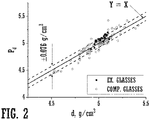
- FIG. 2 is a plot of the parameter P d calculated by Formula (II) as a function of measured density d RT for some Literature Glasses ("Comp. Glasses”) and some Exemplary Glasses ("Ex. Glasses”). As illustrated by the data in FIG. 2 , the compositional dependence of the parameter P d had an error within a range of ⁇ 0.076 unit of the measured d RT for the majority of glasses, that corresponds to the standard error specified in Table 2.
- FIG. 3 is a plot of the parameter P ref calculated by Formula (III) as a function of measured refraction (n d -1)/d RT for some Literature Glasses ("Comp. Glasses”) and some Exemplary Glasses ("Ex. Glasses”).
- the compositional dependence of the parameter P ref had an error within a range of ⁇ 0.0031 unit of the measured (n d -1)/d RT for the majority of glasses, that corresponds to the standard error specified in Table 2.
- Table 3 identifies the combination of components and their respective amounts according to some embodiments of the present disclosure.
- the Exemplary Glasses A in Table 3 may include additional components according to any aspects of the present disclosure as described herein.
- Exemplary Glasses A may satisfy the following condition: Y 2 O 3 ⁇ Gd 2 O 3 mol . % ⁇ ⁇ 2.0 , where chemical formulas refer to the amounts of components in glass, expressed in mol.%.
- Exemplary Glasses A may also have a density at room temperature d RT [g/cm 3 ] from 4 to 6.
- Exemplary Glasses A may also satisfy the following formula: n d ⁇ 1.207 + 0.155 * d RT > 0.000 , where n d is a refractive index at 587.56 nm, and d RT is a density at room temperature.
- Exemplary Glasses A may also satisfy the following formula: n d ⁇ 1.217 + 0.155 * d RT > 0.000 , where n d is a refractive index at 587.56 nm, and d RT is a density at room temperature.
- Table 4 identifies the combination of components and their respective amounts according to some embodiments of the present disclosure.
- the Exemplary Glasses B in Table 4 may include additional components according to any aspects of the present disclosure as described herein.
- Exemplary Glasses B may satisfy the following condition: SiO 2 + B 2 O 3 ⁇ TiO 2 mol . % ⁇ 7.05 , where chemical formulas refer to the amounts of components in glass, expressed in mol.%.
- Exemplary Glasses B may also satisfy the following condition: B 2 O 3 ⁇ SiO 2 mol . % ⁇ 7.0 , where chemical formulas refer to the amounts of components in glass, expressed in mol.%.
- Exemplary Glasses B may also satisfy the following formula: n d ⁇ 1 / d RT ⁇ 0.196 + 0.0016 * TiO 2 ⁇ La 2 O 3 > 0.000 , where (n d -1)/d RT is a refractive index to density ratio ("refraction").
- Exemplary Glasses B may also satisfy the following formula: n d ⁇ 1 / d RT ⁇ 0.199 + 0.0016 * TiO 2 ⁇ La 2 O 3 > 0.000 , where (n d -1)/d RT is a refractive index to density ratio ("refraction").
- Table 5 identifies the combination of components and their respective amounts according to some embodiments of the present disclosure.
- the Exemplary Glasses C in Table 5 may include additional components according to any aspects of the present disclosure as described herein.
- Exemplary Glasses C may satisfy the following condition: TiO 2 ⁇ B 2 O 3 mol . % ⁇ ⁇ 6.0 , where chemical formulas refer to the amounts of components in glass, expressed in mol.%.
- Exemplary Glasses C may also satisfy the following condition: TiO 2 ⁇ La 2 O 3 mol . % ⁇ 5.0 , where chemical formulas refer to the amounts of components in glass, expressed in mol.%.
- Exemplary Glasses C may also satisfy the following formula: n d ⁇ 1 / d RT ⁇ 0.199 + 0.0025 * TiO 2 ⁇ La 2 O 3 > 0.000 , where (n d -1)/d RT is a refractive index to density ratio ("refraction").
- Exemplary Glasses C may also satisfy the following formula: n d ⁇ 1 / d RT ⁇ 0.204 + 0.0025 * TiO 2 ⁇ La 2 O 3 > 0.000 , where (n d -1)/d RT is a refractive index to density ratio ("refraction").
- the cooling conditions were controlled so that it took about 2.5 min for the samples to cool from 1100 °C to 500 °C in air inside a furnace. Temperature readings were obtained by direct reading of the furnace temperature or using an IR camera reading with calibration scaling.
- the first condition (15 min test) approximately corresponds to a cooling rate of up to 300 °C/min at a temperature of 1000 °C and the second test approximately corresponds to a cooling rate of up to 600 °C/min at 1000 °C (the temperature of 1000 °C corresponds approximately to the temperature at which the cooling rate was expected to approach a maximum). When the temperature is lower, the cooling rate also decreases significantly.
- Typical schedules of the first and second cooling regimes are shown in FIG. 4 .
- observations referred to as "15-min devit test” and "2.5-min devit test” are specified in Table 6 below; the observation "1” is used to denote that a glass composition passed the indicated devit test, where a composition is deemed to have passed the indicated devit test if a melt of the composition forms a glass free of crystals visible under an optical microscope under magnification from 100x to 500x. The observation "0" is used to denote that a glass composition failed the indicated devit test.
- a one kilogram of batch of the components was prepared in a pure platinum crucible.
- the crucible was placed in a furnace set at a temperature of 1250°C, after which, the temperature in the furnace was raised to 1300°C and held at 1300°C for 2 hours.
- the furnace temperature was then reduced to 1250°C and the glass was allowed to equilibrate at this temperature for an hour before being poured on a steel table followed by annealing at Tg for an hour.
- a one kilogram of batch of the components was prepared in a pure platinum crucible.
- the crucible was placed in a furnace set at a temperature of between 1300°C and 1400°C for 3 hours and subsequently poured on a steel table followed by annealing at Tg for an hour.
- sample melts were also melted in a "one liter" platinum crucible heated by Joule effect. In this process, approximately 4800 g of raw materials were used. The crucible was filled in 1.5 hours at temperatures between 1250 and 1300°C. The samples then were heated to a temperature between 1300°C and 1375°C and held for one hour. During this step, the glass was continuously stirred at 60 rpm. Then the samples were cooled to a temperature between 1250°C and 1310°C to equilibrate for 30 minutes, and the stirring speed was decreased to 20 rpm. The delivery tube was heated top a temperature between 1250°C and 1310°C, and the glass was cast on a cooled graphite table.
- the glass was formed into a bar of approximately 25 mm in thickness, 50 mm in width, and 90 cm in length.
- the prepared bars were inspected under an optical microscope to check for crystallization and were all crystal free.
- the glass quality observed under the optical microscope was good with the bars being free of striae and bubbles.
- the glass was placed at Tg in a lehr oven for 1 hour for a rough annealing.
- the bars were then annealed in a static furnace for one hour at Tg and the temperature was then lowered at 1°C/min.
- Bleaching process was performed at the temperatures between 500°C and the crystallization onset temperature T x .
- the temperature is less than about 500°C, the bleaching process may take too long time because of its slow rate.
- the temperature of bleaching exceeds T x , the glass may crystallize when heat-treating. The higher the bleaching temperature, the faster the bleaching process goes, but the lower value of resulting transmittance can be obtained. Accordingly, the temperature and time of bleaching was selected to come to an acceptable transmittance within a reasonable time, such as less than or equal to 24 hours, or less than or equal to 48 hours, or less than or equal to 96 hours, or like.
- Nanostrip 2X solution Capitol Scientific, 85% H 2 SO 4 and ⁇ 1% H 2 O 2
- the ratio of surface area to volume used in this test is 0.08 cm -1 .
- the samples were quenched in deionized water and rinsed in 18 M ⁇ water, and then dried by high-pure nitrogen gas and placed in a desiccator for overnight. Weight loss normalized to surface area (mg/cm 2 ) and weight loss percentage (wt%) was calculated.
- n refers to the refractive index at a corresponding wavelength in nm; for example, n 632.8nm refers to the refractive index at wavelengths of 632.8 nm.
- T x refers to the crystallization onset temperature.
- TX 460 nm refers to the total transmittance of a 10 mm thick sample of the glass at a wavelength of 460 nm after bleaching. Total transmittance refers to transmittance that has not been corrected for Fresnel losses and was measured with a Cary 5000 spectrometer. Table 6.
- Exemplary Glass Compositions Exemplary Glass 1 2 3 4 5 6 7 8 Composition - mol.% B 2 O 3 mol.% 16.70 20.38 20.37 18.77 18.78 18.78 16.70 20.37 La 2 O 3 mol.% 28.00 25.54 24.54 24.00 23.70 20.70 28.00 25.44 TiO 2 mol.% 24.50 24.58 20.58 22.00 22.00 25.00 25.00 20.55 SiO 2 mol.% 18.28 11.27 11.27 15.22 15.22 15.22 18.29 11.18 CaO mol.% 0 0 0 0 0 0 0 2.12 Nb 2 O 5 mol.% 5.50 6.70 6.70 6.50 6.50 6.50 7.00 6.69 Ga 2 O 3 mol.% 0 0 1.00 0 0 0 0 0 ZrO 2 mol.% 7.00 7.88 7.88 8.00 8.00 8.00 4.99 7.88 Y 2 O 3 mol.% 0 0.88 0.88 3.50 4.50 4.50 0 0.90 BaO
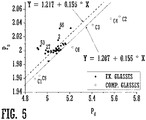
- FIG. 5 is a plot showing the relationship between the density parameter P d and the refractive index parameter P n for some of the Exemplary Glasses and some of the Comparative Glasses.
- the Exemplary Glasses are the Examples 2, 4, 6, 9, 11, 16 to 18, 20, 22, 25 to 47, 49, 50 and 53 to 55 from Table 6.
- the Comparative Glasses are the Examples C1 to C6 from Table 7.
- the density parameter P d that predicts density at room temperature was determined according to Formula (II).
- the refractive index parameter P n that predicts refractive index at 587.56 nm was determined according to Formula (I). All of the Exemplary Glasses and Comparative Glasses shown in FIG. 5 have the features specified in Table 8.
- Comparative Glasses were selected as having the highest refractive index parameter P n at comparable values of density parameter P d among the known glasses that have the features specified in Table 8.
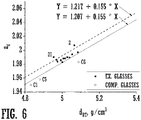
- FIG. 6 is a plot showing the relationship between d RT and n d for some of the Exemplary Glasses and some of the Comparative Glasses.
- the Exemplary Glasses are the Examples 2, 16 to 18 and 25 to 33 from Table 6.
- the Comparative Glasses are the Examples C1, C5 and C6 from Table 7. All of the Exemplary Glasses and Comparative Glasses shown in FIG. 6 have the features specified in Table 9. In Table 9, the specification "Not limited” refers to a limitation that was not considered when selecting the compositions. Table 9.
- Comparative Glasses were selected as having the highest measured values of n d at comparable values of d RT among the known glasses that have the mentioned features specified in Table 9.
- Comparative Glasses were selected as having the highest measured values of the refractive index to density ratio ("refraction") (n d -1)/d RT at comparable values of the difference TiO 2 - La 2 O 3 among the known glasses that have the mentioned features specified in Table 11.
- any one of the features of the first through the sixty-eighth aspect may be combined in part or in whole with features of any one or more of the other aspects of the present disclosure to form additional aspects, even if such a combination is not explicitly described.
- the glass of the first aspect wherein the glass has a density at room temperature, d RT , that is greater than or equal to 4.0 g/cm 3 and less than or equal to 6.0 g/cm 3 and wherein the glass satisfies the condition: n d - (1.207 + 0.155 ⁇ d RT ) > 0.000, where n d is a refractive index at 587.56 nm.
- the glass of any one of aspects 1-3 wherein the glass satisfies the condition: P n - (1.217 + 0.155 ⁇ P d ) > 0.000.
- the glass of any one of aspects 1-5 wherein the composition of the components comprises one or more of the following: greater than or equal to 20.25 mol.% and less than or equal to 25.2 mol.% TiO 2 , greater than or equal to 20.0 mol.% and less than or equal to 27.5 mol.% La 2 O 3 , greater than or equal to 16.4 mol.% and less than or equal to 20.4 mol.% B 2 O 3 , greater than or equal to 10.0 mol.% and less than or equal to 17.5 mol.% SiO 2 , greater than or equal to 5.3 mol.% and less than or equal to 8.1 mol.% ZrO 2 , greater than or equal to 4.5 mol.% and less than or equal to 9.3 mol.% Nb 2 O 5 , greater than or equal to 0.5 mol.% and less than or equal to 6.3 mol.% Y 2 O 3 , greater than or equal to 0.0 mol.% and less than or equal to 9.0
- the glass of any one of aspects 1-6 wherein the composition of the components comprises greater than or equal to 21.0 mol.% and less than or equal to 26.3 mol.% La 2 O 3 , greater than or equal to 20.25 mol.% and less than or equal to 25.2 mol.% TiO 2 , greater than or equal to 16.9 mol.% and less than or equal to 20.4 mol.% B 2 O 3 , greater than or equal to 11.0 mol.% and less than or equal to 16.5 mol.% SiO 2 , greater than or equal to 5.6 mol.% and less than or equal to 8.0 mol.% ZrO 2 , greater than or equal to 5.1 mol.% and less than or equal to 8.6 mol.% Nb 2 O 5 , greater than or equal to 0.75 mol.% and less than or equal to 5.50 mol.% Y 2 O 3 , greater than or equal to 0.0 mol.% and less than or equal to 8.0 mol.% CaO,
- the glass of any one of aspects 1-8 wherein the composition of the components comprises greater than or equal to 5.0 mol.% B 2 O 3 , greater than or equal to 5.0 mol.% La 2 O 3 , greater than or equal to 5.0 mol.% Nb 2 O 5 , greater than or equal to 5.0 mol.% SiO 2 , greater than or equal to 5.0 mol.% TiO 2 and greater than or equal to 1.0 mol.% ZrO 2 + HfO 2 .
- the glass of any one of aspects 1-12 wherein the composition of the components satisfies the condition: 0.38 ⁇ SiO 2 / (SiO 2 + B 2 O 3 ) [mol.%] ⁇ 0.75.
- the glass of any one of aspects 1-13 wherein the composition of the components comprises greater than or equal to 0.0 mol.% and less than or equal to 6.5 mol.% CaO and greater than or equal to 0.0 mol.% and less than or equal to 5.5 mol.% BaO and wherein the composition of the components is substantially free of ZnO.
- the glass of any one of aspects 1-15 wherein the composition of the components comprises greater than or equal to 22.0 mol.% and less than or equal to 25.0 mol.% TiO 2 , greater than or equal to 20.0 mol.% and less than or equal to 29.0 mol.% La 2 O 3 , greater than or equal to 16.0 mol.% and less than or equal to 20.0 mol.% B 2 O 3 , greater than or equal to 10.0 mol.% and less than or equal to 20.0 mol.% SiO 2 , greater than or equal to 6.5 mol.% and less than or equal to 8.0 mol.% ZrO 2 , greater than or equal to 5.0 mol.% and less than or equal to 6.7 mol.% Nb 2 O 5 , greater than or equal to 0.0 mol.% and less than or equal to 6.0 mol.% Y 2 O 3 , greater than or equal to 0.0 mol.% and less than or equal to 3.0 mol.% BaO
- the glass of any one of aspects 1-18 wherein when cooled in air from 1100 °C to 500 °C in 2.5 minutes, the glass does not crystallize.
- the glass of any one of aspects 1-19 wherein when having a thickness of 10 mm, the glass has transmittance at a wavelength of 460 nm, TX 460 nm , that is greater than or equal to 70%.
- a method for manufacturing an optical element comprising processing the glass of any one of aspects 1-20.
- an optical element comprising the glass of any one of aspects 1-21.
- the glass of the twentieth fourth aspect wherein the glass satisfies the conditions: (n d -1)/d RT - (0.199 + 0.0016 ⁇ (TiO 2 - La 2 O 3 )) > 0.000.
- the glass of any one of aspects 23-25 wherein the glass satisfies the conditions: P ref - (0.199 + 0.0016 ⁇ (TiO 2 - La 2 O 3 )) > 0.000.
- the glass of any one of aspects 23-26 wherein the composition of the components comprises greater than or equal to 20.0 mol.% and less than or equal to 27.5 mol.% TiO 2 , greater than or equal to 15.0 mol.% and less than or equal to 30.0 mol.% La 2 O 3 , greater than or equal to 15.0 mol.% and less than or equal to 22.5 mol.% B 2 O 3 , greater than or equal to 5.0 mol.% and less than or equal to 20.0 mol.% SiO 2 , greater than or equal to 4.0 mol.% and less than or equal to 9.0 mol.% ZrO 2 , greater than or equal to 2.5 mol.% and less than or equal to 6.8 mol.% Nb 2 O 5 , greater than or equal to 0.0 mol.% and less than or equal to 10.0 mol.% BaO, greater than or equal to 0.0 mol.% and less than or equal to 10.0 mol.% CaO, greater than or equal to 20.0 mol.% and
- the glass of any one of aspects 23-29 wherein the composition of the components satisfies one or more of the conditions: a sum of La 2 O 3 + TiO 2 + B 2 O 3 + SiO 2 + ZrO 2 + Nb 2 O 5 + BaO + Y 2 O 3 + CaO + Ga 2 O 3 + Gd 2 O 3 + ZnO + WO 3 + CeO 2 + SrO + Na 2 O + Ta 2 O 5 + Al 2 O 3 is greater than or equal to 99.0 mol.%, a sum of La 2 O 3 + Y 2 O 3 + Gd 2 O 3 + TiO 2 + B 2 O 3 + SiO 2 + ZrO 2 + Nb 2 O 5 is greater than or equal to 99.0 mol.%, a sum of La 2 O 3 + Y 2 O 3 + Gd 2 O 3 + TiO 2 + B 2 O 3 + SiO 2 + ZrO 2 + Nb 2 O 5 + CaO + BaO is greater than or equal to 99.
- the glass of any one of aspects 23-34 wherein the composition of the components satisfies the condition: 0.38 ⁇ SiO 2 / (SiO 2 + B 2 O 3 ) [mol.%] ⁇ 0.75.
- the glass of any one of aspects 23-36 wherein the composition of the components comprises greater than or equal to 0.0 mol.% and less than or equal to 5.0 mol.% Y 2 O 3 , greater than or equal to 0.0 mol.% and less than or equal to 2.0 mol.% Ta 2 O 5 , greater than or equal to 0.0 mol.% and less than or equal to 2.0 mol.% TeO 2 , greater than or equal to 0.0 mol.% and less than or equal to 0.5 mol.% GeO 2 , greater than or equal to 0.0 mol.% and less than or equal to 0.5 mol.% PbO, greater than or equal to 0.0 mol.% and less than or equal to 0.2 mol.% As 2 O 3 and greater than or equal to 0.0 mol.% and less than or equal to 0.2 mol.% Sb 2 O 3 , wherein the composition of the components is substantially free of fluorine and substantially free of V 2 O 5 .
- the glass of any one of aspects 23-39 wherein the glass has density at room temperature, d RT , that is greater than or equal to 4.5 g/cm 3 and less than or equal to 5.5 g/cm 3 and a refractive index at 587.56 nm, n d , that is greater than or equal to 1.95 and less than or equal to 2.07.
- the glass of any one of aspects 23-40 wherein the glass has a liquidus temperature, T liq , that is less than or equal to 1260 °C.
- the glass of any one of aspects 23-41 wherein when cooled in air from 1100 °C to 500 °C in 2.5 minutes, the glass does not crystallize.
- the glass of any one of aspects 23-42 wherein when having a thickness of 10 mm, the glass has transmittance at a wavelength of 460 nm, TX 460 nm , that is greater than or equal to 70%.
- a method for manufacturing an optical element comprising processing the glass of any one of aspects 23-43.
- an optical element comprising the glass of any one of aspects 23-44.
- the glass comprises a plurality of components, the glass having a composition of the components comprising greater than or equal to 1.0 mol.% and less than or equal to 40.0 mol.% TiO 2 , greater than or equal to 1.0 mol.% and less than or equal to 40.0 mol.% B 2 O 3 , greater than or equal to 0.0 mol.% and less than or equal to 35.0 mol.% SiO 2 , greater than or equal to 0.0 mol.% and less than or equal to 30.0 mol.% La 2 O 3 , greater than or equal to 0.0 mol.% and less than or equal to 20.0 mol.% CaO, greater than or equal to 0.0 mol.% and less than or equal to 10.0 mol.% ZrO 2 , greater than or equal to 0.0 mol.% and less than or equal to 10.0 mol.% GeO 2 , greater than or equal to 0.0 mol.% and less than or equal to 10.0 mol.% Al 2 O
- the glass of any one of aspects 46-48 wherein the glass satisfies the conditions: P ref - (0.204 + 0.0025 ⁇ (TiO 2 - La 2 O 3 )) > 0.000
- the glass of any one of aspects 46-49 wherein the composition of the components comprises greater than or equal to 20.0 mol.% and less than or equal to 27.5 mol.% TiO 2 , greater than or equal to 15.0 mol.% and less than or equal to 30.0 mol.% La 2 O 3 , greater than or equal to 15.0 mol.% and less than or equal to 22.5 mol.% B 2 O 3 , greater than or equal to 5.0 mol.% and less than or equal to 20.0 mol.% SiO 2 , greater than or equal to 4.0 mol.% and less than or equal to 9.0 mol.% ZrO 2 , greater than or equal to 2.5 mol.% and less than or equal to 6.8 mol.% Nb 2 O 5 , greater than or equal to 0.0 mol.% and less than or equal to 10.0 mol.% CaO and greater than or equal to 0.0 mol.% and less than or equal to 10.0 mol.% Ga 2 O
- the glass of any one of aspects 46-50 wherein the composition of the components comprises one or more of the following: greater than or equal to 20.25 mol.% and less than or equal to 26.00 mol.% TiO 2 , greater than or equal to 20.0 mol.% and less than or equal to 27.5 mol.% La 2 O 3 , greater than or equal to 16.4 mol.% and less than or equal to 20.4 mol.% B 2 O 3 , greater than or equal to 10.0 mol.% and less than or equal to 17.5 mol.% SiO 2 , greater than or equal to 5.3 mol.% and less than or equal to 8.1 mol.% ZrO 2 , greater than or equal to 4.5 mol.% and less than or equal to 6.8 mol.% Nb 2 O 5 , greater than or equal to 0.5 mol.% and less than or equal to 4.6 mol.% Y 2 O 3 , greater than or equal to 0.0 mol.% and less than or equal to
- the glass of any one of aspects 46-51 wherein the composition of the components comprises greater than or equal to 21.0 mol.% and less than or equal to 26.3 mol.% La 2 O 3 , greater than or equal to 20.25 mol.% and less than or equal to 25.50 mol.% TiO 2 , greater than or equal to 16.9 mol.% and less than or equal to 20.4 mol.% B 2 O 3 , greater than or equal to 11.0 mol.% and less than or equal to 16.5 mol.% SiO 2 , greater than or equal to 5.6 mol.% and less than or equal to 8.0 mol.% ZrO 2 , greater than or equal to 5.1 mol.% and less than or equal to 6.8 mol.% Nb 2 O 5 , greater than or equal to 0.75 mol.% and less than or equal to 4.6 mol.% Y 2 O 3 , greater than or equal to 0.0 mol.% and less than or equal to 8.0 mol.
- the glass of any one of aspects 46-52 wherein the composition of the components satisfies one or more of the conditions: a sum of La 2 O 3 + TiO 2 + B 2 O 3 + SiO 2 + ZrO 2 + Nb 2 O 5 + BaO + Y 2 O 3 + CaO + Ga 2 O 3 + Gd 2 O 3 + ZnO + WO 3 + CeO 2 + SrO + Na 2 O + Ta 2 O 5 + Al 2 O 3 is greater than or equal to 99.0 mol.%, a sum of La 2 O 3 + Y 2 O 3 + Gd 2 O 3 + TiO 2 + B 2 O 3 + SiO 2 + ZrO 2 + Nb 2 O 5 is greater than or equal to 99.0 mol.%, a sum of La 2 O 3 + Y 2 O 3 + Gd 2 O 3 + TiO 2 + B 2 O 3 + SiO 2 + ZrO 2 + Nb 2 O 5 + CaO + BaO is greater than or equal to 99.0
- the glass of any one of aspects 46-53 wherein the composition of the components comprises greater than or equal to 5.0 mol.% B 2 O 3 , greater than or equal to 5.0 mol.% La 2 O 3 , greater than or equal to 5.0 mol.% Nb 2 O 5 , greater than or equal to 5.0 mol.% SiO 2 , greater than or equal to 5.0 mol.% TiO 2 , greater than or equal to 1.0 mol.% ZrO 2 + HfO 2 and greater than or equal to 10.0 mol.% SiO 2 + B 2 O 3 .
- the glass of any one of aspects 46-54 wherein the composition of the components comprises greater than or equal to 0.0 mol.% and less than or equal to 6.0 mol.% R 2 O + RO.
- the glass of the fifty-fifth aspect wherein the composition of the components comprises greater than or equal to 0.0 mol.% and less than or equal to 1.0 mol.% R 2 O + RO.
- the glass of any one of aspects 46-56 wherein the composition of the components satisfies the conditions: 0.00 ⁇ SiO 2 / (SiO 2 + B 2 O 3 ) [mol.%] ⁇ 0.40.
- the glass of any one of aspects 46-57 wherein the composition of the components satisfies the conditions: 0.38 ⁇ SiO 2 / (SiO 2 + B 2 O 3 ) [mol.%] ⁇ 0.75.
- the glass of any one of aspects 46-58 wherein the composition of the components comprises greater than or equal to 0.0 mol.% and less than or equal to 6.5 mol.% CaO and wherein the composition of the components is substantially free of ZnO.
- the glass of any one of aspects 46-59 wherein the composition of the components comprises greater than or equal to 0.0 mol.% and less than or equal to 2.0 mol.% Ta 2 O 5 , greater than or equal to 0.0 mol.% and less than or equal to 2.0 mol.% TeO 2 , greater than or equal to 0.0 mol.% and less than or equal to 0.5 mol.% GeO 2 , greater than or equal to 0.0 mol.% and less than or equal to 0.5 mol.% PbO, greater than or equal to 0.0 mol.% and less than or equal to 0.2 mol.% As 2 O 3 and greater than or equal to 0.0 mol.% and less than or equal to 0.2 mol.% Sb 2 O 3 , wherein the composition of the components is substantially free of fluorine and substantially free of V 2 O 5 .
- the glass of any one of aspects 46-62 wherein the glass has density at room temperature, d RT , that is greater than or equal to 4.5 g/cm 3 and less than or equal to 5.5 g/cm 3 and refractive index at 587.56 nm, n d , that is greater than or equal to 1.95 and less than or equal to 2.07.
- the glass of any one of aspects 46-64 wherein when cooled in air from 1100 °C to 500 °C in 2.5 minutes, the glass does not crystallize.
- the glass of any one of aspects 46-65 wherein when having a thickness of 10 mm, the glass has transmittance at a wavelength of 460 nm, TX 460 nm , that is greater than or equal to 70%.
- a method for manufacturing an optical element comprising processing the glass of any one of aspects 46-66.
- an optical element comprising the glass of any one of aspects 46-67.
Landscapes
- Chemical & Material Sciences (AREA)
- Life Sciences & Earth Sciences (AREA)
- Engineering & Computer Science (AREA)
- Chemical Kinetics & Catalysis (AREA)
- General Chemical & Material Sciences (AREA)
- Geochemistry & Mineralogy (AREA)
- Materials Engineering (AREA)
- Organic Chemistry (AREA)
- Glass Compositions (AREA)
Applications Claiming Priority (2)
| Application Number | Priority Date | Filing Date | Title |
|---|---|---|---|
| US202163170734P | 2021-04-05 | 2021-04-05 | |
| NL2028132A NL2028132B1 (en) | 2021-04-05 | 2021-05-03 | High-Index Silicoborate and Borosilicate Glasses |
Publications (1)
| Publication Number | Publication Date |
|---|---|
| EP4071118A1 true EP4071118A1 (fr) | 2022-10-12 |
Family
ID=80952346
Family Applications (1)
| Application Number | Title | Priority Date | Filing Date |
|---|---|---|---|
| EP22166349.5A Pending EP4071118A1 (fr) | 2021-04-05 | 2022-04-01 | Verres à base de silicoborate et de borosilicate à indice élevé |
Country Status (4)
| Country | Link |
|---|---|
| US (1) | US20220324744A1 (fr) |
| EP (1) | EP4071118A1 (fr) |
| JP (1) | JP2024512815A (fr) |
| WO (1) | WO2022216567A1 (fr) |
Cited By (2)
| Publication number | Priority date | Publication date | Assignee | Title |
|---|---|---|---|---|
| EP4421045A1 (fr) | 2023-02-21 | 2024-08-28 | Corning Incorporated | Verres à indices de réfraction élevés contenant de l'oxyde de bore |
| NL2034604B1 (en) | 2023-02-21 | 2024-09-03 | Corning Inc | Glasses with high refractive indexes containing boron oxide |
Families Citing this family (1)
| Publication number | Priority date | Publication date | Assignee | Title |
|---|---|---|---|---|
| WO2024242842A1 (fr) | 2023-05-25 | 2024-11-28 | Corning Incorporated | Système et procédé de fusion sans platine de verres à indice élevé |
Citations (8)
| Publication number | Priority date | Publication date | Assignee | Title |
|---|---|---|---|---|
| US4439531A (en) | 1981-07-30 | 1984-03-27 | Schott Glaswerke | CdO-ThO2 -Free, highly refractive optical glass |
| US4584279A (en) | 1983-12-01 | 1986-04-22 | Schott Glaswerke | Optical glass with refractive indices>1.90, Abbe numbers>25 and high chemical stability |
| US20090325779A1 (en) * | 2008-06-27 | 2009-12-31 | Tomoaki Negishi | Optical glass |
| WO2012099168A1 (fr) | 2011-01-18 | 2012-07-26 | 株式会社オハラ | Verre optique, préforme et élément optique |
| US8661853B2 (en) | 2008-11-10 | 2014-03-04 | Hoya Corporation | Method for producing glass, optical glass, glass material for press molding, optical element and methods for producing same |
| US20150203395A1 (en) * | 2014-01-22 | 2015-07-23 | Cdgm Glass Co., Ltd. | High refractivity and high dispersion optical glass, element and instrument |
| TW202012333A (zh) | 2018-09-28 | 2020-04-01 | 大陸商成都光明光電股份有限公司 | 氟磷酸鹽光學玻璃、光學預製件、元件及儀器 |
| CN111320384A (zh) | 2019-04-04 | 2020-06-23 | 株式会社小原 | 光学玻璃的制造方法 |
Family Cites Families (1)
| Publication number | Priority date | Publication date | Assignee | Title |
|---|---|---|---|---|
| CN116655238A (zh) | 2018-08-31 | 2023-08-29 | Agc株式会社 | 光学玻璃和光学部件 |
-
2022
- 2022-03-25 US US17/704,631 patent/US20220324744A1/en active Pending
- 2022-04-01 EP EP22166349.5A patent/EP4071118A1/fr active Pending
- 2022-04-04 JP JP2023561151A patent/JP2024512815A/ja active Pending
- 2022-04-04 WO PCT/US2022/023228 patent/WO2022216567A1/fr not_active Ceased
Patent Citations (9)
| Publication number | Priority date | Publication date | Assignee | Title |
|---|---|---|---|---|
| US4439531A (en) | 1981-07-30 | 1984-03-27 | Schott Glaswerke | CdO-ThO2 -Free, highly refractive optical glass |
| US4584279A (en) | 1983-12-01 | 1986-04-22 | Schott Glaswerke | Optical glass with refractive indices>1.90, Abbe numbers>25 and high chemical stability |
| US20090325779A1 (en) * | 2008-06-27 | 2009-12-31 | Tomoaki Negishi | Optical glass |
| US8728963B2 (en) | 2008-06-27 | 2014-05-20 | Hoya Corporation | Optical glass |
| US8661853B2 (en) | 2008-11-10 | 2014-03-04 | Hoya Corporation | Method for producing glass, optical glass, glass material for press molding, optical element and methods for producing same |
| WO2012099168A1 (fr) | 2011-01-18 | 2012-07-26 | 株式会社オハラ | Verre optique, préforme et élément optique |
| US20150203395A1 (en) * | 2014-01-22 | 2015-07-23 | Cdgm Glass Co., Ltd. | High refractivity and high dispersion optical glass, element and instrument |
| TW202012333A (zh) | 2018-09-28 | 2020-04-01 | 大陸商成都光明光電股份有限公司 | 氟磷酸鹽光學玻璃、光學預製件、元件及儀器 |
| CN111320384A (zh) | 2019-04-04 | 2020-06-23 | 株式会社小原 | 光学玻璃的制造方法 |
Cited By (3)
| Publication number | Priority date | Publication date | Assignee | Title |
|---|---|---|---|---|
| EP4421045A1 (fr) | 2023-02-21 | 2024-08-28 | Corning Incorporated | Verres à indices de réfraction élevés contenant de l'oxyde de bore |
| WO2024177781A1 (fr) | 2023-02-21 | 2024-08-29 | Corning Incorporated | Verres à indices de réfraction élevés contenant de l'oxyde de bore |
| NL2034604B1 (en) | 2023-02-21 | 2024-09-03 | Corning Inc | Glasses with high refractive indexes containing boron oxide |
Also Published As
| Publication number | Publication date |
|---|---|
| JP2024512815A (ja) | 2024-03-19 |
| WO2022216567A1 (fr) | 2022-10-13 |
| US20220324744A1 (en) | 2022-10-13 |
Similar Documents
| Publication | Publication Date | Title |
|---|---|---|
| US12577146B2 (en) | Borate and silicoborate optical glasses with high refractive index and low liquidus temperature | |
| US11802073B2 (en) | Silicoborate and borosilicate glasses with high refractive index and low density | |
| CN117295695B (zh) | 高折射率硼酸盐玻璃 | |
| US11976004B2 (en) | Silicoborate and borosilicate glasses having high refractive index and high transmittance to blue light | |
| US11472731B2 (en) | Phosphate glasses with high refractive index and reduced dispersion | |
| US20220324744A1 (en) | High-Index Silicoborate and Borosilicate Glasses | |
| US20230339801A1 (en) | Optical Glasses Containing Bismuth Oxide | |
| EP4281421B1 (fr) | Verres phosphatés à indice de réfraction élevé contenant du calcium | |
| EP4257562A1 (fr) | Verres silico-borate et borosilicate à indice élevé | |
| US20230303426A1 (en) | High-Index High-Dispersion Phosphate Glasses Containing Bismuth Oxide | |
| CN117980278A (zh) | 具有高折射率和低液相线温度的硼酸盐和硅硼酸盐光学玻璃 | |
| NL2028132B1 (en) | High-Index Silicoborate and Borosilicate Glasses | |
| US20230227347A1 (en) | Phosphate and borate glasses with high elastic moduli | |
| WO2024177781A1 (fr) | Verres à indices de réfraction élevés contenant de l'oxyde de bore |
Legal Events
| Date | Code | Title | Description |
|---|---|---|---|
| PUAI | Public reference made under article 153(3) epc to a published international application that has entered the european phase |
Free format text: ORIGINAL CODE: 0009012 |
|
| STAA | Information on the status of an ep patent application or granted ep patent |
Free format text: STATUS: EXAMINATION IS IN PROGRESS |
|
| 17P | Request for examination filed |
Effective date: 20220401 |
|
| AK | Designated contracting states |
Kind code of ref document: A1 Designated state(s): AL AT BE BG CH CY CZ DE DK EE ES FI FR GB GR HR HU IE IS IT LI LT LU LV MC MK MT NL NO PL PT RO RS SE SI SK SM TR |