EP4071266A1 - Suspension pour revêtements par pulvérisation thermique - Google Patents
Suspension pour revêtements par pulvérisation thermique Download PDFInfo
- Publication number
- EP4071266A1 EP4071266A1 EP21167249.8A EP21167249A EP4071266A1 EP 4071266 A1 EP4071266 A1 EP 4071266A1 EP 21167249 A EP21167249 A EP 21167249A EP 4071266 A1 EP4071266 A1 EP 4071266A1
- Authority
- EP
- European Patent Office
- Prior art keywords
- suspension
- glycol
- ether
- suspension according
- oxide
- Prior art date
- Legal status (The legal status is an assumption and is not a legal conclusion. Google has not performed a legal analysis and makes no representation as to the accuracy of the status listed.)
- Withdrawn
Links
- 239000000725 suspension Substances 0.000 title claims abstract description 169
- 238000005507 spraying Methods 0.000 title description 5
- 239000002245 particle Substances 0.000 claims abstract description 86
- 239000007787 solid Substances 0.000 claims abstract description 42
- 239000000919 ceramic Substances 0.000 claims abstract description 33
- 239000003960 organic solvent Substances 0.000 claims abstract description 27
- 238000007751 thermal spraying Methods 0.000 claims abstract description 22
- 239000007791 liquid phase Substances 0.000 claims abstract description 14
- 229910052799 carbon Inorganic materials 0.000 claims abstract description 5
- LYCAIKOWRPUZTN-UHFFFAOYSA-N ethylene glycol Natural products OCCO LYCAIKOWRPUZTN-UHFFFAOYSA-N 0.000 claims description 48
- 239000002270 dispersing agent Substances 0.000 claims description 22
- ZSIAUFGUXNUGDI-UHFFFAOYSA-N hexan-1-ol Chemical compound CCCCCCO ZSIAUFGUXNUGDI-UHFFFAOYSA-N 0.000 claims description 18
- 238000007750 plasma spraying Methods 0.000 claims description 17
- WGCNASOHLSPBMP-UHFFFAOYSA-N hydroxyacetaldehyde Natural products OCC=O WGCNASOHLSPBMP-UHFFFAOYSA-N 0.000 claims description 16
- 239000000203 mixture Substances 0.000 claims description 16
- 239000012720 thermal barrier coating Substances 0.000 claims description 16
- SIWVEOZUMHYXCS-UHFFFAOYSA-N oxo(oxoyttriooxy)yttrium Chemical compound O=[Y]O[Y]=O SIWVEOZUMHYXCS-UHFFFAOYSA-N 0.000 claims description 15
- MTHSVFCYNBDYFN-UHFFFAOYSA-N diethylene glycol Chemical class OCCOCCO MTHSVFCYNBDYFN-UHFFFAOYSA-N 0.000 claims description 14
- QDOXWKRWXJOMAK-UHFFFAOYSA-N dichromium trioxide Chemical compound O=[Cr]O[Cr]=O QDOXWKRWXJOMAK-UHFFFAOYSA-N 0.000 claims description 13
- 239000000758 substrate Substances 0.000 claims description 12
- RVTZCBVAJQQJTK-UHFFFAOYSA-N oxygen(2-);zirconium(4+) Chemical compound [O-2].[O-2].[Zr+4] RVTZCBVAJQQJTK-UHFFFAOYSA-N 0.000 claims description 10
- 229910001928 zirconium oxide Inorganic materials 0.000 claims description 10
- 150000001298 alcohols Chemical class 0.000 claims description 8
- 229910052751 metal Inorganic materials 0.000 claims description 8
- 229910052723 transition metal Inorganic materials 0.000 claims description 8
- GWEVSGVZZGPLCZ-UHFFFAOYSA-N Titan oxide Chemical compound O=[Ti]=O GWEVSGVZZGPLCZ-UHFFFAOYSA-N 0.000 claims description 7
- 239000002184 metal Substances 0.000 claims description 7
- DNIAPMSPPWPWGF-UHFFFAOYSA-N Propylene glycol Chemical compound CC(O)CO DNIAPMSPPWPWGF-UHFFFAOYSA-N 0.000 claims description 6
- 150000003624 transition metals Chemical class 0.000 claims description 6
- 239000002131 composite material Substances 0.000 claims description 5
- 230000000737 periodic effect Effects 0.000 claims description 5
- BBMCTIGTTCKYKF-UHFFFAOYSA-N 1-heptanol Chemical compound CCCCCCCO BBMCTIGTTCKYKF-UHFFFAOYSA-N 0.000 claims description 4
- ARXJGSRGQADJSQ-UHFFFAOYSA-N 1-methoxypropan-2-ol Chemical compound COCC(C)O ARXJGSRGQADJSQ-UHFFFAOYSA-N 0.000 claims description 4
- 229940028356 diethylene glycol monobutyl ether Drugs 0.000 claims description 4
- JCGNDDUYTRNOFT-UHFFFAOYSA-N oxolane-2,4-dione Chemical group O=C1COC(=O)C1 JCGNDDUYTRNOFT-UHFFFAOYSA-N 0.000 claims description 4
- 229910052761 rare earth metal Inorganic materials 0.000 claims description 4
- 150000002910 rare earth metals Chemical class 0.000 claims description 4
- 239000005995 Aluminium silicate Substances 0.000 claims description 3
- 229910003087 TiOx Inorganic materials 0.000 claims description 3
- PZZYQPZGQPZBDN-UHFFFAOYSA-N aluminium silicate Chemical compound O=[Al]O[Si](=O)O[Al]=O PZZYQPZGQPZBDN-UHFFFAOYSA-N 0.000 claims description 3
- 235000012211 aluminium silicate Nutrition 0.000 claims description 3
- 229910000323 aluminium silicate Inorganic materials 0.000 claims description 3
- 239000011153 ceramic matrix composite Substances 0.000 claims description 3
- KZHJGOXRZJKJNY-UHFFFAOYSA-N dioxosilane;oxo(oxoalumanyloxy)alumane Chemical compound O=[Si]=O.O=[Si]=O.O=[Al]O[Al]=O.O=[Al]O[Al]=O.O=[Al]O[Al]=O KZHJGOXRZJKJNY-UHFFFAOYSA-N 0.000 claims description 3
- 229910052863 mullite Inorganic materials 0.000 claims description 3
- HLLICFJUWSZHRJ-UHFFFAOYSA-N tioxidazole Chemical compound CCCOC1=CC=C2N=C(NC(=O)OC)SC2=C1 HLLICFJUWSZHRJ-UHFFFAOYSA-N 0.000 claims description 3
- OGIDPMRJRNCKJF-UHFFFAOYSA-N titanium oxide Inorganic materials [Ti]=O OGIDPMRJRNCKJF-UHFFFAOYSA-N 0.000 claims description 3
- PUPZLCDOIYMWBV-UHFFFAOYSA-N (+/-)-1,3-Butanediol Chemical compound CC(O)CCO PUPZLCDOIYMWBV-UHFFFAOYSA-N 0.000 claims description 2
- RWNUSVWFHDHRCJ-UHFFFAOYSA-N 1-butoxypropan-2-ol Chemical compound CCCCOCC(C)O RWNUSVWFHDHRCJ-UHFFFAOYSA-N 0.000 claims description 2
- RRQYJINTUHWNHW-UHFFFAOYSA-N 1-ethoxy-2-(2-ethoxyethoxy)ethane Chemical compound CCOCCOCCOCC RRQYJINTUHWNHW-UHFFFAOYSA-N 0.000 claims description 2
- FENFUOGYJVOCRY-UHFFFAOYSA-N 1-propoxypropan-2-ol Chemical compound CCCOCC(C)O FENFUOGYJVOCRY-UHFFFAOYSA-N 0.000 claims description 2
- XNWFRZJHXBZDAG-UHFFFAOYSA-N 2-METHOXYETHANOL Chemical compound COCCO XNWFRZJHXBZDAG-UHFFFAOYSA-N 0.000 claims description 2
- POAOYUHQDCAZBD-UHFFFAOYSA-N 2-butoxyethanol Chemical compound CCCCOCCO POAOYUHQDCAZBD-UHFFFAOYSA-N 0.000 claims description 2
- QCAHUFWKIQLBNB-UHFFFAOYSA-N 3-(3-methoxypropoxy)propan-1-ol Chemical compound COCCCOCCCO QCAHUFWKIQLBNB-UHFFFAOYSA-N 0.000 claims description 2
- 229940019778 diethylene glycol diethyl ether Drugs 0.000 claims description 2
- XXJWXESWEXIICW-UHFFFAOYSA-N diethylene glycol monoethyl ether Chemical compound CCOCCOCCO XXJWXESWEXIICW-UHFFFAOYSA-N 0.000 claims description 2
- 229940075557 diethylene glycol monoethyl ether Drugs 0.000 claims description 2
- 150000002148 esters Chemical class 0.000 claims description 2
- -1 glycol ethers Chemical class 0.000 claims description 2
- 150000002334 glycols Chemical class 0.000 claims description 2
- 229930195733 hydrocarbon Natural products 0.000 claims description 2
- 150000002430 hydrocarbons Chemical class 0.000 claims description 2
- 150000002576 ketones Chemical class 0.000 claims description 2
- 229910001092 metal group alloy Inorganic materials 0.000 claims description 2
- TWNQGVIAIRXVLR-UHFFFAOYSA-N oxo(oxoalumanyloxy)alumane Chemical compound O=[Al]O[Al]=O TWNQGVIAIRXVLR-UHFFFAOYSA-N 0.000 claims description 2
- 229920000642 polymer Polymers 0.000 claims description 2
- 229910002076 stabilized zirconia Inorganic materials 0.000 claims description 2
- KBPLFHHGFOOTCA-UHFFFAOYSA-N 1-Octanol Chemical compound CCCCCCCCO KBPLFHHGFOOTCA-UHFFFAOYSA-N 0.000 claims 2
- YIWUKEYIRIRTPP-UHFFFAOYSA-N 2-ethylhexan-1-ol Chemical compound CCCCC(CC)CO YIWUKEYIRIRTPP-UHFFFAOYSA-N 0.000 claims 2
- 238000000576 coating method Methods 0.000 description 39
- 239000007921 spray Substances 0.000 description 24
- 239000011248 coating agent Substances 0.000 description 23
- 238000000034 method Methods 0.000 description 22
- 238000000151 deposition Methods 0.000 description 17
- XLYOFNOQVPJJNP-UHFFFAOYSA-N water Substances O XLYOFNOQVPJJNP-UHFFFAOYSA-N 0.000 description 15
- LFQSCWFLJHTTHZ-UHFFFAOYSA-N Ethanol Chemical compound CCO LFQSCWFLJHTTHZ-UHFFFAOYSA-N 0.000 description 14
- 229910001233 yttria-stabilized zirconia Inorganic materials 0.000 description 14
- PNEYBMLMFCGWSK-UHFFFAOYSA-N Alumina Chemical compound [O-2].[O-2].[O-2].[Al+3].[Al+3] PNEYBMLMFCGWSK-UHFFFAOYSA-N 0.000 description 11
- 239000002904 solvent Substances 0.000 description 10
- 230000008021 deposition Effects 0.000 description 8
- 239000007789 gas Substances 0.000 description 8
- 239000007788 liquid Substances 0.000 description 7
- 238000005259 measurement Methods 0.000 description 7
- 239000002994 raw material Substances 0.000 description 7
- VYPSYNLAJGMNEJ-UHFFFAOYSA-N Silicium dioxide Chemical compound O=[Si]=O VYPSYNLAJGMNEJ-UHFFFAOYSA-N 0.000 description 6
- 238000004458 analytical method Methods 0.000 description 6
- 238000005516 engineering process Methods 0.000 description 6
- CMIHHWBVHJVIGI-UHFFFAOYSA-N gadolinium(iii) oxide Chemical compound [O-2].[O-2].[O-2].[Gd+3].[Gd+3] CMIHHWBVHJVIGI-UHFFFAOYSA-N 0.000 description 6
- 239000000463 material Substances 0.000 description 6
- OAYXUHPQHDHDDZ-UHFFFAOYSA-N 2-(2-butoxyethoxy)ethanol Chemical compound CCCCOCCOCCO OAYXUHPQHDHDDZ-UHFFFAOYSA-N 0.000 description 5
- 230000000052 comparative effect Effects 0.000 description 5
- 238000009826 distribution Methods 0.000 description 5
- 239000000843 powder Substances 0.000 description 5
- 239000010935 stainless steel Substances 0.000 description 5
- 229910001220 stainless steel Inorganic materials 0.000 description 5
- YHBWXWLDOKIVCJ-UHFFFAOYSA-N 2-[2-(2-methoxyethoxy)ethoxy]acetic acid Chemical compound COCCOCCOCC(O)=O YHBWXWLDOKIVCJ-UHFFFAOYSA-N 0.000 description 4
- KFZMGEQAYNKOFK-UHFFFAOYSA-N Isopropanol Chemical compound CC(C)O KFZMGEQAYNKOFK-UHFFFAOYSA-N 0.000 description 4
- 239000002360 explosive Substances 0.000 description 4
- 229910052739 hydrogen Inorganic materials 0.000 description 4
- 239000001257 hydrogen Substances 0.000 description 4
- 230000003746 surface roughness Effects 0.000 description 4
- 238000000889 atomisation Methods 0.000 description 3
- KRKNYBCHXYNGOX-UHFFFAOYSA-N citric acid Chemical compound OC(=O)CC(O)(C(O)=O)CC(O)=O KRKNYBCHXYNGOX-UHFFFAOYSA-N 0.000 description 3
- 238000005328 electron beam physical vapour deposition Methods 0.000 description 3
- 238000011068 loading method Methods 0.000 description 3
- 238000003801 milling Methods 0.000 description 3
- 239000000377 silicon dioxide Substances 0.000 description 3
- FQENQNTWSFEDLI-UHFFFAOYSA-J sodium diphosphate Chemical compound [Na+].[Na+].[Na+].[Na+].[O-]P([O-])(=O)OP([O-])([O-])=O FQENQNTWSFEDLI-UHFFFAOYSA-J 0.000 description 3
- 239000007790 solid phase Substances 0.000 description 3
- UIIMBOGNXHQVGW-UHFFFAOYSA-M Sodium bicarbonate Chemical compound [Na+].OC([O-])=O UIIMBOGNXHQVGW-UHFFFAOYSA-M 0.000 description 2
- MCMNRKCIXSYSNV-UHFFFAOYSA-N Zirconium dioxide Chemical compound O=[Zr]=O MCMNRKCIXSYSNV-UHFFFAOYSA-N 0.000 description 2
- 125000001931 aliphatic group Chemical group 0.000 description 2
- 230000015572 biosynthetic process Effects 0.000 description 2
- 239000011449 brick Substances 0.000 description 2
- 239000003795 chemical substances by application Substances 0.000 description 2
- 239000008367 deionised water Substances 0.000 description 2
- 229910021641 deionized water Inorganic materials 0.000 description 2
- 238000007865 diluting Methods 0.000 description 2
- 230000002349 favourable effect Effects 0.000 description 2
- 238000009472 formulation Methods 0.000 description 2
- 239000000446 fuel Substances 0.000 description 2
- 229910052747 lanthanoid Inorganic materials 0.000 description 2
- 150000002602 lanthanoids Chemical class 0.000 description 2
- 238000004519 manufacturing process Methods 0.000 description 2
- 229910001404 rare earth metal oxide Inorganic materials 0.000 description 2
- 230000035945 sensitivity Effects 0.000 description 2
- 238000003860 storage Methods 0.000 description 2
- 235000019818 tetrasodium diphosphate Nutrition 0.000 description 2
- 238000001238 wet grinding Methods 0.000 description 2
- VBEHYHZDAYTHIP-UHFFFAOYSA-N 2-ethylhexan-1-ol;octan-1-ol Chemical compound CCCCCCCCO.CCCCC(CC)CO VBEHYHZDAYTHIP-UHFFFAOYSA-N 0.000 description 1
- MOMKYJPSVWEWPM-UHFFFAOYSA-N 4-(chloromethyl)-2-(4-methylphenyl)-1,3-thiazole Chemical compound C1=CC(C)=CC=C1C1=NC(CCl)=CS1 MOMKYJPSVWEWPM-UHFFFAOYSA-N 0.000 description 1
- QGZKDVFQNNGYKY-UHFFFAOYSA-O Ammonium Chemical compound [NH4+] QGZKDVFQNNGYKY-UHFFFAOYSA-O 0.000 description 1
- 229910052688 Gadolinium Inorganic materials 0.000 description 1
- 229920002873 Polyethylenimine Polymers 0.000 description 1
- 229910052773 Promethium Inorganic materials 0.000 description 1
- 229920002125 Sokalan® Polymers 0.000 description 1
- 229910000831 Steel Inorganic materials 0.000 description 1
- GSEJCLTVZPLZKY-UHFFFAOYSA-N Triethanolamine Chemical compound OCCN(CCO)CCO GSEJCLTVZPLZKY-UHFFFAOYSA-N 0.000 description 1
- 239000004411 aluminium Substances 0.000 description 1
- 229910052782 aluminium Inorganic materials 0.000 description 1
- XAGFODPZIPBFFR-UHFFFAOYSA-N aluminium Chemical compound [Al] XAGFODPZIPBFFR-UHFFFAOYSA-N 0.000 description 1
- CBTVGIZVANVGBH-UHFFFAOYSA-N aminomethyl propanol Chemical compound CC(C)(N)CO CBTVGIZVANVGBH-UHFFFAOYSA-N 0.000 description 1
- 239000011230 binding agent Substances 0.000 description 1
- 230000033228 biological regulation Effects 0.000 description 1
- 229910021538 borax Inorganic materials 0.000 description 1
- 150000001768 cations Chemical class 0.000 description 1
- 229910052681 coesite Inorganic materials 0.000 description 1
- 238000010288 cold spraying Methods 0.000 description 1
- 238000002485 combustion reaction Methods 0.000 description 1
- 150000001875 compounds Chemical class 0.000 description 1
- 229910052906 cristobalite Inorganic materials 0.000 description 1
- 230000001186 cumulative effect Effects 0.000 description 1
- 238000010227 cup method (microbiological evaluation) Methods 0.000 description 1
- 125000004122 cyclic group Chemical group 0.000 description 1
- 230000007547 defect Effects 0.000 description 1
- 229910003460 diamond Inorganic materials 0.000 description 1
- 239000010432 diamond Substances 0.000 description 1
- UQGFMSUEHSUPRD-UHFFFAOYSA-N disodium;3,7-dioxido-2,4,6,8,9-pentaoxa-1,3,5,7-tetraborabicyclo[3.3.1]nonane Chemical compound [Na+].[Na+].O1B([O-])OB2OB([O-])OB1O2 UQGFMSUEHSUPRD-UHFFFAOYSA-N 0.000 description 1
- 239000003822 epoxy resin Substances 0.000 description 1
- 230000003628 erosive effect Effects 0.000 description 1
- 230000008020 evaporation Effects 0.000 description 1
- 238000001704 evaporation Methods 0.000 description 1
- 238000009852 extractive metallurgy Methods 0.000 description 1
- 239000000835 fiber Substances 0.000 description 1
- 238000010285 flame spraying Methods 0.000 description 1
- UIWYJDYFSGRHKR-UHFFFAOYSA-N gadolinium atom Chemical compound [Gd] UIWYJDYFSGRHKR-UHFFFAOYSA-N 0.000 description 1
- 229910001938 gadolinium oxide Inorganic materials 0.000 description 1
- 229940075613 gadolinium oxide Drugs 0.000 description 1
- 238000000227 grinding Methods 0.000 description 1
- 238000010286 high velocity air fuel Methods 0.000 description 1
- 230000003116 impacting effect Effects 0.000 description 1
- 229910017053 inorganic salt Inorganic materials 0.000 description 1
- 238000004372 laser cladding Methods 0.000 description 1
- 239000011159 matrix material Substances 0.000 description 1
- 238000002156 mixing Methods 0.000 description 1
- 239000004584 polyacrylic acid Substances 0.000 description 1
- 229920005646 polycarboxylate Polymers 0.000 description 1
- 229920000647 polyepoxide Polymers 0.000 description 1
- VQMWBBYLQSCNPO-UHFFFAOYSA-N promethium atom Chemical compound [Pm] VQMWBBYLQSCNPO-UHFFFAOYSA-N 0.000 description 1
- 150000003839 salts Chemical class 0.000 description 1
- 229910052706 scandium Inorganic materials 0.000 description 1
- SIXSYDAISGFNSX-UHFFFAOYSA-N scandium atom Chemical compound [Sc] SIXSYDAISGFNSX-UHFFFAOYSA-N 0.000 description 1
- 239000013049 sediment Substances 0.000 description 1
- 229910052604 silicate mineral Inorganic materials 0.000 description 1
- 235000012239 silicon dioxide Nutrition 0.000 description 1
- 229910000030 sodium bicarbonate Inorganic materials 0.000 description 1
- 235000017557 sodium bicarbonate Nutrition 0.000 description 1
- 235000019983 sodium metaphosphate Nutrition 0.000 description 1
- 239000004328 sodium tetraborate Substances 0.000 description 1
- 235000010339 sodium tetraborate Nutrition 0.000 description 1
- 230000000087 stabilizing effect Effects 0.000 description 1
- 239000010959 steel Substances 0.000 description 1
- 229910052682 stishovite Inorganic materials 0.000 description 1
- 229910000601 superalloy Inorganic materials 0.000 description 1
- 229910052905 tridymite Inorganic materials 0.000 description 1
- GPRLSGONYQIRFK-MNYXATJNSA-N triton Chemical compound [3H+] GPRLSGONYQIRFK-MNYXATJNSA-N 0.000 description 1
- 229910052727 yttrium Inorganic materials 0.000 description 1
- VWQVUPCCIRVNHF-UHFFFAOYSA-N yttrium atom Chemical compound [Y] VWQVUPCCIRVNHF-UHFFFAOYSA-N 0.000 description 1
- RUDFQVOCFDJEEF-UHFFFAOYSA-N yttrium(III) oxide Inorganic materials [O-2].[O-2].[O-2].[Y+3].[Y+3] RUDFQVOCFDJEEF-UHFFFAOYSA-N 0.000 description 1
Images
Classifications
-
- C—CHEMISTRY; METALLURGY
- C23—COATING METALLIC MATERIAL; COATING MATERIAL WITH METALLIC MATERIAL; CHEMICAL SURFACE TREATMENT; DIFFUSION TREATMENT OF METALLIC MATERIAL; COATING BY VACUUM EVAPORATION, BY SPUTTERING, BY ION IMPLANTATION OR BY CHEMICAL VAPOUR DEPOSITION, IN GENERAL; INHIBITING CORROSION OF METALLIC MATERIAL OR INCRUSTATION IN GENERAL
- C23C—COATING METALLIC MATERIAL; COATING MATERIAL WITH METALLIC MATERIAL; SURFACE TREATMENT OF METALLIC MATERIAL BY DIFFUSION INTO THE SURFACE, BY CHEMICAL CONVERSION OR SUBSTITUTION; COATING BY VACUUM EVAPORATION, BY SPUTTERING, BY ION IMPLANTATION OR BY CHEMICAL VAPOUR DEPOSITION, IN GENERAL
- C23C4/00—Coating by spraying the coating material in the molten state, e.g. by flame, plasma or electric discharge
- C23C4/04—Coating by spraying the coating material in the molten state, e.g. by flame, plasma or electric discharge characterised by the coating material
- C23C4/10—Oxides, borides, carbides, nitrides or silicides; Mixtures thereof
- C23C4/11—Oxides
-
- C—CHEMISTRY; METALLURGY
- C09—DYES; PAINTS; POLISHES; NATURAL RESINS; ADHESIVES; COMPOSITIONS NOT OTHERWISE PROVIDED FOR; APPLICATIONS OF MATERIALS NOT OTHERWISE PROVIDED FOR
- C09D—COATING COMPOSITIONS, e.g. PAINTS, VARNISHES OR LACQUERS; FILLING PASTES; CHEMICAL PAINT OR INK REMOVERS; INKS; CORRECTING FLUIDS; WOODSTAINS; PASTES OR SOLIDS FOR COLOURING OR PRINTING; USE OF MATERIALS THEREFOR
- C09D1/00—Coating compositions, e.g. paints, varnishes or lacquers, based on inorganic substances
-
- C—CHEMISTRY; METALLURGY
- C09—DYES; PAINTS; POLISHES; NATURAL RESINS; ADHESIVES; COMPOSITIONS NOT OTHERWISE PROVIDED FOR; APPLICATIONS OF MATERIALS NOT OTHERWISE PROVIDED FOR
- C09D—COATING COMPOSITIONS, e.g. PAINTS, VARNISHES OR LACQUERS; FILLING PASTES; CHEMICAL PAINT OR INK REMOVERS; INKS; CORRECTING FLUIDS; WOODSTAINS; PASTES OR SOLIDS FOR COLOURING OR PRINTING; USE OF MATERIALS THEREFOR
- C09D5/00—Coating compositions, e.g. paints, varnishes or lacquers, characterised by their physical nature or the effects produced; Filling pastes
- C09D5/02—Emulsion paints including aerosols
- C09D5/021—Aerosols
-
- C—CHEMISTRY; METALLURGY
- C09—DYES; PAINTS; POLISHES; NATURAL RESINS; ADHESIVES; COMPOSITIONS NOT OTHERWISE PROVIDED FOR; APPLICATIONS OF MATERIALS NOT OTHERWISE PROVIDED FOR
- C09D—COATING COMPOSITIONS, e.g. PAINTS, VARNISHES OR LACQUERS; FILLING PASTES; CHEMICAL PAINT OR INK REMOVERS; INKS; CORRECTING FLUIDS; WOODSTAINS; PASTES OR SOLIDS FOR COLOURING OR PRINTING; USE OF MATERIALS THEREFOR
- C09D7/00—Features of coating compositions, not provided for in group C09D5/00; Processes for incorporating ingredients in coating compositions
- C09D7/20—Diluents or solvents
-
- C—CHEMISTRY; METALLURGY
- C09—DYES; PAINTS; POLISHES; NATURAL RESINS; ADHESIVES; COMPOSITIONS NOT OTHERWISE PROVIDED FOR; APPLICATIONS OF MATERIALS NOT OTHERWISE PROVIDED FOR
- C09D—COATING COMPOSITIONS, e.g. PAINTS, VARNISHES OR LACQUERS; FILLING PASTES; CHEMICAL PAINT OR INK REMOVERS; INKS; CORRECTING FLUIDS; WOODSTAINS; PASTES OR SOLIDS FOR COLOURING OR PRINTING; USE OF MATERIALS THEREFOR
- C09D7/00—Features of coating compositions, not provided for in group C09D5/00; Processes for incorporating ingredients in coating compositions
- C09D7/40—Additives
- C09D7/45—Anti-settling agents
-
- C—CHEMISTRY; METALLURGY
- C09—DYES; PAINTS; POLISHES; NATURAL RESINS; ADHESIVES; COMPOSITIONS NOT OTHERWISE PROVIDED FOR; APPLICATIONS OF MATERIALS NOT OTHERWISE PROVIDED FOR
- C09D—COATING COMPOSITIONS, e.g. PAINTS, VARNISHES OR LACQUERS; FILLING PASTES; CHEMICAL PAINT OR INK REMOVERS; INKS; CORRECTING FLUIDS; WOODSTAINS; PASTES OR SOLIDS FOR COLOURING OR PRINTING; USE OF MATERIALS THEREFOR
- C09D7/00—Features of coating compositions, not provided for in group C09D5/00; Processes for incorporating ingredients in coating compositions
- C09D7/40—Additives
- C09D7/66—Additives characterised by particle size
- C09D7/67—Particle size smaller than 100 nm
-
- C—CHEMISTRY; METALLURGY
- C09—DYES; PAINTS; POLISHES; NATURAL RESINS; ADHESIVES; COMPOSITIONS NOT OTHERWISE PROVIDED FOR; APPLICATIONS OF MATERIALS NOT OTHERWISE PROVIDED FOR
- C09D—COATING COMPOSITIONS, e.g. PAINTS, VARNISHES OR LACQUERS; FILLING PASTES; CHEMICAL PAINT OR INK REMOVERS; INKS; CORRECTING FLUIDS; WOODSTAINS; PASTES OR SOLIDS FOR COLOURING OR PRINTING; USE OF MATERIALS THEREFOR
- C09D7/00—Features of coating compositions, not provided for in group C09D5/00; Processes for incorporating ingredients in coating compositions
- C09D7/40—Additives
- C09D7/66—Additives characterised by particle size
- C09D7/68—Particle size between 100-1000 nm
-
- C—CHEMISTRY; METALLURGY
- C09—DYES; PAINTS; POLISHES; NATURAL RESINS; ADHESIVES; COMPOSITIONS NOT OTHERWISE PROVIDED FOR; APPLICATIONS OF MATERIALS NOT OTHERWISE PROVIDED FOR
- C09D—COATING COMPOSITIONS, e.g. PAINTS, VARNISHES OR LACQUERS; FILLING PASTES; CHEMICAL PAINT OR INK REMOVERS; INKS; CORRECTING FLUIDS; WOODSTAINS; PASTES OR SOLIDS FOR COLOURING OR PRINTING; USE OF MATERIALS THEREFOR
- C09D7/00—Features of coating compositions, not provided for in group C09D5/00; Processes for incorporating ingredients in coating compositions
- C09D7/40—Additives
- C09D7/66—Additives characterised by particle size
- C09D7/69—Particle size larger than 1000 nm
-
- C—CHEMISTRY; METALLURGY
- C23—COATING METALLIC MATERIAL; COATING MATERIAL WITH METALLIC MATERIAL; CHEMICAL SURFACE TREATMENT; DIFFUSION TREATMENT OF METALLIC MATERIAL; COATING BY VACUUM EVAPORATION, BY SPUTTERING, BY ION IMPLANTATION OR BY CHEMICAL VAPOUR DEPOSITION, IN GENERAL; INHIBITING CORROSION OF METALLIC MATERIAL OR INCRUSTATION IN GENERAL
- C23C—COATING METALLIC MATERIAL; COATING MATERIAL WITH METALLIC MATERIAL; SURFACE TREATMENT OF METALLIC MATERIAL BY DIFFUSION INTO THE SURFACE, BY CHEMICAL CONVERSION OR SUBSTITUTION; COATING BY VACUUM EVAPORATION, BY SPUTTERING, BY ION IMPLANTATION OR BY CHEMICAL VAPOUR DEPOSITION, IN GENERAL
- C23C4/00—Coating by spraying the coating material in the molten state, e.g. by flame, plasma or electric discharge
- C23C4/12—Coating by spraying the coating material in the molten state, e.g. by flame, plasma or electric discharge characterised by the method of spraying
- C23C4/129—Flame spraying
-
- C—CHEMISTRY; METALLURGY
- C23—COATING METALLIC MATERIAL; COATING MATERIAL WITH METALLIC MATERIAL; CHEMICAL SURFACE TREATMENT; DIFFUSION TREATMENT OF METALLIC MATERIAL; COATING BY VACUUM EVAPORATION, BY SPUTTERING, BY ION IMPLANTATION OR BY CHEMICAL VAPOUR DEPOSITION, IN GENERAL; INHIBITING CORROSION OF METALLIC MATERIAL OR INCRUSTATION IN GENERAL
- C23C—COATING METALLIC MATERIAL; COATING MATERIAL WITH METALLIC MATERIAL; SURFACE TREATMENT OF METALLIC MATERIAL BY DIFFUSION INTO THE SURFACE, BY CHEMICAL CONVERSION OR SUBSTITUTION; COATING BY VACUUM EVAPORATION, BY SPUTTERING, BY ION IMPLANTATION OR BY CHEMICAL VAPOUR DEPOSITION, IN GENERAL
- C23C4/00—Coating by spraying the coating material in the molten state, e.g. by flame, plasma or electric discharge
- C23C4/12—Coating by spraying the coating material in the molten state, e.g. by flame, plasma or electric discharge characterised by the method of spraying
- C23C4/134—Plasma spraying
Definitions
- the invention relates to a suspension for suspension thermal spraying.
- Suspension thermal spraying for example suspension plasma spraying, has become an emerging technology for producing coatings.
- suspension thermal spraying the suspension is injected into a thermal spray jet of hot and high-speed plasma gas or flame, in which it is atomized into smaller droplets. Then, the liquid vaporizes while the original solid particles agglomerate and thereby increase in size. The spray particles melt in the hot plasma gas or flame and are accelerated towards the surface to be coated. By impacting on the cold and solid surface, the spray particles are flattened into so called splats, cool down, solidify and form the thermally sprayed coating.
- suspension thermal spraying is particularly useful for producing thermal barrier coatings (TBC).
- TBCs are applied in industrial gas turbines or aero turbines as thermal insulating layer to protect the metal components at high temperature operating conditions.
- Suspension plasma sprayed (SPS) yttria stabilized zirconia (YSZ) show favorable properties compared to other standard coating methods in this field, i.e. air plasma spraying (APS) or the electron beam physical vapor deposition (EB-PVD), which are based on solid feedstocks.
- SPS Suspension plasma sprayed
- YSZ yttria stabilized zirconia
- APS air plasma spraying
- EB-PVD electron beam physical vapor deposition
- Columnar structured SPS coatings show high strain tolerance (which is advantageous for high cyclic lifetime), low thermal conductivity, and better erosion resistance than APS coatings. The lower cost of processing the SPS TBC coatings makes this technique a promising alternative to EB-PVD
- VanEvery et al. discusses the influence of the suspension droplet size and depositing particle size on the coating microstructure.
- Small depositing particles with low inertia follow the gas jet near the substrate and are deposited with an impact angle not perpendicular to the substrate plane and columnar structures (defects) are formed.
- large depositing particles with high inertia keep their trajectory and impact with an angle close to 90° towards the coating surface and form a dense microstructure.
- small depositing particles are formed if the suspension contains small solid particles at a low concentration, while large depositing particles are formed if the suspension contains large particles or small particles at high concentration.
- suspension droplet size is controlled by suspension properties, especially by the viscosity, surface tension and density (solids loading) of the suspension.
- a small suspension droplet size is desired, resulting in a small depositing particle size and thus in coatings with a columnar microstructure.
- the suspension viscosity and surface tension should be minimized.
- a small particle size e.g. below 1 ⁇ m is also favorable.
- Low-molecular-weight alcohols such as ethanol or isopropanol have low viscosity and low surface tension, making them easy to atomize in the plasma stream to achieve fine spray particles, but are classified as highly flammable and/or explosive and therefore have restrictions on their transportation, storage and handling.
- water based suspensions are ideal in that they have no specific safety regulations for their handling. Their main disadvantage is that water requires high-energy input for evaporation (approximately 2.2 times that of ethanol). Furthermore, water provides no additional energy to the spray process, in contrast to suspensions based on alcohols that release thermal energy by combustion. Thus, water-based suspensions are typically not used for producing columnar coatings.
- a suspension for suspension thermal spraying comprising solid ceramic particles having an average particle size of 2 ⁇ m or below and a liquid phase comprising an organic solvent, characterized in that said suspension has a flashpoint of at least 60 °C.
- the flashpoint is at least 65 °C, and at most 400 °C, preferably at most 300 °C.
- inventive suspension is particularly useful to produce thermal barrier coatings with a columnar microstructure.
- the present invention provides in a first aspect a suspension for suspension thermal spraying comprising solid ceramic particles having an average particle size of 2 ⁇ m or below, and a liquid phase comprising an organic solvent, characterized in that said suspension has a flashpoint of at least 60 °C, preferably at least 65 °C, and at most 400 °C, preferably at most 300 °C.
- the present invention provides the use of said suspension for suspension thermal spraying, in particular suspension plasma spraying.
- suspension thermal spraying refers to the use of a suspension as a feedstock in a thermal spraying processes, including plasma spraying (such as atmospheric plasma spraying and low pressure plasma spraying), high-velocity oxy-fuel spraying, high-velocity air-fuel spraying, flame spraying, cold spraying, laser spraying or laser cladding.
- plasma spraying such as atmospheric plasma spraying and low pressure plasma spraying
- high-velocity oxy-fuel spraying high-velocity air-fuel spraying
- flame spraying flame spraying
- cold spraying cold spraying
- laser spraying laser cladding
- the suspension according to the present invention is used in suspension plasma spraying and low pressure plasma spraying and high velocity oxy fuel spraying, most preferably in suspension plasma spraying, specifically in atmospheric suspension plasma spraying.
- the term "average particle size” as used herein refers to the d50 value as determined from the particle size distribution.
- the d50 value is known as median diameter or medium value of the particle size distribution, being determined from a volume based representation (dv50) or from a number based representation (dn50).
- the d50 value refers to the volume based representation, i.e. the particle diameter at 50 vol% in the cumulative distribution (e.g. a d50 of 2 ⁇ m means that 50 vol% of the particles have a smaller diameter than 2 ⁇ m).
- the solid ceramic particles according to the present invention have an average particle size of 2 ⁇ m or below, preferably of 1 ⁇ m or below. In particularly preferred embodiments, said particles have an average particle size between 0.2 ⁇ m and 0.8 ⁇ m, preferably between 0.4 ⁇ m and 0.6 ⁇ m.
- the particle size distribution is preferably determined using laser diffraction particle analysis, preferably using a "Microtrac” particle analyser, such as a Microtrac S3500 or a Microtrac XI00 instrument, employing the Fraunhofer analysis mode (measurement mode: full range analysis (FRA) of absorbing particles).
- a "Microtrac” particle analyser such as a Microtrac S3500 or a Microtrac XI00 instrument, employing the Fraunhofer analysis mode (measurement mode: full range analysis (FRA) of absorbing particles).
- FFA full range analysis
- the suspension of the present invention consists of a liquid phase and a solid phase.
- the liquid phase comprises an organic solvent.
- the solid phase comprises the solid ceramic particles described herein.
- the solid phase does not contain any other solid ceramic particles.
- the organic solvent is the main component of the liquid phase and is present at an amount of at least 75 wt%, preferably at least 90 wt%, most preferably at least 98 wt%, relative to the overall amount of liquid components in the liquid phase.
- Further liquid components of the liquid phase may comprise one or more dispersing agents.
- the liquid phase is substantially free of water.
- the liquid phase may also comprise small amounts of water, e.g. water in an amount of up to 20 wt%, preferably up to 10 wt%.
- an organic solvent comprising small amounts of water may be employed.
- flash point refers to the lowest temperature at which vapors of the suspension ignite if given an ignition source.
- the flash point of the suspension is determined according to the DIN EN ISO 2719 Pensky-Martens closed cup method.
- the flash point of the inventive suspension is determined by the liquid phase of the suspension.
- the liquid phase of the inventive suspension (including the organic solvent and any further liquids such as dispersing agents) has a flash point of at least 60 °C, preferably at least 65 °C, or 70 °C or 75 °C, or 80 °C, or 90 °C, or 100 °C, or higher and at most 400 °C, preferably at most 300 °C.
- the organic solvent is the main component of the liquid phase of the suspension
- the organic solvent has preferably a flash point of at least 60 °C, preferably at least 65 °C, or 70 °C or 75 °C, or 80 °C, or 90 °C, or 100 °C, or higher and at most 400 °C, preferably at most 300 °C.
- the suspension according to the present invention is non-flammable and non-explosive.
- the suspension according to the present invention is particularly suitable for producing a thermal barrier coating with a columnar microstructure.
- columnar microstructure refers to a structure having, at the micrometric scale, a preferred orientation of elementary bricks in the direction of the thickness of the layer, wherein these bricks are organized in the form of columns.
- the preferred organic solvents described herein allow to obtain a suspension that has low viscosity and low surface tension, allowing for fast atomization in the plasma stream, thus resulting in fine spray particles, which create a columnar microstructure.
- the suspension according to the present invention has a viscosity at a shear rate of 100-1000 s -1 of below 50 mPa*s, preferably below 30 mPa*s, even more preferably below 20 mPa*s, even more preferably below 10 mPa*s.
- said organic solvent is selected from the group consisting of alcohols, ketones, esters, glycols, glycol ethers, glycol ether esters or hydrocarbons and any combination thereof.
- the organic solvent may be a single solvent or a combination of at least two, three, four or five organic solvents
- the organic solvent comprises a C 6 -C 15 monoalcohol, preferably a C 6 -C 9 monoalcohol.
- a C 6 -C 15 monoalcohol can be used as a solvent instead of low-molecular weight alcohols such as ethanol in suspensions for thermal spraying. This allows the straightforward production of thermal barrier coatings with columnar microstructures from a suspension which is non-flammable and non-explosive and thus easy to handle.
- the C 6 -C 15 monoalcohol may have a linear or branched aliphatic chain.
- said C 6 -C 15 monoalcohol is selected from the group consisting of 1-hexanol, 1-heptanol, 1-octanol 2-ethylhexanol and any combination thereof.
- the organic solvent consists of a C 6 -C 15 monoalcohol.
- said organic solvent comprises a glycol or glycol ether. It was found that a glycol or glycol ether is a suitable non-flammable and non-explosive solvent for suspensions for thermal spraying, especially for producing thermal barrier coatings with columnar microstructures.
- said glycol is selected from the group consisting of ethylene glycol, propylene glycol, butylene glycol and diethylene glycol.
- said glycol ether is selected from the group consisting of diethylene glycol monobutyl ether, ethylene glycol monomethyl ether, ethylene glycol monobutyl ether, diethylene glycol monoethyl ether, diethylene glycol diethyl ether, dipropylene glycol monomethyl ether, propylene glycol methyl ether, propylene glycol n-propyl ether, propylene glycol n-butyl ether, and any combination thereof.
- said organic solvent comprises or consists of diethylene glycol monobutyl ether, which is also referred to as "butyl diglycol”.
- the organic solvent comprises or consists of a mixture of a C 6 -C 15 monoalcohol, preferably a C 6 -C 9 monoalcohol, and a glycol.
- said C 6 -C 15 monoalcohol is 1-hexanol and said glycol is ethylene glycol.
- the weight ratio of the C 6 -C 15 monoalcohol to the glycol may range from 1:1 w/w to 40:1 w/w, preferably from 5:1 to 30:1, or from 10:1 to 30:1 or from 14:1 to 24:1.
- the concentration of said solid ceramic particles in the inventive suspension ranges from 5 wt% to 95 wt%, preferably from 20 wt% to 70 wt%, even more preferably from 25 wt% to 50 wt% or from 20 wt% to 30 wt%.
- the concentration of solid ceramic particles is also referred to as the "solids loading" of the suspension.
- the concentration of said organic solvent may range from 95 wt% to 5 wt%, preferably from 80 wt% to 30 wt%, even more preferably from 75 wt% to 50 wt%.
- the inventive suspension may contain said solid ceramic particles at a concentration of 20 to 30 wt%, for example 25 wt%, and said organic solvent at a concentration of 80 to 70 wt%, for example 75 wt%.
- the solvent consists of a mixture of a C 6 -C 15 monoalcohol and a glycol
- the weight ratio of the C 6 -C 15 monoalcohol is as described above.
- the concentration of the C 6 -C 15 monoalcohol e.g.
- 1-hexanol may range from 37.5 wt% to 73 wt% (corresponding to a weight ratio of the C 6 -C 15 monoalcohol to the glycol of 1:1 to 1:40), for example from 70 wt % to 72 wt% (corresponding to a weight ratio of the C 6 -C 15 monoalcohol to the glycol of 1:14 to 1:24).
- said solid ceramic particles comprise or consist of at least one oxide of a transition metal, a rare earth metal, a metal of group 13 or 14 of the periodic table and any combination thereof.
- transition metal refers to a transition metal element or a mixture thereof, i.e. more than one transition metal element.
- a transition metal is an element whose atom has an incomplete d sub-shell, or which can give rise to cations with an incomplete d sub-shell.
- transition metal shall only comprise the elements of groups 4-11 on the periodic table and Zn.
- rare earth metal refers to the group of 17 chemically similar metallic elements including the lanthanides, yttrium and scandium.
- the lanthanides are defined as the series of elements with atomic numbers 57 to 71, all of which, except promethium, occur in nature ( Extractive Metallurgy of Rare Earths, C. K. Gupta, N. Krishnamurthy, CRC ).
- said solid ceramic particles comprise or consist of an oxide of a transition metal
- said oxide is preferably selected from the group consisting of zirconium oxide (zirconia, ZrO 2 ), titanium oxide (titania, TiOx with x preferably being 1.6 to 2, even more preferably with x being 1.6 to 1.9, or 2, i.e. TiO 2 ) and chromium (III) oxide (chromia, Cr 2 O 3 ).
- Said zirconium oxide may be further stabilized or blended with one or more rare earth metal oxides, such as yttrium oxide (yttria, Y 2 O 3 ) or gadolinium oxide (gadolinia, Gd 2 O 3 ).
- rare earth metal oxides such as yttrium oxide (yttria, Y 2 O 3 ) or gadolinium oxide (gadolinia, Gd 2 O 3 ).
- the solid ceramic particles used in the inventive suspension may comprise or consist of yttria-stabilized zirconia (YSZ).
- the amount of yttrium oxide in the YSZ may range from 1-70 wt% Y 2 O 3 , preferably 3-9 wt% Y 2 O 3 , and most preferably 7-9 wt% Y 2 O 3 .
- the solid ceramic particles used in the inventive suspension may further comprise or consist of gadolinium zirconate (Gd 2 Zr 2 O 7 ), which may also be referred to as "gadolinia stabilized zirconium oxide".
- Said solid ceramic particles may also entirely consist of an oxide of a rare earth metal, such as yttrium oxide.
- said solid ceramic particles comprise or consist of an oxide of a metal of group 13 of the periodic table, said oxide is preferably aluminium oxide (alumina, Al 2 O 3 ).
- said solid ceramic particles comprise or consist of an oxide of a metal of group 14 of the periodic table
- said oxide is preferably a silicate mineral comprising silicon dioxide (silica, SiO 2 ), for example aluminium silicate such as mullite (3Al 2 O 3 ⁇ 2SiO 2 ).
- said solid ceramic particles are selected from the group consisting of yttrium-stabilized zirconia (YSZ), zirconium oxide (ZrO 2 ), yttrium oxide (Y 2 O 3 ) gadolinium-zirconate (Gd 2 Zr 2 O 7 ), chromium (III) oxide (Cr 2 O 3 ), aluminium oxide (Al 2 O 3 ), aluminium silicate, preferably mullite (3Al 2 O 3 ⁇ 2SiO 2 ), titanium oxide (TiO x , wherein x preferably ranges from 1.6 to 2), and mixtures and/or composites thereof.
- YSZ yttrium-stabilized zirconia
- ZrO 2 zirconium oxide
- Y 2 O 3 gadolinium-zirconate
- Cr 2 O 3 chromium oxide
- Al 2 O 3 aluminium oxide
- aluminium silicate preferably mullite (3Al 2 O 3 ⁇ 2SiO 2 )
- the suspension according to the present invention further comprises a dispersing agent.
- the dispersing agent may be any chemical compound suitable for stabilizing a suspension for thermal spraying.
- the dispersing agent ensures that the particles remain well dispersed and do not form large agglomerates or sediment.
- the dispersing agent may for example be a polymeric salt, and inorganic salt or an organic molecule.
- Suitable dispersing agents are 2-[2-(2-methoxyethoxy) ethoxy] acetic acid (MEEA), 2-amino-2-methylpropanol (such as AMP 90 TM and AMP 95 TM ), ammonium polycarboxylate, polyacrylic acid, polyethyleneimine, sodium metaphosphate, sodium tetraborate, triethanolamine, TRITON X-100 TM , Lopon ® 888 sodium bicarbonate and citric acid.
- a particularly preferred dispersing agent is 2-[2-(2-methoxyethoxy) ethoxy] acetic acid (MEEA).
- the present invention is however not limited to this exemplary list of dispersing agents.
- the skilled person is aware of suitable dispersing agents for each type of solid ceramic particles.
- the concentration of the dispersing agent is chosen in order to provide a homogeneous stable suspension and to lower the viscosity and shear forces needed for atomization, said concentration depending on the concentration of solid ceramic particles in the suspension.
- the concentration of the dispersing agent may range from 0.1 wt% to 10 wt%, preferably from 0.2 wt% to 5 wt%, even more preferably from 0.4 wt% to 2 wt% relative to the content of solid ceramic particles.
- the suspension according to the present invention may optionally further contain a binder.
- the inventive suspension can be used for producing a thermal barrier coating with a columnar microstructure by suspension thermal spraying, preferably by suspension plasma spraying.
- suspension thermal spraying preferably by suspension plasma spraying.
- the skilled person is aware of suitable thermal spray parameters for obtaining a columnar microstructure.
- a thermal barrier coating can be produced on any suitable substrate, such as a metal, a ceramic, a polymer, a ceramic matrix composite, a metal alloy or mixtures or composites thereof.
- a suitable substrate such as a metal, a ceramic, a polymer, a ceramic matrix composite, a metal alloy or mixtures or composites thereof.
- ceramic matrix composite refers to a composite material comprising ceramic fibers embedded in a ceramic matrix.
- the substrate may consist of steel, preferably stainless steel, aluminium, or a superalloy.
- the suspension according to the present invention can be used for producing a thermal barrier coating, wherein the thermal barrier coating has a thickness between 50 ⁇ m and 1000 ⁇ m, preferably between 100 ⁇ m and 400 ⁇ m.
- the suspension according to the present invention can be produced by dispersing a solid ceramic raw material in a solvent as described herein and milling the suspension until the desired average particle size (d50) is obtained. Milling is performed optionally in the presence of a dispersing agent as described herein. Afterwards, the suspension is diluted to the desired solids concentration.
- YSZ particles (8 wt% Y 2 O 3 stabilized ZrO 2 , Treibacher Industrie AG) with an average particle size (d50) of 23.0 ⁇ m were used as raw material for the suspension. 3.0 kg YSZ raw material was dispersed in 1 kg of 1-Hexanol (99%, Alfa Aesar) solvent to form a 75 wt% suspension.
- a dispersing agent MEEA (2-(2-methoxyethoxy)ethoxy acetic acid) (Amri Global) was added to decrease the viscosity of the raw material suspension and to enable wet milling. Dispersing agent was added in an amount of 0.8 wt% relative to the oxide content.
- the oxide material was wet milled in a WAB Dyno-Mill Multilab High energy wet mill until the average particle size (d50) of the ceramic particles in the suspension was 0.385 ⁇ m.
- the milled suspension was sieved through a 32 ⁇ m mesh size sieve without additional pressure to ensure no oversize particles or debris is present in the final suspension.
- the thermal spray suspensions were prepared by diluting the high solid content suspensions after milling with the selected solvents to 25 wt% solids load.
- the suspension milled in 1-hexanol at 75 wt% was diluted with 1-hexanol and ethylene glycol to achieve a final composition as follows: 24.86 wt% YSZ, 0.20 wt% dispersing agent MEEA, 71.19 wt%, 1-hexanol, 3.75 wt% ethylene glycol.
- the sample for measuring the particle size was prepared by diluting 10 ml of the suspension with 10 ml of deionized water and mixing with 5 droplets of a 5 wt% TSPP dispersant (Sodium pyrophosphate tetrabasic) by hand for one minute. A few droplets of the so prepared sample were used for the measurement.
- the equipment used was a Microtrac S3500. Before starting the measurement additional 5 droplets of a 5 wt% TSPP dispersant were put into the measurement chamber (analysis mode: Fraunhofer, measurement mode: "FRA" (Full Range Analysis), particle transparency: absorbing). The following parameters were used: Refractive index for water of 1.33, flow rate of 45% and an internal ultrasonic power of 40 watts for 120 second.
- Viscosity of the suspension is 5.6 mPa.s at 1000 1/s shear rate measured by the Anton Paar Physica MCR 301 rotational rheometer equipped with a plate-plate system.
- the flash point of the suspension was 68.0°C ⁇ 1 °C, as measured by the Pensky-Martens closed cup device according to the DIN EN ISO 2719 standard.
- This suspension was used in a suspension plasma spray process as feedstock material.
- the suspension was fed into a spray torch (Axial III TM , Northwest Mettech) using as suspension feeder (NanoFeeder TM , Northwest Mettech).
- the spray torch was operated with an Argon-Nitrogen-Hydrogen plasma gas composition with a flowrate of 300 standard liters per minute at a power setting of 127 kW and a plasma enthalpy of 16.9 kJ/L Coatings were deposited on stainless steel samples with a diameter of 25.4 mm and a thickness of 5 mm. Before deposition, samples were grit blasted to prepare the surface with Grit 220 alumina blast media to a surface roughness of Ra 1.5 ⁇ m ⁇ 0.5 measured with a surface profilometer (MarSurf PS 10, Mahr, Germany).
- the suspension flow rate for the coating deposition was 100 ml/min and the standoff distance (torch nozzle exit to substrate surface) was 100 mm.
- the suspension density was 1.052 g/ml at 24.86% solids load (determined by gravimetric method with a graduated cylinder and a laboratory scale), equating to 26.15 g of oxide powder per minute feeding rate.
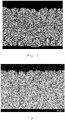
- a columnar microstructure was obtained as shown in the SEM BSE image of a polished cross section of the coating ( Fig. 1 ).
- the coating cross section was embedded in epoxy resin under vacuum und then grinded with SiC grinding paper and polished with diamond suspension until a mirror polished surface finish was achieved.
- YSZ particles (8 wt% Y 2 O 3 stabilized ZrO 2 , Treibacher Industrie AG) with an average particle size (d50) of 23.0 ⁇ m was used as raw material for the suspension.
- 3 kg of YSZ powder raw material was dispersed in butyl diglycol (>98%, Sigma Aldrich) to form a 75 wt% suspension.
- the dispersing agent MEEA (2-(2-methoxyethoxy)ethoxy acetic acid) (Amri Global) was added to decrease the viscosity of the raw material suspension and to enable wet milling. Dispersing agent was added in an amount of 1.43 wt% relative to the oxide content.
- the oxide material was wet milled on a WAB Dyno-Mill Multilab High energy wet mill to obtain the average particle size (d50) of 0.404 ⁇ m, determined with the same method as described in Example 1.
- the milled suspension was sieved through a 32 ⁇ m mesh size sieve without additional pressure to ensure no oversize particles or debris is present in the final suspension.
- the suspension milled in butyl diglycol at 75.2 wt% was further diluted with butyl-diglycol to achieve a final composition as follows: 25.35 wt% YSZ, 0.36 wt% dispersing agent MEEA, 74.29 wt% butyl diglycol.
- Viscosity of the suspension is 6.8 mPa.s at 1000 1/s shear rate, obtained with the same method as in Example 1.
- the flash point of the suspension is 110.0°C ⁇ 1°C measured by the Pensky-Martens closed cup device according to the DIN EN ISO 2719 standard.
- This suspension was used in a suspension plasma spray process as feedstock material.
- the suspension was feed into a spray torch (Axial III TM , Northwest Mettech) using as suspension feeder (NanoFeeder TM , Northwest Mettech).
- the spray torch was operated with an Argon-Nitrogen-Hydrogen plasma gas composition with a flowrate of 300 standard liters per minute at a power setting of 127 kW and a plasma enthalpy of 16.9 kJ/L Coatings were deposited on stainless steel samples with a diameter of 25.4 mm and a thickness of 5 mm. Before deposition, samples were grit blasted to prepare the surface with Grit 220 alumina blast media to a surface roughness of Ra 1.5 ⁇ m ⁇ 0.5 measured with a surface profilometer (MarSurf PS 10, Mahr, Germany)
- Suspension flow rate for coating deposition was 100 ml/min and the standoff distance (torch nozzle exit to substrate surface) was 100 mm.
- the suspension density was 1.206 g/ml at 25.35% solids load (determined with the same method as in Example 1), equating to 30.6 g of oxide powder per minute feeding rate.
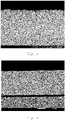
- a coating with a columnar microstructure was obtained as shown in the SEM BSE image of the polished cross section prepared with the same method as described in Example 1 ( Fig. 2 ).
- the suspension contained YSZ particles (8 wt% Y 2 O 3 ) with an average size d50 0.58 ⁇ m (determined by the same method as described in Example 1,) at a concentration of 25.2 wt% and is based on a technical grade ethanol (ethanol 95-99%) used as solvent liquid.
- the viscosity of the suspension was 1.6 mPa.s at 1000 1/s shear rate obtained with the same method as described in Example 1, and the flash point is 16.5°C ⁇ 1°C measured with the same method as described in Example 1.
- This suspension was used in a suspension plasma spray process as feedstock material.
- the suspension was feed into a spray torch (Axial III TM , Northwest Mettech) using as suspension feeder (NanoFeeder TM , Northwest Mettech).
- the spray torch was operated with an Argon-Nitrogen-Hydrogen plasma gas composition with a flowrate of 300 standard liters per minute at a power setting of 127 kW and plasma enthalpy of 16.9 kJ/L Coatings were deposited on stainless steel samples with a diameter of 25.4 mm and a thickness of 5 mm. Before deposition, samples were grit blasted to prepare the surface with Grit 220 alumina blast media to a surface roughness of Ra 1.5 ⁇ m ⁇ 0.5 measured with a surface profilometer (MarSurf PS 10, Mahr, Germany).
- Suspension flow rate for coating deposition was 100ml/min and the standoff distance (torch nozzle exit to substrate surface) was 100 mm.
- the suspension density was 1.028 g/ml at 25.2% solids load (determined with the same method as in Example 1), equating to 25.7g of oxide powder per minute feeding rate.
- a coating with a columnar microstructure was obtained as shown in the SEM BSE image of the polished cross section prepared with the same method as described in Example 1 ( Fig. 3 ).
- the suspension contained YSZ particles (8 wt% Y 2 O 3 ) with an average size d50 of 0.506 ⁇ m (determined by the same method as described in Example 1) at a concentration of 24.57 wt% and deionized water as solvent liquid.
- the viscosity of the suspension was 1.15 mPa.s at 1000 1/s shear rate obtained with the same method as described in Example 1.
- This suspension was used in a suspension plasma spray process as feedstock material.
- the suspension was feed into a spray torch (Axial III TM , Northwest Mettech) using as suspension feeder (NanoFeeder TM , Northwest Mettech).
- the spray torch was operated with an Argon-Nitrogen-Hydrogen plasma gas composition with a flowrate of 300 standard liters per minute at a power setting of 139 kW and plasma enthalpy of 15 kJ/L Coatings were deposited on stainless steel samples 25.4 mm in diameter with a thickness of 5 mm. Before deposition, samples were grit blasted to prepare the surface with Grit 220 alumina blast media to a surface roughness of Ra 1.5 ⁇ m ⁇ 0.5 measured with a surface profilometer (MarSurf PS 10, Mahr, Germany).
- Suspension flow rate for coating deposition was 80ml/min and the standoff distance (torch nozzle exit to substrate surface) was 100 mm.
- the suspension density was 1.287 g/ml at 24.57 % solids load (determined with the same method as in Example 1), equating to 25.3 g of oxide powder per minute feeding rate.
Landscapes
- Chemical & Material Sciences (AREA)
- Engineering & Computer Science (AREA)
- Organic Chemistry (AREA)
- Materials Engineering (AREA)
- Wood Science & Technology (AREA)
- Life Sciences & Earth Sciences (AREA)
- Plasma & Fusion (AREA)
- Physics & Mathematics (AREA)
- Chemical Kinetics & Catalysis (AREA)
- Metallurgy (AREA)
- Mechanical Engineering (AREA)
- Nanotechnology (AREA)
- Dispersion Chemistry (AREA)
- Inorganic Chemistry (AREA)
- Coating By Spraying Or Casting (AREA)
- Paints Or Removers (AREA)
Priority Applications (5)
| Application Number | Priority Date | Filing Date | Title |
|---|---|---|---|
| EP21167249.8A EP4071266A1 (fr) | 2021-04-07 | 2021-04-07 | Suspension pour revêtements par pulvérisation thermique |
| US18/283,425 US20240167141A1 (en) | 2021-04-07 | 2022-04-06 | Suspension for thermal spray coatings |
| TW111113103A TW202305068A (zh) | 2021-04-07 | 2022-04-06 | 用於熱噴塗塗層之懸浮液 |
| EP22721055.6A EP4320283A1 (fr) | 2021-04-07 | 2022-04-06 | Suspension pour revêtements par pulvérisation thermique |
| PCT/EP2022/059142 WO2022214556A1 (fr) | 2021-04-07 | 2022-04-06 | Suspension pour revêtements par pulvérisation thermique |
Applications Claiming Priority (1)
| Application Number | Priority Date | Filing Date | Title |
|---|---|---|---|
| EP21167249.8A EP4071266A1 (fr) | 2021-04-07 | 2021-04-07 | Suspension pour revêtements par pulvérisation thermique |
Publications (1)
| Publication Number | Publication Date |
|---|---|
| EP4071266A1 true EP4071266A1 (fr) | 2022-10-12 |
Family
ID=75426509
Family Applications (2)
| Application Number | Title | Priority Date | Filing Date |
|---|---|---|---|
| EP21167249.8A Withdrawn EP4071266A1 (fr) | 2021-04-07 | 2021-04-07 | Suspension pour revêtements par pulvérisation thermique |
| EP22721055.6A Pending EP4320283A1 (fr) | 2021-04-07 | 2022-04-06 | Suspension pour revêtements par pulvérisation thermique |
Family Applications After (1)
| Application Number | Title | Priority Date | Filing Date |
|---|---|---|---|
| EP22721055.6A Pending EP4320283A1 (fr) | 2021-04-07 | 2022-04-06 | Suspension pour revêtements par pulvérisation thermique |
Country Status (4)
| Country | Link |
|---|---|
| US (1) | US20240167141A1 (fr) |
| EP (2) | EP4071266A1 (fr) |
| TW (1) | TW202305068A (fr) |
| WO (1) | WO2022214556A1 (fr) |
Families Citing this family (2)
| Publication number | Priority date | Publication date | Assignee | Title |
|---|---|---|---|---|
| EP4385967A1 (fr) | 2022-12-14 | 2024-06-19 | Treibacher Industrie AG | Poudre de pulvérisation pour revêtements à porosité élevée |
| CN120272847B (zh) * | 2025-03-24 | 2026-04-10 | 泰伦特生物工程股份有限公司 | 一种用于等离子喷涂的y2o3悬浮液、制备方法及应用 |
Citations (8)
| Publication number | Priority date | Publication date | Assignee | Title |
|---|---|---|---|---|
| US20060222777A1 (en) | 2005-04-05 | 2006-10-05 | General Electric Company | Method for applying a plasma sprayed coating using liquid injection |
| US20110003084A1 (en) * | 2008-02-25 | 2011-01-06 | National Research Council Of Canada | Process of Making Ceria-Based Electrolyte Coating |
| US20130224453A1 (en) | 2012-02-29 | 2013-08-29 | United Technologies Corporation | Spallation-Resistant Thermal Barrier Coating |
| EP2754727A1 (fr) | 2013-01-15 | 2014-07-16 | General Electric Company | Nouvelles architectures de revêtements de barrière thermique à conductivité thermique extrêmement faible présentant de meilleures propriétés de résistance aux chocs et à l'érosion |
| US20170121804A1 (en) * | 2014-09-18 | 2017-05-04 | Oerlikon Metco (Us) Inc. | Pre-formulated powder feedstock |
| US20190017177A1 (en) | 2017-07-17 | 2019-01-17 | Rolls-Royce Corporation | Thermal barrier coatings for components in high-temperature mechanical systems |
| US20190242001A1 (en) | 2016-10-18 | 2019-08-08 | Commissariat á l'énergie atomique et aux énergies alternatives | Method for coating a surface of a solid substrate with a layer comprising a ceramic compound, and coated substrate thus obtained |
| US20190308910A1 (en) * | 2013-12-06 | 2019-10-10 | United Technologies Corporation | Calcium-magnesium alumino-silicate (cmas) resistant thermal barrier coatings, systems, and methods of production thereof |
Family Cites Families (1)
| Publication number | Priority date | Publication date | Assignee | Title |
|---|---|---|---|---|
| DE102008011109A1 (de) | 2008-02-26 | 2009-09-03 | Khs Ag | Füllelement zum Füllen von Behältern mit einem flüssigen Füllgut, sowie Füllmaschine |
-
2021
- 2021-04-07 EP EP21167249.8A patent/EP4071266A1/fr not_active Withdrawn
-
2022
- 2022-04-06 EP EP22721055.6A patent/EP4320283A1/fr active Pending
- 2022-04-06 TW TW111113103A patent/TW202305068A/zh unknown
- 2022-04-06 WO PCT/EP2022/059142 patent/WO2022214556A1/fr not_active Ceased
- 2022-04-06 US US18/283,425 patent/US20240167141A1/en active Pending
Patent Citations (8)
| Publication number | Priority date | Publication date | Assignee | Title |
|---|---|---|---|---|
| US20060222777A1 (en) | 2005-04-05 | 2006-10-05 | General Electric Company | Method for applying a plasma sprayed coating using liquid injection |
| US20110003084A1 (en) * | 2008-02-25 | 2011-01-06 | National Research Council Of Canada | Process of Making Ceria-Based Electrolyte Coating |
| US20130224453A1 (en) | 2012-02-29 | 2013-08-29 | United Technologies Corporation | Spallation-Resistant Thermal Barrier Coating |
| EP2754727A1 (fr) | 2013-01-15 | 2014-07-16 | General Electric Company | Nouvelles architectures de revêtements de barrière thermique à conductivité thermique extrêmement faible présentant de meilleures propriétés de résistance aux chocs et à l'érosion |
| US20190308910A1 (en) * | 2013-12-06 | 2019-10-10 | United Technologies Corporation | Calcium-magnesium alumino-silicate (cmas) resistant thermal barrier coatings, systems, and methods of production thereof |
| US20170121804A1 (en) * | 2014-09-18 | 2017-05-04 | Oerlikon Metco (Us) Inc. | Pre-formulated powder feedstock |
| US20190242001A1 (en) | 2016-10-18 | 2019-08-08 | Commissariat á l'énergie atomique et aux énergies alternatives | Method for coating a surface of a solid substrate with a layer comprising a ceramic compound, and coated substrate thus obtained |
| US20190017177A1 (en) | 2017-07-17 | 2019-01-17 | Rolls-Royce Corporation | Thermal barrier coatings for components in high-temperature mechanical systems |
Non-Patent Citations (5)
| Title |
|---|
| AGHASIBEIG ET AL., JOURNAL OF THERMAL SPRAY TECHNOLOGY, vol. 28, 2019, pages 1579 - 1605 |
| C. K. GUPTAN. KRISHNAMURTHY: "Extractive Metallurgy of Rare Earths", CRC |
| CURRY ET AL., COATINGS, vol. 5, 2015, pages 338 - 356 |
| KITAMURA ET AL., JOURNAL OF THERMAL SPRAY TECHNOLOGY, vol. 20, no. 1-2, 2011, pages 170 - 185 |
| L. PAWLOWSKI, SURFACE & COATINGS TECHNOLOGY, vol. 203, no. 19, 2009, pages 2807 - 2829 |
Also Published As
| Publication number | Publication date |
|---|---|
| WO2022214556A1 (fr) | 2022-10-13 |
| EP4320283A1 (fr) | 2024-02-14 |
| US20240167141A1 (en) | 2024-05-23 |
| TW202305068A (zh) | 2023-02-01 |
Similar Documents
| Publication | Publication Date | Title |
|---|---|---|
| US20140178632A1 (en) | High purity zirconia-based thermally sprayed coatings and processes for the preparation thereof | |
| Liu et al. | Spraying power influence on microstructure and bonding strength of ZrSi2 coating for SiC coated carbon/carbon composites | |
| US20240167141A1 (en) | Suspension for thermal spray coatings | |
| Ryu et al. | Preparation of crystalline ytterbium disilicate environmental barrier coatings using suspension plasma spray | |
| Rosado et al. | ZrSiO4/ZrO2 thermal barrier coatings produced by suspension plasma spraying | |
| Muoto et al. | Identification of desirable precursor properties for solution precursor plasma spray | |
| Praveen et al. | Development of lanthanum cerate based thermal barrier coatings with enhanced resistance to ingestion by volcanic ash particles | |
| Zhao et al. | Phase composition, structural, and plasma erosion properties of ceramic coating prepared by suspension plasma spraying | |
| Steinberg et al. | Erosion resistance of CMAS infiltrated sacrificial suspension sprayed alumina top layer on EB-PVD 7YSZ coatings | |
| Kumar et al. | Development of Gd2O3 doped yttria stabilized zirconia based thermal barrier coating for improved high temperature oxidation and erosion resistance | |
| EP1829824A1 (fr) | Poudre de zirconium partiellement allié | |
| US20240150583A1 (en) | Suspension for thermal spray coatings | |
| Wang et al. | Comparison of microstructure and oxidation behavior of La-Mo-Si coatings deposited by two approaches | |
| KR102013652B1 (ko) | 기공도 제어를 통해 향상된 열내구성을 가지는 세라믹 열차폐코팅층의 제조방법 | |
| KR102284838B1 (ko) | 서스펜션 플라즈마 용사용 슬러리 조성물, 그 제조방법 및 서스펜션 플라즈마 용사 코팅막 | |
| Lashmi et al. | Solution combustion synthesis of calcia-magnesia-aluminosilicate powder and its interaction with yttria-stabilized zirconia and co-doped yttria-stabilized zirconia | |
| Yaghtin et al. | Deposition of columnar-morphology lanthanum zirconate thermal barrier coatings by solution precursor plasma spraying | |
| Chen et al. | Solution precursor high-velocity oxy-fuel spray ceramic coatings | |
| JP7742750B2 (ja) | 溶射用粉末および溶射皮膜の作製方法 | |
| JP5996756B2 (ja) | 溶射用材料 | |
| Guo et al. | Evading the strength and toughness trade-off dilemma in Lu2Si2O7 environmental barrier coatings via micro-nano reinforcement | |
| Guignard | Development of thermal spray processes with liquid feedstocks | |
| Muoto et al. | Microstructural characteristics of Y2O3-MgO composite coatings deposited by suspension plasma spray | |
| Martin | Processing, microstructure, properties and performance of thermal sprayed ceramic coatings from powder, suspension and solution precursor | |
| FI131339B1 (en) | Method for producing powder mixture for ceramic coating and its use |
Legal Events
| Date | Code | Title | Description |
|---|---|---|---|
| PUAI | Public reference made under article 153(3) epc to a published international application that has entered the european phase |
Free format text: ORIGINAL CODE: 0009012 |
|
| STAA | Information on the status of an ep patent application or granted ep patent |
Free format text: STATUS: THE APPLICATION HAS BEEN PUBLISHED |
|
| AK | Designated contracting states |
Kind code of ref document: A1 Designated state(s): AL AT BE BG CH CY CZ DE DK EE ES FI FR GB GR HR HU IE IS IT LI LT LU LV MC MK MT NL NO PL PT RO RS SE SI SK SM TR |
|
| STAA | Information on the status of an ep patent application or granted ep patent |
Free format text: STATUS: THE APPLICATION IS DEEMED TO BE WITHDRAWN |
|
| 18D | Application deemed to be withdrawn |
Effective date: 20230413 |