EP4071327A1 - Dispositif mobile de sécurité - Google Patents
Dispositif mobile de sécurité Download PDFInfo
- Publication number
- EP4071327A1 EP4071327A1 EP22167402.1A EP22167402A EP4071327A1 EP 4071327 A1 EP4071327 A1 EP 4071327A1 EP 22167402 A EP22167402 A EP 22167402A EP 4071327 A1 EP4071327 A1 EP 4071327A1
- Authority
- EP
- European Patent Office
- Prior art keywords
- safety device
- housing
- mobile
- vacuum
- chain
- Prior art date
- Legal status (The legal status is an assumption and is not a legal conclusion. Google has not performed a legal analysis and makes no representation as to the accuracy of the status listed.)
- Withdrawn
Links
- 238000012795 verification Methods 0.000 claims description 18
- 241001465382 Physalis alkekengi Species 0.000 description 4
- 239000000463 material Substances 0.000 description 3
- 238000002485 combustion reaction Methods 0.000 description 2
- 230000000694 effects Effects 0.000 description 2
- 229910052751 metal Inorganic materials 0.000 description 2
- 239000002184 metal Substances 0.000 description 2
- OKTJSMMVPCPJKN-UHFFFAOYSA-N Carbon Chemical compound [C] OKTJSMMVPCPJKN-UHFFFAOYSA-N 0.000 description 1
- 239000000654 additive Substances 0.000 description 1
- 230000000996 additive effect Effects 0.000 description 1
- 229910052782 aluminium Inorganic materials 0.000 description 1
- XAGFODPZIPBFFR-UHFFFAOYSA-N aluminium Chemical compound [Al] XAGFODPZIPBFFR-UHFFFAOYSA-N 0.000 description 1
- 229910052799 carbon Inorganic materials 0.000 description 1
- 238000010276 construction Methods 0.000 description 1
- 230000008602 contraction Effects 0.000 description 1
- 230000003203 everyday effect Effects 0.000 description 1
- 229910001385 heavy metal Inorganic materials 0.000 description 1
- 239000007769 metal material Substances 0.000 description 1
- 238000000034 method Methods 0.000 description 1
- 210000003205 muscle Anatomy 0.000 description 1
- 229920001296 polysiloxane Polymers 0.000 description 1
- 239000007921 spray Substances 0.000 description 1
Images
Classifications
-
- E—FIXED CONSTRUCTIONS
- E05—LOCKS; KEYS; WINDOW OR DOOR FITTINGS; SAFES
- E05B—LOCKS; ACCESSORIES THEREFOR; HANDCUFFS
- E05B51/00—Operating or controlling locks or other fastening devices by other non-mechanical means
- E05B51/02—Operating or controlling locks or other fastening devices by other non-mechanical means by pneumatic or hydraulic means
-
- E—FIXED CONSTRUCTIONS
- E05—LOCKS; KEYS; WINDOW OR DOOR FITTINGS; SAFES
- E05B—LOCKS; ACCESSORIES THEREFOR; HANDCUFFS
- E05B73/00—Devices for locking portable objects against unauthorised removal; Miscellaneous locking devices
- E05B73/0005—Devices for locking portable objects against unauthorised removal; Miscellaneous locking devices using chains, cables or the like
-
- E—FIXED CONSTRUCTIONS
- E05—LOCKS; KEYS; WINDOW OR DOOR FITTINGS; SAFES
- E05C—BOLTS OR FASTENING DEVICES FOR WINGS, SPECIALLY FOR DOORS OR WINDOWS
- E05C19/00—Other devices specially designed for securing wings, e.g. with suction cups
- E05C19/18—Portable devices specially adapted for securing wings
- E05C19/188—Removably mounted securing devices, e.g. devices clamped to the wing or the frame
-
- F—MECHANICAL ENGINEERING; LIGHTING; HEATING; WEAPONS; BLASTING
- F16—ENGINEERING ELEMENTS AND UNITS; GENERAL MEASURES FOR PRODUCING AND MAINTAINING EFFECTIVE FUNCTIONING OF MACHINES OR INSTALLATIONS; THERMAL INSULATION IN GENERAL
- F16B—DEVICES FOR FASTENING OR SECURING CONSTRUCTIONAL ELEMENTS OR MACHINE PARTS TOGETHER, e.g. NAILS, BOLTS, CIRCLIPS, CLAMPS, CLIPS OR WEDGES; JOINTS OR JOINTING
- F16B45/00—Hooks; Eyes
- F16B45/002—Eyes
-
- F—MECHANICAL ENGINEERING; LIGHTING; HEATING; WEAPONS; BLASTING
- F16—ENGINEERING ELEMENTS AND UNITS; GENERAL MEASURES FOR PRODUCING AND MAINTAINING EFFECTIVE FUNCTIONING OF MACHINES OR INSTALLATIONS; THERMAL INSULATION IN GENERAL
- F16B—DEVICES FOR FASTENING OR SECURING CONSTRUCTIONAL ELEMENTS OR MACHINE PARTS TOGETHER, e.g. NAILS, BOLTS, CIRCLIPS, CLAMPS, CLIPS OR WEDGES; JOINTS OR JOINTING
- F16B47/00—Suction cups for attaching purposes; Equivalent means using adhesives
Definitions
- the invention relates to a mobile security device for movable objects, in particular anti-theft protection for movable objects.
- the present invention relates to a mobile security device for moving objects.
- the movable objects can be, for example, two-wheelers, signs, traffic lights, tools or the like.
- a bicycle lock is a special lock to protect against bicycle theft, for example. Different designs and their designs offer different levels of protection against different tools. When choosing, a compromise must be made between weight, handling, price - also in relation to the two-wheeler - and the desired protection.
- a U-lock similar to a padlock, consists of a large plastic-coated metal shackle and the actual lock, a metal body with two openings.
- U-locks offer the comparatively best protection against theft and, for example, weigh approx. 1.7 to 2.8 kg with a shackle thickness greater than 14 mm, depending on the dimensions of the shackle.
- the temples are up to 18 mm thick.
- the shackles of high-quality U-locks are hardened on the outside to prevent them from being cut through, but are a little softer in the middle to be able to withstand cold spray attacks.
- U-locks are similar in use to cable and chain locks.
- the lock can be passed through the spokes or the wheel frame, but can also be placed around fixed objects (lanterns, wheel stands, fence slats, etc.), which, in contrast to the spoke lock, secures the wheel against being carried away.
- Folding or articulated locks have been on the market since 2005.
- This type of lock consists of rigid links that can be folded together by means of joints, as with the folding rule.
- This joint construction makes it much more flexible than a U-lock, but according to the manufacturer it should achieve similar strength values. This is partly due to the fact that the movable Links make it difficult to use saws, and the low profile makes it difficult to use bolt cutters.
- different lengths and security classes are available, and both combination and cylinder locks are also available. Available lengths range from 70cm to 120cm and weights range from 590g to 1625g.
- a heavy metal chain is used to protect against theft in the same way as the cable and U-lock.
- a padlock can be used as a lock.
- Chain links are often only up to ten millimeters thick, so they can be severed with correspondingly large bolt cutters.
- the chain links of high-quality chain locks are hardened on the outside and slightly softer in the middle of the material, as with high-quality U-locks.
- the term chain lock also refers to the connecting link of the bicycle chain, which is closed on one side with a snap ring instead of being riveted, so that the two ends of the chain can be closed with it.
- a two-wheeler stand which can also be used to secure a two-wheeler.
- the two-wheeler stand described includes a foot having at least one cavity, and by contacting this foot with a surface, this cavity forms at least one cavity with the surface, and a negative pressure can be built up and reduced in at least one of these cavities.
- This two-wheeler stand known from the prior art has the disadvantage that it is permanently connected to the two-wheeler and cannot be removed from the two-wheeler when not in use.
- the aforementioned locks are not only used to secure two-wheelers, but can also be used to secure any other movable objects. It is obvious that the aforementioned locks are also suitable for fixing other movable objects.
- the present invention sets itself the task of providing a new, efficient mobile security device, in particular a lock system, for example a bicycle lock.
- the object of the invention is also to provide a new, efficient mobile security device, in particular a lock system, for example a bicycle lock, which at the same time imparts stability to the object to be secured, for example the bicycle, and which also contributes to anti-theft protection.
- a lock system for example a bicycle lock
- the efficient mobile security device according to the invention in particular the lock system, for example the bicycle lock, should be as effective and easy to use in everyday life as possible and to be inexpensive to produce.
- the new efficient mobile security device in particular the lock system, for example the two-wheeler lock, is intended to prevent the moving object, for example the locked two-wheeler, from being carried away without it being necessary to simultaneously block the lock system with fixed objects (lanterns, wheel stands, fence pickets, etc.). etc.) to lead.
- the moving object for example the locked two-wheeler
- the new efficient mobile security device in particular the lock system, for example the bicycle lock, should not be permanently connected to the movable object, for example the bicycle, so that it can be removed from the object to be secured, for example the bicycle, when not in use .
- the mobile safety device is characterized by a chain or rope which can be opened and closed and which is detachably connected to a housing which has on one side a device capable of drawing a vacuum with a substantially smooth surface .
- a mobile security device is formed from two essential components.
- the first element is a chain or a rope, which can be guided through an object to be secured, for example a wheel frame or a tire of the two-wheeler, and thus closes off the object that is movable per se, for example the two-wheeler.
- the chain or rope is provided with a clasp with which the chain or rope can be opened and closed. By opening the closure, the chain or cable can be guided through an opening in the object that is movable per se, for example the bicycle frame or the tire of the bicycle, and then the chain or cable can be closed again at the closure.
- the rope or chain is connected to a second element.
- This is a housing which is designed on one side in such a way that it can form a vacuum with an essentially straight surface.
- the mobile safety device according to the invention can thus be firmly connected to the floor, for example, forming a vacuum, but also to other flat surfaces that can be arranged in any way (horizontally or vertically).
- the vacuum is preferably so strong that the housing cannot be detached from the surface with which the housing creates a vacuum by an external force, in particular muscle power.
- the mobile security device according to the invention for example the bicycle lock of the present invention, thus has in the housing at least one cavity which may be to be produced, whereby contacting the housing with a surface forms at least one cavity together with the surface at least one cavity.
- the mobile safety device according to the invention for example the bicycle lock, is then characterized in that a negative pressure can be built up and reduced in at least one of these cavities.
- the housing of the mobile security device of the present invention is preferably made of a flexible material such as rubber and/or flexible silicone, which “sucks” onto the surface in the event of negative pressure.
- a flexible material such as rubber and/or flexible silicone
- the housing can also be made of metallic materials, such as aluminum or carbon.
- the mobile security device according to the invention for example the bicycle lock according to the invention, is designed independently of the movable object to be secured, for example a bicycle, a secure fixation of the movable Object, for example the two-wheeler, on uneven and / or sloping surfaces allows without it preferably requires further fixation.
- the surface to be used according to the invention, to which the housing is connected via the structure of a vacuum, is normally the floor on which the mobile safety device according to the invention is arranged. However, it can also be other surfaces, such as a wall.
- a mobile safety device is understood to mean the device described above and in particular embodiments below, which is used to essentially secure movable objects, such as bicycles, signs, traffic lights, tools or the like, so that their Mobility is severely restricted or even prevented.
- two-wheelers within the meaning of the present invention include non-motorized two-wheelers, for example bicycles, and motorized two-wheelers, for example motorcycles, mopeds, scooters, but also motorized bicycles.
- Bicycles within the meaning of the invention include non-motorized bicycles and motorized bicycles.
- Motorized bicycles mean those with an (additional) electric drive. Examples of this are e-bikes and pedelecs or S-pedelecs.
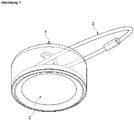
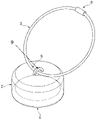
- FIGS 1 and 2 show a mobile security device according to the invention, for example a bicycle lock according to the invention, which has a housing 1 .
- the exact shape of the housing can be chosen arbitrarily; in the present embodiment, the case is formed round.
- On one side it has a recessed surface with a vacuum suction cup 2, with which a vacuum can be generated with a surface (not shown).
- the housing 2 can thus be fixed on a surface.
- a chain or cable 3 is provided on the housing 1, with which the housing 1 can be connected to a movable object (not shown), for example a bicycle.
- the chain or cable 3 has a clasp 9 and is connected to the housing 1 via an eyelet 8 .
- the movable object for example the bicycle
- the movable object in a fixed position, for example in the parking position, has increased stability in addition to theft protection, since the negative pressure damages the housing 1 and thus also "sucks" the movable object, for example the two-wheeler, onto the surface via the chain or the rope.
- “parking position” or “parking” or “parking mode” means that the movable object, for example the bicycle, is standing in one place, with the housing 1 contacting a surface using a vacuum.
- the at least one cavity of the suction foot can be evacuated, so that there is a negative pressure in this at least one cavity.
- a corresponding strength of the negative pressure prevents both illegal (theft) and unintentional ("tipping over") movement of the movable object to be secured, for example the bicycle, especially if the chain or the rope 3 is correspondingly closely guided by the movable object, for example the bicycle.
- evacuation means the generation of a negative pressure, ie a pressure that is lower than the ambient pressure.
- the mobile safety device according to the invention for example the two-wheeler lock according to the invention, can have a pressure display which shows the strength of the negative pressure in the area of the vacuum cup 2 .
- a pressure display can also or instead be located on the object to be secured, for example the bicycle.
- the negative pressure in the mobile safety device according to the invention can be controlled, or at least read, via an app application installed on a smartphone.
- the reduction in the negative pressure in the housing requires verification.
- Verification is intended to prevent the negative pressure from being reduced in an unauthorized manner, since such unauthorized pressure equalization would undesirably cancel the increased stability and anti-theft protection of the mobile security device according to the invention, for example the bicycle lock or the connected bicycle.
- a servomotor with a receiving device for example an antenna—is connected to the vacuum suction device 2 of the mobile safety device according to the invention.
- a battery and/or accumulator can be used, for example, which can be charged by pedaling during normal movement when using a bicycle as a two-wheeler, for example.
- the analog verification preferably takes place by means of a coded (radio) signal.
- the verification takes place via a signal from a mobile device, such as a smartphone, via an "app".
- This verification is intended to ensure that only the authorized person(s) can initiate the pressure equalization and thus release the movable object from the parked position.
- a verification can be done analogously or digitally, for example. If the verification is successful, for example, a valve can then be opened or a valve opens, as a result of which the ambient atmosphere flows into the at least one cavity of the foot and pressure equalization takes place.
- Examples of analog verification include using a key or a numeric code.
- Examples of digital verification include using an "app" or a wireless remote control.
- an "app” means digital verification using a program on a portable computer, such as a smartphone, which sends a corresponding verification signal.
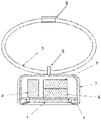
- FIG. 3 shows an embodiment of the present invention, showing how the two-wheeler lock according to the invention can function.
- the housing 1 has an electric vacuum pump 4, with which a vacuum between the (surface not shown) and the vacuum suction cup 2 of the housing 1 can be generated.
- a component carrier 5 separates the vacuum suction cup 2 spatially from the electric vacuum pump 4 and a rechargeable battery unit 6 with which the vacuum suction cup 2 can be operated.
- the control unit 7 With the help of the control unit 7, a signal for building up or reducing the vacuum is sent to the vacuum suction cup 2, which then closes or opens the mobile safety device accordingly.
- the chain or cable 3 can be opened and closed, so that the chain or cable 3 can be passed through an opening on the movable object (e.g. the frame or rim of a bicycle) and then closed. Analogously, the chain or the rope 3 can be removed from the moving object, the two-wheeler.
- the chain or cable 3 is connected to the housing 1, for example by guiding the chain and cable 3 through an eyelet.
- the bicycle lock according to the invention has a device for manually generating the vacuum.
- the negative pressure can be generated manually, for example, by means of a pressure step surface.
- a force effect on this pressure tread surface in the direction of the surface causes a contraction of the at least one cavity in the at least one housing 1 of the mobile safety device.
- this force effect is removed, this at least one cavity expands.
- an appropriately configured valve is connected to the foot, air can escape when the cavity contracts, but no air can flow back when the cavity subsequently expands, creating a negative pressure in the foot.
- An integrated manual pump for generating a negative pressure is also conceivable.
- the negative pressure is generated automatically.
- evacuation methods can also be used, for example with an automated pump.
- the automatically operated pump can obtain its energy from these components.
- a battery for example, can be used alternatively and/or additionally and/or to protect such a pump. Such a battery can be charged by pedaling during normal movement, for example when using a bicycle as a two-wheeler.
- establishing the vacuum requires verification.
- the verification of the build-up of the negative pressure can take place analogously to the verification of the reduction of the negative pressure already described.
- a successful verification can, for example, close a valve, which prevents pressure equalization of any negative pressure that may arise or exist in the at least one cavity of the foot 6 with the environment.
- This verification of the build-up of the negative pressure is also preferably carried out using an “app”, which is run using smartphones, for example.
- the housing 1 has at least one cavity which, together with the vacuum suction cup 2, can build up a vacuum.
- the mobile safety device according to the invention can, for example, be connected to a two-wheeler and the bicycle can thus be secured; if the two-wheeler lock according to the invention is not required, it can be stowed either on the two-wheeler or elsewhere.
Landscapes
- Engineering & Computer Science (AREA)
- General Engineering & Computer Science (AREA)
- Mechanical Engineering (AREA)
- Burglar Alarm Systems (AREA)
- Lock And Its Accessories (AREA)
Applications Claiming Priority (1)
| Application Number | Priority Date | Filing Date | Title |
|---|---|---|---|
| DE202021101907.7U DE202021101907U1 (de) | 2021-04-09 | 2021-04-09 | Mobile Sicherheitsvorrichtung für Zweiräder |
Publications (1)
| Publication Number | Publication Date |
|---|---|
| EP4071327A1 true EP4071327A1 (fr) | 2022-10-12 |
Family
ID=76854054
Family Applications (1)
| Application Number | Title | Priority Date | Filing Date |
|---|---|---|---|
| EP22167402.1A Withdrawn EP4071327A1 (fr) | 2021-04-09 | 2022-04-08 | Dispositif mobile de sécurité |
Country Status (2)
| Country | Link |
|---|---|
| EP (1) | EP4071327A1 (fr) |
| DE (1) | DE202021101907U1 (fr) |
Families Citing this family (1)
| Publication number | Priority date | Publication date | Assignee | Title |
|---|---|---|---|---|
| EP4336002A1 (fr) * | 2022-09-07 | 2024-03-13 | Roth Thorsten | Dispositif mobile de sécurité |
Citations (3)
| Publication number | Priority date | Publication date | Assignee | Title |
|---|---|---|---|---|
| KR200398987Y1 (ko) * | 2005-07-26 | 2005-10-18 | 주식회사 리디자인 | 도난방지용 흡착식 걸이구 |
| EP2866537A1 (fr) * | 2013-10-25 | 2015-04-29 | TSI Technologie, Service, Innovation GmbH | Module télématique avec ventouse et surveillance de la pression de ventouse |
| EP3456613A1 (fr) | 2017-09-13 | 2019-03-20 | Thorsten Roth | Dispositif mobile de sécurité et de support pour véhicule à deux roues |
-
2021
- 2021-04-09 DE DE202021101907.7U patent/DE202021101907U1/de not_active Withdrawn - After Issue
-
2022
- 2022-04-08 EP EP22167402.1A patent/EP4071327A1/fr not_active Withdrawn
Patent Citations (3)
| Publication number | Priority date | Publication date | Assignee | Title |
|---|---|---|---|---|
| KR200398987Y1 (ko) * | 2005-07-26 | 2005-10-18 | 주식회사 리디자인 | 도난방지용 흡착식 걸이구 |
| EP2866537A1 (fr) * | 2013-10-25 | 2015-04-29 | TSI Technologie, Service, Innovation GmbH | Module télématique avec ventouse et surveillance de la pression de ventouse |
| EP3456613A1 (fr) | 2017-09-13 | 2019-03-20 | Thorsten Roth | Dispositif mobile de sécurité et de support pour véhicule à deux roues |
Also Published As
| Publication number | Publication date |
|---|---|
| DE202021101907U1 (de) | 2021-06-25 |
Similar Documents
| Publication | Publication Date | Title |
|---|---|---|
| EP3020892A1 (fr) | Poignee de porte avec capuchon amovible | |
| EP2504203A1 (fr) | Dispositif de verrouillage et procédé pour empêcher la mise en marche non autorisée d'un véhicule | |
| EP3743289B1 (fr) | Roue pour roulage à plat | |
| EP3507131B1 (fr) | Dispositif de charge et de verrouillage pour véhicules électriques | |
| EP3159254A1 (fr) | Vehicule, specialement une bicyclette | |
| EP2915732B1 (fr) | Véhicule électrique avec câble de charge intégré | |
| EP4071327A1 (fr) | Dispositif mobile de sécurité | |
| EP3456613B1 (fr) | Dispositif mobile de sécurité et de support pour véhicule à deux roues | |
| EP1178915B9 (fr) | Systeme de sauvetage pour train ou vehicule | |
| DE1780468C3 (de) | Diebstahlsicherung mit Warnvorrichtung für Kraftfahrzeuge | |
| DE102019009013A1 (de) | Fahrzeug | |
| DE102011004464A1 (de) | Sicherungssystem für ein Zweirad | |
| DE102015002486A1 (de) | Fahrzeug | |
| DE102016007462A1 (de) | Fahrradschloss mit Tretlagerwegfahrsperre, Einbau eines Fahrradschlosses in das Sattelaufnahmerohr von Neu- und Gebrauchtfahrrädern | |
| DE4222526C2 (fr) | ||
| EP1384658A2 (fr) | Système de verrouillage central pour motocyclettes | |
| EP4336002A1 (fr) | Dispositif mobile de sécurité | |
| AT522762B1 (de) | Schloss | |
| EP2842848A1 (fr) | Support de deux roues et deux roues doté d'un tel support | |
| DE69603353T2 (de) | Diebstahlsicherungssystem für fahrrad | |
| DE202011100725U1 (de) | Schließeinrichtung | |
| DE10240558A1 (de) | Rahmenschloß | |
| DE102011013250A1 (de) | Fahrrad mit mindestens einem werkzeuglos abnehmbaren Pedal | |
| DE202020000053U1 (de) | Zweiradschließsystem | |
| EP1367201B1 (fr) | Antivol pour véhicule à deux ou trois roues |
Legal Events
| Date | Code | Title | Description |
|---|---|---|---|
| PUAI | Public reference made under article 153(3) epc to a published international application that has entered the european phase |
Free format text: ORIGINAL CODE: 0009012 |
|
| STAA | Information on the status of an ep patent application or granted ep patent |
Free format text: STATUS: THE APPLICATION HAS BEEN PUBLISHED |
|
| AK | Designated contracting states |
Kind code of ref document: A1 Designated state(s): AL AT BE BG CH CY CZ DE DK EE ES FI FR GB GR HR HU IE IS IT LI LT LU LV MC MK MT NL NO PL PT RO RS SE SI SK SM TR |
|
| STAA | Information on the status of an ep patent application or granted ep patent |
Free format text: STATUS: THE APPLICATION IS DEEMED TO BE WITHDRAWN |
|
| 18D | Application deemed to be withdrawn |
Effective date: 20230413 |