EP4073473B1 - Verfahren zur optimierung einer mess-rate eines feldgerätes - Google Patents
Verfahren zur optimierung einer mess-rate eines feldgerätes Download PDFInfo
- Publication number
- EP4073473B1 EP4073473B1 EP20811586.5A EP20811586A EP4073473B1 EP 4073473 B1 EP4073473 B1 EP 4073473B1 EP 20811586 A EP20811586 A EP 20811586A EP 4073473 B1 EP4073473 B1 EP 4073473B1
- Authority
- EP
- European Patent Office
- Prior art keywords
- field device
- measured variable
- measured
- measuring
- correlation pattern
- Prior art date
- Legal status (The legal status is an assumption and is not a legal conclusion. Google has not performed a legal analysis and makes no representation as to the accuracy of the status listed.)
- Active
Links
Images

Classifications
-
- G—PHYSICS
- G01—MEASURING; TESTING
- G01D—MEASURING NOT SPECIALLY ADAPTED FOR A SPECIFIC VARIABLE; ARRANGEMENTS FOR MEASURING TWO OR MORE VARIABLES NOT COVERED IN A SINGLE OTHER SUBCLASS; TARIFF METERING APPARATUS; MEASURING OR TESTING NOT OTHERWISE PROVIDED FOR
- G01D21/00—Measuring or testing not otherwise provided for
-
- G—PHYSICS
- G01—MEASURING; TESTING
- G01N—INVESTIGATING OR ANALYSING MATERIALS BY DETERMINING THEIR CHEMICAL OR PHYSICAL PROPERTIES
- G01N35/00—Automatic analysis not limited to methods or materials provided for in any single one of groups G01N1/00 - G01N33/00; Handling materials therefor
- G01N35/00584—Control arrangements for automatic analysers
- G01N35/00594—Quality control, including calibration or testing of components of the analyser
- G01N35/00712—Automatic status testing, e.g. at start-up or periodic
-
- B—PERFORMING OPERATIONS; TRANSPORTING
- B01—PHYSICAL OR CHEMICAL PROCESSES OR APPARATUS IN GENERAL
- B01L—CHEMICAL OR PHYSICAL LABORATORY APPARATUS FOR GENERAL USE
- B01L3/00—Containers or dishes for laboratory use, e.g. laboratory glassware; Droppers
- B01L3/50—Containers for the purpose of retaining a material to be analysed, e.g. test tubes
- B01L3/502—Containers for the purpose of retaining a material to be analysed, e.g. test tubes with fluid transport, e.g. in multi-compartment structures
- B01L3/5027—Containers for the purpose of retaining a material to be analysed, e.g. test tubes with fluid transport, e.g. in multi-compartment structures by integrated microfluidic structures, i.e. dimensions of channels and chambers are such that surface tension forces are important, e.g. lab-on-a-chip
- B01L3/502715—Containers for the purpose of retaining a material to be analysed, e.g. test tubes with fluid transport, e.g. in multi-compartment structures by integrated microfluidic structures, i.e. dimensions of channels and chambers are such that surface tension forces are important, e.g. lab-on-a-chip characterised by interfacing components, e.g. fluidic, electrical, optical or mechanical interfaces
-
- G—PHYSICS
- G16—INFORMATION AND COMMUNICATION TECHNOLOGY [ICT] SPECIALLY ADAPTED FOR SPECIFIC APPLICATION FIELDS
- G16C—COMPUTATIONAL CHEMISTRY; CHEMOINFORMATICS; COMPUTATIONAL MATERIALS SCIENCE
- G16C20/00—Chemoinformatics, i.e. ICT specially adapted for the handling of physicochemical or structural data of chemical particles, elements, compounds or mixtures
- G16C20/70—Machine learning, data mining or chemometrics
-
- B—PERFORMING OPERATIONS; TRANSPORTING
- B01—PHYSICAL OR CHEMICAL PROCESSES OR APPARATUS IN GENERAL
- B01L—CHEMICAL OR PHYSICAL LABORATORY APPARATUS FOR GENERAL USE
- B01L2200/00—Solutions for specific problems relating to chemical or physical laboratory apparatus
- B01L2200/16—Reagents, handling or storing thereof
-
- B—PERFORMING OPERATIONS; TRANSPORTING
- B01—PHYSICAL OR CHEMICAL PROCESSES OR APPARATUS IN GENERAL
- B01L—CHEMICAL OR PHYSICAL LABORATORY APPARATUS FOR GENERAL USE
- B01L2300/00—Additional constructional details
- B01L2300/06—Auxiliary integrated devices, integrated components
- B01L2300/0627—Sensor or part of a sensor is integrated
- B01L2300/0636—Integrated biosensor, microarrays
-
- B—PERFORMING OPERATIONS; TRANSPORTING
- B01—PHYSICAL OR CHEMICAL PROCESSES OR APPARATUS IN GENERAL
- B01L—CHEMICAL OR PHYSICAL LABORATORY APPARATUS FOR GENERAL USE
- B01L2400/00—Moving or stopping fluids
- B01L2400/08—Regulating or influencing the flow resistance
- B01L2400/082—Active control of flow resistance, e.g. flow controllers
Definitions
- the invention relates to a method for optimizing a measuring rate of a field device in a measuring system.
- the measured variable to be determined can be, for example, a fill level, a flow rate, a pressure, the temperature, the pH value, the redox potential, a conductivity or the dielectric value of a medium in a process plant.
- the field devices each contain suitable sensors or are based on suitable measuring principles. A large number of different types of field devices are manufactured and sold by the Endress + Hauser group of companies.
- the individual field devices are usually connected to form a measuring system in order to be able to coordinate the corresponding process variables with suitable actuators, such as heating elements, agitators, valves or pumps for inflow and outflow.
- suitable actuators such as heating elements, agitators, valves or pumps for inflow and outflow.
- the measured variables of the individual field devices of a process plant may also correlate with one another.
- the field devices can be connected to one another either directly or centrally via a control unit, such as a process control center.
- wireless transmission protocols such as wireless HART or WLAN are preferably implemented for communication within the measuring system. In these cases, these field devices are powered by batteries.
- the potential service life of the individual field device depends on the capacity of the battery and the measuring rate, i.e. the clocking and measuring time per clock with which the field device measures the measured value.
- the measurement rate must not be set too low so that the process can be adequately monitored.
- the corresponding field devices must therefore be taken out of operation during regular maintenance cycles in order to change the battery.
- the processes within the process plant must also be stopped during these maintenance periods, as the processes cannot usually run in a controlled manner without appropriate monitoring. This is disadvantageous for the plant operator, as any downtime of the process plant affects its profitability.
- TAYEH GABY BOU ET AL "A Spatial-Temporal Correlation Approach for Data Reduction in Cluster-Based Sensor Networks" discloses a method for data reduction using spatial and temporal correlation of sensor measurement data.
- the invention is therefore based on the object of providing a method with which the availability of battery-operated field devices can be increased.
- At least the measured values of the second field device are checked for the correlation pattern during a measurement operation, wherein the measuring rate of the first field device in the measuring operation is changed at least during the time window in which the correlation pattern is detected in the measured values of the second measured quantity.
- the optimal correlation pattern such as a Pearson or partial correlation, can be determined using an auto machine learning algorithm.
- the invention is therefore based on checking the correlation of the individual measured variables with each other. If the method detects a strong correlation between the measured variables, this is considered proof that the measuring system is functioning properly. In the other case, it is assumed that there is a malfunction in the measuring system, so that the measured values are to be classified as incorrect or at least not trustworthy.
- the measuring rate of the first field device can be reduced during measuring operation, at least during the time window in which the correlation pattern is detected in the measured values of the second measured variable. This can reduce the power consumption of the respective device. This is particularly advantageous if the first field device and/or the second field device include a battery for power supply, as this increases the battery life and thus the availability in the process plant.
- redundant measured values from the learning phase can advantageously be filtered out to determine the correlation pattern, for example by means of an unsupervised clustering procedure.
- the first field device and/or the second field device can be connected to the control unit, for example, via a wireless interface.
- the term " unit" is understood to mean in principle any electronic circuit that is suitably designed for the intended purpose. Depending on the requirements, it can therefore be an analog circuit for generating or processing corresponding analog signals. However, it can also be a digital circuit such as an FPGA or a storage medium in conjunction with a program. The program is designed to carry out the corresponding process steps or to apply the necessary computing operations of the respective unit.
- different electronic units of the level measuring device within the meaning of the invention can potentially also access a common physical memory or be operated using the same physical digital circuit.
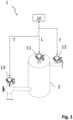
- Fig.1 an exemplary measuring system 1 is shown, which serves to monitor a process plant 2, such as a chemical reactor.
- the exemplary measuring system 1 comprises as field devices a flow meter 12 at an inlet of the reactor 2, a level meter 11 on the reactor 2 itself, and a temperature measuring device 13 at an outlet of the reactor 2.
- the field devices 11, 12, 13 measure the corresponding measured values L, f, T each with an individually adjustable measuring rate, for example between 1 measurement per minute and 1000 measurements per second.
- reaction reactants can be fed in via the inlet of the reactor 2, wherein the flow rate f at which the reaction reactant is fed in is recorded by means of the flow meter 12.
- the level measuring device 11 measures the level L in the reactor 2 and thus monitors, for example, whether a critical level value L is exceeded or not reached due to the reaction or due to the supply of the reaction educt. Accordingly, the measured values of the level measuring device 11 in the exemplary process plant 2 correlate with the measured values of the flow measuring device 12 in that the level L in the reactor 2 increases linearly over time in the time interval ⁇ t in which a constant flow rate f prevails in the inlet.
- This correlation of the level measurements with those of the flow meter 12 is shown schematically in the graph of Fig.2
- the temperature measuring device 13 at the outlet of the reactor 2 can be Fig.1 shown embodiment can in turn be used to measure the temperature T of a reaction product when emptying the reactor 2, for example in order to adapt subsequent process steps accordingly. If any chemical reactions in the process plant 2 are endothermic and therefore lead to cooling in the reactor 2, the temperature measuring device 13 registers at least a short drop in the temperature T during the corresponding time interval ⁇ t 2 in which the reactor 2 is emptied, depending on the ambient temperature. Accordingly, the Measured values of the temperature measuring device 13 with a (time-linear) decrease in the filling level L with the measured values of the filling level measuring device 11. This exemplary relationship is also shown schematically in the graph of Fig.2 shown.
- the measuring system 1 comprises a control unit 14 to which the field devices 11, 12, 13 are connected.
- the control unit 14 can be, for example, the process control system of the process plant.
- the interface via which the field devices 11, 12, 13 are connected to the control unit 14 can be implemented as "PROFIBUS", “HART”, “Wireless HART” or "Ethernet”.
- the field devices 11, 12, 13 can be operated using a battery, so that no additional cabling is required.
- the measured values f, L, T measured by the field devices 11, 12, 13 can be transmitted via the interfaces.
- the control unit 4 is thereby able to determine the previously described correlation patterns between the level measured values and the measured values f of the flow meter 12 or the temperature measured values and the level measured values during a defined learning phase.
- a suitable correlation type such as a Pearson or partial correlation
- the control unit 14 can, for example, use an auto-machine learning algorithm.
- the measuring system 1 After detecting the correlation pattern, the measuring system 1 according to the invention or the control unit 14 can switch to regular measuring operation. This means that during the measuring operation, the control unit 14 checks at least the measured values f of the flow meter 12 for the previously determined correlation pattern. Specifically, it is checked whether a (constant) flow rate f currently prevails. If this is detected, it is deduced from this that the fill level L must also change accordingly due to the previously detected correlation pattern.
- the measuring rate of the filling level measuring device 11 in the measuring mode can be reduced at least during the time window ⁇ t in which the correlation pattern is recognized in the flow measurement values f, without an unpredictable abrupt change in the filling level L being expected. In this way, in the event that the filling level measuring device 11 is battery-operated, its service life and thus its availability can be optimized.
- the control unit 14 can also check the measurement values L of the level measuring device 11 for the previously defined correlation pattern of the temperature measuring device 13 with regard to the level measurement values L during measuring operation. As soon as a decrease in the level is detected, this is again recognized as the presence of the correlation pattern and a corresponding (short-term) reduction in the temperature T on the temperature measuring device 13 is anticipated. Consequently, the measurement rate of the temperature measuring device 13 in measuring operation can also be reduced at least during the time window ⁇ t 2 in which the correlation pattern is recognized in the level values L, without an unforeseen change in temperature being expected. This also means that the service life or the availability of the temperature measuring device 13 can be increased in the case of battery operation.
- control unit 14 is shown as a separate, higher-level unit in the illustration shown. Within the scope of the invention, however, it is also conceivable to design the control unit 4 not as an external device, but as a component of one of the field devices 11, 12, 13.
Landscapes
- Chemical & Material Sciences (AREA)
- Health & Medical Sciences (AREA)
- General Health & Medical Sciences (AREA)
- Engineering & Computer Science (AREA)
- Life Sciences & Earth Sciences (AREA)
- Analytical Chemistry (AREA)
- Physics & Mathematics (AREA)
- General Physics & Mathematics (AREA)
- Clinical Laboratory Science (AREA)
- Databases & Information Systems (AREA)
- Immunology (AREA)
- Pathology (AREA)
- Dispersion Chemistry (AREA)
- Hematology (AREA)
- Quality & Reliability (AREA)
- Chemical Kinetics & Catalysis (AREA)
- Artificial Intelligence (AREA)
- Computer Vision & Pattern Recognition (AREA)
- Data Mining & Analysis (AREA)
- Biochemistry (AREA)
- Evolutionary Computation (AREA)
- Medical Informatics (AREA)
- Software Systems (AREA)
- Crystallography & Structural Chemistry (AREA)
- Bioinformatics & Cheminformatics (AREA)
- Bioinformatics & Computational Biology (AREA)
- Computing Systems (AREA)
- Theoretical Computer Science (AREA)
- Testing And Monitoring For Control Systems (AREA)
- Testing Or Calibration Of Command Recording Devices (AREA)
Description
- Die Erfindung betrifft ein Verfahren zur Optimierung einer Mess-Rate eines Feldgerätes in einem Mess-System.
- In der Automatisierungstechnik, insbesondere zur Prozessautomatisierung, werden vielfach Feldgeräte eingesetzt, die zur Erfassung verschiedener Messgrößen dienen. Bei der zu bestimmenden Messgröße kann es sich beispielsweise um einen Füllstand, einen Durchfluss, einen Druck, die Temperatur, den pH-Wert, das Redoxpotential, eine Leitfähigkeit oder den Dielektrizitätswert eines Mediums in einer Prozessanlage handeln. Zur Erfassung der entsprechenden Messwerte umfassen die Feldgeräte jeweils geeignete Sensoren bzw. basieren auf geeigneten Messprinzipien. Eine Vielzahl verschiedener Feldgeräte-Typen wird von der Firmen-Gruppe Endress + Hauser hergestellt und vertrieben.
- In der jeweiligen Prozessanlage sind die einzelnen Feldgeräte in der Regel zu einem Mess-System zusammengeschaltet, um die korrespondierenden Prozessvariablen mit geeigneten Aktoren, wie Heitz-Elementen, Rührwerken, Ventilen oder Pumpen für Zu- und Abläufe koordinieren zu können. Dementsprechend korrelieren auch die Messgrößen der einzelnen Feldgeräte einer Prozessanlage gegebenenfalls miteinander. Zur Kommunikation innerhalb des Mess-Systems können die Feldgeräte entweder direkt, oder auch zentral über eine Steuer-Einheit, wie eine Prozessleitstelle, miteinander verbunden sein. Vor allem bei Feldgeräten, die an schwer zugänglichen Orten der Prozessanlage angeordnet sind, werden zur Kommunikation innerhalb des Mess-Systems vorzugsweise drahtlose Übertragungsprotokolle, wie Wireless HART oder WLAN implementiert. Die Energieversorgung dieser Feldgeräte erfolgt in diesen Fällen entsprechend über Batterien. Die potentielle Einsatzdauer des einzelnen Feldgerätes hängt dabei von der Kapazität der Batterie sowie der Mess-Rate, also der Taktung und der Messzeit pro Takt, mit der das Feldgerät den Messwert misst, ab.
- In diesem Zusammenhang darf die Mess-Rate jedoch auch nicht zu gering eingestellt werden, damit der Prozess ausreichend überwacht werden kann. In Verbindung mit der endlichen Kapazität der Batterie müssen die entsprechenden Feldgeräte daher in regelmäßigem Wartungszyklen außer Betrieb genommen werden, um den Batterie-Wechsel vorzunehmen. Hierdurch bedingt müssen auch die Prozesse innerhalb der Prozessanlage in diesen Wartungszeiträumen gestoppt werden, da die Prozesse ohne entsprechende Überwachung in der Regel nicht kontrolliert ablaufen können. Dies ist insofern nachteilhaft für den Anlagenbetreiber, da jegliche Stillstandszeit der Prozessanlage dessen Wirtschaftlichkeit beeinträchtigt.
- TAYEH GABY BOU ET AL: "A Spatial-Temporal Correlation Approach for Data Reduction in Cluster-Based Sensor Networks" offenbart ein Verfahren zur Datenreduktion mittels räumlicher und zeitlicher Korrelation von Sensormessdaten.
- Der Erfindung liegt daher die Aufgabe zugrunde, ein Verfahren bereitzustellen, mit dem die Verfügbarkeit von Batteriebetriebenen Feldgeräten erhöht werden kann.
- Die Erfindung löst diese Aufgabe durch ein Verfahren zur Optimierung einer Mess-Rate eines ersten Feldgerätes in einem Mess-System. Zur Anwendung des Verfahrens ist es hierbei erforderlich, dass das Mess-System neben dem ersten Feldgerät zumindest ein zweites Feldgerät umfasst, wobei die zumindest zwei Feldgeräte mit jeweils einer bestimmten Mess-Rate Messwerte entsprechender Messgrößen messen, und wobei zumindest die Messgröße des ersten Feldgerätes mit der Messgröße des zweiten Feldgerätes korreliert. Folgende Verfahrensschritte umfasst das Verfahren:
- Messung der Messgrößen der zumindest zwei Feldgeräte mit jeweils einer voreingestellten Mess-Rate während einer definierten Einlernphase,
- Bestimmung eines Korrelations-Musters zwischen der ersten Messgröße und der zweiten Messgröße anhand der in der Einlernphase gemessenen Messwerte.
- Dabei werden zumindest die Messwerte des zweiten Feldgerätes während eines Messbetriebs auf das Korrelations-Muster hin geprüft,
wobei die Mess-Rate des ersten Feldgerätes im Messbetrieb zumindest während desjenigen Zeitfensters, in dem das Korrelations-Muster bei den Messwerten der zweiten Messgröße erkannt wird, geändert wird. - Dabei kann das optimale Korrelations-Muster, wie beispielsweise eine Pearson- oder Partial- Korrelation mittels eines Auto-Machine-Learning Algorithmus bestimmt werden.
- Die Erfindung beruht also darauf, die Korrelation der einzelnen Messgrößen zueinander zu überprüfen. Wird durch das Verfahren eine starke Korrelation zwischen den Messgrößen erkannt, so wird dies als Beleg für die Funktionsfähigkeit des Mess-Systems gewertet. Im anderen Fall ist von einer Störung des Mess-Systems auszugehen, so dass die gemessenen Messwerte als falsch bzw. zumindest nicht vertrauenswürdig einzustufen sind.
- Die Mess-Rate des ersten Feldgerätes kann im Messbetrieb zumindest während des Zeitfensters, in dem das Korrelations-Muster bei den Messwerten der zweiten Messgröße erkannt wird, verringert werden. Hierdurch kann der Leistungsverbrauch des jeweiligen Gerätes verringert werden. Vorteilhaft ist dies vor allem, wenn das erste Feldgerät und/oder das zweite Feldgerät zur Energieversorgung eine Batterie umfassen, da hierdurch die Batterie-Laufzeit und somit die Verfügbarkeit in der Prozessanlage erhöht werden.
- Um etwaigen Rechenaufwand zu vermindern und somit die Erstellung des Korrelations-Musters zu beschleunigen, können zur Bestimmung des Korrelations-Musters redundante Messwerte aus der Einlernphase vorteilhafter Weise beispielsweise mittels eines Unsupervised Clustering Verfahrens herausgefiltert werden.
- Ein entsprechendes Mess-System, das zur Ausführung des Verfahrens gemäß einer der vorhergehenden Ausführungsvarianten geeignet ist, hat zumindest folgende Komponenten zu umfassen:
- Eine erstes Feldgerät, das ausgelegt ist, die erste Messgröße mit einer einstellbaren Mess-Rate zu messen,
- eine zweites Feldgerät, das ausgelegt ist, die zweite Messgröße zu messen,
- eine Steuer-Einheit, die ausgelegt ist, um
- ∘ ein Korrelations-Muster zwischen der ersten Messgröße und der zweiten Messgröße anhand der in der Einlernphase gemessenen Messwerte zu bestimmen,
- ∘ zumindest die Messwerte des zweiten Feldgerätes während des Messbetriebs auf das Korrelations-Muster hin zu prüfen,
- o zumindest die Mess-Rate des ersten Feldgerätes im Messbetrieb zumindest während eines Zeitfensters, in dem das Korrelations-Muster bei den Messwerten der zweiten Messgröße erkannt wird, zu ändern.
- Dabei können das erste Feldgerät und/oder das zweite Feldgerät beispielsweise mittels einer drahtlosen Schnittstelle mit der Steuer-Einheit verbunden sein.
- Unter dem Begriff "Einheit" werden im Rahmen der Erfindung prinzipiell jede elektronische Schaltung verstanden, die für den angedachten Einsatzzweck geeignet ausgelegt ist. Es kann sich also je nach Anforderung um eine Analogschaltung zur Erzeugung bzw. Verarbeitung entsprechender analoger Signale handeln. Es kann sich jedoch auch um eine Digitalschaltung wie einem FPGA oder einen Speichermedium in Zusammenwirken mit einem Programm handeln. Dabei ist das Programm ausgelegt, die entsprechenden Verfahrensschritte durchzuführen bzw. die notwendigen Rechenoperationen der jeweiligen Einheit anzuwenden. In diesem Kontext können verschiedene elektronische Einheiten des Füllstandsmessgerätes im Sinne der Erfindung potentiell auch auf einen gemeinsamen physikalischen Speicher zurückgreifen bzw. mittels derselben physikalischen Digitalschaltung betrieben werden.
- Anhand der nachfolgenden Figuren wird die Erfindung näher erläutert. Es zeigt:
-
Fig. 1 : Ein Mess-System mit drei Feldgeräten in einer Prozessanlage, und -
Fig. 2 : eine Korrelation zwischen den Messgrößen der Feldgeräte. - Zum allgemeinen Verständnis des erfindungsgemäßen Verfahrens ist in
Fig. 1 ein beispielhaftes Mess-System 1 gezeigt, das zur Überwachung einer Prozess-Anlage 2, wie beispielsweise einem Chemie-Reaktor, dient. Hierzu umfasst das exemplarische Mess-System 1 als Feldgeräte ein Durchflussmessgerät 12 an einem Zulauf des Reaktors 2, ein Füllstandsmessgerät 11 am Reaktor 2 selbst, und ein Temperaturmessgerät 13 an einem Ablauf des Reaktors 2. Dabei messen die Feldgeräte 11, 12, 13 die entsprechenden Messwerte L, f, T jeweils mit einer individuell einstellbaren Mess-Rate, beispielsweise zwischen 1 Messung pro Minute und 1000 Messungen pro Sekunde. - Über den Zulauf des Reaktors 2 können beispielsweise Reaktions-Edukte zugeführt werden, wobei die Durchflussrate f, mit der das Reaktions-Edukt zugeführt wird, mittels des Durchflussmessgerätes 12 erfasst wird.
- Das Füllstandsmessgerät 11 misst den Füllstand L im Reaktor 2 und überwacht somit beispielsweise, ob durch die Reaktion oder durch das Zuführen des Reaktions-Eduktes ein kritischer Füllstandswert L über- oder unterschritten wird. Dementsprechend korrelieren die Messwerte des Füllstandsmessgerätes 11 in der exemplarischen Prozessanlage 2 insofern mit den Messwerten des Durchflussmessgerätes 12, als dass sich in demjenigen Zeitintervall Δt, in dem eine konstante Durchflussrate f im Zulauf vorherrscht, sich der Füllstand L im Reaktor 2 zeitlich linear erhöht. Somit kann diese exemplarische Korrelation des Füllstandes L in Bezug zum Durchfluss f funktional beschrieben werden, da der Füllstand durch die Stammfunktion des Durchflusses gebildet wird:

Fig. 2 - Das Temperaturmessgerät 13 am Ablauf des Reaktors 2 kann bei dem in
Fig. 1 gezeigten Ausführungsbeispiel wiederum dazu dienen, die Temperatur T eines Reaktions-Produktes beim Entleeren des Reaktors 2 zu messen, um beispielsweise nachfolgende Prozess-Schritte entsprechend anzupassen. Sofern etwaige chemische Reaktionen in der Prozessanlage 2 endotherm verlaufen und daher zu einer Abkühlung im Reaktor 2 führen, registriert das Temperaturmessgerät 13 während des entsprechenden Zeitintervalls Δt2, in dem der Reaktor 2 entleert wird, je nach Umgebungstemperatur zumindest einen kurzen Abfall der Temperatur T. Dementsprechend korrelieren auch die Messwerte des Temperaturmessgerätes 13 bei einer (zeitlich linearen) Abnahme des Füllstandes L mit den Messwerten des Füllstandsmessgerätes 11. Auch dieser exemplarische Zusammenhang ist schematisch in dem Graph vonFig. 2 dargestellt. - Bei der in
Fig. 1 gezeigten Ausführungsvariante umfasst das Mess-System 1 eine Steuer-Einheit 14, mit welcher die Feldgeräte 11, 12, 13 verbunden sind. Dabei kann es sich bei der Steuer-Einheit 14 beispielsweise um das Prozessleitsystem der Prozessanlage handeln. Als Schnittstelle, über welche die Feldgeräte 11, 12, 13 mit der Steuer-Einheit 14 verbunden sind, kann etwa "PROFIBUS", "HART", "Wireless HART" oder "Ethernet" implementiert sein. Speziell bei kabelloser Auslegung der Schnittstellen können die Feldgeräte 11, 12, 13 entsprechend mittels Batterie betrieben werden, so dass hierfür keine zusätzliche Verkabelung erforderlich ist. - Über die Schnittstellen können die von den Feldgeräten 11, 12, 13 gemessenen Messwerte f, L, T übermittelt werden. Bei entsprechender Auslegung ist es der Steuer-Einheit 4 hierdurch möglich, während einer definierten Einlernphase die zuvor beschriebenen Korrelations-Muster zwischen den Füllstands-Messwerten und den Messwerten f des Durchflussmessgerätes 12 bzw. den Temperaturmesswerten und den Füllstands-Messwerten zu bestimmen. Zur Findung eines geeigneten Korrelations-Typs, wie beispielsweise einer Pearson- oder Partial-Korrelation kann die Steuer-Einheit 14 beispielsweise einen Auto-Machine-Learning Algorithmus anwenden.
- Nach Erfassung der Korrelations-Muster kann das erfindungsgemäße Mess-System 1 bzw. die Steuer-Einheit 14 in den regulären Messbetrieb übergehen. Das heißt, während des Messbetriebs prüft die die Steuer-Einheit 14 zumindest die Messwerte f des Durchflussmessgerätes 12 auf das zuvor bestimmte Korrelations-Muster hin. Konkret wird geprüft, ob eine derzeit eine (konstanter) Durchfluss-Rate f vorherrscht. Sofern, dies erkannt wird, wird hieraus abgeleitet, dass sich aufgrund des zuvor erkannten Korrelations-Musters auch der Füllstand L entsprechend ändern muss.
- Da aufgrund dieser Art der Korrelation die Füllstands-Änderung vorhersehbar ist, kann infolge dessen die Mess-Rate des Füllstandsmessgerätes 11 im Messbetrieb zumindest während desjenigen Zeitfensters Δt, in dem das Korrelations-Muster bei den Durchfluss-Messwerten f erkannt wird, verringert werden, ohne das bezüglich des Füllstandes L eine unvorhersehbare abrupte Füllstands-Änderung zu erwarten ist. Hierdurch kann für den Fall, dass das Füllstandsmessgerät 11 Batterie-betrieben ist, dessen Einsatzdauer und somit dessen Verfügbarkeit optimiert werden.
- Analog zu den Durchfluss-Messwerten f des Durchflussmessgerätes 12 kann die Steuer-Einheit 14 während des Messbetriebes auch die Messwerte L des Füllstandsmessgerätes 11 auf das zuvor festgelegte Korrelations-Muster des Temperaturmessgerätes 13 hinsichtlich der Füllstands-Messwerte L hin überprüfen. Sobald also eine Füllstands-Abnahme detektiert wird, wird dies wiederum als Vorliegen des Korrelations-Musters erkannt und eine entsprechende (kurzzeitige) Senkung der Temperatur T am TemperaturMessgerät 13 antizipiert. Folglich kann auch die Mess-Rate des Temperatur-Messgerätes 13 im Messbetrieb zumindest während des Zeitfensters Δt2, in dem das Korrelations-Muster bei den Füllstands-Werten L erkannt wird, verringert werden, ohne dass eine unvorhergesehene Temperatur-Änderung zu erwarten ist. Somit können also auch die Einsatzdauer bzw. die Verfügbarkeit des Temperatur-Messgerätes 13 im Falle von Batterie-Betrieb erhöht werden.
- Die Steuer-Einheit 14 ist in der gezeigten Darstellung als separate, übergeordnete Einheit dargestellt. Im Rahmen der Erfindung ist es jedoch ebenso denkbar, die Steurer-Einheit 4 nicht als externes Gerät, sondern als Bestandteil eines der Feldgeräte 11, 12, 13 auszulegen.
-
- 1
- Mess-System
- 2
- Prozess-Anlage
- 11
- Füllstandsmessgerät
- 12
- Durchflussmessgerät
- 13
- Temperaturmessgerät
- 14
- Steuer-Einheit
- f
- Durchfluss-Rate
- L
- Füllstand
- T
- Temperatur
- Δt
- Zeitfenster
Claims (7)
- Verfahren zur Optimierung einer Mess-Rate eines ersten Feldgerätes (11) in einem Mess-System (1), wobei das erste Feldgerät (11) ausgelegt ist, eine erste Messgröße (L) mit einer einstellbaren Mess-Rate zu messen, wobei das Mess-System (1) neben dem ersten Feldgerät (11) zumindest ein zweites Feldgerät (12) umfasst, welches ausgelegt ist, eine zweiten Messgröße (f) zu messen, wobei die erste Messgröße (L) von der zweiten Messgröße (f) verschieden ist und wobei zumindest die erste Messgröße (L) des ersten Feldgerätes (11) mit der zweiten Messgröße (f) des zweiten Feldgerätes (12) korreliert, folgende Verfahrensschritte umfassend:- Messung der Messgrößen (f, L) der zumindest zwei Feldgeräte (11, 12) mit jeweils einer voreingestellten Mess-Rate während einer definierten Einlernphase,- Bestimmung eines Korrelations-Musters zwischen der ersten Messgröße (L) und der zweiten Messgröße (f) anhand der in der Einlernphase gemessenen Messwerte,- Durchführung eines Messbetriebs,wobei zumindest die Messwerte des zweiten Feldgerätes (12) während des Messbetriebs auf das Korrelations-Muster hin geprüft werden, undwobei die Mess-Rate des ersten Feldgerätes (11) im Messbetrieb zumindest während eines Zeitfensters (Δt), in dem das Korrelations-Muster bei den Messwerten der zweiten Messgröße (f) erkannt wird, geändert wird.
- Verfahren nach Anspruch 1, wobei das Korrelations-Muster mittels eines Auto-Machine-Learning Algorithmus bestimmt wird.
- Verfahren nach einem der vorhergehenden Ansprüche, wobei die Mess-Rate des ersten Feldgerätes (11) im Messbetrieb zumindest während des Zeitfensters (Δt), in dem das Korrelations-Muster bei den Messwerten der zweiten Messgröße (f) erkannt wird, verringert wird.
- Verfahren nach Anspruch 1 bis 3, wobei zur Bestimmung des Korrelations-Musters redundante Messwerte aus der Einlernphase insbesondere mittels eines Unsupervised Clustering Verfahrens herausgefiltert werden.
- Mess-System zur Ausführung des Verfahrens nach einem der vorherigen Ansprüche, umfassend:- Ein erstes Feldgerät (11), das ausgelegt ist, die erste Messgröße (L) mit einer einstellbaren Mess-Rate zu messen,- eine zweites Feldgerät (12), das ausgelegt ist, die zweite Messgröße (f) zu messen, wobei die erste Messgröße (L) von der zweiten Messgröße (f) verschieden ist,- eine Steuer-Einheit (4), die ausgelegt ist, um∘ ein Korrelations-Muster zwischen der ersten Messgröße (L) und der zweiten Messgröße (f) anhand der in der Einlernphase gemessenen Messwerte zu bestimmen,∘ zumindest die Messwerte des zweiten Feldgerätes (12) während des Messbetriebs auf das Korrelations-Muster hin zu prüfen,∘ zumindest die Mess-Rate des ersten Feldgerätes (11) im Messbetrieb zumindest während eines Zeitfensters (Δt, Δt2), in dem das Korrelations-Muster bei den Messwerten der zweiten Messgröße (f) erkannt wird, zu ändern.
- Mess-System nach Anspruch 5, wobei das erste Feldgerät (11) und/oder das zweite Feldgerät (12) zur Energieversorgung eine Batterie umfassen bzw. umfasst.
- Mess-System nach Anspruch 5 oder 6, wobei das erste Feldgerät (11) und/oder das zweite Feldgerät (12) mittels einer drahtlosen Schnittstelle mit der Steuer-Einheit (14) verbunden sind bzw. ist.
Applications Claiming Priority (2)
| Application Number | Priority Date | Filing Date | Title |
|---|---|---|---|
| DE102019133600.7A DE102019133600A1 (de) | 2019-12-09 | 2019-12-09 | Verfahren zur Optimierung einer Mess-Rate eines Feldgerätes |
| PCT/EP2020/082901 WO2021115760A1 (de) | 2019-12-09 | 2020-11-20 | Verfahren zur optimierung einer mess-rate eines feldgerätes |
Publications (2)
| Publication Number | Publication Date |
|---|---|
| EP4073473A1 EP4073473A1 (de) | 2022-10-19 |
| EP4073473B1 true EP4073473B1 (de) | 2024-09-04 |
Family
ID=73544177
Family Applications (1)
| Application Number | Title | Priority Date | Filing Date |
|---|---|---|---|
| EP20811586.5A Active EP4073473B1 (de) | 2019-12-09 | 2020-11-20 | Verfahren zur optimierung einer mess-rate eines feldgerätes |
Country Status (5)
| Country | Link |
|---|---|
| US (1) | US12480963B2 (de) |
| EP (1) | EP4073473B1 (de) |
| CN (1) | CN114761760B (de) |
| DE (1) | DE102019133600A1 (de) |
| WO (1) | WO2021115760A1 (de) |
Families Citing this family (2)
| Publication number | Priority date | Publication date | Assignee | Title |
|---|---|---|---|---|
| DE102021133787A1 (de) | 2021-12-20 | 2023-06-22 | Endress+Hauser SE+Co. KG | Detektion von Fremdkörpern in fließenden Messmedien |
| DE102023122776A1 (de) | 2023-08-24 | 2025-02-27 | Vega Grieshaber Kg | Verfahren zum Bestimmen eines Füllstands eines Füllguts in einem Behälter |
Family Cites Families (15)
| Publication number | Priority date | Publication date | Assignee | Title |
|---|---|---|---|---|
| CA1065060A (en) | 1976-04-01 | 1979-10-23 | Canadian General Electric Company Limited | Cross-correlator circuit |
| GB2186468B (en) | 1986-02-06 | 1989-11-01 | Plessey Co Plc | Improvements relating to data transmission systems |
| DE102008016940A1 (de) | 2008-04-01 | 2009-10-08 | Endress + Hauser Gmbh + Co. Kg | Verfahren zur Bestimmung und/oder Überwachung des Füllstands eines Mediums in einem Behälter |
| DE102008036968A1 (de) * | 2008-08-08 | 2010-02-11 | Endress + Hauser Gmbh + Co. Kg | Diagnoseverfahren eines Prozessautomatisierungssystem |
| DE102010027144A1 (de) * | 2010-07-09 | 2012-01-12 | Fraunhofer-Gesellschaft zur Förderung der angewandten Forschung e.V. | Trainingsverfahren für einen adaptiven Auswertealgorithmus, ein hyperspektrales Messgerät, sowie eine Vorrichtung zum Ausbringen eines Betriebsmittels |
| CN102857938A (zh) | 2011-06-30 | 2013-01-02 | 冯奇 | 认知无线电中频谱环境学习与预测 |
| US20140088873A1 (en) * | 2012-09-21 | 2014-03-27 | Lantronix, Inc. | Networked Sensor Devices And Systems |
| WO2015135559A1 (en) * | 2014-03-14 | 2015-09-17 | Abb Technology Ag | Optimized configuration method for an automation system |
| CN104394580B (zh) | 2014-07-29 | 2019-01-04 | 湖南大学 | 基于模式统计的时间冗余数据消除方法 |
| EP3295611B1 (de) * | 2016-07-13 | 2018-12-05 | Incelligent P.C. | Frühwarn- und empfehlungssystem zur proaktiven verwaltung von drahtlosbreitbandnetzwerken |
| DE102016120444A1 (de) * | 2016-10-26 | 2018-04-26 | Endress+Hauser SE+Co. KG | Verfahren zum Betreiben eines Feldgerätes für die Automatisierungstechnik |
| DE102017200134A1 (de) * | 2017-01-05 | 2018-07-05 | Fraunhofer-Gesellschaft zur Förderung der angewandten Forschung e.V. | Selbstkonfigurierende Überwachungseinrichtung für ein auf einem industriellen Datenkommunikationsnetzwerk basierendes Automatisierungssystem |
| US10657444B2 (en) | 2017-03-09 | 2020-05-19 | Thomas Danaher Harvey | Devices and methods using machine learning to reduce resource usage in surveillance |
| US11119453B2 (en) | 2018-03-09 | 2021-09-14 | Nishil Thomas Koshy | System and method for remote non-intrusive monitoring of assets and entities |
| CN108549840A (zh) | 2018-03-19 | 2018-09-18 | 广东核电合营有限公司 | 一种多模拟仪表同步快速识别的方法及装置 |
-
2019
- 2019-12-09 DE DE102019133600.7A patent/DE102019133600A1/de not_active Withdrawn
-
2020
- 2020-11-20 US US17/783,957 patent/US12480963B2/en active Active
- 2020-11-20 WO PCT/EP2020/082901 patent/WO2021115760A1/de not_active Ceased
- 2020-11-20 EP EP20811586.5A patent/EP4073473B1/de active Active
- 2020-11-20 CN CN202080083879.4A patent/CN114761760B/zh active Active
Also Published As
| Publication number | Publication date |
|---|---|
| EP4073473A1 (de) | 2022-10-19 |
| US12480963B2 (en) | 2025-11-25 |
| US20230010373A1 (en) | 2023-01-12 |
| DE102019133600A1 (de) | 2021-06-10 |
| CN114761760A (zh) | 2022-07-15 |
| WO2021115760A1 (de) | 2021-06-17 |
| CN114761760B (zh) | 2025-01-21 |
Similar Documents
| Publication | Publication Date | Title |
|---|---|---|
| DE10007972B4 (de) | Diagnosevorrichtung und -verfahren in einem Prozeßsteuersystem | |
| EP2156251B1 (de) | Feldgerät mit einer vorrichtung zur durchführung von diagnoseverfahren | |
| EP2082297B1 (de) | PROZESSAUTOMATISIERUNGSSYSTEM ZUR BESTIMMUNG, ZUR ÜBERWACHUNG UND/ODER ZUM BEEINFLUSSEN VON UNTERSCHIEDLICHEN PROZESSGRÖßEN UND/ODER ZUSTANDSGRÖßEN | |
| EP2156150B1 (de) | Verfahren zur zustandsüberwachung einer kraftmessvorrichtung, kraftmessvorrichtung und kraftmessmodul | |
| DE102008036968A1 (de) | Diagnoseverfahren eines Prozessautomatisierungssystem | |
| WO2015096933A1 (de) | Messumformer mit überwachungsfunktion | |
| DE10008020B4 (de) | Diagnosevorrichtung in einem Prozeßsteuersystem, das Mehrgrößen-Regeltechniken verwendet | |
| EP3538962B1 (de) | Verfahren zur analyse von fehlfunktionen in einer anlage der prozessautomatisierung | |
| EP3745217B1 (de) | Vorrichtung zum überwachen einer datenverarbeitung und - übertragung in einem sicherheitssystems | |
| DE102009026785A1 (de) | Feldgerät zur Bestimmung und/oder Überwachung einer physikalischen oder chemischen Prozessgröße | |
| DE102016120444A1 (de) | Verfahren zum Betreiben eines Feldgerätes für die Automatisierungstechnik | |
| EP4073473A1 (de) | Verfahren zur optimierung einer mess-rate eines feldgerätes | |
| EP3983853B1 (de) | Feldgerät der automatisierungstechnik | |
| WO2010142535A1 (de) | Verfahren und vorrichtung zur fehlerüberwachung eines mehrere anlagen aufweisenden gesamtsystems | |
| DE102019002066A1 (de) | Eingabefehler-Erfassungsvorrichtung | |
| EP2988182A1 (de) | Vorrichtung und system zur bestimmung, optimierung oder überwachung zumindest einer prozessgrösse | |
| EP4018277B1 (de) | Ereignisorientierte übertragung von prozessmesswerten | |
| DE102016125240A1 (de) | Elektronische Schaltung für ein Feldgerät der Automatisierungstechnik | |
| EP3555714B1 (de) | Verfahren zur applikationsspezifischen einstellung eines feldgeräts | |
| DE102012016269A1 (de) | Elektrische Maschine mit einer Überwachungseinrichtung | |
| EP3729219B1 (de) | Verfahren zum überwachen einer messstelle in einer anlage der prozessautomatisierung | |
| DE102016124145A1 (de) | Verfahren zum Bedienen eines Feldgeräts der Automatisierungstechnik | |
| EP2316195B1 (de) | Vorrichtung zum bedienen eines feldgeräts, das in ein funknetzwerk der automatisierungstechnik eingebunden ist | |
| DE102016002345A1 (de) | Datenmessvorrichtung, die zum Messen physikalischer Daten ein Kommunikationsziel wechselt | |
| EP3475775A1 (de) | Ermitteln einer ausführungszeit eines anwenderprogramms |
Legal Events
| Date | Code | Title | Description |
|---|---|---|---|
| STAA | Information on the status of an ep patent application or granted ep patent |
Free format text: STATUS: UNKNOWN |
|
| STAA | Information on the status of an ep patent application or granted ep patent |
Free format text: STATUS: THE INTERNATIONAL PUBLICATION HAS BEEN MADE |
|
| PUAI | Public reference made under article 153(3) epc to a published international application that has entered the european phase |
Free format text: ORIGINAL CODE: 0009012 |
|
| STAA | Information on the status of an ep patent application or granted ep patent |
Free format text: STATUS: REQUEST FOR EXAMINATION WAS MADE |
|
| 17P | Request for examination filed |
Effective date: 20220518 |
|
| AK | Designated contracting states |
Kind code of ref document: A1 Designated state(s): AL AT BE BG CH CY CZ DE DK EE ES FI FR GB GR HR HU IE IS IT LI LT LU LV MC MK MT NL NO PL PT RO RS SE SI SK SM TR |
|
| DAV | Request for validation of the european patent (deleted) | ||
| DAX | Request for extension of the european patent (deleted) | ||
| GRAP | Despatch of communication of intention to grant a patent |
Free format text: ORIGINAL CODE: EPIDOSNIGR1 |
|
| STAA | Information on the status of an ep patent application or granted ep patent |
Free format text: STATUS: GRANT OF PATENT IS INTENDED |
|
| INTG | Intention to grant announced |
Effective date: 20240424 |
|
| GRAS | Grant fee paid |
Free format text: ORIGINAL CODE: EPIDOSNIGR3 |
|
| GRAA | (expected) grant |
Free format text: ORIGINAL CODE: 0009210 |
|
| STAA | Information on the status of an ep patent application or granted ep patent |
Free format text: STATUS: THE PATENT HAS BEEN GRANTED |
|
| AK | Designated contracting states |
Kind code of ref document: B1 Designated state(s): AL AT BE BG CH CY CZ DE DK EE ES FI FR GB GR HR HU IE IS IT LI LT LU LV MC MK MT NL NO PL PT RO RS SE SI SK SM TR |
|
| REG | Reference to a national code |
Ref country code: GB Ref legal event code: FG4D Free format text: NOT ENGLISH |
|
| REG | Reference to a national code |
Ref country code: CH Ref legal event code: EP |
|
| REG | Reference to a national code |
Ref country code: IE Ref legal event code: FG4D Free format text: LANGUAGE OF EP DOCUMENT: GERMAN |
|
| REG | Reference to a national code |
Ref country code: DE Ref legal event code: R096 Ref document number: 502020009142 Country of ref document: DE |
|
| P01 | Opt-out of the competence of the unified patent court (upc) registered |
Free format text: CASE NUMBER: APP_48901/2024 Effective date: 20240827 |
|
| REG | Reference to a national code |
Ref country code: LT Ref legal event code: MG9D |
|
| REG | Reference to a national code |
Ref country code: NL Ref legal event code: MP Effective date: 20240904 |
|
| PG25 | Lapsed in a contracting state [announced via postgrant information from national office to epo] |
Ref country code: NO Free format text: LAPSE BECAUSE OF FAILURE TO SUBMIT A TRANSLATION OF THE DESCRIPTION OR TO PAY THE FEE WITHIN THE PRESCRIBED TIME-LIMIT Effective date: 20241204 |
|
| PG25 | Lapsed in a contracting state [announced via postgrant information from national office to epo] |
Ref country code: GR Free format text: LAPSE BECAUSE OF FAILURE TO SUBMIT A TRANSLATION OF THE DESCRIPTION OR TO PAY THE FEE WITHIN THE PRESCRIBED TIME-LIMIT Effective date: 20241205 Ref country code: PL Free format text: LAPSE BECAUSE OF FAILURE TO SUBMIT A TRANSLATION OF THE DESCRIPTION OR TO PAY THE FEE WITHIN THE PRESCRIBED TIME-LIMIT Effective date: 20240904 Ref country code: FI Free format text: LAPSE BECAUSE OF FAILURE TO SUBMIT A TRANSLATION OF THE DESCRIPTION OR TO PAY THE FEE WITHIN THE PRESCRIBED TIME-LIMIT Effective date: 20240904 |
|
| PG25 | Lapsed in a contracting state [announced via postgrant information from national office to epo] |
Ref country code: BG Free format text: LAPSE BECAUSE OF FAILURE TO SUBMIT A TRANSLATION OF THE DESCRIPTION OR TO PAY THE FEE WITHIN THE PRESCRIBED TIME-LIMIT Effective date: 20240904 |
|
| PG25 | Lapsed in a contracting state [announced via postgrant information from national office to epo] |
Ref country code: LV Free format text: LAPSE BECAUSE OF FAILURE TO SUBMIT A TRANSLATION OF THE DESCRIPTION OR TO PAY THE FEE WITHIN THE PRESCRIBED TIME-LIMIT Effective date: 20240904 |
|
| PG25 | Lapsed in a contracting state [announced via postgrant information from national office to epo] |
Ref country code: HR Free format text: LAPSE BECAUSE OF FAILURE TO SUBMIT A TRANSLATION OF THE DESCRIPTION OR TO PAY THE FEE WITHIN THE PRESCRIBED TIME-LIMIT Effective date: 20240904 |
|
| PG25 | Lapsed in a contracting state [announced via postgrant information from national office to epo] |
Ref country code: ES Free format text: LAPSE BECAUSE OF FAILURE TO SUBMIT A TRANSLATION OF THE DESCRIPTION OR TO PAY THE FEE WITHIN THE PRESCRIBED TIME-LIMIT Effective date: 20240904 Ref country code: RS Free format text: LAPSE BECAUSE OF FAILURE TO SUBMIT A TRANSLATION OF THE DESCRIPTION OR TO PAY THE FEE WITHIN THE PRESCRIBED TIME-LIMIT Effective date: 20241204 |
|
| PG25 | Lapsed in a contracting state [announced via postgrant information from national office to epo] |
Ref country code: RS Free format text: LAPSE BECAUSE OF FAILURE TO SUBMIT A TRANSLATION OF THE DESCRIPTION OR TO PAY THE FEE WITHIN THE PRESCRIBED TIME-LIMIT Effective date: 20241204 Ref country code: PL Free format text: LAPSE BECAUSE OF FAILURE TO SUBMIT A TRANSLATION OF THE DESCRIPTION OR TO PAY THE FEE WITHIN THE PRESCRIBED TIME-LIMIT Effective date: 20240904 Ref country code: NO Free format text: LAPSE BECAUSE OF FAILURE TO SUBMIT A TRANSLATION OF THE DESCRIPTION OR TO PAY THE FEE WITHIN THE PRESCRIBED TIME-LIMIT Effective date: 20241204 Ref country code: LV Free format text: LAPSE BECAUSE OF FAILURE TO SUBMIT A TRANSLATION OF THE DESCRIPTION OR TO PAY THE FEE WITHIN THE PRESCRIBED TIME-LIMIT Effective date: 20240904 Ref country code: HR Free format text: LAPSE BECAUSE OF FAILURE TO SUBMIT A TRANSLATION OF THE DESCRIPTION OR TO PAY THE FEE WITHIN THE PRESCRIBED TIME-LIMIT Effective date: 20240904 Ref country code: GR Free format text: LAPSE BECAUSE OF FAILURE TO SUBMIT A TRANSLATION OF THE DESCRIPTION OR TO PAY THE FEE WITHIN THE PRESCRIBED TIME-LIMIT Effective date: 20241205 Ref country code: FI Free format text: LAPSE BECAUSE OF FAILURE TO SUBMIT A TRANSLATION OF THE DESCRIPTION OR TO PAY THE FEE WITHIN THE PRESCRIBED TIME-LIMIT Effective date: 20240904 Ref country code: ES Free format text: LAPSE BECAUSE OF FAILURE TO SUBMIT A TRANSLATION OF THE DESCRIPTION OR TO PAY THE FEE WITHIN THE PRESCRIBED TIME-LIMIT Effective date: 20240904 Ref country code: BG Free format text: LAPSE BECAUSE OF FAILURE TO SUBMIT A TRANSLATION OF THE DESCRIPTION OR TO PAY THE FEE WITHIN THE PRESCRIBED TIME-LIMIT Effective date: 20240904 |
|
| PG25 | Lapsed in a contracting state [announced via postgrant information from national office to epo] |
Ref country code: NL Free format text: LAPSE BECAUSE OF FAILURE TO SUBMIT A TRANSLATION OF THE DESCRIPTION OR TO PAY THE FEE WITHIN THE PRESCRIBED TIME-LIMIT Effective date: 20240904 |
|
| PG25 | Lapsed in a contracting state [announced via postgrant information from national office to epo] |
Ref country code: PT Free format text: LAPSE BECAUSE OF FAILURE TO SUBMIT A TRANSLATION OF THE DESCRIPTION OR TO PAY THE FEE WITHIN THE PRESCRIBED TIME-LIMIT Effective date: 20250106 Ref country code: IS Free format text: LAPSE BECAUSE OF FAILURE TO SUBMIT A TRANSLATION OF THE DESCRIPTION OR TO PAY THE FEE WITHIN THE PRESCRIBED TIME-LIMIT Effective date: 20250104 |
|
| PG25 | Lapsed in a contracting state [announced via postgrant information from national office to epo] |
Ref country code: SM Free format text: LAPSE BECAUSE OF FAILURE TO SUBMIT A TRANSLATION OF THE DESCRIPTION OR TO PAY THE FEE WITHIN THE PRESCRIBED TIME-LIMIT Effective date: 20240904 Ref country code: RO Free format text: LAPSE BECAUSE OF FAILURE TO SUBMIT A TRANSLATION OF THE DESCRIPTION OR TO PAY THE FEE WITHIN THE PRESCRIBED TIME-LIMIT Effective date: 20240904 |
|
| PG25 | Lapsed in a contracting state [announced via postgrant information from national office to epo] |
Ref country code: EE Free format text: LAPSE BECAUSE OF FAILURE TO SUBMIT A TRANSLATION OF THE DESCRIPTION OR TO PAY THE FEE WITHIN THE PRESCRIBED TIME-LIMIT Effective date: 20240904 |
|
| PG25 | Lapsed in a contracting state [announced via postgrant information from national office to epo] |
Ref country code: CZ Free format text: LAPSE BECAUSE OF FAILURE TO SUBMIT A TRANSLATION OF THE DESCRIPTION OR TO PAY THE FEE WITHIN THE PRESCRIBED TIME-LIMIT Effective date: 20240904 |
|
| PG25 | Lapsed in a contracting state [announced via postgrant information from national office to epo] |
Ref country code: SK Free format text: LAPSE BECAUSE OF FAILURE TO SUBMIT A TRANSLATION OF THE DESCRIPTION OR TO PAY THE FEE WITHIN THE PRESCRIBED TIME-LIMIT Effective date: 20240904 |
|
| REG | Reference to a national code |
Ref country code: DE Ref legal event code: R097 Ref document number: 502020009142 Country of ref document: DE |
|
| REG | Reference to a national code |
Ref country code: CH Ref legal event code: PL |
|
| PG25 | Lapsed in a contracting state [announced via postgrant information from national office to epo] |
Ref country code: MC Free format text: LAPSE BECAUSE OF FAILURE TO SUBMIT A TRANSLATION OF THE DESCRIPTION OR TO PAY THE FEE WITHIN THE PRESCRIBED TIME-LIMIT Effective date: 20240904 |
|
| PG25 | Lapsed in a contracting state [announced via postgrant information from national office to epo] |
Ref country code: DK Free format text: LAPSE BECAUSE OF FAILURE TO SUBMIT A TRANSLATION OF THE DESCRIPTION OR TO PAY THE FEE WITHIN THE PRESCRIBED TIME-LIMIT Effective date: 20240904 |
|
| PLBE | No opposition filed within time limit |
Free format text: ORIGINAL CODE: 0009261 |
|
| STAA | Information on the status of an ep patent application or granted ep patent |
Free format text: STATUS: NO OPPOSITION FILED WITHIN TIME LIMIT |
|
| PG25 | Lapsed in a contracting state [announced via postgrant information from national office to epo] |
Ref country code: LU Free format text: LAPSE BECAUSE OF NON-PAYMENT OF DUE FEES Effective date: 20241120 |
|
| REG | Reference to a national code |
Ref country code: CH Ref legal event code: PL |
|
| PG25 | Lapsed in a contracting state [announced via postgrant information from national office to epo] |
Ref country code: CH Free format text: LAPSE BECAUSE OF NON-PAYMENT OF DUE FEES Effective date: 20241130 |
|
| 26N | No opposition filed |
Effective date: 20250605 |
|
| GBPC | Gb: european patent ceased through non-payment of renewal fee |
Effective date: 20241204 |
|
| REG | Reference to a national code |
Ref country code: BE Ref legal event code: MM Effective date: 20241130 |
|
| PG25 | Lapsed in a contracting state [announced via postgrant information from national office to epo] |
Ref country code: SE Free format text: LAPSE BECAUSE OF FAILURE TO SUBMIT A TRANSLATION OF THE DESCRIPTION OR TO PAY THE FEE WITHIN THE PRESCRIBED TIME-LIMIT Effective date: 20240904 |
|
| PG25 | Lapsed in a contracting state [announced via postgrant information from national office to epo] |
Ref country code: BE Free format text: LAPSE BECAUSE OF NON-PAYMENT OF DUE FEES Effective date: 20241130 Ref country code: GB Free format text: LAPSE BECAUSE OF NON-PAYMENT OF DUE FEES Effective date: 20241204 |
|
| PG25 | Lapsed in a contracting state [announced via postgrant information from national office to epo] |
Ref country code: IE Free format text: LAPSE BECAUSE OF NON-PAYMENT OF DUE FEES Effective date: 20241120 |
|
| PGFP | Annual fee paid to national office [announced via postgrant information from national office to epo] |
Ref country code: DE Payment date: 20251119 Year of fee payment: 6 |
|
| PGFP | Annual fee paid to national office [announced via postgrant information from national office to epo] |
Ref country code: AT Payment date: 20260113 Year of fee payment: 5 |
|
| PGFP | Annual fee paid to national office [announced via postgrant information from national office to epo] |
Ref country code: IT Payment date: 20251125 Year of fee payment: 6 |
|
| PGFP | Annual fee paid to national office [announced via postgrant information from national office to epo] |
Ref country code: FR Payment date: 20251126 Year of fee payment: 6 |
|
| PG25 | Lapsed in a contracting state [announced via postgrant information from national office to epo] |
Ref country code: HU Free format text: LAPSE BECAUSE OF FAILURE TO SUBMIT A TRANSLATION OF THE DESCRIPTION OR TO PAY THE FEE WITHIN THE PRESCRIBED TIME-LIMIT; INVALID AB INITIO Effective date: 20201120 |
|
| PG25 | Lapsed in a contracting state [announced via postgrant information from national office to epo] |
Ref country code: CY Free format text: LAPSE BECAUSE OF FAILURE TO SUBMIT A TRANSLATION OF THE DESCRIPTION OR TO PAY THE FEE WITHIN THE PRESCRIBED TIME-LIMIT; INVALID AB INITIO Effective date: 20201120 |