EP4073775B1 - Commande à distance personnalisée configurable - Google Patents
Commande à distance personnalisée configurable Download PDFInfo
- Publication number
- EP4073775B1 EP4073775B1 EP20821240.7A EP20821240A EP4073775B1 EP 4073775 B1 EP4073775 B1 EP 4073775B1 EP 20821240 A EP20821240 A EP 20821240A EP 4073775 B1 EP4073775 B1 EP 4073775B1
- Authority
- EP
- European Patent Office
- Prior art keywords
- remote control
- output
- digital content
- electronic device
- housing
- Prior art date
- Legal status (The legal status is an assumption and is not a legal conclusion. Google has not performed a legal analysis and makes no representation as to the accuracy of the status listed.)
- Active
Links
Images



Classifications
-
- H—ELECTRICITY
- H04—ELECTRIC COMMUNICATION TECHNIQUE
- H04N—PICTORIAL COMMUNICATION, e.g. TELEVISION
- H04N21/00—Selective content distribution, e.g. interactive television or video on demand [VOD]
- H04N21/80—Generation or processing of content or additional data by content creator independently of the distribution process; Content per se
- H04N21/81—Monomedia components thereof
- H04N21/8146—Monomedia components thereof involving graphical data, e.g. 3D object, 2D graphics
- H04N21/8153—Monomedia components thereof involving graphical data, e.g. 3D object, 2D graphics comprising still images, e.g. texture, background image
-
- G—PHYSICS
- G08—SIGNALLING
- G08C—TRANSMISSION SYSTEMS FOR MEASURED VALUES, CONTROL OR SIMILAR SIGNALS
- G08C17/00—Arrangements for transmitting signals characterised by the use of a wireless electrical link
- G08C17/02—Arrangements for transmitting signals characterised by the use of a wireless electrical link using a radio link
-
- G—PHYSICS
- G06—COMPUTING OR CALCULATING; COUNTING
- G06F—ELECTRIC DIGITAL DATA PROCESSING
- G06F3/00—Input arrangements for transferring data to be processed into a form capable of being handled by the computer; Output arrangements for transferring data from processing unit to output unit, e.g. interface arrangements
- G06F3/01—Input arrangements or combined input and output arrangements for interaction between user and computer
- G06F3/03—Arrangements for converting the position or the displacement of a member into a coded form
- G06F3/033—Pointing devices displaced or positioned by the user, e.g. mice, trackballs, pens or joysticks; Accessories therefor
- G06F3/0362—Pointing devices displaced or positioned by the user, e.g. mice, trackballs, pens or joysticks; Accessories therefor with detection of one-dimensional [1D] translations or rotations of an operating part of the device, e.g. scroll wheels, sliders, knobs, rollers or belts
-
- G—PHYSICS
- G06—COMPUTING OR CALCULATING; COUNTING
- G06F—ELECTRIC DIGITAL DATA PROCESSING
- G06F3/00—Input arrangements for transferring data to be processed into a form capable of being handled by the computer; Output arrangements for transferring data from processing unit to output unit, e.g. interface arrangements
- G06F3/01—Input arrangements or combined input and output arrangements for interaction between user and computer
- G06F3/048—Interaction techniques based on graphical user interfaces [GUI]
- G06F3/0481—Interaction techniques based on graphical user interfaces [GUI] based on specific properties of the displayed interaction object or a metaphor-based environment, e.g. interaction with desktop elements like windows or icons, or assisted by a cursor's changing behaviour or appearance
- G06F3/04815—Interaction with a metaphor-based environment or interaction object displayed as three-dimensional [3D], e.g. changing the user viewpoint with respect to the environment or object
-
- H—ELECTRICITY
- H04—ELECTRIC COMMUNICATION TECHNIQUE
- H04N—PICTORIAL COMMUNICATION, e.g. TELEVISION
- H04N21/00—Selective content distribution, e.g. interactive television or video on demand [VOD]
- H04N21/40—Client devices specifically adapted for the reception of or interaction with content, e.g. set-top-box [STB]; Operations thereof
- H04N21/41—Structure of client; Structure of client peripherals
- H04N21/422—Input-only peripherals, i.e. input devices connected to specially adapted client devices, e.g. global positioning system [GPS]
- H04N21/42204—User interfaces specially adapted for controlling a client device through a remote control device; Remote control devices therefor
- H04N21/42206—User interfaces specially adapted for controlling a client device through a remote control device; Remote control devices therefor characterized by hardware details
- H04N21/42221—Transmission circuitry, e.g. infrared [IR] or radio frequency [RF]
-
- H—ELECTRICITY
- H04—ELECTRIC COMMUNICATION TECHNIQUE
- H04N—PICTORIAL COMMUNICATION, e.g. TELEVISION
- H04N21/00—Selective content distribution, e.g. interactive television or video on demand [VOD]
- H04N21/40—Client devices specifically adapted for the reception of or interaction with content, e.g. set-top-box [STB]; Operations thereof
- H04N21/41—Structure of client; Structure of client peripherals
- H04N21/422—Input-only peripherals, i.e. input devices connected to specially adapted client devices, e.g. global positioning system [GPS]
- H04N21/42204—User interfaces specially adapted for controlling a client device through a remote control device; Remote control devices therefor
- H04N21/42206—User interfaces specially adapted for controlling a client device through a remote control device; Remote control devices therefor characterized by hardware details
- H04N21/42222—Additional components integrated in the remote control device, e.g. timer, speaker, sensors for detecting position, direction or movement of the remote control, microphone or battery charging device
-
- G—PHYSICS
- G06—COMPUTING OR CALCULATING; COUNTING
- G06F—ELECTRIC DIGITAL DATA PROCESSING
- G06F2203/00—Indexing scheme relating to G06F3/00 - G06F3/048
- G06F2203/048—Indexing scheme relating to G06F3/048
- G06F2203/04802—3D-info-object: information is displayed on the internal or external surface of a three dimensional manipulable object, e.g. on the faces of a cube that can be rotated by the user
-
- G—PHYSICS
- G08—SIGNALLING
- G08C—TRANSMISSION SYSTEMS FOR MEASURED VALUES, CONTROL OR SIMILAR SIGNALS
- G08C2201/00—Transmission systems of control signals via wireless link
- G08C2201/30—User interface
- G08C2201/32—Remote control based on movements, attitude of remote control device
-
- H—ELECTRICITY
- H04—ELECTRIC COMMUNICATION TECHNIQUE
- H04N—PICTORIAL COMMUNICATION, e.g. TELEVISION
- H04N21/00—Selective content distribution, e.g. interactive television or video on demand [VOD]
- H04N21/40—Client devices specifically adapted for the reception of or interaction with content, e.g. set-top-box [STB]; Operations thereof
- H04N21/41—Structure of client; Structure of client peripherals
- H04N21/422—Input-only peripherals, i.e. input devices connected to specially adapted client devices, e.g. global positioning system [GPS]
Definitions
- the present disclosure relates to a personalized remote control configured such that a predefined movement and/or orientation of the remote control is associated with a predefined command.
- the remote control comprises a plurality of output surfaces configured for controlling digital content on one or more output devices, such that each of said output surfaces is associated with a predefined selection of digital content.
- Remote controls have existed for decades as a means for operating electronic devices from a distance, usually wirelessly.
- Early television remote controls (1956-1977) used ultrasonic tones.
- Present-day remote controls are commonly infrared devices.
- Remote controls in the 2000s introduced Bluetooth connectivity, motion sensor-enabled capabilities and voice control.
- remote controls comprise a large number of buttons for providing a large number of options.
- the user often needs to point the remote control at the electronic device that he/she wants to control. This is especially the case for infrared devices, which form a large part of the commonly encountered remote controls.
- a remote control that provides an easy-to-use interface between a user and one or more electronic devices. Furthermore, there is a need of a remote control that can be used by mentally impaired people, e.g. people with dementia.
- GB 2 533 389 A discloses a cube or polyhedron shaped control device, which converts user actuations to control signals for at least one remotely controlled device in an environment or room used for medical examinations.
- a processor of the control device generates output control signals responsive to the signals of a user actuated sensor for detecting a movement and/or a pressure.
- a communication unit transmits the output control signals to the remotely controlled device.
- the control device operates in an ambience control mode in which the output control signals, according to movement, rotation or shaking detected by a movement sensor (e.g. accelerometer), control the selection of a set of ambient parameters such as visual, audible, tactile, olfactory or gustative stimuli, within the room.
- a movement sensor e.g. accelerometer
- the present disclosure addresses the above-mentioned needs by providing a remote control constituting a simple physical interface that may be operated by elderly people, as defined in claim 1.
- Favourable embodiments are defined in the dependent claims.
- the present disclosure relates to a remote control for wirelessly controlling digital content on one or more output devices. It further relates to a method for controlling, via said remote control, one or more output devices in the environment of a person.
- Said output devices may include displays, sound systems, aroma systems, lighting systems, or temperature control systems.
- the remote control preferably constitutes a simple interface between a user and one or more output devices, such that it may be operated by elderly people and even mentally impaired persons, e.g. individuals suffering from dementia.
- the remote control according to the invention comprises means for controlling the playback of digital content on an output device such as a display, a TV, a sound system, or similar.
- the remote control In order for the remote control to provide an alternative that is easy to operate compared to common remote controls, it should preferably be possible to interact with the remote control entirely through one or more actions interpretable by the device.
- the remote control is configured such that a user can control the playback of digital content on an output device entirely through movements (e.g. rotations) of the remote control.
- the presently disclosed remote control provides many advantages over existing remote controls.
- the remote control may be used to control digital content on one or more devices simply by rotating the remote control such that an output surface of the remote control points in a predefined direction.
- the presently disclosed remote control obviates the need for buttons to control digital media. This makes the device more intuitive to use, which makes it ideal for the elderly or people with dementia.
- the remote control may comprise a few buttons, such as a single button e.g. with the purpose of enabling a user to grade the digital media being presented.
- the remote control may be reconfigured by the user, a caretaker, or a relative.
- the remote control comprises a plurality of flat polygonal surfaces, wherein a subset of said surfaces are configured as output surfaces, each of said output surfaces being associated with a specific digital collection, such that e.g. a presentation comprising content from said digital collection may be displayed on a nearby screen by orienting the output surface associated with said collection in a predefined direction.
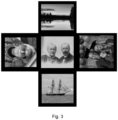
- the output surfaces may be labelled with a personal image, a drawing, an icon, a text, or combinations thereof, that represent the associated digital collection to facilitate use.
- the remote control is reconfigured such that the output surfaces are associated with new digital content, which may include changing the image displayed on the associated surfaces.
- the presently disclosed remote control is a highly dynamic device that may be reconfigured during the lifetime of the product.
- the remote control may be adapted to control many different devices such as TVs, tablets, electronic displays, sound systems, etc., whereas common remote controls are typically only capable of controlling one device or one system.
- a third advantage of the present disclosure is that the system may automatically generate new personalized presentations comprising a variety of digital content (e.g. images, videos, sounds, etc.) on a plurality of output devices.
- the presentations may be generated automatically using an artificial intelligence algorithm, which selects the content based on e.g. user preferences, user behaviour, uploads from the user, or combinations thereof.
- the present disclosure relates to a method for adapting the environment of an individual, such as a person diagnosed with dementia.
- the method described herein has a number of advantages over existing approaches for enhancing the well-being of persons with dementia.
- the method allows friends and relatives to the person to share personal digital collections, which may be formed either manually or automatically based on uploaded digital content from said relatives.
- the environment may be personalized based on content from the person's own life and relatives may continuously add new content to the system, such that new digital collections are easily formed.
- the system may then automatically generate presentations comprising content from said digital collections.
- the method utilizes a machine learning technique, which determines a quantifiable measure of the person's well-being based on real-time obtained data pertaining to the person. Accordingly, the environment may be continuously adapted in response to the person's well-being in order to maximize the well-being of the person.
- the remote control according to the first aspect may be used in connection with the method described in the second aspect.
- Digital content is understood as any content that exists in the form of digital data. Examples include video, audio, images, and/or combinations thereof. It can also include additional sensory input that can be generated based on digital data, such as vibrations, ambient lighting, olfactory stimuli etc. In the present context, the terms digital content and digital media are used interchangeably.
- the system in the present context refers to a system comprising the remote control according to the present disclosure and an electronic device configured for receiving commands from the remote control.
- the system may further comprise one or more output device(s) configured for displaying digital content.
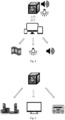
- the system may further comprise a database and a computer program (e.g. a computer application) for mobile devices to add content and/or configure the system. An example of such a system is shown in Fig. 6B .
- An output surface is to be understood as a surface of the remote control that is associated with a selection of digital content to be presented on an output device such as an electronic display, wherein said digital content can be selected by a user action, preferably by orienting the output surface in a predefined direction, e.g. upwards.
- the remote control comprises a plurality of surfaces, wherein a predefined subset of said surfaces are configured as output surfaces. Some of the surfaces of the remote control may be configured for other purposes than controlling/initiating digital content.
- the remote control may comprise a surface with a cover to access batteries or it may comprise a surface with a button.
- Such a surface (also referred to herein as a control surface) may be used to change the presentation e.g. by changing the sound volume, pausing playback, turning the device of etc.
- a static image is to be understood as a visual representation of the digital content associated with the output surface on which the static image is provided, wherein the visual representation does not change in time.
- the static image may comprise photograph(s), illustration(s), symbol(s), logo(s), text(s), and/or combinations thereof.
- the term 'static' means that the image does not change in time, i.e. as in the case of a video.
- the present disclosure relates to a remote control for wirelessly controlling digital content on one or more output devices. It further relates to a method for controlling, via said remote control, one or more output devices in the environment of a person.
- the remote control preferably constitutes a simple interface between a user and one or more output devices, such that it may be operated by elderly people and even mentally impaired persons, e.g. individuals suffering from dementia.
- the remote control allows controlling the playback of digital content on an output device such as a display, a TV, a sound system, or similar. It may further be able to control a range of systems such as lighting systems, temperature control systems, aroma systems, audio systems, AV systems, or other systems (see figure 4-5 ).
- an output device such as a display, a TV, a sound system, or similar. It may further be able to control a range of systems such as lighting systems, temperature control systems, aroma systems, audio systems, AV systems, or other systems (see figure 4-5 ).
- the remote control preferably comprises a plurality of flat polygonal surfaces such that the geometry of the remote control substantially resembles a polyhedron.
- Each output surface is preferably associated with a specific piece of digital content (or a collection of digital content), such that a user may select said content by placing the remote control with a specific output surface in a predefined direction.
- the geometry of the device should preferably allow the orientation of the remote control to remain stationary once a selection is made. This may be achieved from a variety of different geometries of the remote control. Some geometries allow the remote control to be placed on a flat surface and maintain the orientation by itself; other geometries may need a holder for keeping the orientation of the remote control stationary after the user leaves the remote control.
- the remote control may approximately resemble the shape of a platonic solid.
- the cube is an example of a platonic solid.
- the remote control comprises an even number of surfaces and a symmetry such that, when placed on a flat surface with one surface pointing down, an opposing surface is pointing straight up.
- the remote control may also comprise one or more curves surfaces, as an alternative to the group of polyhedrons.
- the remote control may approximately resemble the shape of a cylinder.
- the circumference of the cylinder may be divided into a plurality of arcs, wherein each arc may constitute an output surface by pointing said surface substantially in a predefined direction such as towards the user.
- the setup of the remote control may begin with a selection of digital content from a database repository or an upload of digital content to said database.
- the selection and/or upload may be performed using a software application running on a personal electronic device such as a smartphone.
- the software application may also be provided as a webpage, which allows the user to select digital content from a large variety of categories.
- the selection process may either be a direct selection of individual files or an indirect selection by answering questions about the habits and preferences of the user such as taste of music, profession and personal interests.
- the system comprising the database and the personal electronic device is able to suggest the most relevant digital media based on the answered questions. This may be achieved through the use of a computer-implemented algorithm that employs artificial intelligence (Al).
- the aforementioned software application preferably allows the upload of digital content directly from the personal device (e.g. from a smartphone) to a database, preferably a cloud-based database.
- the upload may be achieved using Wi-Fi or other network protocols.
- Said digital content may be personal content such as images, videos, recordings or preferred music.
- the content may comprise personal photos representing highlights of the person's life, which may be particularly relevant in case the person is diagnosed with dementia.
- Several people may preferably upload to the same user account, but all data transfer preferably involves access control and end-to-end encryption.
- the digital media may be sorted and assigned to different digital collections by the user.
- the data will preferably be stored in a secure (encrypted) cloud-based database.
- the remote control is preferably configured such that personal content may only be retrieved from the database in case it belongs to the user or owner of the remote control.
- the database may contain personal content from a large number of persons, however each remote control should only be able to access personal content uploaded by the owner of that specific remote control or people associated with the owner (e.g. relatives or close friends) along with generic digital content that is available to all users, either freely or through a payment.
- the remote control may initially not be able to control or retrieve any digital content from the database, since that content belongs to other users. Accordingly, the remote control may be configured to unlock secure content belonging to the user of the remote control.
- the remote control may be reconfigured at any time, either by uploading new content to the database paired with the remote control, or by assigning the surfaces of the remote control to other content present in the database.
- the database may be a remote server, a local server, or a cloud-based database. It is preferred that the database is a cloud-based database.
- the database may comprise generic digital content that is available to the user e.g. upon payment of an additional fee or through a user subscription. It may also comprise personal content that is only accessible to the owner of said content or the user who uploaded the content to the database.
- the generic data may comprise nature sounds, images, documentaries, wildlife footage, music, etc. Other types of generic data could also comprise news updates, exercise programs, sport updates, hobbies and special topics of interest to the user. This content may be accessible through licenses.
- the database may also contain audio files such as calming music or music designed to follow a daily rhythm.
- the digital content contained in the database may be used as part of the method described in the second aspect of the disclosure.
- the output surfaces of the remote control typically need to be associated with the digital content such that each output surface corresponds to a specific piece of digital content (or a collection of digital content).
- a digital collection may comprise a collection of images, a collection of videos, a collection of audio files, and/or combinations thereof.
- one output surface may be associated with a collection of childhood memories, a second output surface associated with a collection of images of the person's family members, a third output surface with a collection of highlights of the person's life, etc.
- each output surface is paired with a collection of the available and uploaded digital content in the database, such that it can be used to initiate the playback of said digital content on an output device (see Fig. 6A and 6B ).
- each output surface of the remote control is preferably associated with a specific piece of digital content (or a collection of digital content), such that each output surface of the remote control constitutes a possible selection.
- the exterior output surfaces of the remote control preferably comprises a piece of information that represents the particular collection associated with that output surface, such that the user is able to distinguish the different choices.
- the piece of representative information may be selected among the group of: texts, images, symbols, logos, or videos.
- each output surface may be provided with an image representing the digital playable content in order for the user to get a preview of the content (see figure 1 ).
- each of the output surfaces configured for controlling digital content is provided with static content constituting representative information, e.g. a static image.
- the static image may comprise any of the following: text(s), photograph(s), symbol(s), logo(s), and/or combinations thereof.
- the static images may be removably attached to the housing using a number of different techniques, such as by magnets, by a frame for holding the static images, or by use of hook-and-loop fasteners (e.g. Velcro).
- an electronic screen may be integrated in one or more of the output surfaces for displaying content representing a selection of the available digital content.
- each output surface may comprise an E ink screen or similar, which may be used to display an image, or a series of images, wherein the displayed image changes dynamically over time.
- the surfaces of the remote control are provided with static images (e.g.
- the remote control comprises means for inserting a printed image on each output surface of the housing of the remote control.
- Said means may be holders or slots for holding said printed images.
- each output surface comprises a frame arranged on the exterior surface of the housing or alternatively the frame constitutes the exterior surface of the housing.
- the frame is preferably configured for holding a plate and/or a printed image (i.e. a static image), such that the plate and/or the printed image is removably attached to the housing.
- a user may exchange the plate/image by sliding it in or out of the frame provided on the exterior of the housing.
- the user may exchange the plate/image by a snapping motion, i.e. by pressing the plate/image into the frame.
- the frame may preferably comprise transparent windows, such that an image placed in the frame is visible from outside the remote control. Such a frame is visible on figures 13-14 .
- the plate is preferably a transparent plate such that light from a light source embedded in the housing may be transmitted, wholly or partly, through the plate.
- the static image(s) may be provided directly on the plate (e.g. printed on the plate) or the plate may be used in combination with a printed image (e.g. printed on paper).
- the user may select and initiate the playback of digital content solely by orienting the remote control in a specific direction, i.e. without interacting with any buttons.
- the number of available choices for making a selection of the digital content corresponds to the number of output surfaces on the housing of the remote control.
- One of the surfaces may be configured for stopping and/or pausing the playing of the digital content.
- the remote control comprises six surfaces, wherein four of the surfaces are configured as output surfaces, one of the surfaces is configured for pausing the playback/presentation, and the last surface is configured for terminating the presentation, shutting the system off, or setting the system in a standby mode.
- the remote control comprises at least one sensor for registering the orientation and/or the rotation of the remote control.
- the remote control preferably immediately initiates the playback of the digital content associated with that particular output surface on a nearby output device, e.g. a monitor or television.
- the output device and/or the remote control issues a confirmation to the user relating to the choices or actions performed by the user.
- the confirmation can be light, sounds, vibrations, displayed images or messages on the output device or on the remote control.
- This confirmation facilitates usage of the device and enhances discoverability of the interface, which is particularly important for mentally impaired persons such as people diagnosed with dementia.
- a particular digital collection is selected for presentation (e.g. by turning a corresponding output surface upward)
- the action is confirmed by illumination of the chosen surface (e.g. by pulsing or flashing internal light sources, such as LED's, embedded in the remote control), by vibration of the controller, and emission of a selection sound.
- a sound or voice command may also be emitted from any of the output device, the remote control, and/or the electronic device, and a corresponding image of the remote control with the chosen collection image may be presented on the output device.
- the digital collections will typically be contained in the aforementioned database, e.g. a database separate from the remote control.
- the collections may comprise different types of digital media, and the system and/or the user may generate presentations comprising content from the collections.
- the system can automatically generate a presentation based on content from a digital collection selected by a user.
- the presentations may be played along with other digital content available in the database (e.g. ambient sounds, ambient lighting, scents, etc.).
- the system may create and play a presentation of images in combination with various music or sounds.
- Another example is a video being played while the lights are dimmed; both may be initiated from a single surface of the remote control, or by turning said surface in a specific direction.
- a digital collection may be created manually by a user, e.g. using a separate electronic device such as a smartphone, or it may be automatically created or suggested by the system, e.g. the electronic device linked to the database.
- the automatic creation may be based on different forms of input (e.g. answers to questions) from the user.
- Each collection may contain pictures, sounds, music, videos, and/or combinations thereof.
- a collection may contain pictures from the person's life, said pictures displaying key events, work celebrations, friends, places the person has lived, etc.
- Another collection may contain pictures and videos of the person's family members, e.g. wife, children, grandchildren, siblings, etc.
- Yet another collection may contain digital content representing the travels and journeys that the person has experienced during his/her life.
- Yet another collection may contain pictures, sounds, and/or videos from the person's favourite nature habitats and animals, e.g. forests, beaches, mountains, lakes, etc.
- the collections serve multiple purposes. One purpose is to share the presentation of personal content between family members, friends, and relatives, and the person owning the remote control. Another purpose is to enhance the well-being of people with dementia, since the collections enable them to relive their memories and to help them retain and remember their identity.
- the playback of a presentation comprising content from the digital collections may be initiated using the remote control.
- the digital collections may be manually named e.g. by relatives to the user. This may be done using a separate device e.g. via an application running on a smartphone linked to the system. Alternatively, the application may be pre-configured with suggested names for the digital collections.
- the user or relatives to the user may add content to the digital collections at a later point in time.
- the time at which the content is added and information about the origin of the content, e.g. the time and place of creation are preferably also stored in the database. This information may be used to improve presentations and/or improve previews of the material, e.g. by generating and/or displaying presentations comprising recently added content.
- the names and topics of the collections may be changed e.g. using an app.
- the application may be used to upload and/or capture images from the rooms of previous residences (e.g. to recreate colour matched surroundings).
- Other examples of digital content that may be uploaded include sounds from the previous residence of the person, images/videos of views from the windows, as well as recordings and videos of family life and music the person used to prefer.
- the uploaded digital content should preferably be stored in the database described previously.
- the remote control is preferably configured for detecting one or more actions performed by a user. Such actions may include rotating the device around different axes (clockwise or counter clockwise), moving the device along an axis, pushing the device, tapping a surface of the device, shaking the device, flipping the device, holding the device, covering one or more surfaces of the device with a hand, and/or combinations thereof. This may be achieved by integrating a sensor system in the remote control, said sensor system comprising at least one sensor for detecting one or more of said actions.
- the sensor system may comprise any of the following: tilt sensors, accelerometers, gyroscopes, magnetometers, light sensors, temperature sensors, microphones, cameras or combinations thereof, such as an accelerometer and a gyroscope, or an accelerometer and a tilt sensor, or an accelerometer and a magnetometer, or the combination of an accelerometer, a gyroscope, and a light sensor.
- the actions should be associated with one or more commands or instructions.
- the remote control may be able to detect the duration of a tap or the number of taps, such that these actions may be associated with different commands.
- a command may also constitute several actions performed in succession and combinations of actions.
- the remote control may be rotated 90° or 180° such that a new output surface points upwards, and the digital collection associated with that output surface automatically starts playing on an output device such as a tablet or a TV. Rotating the remote control such that another output surface points upwards may initiate the playing of another digital collection. Rotating the remote control yet again such that it is returned to the original position may replay the previous digital collection or alternatively generate a new and possibly longer digital media file, which is automatically generated and played immediately.
- Rotating the remote control clockwise with the same output surface upwards may be used to increase the sound level, and a counter-clockwise rotation may lower the sound level.
- Covering the currently active surface (e.g. the output surface pointing upward) with a hand, may interrupt or pause an ongoing presentation. Alternatively, another surface may be used to pause the presentation.
- one of the surfaces is recessed in the housing, wherein a button may be placed in the recessed surface.
- the presentation of the digital content may be paused by orienting the recessed surface in a predefined direction such as upwards.
- the remote control may comprise a button on one of the surfaces; preferably, the button is placed in a recessed surface in the housing.
- said surface is preferably configured such that the remote control may be placed with recessed surface facing downwards e.g. against a table, however without the button contacting the table.
- the button may comprise a knob and/or a push-button.
- the button is a combination of a knob and a push-button, such that the button may be turned, e.g. to increase the volume, and the button may be pushed, e.g. in order for a user to grade the digital content by pressing the button.
- the turning of the button may additionally/alternatively be configured to allow the user to scroll through a series of images/videos in order to select a particular image/video.
- the output device preferably provides feedback indicating the transmitted command, e.g. it may indicate that the volume is increased, if a user turns the button on the remote control, or it may show an intended selection in e.g. the bottom of the screen.
- the push-button may resemble a heart as depicted in Fig.
- the button is configured to indicate a 'like' of a certain image or video forming part of a digital collection being presented.
- the grading of the digital content i.e. whether a person likes the content or not
- the push-button may be configured to identify a double press and/or a long press, or combinations thereof.
- the output device e.g. a monitor, tablet, television, or similar
- the output device immediately shows the transmitted command on a screen of the output device.
- the output device may display a range of different icons, each icon associated with a particular command, e.g.
- the output device may further display a plurality of smaller pictures resembling the image(s) preceding/succeeding the currently displayed image.
- the aforementioned button may be used to select an image among the plurality of smaller pictures.
- the button may be configured such that it has different functionality depending on which surface of the remote control is oriented in the predefined direction (e.g. upwards). As an example, if an output surface is oriented upwards and a presentation of digital content is running, the button may be used to change the volume of the presentation. If the surface comprising the button is oriented upwards, the same button may be used in this case to change among the images in the (now paused) presentation.
- Additional action/gestures may be implemented and controlled e.g. in a settings menu accessed by caregivers or relatives when they set up the system or adjust the system to the preferences of the user.
- a settings menu may be part of an application running on an external remote device such as a smartphone, wherein said device may communicate with the system comprising the database, the remote control, and the electronic processing device and/or the output devices.
- the remote control may provide feedback to the user in order to confirm that a given action has been registered by the device.
- the feedback may comprise vibration of the remote control, flashing lights, illumination of one or more surfaces of the remote control, change of colours, sounds, etc.
- the remote control may comprise electronic displays that may change brightness level, emitted colour, or similar, in response to a given action or handling of the device.
- the system may also comprise light sources that similar to the electronic displays may change in brightness or colour.
- the system may employ different feedback (e.g. illumination or emitted sound) to indicate initiated action or completed action, as well as the success or failure of the completed action.
- the remote control may display a dim steady light when the controller is handled by a user followed by a stronger pulsed light once a selection of a particular collection is registered. It may also play a sound to indicate a successful selection of a collection, and a different sound to indicate an unresolved selection where the user input was ambiguous, e.g. in case the remote control is oriented such that it is unclear, which output surface is intended for selection by the user.
- the remote control preferably further comprises a communication unit for wirelessly communicating with one or more output devices either directly or via an electronic device (described below).
- the communication unit may communicate using any suitable existing information technology, e.g. infrared transmission, Bluetooth, Bluetooth Low Energy (BLE), Ultra Wideband (UWB), Wi-Fi, IEEE 802.11ah (Wi-Fi HaLow), GSM, 4G, 5G, or other similar technologies.
- the remote control is configured for BLE communication with the electronic device.
- the system may further comprise an electronic device, which preferably constitutes both a processing unit and a communication link between the remote control, a database containing stored digital content, and the one or more output devices (see figure 6B ).
- a single electronic device may be configured to receive input from more than one remote control.
- a user may have one remote control setup to select digital content comprising family photos and another remote control setup to select digital content relating to various favourite music of the user.
- the last action and the identity of the controller where the action was performed determine the outcome, e.g. which presentation is being played.
- the electronic device may be integrated in said one or more output devices, or it may be a separate computing device such as a tablet, a smartphone, a computer, similar computing devices. It may also be integrated in the remote control itself.
- An example of a suitable electronic device is a computing device, which is configured to access curated and encrypted digital media files belonging to a particular user from a cloud-based database.
- the electronic device may be configured for decrypting data received from a database, said database storing the digital content (such as images) in encrypted form.
- the electronic device should be further configured for displaying the digital media on a connected monitor and/or playing associated sounds e.g. using built-in speakers, when receiving appropriate input from the remote control.
- the electronic device may further be configured for rendering visual images and/or movies on a connected monitor using e.g. Chromecast or Apple TV, or a wired connection.
- the electronic device may also comprise an interface for connecting to said monitor, e.g. via HDMI.
- the electronic device is configured for wireless communication with the remote control, e.g. via Bluetooth or Bluetooth low energy (BLE).
- the electronic device is further configured for wireless communication with a cloud-based database, e.g. via a cellular network such as 4G.
- a cloud-based database e.g. via a cellular network such as 4G.
- 4G cellular network
- the electronic device is configured for creating a presentation comprising one or more images based on the digital content.
- An example of an electronic device configured for this purpose is a computing device comprising an integrated BLE module and an interface configured to connect a 4G USB-modem.
- the electronic device further comprises an interface for connecting an electronic display/monitor, e.g. a High-Definition Multimedia Interface (HDMI), DisplayPort (DP), Digital Visual Interface (DVI), or other types of digital display interfaces.
- an electronic display/monitor e.g. a High-Definition Multimedia Interface (HDMI), DisplayPort (DP), Digital Visual Interface (DVI), or other types of digital display interfaces.
- the electronic device may be configured to connect to a monitor, a TV or similar, and it may be configured to render images and/or video to be presented on said monitor and/or TV.
- An example of such a system as described above is shown in Fig. 6B .
- the electronic device is configured such that any received command from the remote control will initiate the associated action on the output device, even in the event that the output device was used for something else, when the command was issued.
- the output device is a television
- the television may already be displaying a TV channel
- the command from the presently disclosed remote control should preferably overrule any content currently being displayed on the output device.
- This functionality may be realised by a protocol such as the consumer electronics control (CEC) protocol that ensures that HDMI units will be prioritized / take over the transmission.
- CEC consumer electronics control
- the electronic device may be embedded in a housing.
- the electronic device including the surrounding housing may be configured to snap on to a monitor to provide a user-friendly set-up or it may be provided as a separate unit.
- the electronic device preferably comprises a memory device, or it comprises an interface for connecting a memory device.
- the memory device is preferably a non-volatile memory.
- the electronic device is configured to retrieve digital content from the cloud-based database upon instructions from the remote control.
- the electronic device may comprise a modem for connecting to a cellular network such as 4G.
- the electronic device may be configured to download digital content from the database and store it locally on a storage medium connected to the electronic device.
- the electronic device may be connected to a camera, such as a webcam, said camera preferably being embedded in the housing of the electronic device.
- the housing preferably comprises an opening such that the lens of the camera is visible from the outside of the housing.
- the housing of the electronic device may further comprise a button connected to the electronic device, said button being accessible from the outside of the housing.
- the button may be configured for a variety of purposes. As an example, a user may record and/or send a message by pressing the button. The message should preferably be received by relatives of the user, said relatives using the software application associated with the remote control as explained in more detail elsewhere in the application.
- Relatives may also use the software application to record or type message(s) and send the message(s) from the mobile device running the software application to the electronic device connected to the remote control.
- the button may also be configured such that a user can select a recipient of the message by holding the button (e.g. for a few seconds) and subsequently turning the button to select the recipient.
- the processing unit will typically monitor and receive command(s) transmitted by the remote control, e.g. a command denoting a change in orientation. Based on the command, the processing unit may then retrieve the relevant digital content (e.g. images, sounds and/or other effects) from the database repository, such that the data is stored locally on the processing unit. Subsequently, and preferably immediately, it will display the requested digital content on a display or send instructions to separate display unit(s).
- the display may be an integral part of the electronic device (e.g. as is the case of a tablet, cf. Fig. 6A ), or it may be a separate display such as a TV screen, a monitor, or similar (cf. Fig. 6B ).
- the displayed content will preferably be a presentation comprising a selection of digital content from the chosen digital collection.
- the presentation may comprise a variety of content (e.g. images, sounds, music, video) and effects (e.g. transitions, animations, panning, zooming), and combine different content with different effects.
- the duration and composition of the presentation including the length of the different segments, transitions and complexity may be controlled and adapted by the processing units based on the habits and interaction of the user with the controller.
- the electronic device may be configured to execute a computer-implemented algorithm based on artificial intelligence.
- the computer program may be stored locally on the electronic device or on a remote server such as the database, e.g. a cloud-based database.
- the handling and/or usage of the remote control may be analysed using pattern recognition and/or artificial intelligence.
- the cloud-based database may further store usage of the remote control from many users, e.g. the times and duration that each remote control was used, in order to collect statistics relating to usage.
- the AI algorithm may select digital media from the database in order to compose a combined digital collection or presentation comprising images, animated images, video clips, appropriate transitions and backgrounds, and/or music/sounds.
- the duration of the presentation may initially be short (e.g. 2 to 3 minutes) and it may only comprise a subset of the digital data in the collection.
- the presentation When the presentation has finished, it will preferably stop and nothing is displayed until a new collection is chosen (or the same collection chosen again). In the default mode the material comprising the presentation may change every time a particular collection is chosen by the remote control.
- the electronic device is preferably configured for adjusting the transition frequency depending on the complexity of the individual elements in the image(s). This may be achieved using machine learning that is able to characterize the images based on the specific elements in the images, e.g. based on the presence of human beings in the images. Similarly, it is desirable to identify the number and position of faces in the image, so that particular animation effects can be selected in order to focus on the people in the image. Finally, it is important to understand the elements/content of the image(s) to provide appropriate ambient sound to enhance the experience (e.g. bird song to images with trees from a forest, sounds of waves and seagulls to sailing images etc.)
- the duration and pacing may also be adapted to the mental condition of the user, the progression of the illness, as well as individual preferences and habits. These parameters may change over time as the disease progress. In case the same collection is chosen repeatedly/frequently, the duration of subsequent presentations in this category will preferably be extended.
- the system will preferably keep track of which collections are being watched, when, and for how long. This may be achieved by the electronic device that received the commands from the remote control.
- the digital collections may be rated according to user preferences.
- the ratings may be conducted by an AI algorithm that connects specific patterns of usage with user preference. As an example, digital collections that are chosen more frequently may be interpreted as "preferred" and thus receive a higher rating. Presentations that are being watched to the end might similarly receive a higher rating, as might all the individual components of the presentation (images, sounds, videos, which were shown as part of the presentation). Conversely, abandoning or exiting presentations may result in a lower rating of the interrupted presentation and/or material. The digital content that was shown at the exact moment of interruption may be given the lowest rating compared to other digital content in the same presentation. In case the user pauses and subsequently resumes the presentation of a digital collection, the specific content (e.g.
- the remote control may also comprise a button configured to directly rate the digital content forming part of a digital collection.
- the remote control comprises a button positioned in a recessed surface. When a user presses the button, the currently presented content (e.g. image or video) is being labelled with a 'like'.
- the label may be transmitted from the remote control to the electronic device, and further to the database, where it may be stored.
- the 'like' may appear as a notification in the software application running on a mobile device belonging to the person who uploaded the digital content, i.e. the label may be transmitted from the remote control to the mobile device via the electronic device and the database.
- the ratings of the presentations may be used to curate the digital collection, i.e. sort the digital content in said collection according to apparent user preference.
- the AI system may use the ratings to display digital content of higher ratings.
- the playback of the digital content may be initiated autonomously by the electronic device. This might be the case, when the system is used to enhance the well-being of e.g. an elderly person or a person with dementia. As an example, the system may initiate the playback of a presentation after a long period of inactivity during the daytime. It may also be used to calm a user that appear agitated.
- the level of activity may be monitored by a sensing system comprising at least one sensor in the room (e.g.
- the level of activity may be correlated with the number of commands received by the electronic device.
- the ratings may be used together with general settings and preferences, activity pattern, habits, time of day etc., to select material with the highest possible chance of having the desired effect, e.g. to increase the well-being of a user with dementia.
- the general usage patterns may be used diagnostically to provide information about disease progression and/or current personal status.
- the usage pattern may be obtained by monitoring and analysing the user's interaction with the remote control. Said analysis may provide valuable information such as the current condition of the user, the diagnosis and disease progression, and/or the immediate interest in the presentations being displayed.
- the information may be combined with information obtained by other means e.g. through sensors placed in the room of the user or sensors worn by the user.
- the sensors may include sensors for sensing/registering movement, position, sound, light, heart rate, respiratory rate, etc.
- the additional information may further contribute to establish an insight into the user's well-being or the user's state of mind.
- Metrics on the usage of the system may be stored in a database and/or presented visually on e.g. an application linked to the system. This will provide friends and relatives to the user with statistics on the highest rated content etc., which may further motivate them to repeatedly upload new material to the database.
- the remote control may come in various shapes and sizes to accommodate the needs of different users. As an example, elderly people that are mentally well might want a remote control with more than six surfaces (e.g. a dodecahedron), in order to have immediate access to and control with more digital collections.
- the remote control might also be set up to recognise many actions or more advanced user input. They may also want settings that prioritize new material, special categories for particular topics, and/or longer presentations with a faster pace.
- people with dementia may want a simpler system and interface, but still with autonomy that allow them to select when and which presentation they want to display. They may also want to share these presentations with visiting relatives and possibly neighbours and nursing staff at the nursing home.
- the remote control preferably has a size such that it is easily operated using only a single hand. It should be large enough that the information on each surface (e.g. an image) is clearly readable and distinguishable from the information on the other surfaces. The size of the remote control should also not be so small that it easily becomes missing, e.g. in the pockets of the owner.
- the length of each edge of the remote control may preferably be approximately between 5 cm to 12 cm, or 6 cm to 10 cm, or 7 cm to 9 cm. Other embodiments of the remote control may have different dimensions depending on the intended usage. As an example, the remote control may be smaller in case it needs to be carried to other places such as when visiting relatives, or it may be larger e.g. for sharing an experience with many participants.
- the remote control may comprise additional features to further enhance the user experience. As previously mentioned, it may comprise electronic screens to display either static or dynamic images, or even videos such as previews. Since electronic screens generally use a significant amount of power compared to the power typically available from batteries that are able to fit inside the remote control, the remote control may comprise means for wireless charging, e.g. inductive charging. An example of a system capable of wireless charging is the Qi wireless charging pad. Alternatively, the remote control may comprise E Ink (“electronic ink”) displays, since they generally consume less power than traditional displays. The E Ink displays would be suitable to display static images that might change occasionally.
- E Ink electronic ink
- the remote control may also comprise a receiver for identifying nearby broadcasting device(s) and/or personal tag(s) (e.g. transmitters such as beacons) carried by other users.
- Said broadcasting may be based on Bluetooth, Bluetooth Low Energy (BLE), Wi-Fi, or similar.
- BLE Bluetooth Low Energy
- Wi-Fi Wireless Fidelity
- the remote control preferably changes the images and/or previews on electronic screens on the output surfaces of the device, such that the images correspond to the user currently holding the remote control, or in close proximity to the remote control.
- the digital content associated with the output surfaces of the remote control may comprise personal content uniquely paired between the remote control and a personal tag such as an iBeacon or similar.
- the remote control comprises at least one electronic display integrated in at least one of the surfaces of the remote control, wherein said display is configured for displaying one or more images representing a selection of digital content or a piece of digital content.
- the images displayed on the display is preferably associated with a personal electronic tag, wherein the images automatically change in response to identifying a new nearby tag.
- a personal tag may also be used to unlock a particular digital collection to ensure that content from this collection is only shown when the user is near the remote control. Absence of the tag will prevent other persons from displaying digital content belonging to the locked collections.
- the remote control may comprise one or more features that protects the controller.
- the edges of the remote control may be covered with a rim configured as a shock absorber. This is advantageous in case the remote control is dropped.
- the rim may be detachable and may constitute a single piece.
- the rim is preferably made from a flexible material.
- the rim may in some embodiments be configured such that it can be mounted on the remote control without the use of tools.
- the rim may comprise an elastic material such as an elastomer (e.g. natural rubber, synthetic rubber, nitrile rubber, silicone rubber, urethane rubber, chloroprene rubber, Ethylene Vinyl Acetate (EVA rubber), etc.).
- the remote control may also feature an additional housing for waterproofing the device. Alternatively, the housing of the remote control may be waterproof in itself.
- the housing may also feature means (e.g. a cover plate) for covering and/or accessing batteries in the remote control.
- the remote control may employ elements of nudging to lightly encourage the user to use the remote control.
- Said elements may comprise flashing or pulsing lights, sounds, spoken messages, vibrations, or other effects.
- the remote control may comprise light sources e.g. light-emitting diodes (LEDs), speakers, a buzzer or haptic devices.
- the remote control comprises at least one light source for each output surface, such that each output surface may be illuminated individually. Such an embodiment is shown in Fig. 16 .
- an output surface may illuminate or flash in case a user has uploaded new content to a digital collection associated with said output surface.
- the upload of new content is preferably performed using the software application on a mobile device, wherein said software application is configured for wireless communication with the cloud-based database as previously described (cf. Fig. 6B ).
- the light sources may be placed in the interior of the remote control, on the outside surfaces of the remote control, along the edges of the remote control, and/or combinations thereof.
- the remote control comprises one or more electronic screens on the surfaces, said screens may be used to display previews or trailers for available presentations in the system.
- the system may autonomously initiate the playback of such previews after a certain period of time or a certain period of inactivity from the user.
- the system may store an action in order to improve the automated behaviour (nudging) using e.g. machine learning.
- the electronic device may transmit instructions to the remote control, such as instructions for illuminating different output surfaces using one or more internal light sources, instructions for the remote control to vibrate, and/or instructions for the remote control to play a sound (see Fig. 4 ). These instructions should preferably be executed immediately by the remote control in order to encourage the user to pick up and/or handle the remote control (i.e. nudging).
- the controller may suggest interaction after long periods of inactivity (in cases where stimulation is considered beneficial) e.g. by emitting a pulsed light from the controller or by playing sounds or music.
- the system may provide the user with one or more signals to indicate availability of new material belonging to a corresponding collection. Said signals may comprise illumination of a particular surface or the playback of a sound (e.g. a recorded message).
- the present disclosure relates to a remote control comprising a housing comprising a plurality of surfaces, at least one sensor for detecting the orientation of the housing, movements of the housing, and/or combinations thereof, at least one communication unit for wirelessly communicating with an electronic device and/or one or more output devices, wherein the remote control is configured such that a predefined movement and/or orientation of the remote control is associated with a predefined command transmitted via the communication unit, and wherein a plurality of the surfaces are configured for controlling digital content on said one or more output devices, such that each of said surfaces is associated with a predefined selection of digital content on said output device(s).
- the remote control comprises a housing comprising a plurality of surfaces, wherein a subset of said surfaces are configured as output surfaces for controlling digital content on one or more output devices, each of said output surfaces being associated with a predefined selection of digital content on said one or more output devices; at least one sensor for detecting the orientation of the remote control, movements of the remote control, and/or combinations thereof; at least one processing unit embedded in the housing, said processing unit configured for processing data from the sensor; at least one communication unit embedded in the housing, said communication unit configured for wirelessly communicating with an electronic device and/or one or more output devices, wherein the remote control is configured such that a predefined movement and/or orientation of the remote control is associated with a predefined command transmitted via the communication unit.
- the present disclosure further relates to a system configured for controlling digital content on an output device, said system comprising: the remote control as described herein, an electronic device comprising a communication module configured for wireless communication with the remote control via the communication unit of the remote control; a first interface configured to connect the output device to the electronic device; and an output device for displaying the digital content, wherein said output device is connected to the electronic device via the first interface.
- the system may further comprise a software application executable on a remote device such as a mobile phone, the software application configured for executing the steps of: uploading by a user digital content to a remote server such as a cloud-based database; and/or selecting by a user digital content available on said remote server; creating by a user a collection of digital content comprising the uploaded content and/or the selected content.
- a remote device such as a mobile phone
- the software application configured for executing the steps of: uploading by a user digital content to a remote server such as a cloud-based database; and/or selecting by a user digital content available on said remote server; creating by a user a collection of digital content comprising the uploaded content and/or the selected content.
- the present disclosure further relates to a remote device, such as a tablet, laptop, computer, or smartphone, said remote device comprising a processor and a memory and being configured to run a software application for providing user upload of digital content to a cloud-based database, wherein said content may be retrieved and stored by an electronic device connected to a monitor in order to display the digital content.
- the user upload of content may also be achieved using a web-application.
- the present disclosure further relates to a method of displaying digital content on one or more output devices, said method comprising the steps of: selecting by a user the digital content by orienting one of the output surfaces of the remote control according to the present disclosure in a predefined direction such as upwards; identifying by the remote control the selected output surface and the digital content associated with said output surface; transmitting via the remote control, instructions for initiating the selected digital content on one or more output devices, said instructions being transmitted to an electronic device; receiving and interpreting said instructions by the electronic device; and displaying the digital content on the one or more output devices.
- the remote control resembles approximately the shape of a cube (see figures 12-14 ).
- the cube comprises six rectangular surfaces, wherein four surfaces are configured as output surfaces, each output surface being associated with a digital collection comprising a variety of digital content stored in a database or in a memory device (preferably a non-volatile memory) in the electronic device described herein.
- the digital collection may be selected by placing the remote control such that the output surface associated with said collection points in a predefined direction, preferably upwards.
- the length of each edge of the cube may preferably be approximately between 5 cm to 12 cm, or 6 cm to 10 cm, or 7 cm to 9 cm.
- the edges of the cube are approximately 9 cm such that the dimension of the cube is approximately 9 cm x 9 cm x 9 cm.
- one of the surfaces is configured as a "standby surface", which stops any currently running digital content and sets the system in a standby mode.
- This particular surface may comprise a standby symbol (IEC 60417-5009) as seen in figure 2 , or it may simply comprise a battery cover for accessing batteries in the remote control.
- the digital content can be discontinued by orienting said standby surface in a predefined direction, preferably upwards.
- the digital content comprises personal content (such as personal photos, videos, or music), which may be uploaded by a user to the database and later accessed upon request.
- the present disclosure relates to a method for adapting the environment of an individual, in particular relating to a person diagnosed with dementia.
- the presently disclosed method for adapting the environment of a person begins by obtaining data relating to the person situated in the environment.
- the data will typically be personal data and may comprise health-related data, biosignals from the person, data related to the behaviour of the person, or combinations thereof.
- the data of the person may comprise information relating to: heart rate, respiratory rate, movements, galvanic skin response, electrical function of the heart (e.g. via electrocardiography, ECG), electrical activity produced by skeletal muscles (via electromyography, EMG), facial expression, eye tracking, housing posture, position, sounds of the person, or combinations thereof.
- the method may employ a number of sensors suitable for obtaining and/or tracking the above-mentioned data.
- the data may be obtained in real-time using a sensor system comprising at least one wearable sensor and/or at least one room sensor.
- wearable sensors include commercially available fitness trackers, health tags, smart watches, skin-mounted patches, bracelets, or combinations thereof.
- room sensors include motion detectors, optical sensors, ultrasonic sensors, photodetectors, light sensors, infrared sensors, cameras, microphones, sound sensors, or combinations thereof.
- the sensor system may comprise any combination of the aforementioned examples of sensors.
- the sensor system is a non-intrusive sensor-system comprising a wearable sensor worn by the person (e.g.
- the wearable sensor may comprise an accelerometer, a gyroscope, a magnetometer, a heart rate monitor, a respiratory rate sensor, an optical sensor, a sweat sensor, and/or combinations thereof.
- the wearable sensor is preferably capable of transmitting data in real-time. Said transmission may be achieved using e.g. Bluetooth, Bluetooth Low Energy (BLE), Wi-Fi, 4G, 5G, or GSM.
- the wearable sensor is a health tag (e.g.
- the Spire Health Tag comprising a battery, a 3-axis accelerometer, an optical PPG (photoplethysmogram) sensor, a respiratory force sensor, a BLE transmission unit, and a feedback mechanism.
- the wearable sensor is configured for transmitting data in real-time via Bluetooth.
- the next step of the method is data analysis.
- the data analysis is preferably performed by a computer-implemented algorithm utilizing machine learning or other artificial intelligence (Al) approaches.
- One purpose of the machine learning is to establish a measure of the person's well-being based on the obtained data. This may be done by correlating information from a plurality of sensors. By comparing e.g. the temporal changes in parameters such as heart rate to motion sensor signals, it will be possible to determine whether changes in the former is caused by the latter. Normal movement will typically increase the heart rate and the skin conductivity. However, in case of anxiety and/or aggression of the person, the heart rate and skin conductivity may increase prior to any increase in movement.
- the sensor system described above provides input to a machine learning algorithm, e.g.
- a neural network which analyses the data and calculates one or more parameters describing the well-being of the person. Accordingly, a lot of information contained in the real-time data is condensed into a few quantifiable measures relating to the person's well-being.
- the measures may comprise estimates of satisfaction/content, activity level, agitation level, and whether the person is preoccupied with other activities or interacting with other persons (e.g. visitors, friends or a caregiver).
- the next step of the method is for the computer-implemented algorithm to determine one or more suitable changes in the environment of the person in order to enhance the well-being of said person.
- the suitable changes will preferably depend on the time of day/night and normal schedules for activities like meals, rest and sleeping periods (e.g. calming at night and possibly activating after long periods of inactivity in the daytime).
- the environment is optimized in this step for the purpose of increasing the well-being.
- the alterations of the environment should preferably stimulate the person, e.g. for calming the person, and may include changing any of the following: brightness and/or colour of lights, images/videos on displays, projected images, sound (e.g. music, ambient sound or voice messages) from speakers, scents, or combinations thereof.
- Some of the changes may be automatically initiated as a result of the assessment of the person's well-being, or at specific times during the daily cycle, or at specific predefines times e.g. scheduled events (bedtime, dinner, visits, excursions, etc.).
- the lighting of the environment may reflect the circadian cycle or a diurnal cycle. For instance, the lights may be warm in the morning to imitate a rising sun and dimmed in the evening to imitate a sunset.
- the changing lights may be accompanied by changes in projected images and/or sounds in the environment, e.g. the sounds of chirping birds, waves, or other pleasant sounds.
- the environment may comprise a number of electronic devices or systems that may be operated as part of the presently disclosed method.
- the environment should preferably be a personalized environment, which is of particular importance in case of a dementia patient.
- the environment may be a room in a nursing home or an assisted living facility, which have been altered to create a more personalized environment. It may also be a stimulation room, a sensory room, or a controlled multisensory environment.
- the presently disclosed method allows for such a room/environment to be dynamically and automatically adapted in response to real-time data of a person situated in the room/environment.
- the environment may be customized/changed using personal digital content stored in a database.
- Family members and friends may preferably have permission to upload personal content to said database.
- the data may comprise generic data, nature sounds, images, video, calming music, music designed to follow the daily rhythm, and more.
- the data may also relate to a particular time-period and/or places that are relevant to the life of the person. Examples include music from the person's youth, images and video from nearby locations, and/or images and videos depicting objects from their youth. It may also include voice and video recordings of relatives from family gatherings, personal videos from vacations, nature experiences, images, sound and videos of rooms and objects from previous residences.
- the data may be used directly or used to determine primary colours in preferred rooms to recreate a familiar colour scheme.
- the data may further include images/videos of a view from a favourite window preferably showing diurnal changes on different days. This data can be used to create an artificial window.
- the data may also include sounds from the previous residence, faint traffic noise, clock ticking, sounds from the garden, birds, wind in the trees, raindrops on windows, etc.
- the next step of the method is to implement the changes in the environment. This may be done automatically by transmitting instructions to the relevant electronic devices, or it may be done manually e.g. based on suggestions from the system.
- the instructions may be any combination of instructions to a number of different devices, or it may be a single instruction. Examples of instructions include: initiate the playback of music or sound on speakers placed in the environment, pull back the curtains from the windows (may be done electrically), release a certain fragrance, initiate the playback of a digital collection comprising photos or videos, or combinations thereof. Examples of digital collections are given in a previous section.
- the instructions may also be transmitted to the devices via the remote control described in the first aspect.
- the method may be repeated. It may also run continuously for a given period of time, wherein the person is constantly monitored and the machine learning algorithm is provided with input comprising real-time data of the person (e.g. providing feedback on the response of the person to said changes in the environment). Hence, the steps of the method may be repeated any number of times until an optimized environment is reached or the system is shut down manually.
- the present disclosure relates to a method for adapting the environment of a person, the method comprising the steps of obtaining data of the person situated in the environment, analysing said data using a machine learning algorithm in order to assess the well-being of the person, wherein said assessment is based on a set of quantifiable measures extracted from the data, determining on the basis of said quantifiable measures a suitable change in the environment in order to enhance the well-being of the person, changing one or more elements within the environment, optionally repeating any of the above steps until the well-being of the person is maximized as a result of the adapted environment.
- the data may preferably be obtained using a non-intrusive sensor-system comprising at least one wearable sensor worn by the person and at least one room sensor located in the environment.
Landscapes
- Engineering & Computer Science (AREA)
- Human Computer Interaction (AREA)
- General Engineering & Computer Science (AREA)
- Theoretical Computer Science (AREA)
- Multimedia (AREA)
- Signal Processing (AREA)
- Physics & Mathematics (AREA)
- General Physics & Mathematics (AREA)
- Computer Graphics (AREA)
- Computer Networks & Wireless Communication (AREA)
- Selective Calling Equipment (AREA)
Claims (15)
- Commande à distance (1) comprenant :- un boîtier comprenant une pluralité de surfaces, dans lequel un sous-ensemble desdites surfaces est configuré en tant que surfaces de sortie pour commander un contenu numérique sur un ou plusieurs dispositifs de sortie (3), chacune desdites surfaces de sortie étant associée à une sélection prédéfinie de contenu numérique sur ledit ou lesdits dispositifs de sortie (3) ;- une ou plusieurs images statiques représentant une sélection du contenu numérique associé à la surface de sortie sur laquelle il est fourni ;- au moins un capteur pour détecter l'orientation de la commande à distance (1), les mouvements de la commande à distance (1) et/ou leurs combinaisons ;- au moins une unité de traitement intégrée dans le boîtier, ladite unité de traitement étant configurée pour traiter des données du capteur ; et- au moins une unité de communication intégrée dans le boîtier, ladite unité de communication étant configurée pour une communication sans fil avec un dispositif électronique (2) et/ou un ou plusieurs dispositifs de sortie (3),dans lequel la commande à distance (1) est configurée de sorte qu'un mouvement et/ou une orientation prédéfinis de la commande à distance (1) sont associés à une commande prédéfinie transmise via l'unité de communication,dans lequel la commande à distance (1) est en outre configurée pour initier, lors de l'orientation de l'une des surfaces de sortie dans une direction prédéfinie, une lecture du contenu numérique associé à l'image de la surface de sortie sur les dispositifs de sortie (3),dans lequel les une ou plusieurs images statiques sont fixées de manière amovible à chacune des une ou plusieurs surfaces de sortie du boîtier, dans lequel les images statiques sont fixées à l'aide de l'un quelconque des éléments suivants : des aimants, des attaches auto-agrippantes, ou par un cadre prévu sur le boîtier etdans lequel la commande à distance (1) est en outre reconfigurable de sorte que les surfaces de sortie peuvent être associées à un nouveau contenu numérique.
- Commande à distance (1) selon la revendication 1, dans laquelle une ou plusieurs des images statiques sont fournies sur une plaque ou un papier ou dans laquelle une ou plusieurs des images statiques sont fournies sur une plaque transparente ou semi-transparente.
- Commande à distance (1) selon l'une quelconque des revendications précédentes, dans laquelle une ou plusieurs sources de lumière (9) sont intégrées dans le boîtier, lesdites sources lumineuses (9) étant configurées pour, lors de l'utilisation, transmettre de la lumière à travers une ou plusieurs des surfaces de sortie, dans laquelle les sources de lumière sont configurées pour éclairer une ou plusieurs des images statiques.
- Commande à distance (1) selon l'une quelconque des revendications précédentes, dans laquelle le boîtier comprend un cadre agencé sur une ou plusieurs desdites surfaces de sortie, le cadre étant configuré pour recevoir les images statiques, de sorte que les images statiques peuvent être fixées de façon amovible au boîtier.
- Commande à distance (1) selon la revendication 4, dans laquelle le cadre est configuré pour recevoir les images statiques soit par un mouvement de glissement dans laquelle les images statiques sont glissées dans le cadre, soit par un mouvement d'encliquetage dans laquelle les images statiques sont pressées dans le cadre.
- Commande à distance (1) selon l'une quelconque des revendications précédentes, dans laquelle au moins l'une des surfaces est évidée dans le boîtier.
- Commande à distance (1) selon la revendication 6, dans laquelle la commande à distance (1) est configurée pour suspendre une présentation en cours sur le dispositif de sortie (3), dans le cas où la surface évidée est orientée dans une direction prédéfinie.
- Commande à distance (1) selon l'une quelconque des revendications 6 à 7, dans laquelle la commande à distance (1) comprend un bouton (7) fixé dans la surface évidée.
- Commande à distance (1) selon la revendication 8, dans laquelle le bouton comprend un bouton (7) et/ou un bouton-poussoir (7).
- Commande à distance (1) selon l'une quelconque des revendications 8 à 9, dans laquelle un utilisateur actionnant la commande à distance (1) peut classer le contenu numérique en appuyant sur le bouton (7).
- Commande à distance (1) selon l'une quelconque des revendications précédentes, dans laquelle au moins l'une des surfaces de la commande à distance (1) est configurée pour, lors de l'utilisation, mettre le dispositif de sortie (3) en mode veille ou l'éteindre, lorsque ladite surface est orientée dans une direction prédéfinie.
- Commande à distance (1) selon l'une quelconque des revendications précédentes, dans laquelle la commande à distance (1) est configurée pour commander les un ou plusieurs dispositifs de sortie (3) via un dispositif électronique (2), dans lequel ledit dispositif électronique (2) est un dispositif informatique tel qu'un ordinateur, une tablette ou un smartphone.
- Système configuré pour commander un contenu numérique sur un dispositif de sortie (3), ledit système comprenant :a) une commande à distance (1) selon l'une quelconque des revendications 1 à 12 ; etb) un dispositif électronique (2) comprenant :- un module de communication configuré pour une communication sans fil avec la commande à distance (1) via l'unité de communication de la commande à distance (1) ; et- une ou des premières interfaces configurées pour connecter le dispositif de sortie (3) au dispositif électronique (2) .
- Système selon la revendication 13, dans lequel le dispositif électronique (2) est configuré pour créer une présentation comprenant le contenu numérique, ledit contenu numérique comprenant une ou plusieurs images.
- Système selon la revendication 14, dans lequel le dispositif électronique (2) est configuré pour changer automatiquement la présentation et/ou créer une nouvelle présentation sur la base de l'analyse de l'utilisation de la commande à distance (1).
Applications Claiming Priority (3)
| Application Number | Priority Date | Filing Date | Title |
|---|---|---|---|
| EP19216124 | 2019-12-13 | ||
| EP20182221 | 2020-06-25 | ||
| PCT/EP2020/085977 WO2021116492A1 (fr) | 2019-12-13 | 2020-12-14 | Télécommande personnalisée configurable |
Publications (3)
| Publication Number | Publication Date |
|---|---|
| EP4073775A1 EP4073775A1 (fr) | 2022-10-19 |
| EP4073775C0 EP4073775C0 (fr) | 2023-06-07 |
| EP4073775B1 true EP4073775B1 (fr) | 2023-06-07 |
Family
ID=73790122
Family Applications (1)
| Application Number | Title | Priority Date | Filing Date |
|---|---|---|---|
| EP20821240.7A Active EP4073775B1 (fr) | 2019-12-13 | 2020-12-14 | Commande à distance personnalisée configurable |
Country Status (3)
| Country | Link |
|---|---|
| US (1) | US12184950B2 (fr) |
| EP (1) | EP4073775B1 (fr) |
| WO (1) | WO2021116492A1 (fr) |
Families Citing this family (2)
| Publication number | Priority date | Publication date | Assignee | Title |
|---|---|---|---|---|
| CN114786072A (zh) * | 2022-04-26 | 2022-07-22 | 杭州小苗科技有限公司 | 一种新型广告机及其控制方法 |
| WO2025166104A1 (fr) * | 2024-02-02 | 2025-08-07 | Bellippady Akash | Dispositif d'affichage de support de table à quatre côtés |
Citations (2)
| Publication number | Priority date | Publication date | Assignee | Title |
|---|---|---|---|---|
| US20190050070A1 (en) * | 2017-08-11 | 2019-02-14 | Hon Hai Precision Industry Co., Ltd. | Remote control device and control method |
| WO2019092120A1 (fr) * | 2017-11-13 | 2019-05-16 | Sas Joyeuse | Procédé de commande d'un objet portable et objet portable contrôlé par un tel procédé |
Family Cites Families (23)
| Publication number | Priority date | Publication date | Assignee | Title |
|---|---|---|---|---|
| WO2008032739A1 (fr) | 2006-09-12 | 2008-03-20 | Panasonic Corporation | Dispositif de formation d'image de contenu |
| JP4557056B2 (ja) * | 2008-06-30 | 2010-10-06 | ソニー株式会社 | リモートコントロール装置とリモートコントロール方法 |
| WO2010023633A1 (fr) | 2008-09-01 | 2010-03-04 | Koninklijke Philips Electronics N.V. | Appareil de commande ayant une zone tactile |
| US9566017B2 (en) | 2008-10-15 | 2017-02-14 | Echostar Technologies L.L.C. | Method and apparatus for identifying a user of an electronic device using bioelectrical impedance |
| DE102010015509A1 (de) | 2010-04-20 | 2011-11-24 | Gira Giersiepen Gmbh & Co. Kg | System für die Gebäudeautomation |
| JP5135426B2 (ja) | 2010-12-27 | 2013-02-06 | 株式会社東芝 | リモコン装置 |
| US20130127620A1 (en) | 2011-06-20 | 2013-05-23 | Cerner Innovation, Inc. | Management of patient fall risk |
| US8727981B2 (en) | 2011-06-20 | 2014-05-20 | Cerner Innovation, Inc. | Ambient sensing of patient discomfort |
| JP2015534701A (ja) | 2012-08-28 | 2015-12-03 | デロス リビング エルエルシーDelos Living Llc | 居住環境に関連するウェルネスを増進するためのシステム、方法、及び物品 |
| US20140074855A1 (en) | 2012-09-13 | 2014-03-13 | Verance Corporation | Multimedia content tags |
| JP2014186610A (ja) | 2013-03-25 | 2014-10-02 | Sony Corp | 情報処理装置および記憶媒体 |
| JP5853006B2 (ja) | 2013-09-25 | 2016-02-09 | 日本電信電話株式会社 | 遠隔制御システムとその方法 |
| US20150294067A1 (en) | 2014-04-14 | 2015-10-15 | Elwha Llc | Devices, systems, and methods for automated enhanced care rooms |
| US20150294086A1 (en) | 2014-04-14 | 2015-10-15 | Elwha Llc | Devices, systems, and methods for automated enhanced care rooms |
| US10179064B2 (en) | 2014-05-09 | 2019-01-15 | Sleepnea Llc | WhipFlash [TM]: wearable environmental control system for predicting and cooling hot flashes |
| GB2533389A (en) | 2014-12-19 | 2016-06-22 | Gen Electric | Device and method for controlling an ambience or a parameter of a compression device of a mammography imaging system |
| US10896756B2 (en) | 2015-04-21 | 2021-01-19 | Washington State University | Environmental sensor-based cognitive assessment |
| US9866507B2 (en) | 2015-04-27 | 2018-01-09 | Agt International Gmbh | Method of monitoring well-being of semi-independent persons and system thereof |
| EP3222207A1 (fr) | 2016-03-23 | 2017-09-27 | Thomson Licensing | Système et procédé de détection et de surveillance non intrusive de symptômes de la maladie de parkinson |
| US11338107B2 (en) | 2016-08-24 | 2022-05-24 | Delos Living Llc | Systems, methods and articles for enhancing wellness associated with habitable environments |
| US11065958B2 (en) | 2017-01-03 | 2021-07-20 | Transportation Ip Holdings, Llc | Control system and method |
| US20180342329A1 (en) | 2017-05-24 | 2018-11-29 | Happie Home, Inc. | Happie home system |
| CN116898406A (zh) | 2017-12-22 | 2023-10-20 | 瑞思迈传感器技术有限公司 | 用于运动感测的设备、系统和方法 |
-
2020
- 2020-12-14 WO PCT/EP2020/085977 patent/WO2021116492A1/fr not_active Ceased
- 2020-12-14 US US17/783,974 patent/US12184950B2/en active Active
- 2020-12-14 EP EP20821240.7A patent/EP4073775B1/fr active Active
Patent Citations (2)
| Publication number | Priority date | Publication date | Assignee | Title |
|---|---|---|---|---|
| US20190050070A1 (en) * | 2017-08-11 | 2019-02-14 | Hon Hai Precision Industry Co., Ltd. | Remote control device and control method |
| WO2019092120A1 (fr) * | 2017-11-13 | 2019-05-16 | Sas Joyeuse | Procédé de commande d'un objet portable et objet portable contrôlé par un tel procédé |
Also Published As
| Publication number | Publication date |
|---|---|
| US12184950B2 (en) | 2024-12-31 |
| EP4073775C0 (fr) | 2023-06-07 |
| EP4073775A1 (fr) | 2022-10-19 |
| US20220417616A1 (en) | 2022-12-29 |
| WO2021116492A1 (fr) | 2021-06-17 |
Similar Documents
| Publication | Publication Date | Title |
|---|---|---|
| TWI800343B (zh) | 虛擬環境鍛煉控制 | |
| US20220395983A1 (en) | Social robot with environmental control feature | |
| KR101978743B1 (ko) | 디스플레이 장치, 상기 디스플레이 장치를 제어하는 원격 제어 장치, 디스플레이 장치 제어 방법, 서버 제어 방법 및 원격 제어 장치 제어 방법 | |
| US8512222B2 (en) | System and method for reorienting and decreasing patient anxiety in a medical facility | |
| US9894415B2 (en) | System and method for media experience data | |
| CN109032223A (zh) | 一种睡眠环境调节装置、系统和方法 | |
| JP2022501697A (ja) | 文脈依存性ユーザインタフェースを備えた筋電位(emg)支援通信デバイス | |
| JP2023123555A (ja) | 日常生活を記録する自律行動型ロボット | |
| CN101326526A (zh) | 改正人的饮食和活动习惯 | |
| CN107924642A (zh) | 基于发育年龄来向婴幼儿呈现定制的学习内容 | |
| JPWO2020116233A1 (ja) | 情報処理装置、情報処理方法、およびプログラム | |
| CN107851356A (zh) | 确定婴幼儿的姿势和运动的可穿戴婴幼儿监测装置和系统 | |
| EP4073775B1 (fr) | Commande à distance personnalisée configurable | |
| US20250032945A1 (en) | Large Language Model-Based AI-Powered Interactive Doll | |
| CN111901682A (zh) | 基于自动识别的电视模式处理方法、系统、电视 | |
| US20150342377A1 (en) | Pillow for displaying imagery and playing associated audio | |
| CN108012560B (zh) | 智能婴幼儿监测系统和婴幼儿监测中心及婴幼儿学习接受度检测系统 | |
| CN107924643A (zh) | 远程地聚集和分析来自多个婴幼儿监测系统的测量数据 | |
| CN107895101A (zh) | 用于老年保健陪伴的Nounou智能监护装置 | |
| CN116649951A (zh) | 运动数据处理方法、穿戴设备、终端、健身器设备及介质 | |
| CN114079730B (zh) | 一种拍摄方法和拍摄系统 | |
| CN119923615A (zh) | 扩展现实环境中的干扰减少 | |
| CN212965894U (zh) | 可穿戴设备 | |
| CN121704679A (zh) | 界面显示方法及相关设备 | |
| Montanini | Smartphone Applications for AAL and Well-being in the Home Environment |
Legal Events
| Date | Code | Title | Description |
|---|---|---|---|
| STAA | Information on the status of an ep patent application or granted ep patent |
Free format text: STATUS: UNKNOWN |
|
| STAA | Information on the status of an ep patent application or granted ep patent |
Free format text: STATUS: THE INTERNATIONAL PUBLICATION HAS BEEN MADE |
|
| PUAI | Public reference made under article 153(3) epc to a published international application that has entered the european phase |
Free format text: ORIGINAL CODE: 0009012 |
|
| STAA | Information on the status of an ep patent application or granted ep patent |
Free format text: STATUS: REQUEST FOR EXAMINATION WAS MADE |
|
| 17P | Request for examination filed |
Effective date: 20220616 |
|
| AK | Designated contracting states |
Kind code of ref document: A1 Designated state(s): AL AT BE BG CH CY CZ DE DK EE ES FI FR GB GR HR HU IE IS IT LI LT LU LV MC MK MT NL NO PL PT RO RS SE SI SK SM TR |
|
| GRAP | Despatch of communication of intention to grant a patent |
Free format text: ORIGINAL CODE: EPIDOSNIGR1 |
|
| STAA | Information on the status of an ep patent application or granted ep patent |
Free format text: STATUS: GRANT OF PATENT IS INTENDED |
|
| DAV | Request for validation of the european patent (deleted) | ||
| DAX | Request for extension of the european patent (deleted) | ||
| INTG | Intention to grant announced |
Effective date: 20221212 |
|
| GRAS | Grant fee paid |
Free format text: ORIGINAL CODE: EPIDOSNIGR3 |
|
| GRAA | (expected) grant |
Free format text: ORIGINAL CODE: 0009210 |
|
| STAA | Information on the status of an ep patent application or granted ep patent |
Free format text: STATUS: THE PATENT HAS BEEN GRANTED |
|
| AK | Designated contracting states |
Kind code of ref document: B1 Designated state(s): AL AT BE BG CH CY CZ DE DK EE ES FI FR GB GR HR HU IE IS IT LI LT LU LV MC MK MT NL NO PL PT RO RS SE SI SK SM TR |
|
| REG | Reference to a national code |
Ref country code: GB Ref legal event code: FG4D |
|
| REG | Reference to a national code |
Ref country code: CH Ref legal event code: EP Ref country code: AT Ref legal event code: REF Ref document number: 1577337 Country of ref document: AT Kind code of ref document: T Effective date: 20230615 |
|
| REG | Reference to a national code |
Ref country code: DE Ref legal event code: R096 Ref document number: 602020012331 Country of ref document: DE |
|
| U01 | Request for unitary effect filed |
Effective date: 20230706 |
|
| U07 | Unitary effect registered |
Designated state(s): AT BE BG DE DK EE FI FR IT LT LU LV MT NL PT SE SI Effective date: 20230719 |
|
| REG | Reference to a national code |
Ref country code: LT Ref legal event code: MG9D |
|
| PG25 | Lapsed in a contracting state [announced via postgrant information from national office to epo] |
Ref country code: NO Free format text: LAPSE BECAUSE OF FAILURE TO SUBMIT A TRANSLATION OF THE DESCRIPTION OR TO PAY THE FEE WITHIN THE PRESCRIBED TIME-LIMIT Effective date: 20230907 Ref country code: ES Free format text: LAPSE BECAUSE OF FAILURE TO SUBMIT A TRANSLATION OF THE DESCRIPTION OR TO PAY THE FEE WITHIN THE PRESCRIBED TIME-LIMIT Effective date: 20230607 |
|
| PG25 | Lapsed in a contracting state [announced via postgrant information from national office to epo] |
Ref country code: RS Free format text: LAPSE BECAUSE OF FAILURE TO SUBMIT A TRANSLATION OF THE DESCRIPTION OR TO PAY THE FEE WITHIN THE PRESCRIBED TIME-LIMIT Effective date: 20230607 Ref country code: HR Free format text: LAPSE BECAUSE OF FAILURE TO SUBMIT A TRANSLATION OF THE DESCRIPTION OR TO PAY THE FEE WITHIN THE PRESCRIBED TIME-LIMIT Effective date: 20230607 Ref country code: GR Free format text: LAPSE BECAUSE OF FAILURE TO SUBMIT A TRANSLATION OF THE DESCRIPTION OR TO PAY THE FEE WITHIN THE PRESCRIBED TIME-LIMIT Effective date: 20230908 |
|
| U20 | Renewal fee for the european patent with unitary effect paid |
Year of fee payment: 4 Effective date: 20231205 |
|
| PG25 | Lapsed in a contracting state [announced via postgrant information from national office to epo] |
Ref country code: SK Free format text: LAPSE BECAUSE OF FAILURE TO SUBMIT A TRANSLATION OF THE DESCRIPTION OR TO PAY THE FEE WITHIN THE PRESCRIBED TIME-LIMIT Effective date: 20230607 |
|
| PG25 | Lapsed in a contracting state [announced via postgrant information from national office to epo] |
Ref country code: IS Free format text: LAPSE BECAUSE OF FAILURE TO SUBMIT A TRANSLATION OF THE DESCRIPTION OR TO PAY THE FEE WITHIN THE PRESCRIBED TIME-LIMIT Effective date: 20231007 |
|
| PG25 | Lapsed in a contracting state [announced via postgrant information from national office to epo] |
Ref country code: SM Free format text: LAPSE BECAUSE OF FAILURE TO SUBMIT A TRANSLATION OF THE DESCRIPTION OR TO PAY THE FEE WITHIN THE PRESCRIBED TIME-LIMIT Effective date: 20230607 Ref country code: SK Free format text: LAPSE BECAUSE OF FAILURE TO SUBMIT A TRANSLATION OF THE DESCRIPTION OR TO PAY THE FEE WITHIN THE PRESCRIBED TIME-LIMIT Effective date: 20230607 Ref country code: RO Free format text: LAPSE BECAUSE OF FAILURE TO SUBMIT A TRANSLATION OF THE DESCRIPTION OR TO PAY THE FEE WITHIN THE PRESCRIBED TIME-LIMIT Effective date: 20230607 Ref country code: IS Free format text: LAPSE BECAUSE OF FAILURE TO SUBMIT A TRANSLATION OF THE DESCRIPTION OR TO PAY THE FEE WITHIN THE PRESCRIBED TIME-LIMIT Effective date: 20231007 Ref country code: CZ Free format text: LAPSE BECAUSE OF FAILURE TO SUBMIT A TRANSLATION OF THE DESCRIPTION OR TO PAY THE FEE WITHIN THE PRESCRIBED TIME-LIMIT Effective date: 20230607 |
|
| PG25 | Lapsed in a contracting state [announced via postgrant information from national office to epo] |
Ref country code: PL Free format text: LAPSE BECAUSE OF FAILURE TO SUBMIT A TRANSLATION OF THE DESCRIPTION OR TO PAY THE FEE WITHIN THE PRESCRIBED TIME-LIMIT Effective date: 20230607 |
|
| REG | Reference to a national code |
Ref country code: DE Ref legal event code: R097 Ref document number: 602020012331 Country of ref document: DE |
|
| PLBE | No opposition filed within time limit |
Free format text: ORIGINAL CODE: 0009261 |
|
| STAA | Information on the status of an ep patent application or granted ep patent |
Free format text: STATUS: NO OPPOSITION FILED WITHIN TIME LIMIT |
|
| 26N | No opposition filed |
Effective date: 20240308 |
|
| REG | Reference to a national code |
Ref country code: CH Ref legal event code: PL |
|
| PG25 | Lapsed in a contracting state [announced via postgrant information from national office to epo] |
Ref country code: MC Free format text: LAPSE BECAUSE OF FAILURE TO SUBMIT A TRANSLATION OF THE DESCRIPTION OR TO PAY THE FEE WITHIN THE PRESCRIBED TIME-LIMIT Effective date: 20230607 |
|
| PG25 | Lapsed in a contracting state [announced via postgrant information from national office to epo] |
Ref country code: MC Free format text: LAPSE BECAUSE OF FAILURE TO SUBMIT A TRANSLATION OF THE DESCRIPTION OR TO PAY THE FEE WITHIN THE PRESCRIBED TIME-LIMIT Effective date: 20230607 |
|
| REG | Reference to a national code |
Ref country code: IE Ref legal event code: MM4A |
|
| PG25 | Lapsed in a contracting state [announced via postgrant information from national office to epo] |
Ref country code: IE Free format text: LAPSE BECAUSE OF NON-PAYMENT OF DUE FEES Effective date: 20231214 |
|
| PG25 | Lapsed in a contracting state [announced via postgrant information from national office to epo] |
Ref country code: CH Free format text: LAPSE BECAUSE OF NON-PAYMENT OF DUE FEES Effective date: 20231231 |
|
| PG25 | Lapsed in a contracting state [announced via postgrant information from national office to epo] |
Ref country code: IE Free format text: LAPSE BECAUSE OF NON-PAYMENT OF DUE FEES Effective date: 20231214 Ref country code: CH Free format text: LAPSE BECAUSE OF NON-PAYMENT OF DUE FEES Effective date: 20231231 |
|
| U20 | Renewal fee for the european patent with unitary effect paid |
Year of fee payment: 5 Effective date: 20241203 |
|
| PG25 | Lapsed in a contracting state [announced via postgrant information from national office to epo] |
Ref country code: CY Free format text: LAPSE BECAUSE OF FAILURE TO SUBMIT A TRANSLATION OF THE DESCRIPTION OR TO PAY THE FEE WITHIN THE PRESCRIBED TIME-LIMIT; INVALID AB INITIO Effective date: 20201214 |
|
| PG25 | Lapsed in a contracting state [announced via postgrant information from national office to epo] |
Ref country code: HU Free format text: LAPSE BECAUSE OF FAILURE TO SUBMIT A TRANSLATION OF THE DESCRIPTION OR TO PAY THE FEE WITHIN THE PRESCRIBED TIME-LIMIT; INVALID AB INITIO Effective date: 20201214 |
|
| PG25 | Lapsed in a contracting state [announced via postgrant information from national office to epo] |
Ref country code: TR Free format text: LAPSE BECAUSE OF FAILURE TO SUBMIT A TRANSLATION OF THE DESCRIPTION OR TO PAY THE FEE WITHIN THE PRESCRIBED TIME-LIMIT Effective date: 20230607 |
|
| PGFP | Annual fee paid to national office [announced via postgrant information from national office to epo] |
Ref country code: GB Payment date: 20251202 Year of fee payment: 6 |
|
| U20 | Renewal fee for the european patent with unitary effect paid |
Year of fee payment: 6 Effective date: 20251209 |