EP4074721B1 - Diphosphite mit einem offenen und einem geschlossenen 2,4-methylierten flügelbaustein - Google Patents
Diphosphite mit einem offenen und einem geschlossenen 2,4-methylierten flügelbaustein Download PDFInfo
- Publication number
- EP4074721B1 EP4074721B1 EP21168815.5A EP21168815A EP4074721B1 EP 4074721 B1 EP4074721 B1 EP 4074721B1 EP 21168815 A EP21168815 A EP 21168815A EP 4074721 B1 EP4074721 B1 EP 4074721B1
- Authority
- EP
- European Patent Office
- Prior art keywords
- olefin
- hydroformylation
- compound
- toluene
- compound according
- Prior art date
- Legal status (The legal status is an assumption and is not a legal conclusion. Google has not performed a legal analysis and makes no representation as to the accuracy of the status listed.)
- Active
Links
Classifications
-
- C—CHEMISTRY; METALLURGY
- C07—ORGANIC CHEMISTRY
- C07F—ACYCLIC, CARBOCYCLIC OR HETEROCYCLIC COMPOUNDS CONTAINING ELEMENTS OTHER THAN CARBON, HYDROGEN, HALOGEN, OXYGEN, NITROGEN, SULFUR, SELENIUM OR TELLURIUM
- C07F9/00—Compounds containing elements of Groups 5 or 15 of the Periodic Table
- C07F9/02—Phosphorus compounds
- C07F9/547—Heterocyclic compounds, e.g. containing phosphorus as a ring hetero atom
- C07F9/6564—Heterocyclic compounds, e.g. containing phosphorus as a ring hetero atom having phosphorus atoms, with or without nitrogen, oxygen, sulfur, selenium or tellurium atoms, as ring hetero atoms
- C07F9/6571—Heterocyclic compounds, e.g. containing phosphorus as a ring hetero atom having phosphorus atoms, with or without nitrogen, oxygen, sulfur, selenium or tellurium atoms, as ring hetero atoms having phosphorus and oxygen atoms as the only ring hetero atoms
- C07F9/6574—Esters of oxyacids of phosphorus
- C07F9/65746—Esters of oxyacids of phosphorus the molecule containing more than one cyclic phosphorus atom
-
- C—CHEMISTRY; METALLURGY
- C07—ORGANIC CHEMISTRY
- C07F—ACYCLIC, CARBOCYCLIC OR HETEROCYCLIC COMPOUNDS CONTAINING ELEMENTS OTHER THAN CARBON, HYDROGEN, HALOGEN, OXYGEN, NITROGEN, SULFUR, SELENIUM OR TELLURIUM
- C07F9/00—Compounds containing elements of Groups 5 or 15 of the Periodic Table
- C07F9/02—Phosphorus compounds
- C07F9/547—Heterocyclic compounds, e.g. containing phosphorus as a ring hetero atom
- C07F9/6564—Heterocyclic compounds, e.g. containing phosphorus as a ring hetero atom having phosphorus atoms, with or without nitrogen, oxygen, sulfur, selenium or tellurium atoms, as ring hetero atoms
- C07F9/6571—Heterocyclic compounds, e.g. containing phosphorus as a ring hetero atom having phosphorus atoms, with or without nitrogen, oxygen, sulfur, selenium or tellurium atoms, as ring hetero atoms having phosphorus and oxygen atoms as the only ring hetero atoms
- C07F9/6574—Esters of oxyacids of phosphorus
- C07F9/65744—Esters of oxyacids of phosphorus condensed with carbocyclic or heterocyclic rings or ring systems
-
- C—CHEMISTRY; METALLURGY
- C07—ORGANIC CHEMISTRY
- C07F—ACYCLIC, CARBOCYCLIC OR HETEROCYCLIC COMPOUNDS CONTAINING ELEMENTS OTHER THAN CARBON, HYDROGEN, HALOGEN, OXYGEN, NITROGEN, SULFUR, SELENIUM OR TELLURIUM
- C07F9/00—Compounds containing elements of Groups 5 or 15 of the Periodic Table
- C07F9/02—Phosphorus compounds
- C07F9/547—Heterocyclic compounds, e.g. containing phosphorus as a ring hetero atom
- C07F9/6564—Heterocyclic compounds, e.g. containing phosphorus as a ring hetero atom having phosphorus atoms, with or without nitrogen, oxygen, sulfur, selenium or tellurium atoms, as ring hetero atoms
- C07F9/6571—Heterocyclic compounds, e.g. containing phosphorus as a ring hetero atom having phosphorus atoms, with or without nitrogen, oxygen, sulfur, selenium or tellurium atoms, as ring hetero atoms having phosphorus and oxygen atoms as the only ring hetero atoms
-
- B—PERFORMING OPERATIONS; TRANSPORTING
- B01—PHYSICAL OR CHEMICAL PROCESSES OR APPARATUS IN GENERAL
- B01J—CHEMICAL OR PHYSICAL PROCESSES, e.g. CATALYSIS OR COLLOID CHEMISTRY; THEIR RELEVANT APPARATUS
- B01J31/00—Catalysts comprising hydrides, coordination complexes or organic compounds
- B01J31/02—Catalysts comprising hydrides, coordination complexes or organic compounds containing organic compounds or metal hydrides
- B01J31/0234—Nitrogen-, phosphorus-, arsenic- or antimony-containing compounds
- B01J31/0255—Phosphorus containing compounds
- B01J31/0257—Phosphorus acids or phosphorus acid esters
-
- B—PERFORMING OPERATIONS; TRANSPORTING
- B01—PHYSICAL OR CHEMICAL PROCESSES OR APPARATUS IN GENERAL
- B01J—CHEMICAL OR PHYSICAL PROCESSES, e.g. CATALYSIS OR COLLOID CHEMISTRY; THEIR RELEVANT APPARATUS
- B01J31/00—Catalysts comprising hydrides, coordination complexes or organic compounds
- B01J31/16—Catalysts comprising hydrides, coordination complexes or organic compounds containing coordination complexes
- B01J31/18—Catalysts comprising hydrides, coordination complexes or organic compounds containing coordination complexes containing nitrogen, phosphorus, arsenic or antimony as complexing atoms, e.g. in pyridine ligands, or in resonance therewith, e.g. in isocyanide ligands C=N-R or as complexed central atoms
- B01J31/1845—Catalysts comprising hydrides, coordination complexes or organic compounds containing coordination complexes containing nitrogen, phosphorus, arsenic or antimony as complexing atoms, e.g. in pyridine ligands, or in resonance therewith, e.g. in isocyanide ligands C=N-R or as complexed central atoms the ligands containing phosphorus
- B01J31/185—Phosphites ((RO)3P), their isomeric phosphonates (R(RO)2P=O) and RO-substitution derivatives thereof
-
- B—PERFORMING OPERATIONS; TRANSPORTING
- B01—PHYSICAL OR CHEMICAL PROCESSES OR APPARATUS IN GENERAL
- B01J—CHEMICAL OR PHYSICAL PROCESSES, e.g. CATALYSIS OR COLLOID CHEMISTRY; THEIR RELEVANT APPARATUS
- B01J31/00—Catalysts comprising hydrides, coordination complexes or organic compounds
- B01J31/16—Catalysts comprising hydrides, coordination complexes or organic compounds containing coordination complexes
- B01J31/22—Organic complexes
- B01J31/2204—Organic complexes the ligands containing oxygen or sulfur as complexing atoms
- B01J31/2208—Oxygen, e.g. acetylacetonates
- B01J31/2213—At least two complexing oxygen atoms present in an at least bidentate or bridging ligand
-
- C—CHEMISTRY; METALLURGY
- C07—ORGANIC CHEMISTRY
- C07B—GENERAL METHODS OF ORGANIC CHEMISTRY; APPARATUS THEREFOR
- C07B41/00—Formation or introduction of functional groups containing oxygen
- C07B41/06—Formation or introduction of functional groups containing oxygen of carbonyl groups
-
- C—CHEMISTRY; METALLURGY
- C07—ORGANIC CHEMISTRY
- C07C—ACYCLIC OR CARBOCYCLIC COMPOUNDS
- C07C45/00—Preparation of compounds having >C = O groups bound only to carbon or hydrogen atoms; Preparation of chelates of such compounds
- C07C45/49—Preparation of compounds having >C = O groups bound only to carbon or hydrogen atoms; Preparation of chelates of such compounds by reaction with carbon monoxide
- C07C45/50—Preparation of compounds having >C = O groups bound only to carbon or hydrogen atoms; Preparation of chelates of such compounds by reaction with carbon monoxide by oxo-reactions
-
- B—PERFORMING OPERATIONS; TRANSPORTING
- B01—PHYSICAL OR CHEMICAL PROCESSES OR APPARATUS IN GENERAL
- B01J—CHEMICAL OR PHYSICAL PROCESSES, e.g. CATALYSIS OR COLLOID CHEMISTRY; THEIR RELEVANT APPARATUS
- B01J2231/00—Catalytic reactions performed with catalysts classified in B01J31/00
- B01J2231/30—Addition reactions at carbon centres, i.e. to either C-C or C-X multiple bonds
- B01J2231/32—Addition reactions to C=C or C-C triple bonds
- B01J2231/321—Hydroformylation, metalformylation, carbonylation or hydroaminomethylation
-
- B—PERFORMING OPERATIONS; TRANSPORTING
- B01—PHYSICAL OR CHEMICAL PROCESSES OR APPARATUS IN GENERAL
- B01J—CHEMICAL OR PHYSICAL PROCESSES, e.g. CATALYSIS OR COLLOID CHEMISTRY; THEIR RELEVANT APPARATUS
- B01J2531/00—Additional information regarding catalytic systems classified in B01J31/00
- B01J2531/80—Complexes comprising metals of Group VIII as the central metal
- B01J2531/82—Metals of the platinum group
- B01J2531/821—Ruthenium
-
- B—PERFORMING OPERATIONS; TRANSPORTING
- B01—PHYSICAL OR CHEMICAL PROCESSES OR APPARATUS IN GENERAL
- B01J—CHEMICAL OR PHYSICAL PROCESSES, e.g. CATALYSIS OR COLLOID CHEMISTRY; THEIR RELEVANT APPARATUS
- B01J2531/00—Additional information regarding catalytic systems classified in B01J31/00
- B01J2531/80—Complexes comprising metals of Group VIII as the central metal
- B01J2531/82—Metals of the platinum group
- B01J2531/822—Rhodium
-
- B—PERFORMING OPERATIONS; TRANSPORTING
- B01—PHYSICAL OR CHEMICAL PROCESSES OR APPARATUS IN GENERAL
- B01J—CHEMICAL OR PHYSICAL PROCESSES, e.g. CATALYSIS OR COLLOID CHEMISTRY; THEIR RELEVANT APPARATUS
- B01J2531/00—Additional information regarding catalytic systems classified in B01J31/00
- B01J2531/80—Complexes comprising metals of Group VIII as the central metal
- B01J2531/82—Metals of the platinum group
- B01J2531/827—Iridium
-
- B—PERFORMING OPERATIONS; TRANSPORTING
- B01—PHYSICAL OR CHEMICAL PROCESSES OR APPARATUS IN GENERAL
- B01J—CHEMICAL OR PHYSICAL PROCESSES, e.g. CATALYSIS OR COLLOID CHEMISTRY; THEIR RELEVANT APPARATUS
- B01J2531/00—Additional information regarding catalytic systems classified in B01J31/00
- B01J2531/80—Complexes comprising metals of Group VIII as the central metal
- B01J2531/84—Metals of the iron group
- B01J2531/845—Cobalt
-
- C—CHEMISTRY; METALLURGY
- C07—ORGANIC CHEMISTRY
- C07F—ACYCLIC, CARBOCYCLIC OR HETEROCYCLIC COMPOUNDS CONTAINING ELEMENTS OTHER THAN CARBON, HYDROGEN, HALOGEN, OXYGEN, NITROGEN, SULFUR, SELENIUM OR TELLURIUM
- C07F15/00—Compounds containing elements of Groups 8, 9, 10 or 18 of the Periodic Table
- C07F15/0006—Compounds containing elements of Groups 8, 9, 10 or 18 of the Periodic Table compounds of the platinum group
- C07F15/0073—Rhodium compounds
Definitions
- the invention relates to diphosphites with an open and a closed 2,4-methylated wing building block and their use in hydroformylation.
- Phosphorus-containing compounds play a crucial role as ligands in a variety of reactions, e.g. in hydrogenation, hydrocyanation and also in hydroformylation.
- hydroformylation or oxidation The reactions between olefin compounds, carbon monoxide and hydrogen in the presence of a catalyst to produce aldehydes that are one carbon atom richer is known as hydroformylation or oxidation.
- Compounds of the transition metals of Group VIII of the Periodic Table of Elements are often used as catalysts in these reactions.
- Known ligands are, for example, compounds from the classes of phosphines, phosphites and phosphonites, each with trivalent phosphorus P III .
- the compound (2) is used here as a ligand in the hydroformylation of 1-butene.
- the technical object of the invention is to provide new ligands which have increased n/iso-selectivity in the hydroformylation of olefins compared to the ligand known from the prior art.
- R 1 , R 2 are selected from: -H, -(C 1 -C 12 )-alkyl, -O-(C 1 -C 12 )-alkyl.
- R 1 , R 2 are selected from: -H, -(C 1 -C 12 )-alkyl.
- R 1 , R 2 are-(C 1 -C 12 )-alkyl.
- R 1 , R 2 represent the same radical.
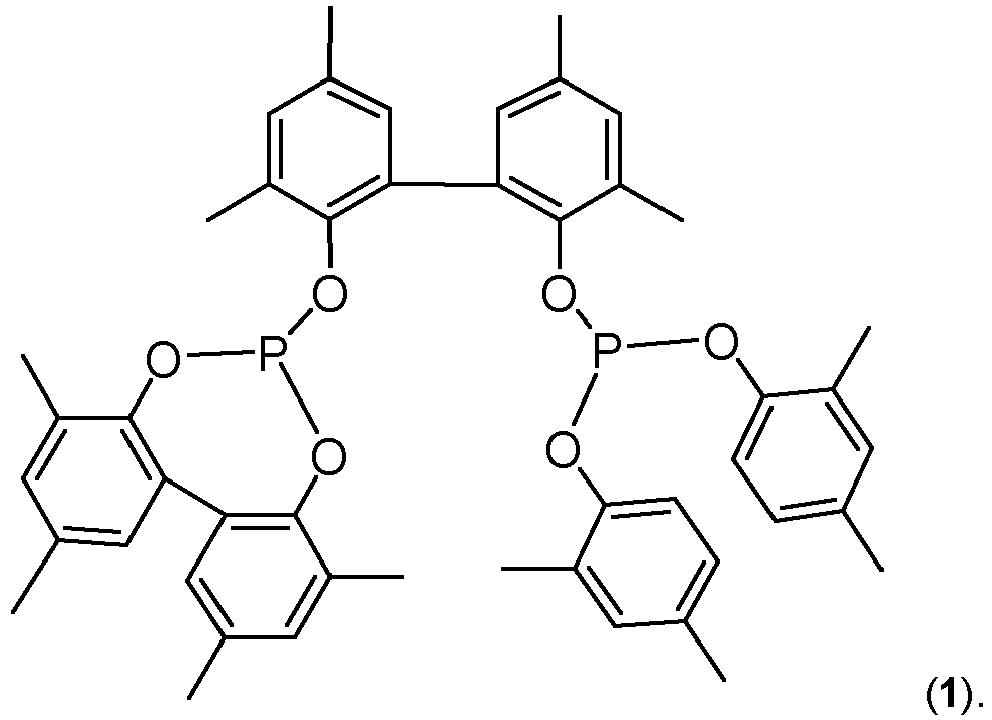
- the compound has the structure (1):
- the metal is Rh.
- ligands can also be used here and not every ligand is necessarily bound in the form of a ligand-metal complex, but is contained in the reaction mixture as a free ligand.
- the reaction is carried out under usual conditions.
- a temperature of 80 ° C to 160 ° C and a pressure of 10 to 60 bar are preferred.
- a temperature of 100 ° C to 140 ° C and a pressure of 20 to 50 bar are particularly preferred.
- the starting materials for the hydroformylation according to the process of the invention are olefins or mixtures of olefins, in particular monoolefins with 2 to 24, preferably 3 to 16, particularly preferably 3 to 12 carbon atoms with terminal or internal CC double bonds, such as 1-propene, 1-butene, 2-butene, 1- or 2-pentene, 2-methyl-1-butene, 2-methyl-2-butene, 3-methyl-1-butene, 1-, 2- or 3-hexene, the Cs-olefin mixture (dipropene) resulting from the dimerization of propene, heptene, 2- or 3-methyl-1-hexene, octene, 2-methylheptene, 3-methylheptene, 5-methyl-2-heptene, 6-methyl-2 -heptene, 2-ethyl-1-hexene, the Cs-olefin mixture (di-n-butene, di-iso-butene) resulting
- ⁇ -olefins, terminally branched, internally branched and internally branched olefins can be hydroformylated using the ligands according to the invention.
- the previously prepared chlorophosphite solution was then added to the phenol-triethylamine solution in one go.
- the reaction mixture was then immediately heated to 80 ° C and stirred vigorously overnight at this reaction temperature.
- the resulting amine hydrochloride was fried at room temperature.
- the stirrer was previously switched off and the reaction mixture was allowed to stand for 1.5 hours:
- the resulting filtrate was evaporated to dryness and dried for 18 hours using an oil pump vacuum at room temperature.
- the residue was then stirred with 100 mL of degassed acetonitrile; it did not dissolve and the solvent was then removed again.
- the resulting solid was mixed with 100 mL of degassed N-heptane. The majority dissolved in heptane.
- the cloudy solution was fried.
- the clear filtrate was evaporated to dryness. Reinhet: 76.6%.
- the reaction mixture was stirred at room temperature for 2 h and then heated to 80 °C.
- the reaction mixture was stirred at this temperature for 15 h and 1.5 mL (0.011 mol) of triethylamine were added three times and the mixture was allowed to continue stirring for 15 h.
- the ammonium hydrochloride was fried, washed once with 10 mL of dried toluene and evaporated to dryness.
- the solid was dried at room temperature for 15 h and stirred with 40 mL of degassed acetonitrile.
- the precipitated white solid was fried off, the Schlenk was rinsed twice with 10 mL ACN and, after drying, introduced into the glove box. Yield 90%, purity: 95%.
- the hydroformylation was carried out in a 16 ml autoclave from the HEL group, Hertfordshire, Great Britain, equipped with constant pressure, gas flow measurement, and aeration stirrer.
- the n-octene used as substrate (Oxeno GmbH, octene isomer mixture from 1-octene: 3%; cis+trans-2-octene: 49%; cis+trans-3-octene: 29%; cis+trans-4-octene: 16%; skeletal isomeric octenes: 3%) was refluxed over sodium for several hours and distilled under argon.
- reaction solutions were prepared in advance under an argon atmosphere.
- 0.0021 g of Rh(acac)(CO) 2 and the corresponding amount of phosphite compound were weighed out and topped up with 8.0 ml of toluene.
- the mass of toluene introduced in each case was determined for the GC analysis. 1.80 g of n-octene (16 mmol) were then added.
- the autoclave was then heated to the desired temperature at a total pressure of 10 bar while stirring (900 rpm).
- the selectivity with respect to the n-aldehyde means that this amount of linear product was formed. The remaining percent then corresponds to the branched isomer.
- a regioselectivity of 50% equal amounts of n-aldehyde and iso-aldehyde are formed.
Landscapes
- Chemical & Material Sciences (AREA)
- Organic Chemistry (AREA)
- Chemical Kinetics & Catalysis (AREA)
- Engineering & Computer Science (AREA)
- Materials Engineering (AREA)
- General Health & Medical Sciences (AREA)
- Molecular Biology (AREA)
- Biochemistry (AREA)
- Life Sciences & Earth Sciences (AREA)
- Health & Medical Sciences (AREA)
- Inorganic Chemistry (AREA)
- Organic Low-Molecular-Weight Compounds And Preparation Thereof (AREA)
- Low-Molecular Organic Synthesis Reactions Using Catalysts (AREA)
Description
- Die Erfindung betrifft Diphosphite mit einem offenen und einem geschlossenen 2,4-methylierten Flügelbaustein und deren Verwendung in der Hydroformylierung.
- Phosphorhaltige Verbindungen spielen als Liganden in einer Vielzahl von Reaktionen eine entscheidende Rolle, z.B. in der Hydrierung, in der Hydrocyanierung und auch in der Hydroformylierung.
- Die Reaktionen zwischen Olefinverbindungen, Kohlenmonoxid und Wasserstoff in Gegenwart eines Katalysators zu den um ein C-Atom reicheren Aldehyden ist als Hydroformylierung bzw. Oxierung bekannt. Als Katalysatoren in diesen Reaktionen werden häufig Verbindungen der Übergangsmetalle der VIII. Gruppe des Periodensystems der Elemente verwendet. Bekannte Liganden sind beispielsweise Verbindungen aus den Klassen der Phosphine, Phosphite und Phosphonite mit jeweils dreiwertigem Phosphor PIII. Eine gute Übersicht über den Stand der Hydroformylierung von Olefinen findet sich in R. Franke, D. Selent, A. Börner, "Applied Hydroformylation", Chem. Rev., 2012, DOI:10.1021/cr3001803.
- In
EP 0213639 A2 ist auf Seite 98 in Beispiel 10 die folgende Verbindung dargestellt:
- Die Verbindung (2) wird hier als Ligand in der Hydroformylierung von 1-Buten eingesetzt.
- Die technische Aufgabe der Erfindung ist die Bereitstellung neuer Liganden, welche in der Hydroformylierung von Olefinen eine gesteigerte n/iso-Selektivität verglichen zu dem aus dem Stand der Technik bekennten Liganden aufweisen.
- Die Aufgabe wird gelöst durch eine Verbindung gemäß Anspruch 1.
- Verbindung gemäß der Struktur (I):

- In einer Ausführungsform sind R1, R2 ausgewählt aus: -H, -(C1-C12)-Alkyl.
- In einer Ausführungsform stehen R1, R2 für-(C1-C12)-Alkyl.
- In einer Ausführungsform stehen R1, R2 für den gleichen Rest.
- In einer Ausführungsform weist die Verbindung die Struktur (1) auf:

- Neben der Verbindung als solche wird auch deren Verwendung zur Katalyse einer Hydroformylierungsreaktion beansprucht.
- Verwendung einer zuvor beschriebenen Verbindung in einem Ligand-Metall-Komplex zur Katalyse einer Hydroformylierungsreaktion.
- Des Weiteren wird ein Verfahren beansprucht, in welchem die zuvor beschriebene Verbindung als Ligand eingesetzt wird.
- Verfahren umfassend die Verfahrensschritte:
- a) Vorlegen eines Olefins,
- b) Zugabe einer zuvor beschriebenen Verbindung und einer Substanz, welche ein Metall ausgewählt aus: Rh, Ru, Co, Ir aufweist,
- c) Zuführen von H2 und CO,
- d) Erwärmen des Reaktionsgemisches aus a) bis c), wobei das Olefin zu einem Aldehyd umgesetzt wird.
- In einer bevorzugten Ausführungsform ist das Metall Rh.
- Es kann hierbei auch ein Überschuss an Liganden verwendet werden und nicht zwangsläufig jeder Ligand liegt gebunden in Form eines Ligand-Metall-Komplexes vor, sondern ist als freier Ligand im Reaktionsgemisch enthalten.
- Die Reaktion wird bei üblichen Bedingungen durchgeführt.
- Bevorzugt sind eine Temperatur von 80 °C bis 160 °C und ein Druck von 10 bis 60 bar. Besonders bevorzugt sind eine Temperatur von 100 °C bis 140 °C und ein Druck von 20 bis 50 bar.
- Die Edukte für die Hydroformylierung gemäß dem Verfahren der Erfindung sind Olefine oder Gemische von Olefinen, insbesondere Monoolefine mit 2 bis 24, bevorzugt 3 bis 16, besonders bevorzugt 3 bis 12 Kohlenstoffatomen mit end- oder innenständigen C-C-Doppelbindungen, wie z.B. 1-Propen, 1-Buten, 2-Buten, 1- oder 2-Penten, 2-Methyl-1-buten, 2-Methyl-2-buten, 3-Methyl-1-buten, 1-, 2- oder 3,-Hexen, das bei der Dimerisierung von Propen anfallende Cs-Olefingemisch (Dipropen), Heptene, 2- oder 3-Methyl-1-hexene, Octene, 2-Methylheptene, 3-Methylheptene, 5-Methyl-2-hepten, 6-Methyl-2-hepten, 2-Ethyl-1-hexen, das bei der Dimerisierung von Butenen anfallende Cs-Olefingemisch (Di-n-buten, Di-iso-buten), Nonene, 2- oder 3-Methyloctene, das bei der Trimerisierung von Propen anfallende C9-Olefingemisch (Tripropen), Decene, 2-Ethyl-1-octen, Dodecene, das bei derTetramerisierung von Propen oder der Trimerisierung von Butenen anfallende C12-Olefingemisch (Tetrapropen oder Tributen), Tetradecene, Hexadecene, das bei der Tetramerisierung von Butenen anfallende C16-Olefingemisch (Tetrabuten) sowie durch Cooligomerisierung von Olefinen mit unterschiedlicher Anzahl von Kohlenstoffatomen (bevorzugt 2 bis 4) hergestellte Olefingemische.
- Mit dem erfindungsgemäßen Verfahren können unter Verwendung der erfindungsgemäßen Liganden α-Olefine, endständig verzweigte, innenständige und innenständig verzweigte Olefine hydroformyliert werden.
- Im Folgenden soll die Erfindung anhand von Ausführungsbeispielen näher erläutert werden.
- Alle nachfolgenden Präparationen wurden mit Standard-Schlenk-Technik unter Schutzgas durchgeführt. Die Lösungsmittel wurden vor Gebrauch über geeigneten Trocknungsmitteln getrocknet.
- Die Charakterisierung der Produkte erfolgte mittels NMR-Spektroskopie. Chemische Verschiebungen (δ) werden in ppm angegeben. Die Referenzierung der 31P-NMR-Signale erfolgte gemäß: SR31P = SR1H * (BF31P / BF1H) = SR1H * 0,4048.
-

-

- In einem 500 ml Schlenk mit Wellenbrecher wurden 10,7 g 2,2'-Bis(3,5-di-methyl)-phenol (Ölpumpenvakuum nachgetrocknet) vorgelegt in 100 mL Toluol gelöst und auf 40 °C erwärmt. In der Glovebox wurden 15,5 g Chlorophosphit in einem 250 ml Schlenk eingewogen und ausgeschleust. Das Chlorophosphit wurde unter Rühren in 150 ml Toluol gelöst und mit 5,6 mL EtsN versetzt. Die Chlorophosphit-EtsN-Toluol Lösung wurde innerhalb von 4 h bei 40 °C langsam zur vorgelegten Phenol-Lösung gegeben. Nach Rühren über Nacht wurde erneut 2,8 mL EtsN hinzugegeben. Nach 18 Stunden wurden 100 mL entgastes Acetonitril unter Rühren zum Feststoff gegeben. Die Mixtur wurde über Nacht bei Raumtemperatur gerührt. Am Morgen wurde die Mixtur auf 0 °C abgekühlt und 2 h bei dieser Temperatur gerührt. Dann wurde abgefrittet und mit wenig entgastem, kaltem Acetonitril nachgewaschen. Der Feststoff auf der Fritte wurde getrocknet und in die Glove-Bos eingeschleust. Reinheit: 95%, Ausbeute 74%.
-

- In einen sekurierten 250ml Schlenk werden nach dem Belüften mit Argon 50mL Toluol und 2,75 mL (0.062 mol) Phosphortrichlorid gegeben. In der Glovebox werden 6 g (0.02mol) (1a) in einen weiteren 250 ml Schlenk eingewogen. Nach dem Ausschleusen werden unter Argon 50 mL Toluol und 4,25 mL (0.061 mol) Triethyamin hinzugegeben. Nach dem vollständigen Lösen wird die (1a)-Lösung langsam zur Phosphortrichlorid/Toluol-Lösung getropft. Anschließend wurde die Lösung 2 Stunden bei 80°C gerührt, danach auf Raumtemperatur abgekühlt und über Nacht bei Raumtemperatur gerührt. Zur Aufarbeitung wird die Suspension am nächsten Morgen über eine G3-Fritte abfiltriert. Das hierbei abfiltrierte Hydrochlorid wird verworfen. Die erhaltene Mutterlauge wird mittels Ölpumpenvakuum bei 45°C bis zur Trockne eingeengt.
- Ausbeute: 90%, Reinheit: 94,5 %.
-

- In der Glove-Box wurde in einem sekurierten 250 ml Schlenk 7.89 g (0,011 mol) Diorganophosphitdichlorphosphit (1b) abgewogen, anschließend ausgeschleusst und in 80 mL getrocknetem Toluol gelöst. In einem zweiten sekurierten 250 ml Schlenk wurden mittels Argon gespülter Spritze 2.64 ml (2.69 g = 0,022 mol) 2.4-Dimethylphenol befüllt. Anschließend wurde unter rühren 60 mL getrocknetes Toluol und 6.6 mL = 4,8 g (0,047 mol) entgastes Triethylamin zugegeben und unter Rühren aufgelöst. Zur Phenol-Triethylamin Lösung wurde dann die zuvor hergestellte Chlorophosphit-Lösung in einem Zug hinzugegeben. Im Anschluß wurde die Reaktionsmixtur sofort auf 80 °C erwärmt und kräftig über Nacht bei dieser Reaktionstemperatur gerührt. Zur Aufarbeitung wurde das entstandene Aminhydrochlorid bei Raumtemperatur abgefrittet. Zur besseren Filtrierbarkeit des Aminhydrochlorid wurde zuvor der Rührer abgestellt und die Reaktionsmischung 1,5 h stehen gelassen: Das erhaltene Filtrat wurde bis zur Trockne eingeengt und über 18 Stunden mittel Ölpumpenvakuum bei Raumtemperatur nachgetrocknet. Anschließend wurde der Rückstand mit 100 mL entgastem Acetonitril gerührt, er ging nicht in Lösung, daraufhin wurde das Lösemittel wieder abgezogen. Den dabei erhaltenen Feststoff wurde mit 100 mL entgastes N-Heptan versetzt. Dabei löste sich der überwiegende Teil in Heptan auf. Die getrübte Lösung wurde gefrittet. Das klare Filtrat bis zur Trockne eingeengt. Reinhet: 76,6%.
- Um eine saubere Aufreinigung zu erzielen, wurde ein DC mit in verschiedenen Laufmittel durchgeführt. Als bestes Laufmittel erwies sich das Gemisch n-Hptan / Ethyacetat 96:4. Das Produkt wurde in 15 ml n-Heptan gelöst und flüssig in den Säulenautomaten beladen. Dazu wurde eine 120 g Kieselgelsäule genutzt. Mit Hilfe vom ermittelten Rf-Werten wurde ein Gradient vom Automaten ermittelt. Reinheit 95%, Ausbeute: 30%.
-

- In der Glove-Box wurde in einem sekurierten 250 mL Schlenk 9 g (0,01 mol) Diorganophosphitdichlorphosphit eingewogen, anschließend ausgeschleusst und in 75 mL getrocknetem Toluol gelöst. In einem zweiten sekurierten 250 mL Schlenk wurden 2.2 g (2,1 mL 0,02 mol) 2-Methylphenol abgewogen und 12 h mittels Ölpumpenvakuum bei Raumtemperatur nachgetrocknet. Es wurde unter Rühren 50 mL getrocknetes Toluol und 3 mL = 2,2 g (0,022 mol) entgastes Triethylamin zugegeben und aufgelöst. Zur Phenol-Triethylamin Lösung wurde bei Raumtemperatur innerhalb 1,5 h das Dichlorophosphit hinzugegeben. Die Reaktionsmischung wurde 2 h bei Raumtemperatur gerührt und danach auf 80 °C erhitzt. Die Reaktionsmischung wurde 15 h bei dieser Temperatur gerührt und es wurden 3 mal 1,5 mL (0,011 mol) Triethylamin nachdosiert und 15 h weiter rühren gelassen. Das Ammoniumhydrochlorid wurde abgefrittet, 1 x mit 10 mL getrocknetem Toluol nachgewaschen bis zur Trockne eingeengt. Der Feststoff wurde 15 h bei Raumtemperatur getrocknet und mit 40 mL entgastem Acetonitril gerührt. Der ausgefallene weiße Feststoff wurde abgefrittet, der Schlenk wurde mit 2 mal 10 mL ACN nachgespült und nach dem Trocknen in die Glove-Box eingeschleust. Ausbeute 90%, Reinheit: 95%.
- Die Hydroformylierung wurde in einem mit Druckkonstanthaltung, Gasflussmessung, und Begasungsrührer ausgestatteten 16 ml-Autoklaven der HEL group, Hertfordshire, Großbritannien, durchgeführt. Das als Substrat eingesetzte n-Octen (Oxeno GmbH, Octenisomerengemisch aus 1-Octen: 3 %; cis+trans-2-Octen: 49 %; cis+trans-3-Octen: 29 %; cis+trans-4-Octen: 16 %; gerüstisomere Octene: 3 %) wurde mehrere Stunden über Natrium am Rückfluss erhitzt und unter Argon destilliert.
- Für die Versuche wurden die Reaktionslösungen vorab unter Argonatmosphäre vorbereitet. Hierfür wurden 0,0021 g Rh(acac)(CO)2 und die entsprechende Menge an Phosphitverbindung eingewogen und mit 8,0 ml Toluol aufgefüllt. Die jeweils eingebrachte Masse an Toluol wurde für die GC-Analyse bestimmt. Anschließend wurden 1,80 g n-Octen (16 mmol) hinzugegeben. Die vorbereiteten Lösungen wurden anschließend in den Autoklaven eingefüllt und dieser dreimal mit Argon und dreimal mit Synthesegas (Linde; H2 (99,999 %) : CO (99,997%) = 1:1) gespült. Dann wurde der Autoklav bei einem Gesamtdruck von 10 bar unter Rühren (900 U/min) auf die angestrebte Temperatur aufgeheizt. Nach Erreichen der Reaktionstemperatur wurde der Synthesegasdruck auf 20 bar erhöht und die Reaktion bei konstantem Druck für 4 h geführt. Der Autoklav wurde nach Ablauf der Reaktionszeit auf Raumtemperatur abgekühlt, unter Rühren entspannt und mit Argon gespült. Jeweils 0,5 ml der Reaktionsmischungen wurden nach Beenden der Reaktion entnommen, mit 4 ml Pentan verdünnt und gaschromatographisch analysiert: HP 5890 Series II plus, PONA, 50 m x 0,2 mm x 0,5 µm. Die quantitative Bestimmung von Restolefin und Aldehyd erfolgte gegen das Lösungsmittel Toluol als interner Standard.
- [Rh]: 120 ppm, L:Rh = 1:2, p: 20 bar, T: 120 °C; t: 4 h
Tabelle 1: Hydroformylierung der n-Octene Ligand n/iso-Selektivität in % 1* 77 2 56 * erfindungsgemäße Verbindung - Bei der Hydroformylierung gibt es die n/iso-Selektivität: das Verhältnis von linearem Aldehyd (= n) zu verzweigtem Aldehyd (= iso). Hierbei bedeutet die Selektivität bezüglich des n-Aldehyden, dass diese Menge an linearem Produkt gebildet wurde. Die restlichen Prozente entsprechen dann dem verzweigten Isomer. Bei einer Regioselektivität von 50% entstehen also n-Aldehyd und iso-Aldehyd zu gleichen Teilen.
- Mit der erfindungsgemäßen Verbindung (1) konnte eine gegenüber dem Vergleichsliganden (2) gesteigerte n/iso-Selektivität erzielt werden.
- Die durchgeführten Versuche belegen, dass die gestellte Aufgabe durch die erfindungsgemäße Verbindung gelöst wird.
Claims (7)
- Verbindung gemäß der Struktur (I):

- Verbindung nach Anspruch 1,
wobei R1, R2 ausgewählt sind aus: -H, -(C1-C12)-Alkyl. - Verbindung nach einem der Ansprüche 1 oder 2, wobei R1, R2 für-(C1-C12)-Alkyl stehen.
- Verbindung nach einem der Ansprüche 1 bis 3, wobei R1, R2 für den gleichen Rest stehen.
- Verbindung nach einem der Ansprüche 1 bis 4, wobei die Verbindung die Struktur (1) aufweist:
- Verwendung einer Verbindung nach einem der Ansprüche 1 bis 5,
in einem Ligand-Metall-Komplex zur Katalyse einer Hydroformylierungsreaktion. - Verfahren umfassend die Verfahrensschritte:a) Vorlegen eines Olefins,b) Zugabe einer Verbindung nach einem der Ansprüche 1 bis 5 und einer Substanz, welche ein Metall ausgewählt aus: Rh, Ru, Co, Ir aufweist,c) Zuführen von H2 und CO,d) Erwärmen des Reaktionsgemisches aus a) bis c), wobei das Olefin zu einem Aldehyd umgesetzt wird.
Priority Applications (3)
| Application Number | Priority Date | Filing Date | Title |
|---|---|---|---|
| EP21168815.5A EP4074721B1 (de) | 2021-04-16 | 2021-04-16 | Diphosphite mit einem offenen und einem geschlossenen 2,4-methylierten flügelbaustein |
| US17/718,503 US11560396B2 (en) | 2021-04-16 | 2022-04-12 | Diphosphites having an open and a closed 2,4-methylated outer unit |
| CN202210397683.3A CN115215903A (zh) | 2021-04-16 | 2022-04-15 | 具有敞开和关闭的2,4-甲基化外翼结构单元的二亚磷酸酯 |
Applications Claiming Priority (1)
| Application Number | Priority Date | Filing Date | Title |
|---|---|---|---|
| EP21168815.5A EP4074721B1 (de) | 2021-04-16 | 2021-04-16 | Diphosphite mit einem offenen und einem geschlossenen 2,4-methylierten flügelbaustein |
Publications (2)
| Publication Number | Publication Date |
|---|---|
| EP4074721A1 EP4074721A1 (de) | 2022-10-19 |
| EP4074721B1 true EP4074721B1 (de) | 2023-10-04 |
Family
ID=75562600
Family Applications (1)
| Application Number | Title | Priority Date | Filing Date |
|---|---|---|---|
| EP21168815.5A Active EP4074721B1 (de) | 2021-04-16 | 2021-04-16 | Diphosphite mit einem offenen und einem geschlossenen 2,4-methylierten flügelbaustein |
Country Status (3)
| Country | Link |
|---|---|
| US (1) | US11560396B2 (de) |
| EP (1) | EP4074721B1 (de) |
| CN (1) | CN115215903A (de) |
Families Citing this family (1)
| Publication number | Priority date | Publication date | Assignee | Title |
|---|---|---|---|---|
| EP4074722A1 (de) * | 2021-04-16 | 2022-10-19 | Evonik Operations GmbH | Diphosphite mit einem offenen, 3-methylierten flügelbaustein |
Family Cites Families (6)
| Publication number | Priority date | Publication date | Assignee | Title |
|---|---|---|---|---|
| US4748261A (en) * | 1985-09-05 | 1988-05-31 | Union Carbide Corporation | Bis-phosphite compounds |
| CN102266796A (zh) * | 2006-12-22 | 2011-12-07 | 中国科学院上海有机化学研究所 | 一种丙烯氢甲酰化催化体系和方法 |
| EP3029045B1 (de) * | 2014-12-04 | 2018-06-13 | Evonik Degussa GmbH | Bisphosphite die eine 2,3 -Biphenol-Einheit als Zentral-Baustein aufweisen |
| EP3763723B1 (de) * | 2019-07-11 | 2022-04-13 | Evonik Operations GmbH | Bisphosphite mit einem geschlossenen und einem offenen flügelbaustein |
| EP3971195B1 (de) | 2020-09-22 | 2023-02-22 | Evonik Operations GmbH | Diphosphite mit einem offenen, 2,4-methylierten flügelbaustein |
| EP4074722A1 (de) * | 2021-04-16 | 2022-10-19 | Evonik Operations GmbH | Diphosphite mit einem offenen, 3-methylierten flügelbaustein |
-
2021
- 2021-04-16 EP EP21168815.5A patent/EP4074721B1/de active Active
-
2022
- 2022-04-12 US US17/718,503 patent/US11560396B2/en active Active
- 2022-04-15 CN CN202210397683.3A patent/CN115215903A/zh active Pending
Also Published As
| Publication number | Publication date |
|---|---|
| EP4074721A1 (de) | 2022-10-19 |
| CN115215903A (zh) | 2022-10-21 |
| US20220340606A1 (en) | 2022-10-27 |
| US11560396B2 (en) | 2023-01-24 |
Similar Documents
| Publication | Publication Date | Title |
|---|---|---|
| EP2906573B1 (de) | Gemisch von bisphosphiten und dessen verwendung als katalysatorgemisch in der hydroformylierung | |
| EP2091958B1 (de) | Bisphosphitliganden für die übergangsmetallkatalysierte hydroformylierung | |
| EP3070093B1 (de) | Neue organophosphorverbindungen auf basis von anthracentriol | |
| EP3763723B1 (de) | Bisphosphite mit einem geschlossenen und einem offenen flügelbaustein | |
| EP2947091B1 (de) | Gemische von monophosphitligand und deren verwendung zur katalyse einer hydroformylierungsreaktion | |
| EP3971195B1 (de) | Diphosphite mit einem offenen, 2,4-methylierten flügelbaustein | |
| EP4074720B1 (de) | Gemisch von bisphosphiten mit einem offenen und einem geschlossenen flügelbaustein und dessen verwendung als katalysatorgemisch in der hydroformylierung | |
| EP4074721A1 (de) | Diphosphite mit einem offenen und einem geschlossenen 2,4-methylierten flügelbaustein | |
| EP4074722A1 (de) | Diphosphite mit einem offenen, 3-methylierten flügelbaustein | |
| EP3763722B1 (de) | Bisphosphite mit einem offenen und einem geschlossenen flügelbaustein | |
| DE60319725T2 (de) | Bischelatligand und seine verwendung in carbonylierungs-verfahren | |
| EP3957643B1 (de) | Neue diphosphite auf basis von cis-butendiol-1,4 | |
| EP4663651A1 (de) | Bisphosphite mit tert-butylresten am zentralbaustein und substituiertem flügelbaustein | |
| EP3318570A1 (de) | Phosphorigsäure-p,p'-[5,5',6,6'-tetramethyl-3,3'-bis(1-methylethyl)[1,1'-biphenyl]-2,2'-diyl] p,p,p',p'-tetrakis(2,4-dimethylphenyl)-ester in der hydroformylierung | |
| EP3816173B1 (de) | Phosphazyklische phosphite aus dem enol des pyridoins und furoins | |
| EP3816172B1 (de) | Phosphazyklische phosphite aus dem enol des 1-hydroxy-2-acetonaphthons | |
| EP3957642A1 (de) | 6,6'-([1,1'-biphenyl]-2,3'-diylbis(oxy))didibenzo[d,f][1,3,2]dioxaphosphepine | |
| EP3816174A1 (de) | Benzopinacolphosphite | |
| EP3438110B1 (de) | Phosphinite mit zwei direkt am phosphor gebundenen tert.-butyl-gruppen | |
| EP3438111B1 (de) | Phosphonite mit einer direkt am phosphor gebundenen tert.-butyl-gruppe | |
| EP4737468A1 (de) | Bisphosphite mit einem naphthalindiol-rückgrat | |
| EP3296304B1 (de) | Monophosphite mit methylenverbrücktem diphenol und anthracenylrest | |
| EP4403562A1 (de) | Diphosphite mit tert-butylresten und methylresten | |
| EP4737466A1 (de) | Bisphosphite mit einem naphthyl-flügelbaustein und einem phenyl-phenyl-flügelbaustein | |
| EP4737467A1 (de) | Bisphosphite mit einem naphthalindiol-zentralbaustein |
Legal Events
| Date | Code | Title | Description |
|---|---|---|---|
| PUAI | Public reference made under article 153(3) epc to a published international application that has entered the european phase |
Free format text: ORIGINAL CODE: 0009012 |
|
| STAA | Information on the status of an ep patent application or granted ep patent |
Free format text: STATUS: THE APPLICATION HAS BEEN PUBLISHED |
|
| AK | Designated contracting states |
Kind code of ref document: A1 Designated state(s): AL AT BE BG CH CY CZ DE DK EE ES FI FR GB GR HR HU IE IS IT LI LT LU LV MC MK MT NL NO PL PT RO RS SE SI SK SM TR |
|
| STAA | Information on the status of an ep patent application or granted ep patent |
Free format text: STATUS: REQUEST FOR EXAMINATION WAS MADE |
|
| 17P | Request for examination filed |
Effective date: 20221104 |
|
| RBV | Designated contracting states (corrected) |
Designated state(s): AL AT BE BG CH CY CZ DE DK EE ES FI FR GB GR HR HU IE IS IT LI LT LU LV MC MK MT NL NO PL PT RO RS SE SI SK SM TR |
|
| GRAP | Despatch of communication of intention to grant a patent |
Free format text: ORIGINAL CODE: EPIDOSNIGR1 |
|
| STAA | Information on the status of an ep patent application or granted ep patent |
Free format text: STATUS: GRANT OF PATENT IS INTENDED |
|
| RIC1 | Information provided on ipc code assigned before grant |
Ipc: C07C 45/50 20060101ALI20230627BHEP Ipc: C07F 9/6574 20060101AFI20230627BHEP |
|
| INTG | Intention to grant announced |
Effective date: 20230720 |
|
| GRAS | Grant fee paid |
Free format text: ORIGINAL CODE: EPIDOSNIGR3 |
|
| GRAA | (expected) grant |
Free format text: ORIGINAL CODE: 0009210 |
|
| STAA | Information on the status of an ep patent application or granted ep patent |
Free format text: STATUS: THE PATENT HAS BEEN GRANTED |
|
| AK | Designated contracting states |
Kind code of ref document: B1 Designated state(s): AL AT BE BG CH CY CZ DE DK EE ES FI FR GB GR HR HU IE IS IT LI LT LU LV MC MK MT NL NO PL PT RO RS SE SI SK SM TR |
|
| REG | Reference to a national code |
Ref country code: GB Ref legal event code: FG4D Free format text: NOT ENGLISH |
|
| REG | Reference to a national code |
Ref country code: CH Ref legal event code: EP |
|
| REG | Reference to a national code |
Ref country code: IE Ref legal event code: FG4D Free format text: LANGUAGE OF EP DOCUMENT: GERMAN |
|
| REG | Reference to a national code |
Ref country code: DE Ref legal event code: R096 Ref document number: 502021001607 Country of ref document: DE |
|
| REG | Reference to a national code |
Ref country code: DE Ref legal event code: R081 Ref document number: 502021001607 Country of ref document: DE Owner name: EVONIK OXENO GMBH & CO. KG, DE Free format text: FORMER OWNER: EVONIK OPERATIONS GMBH, 45128 ESSEN, DE |
|
| P01 | Opt-out of the competence of the unified patent court (upc) registered |
Effective date: 20231013 |
|
| RAP2 | Party data changed (patent owner data changed or rights of a patent transferred) |
Owner name: EVONIK OXENO GMBH & CO. KG |
|
| REG | Reference to a national code |
Ref country code: NL Ref legal event code: FP |
|
| REG | Reference to a national code |
Ref country code: NL Ref legal event code: PD Owner name: EVONIK OXENO GMBH & CO. KG; DE Free format text: DETAILS ASSIGNMENT: CHANGE OF OWNER(S), ASSIGNMENT; FORMER OWNER NAME: EVONIK OPERATIONS GMBH Effective date: 20231218 Ref country code: SE Ref legal event code: TRGR |
|
| REG | Reference to a national code |
Ref country code: LT Ref legal event code: MG9D |
|
| REG | Reference to a national code |
Ref country code: BE Ref legal event code: PD Owner name: EVONIK OXENO GMBH & CO. KG; DE Free format text: DETAILS ASSIGNMENT: CHANGE OF OWNER(S), ASSIGNMENT; FORMER OWNER NAME: EVONIK OPERATIONS GMBH Effective date: 20231129 |
|
| PG25 | Lapsed in a contracting state [announced via postgrant information from national office to epo] |
Ref country code: GR Free format text: LAPSE BECAUSE OF FAILURE TO SUBMIT A TRANSLATION OF THE DESCRIPTION OR TO PAY THE FEE WITHIN THE PRESCRIBED TIME-LIMIT Effective date: 20240105 |
|
| PG25 | Lapsed in a contracting state [announced via postgrant information from national office to epo] |
Ref country code: IS Free format text: LAPSE BECAUSE OF FAILURE TO SUBMIT A TRANSLATION OF THE DESCRIPTION OR TO PAY THE FEE WITHIN THE PRESCRIBED TIME-LIMIT Effective date: 20240204 |
|
| PG25 | Lapsed in a contracting state [announced via postgrant information from national office to epo] |
Ref country code: LT Free format text: LAPSE BECAUSE OF FAILURE TO SUBMIT A TRANSLATION OF THE DESCRIPTION OR TO PAY THE FEE WITHIN THE PRESCRIBED TIME-LIMIT Effective date: 20231004 |
|
| PG25 | Lapsed in a contracting state [announced via postgrant information from national office to epo] |
Ref country code: ES Free format text: LAPSE BECAUSE OF FAILURE TO SUBMIT A TRANSLATION OF THE DESCRIPTION OR TO PAY THE FEE WITHIN THE PRESCRIBED TIME-LIMIT Effective date: 20231004 |
|
| PG25 | Lapsed in a contracting state [announced via postgrant information from national office to epo] |
Ref country code: LT Free format text: LAPSE BECAUSE OF FAILURE TO SUBMIT A TRANSLATION OF THE DESCRIPTION OR TO PAY THE FEE WITHIN THE PRESCRIBED TIME-LIMIT Effective date: 20231004 Ref country code: IS Free format text: LAPSE BECAUSE OF FAILURE TO SUBMIT A TRANSLATION OF THE DESCRIPTION OR TO PAY THE FEE WITHIN THE PRESCRIBED TIME-LIMIT Effective date: 20240204 Ref country code: GR Free format text: LAPSE BECAUSE OF FAILURE TO SUBMIT A TRANSLATION OF THE DESCRIPTION OR TO PAY THE FEE WITHIN THE PRESCRIBED TIME-LIMIT Effective date: 20240105 Ref country code: ES Free format text: LAPSE BECAUSE OF FAILURE TO SUBMIT A TRANSLATION OF THE DESCRIPTION OR TO PAY THE FEE WITHIN THE PRESCRIBED TIME-LIMIT Effective date: 20231004 Ref country code: BG Free format text: LAPSE BECAUSE OF FAILURE TO SUBMIT A TRANSLATION OF THE DESCRIPTION OR TO PAY THE FEE WITHIN THE PRESCRIBED TIME-LIMIT Effective date: 20240104 Ref country code: PT Free format text: LAPSE BECAUSE OF FAILURE TO SUBMIT A TRANSLATION OF THE DESCRIPTION OR TO PAY THE FEE WITHIN THE PRESCRIBED TIME-LIMIT Effective date: 20240205 |
|
| PG25 | Lapsed in a contracting state [announced via postgrant information from national office to epo] |
Ref country code: RS Free format text: LAPSE BECAUSE OF FAILURE TO SUBMIT A TRANSLATION OF THE DESCRIPTION OR TO PAY THE FEE WITHIN THE PRESCRIBED TIME-LIMIT Effective date: 20231004 Ref country code: PL Free format text: LAPSE BECAUSE OF FAILURE TO SUBMIT A TRANSLATION OF THE DESCRIPTION OR TO PAY THE FEE WITHIN THE PRESCRIBED TIME-LIMIT Effective date: 20231004 Ref country code: NO Free format text: LAPSE BECAUSE OF FAILURE TO SUBMIT A TRANSLATION OF THE DESCRIPTION OR TO PAY THE FEE WITHIN THE PRESCRIBED TIME-LIMIT Effective date: 20240104 Ref country code: LV Free format text: LAPSE BECAUSE OF FAILURE TO SUBMIT A TRANSLATION OF THE DESCRIPTION OR TO PAY THE FEE WITHIN THE PRESCRIBED TIME-LIMIT Effective date: 20231004 Ref country code: HR Free format text: LAPSE BECAUSE OF FAILURE TO SUBMIT A TRANSLATION OF THE DESCRIPTION OR TO PAY THE FEE WITHIN THE PRESCRIBED TIME-LIMIT Effective date: 20231004 |
|
| REG | Reference to a national code |
Ref country code: DE Ref legal event code: R097 Ref document number: 502021001607 Country of ref document: DE |
|
| PG25 | Lapsed in a contracting state [announced via postgrant information from national office to epo] |
Ref country code: DK Free format text: LAPSE BECAUSE OF FAILURE TO SUBMIT A TRANSLATION OF THE DESCRIPTION OR TO PAY THE FEE WITHIN THE PRESCRIBED TIME-LIMIT Effective date: 20231004 |
|
| PG25 | Lapsed in a contracting state [announced via postgrant information from national office to epo] |
Ref country code: CZ Free format text: LAPSE BECAUSE OF FAILURE TO SUBMIT A TRANSLATION OF THE DESCRIPTION OR TO PAY THE FEE WITHIN THE PRESCRIBED TIME-LIMIT Effective date: 20231004 |
|
| PG25 | Lapsed in a contracting state [announced via postgrant information from national office to epo] |
Ref country code: SK Free format text: LAPSE BECAUSE OF FAILURE TO SUBMIT A TRANSLATION OF THE DESCRIPTION OR TO PAY THE FEE WITHIN THE PRESCRIBED TIME-LIMIT Effective date: 20231004 |
|
| PG25 | Lapsed in a contracting state [announced via postgrant information from national office to epo] |
Ref country code: SM Free format text: LAPSE BECAUSE OF FAILURE TO SUBMIT A TRANSLATION OF THE DESCRIPTION OR TO PAY THE FEE WITHIN THE PRESCRIBED TIME-LIMIT Effective date: 20231004 Ref country code: SK Free format text: LAPSE BECAUSE OF FAILURE TO SUBMIT A TRANSLATION OF THE DESCRIPTION OR TO PAY THE FEE WITHIN THE PRESCRIBED TIME-LIMIT Effective date: 20231004 Ref country code: RO Free format text: LAPSE BECAUSE OF FAILURE TO SUBMIT A TRANSLATION OF THE DESCRIPTION OR TO PAY THE FEE WITHIN THE PRESCRIBED TIME-LIMIT Effective date: 20231004 Ref country code: IT Free format text: LAPSE BECAUSE OF FAILURE TO SUBMIT A TRANSLATION OF THE DESCRIPTION OR TO PAY THE FEE WITHIN THE PRESCRIBED TIME-LIMIT Effective date: 20231004 Ref country code: EE Free format text: LAPSE BECAUSE OF FAILURE TO SUBMIT A TRANSLATION OF THE DESCRIPTION OR TO PAY THE FEE WITHIN THE PRESCRIBED TIME-LIMIT Effective date: 20231004 Ref country code: DK Free format text: LAPSE BECAUSE OF FAILURE TO SUBMIT A TRANSLATION OF THE DESCRIPTION OR TO PAY THE FEE WITHIN THE PRESCRIBED TIME-LIMIT Effective date: 20231004 Ref country code: CZ Free format text: LAPSE BECAUSE OF FAILURE TO SUBMIT A TRANSLATION OF THE DESCRIPTION OR TO PAY THE FEE WITHIN THE PRESCRIBED TIME-LIMIT Effective date: 20231004 |
|
| PLBE | No opposition filed within time limit |
Free format text: ORIGINAL CODE: 0009261 |
|
| STAA | Information on the status of an ep patent application or granted ep patent |
Free format text: STATUS: NO OPPOSITION FILED WITHIN TIME LIMIT |
|
| 26N | No opposition filed |
Effective date: 20240705 |
|
| PG25 | Lapsed in a contracting state [announced via postgrant information from national office to epo] |
Ref country code: SI Free format text: LAPSE BECAUSE OF FAILURE TO SUBMIT A TRANSLATION OF THE DESCRIPTION OR TO PAY THE FEE WITHIN THE PRESCRIBED TIME-LIMIT Effective date: 20231004 |
|
| PG25 | Lapsed in a contracting state [announced via postgrant information from national office to epo] |
Ref country code: SI Free format text: LAPSE BECAUSE OF FAILURE TO SUBMIT A TRANSLATION OF THE DESCRIPTION OR TO PAY THE FEE WITHIN THE PRESCRIBED TIME-LIMIT Effective date: 20231004 |
|
| PG25 | Lapsed in a contracting state [announced via postgrant information from national office to epo] |
Ref country code: MC Free format text: LAPSE BECAUSE OF FAILURE TO SUBMIT A TRANSLATION OF THE DESCRIPTION OR TO PAY THE FEE WITHIN THE PRESCRIBED TIME-LIMIT Effective date: 20231004 |
|
| PG25 | Lapsed in a contracting state [announced via postgrant information from national office to epo] |
Ref country code: MC Free format text: LAPSE BECAUSE OF FAILURE TO SUBMIT A TRANSLATION OF THE DESCRIPTION OR TO PAY THE FEE WITHIN THE PRESCRIBED TIME-LIMIT Effective date: 20231004 |
|
| REG | Reference to a national code |
Ref country code: CH Ref legal event code: PL |
|
| PG25 | Lapsed in a contracting state [announced via postgrant information from national office to epo] |
Ref country code: LU Free format text: LAPSE BECAUSE OF NON-PAYMENT OF DUE FEES Effective date: 20240416 |
|
| PG25 | Lapsed in a contracting state [announced via postgrant information from national office to epo] |
Ref country code: LU Free format text: LAPSE BECAUSE OF NON-PAYMENT OF DUE FEES Effective date: 20240416 |
|
| PG25 | Lapsed in a contracting state [announced via postgrant information from national office to epo] |
Ref country code: FR Free format text: LAPSE BECAUSE OF NON-PAYMENT OF DUE FEES Effective date: 20240430 |
|
| PG25 | Lapsed in a contracting state [announced via postgrant information from national office to epo] |
Ref country code: FR Free format text: LAPSE BECAUSE OF NON-PAYMENT OF DUE FEES Effective date: 20240430 Ref country code: CH Free format text: LAPSE BECAUSE OF NON-PAYMENT OF DUE FEES Effective date: 20240430 |
|
| PG25 | Lapsed in a contracting state [announced via postgrant information from national office to epo] |
Ref country code: IE Free format text: LAPSE BECAUSE OF NON-PAYMENT OF DUE FEES Effective date: 20240416 |
|
| PGFP | Annual fee paid to national office [announced via postgrant information from national office to epo] |
Ref country code: NL Payment date: 20250418 Year of fee payment: 5 |
|
| PGFP | Annual fee paid to national office [announced via postgrant information from national office to epo] |
Ref country code: DE Payment date: 20250422 Year of fee payment: 5 |
|
| PGFP | Annual fee paid to national office [announced via postgrant information from national office to epo] |
Ref country code: BE Payment date: 20250418 Year of fee payment: 5 |
|
| PGFP | Annual fee paid to national office [announced via postgrant information from national office to epo] |
Ref country code: AT Payment date: 20250721 Year of fee payment: 5 |
|
| PGFP | Annual fee paid to national office [announced via postgrant information from national office to epo] |
Ref country code: SE Payment date: 20250429 Year of fee payment: 5 |
|
| PG25 | Lapsed in a contracting state [announced via postgrant information from national office to epo] |
Ref country code: CY Free format text: LAPSE BECAUSE OF FAILURE TO SUBMIT A TRANSLATION OF THE DESCRIPTION OR TO PAY THE FEE WITHIN THE PRESCRIBED TIME-LIMIT; INVALID AB INITIO Effective date: 20210416 |
|
| PG25 | Lapsed in a contracting state [announced via postgrant information from national office to epo] |
Ref country code: HU Free format text: LAPSE BECAUSE OF FAILURE TO SUBMIT A TRANSLATION OF THE DESCRIPTION OR TO PAY THE FEE WITHIN THE PRESCRIBED TIME-LIMIT; INVALID AB INITIO Effective date: 20210416 |
|
| PG25 | Lapsed in a contracting state [announced via postgrant information from national office to epo] |
Ref country code: FI Free format text: LAPSE BECAUSE OF FAILURE TO SUBMIT A TRANSLATION OF THE DESCRIPTION OR TO PAY THE FEE WITHIN THE PRESCRIBED TIME-LIMIT Effective date: 20231004 |
|
| GBPC | Gb: european patent ceased through non-payment of renewal fee |
Effective date: 20250416 |
|
| PG25 | Lapsed in a contracting state [announced via postgrant information from national office to epo] |
Ref country code: GB Free format text: LAPSE BECAUSE OF NON-PAYMENT OF DUE FEES Effective date: 20250416 |