EP4074888A1 - Airbag-gewebe, das verbesserte haltbarkeit aufweist, und verfahren zum herstellen desselben - Google Patents
Airbag-gewebe, das verbesserte haltbarkeit aufweist, und verfahren zum herstellen desselben Download PDFInfo
- Publication number
- EP4074888A1 EP4074888A1 EP19957237.1A EP19957237A EP4074888A1 EP 4074888 A1 EP4074888 A1 EP 4074888A1 EP 19957237 A EP19957237 A EP 19957237A EP 4074888 A1 EP4074888 A1 EP 4074888A1
- Authority
- EP
- European Patent Office
- Prior art keywords
- fabric
- textile substrate
- airbag
- airbag according
- thickener
- Prior art date
- Legal status (The legal status is an assumption and is not a legal conclusion. Google has not performed a legal analysis and makes no representation as to the accuracy of the status listed.)
- Granted
Links
Images
Classifications
-
- B—PERFORMING OPERATIONS; TRANSPORTING
- B60—VEHICLES IN GENERAL
- B60R—VEHICLES, VEHICLE FITTINGS, OR VEHICLE PARTS, NOT OTHERWISE PROVIDED FOR
- B60R21/00—Arrangements or fittings on vehicles for protecting or preventing injuries to occupants or pedestrians in case of accidents or other traffic risks
- B60R21/02—Occupant safety arrangements or fittings, e.g. crash pads
- B60R21/16—Inflatable occupant restraints or confinements designed to inflate upon impact or impending impact, e.g. air bags
- B60R21/23—Inflatable members
- B60R21/235—Inflatable members characterised by their material
-
- D—TEXTILES; PAPER
- D06—TREATMENT OF TEXTILES OR THE LIKE; LAUNDERING; FLEXIBLE MATERIALS NOT OTHERWISE PROVIDED FOR
- D06M—TREATMENT, NOT PROVIDED FOR ELSEWHERE IN CLASS D06, OF FIBRES, THREADS, YARNS, FABRICS, FEATHERS OR FIBROUS GOODS MADE FROM SUCH MATERIALS
- D06M15/00—Treating fibres, threads, yarns, fabrics, or fibrous goods made from such materials, with macromolecular compounds; Such treatment combined with mechanical treatment
- D06M15/19—Treating fibres, threads, yarns, fabrics, or fibrous goods made from such materials, with macromolecular compounds; Such treatment combined with mechanical treatment with synthetic macromolecular compounds
- D06M15/37—Macromolecular compounds obtained otherwise than by reactions only involving carbon-to-carbon unsaturated bonds
- D06M15/564—Polyureas, polyurethanes or other polymers having ureide or urethane links; Precondensation products forming them
-
- D—TEXTILES; PAPER
- D06—TREATMENT OF TEXTILES OR THE LIKE; LAUNDERING; FLEXIBLE MATERIALS NOT OTHERWISE PROVIDED FOR
- D06N—WALL, FLOOR, OR LIKE COVERING MATERIALS, e.g. LINOLEUM, OILCLOTH, ARTIFICIAL LEATHER, ROOFING FELT, CONSISTING OF A FIBROUS WEB COATED WITH A LAYER OF MACROMOLECULAR MATERIAL; FLEXIBLE SHEET MATERIAL NOT OTHERWISE PROVIDED FOR
- D06N3/00—Artificial leather, oilcloth or other material obtained by covering fibrous webs with macromolecular material, e.g. resins, rubber or derivatives thereof
- D06N3/007—Artificial leather, oilcloth or other material obtained by covering fibrous webs with macromolecular material, e.g. resins, rubber or derivatives thereof characterised by mechanical or physical treatments
- D06N3/0077—Embossing; Pressing of the surface; Tumbling and crumbling; Cracking; Cooling; Heating, e.g. mirror finish
-
- D—TEXTILES; PAPER
- D06—TREATMENT OF TEXTILES OR THE LIKE; LAUNDERING; FLEXIBLE MATERIALS NOT OTHERWISE PROVIDED FOR
- D06N—WALL, FLOOR, OR LIKE COVERING MATERIALS, e.g. LINOLEUM, OILCLOTH, ARTIFICIAL LEATHER, ROOFING FELT, CONSISTING OF A FIBROUS WEB COATED WITH A LAYER OF MACROMOLECULAR MATERIAL; FLEXIBLE SHEET MATERIAL NOT OTHERWISE PROVIDED FOR
- D06N3/00—Artificial leather, oilcloth or other material obtained by covering fibrous webs with macromolecular material, e.g. resins, rubber or derivatives thereof
- D06N3/12—Artificial leather, oilcloth or other material obtained by covering fibrous webs with macromolecular material, e.g. resins, rubber or derivatives thereof with macromolecular compounds obtained otherwise than by reactions only involving carbon-to-carbon unsaturated bonds, e.g. gelatine proteins
- D06N3/14—Artificial leather, oilcloth or other material obtained by covering fibrous webs with macromolecular material, e.g. resins, rubber or derivatives thereof with macromolecular compounds obtained otherwise than by reactions only involving carbon-to-carbon unsaturated bonds, e.g. gelatine proteins with polyurethanes
-
- B—PERFORMING OPERATIONS; TRANSPORTING
- B60—VEHICLES IN GENERAL
- B60R—VEHICLES, VEHICLE FITTINGS, OR VEHICLE PARTS, NOT OTHERWISE PROVIDED FOR
- B60R21/00—Arrangements or fittings on vehicles for protecting or preventing injuries to occupants or pedestrians in case of accidents or other traffic risks
- B60R21/02—Occupant safety arrangements or fittings, e.g. crash pads
- B60R21/16—Inflatable occupant restraints or confinements designed to inflate upon impact or impending impact, e.g. air bags
- B60R21/23—Inflatable members
- B60R21/235—Inflatable members characterised by their material
- B60R2021/23504—Inflatable members characterised by their material characterised by material
- B60R2021/23509—Fabric
- B60R2021/23514—Fabric coated fabric
-
- B—PERFORMING OPERATIONS; TRANSPORTING
- B60—VEHICLES IN GENERAL
- B60R—VEHICLES, VEHICLE FITTINGS, OR VEHICLE PARTS, NOT OTHERWISE PROVIDED FOR
- B60R21/00—Arrangements or fittings on vehicles for protecting or preventing injuries to occupants or pedestrians in case of accidents or other traffic risks
- B60R21/02—Occupant safety arrangements or fittings, e.g. crash pads
- B60R21/16—Inflatable occupant restraints or confinements designed to inflate upon impact or impending impact, e.g. air bags
- B60R21/23—Inflatable members
- B60R21/235—Inflatable members characterised by their material
- B60R2021/23504—Inflatable members characterised by their material characterised by material
- B60R2021/23519—Resin
-
- D—TEXTILES; PAPER
- D06—TREATMENT OF TEXTILES OR THE LIKE; LAUNDERING; FLEXIBLE MATERIALS NOT OTHERWISE PROVIDED FOR
- D06N—WALL, FLOOR, OR LIKE COVERING MATERIALS, e.g. LINOLEUM, OILCLOTH, ARTIFICIAL LEATHER, ROOFING FELT, CONSISTING OF A FIBROUS WEB COATED WITH A LAYER OF MACROMOLECULAR MATERIAL; FLEXIBLE SHEET MATERIAL NOT OTHERWISE PROVIDED FOR
- D06N2203/00—Macromolecular materials of the coating layers
- D06N2203/06—Macromolecular compounds obtained otherwise than by reactions only involving carbon-to-carbon unsaturated bonds
- D06N2203/068—Polyurethanes
-
- D—TEXTILES; PAPER
- D06—TREATMENT OF TEXTILES OR THE LIKE; LAUNDERING; FLEXIBLE MATERIALS NOT OTHERWISE PROVIDED FOR
- D06N—WALL, FLOOR, OR LIKE COVERING MATERIALS, e.g. LINOLEUM, OILCLOTH, ARTIFICIAL LEATHER, ROOFING FELT, CONSISTING OF A FIBROUS WEB COATED WITH A LAYER OF MACROMOLECULAR MATERIAL; FLEXIBLE SHEET MATERIAL NOT OTHERWISE PROVIDED FOR
- D06N2205/00—Condition, form or state of the materials
- D06N2205/20—Cured materials, e.g. vulcanised, cross-linked
-
- D—TEXTILES; PAPER
- D06—TREATMENT OF TEXTILES OR THE LIKE; LAUNDERING; FLEXIBLE MATERIALS NOT OTHERWISE PROVIDED FOR
- D06N—WALL, FLOOR, OR LIKE COVERING MATERIALS, e.g. LINOLEUM, OILCLOTH, ARTIFICIAL LEATHER, ROOFING FELT, CONSISTING OF A FIBROUS WEB COATED WITH A LAYER OF MACROMOLECULAR MATERIAL; FLEXIBLE SHEET MATERIAL NOT OTHERWISE PROVIDED FOR
- D06N2211/00—Specially adapted uses
- D06N2211/12—Decorative or sun protection articles
- D06N2211/26—Vehicles, transportation
- D06N2211/268—Airbags
Definitions
- This invention relates to fabric for airbag and a method for preparing the same, and more specifically, relates to fabric for airbag that has excellent air-tightness, and simultaneously has improved durability, and a method for preparing such fabric for airbag with high productivity.
- a shock detection sensor detects shock applied to a vehicle during collision or rollover of vehicle running above a certain speed
- airbag is inflated and deployed, thereby protecting a driver and a passenger of the vehicle from the accident.
- Fabric for airbag comprises a coating layer for increasing air tightness of fabric, as well as a textile substrate.
- inflatable airbag is manufactured by cut and sewing of a textile substrate that is plain weave or basket weave woven, or manufactured by seam-sealing of a seam formed by the cut and sewing with a sealant, or manufactured using one piece woven(OPW) type textile substrate forming a double layer inflation part during a weaving process.
- a coating layer formed on a textile substrate is to provide air tightness required for airbag. For example, since a side curtain airbag should be maintained in an inflated shape for a relatively long time(for example, 6 seconds) so as to protect a passenger during rollover accident, it should have relatively higher air tightness compared to other kinds of airbags.
- neoprene rubber As the main ingredient of the coating layer, neoprene rubber was used in the initial stage. However, in order to meet high air tightness particularly required for a side curtain fabric, it was required to coat excessively large amount of neoprene rubber. Thus, formation of the coating layer with neoprene rubber was not preferable in terms of production cost and packability of airbag. And, in case the coating layer is formed with neoprene rubber, airbag may become too heavy, thus causing lowering of fuel efficiency of automobiles.
- an aqueous polyurethane dispersion can provide excellent internal pressure retaining property to airbag even with a relatively small amount, compared to silicon resin.
- an aqueous polyurethane dispersion coating layer has relatively low adhesion with a textile substrate, in case stored for a long time while being packed in an automobile, there is a risk of delamination of the coating layer from the textile substrate. Such delamination of a coating layer makes it impossible for a side curtain airbag to maintain an inflated shape when vehicle roll-over accident occurs.
- the invention relates to fabric for airbag and a method for preparing the same that can meet the above requirements of related technical fields.
- One aspect of the invention provides fabric for airbag that has excellent air-tightness, and simultaneously, has improved durability.
- Another aspect of the invention provides a method capable of preparing fabric for airbag that has excellent air-tightness, and simultaneously, has improved durability, with high productivity, without wasting materials.
- fabric for airbag comprising a textile substrate; and a coating layer on at least one side of the textile substrate,
- coating layer comprises polyurethane resin, a crosslinking agent, and a hydrophilic thickener, and the crosslinking agent is a compound having a blocked active group.
- Penetration level of the coating layer into the textile substrate defined by the following Formula 1, may be 10 to 50%:
- the textile substrate may be fabric comprising warp yarns and weft yarns, and flex abrasion of the airbag fabric, measured according to ISO 5981 standard after aging under temperature of 70 ⁇ 2 °C and relative humidity of 95 ⁇ 2 % for 408 hours, may be 1,000 strokes or more, in both warp direction and weft direction.
- the hydrophilic thickener may be a non-associative thickener.
- the hydrophilic thickener may be a non-newtonian pseudoplastic acryl-based thickener.
- the textile substrate may be one piece woven(OPW) type fabric comprising plural warp yarns and weft yarns, each of the warp yarns and weft yarns may have fineness of 210 to 1500 denier, the density of warp yarns and the density of weft yarns may be respectively 40 th/inch to 80 th/inch, based on one layer of the chamber region of the fabric, and each of the warp yarns and weft yarns may comprise at least one of aliphatic polyamide, aromatic polyamide, polyester, and polyolefin.
- the blocked active group may comprise a blocking component dissociated from the active group at 100 °C or more.
- the active group may be an isocyanate group or a carbodiimide group.
- the blocking component may be 3,5-dimethyl pyrazole(DMP), ⁇ -caprolactame, or methylethylketoxime.
- the crosslinking agent may be a polyisocyanate compound or a polycarbodiimide compound to which one or more blocking components selected from the group consisting of 3,5-dimethyl pyrazole(DMP), ⁇ -caprolactame, and methylethylketoxime are bonded.
- DMP 3,5-dimethyl pyrazole
- ⁇ -caprolactame ⁇ -caprolactame
- methylethylketoxime methylethylketoxime
- a method for preparing fabric for airbag comprising steps of: preparing a textile substrate; and forming a coating layer on at least one side of the textile substrate, wherein the step of forming a coating layer comprise steps of: adding a crosslinking agent and a hydrophilic thickener to an aqueous polyurethane dispersion to prepare a coating solution; applying the coating solution one at least one side of the textile substrate; drying the textile substrate on which the coating solution is applied; and heat treating the dried textile substrate, and the crosslinking agent is a compound having a blocked active group.
- the blocked active group may comprise a blocking component dissociated from the active group at 100 °C or more.
- the active group may be an isocyanate group or a carbodiimide group.
- the blocking component may be 3,5-dimethyl pyrazole(DMP), ⁇ -caprolactame, or methylethylketoxime.
- the crosslinking agent may be a polyisocyanate compound or a polycarbodiimide compound to which one or more blocking components selected from the group consisting of 3,5-dimethyl pyrazole(DMP), ⁇ -caprolactame, and methylethylketoxime are bonded.
- DMP 3,5-dimethyl pyrazole
- ⁇ -caprolactame ⁇ -caprolactame
- methylethylketoxime methylethylketoxime
- the thickener may be a non-associative thickener
- the thickener may be a non-newtonian pseudoplastic acryl-based thickener.
- the thickener may have viscosity of 25,000 to 60,000 cps, and the coating solution may have viscosity of 6,000 to 30,000 cps.
- the amount of the coating solution applied on at least one side of the textile substrate may be 15 to 50 gsm.
- the drying step may be conducted by raising a temperature between 80 °C and 150 °C, and the heat treatment step may be conducted at a temperature greater than 150 °C.
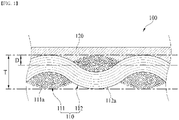
- Fig. 1 is a cross-sectional view of fabric for airbag according to one embodiment of the invention.
- Fabric for airbag(100) comprises a textile substrate(110) and a coating layer(120).
- the fabric(100) is for side curtain airbag
- the textile substrate(110) is one-piece woven(OPW) type fabric comprising warp yarns(111) and weft yarns(112).
- the density of warp yarns(111) and the density of weft yarns(112) are respectively 40 to 80 th/inch, based on one layer of the chamber region of the OPW fabric.
- the fineness of the each warp yarn and weft yarn(111, 112) should be 210 denier or more so that excellent mechanical property(for example, strength) may be maintained in terms of absorption performance for absorbing high temperature-high pressure deployment energy during airbag deployment.
- the fineness of each warp yarn and weft yarn(111, 112) is 1500 denier or less.
- each of warp yarn and weft yarn(111, 112) is multifilament comprising 72 or more filaments(111a, 112a).
- Each of warp yarns(111) and weft yarns(112) may comprise at least one of aliphatic polyamide(for example, nylon 6 or nylon 6), aromatic polyamide(for example, aramid), polyester(for example, PET), and polyolefin(for example, PE or PP).
- the coating layer(120) on at least one side of the textile substrate(110) may comprise polyurethane resin, a crosslinking agent and a hydrophilic thickener.
- the polyurethane resin of the invention formed by urethane bonding of polyol and isocyanate is a polyol component, and may comprise one or more selected from polycarbonate-based polyol, polyether-based polyol, polyester-based polyol, and silicon-based polyol.
- the polyurethane resin may be water dispersible polyurethane resin.
- the thickener gives viscosity over e certain level to a coating solution used to form the coating layer(120), thereby improving uniformity of coating and efficiency of the coating process.
- the thickener is a hydrophilic thickener. Since the hydrophilic thickener is included as an additive in the coating solution comprising an aqueous polyurethane dispersion as a main component, by wetting effect, polyurethane particles may penetrate better and uniformly into the textile substrate(110) when the medium of the coating solution, water penetrates into the textile substrate(110).
- the hydrophilic thickener may be a non-associative thickener that swells the medium of the coating solution, water, and more preferably, it may be a non-newtonian pseudoplastic acryl-based thickener, which is a low shear type, and generates viscosity change when shear stress is applied.
- the thickener may be a hydrophilic non-associative thickener comprising (meth)acryl functional groups, and such a thickener may be a liquid comprising about 5 to 20 wt% of solid content.
- Penetration level of the coating layer(120) into the textile substrate(110) may be 10 to 50 %, preferably 25 to 40 %.
- the Penetration level may be defined by the following Formula 1.
- the penetration level of the coating layer(120) is less than ' 10%, although the fabric for airbag(100) may have excellent flexibility, due to low adhesion between the textile substrate(110) and the coating layer(120), they may be separated from each other when stored in an automobile for a long time. Such delamination of the coating layer makes it impossible for side curtain airbag to be maintained in inflated shape when vehicle rollover accident occurs.
- flex abrasion of the fabric for airbag(100) since penetration level of the coating layer(120) is 10 %or more, flex abrasion of the fabric for airbag(100), measured according to ISO 5981 standard after aging under temperature of 70 ⁇ 2 °C and relative humidity of 95 ⁇ 2 % for 408 hours, is 1,000 strokes or more, in both warp direction and weft direction, which means that the coating layer(120) is delaminated from the textile substrate(110) even after 1,000 or more strokes.
- Such improvement in flex abrasion of fabric for airbag(100) results from the anchoring effect of the coating layer(120) part formed by penetration deeply into the textile substrate(110).
- the coating layer(120) may further comprise a wetting agent(for example, acryl ester-based wetting agent) for facilitating uniform penetration of polyurethane particles into the textile substrate(110), a flame retardant(for example, non-halogen phosphorus-based flame retardant) for improving flame retardancy of fabric for airbag(100), an anti-blocking agent for improving surface property of fabric for airbag(100), and/or a slip agent.
- a wetting agent for example, acryl ester-based wetting agent
- a flame retardant for example, non-halogen phosphorus-based flame retardant
- an anti-blocking agent for improving surface property of fabric for airbag(100
- a slip agent for example, acryl ester-based wetting agent
- the crosslinking agent may be a compound having a blocked active group.
- the blocked active group may comprise a blocking component dissociated from the active group at 100 °C or more.
- the active group may be an isocyanate group or a carbodiimide group.
- the blocking component may be 3,5-dimethyl pyrazole(DMP), ⁇ -caprolactame, or methylethylketoxime.
- the crosslinking agent may be a polyisocyanate compound or a polycarbodiimide compound to which one or more blocking components selected from the group consisting of 3,5-dimethyl pyrazole(DMP), ⁇ -caprolactame, and methylethylketoxime are bonded.
- DMP 3,5-dimethyl pyrazole
- ⁇ -caprolactame ⁇ -caprolactame
- methylethylketoxime methylethylketoxime
- the polyisocyanate compound is a compound having 2 or more NCO functional groups, and aliphatic, cycloaliphatic, aromatic, araliphatic polyisocyanate or a mixture thereof may be used.
- polycarbodiimide compound compounds having carbodiimide equivalent of 200 to 600 may be used.
- the carbodiimide equivalent means the weight of a polycarbodiimide-based crosslinking agent to the number of moles of carbodiimide groups of the polycarbodiimide-based crosslinking agent.
- the polycarbodiimide-based crosslinking agent has long pot life and excellent crosslinking efficiency.
- a polycarbodiimide-based crosslinking agent Carbodilite V-02, SV-02, V-02-L2, V-04, E-01, E-02, E-03A or E-05, and the like (Nisshinbo Chemical Inc.) may be used.
- the method of the invention comprises steps of: preparing a textile substrate(110); and forming a coating layer(120) on at least one side of the textile substrate(110).
- the textile substrate(110) may be one-piece woven(OPW) type fabric comprising warp yarns(111) and weft yarns(112), and the density of warp yarns(111) and the density of weft yarns(112) may be 40 to 80 th/inch, based on one layer of the chamber region of the OPW fabric.
- Each of the warp yarn and weft yarn(111, 112) may be multifilament comprising 72 or more filaments(111a, 112a) and having total fineness of 210 to 1500 denier, and may comprise at least one of aliphatic polyamide(for example, nylon 6 or nylon 6), aromatic polyamide(for example, aramide), polyester(for example, PET), and polyolefin(for example, PE or PP).
- a softener or a binder is added to yarn before weaving.
- steps of refining the textile substrate(110) and washing the refined textile substrate(110) may be further conducted.
- a coating solution is prepared first.
- the coating solution may be prepared by adding a crosslinking agent for increasing adhesion between the textile substrate(110) and coating layer(120), and a thickener for controlling the viscosity of the coating solution to an aqueous polyurethane dispersion.
- the water dispersible polyurethane resin of the invention formed by urethane bonding of polyol and isocyanate is a polyol component, and may comprise one or more selected from polycarbonate-based polyol, polyether-based polyol, polyester-based polyol, and silicon-based polyol.
- the crosslinking agent has a blocked active group. Since the active group of the crosslinking agent is blocked with a component dissociated at high temperature(for example, 100 °C or more), it takes a substantial amount of time (pot lifetime) until curing begins at room temperature after a crosslinking agent is added to an aqueous polyurethane dispersion. Thus, according to the invention, after adding the crosslinking agent to an aqueous polyurethane dispersion, before practically applying the coating solution to the textile substrate(110), a substantial amount of space time (for example, about 48 hours or more) can be secured.
- the active group may be an isocyanate group or a carbodiimide group.
- the blocking component may be any compound that may be dissociated from the active group only at 100 °C or more, and completely vaporized at a temperature exceeding 150 °C (namely, completely removed during a heat treatment process for curing of the coating solution), and for example, it may be may be 3,5-dimethyl pyrazole(DMP), ⁇ -caprolactame, or methylethylketoxime.
- the crosslinking agent may be a polyisocyanate compound or a polycarbodiimide compound to which one or more blocking components selected from the group consisting of 3,5-dimethyl pyrazole(DMP), ⁇ -caprolactame, and methylethylketoxime are bonded.
- DMP 3,5-dimethyl pyrazole
- ⁇ -caprolactame ⁇ -caprolactame
- methylethylketoxime methylethylketoxime
- the coating solution may comprise the crosslinking agent in the content of 1 to 5 parts by weight, based on 100 parts by weight of the aqueous polyurethane dispersion.
- the thickener is a hydrophilic thickener, and allows polyurethane particles to penetrate better and uniformly into the textile substrate(110) when the medium of the coating solution, water penetrates into the textile substrate(110), by wetting effect.
- the hydrophilic thickener may be a non-associative thickener that swells the medium of the coating solution, water, and more preferably, it may be a non-newtonian pseudoplastic acryl-based thickener, which is a low shear type, and generates viscosity change when shear stress is applied by a head part of a coating knife.
- the thickener may be a hydrophilic non-associative thickener comprising (meth)acryl functional groups, and such a thickener may be a liquid comprising about 5 to 20 wt% of solid content.
- the hydrophilic additive may have viscosity of 25,000 to 60,000 cps, and it may be added to the aqueous polyurethane dispersion in such an amount to make the viscosity of the coating solution to 6,000 to 30,000 cps
- the viscosity of the coating solution is greater than 30,000 cps, it may be difficult to control the amount of a coating solution applied to 50 gsm or less(the reason why the amount of the coating solution applied should be controlled to 50 gsm or less will be explained later), an excessive amount of a thickener may be required, homogeneity decrease may be caused due to high viscosity, and penetration of the coating solution into the textile substrate(110) may become difficult.
- the viscosity of the coating solution is less than 6,000 cps, sufficient coating solution may not be applied, desired properties of the coating layer(120) may not be exhibited, and the coating solution may penetrate too deeply into the textile substrate(110) due to capillary phenomenon, thus causing deterioration of foldability and packability of airbag.
- the viscosity may be measured with rotary viscometer, and for example, it may be measured with Brookfield DV2T, spindle LV-3(63) or LV-4(64), at a speed of 10rpm.
- a wetting agent for example, acryl ester-based wetting agent for facilitating uniform penetration of polyurethane particles into the textile substrate(110), a flame retardant(for example, non-halogen phosphorus-based flame retardant) for improving flame retardancy of fabric for airbag(100), an anti-blocking agent for improving surface property of fabric for airbag(100), and/or a slip agent, and the like may be further added to the aqueous polyurethane dispersion.
- the coating solution may comprise 30 to 60 wt% of solid content, and it may be prepared by adding 1 to 5 parts by weight of a crosslinking agent, 3 to 10 parts by weight of a thickener, 5 to 20 parts by weight of a flame retardant, and 0.1 to 20 parts by weight of other additives (silicon-based anti-blocking agent and/or slip agent) to 100 parts by weight of an aqueous polyurethane dispersion.
- the coating solution is applied on at least one side of the textile substrate(110).
- the coating solution may be uniformly coated on the textile substrate(110) by knife coating or roll coating.
- a knife coating method may be preferable because it can easily control the amount of coating and enables uniform coating.
- the amount of the coating solution applied on at least one side of the textile substrate may be 15 to 50 gsm. If the amount applied is less than 15 gsm, internal pressure retaining property may be deteriorated, and if the amount applied is greater than 50 gsm, stiffness of fabric for airbag(100) may rapidly increase (namely, flexibility may rapidly decrease), and thus, foldability and packability of airbag may be deteriorated, and weight reduction of airbag may not be realized.
- the textile substrate(110) on which the coating solution is applied is dried.
- the textile substrate(110) may be dried in a tenter oven.
- the drying process may be conducted by raising a temperature between 80°C and 150°C.
- the dried textile substrate is heat treated.
- the heat treatment step may be conducted at a temperature greater than 150°C, for example 155 to 200°C, for 120 to 350 seconds.
- the blocking components dissociated from the active group during the drying process are vaporized and completely removed during such a heat treatment process.
- a cooling process for lowering the temperature of fabric for airbag(100) may be further conducted, for example, using a cooling cylinder(not shown), and the cooled fabric(100) is wound in a winder(not shown).
- OPW textile substrate (warp density: 57th/inch, weft density: 49th/inch) was prepared.
- the OPW textile substrate was sequentially passed through a refining bath and a washing bath, and then, dried.
- aqueous polyurethane dispersion To 100 parts by weight of an aqueous polyurethane dispersion, 3 parts by weight of a crosslinking agent IMPRAFIX ® 2794(Covestro) [polyisocyanate blocked with DMP(3,5-dimethyl pyrazole)] and 5 parts by weight of a hydrophilic non-associative acryl-based thickener Borchi ® Gel A-LA(Borchers) were added to obtain a coating solution with a viscosity of 15,000 cps.
- the coating solution was uniformly applied on the textile substrate in an amount of 30 gsm by knife coating.
- top coating applied was a silicon-based top coating composition containing talc, and it was transcribed on the surface of a base coating layer using a gravure roller, and then, dried at a temperature of about 150°C. And then, by additionally conducting heat treatment at 180°C, fabric for airbag was completed.
- Fabric for airbag was obtained by the same method as Example 1, except that the crosslinking agent was not included in the coating solution.
- a textile substrate and a coating solution were respectively obtained by the same method as Example 1, except that a crosslinking agent DESMODUR ® N3900(Covestro) in which an isocyanate group is not blocked was used. And then, it was attempted to apply the coating solution (namely, 24 hours after adding the crosslinking agent to an aqueous polyurethane dispersion, it was attempted to apply the coating solution on the textile substrate), but curing of the coating solution had been already significantly progressed, and thus, coating could not be progressed.
- a crosslinking agent DESMODUR ® N3900(Covestro) in which an isocyanate group is not blocked
- Fabric for airbag was obtained by the same method as Example 1, except that a hydrophobic PU thickener Borchi ® Gel L75N(Borchers) was used instead of the hydrophilic non-associative acryl-based thickener.
- Fabric samples were left at a temperature of 70 ⁇ 2 °C and relative humidity of 95 ⁇ 2 % for 408 hours, thereby conducting aging. Subsequently, flex abrasions to warp direction and weft direction of the fabric for airbag were respectively measured according to ISO 5981 standard. Specifically, while both ends of the fabric sample were fixed with a clamp, and load of 10 N was applied to the fabric sample, the fabric sample was repeatedly made to reciprocate, and strokes just before the coating layer was peeled off was measured.
- Example 1 As shown in the Table 1, it was confirmed that in Example 1, the coating solution penetrates into fabric for airbag at relatively high penetration level, and that the finally prepared fabric for airbag has high flex abrasion.
Landscapes
- Engineering & Computer Science (AREA)
- Textile Engineering (AREA)
- Chemical & Material Sciences (AREA)
- Chemical Kinetics & Catalysis (AREA)
- Mechanical Engineering (AREA)
- Dispersion Chemistry (AREA)
- Treatments For Attaching Organic Compounds To Fibrous Goods (AREA)
- Air Bags (AREA)
- Laminated Bodies (AREA)
- Woven Fabrics (AREA)
Applications Claiming Priority (1)
| Application Number | Priority Date | Filing Date | Title |
|---|---|---|---|
| PCT/KR2019/018637 WO2021132778A1 (ko) | 2019-12-27 | 2019-12-27 | 향상된 내구성을 갖는 에어백 원단 및 그 제조방법 |
Publications (3)
| Publication Number | Publication Date |
|---|---|
| EP4074888A1 true EP4074888A1 (de) | 2022-10-19 |
| EP4074888A4 EP4074888A4 (de) | 2023-09-20 |
| EP4074888B1 EP4074888B1 (de) | 2024-08-14 |
Family
ID=76574792
Family Applications (1)
| Application Number | Title | Priority Date | Filing Date |
|---|---|---|---|
| EP19957237.1A Active EP4074888B1 (de) | 2019-12-27 | 2019-12-27 | Airbag-gewebe, das verbesserte haltbarkeit aufweist, und verfahren zum herstellen desselben |
Country Status (9)
| Country | Link |
|---|---|
| US (1) | US12060028B2 (de) |
| EP (1) | EP4074888B1 (de) |
| JP (1) | JP7373071B2 (de) |
| CN (1) | CN114746604B (de) |
| CA (1) | CA3158397C (de) |
| ES (1) | ES2993238T3 (de) |
| MX (1) | MX2022007984A (de) |
| PL (1) | PL4074888T3 (de) |
| WO (1) | WO2021132778A1 (de) |
Families Citing this family (1)
| Publication number | Priority date | Publication date | Assignee | Title |
|---|---|---|---|---|
| US20240326733A1 (en) * | 2023-03-30 | 2024-10-03 | Toyota Motor Engineering & Manufacturing North America, Inc. | Airbag system with custom tear resistance |
Family Cites Families (21)
| Publication number | Priority date | Publication date | Assignee | Title |
|---|---|---|---|---|
| JPH11240027A (ja) | 1998-02-25 | 1999-09-07 | Toyo Tire & Rubber Co Ltd | 表皮材の成形材料及びその材料を使用したエアバッグ用インストルメントパネルの表皮材並びにその表皮材の成形方法 |
| JP4357702B2 (ja) | 2000-05-12 | 2009-11-04 | 芦森工業株式会社 | エアバッグ用基布 |
| US6908528B2 (en) * | 2001-08-02 | 2005-06-21 | Reeves Brothers, Inc. | Laminate composite fabric |
| US6891012B2 (en) * | 2003-05-23 | 2005-05-10 | Bayer Materialscience Llc | Powder coatings produced with crosslinkers capable of curing at low temperatures and coated articles produced therefrom |
| DE102006025313A1 (de) * | 2006-05-31 | 2007-12-06 | Bayer Materialscience Ag | Lösemittelarme oder lösemittelfreie Vernetzer-Dispersion mit Pyrazol-blockierten Isocyanatgruppen |
| JP2009062643A (ja) | 2007-09-06 | 2009-03-26 | Seiren Co Ltd | エアバッグ用基布およびエアバッグ |
| JP5435328B2 (ja) * | 2007-12-07 | 2014-03-05 | 東洋紡株式会社 | エアバッグ用織物 |
| CN102471630B (zh) * | 2009-07-24 | 2015-03-25 | 关西涂料株式会社 | 水性涂料组合物以及用于形成多层涂膜的方法 |
| JP5610902B2 (ja) * | 2010-07-29 | 2014-10-22 | セーレン株式会社 | エアバッグ用基布 |
| JP5772005B2 (ja) | 2011-01-21 | 2015-09-02 | 東洋紡株式会社 | エアバッグ用基布 |
| KR101943102B1 (ko) * | 2011-12-21 | 2019-01-29 | 현대모비스 주식회사 | 에어백 쿠션용 우레탄 원단 및 그 제조방법 |
| JP6210327B2 (ja) | 2013-09-27 | 2017-10-11 | 豊田合成株式会社 | エアバッグ基布用塗料並びにエアバッグ基布及びその製造方法 |
| US20150259566A1 (en) | 2014-03-11 | 2015-09-17 | Bayer Materialscience Llc | Methods for providing a low gloss polyurethane coating on a substrate |
| JP6405849B2 (ja) | 2014-09-30 | 2018-10-17 | 豊田合成株式会社 | 縫製エアバッグ及びその製造方法 |
| KR102068260B1 (ko) * | 2014-12-30 | 2020-01-20 | 코오롱인더스트리 주식회사 | 에어백용 원단 및 그 제조방법 |
| JP2017177019A (ja) | 2016-03-30 | 2017-10-05 | 豊田合成株式会社 | 縫製部への接着剤の塗布方法と塗布装置 |
| KR102201330B1 (ko) | 2017-03-31 | 2021-01-08 | 코오롱인더스트리 주식회사 | 공기부품성 에어백 원단 및 그 제조방법 |
| JP6877837B2 (ja) | 2017-06-28 | 2021-05-26 | 旭化成ワッカーシリコーン株式会社 | ブロックポリイソシアネート組成物を含有するシリコーンゴム組成物、コーティング物の製造方法およびコーティング物 |
| JP6892200B2 (ja) | 2017-06-28 | 2021-06-23 | 旭化成ワッカーシリコーン株式会社 | ブロックポリイソシアネート組成物を含有するシリコーンゴム組成物、コーティング物の製造方法およびコーティング物。 |
| CN108103777B (zh) * | 2017-12-14 | 2019-12-10 | 华南理工大学 | 一种抗菌阻燃粘胶纤维及其制备方法与应用 |
| KR102347103B1 (ko) * | 2018-06-29 | 2022-01-03 | 코오롱인더스트리 주식회사 | 향상된 내구성을 갖는 에어백 원단 및 그 제조방법 |
-
2019
- 2019-12-27 US US17/767,879 patent/US12060028B2/en active Active
- 2019-12-27 CN CN201980102579.3A patent/CN114746604B/zh active Active
- 2019-12-27 WO PCT/KR2019/018637 patent/WO2021132778A1/ko not_active Ceased
- 2019-12-27 MX MX2022007984A patent/MX2022007984A/es unknown
- 2019-12-27 ES ES19957237T patent/ES2993238T3/es active Active
- 2019-12-27 EP EP19957237.1A patent/EP4074888B1/de active Active
- 2019-12-27 CA CA3158397A patent/CA3158397C/en active Active
- 2019-12-27 JP JP2022529098A patent/JP7373071B2/ja active Active
- 2019-12-27 PL PL19957237.1T patent/PL4074888T3/pl unknown
Also Published As
| Publication number | Publication date |
|---|---|
| JP2023503078A (ja) | 2023-01-26 |
| MX2022007984A (es) | 2022-07-11 |
| CA3158397A1 (en) | 2021-07-01 |
| US12060028B2 (en) | 2024-08-13 |
| CN114746604A (zh) | 2022-07-12 |
| CA3158397C (en) | 2025-05-13 |
| ES2993238T3 (en) | 2024-12-26 |
| JP7373071B2 (ja) | 2023-11-01 |
| US20230322179A1 (en) | 2023-10-12 |
| PL4074888T3 (pl) | 2024-10-28 |
| WO2021132778A1 (ko) | 2021-07-01 |
| EP4074888A4 (de) | 2023-09-20 |
| CN114746604B (zh) | 2025-02-11 |
| EP4074888B1 (de) | 2024-08-14 |
Similar Documents
| Publication | Publication Date | Title |
|---|---|---|
| CN105463855B (zh) | 缝制气囊及其制造方法 | |
| EP2028315B1 (de) | Gewebe für luftsack | |
| US10655248B2 (en) | Method of preparing polyester fabric for airbag | |
| EP2842816A1 (de) | Beutelkörper | |
| EP3040246B1 (de) | Beschichtetes gewebe für airbag | |
| EP4074888B1 (de) | Airbag-gewebe, das verbesserte haltbarkeit aufweist, und verfahren zum herstellen desselben | |
| EP2977508B1 (de) | Gewebe für airbags | |
| EP3418129B1 (de) | Beutelkörper | |
| EP3687867B1 (de) | Airbags und verfahren zur herstellung von airbags | |
| CN1774335B (zh) | 机动车气囊和用于气囊的织物 | |
| KR102817180B1 (ko) | 에어백 원단 및 이의 제조 방법 | |
| KR102347103B1 (ko) | 향상된 내구성을 갖는 에어백 원단 및 그 제조방법 | |
| JP4151414B2 (ja) | エアバッグ用基布、エアバッグおよびエアバッグ装置 | |
| EP4006220B1 (de) | Mehrschichtiges gewebe | |
| KR20160080212A (ko) | 에어백용 원단 및 그 제조방법 | |
| KR102068260B1 (ko) | 에어백용 원단 및 그 제조방법 | |
| KR102201330B1 (ko) | 공기부품성 에어백 원단 및 그 제조방법 | |
| KR102636613B1 (ko) | 코팅 조성물 및 에어백 원단 | |
| CA3149662C (en) | Multi-layer fabric | |
| EP3530802A1 (de) | Silikonbeschichtetes gewebe | |
| KR20170072797A (ko) | 폴리에스터 폴리우레탄과 폴리카보네이트 폴리우레탄의 혼합물의 연속 코팅을 갖는 직물 기재 | |
| JPH05170042A (ja) | エアバッグ |
Legal Events
| Date | Code | Title | Description |
|---|---|---|---|
| STAA | Information on the status of an ep patent application or granted ep patent |
Free format text: STATUS: THE INTERNATIONAL PUBLICATION HAS BEEN MADE |
|
| PUAI | Public reference made under article 153(3) epc to a published international application that has entered the european phase |
Free format text: ORIGINAL CODE: 0009012 |
|
| STAA | Information on the status of an ep patent application or granted ep patent |
Free format text: STATUS: REQUEST FOR EXAMINATION WAS MADE |
|
| 17P | Request for examination filed |
Effective date: 20220712 |
|
| AK | Designated contracting states |
Kind code of ref document: A1 Designated state(s): AL AT BE BG CH CY CZ DE DK EE ES FI FR GB GR HR HU IE IS IT LI LT LU LV MC MK MT NL NO PL PT RO RS SE SI SK SM TR |
|
| DAV | Request for validation of the european patent (deleted) | ||
| DAX | Request for extension of the european patent (deleted) | ||
| A4 | Supplementary search report drawn up and despatched |
Effective date: 20230821 |
|
| RIC1 | Information provided on ipc code assigned before grant |
Ipc: D06N 3/14 20060101ALI20230814BHEP Ipc: B60R 21/235 20060101ALI20230814BHEP Ipc: D03D 1/02 20060101ALI20230814BHEP Ipc: D06M 15/564 20060101AFI20230814BHEP |
|
| GRAP | Despatch of communication of intention to grant a patent |
Free format text: ORIGINAL CODE: EPIDOSNIGR1 |
|
| STAA | Information on the status of an ep patent application or granted ep patent |
Free format text: STATUS: GRANT OF PATENT IS INTENDED |
|
| INTG | Intention to grant announced |
Effective date: 20240318 |
|
| GRAS | Grant fee paid |
Free format text: ORIGINAL CODE: EPIDOSNIGR3 |
|
| GRAA | (expected) grant |
Free format text: ORIGINAL CODE: 0009210 |
|
| STAA | Information on the status of an ep patent application or granted ep patent |
Free format text: STATUS: THE PATENT HAS BEEN GRANTED |
|
| AK | Designated contracting states |
Kind code of ref document: B1 Designated state(s): AL AT BE BG CH CY CZ DE DK EE ES FI FR GB GR HR HU IE IS IT LI LT LU LV MC MK MT NL NO PL PT RO RS SE SI SK SM TR |
|
| REG | Reference to a national code |
Ref country code: GB Ref legal event code: FG4D |
|
| REG | Reference to a national code |
Ref country code: CH Ref legal event code: EP |
|
| REG | Reference to a national code |
Ref country code: DE Ref legal event code: R096 Ref document number: 602019057229 Country of ref document: DE |
|
| REG | Reference to a national code |
Ref country code: IE Ref legal event code: FG4D |
|
| REG | Reference to a national code |
Ref country code: SE Ref legal event code: TRGR |
|
| REG | Reference to a national code |
Ref country code: LT Ref legal event code: MG9D |
|
| REG | Reference to a national code |
Ref country code: NL Ref legal event code: MP Effective date: 20240814 |
|
| REG | Reference to a national code |
Ref country code: ES Ref legal event code: FG2A Ref document number: 2993238 Country of ref document: ES Kind code of ref document: T3 Effective date: 20241226 |
|
| PG25 | Lapsed in a contracting state [announced via postgrant information from national office to epo] |
Ref country code: NO Free format text: LAPSE BECAUSE OF FAILURE TO SUBMIT A TRANSLATION OF THE DESCRIPTION OR TO PAY THE FEE WITHIN THE PRESCRIBED TIME-LIMIT Effective date: 20241114 |
|
| REG | Reference to a national code |
Ref country code: AT Ref legal event code: MK05 Ref document number: 1713385 Country of ref document: AT Kind code of ref document: T Effective date: 20240814 |
|
| PG25 | Lapsed in a contracting state [announced via postgrant information from national office to epo] |
Ref country code: FI Free format text: LAPSE BECAUSE OF FAILURE TO SUBMIT A TRANSLATION OF THE DESCRIPTION OR TO PAY THE FEE WITHIN THE PRESCRIBED TIME-LIMIT Effective date: 20240814 Ref country code: NL Free format text: LAPSE BECAUSE OF FAILURE TO SUBMIT A TRANSLATION OF THE DESCRIPTION OR TO PAY THE FEE WITHIN THE PRESCRIBED TIME-LIMIT Effective date: 20240814 Ref country code: GR Free format text: LAPSE BECAUSE OF FAILURE TO SUBMIT A TRANSLATION OF THE DESCRIPTION OR TO PAY THE FEE WITHIN THE PRESCRIBED TIME-LIMIT Effective date: 20241115 Ref country code: PT Free format text: LAPSE BECAUSE OF FAILURE TO SUBMIT A TRANSLATION OF THE DESCRIPTION OR TO PAY THE FEE WITHIN THE PRESCRIBED TIME-LIMIT Effective date: 20241216 |
|
| PG25 | Lapsed in a contracting state [announced via postgrant information from national office to epo] |
Ref country code: LV Free format text: LAPSE BECAUSE OF FAILURE TO SUBMIT A TRANSLATION OF THE DESCRIPTION OR TO PAY THE FEE WITHIN THE PRESCRIBED TIME-LIMIT Effective date: 20240814 |
|
| PG25 | Lapsed in a contracting state [announced via postgrant information from national office to epo] |
Ref country code: AT Free format text: LAPSE BECAUSE OF FAILURE TO SUBMIT A TRANSLATION OF THE DESCRIPTION OR TO PAY THE FEE WITHIN THE PRESCRIBED TIME-LIMIT Effective date: 20240814 Ref country code: IS Free format text: LAPSE BECAUSE OF FAILURE TO SUBMIT A TRANSLATION OF THE DESCRIPTION OR TO PAY THE FEE WITHIN THE PRESCRIBED TIME-LIMIT Effective date: 20241214 |
|
| PG25 | Lapsed in a contracting state [announced via postgrant information from national office to epo] |
Ref country code: HR Free format text: LAPSE BECAUSE OF FAILURE TO SUBMIT A TRANSLATION OF THE DESCRIPTION OR TO PAY THE FEE WITHIN THE PRESCRIBED TIME-LIMIT Effective date: 20240814 |
|
| PG25 | Lapsed in a contracting state [announced via postgrant information from national office to epo] |
Ref country code: RS Free format text: LAPSE BECAUSE OF FAILURE TO SUBMIT A TRANSLATION OF THE DESCRIPTION OR TO PAY THE FEE WITHIN THE PRESCRIBED TIME-LIMIT Effective date: 20241114 |
|
| PG25 | Lapsed in a contracting state [announced via postgrant information from national office to epo] |
Ref country code: RS Free format text: LAPSE BECAUSE OF FAILURE TO SUBMIT A TRANSLATION OF THE DESCRIPTION OR TO PAY THE FEE WITHIN THE PRESCRIBED TIME-LIMIT Effective date: 20241114 Ref country code: PT Free format text: LAPSE BECAUSE OF FAILURE TO SUBMIT A TRANSLATION OF THE DESCRIPTION OR TO PAY THE FEE WITHIN THE PRESCRIBED TIME-LIMIT Effective date: 20241216 Ref country code: NO Free format text: LAPSE BECAUSE OF FAILURE TO SUBMIT A TRANSLATION OF THE DESCRIPTION OR TO PAY THE FEE WITHIN THE PRESCRIBED TIME-LIMIT Effective date: 20241114 Ref country code: NL Free format text: LAPSE BECAUSE OF FAILURE TO SUBMIT A TRANSLATION OF THE DESCRIPTION OR TO PAY THE FEE WITHIN THE PRESCRIBED TIME-LIMIT Effective date: 20240814 Ref country code: LV Free format text: LAPSE BECAUSE OF FAILURE TO SUBMIT A TRANSLATION OF THE DESCRIPTION OR TO PAY THE FEE WITHIN THE PRESCRIBED TIME-LIMIT Effective date: 20240814 Ref country code: IS Free format text: LAPSE BECAUSE OF FAILURE TO SUBMIT A TRANSLATION OF THE DESCRIPTION OR TO PAY THE FEE WITHIN THE PRESCRIBED TIME-LIMIT Effective date: 20241214 Ref country code: HR Free format text: LAPSE BECAUSE OF FAILURE TO SUBMIT A TRANSLATION OF THE DESCRIPTION OR TO PAY THE FEE WITHIN THE PRESCRIBED TIME-LIMIT Effective date: 20240814 Ref country code: GR Free format text: LAPSE BECAUSE OF FAILURE TO SUBMIT A TRANSLATION OF THE DESCRIPTION OR TO PAY THE FEE WITHIN THE PRESCRIBED TIME-LIMIT Effective date: 20241115 Ref country code: FI Free format text: LAPSE BECAUSE OF FAILURE TO SUBMIT A TRANSLATION OF THE DESCRIPTION OR TO PAY THE FEE WITHIN THE PRESCRIBED TIME-LIMIT Effective date: 20240814 Ref country code: AT Free format text: LAPSE BECAUSE OF FAILURE TO SUBMIT A TRANSLATION OF THE DESCRIPTION OR TO PAY THE FEE WITHIN THE PRESCRIBED TIME-LIMIT Effective date: 20240814 |
|
| PG25 | Lapsed in a contracting state [announced via postgrant information from national office to epo] |
Ref country code: DK Free format text: LAPSE BECAUSE OF FAILURE TO SUBMIT A TRANSLATION OF THE DESCRIPTION OR TO PAY THE FEE WITHIN THE PRESCRIBED TIME-LIMIT Effective date: 20240814 Ref country code: SM Free format text: LAPSE BECAUSE OF FAILURE TO SUBMIT A TRANSLATION OF THE DESCRIPTION OR TO PAY THE FEE WITHIN THE PRESCRIBED TIME-LIMIT Effective date: 20240814 |
|
| PG25 | Lapsed in a contracting state [announced via postgrant information from national office to epo] |
Ref country code: EE Free format text: LAPSE BECAUSE OF FAILURE TO SUBMIT A TRANSLATION OF THE DESCRIPTION OR TO PAY THE FEE WITHIN THE PRESCRIBED TIME-LIMIT Effective date: 20240814 |
|
| PG25 | Lapsed in a contracting state [announced via postgrant information from national office to epo] |
Ref country code: IT Free format text: LAPSE BECAUSE OF FAILURE TO SUBMIT A TRANSLATION OF THE DESCRIPTION OR TO PAY THE FEE WITHIN THE PRESCRIBED TIME-LIMIT Effective date: 20240814 Ref country code: SK Free format text: LAPSE BECAUSE OF FAILURE TO SUBMIT A TRANSLATION OF THE DESCRIPTION OR TO PAY THE FEE WITHIN THE PRESCRIBED TIME-LIMIT Effective date: 20240814 |
|
| REG | Reference to a national code |
Ref country code: DE Ref legal event code: R097 Ref document number: 602019057229 Country of ref document: DE |
|
| PLBE | No opposition filed within time limit |
Free format text: ORIGINAL CODE: 0009261 |
|
| STAA | Information on the status of an ep patent application or granted ep patent |
Free format text: STATUS: NO OPPOSITION FILED WITHIN TIME LIMIT |
|
| PG25 | Lapsed in a contracting state [announced via postgrant information from national office to epo] |
Ref country code: MC Free format text: LAPSE BECAUSE OF FAILURE TO SUBMIT A TRANSLATION OF THE DESCRIPTION OR TO PAY THE FEE WITHIN THE PRESCRIBED TIME-LIMIT Effective date: 20240814 |
|
| 26N | No opposition filed |
Effective date: 20250515 |
|
| PG25 | Lapsed in a contracting state [announced via postgrant information from national office to epo] |
Ref country code: LU Free format text: LAPSE BECAUSE OF NON-PAYMENT OF DUE FEES Effective date: 20241227 |
|
| REG | Reference to a national code |
Ref country code: BE Ref legal event code: MM Effective date: 20241231 |
|
| PG25 | Lapsed in a contracting state [announced via postgrant information from national office to epo] |
Ref country code: BE Free format text: LAPSE BECAUSE OF NON-PAYMENT OF DUE FEES Effective date: 20241231 |
|
| PG25 | Lapsed in a contracting state [announced via postgrant information from national office to epo] |
Ref country code: FR Free format text: LAPSE BECAUSE OF NON-PAYMENT OF DUE FEES Effective date: 20241231 |
|
| PG25 | Lapsed in a contracting state [announced via postgrant information from national office to epo] |
Ref country code: IE Free format text: LAPSE BECAUSE OF NON-PAYMENT OF DUE FEES Effective date: 20241227 |
|
| REG | Reference to a national code |
Ref country code: CH Ref legal event code: U11 Free format text: ST27 STATUS EVENT CODE: U-0-0-U10-U11 (AS PROVIDED BY THE NATIONAL OFFICE) Effective date: 20260101 |
|
| PGFP | Annual fee paid to national office [announced via postgrant information from national office to epo] |
Ref country code: DE Payment date: 20251105 Year of fee payment: 7 |
|
| PGFP | Annual fee paid to national office [announced via postgrant information from national office to epo] |
Ref country code: GB Payment date: 20251105 Year of fee payment: 7 |
|
| PGFP | Annual fee paid to national office [announced via postgrant information from national office to epo] |
Ref country code: SE Payment date: 20251105 Year of fee payment: 7 |
|
| PGFP | Annual fee paid to national office [announced via postgrant information from national office to epo] |
Ref country code: CZ Payment date: 20251111 Year of fee payment: 7 |
|
| PGFP | Annual fee paid to national office [announced via postgrant information from national office to epo] |
Ref country code: BG Payment date: 20251104 Year of fee payment: 7 Ref country code: PL Payment date: 20251107 Year of fee payment: 7 |
|
| PGFP | Annual fee paid to national office [announced via postgrant information from national office to epo] |
Ref country code: RO Payment date: 20251124 Year of fee payment: 7 |
|
| PGFP | Annual fee paid to national office [announced via postgrant information from national office to epo] |
Ref country code: ES Payment date: 20260122 Year of fee payment: 7 |
|
| PGFP | Annual fee paid to national office [announced via postgrant information from national office to epo] |
Ref country code: CH Payment date: 20260101 Year of fee payment: 7 |