EP4075733A1 - Verfahren und vorrichtung zur funkzugangsnetzplanung in einer produktionsumgebung - Google Patents
Verfahren und vorrichtung zur funkzugangsnetzplanung in einer produktionsumgebung Download PDFInfo
- Publication number
- EP4075733A1 EP4075733A1 EP21168303.2A EP21168303A EP4075733A1 EP 4075733 A1 EP4075733 A1 EP 4075733A1 EP 21168303 A EP21168303 A EP 21168303A EP 4075733 A1 EP4075733 A1 EP 4075733A1
- Authority
- EP
- European Patent Office
- Prior art keywords
- radio access
- access network
- representation
- radio
- configuration
- Prior art date
- Legal status (The legal status is an assumption and is not a legal conclusion. Google has not performed a legal analysis and makes no representation as to the accuracy of the status listed.)
- Pending
Links
Images



Classifications
-
- H—ELECTRICITY
- H04—ELECTRIC COMMUNICATION TECHNIQUE
- H04L—TRANSMISSION OF DIGITAL INFORMATION, e.g. TELEGRAPHIC COMMUNICATION
- H04L41/00—Arrangements for maintenance, administration or management of data switching networks, e.g. of packet switching networks
- H04L41/08—Configuration management of networks or network elements
- H04L41/0803—Configuration setting
- H04L41/0806—Configuration setting for initial configuration or provisioning, e.g. plug-and-play
-
- H—ELECTRICITY
- H04—ELECTRIC COMMUNICATION TECHNIQUE
- H04W—WIRELESS COMMUNICATION NETWORKS
- H04W16/00—Network planning, e.g. coverage or traffic planning tools; Network deployment, e.g. resource partitioning or cells structures
- H04W16/18—Network planning tools
-
- G—PHYSICS
- G06—COMPUTING OR CALCULATING; COUNTING
- G06N—COMPUTING ARRANGEMENTS BASED ON SPECIFIC COMPUTATIONAL MODELS
- G06N3/00—Computing arrangements based on biological models
- G06N3/02—Neural networks
- G06N3/08—Learning methods
- G06N3/086—Learning methods using evolutionary algorithms, e.g. genetic algorithms or genetic programming
-
- H—ELECTRICITY
- H04—ELECTRIC COMMUNICATION TECHNIQUE
- H04L—TRANSMISSION OF DIGITAL INFORMATION, e.g. TELEGRAPHIC COMMUNICATION
- H04L41/00—Arrangements for maintenance, administration or management of data switching networks, e.g. of packet switching networks
- H04L41/16—Arrangements for maintenance, administration or management of data switching networks, e.g. of packet switching networks using machine learning or artificial intelligence
-
- H—ELECTRICITY
- H04—ELECTRIC COMMUNICATION TECHNIQUE
- H04W—WIRELESS COMMUNICATION NETWORKS
- H04W24/00—Supervisory, monitoring or testing arrangements
- H04W24/02—Arrangements for optimising operational condition
-
- H—ELECTRICITY
- H04—ELECTRIC COMMUNICATION TECHNIQUE
- H04W—WIRELESS COMMUNICATION NETWORKS
- H04W16/00—Network planning, e.g. coverage or traffic planning tools; Network deployment, e.g. resource partitioning or cells structures
- H04W16/22—Traffic simulation tools or models
Definitions
- a wireless network planning process typically consists of four steps as follows: i) specification of the factory floor plan, ii) radio planning, iii) access points deployment, and iv) fine tuning of the access points configuration.
- the factory floor usage and environment including, for instance, machine dimensions and locations, possible trajectories of mobile robots, cable plans and potential candidates for access point locations.
- the network setup is defined, where the number and location of access points is given together with the configuration of their transmission parameters. Examples of these parameters are antenna patterns and directivity, and frequency bands to be used.
- the third step implies the physical deployment of the access points in the factory floor, with the four step making fine tuning modifications based on local measurements to reach the target requirements.
- a method comprising: determining a representation of a production environment, wherein the representation comprises at least a plurality of spatial positions associated with a presence of a respective production equipment; determining at least one performance indicator that indicates a performance requirement for reception or transmission of radio signals by at least one of a plurality of radio access nodes or by at least one of a plurality of radio terminals that is associated with the respective production equipment; and propagating the representation and the at least one performance indicator through a machine-trained radio access network configuration model, wherein the representation and the at least one performance indicator are provided at an input section of the machine-trained radio access network configuration model; wherein at least one configuration for a radio access network is provided at an output section of the machine-trained radio access network configuration model; and wherein the at least one configuration of the radio access network comprises at least one or a set of configurations of radio access nodes.
- the proposed method simplifies the rollout of a radio access network in a production environment while improving the communication characteristics of the radio access network configured with the method.
- the machine-trained radio access network configuration model comprises a convolutional neural network.
- the Convolutional Neural Network provides that the representation of the production environment can be derived from planning data, which is available from production planning tools.
- the convolutional neural network comprises a downsampling section and an upsampling section between the input section and the output section.
- the convolutional neural network is enabled to provide map-like data including spatial positions at the output section for deploying the radio access nodes.
- the representation comprises a plurality of spatial positions available, in particular in form of areas that are available for deploying the plurality of radio access nodes.
- the determination of the at least one configuration is constrained by the potential deployment locations of the radio access nodes. This constraint improves the practicability of the proposed configuration determination scheme.
- the at least one performance indicator comprises at least one of the following: a minimum or mean signal-to-interference-plus-noise ratio; and the mean or maximum utilized bandwidth.
- the provided signal-to-interference-plus-noise ratio advantageously provides that a certain degree of availability of communication with the radio terminals is guaranteed.
- the provided bandwidth as performance indicator advantageously provides that a system's capacitiy is ensured.
- the respective configuration associated with one of the planned radio access nodes comprises at least a spatial position indicator indicating at least one spatial position for deploying the radio access node.
- the positions for deploying the respective radio access nodes are provided in order to provide coverage for the radio terminals of the production equipment.
- the method comprises: transferring at least a part of the configuration of the radio access network, in particular a/the configuration of a radio access node, in particular at least one uplink radio parameter like uplink channel radio frequency and uplink subcarrier frequency and/or at least one downlink parameter like downlink channel radio frequency and downlink subcarrier frequency, to at least one of the radio access nodes of the radio access network.
- the determined configuration of the radio access network is then available and the radio access nodes are ready to be installed. Therefore, manual configuration overhead is reduced and network installation time is reduced.
- an apparatus comprising: determining means for determining a representation of a production environment, wherein the representation comprises at least a plurality of spatial positions associated with a presence of a respective production equipment; determining means for determining at least one performance indicator that indicates a performance requirement for reception or transmission of radio signals by at least one of a plurality of radio access nodes or by at least one of a plurality of radio terminals that is associated with the respective production equipment; and propagating means for propagating the representation and the at least one performance indicator through a machine-trained radio access network configuration model, wherein the representation and the at least one performance indicator are provided at an input section of the machine-trained radio access network configuration model; wherein at least one configuration for a radio access network is provided at an output section of the machine-trained radio access network configuration model; and wherein the at least one configuration of the radio access network comprises at least one or a set of configurations of radio access nodes.
- Figure 1 schematically depicts a block diagram of an apparatus 100.
- the apparatus 100 comprises determining means 102 for determining or providing a multi-dimensional digital representation rp of an indoor production environment.
- the representation rp comprises at least a plurality of spatial positions associated with a presence of a respective production equipment.
- the representation rp can be provided, for example, by a factory-planning tool.
- the spatial positions indicate that there might be multiple radio terminals there.
- the apparatus 100 comprises determining means 104 for determining or providing at least one performance indicator pi that indicates a performance requirement for reception or transmission of radio signals by at least one of a plurality of radio access nodes or at least one of a plurality of radio terminals that is associated with and/or part of the respective production equipment.
- the performance requirement for the reception or transmission of radio signals by the at least one of the plurality of radio access nodes refers to the spatial positions available for the deployment of radio access nodes. Therefore, the performance requirement associated with the at least one access node can be provided in a map-like or image-like manner.
- the at least one performance indicator pi specifies a) that there is a radio signal transmission or reception expected to occur at the at least one radio access node or the at least one of a plurality of radio terminals associated with the respective production equipment, and b) the required performance of the radio signal transmission or reception.
- the at least one performance indicator pi indicates the performance requirement for at least one radio channel or data flow between the at least one of the plurality of radio access nodes and the at least one of the plurality of radio terminals that is associated with and/or part of the respective production equipment. So, according to this example, the performance indicator pi may indicate certain level of performance to a data flow associated with the radio channel.
- the apparatus 100 comprises propagating means 106 for propagating the representation rp and the at least one performance indicator pi or a plurality of performance indicators pi through a machine-trained radio access network configuration model RCM, wherein the representation rp and the at least one performance indicator pi are provided at an input section of the machine-trained radio access network configuration model.
- At least one configuration c for a radio access network is provided at an output section of the machine-trained radio access network configuration model RCM.
- the at least one configuration c of the radio access network RAN comprises at least one or a set of configurations of radio access nodes.
- the apparatus 100 comprises transferring means 108 to transfer at least a part of the configuration c of the radio access network, in particular the configuration of a radio access node, in particular at least one uplink radio parameter like uplink channel radio frequency and uplink subcarrier frequency and/or at least one downlink parameter like downlink channel radio frequency and downlink subcarrier frequency, to at least one of the radio access nodes.
- the configuration of the radio access node comprises at least one configuration parameter like position, UL/DL channels, transmit power, etc.
- the determined configuration c is used to deploy the radio access network.
- Deploying the radio access networks includes manual steps like mounting the access points or radio access nodes at the given positions.
- Deploying the radio access network also includes automatic steps like writing the respective determined configuration like the frequency range to be used to the respective access points or radio access nodes.
- the model RCM is either a deterministic or a generative model.
- the deterministic model will output only one configuration per representation rp and performance indicator pi, while the generative model generates multiple potentially very different configurations c.
- Training of the model RCM is done using optimized configurations, so that the model proposes quasi-optimal solutions. This improves the performance compared to the stepwise optimization in the prior art.
- archived or "randomly generated" production plans in form of representations rp are targeted by means of multi-objective optimization in a simulation.
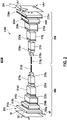
- Figure 2 depicts schematically the exemplary radio access network configuration model RCM.
- the at least one performance indicator pi can be provided - as shown - at the input section 202 as a separate parameter.
- the performance indicator pi is provided as a separate layer of the representation rp.
- the machine-trained radio access network configuration model RCM comprises a convolutional neural network CNN.
- the convolutional neural network CNN comprises a downsampling section 206 and an upsampling section 208 between the input section 202 and the output section 204.
- the network CNN comprises a plurality of convolutional layers 210a-m, pooling layers 220a-e, and up-pooling layers 230a-e.
- the convolutional layer 210a-m applies a spatial filter to the input image.
- the spatial filter is shifted successively, wherein the spatial filter has a size smaller than the size of the input image.
- Spatial filtering is equivalent to a convolutional process.
- the convolution process extracts a feature amount of the input image. Padding, etc. may be performed in the convolutional layer 210a-m.
- the convolutional layer 210a-m may also use a plurality of spatial filters in parallel and perform a plurality of spatial filtering steps in parallel on the input image. Using a plurality of spatial filters in parallel increases the image.
- the number of spatial filters used in parallel in the convolutional layer 210a-m is referred to as the number of channels.
- the representation rp of the production environment is provided in image-like form to the model RCM. Therefore, the spatial directions xy are represented by pixels of the representation.
- the different channels of the representation rp represent different objects and their properties.
- the areas in the plan where the radio access points can be placed are marked.
- the model RP is provided with a vector of performance indicators pi.
- the model RCM directly outputs the spatial positions and configuration of the radio access nodes. This could again be done in image-like form, since the number of APs is variable and their spatial arrangement is thus directly mapped.
- the training data for the model RCM consists of representations of different production environments, access point arrangements and associated performance indicators. These can be recorded by means of models, simulations or measurements. To guarantee configurations c with the best possible performance indicators in the training data, we propose to collect them using multi-objective optimization. This ensures that the model can generate quasi-optimal solutions.
- a promising approach here is genetic algorithms, since they can be applied to complex search spaces with variable dimensionality (here because of the variable number of APs).
- the pooling layer 220a-e reduces the size of the image by aggregating a plurality of pixels included in an arbitrary region in the image into a single pixel. For aggregation of a plurality of pixels into a single pixel, average pooling or maximum pooling is performed. In average pooling, an average value of a plurality of pixel values in the region is used for the single pixel. In maximum pooling, the maximum value of a plurality of pixel values in the region is used for the single pixel. A pooling process is performed to reinforce the robustness for translation of a representative value or an average value in the region of interest.
- the up-pooling layer 230a-e performs a process opposite to the process in the pooling layer 220a-e. In other words, the size of the image is reduced in the pooling layer 220a-e, but the size of the image is enlarged in the up-pooling layer 230a-e.
- a plurality of differing suggestions for configuring the radio access nodes in form of a plurality of configurations c are provided by the model RCM being a generative model.
- the generative model suggests one or more potential configurations c based on the representation rp and the at least one performance indicator pi.
- Figure 3 depicts schematically the digital representation rp of the production environment.
- the representation comprises data representing physical properties of the planned production environment.
- the exemplary production environment PEnv comprises two stationary production lines as production equipment PEa, PEz.
- the spatial positions pa1-n, pb1-n of the respective production equipment PEa, PEz are a set of points that lie within the outer contours of the respective production line.
- mobile production environment like moving robots or the like can be represented by defining outer contours of the radius of motion, therefore defining a further plurality of spatial positions associated with a potential presence of a radio terminal Ta1-n, Tb1-n.
- the representation rp comprises a plurality of spatial positions available, in particular in form of areas aa1, aan that are available for deploying the plurality of radio access nodes A1, An. Due to building constraints like pipes on the ceiling area, there may be only a part of the production area in form of the areas aa1, aan available for deploying the radio access nodes.
- the at least one performance indicator pi comprises at least one of the following:
- the minimum signal-to-interference-plus-noise ratio is the main performance indicator to be fulfilled for the points of interests, e.g., the radio terminals at the machines of the production equipment, potential trajectories of mobile robots. Additionally, the total used bandwidth is to be fulfilled, which can be calculated from the information of the frequency bands already in use.
- the fulfillment of the minimum signal-to-interference-plus-noise ratio can be used to infer the reliability of the communication link.
- the total used bandwidth gives a reference on the system's ability to support additional users in the future (who could use remaining bandwidth without affecting the current deployment).
- bandwidth is scarce and costly. Thus, its usage should be minimized if possible.
- the one with the smallest used bandwidth should be preferred in order to reduce costs and/or to enable new devices to be served in the future.
- Figure 4 illustrates the result at the output of the RCM model in the form of configuration c, following Figure 3 .
- the configuration c is the starting point for deploying the radio access network comprising a plurality of radio access nodes.
- the respective configuration cA1, cAn is associated with one of the planned radio access nodes comprises at least a spatial position indicator spi1, spin indicating at least one spatial position q1, qn for deploying and mounting the radio access node A1, An.
- the respective configuration cA1, cAn further comprises at least one of the following: An antenna directivity indicator adi1, adin indicating at least one direction indication a main lobe I1, In of radiation, wherein the antenna directivity indicator adi1, adin is associated with a respective spatial position q1, qn; a radiated power indicator indicating a transmission and/or reception power of the radio access node A1, An; and a frequency band indicator indicating at least one frequency band to be used by the radio access node.
- the frequency bands are configurable per access node, which then results in a frequency plan alongside the spatial deployment plan.
- Figure 5 depicts a deployed radio access network comprising the radio access nodes A1, An at the production environment.
- the radio access network is configured according to the configuration as exemplified in figure 4 . Accordingly, the planned production equipment is served by the configured radio access network.
Landscapes
- Engineering & Computer Science (AREA)
- Computer Networks & Wireless Communication (AREA)
- Signal Processing (AREA)
- Theoretical Computer Science (AREA)
- Evolutionary Computation (AREA)
- Life Sciences & Earth Sciences (AREA)
- Health & Medical Sciences (AREA)
- Physics & Mathematics (AREA)
- Artificial Intelligence (AREA)
- Software Systems (AREA)
- Computing Systems (AREA)
- Mathematical Physics (AREA)
- Data Mining & Analysis (AREA)
- Biophysics (AREA)
- General Health & Medical Sciences (AREA)
- Molecular Biology (AREA)
- Bioinformatics & Computational Biology (AREA)
- General Engineering & Computer Science (AREA)
- General Physics & Mathematics (AREA)
- Computational Linguistics (AREA)
- Biomedical Technology (AREA)
- Physiology (AREA)
- Bioinformatics & Cheminformatics (AREA)
- Evolutionary Biology (AREA)
- Computer Vision & Pattern Recognition (AREA)
- Databases & Information Systems (AREA)
- Medical Informatics (AREA)
- Mobile Radio Communication Systems (AREA)
Priority Applications (2)
| Application Number | Priority Date | Filing Date | Title |
|---|---|---|---|
| EP21168303.2A EP4075733A1 (de) | 2021-04-14 | 2021-04-14 | Verfahren und vorrichtung zur funkzugangsnetzplanung in einer produktionsumgebung |
| CN202210384256.1A CN115209421A (zh) | 2021-04-14 | 2022-04-13 | 用于生产环境中无线电接入网络规划的方法和装置 |
Applications Claiming Priority (1)
| Application Number | Priority Date | Filing Date | Title |
|---|---|---|---|
| EP21168303.2A EP4075733A1 (de) | 2021-04-14 | 2021-04-14 | Verfahren und vorrichtung zur funkzugangsnetzplanung in einer produktionsumgebung |
Publications (1)
| Publication Number | Publication Date |
|---|---|
| EP4075733A1 true EP4075733A1 (de) | 2022-10-19 |
Family
ID=75539065
Family Applications (1)
| Application Number | Title | Priority Date | Filing Date |
|---|---|---|---|
| EP21168303.2A Pending EP4075733A1 (de) | 2021-04-14 | 2021-04-14 | Verfahren und vorrichtung zur funkzugangsnetzplanung in einer produktionsumgebung |
Country Status (2)
| Country | Link |
|---|---|
| EP (1) | EP4075733A1 (de) |
| CN (1) | CN115209421A (de) |
Cited By (1)
| Publication number | Priority date | Publication date | Assignee | Title |
|---|---|---|---|---|
| EP4738914A1 (de) * | 2024-11-05 | 2026-05-06 | Uniberg GmbH | Netzwerkverfahren, netzwerksystem, computerprogrammprodukt und computerlesbares medium |
Families Citing this family (1)
| Publication number | Priority date | Publication date | Assignee | Title |
|---|---|---|---|---|
| CN120111505B (zh) * | 2025-02-08 | 2025-12-26 | 辽宁钢研高纳智能制造有限公司 | 一种无线网络架设方法、装置、电子设备及存储介质 |
Citations (3)
| Publication number | Priority date | Publication date | Assignee | Title |
|---|---|---|---|---|
| EP2629247A1 (de) * | 2012-02-15 | 2013-08-21 | Alcatel Lucent | Verfahren zum Lokalisieren von Medienkomponenten unter Verwendung des Maschinenlernens |
| WO2020064134A1 (en) * | 2018-09-28 | 2020-04-02 | Nokia Technologies Oy | Radio-network self-optimization based on data from radio network and spatiotemporal sensors |
| US20200178093A1 (en) * | 2018-11-29 | 2020-06-04 | Beijing University Of Posts And Telecommunications | Intent-driven radio access networking method and system |
-
2021
- 2021-04-14 EP EP21168303.2A patent/EP4075733A1/de active Pending
-
2022
- 2022-04-13 CN CN202210384256.1A patent/CN115209421A/zh active Pending
Patent Citations (3)
| Publication number | Priority date | Publication date | Assignee | Title |
|---|---|---|---|---|
| EP2629247A1 (de) * | 2012-02-15 | 2013-08-21 | Alcatel Lucent | Verfahren zum Lokalisieren von Medienkomponenten unter Verwendung des Maschinenlernens |
| WO2020064134A1 (en) * | 2018-09-28 | 2020-04-02 | Nokia Technologies Oy | Radio-network self-optimization based on data from radio network and spatiotemporal sensors |
| US20200178093A1 (en) * | 2018-11-29 | 2020-06-04 | Beijing University Of Posts And Telecommunications | Intent-driven radio access networking method and system |
Cited By (1)
| Publication number | Priority date | Publication date | Assignee | Title |
|---|---|---|---|---|
| EP4738914A1 (de) * | 2024-11-05 | 2026-05-06 | Uniberg GmbH | Netzwerkverfahren, netzwerksystem, computerprogrammprodukt und computerlesbares medium |
Also Published As
| Publication number | Publication date |
|---|---|
| CN115209421A (zh) | 2022-10-18 |
Similar Documents
| Publication | Publication Date | Title |
|---|---|---|
| KR102030128B1 (ko) | 기계학습을 이용한 무선 백홀망 자원할당방법 및 자원할당 장치 | |
| JPH04504038A (ja) | 無線セルを設計するための方法 | |
| US20190223029A1 (en) | Systems and methods for automatically configuring frequencies of radio communication devices | |
| CN113965942B (zh) | 一种网络配置方法及装置 | |
| JP5475822B2 (ja) | 無線通信ネットワークにおいて装置をクラスタ化する方法 | |
| JP4254929B2 (ja) | 位置決定方法およびシステム | |
| WO2022051226A1 (en) | Method and apparatus for cbrs network planning and operating in an enterprise network | |
| CN113365209A (zh) | 确定移动设备的目标定位 | |
| CN115209421A (zh) | 用于生产环境中无线电接入网络规划的方法和装置 | |
| EP3668140B1 (de) | Verfahren, durchgeführt von einer rechenvorrichtung, und rechenvorrichtung für netzwerkdesign in einem drahtloskommunikationssystem | |
| CN114615693A (zh) | 网络容量预测方法、装置、电子设备及计算机存储介质 | |
| CN120075741A (zh) | 一种基于5g的高精度定位方法 | |
| CN116324803A (zh) | 一种数据处理方法及相关设备 | |
| US11729741B2 (en) | Detection of a change of a remote unit of a centralized radio access network (C-RAN) | |
| Atakpo et al. | A comparative analysis of selforganizing map and k-means models for selection of cluster heads in out-of-band device-to-device communication | |
| EP3454619B1 (de) | Verfahren und system zur realisierung einer kommunikation zwischen antennen-cloud-knoten in einem hochdichten innenraumnetzwerk | |
| US11533633B2 (en) | Frequency planning for a communication system | |
| CN116056102B (zh) | 无人机基站部署方法、装置、电子设备及存储介质 | |
| CN116017717B (zh) | 一种无人系统集群网络中的混合式智能频谱管理方法 | |
| CN115134817B (zh) | 5g波束赋形优化方法及系统 | |
| US7054795B1 (en) | Method for selecting optimized lengths of a segmented transmission line and a transmission line resulting therefrom | |
| CN102315891B (zh) | 一种业务测试方法和系统 | |
| Hayashi et al. | Fine-tuning approach to configuration and data selection for path loss prediction in different geographical environments | |
| Suzuki et al. | Power estimation by power contour to monitor sharable frequency with mobile phone sensors | |
| Mahajan et al. | Improved learning scheme for cognitive radio using artificial neural networks |
Legal Events
| Date | Code | Title | Description |
|---|---|---|---|
| PUAI | Public reference made under article 153(3) epc to a published international application that has entered the european phase |
Free format text: ORIGINAL CODE: 0009012 |
|
| STAA | Information on the status of an ep patent application or granted ep patent |
Free format text: STATUS: THE APPLICATION HAS BEEN PUBLISHED |
|
| AK | Designated contracting states |
Kind code of ref document: A1 Designated state(s): AL AT BE BG CH CY CZ DE DK EE ES FI FR GB GR HR HU IE IS IT LI LT LU LV MC MK MT NL NO PL PT RO RS SE SI SK SM TR |
|
| STAA | Information on the status of an ep patent application or granted ep patent |
Free format text: STATUS: REQUEST FOR EXAMINATION WAS MADE |
|
| 17P | Request for examination filed |
Effective date: 20230419 |
|
| RBV | Designated contracting states (corrected) |
Designated state(s): AL AT BE BG CH CY CZ DE DK EE ES FI FR GB GR HR HU IE IS IT LI LT LU LV MC MK MT NL NO PL PT RO RS SE SI SK SM TR |
|
| STAA | Information on the status of an ep patent application or granted ep patent |
Free format text: STATUS: EXAMINATION IS IN PROGRESS |
|
| 17Q | First examination report despatched |
Effective date: 20240902 |