EP4077253B1 - Procédé de production d'alcoolates métalliques - Google Patents
Procédé de production d'alcoolates métalliques Download PDFInfo
- Publication number
- EP4077253B1 EP4077253B1 EP20829876.0A EP20829876A EP4077253B1 EP 4077253 B1 EP4077253 B1 EP 4077253B1 EP 20829876 A EP20829876 A EP 20829876A EP 4077253 B1 EP4077253 B1 EP 4077253B1
- Authority
- EP
- European Patent Office
- Prior art keywords
- column
- alcohol
- solution
- metal alkoxide
- process according
- Prior art date
- Legal status (The legal status is an assumption and is not a legal conclusion. Google has not performed a legal analysis and makes no representation as to the accuracy of the status listed.)
- Active
Links
Images

Classifications
-
- C—CHEMISTRY; METALLURGY
- C07—ORGANIC CHEMISTRY
- C07C—ACYCLIC OR CARBOCYCLIC COMPOUNDS
- C07C29/00—Preparation of compounds having hydroxy or O-metal groups bound to a carbon atom not belonging to a six-membered aromatic ring
- C07C29/68—Preparation of metal alcoholates
- C07C29/70—Preparation of metal alcoholates by converting hydroxy groups to O-metal groups
- C07C29/705—Preparation of metal alcoholates by converting hydroxy groups to O-metal groups by transalcoholysis
-
- Y—GENERAL TAGGING OF NEW TECHNOLOGICAL DEVELOPMENTS; GENERAL TAGGING OF CROSS-SECTIONAL TECHNOLOGIES SPANNING OVER SEVERAL SECTIONS OF THE IPC; TECHNICAL SUBJECTS COVERED BY FORMER USPC CROSS-REFERENCE ART COLLECTIONS [XRACs] AND DIGESTS
- Y02—TECHNOLOGIES OR APPLICATIONS FOR MITIGATION OR ADAPTATION AGAINST CLIMATE CHANGE
- Y02P—CLIMATE CHANGE MITIGATION TECHNOLOGIES IN THE PRODUCTION OR PROCESSING OF GOODS
- Y02P20/00—Technologies relating to chemical industry
- Y02P20/10—Process efficiency
Definitions
- Metal alcoholates can be produced from metal hydroxides (MOH) and alcohols (ROH) that are passed in countercurrent in a reactive distillation column according to the following reaction equation, whereby water produced during the reaction is removed with the distillate: MOH + ROH MOR + H 2 O
- the EP 0 091 425 A1 describes such a process, in which an aqueous alkali metal hydroxide is introduced into the rectifying section and a gaseous alcohol is introduced into the bottom of the column. Water is discharged via the top of the column as an azeotrope and subjected to separation. Similar processes are described in EP 1 997 794 A1 and the DD 246 988 A1 described.
- Metal alcoholates can also be prepared by transalcoholization according to the following formula, whereby alcoholates of low-boiling alcohols (MOR 1 ) are reacted with a higher-boiling alcohol (R 2 OH) by reactive distillation to form alcoholates of higher-boiling alcohols and lower alcohols: MOR 1 + R 2 OH MOR 2 + R 1 OH
- the known processes for producing metal alcoholates of higher-boiling alcohols require a high amount of energy.
- the object of the present invention is to provide a process for producing metal alcoholates with reduced energy requirements.
- the lower metal alcoholate and the higher alcohol are re-alcoholized in order to obtain the higher metal alcoholate and the lower alcohol.
- a vapor comprising lower alcohol is withdrawn at the top of the reactive distillation column and a solution of the higher metal alcoholate in the higher alcohol is withdrawn at the bottom of the column and/or from the bottom outlet.
- a gaseous and a liquid fraction are thus withdrawn.
- the degree of purity of the fractions obtained is crucial for the efficiency of the process and the usability of the fractions.
- the vapor drawn off at the top of the column is at least partially condensed and a partial flow of the condensate obtained is returned to the top of the column as reflux.
- a gas phase and a liquid phase are in contact with each other and are fed in countercurrent to each other. A mass transfer takes place between the gas phase and the liquid phase. The more volatile components accumulate in the gas phase towards the top of the column and the less volatile components accumulate in the liquid phase towards the bottom of the column.
- the degree of purity particularly of the solution of the higher metal alcoholate withdrawn at the bottom and/or from the bottom circulation, can be adjusted, among other things, via the reflux ratio at the top of the column. As a rule, a higher reflux ratio results in a higher degree of purity of the solution of the higher metal alcoholate.
- the process according to the invention therefore has a significantly lower energy requirement for the same separation task.
- lower and higher alcohol mean lower boiling alcohol and higher boiling alcohol. It is understood that in the process according to the invention the higher alcohol (“transalcoholization alcohol”) has a higher boiling point than the alcohol of the lower metal alcoholate.
- the process according to the invention is generally applicable to the reaction of metal alcoholates of lower alcohols with higher alcohols, provided that the alcohols can be distilled and the solubility behavior of the lower and higher metal alcoholates allows the reaction in the liquid phase.
- the lower metal alcoholate is fed into the reactive distillation column via a lateral inlet.
- lateral means that the feed takes place below the top of the column and above the bottom of the column.
- the location of the inlet of the lower metal alcoholate divides the column into a rectifying section (above the inlet) and a stripping section (below the location of the inlet). The alcohol conversion takes place in the stripping section of the column.
- the lower metal alcoholate is fed as a solution in the lower alcohol, the solution comprising 20 to 40 wt.% of the lower metal alcoholate, preferably 25 to 35 wt.% of the lower metal alcoholate, such as 28 to 32 wt.% of the lower metal alcoholate, based on the total weight of the lower metal alcoholate solution.
- the lower metal alcoholate is usually a metal alcoholate of a monohydric C 1 -C 4 alcohol, i.e. methoxide, ethanolate, propoxide, butoxide and their constitutional isomers, including cyclic alcoholates.
- the lower metal alcoholate is particularly preferably metal methoxide or metal ethoxide, in particular metal methoxide.
- the lower metal alcoholate is usually an alkali metal alcoholate, preferably a sodium alcoholate or a potassium alcoholate.
- the lower metal alcoholate sodium methoxide or potassium methoxide especially sodium methoxide.
- the temperature of the solution of the lower metal alcoholate at the side inlet is suitably selected so that the lower metal alcoholate always remains in solution.
- the temperature of the solution of the lower metal alcoholate is preferably at least 6 °C, in particular at least 10 °C and particularly preferably at least 20 °C, for example 25 °C or 30 °C.
- the solution of the lower metal alcoholate can be preheated to the boiling temperature, for example in a heat exchanger in which the solution of the higher metal alcoholate withdrawn at the bottom of the column is simultaneously cooled. This is particularly advantageous in terms of energy.
- a higher alcohol is fed into the stripping section, the bottom and/or a bottom circuit of the reactive distillation column, preferably into the bottom and/or the bottom circuit.
- the higher alcohol can be fed into the stripping section, the bottom or bottom circuit of the column in liquid form or in gaseous form.
- the higher alcohol is preferably fed into the stripping section, the bottom and/or bottom circuit of the column in liquid form.
- the higher alcohol is particularly preferably fed into the bottom and/or bottom circuit, in particular the bottom circuit of the column, in liquid form.
- the reactive distillation column usually has an evaporator, preferably a circulation evaporator.
- a partial stream of the solution of the higher-boiling metal alcoholate withdrawn at the bottom of the column is heated and at least partially fed back into the bottom of the column in gaseous form. Alternatively or additionally, the bottom is heated directly. Part of the higher alcohol is present in gaseous form in the reactive distillation column and rises towards the top of the column.
- the higher alcohol is usually selected from monohydric C 2 -C 10 alcohols, i.e. ethanol, propanol, butanol, pentanol, hexanol, heptanol, octanol, nonanol, decanol and their constitutional isomers, including cyclic alcohols.
- monohydric C 2 -C 10 alcohols i.e. ethanol, propanol, butanol, pentanol, hexanol, heptanol, octanol, nonanol, decanol and their constitutional isomers, including cyclic alcohols.
- polyhydric C 2 -C 10 alcohols such as diols, for example ethylene glycol, diethylene glycol, propanediol or butanediol, can also be used.
- the higher alcohol is particularly preferably selected from isopropanol, sec-butanol, 2-methyl-2-butanol, tert-butanol, 2-methyl-2-pentanol, 3-methyl-3-pentanol, 3-ethyl-3-pentanol, 2-methyl-2-hexanol and 3-methyl-3-hexanol.
- isopropanol, 2-methyl-2-butanol, 3-methyl-3-pentanol and 3-ethyl-3-pentanol in particular isopropanol and 2-methyl-2-butanol.
- a solution of the higher metal alcoholate in the higher alcohol is withdrawn at the bottom of the column and/or from the bottom circulation.
- the withdrawn solution of the higher metal alcoholate advantageously contains only small amounts of lower alcohol, which allows an efficient process.
- the solution of the higher metal alcoholate preferably comprises at most 1.0% by weight of the lower alcohol, particularly preferably at most 0.5% by weight of the lower alcohol and very particularly preferably at most 0.3% by weight of the lower alcohol, for example 0.01 to 0.20% by weight of the lower alcohol or 0.01 to 0.10% by weight of the lower alcohol, based on the total weight of the withdrawn solution of the higher metal alcoholate.
- the methanol concentration in the solution of the higher metal alcoholate can be determined, for example, by means of headspace analysis or by means of gas chromatography.
- the solution of the higher metal alcoholate usually comprises 3 to 60 wt.% of the higher metal alcoholate, preferably 5 to 55 wt.% and particularly preferably 7 to 50 wt.% of the higher metal alcoholate, for example 7 to 30 wt.%, 7 to 25 wt.%, 7 to 20 wt.% or 7 to 15 wt.% of the higher metal alcoholate, based on the total weight of the withdrawn solution of the higher metal alcoholate.
- the concentration of the higher metal alcoholate in the solution of the higher metal alcoholate can be determined, for example, by means of titration.
- a vapor containing lower alcohol is drawn off.
- the drawn off vapor consists essentially of lower alcohol and advantageously contains only small amounts of higher alcohol, which allows an efficient process.
- the vapor is at least partially condensed ("top condensate"), wherein the top condensate preferably comprises at most 1.0% by weight of the higher alcohol, particularly preferably at most 0.6% by weight of the higher alcohol and very particularly preferably at most 0.5% by weight of the higher alcohol, based on the total weight of the top condensate.
- the concentration of the higher alcohol in the top condensate can be determined, for example, by means of gas chromatography.
- the lower metal alcoholate and the higher alcohol are brought into contact with one another in a reactive distillation column.
- the contact between the lower metal alcoholate and the higher alcohol takes place in countercurrent.
- the higher alcohol is partially in gaseous form and rises in the column towards the top of the column, while the solution of the lower metal alcoholate sinks towards the bottom of the column.
- the higher alcohol and the lower metal alcoholate are re-alcoholized to obtain the higher metal alcoholate and the lower alcohol.
- a conventional reactive distillation column can be used as the reactive distillation column.
- the column is selected, for example, from among packed columns, packed columns and tray columns, particularly preferably tray and packed columns.
- the reactive distillation column of the process according to the invention preferably has trays as internals, for example selected from bubble trays, valve trays, tunnel trays and Thormann ® trays.
- Packed columns can be filled with different shaped bodies. Heat and mass transfer are improved by increasing the surface area due to the shaped bodies, which are usually around 25 to 80 mm in size.
- Well-known examples are the Raschig ring (a hollow cylinder), Pall ring, Hiflow ring, Intalox saddle and the like.
- the packing can be introduced into the column in an orderly manner or randomly (as a bed). Possible materials include glass, ceramics, metal and plastics.
- Structured packings are a further development of ordered packings. They have a regularly shaped structure. This makes it possible to reduce pressure losses in the gas flow.
- packings e.g. fabric or sheet metal packings.
- the rectifying section of the column comprises packings, while the stripping section of the column comprises trays.
- the head of the column is the area above the top plate or above the top packing layer that is free of internals. It is usually formed by a curved plate (hood, e.g. dished plate or basket arch plate), which forms the closing element of the reactive distillation column.
- hood e.g. dished plate or basket arch plate
- the bottom of the column is the area below the lowest tray or below the lowest packing layer that is free of internals.
- the appropriate number of theoretical separation stages in the rectification section depends on the difference in the vapor pressures of the higher and lower alcohols, with a smaller difference and a higher number of theoretical separation stages being advantageous.
- the appropriate number of theoretical separation stages in the stripping section depends on the difference in the vapor pressures of the higher and lower alcohols and the equilibrium position of the reaction, with a higher number of theoretical separation stages being advantageous the stronger the equilibrium is on the side of the reactants.
- the appropriate number of theoretical separation stages in both the rectification and stripping sections also depends on the degree of purity to be achieved for the bottom and top products and the amount of reflux used, with a higher number of theoretical separation stages being required to achieve a higher purity for a given amount of reflux.
- the column can consist of several individual vessels or individual columns connected in a cascade-like manner.
- the individual vessels or individual columns are preferably arranged one above the other and can optionally be laterally offset from one another.
- the individual vessels or individual columns are arranged next to one another using suitable pumping devices.
- reaction and rectifying sections are preferably arranged one above the other in a single column.
- the vapors containing lower alcohols drawn off at the top of the column are at least partially condensed to give a top condensate.
- Condensation preferably takes place in one or more plate or tube bundle condensers or air coolers connected in series.
- air coolers or tube bundle condensers or combinations thereof are used.
- the condensers can be cooled using air, cooling water or brine, for example.
- the vapor is substantially completely condensed, for example to more than 98% by weight or more than 99% by weight, based on the total amount of vapor.
- a partial flow of the condensate obtained is returned to the top of the column as reflux.
- the reflux ratio influences the purity of the withdrawn gaseous fraction and in particular the withdrawn liquid fraction.
- the reflux ratio is understood to be the ratio of the partial flow of condensate (kg/h) that is returned to the column (reflux) and the partial flow of condensate (kg/h) that is discharged from the process.
- the reflux ratios mentioned are based on the use of monohydric, aliphatic or cycloaliphatic higher alcohols. With other higher alcohols, e.g. dihydric or polyhydric alcohols or alcohols other than aliphatic or cycloaliphatic alcohols, the reflux quantity may be higher if necessary. The optimum reflux quantity is determined in preliminary tests.
- the optimum reflux ratio for the process according to the invention is determined in a known manner such that, with an economic optimum in terms of the power required to separate the lower and higher alcohols present in the system, an optimum is achieved in terms of the purity of the lower alcohol to be discharged at the top or of the solution of the higher alcoholate in the higher alcohol to be withdrawn at the bottom.
- the lower alcohol withdrawn at the top i.e. the partial stream of the top condensate
- the lower alcohol withdrawn at the top is usually of high purity and can be reused without further distillation. Only the excess part of the top condensate that is not needed to adjust the reflux rate is removed from the system. The remaining part of the top condensate is returned to the top of the column as reflux.
- the reactive distillation column usually has a bottom circulation.
- a partial stream of the solution of the higher metal alcoholate in the higher alcohol withdrawn at the bottom of the column is returned to the bottom of the column, while another partial stream of the solution of the higher metal alcoholate in the higher alcohol withdrawn at the bottom of the column is discharged from the process.
- a partial stream from the bottom circulation is returned to the bottom of the column, while another partial stream is removed from the bottom circulation, preferably after the evaporator, and discharged from the process.
- the reactive distillation column has an evaporator that is integrated in the column bottom, or preferably an evaporator that is incorporated in a bottom circulation.
- a partial stream of the solution of the higher metal alcoholate withdrawn at the bottom of the column is fed to the evaporator via a bottom circulation and then returned to the column as a heated, possibly two-phase fluid stream.
- Suitable evaporators include, for example, reboilers, natural circulation evaporators, forced circulation evaporators and forced circulation flash evaporators.
- a pump is used to pass the liquid to be evaporated through the heater. The resulting vapor/liquid mixture is then returned to the column.
- Forced circulation flash evaporators also use a pump to pass the liquid to be evaporated through the heater.
- a superheated liquid recycle stream is obtained, which is expanded into the bottom of the column.
- the pressure on the metal alcoholate solution withdrawn from the column and returned to the column is increased by superheating.
- the superheated recycle stream is expanded via a flow restrictor. This causes the liquid to be superheated above its boiling point in relation to the pressure inside the column.
- the flow limiting means is advantageously arranged immediately before the superheated liquid re-enters the column, or even inside it.
- an orifice, a valve, a throttle, a perforated disk, a nozzle, a capillary or combinations thereof, in particular a valve is used as the flow limiting means.
- a rotary cone valve can be used. It is particularly preferred if the opening characteristics of the flow limiting means are adjustable. In this way, the pressure in the evaporator can always be kept above the boiling pressure of the liquid, based on the pressure inside the column, even with changed flow rates, as can occur, for example, during start-up and shut-down processes.
- an increased flow rate of the liquid in the heating device e.g. in the tube bundle of the heat exchanger, is achieved compared to operation with natural circulation.
- the increased flow rate results in improved heat transfer between the heat exchanger and the heated liquid, which in turn helps to avoid local overheating.
- the pump to be used in forced circulation or forced circulation flash evaporators is preferably arranged between the extraction line and the evaporator.
- the column has a forced circulation evaporator and the higher alcohol is fed in liquid form into the feed to the forced circulation evaporator.
- the sump can be heated directly, for example by means of a reboiler.
- the bottom temperature of the reactive distillation column determines the concentration of the higher metal alcoholate in the solution withdrawn from the bottom of the column or from the bottom circulation at a given pressure.
- the temperature and thus the concentration are expediently selected so that the higher metal alcoholate always remains in solution in the bottom.
- the bottom temperature is set, for example, via an evaporator and/or direct heating of the bottom.
- the process according to the invention can be carried out under normal pressure as well as under increased or reduced pressure. It is advantageous to operate the reactive distillation column at a pressure of 0.2 to 10 bar absolute.
- the reactive distillation column is preferably operated at ambient pressure, for example 1 bar absolute.
- the equilibrium position of the reaction is temperature-dependent in the preparation of some alcoholates. In these cases, high temperatures can advantageously result in a higher conversion. It can also be advantageous to carry out the process according to the invention under increased pressure, for example at least 1.5 bar absolute, at least 2.5 bar absolute, or at least 5.0 bar absolute.
- the process according to the invention can be carried out both continuously and batchwise.
- the process according to the invention is preferably carried out continuously.
- the reaction equilibrium is constantly readjusted by the constant exchange of materials and the changing concentrations within the gas phase and the liquid phase, which enables a high conversion.
- the amount of reflux of the lower alcohol can be adjusted by feeding it to the top of the column, with the stripping section and the bottom being filled with the higher alcohol.
- Lower alcohol can also be added to the higher alcohol.
- the solution of the lower metal alcoholate is added. During the reaction, new lower alcohol is continuously formed.
- the reactive distillation column is filled with the higher alcohol before start-up and this is initially used as reflux. Once the operating temperature has been reached, the solution of the lower metal alcoholate is then added.
- the vapor or its condensate drawn off at the top of the column usually consists of essentially pure lower alcohol.
- the condensate can be discharged without further purification and used, for example, to produce lower metal alcoholates or solutions thereof.
- the solution of the higher metal alcoholate withdrawn from the bottom of the column and/or from the bottom circulation usually consists essentially of the higher alcohol and the higher metal alcoholate.
- the solution of the higher metal alcoholate can therefore be reused as such, if necessary after cooling in a heat exchanger.
- the higher alcohol can be separated from the higher metal alcoholate. This can be done by evaporation.
- Fig.1 shows a comparison plant suitable for the production of metal alcoholates.
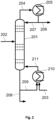
- Fig.2 shows a plant suitable for producing metal alcoholates by means of the process according to the invention.
- the plant comprises a reactive distillation column 101.
- a solution of a lower metal alcoholate together with a higher alcohol from line 103 is fed into this via line 102.
- a vapor comprising lower alcohol is withdrawn via line 104 and condensed in condenser 105.
- a first partial stream of the condensed vapor is discharged from the process via line 106, while a second partial stream of the condensed vapor is returned to the top of the column via line 107.
- a solution of a higher metal alcoholate in the higher alcohol is withdrawn.
- a first partial stream of the solution of the higher metal alcoholate is discharged from the process via line 108, while a second partial stream of the solution of the higher metal alcoholate is returned to the bottom of the column via the evaporator 110 and line 111.
- the plant comprises a reactive distillation column 201.
- a solution of a lower metal alcoholate is fed into this via line 202.
- a higher alcohol is fed into the bottom circulation via line 203 and the evaporator 210.
- a vapor comprising lower alcohol is withdrawn via line 204 and condensed in condenser 205.
- a first partial stream of the condensed vapor is discharged from the process via line 206, while a second partial stream of the condensed vapor is returned to the top of the column via line 207.
- a solution of a higher metal alcoholate in the higher alcohol is withdrawn.
- a first partial stream of the solution of the higher metal alcoholate is discharged from the process via line 208, while a second partial stream of the solution of the higher metal alcoholate is returned to the bottom of the column via the evaporator 210 together with the higher alcohol from line 203 via line 211.
- the sample was mixed with 1 mL of tap water, sealed with an aluminum cap and analyzed by headspace GC (separation column DB-1, length 30 m, Inner diameter 0.25 mm, film thickness 1.0 ⁇ m). Quantification was carried out using the standard addition method. The detection limit was less than 100 mg/kg.
- a multiple determination of the sample is carried out, for example a double determination.
- a specific amount of the substance to be determined (the higher alcohol) is added to each sample several times and the sample is measured after each addition.
- the increase in the substance signal is determined.
- the concentration of the higher alcohol in the original sample can be calculated by linear regression.
- the solubility of the samples must be checked in advance. If two phases form, the sample weight must be reduced.
- the examples were carried out in a system that included a glass bubble-cap column with 80 trays and a forced circulation flash evaporator.
- Tables 1A and 1B show the specific parameters of the examples.
- the evaporator was heated with a commercially available thermostat (Julabo HT6) with a maximum heating power of 5700 W.
- the diameter of the column was 50 mm.
- Sodium methoxide (30 wt.% in methanol) was fed into the side of the column. To avoid heat losses, the column was heated isothermally with an electric protective heater.
- the higher alcohol was fed into the column either before the evaporator or onto a tray in the stripping section or together with sodium methoxide from the side.
- the amount of higher metal alcoholate or methanol in the solution of the higher metal alcoholate withdrawn at the bottom was determined.
- the vapor was discharged from the top of the column and condensed in a condenser. The amount of higher alcohol in the top condensate was determined.
- Comparative example 1 was initially carried out as in example 1. After the steady state had been established, the feed of isopropanol upstream of the evaporator was stopped and isopropanol was instead fed in together with sodium methoxide. The composition of the top condensate or the sodium isopropoxide withdrawn at the bottom was determined after the steady state had been established again.
- Comparative example 2 was initially carried out in the same way as example 2. After the steady state had been established, the feed of sec-butanol upstream of the evaporator was stopped and sec-butanol was instead fed in together with sodium methoxide. The composition of the top condensate or the sodium sec-butoxide withdrawn at the bottom was determined after the steady state had been established again.
- Comparative Example 3 was carried out analogously to Example 5, with the difference that the 2-methyl-2-butanol was not fed in before the evaporator, but together with sodium methoxide on tray 30. The composition of the top condensate or of the sodium 2-methyl-2-butoxide withdrawn at the bottom was determined after the steady state had been established.
- Table 1A Experimental data for Examples 1 and 2 and Comparative Examples 1 and 2.
- Example 1 From the comparison of Example 1 with Comparative Example 1, it is evident that feeding the higher alcohol upstream of the evaporator results in a lower methanol concentration in the bottom than feeding the higher alcohol together with the lower alcoholate at tray 40 of the column at the same feed to reflux ratio.
- Table 2 Specific heating output Example 2 Comparison example 2, variant 4 Example 5, Variant 2 Comparison example 3, variant 1 Methanol in the bottoms [wt.%] 0.07 0.1 0.76 0.82 Oil temperature flow [°C] 120.1 122.8 122.5 127.7 Oil temperature return [°C] 115.4 117.6 117.5 121.2 ⁇ T flow / return [°C] 4.7 5.2 5 6.5 Oil mass flow [kg/h] 331.0 322.3 319.1 190.1 Heating capacity evaporator [W] 752 810 771 597 specific heating power [J/g] 10.1 10.9 18.0 25.2
Landscapes
- Chemical & Material Sciences (AREA)
- Organic Chemistry (AREA)
- Chemical Kinetics & Catalysis (AREA)
- Organic Low-Molecular-Weight Compounds And Preparation Thereof (AREA)
Claims (11)
- Procédé de fabrication d'alcoolates métalliques par transalcoolisation, dans lequel- on injecte par une alimentation latérale un alcoolate métallique inférieur dans une colonne de distillation réactive comportant une section de rectification disposée au-dessus de l'alimentation et une section d'épuisement disposée en dessous de l'alimentation ;- on injecte un alcool supérieur dans la section d'épuisement, dans le fond et/ou dans une recirculation du fond de la colonne ;- on soutire au fond de la colonne, et/ou de la recirculation du fond, une solution d'un alcool métallique supérieur dans l'alcool supérieur ; et- on soutire en tête de la colonne une vapeur comprenant un alcool inférieur, on condense au moins partiellement la vapeur et on renvoie un courant partiel du condensat sous forme de reflux en tête de la colonne ;dans lequel l'alcool supérieur présente un point d'ébullition supérieur à celui de l'alcool inférieur.
- Procédé selon la revendication 1, dans lequel l'alcool supérieur est injecté sous forme liquide dans le fond et/ou dans la recirculation du fond de la colonne.
- Procédé selon la revendication 1 ou 2, dans lequel la solution de l'alcoolate métallique supérieur comprend au plus 1,0 % en poids de l'alcool inférieur, par rapport au poids total de la solution de l'alcoolate métallique supérieur.
- Procédé selon l'une des revendications précédentes, dans lequel la solution de l'alcoolate métallique supérieur comprend 3 à 60 % en poids de l'alcoolate métallique supérieur, par rapport au poids total de la solution de l'alcoolate métallique supérieur.
- Procédé selon l'une des revendications précédentes, dans lequel la colonne comprend un évaporateur à circulation forcée, et on injecte l'alcool supérieur sous forme liquide dans l'alimentation de l'évaporateur à circulation forcée.
- Procédé selon l'une des revendications précédentes, dans lequel le condensat de tête comprend au plus 0,8 % en poids de l'alcool supérieur, par rapport au poids total du condensat de tête.
- Procédé selon l'une des revendications précédentes, dans lequel on injecte l'alcoolate métallique inférieur sous forme d'une solution dans l'alcool inférieur, et la solution comprend 20 à 40 % en poids de l'alcoolate métallique inférieur, par rapport au poids total de la solution de l'alcoolate métallique inférieur.
- Procédé selon l'une des revendications précédentes, caractérisé en ce que l'alcoolate métallique inférieur est un alcoolate d'un métal alcalin.
- Procédé selon la revendication 8, dans lequel l'alcoolate métallique inférieur est un alcoolate de sodium ou un alcoolate de potassium.
- Procédé selon la revendication 9, dans lequel l'alcoolate métallique inférieur est le méthanolate de sodium ou le méthanolate de potassium, en particulier le méthanolate de sodium.
- Procédé selon l'une des revendications précédentes, dans lequel l'alcool supérieur est choisi parmi les composés isopropanol, sec-butanol, 2-méthyl-2-butanol, tert-butanol, 2-méthyl-2-pentanol, 3-méthyl-3-pentanol, 3-éthyl-3-pentanol, 2-méthyl-2-hexanol et 3-méthyl-3-hexanol, en particulier isopropanol, 2-méthyl-2-butanol, 3-méthyl-3-pentanol et 3-éthyl-3-pentanol.
Applications Claiming Priority (2)
| Application Number | Priority Date | Filing Date | Title |
|---|---|---|---|
| EP19217475 | 2019-12-18 | ||
| PCT/EP2020/086362 WO2021122702A1 (fr) | 2019-12-18 | 2020-12-16 | Procédé de production d'alcoolates métalliques |
Publications (2)
| Publication Number | Publication Date |
|---|---|
| EP4077253A1 EP4077253A1 (fr) | 2022-10-26 |
| EP4077253B1 true EP4077253B1 (fr) | 2024-06-12 |
Family
ID=68944618
Family Applications (1)
| Application Number | Title | Priority Date | Filing Date |
|---|---|---|---|
| EP20829876.0A Active EP4077253B1 (fr) | 2019-12-18 | 2020-12-16 | Procédé de production d'alcoolates métalliques |
Country Status (4)
| Country | Link |
|---|---|
| US (1) | US11945767B2 (fr) |
| EP (1) | EP4077253B1 (fr) |
| CN (1) | CN114787115A (fr) |
| WO (1) | WO2021122702A1 (fr) |
Families Citing this family (13)
| Publication number | Priority date | Publication date | Assignee | Title |
|---|---|---|---|---|
| ES3066980T3 (en) * | 2020-12-04 | 2026-05-19 | Basf Se | Method for controlling a reactive distillation column |
| CN113694851B (zh) * | 2021-09-03 | 2023-02-10 | 江西宝弘纳米科技有限公司 | 一种异丙醇铝合成中防爆沸的方法和设备 |
| WO2023193941A1 (fr) | 2022-04-04 | 2023-10-12 | Evonik Operations Gmbh | Procédé amélioré de dépolymérisation de polyéthylène téréphtalate |
| KR20250092186A (ko) | 2022-10-19 | 2025-06-23 | 에보닉 오퍼레이션스 게엠베하 | 폴리에틸렌 테레프탈레이트의 개선된 탈중합 방법 |
| EP4605361A1 (fr) * | 2022-10-19 | 2025-08-27 | Evonik Operations GmbH | Procédé de production d'un alcoxyde de métal alcalin |
| EP4605360A1 (fr) | 2022-10-20 | 2025-08-27 | Evonik Operations GmbH | Procédé amélioré pour produire des méthoxydes de métaux alcalins |
| JP2025538311A (ja) | 2022-11-30 | 2025-11-27 | エボニック オペレーションズ ゲーエムベーハー | アルカリ金属メトキシドを製造するための改善された方法 |
| JP2025540297A (ja) | 2022-12-07 | 2025-12-11 | エボニック オペレーションズ ゲーエムベーハー | 金属アルコキシド化合物の改善された調製プロセス |
| WO2024125775A1 (fr) | 2022-12-14 | 2024-06-20 | Evonik Operations Gmbh | Procédé amélioré pour préparer des composés d'alcoolates métalliques |
| WO2024156567A1 (fr) | 2023-01-23 | 2024-08-02 | Evonik Operations Gmbh | Processus de dépolymérisation de téréphtalates de polyalkylène dans une extrudeuse |
| WO2024156568A1 (fr) | 2023-01-23 | 2024-08-02 | Evonik Operations Gmbh | Procédé de dépolymérisation de poly(téréphtalates d'alkylène) dans une extrudeuse |
| WO2024156563A1 (fr) | 2023-01-23 | 2024-08-02 | Evonik Operations Gmbh | Processus de dépolymérisation de téréphtalates de polyalkylène dans des mélanges avec des polyoléfines à point de fusion inférieur |
| CN122422283A (zh) | 2023-12-14 | 2026-07-17 | 巴斯夫欧洲公司 | 用于同时制备多种碱金属甲醇盐的集成方法 |
Citations (9)
| Publication number | Priority date | Publication date | Assignee | Title |
|---|---|---|---|---|
| US2069404A (en) | 1936-08-26 | 1937-02-02 | Mathieson Alkali Works Inc | Manufacture of alkali metal alcoholates |
| US3418383A (en) | 1965-11-10 | 1968-12-24 | Dynamit Nobel Ag | Production of alkali metal alcoholates |
| EP0026547A1 (fr) | 1979-09-27 | 1981-04-08 | Union Carbide Corporation | Procédé pour la préparation de sels alcalino-terreux basiques |
| US4327230A (en) | 1977-06-11 | 1982-04-27 | Dynamit Nobel Ag | Method for the continuous preparation of alcoholates |
| EP0776995A1 (fr) | 1995-11-29 | 1997-06-04 | Hüls Aktiengesellschaft | Procédé de préparation d'alcoolates |
| DE10008901A1 (de) | 2000-02-25 | 2001-09-06 | Degussa | Verfahren zur Herstellung von Malonsäurediestern durch kontinuierliche Umesterung |
| US20020183566A1 (en) | 1999-12-08 | 2002-12-05 | Josef Guth | Method for producing alkali methylates |
| DE10350105A1 (de) | 2003-10-27 | 2005-05-25 | Basf Ag | Verfahren zur Herstellung von Orthoestern |
| US20050159630A1 (en) | 2003-12-13 | 2005-07-21 | Degussa Ag | Process for preparing alkoxy-pure alkaline-earth alkoxides |
Family Cites Families (4)
| Publication number | Priority date | Publication date | Assignee | Title |
|---|---|---|---|---|
| DE246988C (fr) | ||||
| DE3371197D1 (en) | 1982-04-07 | 1987-06-04 | Fmc Corp | Continuous alkoxidation process |
| DD246988B1 (de) | 1986-02-25 | 1989-01-25 | Fahlberg List Veb | Verfahren zur kontinuierlichen herstellung von natrium-n-butylat |
| DE102007025904A1 (de) | 2007-06-01 | 2008-12-04 | Evonik Degussa Gmbh | Verfahren zur Herstellung von Alkalimetallalkoholaten |
-
2020
- 2020-12-16 EP EP20829876.0A patent/EP4077253B1/fr active Active
- 2020-12-16 CN CN202080086916.7A patent/CN114787115A/zh active Pending
- 2020-12-16 WO PCT/EP2020/086362 patent/WO2021122702A1/fr not_active Ceased
- 2020-12-16 US US17/785,674 patent/US11945767B2/en active Active
Patent Citations (9)
| Publication number | Priority date | Publication date | Assignee | Title |
|---|---|---|---|---|
| US2069404A (en) | 1936-08-26 | 1937-02-02 | Mathieson Alkali Works Inc | Manufacture of alkali metal alcoholates |
| US3418383A (en) | 1965-11-10 | 1968-12-24 | Dynamit Nobel Ag | Production of alkali metal alcoholates |
| US4327230A (en) | 1977-06-11 | 1982-04-27 | Dynamit Nobel Ag | Method for the continuous preparation of alcoholates |
| EP0026547A1 (fr) | 1979-09-27 | 1981-04-08 | Union Carbide Corporation | Procédé pour la préparation de sels alcalino-terreux basiques |
| EP0776995A1 (fr) | 1995-11-29 | 1997-06-04 | Hüls Aktiengesellschaft | Procédé de préparation d'alcoolates |
| US20020183566A1 (en) | 1999-12-08 | 2002-12-05 | Josef Guth | Method for producing alkali methylates |
| DE10008901A1 (de) | 2000-02-25 | 2001-09-06 | Degussa | Verfahren zur Herstellung von Malonsäurediestern durch kontinuierliche Umesterung |
| DE10350105A1 (de) | 2003-10-27 | 2005-05-25 | Basf Ag | Verfahren zur Herstellung von Orthoestern |
| US20050159630A1 (en) | 2003-12-13 | 2005-07-21 | Degussa Ag | Process for preparing alkoxy-pure alkaline-earth alkoxides |
Non-Patent Citations (2)
| Title |
|---|
| HASABNIS AMIT, MAHAJANI SANJAY: "Transacetalization of Glycerol with Methylal by Reactive Distillation", INDUSTRIAL & ENGINEERING CHEMISTRY RESEARCH, AMERICAN CHEMICAL SOCIETY, vol. 51, no. 40, 10 October 2012 (2012-10-10), pages 13021 - 13036, XP093266421, ISSN: 0888-5885, DOI: 10.1021/ie300403k |
| SHIH‐TSE TUNG; CHENG‐CHING YU: "Effects of relative volatility ranking to the design of reactive distillation", AICHE JOURNAL, JOHN WILEY & SONS, INC., US, vol. 53, no. 5, 30 March 2007 (2007-03-30), US , pages 1278 - 1297, XP071003616, ISSN: 0001-1541, DOI: 10.1002/aic.11168 |
Also Published As
| Publication number | Publication date |
|---|---|
| US11945767B2 (en) | 2024-04-02 |
| WO2021122702A1 (fr) | 2021-06-24 |
| EP4077253A1 (fr) | 2022-10-26 |
| CN114787115A (zh) | 2022-07-22 |
| US20230054206A1 (en) | 2023-02-23 |
Similar Documents
| Publication | Publication Date | Title |
|---|---|---|
| WO2021122702A1 (fr) | Procédé de production d'alcoolates métalliques | |
| EP1242345B1 (fr) | Procede de production de methylates alcalins | |
| EP4074684B1 (fr) | Procédé de production économique en énergie d'alcoolates alcalimétales | |
| EP1280787B1 (fr) | Procede pour la separation par distillation de melanges contenant du tetrahydrofurane, de la gamma-butyrolactone et/ou du 1,4-butanediol | |
| EP4074685B1 (fr) | Procédé de production économique en énergie d'alcoolates alcalimétales | |
| EP2580202B1 (fr) | Procédé de production et d'isolement de tétrahydropyranoles substitués en 2 | |
| EP2118044B1 (fr) | Procédé de préparation de 1,4-butanediol très pur | |
| EP2200961A1 (fr) | Procédé de production en continu de menthol sous une forme pure ou enrichie | |
| EP3380477B1 (fr) | Procede de preparation de composes a squelette de 16-oxabicycloo[10.3.1]pentadecen et leurs produits secondaires | |
| EP4288400B1 (fr) | Procédé de production économique en énergie d'alcoolates alcalimétales | |
| EP0634386B1 (fr) | Procédé de préparation du carbonate de diméthyle | |
| EP1931650B1 (fr) | Procede de production de dioxolane | |
| EP2135857B1 (fr) | Procédé de fabrication de diarylcarbonates à partir de dialkylcarbonates | |
| EP2162418A1 (fr) | Procédé continu de fabrication de néral sous forme pure ou enrichie | |
| EP1284928A1 (fr) | Procede pour la production d'acide nitrique concentre, ainsi qu'installation pour l'execution de ce procede | |
| WO2000058255A1 (fr) | Procede de separation par distillation d'un melange d'aldehydes bruts liquides | |
| WO2016083175A1 (fr) | Production d'un alcoxyde métallique par distillation réactive | |
| DE10255647A1 (de) | Verfahren zur Gewinnung eines aliphatischen Dialdehyd-Monoacetals | |
| WO2022117612A1 (fr) | Procédé de préparation d'alcoxydes métalliques par transalcoolisation | |
| EP2447244B1 (fr) | Procédé destiné à la fabrication continue de carbonate de dialkyle | |
| EP3931175B1 (fr) | Procédé pour le retraitement d'esters d'acide benzènepolycarboxylique et leur utilisation pour la production d'esters d'acide cyclohexanepolycarboxylique | |
| EP2447246B1 (fr) | Procédé destiné à la fabrication continue de carbonate de dialkyle | |
| DE10251311A1 (de) | Verfahren zur integrierten Herstellung von 2-Ethylhexanol, 2-Ethylhexan-1,3-diol und 2,4-Diethyloctan-1,5-diol | |
| DE102018219557A1 (de) | Verfahren zur Herstellung und Reinigung von Propylenglykol | |
| DE10330934A1 (de) | Isolierung von Citronellal oder Citronellol aus einem Rohgemisch |
Legal Events
| Date | Code | Title | Description |
|---|---|---|---|
| STAA | Information on the status of an ep patent application or granted ep patent |
Free format text: STATUS: UNKNOWN |
|
| STAA | Information on the status of an ep patent application or granted ep patent |
Free format text: STATUS: THE INTERNATIONAL PUBLICATION HAS BEEN MADE |
|
| PUAI | Public reference made under article 153(3) epc to a published international application that has entered the european phase |
Free format text: ORIGINAL CODE: 0009012 |
|
| STAA | Information on the status of an ep patent application or granted ep patent |
Free format text: STATUS: REQUEST FOR EXAMINATION WAS MADE |
|
| 17P | Request for examination filed |
Effective date: 20220718 |
|
| AK | Designated contracting states |
Kind code of ref document: A1 Designated state(s): AL AT BE BG CH CY CZ DE DK EE ES FI FR GB GR HR HU IE IS IT LI LT LU LV MC MK MT NL NO PL PT RO RS SE SI SK SM TR |
|
| DAV | Request for validation of the european patent (deleted) | ||
| DAX | Request for extension of the european patent (deleted) | ||
| GRAP | Despatch of communication of intention to grant a patent |
Free format text: ORIGINAL CODE: EPIDOSNIGR1 |
|
| STAA | Information on the status of an ep patent application or granted ep patent |
Free format text: STATUS: GRANT OF PATENT IS INTENDED |
|
| RIC1 | Information provided on ipc code assigned before grant |
Ipc: C07C 31/125 20060101ALI20231215BHEP Ipc: C07C 31/12 20060101ALI20231215BHEP Ipc: C07C 31/10 20060101ALI20231215BHEP Ipc: C07C 29/70 20060101AFI20231215BHEP |
|
| INTG | Intention to grant announced |
Effective date: 20240122 |
|
| GRAS | Grant fee paid |
Free format text: ORIGINAL CODE: EPIDOSNIGR3 |
|
| GRAA | (expected) grant |
Free format text: ORIGINAL CODE: 0009210 |
|
| STAA | Information on the status of an ep patent application or granted ep patent |
Free format text: STATUS: THE PATENT HAS BEEN GRANTED |
|
| AK | Designated contracting states |
Kind code of ref document: B1 Designated state(s): AL AT BE BG CH CY CZ DE DK EE ES FI FR GB GR HR HU IE IS IT LI LT LU LV MC MK MT NL NO PL PT RO RS SE SI SK SM TR |
|
| REG | Reference to a national code |
Ref country code: GB Ref legal event code: FG4D Free format text: NOT ENGLISH |
|
| REG | Reference to a national code |
Ref country code: CH Ref legal event code: EP |
|
| REG | Reference to a national code |
Ref country code: DE Ref legal event code: R096 Ref document number: 502020008289 Country of ref document: DE |
|
| REG | Reference to a national code |
Ref country code: IE Ref legal event code: FG4D Free format text: LANGUAGE OF EP DOCUMENT: GERMAN |
|
| PG25 | Lapsed in a contracting state [announced via postgrant information from national office to epo] |
Ref country code: BG Free format text: LAPSE BECAUSE OF FAILURE TO SUBMIT A TRANSLATION OF THE DESCRIPTION OR TO PAY THE FEE WITHIN THE PRESCRIBED TIME-LIMIT Effective date: 20240612 |
|
| PG25 | Lapsed in a contracting state [announced via postgrant information from national office to epo] |
Ref country code: HR Free format text: LAPSE BECAUSE OF FAILURE TO SUBMIT A TRANSLATION OF THE DESCRIPTION OR TO PAY THE FEE WITHIN THE PRESCRIBED TIME-LIMIT Effective date: 20240612 Ref country code: FI Free format text: LAPSE BECAUSE OF FAILURE TO SUBMIT A TRANSLATION OF THE DESCRIPTION OR TO PAY THE FEE WITHIN THE PRESCRIBED TIME-LIMIT Effective date: 20240612 |
|
| REG | Reference to a national code |
Ref country code: LT Ref legal event code: MG9D |
|
| PG25 | Lapsed in a contracting state [announced via postgrant information from national office to epo] |
Ref country code: GR Free format text: LAPSE BECAUSE OF FAILURE TO SUBMIT A TRANSLATION OF THE DESCRIPTION OR TO PAY THE FEE WITHIN THE PRESCRIBED TIME-LIMIT Effective date: 20240913 |
|
| REG | Reference to a national code |
Ref country code: NL Ref legal event code: MP Effective date: 20240612 |
|
| PG25 | Lapsed in a contracting state [announced via postgrant information from national office to epo] |
Ref country code: ES Free format text: LAPSE BECAUSE OF FAILURE TO SUBMIT A TRANSLATION OF THE DESCRIPTION OR TO PAY THE FEE WITHIN THE PRESCRIBED TIME-LIMIT Effective date: 20240612 |
|
| PG25 | Lapsed in a contracting state [announced via postgrant information from national office to epo] |
Ref country code: LV Free format text: LAPSE BECAUSE OF FAILURE TO SUBMIT A TRANSLATION OF THE DESCRIPTION OR TO PAY THE FEE WITHIN THE PRESCRIBED TIME-LIMIT Effective date: 20240612 |
|
| PG25 | Lapsed in a contracting state [announced via postgrant information from national office to epo] |
Ref country code: NO Free format text: LAPSE BECAUSE OF FAILURE TO SUBMIT A TRANSLATION OF THE DESCRIPTION OR TO PAY THE FEE WITHIN THE PRESCRIBED TIME-LIMIT Effective date: 20240912 Ref country code: LV Free format text: LAPSE BECAUSE OF FAILURE TO SUBMIT A TRANSLATION OF THE DESCRIPTION OR TO PAY THE FEE WITHIN THE PRESCRIBED TIME-LIMIT Effective date: 20240612 Ref country code: HR Free format text: LAPSE BECAUSE OF FAILURE TO SUBMIT A TRANSLATION OF THE DESCRIPTION OR TO PAY THE FEE WITHIN THE PRESCRIBED TIME-LIMIT Effective date: 20240612 Ref country code: GR Free format text: LAPSE BECAUSE OF FAILURE TO SUBMIT A TRANSLATION OF THE DESCRIPTION OR TO PAY THE FEE WITHIN THE PRESCRIBED TIME-LIMIT Effective date: 20240913 Ref country code: FI Free format text: LAPSE BECAUSE OF FAILURE TO SUBMIT A TRANSLATION OF THE DESCRIPTION OR TO PAY THE FEE WITHIN THE PRESCRIBED TIME-LIMIT Effective date: 20240612 Ref country code: ES Free format text: LAPSE BECAUSE OF FAILURE TO SUBMIT A TRANSLATION OF THE DESCRIPTION OR TO PAY THE FEE WITHIN THE PRESCRIBED TIME-LIMIT Effective date: 20240612 Ref country code: BG Free format text: LAPSE BECAUSE OF FAILURE TO SUBMIT A TRANSLATION OF THE DESCRIPTION OR TO PAY THE FEE WITHIN THE PRESCRIBED TIME-LIMIT Effective date: 20240612 Ref country code: RS Free format text: LAPSE BECAUSE OF FAILURE TO SUBMIT A TRANSLATION OF THE DESCRIPTION OR TO PAY THE FEE WITHIN THE PRESCRIBED TIME-LIMIT Effective date: 20240912 |
|
| PG25 | Lapsed in a contracting state [announced via postgrant information from national office to epo] |
Ref country code: NL Free format text: LAPSE BECAUSE OF FAILURE TO SUBMIT A TRANSLATION OF THE DESCRIPTION OR TO PAY THE FEE WITHIN THE PRESCRIBED TIME-LIMIT Effective date: 20240612 |
|
| PG25 | Lapsed in a contracting state [announced via postgrant information from national office to epo] |
Ref country code: NL Free format text: LAPSE BECAUSE OF FAILURE TO SUBMIT A TRANSLATION OF THE DESCRIPTION OR TO PAY THE FEE WITHIN THE PRESCRIBED TIME-LIMIT Effective date: 20240612 |
|
| PG25 | Lapsed in a contracting state [announced via postgrant information from national office to epo] |
Ref country code: PT Free format text: LAPSE BECAUSE OF FAILURE TO SUBMIT A TRANSLATION OF THE DESCRIPTION OR TO PAY THE FEE WITHIN THE PRESCRIBED TIME-LIMIT Effective date: 20241014 |
|
| PG25 | Lapsed in a contracting state [announced via postgrant information from national office to epo] |
Ref country code: PT Free format text: LAPSE BECAUSE OF FAILURE TO SUBMIT A TRANSLATION OF THE DESCRIPTION OR TO PAY THE FEE WITHIN THE PRESCRIBED TIME-LIMIT Effective date: 20241014 |
|
| PG25 | Lapsed in a contracting state [announced via postgrant information from national office to epo] |
Ref country code: PL Free format text: LAPSE BECAUSE OF FAILURE TO SUBMIT A TRANSLATION OF THE DESCRIPTION OR TO PAY THE FEE WITHIN THE PRESCRIBED TIME-LIMIT Effective date: 20240612 |
|
| PG25 | Lapsed in a contracting state [announced via postgrant information from national office to epo] |
Ref country code: EE Free format text: LAPSE BECAUSE OF FAILURE TO SUBMIT A TRANSLATION OF THE DESCRIPTION OR TO PAY THE FEE WITHIN THE PRESCRIBED TIME-LIMIT Effective date: 20240612 |
|
| PG25 | Lapsed in a contracting state [announced via postgrant information from national office to epo] |
Ref country code: IS Free format text: LAPSE BECAUSE OF FAILURE TO SUBMIT A TRANSLATION OF THE DESCRIPTION OR TO PAY THE FEE WITHIN THE PRESCRIBED TIME-LIMIT Effective date: 20241012 |
|
| PG25 | Lapsed in a contracting state [announced via postgrant information from national office to epo] |
Ref country code: CZ Free format text: LAPSE BECAUSE OF FAILURE TO SUBMIT A TRANSLATION OF THE DESCRIPTION OR TO PAY THE FEE WITHIN THE PRESCRIBED TIME-LIMIT Effective date: 20240612 |
|
| PG25 | Lapsed in a contracting state [announced via postgrant information from national office to epo] |
Ref country code: SK Free format text: LAPSE BECAUSE OF FAILURE TO SUBMIT A TRANSLATION OF THE DESCRIPTION OR TO PAY THE FEE WITHIN THE PRESCRIBED TIME-LIMIT Effective date: 20240612 Ref country code: RO Free format text: LAPSE BECAUSE OF FAILURE TO SUBMIT A TRANSLATION OF THE DESCRIPTION OR TO PAY THE FEE WITHIN THE PRESCRIBED TIME-LIMIT Effective date: 20240612 |
|
| PG25 | Lapsed in a contracting state [announced via postgrant information from national office to epo] |
Ref country code: SM Free format text: LAPSE BECAUSE OF FAILURE TO SUBMIT A TRANSLATION OF THE DESCRIPTION OR TO PAY THE FEE WITHIN THE PRESCRIBED TIME-LIMIT Effective date: 20240612 |
|
| PG25 | Lapsed in a contracting state [announced via postgrant information from national office to epo] |
Ref country code: SM Free format text: LAPSE BECAUSE OF FAILURE TO SUBMIT A TRANSLATION OF THE DESCRIPTION OR TO PAY THE FEE WITHIN THE PRESCRIBED TIME-LIMIT Effective date: 20240612 Ref country code: SK Free format text: LAPSE BECAUSE OF FAILURE TO SUBMIT A TRANSLATION OF THE DESCRIPTION OR TO PAY THE FEE WITHIN THE PRESCRIBED TIME-LIMIT Effective date: 20240612 Ref country code: RO Free format text: LAPSE BECAUSE OF FAILURE TO SUBMIT A TRANSLATION OF THE DESCRIPTION OR TO PAY THE FEE WITHIN THE PRESCRIBED TIME-LIMIT Effective date: 20240612 Ref country code: PL Free format text: LAPSE BECAUSE OF FAILURE TO SUBMIT A TRANSLATION OF THE DESCRIPTION OR TO PAY THE FEE WITHIN THE PRESCRIBED TIME-LIMIT Effective date: 20240612 Ref country code: IS Free format text: LAPSE BECAUSE OF FAILURE TO SUBMIT A TRANSLATION OF THE DESCRIPTION OR TO PAY THE FEE WITHIN THE PRESCRIBED TIME-LIMIT Effective date: 20241012 Ref country code: EE Free format text: LAPSE BECAUSE OF FAILURE TO SUBMIT A TRANSLATION OF THE DESCRIPTION OR TO PAY THE FEE WITHIN THE PRESCRIBED TIME-LIMIT Effective date: 20240612 Ref country code: CZ Free format text: LAPSE BECAUSE OF FAILURE TO SUBMIT A TRANSLATION OF THE DESCRIPTION OR TO PAY THE FEE WITHIN THE PRESCRIBED TIME-LIMIT Effective date: 20240612 |
|
| PG25 | Lapsed in a contracting state [announced via postgrant information from national office to epo] |
Ref country code: IT Free format text: LAPSE BECAUSE OF FAILURE TO SUBMIT A TRANSLATION OF THE DESCRIPTION OR TO PAY THE FEE WITHIN THE PRESCRIBED TIME-LIMIT Effective date: 20240612 |
|
| REG | Reference to a national code |
Ref country code: DE Ref legal event code: R026 Ref document number: 502020008289 Country of ref document: DE |
|
| PLBI | Opposition filed |
Free format text: ORIGINAL CODE: 0009260 |
|
| PLAX | Notice of opposition and request to file observation + time limit sent |
Free format text: ORIGINAL CODE: EPIDOSNOBS2 |
|
| PG25 | Lapsed in a contracting state [announced via postgrant information from national office to epo] |
Ref country code: DK Free format text: LAPSE BECAUSE OF FAILURE TO SUBMIT A TRANSLATION OF THE DESCRIPTION OR TO PAY THE FEE WITHIN THE PRESCRIBED TIME-LIMIT Effective date: 20240612 |
|
| 26 | Opposition filed |
Opponent name: EVONIK OPERATIONS GMBH Effective date: 20250312 |
|
| PG25 | Lapsed in a contracting state [announced via postgrant information from national office to epo] |
Ref country code: MC Free format text: LAPSE BECAUSE OF FAILURE TO SUBMIT A TRANSLATION OF THE DESCRIPTION OR TO PAY THE FEE WITHIN THE PRESCRIBED TIME-LIMIT Effective date: 20240612 |
|
| PLBB | Reply of patent proprietor to notice(s) of opposition received |
Free format text: ORIGINAL CODE: EPIDOSNOBS3 |
|
| REG | Reference to a national code |
Ref country code: CH Ref legal event code: PL |
|
| PG25 | Lapsed in a contracting state [announced via postgrant information from national office to epo] |
Ref country code: LU Free format text: LAPSE BECAUSE OF NON-PAYMENT OF DUE FEES Effective date: 20241216 |
|
| GBPC | Gb: european patent ceased through non-payment of renewal fee |
Effective date: 20241216 |
|
| PG25 | Lapsed in a contracting state [announced via postgrant information from national office to epo] |
Ref country code: SE Free format text: LAPSE BECAUSE OF FAILURE TO SUBMIT A TRANSLATION OF THE DESCRIPTION OR TO PAY THE FEE WITHIN THE PRESCRIBED TIME-LIMIT Effective date: 20240612 |
|
| PG25 | Lapsed in a contracting state [announced via postgrant information from national office to epo] |
Ref country code: GB Free format text: LAPSE BECAUSE OF NON-PAYMENT OF DUE FEES Effective date: 20241216 |
|
| PG25 | Lapsed in a contracting state [announced via postgrant information from national office to epo] |
Ref country code: CH Free format text: LAPSE BECAUSE OF NON-PAYMENT OF DUE FEES Effective date: 20241231 |
|
| PG25 | Lapsed in a contracting state [announced via postgrant information from national office to epo] |
Ref country code: IE Free format text: LAPSE BECAUSE OF NON-PAYMENT OF DUE FEES Effective date: 20241216 |
|
| PGFP | Annual fee paid to national office [announced via postgrant information from national office to epo] |
Ref country code: AT Payment date: 20260113 Year of fee payment: 5 |
|
| PGFP | Annual fee paid to national office [announced via postgrant information from national office to epo] |
Ref country code: FR Payment date: 20251223 Year of fee payment: 6 |
|
| PLAB | Opposition data, opponent's data or that of the opponent's representative modified |
Free format text: ORIGINAL CODE: 0009299OPPO |
|
| REG | Reference to a national code |
Ref country code: CH Ref legal event code: L10 Free format text: ST27 STATUS EVENT CODE: U-0-0-L10-L00 (AS PROVIDED BY THE NATIONAL OFFICE) Effective date: 20260325 |
|
| PGFP | Annual fee paid to national office [announced via postgrant information from national office to epo] |
Ref country code: DE Payment date: 20251229 Year of fee payment: 6 |
|
| PGFP | Annual fee paid to national office [announced via postgrant information from national office to epo] |
Ref country code: BE Payment date: 20260109 Year of fee payment: 6 |
|
| R26 | Opposition filed (corrected) |
Opponent name: EVONIK OPERATIONS GMBH Effective date: 20250312 |
|
| PLAB | Opposition data, opponent's data or that of the opponent's representative modified |
Free format text: ORIGINAL CODE: 0009299OPPO |
|
| REG | Reference to a national code |
Ref country code: CH Ref legal event code: L10 Free format text: ST27 STATUS EVENT CODE: U-0-0-L10-L00 (AS PROVIDED BY THE NATIONAL OFFICE) Effective date: 20260430 |
|
| PG25 | Lapsed in a contracting state [announced via postgrant information from national office to epo] |
Ref country code: CY Free format text: LAPSE BECAUSE OF FAILURE TO SUBMIT A TRANSLATION OF THE DESCRIPTION OR TO PAY THE FEE WITHIN THE PRESCRIBED TIME-LIMIT Effective date: 20240612 |
|
| R26 | Opposition filed (corrected) |
Opponent name: EVONIK OPERATIONS GMBH Effective date: 20250312 |
|
| PG25 | Lapsed in a contracting state [announced via postgrant information from national office to epo] |
Ref country code: TR Free format text: LAPSE BECAUSE OF FAILURE TO SUBMIT A TRANSLATION OF THE DESCRIPTION OR TO PAY THE FEE WITHIN THE PRESCRIBED TIME-LIMIT Effective date: 20240612 |
|
| PG25 | Lapsed in a contracting state [announced via postgrant information from national office to epo] |
Ref country code: HU Free format text: LAPSE BECAUSE OF FAILURE TO SUBMIT A TRANSLATION OF THE DESCRIPTION OR TO PAY THE FEE WITHIN THE PRESCRIBED TIME-LIMIT; INVALID AB INITIO Effective date: 20201216 |
|
| PG25 | Lapsed in a contracting state [announced via postgrant information from national office to epo] |
Ref country code: SI Free format text: LAPSE BECAUSE OF FAILURE TO SUBMIT A TRANSLATION OF THE DESCRIPTION OR TO PAY THE FEE WITHIN THE PRESCRIBED TIME-LIMIT Effective date: 20240612 |
|
| PG25 | Lapsed in a contracting state [announced via postgrant information from national office to epo] |
Ref country code: LT Free format text: LAPSE BECAUSE OF FAILURE TO SUBMIT A TRANSLATION OF THE DESCRIPTION OR TO PAY THE FEE WITHIN THE PRESCRIBED TIME-LIMIT Effective date: 20240612 |
|
| PLCK | Communication despatched that opposition was rejected |
Free format text: ORIGINAL CODE: EPIDOSNREJ1 |